Machine Guarding for Ship Loaders, Stackers & Reclaimers in Bulk Materials Handling

Machine Guarding for Ship Loaders, Stackers & Reclaimers | Bulk Materials Safety

Why guarding matters on large bulk material machines

Ship loaders, stackers and reclaimers combine elements of mobile plant, fixed plant and continuous conveying systems. Their scale, movement and operating envelopes introduce hazards that cannot be managed with ad-hoc or legacy guarding.

Most guarding failures are not caused by a single missing guard, but by brownfield modifications, undocumented changes, and loss of original design intent. This makes engineering-led guarding essential for safety, compliance and uptime.


Australian Standards framework for guarding

AS 4024 โ€“ Safety of Machinery

The AS 4024 series provides the primary principles for machine guarding, including hazard identification, risk assessment, guarding selection, and safe distances. For bulk materials handling equipment, it must be applied in context rather than as a checklist.

AS 1755 โ€“ Conveyors: Safety requirements

AS 1755 governs conveyor-specific hazards common to ship loaders, stackers and reclaimers, including:

  • Nip points and pulleys
  • Transfer and chute interfaces
  • Emergency stop systems
  • Access for inspection and maintenance

Most real-world non-conformances occur at head/tail pulleys, transitions, take-ups and return belts beneath walkways.

AS 1657 โ€“ Fixed access systems

Guarding must coexist with compliant access. AS 1657 covers walkways, stairs, ladders, handrails and edge protection. Poor integration often leads to guards being removed to regain access โ€” undermining safety intent.

AS 4324.1 โ€“ Mobile bulk materials handling equipment

AS 4324.1 recognises ship loaders, stackers and reclaimers as integrated machines, where guarding, access, structure and maintainability must be considered together.


Guarding challenges unique to ship loaders & reclaimers

Scale and movement
These machines include slew, luff and travel motions, requiring guarding to remain effective across all operating positions.

Brownfield evolution
Temporary or reactive guarding solutions often become permanent without verification against standards.

Shutdown constraints
Guarding changes made under shutdown pressure frequently prioritise constructability over defensible engineering.


Engineering-led guarding approach

Effective guarding is based on:

  • Engineering-grade spatial understanding of reach, envelopes and access paths
  • Risk-based selection of fixed, interlocked or removable guarding in line with AS 4024
  • Integration with maintenance and operations, avoiding unsafe workarounds

On large machines, guarding that cannot be safely removed, reinstated or inspected will not survive long-term operation.


Common high-risk interfaces

Guarding assessment typically focuses on:

  • Conveyor head, tail and bend pulleys
  • Transfer points and chutes
  • Slew, luff and drive mechanisms
  • Gearboxes, brakes and take-ups
  • Return belt zones beneath accessways

Each interface must be checked against AS 4024, AS 1755, AS 1657 and AS 4324.1 as a combined framework.


Our clients:


Building toward a bulk materials handling safety framework

This post forms part of a broader technical narrative around safe, maintainable bulk materials handling systems.
Future companion topics may include:

  • Conveyor transfer point guarding
  • Brownfield guarding upgrades during life-extension works
  • Balancing guarding and access on reclaimers
  • Using validated 3D data to de-risk shutdown modifications

Together, these posts naturally support a future Bulk Materials Handling / Stacker & Reclaimer Engineering landing page without forcing a sales message.


Hamilton By Design logo displayed on a blue tilted rectangle with a grey gradient background
3D LiDAR scanning and 3D modelling service button โ€” laser scanner capturing a point cloud for engineering and CAD modelling
Mechanical engineering services

Key takeaway

On ship loaders, stackers and reclaimers, guarding must be engineered, spatially validated and operationally practical. When aligned with Australian Standards, guarding becomes an enabler of safe production โ€” not a liability.

Discuss machine safety and guarding for bulk materials handling equipment

If you are reviewing or upgrading ship loaders, stackers, reclaimers or conveyor systems, early engineering input can reduce safety risk, rework and shutdown pressure.

For discussions relating to:

  • Machine guarding and conveyor safety
  • Brownfield compliance with Australian Standards
  • Engineering-led reviews for bulk materials handling equipment

Please connect with us by filling out the form below.

Name
Would you like us to arrange a phone consultation for you?
Address
3D LiDAR scanning and 3D modelling service button โ€” laser scanner capturing a point cloud for engineering and CAD modelling
Mechanical engineering services
Finite Element Analysis (FEA) engineering simulation button
Mechanical engineering services

Structural Engineering

Structural Engineering: Turning Structural Concepts into Buildable, Compliant Outcomes

Structural engineering plays a critical role in ensuring that structures are safe, stable, and fit for purposeโ€”not just on paper, but in the real world.

Across industrial facilities, mining sites, power infrastructure, and building projects, structural engineering is what turns concepts into buildable, verifiable outcomes. It requires more than calculations alone; it depends on accurate information, sound judgement, and clear documentation that can be understood and constructed on site.

At Hamilton By Design, structural engineering is delivered with a strong focus on existing conditions, constructability, and compliance, particularly for brownfield and live environments.


What structural engineering actually delivers

Structural engineering involves the assessment, design, and verification of structures that support loads safely over their intended life.

Typical applications include:

  • Structural steelwork and framing
  • Platforms, walkways, stairs, and access systems
  • Equipment support structures and foundations
  • Modifications to existing buildings and industrial assets
  • Strengthening, repair, and upgrade works

In many projects, especially upgrades and refurbishments, the challenge is not designing something newโ€”but understanding what already exists and how it behaves.


Our clients:


Structural engineering on existing and brownfield sites

Many industrial and construction projects rely on incomplete or outdated drawings. Over time, assets are modified, reinforced, or repaired without full documentation, increasing risk when new works are planned.

Structural engineering in these environments often involves:

  • Verifying existing steel sizes and connections
  • Assessing capacity against current load requirements
  • Identifying undocumented changes or deterioration
  • Designing upgrades that integrate with existing structures

Accurate engineering input at this stage reduces rework, improves safety, and avoids costly site changes during construction.


Hamilton By Design logo displayed on a blue tilted rectangle with a grey gradient background
3D LiDAR scanning and 3D modelling service button โ€” laser scanner capturing a point cloud for engineering and CAD modelling
Mechanical engineering services

The role of structural drafting in successful outcomes

Even the best structural design can fail if it is not clearly documented.

Structural drafting is the critical link between engineering intent and construction reality. It translates structural engineering decisions into clear, coordinated drawings that fabricators and builders can rely on.

Well-executed structural drafting ensures:

  • Load paths and connections are clearly communicated
  • Member sizes, levels, and interfaces are unambiguous
  • Drawings reflect actual site conditions
  • Fabrication and installation can proceed with confidence

For more detail on how drafting supports engineering outcomes, see our Structural Drafting services page

Name
Would you like us to arrange a phone consultation for you?
Address
3D Scanning Sydney banner promoting engineering-grade 3D laser scanning, LiDAR scanning, and reality capture services by Hamilton By Design.
Mechanical Engineering Sydney banner with white text on a blue background representing Hamilton By Design's mechanical engineering services in Sydney.
Mechanical Drafting and 3D Modelling Sydney banner highlighting Hamilton By Design's CAD drafting, 3D modelling, and engineering design services in Sydney.
3D LiDAR scanning and 3D modelling service button โ€” laser scanner capturing a point cloud for engineering and CAD modelling
Mechanical engineering services
Finite Element Analysis (FEA) engineering simulation button
Mechanical engineering services

Mechanical Engineering | Structural Engineering


Structural Engineers

Structural Engineers for Industrial and Mining Projects

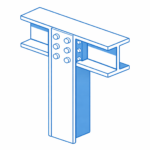
Structural steel I-beam bolted connection with column in isometric view.

Hamilton By Design provides structural engineering support for industrial facilities, mining operations, and heavy infrastructure across Australia. We work in complex, high-risk environments where accuracy matters โ€” brownfield sites, operating plants, shutdown windows, and projects that must be buildable the first time.

Our approach combines practical structural engineering with digital capture and modelling workflows to reduce uncertainty, minimise rework, and help projects move from site conditions to fabrication-ready outcomes with confidence.


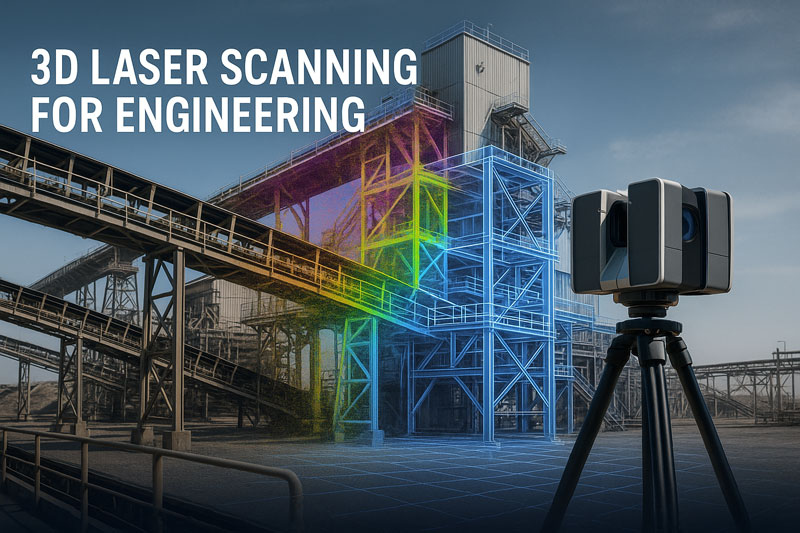
A 3D laser scanner on a tripod capturing an industrial plant structure, with a colourful point cloud and blue CAD wireframe overlay illustrating engineering-grade 3D laser scanning accuracy.

3D LiDAR scanning and 3D modelling service button โ€” laser scanner capturing a point cloud for engineering and CAD modelling
Mechanical engineering services

Structural Engineering Services

We support asset owners, EPCs, maintenance teams, and fabricators with structural engineering services including:

  • Structural design and upgrade packages for plant modifications, support steelwork, access platforms, and equipment foundations
  • Structural assessments and verification for existing assets, including fit-for-purpose checks and load capacity reviews
  • Brownfield integration and retrofit design, accounting for existing geometry, constraints, and constructability
  • Connection detailing and design intent, supporting practical fabrication and installation sequencing
  • Compliance-aligned engineering documentation, suitable for procurement, fabrication, and site installation
  • Engineering support for shutdowns, upgrades, and maintenance-driven scope where time and accuracy are critical

If you need broader capability beyond structural work, view our full service offering here:
https://www.hamiltonbydesign.com.au/engineering-services/


Where Structural Engineers Add Value in Industrial Sites

Industrial and mining environments create structural challenges that differ from greenfield construction. Common drivers include:

  • Uncertain existing conditions (missing drawings, undocumented changes, deformation over time)
  • High operational loads, vibration exposure, and fatigue risk
  • Space constraints and access limitations in operating plants
  • Safety and compliance obligations for access systems, platforms, and guarding interfaces
  • Tight installation windows during shutdowns โ€” where rework is not an option

Hamilton By Design supports these conditions with structural design methods that are grounded in constructability and site realities, not just theoretical models.


Scan-to-Engineering Workflows for Structural Accuracy

Structural engineering outcomes improve dramatically when design is based on accurate existing conditions. Where appropriate, we integrate engineering-grade 3D scanning and modelling so that structural solutions fit first time.

This workflow supports:

  • Accurate member locations and interface checks
  • Clearance verification for equipment and access structures
  • Retrofit designs that align with existing steelwork and foundations
  • Reduced site clashes and fewer fabrication changes

Learn more about our scanning capability here:
https://www.hamiltonbydesign.com.au/home/3d-lidar-scanning-digital-quality-assurance/3d-laser-scanning/


Drafting and Fabrication-Ready Documentation

Structural work only delivers value when it can be fabricated and installed cleanly. Hamilton By Design produces documentation that supports workshop and site teams, including:

  • GA drawings and layout plans
  • Fabrication drawings and installation details
  • BOM support (where required)
  • As-built updates based on verified site data

Explore drafting support here:
https://www.hamiltonbydesign.com.au/engineering-services/services-drafting-lidar-scanning/


Structural Analysis and Verification

For projects involving modification, unusual loads, vibration concerns, or uncertainty around existing asset performance, we can support analysis and verification pathways to reduce risk and improve decision-making.

Our capability includes engineering checks that align with mechanical and structural project needs. If analysis is part of your scope, you can also review our assessment services here:
https://www.hamiltonbydesign.com.au/finite-element-analysis-fea-mechanical-assessment/


Typical Structural Engineering Applications

Hamilton By Design frequently supports structural engineering across:

  • Mining and process plants (CHPPs, conveyors, transfer stations, access systems)
  • Industrial facilities and workshops (equipment supports, platforms, structural modifications)
  • Brownfield upgrades where new equipment must integrate with existing structures
  • Safety improvements such as walkways, stairs, handrails, guarding supports, and maintenance access
  • Foundation and support modifications for mechanical equipment upgrades and plant change-outs

For mining-specific engineering support, see:
https://www.hamiltonbydesign.com.au/mechanical-engineering-mining-industry-australia/


Why Work With Hamilton By Design

Clients engage Hamilton By Design when they need structural engineering that is:

  • Practical and buildable โ€” designed for fabrication and installation reality
  • Accurate โ€” supported by digital site capture where needed
  • Integrated โ€” structural work aligned with mechanical interfaces and plant constraints
  • Responsive โ€” suited to shutdown-driven and time-critical scopes
  • Single-source accountable โ€” engineering, modelling, and drafting in one workflow

See examples of outcomes delivered across real projects here:
https://www.hamiltonbydesign.com.au/case-studies-hamilton-by-design/


Talk to a Structural Engineer

If you are planning a plant upgrade, safety improvement, retrofit, or structural assessment, Hamilton By Design can support your project from site conditions through to fabrication-ready documentation.

Visit our Engineering Services hub to get started:
https://www.hamiltonbydesign.com.au/engineering-services/

Hamilton By Design logo displayed on a blue tilted rectangle with a grey gradient background

Our clients:

Name
Would you like us to arrange a phone consultation for you?
Address

3D Scanning Sydney banner promoting engineering-grade 3D laser scanning, LiDAR scanning, and reality capture services by Hamilton By Design.
Mechanical Engineering Sydney banner with white text on a blue background representing Hamilton By Design's mechanical engineering services in Sydney.
Mechanical Drafting and 3D Modelling Sydney banner highlighting Hamilton By Design's CAD drafting, 3D modelling, and engineering design services in Sydney.

Mechanical Engineering | Structural Engineering


Mount Isa

Engineering & 3D Laser Scanning Services in Mount Isa

Supporting Hard-Rock Mining, Processing Plants & Regional Industry

Mount Isa is one of Australiaโ€™s most iconic mining regions โ€” a landscape defined by heavy industry, world-class mineral resources, and complex mechanical infrastructure. Hamilton By Design partners with mining and engineering companies across Mount Isa to deliver accurate, reliable and fabrication-ready engineering solutions.

Whether youโ€™re upgrading a conveyor, replacing worn chutes, capturing as-built data before shutdown, or solving long-term operational bottlenecks, our team brings precise engineering and modern digital tools to every project.


3D LiDAR scanning and 3D modelling service button โ€” laser scanner capturing a point cloud for engineering and CAD modelling
Mechanical engineering services

Our Services

3D Laser Scanning (LiDAR)

Accurate as-built information is critical in brownfield mining environments.
Hamilton By Design provides fast, high-accuracy 3D LiDAR scanning using FARO Focus technology:

  • As-built capture for existing plant and machinery
  • Pre-shutdown measurement and digital QA
  • Point-cloud generation for design, compliance, and verification
  • Clash detection for new installations
  • Scan-to-CAD models for fabrication and engineering planning

High-resolution data reduces rework, improves safety, and makes it easier to plan complex upgrades.


Mechanical Engineering

We support maintenance teams, shutdown crews, and capital works projects through:

  • Chute optimisation and redesign
  • Conveyor modifications and transfer-tower upgrades
  • Pump and slurry-handling systems
  • Mechanical assemblies and machine components
  • Fluid transfer and pipe-routing development

Our engineering approach focuses on reliability, maintainability, and long-term productivity.


Structural Engineering

Mining operations demand robust structures that handle harsh loads and constant vibration. Our structural services include:

  • Platforms, stairs and walkways
  • Structural supports and frames
  • Access systems for safe maintenance
  • Compliance upgrades and design verification
  • Brownfield integration into existing plant layouts

Every structure is modelled in 3D to confirm safety, fit, and practical access.


3D CAD Modelling & Fabrication Drawings

We create accurate, fabrication-ready SolidWorks models and drawings for:

  • Chutes, diverters and hoppers
  • Conveyor frames, guards, and transfer points
  • Pipe spools, manifolds, and pump skids
  • Structural layouts, GA drawings and BOM creation

Our deliverables are built for real-world construction โ€” clear, accurate and ready for fabrication.


FEA / Simulation

Before anything is manufactured or installed, we validate performance using:

  • Stress analysis
  • Fatigue checks
  • Weld and joint assessment
  • Validation of new or modified components under real loading conditions

FEA minimises risk, extends equipment life, and supports compliance with engineering standards.


Plant Upgrades & Retrofits

Mount Isaโ€™s mining facilities operate continuously โ€” our role is to help you improve reliability and throughput with minimal disruption:

  • Brownfield redesign and integration
  • Fit-for-purpose component replacement
  • Productivity improvements
  • Shutdown planning and digital measurement
  • Design for maintainability and safety

From small modifications to large-scale infrastructure upgrades, we help mines operate with greater confidence.


Why Mining Companies in Mount Isa Choose Hamilton By Design

  • Local knowledge of mining operations across the North West Minerals Province
  • Fast turnaround for scans, drawings and engineering models
  • Accurate digital data reducing onsite rework and re-measurement
  • Fabrication-ready deliverables trusted by boilermakers, fitters, contractors and OEMs
  • Practical engineering from people who understand heavy industry

We combine digital engineering with hands-on mining experience โ€” giving you a partner who understands the environment, the pressures, and the operational realities of Mount Isa.

Hamilton By Design logo displayed on a blue tilted rectangle with a grey gradient background
3D LiDAR scanning and 3D modelling service button โ€” laser scanner capturing a point cloud for engineering and CAD modelling
Mechanical engineering services

3D Laser Scanning in Mount Isa

Our clients:

3D CAD Modelling Australia service banner for Hamilton By Design
Australian Drafting logo featuring bold white text reading "Australian Drafting" centred on a blue rounded rectangle background.
Engineering Governance title graphic featuring bold white text reading "Engineering Governance" centred on a blue rounded rectangle background.
Mechanical, Structural & Pipework Drafting service banner by Hamilton By Design featuring white text on a blue background.
Mechanical engineering services
Blue rounded button with the text โ€œSolidWorks Designโ€ in white.
Finite Element Analysis (FEA) engineering simulation button
3D LiDAR Scanning Darwin for engineering surveys, laser scanning, reality capture and point cloud modelling services
3D LiDAR Scanning Australia engineering services for laser scanning, reality capture, scan-to-CAD, Scan-to-BIM and as-built documentation across Australia
3D LiDAR scanning services on the Central Coast providing engineering-grade laser scanning, point cloud capture, scan-to-CAD modelling and industrial reality capture for infrastructure and industrial projects.
3D LiDAR Scanning Perth for engineering surveys, laser scanning, reality capture and point cloud modelling services
3D LiDAR Scanning Sydney for engineering surveys, laser scanning, reality capture and point cloud modelling services
3D LiDAR Scanning Brisbane for engineering surveys, laser scanning, reality capture and point cloud modelling services
3D LiDAR Scanning Canberra for engineering surveys, laser scanning, reality capture and point cloud modelling services
3D LiDAR Scanning Newcastle for engineering surveys, laser scanning, reality capture and point cloud modelling services
3D LiDAR Scanning Adelaide for engineering surveys, laser scanning, reality capture and point cloud modelling services

Newcastle & The Hunter Valley

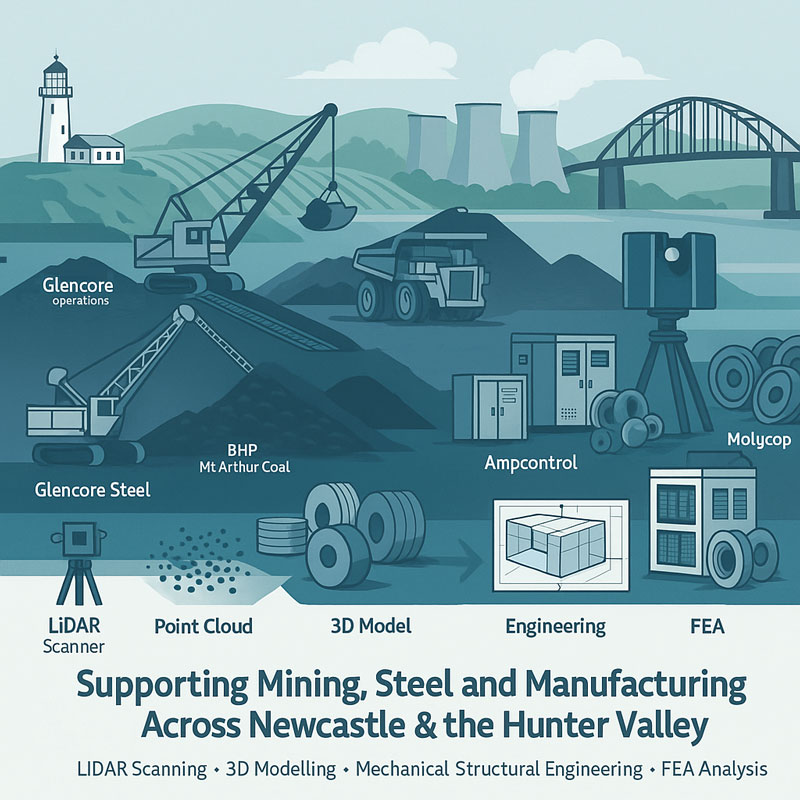
Illustrated scene showing major industrial landmarks across Newcastle and the Hunter Valley, including coal mining equipment, dump trucks, conveyors, steel coils, a LiDAR scanner, point-cloud and 3D model graphics, and labels for Glencore operations, BHP Mt Arthur Coal, Glencore Steel, Ampcontrol and Molycop. The banner text reads โ€˜Supporting Mining, Steel and Manufacturing Across Newcastle & the Hunter Valley โ€“ LIDAR Scanning, 3D Modelling, Mechanical Structural Engineering, FEA Analysis www.hamiltonbydesign.com.au

Precision Engineering for Mining, Steel, Manufacturing & Infrastructure

Blue Gear and Spanner icon

Hamilton By Design supports industry across Newcastle and the Hunter Valley with high-accuracy 3D laser scanning, mechanical and structural engineering, SolidWorks modelling, and fabrication-ready deliverables.
From CHPP plants to heavy manufacturing, we help your team deliver projects that fit first time, every time.

Whether you operate a coal handling facility, a steel mill, a power station, a manufacturing line, or a fabrication workshop, our digital workflows remove rework, reduce shutdown risk, and keep projects moving.


Why the Region Relies on Hamilton By Design

The Newcastleโ€“Hunter corridor is one of Australiaโ€™s most engineering-intensive regions, home to:

  • Glencore coal operations
  • BHP Mt Arthur Coal
  • BlueScope Steel
  • Ampcontrol Tomago
  • Molycop Waratah
  • PWCS Kooragang & Carrington
  • Bayswater & Liddell Power Stations
  • A large network of fabrication and machining workshops

These assets require measurement certainty, digital QA, and accurate engineering models to execute upgrades, fabricate replacements, or plan shutdowns.
Thatโ€™s where Hamilton By Design delivers value.


Our Core Services

โœ” 3D LiDAR Laser Scanning

High-accuracy FARO scanning for:

  • CHPP modules, conveyors, chutes, structural frames
  • Reclaimers, crushers, ROM bins, stockpile conveyors
  • Manufacturing plants and production lines
  • Steel structures and walkways
  • Pipe spools and pump skids
  • Power station equipment, ducting, and access systems

We capture the built environment with sub-millimetre precision.


โœ” Point Cloud Processing & Digital Twins

Your scanned environment is processed into clean, accessible formats for decisions and design:

  • Colourised point clouds
  • Autodesk, Navisworks, & SolidWorks compatible
  • De-cluttering, segmentation, and alignment
  • As-built digital twins

This forms the foundation of our engineering accuracy.


โœ” SolidWorks 3D Modelling & Detail Drafting

We transform your scan data into:

  • Fabrication-ready 3D models
  • Sheet metal components
  • Structural frames
  • Pipe spools
  • Chute geometry
  • Reverse-engineered machinery

All models are delivered with clear origin, mass properties, and assembly logic built in.


โœ” Mechanical & Structural Engineering

Our engineering capability supports:

  • Conveyor upgrades
  • Diverter chutes
  • Structural strengthening
  • Access systems
  • Vibrating equipment assessments
  • Pumping and fluid transfer systems
  • Walkways, stairs, platforms

We design with purpose and detailโ€”fit-for-service and fabrication-ready.


โœ” FEA, Simulation & Digital QA

We validate the performance of your designs:

  • Static stress analysis
  • Weld assessments
  • Fatigue checks
  • Lifting and handling design
  • Load cases for mining applications

Every analysis is supported by documented reports.


3D LiDAR Scanning Hunter & Newcastle banner with white text on a blue background promoting engineering-grade laser scanning services for industrial, mining and infrastructure projects across the Hunter Valley and Newcastle region.
Mechanical Engineering Hunter & Newcastle banner promoting mechanical engineering services for mining, industrial plants, power generation, manufacturing and heavy industry throughout the Hunter Valley and Newcastle region.
Structural Drafting Hunter & Newcastle banner promoting structural drafting services for mining, industrial plants, power generation, manufacturing and infrastructure projects across the Hunter Valley and Newcastle region.

Industries We Service

Mining & CHPP

Glencore โ€ข BHP โ€ข Yancoal โ€ข Bengalla
Conveyors, chutes, spools, access, structural remediation.

Steel & Manufacturing

BlueScope โ€ข Molycop โ€ข Bradken โ€ข Civmec
Heavy fabrication, machinery, production line bottleneck removal.

Power & Energy

AGL Bayswater โ€ข Liddell
Ducting, steelworks, access upgrades, maintenance planning.

Infrastructure & Port Operations

PWCS โ€ข Kooragang Island โ€ข Carrington
Shiploaders, reclaimers, transfer towers, berthing structures.


Why Clients Choose Hamilton By Design

Accuracy

We eliminate guesswork with precise field measurements.

Reduced Shutdown Risk

Projects assemble as intended, reducing time onsite.

Fabrication Certainty

Your workshop receives models and drawings that simply work.

Responsibility & Reliability

We take responsibility for measurement, engineering, and QA along the entire workflow.


Local Knowledge, Regional Capability

We understand the operational requirements of heavy industry in Newcastle & the Hunter Valley:

  • The constraints of CHPP shutdowns
  • The complexity of steel manufacturing
  • The workflow of fabrication shops
  • The need for accurate, fast engineering responses
  • The importance of minimal downtime

Weโ€™ve delivered successful projects across the entire region, from the coast through to Muswellbrook, Singleton, and the Upper Hunter.

Hamilton By Design logo displayed on a blue tilted rectangle with a grey gradient background
3D LiDAR scanning and 3D modelling service button โ€” laser scanner capturing a point cloud for engineering and CAD modelling
Mechanical engineering services

Ready to Improve Your Next Project?

Contact Hamilton By Design

LiDAR Scanning โ€ข 3D Modelling โ€ข Engineering โ€ข FEA โ€ข Digital QA
Supporting Newcastle & the Hunter Valley with precision and reliability.

Email โ€“ [email protected]

Phone – 0477002249

Name
Address
You would like to:

3D Laser Scanning

Mechanical engineering services
Australian Drafting logo featuring bold white text reading "Australian Drafting" centred on a blue rounded rectangle background.

3D LiDAR Scanning โ€“ Digital Quality Assurance

Coal Chute Design

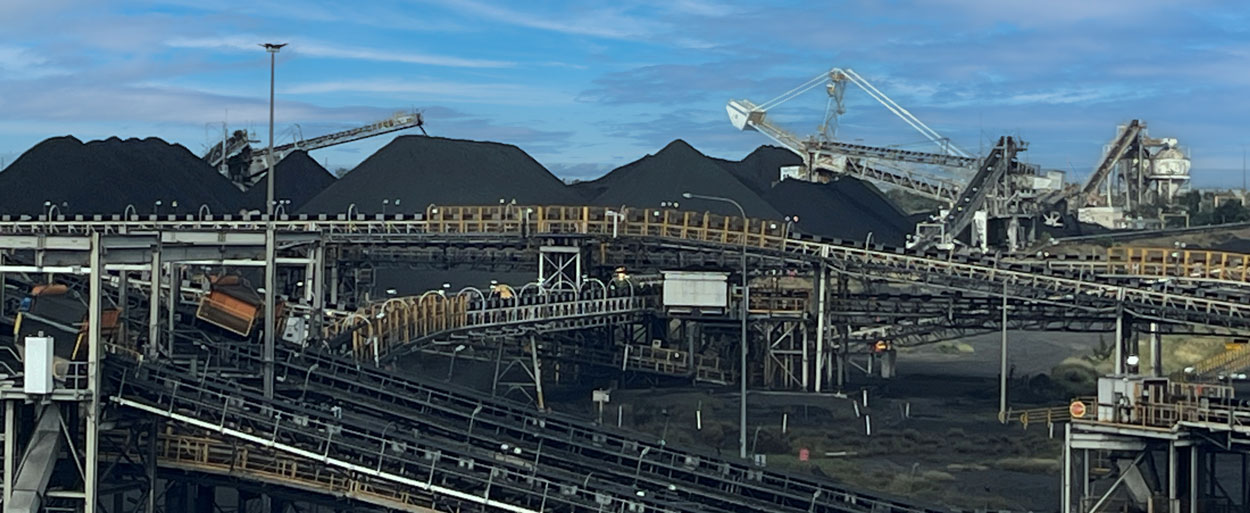
Coal handling and processing facility with multiple conveyors, stockpiles of coal, and stacking-reclaiming machinery operating under a blue sky

A Systems Engineering Approach for Reliable Coal Handling

In coal mining operations, transfer chutes play a deceptively small role with disproportionately large impacts. They sit quietly between conveyors, crushers, and stockpiles, directing tonnes of coal every hour. Yet when a chute is poorly designed or not maintained, the whole coal handling system suffers: blockages stop production, dust creates safety and environmental hazards, and worn liners demand costly maintenance shutdowns.

At Hamilton by Design, we believe coal chute design should be treated not as a piece of steelwork, but as a systems engineering challenge. By applying systems thinking, we connect stakeholder requirements, material behaviour, environmental factors, and lifecycle performance into a holistic design approach that delivers long-term value for mining operations in the Hunter Valley and beyond.


Coal Chutes in the Mining Value Chain

Coal chutes form the links in a chain of bulk material handling equipment:

  • ROM bins and crushers feed coal into the system.
  • Conveyors carry coal across site, often over long distances.
  • Transfer chutes guide coal between conveyors or onto stockpiles.
  • Load-out stations deliver coal to trains or ports for export.

Although they are small compared to conveyors or crushers, coal chutes are often where problems first appear. A well-designed chute keeps coal flowing consistently; a poorly designed one causes buildup, spillage, dust emissions, and accelerated wear. Thatโ€™s why leading operators now see chute design as a critical system integration problem rather than just a fabrication task.

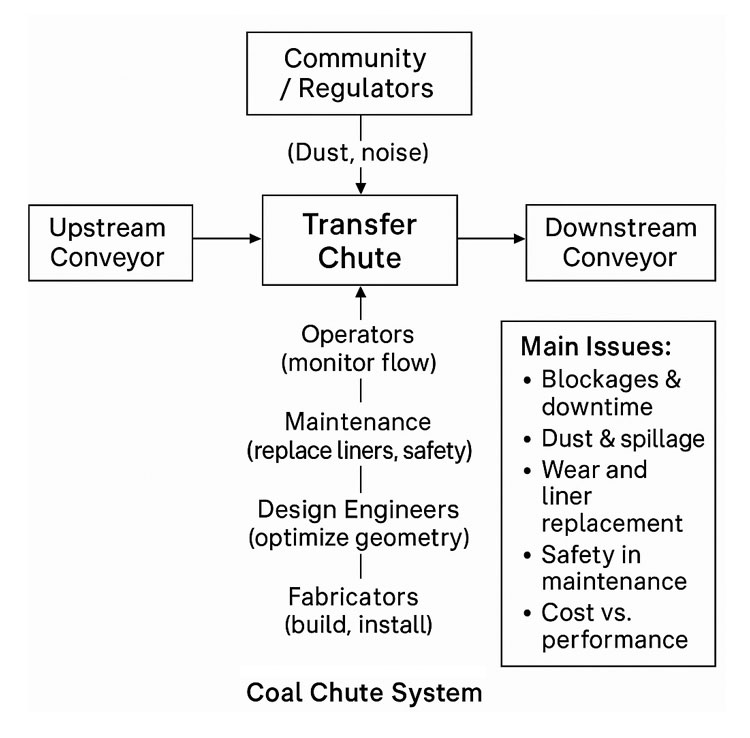
Flow diagram of a coal chute system showing upstream and downstream conveyors, the transfer chute, stakeholder interactions, and main issues such as blockages, dust, wear, maintenance safety, and cost versus performance

Systems Engineering in Coal Chute Design

Systems engineering is the discipline of managing complexity in engineering projects. It recognises that every component is part of a bigger system, with interdependencies and trade-offs. Applying this mindset to coal chute design ensures that each chute is considered not in isolation, but as part of the broader coal handling plant.

1. Requirements Analysis

The first step is gathering and analysing stakeholder and system requirements:

  • Throughput capacity: e.g. handling 4,000 tonnes per hour of coal.
  • Material properties: coal size distribution, moisture content, abrasiveness, stickiness.
  • Safety requirements: compliance with AS/NZS 4024 conveyor safety standards, confined space entry protocols, guarding, and interlocks.
  • Environmental compliance: dust, noise, and spillage limits.
  • Maintenance objectives: target liner life (e.g. 6 months), maximum downtime per liner change (e.g. 30 minutes with two workers).

A structured requirements phase reduces the risk of costly redesign later in the project.


2. System Design and Integration

Once requirements are defined, the design process considers how the chute integrates into the coal handling system:

  • Flow optimisation using DEM: Discrete Element Modelling allows engineers to simulate coal particle behaviour, test different geometries, and reduce blockages before steel is ever cut.
  • Dust control strategies: designing chutes with enclosures, sprays, and extraction ports to minimise airborne dust.
  • Wear management: predicting wear zones, selecting suitable liner materials (ceramic, Bisplate, rubber composites), and ensuring easy access for replacement.
  • Structural and safety design: ensuring the chute can withstand dynamic loads, vibration, and impact, while providing safe access platforms and guarding.
  • Interfaces with conveyors and crushers: alignment, skirt seals, trip circuits, and integration with PLC/SCADA control systems.

By treating the chute as a subsystem with multiple interfaces, designers avoid the โ€œbolt-onโ€ mentality that often leads to operational headaches.


3. Verification and Validation

The systems engineering V-model reminds us that every requirement must be verified and validated:

  • Component verification: weld inspections, liner hardness testing, nozzle spray checks.
  • Subsystem verification: chute section fit-up, guard gap measurements, coating checks.
  • Integration testing: conveyor-chute alignment, PLC spray interlocks, trip circuits.
  • System validation: commissioning with live coal flow, dust monitoring against limits, maintainability time trials for liner change.

By linking requirements directly to tests in a traceability matrix, operators can be confident that the chute is not only built to spec, but proven in operation.


Lifecycle Engineering: Beyond Installation

Good chute design doesnโ€™t stop at commissioning. A lifecycle engineering mindset ensures the chute continues to deliver performance over years of operation.

  • Maintainability: modular liners, captive fasteners, hinged access doors, and clear procedures reduce downtime and improve worker safety.
  • Reliability: DEM-informed designs and wear-resistant materials reduce the frequency of blockages and rebuilds.
  • Sustainability: dust suppression and enclosure strategies reduce environmental impact and support community and regulatory compliance.
  • Continuous improvement: feedback loops from operators and maintenance teams feed into the next design iteration, closing the systems engineering cycle.

A Rich Picture of Coal Chute Complexity

Visualising the coal chute system as a rich picture reveals its complexity:

  • Operators monitoring flow from control rooms.
  • Maintenance crews working in confined spaces, replacing liners.
  • Design engineers using DEM simulations to model coal flow.
  • Fabricators welding heavy plate sections on site.
  • Environmental officers measuring dust levels near transfer points.
  • Regulators and community monitoring compliance.

This web of relationships shows why coal chute design benefits from systems thinking. No single stakeholder sees the whole pictureโ€”but systems engineering does.


Benefits of a Systems Engineering Approach

When coal chute design is guided by systems engineering principles, operators gain:

  • Higher reliability: smoother coal flow with fewer blockages.
  • Lower maintenance costs: liners that last longer and can be swapped quickly.
  • Improved compliance: dust, spillage, and safety issues designed out, not patched later.
  • Lifecycle value: less unplanned downtime and a lower total cost of ownership.

In short, systems engineering transforms coal chutes from weak links into strong connectors in the mining value chain.


Case Study: Hunter Valley Context

In the Hunter Valley, coal mines have long struggled with transfer chute problems. Companies like T.W. Woods, Chute Technology, HIC Services, and TUNRA Bulk Solids have all demonstrated the value of combining local fabrication expertise with advanced design tools. Hamilton by Design builds on this ecosystem by applying structured systems engineering methods, ensuring each chute project balances performance, safety, cost, and sustainability.


Conclusion

Coal chute design might seem like a small detail, but in mining, details matter. When transfer chutes fail, production stops. By applying systems engineering principlesโ€”from requirements analysis and DEM modelling to verification, lifecycle planning, and continuous improvementโ€”we can design coal chutes that are reliable, maintainable, and compliant.

At Hamilton by Design, we believe in tackling these challenges with a systems mindset, delivering solutions that stand up to the realities of coal mining.


Are you struggling with coal chute blockages, dust, or costly downtime in your coal handling system?

Hamilton By Design logo displayed on a blue tilted rectangle with a grey gradient background

Contact Hamilton by Design today and discover how our systems engineering expertise in coal chute design can optimise your mining operations for performance, safety, and sustainability.

Mechanical Engineering | Structural Engineering

Mechanical Drafting | Structural Drafting

3D CAD Modelling | 3D Scanning

Chute Design

SolidWorks Contractors in Australia

Hamilton By Design โ€“ Blog

Our clients:

Name
Would you like us to arrange a phone consultation for you?
Address
Finite Element Analysis (FEA) engineering simulation button
Mechanical engineering services