From Reality to Results: How Hamilton By Design Delivers Engineering Success Through SolidWorks, Laser Scanning, and Intelligent Data Sharing

In complex engineering environments, success is rarely determined by a single calculation or drawing. It is determined by clarityโ€”clarity of information, clarity of intent, and clarity across every handover point between site, engineer, fabricator, and installer.

Hamilton By Design was created around this idea.

Across mining, heavy industry, infrastructure, and complex buildings, projects increasingly fail not because engineers lack capability, but because teams are working from incomplete, inconsistent, or unreliable information. Assumptions creep in. Measurements are approximated. Old drawings are trusted when they should not be. By the time fabrication or installation begins, risk has already been locked into the project.

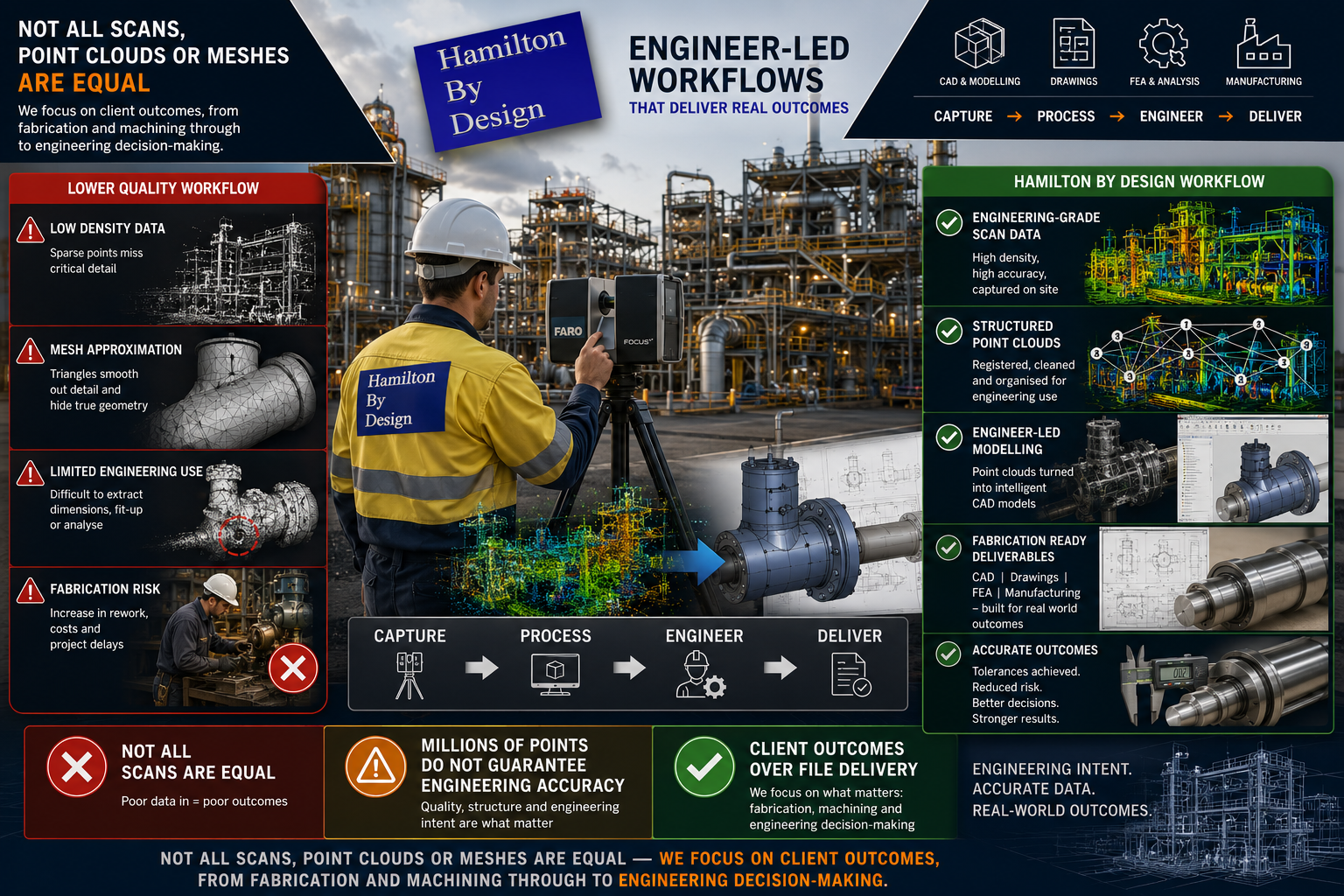
Hamilton By Design approaches engineering differently. By combining engineer-led 3D laser scanning, SolidWorks-based mechanical design, and clear, practical data sharing, we reduce uncertainty at the very start of a projectโ€”and that single shift changes everything that follows.


Engineering begins with reality, not assumptions

Every project starts with an existing environment. Whether it is a CHPP in the Bowen Basin, a brownfield processing plant, a congested industrial building, or a live infrastructure asset, the reality on site is often more complex than any drawing suggests.

Hamilton By Design begins with capturing reality as it actually exists.

Using high-accuracy 3D laser scanning, site conditions are recorded in full context: structure, equipment, services, clearances, and access constraints. This is not about producing pretty visualsโ€”it is about creating a measurable, defensible digital reference that engineers can trust.

Unlike traditional measurement methods, laser scanning:

  • Captures millions of data points per second
  • Records geometry that is difficult or unsafe to measure manually
  • Preserves site information long after access windows close
  • Eliminates reliance on assumptions and partial measurements

For engineering teams, this changes the starting point of the project from โ€œwhat we think is thereโ€ to โ€œwhat we know is there.โ€


Why the FARO Focus S70 fits Hamilton By Designโ€™s workflow

4

Hamilton By Design uses the FARO Focus S70 laser scanner because it strikes the right balance between accuracy, portability, and ease of useโ€”qualities that matter in live industrial environments.

The Focus S70 is particularly well suited to:

  • Brownfield industrial sites
  • Mining and materials-handling plants
  • Buildings with tight access or active operations
  • Remote locations where speed and reliability matter

From a practical engineering perspective, its ease of deployment is critical. Scans can be completed quickly, often without disrupting operations, and without the need for complex setup or prolonged site occupation. This means:

  • Shorter site visits
  • Reduced exposure to operational risk
  • More flexibility around shutdown or access windows

Just as importantly, the data produced is clean, consistent, and immediately usable within downstream engineering workflows.

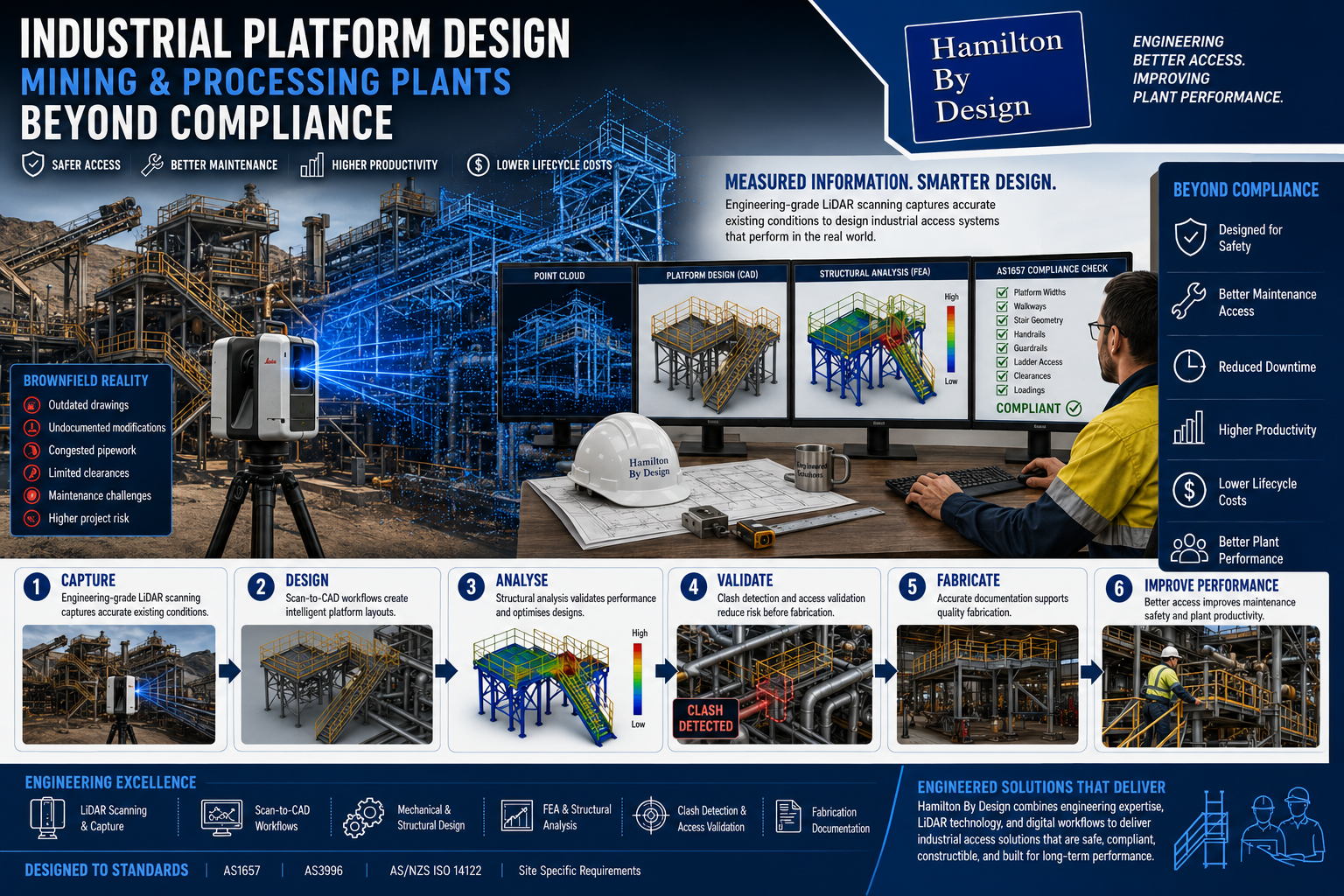
At Hamilton By Design, scanning is not outsourced or treated as a separate discipline. The same engineers who design the solution are involved in planning the scan, understanding what information matters, and verifying that the captured data is fit for purpose.

This engineer-led approach is one of the quiet but critical advantages that underpins project success.


Turning point clouds into engineering intelligence

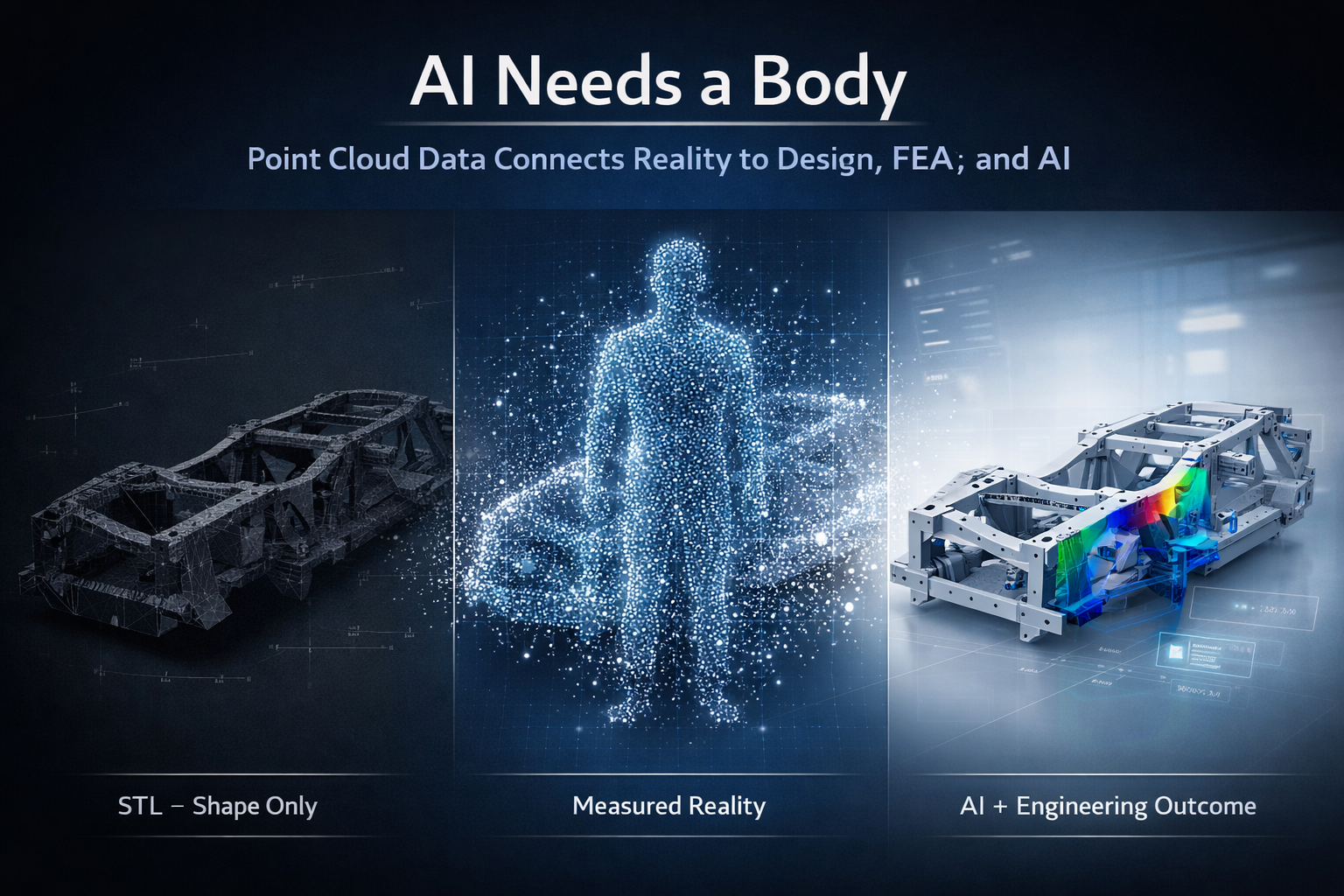
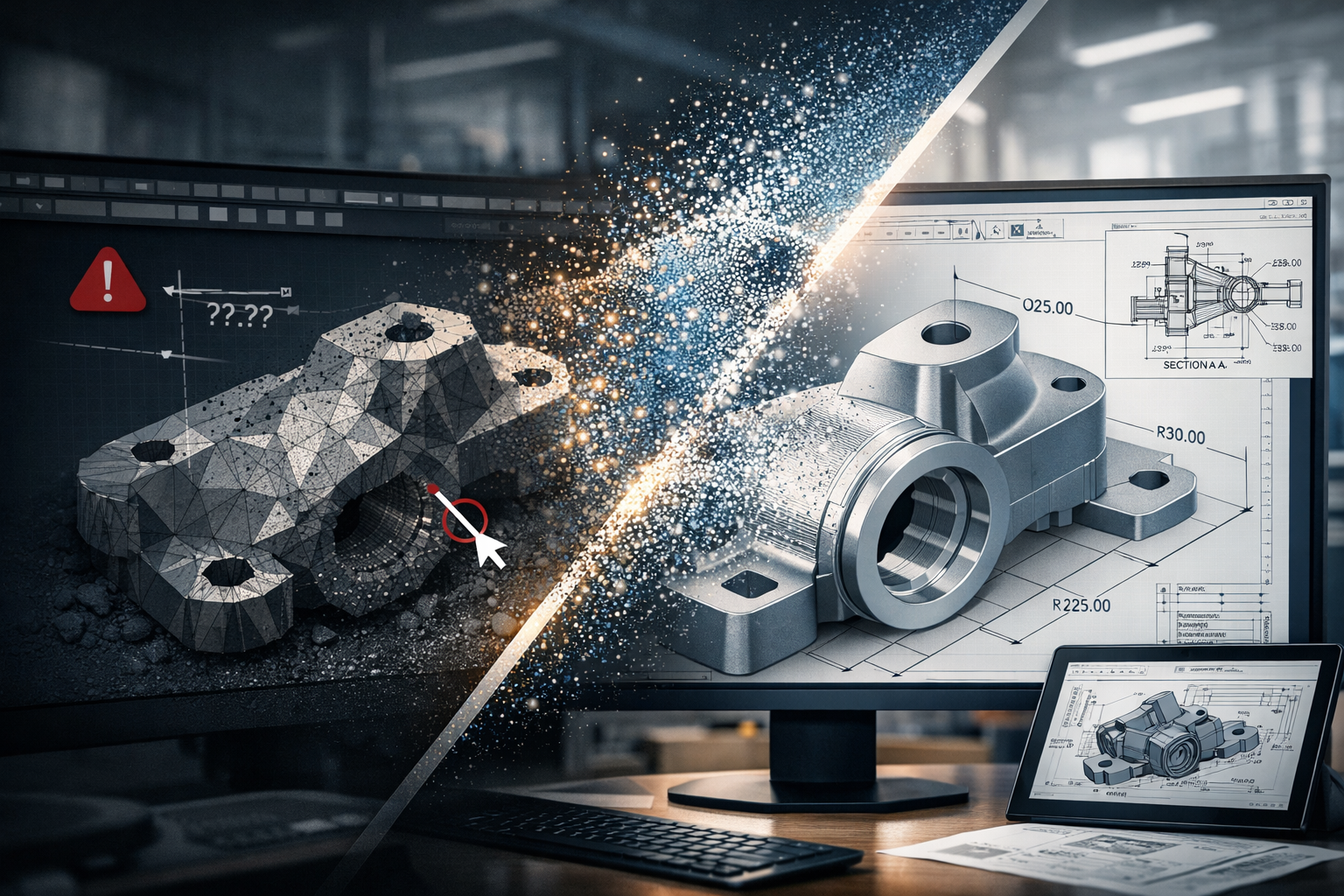
Raw point clouds are powerfulโ€”but only if they are translated into meaningful engineering information.

This is where Hamilton By Designโ€™s use of SolidWorks becomes central to our workflow.

SolidWorks provides a flexible, parametric modelling environment that allows scanned data to be transformed into:

  • Accurate 3D mechanical models
  • Structural steel frameworks
  • Equipment layouts
  • Platforms, guards, chutes, and pipework
  • Assemblies designed specifically for fabrication and installation

By importing and referencing point clouds directly within SolidWorks, engineers are no longer designing in isolation. Every model is built in context, anchored to the real geometry of the site.

This approach delivers several key advantages:

  • Components fit the first time
  • Clearances are verified early
  • Interfaces with existing assets are fully understood
  • Installation sequencing can be considered during design

Rather than working around uncertainty, engineers are free to focus on optimisation, constructability, and safety.


SolidWorks as a collaboration platform, not just a design tool

One of the most underestimated strengths of SolidWorks is how well it supports collaboration and communication across project teams.

At Hamilton By Design, SolidWorks models are not treated as internal artefacts. They are shared, reviewed, and used as communication tools.

Through native files, neutral formats, and lightweight viewing options:

  • Fabricators can interrogate geometry before cutting steel
  • Site teams can visualise assemblies before installation
  • Clients can understand scope and interfaces without reading complex drawings
  • Engineers can identify risks long before they appear on site

This transparency dramatically reduces misinterpretation. When everyone is looking at the same modelโ€”derived from the same scanโ€”alignment improves naturally.

The result is fewer RFIs, fewer site surprises, and a smoother transition from design to construction.


Fabrication-ready outcomes, not theoretical models

Hamilton By Design places a strong emphasis on fabrication-ready deliverables.

Because models are developed with manufacturing in mind, downstream drawings are clearer, more consistent, and easier to build from. This includes:

  • Clear general arrangement drawings
  • Detailed part and assembly drawings
  • Logical BOMs aligned to procurement
  • Realistic tolerances based on site conditions

Fabricators appreciate drawings that reflect how things are actually builtโ€”not just how they look on screen. By grounding design in scan data and modelling within SolidWorks, Hamilton By Design produces outputs that align closely with workshop reality.

This reduces rework in the shop and stress during shutdowns, where time pressure is highest.


Technology alone does not deliver project success. The real differentiator is how information is shared.

Hamilton By Design places significant emphasis on making data:

  • Accessible
  • Understandable
  • Reusable

Point clouds, models, drawings, and supporting data are structured so they can be:

  • Revisited for future projects
  • Used by different stakeholders
  • Built upon rather than recreated

This is particularly valuable in long-life industrial assets, where todayโ€™s modification becomes tomorrowโ€™s interface.

By maintaining continuity of data across projects, clients build a digital assetโ€”not just a set of drawings. Over time, this reduces engineering cost, shortens project timelines, and increases confidence in future upgrades.


Ease of use drives adoption and value

One of the reasons the FARO Focus S70 and SolidWorks work so well together is their ease of use relative to the value they deliver.

Ease of use matters because:

  • It shortens learning curves
  • It reduces reliance on niche specialists
  • It allows engineers to stay focused on engineering, not software complexity

At Hamilton By Design, tools are selected not because they are fashionable, but because they support repeatable, reliable outcomes.

Scanning workflows are streamlined. Modelling practices are consistent. File structures are logical. This discipline ensures that projects scale smoothly, whether they involve a small retrofit or a major plant upgrade.


Reducing risk where it matters most

In industrial and mining projects, risk concentrates at interfaces:

  • New steel to old steel
  • New equipment to existing plant
  • Design intent to site execution

Hamilton By Designโ€™s integrated workflow reduces risk at these interfaces by ensuring:

  • Geometry is verified early
  • Interfaces are modelled, not guessed
  • Decisions are made with full context

This approach shifts risk out of the shutdown window and into the design phaseโ€”where it is cheaper and safer to manage.


A philosophy built around accountability

What truly differentiates Hamilton By Design is not just technology, but ownership.

The same team is responsible for:

  • Capturing site data
  • Interpreting it
  • Designing the solution
  • Producing fabrication-ready outputs

There is no fragmentation between disciplines, no handover gaps where responsibility becomes unclear. This single-source accountability builds trust with clients, fabricators, and site teams alike.


The compound effect of doing it right

When accurate data, SolidWorks-based design, and clear information sharing come together, the benefits compound:

  • Fewer site visits
  • Shorter design cycles
  • More confident fabrication
  • Smoother installations
  • Better long-term asset knowledge

Over time, this approach changes how projects are delivered. Engineering becomes proactive rather than reactive. Problems are solved digitally instead of on site. Teams collaborate instead of firefighting.


Engineering for real-world success

Hamilton By Designโ€™s workflow is not built around theory. It is built around what actually happens on site.

By grounding every project in reality through laser scanning, translating that reality into SolidWorks models, and sharing information clearly across all stakeholders, Hamilton By Design helps projects succeed where it matters most: in fabrication shops, during shutdowns, and on live sites.

In an industry where uncertainty is expensive and time is unforgiving, clarity becomes the most valuable engineering output of all.

That is the philosophy behind Hamilton By Designโ€”and the reason our approach continues to deliver consistent, practical success across complex engineering projects.

Hamilton By Design logo displayed on a blue tilted rectangle with a grey gradient background
3D LiDAR scanning and 3D modelling service button โ€” laser scanner capturing a point cloud for engineering and CAD modelling
Mechanical engineering services

Our Clients:

Name
Would you like us to arrange a phone consultation for you?
Address
3D LiDAR scanning and 3D modelling service button โ€” laser scanner capturing a point cloud for engineering and CAD modelling
Mechanical engineering services
Finite Element Analysis (FEA) engineering simulation button
Mechanical engineering services

The Real-World Accuracy of 3D LiDAR Scanning With FARO S150 & S350 Scanners

When people first explore 3D LiDAR scanning, one of the most eye-catching numbers in any product brochure is the advertised accuracy. FAROโ€™s Focus S150 and S350 scanners are often promoted as delivering โ€œยฑ1 mm accuracy,โ€ which sounds definitive and easy to rely on for engineering, mining and fabrication work. But anyone who has spent time working with 3D LiDAR scanning in real industrial environments understands that accuracy isnโ€™t a single number โ€” it is a system of interrelated factors.

This article explains what the ยฑ1 mm specification from FARO really means, how accuracy shifts with distance, and what engineers, project managers and clients need to do to achieve dependable results when applying 3D LiDAR scanning on live sites.

3D LiDAR scanning and 3D modelling service button โ€” laser scanner capturing a point cloud for engineering and CAD modelling
Mechanical engineering services

Infographic explaining 3D LiDAR scanning accuracy, showing a scanner capturing a building and highlighting factors that affect accuracy such as temperature, atmospheric noise, surface reflectivity and tripod stability. Includes diagrams comparing realistic versus unrealistic ยฑ1 mm accuracy, the impact of distance, environment and registration quality, and notes that large open sites typically achieve ยฑ3โ€“6 mm global accuracy.

1. What FAROโ€™s โ€œยฑ1 mm Accuracyโ€ Really Means in 3D LiDAR Scanning

The ยฑ1 mm number applies only to the internal distance measurement unit inside the scanner. It reflects how accurately the laser measures a single distance in controlled conditions.

It does not guarantee:

  • ยฑ1 mm for every point in a full plant model
  • ยฑ1 mm for every dimension extracted for engineering
  • ยฑ1 mm global accuracy across large multi-scan datasets

In 3D LiDAR scanning, ranging accuracy is just one ingredient. Real-world accuracy is shaped by distance, reflectivity, scan geometry and how multiple scans are registered together.


2. How Accuracy Changes With Distance in Real Projects

Even though the S150 and S350 list the same ranging accuracy, their 3D LiDAR scanning performance changes as distance increases. This is due to beam divergence, angular error, environment and surface reflectivity.

Typical real-world behaviour:

  • 0โ€“10 m: extremely precise, often sub-millimetre
  • 10โ€“25 m: excellent for engineering work, only slight noise increase
  • 25โ€“50 m: more noticeable noise and increasing angular error
  • 50โ€“100 m: atmospheric distortion and reduced overlap become evident
  • Near maximum range: still useful for mapping conveyors, yards and structures, but not suitable for tight fabrication tolerances

This distance-based behaviour is one of the most important truths to understand about 3D LiDAR scanning in field conditions.


3. Ranging Accuracy vs Positional Accuracy vs Global Accuracy

Anyone planning a project involving 3D LiDAR scanning must distinguish between:

Ranging Accuracy

The ยฑ1 mm value โ€” only the distance measurement.

3D Positional Accuracy

The true X/Y/Z location of a point relative to the scanner.

Global Point Cloud Accuracy

How accurate the entire dataset is after registration.

Global accuracy is the number engineers depend on, and it is normally around ยฑ3โ€“6 mm for large industrial sites โ€” completely normal for terrestrial 3D LiDAR scanning.


4. What Real Field Testing Reveals About FARO S-Series Accuracy

Independent practitioners across mining, infrastructure, CHPPs, plants and structural environments report similar results when validating 3D LiDAR scanning against survey control:

  • ยฑ2โ€“3 mm accuracy in compact plant rooms
  • ยฑ5โ€“10 mm across large facilities
  • Greater drift across long, open, feature-poor areas

These outcomes are not equipment faults โ€” they are the natural result of how 3D LiDAR scanning behaves in open, uncontrolled outdoor environments.


5. Why Registration Matters More Than the Scanner Model

Most real-world error in 3D LiDAR scanning comes from registration, not the laser itself.

Cloud-to-Cloud Registration

Good for dense areas, less reliable for long straight conveyors, open yards or tanks.

Target-Based Registration

Essential for high-precision engineering work.
Allows tie-in to survey control and dramatically improves global accuracy.

If your project needs ยฑ2โ€“3 mm globally, target control is mandatory in all 3D LiDAR scanning workflows.


6. Surface Reflectivity and Environmental Effects

Reflectivity dramatically affects measurement quality during 3D LiDAR scanning:

  • Matte steel and concrete return excellent data
  • Rusted surfaces return good data
  • Dark rubber, black plastics and wet surfaces reduce accuracy
  • Stainless steel and glass behave unpredictably

Environmental factors โ€” wind, heat shimmer, dust, rain โ€” also reduce accuracy. Early morning or late afternoon typically produce better 3D LiDAR scanning results on mining and industrial sites.


7. When ยฑ1 mm Is Actually Achievable

True ยฑ1 mm accuracy in 3D LiDAR scanning is realistic when:

  • Working within 10โ€“15 m
  • Surfaces are matte and reflective
  • Registration uses targets
  • Tripod stability is high
  • Conditions are controlled

This makes it suitable for:

  • Pump rooms
  • Valve skids
  • Structural baseplates
  • Reverse engineering
  • Small mechanical upgrades

But achieving ยฑ1 mm across a full plant, CHPP, or yard is outside the capability of any terrestrial 3D LiDAR scanning workflow.


8. S150 vs S350: Which One for Your Accuracy Needs?

S150 โ€“ Engineering-Focused Precision

Ideal for industrial rooms, skids, structural steel and retrofit design work where short-to-mid-range accuracy is essential.

S350 โ€“ Large-Area Coverage

Perfect for conveyors, rail lines, yards, and outdoor infrastructure.
Global accuracy must be survey-controlled for tight tolerances.

Both scanners deliver excellent 3D LiDAR scanning performance, but the S150 is the engineering favourite while the S350 is the large-site specialist.


9. What to Specify in Contracts to Avoid Misunderstandings

Instead of stating:

โ€œScanner accuracy ยฑ1 mm.โ€

Specify:

  • Local accuracy requirement (e.g., ยฑ2 mm at 15 m)
  • Global accuracy requirement (e.g., ยฑ5 mm total dataset)
  • Registration method (mandatory target control)
  • Environmental constraints
  • Verification method (e.g., independent survey checks)

This ensures everyone understands what 3D LiDAR scanning will realistically deliver.


10. When a Terrestrial Scanner Is Not Enough

Do not rely solely on 3D LiDAR scanning for:

  • Machine alignment <1 mm
  • Bearing or gearbox placement
  • Certified dimensional inspection
  • Metrology-level tolerances

In these cases, supplement scanning with:

  • Laser trackers
  • Total stations
  • Metrology arms
  • Hybrid workflows

Conclusion: The Real Truth About 3D LiDAR Scanning Accuracy

FAROโ€™s S150 and S350 are outstanding tools for industrial 3D LiDAR scanning, but the ยฑ1 mm spec does not tell the full story. Real-world accuracy is a combination of:

  • Distance
  • Registration method
  • Surface reflectivity
  • Site conditions
  • Workflow discipline

When used correctly, these scanners consistently deliver high-quality, engineering-grade point clouds suitable for clash detection, retrofit design, fabrication planning and as-built documentation.

3D LiDAR scanning is not just a laser โ€” it is an entire measurement system.
And when the system is applied with care, it produces reliable, repeatable data that reduces rework, improves safety, and strengthens decision-making across mining, construction, fabrication and industrial operations.

Where Is your project

3D Scanning Sydney CBD3D Scanning Brisbane CBD
3D Scanning across Melbourne3D Scanning across Perth
3D Scanning across Adelaide3D Scanning in The Hunter Valley
3D Scanning Mount Isa3D Scanning Emerald
3D Laser Scanning Central Coast3D Scanning in The Pilbara
3d Scanning other Areas of Australia3D Scanning Outside Australia
Hamilton By Design logo displayed on a blue tilted rectangle with a grey gradient background
3D LiDAR scanning and 3D modelling service button โ€” laser scanner capturing a point cloud for engineering and CAD modelling
Mechanical engineering services
Name
Address
You would like to:

3D CAD Modelling | 3D Scanning

3D Experience Platform Login

3D Scanning for Construction

Transforming Projects with 3D Scanning

3D LiDAR Scanning โ€“ Digital Quality Assurance

Itโ€™s Time to Level Up: Why Mechanical Engineering Consultants Are Key to Unlocking the Power of Point Cloud to 3D Modeling

In todayโ€™s competitive manufacturing and fabrication landscape, the difference between success and frustration often comes down to one thing: how well you capture and use data. Traditional methods of measurement, drafting, and design simply canโ€™t keep up with the complexity and pace of modern projects.

Enter point cloud scanning and 3D modeling โ€” a transformative approach that is reshaping how manufacturers, fabricators, and engineers work together. But as powerful as this technology is, getting the most from it takes more than just buying a scanner. It takes expertise, insight, and a partner who can integrate this digital transformation seamlessly into your workflows.

So, is it time to level up and engage mechanical engineering consultants who can make this happen?

We think so โ€” and hereโ€™s why.


From Point Cloud to 3D Model: A Game-Changer

When you scan a physical space, component, or assembly using modern laser scanning or photogrammetry, you capture millions of data points โ€” a digital twin of reality. Converting that data into a precise 3D model opens the door to benefits like:

  • Pinpoint Accuracy: Say goodbye to guesswork and human measurement errors.
  • Faster Iteration: Generate manufacturing and fabrication drawings quickly, test design variations digitally, and accelerate your project timelines.
  • Improved Collaboration: Give engineers, fabricators, and stakeholders a single source of truth that everyone can see and work from.
  • Risk Reduction: Spot interferences, clashes, and potential problems before they become costly rework in the shop or on-site.
  • Future-Proofing: Create a digital foundation for maintenance, upgrades, and retrofits years down the line.

This isnโ€™t just better engineering โ€” itโ€™s smarter business.


3D LiDAR scanning and 3D modelling service button โ€” laser scanner capturing a point cloud for engineering and CAD modelling
Mechanical engineering services

The Missing Piece: Expertise

Technology alone doesnโ€™t guarantee success. A high-resolution point cloud is just data โ€” and without the right people turning that data into insight, it wonโ€™t deliver its full value.

Thatโ€™s where mechanical engineering consultants come in. By partnering with experts who understand both the technology and the application, you gain:

  • Tailored Workflows: A consultant knows how to align the process with your unique needs, whether itโ€™s structural steel, piping systems, or custom machinery.
  • Best-Practice Modeling: Avoid bloated, unusable models or drawings that donโ€™t reflect fabrication realities.
  • Integrated Solutions: Consultants ensure your 3D models, fabrication drawings, and QA processes work seamlessly with your existing systems.
  • Strategic Insight: Move beyond simply โ€œdrawing whatโ€™s thereโ€ to rethinking processes, improving efficiency, and reducing total cost of ownership.

Why Now Is the Perfect Time

Market pressures are increasing. Labor costs are rising. Margins are under strain. Mistakes are expensive โ€” but digital solutions are more accessible than ever.

Your competitors are already exploring Industry 4.0 technologies like point cloud scanning, 3D modeling, and digital twins. The companies that succeed are the ones that move early, learn fast, and embed these practices into their operations.

Bringing in mechanical engineering consultants allows you to leapfrog the painful trial-and-error phase and start reaping the benefits from day one.


Level Up Your Engineering Today

If youโ€™re still relying on outdated measurement methods, 2D drawings, and siloed workflows, now is the time to level up. Scanning, modeling, and digital collaboration arenโ€™t โ€œnice-to-havesโ€ anymore โ€” theyโ€™re the foundation of modern manufacturing and fabrication.

Engage a trusted mechanical engineering consultant who can:

  • Capture your as-built environment accurately
  • Convert point clouds into actionable 3D models
  • Deliver fabrication-ready drawings
  • Help you reduce risk, save time, and improve quality

The future of engineering is here. Donโ€™t just keep up โ€” get ahead.

Consulting Engineers

3D Scanning | Mechanical Engineering | Hamilton By Design

Contact us

3D LiDAR scanning and 3D modelling service button โ€” laser scanner capturing a point cloud for engineering and CAD modelling
Mechanical engineering services
Finite Element Analysis (FEA) engineering simulation button
Mechanical engineering services

3D Laser Scanning and CAD Modelling Services | Hamilton By Design


There are two things weโ€™ve always believed at Hamilton By Design:

  1. Accuracy matters.
  2. If you can model it before you make it, do it.

Thatโ€™s why when the FARO Focus S70 hit the scene in 2017, we were early to the party โ€” not just because it was shiny and new (though it was), but because we knew it would change how we support our clients in mining, processing, and manufacturing environments.
The S70 didnโ€™t just give us a tool โ€” it gave us a superpower: the ability to see an entire site, down to the bolt heads and pipe supports, in full 3D before anyone picked up a wrench. Dust, heat, poor lighting โ€” no problem. With its IP54 rating and extended temperature range, this scanner thrives where other tools tap out.

And weโ€™ve been putting it to work ever since.

3D laser scan of mechanical plant

โ€œMeasure Twice, Cut Onceโ€ Just Got a Whole Lot More Real

Laser scanning means we no longer rely on outdated drawings, forgotten markups, or that sketch someone did on the back of a clipboard in 2004.

Weโ€™re capturing site geometry down to millimetres, mapping full plant rooms, structural steel, conveyors, tanks, ducts โ€” you name it. And the moment we leave site, weโ€™ve already got the data we need, registered and ready to drop into SolidWorks.

Which, by the way, weโ€™ve been using since 2001.

Yes โ€” long before CAD was cool, we were deep into SolidWorks building models, simulating loads, tweaking fit-ups, and designing smarter mechanical solutions for complex environments. Itโ€™s the other half of the story โ€” scan it, then model it, all in-house, all under one roof.

Safety by Design โ€“ Literally

Hereโ€™s the part people often overlook: 3D laser scanning isnโ€™t just about accuracy โ€” itโ€™s about safety.

Weโ€™ve worked across enough plants and mine sites to know that the real hazards are often the things you donโ€™t see in a drawing. Tight access ways. Awkward pipe routing. Obstructions waiting to drop something nasty when a shutdown rolls around.

By scanning and reviewing environments virtually, we can spot those risks early โ€” hazard identification before boots are even on the ground. We help clients:
  • Reduce time-on-site
  • Limit the number of field visits
  • Minimise exposure to high-risk zones
  • Plan safer shutdowns and installations

Thatโ€™s a big win in any plant or processing facility โ€” not just for compliance, but for peace of mind.

SolidWorks 3D Modelling
CAD model from site scan

From Point Cloud to Problem Solved

Since 2017, our scanning and modelling workflows have supported:

  • Brownfield upgrade projects
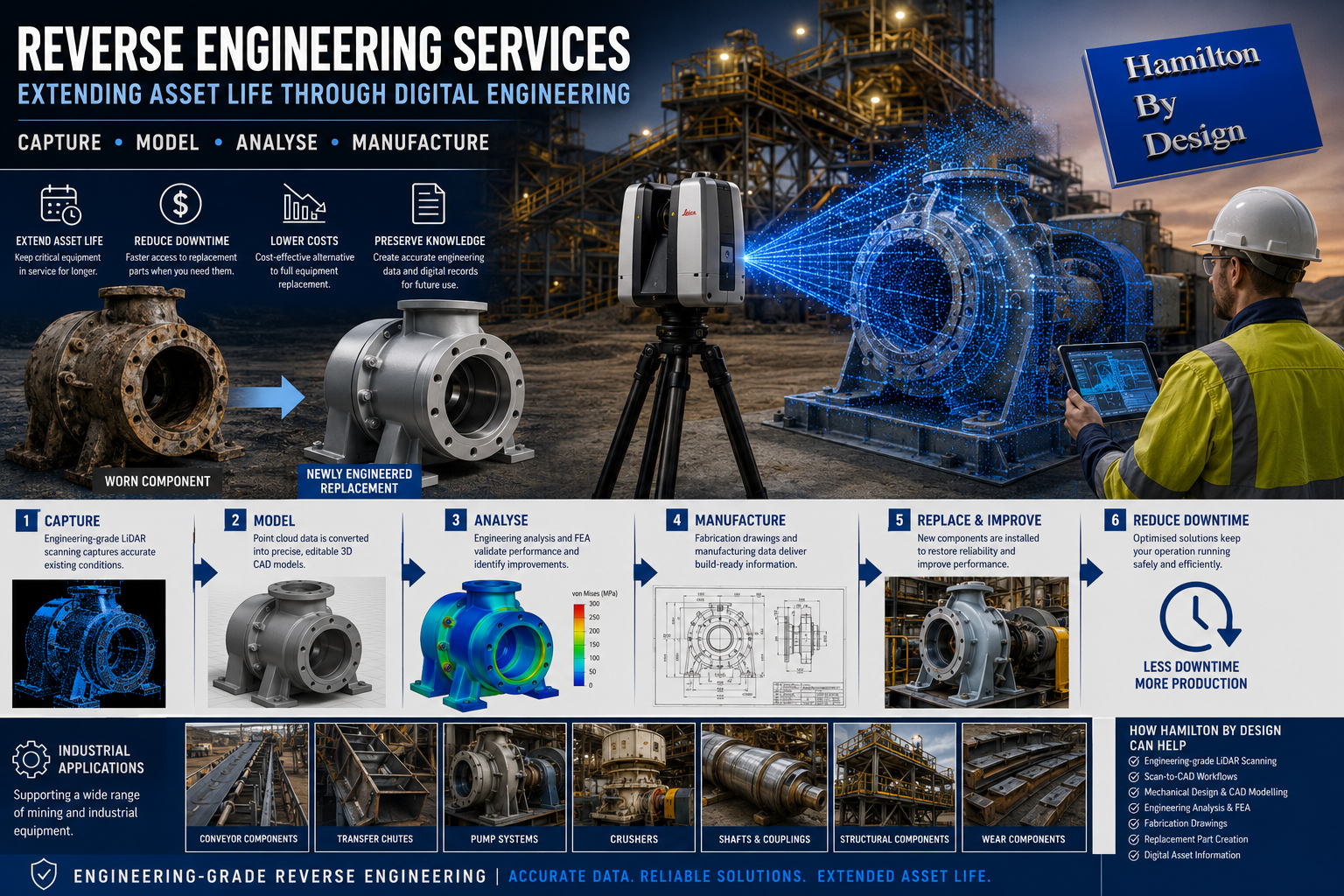
  • Reverse engineering of legacy components
  • Fabrication and installation validation
  • Creation of digital twins
  • Asset audits and documentation updates
And when you pair that with 24 years of SolidWorks expertise, you get more than just a pretty point cloud โ€” you get practical, buildable, fit-for-purpose engineering solutions backed by deep industry knowledge.


Thinking about your next project? Letโ€™s make it smarter from the start.

Weโ€™ll scan it, model it, and engineer it as we have been doing for decades โ€” with zero guesswork and full confidence.

Hamilton By Design logo displayed on a blue tilted rectangle with a grey gradient background

www.hamiltonbydesign.com.au

3D LiDAR scanning and 3D modelling service button โ€” laser scanner capturing a point cloud for engineering and CAD modelling
Mechanical engineering services

Mechanical Engineering | Structural Engineering

Mechanical Drafting | Structural Drafting

3D CAD Modelling | 3D Scanning

Our clients:

Name
Would you like us to arrange a phone consultation for you?
Address