Mechanical Engineering | 3D Scanning | 3D Modelling
Tag: mining-infrastructure
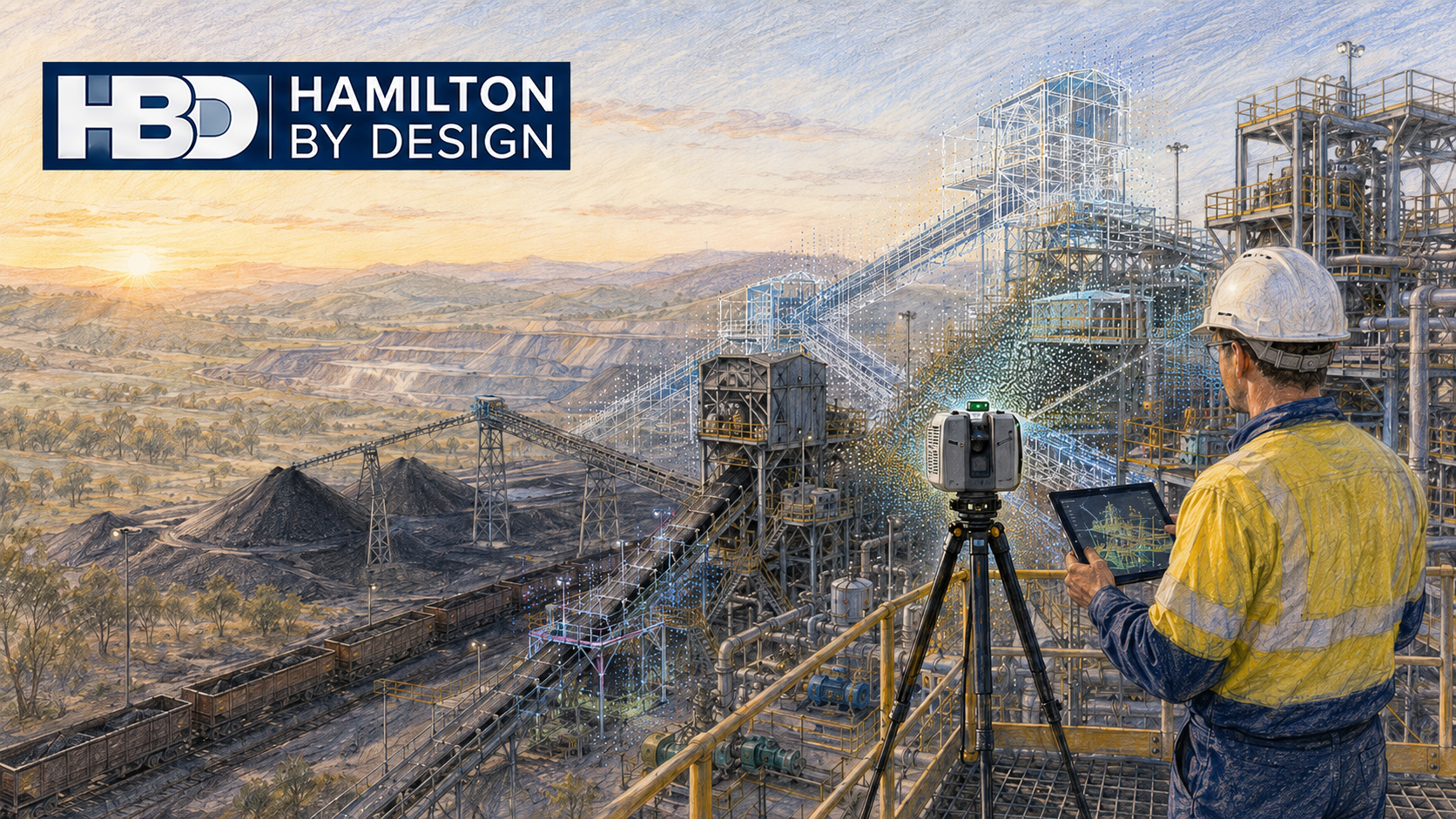
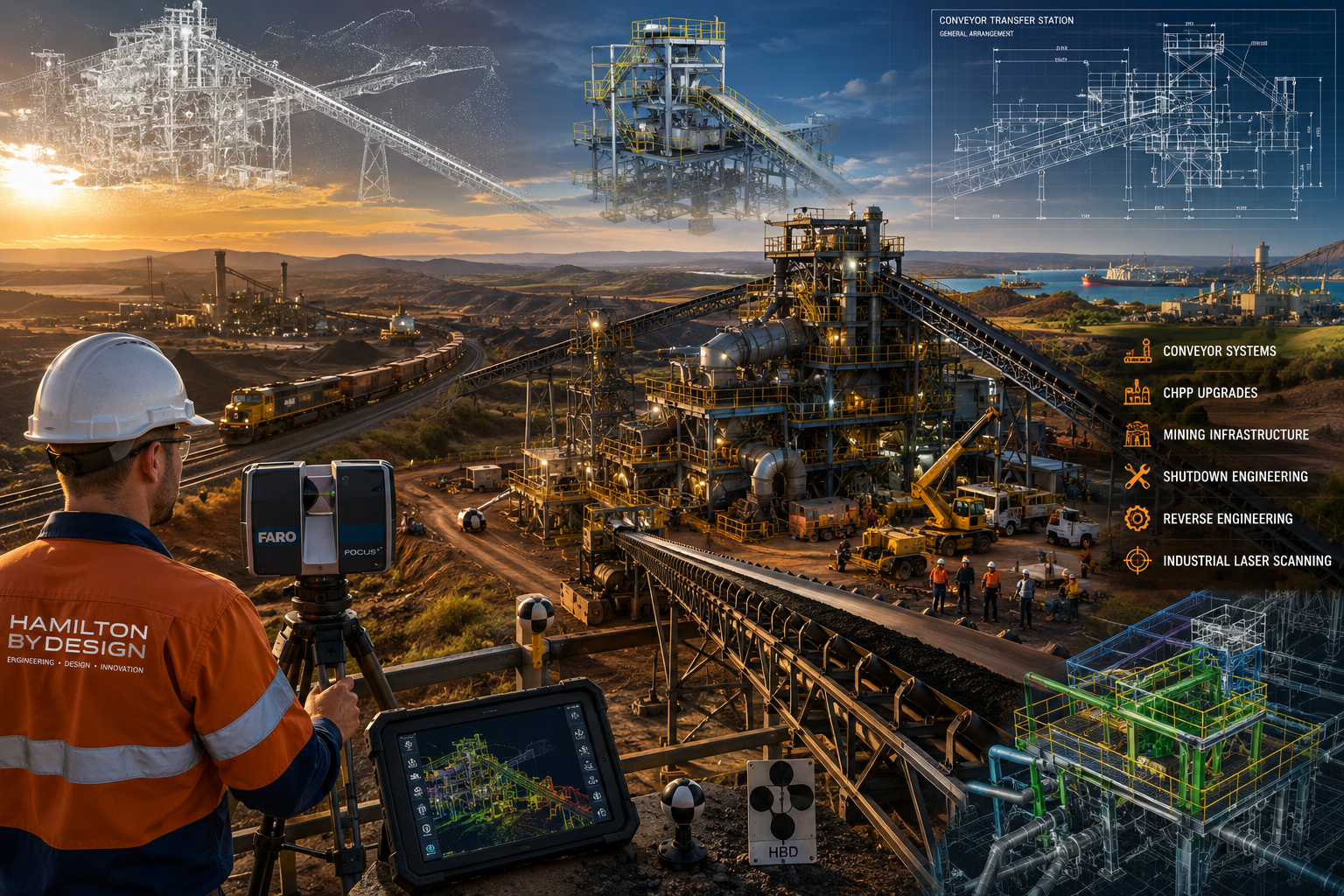
Hamilton By Design provides mechanical engineering, 3D LiDAR scanning and CAD support for mining infrastructure and fixed plant across Australia and the Pacific.
Mining infrastructure can include processing facilities, conveyors, transfer chutes, crushers, screens, pumping stations, pipework, tanks, platforms, walkways and supporting mechanical equipment. Projects often involve remote locations, restricted access, shutdown constraints and complex interfaces with existing plant.
Our services can include:
Existing-condition and as-built scanning
Point-cloud registration
Mechanical design and equipment layouts
Scan-to-CAD modelling
Fixed plant and equipment upgrades
Clash detection and clearance reviews
Shutdown and installation planning
General arrangement drawings
Fabrication and structural drafting
Installation verification
LiDAR scanning can capture existing equipment, steelwork, connection points and surrounding site conditions. The resulting point cloud provides a reliable spatial reference for planning modifications, replacement equipment and brownfield installations.
Proposed designs can be checked against the existing geometry to identify clashes, restricted access and installation constraints before fabrication begins. Deliverables may include E57 or RCP point clouds, SolidWorks models, STEP or Parasolid files, AutoCAD drawings and Navisworks-compatible data.
Hamilton By Design provides mechanical engineering and drafting services. Civil, geotechnical, electrical and structural design or certification must be completed by appropriately qualified professionals where required.
Hunter Valley + Mining + Mechanical Engineering + Conveyor Systems + Industrial Design + 3D Lidar Laser Scanning Services = Hamilton By Design
Supporting Hunter Valley Mining Infrastructure, CHPP Facilities & Materials Handling Systems
The Hunter Valley is one of Australia’s most significant mining and industrial regions. Home to major coal mining operations, Coal Handling and Preparation Plants (CHPP), rail infrastructure, export facilities and bulk materials handling systems, the region continues to support large-scale engineering, maintenance and infrastructure projects.
At Hamilton By Design, we provide engineering-grade 3D laser scanning, reverse engineering, mechanical engineering and drafting services supporting mining infrastructure throughout the Hunter Valley.
Our team understands mining environments because we come from industry. Our experience spans materials handling systems, conveyor infrastructure, CHPP facilities, structural steelwork, shutdown engineering and brownfield plant modifications.
Supporting the Hunter Valley Coal Industry
The Hunter Valley Coal Chain is one of the largest integrated coal export systems in the world, linking mining operations throughout the Hunter Region with rail infrastructure and the Port of Newcastle export terminals.
Mining operations throughout the region rely on extensive infrastructure including:
Conveyor systems
CHPP facilities
Rail loading systems
Bulk materials handling equipment
Transfer stations
Stackers and reclaimers
Structural steel infrastructure
Pumping systems
Water management assets
Hamilton By Design provides engineering support services helping operators, contractors and project teams better understand existing site conditions before design, fabrication and installation activities commence.
Engineering-Grade 3D Laser Scanning
Not all scans are equal.
At Hamilton By Design, we specialise in engineering-grade terrestrial LiDAR scanning designed to support practical engineering outcomes.
Our scanning services support:
Conveyor upgrades
Transfer station modifications
Shutdown planning
Existing condition surveys
Structural steel verification
Pipework modifications
Equipment replacement projects
Brownfield engineering
Asset capture programs
As-built verification
We provide registered point cloud data suitable for:
SolidWorks
Autodesk Revit
AutoCAD
Navisworks
Inventor
Recap
Digital engineering workflows
Accurate site information helps reduce project risk, improve constructability and minimise installation issues during shutdown activities.
Conveyor Systems & Materials Handling Engineering
Conveyor systems form the backbone of Hunter Valley mining operations.
Hamilton By Design supports projects involving:
Overland conveyors
Transfer stations
Conveyor gantries
Belt feeder systems
Chute upgrades
Structural modifications
Maintenance access improvements
Conveyor replacement projects
Working within existing operating facilities often requires accurate existing condition information before fabrication begins.
Our laser scanning and engineering services help ensure designs reflect real-world site conditions.
CHPP Upgrades & Plant Modifications
Coal Handling and Preparation Plants continue to evolve as production requirements change and ageing infrastructure requires replacement or modification.
We support projects involving:
Structural steel modifications
Conveyor upgrades
Pipework systems
Access platform improvements
Transfer chute modifications
Equipment replacement projects
Existing condition verification
Brownfield expansion works
Engineering-grade scanning provides a reliable foundation for design development and project planning.
Shutdown Engineering Support
Mining shutdowns are often where accurate engineering information delivers the greatest value.
Every hour of shutdown downtime can have significant production implications.
Hamilton By Design assists shutdown projects with:
Existing condition capture
Laser scanning surveys
Installation planning
Fabrication verification
Clash detection
Asset documentation
As-built verification
Accurate scan data helps reduce rework, improve fitment outcomes and minimise project risk during shutdown execution.
Reverse Engineering Services
Many mining facilities continue operating equipment where original drawings are incomplete, unavailable or no longer represent the installed asset.
Our reverse engineering services support:
Conveyor components
Chutes and transfer systems
Pump assemblies
Wear liners
Castings
Structural assemblies
Legacy plant equipment
Fabricated mining infrastructure
Using engineering-grade scanning and practical manufacturing experience, we develop models and fabrication drawings suitable for refurbishment, replacement or modification.
Mining Infrastructure Engineering
Mining infrastructure must operate in demanding environments while remaining maintainable and practical to construct.
Hamilton By Design supports projects involving:
Materials handling systems
Conveyor structures
Access platforms
Maintenance walkways
Pipework systems
Structural steel modifications
Brownfield upgrades
Industrial plant infrastructure
Our engineering approach focuses on constructability, maintainability and long-term asset performance.
Why Hamilton By Design?
Hamilton By Design combines practical trade experience with engineering capability.
Our experience includes:
Mechanical engineering
Fitting and machining
Industrial drafting
Mining operations
Materials handling systems
Smelting and processing facilities
Site-based engineering
Industrial maintenance
We understand that successful engineering projects require more than accurate models. They require solutions that can be fabricated, installed and maintained within real operating mining environments.
Servicing the Hunter Valley Mining Region
Hamilton By Design supports projects throughout:
Cessnock
Singleton
Muswellbrook
Mount Thorley
Ravensworth
Warkworth
Branxton
Rutherford
Beresfield
Tomago
Newcastle
Hunter Valley mining operations
Whether you require engineering-grade laser scanning, reverse engineering, conveyor design support or shutdown engineering services, our team is available to assist.
Engineering Support for Hunter Valley Mining Operations
Hamilton By Design provides engineering-grade 3D laser scanning, mechanical engineering, drafting and reverse engineering services supporting Hunter Valley mining infrastructure, CHPP facilities, conveyor systems and materials handling operations.
Contact our team to discuss your next mining project and discover how accurate site data and practical engineering experience can improve project outcomes, reduce shutdown risk and support long-term asset performance.
Yeppoon + Mechanical Engineering +Industrial Laser Scanning + Mining Infrastructure Services = Hamilton By Design
Supporting Central Queensland Mining, CHPP & Materials Handling Projects
Yeppoon sits at the gateway to Central Queensland’s mining and industrial sectors. While the Capricorn Coast is well known for tourism and marine industries, the region also supports major coal mining operations, coal handling and preparation plants (CHPP), bulk materials handling facilities, industrial infrastructure and shutdown maintenance projects throughout the Bowen Basin and Central Queensland.
At Hamilton By Design, we provide engineering-grade 3D laser scanning, mechanical engineering, reverse engineering and drafting services supporting mining, processing and materials handling facilities throughout Yeppoon, Rockhampton and the wider Central Queensland region.
Our team understands industrial facilities because we come from industry. Our experience includes mining operations, CHPP facilities, smelting plants, conveyor systems, materials handling infrastructure and brownfield plant modifications.
Why Yeppoon?
Yeppoon provides strategic access to some of Australia’s most significant mining and industrial operations.
The region supports:
Bowen Basin coal mines
Coal handling and preparation plants (CHPP)
Bulk materials handling systems
Port infrastructure
Industrial processing facilities
Heavy engineering workshops
Mining maintenance contractors
Marine and coastal infrastructure
Transport and logistics operations
For engineering companies supporting mining infrastructure, Yeppoon offers direct access to clients operating throughout Central Queensland.
Engineering-Grade 3D Laser Scanning
Not all scans are equal.
At Hamilton By Design, we specialise in engineering-grade terrestrial LiDAR scanning designed to support practical engineering outcomes.
Our scanning services assist with:
Conveyor upgrades
CHPP modifications
Shutdown planning
Structural steel verification
Pipework design
Access platform design
Brownfield plant upgrades
Equipment replacement projects
Existing condition surveys
Industrial asset capture
We deliver registered point cloud data suitable for:
SolidWorks
Autodesk Revit
AutoCAD
Navisworks
Inventor
Recap
Digital engineering workflows
Whether capturing an entire processing plant or a critical conveyor transfer station, our team provides accurate engineering-grade information for design, fabrication and construction.
Conveyor Systems & Materials Handling
Conveyors are the backbone of many mining and processing operations throughout Central Queensland.
Hamilton By Design supports projects involving:
Conveyor upgrades
Transfer station modifications
Conveyor gantries
Belt feeder systems
Chute design
Structural modifications
Maintenance access improvements
Conveyor replacement projects
Accurate site information is critical when working within operating facilities where shutdown durations are limited and installation tolerances are tight.
Our laser scanning and engineering services help reduce risk by ensuring designs are based on real-world site conditions.
CHPP Upgrades & Brownfield Modifications
Coal Handling and Preparation Plants continue to evolve as production requirements change and equipment reaches the end of its service life.
Hamilton By Design supports CHPP projects including:
Structural modifications
Conveyor upgrades
Pipework design
Access system improvements
Transfer chute modifications
Equipment replacements
Existing condition verification
Shutdown planning support
Using engineering-grade scan data, we help project teams understand existing site conditions before fabrication and installation begin.
Shutdown Engineering Support
Shutdowns are often where accurate engineering information provides the greatest value.
Every hour of downtime carries significant cost.
Our services assist shutdown teams with:
Existing condition capture
Site verification
Fabrication support
Installation planning
Clash detection
As-built verification
Asset documentation
Laser scanning prior to shutdown activities can significantly reduce rework, site fitment issues and project delays.
Reverse Engineering Services
Many mining and processing facilities continue to operate equipment where original drawings are incomplete, unavailable or no longer represent the asset currently installed.
Hamilton By Design provides reverse engineering services for:
Conveyor components
Chutes and transfer systems
Pump components
Castings
Wear liners
Structural assemblies
Fabricated equipment
Legacy plant infrastructure
Our team combines practical manufacturing knowledge with modern scanning technologies to develop detailed models and fabrication drawings suitable for refurbishment or replacement.
Mining Infrastructure Engineering
Mining infrastructure requires practical engineering solutions capable of operating in demanding environments.
We support projects involving:
Materials handling systems
Conveyor structures
Access platforms
Maintenance walkways
Structural steelwork
Pipework systems
Plant modifications
Asset upgrades
Our engineering approach focuses on constructability, maintainability and long-term asset performance.
Why Hamilton By Design?
Hamilton By Design combines practical trade experience with engineering capability.
Our background includes:
Mechanical engineering
Fitting and machining
Industrial drafting
Mining operations
Smelting facilities
Materials handling systems
Site-based engineering
Industrial maintenance
We understand that successful projects require more than accurate models. They require engineering solutions that can be fabricated, installed and maintained within real operating environments.
Servicing Yeppoon & Central Queensland
Hamilton By Design supports projects throughout:
Yeppoon
Rockhampton
Gladstone
Emerald
Blackwater
Moranbah
Dysart
Mackay
Bowen Basin
Central Queensland
Whether you require engineering-grade laser scanning, reverse engineering, conveyor design support or detailed drafting services, our team is available to assist.
Engineering Support for Central Queensland Industry
Hamilton By Design provides engineering-grade 3D laser scanning, mechanical engineering, drafting and reverse engineering services supporting mining infrastructure, CHPP facilities, conveyor systems and industrial processing plants throughout Yeppoon and Central Queensland.
Contact our team to discuss your next project and discover how accurate site data and practical engineering experience can improve project outcomes, reduce shutdown risk and support long-term asset performance.
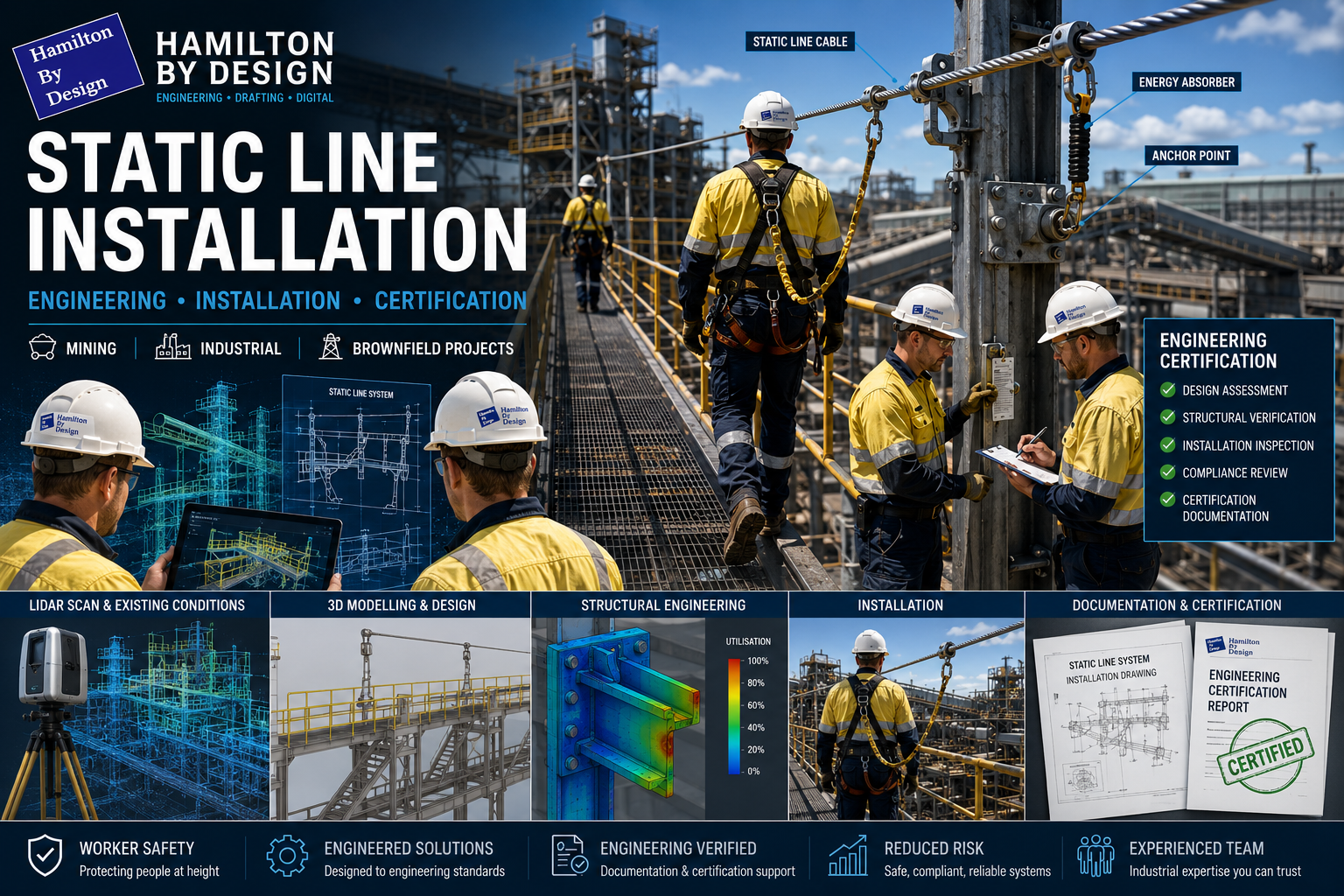
Static line systems play an important role in protecting personnel working at heights across mining, manufacturing, processing plants, smelters and heavy industrial environments. While a static line system may appear simple, effective implementation requires significantly more than installing a cable between two points.
A static line system is an engineered safety system requiring assessment of supporting structures, installation planning, documentation and engineering verification to ensure safe operation throughout its service life.
Why Engineering Assessment Matters
Static line systems can transfer significant loads into supporting structures during operation and potential fall events. Existing platforms, structural steel, roof systems and access structures may not have originally been designed for these additional loading conditions.
Potential risks may include:
Structural overload
Excessive cable deflection
Anchor point failure
Reduced fall clearance
Interference with plant infrastructure
Installation conflicts with existing services
Engineering assessment helps ensure the complete system performs safely and integrates correctly with existing facility infrastructure.
Brownfield Installation Challenges
Many industrial facilities have undergone modifications over many years and existing drawings do not always reflect current site conditions.
Common challenges include:
Structural changes not reflected in drawings
Additional pipework and services
Restricted installation access
Congested steelwork layouts
Equipment interferences
Unknown structural details
Capturing existing conditions before installation can reduce uncertainty and improve design confidence.
Engineering-grade LiDAR scanning and site verification can assist with:
Existing-condition capture
Structural geometry verification
Access assessment
Clash identification
As-built modelling
Installation planning
Typical Static Line Engineering Process
Site Inspection and Existing Asset Review
The process generally begins with:
Site inspections
Existing drawing review
Structural assessment
Access reviews
Existing-condition verification
Asset condition assessment
Structural Engineering Assessment
Supporting structures are assessed for:
Structural member capacity
Connection capacity
Anchor loading requirements
Dynamic loading conditions
Multiple-user requirements
Deflection limits
Existing loading conditions
Corrosion and asset condition
Where required, structural modifications or strengthening works may be developed.
Design Documentation
Typical engineering deliverables may include:
Static line layouts
General Arrangement (GA) drawings
Structural details
Anchor point details
Installation drawings
Load calculations
Fabrication documentation
Clear documentation reduces installation uncertainty and assists construction and maintenance activities.
Installation Verification
Following installation, verification activities may include:
Anchor inspections
Fixing verification
Installation checks
Dimensional confirmation
Asset tagging
Documentation review
Engineering Certification
Engineering certification documentation may include:
Design calculations
Compliance documentation
Inspection records
Installation drawings
Certification statements
Asset schedules
Maintenance requirements
Certification provides confidence that the installed system aligns with engineering design intent and project requirements.
How Hamilton By Design Can Support Static Line Projects
Hamilton By Design has a team capable of supporting the design, fabrication, installation and engineering certification process for static line systems and working-at-height access solutions for mining and industrial facilities.
Our engineering-led approach may include:
Existing-condition site inspections
Engineering-grade LiDAR scanning and verification
Structural and mechanical assessment
Static line and anchor layout development
Fabrication drawings and installation documentation
Site coordination and construction support
Engineering review and certification documentation
Whether for new installations or brownfield modifications, our objective is to deliver systems designed and installed to relevant engineering requirements and project standards while integrating with existing infrastructure.
This provides clients with a complete workflow from concept and site capture through to installation support and engineering verification.
Benefits of an Engineered Approach
A structured engineering approach can provide:
Improved worker safety
Reduced project risk
Better installation outcomes
Reduced rework
Improved documentation
Increased confidence in long-term asset performance
Improved lifecycle management
Final Thoughts
Static line systems are critical safety assets and should be treated as engineered systems rather than standalone products. Proper installation, engineering assessment and certification help ensure systems perform as intended and integrate safely within operating facilities.
For mining and industrial environments, combining engineering assessment with existing-condition verification and structured project documentation can significantly reduce uncertainty and improve installation outcomes.
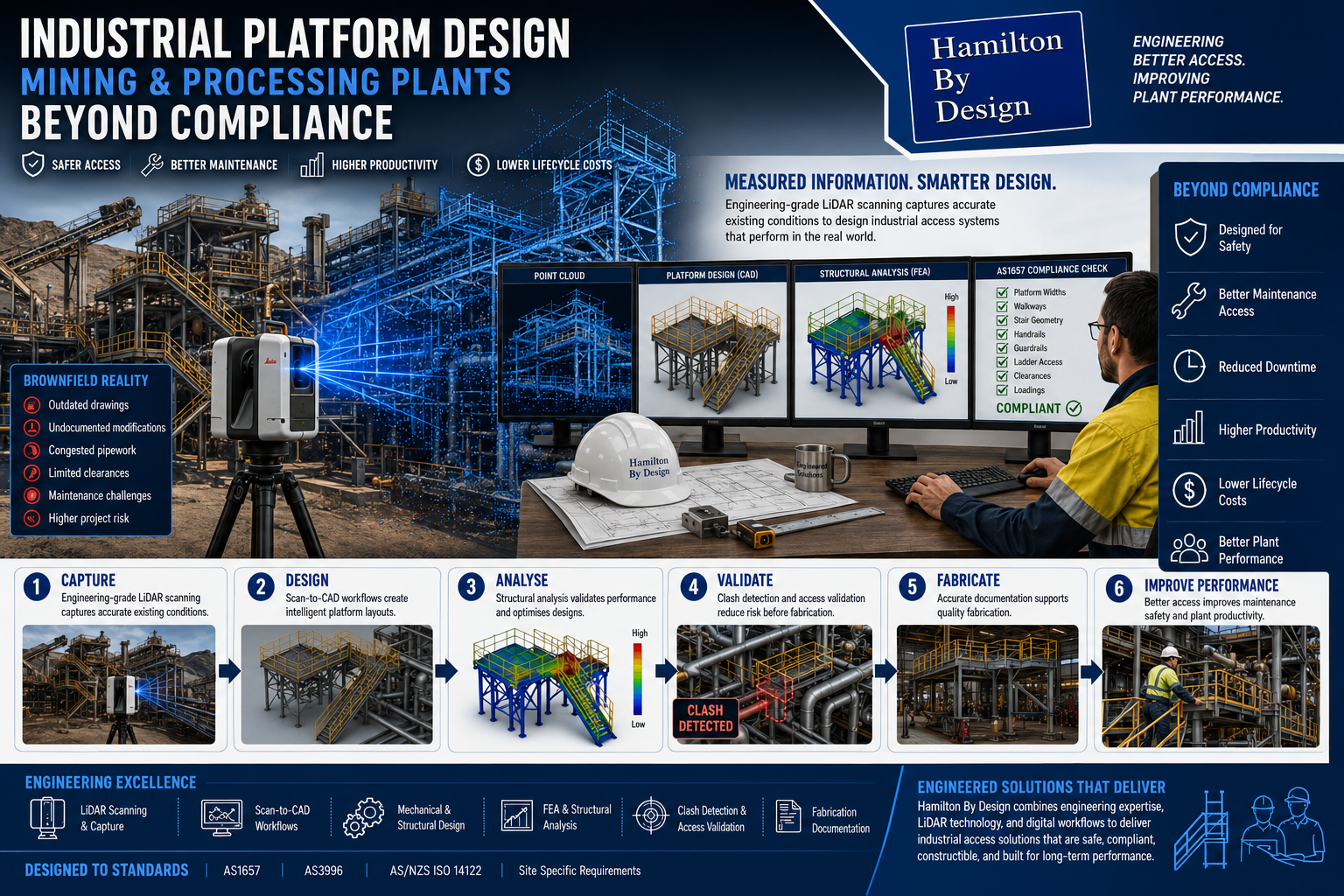
Industrial platforms are commonly viewed as supporting structures that simply provide access to equipment and operating areas. In many projects the design process focuses heavily on meeting minimum standards and compliance requirements.
While compliance is essential, successful platform design extends beyond satisfying engineering checklists.
Mining and processing facilities rely on platforms every day for:
Maintenance activities
Equipment inspections
Shutdown work
Operational access
Plant monitoring
Emergency access
Equipment removal and installation
Poor platform design can create safety concerns, maintenance challenges, and operational inefficiencies that remain throughout the life of the asset.
At Hamilton By Design, we view platform design as an engineering solution supporting productivity, maintenance, and long-term operational performance rather than simply meeting minimum requirements.
Why Industrial Platform Design Matters
Platforms directly affect how personnel interact with equipment and infrastructure.
Well-designed systems can improve:
Worker safety
Maintenance access
Equipment accessibility
Shutdown performance
Plant productivity
Long-term operating costs
Poor platform layouts may create:
Congested access areas
Restricted maintenance access
Increased manual handling risks
Difficult equipment removal
Longer shutdown durations
Increased project costs
Platform design influences how effectively a facility operates every day.
Compliance is the Starting Point
Mining and processing facilities frequently consider standards including:
AS1657 – Fixed Platforms, Walkways, Stairways and Ladders
AS3996 – Access Covers and Grates
Structural loading requirements
Site-specific engineering requirements
Standards establish minimum requirements for:
Platform dimensions
Walkway widths
Guardrails
Handrails
Stair geometry
Ladder systems
Access openings
Compliance is important, but meeting minimum requirements alone does not guarantee an efficient design.
Maintenance Access Often Drives Better Outcomes
Maintenance teams commonly interact with platforms more frequently than operations personnel.
Platform design should consider:
Equipment removal paths
Tool access requirements
Safe working zones
Inspection locations
Clearance requirements
Shutdown activities
Future maintenance needs
Questions often worth asking include:
Can pumps or motors be removed safely?
Can maintenance teams work comfortably?
Is lifting equipment accessible?
Can personnel safely carry tools and equipment?
Is there room for future upgrades?
Designing around maintenance activities often improves long-term outcomes.
Human Factors Matter
Platform systems should be designed around how people actually move and work.
Human considerations can include:
Visibility
Reach distances
Working posture
Congestion
Manual handling requirements
Access frequency
Emergency escape routes
Designs that ignore human interaction can create unnecessary operational difficulties.
Mining and industrial facilities often operate equipment for many years beyond its original installation date. Over time, machinery evolves through repairs, modifications, upgrades, and changing operational requirements. While equipment may continue performing effectively, obtaining replacement components can become increasingly difficult.
One of the most common challenges faced by industrial operations is finding replacement parts for ageing equipment where:
Original equipment manufacturers (OEMs) no longer support the product
Engineering drawings are unavailable
Documentation has been lost
Components have become obsolete
Lead times are excessive
Full equipment replacement becomes expensive
In these situations, reverse engineering can provide a practical pathway to maintain equipment performance and extend asset life.
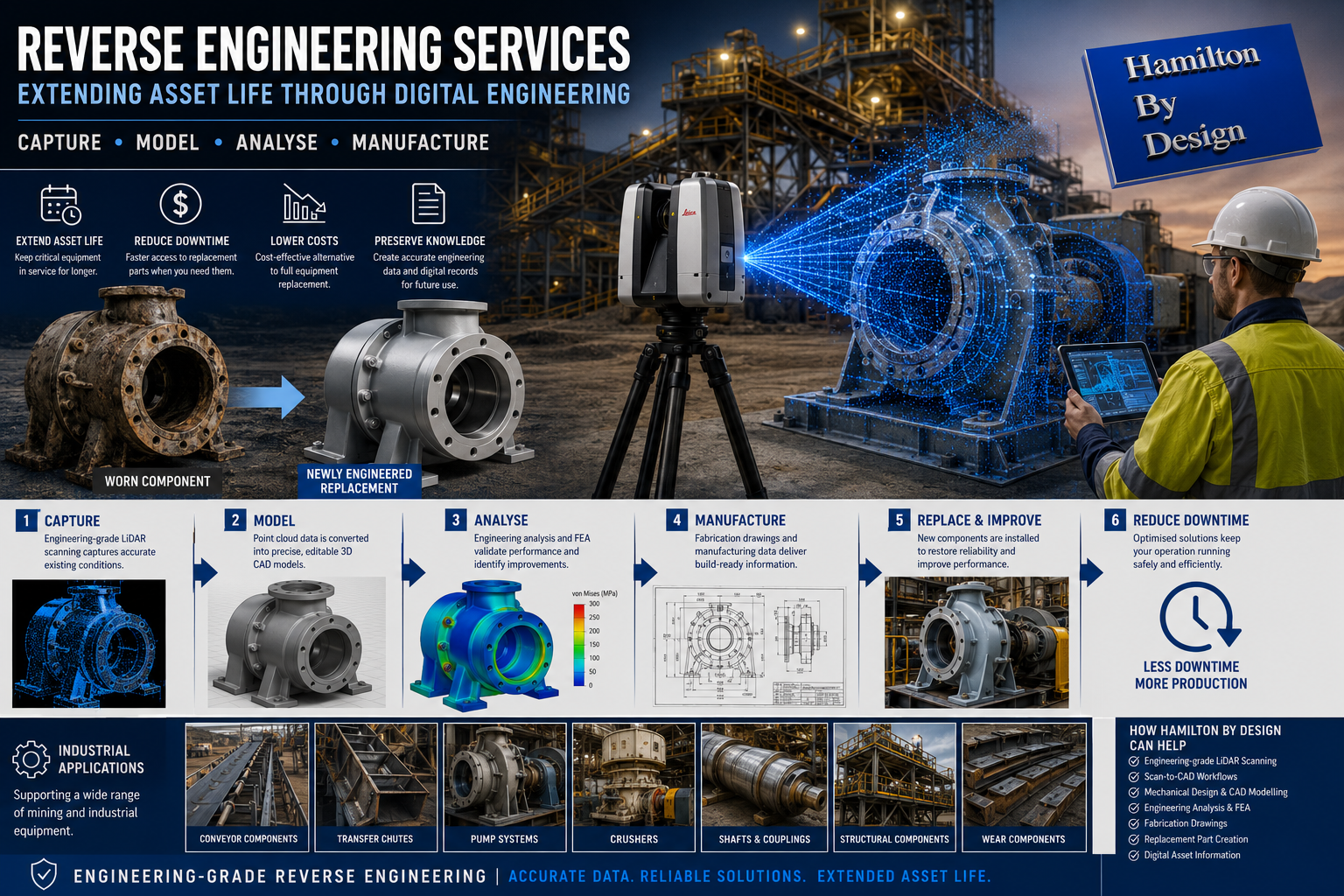
At Hamilton By Design, we support mining and industrial operations through engineering-grade reverse engineering workflows incorporating 3D LiDAR scanning, CAD modelling, engineering analysis, and fabrication-ready documentation.
What is Reverse Engineering?
Reverse engineering involves capturing and analysing an existing component or system to recreate accurate engineering information.
Rather than starting from a new concept design, the process begins with an existing asset and develops:
Digital geometry
Engineering drawings
CAD models
Dimensional information
Design documentation
Manufacturing information
The goal is creating accurate engineering data that supports maintenance, fabrication, and equipment improvement.
Why Mining and Industrial Operations Use Reverse Engineering
Many industrial facilities contain equipment that may have operated for decades.
Examples include:
Conveyors
Transfer chutes
Pumps
Crushers
Structural components
Wear liners
Shafts
Fabricated assemblies
Mechanical components
Materials handling systems
As equipment ages, facilities can encounter increasing challenges obtaining replacement parts.
Common issues include:
Obsolete components
Long manufacturing lead times
Missing drawings
Unknown modifications
Reduced OEM support
Increased maintenance costs
Reverse engineering helps bridge this information gap.
Obsolete Components and Missing Documentation
A common situation occurs when maintenance teams identify a failed component but no manufacturing information exists.
Examples may include:
Worn shafts
Custom brackets
Conveyor components
Pump assemblies
Structural items
Wear components
Without engineering information, organisations may face:
Extended downtime
Emergency fabrication
Manual measurement errors
Increased costs
Reverse engineering can convert physical components into accurate engineering data.
Extending Equipment Life
Full equipment replacement is not always necessary.
In many situations:
The surrounding system remains functional
Only selected components require replacement
Minor improvements may improve performance
Existing equipment can continue operating effectively
Extending equipment life may provide:
Lower capital expenditure
Reduced project risk
Reduced downtime
Improved return on investment
Improved operational continuity
Replacement Part Creation
Hamilton By Design can support replacement component development through engineering workflows including:
Existing Condition Capture
Capture existing equipment using:
Engineering-grade LiDAR scanning
Physical measurements
Dimensional verification
CAD Modelling
Develop:
Editable CAD models
Mechanical assemblies
Manufacturing information
Engineering Drawings
Generate:
General arrangement drawings
Fabrication drawings
Manufacturing documentation
Engineering Validation
Support projects through:
Design assessment
Engineering analysis
Finite Element Analysis (FEA)
Structural validation
Reducing Downtime
Unexpected equipment failures can significantly affect production.
Potential impacts may include:
Lost production
Shutdown delays
Increased labour requirements
Emergency maintenance costs
Reduced operational efficiency
Reverse engineering can support maintenance planning by creating:
Digital spare part libraries
Engineering records
Manufacturing information
Improved replacement processes
This allows organisations to move from reactive responses toward more structured asset management.
Cost Versus Full Equipment Replacement
Replacing an entire system can involve:
High capital cost
Long procurement timeframes
Installation costs
Production interruptions
Project risk
Reverse engineering may provide an alternative where:
Existing equipment remains suitable
Only selected components require replacement
Performance improvements can be introduced
Engineering decisions can then focus on lifecycle value rather than simply replacing complete systems.
Industrial Applications
Reverse engineering can support:
Mining Operations
Conveyor systems
Transfer chutes
Crushers
Pump systems
Structural assets
Processing equipment
Manufacturing Facilities
Production equipment
Mechanical assemblies
Custom components
Industrial Processing Plants
Wear components
Mechanical equipment
Plant modifications
Existing assets
How Hamilton By Design Supports Reverse Engineering Projects
Hamilton By Design combines engineering tools and practical engineering experience to support reverse engineering projects through:
Engineering-grade 3D LiDAR scanning
Scan-to-CAD workflows
Mechanical design
CAD modelling
Engineering analysis and FEA
Fabrication documentation
Existing condition verification
The objective is not simply reproducing a component.
The objective is creating reliable engineering information that supports productivity, maintenance, and long-term asset performance.
Engineering-grade reverse engineering helps transform ageing assets from a limitation into an opportunity for improved operational performance.
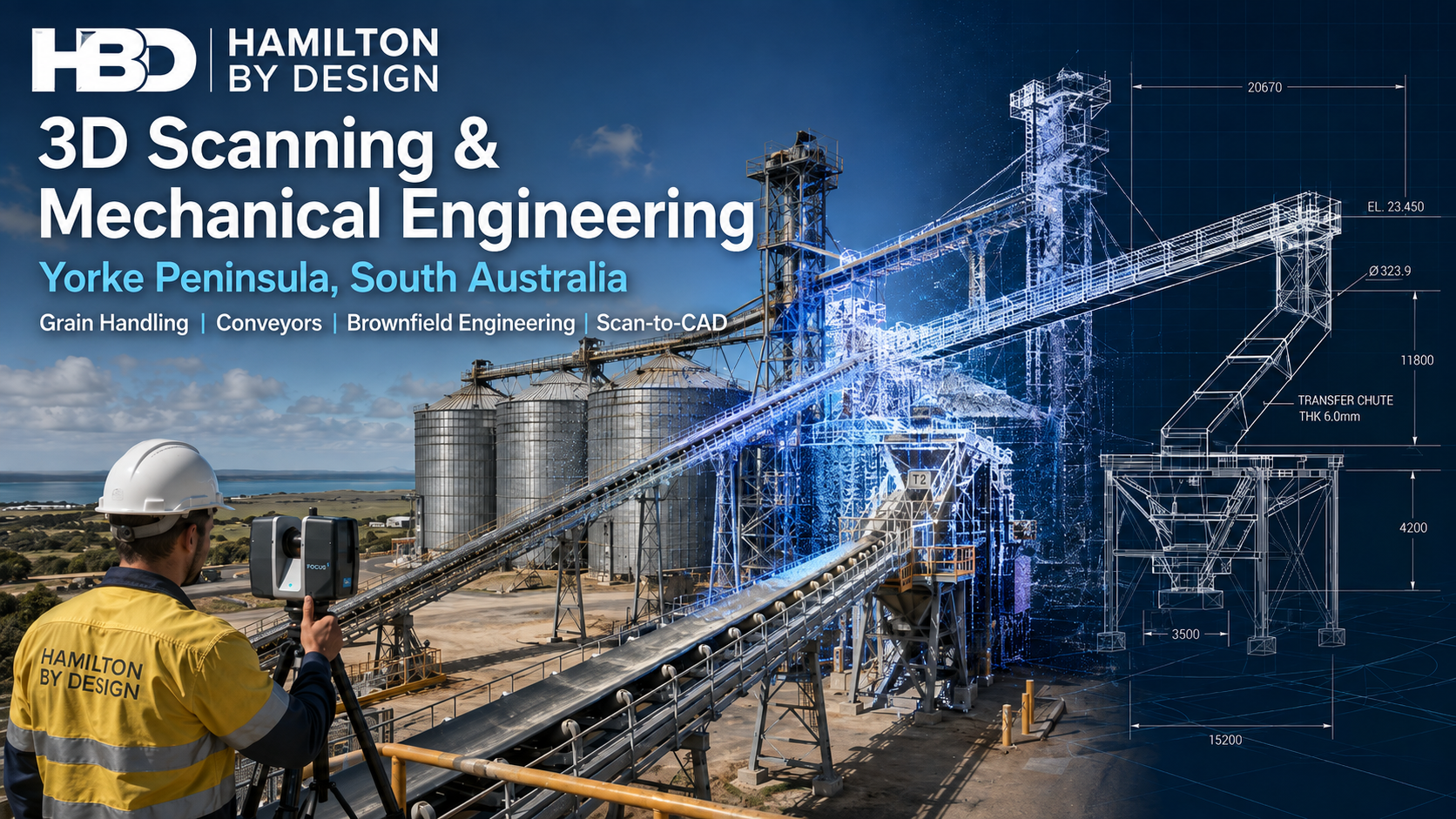
The Yorke Peninsula is an important regional area of South Australia, supporting agriculture, grain handling, bulk storage, transport infrastructure, manufacturing, maintenance activities and a wide range of regional businesses. When existing facilities require modification, replacement equipment, additional structures or improved documentation, one of the biggest challenges is often understanding exactly what is already installed.
Hamilton By Design provides 3D scanning, mechanical engineering, CAD modelling and drafting services across the Yorke Peninsula and regional South Australia, helping project teams capture existing conditions and convert that information into practical engineering deliverables.
Our approach combines site-based reality capture with engineering and design. Rather than treating scanning as an isolated surveying activity, the captured information can become the starting point for plant modifications, equipment replacement, fabrication, structural detailing, reverse engineering and brownfield project development.
For projects requiring accurate existing-condition information, our broader 3D LiDAR scanning services in Adelaide and South Australia support industrial, infrastructure, manufacturing and regional engineering projects throughout the state.
Engineering Support for Existing Yorke Peninsula Facilities
Regional facilities often develop progressively over many years. Equipment may have been replaced, conveyors extended, platforms modified, pipework rerouted or structural steel added without every change being accurately reflected in the original drawings.
This creates a problem when another modification is required.
A drawing may show what was originally designed, but not necessarily what exists today.
For brownfield engineering projects, Hamilton By Design uses engineering-grade 3D laser scanning to capture existing structures, mechanical equipment, access systems and surrounding infrastructure before detailed design begins.
The resulting point cloud provides a three-dimensional record of the site that can be reviewed and measured after the fieldwork has been completed.
This can reduce the need for repeated site visits and allows designers to work with existing geometry rather than assumptions.
What Can Be Captured Using 3D LiDAR Scanning?
3D scanning can be applied to individual pieces of equipment or large sections of an industrial facility.
Typical Yorke Peninsula applications may include:
grain handling equipment
conveyors and conveyor galleries
transfer stations
chutes and hoppers
silos and storage structures
structural steel
platforms, stairs and handrails
machinery and equipment
pipework and service routes
equipment foundations
building interiors
plant rooms
access areas
existing fabrication
equipment interfaces.
For engineering projects, accurate capture of the surrounding area can be just as important as capturing the equipment being replaced.
Our 3D laser scanning for engineering projects workflow provides engineers and designers with a digital representation of existing plant and structures that can then be used as the basis for engineering development.
This is particularly useful when a new component has to fit between existing structures, connect to established equipment or be installed during a limited shutdown period.
Grain Handling and Bulk Materials Engineering
Grain and bulk-material facilities present their own engineering challenges.
Conveyors, chutes, hoppers, transfer points and supporting structures operate as connected systems. A modification made to one part of the plant can affect material flow, maintenance access, clearances and the performance of equipment further downstream.
Hamilton By Design’s experience with bulk material handling systems can support projects where existing equipment needs to be modified, replaced or integrated with new plant.
While individual industries and materials differ, many of the engineering principles remain similar.
The objective is not simply to produce a CAD model. It is to understand how the equipment fits into the complete operating environment.
3D scanning can help establish:
existing conveyor positions
belt centre lines
chute geometry
support locations
surrounding structural steel
head and tail pulley arrangements
maintenance clearances
access requirements
equipment interfaces
available installation space.
Having this information available during design can significantly improve the coordination of modifications.
Conveyor, Chute and Transfer Station Projects
Transfer points can become maintenance-intensive areas when material flow, equipment geometry or operating conditions are not properly considered.
Excessive wear, spillage, dust, blockages and difficult maintenance access can all create operational problems.
Hamilton By Design provides engineering and design support for conveyor transfer chute design, including projects where existing structures and equipment need to be captured before new components can be developed.
For a Yorke Peninsula brownfield project, the process may begin by scanning the conveyor, chute, support structure and surrounding area.
The point cloud can then be imported into the engineering environment, allowing proposed equipment to be positioned relative to the actual plant.
This approach is particularly valuable where site access is difficult or where measuring individual components manually would require numerous dimensions to be recorded.
Scan-to-CAD for Brownfield Engineering
Capturing a point cloud is only the first stage.
The information can then be converted into engineering geometry suitable for design, documentation and coordination.
Depending on the project, Hamilton By Design can develop:
3D CAD models
existing-condition models
general arrangement drawings
sections and elevations
mechanical layouts
structural layouts
fabrication drawings
equipment models
interface geometry
installation concepts.
This allows the physical site to become part of the CAD design environment.
New equipment can be modelled around existing structures, and potential interference can be investigated before fabrication or installation.
For brownfield work, this creates an important connection between site capture and engineering design.
Reverse Engineering Existing Equipment
Regional facilities can contain machinery that has been operating for many years.
In some cases, original manufacturing drawings may no longer be available. Equipment may also have been repaired, modified or altered during its operating life.
When components require replacement, scanning can provide an effective starting point.
Hamilton By Design’s reverse engineering using 3D scanning workflow uses captured geometry together with engineering assessment, CAD modelling and dimensional verification.
Applications may include:
replacement components
obsolete machinery
worn equipment
guards and covers
fabricated structures
chutes and hoppers
equipment interfaces
legacy plant.
Importantly, reverse engineering does not necessarily mean blindly copying an existing component.
The existing geometry provides information about what fits the plant, while engineering review can consider whether the replacement can be improved for manufacture, installation, maintenance or service life.
Digital Verification and Quality Assurance
3D scanning can also be useful after fabrication or installation.
A scan of installed equipment can be compared with the design model to identify potential differences and confirm important geometry.
Hamilton By Design’s 3D LiDAR digital quality assurance services can assist project teams with dimensional verification and existing-condition documentation.
This may be useful where a project requires confidence that equipment, structures or interfaces have been installed as expected before the next stage of work proceeds.
For regional projects, having a permanent digital record can also reduce uncertainty during future modifications.
Supporting Shutdowns and Plant Upgrades
Shutdown projects often provide only a limited period in which existing equipment can be removed and replacement components installed.
Discovering an unexpected obstruction after fabrication has begun can create significant problems.
Capturing the existing plant before detailed design allows the project team to investigate many potential fit-up issues earlier.
The scanned environment can assist with:
checking equipment clearances
planning replacement components
developing installation concepts
identifying surrounding obstructions
reviewing access
coordinating structural and mechanical work
developing fabrication drawings.
This does not remove every risk associated with brownfield work, but it provides significantly more information than relying solely on old drawings and isolated manual dimensions.
Mechanical Engineering and Drafting From the Same Digital Dataset
A major advantage of engineering-led scanning is that the data does not have to stop at the point-cloud stage.
Hamilton By Design can use the captured information as part of a broader engineering workflow incorporating mechanical design, CAD modelling, drafting and fabrication documentation.
Our national 3D laser scanning services support projects where accurate site capture needs to connect directly with subsequent engineering work.
Depending on project requirements, deliverables can include registered point clouds, CAD models, drawings and engineering information suitable for continued project development.
This integrated approach is particularly useful for smaller and regional projects where having multiple companies separately responsible for site measurement, modelling and drafting can create unnecessary handover points.
3D Scanning Across the Yorke Peninsula
Hamilton By Design can support projects across the Yorke Peninsula and surrounding regional areas.
Projects do not necessarily need to involve an entire facility.
A scanning assignment may involve one conveyor transfer, an individual piece of machinery, a structural modification or a small area where accurate measurements are required.
For larger projects, scanning can be expanded to capture an entire working area and provide project teams with a broader existing-condition dataset.
The appropriate scope depends on what the client needs to design, modify, replace or document.
Why Use 3D Scanning Before Starting a Brownfield Design?
The greatest benefit is simple: designing around what actually exists.
Brownfield projects frequently involve compromises imposed by existing structures, equipment, access and operating requirements.
A point cloud provides engineers and designers with significantly more spatial information than a collection of individual measurements.
That can assist project teams in making better-informed decisions earlier in the project and can help reduce the risk of discovering dimensional problems during fabrication or installation.
For Yorke Peninsula businesses planning plant upgrades, equipment replacements or facility modifications, the objective is not simply to create a sophisticated 3D image.
The objective is to turn accurate existing-condition information into practical engineering decisions and buildable outcomes.
Frequently Asked Questions
What is 3D LiDAR scanning?
3D LiDAR scanning uses a laser scanner to capture large numbers of spatial measurement points around an existing environment. These measurements form a three-dimensional point cloud representing the geometry of the captured plant, structure or building.
Can you provide 3D scanning services on the Yorke Peninsula?
Yes. Hamilton By Design supports regional projects and can provide engineering-led 3D scanning, CAD modelling and drafting for suitable projects across the Yorke Peninsula and South Australia.
Can you scan grain handling equipment?
Yes. Depending on access and project requirements, equipment such as conveyors, chutes, transfer points, structural steel, platforms, silos and surrounding plant can be captured.
Can the scan data be converted into CAD?
Yes. Point-cloud information can be used to develop CAD geometry, general arrangement drawings, sections, equipment layouts and other engineering documentation depending on project requirements.
Is 3D scanning useful for conveyor modifications?
Yes. Scanning can capture the conveyor, support structure, transfer equipment and surrounding geometry, allowing proposed modifications to be developed relative to actual site conditions.
Can 3D scanning help with reverse engineering?
Yes. Existing equipment can be scanned and used as the basis for CAD modelling and engineering review where original drawings are unavailable, unreliable or no longer representative of the installed asset.
Is scanning suitable for shutdown projects?
Yes. Capturing existing conditions before a shutdown can help engineers investigate equipment fit-up, access, interfaces and potential clashes before fabricated components arrive on site.
What project deliverables can Hamilton By Design provide?
Depending on the agreed scope, deliverables may include registered point-cloud information, 3D CAD models, general arrangement drawings, sections, elevations, fabrication information and other engineering documentation.
Do you only undertake large scanning projects?
No. 3D scanning can be appropriate for anything from an individual component or transfer station through to large sections of an industrial facility. The scanning scope should be based on the information required for the engineering task.
Why combine 3D scanning with mechanical engineering?
Combining scanning with engineering allows the captured site information to become part of the design process. Instead of producing a point cloud and handing it over without engineering context, the information can be used to develop modifications, models and drawings around verified existing conditions.
Engineering-Led 3D Scanning for Yorke Peninsula Projects
For Yorke Peninsula businesses planning equipment upgrades, conveyor modifications, grain-handling improvements, structural changes, reverse engineering or brownfield plant work, accurate information at the beginning of the project can make a significant difference.
Hamilton By Design provides a connected workflow from 3D LiDAR site capture through to CAD modelling, mechanical engineering and drafting, helping regional project teams understand existing conditions and develop solutions that are designed around the plant that is actually there.
Whether the requirement involves one difficult-to-measure component or a larger industrial facility, 3D scanning provides a practical digital foundation for better-informed engineering and project development.
If you’re operating on the Yorke Peninsula and require:
Mechanical engineering support
3D LiDAR scanning
Mechanical or structural drafting
contact Hamilton By Design to discuss how we can support your next project.
🏷️ Labels
yorke peninsula engineering, 3d scanning south australia, lidar scanning australia, mechanical engineering services australia, point cloud to cad, grain handling engineering, conveyor design australia, regional engineering support
🔍 Search Description
Mechanical engineering, 3D LiDAR scanning, and drafting services for the Yorke Peninsula, South Australia. Supporting regional industry with accurate reality capture and practical design solutions.
Explore additional Hamilton By Design resources covering 3D LiDAR scanning,
mechanical engineering, Scan-to-CAD, reverse engineering, conveyors,
materials handling and brownfield industrial projects across South Australia
and regional Australia.
Engineering-grade LiDAR reality capture, point-cloud processing,
Scan-to-CAD and as-built documentation for industrial and infrastructure
projects throughout Adelaide and South Australia.
Engineer-led mechanical engineering support for South Australian
industrial, manufacturing and brownfield projects where constructability
and accurate existing-condition information matter.
Regional South Australian 3D scanning for ports, processing facilities,
conveyors, structural steel, pipework and space-constrained industrial
environments.
Engineering-focused terrestrial LiDAR scanning for brownfield,
industrial, mining and infrastructure projects across metropolitan,
regional and remote Australia.
Hamilton By Design’s core engineering-grade 3D laser scanning capability
for industrial facilities, processing plants, infrastructure and complex
existing assets.
Use accurate scan data to recreate worn, modified or undocumented
equipment and develop practical CAD models and drawings for replacement
and fabrication.
See how registered LiDAR point clouds can progress from site capture
through CAD modelling and engineering development for plant upgrades
and brownfield projects.
Understand the differences between point-cloud data and mesh files and
why engineering projects often require more than a visual representation
of existing plant.
Mechanical engineering support for conveyors, transfer stations,
hoppers, chutes and associated structural steel used throughout
bulk-material-handling facilities.
Use high-accuracy LiDAR scanning for dimensional verification,
installation checking, existing-condition documentation and digital QA
across industrial projects.
Convert point clouds, drawings, sketches and existing site information
into practical mechanical and industrial CAD models for design,
fabrication and plant modification.
Mechanical drafting and engineering documentation for plant upgrades,
fabrication, maintenance projects and brownfield modifications across
industrial facilities.
To provide the best experiences, we use technologies like cookies to store and/or access device information. Consenting to these technologies will allow us to process data such as browsing behaviour or unique IDs on this site. Not consenting or withdrawing consent, may adversely affect certain features and functions.
Functional
Always active
The technical storage or access is strictly necessary for the legitimate purpose of enabling the use of a specific service explicitly requested by the subscriber or user, or for the sole purpose of carrying out the transmission of a communication over an electronic communications network.
Preferences
The technical storage or access is necessary for the legitimate purpose of storing preferences that are not requested by the subscriber or user.
Statistics
The technical storage or access that is used exclusively for statistical purposes.The technical storage or access that is used exclusively for anonymous statistical purposes. Without a subpoena, voluntary compliance on the part of your Internet Service Provider, or additional records from a third party, information stored or retrieved for this purpose alone cannot usually be used to identify you.
Marketing
The technical storage or access is required to create user profiles to send advertising, or to track the user on a website or across several websites for similar marketing purposes.