Point Cloud to Engineering Model for Mining Infrastructure

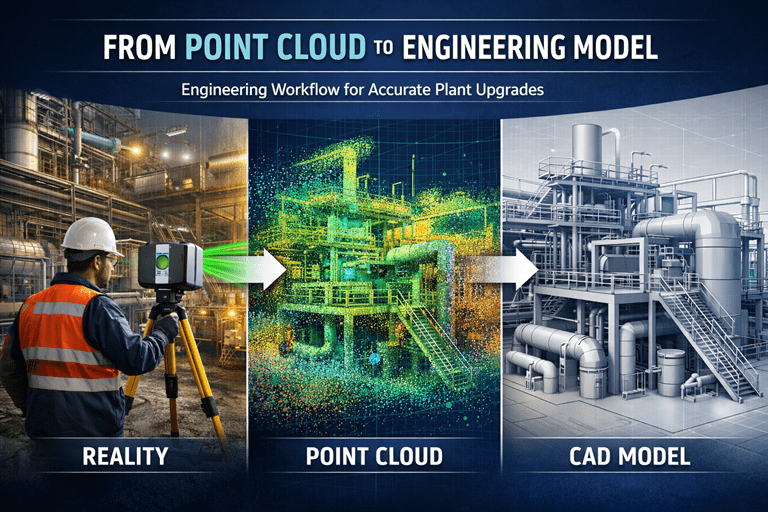
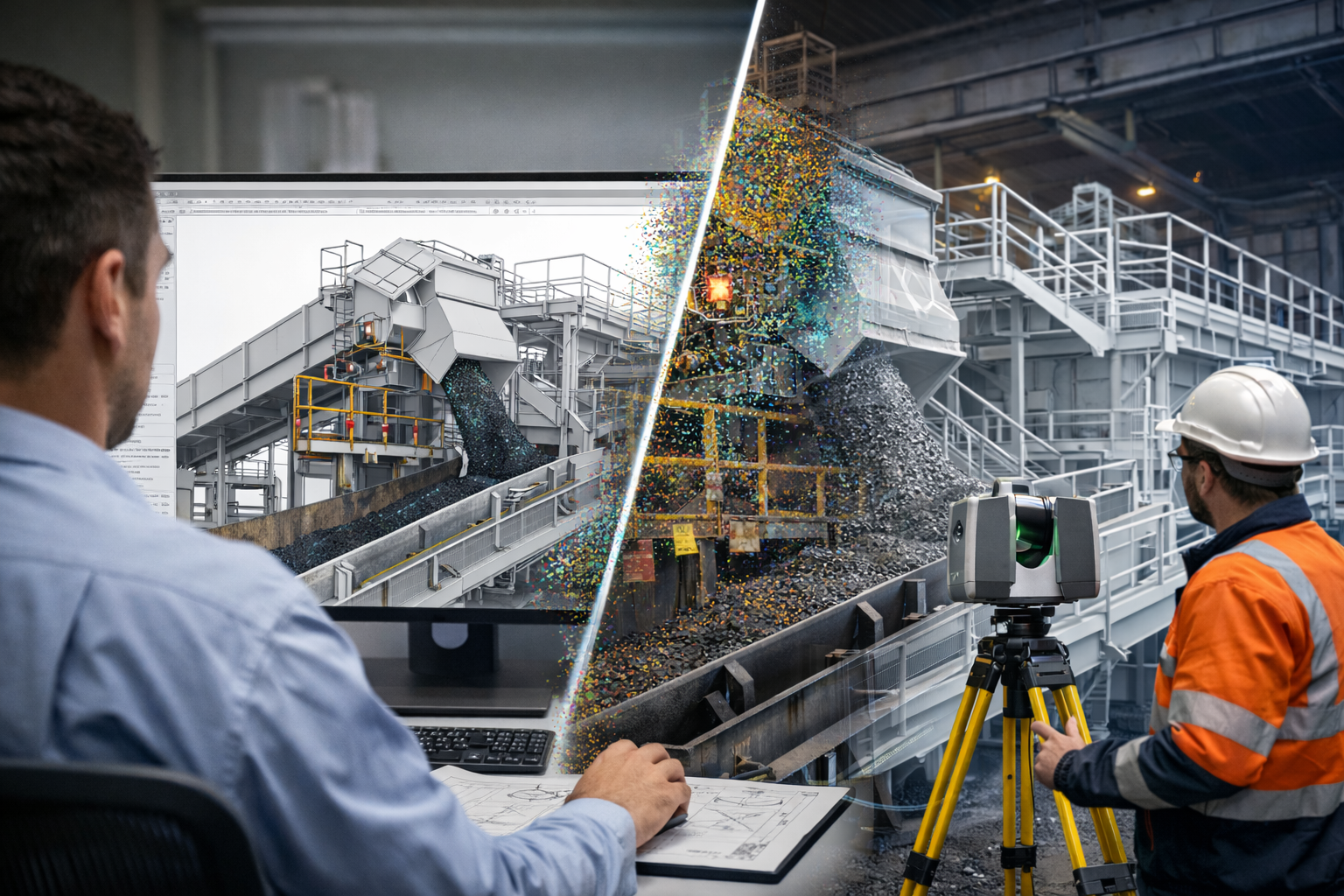
Point cloud mining infrastructure scanning connected to a 3D engineering model of a conveyor transfer chute.

Point Cloud to Engineering Model for Mining Infrastructure

Modern mining infrastructure is complex, constantly evolving, and rarely matches the original construction drawings. Over decades of plant upgrades, maintenance work, and operational modifications, the physical layout of conveyors, chutes, platforms, and structural steel often diverges significantly from historical design documentation.

For engineering teams planning plant upgrades or shutdown work, accurate site information is essential. One of the most effective ways to capture this information is through laser scanning and point cloud modelling, which allows engineers to convert real-world infrastructure into detailed digital engineering models.

The process of converting point cloud mining infrastructure data into engineering models is now widely used across the mining and bulk materials handling industries.


What Is a Point Cloud in Mining Infrastructure?

A point cloud is a dense collection of spatial measurements captured using 3D laser scanning equipment. Each point represents a precise location in space, allowing engineers to reconstruct the geometry of plant infrastructure with extremely high accuracy.

When scanning a mining facility, the point cloud may capture:

  • Conveyors and transfer stations
  • Structural steel platforms and walkways
  • Crushers, screens and processing equipment
  • Stockpile reclaim systems
  • Pipework and mechanical installations
  • Port and ship loading infrastructure

These datasets can contain millions or even billions of measurement points, forming a highly accurate digital representation of the plant environment.


Converting Point Clouds into Engineering Models

While point clouds provide valuable measurement data, they are not directly usable for engineering design. Engineers must convert the scan data into structured mechanical and structural models that can be used for analysis, fabrication and construction planning.

The typical engineering workflow includes:

1. Site Laser Scanning

The plant is scanned using high-accuracy laser scanning equipment to capture the geometry of existing infrastructure.

2. Point Cloud Processing

The raw scan data is registered and combined to form a unified point cloud representing the entire plant area.

3. Engineering Modelling

Engineers interpret the point cloud and convert key infrastructure elements into CAD models including:

  • Structural steel frameworks
  • Conveyor structures and galleries
  • Transfer chutes
  • Access platforms and walkways
  • Mechanical equipment interfaces

4. Engineering Design and Upgrades

The resulting model allows engineers to design plant modifications with confidence, ensuring equipment fits correctly within the existing infrastructure.

This workflow significantly reduces installation risk during shutdowns and upgrade projects.

For further information on mechanical engineering services for mining plants see:


Supporting Shutdown Planning and Plant Upgrades

Mining plants frequently undergo upgrades to improve reliability, throughput and maintenance access. Many of these upgrades are installed during planned shutdowns where downtime must be carefully controlled.

By developing accurate engineering models from point cloud data, engineers can:

  • Confirm clearances for new equipment
  • Identify potential clashes before fabrication
  • Design replacement transfer chutes and conveyors
  • Validate structural modifications
  • Improve maintenance access systems

These digital engineering models are particularly valuable for shutdown preparation.

More information about this process can be found here:


Transfer Chutes and Materials Handling Infrastructure

Transfer chutes are one of the most common areas requiring modification in coal handling plants and mining infrastructure. Poorly designed chutes can lead to excessive belt wear, blockages, dust generation and maintenance challenges.

Using point cloud models, engineers can analyse the surrounding infrastructure and design improved chute geometries that integrate correctly with existing conveyors and structures.

Learn more about chute engineering and materials handling design here:
โžก https://www.hamiltonbydesign.com.au/coal-chute-design/

Additional engineering insight is available in this technical article:
โžก https://chutesandtransferstations.blogspot.com/2025/07/designing-for-durability-chutes.html
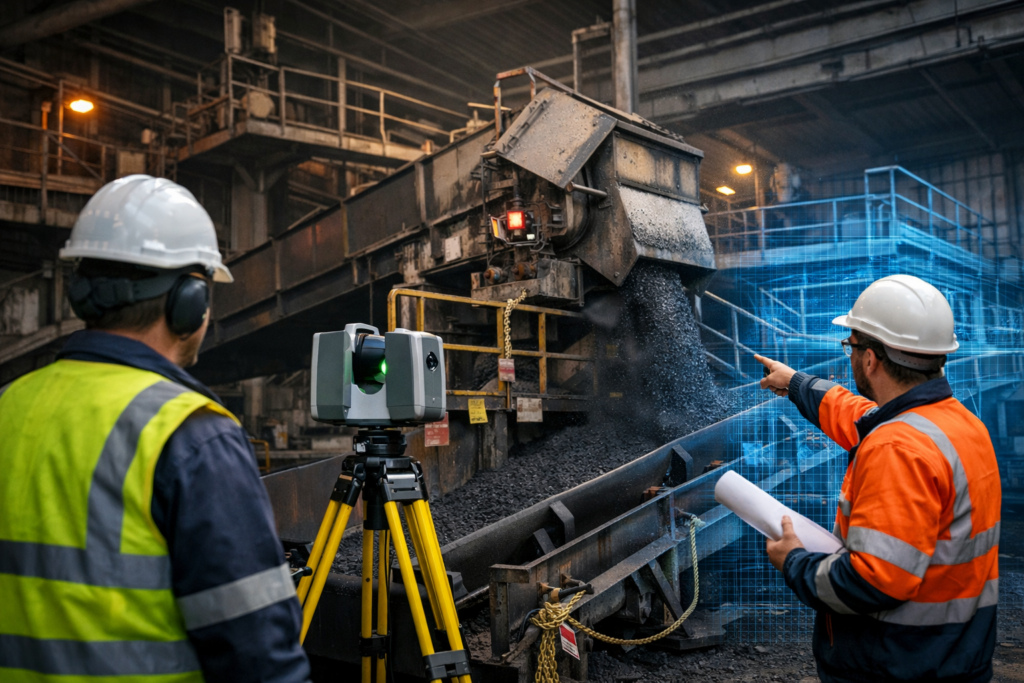
Coal plant shutdown engineering using a 3D laser scanner to capture conveyor and transfer chute infrastructure.

Engineering Applications Across Mining Infrastructure

The conversion of point clouds into engineering models is now widely used across many mining environments.

Common applications include:

  • Coal handling plants
  • Bulk materials handling infrastructure
  • Processing plants and concentrators
  • Port loading facilities
  • Conveyor systems and transfer stations
  • Industrial processing plants

By capturing existing infrastructure digitally, engineers can develop highly accurate models that support plant upgrades, shutdown planning and long-term asset management.


The Future of Digital Engineering in Mining

As scanning technology continues to improve, point cloud modelling is becoming a core component of modern mining engineering workflows.

The ability to convert real-world infrastructure into precise digital models allows engineers to design upgrades more efficiently, reduce installation risk and improve plant reliability.

For mining operators and engineering teams planning infrastructure upgrades, the integration of laser scanning, point clouds and engineering modelling is transforming how projects are designed and delivered.



Hamilton By Design logo displayed on a blue tilted rectangle with a grey gradient background

3D LiDAR scanning and 3D modelling service button โ€” laser scanner capturing a point cloud for engineering and CAD modelling
Mechanical engineering services
Name
Would you like us to arrange a phone consultation for you?
Address

CHPP Engineering title graphic featuring bold white text reading "CHPP Engineering" centred on a blue rounded rectangle background.
Pipework Drafting title graphic featuring bold white text reading "Pipework Drafting" centred on a blue rounded rectangle background.
3D LiDAR Scanning for Engineering Projects title graphic featuring bold white text on a blue rounded rectangle background.

3D CAD Modelling Australia service banner for Hamilton By Design

Engineering Resources for Mining, Mechanical and Industrial Design

Mining and industrial engineering design montage showing conveyors, pipework systems, structural steel platforms and a mechanical assembly CAD model.

Supporting Engineering Knowledge Across Multiple Industry Blogs

At Hamilton By Design Co., we regularly publish engineering insights, technical discussions, and project examples across a number of specialist industry blogs.

These resources support engineers, plant operators, maintenance managers, and project teams working across mining, manufacturing, industrial infrastructure and structural design.

Many of these posts explore the practical engineering challenges encountered when designing, upgrading, or reverse engineering industrial equipment and facilities.

Topics include:

  • Mining plant design
  • Conveyor transfer systems
  • Structural steel detailing
  • Mechanical drafting
  • SolidWorks engineering design
  • Point cloud modelling and laser scanning
  • Design for manufacturing
  • Industrial plant upgrades

These blogs form part of the broader Hamilton By Design engineering knowledge network, providing practical insight into the real-world challenges of industrial design and engineering projects.


Hamilton By Design Engineering Blog Network

Hamilton By Design Engineering Blog

https://hamiltonbydesign.blogspot.com

This blog focuses on engineering services delivered by Hamilton By Design, including:

  • 3D laser scanning for engineering projects
  • Reverse engineering workflows
  • Industrial plant modelling
  • Engineering design case studies

It provides insights into how scanning and modelling technologies are applied to real engineering projects across Australia.


Mining Infrastructure and SolidWorks Design

https://mininginfrastructuresolidworksdesign.blogspot.com

This engineering blog focuses on the design and modelling of mining infrastructure, including:

  • Conveyor systems
  • Transfer chutes
  • Structural supports
  • Plant layout modelling

Articles often explore how SolidWorks and engineering modelling tools are used to develop reliable infrastructure for mining and bulk material handling.


Chutes and Transfer Stations

https://chutesandtransferstations.blogspot.com

Transfer chutes are one of the most critical components in bulk material handling systems.

This blog discusses:

  • Common chute failures in mining plants
  • Conveyor loading problems
  • Transfer point design
  • Bulk material handling improvements

Engineering design decisions made at transfer stations can significantly impact conveyor reliability, maintenance costs, and plant performance.


Design for Manufacturing

https://design-for-manufacturing.blogspot.com

The Design for Manufacturing (DFM) blog focuses on improving product and equipment designs to simplify fabrication and assembly.

Topics include:

  • Fabrication-friendly engineering design
  • Cost reduction through smarter design
  • Manufacturing workflow improvements
  • Practical mechanical engineering tips

Industrial Design Australia

https://industrialdesignaustralia.blogspot.com

This blog discusses engineering and industrial design challenges across Australian industries including:

  • Mining infrastructure
  • Industrial plants
  • Equipment upgrades
  • Plant shutdown planning

It highlights the engineering considerations required when working within complex operating facilities.


Mechanical Drafting Sydney

https://mechanical-drafting-sydney.blogspot.com

This blog focuses on professional drafting services including:

  • Mechanical design documentation
  • Engineering drawings
  • Industrial layout modelling
  • Detailed fabrication drawings

It provides insights into the role of drafting in delivering successful engineering projects.


Pipework Detailing

https://pipeworkdetailing.blogspot.com

Industrial pipe systems are critical infrastructure within processing plants.

This blog covers:

  • Pipe routing design
  • Pipe spool drawings
  • Scan-to-model workflows
  • Pipework engineering documentation

The content is particularly relevant to projects where laser scanning is used to capture existing plant geometry before upgrades.


SolidWorks Designer

https://solidworksdesigner.blogspot.com

This blog focuses on 3D mechanical design using SolidWorks, including:

  • Industrial equipment design
  • Mechanical assemblies
  • Engineering modelling workflows
  • Reverse engineering projects

SolidWorks Sydney

https://solidworkssydney.blogspot.com

This site focuses on SolidWorks engineering services in Australia, including:

  • Mechanical design
  • Industrial equipment modelling
  • Manufacturing design support

Structural Detailing

https://structural-detailing.blogspot.com

Structural detailing plays an important role in industrial plant upgrades and infrastructure projects.

This blog discusses:

  • Structural steel detailing
  • Engineering drawings for fabrication
  • Industrial infrastructure design

Structural Drafting

https://structural-drafting.blogspot.com

This blog focuses on structural drafting services including:

  • Steel framing drawings
  • Fabrication documentation
  • Structural engineering support for industrial facilities.

Structural Steel Drafting

https://structural-steel-drafting.blogspot.com

This blog focuses specifically on steel structures used in industrial plants and mining facilities, including:

  • Conveyor structures
  • Plant platforms
  • Maintenance walkways
  • Equipment support frames

Supporting Industrial Engineering Projects Across Australia

These blogs collectively explore the practical engineering knowledge required to support industrial facilities across Australia.

Many of the engineering topics discussed across these blogs are connected to services provided by Hamilton By Design, including:

  • Engineering grade 3D laser scanning
  • Point cloud to engineering model workflows
  • Mechanical and structural engineering design
  • Reverse engineering of industrial equipment
  • Plant upgrades and shutdown preparation

These resources help engineers and plant operators better understand how modern digital engineering tools can support safer, more efficient industrial infrastructure projects.

Hamilton By Design logo displayed on a blue tilted rectangle with a grey gradient background

3D LiDAR scanning and 3D modelling service button โ€” laser scanner capturing a point cloud for engineering and CAD modelling
Mechanical engineering services
Name
Would you like us to arrange a phone consultation for you?
Address


3D CAD Modelling Australia service banner for Hamilton By Design

Mechanical Engineering | Structural Engineering


3D LiDAR Scanning Darwin for engineering surveys, laser scanning, reality capture and point cloud modelling services
3D LiDAR Scanning Australia engineering services for laser scanning, reality capture, scan-to-CAD, Scan-to-BIM and as-built documentation across Australia
3D LiDAR scanning services on the Central Coast providing engineering-grade laser scanning, point cloud capture, scan-to-CAD modelling and industrial reality capture for infrastructure and industrial projects.
3D LiDAR Scanning Perth for engineering surveys, laser scanning, reality capture and point cloud modelling services
3D LiDAR Scanning Sydney for engineering surveys, laser scanning, reality capture and point cloud modelling services
3D LiDAR Scanning Brisbane for engineering surveys, laser scanning, reality capture and point cloud modelling services
3D LiDAR Scanning Canberra for engineering surveys, laser scanning, reality capture and point cloud modelling services
3D LiDAR Scanning Newcastle for engineering surveys, laser scanning, reality capture and point cloud modelling services
3D LiDAR Scanning Adelaide for engineering surveys, laser scanning, reality capture and point cloud modelling services

Mining Infrastructure Design Discussions โ€“ SolidWorks and Industrial Engineering

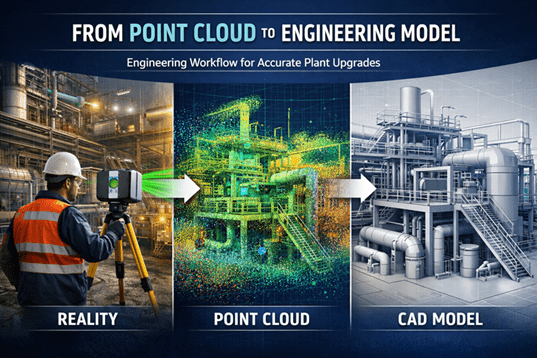
Engineering workflow showing industrial laser scanning, point cloud data, and a CAD model used for plant upgrade design.

Modern mining and industrial infrastructure projects increasingly rely on advanced digital engineering tools to support plant design, equipment upgrades, and infrastructure development. Engineers working in mining environments must often design and model complex systems including materials handling equipment, processing plant infrastructure, and structural steel frameworks.

Engineer using a laser scanner capturing an industrial facility, converting scan data into a point cloud and engineering CAD model.

One of the most commonly used design platforms for mechanical engineering and plant infrastructure modelling is SolidWorks, which allows engineers to develop detailed 3D assemblies and fabrication-ready engineering drawings.

At Hamilton By Design, many projects involve the integration of modern digital engineering workflows with practical industry experience. These workflows often include:

  • Mechanical design for mining infrastructure
  • Bulk materials handling system design
  • Industrial plant layout modelling
  • Point cloud modelling from laser scanning
  • Engineering design for plant upgrades and shutdown projects

Engineering Design in Mining Infrastructure

Mining infrastructure often includes complex systems such as conveyors, transfer stations, processing equipment, and plant structures. Designing or upgrading these systems requires accurate modelling of both existing infrastructure and proposed modifications.

Modern engineering teams frequently combine several technologies during the design process, including:

  • 3D laser scanning to capture existing plant conditions
  • Point cloud modelling to represent real-world infrastructure
  • CAD modelling using platforms such as SolidWorks
  • Engineering drawings and documentation for fabrication and construction

These tools allow engineers to develop more accurate designs and reduce risks when implementing plant modifications or shutdown upgrades.


Engineering Discussions and SolidWorks Design Examples

Engineering professionals often share practical insights, modelling approaches, and design workflows through technical blogs and engineering discussion platforms.

For those interested in SolidWorks modelling techniques, mining infrastructure design concepts, and materials handling engineering, additional discussions can be found on the following engineering blog:

Mining Infrastructure โ€“ SolidWorks Design
https://mininginfrastructuresolidworksdesign.blogspot.com/

The blog explores various topics including mechanical design workflows, industrial equipment modelling, and practical engineering approaches used when designing plant infrastructure.


Supporting Mining Engineering Projects

Hamilton By Design supports mining and industrial operators with engineering services that include mechanical design, infrastructure modelling, and reality capture technologies such as laser scanning.

Learn more about our engineering-grade scanning and modelling services:

Engineering-Grade 3D Laser Scanning for Mining and Industrial Projects
https://www.hamiltonbydesign.com.au/home/engineering-grade-3d-laser-scanning-mining-industrial/

3D Laser Scanning Across Australia
https://www.hamiltonbydesign.com.au/home/engineering-services/3d-laser-scanning/3d-laser-scanning-across-australia/

Capturing Existing Conditions Before Plant Upgrades
https://www.hamiltonbydesign.com.au/capture-existing-conditions-before-plant-upgrades/


3D LiDAR scanning and 3D modelling service button โ€” laser scanner capturing a point cloud for engineering and CAD modelling
Mechanical engineering services

Engineering Knowledge Sharing

Engineering blogs and technical discussion platforms provide an opportunity for engineers, designers, and industry professionals to share knowledge about real-world engineering challenges.

By combining practical industry experience with modern digital engineering tools, the mining and industrial sectors continue to improve the way infrastructure is designed, documented, and upgraded.

For more engineering discussions on SolidWorks design and mining infrastructure modelling, visit:

https://mininginfrastructuresolidworksdesign.blogspot.com

3D CAD Modelling Australia service banner for Hamilton By Design
Australian Drafting logo featuring bold white text reading "Australian Drafting" centred on a blue rounded rectangle background.
Engineering Governance title graphic featuring bold white text reading "Engineering Governance" centred on a blue rounded rectangle background.
Mechanical, Structural & Pipework Drafting service banner by Hamilton By Design featuring white text on a blue background.
Mechanical engineering services
Blue rounded button with the text โ€œSolidWorks Designโ€ in white.
Finite Element Analysis (FEA) engineering simulation button
3D LiDAR Scanning Darwin for engineering surveys, laser scanning, reality capture and point cloud modelling services
3D LiDAR Scanning Australia engineering services for laser scanning, reality capture, scan-to-CAD, Scan-to-BIM and as-built documentation across Australia
3D LiDAR scanning services on the Central Coast providing engineering-grade laser scanning, point cloud capture, scan-to-CAD modelling and industrial reality capture for infrastructure and industrial projects.
3D LiDAR Scanning Perth for engineering surveys, laser scanning, reality capture and point cloud modelling services
3D LiDAR Scanning Sydney for engineering surveys, laser scanning, reality capture and point cloud modelling services
3D LiDAR Scanning Brisbane for engineering surveys, laser scanning, reality capture and point cloud modelling services
3D LiDAR Scanning Canberra for engineering surveys, laser scanning, reality capture and point cloud modelling services
3D LiDAR Scanning Newcastle for engineering surveys, laser scanning, reality capture and point cloud modelling services
3D LiDAR Scanning Adelaide for engineering surveys, laser scanning, reality capture and point cloud modelling services

Scan for Conveyor Transfers

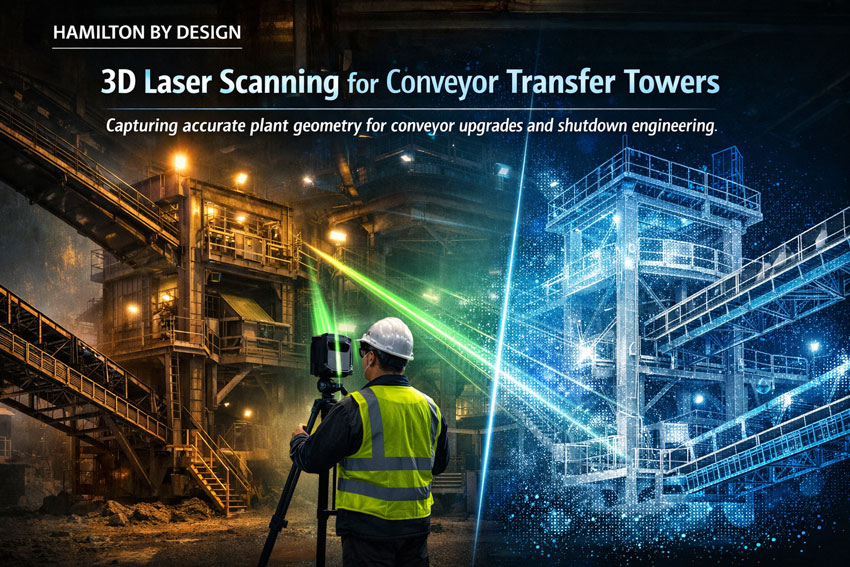
3D laser scanning of a mining conveyor transfer tower capturing point cloud data for engineering modelling.

Conveyor transfer towers are critical components within mining and bulk material handling operations. These structures control the movement of material between conveyors and often contain complex arrangements of chutes, structural steel, maintenance platforms, and access walkways.

Over time, many transfer towers are modified as production requirements change. Equipment upgrades, chute redesigns, and maintenance improvements can result in plant infrastructure that no longer matches the original engineering drawings.

For engineers planning upgrades or maintenance projects, accurate existing condition data is essential. One of the most effective ways to capture this information is through 3D laser scanning.

At Hamilton By Design, engineering-grade scanning is used to capture precise geometry of conveyor transfer towers and surrounding plant infrastructure. This data can then be converted into accurate digital models used for mechanical design, plant upgrades, and engineering analysis.

Engineer performing LiDAR scanning of a conveyor transfer tower in a mining processing plant.

Learn more about our engineering scanning capabilities here:
๐Ÿ‘‰ https://www.hamiltonbydesign.com.au/home/engineering-services/3d-laser-scanning/


Why Conveyor Transfer Towers Are Difficult to Measure

Transfer towers are often some of the most complex areas within a processing plant. They typically contain multiple systems operating within a confined structure including conveyors, transfer chutes, structural supports, and maintenance platforms.

These environments can include:

โ€ข multiple conveyors entering and exiting the structure
โ€ข chute systems with wear liners
โ€ข structural steel frames and supports
โ€ข maintenance walkways and access platforms
โ€ข dust control and service equipment

Because of the tight layout and elevation changes within these structures, traditional measurement methods can be slow and prone to error.

In many facilities, the original engineering drawings may also be outdated due to years of plant modifications.

Accurate measurement is therefore essential when designing upgrades or modifications to conveyor transfer systems.


Using 3D Laser Scanning to Capture Transfer Tower Geometry

Engineering-grade 3D laser scanning uses LiDAR technology to capture millions of spatial measurements of plant infrastructure.

The resulting dataset forms a point cloud model representing the exact geometry of conveyors, structural steel, chutes, and surrounding plant equipment.

This digital model allows engineers to analyse plant layouts and develop accurate engineering designs before physical work begins.

Laser scanning provides several advantages when working in conveyor transfer towers.

Accurate Existing Conditions

Scanning captures the true geometry of plant infrastructure, allowing engineers to design modifications based on reliable data rather than outdated drawings.

Improved Design Planning

Digital models generated from scan data allow engineers to verify clearances and identify potential clashes before installation.

Reduced Shutdown Risk

Engineering teams can plan installation work more effectively using digital models created from scan data.

Faster Data Capture

Laser scanning can capture complex structures quickly compared with traditional measurement methods.


3D Scanning for Mining Shutdown Projects

Many conveyor transfer tower upgrades are performed during planned mining shutdowns, where engineering teams must complete inspections, modifications, and installations within tight timeframes.

Laser scanning provides a fast and reliable way to capture accurate plant geometry before shutdown work begins. Engineers can then analyse the digital model and develop upgrade designs in advance.

This approach reduces the risk of unexpected installation issues during shutdown periods.

You can learn more about scanning applications during plant shutdowns here:

๐Ÿ‘‰ https://www.hamiltonbydesign.com.au/home/engineering-grade-3d-laser-scanning-mining-industrial/3d-scanning-mining-shutdown-projects/


From Laser Scan to Engineering Model

The laser scanning workflow for conveyor transfer towers typically follows a structured process.

  1. Planning scan locations within the transfer tower
  2. Capturing plant geometry using LiDAR scanners
  3. Registering scan positions to create a unified point cloud
  4. Extracting geometry from the point cloud dataset
  5. Creating engineering CAD models for design analysis

These models allow engineers to analyse plant infrastructure and design upgrade solutions with greater confidence.


Reverse Engineering Conveyor Infrastructure

In many mining plants, original equipment drawings are missing or no longer reflect the current infrastructure. In these cases, laser scanning can be used to reverse engineer existing equipment and structures.

By capturing the geometry of conveyors, chutes, and supporting structures, engineers can recreate accurate CAD models used for redesign, replacement components, or plant upgrades.

Hamilton By Design provides reverse engineering services using high-accuracy scanning technology.

Learn more about this process here:

๐Ÿ‘‰ https://www.hamiltonbydesign.com.au/reverse-engineer-3d-scanning/


Digital Engineering for Conveyor Transfer Towers

Digital models created from laser scanning allow engineers to analyse plant infrastructure in a controlled environment before work begins on site.

These models support engineering tasks such as:

โ€ข chute design and optimisation
โ€ข conveyor upgrade planning
โ€ข structural modifications
โ€ข clash detection and layout verification
โ€ข maintenance planning and documentation

For mining operations, this approach improves the reliability of plant upgrade projects and reduces engineering risk.


Engineering Support from Hamilton By Design

Hamilton By Design provides engineering-led 3D laser scanning and mechanical design services supporting mining and industrial infrastructure projects across Australia.

Our services include:

โ€ข conveyor transfer tower scanning
โ€ข plant upgrade engineering
โ€ข mechanical design and modelling
โ€ข reverse engineering of plant infrastructure
โ€ข digital engineering models and inspections

By combining scanning technology with engineering expertise, we help mining and industrial clients capture accurate plant geometry and convert it into practical engineering solutions.


Hamilton By Design logo displayed on a blue tilted rectangle with a grey gradient background

Learn More About Engineering-Grade Laser Scanning

For a full overview of engineering-grade laser scanning and its applications in mining and industrial plants, visit:

๐Ÿ‘‰ https://www.hamiltonbydesign.com.au/home/engineering-grade-3d-laser-scanning-mining-industrial/


Anthony Hamilton
Principal Engineer
Hamilton By Design


Name
Would you like us to arrange a phone consultation for you?
Address

3D CAD Modelling Australia service banner for Hamilton By Design

Engineering-Grade 3D Scanning in Papua New Guinea

3D laser scanner capturing point cloud data of remote processing plant.

Papua New Guinea presents some of the most demanding industrial environments in the Asia-Pacific region. Remote terrain, ageing infrastructure, complex plant layouts and tight shutdown windows demand precision, efficiency and engineering certainty.

Hamilton By Design delivers engineering-grade 3D scanning services in Papua New Guinea, supporting mining, processing, infrastructure and industrial projects with accurate digital capture and practical engineering outcomes.

If you are planning a plant expansion, shutdown upgrade, brownfield modification or condition assessment in PNG, high-resolution laser scanning provides the clarity your project needs.

๐Ÿ‘‰ Learn more about our dedicated PNG services here:
https://www.hamiltonbydesign.com.au/3d-scanning-papua-new-guinea/


Industrial mining facility in PNG captured with engineering-grade 3D scanning technology.

Why 3D Laser Scanning Matters in PNG

Traditional measurement methods are time-consuming and prone to error โ€” especially in remote or operational sites. 3D laser scanning eliminates guesswork by capturing millions of precise data points in a matter of hours.

The result is a complete and reliable as-built digital record of your asset.

This enables:

  • Accurate retrofit and tie-in design
  • Reduced site revisits
  • Improved shutdown planning
  • Clash detection before fabrication
  • Safer project execution

In remote PNG environments, reducing mobilisation and rework is not just convenient โ€” it is critical to project success.


From Point Cloud to Engineering Outcome

At Hamilton By Design, we go beyond scanning.

We transform raw point cloud data into usable engineering outputs including:

  • SolidWorks-ready 3D models
  • Structural and mechanical layouts
  • Fabrication drawings
  • Design verification data
  • Digital asset records

Our difference is simple: we are engineers first. Scanning is integrated directly into mechanical and structural design workflows, ensuring data captured onsite translates into practical, buildable solutions.

For a broader overview of our national capability, explore our full 3D laser scanning services here:
https://www.hamiltonbydesign.com.au/home/engineering-services/3d-laser-scanning/


Supporting Mining & Industrial Projects Across Papua New Guinea

Our PNG capability supports:

  • Mining processing plants
  • Conveyors and transfer stations
  • Pump stations and pipework systems
  • Structural steel and platforms
  • Smelter and refinery infrastructure
  • Brownfield plant upgrades

Whether your site is operational, remote or in early planning stages, we deliver data accuracy that reduces risk and accelerates decision-making.


Reduce Risk. Increase Certainty.

In complex industrial environments, uncertainty drives cost.

3D laser scanning provides:

  • Accurate geometry
  • Faster design cycles
  • Reduced fabrication errors
  • Improved stakeholder confidence

When combined with Hamilton By Designโ€™s engineering capability, it becomes a powerful project delivery tool.


Delivering Engineering Certainty in Papua New Guinea

If your organisation is undertaking upgrades, expansions or asset assessments in Papua New Guinea, we are ready to support your project.

Explore our dedicated PNG scanning capability:
๐Ÿ‘‰ https://www.hamiltonbydesign.com.au/3d-scanning-papua-new-guinea/

Or view our broader engineering-led 3D laser scanning services:
๐Ÿ‘‰ https://www.hamiltonbydesign.com.au/home/engineering-services/3d-laser-scanning/


3D LiDAR scanning and 3D modelling service button โ€” laser scanner capturing a point cloud for engineering and CAD modelling
Mechanical engineering services
Name
Would you like us to arrange a phone consultation for you?
Address

3D CAD Modelling Australia service banner for Hamilton By Design
Australian Drafting logo featuring bold white text reading "Australian Drafting" centred on a blue rounded rectangle background.
Engineering Governance title graphic featuring bold white text reading "Engineering Governance" centred on a blue rounded rectangle background.
Mechanical, Structural & Pipework Drafting service banner by Hamilton By Design featuring white text on a blue background.
Mechanical engineering services
Blue rounded button with the text โ€œSolidWorks Designโ€ in white.
Finite Element Analysis (FEA) engineering simulation button
3D LiDAR Scanning Darwin for engineering surveys, laser scanning, reality capture and point cloud modelling services
3D LiDAR Scanning Australia engineering services for laser scanning, reality capture, scan-to-CAD, Scan-to-BIM and as-built documentation across Australia
3D LiDAR scanning services on the Central Coast providing engineering-grade laser scanning, point cloud capture, scan-to-CAD modelling and industrial reality capture for infrastructure and industrial projects.
3D LiDAR Scanning Perth for engineering surveys, laser scanning, reality capture and point cloud modelling services
3D LiDAR Scanning Sydney for engineering surveys, laser scanning, reality capture and point cloud modelling services
3D LiDAR Scanning Brisbane for engineering surveys, laser scanning, reality capture and point cloud modelling services
3D LiDAR Scanning Canberra for engineering surveys, laser scanning, reality capture and point cloud modelling services
3D LiDAR Scanning Newcastle for engineering surveys, laser scanning, reality capture and point cloud modelling services
3D LiDAR Scanning Adelaide for engineering surveys, laser scanning, reality capture and point cloud modelling services

Engineering-Grade 3D Laser Scanning for Mining & Industrial Projects

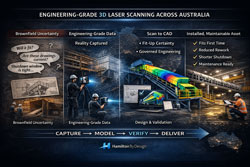
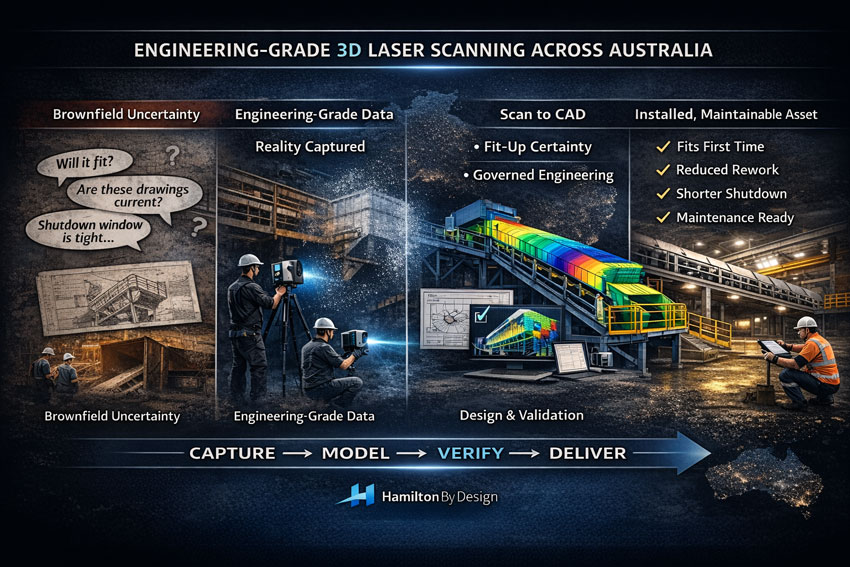
Executive infographic showing engineering-grade 3D laser scanning workflow from brownfield uncertainty to installed mining asset.

When a project slows down, itโ€™s rarely because the engineering team lacks capability. Itโ€™s usually because the site reality is unclear: legacy drawings donโ€™t match whatโ€™s installed, shutdown windows are tight, and one wrong assumption can cascade into rework, delays, and variation costs.

Engineering-grade 3D laser scanning is how you remove uncertainty early and build momentum fast.

At Hamilton By Design, we deliver 3D engineering scans that donโ€™t stop at โ€œcapturing points.โ€ We focus on engineering outcomesโ€”accurate as-built evidence, point cloud processing, scan-to-CAD modelling, and fit-for-purpose deliverables that support design, fabrication, and installation across mining and heavy industry.


Mining infrastructure upgrade workflow using LiDAR scanning, CAD modelling and engineering validation.

Why โ€œEngineering-Gradeโ€ Scanning Matters

Not all scanning services are equal. Scan density alone doesnโ€™t guarantee a usable engineering resultโ€”what matters is how the scan is controlled, interpreted, and translated into engineering decisions.

If youโ€™re planning upgrades in brownfield environments (plants, conveyors, chutes, pump skids, steelwork tie-ins), engineering-grade scanning helps you:

  • Verify true geometry before you design
  • Reduce shutdown risk and rework
  • Improve fit-up confidence for fabricated parts
  • Create accurate as-built documentation that stays useful over time

To understand what โ€œengineering-gradeโ€ really means, start here:
Engineering-Grade LiDAR Scanning (service page)
https://www.hamiltonbydesign.com.au/home/engineering-services/engineering-grade-lidar-scanning/

Engineering-Grade LiDAR Scanning (article/definition page)
https://www.hamiltonbydesign.com.au/engineering-grade-lidar-scanning/


Our Core 3D Engineering Scan Capability

3D Laser Scanning โ€“ Service Overview

This is the best โ€œhubโ€ page for prospects who want the full scanning capability and what it supports (engineering models, documentation, project delivery).
https://www.hamiltonbydesign.com.au/home/engineering-services/3d-laser-scanning/

3D Laser Scanning for Engineering

If your audience is engineers, project managers, and maintenance teams, this page speaks directly to engineering use-cases and how scanning reduces risk.
https://www.hamiltonbydesign.com.au/home/engineering-services/3d-laser-scanning/3d-laser-scanning-for-engineering/

Engineering-Grade 3D Laser Scanning Across Australia

For national capability (remote sites, shutdown support, travel-ready service delivery), use this page as the authority link.
https://www.hamiltonbydesign.com.au/engineering-grade-3d-laser-scanning-australia/

3D Laser Scanning Across Australia

A complementary national service page that reinforces coverage across mining, industry, and infrastructure.
https://www.hamiltonbydesign.com.au/home/engineering-services/3d-laser-scanning/3d-laser-scanning-across-australia/


Turning Point Clouds into Real Project Momentum

A point cloud is evidenceโ€”but the value is unlocked when that evidence becomes engineering geometry and fabrication-ready decisions.

Hamilton By Design supports scan-based workflows that typically include:

  • Scan control and site capture planning
  • Point cloud processing aligned to engineering datums
  • Model development for fit-up checks and tie-ins
  • Documentation updates and revision control pathways

For scanning + modelling capability in one place:
3D LiDAR Scanning and 3D Modelling (Sydney)
https://www.hamiltonbydesign.com.au/home/3d-lidar-scanning-and-3d-modelling-in-sydney/

For reverse engineering where the goal is better outcomes, not just copying old geometry:
Reverse Engineer 3D Scanning
https://www.hamiltonbydesign.com.au/reverse-engineer-3d-scanning/


Construction & Fit-Out Scanning (Sydney and Greater Metro)

For construction, retrofit, or building services environments, scanning often supports safe coordination, clash reduction, and fast design decisions.

If your audience includes builders, architects, MEP contractors, or refurbishment teams, link these pages:

3D Scanning for Construction in Sydney
https://www.hamiltonbydesign.com.au/home/engineering-services/3d-scanning-sydney/3d-scanning-for-construction-in-sydney/

3D Construction Scan Sydney
https://www.hamiltonbydesign.com.au/home/engineering-services/3d-scanning-sydney/3d-scanning-services-in-sydney/3d-construction-scan-sydney/

3D Scanning & BIM Across Greater Sydney
https://www.hamiltonbydesign.com.au/home/engineering-services/3d-scanning-sydney/3d-scanning-bim-greater-sydney/

3D LiDAR Scanning Chatswood & Greater Sydney
https://www.hamiltonbydesign.com.au/home/engineering-services/3d-scanning-sydney/3d-scanning-services-in-sydney/mechanical-engineers-in-sydney-hamilton-by-design/3d-lidar-scanning-chatswood/


Mining and Process Plant Scanning (CHPP and Heavy Industry)

Mining projects demand more than visual accuracyโ€”they demand engineering judgement around interfaces, access constraints, and shutdown deliverability.

If you want a clear scanning-to-mining outcome page, use:
CHPP Engineering, 3D Scanning & Upgrade Services
https://www.hamiltonbydesign.com.au/home/engineering-services/mining-engineering-services-australia/chpp-engineering-3d-scanning-upgrade-services/

For an educational/insight piece that supports credibility and internal linking:
How LiDAR Scanning is Transforming Mining Process Plants
https://www.hamiltonbydesign.com.au/seeing-the-unseen-how-lidar-scanning-is-transforming-mining-process-plants/


Regional and Project Delivery Pages

These pages are useful for local SEO and converting clients who search by region:

3D Scanning Engineering in Brisbane
https://www.hamiltonbydesign.com.au/home/engineering-services/3d-laser-scanning/3d-scanning-engineering-brisbane/

3D Laser Scanning & Mechanical Engineering in Wyong (NSW Central Coast)
https://www.hamiltonbydesign.com.au/nsw-central-coast/3d-laser-scanning-mechanical-engineering-in-wyong-nsw/


Ready to Start With an Engineering-Grade Scan?

If your project involves brownfield upgrades, shutdown tie-ins, or legacy infrastructure that canโ€™t be trusted from drawings alone, the fastest way to move forward is to capture reality, then design with certainty.

Start with the main scanning overview and follow the pathway that matches your project:


3D LiDAR scanning and 3D modelling service button โ€” laser scanner capturing a point cloud for engineering and CAD modelling
Mechanical engineering services
Name
Would you like us to arrange a phone consultation for you?
Address

3D CAD Modelling Australia service banner for Hamilton By Design

Mechanical Engineering | Structural Engineering