3D Laser Scanning for Industrial Plants in Sydney

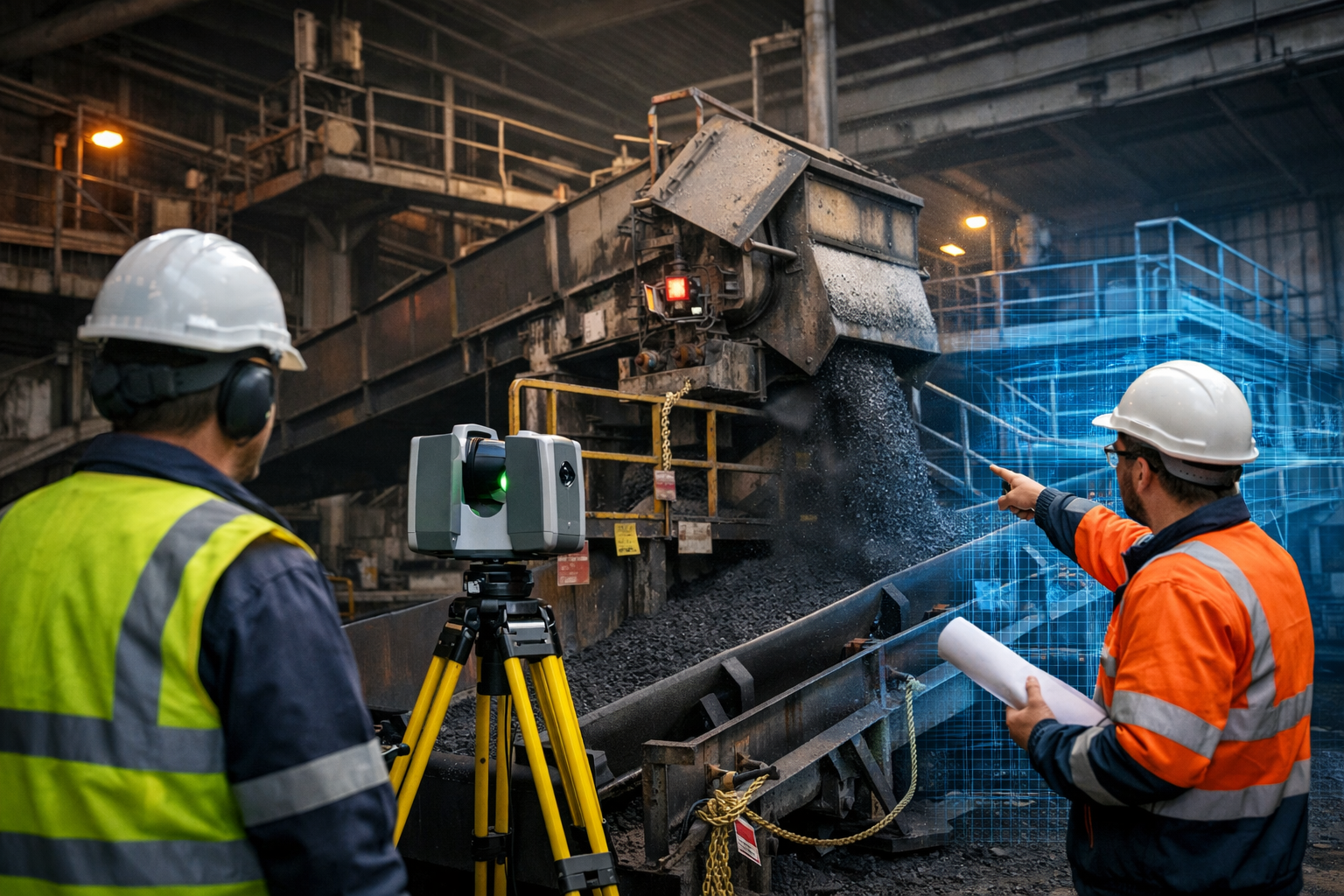
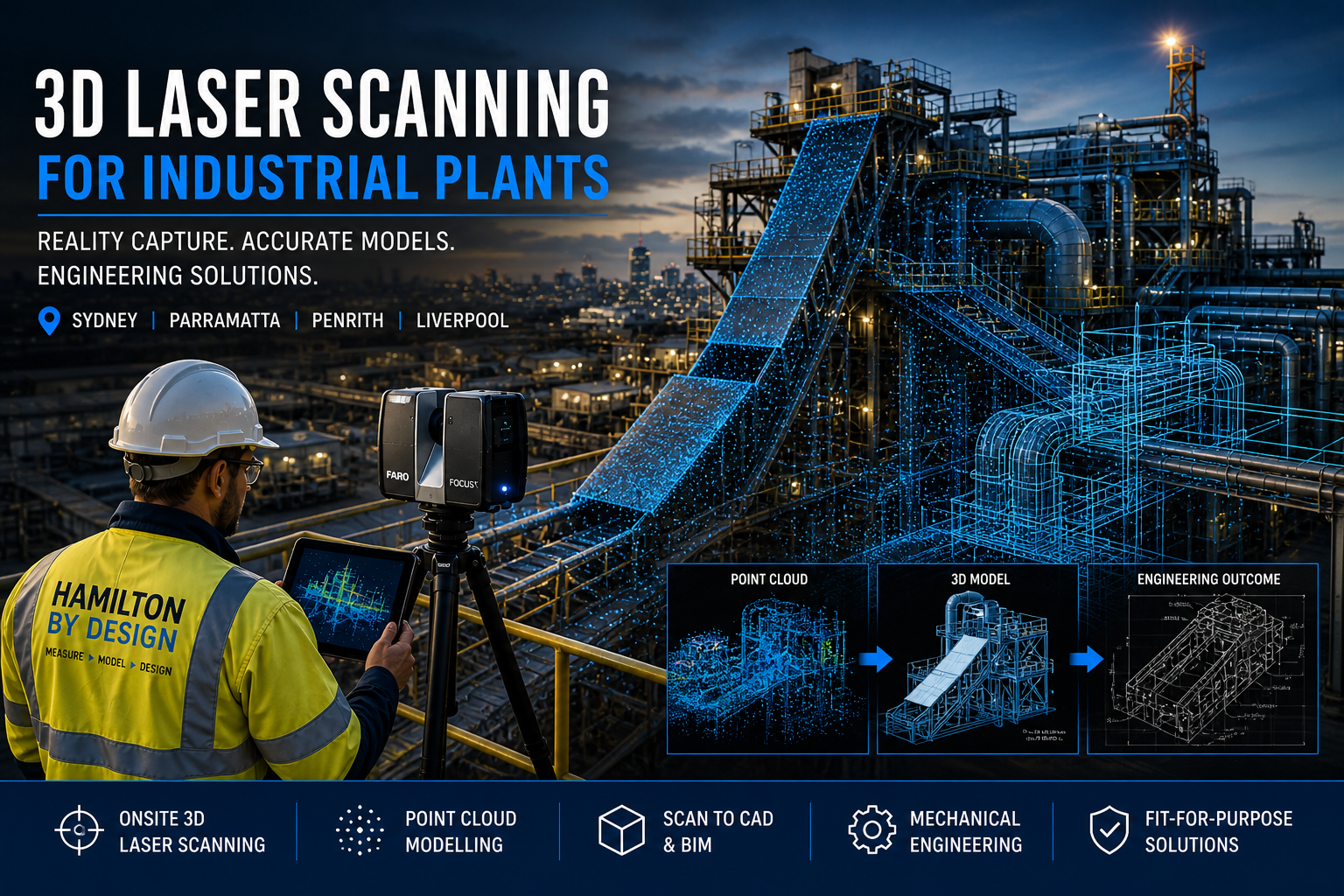
Industrial plant 3D laser scanning in Sydney showing engineer using LiDAR scanner with point cloud overlay and CAD modelling for engineering design

Point Cloud to CAD | Mechanical Engineering | Western Sydney Specialists

At Hamilton By Design, we provide engineering-grade 3D laser scanning for industrial plants, delivering accurate site data, detailed CAD models, and fit-for-purpose mechanical design solutions across Sydney, Parramatta, Penrith, and Liverpool.

Unlike typical 3D scanning companies, we are mechanical engineers first. That means every scan is captured with the end goal in mind โ€” design, fabrication, and real-world application.


3D Laser Scanning Services (Sydney & Western Sydney)

We offer onsite and mobile 3D scanning services across:

  • Parramatta
  • Penrith
  • Liverpool
  • Greater Western Sydney

Our LiDAR scanning services are ideal for:

  • Industrial plants
  • Manufacturing facilities
  • Processing plants
  • Construction and building upgrades

If youโ€™re searching for a โ€œ3D scanning company near meโ€, we deliver fast, accurate, and engineering-ready results.
3D CAD Modelling Australia service banner for Hamilton By Design

From Point Cloud to CAD (Engineering-Ready Models)

Scanning is only the first step.

We convert scan data into:

  • Point cloud modelling
  • 3D CAD models (SolidWorks, STEP, Parasolid)
  • 2D AutoCAD drawings
  • Scan-to-BIM models

This allows for:

  • Accurate design modifications
  • Clash detection
  • Fabrication-ready outputs

Mechanical Engineering Services

Hamilton By Design provides full mechanical engineering support, including:

  • Process equipment design
  • Structural and mechanical upgrades
  • Preventative maintenance design
  • Fit-for-purpose engineering solutions

All work is aligned with relevant Australian Standards, including AS 4991 where applicable.


Mining & Bulk Handling (High-Value Applications)

We specialise in mining and bulk materials handling systems, including:

  • Coal chutes and transfer stations
  • Conveyor systems
  • Outbye mining infrastructure
  • Header transition chutes

Custom Design vs Off-the-Shelf

Off-the-shelf chute designs often lead to:

  • Poor fit
  • Increased wear
  • High maintenance costs

Our approach:

  • Scan existing plant conditions
  • Develop custom designs based on real data
  • Deliver solutions that reduce downtime and improve performance

Building & Construction Scanning

We also support:

  • Building scanning services
  • Construction site verification
  • Scan-to-BIM for refurbishment projects

Ideal for commercial, industrial, and infrastructure upgrades.


Industries We Support

  • Industrial plants
  • Manufacturing facilities
  • Food processing plants
  • Mining and bulk handling
  • Construction and infrastructure

Locations We Service

We provide 3D laser scanning and engineering services across:

Sydney
Parramatta
Penrith
Liverpool
Western Sydney

With project capability across NSW and Australia.


Common Questions

What are the best 3D scanning platforms?

We use industry-leading LiDAR systems such as FARO and Leica. However, the real value comes from how the data is used in engineering design.


3D LiDAR scanning and 3D modelling service button โ€” laser scanner capturing a point cloud for engineering and CAD modelling
Mechanical engineering services

Do I need scan-to-CAD or just scanning?

Most industrial projects require CAD models and engineering input โ€” not just raw scan data.


Who provides professional 3D scanning near me?

Engineering-led companies like Hamilton By Design provide usable outcomes, not just visual data.


Hamilton By Design logo displayed on a blue tilted rectangle with a grey gradient background

Get Started

If you need accurate site data, modelling, or engineering support for an industrial project, contact Hamilton By Design today.
Related Sydney Services

Hamilton By Design provides engineering-led 3D scanning, LiDAR scanning, mechanical engineering and digital engineering services throughout Sydney and Greater Sydney.

Explore our related Sydney services:


  • 3D Scanning Sydney โ€“ Engineering-grade terrestrial laser scanning, as-built surveys and point cloud capture for industrial, infrastructure and commercial projects.
  • Reality Capture Sydney โ€“ High-accuracy reality capture, digital twins, asset documentation and engineering-grade site verification.
  • Scan to CAD Sydney โ€“ Convert point cloud data into AutoCAD, SolidWorks, Inventor and other engineering-ready CAD deliverables.
  • Point Cloud Modelling Sydney โ€“ Engineering-grade point cloud processing, clash detection, as-built verification and 3D modelling.
  • Mechanical Engineering Sydney โ€“ Mechanical design, plant upgrades, materials handling systems, conveyors, chutes, platforms and engineering support.
  • Structural Drafting Sydney โ€“ Structural steel drafting, fabrication drawings, GA drawings, workshop detailing and as-built documentation.

Hamilton By Design supports projects throughout Sydney CBD, Parramatta, Liverpool, Penrith, Blacktown, Chatswood, Alexandria, Mascot, Newcastle and the Central Coast.

Blue banner graphic displaying the text "Point Cloud to CAD - Australia" in large white lettering, representing point cloud processing, scan-to-CAD conversion and digital engineering services across Australia.
Blue banner graphic displaying the text "Scan to CAD Sydney" in large white lettering, representing engineering-led point cloud to CAD conversion, LiDAR scanning and digital engineering services in Sydney.
Blue banner graphic displaying the text "Reality Capture Sydney - CBD" in large white lettering, representing engineering-led reality capture, LiDAR scanning and digital engineering services within Sydney CBD commercial buildings and infrastructure.

Coal Chute Design

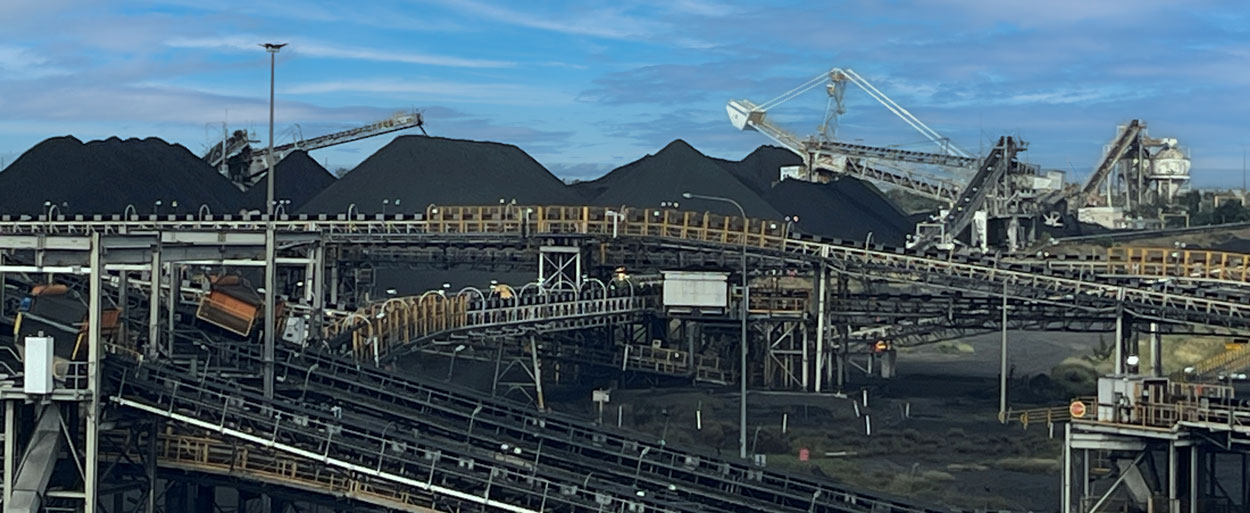
Coal handling and processing facility with multiple conveyors, stockpiles of coal, and stacking-reclaiming machinery operating under a blue sky

A Systems Engineering Approach for Reliable Coal Handling

In coal mining operations, transfer chutes play a deceptively small role with disproportionately large impacts. They sit quietly between conveyors, crushers, and stockpiles, directing tonnes of coal every hour. Yet when a chute is poorly designed or not maintained, the whole coal handling system suffers: blockages stop production, dust creates safety and environmental hazards, and worn liners demand costly maintenance shutdowns.

At Hamilton by Design, we believe coal chute design should be treated not as a piece of steelwork, but as a systems engineering challenge. By applying systems thinking, we connect stakeholder requirements, material behaviour, environmental factors, and lifecycle performance into a holistic design approach that delivers long-term value for mining operations in the Hunter Valley and beyond.


Coal Chutes in the Mining Value Chain

Coal chutes form the links in a chain of bulk material handling equipment:

  • ROM bins and crushers feed coal into the system.
  • Conveyors carry coal across site, often over long distances.
  • Transfer chutes guide coal between conveyors or onto stockpiles.
  • Load-out stations deliver coal to trains or ports for export.

Although they are small compared to conveyors or crushers, coal chutes are often where problems first appear. A well-designed chute keeps coal flowing consistently; a poorly designed one causes buildup, spillage, dust emissions, and accelerated wear. Thatโ€™s why leading operators now see chute design as a critical system integration problem rather than just a fabrication task.

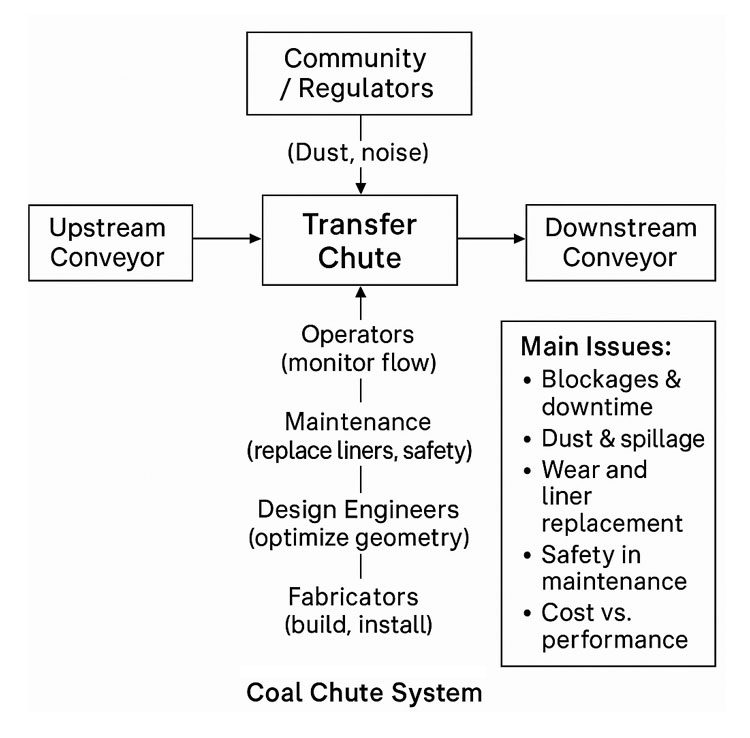
Flow diagram of a coal chute system showing upstream and downstream conveyors, the transfer chute, stakeholder interactions, and main issues such as blockages, dust, wear, maintenance safety, and cost versus performance

Systems Engineering in Coal Chute Design

Systems engineering is the discipline of managing complexity in engineering projects. It recognises that every component is part of a bigger system, with interdependencies and trade-offs. Applying this mindset to coal chute design ensures that each chute is considered not in isolation, but as part of the broader coal handling plant.

1. Requirements Analysis

The first step is gathering and analysing stakeholder and system requirements:

  • Throughput capacity: e.g. handling 4,000 tonnes per hour of coal.
  • Material properties: coal size distribution, moisture content, abrasiveness, stickiness.
  • Safety requirements: compliance with AS/NZS 4024 conveyor safety standards, confined space entry protocols, guarding, and interlocks.
  • Environmental compliance: dust, noise, and spillage limits.
  • Maintenance objectives: target liner life (e.g. 6 months), maximum downtime per liner change (e.g. 30 minutes with two workers).

A structured requirements phase reduces the risk of costly redesign later in the project.


2. System Design and Integration

Once requirements are defined, the design process considers how the chute integrates into the coal handling system:

  • Flow optimisation using DEM: Discrete Element Modelling allows engineers to simulate coal particle behaviour, test different geometries, and reduce blockages before steel is ever cut.
  • Dust control strategies: designing chutes with enclosures, sprays, and extraction ports to minimise airborne dust.
  • Wear management: predicting wear zones, selecting suitable liner materials (ceramic, Bisplate, rubber composites), and ensuring easy access for replacement.
  • Structural and safety design: ensuring the chute can withstand dynamic loads, vibration, and impact, while providing safe access platforms and guarding.
  • Interfaces with conveyors and crushers: alignment, skirt seals, trip circuits, and integration with PLC/SCADA control systems.

By treating the chute as a subsystem with multiple interfaces, designers avoid the โ€œbolt-onโ€ mentality that often leads to operational headaches.


3. Verification and Validation

The systems engineering V-model reminds us that every requirement must be verified and validated:

  • Component verification: weld inspections, liner hardness testing, nozzle spray checks.
  • Subsystem verification: chute section fit-up, guard gap measurements, coating checks.
  • Integration testing: conveyor-chute alignment, PLC spray interlocks, trip circuits.
  • System validation: commissioning with live coal flow, dust monitoring against limits, maintainability time trials for liner change.

By linking requirements directly to tests in a traceability matrix, operators can be confident that the chute is not only built to spec, but proven in operation.


Lifecycle Engineering: Beyond Installation

Good chute design doesnโ€™t stop at commissioning. A lifecycle engineering mindset ensures the chute continues to deliver performance over years of operation.

  • Maintainability: modular liners, captive fasteners, hinged access doors, and clear procedures reduce downtime and improve worker safety.
  • Reliability: DEM-informed designs and wear-resistant materials reduce the frequency of blockages and rebuilds.
  • Sustainability: dust suppression and enclosure strategies reduce environmental impact and support community and regulatory compliance.
  • Continuous improvement: feedback loops from operators and maintenance teams feed into the next design iteration, closing the systems engineering cycle.

A Rich Picture of Coal Chute Complexity

Visualising the coal chute system as a rich picture reveals its complexity:

  • Operators monitoring flow from control rooms.
  • Maintenance crews working in confined spaces, replacing liners.
  • Design engineers using DEM simulations to model coal flow.
  • Fabricators welding heavy plate sections on site.
  • Environmental officers measuring dust levels near transfer points.
  • Regulators and community monitoring compliance.

This web of relationships shows why coal chute design benefits from systems thinking. No single stakeholder sees the whole pictureโ€”but systems engineering does.


Benefits of a Systems Engineering Approach

When coal chute design is guided by systems engineering principles, operators gain:

  • Higher reliability: smoother coal flow with fewer blockages.
  • Lower maintenance costs: liners that last longer and can be swapped quickly.
  • Improved compliance: dust, spillage, and safety issues designed out, not patched later.
  • Lifecycle value: less unplanned downtime and a lower total cost of ownership.

In short, systems engineering transforms coal chutes from weak links into strong connectors in the mining value chain.


Case Study: Hunter Valley Context

In the Hunter Valley, coal mines have long struggled with transfer chute problems. Companies like T.W. Woods, Chute Technology, HIC Services, and TUNRA Bulk Solids have all demonstrated the value of combining local fabrication expertise with advanced design tools. Hamilton by Design builds on this ecosystem by applying structured systems engineering methods, ensuring each chute project balances performance, safety, cost, and sustainability.


Conclusion

Coal chute design might seem like a small detail, but in mining, details matter. When transfer chutes fail, production stops. By applying systems engineering principlesโ€”from requirements analysis and DEM modelling to verification, lifecycle planning, and continuous improvementโ€”we can design coal chutes that are reliable, maintainable, and compliant.

At Hamilton by Design, we believe in tackling these challenges with a systems mindset, delivering solutions that stand up to the realities of coal mining.


Are you struggling with coal chute blockages, dust, or costly downtime in your coal handling system?

Hamilton By Design logo displayed on a blue tilted rectangle with a grey gradient background

Contact Hamilton by Design today and discover how our systems engineering expertise in coal chute design can optimise your mining operations for performance, safety, and sustainability.

Mechanical Engineering | Structural Engineering

Mechanical Drafting | Structural Drafting

3D CAD Modelling | 3D Scanning

Chute Design

SolidWorks Contractors in Australia

Hamilton By Design โ€“ Blog

Our clients:

Name
Would you like us to arrange a phone consultation for you?
Address
Finite Element Analysis (FEA) engineering simulation button
Mechanical engineering services

Chute Design At Hamilton By Design

Coal plant shutdown engineering using a 3D laser scanner to capture conveyor and transfer chute infrastructure.

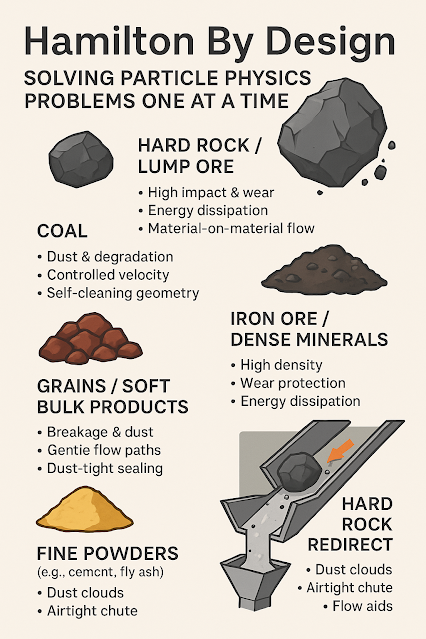
At Hamilton by Design, we believe that every bulk material transfer is an opportunity for improvement. What appears to be a simple flow of rock, coal, grain, or powder is, in reality, a particle physics problem waiting to be solved. By approaching these challenges with precision, creativity, and hands-on knowledge, we deliver chute designs that do more than move material โ€” they protect assets, enhance performance, and improve the bottom line.

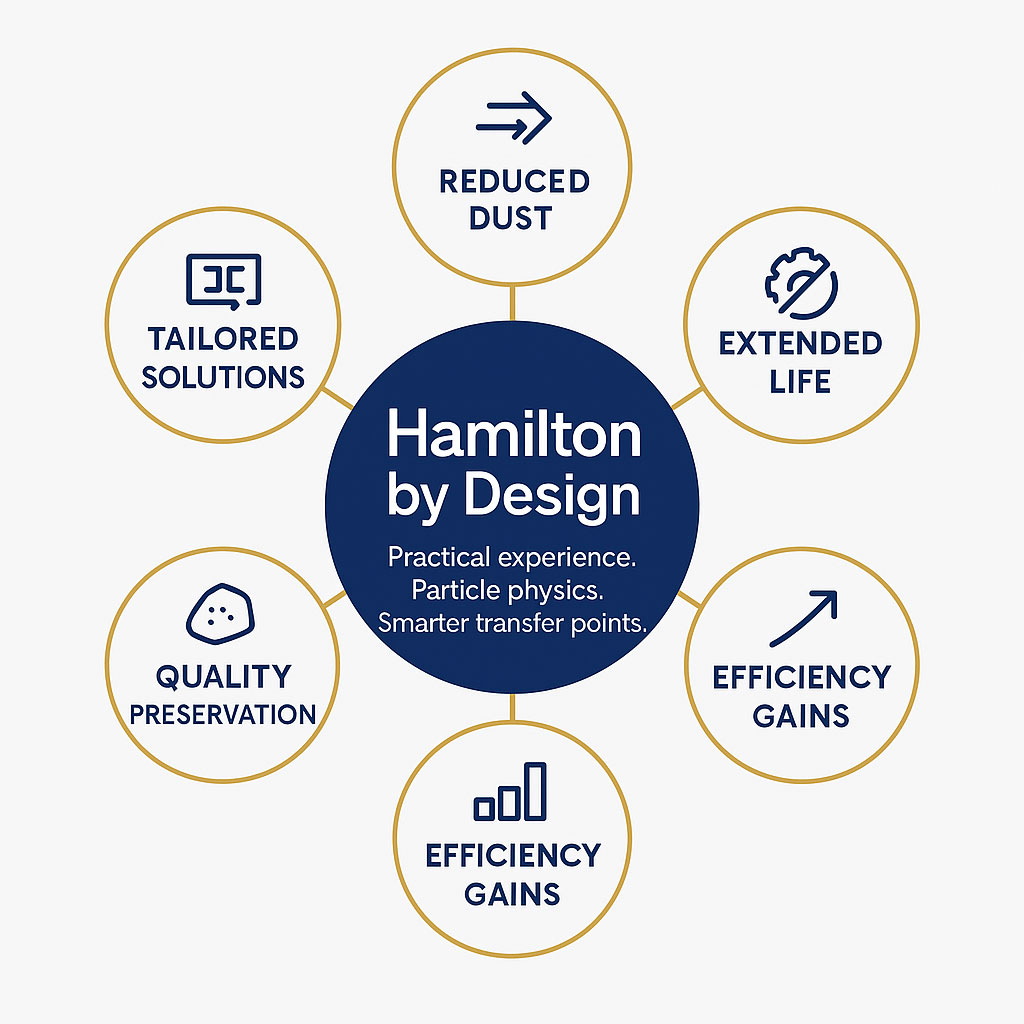
Infographic showing Hamilton By Design in a central blue circle with the text โ€˜Practical experience. Particle physics. Smarter transfer points.โ€™ Surrounding circles highlight benefits: reduced dust, extended life, efficiency gains, quality preservation, and tailored solutions.
3D LiDAR scanning and 3D modelling service button โ€” laser scanner capturing a point cloud for engineering and CAD modelling
Mechanical engineering services

We are a small, specialised company with a wealth of on-site experience. Our engineers have spent years in the field, watching, listening, and learning how different materials behave under real conditions. This raw experience gives us a unique advantage: we can see and understand particle flow first-hand, not just through numbers on a screen. While many large organisations rely solely on computer models, we combine advanced simulation with practical insight, ensuring solutions that work not only in theory but also in practice.

Our team thrives on solving the complex problems others overlook:

  • Redirecting hard rock at speed without spillage or damage.
  • Handling sticky coal without blockages or hang-ups.
  • Containing fine powders without dust plumes or health risks.
  • Transferring fragile grains without breakage or product loss.
  • Extending chute, liner, and belt life with robust material-on-material flow designs.

We approach every challenge with the mindset that your success is our success. When your plant runs reliably, safely, and efficiently, we succeed alongside you. Thatโ€™s why we design transfer points that:

  • Absorb and dissipate energy from high-impact lumps.
  • Control dust and minimise degradation for cleaner, safer operations.
  • Extend equipment life by reducing wear and maintenance.
  • Adapt to variability in feed size, flow, and moisture.
  • Boost throughput and availability by minimising stoppages.

In a world where margins are tight and environmental responsibility is critical, Hamilton by Design offers a personal, client-focused approach that puts performance and partnership at the centre. We are not a large organisation pushing generic solutions โ€” we are a dedicated team that listens, observes, and engineers smarter outcomes, one particle physics problem at a time.

Our clients:


For more information, Coal Chute Design

Hamilton By Design logo displayed on a blue tilted rectangle with a grey gradient background


Name
Would you like us to arrange a phone consultation for you?
Address