Mechanical Engineering Port of Newcastle | 3D Scanning

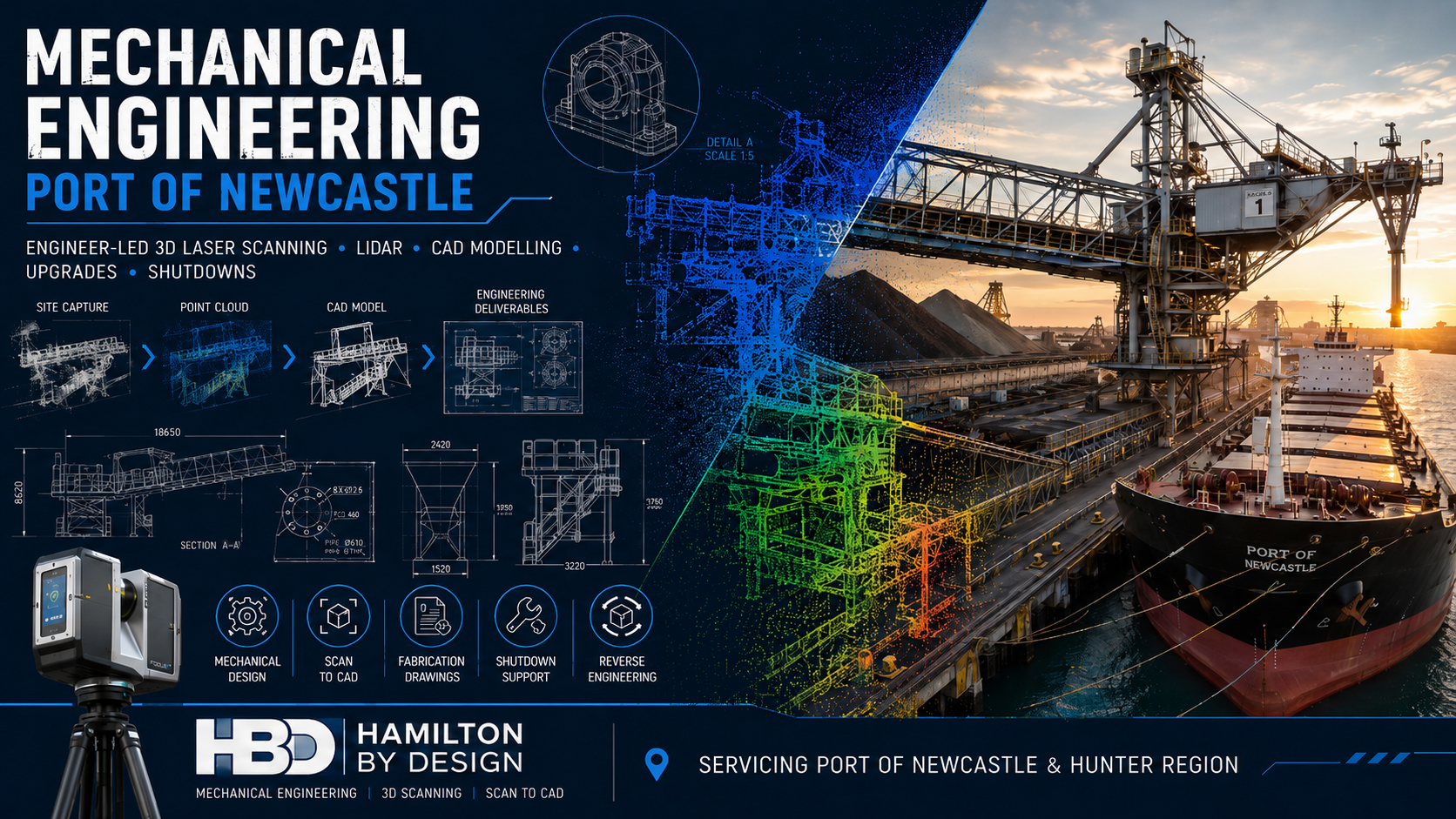
Mechanical engineering at the Port of Newcastle showing a bulk cargo ship, ship loader, conveyors, LiDAR scanner, point-cloud data and engineering drawings.

Engineer-Led 3D Laser Scanning, CAD Modelling and Mechanical Engineering for Port Assets

Port infrastructure operates under demanding mechanical, environmental and operational conditions.

Blue line icon showing a port crane loading a cargo ship while a tripod-mounted LiDAR scanner captures the vessel and crane.

Ship loaders, conveyors, transfer chutes, hoppers, pipework, access platforms, wharf equipment and structural support systems must operate reliably while being exposed to vibration, corrosion, abrasive materials, heavy loads and continuous production demands.

When these assets require modification, replacement or refurbishment, engineering decisions need to be based on accurate information about the equipment and surrounding site conditions.

Hamilton By Design provides mechanical engineering services for Port of Newcastle projects, combining engineering-grade 3D laser scanning, LiDAR reality capture, Scan to CAD, mechanical design and fabrication documentation.

Our integrated approach helps port operators, terminal operators, consultants, contractors and fabricators plan upgrades and shutdown work around the actual installed condition of the facility.


Mechanical Engineering for Port of Newcastle Assets

The Port of Newcastle contains a broad mix of coal, bulk-material, liquid-bulk, general-cargo, fuel, rail and logistics infrastructure. Its operating facilities include coal terminals, bulk-liquid terminals, storage areas, road and rail connections, multipurpose berths and associated materials-handling equipment.

Mechanical-engineering support may be required for assets such as:

  • Ship loaders and unloaders
  • Belt conveyors
  • Transfer stations
  • Chutes and hoppers
  • Feeders and gates
  • Pipework and pumping systems
  • Mechanical skids
  • Wharf-mounted equipment
  • Crane interfaces
  • Access platforms and walkways
  • Machine guards
  • Dust-extraction systems
  • Equipment supports
  • Maintenance lifting systems
  • Replacement components

Hamilton By Design can support these projects from initial site capture through to CAD modelling, engineering development and fabrication drawings.


Why Port Engineering Projects Need Accurate Existing-Condition Data

Port facilities frequently contain equipment that has been modified over many years.

An asset may have been:

  • Repaired
  • Reinforced
  • Relocated
  • Replaced
  • Extended
  • Distorted
  • Worn
  • Supplemented with additional steelwork
  • Modified without corresponding drawing updates

Original drawings remain useful, but they may not represent the current physical arrangement.

Hamilton By Design uses engineering-grade 3D scanning in Newcastle to capture the visible position and geometry of existing equipment, structures and services.

The registered point cloud can then provide a reliable basis for mechanical design, fit-up checks, installation planning and engineering studies.


Engineer-Led 3D Laser Scanning

A useful port scan requires more than simply positioning a scanner on site.

The capture should be planned around the engineering purpose of the project.

Before scanning, we consider:

  • The proposed modification
  • Critical tie-in points
  • Required accuracy
  • Equipment interfaces
  • Access restrictions
  • Installation routes
  • Crane and lifting requirements
  • Areas requiring detailed modelling
  • File-format requirements
  • Coordinate-control requirements

This helps ensure that the point cloud captures the information required by the engineers, designers and fabricators who will use it.

Our existing 3D Scanning Port of Newcastle service supports port infrastructure, ship loaders, conveyors, structural steel, shutdowns and brownfield upgrades.


Mechanical Design for Brownfield Port Upgrades

Most port engineering projects are brownfield projects.

New equipment must be designed around existing structures, platforms, pipework, conveyors, electrical services and operating assets.

Even a small dimensional error can cause:

  • Fabrication rework
  • Site cutting and welding
  • Installation delays
  • Additional crane time
  • Extended isolations
  • Access problems
  • Unexpected clashes
  • Increased shutdown costs
  • Increased safety exposure

By combining LiDAR point-cloud data with CAD modelling, proposed components can be developed within the measured site environment.

This allows the engineering team to consider:

  • Whether the new equipment will fit
  • Whether adequate maintenance access exists
  • Whether removal paths are available
  • Whether surrounding infrastructure creates a clash
  • Whether fabricated sections can reach their installation location
  • Whether lifting and installation sequences are practical

Ship Loader and Conveyor Engineering

The Port of Newcastle includes extensive bulk-handling and coal-export infrastructure, including conveyors, stockyard systems and ship-loading equipment.

Hamilton By Design can support projects involving:

  • Ship-loader chute modifications
  • Conveyor replacements
  • Transfer-station upgrades
  • Skirt and sealing improvements
  • Deflector plates
  • Wear-liner arrangements
  • Access-platform modifications
  • Maintenance walkways
  • Equipment-support frames
  • Guarding upgrades
  • Dust-control improvements
  • Replacement mechanical components

The point cloud can provide the surrounding structural and mechanical context needed to design new equipment accurately.


Chutes, Hoppers and Materials-Handling Equipment

Transfer chutes and hoppers are exposed to abrasive material flow, impact, blockage, dust and wear.

Mechanical-engineering work may include:

  • Existing-condition assessment
  • Chute geometry review
  • Wear-liner replacement
  • Impact-zone modifications
  • Flow-path improvements
  • Deflector and spoon design
  • Access-door upgrades
  • Dust-sealing improvements
  • Support-frame modifications
  • Fabrication drawing development

LiDAR scanning can capture both the materials-handling equipment and the surrounding support structure.

This can be particularly useful where the equipment is elevated, congested or difficult to measure manually.


Pipework and Mechanical Services

Port terminals may contain fuel, water, compressed-air, hydraulic, lubrication, dust-suppression and process-pipe systems.

Mechanical-engineering and Scan to CAD support can assist with:

  • Pipe-routing modifications
  • Pump and valve replacements
  • New branch connections
  • Flange and nozzle location capture
  • Pipe-support design
  • Mechanical-skid installation
  • Access and maintenance reviews
  • Clash detection
  • Replacement spool planning
  • Existing-condition documentation

Accurate scanning of tie-in points can reduce uncertainty when designing pipe spools and replacement equipment.


Structural Interfaces and Access Systems

Mechanical modifications frequently connect to structural steel.

Hamilton By Design can capture and model:

  • Beams and columns
  • Equipment-support frames
  • Platforms
  • Stairs
  • Walkways
  • Handrails
  • Ladders
  • Guarding
  • Connection points
  • Existing foundations

This information can support mechanical arrangement design and coordination with structural engineers and fabricators.

Our Kooragang and Carrington industrial scanning and engineering service is particularly relevant to projects within Newcastleโ€™s port and heavy-industrial precincts.


Shutdown Engineering Support

Port shutdowns may have tightly controlled work windows.

A delay caused by missing measurements, an unexpected clash or incorrect fit-up can affect labour, crane bookings, contractors and the return-to-service schedule.

Hamilton By Design can support shutdown preparation through:

  • Pre-shutdown LiDAR scanning
  • Existing-condition verification
  • Work-pack drawing development
  • Removal-path studies
  • Installation-sequence reviews
  • Crane and lifting-layout support
  • Fit-up checks
  • Clash detection
  • Temporary-access planning
  • Demolition planning
  • Fabrication documentation

The digital site record also allows engineering teams, fabricators and contractors to review the work area remotely before mobilisation.


Scan to CAD for Mechanical Engineering

Registered point-cloud information can be converted into practical CAD geometry.

Depending on the project, deliverables may include:

  • Existing-condition models
  • Mechanical-equipment models
  • Conveyor models
  • Chute and hopper models
  • Structural interfaces
  • Pipework models
  • Equipment envelopes
  • Platform and access models
  • General-arrangement drawings
  • Plans, sections and elevations
  • Fabrication-support models
  • Installation-planning models

Hamilton By Design can prepare models using:

  • SolidWorks
  • AutoCAD
  • Autodesk Inventor
  • Navisworks-compatible formats
  • STEP
  • SAT
  • Parasolid
  • DWG
  • DXF

The level of detail is matched to the engineering objective. A project does not necessarily require every visible object to be modelled.


Mechanical Engineering Studies

Point-cloud data can support a range of engineering studies for port assets.

These may include:

  • Existing-condition studies
  • Drawing-verification studies
  • Fit-up assessments
  • Equipment-clearance studies
  • Maintenance-access reviews
  • Constructability assessments
  • Wear and erosion studies
  • Deformation assessments
  • Refurbishment planning
  • Reverse-engineering studies
  • Remaining-service-life investigations
  • Incident and damage documentation
  • As-built verification

The scanning scope can be targeted to the equipment and interfaces relevant to the study.


Reverse Engineering of Port Equipment

Original manufacturing drawings may be unavailable for older port equipment.

Hamilton By Design can use 3D scanning and physical inspection to support the reconstruction of:

  • Chute components
  • Guards
  • Covers
  • Housings
  • Duct sections
  • Equipment brackets
  • Support frames
  • Wear plates
  • Mechanical interfaces
  • Replacement components

The scan data can be combined with manual measurements and engineering judgement to develop replacement CAD geometry.

Learn more about our reverse engineering with 3D scanning services.


Fabrication and Fit-Up Support

Mechanical-engineering projects often succeed or fail at the physical interface between new and existing equipment.

Scan-derived CAD models can support:

  • Fabrication-ready geometry
  • General-arrangement drawings
  • Shop and detail drawings
  • Interface checking
  • Bolt and flange alignment
  • Equipment fit checks
  • Structural connection coordination
  • Installation planning
  • Clash detection
  • As-built verification

This approach helps reduce the risk that fabricated equipment will require extensive modification after arriving on site.


As-Built Verification

After installation, selected equipment and infrastructure may be rescanned.

The scan can be compared with the design model to assess:

  • Installed position
  • Equipment orientation
  • Pipe routing
  • Structural alignment
  • Clearances
  • Interface locations
  • Construction tolerances
  • Differences from the approved design

The updated information can also support future maintenance, asset management and modification work.


Mechanical Engineering for Asset Maintenance

The Port of Newcastle operates a large and complex infrastructure portfolio requiring ongoing maintenance, lifecycle planning and coordination around operational continuity.

Hamilton By Design can support maintenance-related work through:

  • Asset-condition capture
  • Replacement-component modelling
  • Equipment modification design
  • Maintenance-access improvements
  • Guarding and safety upgrades
  • Drawing updates
  • Reverse engineering
  • Wear assessment
  • Refurbishment planning
  • Shutdown documentation

The result is a more reliable connection between field conditions, engineering decisions and maintenance execution.


Our Project Workflow

1. Scope Definition

We establish:

  • Project objective
  • Equipment to be scanned
  • Required accuracy
  • Critical interfaces
  • Deliverables
  • Site constraints
  • Required CAD formats
  • Engineering responsibilities

2. Site and Safety Planning

Port projects may require consideration of:

  • Site inductions
  • Maritime-security requirements
  • Work permits
  • Traffic management
  • Vessel movements
  • Crane operations
  • Operating conveyors
  • Work near water
  • Exclusion zones
  • Shutdown and isolation requirements

3. LiDAR Capture

Multiple scan positions are selected to capture the equipment, surrounding structures and important tie-in points.

4. Point-Cloud Registration

Individual scans are aligned into a coordinated point cloud and reviewed for coverage and registration quality.

5. CAD Modelling

Relevant geometry is converted into fit-for-purpose mechanical and structural CAD information.

6. Mechanical Engineering

The measured model is used to support design, assessment, equipment modification, fit-up review or drawing development.

7. Project Delivery

Final files and documentation are issued in the agreed formats.


Available Deliverables

Project deliverables may include:

  • Registered point clouds
  • E57 files
  • RCP and RCS files
  • LAS files
  • AutoCAD DWG drawings
  • DXF files
  • SolidWorks parts and assemblies
  • Autodesk Inventor models
  • STEP files
  • SAT files
  • Parasolid files
  • General-arrangement drawings
  • Plans, sections and elevations
  • Fabrication drawings
  • Existing-condition reports
  • Engineering-study documentation
  • As-built models

Benefits for Port Operators

Mechanical engineering supported by LiDAR scanning can provide:

  • More reliable existing-condition information
  • Reduced reliance on outdated drawings
  • Fewer repeated site visits
  • Better shutdown preparation
  • Improved design coordination
  • Earlier clash identification
  • Reduced fabrication uncertainty
  • Improved installation planning
  • Better asset documentation
  • A reusable digital site record

Benefits for Engineers and Consultants

Engineering teams can use the captured data to:

  • Design around measured geometry
  • Review mechanical and structural interfaces
  • Develop accurate layouts
  • Assess maintenance access
  • Produce sections through congested areas
  • Review constructability
  • Reduce assumptions
  • Coordinate multiple disciplines
  • Prepare fabrication documentation
  • Communicate modifications clearly

Benefits for Fabricators and Contractors

Fabricators and contractors can benefit from:

  • Better-defined interfaces
  • Improved fit-up confidence
  • Clearer fabrication drawings
  • Reduced dimensional uncertainty
  • Better lifting and installation planning
  • Fewer unexpected site modifications
  • Reduced rework
  • Better shutdown coordination

Port of Newcastle Areas Serviced

Hamilton By Design can support projects throughout:

  • Port of Newcastle
  • Kooragang Island
  • Carrington
  • Mayfield
  • Mayfield West
  • Walsh Point
  • Steel River
  • Newcastle
  • Lower Hunter
  • Hunter Valley
  • Greater Newcastle
  • Regional New South Wales

Access remains subject to the requirements of the relevant port operator, terminal operator, asset owner or site controller.


Why Choose Hamilton By Design?

Hamilton By Design combines:

  • Mechanical-engineering capability
  • Trade and fabrication experience
  • Engineering-grade LiDAR scanning
  • Point-cloud processing
  • Scan to CAD
  • SolidWorks modelling
  • AutoCAD drafting
  • Structural and mechanical detailing
  • Reverse engineering
  • Brownfield-design experience
  • Shutdown and installation planning

Our Mayfield West and Steel River engineering services and broader Newcastle 3D scanning capability demonstrate this integrated local approach.


Frequently Asked Questions

What mechanical-engineering services can you provide for port assets?

Services may include site scanning, mechanical design, equipment modification, Scan to CAD, reverse engineering, fabrication drawings, access reviews, clash detection and shutdown support.

Can you scan operating port equipment?

In many cases, yes. LiDAR scanning is non-contact, although work must be coordinated with site operations, permits, exclusion zones and relevant safety controls.

Can the point cloud be converted into SolidWorks?

Yes. Relevant scan geometry can be used to develop SolidWorks parts, assemblies, layouts and fabrication documentation.

Can you scan conveyors and ship loaders?

Yes. LiDAR scanning can capture conveyor systems, ship loaders, chutes, transfer stations, support structures and surrounding infrastructure.

Can the scan support a shutdown?

Yes. Pre-shutdown scanning can support planning, fit-up checks, clash detection, work-pack drawings, installation sequencing and contractor coordination.

Can you design replacement components?

Hamilton By Design can support reverse engineering and replacement-component development where suitable site data, measurements and engineering information are available.

Can existing drawings be checked against the scan?

Yes. Existing drawings or CAD models can be compared with the measured point cloud to identify differences from actual site conditions.

Do all projects require a complete CAD model?

No. Some projects need only registered point-cloud data, while others require targeted modelling, detailed drawings or engineering analysis.


Discuss a Port of Newcastle Mechanical Engineering Project

Reliable port engineering begins with accurate information about the existing asset.

Hamilton By Design provides engineer-led 3D laser scanning, LiDAR reality capture, CAD modelling and mechanical engineering for Port of Newcastle assets, upgrades and shutdowns.

Whether the project involves a ship loader, conveyor, transfer chute, platform, pipework system, mechanical skid or broader terminal upgrade, the scanning and engineering scope can be tailored to the required outcome.

Contact Hamilton By Design to discuss mechanical engineering and 3D scanning support for your Port of Newcastle project.


Hamilton By Design logo displayed on a blue tilted rectangle with a grey gradient background

Contact Us – Talk To Us

Name
Would you like us to arrange a phone consultation for you?
Address

Our clients:
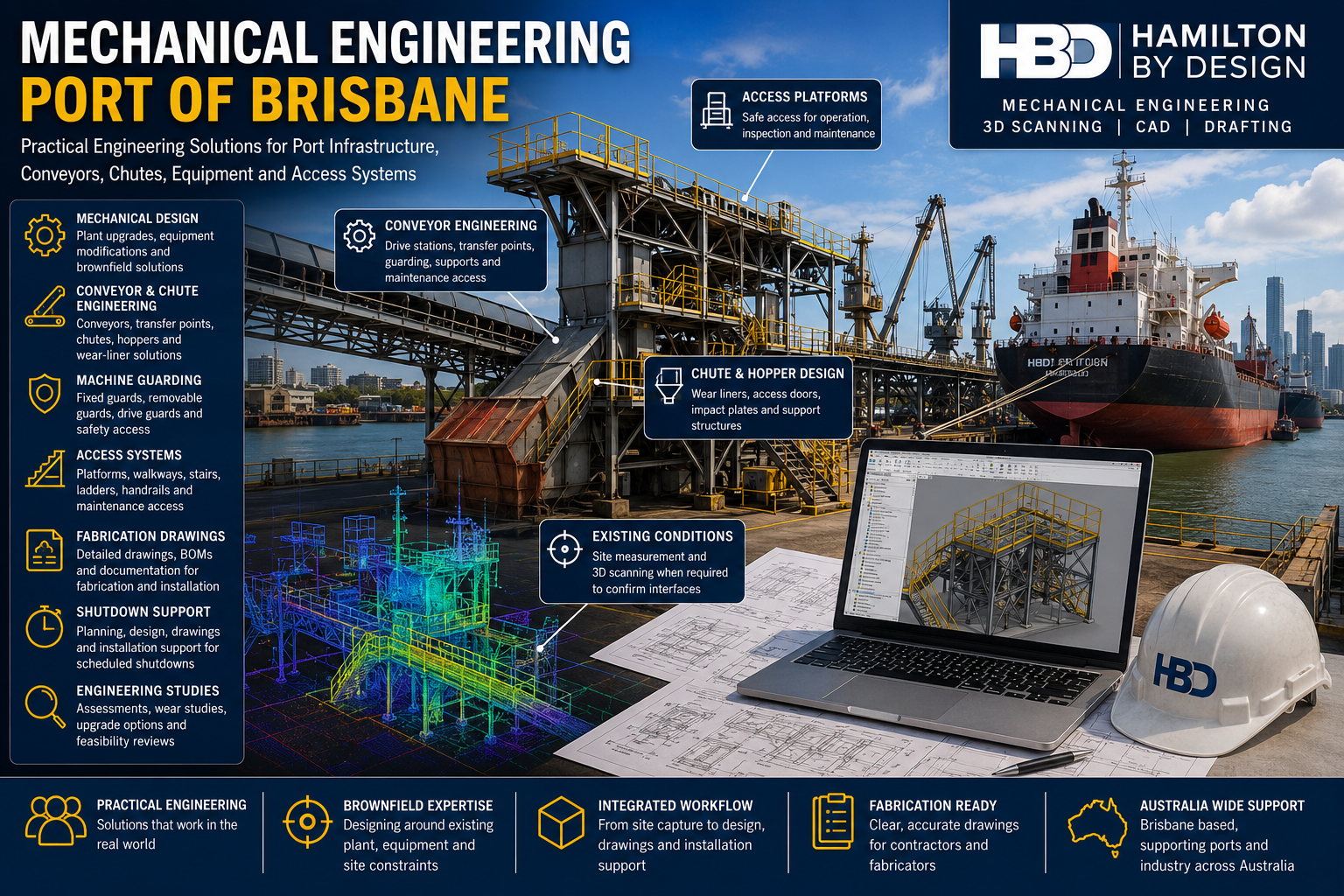


Mechanical Engineering Port of Brisbane | Plant & Equipment Design

Mechanical engineering services for Port of Brisbane conveyors, chutes, access platforms, machine guarding and brownfield plant upgrades.

Mechanical Engineering Port of Brisbane

Mechanical Design, Plant Upgrades and Engineering Support for Port Infrastructure

Hamilton By Design provides mechanical engineering services for Port of Brisbane projects, supporting port operators, terminal operators, contractors, fabricators and maintenance teams working across Fisherman Islands, Pinkenba, Lytton, Hemmant and surrounding Brisbane industrial areas.

This page should be positioned differently from the existing Port of Brisbane Engineering and 3D Laser Scanning Services article.

The existing page should remain focused on:

  • 3D laser scanning
  • LiDAR capture
  • Point clouds
  • Scan-to-CAD
  • As-built documentation

This new page should focus primarily on:

  • Mechanical design
  • Plant and equipment modifications
  • Conveyor and chute engineering
  • Machine guarding
  • Maintenance access
  • Fabrication drawings
  • Shutdown engineering
  • Engineering studies

That separation reduces the risk of both pages competing for the same search terms.


Mechanical Engineering for Port and Terminal Assets

Port facilities rely on mechanical systems that must operate safely, reliably and within tightly controlled shutdown windows.

Hamilton By Design can assist with engineering projects involving:

  • Conveyors and transfer stations
  • Chutes and hoppers
  • Loading and unloading equipment
  • Mechanical support frames
  • Maintenance platforms
  • Stairs, ladders and walkways
  • Machine guarding
  • Pipe supports
  • Equipment bases
  • Access systems
  • Wear liners
  • Replacement machinery
  • Structural interfaces
  • Brownfield plant modifications

Our work is suited to existing facilities where equipment has been altered over time and original drawings may no longer match what is installed.

For projects requiring accurate site capture, our separate Port of Brisbane engineering and 3D laser scanning service can establish the existing geometry before mechanical design begins.


Conveyor and Transfer-Station Engineering

Conveyor systems are central to many port and bulk-material handling operations.

Hamilton By Design can support mechanical engineering work involving:

  • Conveyor modifications
  • Head and tail pulley arrangements
  • Drive-station layouts
  • Transfer-point upgrades
  • Conveyor guarding
  • Skirt systems
  • Maintenance access
  • Support frames
  • Walkways and platforms
  • Replacement components
  • Equipment-clearance reviews

Existing conveyor systems are often congested by structural steel, services, electrical equipment and previous modifications.

Mechanical designs should therefore consider not only the new equipment but also installation access, maintenance requirements, removal paths and surrounding plant.


Chute and Hopper Design

Transfer chutes and hoppers can experience wear, blockage, poor material flow and difficult maintenance access.

Mechanical engineering services may include:

  • Replacement chute design
  • Chute geometry modifications
  • Hopper modifications
  • Wear-liner arrangements
  • Inspection-door design
  • Access improvements
  • Deflector and impact-plate design
  • Support-frame design
  • Flange and interface detailing
  • Fabrication drawings
  • Installation planning

Where site geometry is uncertain, engineering-grade scanning can be used to confirm the interfaces before the chute or hopper is modelled.

Hamilton By Design also provides wear and erosion studies for materials-handling equipment.


Brownfield Mechanical Upgrades

Brownfield port projects require new equipment to fit within an operating environment.

Mechanical upgrade projects may involve:

  • Replacing obsolete equipment
  • Increasing throughput
  • Improving maintenance access
  • Relocating machinery
  • Modifying conveyors
  • Installing new guards
  • Replacing worn structural supports
  • Adding platforms or walkways
  • Altering pipework interfaces
  • Integrating new plant with existing assets

The design process should account for:

  • Existing geometry
  • Installation sequence
  • Lifting requirements
  • Maintenance clearances
  • Operational constraints
  • Shutdown duration
  • Temporary works
  • Fabrication tolerances
  • Access restrictions

Hamilton By Designโ€™s engineering studies and assessments can help define the existing problem before detailed design begins.


Machine Guarding for Port Equipment

Conveyors, pulleys, drives, shafts, couplings and rotating machinery may require new or upgraded guarding.

Hamilton By Design can assist with:

  • Fixed guards
  • Removable guards
  • Drive guards
  • Pulley and nip-point guarding
  • Conveyor side guarding
  • Access gates
  • Inspection openings
  • Maintenance-removal arrangements
  • Guard-support frames
  • Fabrication drawings

A practical guard design must control access to hazardous areas while still allowing inspection, maintenance and component removal.

The final guarding arrangement should be reviewed against the machinery, risk assessment, applicable legislation, relevant standards and site-specific requirements.


Maintenance Platforms, Walkways and Access Systems

Safe access is essential around port machinery and materials-handling equipment.

Mechanical and structural access projects may include:

  • Maintenance platforms
  • Conveyor walkways
  • Stairs
  • Ladders
  • Crossovers
  • Step-over platforms
  • Handrails
  • Guardrails
  • Removable floor sections
  • Equipment-access frames
  • Inspection platforms

The design should consider:

  • Normal operating access
  • Maintenance activities
  • Emergency egress
  • Headroom
  • Fall risks
  • Machinery clearances
  • Lifting and removal paths
  • Existing services
  • Future equipment replacement

For projects involving existing steelwork and restricted interfaces, structural drafting and 3D scanning in Brisbane can support the development of coordinated access designs.


Mechanical Equipment Replacement

Replacing existing machinery can be difficult where the original drawings are unavailable or the surrounding plant has changed.

Hamilton By Design can assist with:

  • Existing-equipment assessment
  • Replacement-equipment layouts
  • Baseplate and mounting design
  • Support-frame modifications
  • Shaft and coupling interfaces
  • Guarding
  • Access provisions
  • Equipment-clearance studies
  • Installation planning
  • Fabrication documentation

Where required, reverse engineering with 3D scanning can be used to develop CAD geometry from the installed asset.


Engineering Drafting and Fabrication Documentation

Port contractors and fabricators may require clear documentation that can be used for pricing, manufacture and installation.

Hamilton By Design can prepare:

  • General arrangement drawings
  • Mechanical layouts
  • Fabrication drawings
  • Assembly drawings
  • Weldment drawings
  • Structural-steel details
  • Platform and handrail drawings
  • Chute and hopper drawings
  • Guarding drawings
  • Equipment-interface drawings
  • Sections and elevations
  • Bills of materials
  • Installation drawings
  • As-built drawings

Deliverables can be prepared using SolidWorks, Autodesk Inventor and AutoCAD, depending on the project requirements.

Our SolidWorks Brisbane services support mechanical modelling, assemblies and fabrication-ready documentation for port and industrial projects.


Shutdown Engineering Support

Port shutdowns are often tightly scheduled, with limited time available for removal, modification and installation.

Mechanical engineering support before a shutdown may include:

  • Defining the work scope
  • Confirming equipment interfaces
  • Reviewing access restrictions
  • Preparing demolition drawings
  • Developing replacement designs
  • Checking lifting and installation space
  • Reviewing installation sequences
  • Preparing fabrication drawings
  • Identifying potential clashes
  • Developing contingency options

Accurate planning before the shutdown can reduce the risk of fabrication errors, unexpected obstructions and delayed restart.


Engineering Studies and Condition Assessments

Not every project should proceed directly to detailed design.

An engineering study can help define:

  • The existing problem
  • Likely failure mechanisms
  • Design constraints
  • Available options
  • Maintenance implications
  • Access requirements
  • Preliminary costs
  • Recommended next steps

Typical studies may include:

  • Existing-condition assessments
  • Wear and erosion studies
  • Machinery-access reviews
  • Conveyor and chute assessments
  • Guarding reviews
  • Constructability studies
  • Equipment-replacement studies
  • Upgrade feasibility studies
  • Refurbishment planning

Typical Port of Brisbane Mechanical Engineering Projects

Hamilton By Design can support projects involving:

  • Conveyor upgrades
  • Transfer-chute replacement
  • Hopper modifications
  • Machine guarding
  • Maintenance platforms
  • Walkways and stairs
  • Equipment support frames
  • Mechanical equipment replacement
  • Bulk-material handling systems
  • Wharf-access equipment
  • Crane-related access structures
  • Pipe and service supports
  • Wear-liner arrangements
  • Fabrication documentation
  • Brownfield plant modifications
  • Shutdown planning

Our Mechanical Engineering Workflow

1. Define the Problem

We review the existing asset, operating issue, maintenance requirement and required project outcome.

2. Establish Existing Conditions

Available drawings, photographs and site information are reviewed. Where required, site measurement or 3D laser scanning is completed.

3. Develop Engineering Options

Practical concepts are developed around safety, operation, access, fabrication and installation constraints.

4. Prepare the Design

The selected option is developed into a coordinated mechanical arrangement and supporting CAD model.

5. Complete Engineering Review

The design is reviewed against the required loads, interfaces, clearances, standards and project requirements.

6. Produce Drawings

General arrangements, details, fabrication drawings and bills of materials are prepared as required.

7. Support Fabrication and Installation

Clarifications, drawing revisions and installation support can be provided within the agreed scope.


Why Choose Hamilton By Design?

Practical Mechanical Engineering

Our approach considers how equipment will be fabricated, installed, operated and maintained.

Brownfield Experience

We understand the challenges of designing around existing machinery, steelwork, services and access restrictions.

Integrated Site Capture and Design

Where reliable drawings are unavailable, LiDAR scanning can be incorporated without making scanning the primary focus of this page.

Fabrication-Ready Documentation

Our mechanical designs can be developed into detailed CAD models and drawings suitable for contractor and fabricator use.

Brisbane and National Project Support

Hamilton By Design supports industrial and infrastructure projects in Brisbane and throughout Australia. Its broader Brisbane offering integrates LiDAR scanning, mechanical engineering and fabrication drafting for complex industrial work.


Areas Serviced

Mechanical engineering support is available for projects throughout:

  • Port of Brisbane
  • Fisherman Islands
  • Pinkenba
  • Lytton
  • Hemmant
  • Murarrie
  • Eagle Farm
  • Greater Brisbane
  • South-East Queensland

Travel can also be arranged for regional port, mining and industrial projects.


Frequently Asked Questions

What mechanical engineering services are available for Port of Brisbane projects?

Services can include conveyor and chute design, machine guarding, equipment replacement, access platforms, fabrication drawings, engineering studies and shutdown support.

Do you provide 3D laser scanning?

Yes. Laser scanning is available where accurate existing-condition data is required. The detailed scanning service is covered on the separate Port of Brisbane 3D laser scanning page.

Can you produce fabrication drawings?

Yes. Fabrication and assembly drawings can be prepared for suitable mechanical and structural items within the agreed engineering scope.

Can you assist with existing equipment where drawings are missing?

Yes. Existing equipment can be measured, scanned or reverse engineered to support replacement or modification work.

Can you design conveyor guards and access platforms?

Yes. Hamilton By Design can develop guarding and access concepts, CAD models and fabrication documentation for existing machinery and conveyor systems.

Do you provide shutdown engineering support?

Yes. Support can include site verification, replacement design, fabrication drawings, access reviews, clash checks and installation planning.

Are you affiliated with Port of Brisbane Pty Ltd?

No. Hamilton By Design is an independent mechanical engineering and digital engineering service provider. This page describes services available for projects in the Port of Brisbane area and does not imply endorsement or affiliation.


Discuss a Port of Brisbane Mechanical Engineering Project

Hamilton By Design can assist with:

  • Conveyor and chute engineering
  • Mechanical equipment modifications
  • Machine guarding
  • Platforms and access systems
  • Reverse engineering
  • Engineering studies
  • Fabrication drawings
  • Brownfield upgrades
  • Shutdown planning
  • Installation support

Contact Hamilton By Design to discuss your Port of Brisbane mechanical engineering requirements.

Hamilton By Design logo displayed on a blue tilted rectangle with a grey gradient background

Contact Us – Talk To Us

Name
Would you like us to arrange a phone consultation for you?
Address

Our clients:
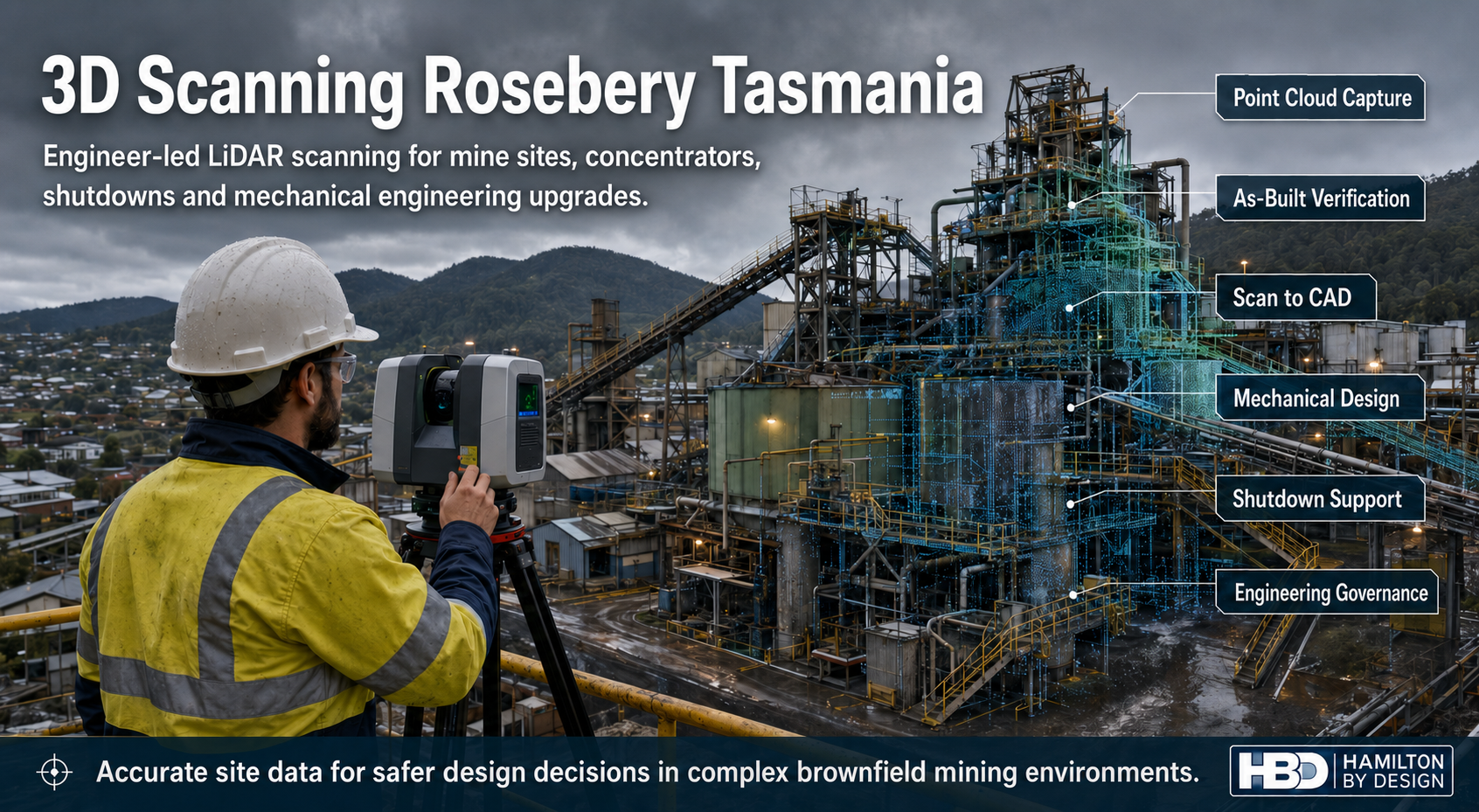


Mechanical Engineering and 3D Scanning Support for Rosebery, Tasmania

Engineer using a LiDAR scanner at a Rosebery Tasmania mining processing plant with point cloud data overlay for 3D scanning and mechanical engineering.

Mechanical Engineering & 3D Scanning Rosebery Tasmania

Rosebery is a working mining town, and the work on site is practical. Fitters, riggers, maintenance crews and supervisors are often dealing with real plant problems before the drawings catch up.

A chute wears out. A pipe spool needs replacing. A pump base does not match what is on the drawing. Access is tight. Shutdown time is limited. The job needs to fit the first time.

Hamilton By Design supports Rosebery and Tasmaniaโ€™s west coast with mechanical engineering, 3D laser scanning, scan-to-CAD, reverse engineering and drafting support for mining, processing and industrial sites.

Supporting Fitters, Riggers and Maintenance Teams

On brownfield sites, the people closest to the work often understand the problem best.

A fitter may know where the wear is occurring. A rigger may know where the lift or install will be difficult. A maintenance supervisor may know which parts of the plant have been modified over time.

Hamilton By Design helps turn that site knowledge into usable engineering information.

We can assist with:

  • site measurement and 3D scanning
  • scan-to-CAD modelling
  • mechanical drafting
  • reverse engineering
  • chute and hopper replacement
  • conveyor and transfer point modifications
  • pipework and spool development
  • pump, bracket and baseplate measurement
  • shutdown planning support
  • fabrication-ready drawings

3D Scanning for Rosebery Mining and Processing Sites

Roseberyโ€™s mining and processing environment makes accurate site information important. Existing drawings may be outdated, incomplete or missing. Plant may have changed over years of maintenance, repair and modification.

3D laser scanning captures the actual site conditions before design or fabrication begins.

This can help reduce:

  • site rework
  • fabrication errors
  • unexpected clashes
  • repeat site visits
  • shutdown delays
  • uncertainty during quoting and planning

For mining and concentrator environments, scanning can be used around conveyors, transfer points, chutes, pipework, tanks, pump areas, platforms, stairs, guarding and structural interfaces.

Scan-to-CAD and Mechanical Drafting

Once the site has been scanned, Hamilton By Design can convert the captured information into practical CAD deliverables.

Depending on the job, this may include:

  • registered point cloud data
  • E57, RCP or RCS files
  • 3D CAD models
  • SolidWorks or Inventor models
  • AutoCAD DWG layouts
  • general arrangement drawings
  • fabrication drawings
  • sections and elevations
  • clearance and clash checks

The aim is simple: provide information that helps the job move from site problem to fabrication, installation or engineering review.

Mechanical Engineering Support for Concentrator Plant Work

Rosebery includes underground mining and onsite processing, with production of zinc, copper and lead concentrates, as well as gold and silver.

For concentrator and mineral processing work, Hamilton By Design can support:

  • crushing and grinding area modifications
  • flotation plant access and layout checks
  • slurry pipework and pump arrangements
  • chute and liner replacement
  • conveyor upgrades
  • transfer point improvements
  • platform, stair and access changes
  • guarding and maintenance access reviews
  • brownfield plant modifications

This type of work often needs a mix of practical trade understanding, site capture, CAD modelling and mechanical engineering judgement.

Secondment Support for Rosebery Projects

For longer shutdowns, ongoing upgrades or peak workload periods, Hamilton By Design can also provide support through secondment.

This allows experienced engineers, designers, draftspersons, fitters, fabricators and riggers to support your team directly during planning, site measurement, drawing updates, fabrication support or project delivery.

Learn more about Hamilton By Designโ€™s Secondment Services.

Servicing Rosebery and Tasmaniaโ€™s West Coast

Hamilton By Design can support Rosebery and nearby west coast locations, including:

  • Tullah
  • Zeehan
  • Queenstown
  • Strahan
  • Burnie
  • Devonport
  • broader Tasmanian mining and industrial sites
Hamilton By Design logo displayed on a blue tilted rectangle with a grey gradient background

Need Mechanical Engineering or 3D Scanning Support in Rosebery?

If you are planning maintenance, shutdown work, fabrication, reverse engineering or plant modification in Rosebery, Hamilton By Design can help capture the site accurately and turn that information into practical engineering deliverables.

Contact Hamilton By Design to discuss your Rosebery site capture, mechanical engineering, scan-to-CAD or secondment support requirements.

Talk to Us – Contact Us

Name
Would you like us to arrange a phone consultation for you?
Address

Our clients:


https://www.hamiltonbydesign.com.au/scan-to-bim-services-australia-lidar-point-clouds-cad-modelling

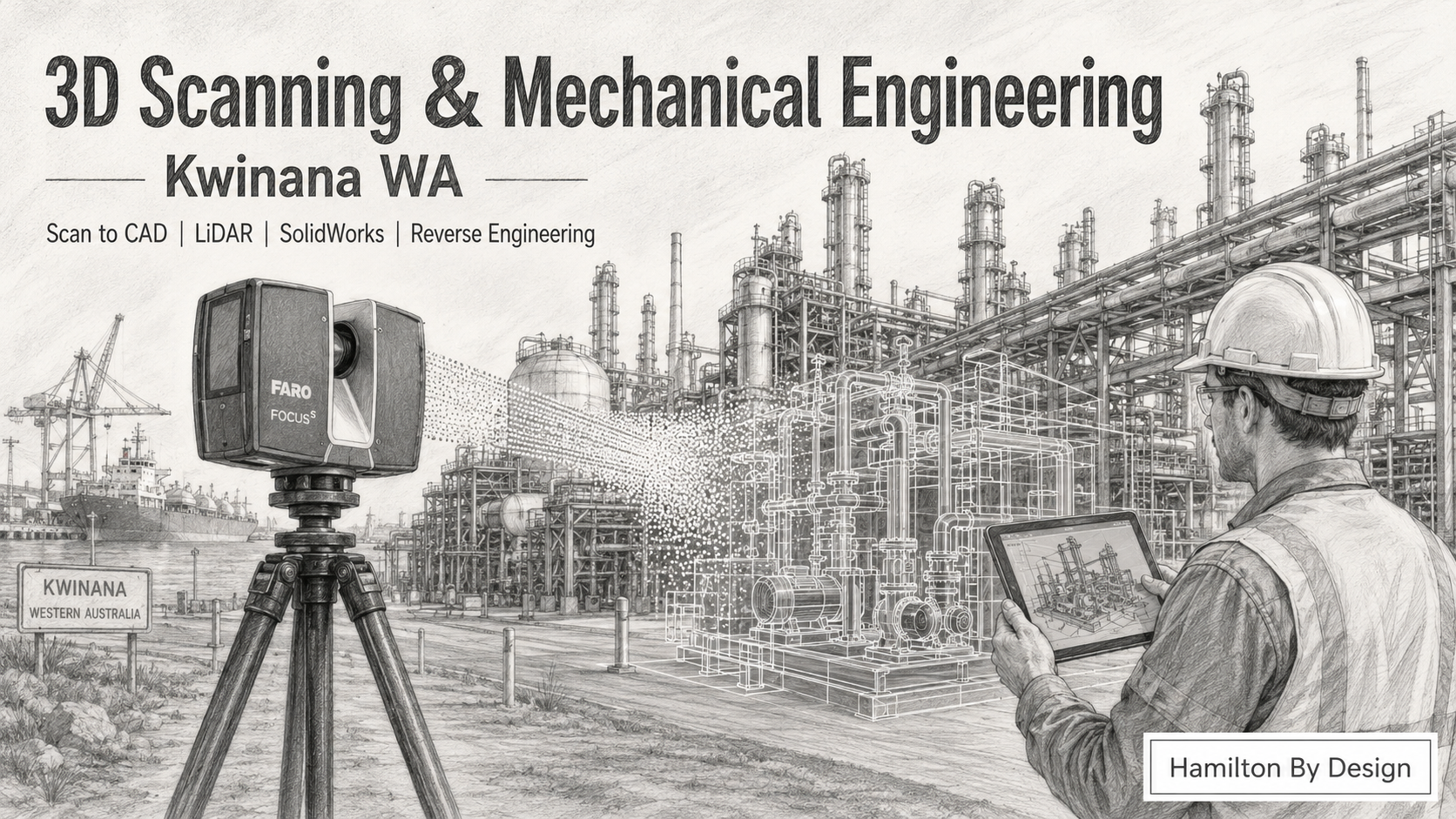
3D Scanning and Mechanical Engineering Services Kwinana WA

Pencil drawing of 3D scanning and mechanical engineering services in Kwinana WA, showing a FARO laser scanner, point cloud, industrial plant, CAD overlay and engineer with tablet.

Engineer-Led 3D Scanning and Mechanical Design Support for Kwinana Industry

Blue 3D LiDAR scanner icon on a tripod with scanning waves

Hamilton By Design provides 3D scanning and mechanical engineering services in Kwinana WA for industrial plants, processing facilities, workshops, fabrication companies, maintenance teams and project engineers.

Kwinana is one of Western Australiaโ€™s most important industrial areas. It supports heavy industry, bulk handling, energy, minerals processing, chemical processing, fabrication, marine services, port infrastructure and industrial maintenance. In these environments, accurate site information is essential. When existing drawings are missing, outdated or unreliable, engineering decisions become harder, slower and more expensive.

That is where 3D laser scanning, LiDAR capture and mechanical engineering design support can help.

Hamilton By Design combines site-based 3D scanning, point cloud processing, SolidWorks modelling, mechanical drafting and reverse engineering to help Kwinana businesses understand existing plant conditions before they design, modify, fabricate or install new equipment.

Whether you need accurate site measurements, as-built documentation, Scan to CAD, reverse engineering of obsolete parts, equipment layout verification or mechanical design support, we can help turn real-world site conditions into useful engineering information.

Why 3D Scanning Matters for Kwinana Industrial Sites

Industrial sites in Kwinana often contain complex plant, pipework, tanks, conveyors, platforms, structural steel, access systems, mechanical equipment and services that have changed over many years.

The problem is simple: the drawings do not always match the site.

A plant may have been modified during shutdowns. Pipework may have been rerouted. Platforms may have been added. Equipment may have been replaced. Fabricators may have worked from site measurements instead of updated drawings. Over time, the real site and the drawing register can become very different.

For brownfield projects, this creates risk.

A new chute may clash with existing steel. A replacement pump base may not line up with the real hold-down bolt locations. A platform may interfere with pipework. A new mechanical assembly may fit in CAD but fail during installation because the design was based on old information.

3D scanning reduces this risk by capturing the existing site in accurate three-dimensional detail. Instead of relying only on manual tape measurements, photos and old drawings, project teams can work from a measured point cloud of the real plant.

Common Problems We Help Solve

Hamilton By Design supports Kwinana industrial businesses with practical engineering information for real-world problems.

Common issues include:

  • Existing drawings are missing, outdated or incomplete
  • New equipment may clash with existing plant
  • Fabrication drawings are required before a shutdown
  • OEM drawings are unavailable
  • Replacement parts are expensive or have long lead times
  • Manual site measurements are difficult, unsafe or incomplete
  • Access platforms, stairs and handrails need to fit around existing equipment
  • Pipework, conveyors, tanks or structures need to be modelled from site data
  • Plant upgrades need accurate as-built information
  • Project teams need better information before approving fabrication

When the plant is complex, old or heavily modified, 3D scanning provides a better starting point.

3D Laser Scanning Services in Kwinana WA

Our 3D scanning service is designed for industrial environments where accurate measurement matters.

We can scan:

  • Processing plants
  • Pump stations
  • Conveyor systems
  • Chutes and hoppers
  • Structural steel
  • Pipe racks and pipework
  • Tanks and vessels
  • Access platforms
  • Stairs and handrails
  • Maintenance areas
  • Workshops and fabrication spaces
  • Marine and port-related infrastructure
  • Brownfield upgrade areas
  • Existing equipment layouts

The scan data can be used for design, verification, planning, fabrication, modelling and project review.

For industrial work, the value is not just the scan itself. The value comes from turning scan data into engineering information that designers, project managers, fabricators and site teams can actually use.

Scan to CAD for Kwinana Industrial Projects

Scan to CAD is the process of converting 3D scan data into CAD models, drawings or design references.

For Kwinana industrial sites, Scan to CAD can be useful when a project team needs a reliable model of existing conditions before designing new work.

Hamilton By Design can convert point cloud data into:

  • SolidWorks models
  • AutoCAD drawings
  • STEP files
  • SAT files
  • DWG files
  • DXF files
  • General arrangement drawings
  • Section views
  • Elevations
  • Fabrication references
  • Mechanical layout models
  • As-built CAD geometry

This is especially useful when working around existing plant, services and structures.

A good Scan to CAD workflow can help answer important questions before fabrication starts:

Will the new equipment fit?

Is there enough clearance?

Are the bolt locations correct?

Will the pipework clash?

Can the platform be installed safely?

Does the model match the real site?

These questions are much cheaper to answer in CAD than during installation.

Mechanical Engineering Services Kwinana WA

Hamilton By Design also provides mechanical engineering and drafting support for Kwinana businesses.

Our mechanical engineering services can include:

  • Mechanical design
  • Equipment layouts
  • Reverse engineering
  • Replacement component modelling
  • Pump and machinery component drawings
  • Fabrication drawings
  • General arrangement drawings
  • Access platform layouts
  • Chute and hopper design support
  • Conveyor-related drafting
  • Pipework drafting support
  • Brownfield modification design
  • Site measurement and verification
  • Engineering-grade CAD modelling

We work with industrial clients who need practical design support that connects the site, the CAD model and the workshop.

This is important because many industrial projects fail at the connection point between design and site reality. A drawing may look correct, but the real plant may tell a different story. By combining 3D scanning with mechanical engineering, the design process starts with better information.

Reverse Engineering for Kwinana Equipment and Parts

Many Kwinana industrial businesses operate equipment where original drawings are unavailable, the OEM no longer supports the part, or replacement lead times are too long.

Reverse engineering can help by measuring the existing component and creating a CAD model or drawing that can support replacement, repair, modification or local manufacture.

Hamilton By Design can assist with reverse engineering of:

  • Pump components
  • Shafts
  • Brackets
  • Guards
  • Covers
  • Frames
  • Mounts
  • Housings
  • Fabricated parts
  • Machined parts
  • Wear components
  • Custom plant items

Depending on the part and project requirement, reverse engineering may involve 3D scanning, manual measurement, CAD modelling, material review, tolerance consideration and production of manufacturing drawings.

This can be useful when an urgent replacement is required, when a part needs to be improved, or when site teams need to reduce reliance on unavailable OEM drawings.

Brownfield Engineering Support

Kwinana contains many brownfield industrial sites where new work must fit around existing infrastructure.

Brownfield work is difficult because there is rarely a clean, empty design space. The design must fit around what is already there.

This may include:

  • Existing structural steel
  • Pipework
  • Electrical services
  • Access ways
  • Platforms
  • Guarding
  • Tanks
  • Conveyors
  • Process equipment
  • Maintenance access zones
  • Crane access
  • Shutdown constraints

3D scanning helps create a digital record of these existing conditions. Mechanical engineering then uses that information to design practical solutions.

This can reduce the risk of rework, installation delays and fabrication changes.

Why Kwinana Businesses Use 3D Scanning Before Fabrication

Fabrication errors can be costly. If steel is fabricated from incorrect dimensions, the problem may not appear until installation. By then, the project may already be in shutdown, cranes may be booked, trades may be waiting and production may be affected.

3D scanning helps avoid this by confirming site conditions before fabrication.

For example, a scan can help check:

  • Existing steel locations
  • Floor levels
  • Equipment footprints
  • Pipework positions
  • Access clearances
  • Tank and vessel locations
  • Conveyor geometry
  • Bolt patterns
  • Existing maintenance access
  • Interface points between old and new equipment

This gives engineers and fabricators more confidence before cutting steel, ordering material or issuing drawings for manufacture.

Deliverables Available

Depending on the project, Hamilton By Design can provide:

  • Point cloud files
  • E57 files
  • RCP / RCS files
  • 3D CAD models
  • SolidWorks models
  • STEP / SAT files
  • DWG / DXF drawings
  • General arrangement drawings
  • Sections and elevations
  • Fabrication drawings
  • Reverse engineering drawings
  • Site verification reports
  • Mechanical design layouts

The right deliverable depends on the project outcome. Some clients need point cloud data. Others need a full CAD model. Some only need key interface geometry for fabrication. We can help define the right level of detail before the work begins.

Industries We Support Around Kwinana

Hamilton By Design can support industrial clients across Kwinana and surrounding areas including Rockingham, Henderson, Naval Base, Hope Valley, Cockburn, Welshpool, Canning Vale, Forrestdale and the broader Perth industrial region.

Relevant industries include:

  • Heavy industry
  • Minerals processing
  • Chemical processing
  • Energy and utilities
  • Bulk materials handling
  • Port infrastructure
  • Marine and defence support
  • Fabrication workshops
  • Mechanical contractors
  • Maintenance teams
  • Industrial construction
  • Processing plants
  • Water and wastewater infrastructure

Why Choose Hamilton By Design

Hamilton By Design is not just a scanning business. We understand mechanical engineering, drafting, fabrication, site measurement and industrial design.

This matters because a point cloud on its own does not solve every problem. The real value comes from knowing what to extract from the scan, what needs to be modelled, what needs to be drawn, and what information the workshop or project engineer needs next.

Our approach is practical:

  1. Capture the existing site conditions
  2. Process the scan data
  3. Review the engineering problem
  4. Convert the information into useful CAD or drawings
  5. Support design, fabrication or installation decisions

This helps clients move from uncertainty to usable engineering information.

3D Scanning and Mechanical Engineering for Kwinana WA

If your Kwinana project depends on accurate site information, Hamilton By Design can help.

We support industrial clients with 3D scanning, LiDAR capture, Scan to CAD, mechanical engineering, reverse engineering and drafting services across Kwinana and the wider Perth industrial region.

Whether you are planning a shutdown, replacing obsolete parts, modifying existing plant, designing new equipment or checking site conditions before fabrication, accurate 3D data can reduce risk and improve project confidence.

Hamilton By Design logo displayed on a blue tilted rectangle with a grey gradient background

Need 3D Scanning or Mechanical Engineering Support in Kwinana?

Talk to Hamilton By Design about your Kwinana industrial project.

We can assist with:

  • 3D laser scanning
  • Scan to CAD
  • Mechanical engineering
  • Reverse engineering
  • SolidWorks modelling
  • Fabrication drawings
  • Brownfield plant upgrades
  • Site verification
  • Industrial drafting

For engineering-grade 3D scanning and mechanical design support in Kwinana WA, contact Hamilton By Design.

Talk to Us – Contact Us

Name
Would you like us to arrange a phone consultation for you?
Address

Our clients:


https://www.hamiltonbydesign.com.au/scan-to-bim-services-australia-lidar-point-clouds-cad-modelling

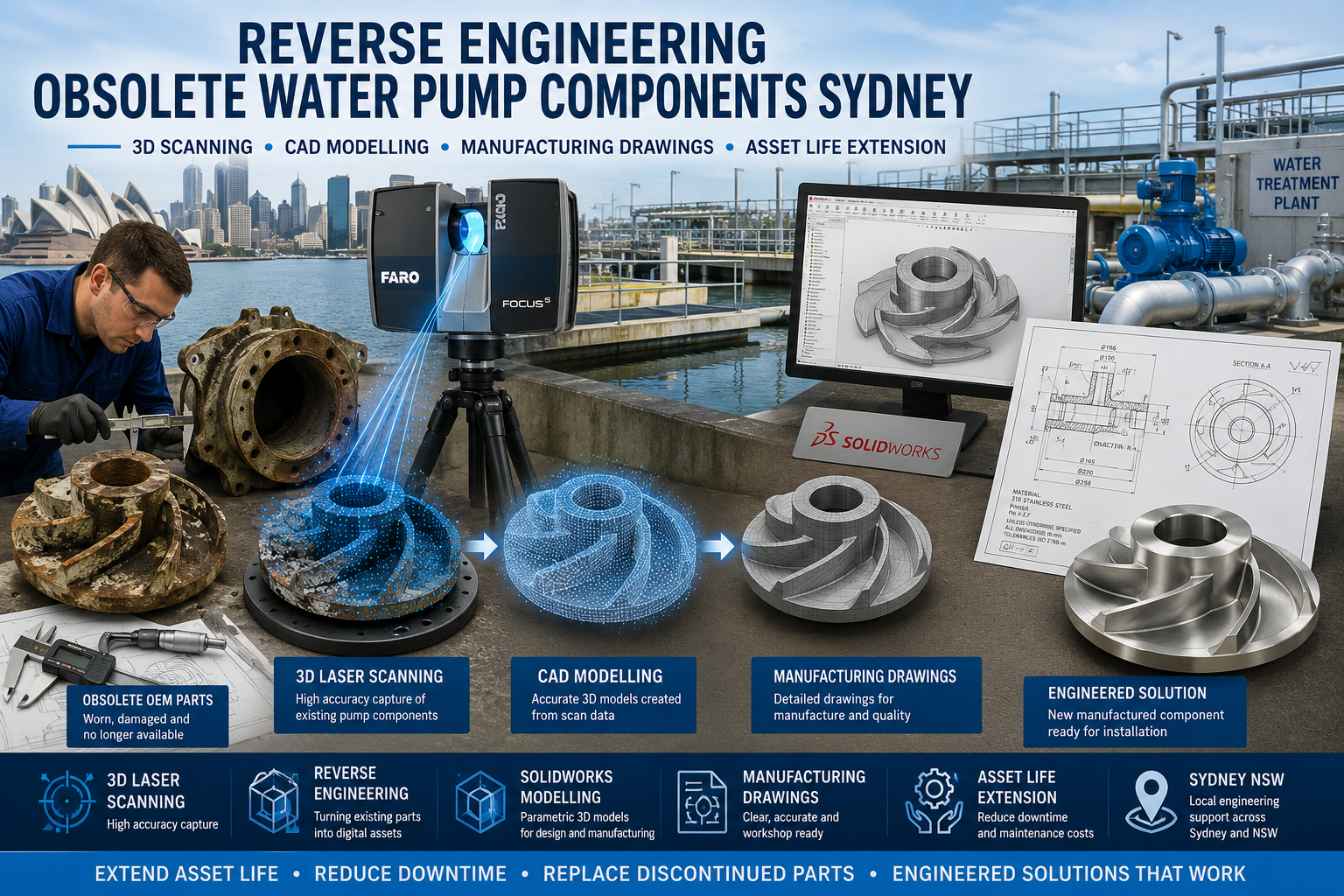
Reverse Engineering Obsolete Water Pump Components Sydney

Reverse engineering obsolete water pump components in Sydney using 3D laser scanning, SolidWorks CAD modelling and manufacturing drawings to replace discontinued OEM pump parts for water infrastructure and industrial facilities.

Reverse Engineering Obsolete Water Pump Components Sydney

Hamilton By Design provides reverse engineering services for obsolete water pump components in Sydney NSW, helping water utilities, maintenance teams, manufacturers, asset owners and engineering contractors replace discontinued OEM pump parts when drawings, models or supplier support are no longer available. We inspect, measure, scan and model existing pump components to create accurate CAD files, manufacturing drawings and engineering documentation suitable for repair, replacement, refurbishment or local manufacture.

Reverse Engineering for Obsolete Pump Components in Sydney NSW

Water pump assets often remain in service for decades. Over time, OEM parts can become unavailable, lead times can increase, suppliers may discontinue product lines, and replacement costs can become difficult to justify. For councils, water treatment plants, pumping stations, industrial facilities and infrastructure operators, this can create serious maintenance and operational risks.

Hamilton By Design supports Sydney-based clients by reverse engineering worn, damaged or obsolete water pump components so they can be reproduced, repaired or improved. This includes pump casings, impellers, shafts, sleeves, bushes, bearing housings, covers, flanges, couplings, wear rings, brackets and other mechanical pump components.

Our work combines practical trade experience, mechanical engineering knowledge, 3D scanning, CAD modelling and detailed drafting. The result is clear, usable documentation that can support fabrication, machining, casting, repair, procurement and asset maintenance.

Who We Help

We provide reverse engineering and engineering drafting services for clients across Sydney NSW and surrounding regions, including:

Water treatment plants
Wastewater facilities
Council pumping stations
Industrial water systems
Utilities and infrastructure operators
Manufacturing plants
Mining and mineral processing facilities
Ports and marine infrastructure
Mechanical contractors
Maintenance teams
Fabricators and machine shops
Pump repair workshops
Asset owners with discontinued OEM equipment

We also support projects in Newcastle, the Hunter Valley, Brisbane, Perth, Melbourne, regional NSW and across Australia where pump components or mechanical assets need to be measured, modelled and documented.

Why Reverse Engineer Obsolete Water Pump Components?

Reverse engineering is useful when an existing component is required but original design information is missing or unreliable. Many older water pump assets were installed years ago, and drawings may no longer exist, may be incomplete, or may not reflect changes made during maintenance.

Reverse engineering can help when:

OEM parts are discontinued
OEM lead times are too long
Replacement parts are too expensive
The original drawings are missing
The part has been modified over time
A casting pattern is no longer available
A pump needs to remain operational
A local manufacturing option is required
The component needs to be improved or strengthened
A damaged part needs to be reproduced urgently

For water infrastructure, downtime can be costly. Reverse engineering allows asset owners to extend the life of critical pump equipment while maintaining control over documentation, repair options and future spare parts.

Typical Pump Components We Reverse Engineer

Hamilton By Design can reverse engineer a wide range of pump and rotating equipment components, including:

Impellers
Pump casings
Bearing housings
Shafts
Shaft sleeves
Wear rings
Bushes
Couplings
Drive components
Flanges
Covers and guards
Mounting brackets
Split casings
Casting components
Machined components
Replacement OEM-style parts
Obsolete water pump components
Custom repair components

Where required, we can also document finished machining details, keyways, fits, tolerances, material notes, surface finish requirements and general arrangement information.

Technical Capability

Our reverse engineering workflow combines physical inspection, 3D measurement, laser scanning and CAD modelling. Depending on the component and project requirements, we can use:

FARO 3D laser scanning
FARO SCENE point cloud processing
Autodesk ReCap RCP and RCS workflows
E57 point cloud export
SolidWorks 3D modelling
Autodesk Inventor modelling
AutoCAD 2D drafting
STEP, SAT and Parasolid file creation
DWG and PDF manufacturing drawings
Engineering review and practical design input

For complex geometry such as cast pump casings or impellers, 3D scanning helps capture the external shape of the component. For machined features, manual measurement and engineering judgement are often required to define functional dimensions, tolerances and fits.

The goal is not just to copy the damaged part. The goal is to understand how the part functions, what surfaces are critical, what features are worn, and what information is required to manufacture or repair the part correctly.

Standards and Engineering Considerations

Depending on the project, documentation may reference relevant Australian Standards, client specifications, machining standards or general engineering practices. Reverse engineering pump components may involve consideration of:

Material selection
Corrosion resistance
Machining allowances
Casting allowances
Fits and tolerances
Surface finish
Weld repair requirements
Fastener details
Bearing and bush fits
Shaft alignment
Clearances
Operating environment
Maintenance access
Asset life extension
Fabrication and machining practicality

For water and wastewater applications, material selection is important. Stainless steel, duplex stainless, cast iron, bronze, polymer composites and engineered coatings may all be considered depending on the service environment and client requirements.

Our Reverse Engineering Process

1. Initial Review

We begin by reviewing the component, photos, existing drawings, site information and the reason the part needs to be reverse engineered. This helps determine whether the outcome should be a like-for-like replacement, a repair drawing, a manufacturing drawing, a 3D model, or an upgraded engineering solution.

2. Site Inspection or Component Measurement

The component can be measured on site in Sydney or inspected at a workshop. For larger pump assemblies or installed equipment, site scanning may be used to capture the surrounding equipment, pipework, access restrictions and interface points.

3. 3D Scanning and Manual Measurement

Where suitable, we use 3D scanning to capture the component geometry. Manual measurement is then used to confirm critical features such as bores, shaft diameters, bolt patterns, keyways, bearing fits, flange faces and machined surfaces.

4. Point Cloud Processing

Scan data is processed into usable formats such as E57, RCP or RCS. The point cloud can then be used as the reference geometry for CAD modelling, comparison and documentation.

5. CAD Modelling

The component is modelled in SolidWorks, Inventor or another suitable CAD platform. For cast or organic shapes, the model may include a practical representation of the geometry suitable for manufacturing, machining, fabrication or pattern development.

6. Engineering Review

We review the model for function, fit, interfaces and manufacturing practicality. Where a component is worn or damaged, engineering judgement may be required to identify original design intent rather than simply copying worn geometry.

7. Drawing and Documentation

Manufacturing drawings are produced showing the required dimensions, notes, tolerances, materials and machining information. Drawings can be supplied as PDF and DWG files, with 3D models supplied in SolidWorks, STEP, SAT or Parasolid formats.

8. Client Review and Final Issue

The drawing package is issued for client review. Where required, changes can be made based on additional photos, site checks, workshop feedback or manufacturing requirements.

Deliverables

Depending on the scope of work, clients may receive:

3D scan files
E57 point cloud files
RCP or RCS files
SolidWorks 3D models
Inventor 3D models
STEP files
SAT files
Parasolid files
DWG drawings
DXF profiles
PDF manufacturing drawings
General arrangement drawings
Machining drawings
Casting reference models
Inspection notes
Reverse engineering report
Critical dimension summaries
Material and finish notes
Assembly interface documentation

Not every project requires every deliverable. For some clients, a simple manufacturing drawing is sufficient. For others, a full 3D model, scan file, assembly drawing and engineering report may be required.

Why Choose Hamilton By Design?

Hamilton By Design brings together hands-on trade experience, mechanical design capability and engineering drafting expertise. Our background includes fitting and turning, CNC machining, fabrication, 3D CAD modelling, site measurement, mechanical engineering and industrial asset documentation.

We understand that reverse engineering is not only a drafting task. It requires practical knowledge of how parts are made, how they fit, how they wear and how they are repaired. This is especially important for pump components where worn surfaces, damaged castings, corrosion and missing information can affect the final outcome.

Our experience includes work across water, mining, ports, manufacturing, infrastructure, industrial plants and utilities. We use modern 3D scanning and CAD tools while applying practical engineering judgement to deliver documentation that fabricators, machinists and asset owners can actually use.

Hamilton By Design also provides related engineering and digital measurement services, including:

Scan to CAD Services
Scan to BIM Services
Mechanical Engineering Services
Reverse Engineering Services
3D LiDAR Scanning
Engineering Drafting
Structural Drafting
SolidWorks Modelling
As-Built Documentation
Industrial Site Measurement

Suggested internal links:

Reverse Engineering Services: /reverse-engineering/
Scan to CAD Services: /scan-to-cad/
Scan to BIM Services: /scan-to-bim/
Mechanical Engineering Services: /mechanical-engineering-services/
3D LiDAR Scanning: /3d-lidar-scanning/
Engineering Drafting Sydney: /engineering-services-sydney/

Frequently Asked Questions

Can you reverse engineer obsolete water pump parts without drawings?

Yes. We can measure, scan and model existing pump components even when original drawings are unavailable. Where parts are worn or damaged, we use engineering judgement to help determine the likely original geometry.

Do you provide reverse engineering services in Sydney NSW?

Yes. Hamilton By Design provides reverse engineering services across Sydney NSW, including water plants, industrial sites, workshops, pumping stations and infrastructure facilities.

What pump components can you reverse engineer?

We can reverse engineer pump casings, impellers, shafts, bushes, sleeves, covers, bearing housings, wear rings, brackets, flanges, couplings and other mechanical pump components.

Can you help replace discontinued OEM pump parts?

Yes. We can create CAD models and manufacturing drawings for discontinued OEM-style parts where original parts are no longer available or have long lead times.

Do you provide manufacturing drawings?

Yes. We can provide PDF and DWG drawings with dimensions, notes, materials, tolerances and machining details suitable for review by fabricators, machinists or repair workshops.

Can you scan large pump assemblies on site?

Yes. Larger pump assemblies, installed equipment and surrounding pipework can be scanned on site where required. This is useful when interface points, access constraints or as-built conditions need to be captured.

What file formats can you supply?

Typical file formats include E57, RCP, RCS, DWG, DXF, PDF, SolidWorks, STEP, SAT and Parasolid files.

Can you improve a component instead of copying it exactly?

Yes. Where required, we can review the component and suggest practical improvements relating to material, machining, fit, access, maintenance or durability. Any design changes should be reviewed and approved before manufacture.

Is reverse engineering suitable for urgent pump repairs?

Yes. Reverse engineering can be useful when a critical pump part has failed and OEM lead times are too long. The timeframe depends on the complexity of the part and the level of documentation required.

Do you work with pump repair workshops and machine shops?

Yes. We regularly support workshops, fabricators, machinists, maintenance contractors and asset owners with practical CAD models and drawings for repair, replacement and manufacturing work.

Hamilton By Design logo displayed on a blue tilted rectangle with a grey gradient background

Reverse Engineering Obsolete Water Pump Components in Sydney

Hamilton By Design helps Sydney water, wastewater, industrial and infrastructure clients extend the life of ageing pump assets by reverse engineering obsolete and discontinued components. We combine 3D scanning, manual measurement, CAD modelling, engineering drafting and practical mechanical experience to produce usable documentation for repair, replacement and manufacture.

If your water pump component is no longer available, has a long OEM lead time or needs to be reproduced from an existing part, Hamilton By Design can help create the CAD files, drawings and engineering documentation required to move the project forward.

Talk to Us – Contact Us

Name
Would you like us to arrange a phone consultation for you?
Address

Our clients:


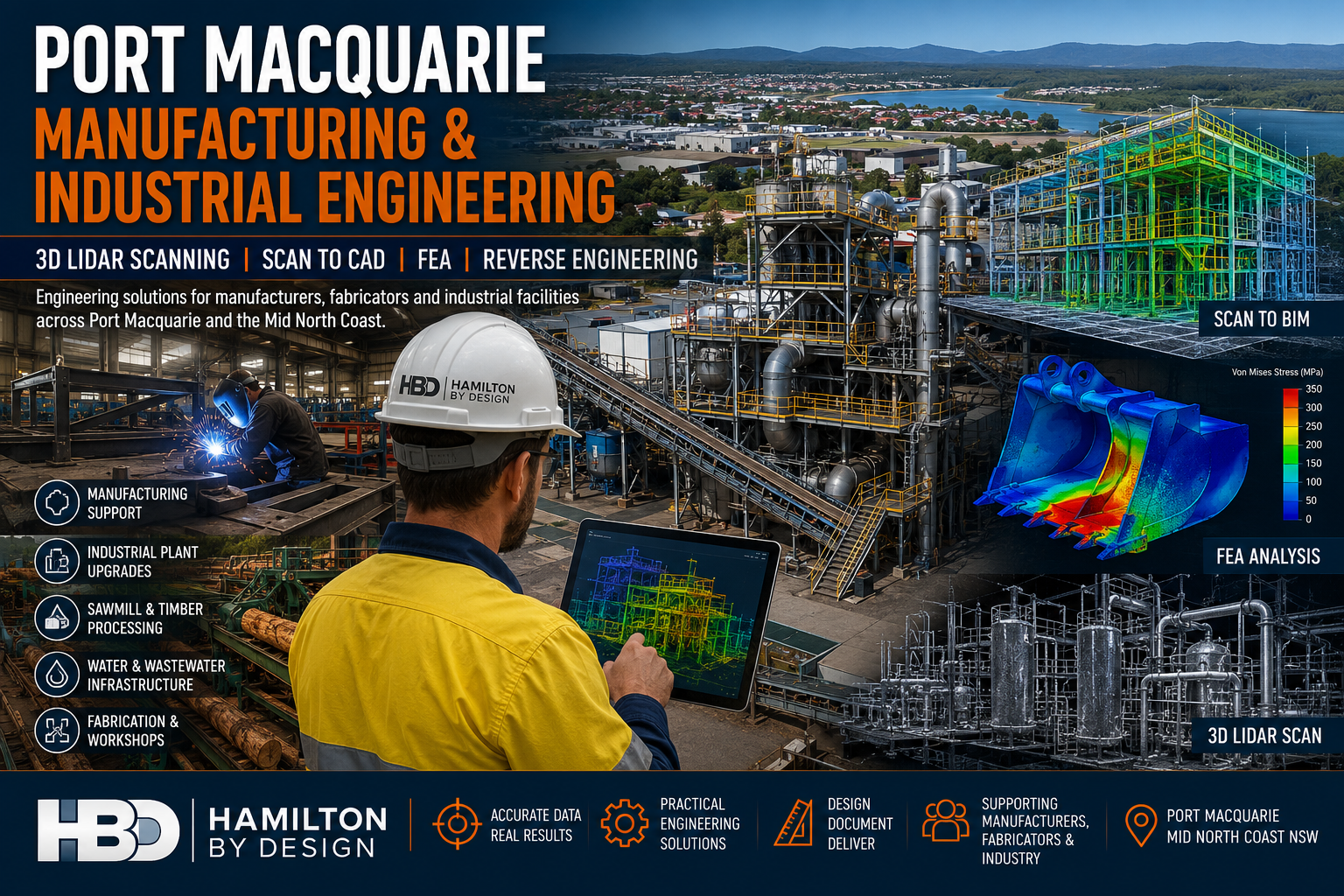
Port Macquarie Manufacturing & Industrial Engineering

Port Macquarie manufacturing and industrial engineering services featuring 3D LiDAR scanning, Scan to BIM, FEA analysis, fabrication support and industrial plant upgrades by Hamilton By Design.

Port Macquarie Manufacturing & Industrial Engineering

Engineering Solutions for Manufacturers, Fabricators & Industrial Facilities Across the Mid North Coast

Hamilton By Design provides engineering-led mechanical engineering, 3D LiDAR scanning, Scan to CAD, Scan to BIM, reverse engineering, finite element analysis (FEA) and engineering drafting services throughout Port Macquarie, Wauchope, Kempsey, Southwest Rocks, Laurieton and the wider Mid North Coast region.

The Port Macquarie region is home to a growing manufacturing and industrial sector that supports timber processing, food manufacturing, fabrication workshops, transport operators, water infrastructure, marine industries and industrial processing facilities.

As facilities grow and equipment ages, accurate engineering information becomes critical for maintaining productivity, reducing downtime and planning future upgrades.

Hamilton By Design helps manufacturers, engineers, fabricators and asset owners capture existing conditions, develop accurate engineering models and deliver practical solutions for brownfield and greenfield projects.

Whether your project involves upgrading a sawmill, replacing ageing equipment, scanning a processing plant, developing fabrication drawings or validating a design using Finite Element Analysis, our team provides practical engineering support backed by decades of industry experience.


Engineering Services for Manufacturers

Supporting Manufacturing Growth Across Port Macquarie

Manufacturing businesses face increasing pressure to improve productivity, reduce maintenance costs and modernise existing facilities.

Hamilton By Design supports manufacturers by providing:

  • Mechanical Engineering
  • Equipment Design
  • Plant Layout Design
  • Reverse Engineering
  • Engineering Drafting
  • 3D Laser Scanning
  • Scan to CAD
  • Finite Element Analysis
  • Asset Documentation
  • Brownfield Upgrade Support

Our engineering services help manufacturers make informed decisions based on accurate site information and engineering data.


Industrial Plant Engineering

Engineering Support for Existing Facilities

Many industrial facilities have evolved over decades through multiple modifications and expansions.

Unfortunately, original drawings often no longer reflect actual site conditions.

Hamilton By Design provides engineering solutions that allow businesses to accurately document and understand their facilities before commencing upgrades or maintenance projects.

Typical facilities include:

  • Manufacturing Plants
  • Timber Processing Facilities
  • Food Processing Facilities
  • Water Treatment Plants
  • Wastewater Facilities
  • Recycling Facilities
  • Quarry Operations
  • Industrial Workshops
  • Processing Plants

3D LiDAR Scanning Port Macquarie

Engineering Grade Reality Capture

Hamilton By Design provides engineering-grade terrestrial laser scanning services that capture millions of highly accurate measurements.

Laser scanning creates an accurate digital representation of existing facilities and equipment, allowing engineering teams to design with confidence.

Applications include:

  • Manufacturing Facilities
  • Industrial Plants
  • Sawmills
  • Warehouses
  • Water Infrastructure
  • Processing Facilities
  • Structural Steel
  • Pipework Systems
  • Mechanical Equipment

Deliverables include:

  • E57 Files
  • RCP Files
  • RCS Files
  • LAS Files
  • Registered Point Clouds
  • Existing Condition Models
  • Engineering Drawings

Sawmill & Timber Processing Engineering

Supporting Brownfield Upgrades

The Mid North Coast has a long history of timber processing and sawmill operations.

Many facilities have grown over decades and contain a mixture of original equipment, modifications and undocumented changes.

Hamilton By Design supports sawmill operators with:

  • Existing Condition Surveys
  • 3D Laser Scanning
  • Conveyor Design
  • Structural Modifications
  • Dust Extraction Upgrades
  • Equipment Replacement Projects
  • Scan to CAD Services
  • Engineering Documentation

Laser scanning enables accurate modelling of existing plant conditions, reducing project risk and improving installation outcomes.


Scan to CAD Services

Converting Reality into Engineering Information

Point cloud data becomes significantly more valuable when converted into usable engineering deliverables.

Hamilton By Design converts laser scan data into:

  • AutoCAD Drawings
  • Plant Layouts
  • General Arrangement Drawings
  • Equipment Layout Drawings
  • Structural Drawings
  • Mechanical Drawings
  • Fabrication Drawings

These deliverables assist engineers, fabricators and project teams during design and construction activities.


Scan to BIM Services

Building Information Modelling for Existing Assets

Hamilton By Design develops BIM models from laser scan data to support engineering, construction and asset management projects.

We develop BIM models for:

  • Buildings
  • Infrastructure
  • Industrial Facilities
  • Processing Plants
  • Utilities
  • Manufacturing Facilities
  • Water Treatment Facilities
  • Government Assets

Benefits include:

  • Improved project coordination
  • Reduced design clashes
  • Improved construction planning
  • Better asset management
  • Digital Twin Development
  • Enhanced lifecycle management

For industrial facilities and manufacturing operations, Scan to BIM provides an accurate digital foundation for future upgrades and expansion projects.


Mechanical Engineering Services

Practical Engineering Solutions

Hamilton By Design provides mechanical engineering services focused on practical, buildable and maintainable outcomes.

Services include:

  • Mechanical Design
  • Equipment Design
  • Conveyor Design
  • Chute Design
  • Hopper Design
  • Materials Handling Systems
  • Structural Interfaces
  • Equipment Modifications
  • Design Reviews
  • Shutdown Engineering

Our experience spans manufacturing, mining, industrial processing and infrastructure projects throughout Australia.


Finite Element Analysis (FEA)

Engineering Validation Before Fabrication

Finite Element Analysis allows engineers to assess how components and structures perform under load before manufacturing begins.

Hamilton By Design provides FEA services for:

Loader Buckets

Assessment of:

  • Wear zones
  • Reinforcement design
  • Fatigue performance
  • Structural adequacy

Excavator Buckets

Analysis of:

  • Impact loading
  • Structural integrity
  • Wear protection systems
  • Load distribution

Grader Blades

Verification of:

  • Structural support systems
  • Ground engagement loads
  • Deflection performance
  • Wear areas

Chutes & Hoppers

Evaluation of:

  • Material loading
  • Structural performance
  • Impact zones
  • Reinforcement requirements

Industrial Structures

Assessment of:

  • Platforms
  • Walkways
  • Equipment Supports
  • Access Systems
  • Structural Frames

FEA provides confidence that designs will perform safely and efficiently under operational conditions.


Reverse Engineering Services

Recreating Existing Assets

When original engineering drawings are unavailable, reverse engineering can recover valuable engineering information.

Hamilton By Design provides reverse engineering services for:

  • Mechanical Components
  • Pumps
  • Shafts
  • Castings
  • Conveyor Components
  • Wear Liners
  • Structural Components
  • Machinery Assemblies

Deliverables include:

  • SolidWorks Models
  • STEP Files
  • SAT Files
  • Fabrication Drawings
  • Manufacturing Drawings

Engineering Drafting Services

Professional Documentation for Construction & Fabrication

Our drafting services provide accurate engineering documentation for manufacturing, industrial and infrastructure projects.

Services include:

  • Mechanical Drafting
  • Structural Drafting
  • Fabrication Drawings
  • Workshop Drawings
  • As-Built Drawings
  • Construction Documentation
  • Plant Layout Drawings

Using:

  • SolidWorks
  • Autodesk Inventor
  • AutoCAD
  • Navisworks
  • FARO SCENE
  • Autodesk ReCap

Why Choose Hamilton By Design?

Engineering-Led Approach

We understand how engineering information is used throughout the project lifecycle.

Practical Industry Experience

Experience supporting:

  • Manufacturers
  • Fabricators
  • Mining Operations
  • Industrial Facilities
  • Utilities
  • Infrastructure Owners

Advanced Technology

Including:

  • FARO Focus Laser Scanners
  • FARO Orbis Mobile Scanning
  • FARO SCENE
  • SolidWorks
  • ANSYS
  • Autodesk Inventor
  • AutoCAD
  • Navisworks

Australia-Wide Capability

Supporting projects across:

  • Port Macquarie
  • Mid North Coast
  • Newcastle & Hunter
  • Sydney
  • Brisbane
  • Melbourne
  • Adelaide
  • Perth

Hamilton By Design logo displayed on a blue tilted rectangle with a grey gradient background

Need Engineering Support in Port Macquarie?

Whether your project involves manufacturing facilities, industrial plants, sawmills, water infrastructure or brownfield upgrades, Hamilton By Design provides practical engineering solutions backed by real industry experience.

Our Services

โœ” Manufacturing Engineering
โœ” Industrial Engineering
โœ” Mechanical Engineering
โœ” 3D LiDAR Scanning
โœ” Scan to CAD
โœ” Scan to BIM
โœ” Reverse Engineering
โœ” Finite Element Analysis (FEA)
โœ” Engineering Drafting
โœ” Sawmill Engineering Support
โœ” Industrial Plant Upgrades
โœ” Brownfield Engineering Projects

Talk to Us – Contact Us

Name
Would you like us to arrange a phone consultation for you?
Address

Our clients:

3D LiDAR Scanning Darwin for engineering surveys, laser scanning, reality capture and point cloud modelling services
3D LiDAR Scanning Australia engineering services for laser scanning, reality capture, scan-to-CAD, Scan-to-BIM and as-built documentation across Australia
3D LiDAR scanning services on the Central Coast providing engineering-grade laser scanning, point cloud capture, scan-to-CAD modelling and industrial reality capture for infrastructure and industrial projects.