Mechanical Engineering | 3D Scanning | 3D Modelling
Tag: As Built Documentation
Explore articles and resources on as-built documentation, including existing-condition capture, drawing updates, point cloud workflows, CAD modelling, and maintaining accurate engineering records for industrial and construction projects.
As-Built Documentation | Why Accurate Records Matter in Engineering
When drawings donโt reflect what is actually installed on site, projects are exposed to design errors, safety risks, rework, and compliance issues. In industrial, mining, power, and construction environments, relying on outdated or assumed information can quickly lead to costly mistakes.
At Hamilton By Design, as-built documentation is treated as an engineering deliverable, not an administrative afterthought.
What is as-built documentation?
As-built documentation records the true, physical condition of an asset after construction, modification, or installation.
This can include:
As-built drawings (plans, sections, elevations)
As-built CAD models
Verified dimensions and interfaces
Documented deviations from original design
Digital records suitable for future upgrades and maintenance
Unlike โdesign intentโ drawings, as-built documentation reflects what exists in reality, not what was originally planned.
Why poor as-built documentation causes problems
Many facilities operate with drawings that are:
Outdated
Incomplete
Never updated after modifications
Based on assumptions or manual measurements
This creates risk when:
Designing upgrades or tie-ins
Replacing equipment
Assessing compliance with Australian Standards
Planning shutdowns or maintenance works
Common outcomes include:
Components that donโt fit
Unexpected clashes during installation
Delays during shutdown windows
Increased safety risk during construction and maintenance
How 3D laser scanning improves as-built accuracy
Modern as-built documentation increasingly relies on engineering-grade 3D laser scanning and LiDAR, rather than tape measures or legacy drawings.
3D scanning allows engineers to:
Capture accurate geometry of existing assets
Verify interfaces, clearances, and alignments
Identify undocumented changes and deviations
Produce reliable CAD models and drawings
When combined with engineering judgement, scanning provides defensible, fit-for-purpose as-built data suitable for design, fabrication, and compliance.
As-built documentation and Australian Standards
As-built documentation plays a critical role in supporting compliance with:
Australian Standards (e.g. access systems, steelwork, structures)
The National Construction Code (NCC)
Safety-in-design obligations
Asset integrity and maintenance requirements
Accurate as-built records enable engineers to:
Verify existing conditions against current standards
Design compliant upgrades and modifications
Demonstrate due diligence if designs or decisions are reviewed
Without reliable as-built data, compliance assessments are often based on assumptions โ increasing risk for owners and contractors alike.
Scan-to-CAD: turning reality into usable engineering information
Capturing a point cloud is only the first step.
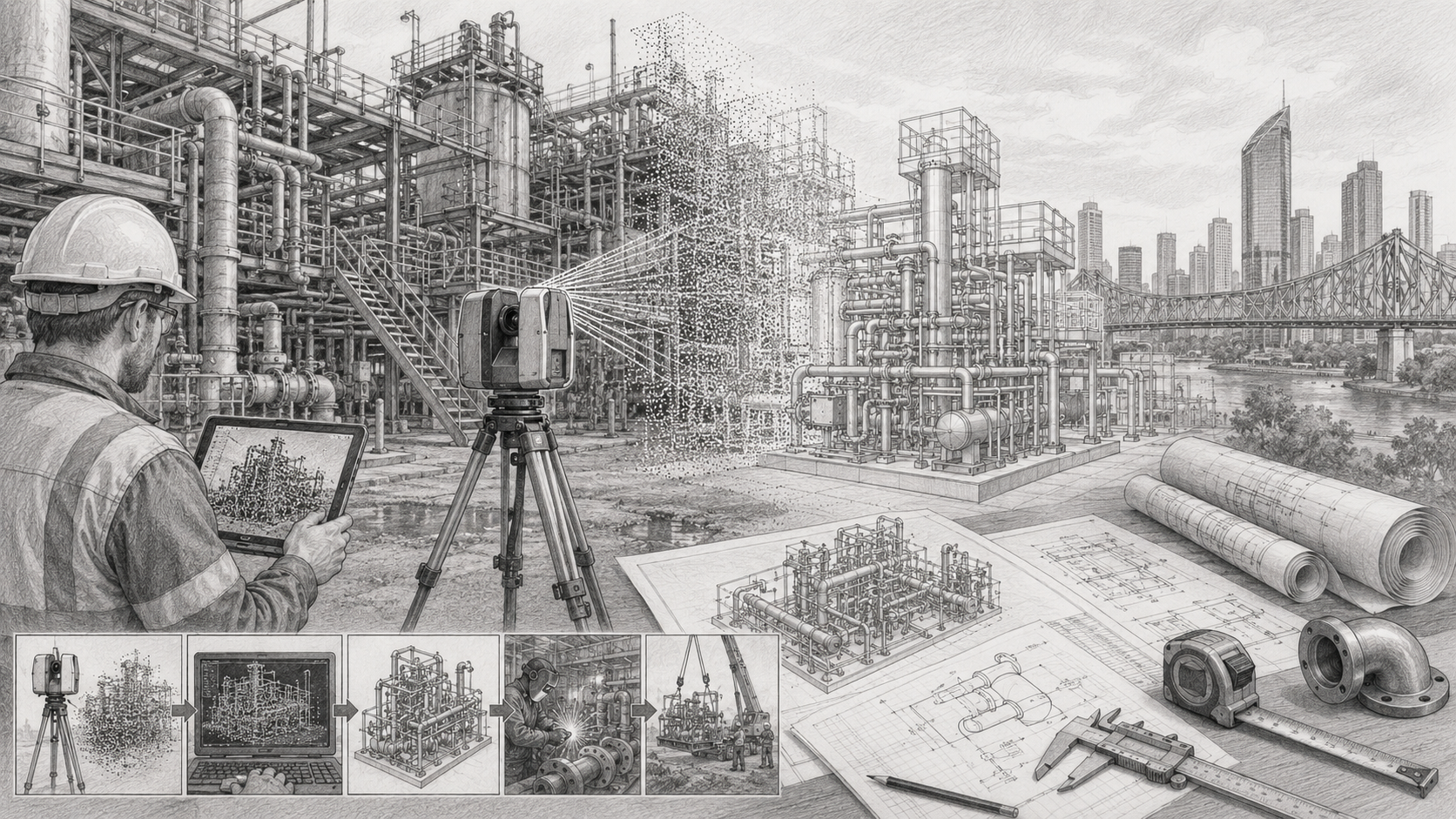
True as-built documentation requires scan-to-CAD workflows, where scan data is converted into:
Structured 3D CAD models
Clear 2D drawings
Fabrication-ready geometry
Engineering documentation suitable for construction
This process requires:
Controlled datums
Appropriate tolerances
Engineering interpretation of scan data
Understanding of how drawings will be used on site
Poorly modelled scan data can be just as problematic as poor drawings.
Where as-built documentation adds the most value
As-built documentation is particularly valuable for:
Brownfield and live-site upgrades
Mining and industrial facilities
Power generation and utilities
Manufacturing plants
Existing buildings undergoing refurbishment
Assets with long operational life and multiple modifications
In these environments, accurate documentation reduces risk, improves safety, and enables better decision-making across the asset lifecycle.
Engineering-led as-built documentation
At Hamilton By Design, as-built documentation is delivered as part of an integrated engineering workflow, combining:
Engineering-grade 3D laser scanning
CAD modelling and drafting
Mechanical and structural engineering expertise
Standards-aware documentation
This ensures as-built records are:
Accurate
Buildable
Defensible
Suitable for future engineering use
Our clients:
Final thoughts
As-built documentation is not just about record-keeping โ it is about engineering confidence.
Accurate as-built information:
Reduces project risk
Improves safety
Supports compliance
Saves time and cost on future works
In complex industrial and construction environments, investing in proper as-built documentation pays for itself many times over.
Need accurate as-built documentation?
If youโre planning upgrades, maintenance, or new works and need engineering-grade as-built documentation, Hamilton By Design can help.
Accurate data today enables better decisions tomorrow.
Reality Capture Sydney | Property & Real Estate Services
Engineering-Grade LiDAR & Digital Reality Capture for the Built Environment
As Sydneyโs construction, infrastructure, and industrial assets become more complex, traditional measurement methods are no longer sufficient. Reality capture has become a critical enabler for accurate planning, risk reduction, and confident project delivery across the built environment in Sydney.
Hamilton By Design provides engineering-grade reality capture services in Sydney, combining high-accuracy LiDAR laser scanning with practical engineering workflows to deliver reliable as-built data, digital twins, and construction-ready models.
Digital Twin Development
Reality capture is often the first step in creating a digital twin of an existing asset, facility or infrastructure network.
Using engineering-grade terrestrial LiDAR scanning, Hamilton By Design captures highly detailed existing-condition data that can be used to develop accurate digital representations of buildings, industrial facilities and infrastructure assets throughout Sydney.
Digital twins provide a valuable foundation for planning upgrades, maintenance activities, asset management programs and future engineering projects by ensuring decision-makers have access to accurate and current information.
Asset Documentation & Existing Conditions
Many facilities operate with incomplete, outdated or missing drawings. Reality capture provides a reliable method of documenting existing conditions and creating an accurate record of an asset at a specific point in time.
Hamilton By Design supports asset owners, engineers and project teams by delivering comprehensive documentation of industrial facilities, manufacturing plants, infrastructure assets and commercial buildings throughout Sydney.
This information can be used for engineering design, maintenance planning, compliance assessments and future capital works projects.
Heritage & Existing Condition Surveys
Reality capture technology provides a non-invasive method of documenting heritage structures, existing buildings and architecturally significant assets.
High-density LiDAR scanning can capture detailed geometric information without disturbing the asset, creating an accurate digital record suitable for preservation, restoration and future reference.
This approach is particularly valuable where traditional measurement methods are impractical or where maintaining a permanent digital archive is important.
Infrastructure Corridor Capture
Reality capture is widely used to document transport corridors, utility networks and linear infrastructure projects.
Hamilton By Design can capture roads, rail corridors, processing facilities, pipelines and utility infrastructure to provide accurate spatial information for planning, design and asset management purposes.
The resulting datasets assist engineering teams in identifying constraints, verifying existing conditions and reducing uncertainty during project development.
Construction Verification & Progress Monitoring
Reality capture can be used throughout construction projects to verify installed works and monitor project progress.
By comparing captured data against design models, project teams can identify deviations, verify installation accuracy and document construction milestones.
This process helps reduce rework, improve project certainty and provide objective records of completed work.
Building Envelope Surveys
Reality capture provides an efficient method of documenting building facades, roof structures and external architectural features.
The resulting data can be used for refurbishment projects, faรงade upgrades, structural assessments and redevelopment planning.
Building envelope surveys provide accurate measurements and spatial information without requiring extensive manual site measurement activities.
Facility Management & Asset Registers
Reality capture data can support facility management programs by providing accurate information about buildings, equipment and infrastructure assets.
Digital asset records allow facility owners to improve maintenance planning, track asset changes and maintain up-to-date documentation throughout the asset lifecycle.
For many organisations, reality capture forms an important component of broader digital engineering and asset management strategies.
What Is Reality Capture?
Reality capture is the process of digitally recording real-world assets using technologies such as:
LiDAR laser scanning
High-resolution spatial data capture
Registered point clouds
3D models aligned to real geometry
The result is an accurate digital representation of existing conditions โ enabling engineers, designers, and constructors to work from a single source of truth rather than assumptions or outdated drawings.
Why Reality Capture Matters in Sydney
Sydney projects frequently involve:
Live operational assets
Brownfield construction and upgrades
Tight construction tolerances
Complex interfaces between structural, mechanical, and architectural systems
Reality capture enables project teams to:
โ Verify existing conditions before design โ Reduce rework and construction clashes โ Improve coordination across disciplines โ Accelerate approvals and decision-making โ Improve safety by minimising site re-visits
This is particularly valuable across commercial buildings, transport infrastructure, industrial facilities, utilities, and large refurbishment projects.
Engineering-Led Reality Capture โ The Hamilton By Design Difference
At Hamilton By Design, reality capture is not treated as a standalone surveying task. Our services are engineer-led, ensuring the data captured is fit for downstream use in:
Mechanical and structural design
Construction coordination
Retrofit and upgrade works
Fabrication and installation planning
Our Sydney reality capture services integrate directly with CAD, BIM, and engineering documentation workflows โ ensuring accountability from scan through to design and delivery.
Typical Reality Capture Applications in Sydney
As-Built Documentation
Capture accurate as-built conditions for compliance, certification, handover, or future upgrades.
Construction & Refurbishment Projects
Scan existing buildings and structures prior to modifications, extensions, or adaptive reuse.
Industrial & Infrastructure Assets
Capture complex geometry such as plant rooms, pipework, platforms, and structural steel.
Digital Twins & Asset Records
Create reliable digital records that support ongoing asset management and lifecycle planning.
Deliverables Tailored to Project Needs
Depending on your scope, Hamilton By Design can provide:
Registered LiDAR point clouds
CAD-ready geometry
BIM-compatible models
Section views and reference drawings
Engineering drawings derived from scan data
All deliverables are issued to suit engineers, builders, asset owners, and project managers working across Sydney.
Reality Capture Applications Across Sydney Industries
Reality capture provides value wherever accurate existing-condition information is required before design, construction or asset management decisions are made.
Commercial Buildings
Reality capture assists building owners, consultants and contractors by documenting existing conditions before refurbishment, fit-outs, services upgrades and redevelopment projects.
Industrial Facilities
Manufacturing plants, processing facilities and operational sites often contain undocumented modifications accumulated over many years. Reality capture provides an accurate digital record that supports future upgrades and maintenance planning.
Transport Infrastructure
Rail facilities, stations, maintenance depots, tunnels and transport corridors can be accurately captured to support planning, coordination and construction activities while minimising disruption to operations.
Utilities & Water Infrastructure
Reality capture supports pump stations, treatment plants, pipelines and utility infrastructure where accurate spatial information is required for maintenance, expansion and compliance projects.
Construction & Refurbishment
Capturing existing site conditions before construction begins reduces uncertainty, improves coordination and helps identify potential clashes before work reaches site.
Asset Management
Reality capture provides a reliable foundation for digital asset registers, facility management programs and long-term lifecycle planning.
Reality Capture Sydney โ Build with Confidence
Reality capture removes uncertainty from complex projects. By accurately capturing what exists today, project teams can design, coordinate, and construct with confidence tomorrow.
Hamilton By Design supports Sydney-based projects with engineering-grade reality capture, practical deliverables, and a deep understanding of how digital data is used in real construction and industrial environments.
Industries We Support
Hamilton By Design provides reality capture services throughout Sydney for manufacturing facilities, rail infrastructure, water treatment plants, commercial buildings, hospitals, data centres and industrial facilities.
Using engineering-grade LiDAR scanning and digital reality capture workflows, we help project teams accurately document existing assets, improve project planning and reduce risk during design, construction and asset management activities.
Contact Hamilton By Design to discuss your Sydney reality capture requirements or arrange a site scan.
Related Sydney Digital Engineering Services
Reality capture is often the first step in a broader digital engineering workflow. Hamilton By Design supports Sydney projects from initial site capture through to engineering design, drafting and fabrication documentation.
Our related Sydney services include:
3D Scanning Sydney โ Engineering-grade terrestrial laser scanning, as-built surveys and point cloud capture for industrial, infrastructure and commercial projects.
Reality Capture Sydney โ High-accuracy reality capture, digital twins, asset documentation and engineering-grade site verification.
Scan to CAD Sydney โ Convert point cloud data into AutoCAD, SolidWorks, Inventor and other engineering-ready CAD deliverables.
Point Cloud Modelling Sydneyโ Engineering-grade point cloud processing, clash detection, as-built verification and 3D modelling.
Mechanical Engineering Sydney โ Mechanical design, plant upgrades, materials handling systems, conveyors, chutes, platforms and engineering support.
Structural Drafting Sydneyโ Structural steel drafting, fabrication drawings, GA drawings, workshop detailing and as-built documentation.
By combining reality capture, LiDAR scanning, engineering design and drafting under one team, Hamilton By Design helps Sydney projects move from existing conditions to construction-ready deliverables with confidence.
Hamilton By Design provides reality capture services throughout Sydney CBD, Parramatta, Liverpool, Penrith, Chatswood, Alexandria, Mascot, Newcastle and the Central Coast. Our engineering-led approach helps project teams accurately capture existing conditions, create digital asset records and support design, construction and asset management activities.
3D Scanning Bathurst | Engineering-Grade LiDAR & Scan-to-CAD
Bathurst and the Central West region support a diverse mix of manufacturing facilities, mining operations, quarries, infrastructure assets, utilities, and heritage structures. These environments demand more than survey-grade outputs.
Hamilton By Design combines LiDAR scanning with mechanical engineering expertise, ensuring that:
Scan coverage targets critical interfaces and load paths
Accuracy supports fabrication-ready design
Models reflect real-world constraints, not assumptions
This significantly reduces rework, clashes, and site uncertainty during upgrades or expansions.
Our 3D Scanning Services in Bathurst
We provide a complete scan-to-engineering workflow, including:
High-resolution terrestrial LiDAR scanning
Registered point clouds (colourised and structured)
Support for mechanical, structural, and fabrication design
All deliverables are tailored to your project scope โ from concept planning through to construction and installation.
Typical Bathurst Applications
Our 3D scanning services are commonly used for:
Industrial plant upgrades and brownfield modifications
Mining and quarry infrastructure
Conveyors, chutes, hoppers, and bulk materials handling systems
Mechanical equipment replacement and tie-ins
Structural steel verification and retrofits
Asset documentation and digital twins
Risk reduction for shutdown and live-site works
Where required, scanning data is integrated directly into engineering calculations, FEA models, and fabrication drawings.
Why Hamilton By Design
Engineer-Led Scanning
Your scan is planned and executed by engineers who understand loads, tolerances, constructability, and compliance, not just data capture.
Fit-for-Purpose Accuracy
We capture only the data that matters โ at the accuracy required for design, fabrication, and installation.
Single-Source Accountability
One team responsible for scanning, modelling, and engineering, eliminating scope gaps between consultants.
Regional & Mobile Delivery
We regularly support projects across Bathurst, Orange, Lithgow, Dubbo, Mudgee, and the broader Central West NSW, mobilising to site as required.
Deliverables You Can Build From
Depending on your project, we can supply:
Registered point clouds (E57 / RCP / compatible formats)
3D CAD models aligned to engineering workflows
GA drawings and interface layouts
Fabrication-ready references
Digital records for asset management and future upgrades
Our clients:
3D Scanning Bathurst โ Get Started
If you are planning a retrofit, upgrade, or new installation in Bathurst or Central West NSW, early 3D scanning can significantly reduce risk and cost.
Talk to an engineer about your site Request a Bathurst 3D scanning proposal On-site scanning available across the Central West
3D Point Cloud Modelling Melbourne | Engineering-Led LiDAR Models
Melbourne is home to some of Australiaโs most complex industrial, infrastructure, and construction assets. From live manufacturing facilities and transport infrastructure to commercial and brownfield redevelopment projects, accurate understanding of existing conditions is critical.
Hamilton By Design provides engineering-grade 3D point cloud modelling services in Melbourne, supporting projects where precision, constructability, and accountability matter. Our workflows convert high-accuracy LiDAR scan data into usable engineering models that reflect what actually exists on site.
Engineering-Grade Point Cloud Modelling for Melbourne Projects
3D point cloud modelling is not simply about visualisation. For engineering, construction, and industrial projects in Melbourne, point clouds are used to:
Establish accurate existing conditions
Verify interfaces with existing assets
Reduce site rework and clashes
Support constructable design decisions
Enable confident fabrication and installation
Our modelling workflows are developed for engineering and delivery, not presentation.
From 3D Laser Scanning to Usable Engineering Models
All point cloud modelling begins with accurate data capture. Our Melbourne projects are supported by engineering-led 3D laser scanning, producing high-resolution point cloud datasets suitable for detailed modelling and analysis.
Once captured, point cloud data is processed, registered, and validated before being used as the foundation for downstream modelling.
Point Clouds as the Basis for As-Built Modelling
A common challenge on Melbourne projects is the lack of reliable as-built information. Drawings may be outdated, incomplete, or no longer reflect site conditions due to years of undocumented modifications.
Our point cloud modelling services directly address this issue by enabling:
Accurate as-built geometry derived from LiDAR data
Verification of steelwork, plant, and structural interfaces
Confident modelling of upgrades, retrofits, and extensions
For projects requiring documented existing conditions, point clouds are often converted into as-built drawings and models to support engineering, construction, and compliance requirements.
Applications of 3D Point Cloud Modelling in Melbourne
Our Melbourne point cloud modelling services are commonly used across:
Industrial and manufacturing facilities
Mechanical plant upgrades and retrofits
Infrastructure and utilities projects
Construction coordination and verification
Structural steel and access modifications
In these environments, point clouds provide a single, reliable source of truth that engineering teams can trust.
Integration with Engineering and Design Services
Point cloud modelling does not exist in isolation. At Hamilton By Design, point clouds are integrated into broader engineering workflows, supporting:
Mechanical and structural design
CAD modelling and documentation
Constructability review
Interface coordination
Asset information and lifecycle planning
Our point cloud services form part of a wider suite of engineering services delivered nationally, ensuring continuity from site capture through to design and documentation.
For Melbourne projects, the quality of a point cloud model directly affects downstream decisions. Our approach ensures that:
Data is captured with engineering intent
Modelling reflects real-world geometry and tolerances
Assumptions are minimised
Risks are identified early
Models can be relied upon for fabrication and site work
This engineering-owned approach reduces uncertainty and improves project outcomes, particularly on complex or live sites.
3D Point Cloud Modelling Services Across Melbourne
We support projects across metropolitan Melbourne and surrounding regions, including inner-city sites, industrial precincts, and large-scale infrastructure corridors. Whether supporting early project definition or detailed upgrade works, our point cloud modelling services are tailored to the realities of Melbourneโs built environment.
Discuss a 3D Point Cloud Modelling Project in Melbourne
If you require accurate, engineering-grade 3D point cloud modelling in Melbourne, Hamilton By Design can support your project from initial capture through to usable engineering models and documentation.
Contact our team to discuss how point cloud modelling can reduce risk and improve certainty on your next Melbourne project.
Engineering-Grade Reality Capture for Live Construction Environments
Construction projects in Brisbane operate under conditions that place unique pressure on engineers, builders, and asset owners. Subtropical climate, flood-affected sites, reactive soils, dense CBD logistics, and a strong reliance on brownfield upgrades all increase one fundamental risk: designing and constructing from incorrect or outdated site information.
A 3D construction scan in Brisbane provides engineering-grade certainty by capturing what actually exists on site, enabling informed decisions during live construction, refurbishment, and staged delivery projects.
What Is a 3D Construction Scan?
A 3D construction scan uses high-accuracy LiDAR laser scanning to capture the true as-built condition of a site at a specific point in time. Unlike visual scans or phone-based capture, engineering-grade scanning produces registered point clouds that can be trusted for:
Construction coordination
Design verification
Clash detection
Fabrication-ready modelling
As-built documentation
Hamilton By Design delivers these outcomes through its engineering-led laser scanning services, where accuracy, downstream use, and construction risk are defined before scanning begins.
Why Brisbane Construction Projects Require a Different Approach
Subtropical Climate & Structural Movement
Brisbaneโs humidity and temperature cycles contribute to thermal expansion, contraction, and cumulative movement across steelwork, pipe runs, conveyors, faรงades, and plant installations.
When construction decisions rely on assumed geometry or legacy drawings, even small movements can result in:
Misaligned interfaces
Fabrication clashes
Installation delays
A 3D construction scan captures the current, in-situ geometry, allowing engineers to design and coordinate based on reality โ not historical intent.
Flood-Affected & Modified Assets
Many Brisbane sites โ particularly river-adjacent commercial and industrial facilities โ have undergone multiple flood recovery and modification cycles. Over time, this results in:
Changed floor levels
Unrecorded ramps and bunds
Altered drainage and gravity-dependent systems
Construction scanning establishes a true datum and elevation baseline, supporting engineering verification of falls, access clearances, and tie-in points.
This capability aligns directly with Hamilton By Designโs broader reality capture and as-built verification workflows.
A significant proportion of Brisbane construction work occurs in live, operational environments, including:
Commercial refurbishments
Industrial plant upgrades
Infrastructure modifications
Asset life-extension projects
These sites often contain undocumented steelwork, legacy penetrations, and accumulated modifications. A 3D construction scan enables non-intrusive capture of this complexity, supporting engineering coordination without disrupting operations.
Reactive clay soils common throughout South-East Queensland contribute to long-term differential settlement, particularly where new construction interfaces with older structures. Over time, this can lead to:
Misaligned columns and beams
Drift in conveyors and pipe racks
Geometry that no longer matches design intent
A construction scan captures current condition, enabling engineers to design extensions and upgrades that reflect actual site geometry.
Construction Scanning vs Generic 3D Scanning
Not all scanning is suitable for construction engineering.
Aspect
Generic Scan
Engineering-Led Construction Scan
Accuracy
Visual or indicative
Millimetre-grade
Output
Meshes or images
Registered point clouds
Engineering Use
Limited
Design & fabrication
Risk Reduction
Low
High
Construction Ready
No
Yes
Hamilton By Design positions construction scanning as part of an integrated engineering workflow, not a standalone data capture exercise.
Melbourne has long been recognised as one of Australiaโs most advanced engineering and manufacturing centres, and inner-city hubs such as South Yarra sit at the intersection of design, industry, infrastructure, and innovation. As projects become more complex and timelines more compressed, engineering teams are increasingly seeking partners who can reduce uncertainty, improve accuracy, and provide reliable technical insight from day one.
This is where Hamilton By Design delivers genuine value.
Hamilton By Design operates as an engineer-led consultancy focused on precision, constructability, and real-world outcomes. Rather than working from assumptions or incomplete information, the business is built around capturing existing conditions accurately and transforming that data into practical engineering deliverables that support confident decision-making.
Moving Beyond Assumptions in Modern Engineering
Many engineering challenges in metropolitan Melbourne are not greenfield projects. They involve existing buildings, operating facilities, constrained spaces, legacy assets, or staged upgrades that must integrate seamlessly with what is already in place. In these environments, relying on outdated drawings or manual measurements introduces risk โ misalignment, clashes, rework, and delays that can quickly erode budgets and schedules.
Hamilton By Design addresses this challenge by placing reality capture and engineering validation at the front end of projects. This ensures that every downstream decision is based on what truly exists on site, not what is assumed to exist.
For engineering teams working in and around South Yarra โ whether supporting manufacturing, infrastructure, plant upgrades, or specialist facilities โ this approach significantly reduces technical risk and increases confidence across all stakeholders.
LiDAR Scanning as a Foundation for Accuracy
A key capability that differentiates Hamilton By Design is its use of engineering-grade LiDAR scanning. Unlike traditional surveys that capture selective points, LiDAR scanning records millions of measurements across an entire environment, producing a high-resolution digital representation of buildings, plant, structures, and surrounding context.
This data becomes a reliable reference point for engineers, designers, fabricators, and project managers alike.
LiDAR scanning enables:
Accurate capture of complex geometries and tight spaces
Clear identification of spatial constraints and interfaces
Early detection of clashes and access issues
Reduced need for repeat site visits
Improved coordination between disciplines
By converting physical assets into precise digital data, Hamilton By Design helps teams eliminate ambiguity and work from a single source of truth.
From Scan Data to Engineering Outcomes
Importantly, Hamilton By Design does not operate as a scanning-only service. The real value lies in how scan data is interpreted, validated, and converted into engineering outputs that directly support delivery.
Scan information is used to develop structured models, layouts, and documentation that reflect real-world conditions. This supports engineering activities such as:
Mechanical and structural modifications
Plant upgrades and equipment integration
Space planning and layout optimisation
Fabrication and installation planning
Asset documentation and as-built records
Because the work is led by experienced engineers, the focus is always on what needs to be built, installed, or modified, not just on creating visually impressive models.
Supporting Engineering Teams and Decision-Makers
In a business and engineering environment like South Yarra โ where projects are often time-sensitive and commercially driven โ external engineering support must be reliable, efficient, and technically sound.
Hamilton By Design integrates smoothly with internal teams, consultants, and contractors, providing additional technical depth without adding unnecessary complexity. The consultancy model is deliberately structured to support decision-makers who need clarity, not noise.
This means:
Clear communication of constraints and risks
Practical recommendations grounded in real site data
Deliverables aligned with fabrication and construction needs
Engineering documentation that supports approval and execution
The result is fewer surprises downstream and a smoother path from concept through to implementation.
Engineering for Brownfield and Live Environments
One of the most challenging aspects of modern engineering is working within live or brownfield environments โ facilities that cannot simply shut down for measurement, redesign, or rework. In these settings, accuracy and planning are critical.
Hamilton By Designโs LiDAR-driven workflows are particularly well suited to these conditions. Rapid data capture minimises disruption on site, while the detailed digital record allows engineering work to continue remotely with confidence.
This approach supports safer planning, better coordination, and reduced exposure to operational risk โ outcomes that are highly valued by engineering leaders and project managers alike.
A Practical, Engineer-Led Philosophy
At its core, Hamilton By Design operates on a simple but powerful principle: engineering should be grounded in reality. By combining high-accuracy site data with deep engineering experience, the consultancy helps organisations make informed decisions, avoid costly mistakes, and deliver projects that work the first time.
For organisations operating in South Yarra and the broader Melbourne region, this means access to an engineering partner who understands both the technical and commercial pressures of modern project delivery.
Engineering Certainty in a Complex World
As engineering projects continue to increase in complexity, the margin for error continues to shrink. Those who invest early in accurate data and sound engineering judgement gain a clear advantage โ fewer delays, lower risk, and better outcomes.
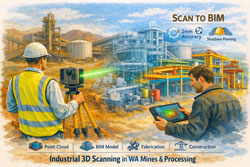
Hamilton By Design provides that advantage by bridging the gap between the physical site and the engineering office. Through precise LiDAR scanning, practical engineering insight, and a strong focus on constructability, the consultancy supports confident, efficient, and reliable project delivery across Melbourneโs most demanding environments.
To provide the best experiences, we use technologies like cookies to store and/or access device information. Consenting to these technologies will allow us to process data such as browsing behaviour or unique IDs on this site. Not consenting or withdrawing consent, may adversely affect certain features and functions.
Functional
Always active
The technical storage or access is strictly necessary for the legitimate purpose of enabling the use of a specific service explicitly requested by the subscriber or user, or for the sole purpose of carrying out the transmission of a communication over an electronic communications network.
Preferences
The technical storage or access is necessary for the legitimate purpose of storing preferences that are not requested by the subscriber or user.
Statistics
The technical storage or access that is used exclusively for statistical purposes.The technical storage or access that is used exclusively for anonymous statistical purposes. Without a subpoena, voluntary compliance on the part of your Internet Service Provider, or additional records from a third party, information stored or retrieved for this purpose alone cannot usually be used to identify you.
Marketing
The technical storage or access is required to create user profiles to send advertising, or to track the user on a website or across several websites for similar marketing purposes.