Mechanical Engineering | 3D Scanning | 3D Modelling
Tag: 3D Modelling
3D modelling covers the creation of accurate digital models used for engineering, design coordination, analysis, and documentation. This tag brings together content that demonstrates how 3D models are developed from design intent or real-world data to support mechanical, structural, industrial, and construction projects.
3D Scanning Melbourne CBD | Engineering-Grade Laser Scanning
Hamilton By Design provides engineering-grade 3D scanning services in Melbourne CBD, supporting designers, engineers, builders, and asset owners working in one of Australia’s most complex urban environments. Melbourne CBD projects are characterised by tight access, heritage overlays, staged construction, and dense services. Our 3D laser scanning workflows deliver accurate existing-condition data that allows engineering decisions to be made with confidence — before work begins on site.
Why 3D Scanning Is Critical in Melbourne CBD
Melbourne’s CBD presents challenges that cannot be reliably addressed using legacy drawings or assumed dimensions:
High-rise and podium structures with layered services
Heritage buildings integrated with modern construction
Restricted access and limited shutdown windows
Tight tolerance interfaces between new and existing works
3D laser scanning provides a measured digital record of what truly exists, allowing project teams to design within real constraints rather than assumptions.
Engineering-Led Laser Scanning
Hamilton By Design approaches scanning from an engineering perspective, not just data capture.
Our Melbourne CBD scanning services are designed to support:
Designers working in Melbourne CBD must account for:
Existing structure geometry
Embedded services and plant
Tolerance stacking across interfaces
Access and installation constraints
3D scanning provides the verified information needed to develop the most appropriate design solution based on the actual scope of works — not idealised assumptions.
This leads to:
Better design decisions
Fewer late-stage changes
Reduced construction risk
Improved project certainty
Why Hamilton By Design for Melbourne CBD
Engineering-led scanning workflows
Accurate, repeatable point cloud data
Strong integration with CAD and engineering design
Experience in dense urban environments
Scanning planned around design outcomes, not just coverage
We don’t scan for visualisation. We scan to support engineering decisions that must stand up to scrutiny.
Our clients:
Discuss 3D Scanning in Melbourne CBD
If your Melbourne CBD project requires accurate existing-condition data to support design, coordination, or construction planning, Hamilton By Design can assist.
📩 Contact us to discuss your 3D scanning requirements in Melbourne CBD.
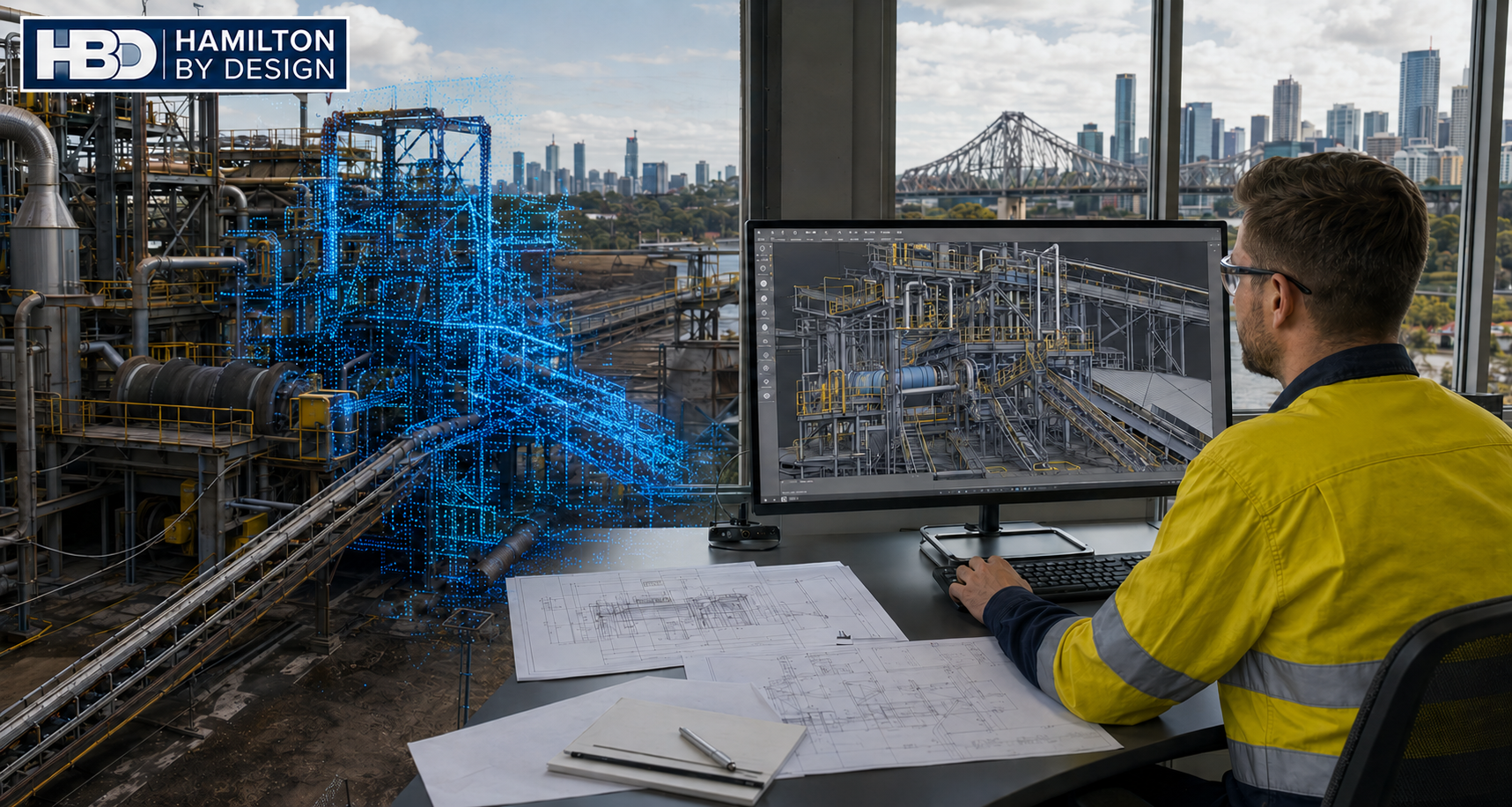
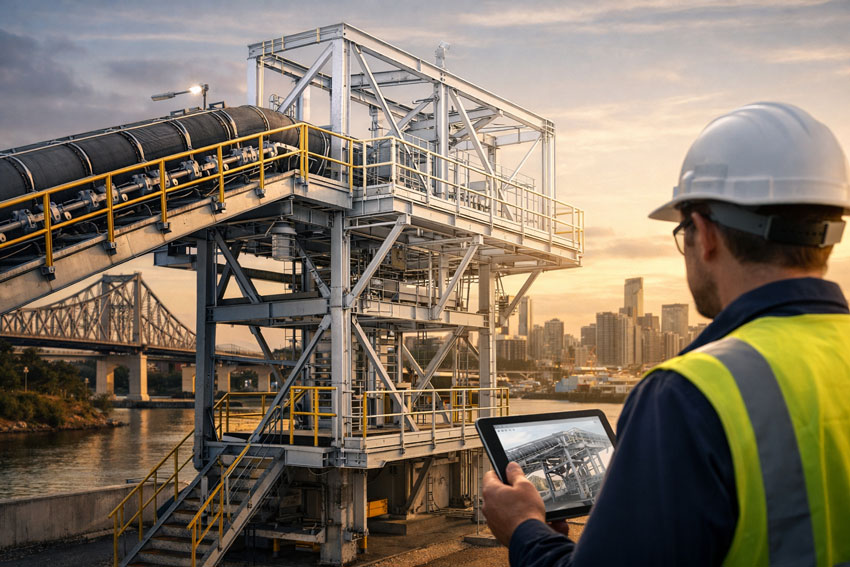
Brisbane is one of Australia’s most active centres for industrial, infrastructure, and brownfield development. From live manufacturing facilities and ports to mineral processing plants and inner-city construction, projects in South East Queensland demand 3D CAD models that reflect reality — not assumptions.
Hamilton By Design provides engineering-led 3D CAD services in Brisbane, supporting mechanical, industrial, and construction projects where accuracy, constructability, and coordination are critical.
Engineering-Led 3D CAD for Brisbane Projects
Our 3D CAD workflows are developed for environments where:
Existing structures must be retained or modified
Access is constrained or live operations continue
Fabrication tolerances matter
Errors translate directly into cost, downtime, or safety risk
Rather than producing conceptual or presentation-only models, our Brisbane CAD services focus on fit-for-purpose engineering outcomes — models that can be trusted for fabrication, installation, and long-term asset management.
Scan-to-CAD: Accurate Models Built on Real Geometry
A defining feature of 3D CAD in Brisbane is the dominance of brownfield and upgrade projects. As-built information is often incomplete, outdated, or missing altogether.
To address this, our CAD services are tightly integrated with engineering-grade LiDAR scanning:
Existing conditions are captured using high-accuracy point cloud data
CAD models are built directly from site geometry
Interfaces with existing steel, plant, and services are verified early
This approach reduces clashes, rework, and site-based decision making.
For projects requiring detailed existing-conditions capture, our CAD services are commonly paired with:
This integrated approach allows Brisbane clients to move from site capture to fabrication-ready models without fragmentation or loss of accountability.
Why Brisbane Projects Benefit from Engineering-Owned CAD
Brisbane’s mix of live industrial assets, ageing infrastructure, and complex construction environments means CAD decisions carry real-world consequences.
Our Brisbane CAD workflows are:
Engineer-owned, not drafting-only
Developed with site conditions in mind
Accountable to constructability and safety
Aligned with Australian Standards and industry best practice
This makes our CAD outputs suitable for use in shutdown planning, procurement, fabrication, and installation, not just design coordination.
3D CAD Services Across Greater Brisbane
We support projects across the greater Brisbane region, including:
Inner-city and CBD environments
Industrial estates and ports
Manufacturing precincts
Infrastructure and utilities corridors
Whether supporting a standalone upgrade or a larger engineering program, our 3D CAD services are structured to integrate smoothly into existing project teams.
Discuss a 3D CAD Project in Brisbane
If you are planning an upgrade, retrofit, or new installation in Brisbane and require accurate, engineering-grade 3D CAD, we can support your project from early capture through to fabrication-ready deliverables.
Contact Hamilton By Design to discuss how our 3D CAD and scan-to-CAD services can reduce risk and improve outcomes on your Brisbane project.
Toowoomba’s Engineering Future: How 3D LiDAR Scanning & Digital Modelling Are Transforming Projects Across the Darling Downs
Toowoomba is quickly becoming one of Australia’s most important regional powerhouses — a city where agriculture, logistics, mining, construction and manufacturing intersect at a scale rarely seen outside capital cities. With major infrastructure investments, the growth of the Toowoomba Wellcamp Airport, and its position as a gateway to the Surat Basin and the Darling Downs, the region is undergoing a steady shift toward digitally enabled engineering and smarter project delivery.
At Hamilton By Design, we’re incredibly proud to support this growth by providing 3D LiDAR laser scanning, mechanical engineering consulting, 3D modelling and drafting, and digital quality assurance tailored specifically for the demands of Toowoomba’s industrial, commercial and rural sectors.
In this article, we explore why Toowoomba is so unique, the role of modern engineering technology in the region, and how accurate site data and digital models are helping local businesses reduce rework, improve safety and deliver better project outcomes.
Why Toowoomba Is the Perfect Fit for Modern Digital Engineering
Toowoomba is Australia’s largest inland city outside Canberra, with more than 180,000 people and an economy driven by a mix of agriculture, logistics, manufacturing, construction and energy projects. Its elevated position on the Great Dividing Range, combined with its access to the Surat Basin and major rural supply chains, makes it a critical service hub for heavy industry and regional infrastructure.
But what really sets Toowoomba apart is its transformation into a logistics and engineering centre. With Inland Rail connections, Wellcamp Airport’s freight terminal and constant agricultural expansion, the demand for precise, reliable engineering data has grown rapidly.
This is where 3D LiDAR scanning and digital engineering provide enormous value.
3D LiDAR Laser Scanning: Bringing Millimetre-Level Accuracy to Local Projects
Whether you’re working on a feed mill upgrade, a manufacturing facility expansion, a rural processing plant, a logistics warehouse fit-out or a mining-related modification, accurate site measurements are essential. Traditional surveys struggle to capture the complex geometry, alignment issues or hidden interferences common in brownfield environments.
Engineering-grade 3D LiDAR scanning solves this problem instantly.
Hamilton By Design uses high-accuracy terrestrial laser scanners capable of capturing:
complex plant layouts
conveyors, chutes, structural frames
pipework routing and clashes
equipment misalignment
deflections, corrosion and wear
existing foundations and tie-in points
site terrain and building envelopes
All delivered with millimetre-level accuracy.
For Toowoomba businesses, this means:
reduced rework
faster fabrication
fewer shutdown overruns
safer installations
accurate as-built documentation
In a region where travel, mobilisation and shutdown timing matter, these improvements translate directly into cost savings and smoother project execution.
3D Modelling & Drafting for Toowoomba Industry
After scanning, the next step is turning point-cloud data into intelligent 3D models and fabrication-ready drawings.
Hamilton By Design specialises in:
SolidWorks mechanical modelling
structural modelling for plant systems
equipment layouts and upgrade designs
skid-based systems
brownfield modification design
drawing packages (GA, detail, isometric, BOMs)
For Toowoomba industries — especially manufacturing workshops, agri-processing facilities, grain-handling plants, transport depots and rural engineering contractors — accurate 3D models significantly improve design coordination.
We often hear clients say:
“We used to rely on tape measures and photos. Now we can see the entire plant from our office.”
That is exactly the transformation 3D modelling provides.
Mechanical Engineering for Brownfield Upgrades Across the Darling Downs
The Toowoomba region is rich in brownfield mechanical assets: farm infrastructure, conveyor systems, grain silos, batching plants, food-processing lines, workshops, energy facilities and quarry machinery.
Hamilton By Design provides engineering support such as:
mechanical design for upgrades
structural integrity assessments
vibration, alignment and deflection reviews
buckling, fatigue and stress analysis (FEA)
chute, pipework and mechanical flow improvements
equipment mounting, lifting and access design
Our combination of engineer-led scanning + mechanical design ensures that every upgrade fits the first time and is supported by real data.
Why 3D Laser Scanning Is a Game-Changer for Toowoomba
Here’s where Toowoomba really benefits compared to many inland cities:
1. Large Agricultural Facilities Need Accurate Layouts
Feedlots, grain silos, packing sheds, processing plants and cold-storage facilities often evolve over many years. Scanning helps document these environments for compliance, redesign and expansion.
2. The Region Supports Mining & Energy Projects
Toowoomba acts as a service centre for the Surat Basin — Dalby, Chinchilla, Miles, Roma. LiDAR enables accurate tie-in points, pipe upgrades and shutdown planning.
3. Manufacturing & Fabrication Are Growing
Local workshops need precise data to avoid rework. Models based on point clouds give fabricators total confidence before cutting steel.
4. Logistics Infrastructure Continues Expanding
Wellcamp Airport, industrial estates and new warehousing projects benefit from accurate as-built documentation to speed up development approvals and construction decisions.
5. Reducing Travel Costs Is Critical for Regional Projects
A single scan eliminates multiple site trips — crucial for Toowoomba’s broad geographic service area.
Types of Toowoomba Projects Hamilton By Design Supports
Here are some of the local project types where our team adds immediate value:
grain-handling plant upgrades
feed mill expansions
water treatment & pumping stations
abattoir & food facility engineering
conveyor & materials-handling systems
batching plant upgrades
workshop fit-outs and machinery layouts
logistics warehouse redesigns
rural industrial buildings
mechanical equipment retrofits
energy & utility infrastructure
Whether it’s a small workshop or a multi-hectare industrial site, LiDAR scanning gives project teams a crystal-clear digital representation of the site.
Single-Source Accountability:
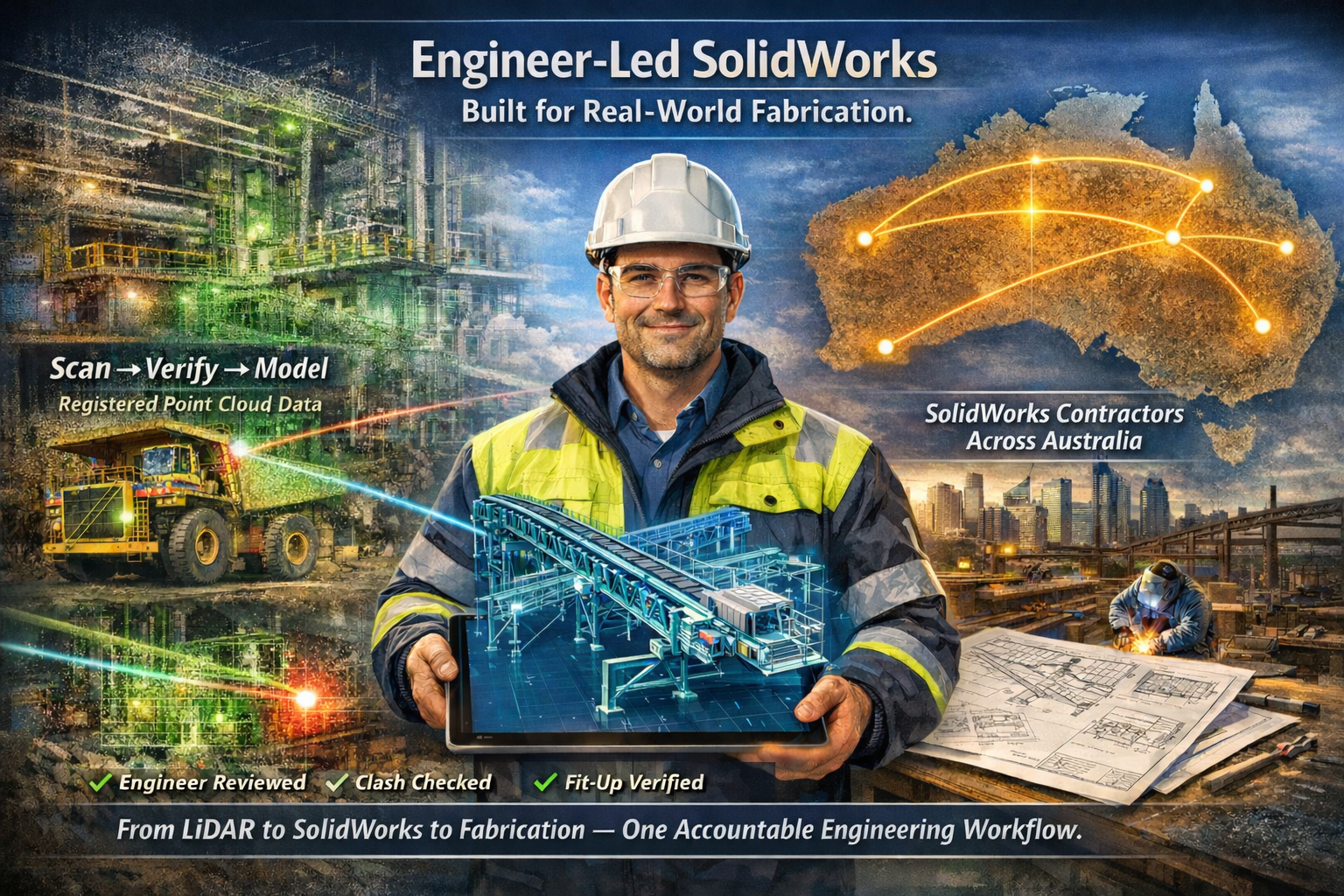
Scanning → Modelling → Engineering → Drawings
One of the biggest frustrations in regional engineering is fragmented contractors — one team scans, another models, another designs, and nobody takes responsibility when things don’t align.
Hamilton By Design solves this with an integrated workflow:
3D LiDAR scan of the site
Registration and accuracy validation
3D CAD modelling (SolidWorks)
Mechanical & structural engineering
Fabrication-ready drawings
Digital QA and installation support
Everything is handled by a single engineering-led team.
Toowoomba’s Future Needs Digital Engineering — And We’re Here to Support It
Toowoomba is entering a decade of growth — new industrial estates, expansions in agri-processing, energy transformation, airport-driven logistics and inland infrastructure. Digital engineering will be a major part of how these projects are delivered efficiently and safely.
Hamilton By Design is excited to provide Toowoomba businesses with:
precise 3D LiDAR scanning
mechanical engineering and assessment
professional 3D modelling and drafting
fabrication-ready design
digital documentation and QA
Whether you’re planning a small plant improvement or a major regional upgrade, our data-driven approach helps you design with confidence.
Bring your concepts, site measurements and hand sketches to life with precise, fabrication-ready SolidWorks models and drawings. Hamilton By Design provides flexible SolidWorks drafting support so you can scale your engineering and detailing capacity without the overhead of another full-time employee.
Whether you’re a fabricator, OEM, consulting engineer, mining operation or builder, you can hire a SolidWorks drafter to step in, pick up your workflow, and deliver accurate drawings that fit first time on site.
Why Hire a SolidWorks Drafter?
Hiring a dedicated SolidWorks drafter gives you:
Extra capacity during peak workload – avoid bottlenecks before shutdowns, tenders or tight project deadlines.
Accurate 3D models and 2D drawings – reduce rework, clashes and “tape measure surprises” on site.
Flexible support – bring us in for a single project, a shutdown, or ongoing drafting support.
Reduced overheads – access professional drafting without the cost of recruitment, training and full-time salaries.
Integrated support with your engineers and workshop – we understand what supervisors, boilermakers and installers need on a drawing.
SolidWorks Drafting Services We Offer
When you hire a SolidWorks drafter from Hamilton By Design, you gain access to a broad range of CAD and documentation services, including:
3D Modelling
Parametric 3D models of mechanical parts and assemblies
Modelling from sketches, photos, existing drawings or LiDAR point clouds
Complex assemblies with correct mates, motion ranges and clear structure
Power & utilities – structural and mechanical modifications, platforms, ducting
Construction & building services – plant decks, supports, frames, miscellaneous metalwork
General engineering – jigs, fixtures, prototypes and custom machinery components
If your project involves metal, structure or machinery, you can hire a SolidWorks drafter who understands both the engineering intent and workshop reality.
How Hiring a SolidWorks Drafter Works
We keep the engagement process simple and transparent:
Standards and templates to follow (your title blocks, layers, revision systems)
Deadlines and approval workflows
Inputs can include sketches, existing drawings, site photos, point clouds, standards and vendor data.
2. Drafting & Modelling in SolidWorks
Our drafter:
Builds parametric models in SolidWorks
Sets up assemblies with logical structure and clear naming
Produces drawing sheets with appropriate views, dimensions and notes
Checks for clashes, interferences and obvious manufacturing issues
3. Review & Mark-Ups
You review PDFs or eDrawings
We incorporate your comments, site feedback or engineering mark-ups
Revisions are tracked so you have a clean history of changes
4. Final Issue
Fabrication-ready PDFs for the workshop
Native SolidWorks files for your own engineering team
DXFs and other exports as required for plasma/laser cutting or CNC
Why Work With Hamilton By Design?
When you hire a SolidWorks drafter from Hamilton By Design, you’re not just engaging a CAD operator – you’re engaging mechanical engineering support that understands site, fabrication and shutdown pressures.
You’ll benefit from:
Real-world engineering experience – extensive work on CHPPs, conveyors, crushers and industrial structures
Attention to detail – clear part numbering, logical drawing sets and tidy models that others can easily work with
Alignment with your standards – we can adopt your drafting standards or help you develop them
Site-aware drafting – we consider access, lifting, installation and maintenance during the detailing stage
Integration with 3D laser scanning (if needed) – LiDAR-based as-built models to make sure your new steel actually fits
Engage a SolidWorks Drafter Today
Need extra drafting capacity for an upcoming shutdown, tender or fabrication package?
Hamilton By Design can provide SolidWorks drafting support on a project, part-time or ongoing basis.
Get in touch today to discuss your drawings, timelines and preferred way of working, and we’ll tailor a SolidWorks drafter engagement that fits your workload and budget.
Engineering-grade accuracy for brownfield upgrades, shutdowns and complex projects across Greater Sydney.
Hamilton By Design provides engineer-led 3D scanning in Sydney for industrial plants, fabrication projects, construction sites and brownfield upgrades. Using terrestrial LiDAR scanning, we capture accurate existing conditions and convert registered point clouds into SolidWorks, Inventor and AutoCAD models, drawings and fabrication-ready design information.
Sydney’s industrial plants, commercial buildings and infrastructure are under constant pressure to increase capacity, improve safety, meet compliance requirements and reduce downtime. Much of this work takes place in congested, operational brownfield environments where traditional tape measurements and hand-sketched site notes may not provide enough information for reliable engineering design.
Hamilton By Design provides 3D LiDAR scanning and 3D modelling across Sydney, capturing existing conditions in detail and converting the scan data into practical engineering models and drawings. From Sydney CBD plant rooms and commercial buildings to manufacturing facilities, power stations, port infrastructure and industrial sites, we help project teams plan upgrades with greater confidence.
3D Scanning Services in Sydney
Hamilton By Design provides 3D scanning services in Sydney for industrial plants, commercial buildings, infrastructure upgrades and fabrication projects. Using terrestrial LiDAR scanning, we can capture structural steel, industrial equipment, conveyors and chutes, pipework and ductwork, platforms and access structures, buildings and plant rooms, fabrication interfaces, connection points and surrounding obstructions.
This coordinated workflow helps engineers, designers and fabricators verify clearances, identify possible clashes and reduce the risk of workshop rework, site modifications and installation delays.
Why use 3D LiDAR scanning in Sydney?
Sydney projects often involve:
Tight CBD access and complex services
Limited shutdown windows
Congested plant rooms and pipe racks
Ageing assets with incomplete or outdated drawings
Multiple contractors needing to coordinate off the same information
3D LiDAR scanning solves these problems by creating a high-resolution digital record of your site before you start detailed design.
Key benefits:
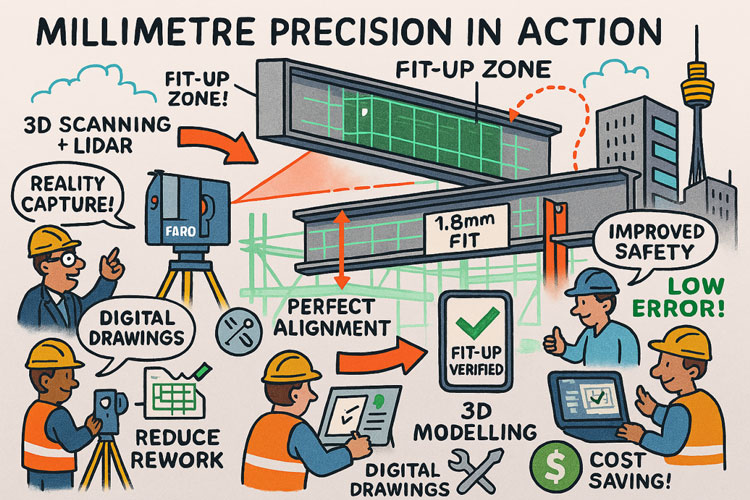
Reduce rework and clashes – design to true, as-built geometry, not assumptions
Shorten shutdowns – fabricate offsite, install first time with fewer site mods
Improve safety – minimise time spent in hazardous or confined areas
Support compliance – maintain a defensible, digital record of existing conditions
Enhance collaboration – share point clouds, 3D models and eDrawings across your team
If you’re planning complex works in Sydney – from a plant upgrade at Port Botany to a new services riser in the CBD – 3D LiDAR scanning gives your engineers and fabricators a reliable starting point.
Our workflow: from LiDAR scan to engineering-ready 3D model
Hamilton By Design combines 3D LiDAR scanning and 3D modelling in Sydney into one integrated workflow, so you don’t have to juggle multiple vendors.
1. Site visit and LiDAR capture
Mobilisation to your site (Sydney CBD, Western Sydney, North Shore, Port Botany, etc.)
Safe access and scanning around your operations and shutdown constraints
Capture of plant rooms, structures, conveyors, chutes, pipework, equipment and building envelopes
2. Point cloud registration and clean-up
Registration of scans into a single, coherent point cloud
Alignment to your coordinate system or project grid where required
Noise reduction and cropping to focus on the area of interest
3. 3D modelling in SolidWorks
Creation of accurate 3D models from the point cloud for critical equipment and structures
Parametric modelling of steelwork, chutes, conveyors, platforms, mechanical items and services
Integration of new design concepts into the as-built environment for clash detection
4. Engineering checks (optional)
Use of SolidWorks Simulation / FEA for mechanical or structural checks where required
Validation of installation envelopes, maintenance clearance and access
5. Fabrication-ready outputs
General arrangement drawings (GA)
Detailed fabrication drawings with DXF outputs for plate and profile cutting
3D formats compatible with your fabricator or EPCM
3D viewer files (e.g. eDrawings) so supervisors and frontline teams can review designs without CAD software
Where 3D LiDAR scanning and 3D modelling add value in Sydney
We provide 3D LiDAR scanning and 3D modelling in Sydney across a wide range of sectors:
Data centres and critical infrastructure
Scanning of white space, plant rooms, battery rooms and switch rooms
Modelling of cable ladders, HVAC ductwork, chilled water, CRAC units and structural supports
Planning of new racks, containment, or UPS upgrades with minimal downtime
Commercial and CBD plant rooms
As-built capture of mechanical services in high-rise towers and commercial buildings
Modelling of pipework, pumps, chillers, heat exchangers, filters and ventilation systems
Feasibility checks for new equipment, risers and routes before cutting steel
Mining, power and heavy industry (Sydney & Hunter-connected assets)
Scanning of coal handling plant, chutes, conveyors and transfer towers feeding into Sydney supply chains
Support for shutdowns at power stations and terminals servicing the Greater Sydney region
Like-for-like replacements and upgrade designs that fit first time
Manufacturing and process plants
Capture of production lines, tanks, pipe bridges and structural frames
Layout changes, new equipment installations and debottlenecking works
Accurate set-outs for fabricators and installers to minimise site cutting and hot work
Heritage and brownfield structures
Non-intrusive digital capture of older buildings and structures
Support for adaptive reuse, fit-outs and services upgrades without damaging heritage fabric
Engineering-grade accuracy you can trust
LiDAR scanners can produce millions of points, but not all scanning and modelling workflows are equal. Hamilton By Design focuses on:
Practical engineering accuracy – suitable for fabrication, structural detailing and mechanical upgrades
Clear tolerances – we communicate what can be relied on to ±1–2 mm locally and how that translates to global fit-up
Model discipline – we model what you need for decision-making, design and fabrication, rather than over-complicating with unnecessary detail
Traceability – every modelled part is traceable back to the point cloud, so you can verify dimensions at any time
This approach is ideal for shutdown work, where every hour counts and “near enough” drawings are no longer acceptable.
Why Sydney clients work with Hamilton By Design
Choosing a partner for 3D LiDAR scanning and 3D modelling in Sydney is about more than just owning a scanner. Our clients value that we:
Understand heavy industry and engineering We’re mechanical engineers with real-world experience in CHPPs, hard rock plants, materials handling, pressure piping and structural steel – not just “scan techs”.
Speak the same language as your fabricator or EPCM We produce models and drawings in formats your fabricators can use immediately, with realistic weld details, plate developments and shop-friendly outputs.
Support your whole project lifecycle From early feasibility and “will it fit?” studies through to final fabrication drawings and as-built documentation.
Service the broader Sydney region Including Sydney CBD, North Sydney, Chatswood, Parramatta, Western Sydney, Port Botany, Kurnell and surrounding industrial hubs.
Industries We Support
Our engineering-grade LiDAR scanning services support manufacturing facilities, Sydney rail infrastructure, water and wastewater treatment plants, ports, commercial buildings, hospitals, data centres and industrial processing facilities throughout Sydney.
Accurate point cloud data enables engineers, designers and asset owners to make informed decisions during brownfield upgrades, shutdowns, maintenance projects and capital works programs.
Typical deliverables for your next project
When you engage Hamilton By Design for 3D LiDAR scanning and 3D modelling in Sydney, you can expect:
Site scanning and registered point cloud
3D SolidWorks models of key plant, structures and new design concepts
2D GA drawings and detailed fabrication drawings
DXF files for laser / plasma cutting
Optional FEA / engineering checks
Clear, practical advice on tolerances, fit-up and constructability
We’re happy to work directly for asset owners, OEMs, fabricators or EPCM firms.
Let’s talk about your Sydney project
If you have a shutdown, upgrade or brownfield project coming up in Sydney, now is the right time to talk about 3D LiDAR scanning and 3D modelling. Early digital capture and smart modelling cost far less than late-stage rework and site delays.
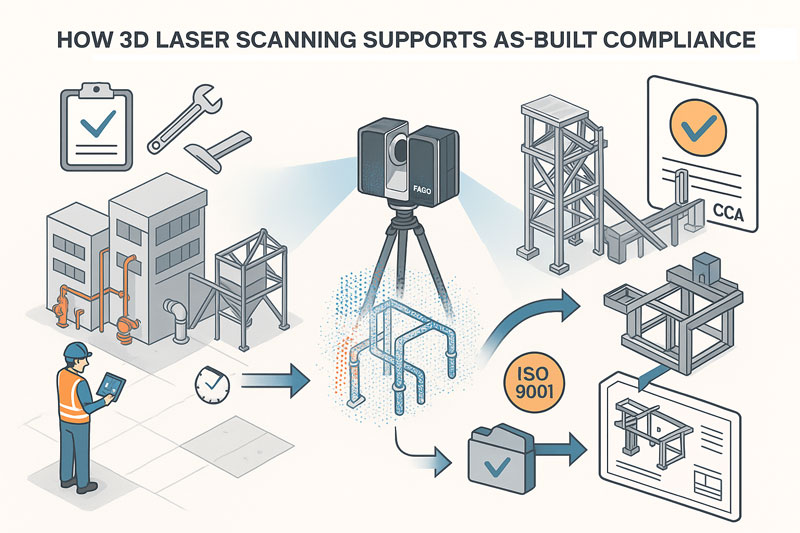
✔ Simplifies BCA Documentation for Fire, Mechanical & Structural Systems
Scanning assists with validating:
Fire Safety Systems
Hydrants, hose reels, fire pump rooms
Fire damper locations
Egress paths and spatial compliance
Service penetrations
Mechanical Systems
Duct routes
Plant room layouts
Fan coil units / AHU placement
Shaft centre-lines
Compliant access paths
Structural Elements
Columns
Beams
Brackets
Plant mounts
Retrofitted steelwork
Tolerance checks
The point cloud provides certifiers with confidence that what was installed does not deviate from approved plans beyond allowable tolerances.
✔ Strengthens ISO 9001 & Government QA Requirements
Most government tenders (TfNSW, Defence, Health Infrastructure, QBuild, etc.) require:
Traceable QA
As-constructed verification
Digital documentation
A 3D scan becomes proof of measurement, improving your QA process by providing:
Verifiable dimensional control
Pre-fabrication QA
Handover packages that exceed minimum compliance
4. How Hamilton By Design Can Position This Service
3D Laser Scanning Enables:
NCC-compliant as-built documentation
Faster certifier approval
Fewer construction disputes
Reduced rework during commissioning
Better safety compliance
Accurate digital twins for maintenance and lifecycle management
You can state (truthfully):
“Our 3D scans provide defensible, audit-ready as-built records that satisfy NCC, engineering, and certification requirements. Certifiers appreciate the precision because it removes ambiguity and reduces approval delays.”
To provide the best experiences, we use technologies like cookies to store and/or access device information. Consenting to these technologies will allow us to process data such as browsing behaviour or unique IDs on this site. Not consenting or withdrawing consent, may adversely affect certain features and functions.
Functional
Always active
The technical storage or access is strictly necessary for the legitimate purpose of enabling the use of a specific service explicitly requested by the subscriber or user, or for the sole purpose of carrying out the transmission of a communication over an electronic communications network.
Preferences
The technical storage or access is necessary for the legitimate purpose of storing preferences that are not requested by the subscriber or user.
Statistics
The technical storage or access that is used exclusively for statistical purposes.The technical storage or access that is used exclusively for anonymous statistical purposes. Without a subpoena, voluntary compliance on the part of your Internet Service Provider, or additional records from a third party, information stored or retrieved for this purpose alone cannot usually be used to identify you.
Marketing
The technical storage or access is required to create user profiles to send advertising, or to track the user on a website or across several websites for similar marketing purposes.