EinScan vs LiDAR Terrestrial Laser Scanners โ€“ Choosing the Right Tool for Reality Capture

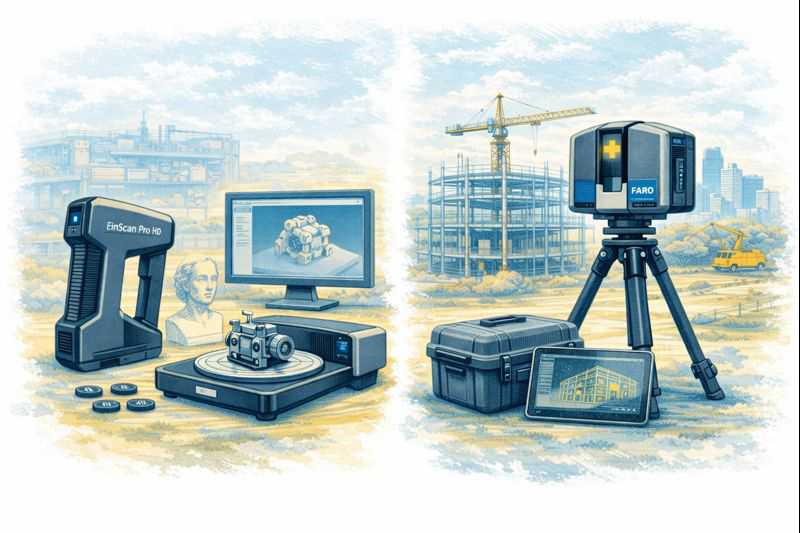
Comparison illustration showing EinScan structured-light scanner on left and FARO LiDAR terrestrial laser scanner on right.

EinScan vs LiDAR Terrestrial Laser Scanners โ€“ Choosing the Right Tool for Reality Capture


The rapid growth of 3D scanning has given engineers, fabricators and designers access to tools that were once limited to large survey companies. Today you can buy a compact EinScan structured-light scanner for a few thousand dollars or hire a FARO or Leica terrestrial LiDAR scanner capable of mapping an entire processing plant in an afternoon. Both are called โ€œ3D scanners,โ€ yet they serve very different purposes. Understanding the difference between EinScan-style scanners and terrestrial LiDAR systems is essential before investing time or money into reality capture.

Two Technologies, Two Different Jobs

EinScan scanners, produced by SHINING 3D, are primarily structured-light or short-range laser scanners. They project patterns of light onto an object and use cameras to interpret how that light deforms across the surface. The result is a dense mesh model of the objectโ€”typically exported as STL, OBJ or PLY files. EinScan units are designed for objects you can walk around, such as mechanical parts, castings, plastic housings and small assemblies.

Terrestrial LiDAR scanners such as the FARO Focus, Leica RTC360 or Trimble X-series operate on a completely different principle. These instruments sit on a tripod and fire millions of laser pulses across a 360-degree field, measuring the time it takes for each pulse to return. The output is a georeferenced point cloud containing precise XYZ coordinates for everything the laser can seeโ€”buildings, structures, conveyors, tanks, pipework and terrain.

Calling both devices โ€œ3D scannersโ€ is like calling a vernier caliper and a total station the same tool. They both measure, but at entirely different scales.


Visual comparison of EinScan object scanner and LiDAR terrestrial laser scanner in matching sketch style.

Scale and Range

The first and most obvious difference is working range.
An EinScan handheld unit is comfortable scanning parts from a few centimetres up to perhaps three or four metres. It is ideal for a gearbox housing on a bench or the plastic bumper of a vehicle. Once the object grows larger than a small room, the scanner begins to lose tracking and accuracy.

A terrestrial LiDAR scanner is built for the opposite end of the spectrum. A FARO Focus S-series can capture data from 0.6 metres out to 70 metres or more, mapping entire buildings or industrial sites from a single setup. Multiple scans are then registered together to create a complete digital twin of a facility.

For workshops and machine shops the question becomes simple:
Are you scanning an object, or are you scanning a place?
Objects suit EinScan; places suit LiDAR.

Accuracy and Tolerance Expectations

Manufacturers often quote impressive numbers, but real-world accuracy must be considered.

  • EinScan desktop and handheld systems typically achieve 0.05โ€“0.2 mm accuracy on small parts when conditions are ideal.
  • Terrestrial LiDAR scanners deliver around ยฑ1 mm to ยฑ3 mm accuracy over distance.

At first glance EinScan appears โ€œmore accurate,โ€ but this is only true at short range. A LiDAR scanner maintains consistent accuracy across tens of metres, something structured-light devices simply cannot do.

For precision mechanical componentsโ€”bearing fits, machined bores, threaded holesโ€”neither technology replaces traditional metrology tools. Scanning excels at capturing shape and context, while micrometers and CMMs remain the authority for tolerance verification.

Type of Data Produced

EinScan produces mesh files made from millions of tiny triangles. These are excellent for visualisation and 3D printing but contain no intelligence about holes, planes or cylinders. CAD systems like SolidWorks or Fusion 360 cannot directly convert these meshes into editable parametric models without additional reverse-engineering work.

LiDAR scanners generate point cloudsโ€”individual points with coordinates and often colour values. Point clouds are perfect for surveying, clash detection, volume calculations and as-built documentation. They are not intended to be edited like CAD models; instead, engineers build new geometry over the top using the cloud as reference.

Understanding this distinction avoids disappointment. Neither scanner delivers a โ€œone-click CAD model.โ€ Human engineering judgement is always required.
Surface and Environmental Limitations

EinScan technology relies on optical cameras and projected light, which introduces several practical limitations:

  • Shiny or black surfaces are difficult to capture
  • Transparent plastics confuse the cameras
  • Deep holes and narrow slots are often missed
  • Sunlight can overpower the projected pattern
  • Tracking can be lost on large flat surfaces

LiDAR systems are more tolerant of environment. They can operate outdoors, in dusty workshops and over long distances. However, they also struggle with highly reflective materials such as polished stainless steel or glass, and they require careful setup to avoid shadows and occlusions.

Workflow Considerations

A typical EinScan workflow looks like this:

  1. Prepare the partโ€”often with scanning spray
  2. Capture multiple passes
  3. Clean and align the mesh
  4. Export STL/OBJ
  5. Rebuild geometry in CAD using the mesh as reference

This process suits reverse engineering of brackets, castings, vehicle parts and consumer products.

A LiDAR workflow is different:

  1. Set up the scanner at multiple locations
  2. Register scans together in software such as FARO Scene or Leica Cyclone
  3. Classify and clean the point cloud
  4. Use the cloud for measurements, modelling or BIM integration

This approach is ideal for as-built surveys, plant upgrades, brownfield design and digital twins.

Cost and Ownership

EinScan systems range from a few thousand to around twenty thousand dollars. They are accessible to small businesses and even serious hobbyists. Software is generally included, and the learning curve is manageable.

Terrestrial LiDAR scanners are capital equipment. Purchase prices often exceed $60,000โ€“$100,000 before software, training and maintenance. For many companies it makes more sense to engage a specialist scanning provider when required.

Hamilton By Design logo displayed on a blue tilted rectangle with a grey gradient background

Choosing the Right Tool

The decision should be driven by the problem you are solving:

Choose EinScan when you need to:

  • Create a bracket to fit an existing motor
  • Reverse engineer a plastic enclosure
  • Modify a vehicle component
  • Capture complex organic shapes
  • Produce meshes for 3D printing

Choose LiDAR when you need to:

  • Document an industrial facility
  • Design around existing plant and pipework
  • Perform clash detection for upgrades
  • Measure volumes and clearances
  • Create a site-wide digital twin

Many organisations ultimately use both. A LiDAR scan provides the big picture, while an EinScan captures detailed components within that environment.
3D LiDAR scanning and 3D modelling service button โ€” laser scanner capturing a point cloud for engineering and CAD modelling
Mechanical engineering services

Integration with CAD

Engineers often ask which scanner works best with SolidWorks or Fusion 360. The honest answer is that neither integrates directly into parametric CAD without intermediate steps. EinScan meshes require reverse-engineering tools or manual modelling. LiDAR point clouds usually pass through Autodesk Recap, FARO Scene or similar before being referenced in CAD.
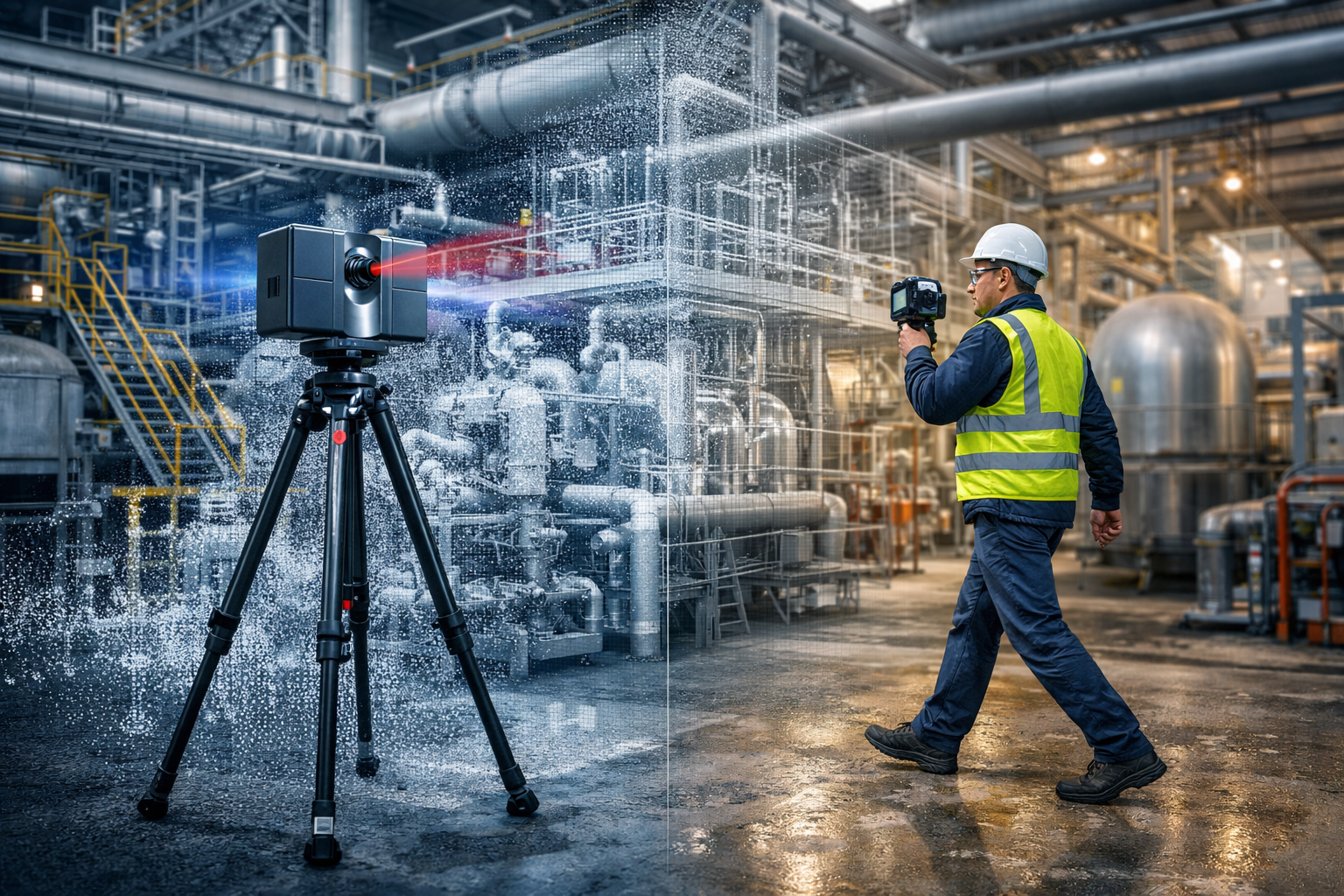
Scanning is a method of collecting truth, not generating finished design. The value lies in reducing site visits, avoiding clashes and giving designers confidence about existing conditions.

Final Thoughts

EinScan scanners and terrestrial LiDAR systems are not competitors; they are complementary tools on the reality-capture spectrum. One excels at objects on a bench, the other at assets spread across hectares. Selecting the wrong tool leads to frustration, while choosing correctly can transform the way projects are delivered.

For Australian fabricators and engineers, the key question is simple:
Are you capturing a part, or are you capturing a place?
Answer that, and the choice between EinScan and LiDAR becomes clear.

Name
Would you like us to arrange a phone consultation for you?
Address

3D CAD Modelling Australia service banner for Hamilton By Design
Mining & Processing Perth WA banner for Hamilton By Design featuring white text on a blue background.
Scan to BIM Perth WA banner for Hamilton By Design featuring white text on a blue background.
Ship Building Perth WA banner for Hamilton By Design featuring white text on a blue background.
Structural drafting services button
3D LiDAR scanning and 3D modelling services button
Mechanical drafting services button

3D Laser Scanning on the Central Coast NSW: From Point Cloud to Build-Ready CAD

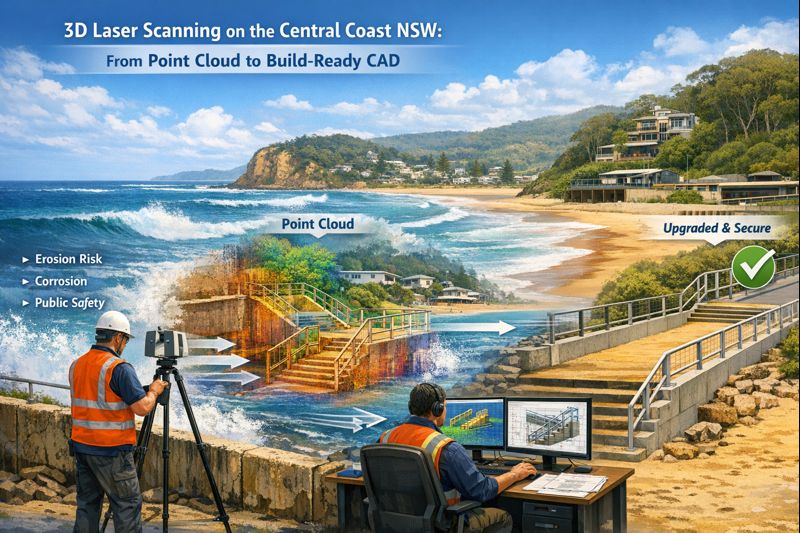
From laser scan to CAD: point cloud of Avoca Beach foreshore assets converted into build-ready engineering drawings.

Accurate site data is the difference between a smooth upgrade and a shutdown full of surprises.
At Hamilton By Design, we provide engineering-grade 3D laser scanning (LiDAR) across the Central Coast NSW โ€” including Wyong, Gosford, Tuggerah and Somersby โ€” and convert that data into design-ready CAD and 3D models for industrial and building projects.

If youโ€™re planning equipment upgrades, new conveyors, structural modifications or fabrication packages, scanning gives you reliable geometry before steel is cut or contractors mobilise.


Who this service is for

Our Central Coast scanning services are typically used by:

  • Project engineers planning plant or building upgrades
  • Maintenance teams preparing shutdown scopes
  • Fabricators needing accurate tie-in dimensions
  • Asset owners updating as-built records
  • Consultants managing brownfield modifications

If drawings donโ€™t match reality โ€” or donโ€™t exist at all โ€” scanning becomes the safest and fastest way to establish an accurate baseline.


3D LiDAR scanning services on the Central Coast providing engineering-grade laser scanning, point cloud capture, scan-to-CAD modelling and industrial reality capture for infrastructure and industrial projects.
Drafting services on the Central Coast providing engineering drawings, fabrication detailing, as-built documentation, reverse engineering and CAD drafting for industrial and infrastructure projects.
Mechanical engineering services on the Central Coast providing industrial design, plant inspections, pump calculations, reverse engineering and engineering support for manufacturing, infrastructure and heavy industry projects.

From scan to CAD: turning site data into buildable designs

A point cloud on its own doesnโ€™t solve project risk.
What matters is converting scan data into usable engineering outputs.

Our workflow supports:

  • 2D CAD drawings (plans, sections, elevations)
  • 3D CAD models for layout and clash detection
  • Tie-in modelling for new equipment and structures
  • Verification of clearances and access zones
  • Fabrication-ready geometry for workshop drawings

This scan-to-CAD process is especially valuable for retrofit projects where new components must integrate with existing assets.


Why 3D scanning is ideal for brownfield upgrades

Most Central Coast industrial and commercial sites are brownfield environments โ€” tight access, legacy equipment and undocumented modifications.

3D laser scanning helps to:

  • Reduce site re-visits and manual re-measuring
  • Identify clashes early in the design phase
  • Support off-site prefabrication
  • Shorten shutdown windows
  • Improve safety by limiting exposure time on site

When combined with engineering design, scanning becomes a risk-reduction tool, not just a survey method.


Engineer using 3D laser scanner at Avoca Beach foreshore with point cloud and CAD model showing upgrade of coastal stairs and seawall.

Typical Central Coast applications

We regularly support projects across:

Manufacturing and processing facilities

Equipment replacements, conveyor upgrades, access platform modifications.

Warehousing and logistics buildings

Structural modifications, mezzanine installations, services coordination.

Building services upgrades

Plantroom retrofits, mechanical services coordination, compliance verification.

Mining-related fabrication and off-site packages

Where Central Coast workshops are producing components for remote sites.


Local coverage: Wyong, Gosford, Tuggerah and Somersby

Being based on the Central Coast means we can support:

  • Rapid site capture
  • Staged scanning across multiple areas
  • Follow-up verification scans as scope evolves

That flexibility is important when designs change during live projects or shutdown preparation.


How accurate is engineering-grade LiDAR scanning?

Accuracy depends on site conditions and scope, but scanning provides consistent, repeatable geometry across complex environments that would be difficult and time-consuming to measure manually.

More importantly, it captures:

  • Spatial relationships
  • Real clearances
  • True equipment alignment

which are critical for retrofit engineering and fabrication.


When is scanning worth the investment?

Scanning typically delivers the best value when:

  • Drawings are outdated or incomplete
  • Fabrication must fit first time
  • Shutdown time is expensive
  • Access is restricted or unsafe
  • Multiple trades must coordinate in tight spaces

In many projects, preventing one major clash or rework cycle pays for the scan many times over.


Hamilton By Design logo displayed on a blue tilted rectangle with a grey gradient background

3D LiDAR scanning and 3D modelling service button โ€” laser scanner capturing a point cloud for engineering and CAD modelling
Mechanical engineering services

Planning an upgrade or fabrication project on the Central Coast?

If youโ€™re preparing for a shutdown, equipment upgrade or fabrication package across the Central Coast, early scanning can significantly reduce downstream risk.

Talk to Hamilton By Design about 3D laser scanning and point cloud to CAD support for your project.
Weโ€™ll help define the scope and deliverables that best suit your engineering and construction needs.

Name
Would you like us to arrange a phone consultation for you?
Address

Engineering-Quality 3D Scanning in Papua New Guinea

Engineer using LiDAR scanner to capture mining and processing plant within a map of Papua New Guinea for engineering design and plant upgrades.

Reality capture that stands up to design, fabrication and installation in remote industrial environments

Papua New Guinea (PNG) is home to complex, high-value industrial assets โ€” from mining and mineral processing plants through to ports, power generation and remote infrastructure. These projects are often delivered under tight shutdown windows, difficult logistics and challenging environmental conditions.

In these environments, engineering-quality 3D scanning is not a โ€œnice to haveโ€ โ€” itโ€™s a practical tool that reduces risk by capturing accurate as-built conditions and converting them into deliverables engineers can trust.

Hamilton By Design provides engineering-led LiDAR scanning and scan-to-CAD modelling workflows designed for real project outcomes: upgrades that fit, installations that align, and drawings that reflect reality.


Why โ€œEngineering Qualityโ€ Matters in PNG

Remote projects canโ€™t afford rework.

When access is limited and mobilisation costs are high, even a small design error can cause major delays:

  • fabricated components donโ€™t fit
  • tie-ins clash with existing pipework
  • platforms and handrails foul equipment clearances
  • shutdown windows blow out due to unexpected constraints

Engineering-quality reality capture reduces these risks by ensuring design starts from verified geometry โ€” not assumptions or outdated drawings.


Papua New Guinea industrial facility being digitally captured with 3D scanning to create accurate models for remote engineering and shutdown planning.

What Engineering-Quality 3D Scanning Includes

Not all scanning services deliver engineering-grade outcomes. โ€œEngineering qualityโ€ means the capture and deliverables are suitable for mechanical and structural decisions, including fabrication and installation.

Key elements include:

  • Survey control and consistent site referencing (where required)
  • Defined accuracy targets aligned to project tolerances
  • Registration QA and documented checks
  • Clear deliverables (E57/RCP/RCS, CAD models, drawings)
  • Model verification against point cloud prior to issue

The goal is simple: data you can design from.


Typical PNG Use Cases

1) Plant Upgrades and Brownfield Modifications

For conveyors, chutes, pipework, pump skids, structural platforms and access upgrades, scanning provides accurate spatial context for clash-free design.

2) Shutdown Planning and Constructability Reviews

Point clouds help teams plan:

  • access routes and lifting paths
  • installation sequencing
  • workpack scoping and constraints

This is especially valuable when shutdown windows are short and remote support is required.

3) Scan-to-CAD for Fabrication and Fit-Up

When components must be fabricated off-site and installed first time, engineering-grade LiDAR scanning provides the geometry needed for:

  • interface modelling
  • connection detailing
  • fabrication drawings

4) As-Built Documentation and Asset Records

Many sites have incomplete legacy drawings. A scanned dataset can become the โ€œsingle source of truthโ€ for future upgrades and maintenance planning.


Choosing the Right Scanning Tool for PNG Conditions

PNG sites often include large structures, dense plant, tight access and harsh environmental conditions. In these cases, engineering-grade LiDAR is typically required because it provides:

  • long-range capture across large facilities
  • reliable geometry in low-light / indoor areas
  • accuracy suitable for engineering design decisions

Other capture methods (visual scanning or photogrammetry) can be useful for context and surfaces, but if fabrication, tie-ins, and fit-up matter, LiDAR is usually the right choice.


Deliverables That Engineers Actually Use

Engineering-quality reality capture is only valuable if it becomes practical outputs.

Common deliverables include:

  • Registered point clouds (E57 / RCP / RCS)
  • 2D layouts, sections and elevations extracted from scans
  • Scan-to-CAD models (structural, mechanical, piping)
  • Interface models for replacement components
  • Verification snapshots and check notes (QA evidence)

How We Manage Quality on Remote Projects

Remote work demands a higher standard of planning.

An engineering-quality workflow typically includes:

  1. Scope definition (what decisions will rely on the data?)
  2. Accuracy targets set to match the engineering requirement
  3. Capture plan (coverage, control, safe access, shutdown constraints)
  4. Registration + QA checks (repeatability, closure error, spot checks)
  5. Model extraction and verification against point cloud
  6. Issue deliverables in formats aligned to the project team

This approach reduces site revisits and ensures the data is fit for purpose.


Why Engineering-Led Reality Capture Matters

3D scanning becomes far more valuable when itโ€™s integrated with mechanical and structural engineering โ€” because the deliverables are designed to support:

  • design decisions
  • fabrication requirements
  • installation sequencing
  • long-term asset management

Engineering-led reality capture means scanning is not the end product โ€” it is the foundation for a better engineering outcome.


Hamilton By Design logo displayed on a blue tilted rectangle with a grey gradient background

3D LiDAR scanning and 3D modelling service button โ€” laser scanner capturing a point cloud for engineering and CAD modelling
Mechanical engineering services

Final Thoughts

For industrial projects in Papua New Guinea, engineering-quality 3D scanning helps teams deliver upgrades with confidence โ€” particularly where logistics are difficult, shutdown time is limited, and โ€œmeasure twiceโ€ is expensive.

If the project depends on fit-up, constructability and accurate as-built conditions, start with reality capture that is designed for engineering โ€” not just visualisation.

Name
Would you like us to arrange a phone consultation for you?
Address
Finite Element Analysis (FEA) engineering simulation button
Mechanical engineering services

Reality Capture for Live or Operational Sites (High-Risk Environments)

Engineer performing LiDAR scanning on live construction site with BIM model overlay for clash-free installation

Reality Capture for Live Sites Sydney | 3D Scanning Without Shutdowns

Keep Sydney Projects Running: Accurate Reality Capture Without Shutdowns

Many projects across Greater Sydney and the Central Coast take place in live, operational environments โ€” hospitals, shopping centres, CBD offices, industrial plants, transport facilities, and heritage buildings โ€” where shutdowns are either impossible or extremely costly.

At Hamilton By Design, we provide engineer-led reality capture and 3D scanning services that allow accurate measurement, modelling, and verification without interrupting operations. Our approach supports safe access, staged construction, and clash-free installation โ€” keeping your project moving while reducing risk, rework, and variations.


The Challenge of Working in Live Environments

Builders, project managers, and facilities teams face real risks when upgrading or modifying operational sites:

  • Buildings that have moved over time, with visible cracking or deformation
  • Changes in soil conditions or legacy engineering affecting structure and services
  • Outdated or unreliable drawings that no longer reflect site conditions
  • Unexpected clashes once walls, ceilings, or plant rooms are opened
  • High costs from rework and contract variations
  • Safety risks from confined spaces, working at heights, or restricted access zones

Relying on manual measurement or assumptions in these environments increases both programme risk and safety exposure.


Reality capture of operational industrial facility using 3D laser scanning without site shutdown

Non-Contact Measurement for High-Risk and Restricted Sites

Our reality capture solutions use non-contact laser scanning and LiDAR technology to safely collect accurate site data, even in difficult or restricted environments.

This allows us to capture:

  • Services above ceilings and within plant rooms
  • Structural elements and building geometry
  • Equipment clearances and access constraints
  • Deformed or out-of-plumb structures

All while minimising disruption to occupants and operations.

Safety and Access Benefits

  • Reduced need for working at heights
  • Faster site presence and data capture
  • Minimal interference with daily operations
  • Scanning possible from walkways or public-access areas
  • Fewer permits, isolations, and shutdown windows required

This makes scanning ideal for live hospitals, retail centres, offices, and industrial facilities where safety and continuity are critical.


Supporting Staged Construction and Live Upgrades

Live environments rarely allow full shutdowns. Our reality capture workflows are designed to support:

  • Staged construction programs
  • Progressive installation of services
  • Ongoing refurbishment works
  • Verification before each construction phase

We can also perform repeat scanning to monitor:

  • Structural movement
  • Progressive cracking
  • Deformation of walls, floors, or structural members

This is especially valuable where movement, settlement, or ageing infrastructure is a concern.


Practical Outcomes for Builders and Project Teams

Our scan data is not just collected โ€” it is engineered into practical construction deliverables that support real project decisions.

Clients use our reality capture outputs for:

  • Design of new mechanical, electrical, and plumbing services
  • Accurate as-built verification prior to fabrication
  • Set-out and coordination models for installation
  • Clash detection before construction begins
  • Monitoring movement or deformation over time

This reduces uncertainty, improves coordination between trades, and significantly lowers the risk of costly on-site surprises.


Construction-Ready Deliverables

We provide data in formats that integrate directly into your existing workflows and design platforms:

  • Point clouds (RCP / E57)
  • Revit models
  • AutoCAD files
  • SolidWorks models
  • 2D drawings (plans, sections, elevations)
  • Clash-ready coordination models

Our focus is on delivering usable, construction-ready information, not just raw scan files.


Engineer-Led Reality Capture โ€” Not Just Scanning

Hamilton By Design is not a scanning-only provider. We deliver end-to-end technical services, allowing us to support projects from concept through to installation.

Our integrated capabilities include:

  • Reality capture and 3D scanning
  • Mechanical engineering
  • Systems management
  • Project management
  • Machining and fabrication support

Because our work is engineer-led, scan data is interpreted with constructability, tolerances, and installation constraints in mind โ€” not simply converted into drawings by offshore drafting teams.

This means better decisions, fewer assumptions, and stronger outcomes on site.


Supporting Greater Sydney and the Central Coast

We regularly support projects across:

  • Sydney CBD and metropolitan areas
  • Major commercial and retail precincts
  • Health and education facilities
  • Industrial and processing plants
  • Infrastructure and heritage assets
  • Central Coast commercial and industrial sites

Our local presence allows efficient mobilisation and ongoing project support throughout staged works.


Hamilton By Design logo displayed on a blue tilted rectangle with a grey gradient background
3D LiDAR scanning and 3D modelling service button โ€” laser scanner capturing a point cloud for engineering and CAD modelling
Mechanical engineering services

Reduce Risk. Avoid Shutdowns. Build With Confidence.

Reality capture is no longer just a documentation tool โ€” it is a risk management strategy for live environments.

By capturing what is truly on site before construction begins, you can:

  • Prevent clashes and redesign
  • Reduce variations and rework
  • Improve safety planning
  • Protect programme and operational continuity

Arrange a Phone Consultation

If you are planning works in a live or high-risk environment and need reliable site data without shutdowns:

Please fill out the form below to arrange a phone consultation.

Weโ€™ll discuss your site conditions, construction staging, and deliverable requirements, and recommend the most effective reality capture approach for your project.

Name
Would you like us to arrange a phone consultation for you?
Address
Finite Element Analysis (FEA) engineering simulation button
Mechanical engineering services

3D LiDAR Scanning for Industrial Facilities in Western Sydney

Mechanical engineer and client reviewing construction drawings beside a LiDAR scanner at a Western Sydney construction site with Sydney Olympic Park and Parramatta skyline in the background

3D LiDAR Scanning for Industrial Facilities in Western Sydney | Engineering-Led Reality Capture

Engineering-Led Reality Capture for Safer, More Accurate Project Outcomes

Western Sydney is one of Australiaโ€™s most active industrial and construction corridors. From large-scale warehousing and manufacturing facilities to logistics hubs, utilities, and infrastructure assets, the region demands accurate site data, safe project delivery, and engineering accountability.

At Hamilton By Design, we provide engineering-led 3D LiDAR scanning services across Western Sydney to support industrial facilities through design, modification, shutdown planning, and asset upgradesโ€”bridging the gap between site reality and build-ready engineering models.


Engineering-led 3D LiDAR scanning at a Western Sydney construction site with a steel-frame building, client consultation, and Parramatta CBD visible in the background

Why Western Sydney Industrial Projects Demand Engineering-Grade Scanning

Industrial sites in Western Sydney often present complex challenges:

  • Live operations with limited access windows
  • Legacy assets with incomplete or outdated drawings
  • Tight safety requirements and compliance obligations
  • Cost pressure from construction programs and shutdown schedules

In these environments, assumptions are expensive. Engineering-grade reality capture removes uncertainty before it reaches site.


Hot Topics Driving Engineering & Construction Decisions

1. Safety Starts With Accurate Information

Safety in industrial facilities begins long before construction or installation.

3D LiDAR scanning allows engineers to:

  • Identify clashes before fabrication
  • Design access platforms, walkways, and guards accurately
  • Reduce site rework, hot works, and manual re-measurement
  • Support safer shutdown planning and installation sequencing

Accurate digital site data reduces exposure hours and lowers risk across the project lifecycle.


2. Australian Engineering Quality vs Low-Cost Shortcuts

Cheaper scanning or modelling options often focus on speed over accuracyโ€”leaving engineers to resolve issues later on site.

Hamilton By Designโ€™s approach is different:

  • Engineer-led scanning, not technician-only capture
  • Models developed with mechanical, structural, and fabrication intent
  • Practical site experience informing what actually matters in design

This Australian engineering know-how delivers defensible, buildable outcomes, not just visually impressive models.


3. Scan-to-CAD: Turning Reality Into Buildable Design

Industrial clients donโ€™t just need point clouds โ€” they need usable engineering deliverables.

Our scan-to-CAD workflows support:

  • Mechanical and structural design
  • Conveyor, plant, and equipment modifications
  • Brownfield upgrades and extensions
  • Fabrication-ready drawings

By aligning reality capture directly with CAD and engineering workflows, we reduce rework, RFIs, and late-stage changes.


4. Supporting Digital Twins for Industrial Assets

3D LiDAR scanning is increasingly used as the foundation for digital twins in industrial environments.

For Western Sydney facilities, this supports:

  • Asset documentation and lifecycle management
  • Future expansion planning
  • Maintenance access reviews
  • Engineering audits and compliance records

Reality capture ensures digital twins are based on what exists, not what drawings suggest.


Mining engineers applying design-for-safety principles to improve material handling systems in an industrial workshop

Typical Western Sydney Industrial Applications

Hamilton By Design supports a wide range of industrial facilities across Western Sydney, including:

  • Warehouses and logistics centres
  • Manufacturing plants
  • Processing and handling facilities
  • Utilities and infrastructure assets
  • Brownfield industrial upgrades

Our services are suited to both small targeted scans and large-scale facility capture, depending on project needs.


How This Supports Sydney-Wide 3D Scanning Services

Western Sydney projects form a key part of our broader Sydney-based 3D scanning services, supporting engineering and construction projects across metropolitan and regional NSW.

By combining engineering oversight, LiDAR accuracy, and scan-to-CAD expertise, we help clients move from uncertainty to confident decision-making.

๐Ÿ‘‰ Learn more about our engineering-led 3D scanning services across Sydney through our dedicated Sydney page.

(Use a partial-match internal link here โ€” not exact-match anchor text.)


Hamilton By Design logo displayed on a blue tilted rectangle with a grey gradient background
3D LiDAR scanning and 3D modelling service button โ€” laser scanner capturing a point cloud for engineering and CAD modelling
Mechanical engineering services

Speak With an Engineer

If youโ€™re planning:

  • An industrial upgrade or expansion
  • A brownfield modification
  • A shutdown or complex installation
  • A scan-to-CAD workflow for engineering design

Hamilton By Design provides engineering-led 3D LiDAR scanning that supports safer, more predictable outcomes across Western Sydney.


Name
Would you like us to arrange a phone consultation for you?
Address

Our clients:


Blue banner graphic displaying the text "Point Cloud to CAD - Australia" in large white lettering, representing point cloud processing, scan-to-CAD conversion and digital engineering services across Australia.
Blue banner graphic displaying the text "Scan to CAD Sydney" in large white lettering, representing engineering-led point cloud to CAD conversion, LiDAR scanning and digital engineering services in Sydney.
Blue banner graphic displaying the text "Reality Capture Sydney - CBD" in large white lettering, representing engineering-led reality capture, LiDAR scanning and digital engineering services within Sydney CBD commercial buildings and infrastructure.

3D CAD Modelling Australia service banner for Hamilton By Design


CHPP Engineering title graphic featuring bold white text reading "CHPP Engineering" centred on a blue rounded rectangle background.
Pipework Drafting title graphic featuring bold white text reading "Pipework Drafting" centred on a blue rounded rectangle background.
3D LiDAR Scanning for Engineering Projects title graphic featuring bold white text on a blue rounded rectangle background.


Finite Element Analysis (FEA) engineering simulation button
Structural drafting services button
Mechanical drafting services button


Australian Drafting logo featuring bold white text reading "Australian Drafting" centred on a blue rounded rectangle background.
Engineering Governance title graphic featuring bold white text reading "Engineering Governance" centred on a blue rounded rectangle background.
Engineering-Grade LiDAR Scanning title graphic featuring bold white text on a blue rounded rectangle background.


Mechanical drafting services button
Structural drafting services button


Fabrication and product design services
3D CAD Modelling Australia service banner for Hamilton By Design
Mechanical, Structural & Pipework Drafting service banner by Hamilton By Design featuring white text on a blue background.


3D LiDAR scanning and 3D modelling service button โ€” laser scanner capturing a point cloud for engineering and CAD modelling
Mechanical engineering services

What Is the Difference Between a Terrestrial Scanner and a LiDAR Scanner?

Terrestrial, mobile SLAM and drone LiDAR scanners capturing an industrial plant with engineers reviewing point cloud data and drawings

Terrestrial vs LiDAR Scanners | Whatโ€™s the Difference?

Confusion around terrestrial scanning and LiDAR scanning is common โ€” and understandable.
The two terms are often used interchangeably, even though they describe different things.

This page explains the difference in plain language, shows where each approach fits, and helps you decide what level of accuracy and risk is appropriate for your project.


Short Answer (If Youโ€™re in a Hurry)

LiDAR describes the laser measurement technology.
Terrestrial describes how and where that LiDAR scanner is deployed.

Most terrestrial scanners use LiDAR, but not all LiDAR scanners are terrestrial.


Illustration comparing terrestrial LiDAR, mobile SLAM LiDAR and drone scanning on an industrial facility

What Is LiDAR?

LiDAR (Light Detection and Ranging) is a method of measuring distance using laser light.

How LiDAR works

  • A laser pulse is emitted
  • The pulse reflects off an object
  • The return time is measured
  • Distance is calculated and stored as a 3D point

Millions of these points form a point cloud that represents real-world geometry.

What LiDAR is good for

  • Accurate 3D measurement
  • Complex geometry
  • Low-light or enclosed environments
  • Engineering, construction, and industrial sites

LiDAR answers: How is distance measured?


What Is a Terrestrial Scanner?

A terrestrial scanner is a ground-based scanning system, usually mounted on a tripod or fixed position.

Key characteristics

  • Fixed scan position
  • Controlled setup and coverage
  • Known geometry and reference
  • High repeatability and validation

Typical environments

  • Processing plants and CHPPs
  • Structural steelwork
  • Conveyor systems
  • Brownfield tie-ins
  • As-built verification
  • Shutdown-critical fit-up work

Terrestrial answers: Where and how is the LiDAR deployed?


How the Two Terms Relate (This Is the Important Part)

A terrestrial scanner is a platform.
A LiDAR scanner is a technology.

Most modern terrestrial scanners are terrestrial LiDAR scanners.

Example: a tripod-mounted system such as the FARO Focus S-Series is:

  • LiDAR-based (laser measurement)
  • Terrestrial (ground-based, fixed setup)

Other Common LiDAR Scanner Types (And Why It Matters)

Scanner TypeHow Itโ€™s UsedTypical Outcome
Terrestrial LiDARTripod / fixedHighest control & accuracy
Mobile / SLAM LiDARHandheld / walk-throughFast capture, lower control
Vehicle-mounted LiDARCar / trolleyCorridor mapping
Aerial LiDARDrone / aircraftLarge areas, low detail

All are โ€œLiDARโ€, but not all are suitable for engineering design or fabrication.


Why This Distinction Matters for Projects

Many issues occur when:

  • A LiDAR scan is assumed to be engineering-grade
  • A mobile or SLAM scan is used beyond its intent
  • Accuracy, validation, or limitations are not clearly understood

This doesnโ€™t mean one method is wrong โ€” it means each has a purpose.

The key is aligning the scanner type with:

  • Required accuracy
  • Risk tolerance
  • Fit-up criticality
  • Intended use of the data

Our clients:


Simple Decision Guide (Client in Control)

If you need:

  • Fabrication or replacement parts โ†’ Terrestrial LiDAR
  • Shutdown-critical fit-up โ†’ Terrestrial LiDAR
  • Structural verification โ†’ Terrestrial LiDAR
  • Rapid site context only โ†’ Mobile / SLAM LiDAR
  • Large terrain or stockpiles โ†’ Aerial LiDAR

There is no โ€œone best scannerโ€ โ€” only the right scanner for the outcome you want.


Comparison at a Glance

RequirementTerrestrial LiDARMobile / SLAM LiDAR
Accuracy controlHighModerate
RepeatabilityHighLower
Engineering defensibilityStrongLimited
Fit-up confidenceSuitableNot recommended
Capture speedSlowerFaster
Best use caseDesign & fabricationVisualisation & context

A Note on Engineering Use

Where scanning data feeds into engineering design, documentation, or fabrication, higher-control methods are typically required to align with engineering practice and Australian Standards expectations.

That doesnโ€™t remove choice โ€” it simply means the assumptions and limitations must match the intended use.


How We Approach This (Without Locking You In)

Weโ€™re happy to:

  • Work with terrestrial, mobile, or supplied scan data
  • Validate data before design where required
  • Align scanning effort with your risk, budget, and outcome
  • Clearly document assumptions and limitations

You stay in control of the approach โ€” our role is to make sure the data supports the outcome you expect.


Hamilton By Design logo displayed on a blue tilted rectangle with a grey gradient background
3D LiDAR scanning and 3D modelling service button โ€” laser scanner capturing a point cloud for engineering and CAD modelling
Mechanical engineering services

Next Step

If youโ€™re unsure which scanning method suits your project:

Fill out the contact form and tell us:

  • What you want to build, replace, or verify
  • How the data will be used
  • Any constraints (budget, time, shutdown windows)

Weโ€™ll help you select a fit-for-purpose scanning approach, not just a scanner.


Name
Would you like us to arrange a phone consultation for you?
Address
Finite Element Analysis (FEA) engineering simulation button
Mechanical engineering services