Designing Bucket Elevators vs Pan Conveyors in Industrial Material Handling

Engineering comparison diagram showing a bucket elevator lifting bulk material vertically and a pan conveyor transporting material horizontally.

Bucket Elevator vs Pan Conveyor Design | Industrial Material Handling Engineering

In bulk material handling industries such as mining, cement production, grain processing, and industrial manufacturing, selecting the right conveying system is critical to reliability, maintenance efficiency, and operating cost. Two commonly used systems are bucket elevators and pan conveyors. While both systems move bulk material efficiently, they are designed for very different operating conditions and material characteristics.

Understanding the difference between the two systems helps engineers select the correct solution for the application.


Bucket elevator vs pan conveyor industrial material handling comparison infographic.

What is a Bucket Elevator?

A bucket elevator is a vertical conveying system designed to lift bulk materials using a series of buckets attached to either a belt or chain. The buckets scoop material from the boot section and carry it upward to the discharge point.

Bucket elevators are widely used where material must be lifted vertically in a compact footprint.

Key Components

Buckets (steel, nylon, or HDPE)
Belt or chain drive
Boot section (material inlet)
Head section with drive and discharge
Casing or elevator trunking

Typical Applications

Grain handling
Fertiliser plants
Cement and lime processing
Mining concentrate handling
Sand, ash, or powder transport

Advantages

Efficient vertical lifting
Small plant footprint
High throughput capacity
Energy efficient for vertical transport

Limitations

Not ideal for very abrasive or large lump materials
Sensitive to overloading and blockages
Requires careful alignment and maintenance


What is a Pan Conveyor?

A pan conveyor, often called an apron conveyor, transports material horizontally or on shallow inclines using overlapping steel pans attached to heavy-duty chains.

The pans form a continuous moving surface that carries material along the conveyor frame.

Pan conveyors are commonly used in harsh industrial environments where materials are heavy, hot, or abrasive.

Key Components

Steel pans or plates
Heavy-duty conveyor chains
Sprockets and drive system
Conveyor frame
Impact loading zone

Typical Applications

Clinker transport in cement plants
Mining ore handling
Hot ash handling
Crusher discharge conveyors
Furnace feed systems

Advantages

Handles very heavy and abrasive materials
Suitable for impact loading
Reliable in harsh environments
Can operate at slow controlled speeds

Limitations

Larger footprint
Higher capital cost
More power consumption than bucket elevators


Key Differences Between Bucket Elevators and Pan Conveyors

Bucket Elevator
Vertical conveying system
Best for fine to medium bulk materials
Compact footprint
High energy efficiency for vertical transport
Requires controlled loading

Pan Conveyor
Horizontal or inclined conveying system
Handles heavy, abrasive or hot materials
Larger footprint
More robust construction
Handles high impact loading


When to Choose a Bucket Elevator

A bucket elevator is typically the preferred solution when:

Material must be lifted vertically
Plant space is limited
The material is free-flowing
Throughput is high but impact loading is low

Examples include grain silos, cement plants, fertiliser plants, and powder handling systems.

In these situations, bucket elevators provide a compact and energy-efficient solution.


When to Choose a Pan Conveyor

A pan conveyor is the better choice when:

Material is coarse, hot, or abrasive
There is high impact loading
The conveyor must operate continuously in harsh conditions
Reliability is more important than plant footprint

Examples include crusher discharge conveyors, furnace feed systems, clinker transport, and mining ore handling.

Pan conveyors are designed to survive the harshest bulk material handling environments.


Engineering Design Considerations

When designing either system, engineers must consider the following:

Bulk material characteristics
Lump size distribution
Abrasiveness
Moisture content
Throughput requirements
Loading conditions
Maintenance access
Structural support

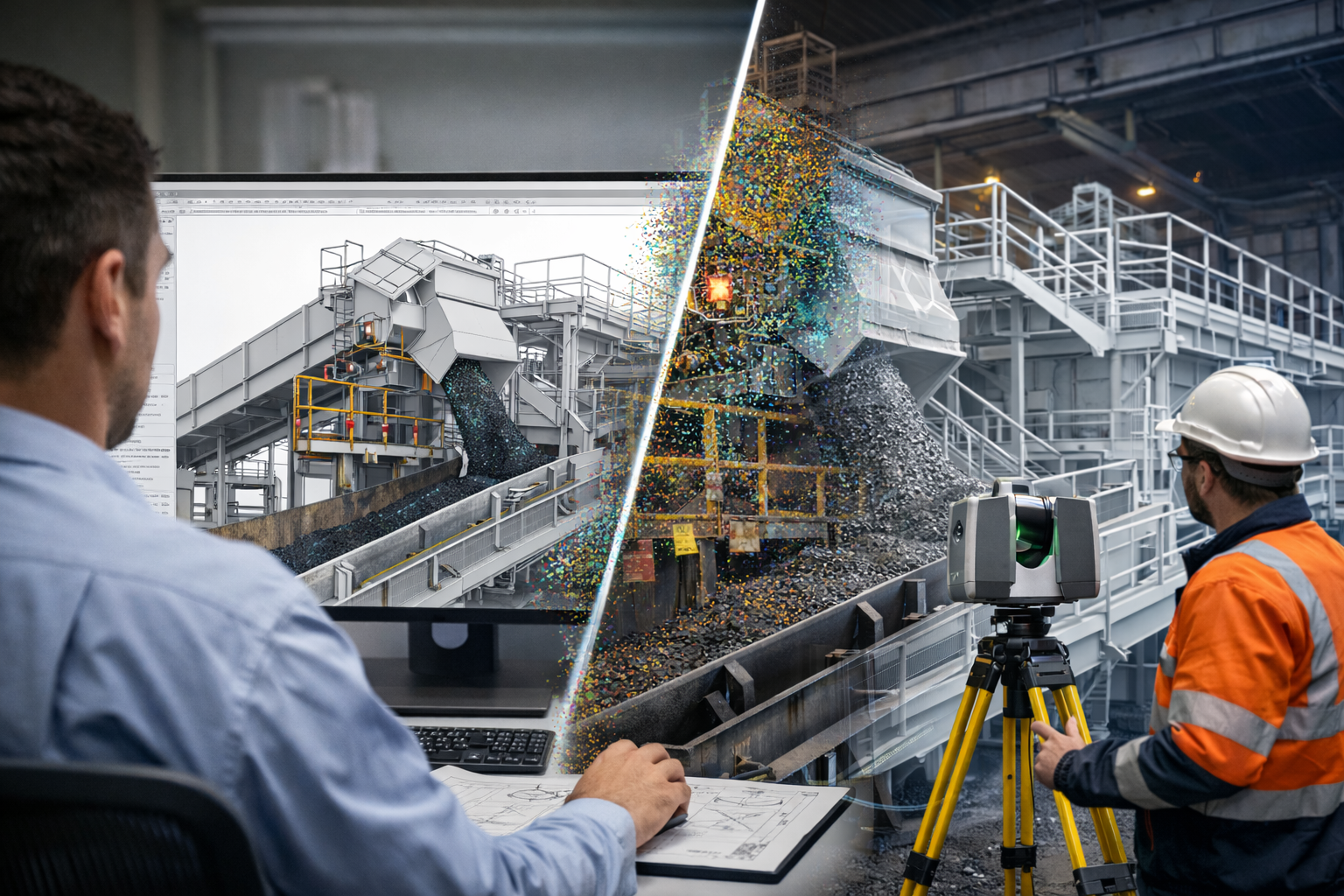
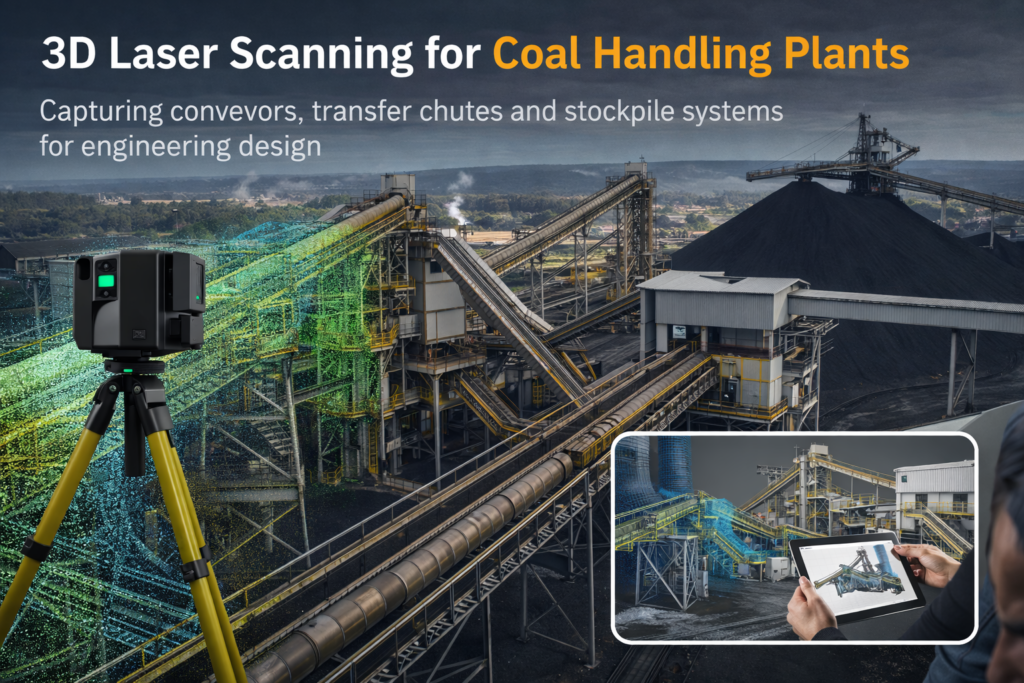
Modern projects often integrate 3D laser scanning and point cloud modelling to ensure conveyors fit within existing plants and connect correctly to existing infrastructure. This approach reduces installation risk and helps engineers verify clearances, structural loads, and maintenance access before fabrication.

3D LiDAR scanning and 3D modelling service button โ€” laser scanner capturing a point cloud for engineering and CAD modelling
Mechanical engineering services

Hamilton By Design logo displayed on a blue tilted rectangle with a grey gradient background

Engineering Support for Conveyor Design

Hamilton By Design supports industrial projects with:

Mechanical conveyor design
3D laser scanning of existing plants
Conveyor chute and transfer design
Structural steel and support frames
Inspection and maintenance optimisation

Whether designing a bucket elevator for vertical material handling or a heavy-duty pan conveyor for mining operations, selecting the correct system is critical to long-term reliability and operational efficiency.


Name
Would you like us to arrange a phone consultation for you?
Address
3D CAD Modelling Australia service banner for Hamilton By Design

Mechanical Engineering Design Companies on the Central Coast

Mechanical engineer reviewing 3D CAD model beside industrial steel platform and 3D laser scanner on the Central Coast NSW

Mechanical Engineering Design Companies | Central Coast | Hamilton By Design

Engineering-led design. Practical outcomes. Built for industry.

If youโ€™re searching for mechanical engineering design companies on the Central Coast, youโ€™re likely trying to solve a real operational problem โ€” upgrading equipment, replacing worn assets, improving maintainability, or getting compliant documentation for a project that needs to move.

Hamilton By Design provides mechanical engineering design services for industrial and mining-linked businesses across the Central Coast and NSW, delivering practical, buildable solutions backed by strong engineering governance.


Mechanical engineering design company on the Central Coast developing industrial steel structures using 3D modelling

What a Mechanical Engineering Design Company Should Deliver

A capable mechanical design partner doesnโ€™t just โ€œdraw it up.โ€ They help you reduce risk and get outcomes that work in the field. That includes:

  • Engineering-grade design documentation (GA drawings, fabrication details, BOMs)
  • Site verification and measurement to confirm real-world geometry and constraints
  • Fit-for-purpose design focused on access, maintenance, and safe operation
  • Design verification aligned to the relevant Australian Standards (as required)
  • Revision control and traceability so your team always works from the correct set

Mechanical Design Services We Provide

Hamilton By Design supports projects from concept through to issued-for-fabrication documentation, including:

1) Industrial Mechanical Design & Drafting

  • Steelwork and platforms
  • Guards, access ways, and maintenance improvements
  • Equipment supports, skids, frames, and brackets
  • Conveyor and transfer component detailing (where required)

2) Site Verification and โ€œAs-Builtโ€ Engineering Support

For many Central Coast sites, legacy assets exist with limited documentation. We help establish the current geometry and constraints so design decisions are based on facts, not assumptions.

3) 3D Laser Scanning and Digital Capture

Where access is difficult or accuracy matters, 3D scanning helps reduce rework and speed up design development.

Learn more:

4) Mining and Heavy Industry Experience

Even if youโ€™re based on the Central Coast, your systems and standards may be โ€œmining-grade.โ€ Weโ€™re used to high-consequence environments where design clarity, traceability, and constructability matter.

Explore our engineering services:


3D LiDAR scanning services on the Central Coast providing engineering-grade laser scanning, point cloud capture, scan-to-CAD modelling and industrial reality capture for infrastructure and industrial projects.
Drafting services on the Central Coast providing engineering drawings, fabrication detailing, as-built documentation, reverse engineering and CAD drafting for industrial and infrastructure projects.
Mechanical engineering services on the Central Coast providing industrial design, plant inspections, pump calculations, reverse engineering and engineering support for manufacturing, infrastructure and heavy industry projects.

Why Central Coast Businesses Choose Hamilton By Design

When youโ€™re comparing mechanical engineering design companies, consider what you really need: speed, accuracy, practicality, and confidence the design will work once itโ€™s built.

Our approach is:

  • Engineering-first: design decisions supported by solid reasoning and verification
  • Practical deliverables: drawings and models that fabricators and maintainers can use
  • Responsive communication: clear scope, staged delivery, and predictable outputs
  • Governance: revision control, structured documentation, and quality-focused process

Common Project Types We Support

If youโ€™re on the Central Coast and need mechanical design, we commonly assist with:

  • Plant upgrades and maintenance projects
  • Replacement design for worn components
  • Access and maintainability improvements
  • Structural/mechanical support design for equipment changes
  • Documentation upgrades for compliance and operations

Hamilton By Design logo displayed on a blue tilted rectangle with a grey gradient background

3D LiDAR scanning and 3D modelling service button โ€” laser scanner capturing a point cloud for engineering and CAD modelling
Mechanical engineering services

Talk to a Mechanical Engineering Design Team on the Central Coast

If you need an engineering partner who can verify conditions, develop practical mechanical designs, and issue clear fabrication-ready documentation, we can help.

Visit our Mechanical Engineering services page:

Or contact Hamilton By Design to discuss your scope and timing.


Name
Would you like us to arrange a phone consultation for you?
Address
3D CAD Modelling Australia service banner for Hamilton By Design
Finite Element Analysis (FEA) engineering simulation button
Mechanical engineering services

Engineering Governance with 24/7 Access, Revision Control & Advanced FEA Capability

Engineering Governance Maturity infographic showing operational risk, structured governance, and engineering confidence with 24/7 secure access and revision control.

Engineering Governance with 24/7 Drawing Access & Advanced FEA | Hamilton By Design

Australian manufacturing does not stop at 5pm.

Projects run across time zones.
Procurement decisions happen after hours.
Site teams need answers immediately.

Your engineering data must be available when your business needs it โ€” not when someone is back in the office.

At Hamilton By Design, we provide structured engineering governance with secure 24 hours, 7 days a week access to your drawings, controlled revision management, protected design data, and advanced engineering analysis capability.


24/7 Access to Released Engineering Data

Engineering delays often occur for one simple reason:

The right drawing cannot be found.

Or worse โ€” the wrong revision is used.

We help organisations implement structured digital environments where:

โœ” Released drawings are accessible anytime
โœ” Models and documentation are securely stored
โœ” Teams work from a single source of truth
โœ” Permissions control who can edit and who can view
โœ” Data is protected but accessible

Whether your team is in the office, on site, or working remotely, access to correct engineering information becomes immediate and controlled.


Engineering governance framework diagram with lifecycle management, multi-CAD control, revision tracking and advanced FEA tools.

Structured Revision Control & Lifecycle Discipline

Revision control is not administrative โ€” it is commercial risk management.

Without structured governance:

  • Manufacturing builds from outdated drawings
  • Procurement orders to superseded revisions
  • Change approvals are undocumented
  • Accountability becomes unclear

Hamilton By Design assists in implementing disciplined lifecycle management including:

โ€ข Controlled revision numbering
โ€ข Defined lifecycle states (In Work โ†’ Released โ†’ Superseded)
โ€ข Formal change review and approval workflows
โ€ข Complete traceability of design decisions
โ€ข Audit-ready documentation

This ensures that engineering change becomes structured and predictable โ€” not reactive.


Design Data Governance Across Multi-CAD Environments

Modern manufacturers operate in complex digital ecosystems.

You may be working with:

  • Native mechanical CAD
  • 2D drawings
  • Neutral formats such as STEP
  • Supplier-generated geometry
  • Legacy data
  • Scan-to-CAD models

We support governance across multiple CAD platforms, ensuring:

โœ” Data consistency
โœ” Controlled release processes
โœ” Alignment between drawings and Bills of Materials
โœ” Protection of intellectual property
โœ” Reduced duplication and confusion

Engineering governance must extend across all formats โ€” not just one system.


Advanced FEA Tools for Engineering Confidence

Governance alone is not enough.

Engineering strength must be validated.

Hamilton By Design integrates advanced Finite Element Analysis (FEA) tools into structured engineering workflows, allowing:

  • Structural validation of components
  • Load case analysis
  • Stress and deflection verification
  • Design optimisation
  • Risk reduction prior to manufacture

By combining disciplined data control with engineering-grade analysis, decisions are made with confidence โ€” not assumption.

FEA becomes part of a controlled, traceable design process.


From Data Control to Commercial Confidence

When engineering governance, revision control, and advanced analysis are aligned:

โœ” Rework reduces
โœ” Margins are protected
โœ” Change is implemented faster
โœ” Compliance improves
โœ” Teams work with clarity
โœ” Directors gain visibility

This is how Australian manufacturers remain competitive in a high-cost environment.


Hamilton By Design logo displayed on a blue tilted rectangle with a grey gradient background

3D LiDAR scanning and 3D modelling service button โ€” laser scanner capturing a point cloud for engineering and CAD modelling
Mechanical engineering services

Engineering Structure. Commercial Confidence.

Hamilton By Design does not simply provide engineering services.

We help organisations level up their engineering maturity by combining:

  • 24/7 secure access to drawings
  • Structured revision control
  • Multi-CAD governance
  • Integrated design data management
  • Advanced FEA capability

The result is a disciplined engineering environment that supports growth, protects margin, and reduces operational exposure.

If your engineering data still lives in shared drives and spreadsheets, it may be time to move toward structured governance.

Hamilton By Design โ€” Engineering Structure. Commercial Confidence.


Name
Would you like us to arrange a phone consultation for you?
Address

3D CAD Modelling Australia service banner for Hamilton By Design

Staying Ahead in Australian Manufacturing: Engineering Governance That Wins Work

Engineering governance maturity graphic showing lifecycle, revision, change, BOM, multi-CAD and traceability with reduced rework benefits.

Engineering Governance for Australian Manufacturing | Hamilton By Design

Australian manufacturing operates in one of the most demanding commercial environments in the world.

High labour costs.
Tight compliance obligations.
Complex global supply chains.
Zero tolerance for engineering error.

You cannot compete in Australia on cheap labour.

You compete on precision, governance, and control.

At Hamilton By Design, we assist Australian manufacturers in staying ahead of their competition by building structured digital engineering ecosystems โ€” aligning product data, drawing control, change management, and multi-CAD environments into one governed framework.


The Hidden Risk in Most Engineering Workflows

Many organisations still rely on:

  • Spreadsheet-based Bills of Materials
  • Drawings stored on shared drives
  • Manual revision tracking
  • Email-driven approvals
  • Disconnected CAD and ERP systems
  • Mixed CAD environments with no central governance

This creates commercial exposure:

  • Ordering parts to the wrong revision
  • Manufacturing from outdated drawings
  • Duplicate data entry
  • No structured audit trail
  • No lifecycle visibility
  • Confusion across different CAD formats

In Australia, where labour and rework costs are high, this is not sustainable.


Infographic illustrating engineering governance maturity model with revision control, lifecycle management and multi-CAD integration.

Structured Product Data Management

A modern engineering business requires centralised control of product structure.

We help implement systems that provide:

  • Controlled Bills of Materials
  • Clear ownership of product data
  • Structured approval workflows
  • Role-based permissions
  • Alignment between engineering, procurement and operations

When product structure is governed correctly:

  • Procurement orders accurately
  • Engineering changes are visible
  • Production builds from approved data
  • Directors gain commercial clarity

This replaces spreadsheet chaos with structured control.


Engineering Governance & Revision Discipline

Drawing control is not just administration โ€” it is commercial risk management.

A governed environment provides:

  • Controlled revisions
  • Defined lifecycle states (In Work โ†’ Released โ†’ Superseded)
  • Formal engineering change processes
  • Complete revision history
  • Secure 24/7 cloud access
  • A single source of truth

This ensures:

  • No one works from outdated documentation
  • Changes are traceable and auditable
  • Compliance is supported
  • Intellectual property is protected

Engineering governance reduces mistakes โ€” and in Australia, mistakes are expensive.


Supporting a Wide Range of CAD Data

Modern manufacturers rarely operate on a single CAD platform.

You may be working with:

  • Native mechanical CAD files
  • 3D assemblies
  • 2D drawings
  • STEP, IGES or neutral formats
  • Scan-to-CAD data
  • Legacy models
  • Supplier-generated geometry

Hamilton By Design supports a wide range of CAD data environments and helps bring them under structured governance.

We assist in:

  • Managing multi-CAD environments
  • Standardising revision structures across platforms
  • Ensuring neutral formats are controlled
  • Aligning scanned or reverse-engineered data with formal release processes
  • Protecting geometry integrity across supply chains

Engineering governance must extend across all CAD formats โ€” not just one system.


Leveling Up Engineering Governance

Many organisations are operating at a basic level of digital maturity.

Leveling up means:

  • Moving from file storage to lifecycle control
  • Moving from version confusion to structured revision discipline
  • Moving from email approvals to controlled workflows
  • Moving from reactive fixes to proactive governance

This is about increasing engineering maturity.

It is about embedding discipline into digital systems.

It is about reducing risk before it becomes rework.


Why the Combination Matters

When product structure control, drawing revision management, and multi-CAD governance are aligned:

  • Bills of Materials reflect released revisions
  • Engineering changes flow through structured pathways
  • ERP and procurement operate from validated data
  • Manufacturing builds from controlled documentation
  • Management gains visibility and confidence

This is not just software implementation.

This is engineering governance embedded into your organisation.


The Australian Advantage

Australian manufacturers succeed through:

  • Reliability
  • Traceability
  • Reduced rework
  • Faster implementation of change
  • Strong governance
  • Protected intellectual property

Governance becomes a competitive advantage.


How Hamilton By Design Assists

We work with Australian manufacturers to:

  • Review current engineering workflows
  • Audit drawing and revision practices
  • Implement structured governance frameworks
  • Align engineering data with ERP and operations
  • Integrate multiple CAD platforms under one disciplined structure
  • Support digital uplift and maturity growth

We do not just provide engineering services.

We provide intellectual structure and digital discipline.


Hamilton By Design logo displayed on a blue tilted rectangle with a grey gradient background

The Outcome

When engineering governance is elevated:

  • Rework reduces
  • Procurement errors decline
  • Teams move faster
  • Compliance strengthens
  • Profit margins improve

If your organisation is still relying on shared drives and spreadsheets to manage engineering data, it may be time to level up.

Hamilton By Design โ€” Engineering Governance for Competitive Advantage in Australian Manufacturing.


Name
Would you like us to arrange a phone consultation for you?
Address

3D CAD Modelling Australia service banner for Hamilton By Design
3D LiDAR scanning and 3D modelling service button โ€” laser scanner capturing a point cloud for engineering and CAD modelling
Mechanical engineering services
Finite Element Analysis (FEA) engineering simulation button
Mechanical engineering services

Mechanical Design Consultants Melbourne

Melbourne mechanical engineering consultancy showcasing governed CAD design, brownfield expertise and controlled drawing revisions.

Mechanical Design Consultants Melbourne | Hamilton By Design

Melbourneโ€™s industrial landscape is evolving rapidly โ€” advanced manufacturing, logistics automation, food processing, infrastructure upgrades and brownfield plant modifications are all demanding stronger mechanical design capability and tighter governance.

At Hamilton By Design, we provide mechanical design consulting services to Melbourne-based businesses that need more than drawings โ€” they need clarity, compliance and confidence.


What We Deliver

As mechanical design consultants servicing Melbourne, our focus is practical engineering solutions that can be built, maintained and certified.

1. Mechanical Design & Drafting

  • 2D and 3D CAD modelling
  • Plant layout development
  • Conveyor and materials handling systems
  • Structural interface coordination
  • Detailed fabrication drawings

2. Brownfield & Upgrade Projects

Melbourne facilities are often live environments. We understand:

  • Working within existing constraints
  • Coordinating multi-vendor inputs
  • Managing drawing revisions (IFR / IFA / IFC)
  • Ensuring installation-ready documentation

3. Engineering Governance

High labour costs in Australia mean rework is expensive. We help you avoid:

  • Building to the wrong drawing revision
  • Supplier misalignment
  • Poor documentation control
  • Unverifiable design assumptions

Our governance approach includes:

  • Revision-controlled drawing systems
  • Structured issue states
  • Design change tracking
  • Documented decision pathways

Industrial mechanical design consultants Melbourne delivering plant modelling, site scanning and engineering governance.

Why Melbourne Clients Choose Mechanical Design Consultants Instead of โ€œJust Draftingโ€

There is a significant difference between drafting and engineering design.

Drafting produces geometry.
Engineering design produces accountable outcomes.

We focus on:

  • Load paths
  • Maintainability access
  • Compliance pathways
  • Constructability
  • Lifecycle thinking

That means fewer RFIs, fewer shutdown overruns and clearer certification pathways.


Mechanical Design Consultants Melbourne โ€“ Industries We Support

We regularly assist projects in:

  • Manufacturing facilities
  • Distribution centres
  • Mining and materials handling
  • Waste and recycling infrastructure
  • Food and beverage processing
  • Energy and utilities

Whether it is a small plant modification or a staged facility upgrade, structured mechanical design reduces downstream risk.


Our Difference: Design + Governance

Many consultants provide CAD. Few provide engineering governance integrated with design delivery.

We combine:

  • 3D scanning and point cloud verification
  • Solid modelling and layout coordination
  • Revision control systems
  • ISO-aligned documentation structures
  • Digital engineering workflows

This means your mechanical design is not just created โ€” it is controlled, traceable and defendable.


When Should You Engage a Mechanical Design Consultant?

You should consider engaging mechanical design consultants in Melbourne when:

  • You are modifying existing plant
  • Multiple vendors are contributing drawings
  • You require certification
  • You need clarity before fabrication
  • You want to reduce rework risk

The earlier structured engineering is introduced, the lower the total project cost.


Supporting Melbourne Projects from Concept to Construction

Hamilton By Design supports:

  • Concept feasibility
  • Detailed mechanical design
  • Fabrication documentation
  • Site coordination
  • As-built documentation
  • Governance setup for future upgrades

We operate with a practical, industry-informed mindset โ€” designs must work not just in CAD, but on site.


Hamilton By Design logo displayed on a blue tilted rectangle with a grey gradient background

3D LiDAR scanning and 3D modelling service button โ€” laser scanner capturing a point cloud for engineering and CAD modelling
Mechanical engineering services

Mechanical Design Consultants Melbourne โ€“ Letโ€™s Talk

If your project requires structured mechanical design support with governance discipline, we welcome the opportunity to assist.

Contact Hamilton By Design to discuss your Melbourne project requirements and how we can help deliver engineering clarity, reduced risk and confident outcomes.


Name
Would you like us to arrange a phone consultation for you?
Address
3D CAD Modelling Australia service banner for Hamilton By Design

Design Verification Under AS 4991: What Fabricators Often Miss

Engineer verifying lifting beam design under AS 4991 with FEA stress analysis overlay in fabrication workshop.

In Australiaโ€™s heavy industry and mining sectors, lifting devices are routinely fabricated under AS 4991 โ€“ Lifting Devices.

While most fabricators understand the need for compliance, design verification is the area where projects most commonly fall short.

The result?
Rework, certification delays, client rejection, and exposure to liability.

Letโ€™s look at what is often missed โ€” and how to avoid it.


What AS 4991 Actually Requires

AS 4991 does not simply require a fabricated lifting device to be โ€œstrong enough.โ€ It requires:

  • Engineered design calculations
  • Verification of limit states
  • Weld design compliance
  • Traceable material selection
  • Independent design review (where applicable)
  • Documentation suitable for certification

Fabrication alone does not equal compliance.


AS 4991 design verification process showing fabrication, engineering analysis and certification workflow.

Engineering Calculations That Donโ€™t Match the Fabrication

One of the most common issues is a disconnect between:

  • The engineered design intent
  • The shop drawings
  • The fabricated outcome

Changes made โ€œon the floorโ€ โ€” such as:

  • Plate thickness substitutions
  • Weld size adjustments
  • Lug geometry tweaks
  • Hole size changes

โ€” can invalidate the original engineering verification.

Without re-verification, certification becomes compromised.


Weld Design is Assumed โ€” Not Verified

Fabricators often focus on structural members but overlook:

  • Fillet weld capacity under combined loading
  • Fatigue considerations
  • Load directionality
  • Throat thickness assumptions

AS 4991 compliance requires welds to be engineered โ€” not assumed.

This is particularly critical in:

  • Spreaders
  • Lifting beams
  • Trunnions
  • Custom lifting frames

No Formal Design Review or Independent Check

The standard requires appropriate verification.

This may include:

  • Independent engineering review
  • Check calculations
  • Formal sign-off by a competent engineer

A workshop โ€œreviewing its own drawingsโ€ does not satisfy independent verification.


Load Cases Are Underestimated

Another common oversight is failure to account for:

  • Dynamic factors
  • Off-centre loading
  • Sling angles
  • Shock loading
  • Environmental factors

Lifting devices rarely operate under perfect static conditions.

Design verification must reflect real-world application.


Documentation Gaps

Even when the engineering is sound, documentation is often incomplete:

  • No clear calculation pack
  • No revision control
  • No traceable material certificates
  • No weld procedure documentation
  • No inspection and test plan

Without structured documentation, clients and auditors may reject otherwise adequate equipment.

This is where governance becomes as important as engineering.


Why This Matters

Failure in lifting devices carries:

  • Serious safety risk
  • Legal liability
  • Project shutdowns
  • Insurance exposure

Under Australian WHS law, the duty of care extends beyond fabrication โ€” it includes engineering adequacy.

AS 4991 is not a box-ticking exercise. It is a risk mitigation framework.


The Hamilton By Design Approach

At Hamilton By Design, we support fabricators by providing:

  • Independent design verification
  • Engineering calculation packages
  • Weld capacity review
  • Load case validation
  • Documentation structured for audit readiness
  • Revision-controlled drawing governance

We work alongside workshops โ€” not against them โ€” ensuring compliance before equipment reaches site.

The cost of early verification is small compared to rework, rejected certification, or liability exposure.


3D LiDAR scanning and 3D modelling service button โ€” laser scanner capturing a point cloud for engineering and CAD modelling
Mechanical engineering services

Final Thought

If your lifting device cannot withstand engineering scrutiny on paper, it should not be trusted in the air.

AS 4991 compliance is not about fabrication skill alone โ€” it is about verified engineering intent.

If you would like assistance reviewing your lifting device designs or establishing a verification framework, reach out to the Hamilton By Design team.


Name
Would you like us to arrange a phone consultation for you?
Address

3D CAD Modelling Australia service banner for Hamilton By Design
Finite Element Analysis (FEA) engineering simulation button
Mechanical engineering services