Mechanical Engineering | 3D Scanning | 3D Modelling
Category: Engineering Services
Engineering Services brings together practical engineering knowledge that supports real projects, real constraints, and real outcomes.
This category covers how engineering services are applied across design, verification, upgrades, and construction support, with a focus on mechanical and structural engineering in existing and live environments. Topics include engineering decision-making, design development, compliance considerations, and how engineering integrates with 3D scanning, CAD modelling, and as-built documentation.
Articles explain what professional engineering input actually deliversโhelping project teams reduce risk, improve buildability, and make informed decisions based on accurate data and sound engineering judgement, not assumptions.
Content is written for asset owners, project engineers, builders, and contractors who want a clearer understanding of how engineering services add value across power, manufacturing, mining, and building & construction projects.
Managing Loader Knee & Chainsaw Use โ Work Safely in Australia
Years spent climbing in and out of loaders, dozers, and haul trucks can leave many operators with what is commonly called โloader knee.โ It isnโt a single diagnosis โ rather a collection of knee problems caused by repetitive climbing, whole-body vibration, and long hours in fixed seated positions.
For people who also need to use a chainsaw โ on a mine site, rural property, or maintenance role โ loader knee can become a serious safety risk. Chainsaw work demands balance, stable footing, and quick reactions. The good news is that with the right approach, many people can continue to work safely.
Why Loader Knee and Chainsaws Donโt Mix Easily
Chainsaw operation places unique demands on the lower body:
Knees remain slightly bent for long periods
Weight shifts constantly between legs
The operator must react instantly to kickback or timber movement
Work often occurs on uneven ground with vibration through the arms and body
If loader knee has caused instability, pain, or reduced strength, these demands can increase the likelihood of a slip, loss of control, or secondary injury.
Step 1 โ Recognise the Early Warning Signs
Do not push through symptoms when a running saw is in your hands. Stop immediately if you experience:
Knee giving way or locking
Sharp pain when weight bearing
Swelling during the task
Reduced ability to squat or step sideways
Numbness or altered sensation down the leg
Finishing โone last cutโ is how many incidents occur.
Step 2 โ Make the Task Safer Before You Start
Engineering and Equipment Controls
Work at bench height using saw horses or log stands rather than ground felling
Choose a low-vibration chainsaw with a well-maintained sharp chain
Use anti-vibration gloves and supportive footwear
Avoid slopes, loose ground, and awkward reaches
Keep cutting zones close to waist height where possible
Administrative Controls
Limit cutting to 15โ20 minute blocks with rest breaks
Rotate to non-chainsaw duties
Use a second person for large or unstable timber
Complete a short warm-up before starting
Personal Supports
Knee brace with lateral support if recommended by a clinician
Strength program targeting quads, hamstrings, and glutes
Maintain healthy body weight to reduce joint load
Step 3 โ Get the Right Type of Assessment
A general medical certificate often isnโt enough. A functional capacity assessment should test the movements actually required for chainsaw work:
Holding a half-squat stance
Stepping sideways with a 5โ7 kg load
Recovering from a stumble
Tolerance to vibration
Repeated kneel-to-stand movements
This provides a realistic picture of whether the task is safe or needs modification.
Step 4 โ Know When to Stop
Chainsaw use should cease โ temporarily or permanently โ if any of the following are present:
Recurrent knee collapse or instability
Inability to squat to approximately 70 degrees
Increasing swelling during work
Use of strong pain medication
Recent injections or acute injury
No production target is worth a life-changing accident.
Step 5 โ Employer and Site Responsibilities
Under Australian WHS duties, a PCBU must ensure:
Task-specific risk assessments
Suitable duties or modified work
Review of vibration exposure
Access to occupational health support
Consideration of alternative methods such as pole saws or mechanical cutters
Managing loader knee is not just a personal issue โ it is a workplace safety obligation.
A Practical Path Forward
Many experienced operators successfully continue chainsaw work by changing the way the task is done rather than ignoring the condition. The combination of smart engineering controls, realistic medical assessment, and sensible work planning keeps people productive and safe.
If you or your team need help developing:
Chainsaw SWMS and task risk assessments
Fitness-for-task guidance
Access and ergonomic improvements
Vibration exposure reviews
Hamilton By Design can assist with practical, site-focused solutions that protect both people and productivity.
Stay safe. Work smart. Look after your knees โ they still have plenty of shifts left in them.
In industrial and mining environments, machine guarding is not a โnice to haveโ โ itโs a critical engineering control that protects people, prevents downtime, and demonstrates compliance with Australian WHS expectations.
Hamilton By Design Co. provides engineering-led design consulting and certification-style verification for fixed plant machine guarding, including new guarding systems, upgrades, and retrofit solutions for existing equipment.
Our focus is simple: protect workers, support safe production, and provide clear, defensible engineering documentation.
What We Mean by โGuarding Certificationโ
In Australia, machine guarding is not typically certified under a single universal โproduct stamp.โ Instead, machine guarding is assessed and verified through:
engineering design and risk-based safeguarding
alignment to recognised standards and good practice
site verification, inspection, and documentation that supports WHS duties
When we certify a guarding design, we provide an engineering verification that the guarding system has been assessed against Australian safety expectations and provides risk reduction so far as reasonably practicable (SFAIRP) for the intended use.
Fixed Plant Machine Guarding Services
We support fixed plant guarding across mining, processing, manufacturing, infrastructure and heavy industry, including:
Guarding Design & Retrofit Engineering
Fixed guards, mesh guards and perimeter guarding
Access prevention and safe maintenance access planning
Retrofit guarding upgrades for brownfields equipment
(Where functional safety calculations or specialist electrical control validation is required, we can work alongside your controls team or specialist partners.)
What We Deliver
Each project is documented for clarity and defensibility. Typical deliverables include:
Design drawings / sketches and installation guidance
Verification checklist (inspection points and acceptance criteria)
Engineering Verification Report (often used as โcertificationโ evidence)
Photo record and โas-installedโ notes (where applicable)
Limitations, assumptions, and maintenance requirements
Standards & Compliance Approach
Our methodology is aligned with widely accepted Australian safeguarding practice, including:
AS/NZS 4024 (Safety of Machinery series)
Risk-based safeguarding methodology consistent with ISO 12100 principles
WHS duty expectations for plant and machinery risk control
We donโt just reference standards โ we apply them to real conditions on your site: access, maintenance needs, exposure time, and realistic human behaviour around machines.
Who We Work With
We support:
mine sites and processing plants
maintenance departments
project teams (brownfields upgrades and shutdown work)
workshop supervisors and fabrication teams
OEMs and equipment suppliers needing Australian verification support
Whether your plant is locally built or imported, the end goal is the same: a safe guarding system that holds up under WHS scrutiny.
Why Hamilton By Design
Hamilton By Design is an engineer-led team that understands operational realities. We design guarding that:
protects people without creating unsafe workarounds
supports maintainability and inspection access
is practical to fabricate and install
is backed by professional engineering documentation
If you need a guarding solution that is fit-for-purpose and properly verified, we can support your team from assessment to final sign-off.
Typical Use Cases
Imported machinery requiring Australian guarding verification
Pre-commissioning guard reviews before handover
Incident-driven guarding upgrades
Shutdown retrofit packages and fabrication-ready guard designs
Periodic plant guarding audits and gap registers
Call to Action
If you need a machine guarding certification-style verification or a complete fixed plant guarding design package, contact the Hamilton By Design team.
Letโs reduce risk, protect your people, and keep your plant operating safely.
Engineering Lessons from Recent Media: Foundations & Process First
A recent Tasmanian news story reported on a homeowner receiving a substantial payout after major renovations led to cracking in their house. The coverage in The Mercury described how the problems were linked to inadequate consideration of existing footings and ground conditions during the design of a second-storey extension:
Rather than revisiting who was right or wrong, the reporting offers a constructive opportunity to reflect on how everyday engineering processes can be improvedโespecially on renovation and brownfield projects where information is incomplete.
1. Investigation Is Part of Design
The media narrative highlights a simple truth: when we work with existing structures, the ground and foundations are not background detailsโthey are primary design inputs.
Good practice means:
Treating site verification as a formal stage of the project
Making recommendations for geotechnical or structural checks early
Being clear about what is known and what is assumed
A design based only on drawings is never as reliable as one based on verified conditions.
2. Make Assumptions Visible
News coverage often shows that problems grow in the grey space between architect, engineer, and builder.
Helpful habits include:
Keeping an assumptions register shared by the whole team
Noting on drawings what has been confirmed on site
Setting clear triggers for further investigation
When assumptions have owners, risks have boundaries.
3. Communication Is a Structural Element
Many reported disputes stem less from technical ability and more from gaps in communication.
Engineers can lead by:
Discussing uncertainties openly at the start
Confirming decisions in writing after meetings
Encouraging contractors to report unexpected conditions
Good communication is often cheaper than remediation.
4. Scope Changes = Risk Changes
Renovations rarely stay the same as the first sketch. Media accounts of failures frequently involve projects that grew beyond the original intent.
Better process includes:
Re-checking engineering scope whenever the design evolves
Linking approvals to stages of investigation
Pricing verification as a real deliverable, not an afterthought
Clarity of scope is a form of structural strength.
5. Document the Story of the Project
Journalists and lawyers both rely on records to understand what happened.
For engineers, simple steps make a big difference:
Photos tied to inspection notes
Short design basis statements
Emails confirming client instructions
Sketches of as-found conditions
Documentation is not defensiveโit is professional memory.
6. Respect the Interface Between Old and New
The media coverage repeatedly points to the moment where new work met an older structure. That interface is where uncertainty lives.
Practical responses:
Specific checks on existing footings before adding load
Independent review for heritage or unknown construction
Monitoring after completion to confirm behaviour
The junction between old and new deserves the most attention.
7. The Courage to Pause
Perhaps the most human lesson from the reports is that engineers sometimes need to slow a project down.
Saying:
โWe need more information before proceedingโ
is not obstructionโit is professionalism.
Organisations that support this courage protect clients and engineers alike.
Turning Headlines into Better Practice
The story covered by The Mercury and the subsequent industry commentary do not need to be read as cautionary tales. They can be read as learning opportunities:
Investigate before you calculate
Make assumptions visible
Communicate uncertainty early
Document decisions clearly
Treat existing conditions with respect
These are the foundations of good engineering, long before concrete is poured.
Final Thought
Risk will always exist in renovation and brownfield work. What we control is the process we wrap around that risk.
When engineers focus on verification, transparency, and collaboration, projects become safer, clients are better served, and the profession grows stronger.
Good engineering is not only about correct numbersโ it is about asking the right questions at the right time.
Refineries, Heritage Buildings & Industrial Retrofits Done Right
The Inner West of Sydney is home to some of the cityโs most complex refurbishment environments. From legacy refinery and industrial sites through to heritage-listed warehouses, factories, and commercial buildings, these assets were never designed with modern codes, loading requirements, or services in mind.
Yet today, theyโre being asked to support:
New plant and equipment
Adaptive re-use and change of occupancy
Heavier floor loads
Updated fire, seismic, and structural standards
Modern services routing in very old structures
This is where many refurbishment projects run into trouble โ not because the design is poor, but because the starting information is wrong or incomplete.
The Inner West Problem: Old Buildings, New Standards
Much of the Inner Westโs industrial and heritage building stock was constructed:
Under superseded Australian Standards
With unknown material properties
Using construction methods no longer permitted
With undocumented modifications over decades of use
What often looks acceptable visually may be:
Structurally marginal under modern load cases
Locally compromised due to corrosion, settlement, or fatigue
Modified in ways that no longer match original drawings
When these issues are discovered late in the design process, the outcome is almost always the same:
Redesign
Strengthening
Programme delays
Budget escalation
Why Waiting Until โDetailed Designโ Is Too Late
A common scenario we see in Inner West refurbishments:
Concept design proceeds based on legacy drawings or assumptions
Floor layouts, equipment, and architectural intent are developed
Engineering review begins
Structural checks identify:
Inadequate floor capacity
Unsupported penetrations
Changed load paths
Degraded or altered members
Design is forced to change โ often significantly
At this point, the engineer isnโt blocking creativity โ theyโre responding to reality.
The issue isnโt engineering input. The issue is when the true condition of the structure becomes visible.
Start With a Scan: Let Designers Create With Confidence
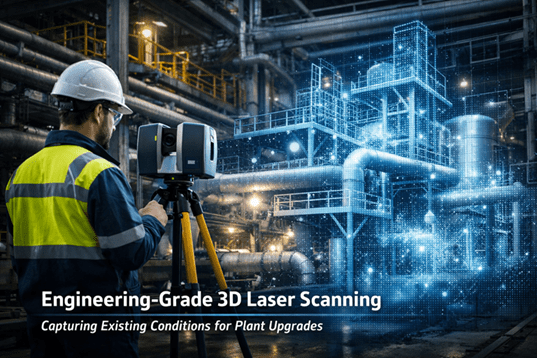
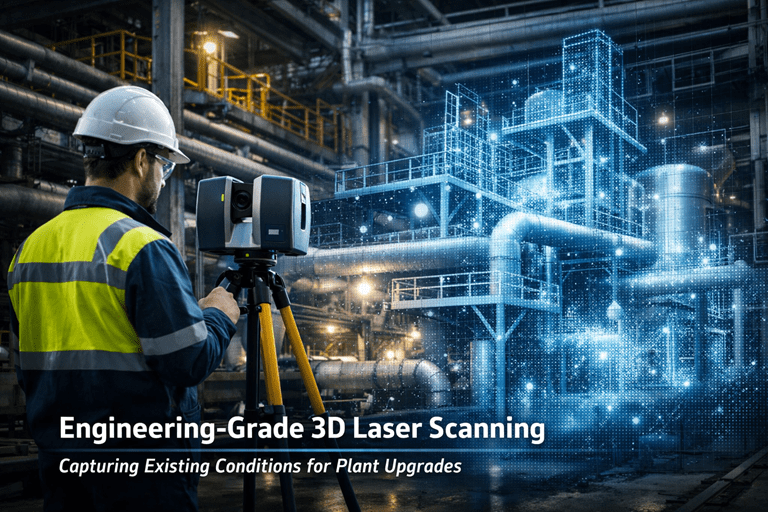
Engineering-grade 3D laser scanning at the very beginning of a refurbishment changes the entire dynamic of a project.
Instead of reacting to unknowns later, the project team starts with:
Verified geometry
True floor levels and deflection
Structural alignment and deformation
Accurate column, beam, and slab positions
Measured deviations from original drawings
This gives architects and designers something powerful:
Freedom to design within known constraints โ not guessed ones.
Heritage & Industrial Retrofits: Why Scanning Matters Even More
Heritage Buildings
Heritage structures often prohibit invasive investigation early on. 3D scanning allows:
Non-intrusive verification of geometry
Identification of movement or deformation
Assessment of tolerance drift over time
Planning of sympathetic strengthening solutions
Refineries & Legacy Industrial Sites
Inner West refinery and process facilities bring additional challenges:
Tight access
Live plant interfaces
Safety-critical environments
Brownfield congestion
Scanning provides:
Safe remote measurement
Clash-free retrofit design
Confidence before shutdowns
Reduced rework during construction
When Standards Change, Reality Matters
One of the most common late-stage surprises in refurbishments is floor capacity.
Buildings that performed adequately for decades may no longer comply with:
Current live load requirements
Change-of-use provisions
Equipment point loads
Modern safety factors
Without accurate structural geometry and context, engineers are forced to:
Assume worst-case scenarios
Over-design strengthening
Restrict layouts unnecessarily
Early scanning supports informed engineering judgement, often resulting in:
Targeted strengthening instead of blanket solutions
Retention of original fabric where possible
Reduced material and construction costs
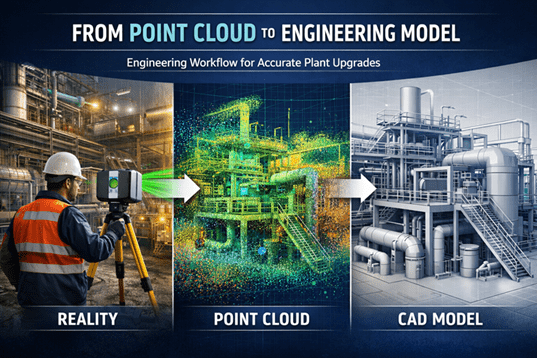
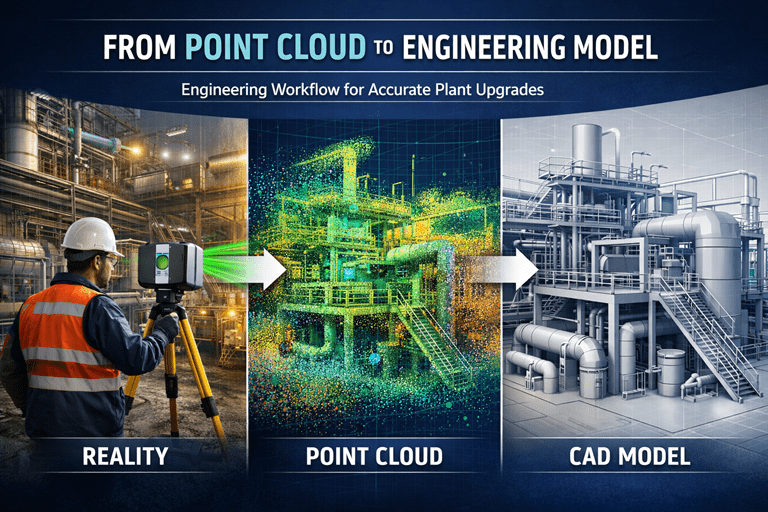
From Point Cloud to Engineering Decisions
At Hamilton By Design, scanning is not a standalone service โ itโs an engineering tool.
Our process typically supports:
Structural verification of existing buildings
Floor flatness, level, and deflection assessment
Alignment checks of columns and frames
Scan-to-CAD models for design integration
Fit-for-purpose information for refurbishment decisions
This is especially critical in Inner West projects, where:
Every millimetre matters
Access is limited
Heritage considerations are real
Late changes are costly
Design With Knowledge, Not Surprises
Refurbishments donโt fail because buildings are old. They fail because assumptions survive too long.
By starting with an engineering-led scan:
Designers get space to create
Engineers get data they can trust
Asset owners avoid late-stage shocks
Projects move forward with confidence
If youโre planning a refinery upgrade, heritage refurbishment, or adaptive re-use project in Inner West Sydney, the smartest decision you can make is to scan first โ before concept becomes constraint.
Thinking about a refurbishment or retrofit in the Inner West?
Engineering-grade 3D scanning at the start gives your project clarity, confidence, and creative freedom โ not limitations.
AS 1100 & LiDAR Scanning: Compliant Engineering Drawings from Point Clouds
If youโve ever tried to update old plant drawings, verify a brownfield tie-in, or issue โas-builtโ documentation after a shutdown, youโll know the pain: the site never matches the drawings, access is limited, and the smallest dimensional miss can cascade into rework, clashes, and schedule blowouts.
Thatโs where engineering-grade LiDAR scanning and AS 1100 (the Australian Standard for technical drawing) make a powerful combination. LiDAR gives you truth data (reality capture), and AS 1100 gives you a shared language for turning that truth into clear, consistent, contract-ready documentation.
What AS 1100 actually โdoesโ in the real world
AS 1100 standardises the way we communicate engineering information through drawings: layout, line types, projection methods, dimensioning rules, tolerancing conventions, symbols, notes, and drawing presentation.
In practice, AS 1100 helps you answer questions like:
Which edges are visible vs hidden? (line conventions)
How are views arranged and interpreted? (projection and view layout)
How do we dimension so the fabricator canโt misread it? (dimensioning rules)
How do we document what matters vs whatโs โreference onlyโ? (notes and drawing hierarchy)
How do we keep drawing sets consistent across multiple contributors? (formatting + standards)
That consistency is exactly whatโs needed after a scanโbecause point clouds are rich, but theyโre not automatically โcommunicableโ in the way a compliant drawing set is.
What LiDAR scanning adds that drawings alone canโt
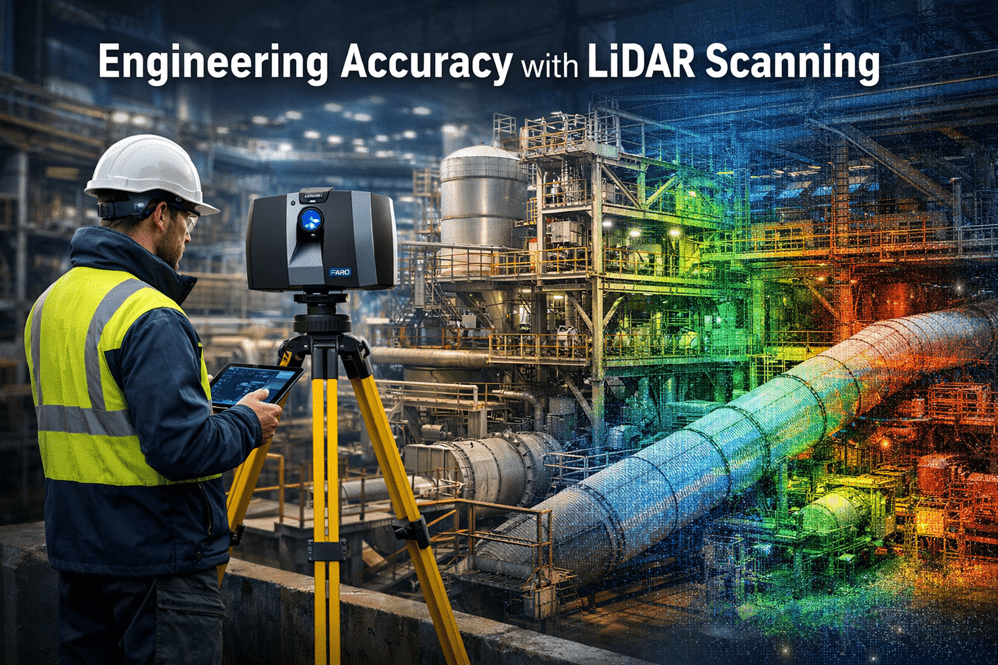
A LiDAR scanner captures millions (often billions) of spatial points that represent real surfacesโsteel, concrete, pipe, equipment, structureโcreating a point cloud that can be registered into a unified coordinate system.
In the engineering context, the big advantages are:
Speed: capture complex geometry quickly, often with minimal disruption
Coverage: see whatโs hard to measure with tape/total station (overhead services, congested pipe racks, odd geometry)
Context: capture โeverything,โ not just what someone remembered to measure
Traceability: you can always โgo backโ to the scan for verification and queries
Clash prevention: scan-to-CAD makes it far easier to design upgrades that actually fit
But hereโs the key: a point cloud isnโt a deliverable most trades can fabricate from directly. Thatโs why AS 1100 becomes the bridge between capture and construction.
The combined workflow: Point cloud โ model โ AS 1100 drawings
1) Capture the site as it really is
We scan the area of interest and register scans into a coordinated dataset. This becomes the base truth for everything that follows. If the project is shutdown-driven, we plan scanning around access windows and risk controls (often capturing adjacent tie-in zones too, because โnearbyโ services are where surprises live).
2) Establish intent: โWhat are we delivering?โ
Not every project needs the same output. Typical outcomes include:
As-built drawings for existing assets
As-found models to support new design work
Dimensional verification for fit-up and prefabrication
Digital QA against design intent (scan-vs-model comparison)
3) Convert scan data into engineering geometry (as much as needed)
Sometimes the best output is a controlled 3D model (plant layout, pipe spools, structural members). Other times the project is best served by 2D drawings extracted from a model.
Weโll typically create:
key datums and grids
primary steel / structure
equipment envelopes and critical interfaces
piping runs and connection points (where relevant)
floor levels, platforms, access constraints, clearance zones
4) Document to AS 1100 so the drawing set is unambiguous
This is where AS 1100 shines. We turn geometry into drawings that read cleanly and consistently across teams.
drawing borders, title blocks, revision control, and drawing register discipline
In short: LiDAR gives accuracy, AS 1100 gives clarity.
Where AS 1100 + LiDAR scanning delivers immediate value
Brownfield upgrades and tie-ins
Tie-ins fail when the โas-builtโ condition is wrong. A scan gives you real geometry; AS 1100 drawings package it so designers, fabricators, and installers share the same reference. This is especially useful when multiple contractors are interfacing.
Fabrication and spool accuracy
If youโre fabricating offsite (pipe spools, platform steel, handrail sections, ducting), you need dependable dimensions and an agreed drawing language. Scan-derived models support accuracy; AS 1100 drawings support fabrication interpretation and QA sign-off.
Shutdown planning and constructability
A point cloud is a brilliant planning toolโaccess routes, crane clearances, removal paths, temporary works, and โwhatโs in the way.โ But shutdown packages still need compliant drawings for permits, isolations, install workpacks, and handover packs. AS 1100 keeps those packages readable and defensible.
Verification and โwhat changed?โ
Sites evolve. A scan provides a timestamped snapshot. Drawings updated to AS 1100 become the controlled record: what was there, what was installed, and what the current state is. That matters for maintenance, safety, and future projects.
Practical example: Turning a congested pipe rack into a buildable upgrade
Imagine youโre adding a new line through an existing pipe rack:
Scan the rack to capture all existing services, supports, cable trays, and steel
Model critical geometry (existing plus proposed) to check routing and supports
Clash check before fabrication begins
Issue AS 1100 drawings for:
support details
spool isometrics (if applicable)
arrangement drawings showing tie-in locations
sections through congestion zones
installation notes and tolerances where appropriate
Verify post-install with a follow-up scan if required for QA/closeout
Thatโs the โwork togetherโ part: the scan stops guesswork, and AS 1100 stops misinterpretation.
Common mistakes when scanning isnโt tied back to AS 1100
Delivering point clouds without a drawing strategy (stakeholders canโt use them effectively)
Over-modelling everything (time is spent modelling non-critical items instead of delivering useful documentation)
Unclear dimensioning (scan accuracy is wasted if dimensions are presented ambiguously)
No controlled datums (people argue about โwhere zero isโ and models drift between disciplines)
Weak revision control (the drawing set becomes untrustworthy fast)
A standards-led drawing approach prevents most of these.
How we approach it at Hamilton By Design
Our angle is simple: engineering-led scanningโnot scanning for its own sake.
We capture reality with LiDAR.
We translate it into the level of model detail the project actually needs.
We document outputs with the discipline and consistency expected in Australian engineering environments.
Closing thought: accuracy is only valuable if itโs understandable
LiDAR scanning can deliver millimetre-grade spatial truth. But in real projects, truth still has to travel through peopleโengineers, drafters, fabricators, installers, supervisors, and asset owners.
AS 1100 makes that truth readable. LiDAR makes it reliable.
Together, they turn messy real-world geometry into clear, controlled documentation that supports safer installs, faster shutdowns, and fewer surprises.
Engineering-Led 3D Laser Scanning for Industrial Facilities in Sydney
In complex industrial environments, accurate site data is critical โ but point clouds alone do not solve engineering problems.
At Hamilton By Design, we provide engineering-led 3D laser scanning services across Sydneyโs industrial precincts, delivering not just accurate capture, but build-ready CAD models, verified layouts, and engineering support for plant upgrades, shutdown works, and fabrication projects.
From manufacturing facilities and bulk materials handling plants to port infrastructure and brownfield industrial sites, our scanning workflows are designed to reduce rework, improve constructability, and support safe, compliant engineering outcomes.
Why Engineering-Led Scanning Matters in Industrial Environments
Industrial facilities are rarely documented accurately. Over years of modifications, shutdown changes, and emergency repairs, original drawings quickly become unreliable.
Common issues we see on Sydney industrial sites include:
undocumented structural changes
misaligned conveyors and transfer points
access platforms not matching compliance drawings
equipment upgrades that donโt fit as expected
safety risks during shutdown installation
Traditional survey-only scanning provides geometry โ but without engineering interpretation, design risk remains high.
Hamilton By Design integrates engineering verification directly into the scanning and modelling workflow, ensuring captured data supports:
mechanical design
structural verification
fabrication detailing
construction planning
This approach is critical for brownfield upgrades and safety-critical installations.
From Point Cloud to Build-Ready CAD โ Not Just Visual Models
Our Sydney scanning projects are delivered as part of a complete scan-to-engineering workflow, including:
high-accuracy terrestrial LiDAR scanning
registered point cloud datasets
engineering-grade CAD and BIM modelling
mechanical and structural integration
fabrication and construction-ready outputs
This allows project teams to move directly from:
Site capture โ engineering design โ fabrication โ installation
without the delays and risks associated with re-measuring or redesigning due to site conflicts.
For shutdown and live-plant environments, this dramatically reduces:
installation clashes
hot-work exposure
crane and access planning errors
schedule overruns
Industrial Facilities We Support Across Sydney
Hamilton By Design provides industrial scanning and engineering support across:
manufacturing plants
materials handling facilities
recycling and processing plants
port and logistics infrastructure
food and beverage production
utilities and treatment facilities
Our team understands the constraints of:
live plant operations
confined access
safety compliance requirements
short shutdown windows
Scanning is planned to integrate with plant operations and maintenance teams, not disrupt them.
Sydney Industrial Precincts We Regularly Support
We provide 3D laser scanning and engineering modelling across key industrial areas including:
Alexandria and Inner South industrial zones
Port Botany and logistics precincts
Western Sydney manufacturing corridors
North Shore infrastructure and access-restricted sites
Regional NSW industrial and mining-linked facilities
Each location presents different engineering challenges โ from heavy materials handling to structural access compliance โ which is why engineering involvement during scanning is critical.
Supporting Engineering, Fabrication and Compliance
Unlike scanning companies that deliver only spatial data, Hamilton By Design integrates scanning into broader project delivery, supporting:
mechanical upgrades and replacements
structural strengthening and access platforms
conveyor and chute modifications
guardrail and walkway compliance upgrades
fabrication shop detailing
as-built documentation for asset registers
This ensures scanning outputs are aligned with:
Australian Standards
engineering design requirements
construction tolerances
Not just visual representation.
Why Industrial Clients Choose Hamilton By Design
Industrial clients across Sydney engage Hamilton By Design because we offer:
โ engineer-led scanning and modelling workflows
โ mechanical and structural design capability in-house
โ fabrication-aware CAD modelling
โ experience in mining and heavy industry environments
โ practical understanding of shutdown and brownfield projects
This allows us to support projects from initial site verification through to construction and commissioning.
When to Use Engineering-Led 3D Scanning
Our Sydney industrial scanning services are particularly valuable for:
brownfield plant upgrades
conveyor and materials handling modifications
access and safety compliance projects
clash detection before fabrication
replacement of undocumented equipment
retrofit installations in congested areas
If the project requires accurate geometry and engineering accountability, scanning must be part of the engineering workflow โ not separate from it.
Talk to an Engineering-Led Scanning Team in Sydney
If you are planning an industrial upgrade, shutdown modification, or facility redevelopment in Sydney, Hamilton By Design can provide:
engineering-led LiDAR scanning
point cloud to CAD modelling
mechanical and structural design support
fabrication-ready documentation
Contact our team to discuss how engineering-driven site capture can reduce project risk and improve construction outcomes.
Related Sydney Services
Hamilton By Design provides engineering-led 3D scanning, LiDAR scanning, mechanical engineering and digital engineering services throughout Sydney and Greater Sydney.
Explore our related Sydney services:
3D Scanning Sydney โ Engineering-grade terrestrial laser scanning, as-built surveys and point cloud capture for industrial, infrastructure and commercial projects.
Reality Capture Sydney โ High-accuracy reality capture, digital twins, asset documentation and engineering-grade site verification.
Scan to CAD Sydney โ Convert point cloud data into AutoCAD, SolidWorks, Inventor and other engineering-ready CAD deliverables.
Point Cloud Modelling Sydneyโ Engineering-grade point cloud processing, clash detection, as-built verification and 3D modelling.
Mechanical Engineering Sydney โ Mechanical design, plant upgrades, materials handling systems, conveyors, chutes, platforms and engineering support.
Structural Drafting Sydneyโ Structural steel drafting, fabrication drawings, GA drawings, workshop detailing and as-built documentation.
Hamilton By Design supports projects throughout Sydney CBD, Parramatta, Liverpool, Penrith, Blacktown, Chatswood, Alexandria, Mascot, Newcastle and the Central Coast.
To provide the best experiences, we use technologies like cookies to store and/or access device information. Consenting to these technologies will allow us to process data such as browsing behaviour or unique IDs on this site. Not consenting or withdrawing consent, may adversely affect certain features and functions.
Functional
Always active
The technical storage or access is strictly necessary for the legitimate purpose of enabling the use of a specific service explicitly requested by the subscriber or user, or for the sole purpose of carrying out the transmission of a communication over an electronic communications network.
Preferences
The technical storage or access is necessary for the legitimate purpose of storing preferences that are not requested by the subscriber or user.
Statistics
The technical storage or access that is used exclusively for statistical purposes.The technical storage or access that is used exclusively for anonymous statistical purposes. Without a subpoena, voluntary compliance on the part of your Internet Service Provider, or additional records from a third party, information stored or retrieved for this purpose alone cannot usually be used to identify you.
Marketing
The technical storage or access is required to create user profiles to send advertising, or to track the user on a website or across several websites for similar marketing purposes.