


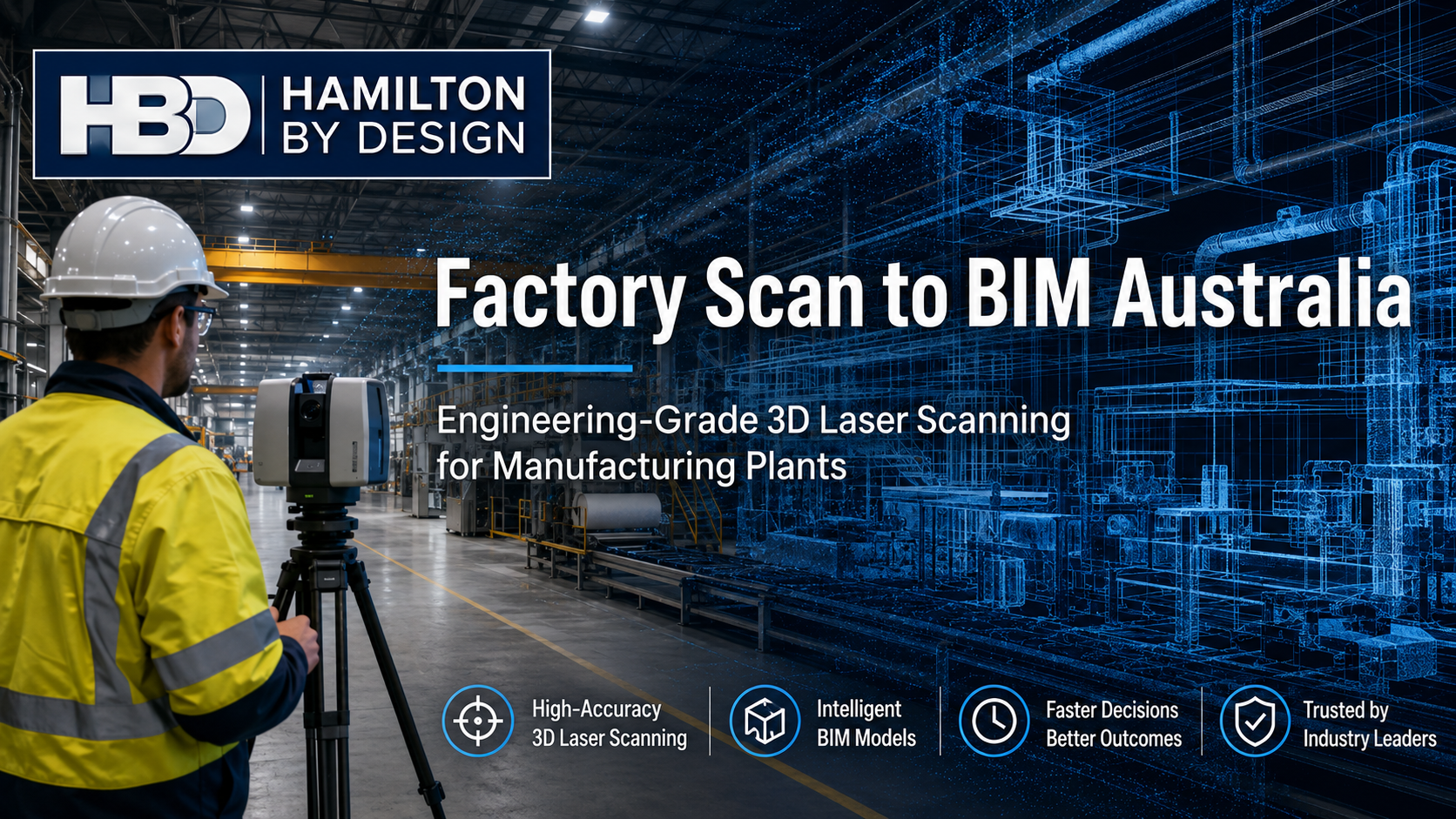
Factory Scan to BIM Australia
Engineering-Grade 3D Laser Scanning for Manufacturing Plants, Processing Facilities and Brownfield Factory Upgrades
Factories rarely remain exactly as they were originally designed.
Production equipment changes. Pipework is rerouted. Conveyors are extended. Platforms are modified. Services are added. Machinery is replaced. Structural steel is altered to accommodate new equipment.
Over time, the drawings used to maintain and upgrade the facility may no longer represent what is actually installed.
Hamilton By Design provides Factory Scan to BIM services across Australia, using engineering-grade 3D LiDAR laser scanning to capture existing factory conditions and convert them into practical digital information for plant upgrades, equipment installation, engineering design and as-built documentation.
Our approach combines accurate reality capture with engineering, 3D CAD modelling and drafting so the resulting information can be used to solve real brownfield engineering problems.
For broader projects involving buildings, industrial facilities and infrastructure, see our Scan to BIM Australia services.
The Biggest Problem: The Factory Has Changed but the Drawings Have Not
One of the biggest challenges in factory and manufacturing engineering is the reliability of existing information.
A factory may have been operating for 10, 20, 30 or more years.
During that time, individual projects may have changed:
- production machinery;
- pipework;
- ducting;
- conveyors;
- access platforms;
- stairs and handrails;
- electrical services;
- cable trays;
- structural steel;
- equipment foundations;
- process lines;
- storage systems; and
- maintenance access.
Unfortunately, those changes are not always incorporated into the original drawings.
The result is a common brownfield engineering problem:
The engineering team may be designing tomorrow’s plant using yesterday’s information.
That creates uncertainty before fabrication and installation begins.
A dimensional error that appears minor on a drawing can become a major problem when new machinery, pipework or structural steel arrives on site and does not fit.
Factory Scan to BIM provides a way to capture the actual existing condition of the facility before the new design is developed.
What Is Factory Scan to BIM?
Factory Scan to BIM is the process of capturing an existing factory using 3D laser scanning and converting the resulting point-cloud information into a digital model suitable for engineering, coordination and documentation.
Hamilton By Design’s 3D Laser Scanning for Engineering Projects service captures millions of spatial measurements across plant, structures, machinery and surrounding interfaces.
These measurements create a detailed point cloud representing the physical factory.
Depending on the project requirements, this information can then be developed into:
- BIM models;
- 3D CAD models;
- equipment layouts;
- general arrangement drawings;
- sections and elevations;
- structural geometry;
- mechanical layouts;
- existing-condition drawings;
- clash-review models; and
- fabrication or installation reference geometry.
The objective is not simply to create a digital model.
The objective is to give engineers, designers, manufacturers and project teams reliable information about what is actually there.
Why Scan a Factory Before an Upgrade?
Brownfield factory projects are often constrained by existing assets.
Unlike a greenfield development, the new equipment has to work around machinery, structures, services and production systems that are already installed.
Traditional site measurements may capture individual dimensions, but complex industrial environments can contain thousands of interconnected spatial relationships.
3D laser scanning captures the broader environment.
This can help answer practical engineering questions such as:
- Will the new machine physically fit?
- Is there enough maintenance clearance?
- Where is the existing structural steel?
- Can new pipework pass through the available space?
- Where are existing services located?
- Will a new conveyor clash with existing equipment?
- Can equipment be fabricated before a shutdown?
- What has changed since the original drawings were produced?
- Can installation work be planned before arriving on site?
For industrial applications beyond manufacturing facilities, our engineering-grade 3D laser scanning services support mining, heavy industry, infrastructure and brownfield engineering projects across Australia.
Factory Scan to BIM Applications
New Machinery and Equipment Installation
One of the strongest applications for Factory Scan to BIM is preparing for the installation of new machinery.
The surrounding factory can be scanned before detailed design begins.
The captured information can help establish:
- available floor area;
- ceiling clearances;
- surrounding equipment;
- column locations;
- structural interfaces;
- services;
- maintenance access;
- lifting access;
- operator access; and
- installation constraints.
The proposed equipment can then be positioned within the captured existing environment before fabrication or installation.
This can significantly improve confidence in fit-up.
Production-Line Modifications
Production lines are frequently modified as factories introduce new products, increase throughput or automate existing processes.
Factory 3D scanning can capture the complete production environment before modifications are designed.
Typical captured assets may include:
- conveyors;
- production machinery;
- guarding;
- operator stations;
- structural steel;
- pipework;
- electrical services;
- walkways;
- access routes; and
- surrounding building geometry.
The resulting model provides a reliable basis for evaluating changes to the production line.
Hamilton By Design also provides broader mechanical engineering consulting for industrial machinery, plant upgrades and brownfield modifications.
Brownfield Factory Engineering
Brownfield engineering is fundamentally different from designing a new facility.
The existing factory determines what is possible.
New equipment may need to interface with:
- old steelwork;
- existing foundations;
- legacy machinery;
- restricted access;
- existing production lines;
- pipework;
- services;
- platforms; and
- equipment that cannot easily be relocated.
Factory Scan to BIM provides accurate spatial information before engineering decisions are made.
This allows engineers to design around the real plant rather than assumptions based on incomplete or outdated documentation.
Hamilton By Design’s broader Engineering Services combine reality capture with mechanical design, drafting and brownfield engineering support.
Factory As-Built Surveys
Many factories have incomplete as-built documentation.
Original drawings may exist, but years of modifications can mean they no longer accurately represent the facility.
A factory as-built survey using 3D laser scanning can capture the existing condition and provide a new reference dataset.
This may be particularly useful when:
- original drawings cannot be located;
- machinery has been relocated;
- equipment has been modified;
- structural changes were undocumented;
- new services have been installed;
- several contractors have modified the facility over time; or
- future upgrades are being planned.
An accurate digital record can reduce the need to repeatedly return to site for additional measurements.
Reverse Engineering Existing Factory Equipment
Factory scanning does not need to stop at the building or plant layout.
Existing machinery and components can also be captured for reverse engineering.
This can be useful when:
- original manufacturing drawings no longer exist;
- equipment is obsolete;
- replacement parts are unavailable;
- machinery has been modified;
- components need to interface with legacy equipment; or
- new equipment must replicate existing connection geometry.
Hamilton By Design provides Reverse Engineer 3D Scanning for industrial assets where scan data is used as the starting point for engineering interpretation and model development.
Scan to BIM for Factory Pipework and Services
Factories can contain highly congested mechanical and electrical services.
Pipework, ducting, cable trays, conduits and structural elements may all occupy the same restricted areas.
Traditional measurement can become difficult where services overlap or access is limited.
3D laser scanning can capture these relationships from multiple scanner positions and combine them into a coordinated point cloud.
This information can support:
- new pipe routes;
- ducting modifications;
- service relocations;
- equipment connections;
- clash review;
- access planning; and
- future plant modifications.
Factory Structural Steel and Equipment Interfaces
Many machinery installations depend upon the geometry of the surrounding structure.
Scanning can capture:
- columns;
- beams;
- bracing;
- platforms;
- floor levels;
- roof structure;
- equipment support steel;
- openings;
- penetrations; and
- access structures.
This provides the design team with a digital reference for evaluating how new machinery or structures will interact with the existing factory.
Scan Before the Shutdown
Factory shutdowns are expensive and often tightly scheduled.
Where practical, laser scanning can be completed before the shutdown so engineering and modelling can progress while the factory continues operating.
This can allow:
Site scanning → point-cloud registration → 3D modelling → engineering → fabrication planning → shutdown installation
rather than beginning measurement and engineering after the plant is already offline.
This is particularly valuable where shutdown duration needs to be minimised.
Hamilton By Design’s industrial scanning experience includes plant, equipment, structures and materials-handling systems where accurate existing-condition information is required for engineering and shutdown work.
What Can Be Captured During a Factory Scan?
A Factory Scan to BIM project can capture a combination of:
Machinery and Production Equipment
- production machinery;
- processing equipment;
- packaging equipment;
- pumps;
- motors;
- gearboxes;
- tanks;
- vessels;
- hoppers; and
- specialised machinery.
Materials Handling
- conveyors;
- transfer points;
- chutes;
- rollers;
- support structures;
- guarding; and
- loading systems.
Mechanical Services
- pipework;
- valves;
- ducting;
- pumps;
- compressed-air lines;
- utility services; and
- equipment connections.
Structures
- structural steel;
- columns;
- beams;
- platforms;
- stairs;
- handrails;
- roof structures; and
- equipment support frames.
Building Geometry
- floors;
- walls;
- ceilings;
- doors;
- openings;
- penetrations;
- plant rooms; and
- access routes.
From Point Cloud to Engineering Model
The registered point cloud is only the starting point.
Hamilton By Design can use captured scan data to support subsequent engineering and drafting.
A typical workflow may include:
Factory Survey
↓
3D LiDAR Laser Scanning
↓
Point-Cloud Registration
↓
Existing-Condition Review
↓
3D CAD / BIM Development
↓
Engineering Design
↓
Drawings and Documentation
↓
Fabrication and Installation
Where conventional engineering documentation is required, our Mechanical Drafting Australia service supports plant upgrades, fabrication, maintenance and brownfield modification projects across Australia.
Factory Scan to BIM Deliverables
Deliverables can be tailored to the project and may include:
- registered point clouds;
- E57 files;
- RCP/RCS datasets;
- LAS point clouds;
- BIM models;
- IFC models;
- SolidWorks models;
- STEP files;
- SAT files;
- AutoCAD DWG drawings;
- DXF files;
- general arrangement drawings;
- sections;
- elevations;
- equipment layouts;
- existing-condition plans;
- interface models; and
- engineering documentation.
The appropriate deliverable depends on what the model needs to achieve.
A project intended to establish general factory geometry may require a different level of modelling from a project involving detailed equipment interfaces.
Engineer-Led Factory 3D Scanning
There is an important distinction between scanning a factory and understanding what needs to be captured for an engineering project.
Hamilton By Design approaches factory scanning from an engineering perspective.
Before scanning begins, consideration can be given to questions such as:
- What equipment is being replaced?
- Which interfaces are critical?
- What level of accuracy is required?
- Which areas need detailed capture?
- What information will the designers require?
- What format does the final engineering team need?
- Is fabrication expected before installation?
- Are future plant modifications likely?
This allows the scanning strategy to be developed around the actual engineering requirement.
Factory Scan to BIM Across Australia
Hamilton By Design provides Factory Scan to BIM and industrial 3D scanning services across Australia.
Project locations can include:
Sydney
Newcastle
Central Coast NSW
Wollongong
Brisbane
Melbourne
Adelaide
Perth
Darwin
Regional NSW
Regional Queensland
Regional Victoria
Regional Western Australia
and remote industrial locations.
Our broader 3D Laser Scanning service supports projects throughout Australia, including major metropolitan centres and regional industrial locations.
Industries That Can Benefit from Factory Scan to BIM
Factory Scan to BIM can support many manufacturing and processing sectors, including:
- food and beverage manufacturing;
- packaging;
- pharmaceutical manufacturing;
- chemical processing;
- heavy manufacturing;
- steel processing;
- mining equipment manufacturing;
- automotive manufacturing;
- timber processing;
- building products;
- plastics;
- recycling;
- water treatment equipment;
- warehousing and logistics;
- materials handling; and
- general industrial manufacturing.
The technology is particularly valuable where a new project needs to integrate with an existing operating facility.
Why Use Factory Scan to BIM?
Factory Scan to BIM can help reduce uncertainty at the beginning of a project.
Potential advantages include:
- better existing-condition information;
- fewer assumptions during design;
- reduced requirement for repeated site measurement;
- earlier identification of spatial constraints;
- improved equipment fit-up;
- better coordination between engineering disciplines;
- improved ability to design remotely;
- more confidence before fabrication;
- improved shutdown preparation; and
- better long-term asset documentation.
The value is not simply in creating a BIM model.
The real value is having better information before expensive engineering, fabrication and installation decisions are made.
Factory Scan to BIM Australia — Frequently Asked Questions
What is Factory Scan to BIM?
Factory Scan to BIM uses 3D laser scanning to capture an existing manufacturing facility and convert that information into BIM, CAD or engineering models representing the actual installed conditions.
Can you scan an operating factory?
Yes. Many factory scans can be completed while facilities remain operational, subject to site access, safety requirements and the type of equipment being captured.
Can factory machinery be included in the BIM model?
Yes. Machinery, conveyors, pipework, services, structural steel and surrounding building geometry can all be captured where required.
Can you scan a factory when the drawings are outdated?
Yes. This is one of the strongest applications for factory scanning. The scan captures existing conditions rather than relying entirely on legacy drawings.
Can the scan be used for SolidWorks design?
Yes. Point-cloud information can be used as reference data for SolidWorks and other CAD modelling workflows where the appropriate geometry is developed from the scan.
Can Factory Scan to BIM help with equipment installation?
Yes. Existing factory geometry can be compared with proposed equipment before installation to identify clearances, interfaces and potential clashes.
Do you provide Factory Scan to BIM outside Sydney?
Yes. Hamilton By Design supports 3D laser scanning and engineering projects across Australia.
Planning a Factory Upgrade?
If you are preparing to install new equipment, modify a production line, upgrade existing machinery or undertake a brownfield factory project, accurate existing-condition information can significantly improve the starting point for engineering.
Hamilton By Design provides Factory Scan to BIM, 3D laser scanning, mechanical engineering, reverse engineering and drafting services across Australia.
Instead of designing around drawings that may no longer represent the facility, capture the factory as it exists today.
Scan the existing plant. Understand the interfaces. Design around reality.

Contact Us – Talk To Us
Our clients:
























