Engineering-Grade & Metrology-Grade 3D Scanning

Engineering-grade and metrology-grade 3D scanning in an industrial plant environment.

Choosing the Right Tool for the Right Scale

At Hamilton By Design, we do not approach 3D scanning as a visual service โ€” we approach it as an engineering measurement tool.

Different projects require different levels of accuracy, coverage and control. For this reason, we operate with two distinct scanning capabilities:

  • Engineering-Grade Terrestrial Laser Scanning
  • Metrology-Grade Handheld 3D Scanning

Each serves a specific purpose within industrial, mining and mechanical environments.
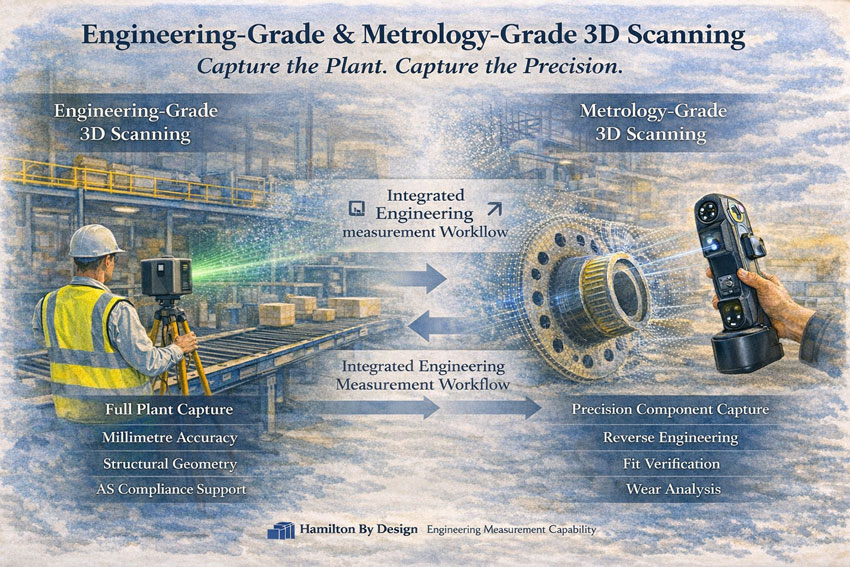

Engineering measurement workflow combining plant scanning and precision component capture.

Engineering-Grade 3D Scanning

Capturing Entire Environments with Structural Accuracy

Engineering-grade laser scanning is used when capturing:

  • Processing plants
  • Conveyor systems
  • Structural steel platforms
  • Brownfield facilities
  • Infrastructure corridors
  • Stockpiles
  • Full building interiors and exteriors

This system is tripod-based and captures large-scale environments with millimetre-level accuracy across significant distances.

Typical Performance:

  • Up to hundreds of metres scanning range
  • ~2 mm accuracy at 10 m
  • Full 360ยฐ environmental capture
  • Suitable for survey control alignment

Used For:

  • As-built plant documentation
  • Structural verification
  • Clearance assessments
  • Shutdown planning
  • Retrofit design
  • Compliance validation under AS standards

If you can walk inside it โ€” this is the correct tool.

This system establishes the macro geometry of a site.


Metrology-Grade 3D Scanning

Capturing High-Precision Component Geometry

Metrology-grade handheld scanning is designed for detailed component-level capture.

This system is compact, highly accurate, and capable of sub-0.05 mm precision.

Typical Performance:

  • Accuracy to ~0.020 mm
  • Volume accuracy to 0.015 mm + scale factor
  • Ideal for complex surfaces and confined spaces
  • Suitable for reverse engineering

Used For:

  • Worn chute liners
  • Flanges and bolt patterns
  • Pump housings
  • Lifting lugs
  • Machined components
  • Distorted structural connections
  • Deep hole geometry
  • Fit-up verification prior to fabrication

If you can hold it โ€” this is the correct tool.

This system establishes the micro geometry of a part.


Why Both Matter

Industrial projects often require both levels of capture.

Example: Mining Shutdown

  1. Engineering-grade scanning captures the entire transfer station.
  2. Metrology-grade scanning captures the worn liner plate.
  3. Data is combined to:
    • Verify fit
    • Model replacement components
    • Reduce fabrication risk
    • Avoid rework during shutdown

This integrated approach reduces:

  • Site time
  • Fabrication errors
  • Installation clashes
  • Cost overruns

Measurement With Engineering Intent

We do not scan for visualisation alone.

We scan to support:

  • Structural compliance
  • Mechanical design
  • FEA validation
  • Access verification
  • Brownfield modification
  • Asset documentation
  • Engineering governance

Scanning without engineering oversight introduces risk.

Scanning with engineering intent reduces it.


When To Use Each Scanner

ScenarioEngineering-Grade ScannerMetrology-Grade Scanner
Full plant captureโœ”
Structural steel verificationโœ”
Conveyor alignmentโœ”
Large-area as-built surveyโœ”
Reverse engineering a componentโœ”
Flange or bolt pattern captureโœ”
Wear measurementโœ”
Fabrication fit verificationโœ”
Confined detailed geometryโœ”

Hamilton By Design logo displayed on a blue tilted rectangle with a grey gradient background
3D LiDAR scanning and 3D modelling service button โ€” laser scanner capturing a point cloud for engineering and CAD modelling
Mechanical engineering services

National Capability

Hamilton By Design provides:

  • Engineering-grade terrestrial scanning
  • Metrology-grade handheld scanning
  • Integrated modelling and verification
  • Compliance-aligned documentation

Across mining, industrial and infrastructure environments throughout Australia.


If your project requires both macro capture and micro precision, we can deliver a structured scanning approach aligned with engineering outcomes.
3D CAD Modelling Australia service banner for Hamilton By Design

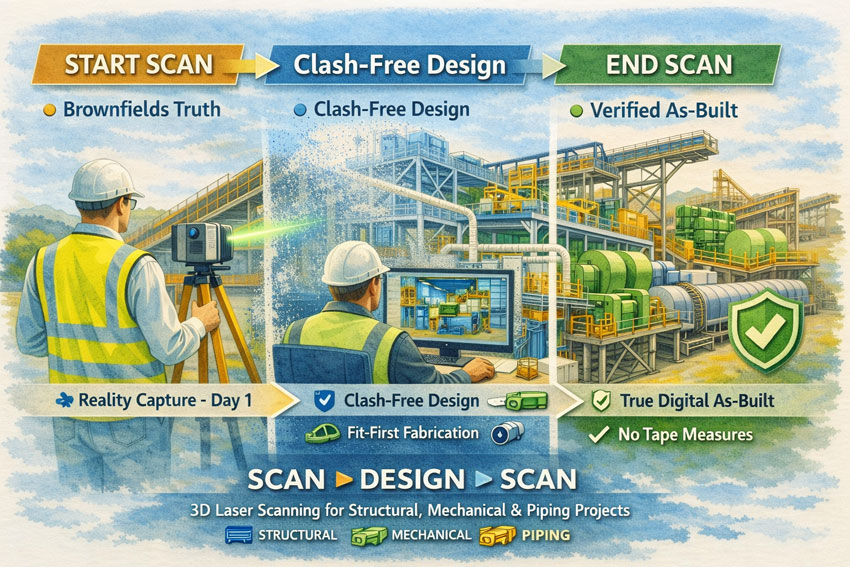
SMP Projects: Enabling Project Success Through a Scan โ†’ Design โ†’ Scan Workflow

Watercolour-style illustration showing SMP 3D laser scanning workflow from start capture to clash-free design and final digital as-built.

Successful Structural, Mechanical and Piping (SMP) projects are built on one fundamental principle: decisions must be based on accurate knowledge of existing conditions. In brownfields industrial environments, legacy drawings and manual measurements rarely reflect the current state of an asset. Over years of operation, piping is rerouted, structures are strengthened, and equipment is modified to meet changing production demands.

Commencing design on the basis of incomplete or inaccurate information introduces uncertainty that can affect safety, cost, schedule, and quality. Modern 3D laser scanning provides a disciplined method to remove this uncertainty and establish a reliable foundation for project delivery.


Establishing a Reliable Baseline

An initial 3D laser scan captures a high-resolution digital representation of the facility, recording structural elements, mechanical equipment, and piping systems exactly as they exist. This dataset becomes the authoritative reference for all subsequent engineering activities.

By beginning with a comprehensive reality capture, project teams can:

  • Define accurate tie-in locations for new works
  • Understand spatial constraints and access requirements
  • Identify potential clashes before detailed design
  • Reduce reliance on manual surveys and assumptions
  • Provide designers with objective, measurable data

This approach aligns engineering decisions with actual site conditions, supporting informed planning and reducing the likelihood of downstream rework.


SMP scanโ€“designโ€“scan process illustrated with laser scanner, point cloud model and finished industrial plant.

Designing From Truth Rather Than Assumption

When the design phase is grounded in verified scan data, coordination across structural, mechanical, and piping disciplines becomes more effective. Engineers are able to develop models that reflect the real environment rather than an idealised interpretation of it.

The benefits to project success include:

  • Improved accuracy of fabrication documentation
  • Reduced design revisions and RFIs
  • Greater confidence in constructability
  • More reliable cost and schedule forecasting
  • Enhanced collaboration between designers, fabricators, and site teams

A scan-based workflow supports the objective of โ€œfit-firstโ€ construction, where components are manufactured with confidence that they will integrate with existing assets.


Verifying Outcomes With a Final Scan

Project success is not only measured by installation, but by the quality of information handed to the asset owner. A second 3D scan at project completion provides a verified digital as-built of all SMP works.

This final dataset delivers:

  • An accurate record of installed structural, mechanical, and piping systems
  • Validation that construction matches design intent
  • A foundation for maintenance and asset management
  • Reliable data for future modifications or expansions
  • Elimination of manual tape-based as-built surveys

The organisation is left with a living digital asset rather than static drawings that quickly lose relevance.


Supporting Measurable Project Outcomes

Adopting a Scan โ†’ Design โ†’ Scan methodology directly contributes to recognised measures of project success:

  • Safety: Reduced site rework and unplanned interventions
  • Cost Control: Fewer field modifications and claims
  • Schedule Reliability: Shorter shutdowns and predictable installation
  • Quality: Higher confidence in alignment and tolerances
  • Knowledge Retention: Creation of enduring digital records

These outcomes are particularly critical in SMP environments where interfaces between steel, equipment, and piping are complex and tolerances are unforgiving.


Applications Across Industrial Sectors

This workflow is suited to a wide range of SMP activities, including:

  • Conveyor and materials handling upgrades
  • Plant expansions and debottlenecking
  • Tank, hopper and bin modifications
  • Piping reroutes and tie-ins
  • Shutdown and turnaround works
  • Brownfields engineering studies

In each case, accurate spatial data enables better engineering judgement and more predictable project delivery.

3D LiDAR scanning and 3D modelling service button โ€” laser scanner capturing a point cloud for engineering and CAD modelling
Mechanical engineering services

Hamilton By Design logo displayed on a blue tilted rectangle with a grey gradient background

A Framework for Sustainable Project Success

For organisations seeking consistent performance from SMP projects, the integration of 3D laser scanning is not a survey exerciseโ€”it is a strategic project control measure. By capturing reality at project commencement and verifying it at completion, stakeholders gain confidence that engineering decisions, construction outcomes, and asset records are aligned.

Start with verified data.
Design with confidence.
Finish with a true digital as-built.

Hamilton By Design Co. partners with project teams to implement this approach, supporting safer, more reliable, and more successful SMP outcomes.

Name
Would you like us to arrange a phone consultation for you?
Address

Finite Element Analysis (FEA) engineering simulation button
Mechanical engineering services

Engineering Drafting Services on the Central Coast

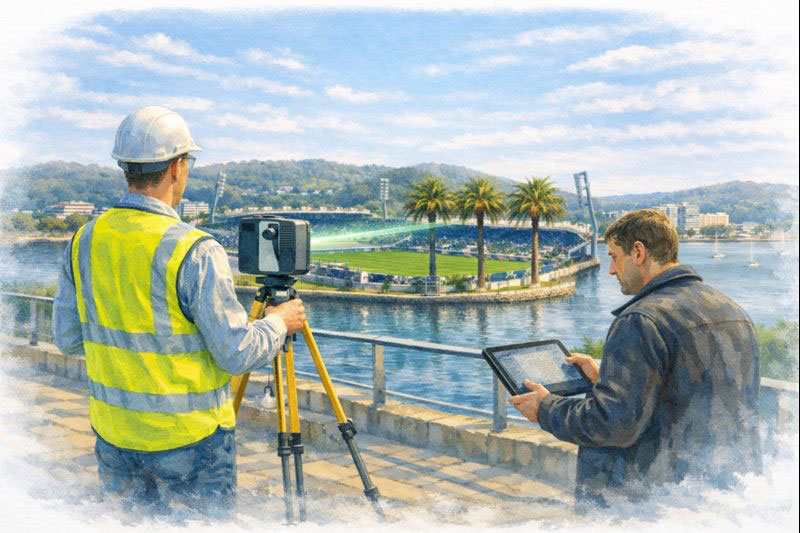
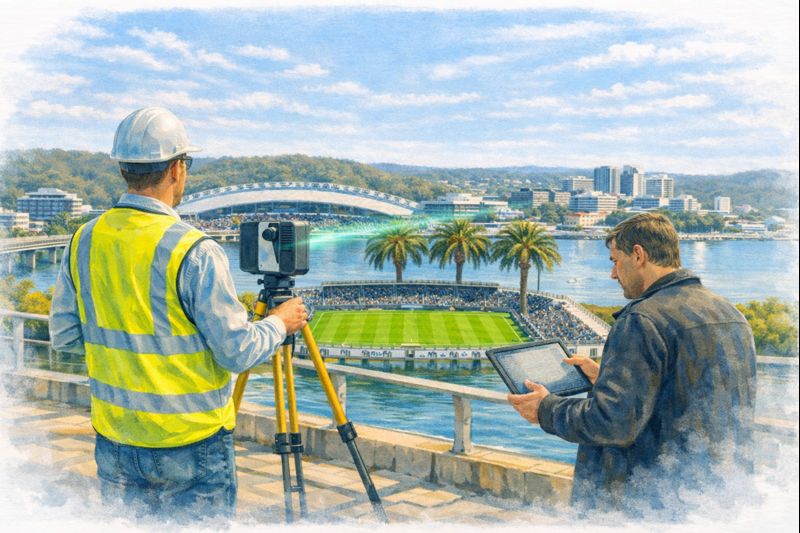
Engineer and client conducting site scanning near Central Coast Stadium in Gosford

Engineering Drafting Services Central Coast NSW | Hamilton By Design

When engineering projects move from concept to construction, clear and accurate drawings are what make the difference between smooth delivery and costly rework. For businesses on the Central Coast, having access to reliable, local engineering drafting services means faster communication, better outcomes, and drawings that actually work on site.

Hamilton By Design, based on the NSW Central Coast, provides professional engineering drafting services to support mechanical, structural, and industrial projects across the region and beyond.


Engineer using LiDAR scanner with client at Gosford Foreshore, Central Coast Stadium and Brisbane Water in background

What Are Engineering Drafting Services?

Engineering drafting is the process of converting design concepts, engineering calculations, and site requirements into detailed technical drawings. These drawings are used by fabricators, machinists, builders, and installers to manufacture and construct components correctly the first time.

Our drafting services typically include:

  • Dimensioned manufacturing drawings
  • Assembly and exploded views
  • Welded fabrication drawings
  • Structural steel and connection details
  • General arrangement (GA) drawings
  • Site and installation layouts

Clear drafting ensures everyone involved in the project is working from the same, accurate information.

Supporting Central Coast Industry & Construction

The Central Coast is home to a wide range of industries, including manufacturing, construction, infrastructure maintenance, and industrial services. We regularly support local businesses, contractors, and engineers who need drafting work completed accurately and efficiently.

Being locally based means we understand:

  • regional fabrication capabilities
  • site access and installation constraints
  • Australian Standards and compliance requirements
  • the importance of practical, buildable solutions

When needed, we can work closely with clients, fabricators, and installers to make sure drawings reflect real-world conditions.

3D LiDAR scanning services on the Central Coast providing engineering-grade laser scanning, point cloud capture, scan-to-CAD modelling and industrial reality capture for infrastructure and industrial projects.
Drafting services on the Central Coast providing engineering drawings, fabrication detailing, as-built documentation, reverse engineering and CAD drafting for industrial and infrastructure projects.
Mechanical engineering services on the Central Coast providing industrial design, plant inspections, pump calculations, reverse engineering and engineering support for manufacturing, infrastructure and heavy industry projects.

Our Engineering Drafting Capabilities

We provide engineering drafting using SolidWorks and proven industry workflows.

Mechanical Drafting

  • Machined component drawings
  • Sheet metal and folded parts
  • Assemblies with bills of materials (BOMs)
  • Practical tolerancing for manufacturing

Structural & Fabrication Drafting

  • Structural steel and fabrication drawings
  • Weld symbols and fabrication notes
  • Platforms, handrails, and access systems
  • Workshop-ready drawing packs

As-Built & Legacy Drawing Updates

  • As-built drawings for existing assets
  • Updating and converting legacy drawings
  • Reverse engineering from physical components

Who We Work With

Our Central Coast engineering drafting services support:

  • manufacturers and machine shops
  • builders and fabricators
  • mining and industrial contractors
  • engineering consultants
  • councils and asset owners

From one-off components to ongoing drafting support, we scale our services to suit your project.

Why Choose a Local Engineering Drafting Service?

Working with a Central Coastโ€“based drafting provider offers real advantages:

  • easier communication and faster turnaround
  • understanding of local suppliers and trades
  • drawings created with fabrication and installation in mind
  • long-term support for updates and modifications

At Hamilton By Design, our drafting work is backed by hands-on engineering and manufacturing experience โ€” not just CAD skills.


Hamilton By Design logo displayed on a blue tilted rectangle with a grey gradient background
3D LiDAR scanning and 3D modelling service button โ€” laser scanner capturing a point cloud for engineering and CAD modelling
Mechanical engineering services

Engineering Drafting You Can Build From

If youโ€™re looking for engineering drafting services on the Central Coast that deliver clear, practical, and construction-ready drawings, Hamilton By Design can help.

Get in touch to discuss your project or request a quote.


Name
Would you like us to arrange a phone consultation for you?
Address


Finite Element Analysis (FEA) engineering simulation button
Mechanical engineering services

Establish a Baseline for Wall Movement in Your Property

Wall Crack Monitoring & Structural Movement Baseline Scans | NSW

Know When Cracks Are Cosmetic โ€” and When Theyโ€™re Not

Cracks in walls are common, but not all cracks are harmless. The real risk isnโ€™t just that a crack exists โ€” itโ€™s how fast itโ€™s changing. Without a baseline, thereโ€™s no reliable way to tell whether your property is stable or slowly moving toward serious structural damage.

Thatโ€™s where our Property Wall Movement Baseline Scan comes in.


What Is a Baseline Scan?

A baseline scan is a highโ€‘accuracy digital survey of your property taken at the moment cracking is first observed. Using precision scanning technology, we capture:

  • Wall alignment and deflection
  • Crack location, length, and width
  • Floor and ceiling reference planes
  • Structural reference points across the building

This scan becomes your timeโ€‘zero reference point โ€” a measurable snapshot of your buildingโ€™s condition today.


Why a Baseline Matters

Without a baseline:

  • Cracks are judged visually (subjective and unreliable)
  • Engineers lack historical movement data
  • Insurance claims become harder to substantiate
  • Small issues can quietly become major repairs

With a baseline:

  • Movement can be quantified in millimetres
  • Crack growth rates can be tracked over time
  • Engineers can make confident, dataโ€‘driven decisions
  • You gain early warning before damage becomes critical

How the Process Works

1. Initial Scan

We perform a nonโ€‘invasive scan of affected areas and key structural zones to establish your baseline condition.

2. Data Archiving

All scan data is securely stored and referenced to fixed control points within your property.

3. Followโ€‘Up Scans

Repeat scans (3, 6, or 12 months later) are compared against the baseline to calculate:

  • Crack propagation rate
  • Wall movement direction
  • Structural settlement or heave

4. Clear Reporting

You receive a clear, easyโ€‘toโ€‘understand report showing:

  • Measured movement (if any)
  • Rate of change over time
  • Professional recommendations

Ideal For

  • Homeowners noticing new or worsening cracks
  • Properties affected by reactive soils or subsidence
  • Buildings near excavation or construction activity
  • Insurance documentation and dispute resolution
  • Engineers requiring longโ€‘term movement data

Early Data Saves Money

Monitoring movement early often means minor intervention instead of major reconstruction. A baseline scan gives you certainty, evidence, and peace of mind.

If nothing is moving โ€” youโ€™ll know.
If something is โ€” youโ€™ll know before itโ€™s too late.


Hamilton By Design logo displayed on a blue tilted rectangle with a grey gradient background
3D LiDAR scanning and 3D modelling service button โ€” laser scanner capturing a point cloud for engineering and CAD modelling
Mechanical engineering services

Book a Baseline Scan

If youโ€™ve noticed cracking, now is the right time to act.

Contact us today to establish your propertyโ€™s movement baseline and protect its longโ€‘term structural integrity.


Precision data. Clear answers. Smarter decisions.

Name
Would you like us to arrange a phone consultation for you?
Address
3D LiDAR scanning and 3D modelling service button โ€” laser scanner capturing a point cloud for engineering and CAD modelling
Mechanical engineering services
Finite Element Analysis (FEA) engineering simulation button
Mechanical engineering services

Why Good Design Matters More Than Project Management

Why Engineering Design Matters More Than Project Management

Lessons from Tailings Dam Failures in the Global Mining Industry

In engineering-led industries such as mining, construction, and heavy manufacturing, project management is often seen as the key to success โ€” on time, on budget, and on scope.

However, history shows that when failures occur, they are rarely caused by poor project management alone.

Some of the most serious industrial failures in the world โ€” including tailings dam collapses โ€” demonstrate a critical truth:

Project management cannot compensate for poor or marginal engineering design.

At Hamilton By Design, we believe design sets the safety ceiling. Project management operates within it.


Project Management Executes โ€” Design Determines Risk

Project management is essential. It coordinates people, schedules, procurement, and delivery. But it does not:

  • Increase a structureโ€™s factor of safety
  • Prevent liquefaction
  • Change material behaviour
  • Improve drainage capacity
  • Create resilience to abnormal conditions

Those outcomes are locked in at the design stage.

If a system requires perfect execution to remain safe, then the design is already fragile.

Good engineering design assumes:

  • Humans make mistakes
  • Weather exceeds forecasts
  • Equipment fails
  • Maintenance is imperfect

And it builds in margin, redundancy, and tolerance accordingly.


Tailings Dam Failures: A Clear Engineering Example

Tailings dam failures provide one of the clearest illustrations of the difference between design responsibility and project management responsibility.

Post-failure investigations across multiple countries consistently show that:

  • Many failed dams were operating as intended
  • Rainfall events were often within design assumptions
  • Operators followed approved procedures
  • Warning signs existed but reflected systemic weakness, not isolated mistakes

The common thread was not poor scheduling or cost control โ€” it was design philosophy.

Typical design-level issues identified:

  • Excess water retained in tailings
  • Low-density slurry disposal
  • Marginal stability under normal variability
  • Reliance on operational controls to maintain safety
  • Legacy designs never upgraded to match increased production

When a dam fails after a rainfall event, the rain is usually the trigger โ€” not the root cause.


Why Design Must Be Forgiving of Operations

Engineering design should be robust, not optimistic.

A safe design is one where:

  • Small operational deviations do not create instability
  • Water balance can tolerate extreme events
  • Safety does not depend on constant intervention
  • Failure modes are slow, visible, and recoverable

When operators or project managers are forced to โ€œmanage aroundโ€ design weaknesses, risk accumulates silently.

If safety relies on perfect behaviour, the system is unsafe by design.


The Australian Perspective: Design First, Then Manage

Australiaโ€™s generally strong tailings safety record reflects a broader engineering mindset:

  • Conservative design assumptions
  • Strong emphasis on water recovery and thickened tailings
  • Avoidance of high-risk construction methods
  • Independent engineering review
  • Design-for-closure thinking

Project management remains critical โ€” but it is not asked to compensate for marginal engineering.

This philosophy extends beyond tailings dams into:

  • Bulk materials handling
  • Structural steelwork
  • Brownfield upgrades
  • Shutdown-critical fabrication
  • Plant modifications

What This Means for Mining and Industrial Projects

The lesson is simple but powerful:

Engineering design controls risk.
Project management controls delivery.

When design is done properly:

  • Project management becomes easier
  • Variability is absorbed safely
  • Failures become unlikely rather than inevitable

When design is compromised:

  • Project management is left managing risk it cannot remove
  • The system becomes fragile
  • Incidents become a matter of when, not if

Our Approach at Hamilton By Design

At Hamilton By Design, we work from the principle that:

  • Design must be defensible
  • Assumptions must be explicit
  • Failure modes must be understood
  • Engineering judgement must lead delivery

Whether weโ€™re supporting:

  • Mining infrastructure
  • Tailings-adjacent plant systems
  • Bulk materials handling
  • Brownfield modifications
  • Shutdown-critical upgrades

We prioritise engineering-led design decisions that reduce reliance on operational heroics.


Final Thought

Project management is essential โ€” but it should never be asked to solve problems that only engineering design can prevent.

The safest projects are not the best managed ones โ€”
they are the best designed ones.

Hamilton By Design logo displayed on a blue tilted rectangle with a grey gradient background
3D LiDAR scanning and 3D modelling service button โ€” laser scanner capturing a point cloud for engineering and CAD modelling
Mechanical engineering services

Talk to an Engineer First

If your project involves:

  • High-risk infrastructure
  • Brownfield modifications
  • Water-sensitive systems
  • Shutdown-critical works

Get engineering involved early.
Contact Hamilton By Design to discuss an engineering-led approach that reduces risk before construction begins or Be part of the discussion.

Name
Would you like us to arrange a phone consultation for you?
Address
3D LiDAR scanning and 3D modelling service button โ€” laser scanner capturing a point cloud for engineering and CAD modelling
Mechanical engineering services
Finite Element Analysis (FEA) engineering simulation button
Mechanical engineering services

SolidWorks Drafting Services Northern Territory | Engineering-Led CAD Support

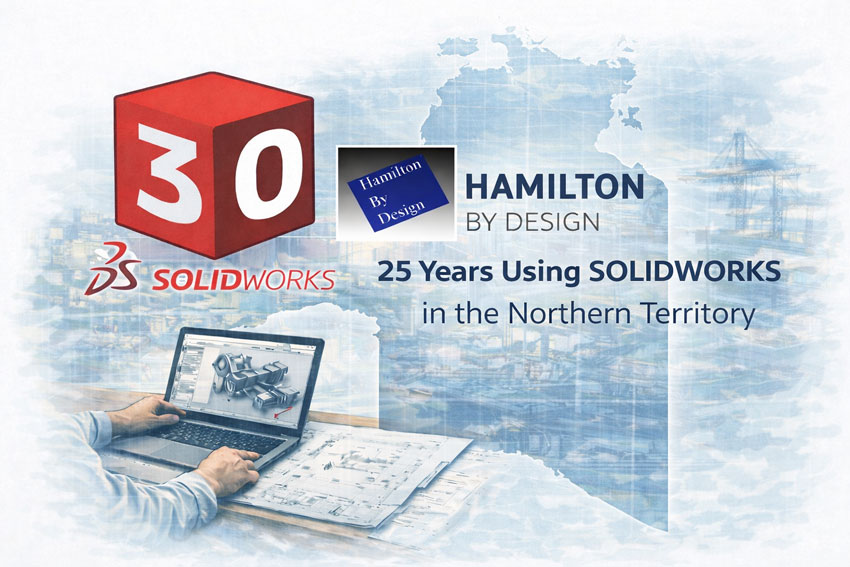
Engineering-led SolidWorks drafting in the Northern Territory with 25 years of Hamilton By Design experience

SolidWorks Drafting Services Northern Territory | Engineer-Led CAD Support

Engineering-Led SolidWorks Drafting Services in the Northern Territory

In the Northern Territory (NT) โ€” where industrial projects, remote operations, and infrastructure upgrades demand accuracy and accountability โ€” SolidWorks drafting is more than just โ€œCAD work.โ€ It must reflect real site conditions, installation constraints, and fabrication realities to avoid costly rework and downtime.

At Hamilton By Design, we provide SolidWorks drafting services in the Northern Territory that are:

  • Engineer-led
  • Fabrication-aware
  • Aligned with real industrial outcomes
  • Deliverable for fabrication and installation readiness

We donโ€™t just produce drawings โ€” we deliver engineered documentation that works on site.


SolidWorks 30 years cube with Hamilton By Design highlighting 25 years of SolidWorks use in the Northern Territory

Who Uses Our SolidWorks Drafting Services in the NT

Clients contact us when they need to:

  • Outsource SolidWorks drafting for mechanical systems or assemblies
  • Update or replace outdated drawings that no longer match site conditions
  • Add drafting capacity without sacrificing engineering quality
  • Support brownfield upgrades, process modifications, and shutdown planning
  • Integrate reverse engineering / scan-to-model deliverables into formal SolidWorks drawings

Many Northern Territory operators start with โ€œI need to hire a SolidWorks drafterโ€ โ€” and quickly realise they also need engineering judgement behind the drafting work.


Why Engineering-Led SolidWorks Drafting Matters in the NT

SolidWorks is a powerful CAD platform โ€” but the value of drafting depends on the engineering context behind it.

Hamilton By Designโ€™s drafting combines:

  • Engineering knowledge applied to drafting decisions
  • Understanding of fabrication constraints (welds, tolerances, access)
  • Installation and erection context
  • Integration with as-built conditions
  • Documentation compliant with project and statutory requirements

This reduces rework, decreases fit-up risk, and better supports tendering and construction outcomes for NT industry clients.


Northern Territory SolidWorks Drafting Services We Provide

Our NT SolidWorks drafting support includes:

  • Mechanical part and assembly drafting
  • Fabrication-ready workshop drawings
  • Structural support and steel detailing
  • Reverse-engineered part drawings
  • As-built model integration (from scans or legacy assets)
  • Drawing updates based on site verification data

All drafting deliverables are created with fabrication and installation readiness in mind, not just geometric accuracy.


Engineering Integration or Secondment Support

For clients needing embedded drafting support, we also offer engineering-led secondment services.

Learn more here:
https://www.hamiltonbydesign.com.au/home/secondment-services/

This is ideal for:

  • Fabricators needing additional drafting capacity
  • Project teams with peak demand
  • Operations requiring close, day-to-day collaboration

Our secondees arenโ€™t just drafters โ€” they bring engineering insight that improves drawing quality and project outcomes.


Industries in the Northern Territory That Benefit

We work with clients across the Territory, including:

  • Mining and processing facilities
  • Ports and logistics infrastructure
  • Utilities and remote infrastructure operators
  • Manufacturing and mechanical services
  • Shutdown, maintenance, and upgrade projects

Whether you are based in Darwin, Katherine, Alice Springs, or remote NT operations, we can support your SolidWorks drafting and technical documentation needs.


Our clients:


How We Differ from Drafting-Only Providers

Many drafting vendors treat SolidWorks as a tool only.

At Hamilton By Design, we combine it with engineering judgment:

  • Ownership of outcome, not just deliverables
  • Fabrication and installation practicality, not just pretty drawings
  • Coordination with site reality, not digital assumptions
  • Support through construction and inspection, not just closure

This is what sets us apart in the Northern Territory market.

Hamilton By Design logo displayed on a blue tilted rectangle with a grey gradient background

3D LiDAR scanning and 3D modelling service button โ€” laser scanner capturing a point cloud for engineering and CAD modelling
Mechanical engineering services

3D Scanning

3D Scanning Darwin


Discuss Your SolidWorks Drafting Project

If youโ€™re considering outsourcing SolidWorks drafting โ€” or you need engineering-led drafting support โ€” early engagement can reduce risk and improve delivery certainty.

Talk to us about your Northern Territory project and weโ€™ll help determine whether project-based drafting or secondment support is right for you.

Use the contact form below to start the conversation.

Name
Would you like us to arrange a phone consultation for you?
Address