Mechanical Engineering | 3D Scanning | 3D Modelling
Tag: solidworks-cad
Hamilton By Design provides SolidWorks CAD modelling and mechanical design services for industrial equipment, machinery and brownfield plant upgrades.
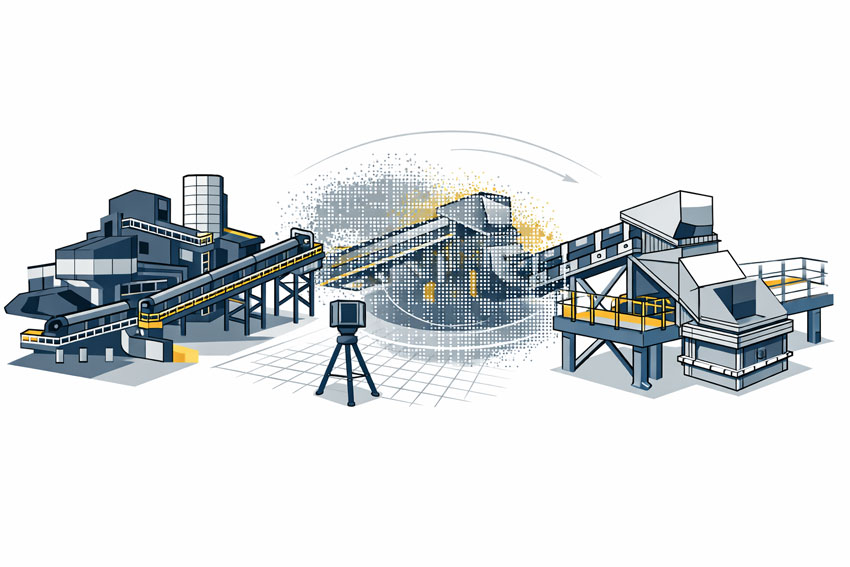
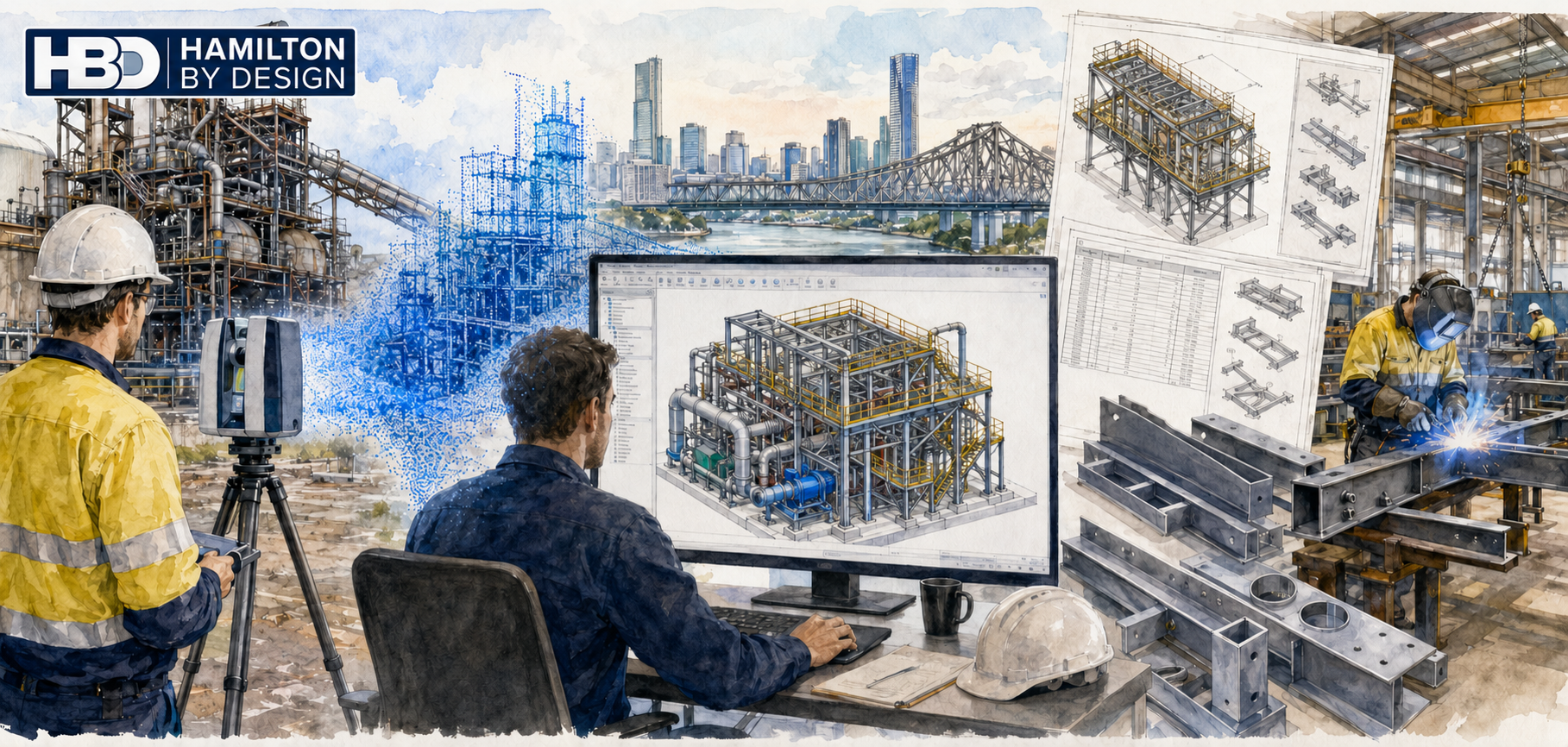
We use SolidWorks to convert site measurements, 3D LiDAR point clouds, existing drawings and physical components into practical 3D CAD models. These models support equipment modifications, reverse engineering, fabrication planning, design reviews and clash identification.
Our SolidWorks CAD services can include detailed part and assembly models, general arrangement drawings, fabrication drawings, sheet-metal components and models developed from existing-condition scan data. Deliverables may be provided in native SolidWorks formats or common exchange formats such as STEP, Parasolid, DXF and PDF.
By combining mechanical engineering experience with 3D scanning and CAD modelling, Hamilton By Design helps clients develop designs that reflect actual site conditions and are suitable for review, manufacture and installation.
Services are available throughout Sydney, Newcastle, the Hunter Valley, regional NSW and across Australia.
We support mining and mineral processing operations with engineering-grade LiDAR scanning and mechanical design for CHPPs, conveyors, transfer stations, plant upgrades, and brownfield modifications. Our experience in live operating environments helps reduce shutdown risk, rework, and costly fabrication errors.
Hamilton By Design supports mining and mineral processing operations with engineering-grade LiDAR scanning, mechanical engineering, and design support for complex, live operating environments. Our work focuses on delivering accurate existing-condition data and engineering outcomes that reduce shutdown risk, minimise rework, and support safe, efficient plant upgrades.
We work across the full project lifecycle — from early site capture and feasibility through to detailed design, fabrication support, and construction verification — with a strong emphasis on brownfield and retrofit projects where getting the geometry right is critical.
Our mining engineering services are built around a clear principle: engineering decisions must be based on accurate site data. We combine reality capture with mechanical engineering to support informed design, modification, and execution of mining projects.
These services support:
Existing asset validation
Upgrade and modification planning
Engineering design development
Risk reduction in live operating plants
By integrating scanning and engineering under one workflow, we provide mining teams with confidence that designs reflect real-world conditions.
Mining & Industrial Engineering
Mining operations rely on complex industrial systems that must perform reliably under demanding conditions. Hamilton By Design works at the interface between mining infrastructure and industrial plant systems, supporting projects where mechanical, structural, and operational requirements overlap.
Our experience includes:
Mineral processing facilities and CHPPs
Materials handling systems
Industrial plant equipment within mining sites
Brownfield integration and asset upgrades
This cross-disciplinary approach allows us to support mining clients with solutions that are practical, buildable, and aligned with operational constraints.
Mining Services
Our mining services focus on practical project delivery support. We work alongside site teams, engineers, and contractors to capture existing conditions, verify designs, and support construction and shutdown activities.
Typical services include:
Engineering-grade LiDAR and as-built capture
Existing condition verification
Design coordination support
Construction and installation validation
These services help reduce uncertainty on site and provide a reliable digital foundation for engineering and fabrication activities.
Mechanical Engineering in Mining
Mechanical engineering is central to the safe and efficient operation of mining assets. Hamilton By Design provides mechanical engineering support informed directly by site-captured data, ensuring designs are suitable for real operating environments.
Our mechanical engineering capabilities support:
Conveyors, chutes, and transfer stations
Plant upgrades and modifications
Structural and mechanical interfaces
Fabrication-ready design documentation
Where required, our work can be supported by engineering verification and analysis to provide additional confidence in design outcomes.
Engineering-Led, Fit-for-Purpose Outcomes
Hamilton By Design operates with a strong focus on:
Accuracy over assumption
Engineering accountability
Fit-first-time outcomes
Reduced risk in brownfield environments
By combining reality capture with mechanical engineering, we help mining and mineral processing clients move from uncertain existing conditions to confident engineering decisions.
If you are planning a mining or mineral processing upgrade, modification, or verification project, Hamilton By Design can support your team with engineering-grade scanning and mechanical design services tailored to live operating environments.
Engineering-led reality capture, CAD modelling, and fabrication-ready design for Queensland industry
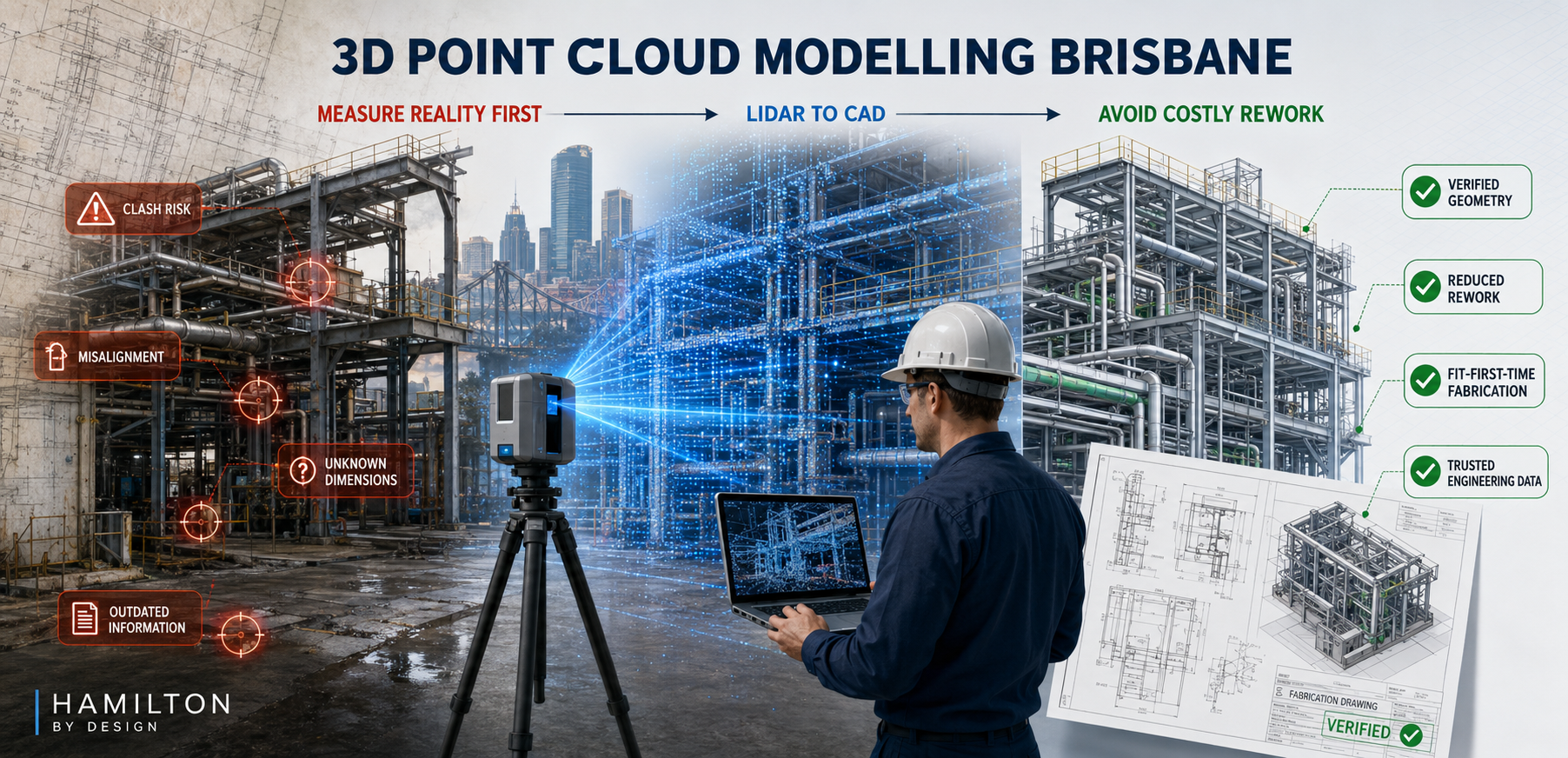
Hamilton By Design provides 3D Engineering Services in Brisbane by integrating engineering-grade reality capture, mechanical engineering, and fabrication-ready documentation into a single accountable workflow.
Our approach builds on proven internal capabilities in Reality Capture and Mechanical Engineering Services ensuring site conditions are accurately understood before design decisions are finalised and steel is cut.
Why 3D engineering services are critical for Brisbane-managed projects
Many industrial and infrastructure projects managed from Brisbane involve brownfield assets, constrained access, and remote delivery locations. In these environments, incomplete information quickly leads to design risk.
Common challenges include:
Outdated or missing as-built documentation
Unknown interfaces between new and existing assets
Limited opportunities for repeat site access
Fabrication errors identified during installation
High rework and logistics costs for regional Queensland projects
can accurately capture site geometry, true risk reduction only occurs when this data is interpreted through an engineering-led process. This is why Hamilton By Design focuses on Engineering-Grade Laser Scanning rather than survey-only or visual-only capture.
What we mean by “3D Engineering Services”
At Hamilton By Design, 3D Engineering Services represent the integration of:
Verified site reality
Mechanical engineering judgement
Fabrication-driven design intent
Point clouds are not treated as visual references. Instead, they are converted into engineering-grade CAD through our Point cloud to CAD modelling process using Solidworks CAD Modelling that reflect true as-built conditions, tolerances, and identifying interfaces.
This approach differentiates our services from marketing scans, survey deliverables without engineering accountability, and drafting workflows disconnected from site reality.
The Hamilton By Design 3D engineering workflow
Our Brisbane-based services follow a structured workflow designed to protect downstream fabrication and installation.
Captured data is reviewed and validated to ensure it is suitable for engineering interpretation rather than visualisation alone.
Point cloud to SolidWorks CAD modelling
Verified site data is translated into SolidWorks CAD models representing real-world geometry and constraints.
Engineering interpretation and validation
Models are assessed with consideration of load paths, tolerances, clearances, and installation constraints.
Fabrication-ready deliverables
Design outputs are prepared for shop-floor use via our fabrication support services</a>, including general arrangement drawings, detailed fabrication drawings, bills of materials, and digital QA models.
Core 3D engineering services delivered in Brisbane
Hamilton By Design provides:
Engineering-grade LiDAR and laser scanning
Point cloud to CAD modelling
Mechanical design and brownfield plant upgrades
Structural steel modelling and verification
Interface and clearance checks
Fabrication drawings and BOMs
Digital QA and clash detection
As-built documentation
Each service is delivered as part of an integrated engineering workflow designed to eliminate ambiguity before fabrication begins.
Brisbane as an engineering coordination hub for Queensland
Brisbane serves as a central coordination hub for industrial projects delivered across Queensland, including mining, energy, port, and regional processing facilities.
Hamilton By Design supports Brisbane-managed projects across:
Bowen Basin
Surat Basin
Gladstone
Townsville
Mount Isa
For resource-sector projects, our experience in mechanical engineering for the mining industry ensures designs remain practical, buildable, and aligned with site conditions.
Industries and assets supported
Industries
Mining and mineral processing
CHPP and bulk materials handling
Energy and utilities
Ports and logistics
Industrial manufacturing
Asset types
Conveyor systems and transfer chutes
Structural steel platforms and walkways
Pipework and mechanical assemblies
Brownfield plant upgrades
Temporary and permanent industrial structures
Our capability in structural engineering supports projects where compliance, load paths, and interfaces must be verified before fabrication.
Why Hamilton By Design
Clients engage Hamilton By Design for engineering accountability, not just technology.
Our key points of difference include:
Engineer-led scanning workflows
Single point of responsibility from scan to drawings
Mechanical-engineering-driven modelling
Fabrication-first mindset
Alignment with Australian engineering standards
Practical understanding of site and installation constraints
Our broader engineering services are designed to reduce rework, improve confidence, and protect project budgets.
Discuss a Brisbane-managed project
If you are managing an industrial or infrastructure project from Brisbane and require engineering-grade 3D data to support design, fabrication, or upgrade works, Hamilton By Design can assist.
Early engagement ensures site reality is embedded into the engineering process—reducing risk and improving project certainty.
Modern engineering, fabrication, and asset upgrades increasingly rely on 3D point cloud data as the foundation for design decisions. However, not all “3D scans” produce data that is suitable for engineering-grade modelling.
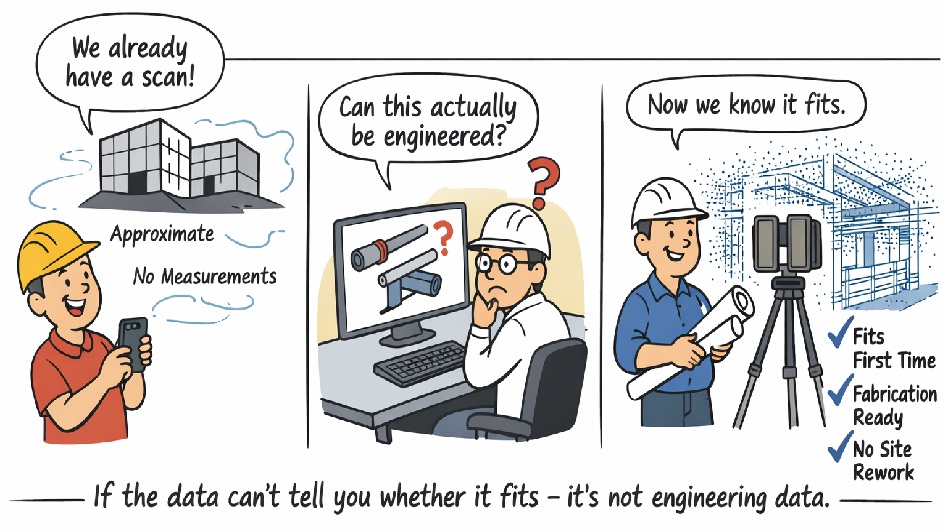
At Hamilton By Design, we regularly encounter projects where scanning has already been undertaken, yet the data cannot be safely relied upon for structural checks, fabrication drawings, or fit-first-time installation. The reason is simple: many common scanning technologies do not generate a true, measurable 3D point cloud.
What Is a True Engineering 3D Point Cloud?
A true 3D point cloud consists of millions of directly measured XYZ coordinates, captured using survey-grade LiDAR technology. Each point represents a real, measured position in space, with known accuracy and traceable error.
This level of data is essential when:
Steelwork must fit without site modification
Pipe spools are fabricated off-site
Structural members must be verified
Clearances and clashes carry cost or safety risk
Visual models, meshes, or approximated surfaces may look correct, but without direct distance measurement and accuracy control, they cannot be relied upon for engineering.
Not All “3D Scans” Produce a Usable Point Cloud
The table below compares common capture methods against engineering-grade LiDAR scanning.
Engineering Data Comparison – 3D Capture Technologies
Criteria
Phone / App Scan
Photo-grammetry
Real-Estate / Visual Scanners
Engineering LiDAR (Hamilton By Design)
Direct distance measurement
❌ No
❌ No
⚠️ Limited
✅ Yes (time-of-flight)
True 3D point cloud output
⚠️ Low-density
❌ No (mesh only)
⚠️ Filtered
✅ Raw XYZ data
Global accuracy control
❌ None
❌ None
❌ None
✅ Survey-controlled
Typical usable accuracy
±20–50 mm
±10–30 mm
±10–20 mm
±1–2 mm
Consistent point density
❌ No
❌ No
❌ No
✅ Yes
Steel & reflective surfaces
❌ Poor
❌ Poor
⚠️ Limited
✅ Yes
Pipework & beam definition
❌ No
⚠️ Limited
❌ No
✅ Yes
Large industrial site capture
❌ No
⚠️ Limited
❌ No
✅ Yes
Registration error reporting
❌ No
❌ No
❌ No
✅ Yes
Suitable for fabrication drawings
❌ No
❌ No
❌ No
✅ Yes
Suitable for structural checks / FEA
❌ No
❌ No
❌ No
✅ Yes
Fit-first-time confidence
❌ No
❌ No
❌ No
✅ Yes
Why This Matters for Brisbane Projects
In Brisbane and across South-East Queensland, many projects involve:
Industrial plant upgrades
Infrastructure retrofits
Fabrication undertaken off-site
Tight shutdown windows
In these environments, millimetres matter. If a beam, pipe, or support cannot be accurately defined in the model, the risk of rework, delays, and site modification increases significantly.
Put simply:
If the data cannot reliably tell you whether something fits, clears, or carries load, it is not suitable for engineering.
Engineer-Led Point Cloud Modelling
Hamilton By Design uses engineering-grade terrestrial LiDAR scanners and an engineer-led workflow to ensure point cloud data is suitable for:
SolidWorks 3D modelling
Fabrication-ready drawings
Structural verification
Clash detection and layout validation
By controlling both data capture and modelling, we maintain single-source accountability — reducing risk and ensuring the model reflects reality.
From Scan to Shop Floor — Done Right
3D point cloud modelling is not about creating a visually impressive model. It is about creating a reliable digital representation of reality that engineers, fabricators, and contractors can trust.
If you are planning a project in Brisbane and need point cloud data that supports real engineering decisions, speak with Hamilton By Design before relying on consumer or visual-only scanning methods.
Wyong sits at the centre of the NSW Central Coast’s industrial, infrastructure, and manufacturing activity. With a mix of legacy assets, live industrial facilities, and expanding development corridors, projects in the region often require accurate, defensible knowledge of existing site conditions before design, fabrication, or construction can proceed.
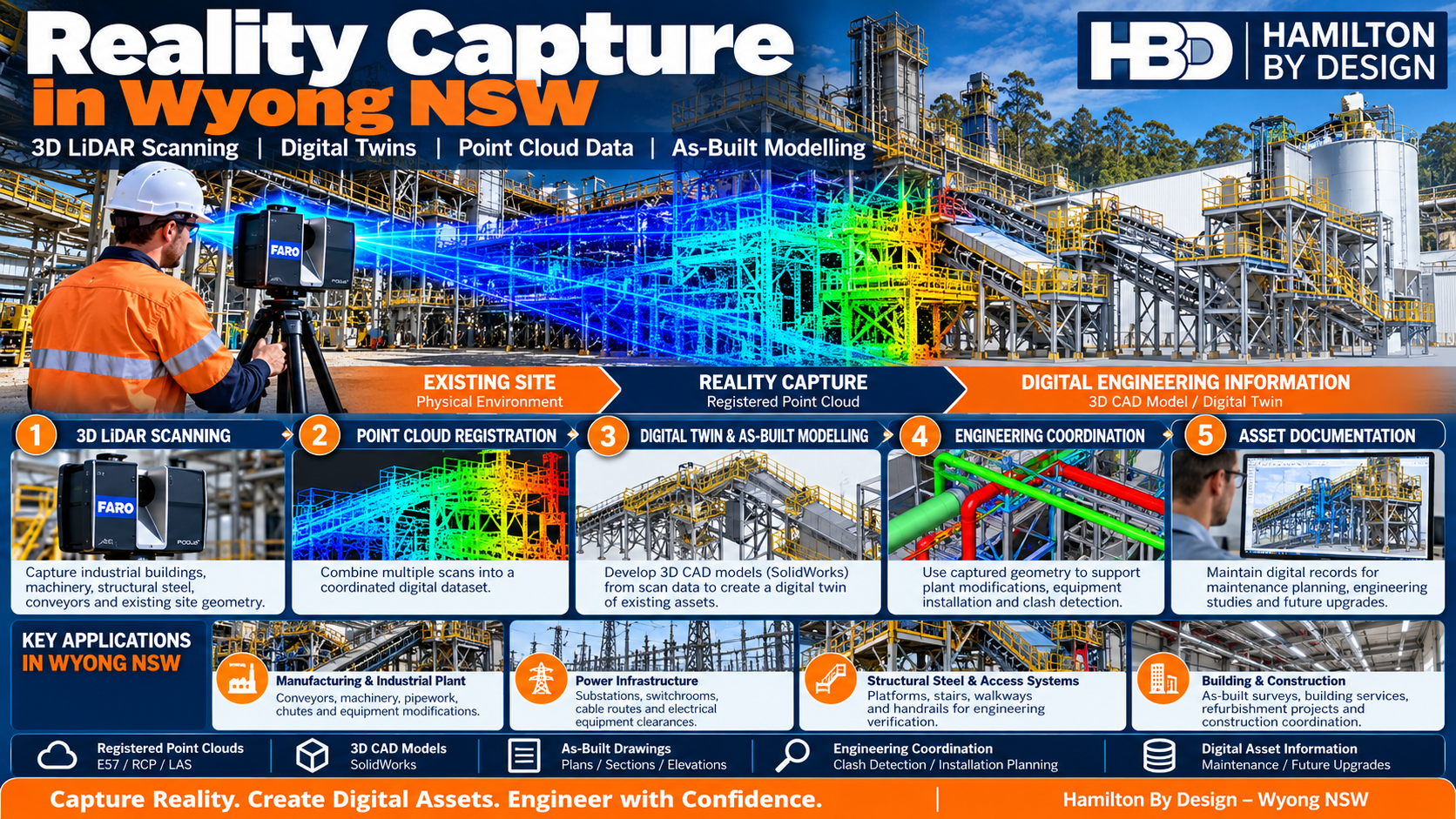
Reality capture in Wyong provides a structured approach to documenting real-world conditions using measured data rather than assumptions. At Hamilton By Design, reality capture is integrated into an engineering-led workflow—ensuring the information collected on site can be reliably used for design coordination, retrofit planning, and downstream documentation.
What reality capture means for Wyong projects
Reality capture refers to the process of recording existing conditions using spatially accurate methods and translating that data into engineering-usable outputs. In practice, this includes:
Engineering-grade laser scanning and LiDAR capture
Controlled registration and validation of spatial data
Interpretation of site geometry in the context of mechanical and structural design
Conversion of captured data into drawings, models, and reference documents
Rather than treating capture as a visual exercise, the emphasis is on measured accuracy, traceability, and fitness for purpose.
Why reality capture is critical in Wyong and the Central Coast
Projects across Wyong and the broader Central Coast commonly involve:
Brownfield industrial upgrades
Plant modifications within operational facilities
Interface works between new and existing infrastructure
Fabrication occurring off-site with limited tolerance for error
Incomplete or outdated as-built documentation
In these environments, traditional measurement methods often fail to provide sufficient confidence. Reality capture reduces this risk by creating a single, verifiable representation of site conditions that can be referenced throughout the project lifecycle.
Typical reality capture applications in Wyong
1. Existing-condition documentation
Reality capture establishes a measured baseline where drawings are missing, inconsistent, or no longer representative of site conditions. This is particularly valuable for long-standing industrial facilities across Wyong and the surrounding region.
2. Retrofit and upgrade planning
Captured data supports the design of upgrades that must integrate precisely with existing structures, equipment, and services—reducing the likelihood of clashes or rework.
3. Fabrication and installation coordination
When fabrication is undertaken away from site, accurate geometry is essential. Reality capture helps ensure fabricated components align correctly once delivered and installed.
4. Risk reduction and project certainty
By replacing assumptions with measured data, reality capture improves decision-making, reduces uncertainty, and supports more reliable cost and schedule outcomes.
Hamilton By Design applies reality capture as part of an integrated engineering process rather than a standalone service.
Project-led scoping
Each capture scope is defined by how the data will be used—whether for design, drafting, verification, or coordination. Accuracy requirements, areas of interest, and deliverables are established upfront.
Field data acquisition
Capture activities are planned to minimise occlusions, maintain consistency, and achieve the level of detail required for engineering interpretation.
Validation and preparation
Spatial datasets are reviewed and structured to ensure they are suitable for downstream use, avoiding the common issue of high-volume data with limited engineering value.
Engineering-ready outputs
Where required, captured data is translated into:
As-built drawings
General arrangement layouts
Reference models for coordination
Documentation suitable for design development and approvals
This approach aligns reality capture outputs with real project decisions rather than producing isolated datasets.
Relationship to laser scanning services
Reality capture in Wyong often incorporates laser scanning and LiDAR technologies; however, the distinction lies in how the data is applied. Laser scanning is the tool—reality capture is the methodology that ensures the data is usable, traceable, and relevant to engineering outcomes.
Reality capture delivers value across multiple stakeholder groups:
Owners and operators gain confidence in upgrade feasibility
Engineers work from reliable existing-condition data
Fabricators receive clearer interfaces and reduced rework risk
Project teams benefit from fewer site disruptions and variations
From an academic perspective, this represents an improvement in information quality and decision reliability—both critical contributors to successful project delivery.
Reality capture as part of regional engineering capability
Wyong’s role as a Central Coast engineering hub makes it an ideal location for engineering-led reality capture services. The ability to capture, interpret, and apply site data locally supports faster turnaround and better alignment between site conditions and engineering intent.
Engineering-Grade Laser Scanning, Modelling & Design for the Top End
Darwin presents a unique engineering environment. Remote logistics, extreme climate conditions, cyclone exposure, corrosive coastal air and a heavy concentration of defence, port, energy and industrial assets mean that engineering work in the Top End demands accuracy from day one.
Hamilton By Design provides engineering-led 3D laser scanning services in Darwin, supporting projects where traditional measurement methods fall short. By combining high-accuracy LiDAR scanning with mechanical engineering, structural design and fabrication-ready documentation, we help Darwin-based projects move from concept to construction with confidence.
This page outlines the types of projects in Darwin that benefit most from 3D scanning, and how Hamilton By Design supports those projects with a complete scan-to-engineering workflow.
Why 3D Scanning Matters in Darwin
Many Darwin projects share common challenges:
Limited or unreliable as-built drawings
Assets modified repeatedly over decades
Restricted site access and tight shutdown windows
High cost of rework due to remoteness
Structural deformation from heat, corrosion and cyclonic loading
3D laser scanning addresses these issues by creating a high-fidelity digital record of existing conditions, allowing engineering decisions to be made using reality-based data rather than assumptions.
Hamilton By Design delivers engineer-led scanning, meaning the data captured on site is purpose-driven for mechanical design, structural verification and fabrication — not just visualisation.
Defence & Federal Infrastructure Projects in Darwin
Darwin is a critical defence hub, hosting permanent and rotating military assets, training facilities and secure infrastructure.
Typical Defence Projects
Building upgrades and refurbishments
Mechanical and services retrofits
Structural strengthening works
New plant and equipment installations within existing facilities
How 3D Scanning Supports Defence Projects
Accurate capture of ageing buildings with no reliable drawings
Reduced time on secure sites
Precise modelling of existing services and structures
Improved coordination between disciplines
3D scanning allows defence projects to progress with minimal disruption, fewer site visits and reduced security exposure, while still achieving high engineering accuracy.
Ports, Marine & Coastal Infrastructure
Darwin Port supports bulk materials, defence logistics, LNG export and general shipping. Marine environments are unforgiving, and many port assets have experienced decades of corrosion, deformation and incremental modification.
Typical Port & Marine Projects
Wharf upgrades and extensions
Conveyor and bulk handling modifications
Structural remediation and strengthening
Mechanical plant replacements
Value of 3D Scanning
Captures true geometry of deformed steelwork
Enables fabrication-ready design without repeated site measurement
Reduces risk of misalignment during installation
For marine and port works, scan-to-CAD modelling ensures fabricated components fit first time — critical in tide-affected, high-cost construction environments.
Oil, Gas & Energy Facilities
Darwin’s proximity to offshore resources and export infrastructure makes it a key energy hub, including LNG processing, fuel storage and power generation assets.
Typical Energy Projects
Brownfield plant modifications
Pipework rerouting and tie-ins
Skid and modular equipment installation
Structural verification of existing frames
Why 3D Scanning Is Essential
Highly congested plant environments
Shutdowns measured in hours, not weeks
Zero tolerance for clashes or rework
Hamilton By Design supports energy projects by capturing engineering-grade point clouds, developing accurate 3D models and producing documentation suitable for fabrication and installation planning.
Mining, Quarrying & Bulk Materials Projects
Across the Northern Territory, mining and quarrying operations rely on reliable materials handling infrastructure operating in harsh conditions.
Typical Mining & Quarry Projects
Crushing and screening plant upgrades
Conveyor replacements and extensions
Chute redesigns
Structural strengthening and fatigue mitigation
3D Scanning Benefits
Enables off-site design with minimal return visits
Captures heavily modified plant accurately
Supports safer, faster project delivery
For remote mining operations, 3D scanning dramatically reduces project risk by allowing engineering, design and detailing to occur away from site.
Cyclone Remediation & Asset Hardening
Darwin’s built environment is heavily influenced by cyclone design requirements, with assets frequently assessed and upgraded to meet evolving standards.
Typical Cyclone-Related Projects
Post-cyclone damage assessment
Structural strengthening works
Roof, façade and services upgrades
Compliance and certification projects
How 3D Scanning Helps
Rapid capture of damaged structures
Safer data collection compared to manual access
Enables deformation and alignment analysis
3D scanning creates a baseline digital record that supports engineering assessment, insurance reporting and compliance documentation.
Water, Sewer & Utilities Infrastructure
Water treatment plants, pump stations and utilities infrastructure in Darwin often operate continuously and in confined or congested environments.
Typical Utilities Projects
Pump station upgrades
Water treatment plant modifications
Pipework replacement and rerouting
Structural audits and asset life extension
Value Delivered by 3D Scanning
Accurate mapping of existing plant layouts
Reduced excavation and clash risk
Improved coordination between contractors and consultants
Scanning supports safer, more efficient upgrades to essential services without unnecessary shutdowns.
Commercial, Industrial & Government Buildings
Darwin includes a mix of older public buildings and newer commercial developments, many requiring refurbishment or adaptive reuse.
Typical Building Projects
Mechanical and HVAC upgrades
Structural assessments
Refurbishments and compliance upgrades
Fit-outs within existing structures
3D Scanning Outcomes
Accurate architectural and structural models
Improved coordination of services
Reduced variations during construction
In buildings where nothing is square, level or documented, scan-to-model workflows significantly improve project certainty.
How Hamilton By Design Delivers 3D Scanning in Darwin
Hamilton By Design does more than collect point clouds. Our workflow is designed around engineering outcomes.
Our Typical Process
On-site 3D laser scanning using survey-grade equipment
Point cloud registration and quality assurance
Engineering-focused modelling aligned to project scope
Delivery of drawings, models and data suitable for construction
This approach ensures that scanning data transitions seamlessly into engineering design, documentation and fabrication.
Integrated Engineering & Scanning Services
Darwin clients benefit most when scanning is combined with engineering expertise. Hamilton By Design offers a fully integrated service, including:
These services allow Darwin projects to move from existing conditions → engineered design → fabrication-ready documentation under one accountable workflow.
Why Choose Hamilton By Design for 3D Scanning in Darwin
Engineer-led scanning, not survey-only capture
Experience with brownfield and remote projects
Focus on fit-first-time fabrication outcomes
Reduced site visits and rework
Data you can design and build from
We understand the realities of working in the Top End and tailor our services to suit Darwin’s operational, environmental and logistical constraints.
3D Scanning Darwin – Built for Real Projects
Whether you are upgrading defence infrastructure, modifying a live plant, strengthening cyclone-exposed assets or planning a remote mining upgrade, 3D scanning provides the certainty required to design and build with confidence.
Hamilton By Design supports Darwin projects with practical, engineering-focused digital capture that reduces risk, improves coordination and delivers real value on site.
If you’re planning a project in Darwin or the Northern Territory, 3D scanning is not just an optional extra — it’s the foundation for getting it right the first time.
In complex engineering environments, success is rarely determined by a single calculation or drawing. It is determined by clarity—clarity of information, clarity of intent, and clarity across every handover point between site, engineer, fabricator, and installer.
Hamilton By Design was created around this idea.
Across mining, heavy industry, infrastructure, and complex buildings, projects increasingly fail not because engineers lack capability, but because teams are working from incomplete, inconsistent, or unreliable information. Assumptions creep in. Measurements are approximated. Old drawings are trusted when they should not be. By the time fabrication or installation begins, risk has already been locked into the project.
Hamilton By Design approaches engineering differently. By combining engineer-led 3D laser scanning, SolidWorks-based mechanical design, and clear, practical data sharing, we reduce uncertainty at the very start of a project—and that single shift changes everything that follows.
Engineering begins with reality, not assumptions
Every project starts with an existing environment. Whether it is a CHPP in the Bowen Basin, a brownfield processing plant, a congested industrial building, or a live infrastructure asset, the reality on site is often more complex than any drawing suggests.
Hamilton By Design begins with capturing reality as it actually exists.
Using high-accuracy 3D laser scanning, site conditions are recorded in full context: structure, equipment, services, clearances, and access constraints. This is not about producing pretty visuals—it is about creating a measurable, defensible digital reference that engineers can trust.
Unlike traditional measurement methods, laser scanning:
Captures millions of data points per second
Records geometry that is difficult or unsafe to measure manually
Preserves site information long after access windows close
Eliminates reliance on assumptions and partial measurements
For engineering teams, this changes the starting point of the project from “what we think is there” to “what we know is there.”
Why the FARO Focus S70 fits Hamilton By Design’s workflow
4
Hamilton By Design uses the FARO Focus S70 laser scanner because it strikes the right balance between accuracy, portability, and ease of use—qualities that matter in live industrial environments.
The Focus S70 is particularly well suited to:
Brownfield industrial sites
Mining and materials-handling plants
Buildings with tight access or active operations
Remote locations where speed and reliability matter
From a practical engineering perspective, its ease of deployment is critical. Scans can be completed quickly, often without disrupting operations, and without the need for complex setup or prolonged site occupation. This means:
Shorter site visits
Reduced exposure to operational risk
More flexibility around shutdown or access windows
Just as importantly, the data produced is clean, consistent, and immediately usable within downstream engineering workflows.
At Hamilton By Design, scanning is not outsourced or treated as a separate discipline. The same engineers who design the solution are involved in planning the scan, understanding what information matters, and verifying that the captured data is fit for purpose.
This engineer-led approach is one of the quiet but critical advantages that underpins project success.
Turning point clouds into engineering intelligence
Raw point clouds are powerful—but only if they are translated into meaningful engineering information.
This is where Hamilton By Design’s use of SolidWorks becomes central to our workflow.
SolidWorks provides a flexible, parametric modelling environment that allows scanned data to be transformed into:
Accurate 3D mechanical models
Structural steel frameworks
Equipment layouts
Platforms, guards, chutes, and pipework
Assemblies designed specifically for fabrication and installation
By importing and referencing point clouds directly within SolidWorks, engineers are no longer designing in isolation. Every model is built in context, anchored to the real geometry of the site.
This approach delivers several key advantages:
Components fit the first time
Clearances are verified early
Interfaces with existing assets are fully understood
Installation sequencing can be considered during design
Rather than working around uncertainty, engineers are free to focus on optimisation, constructability, and safety.
SolidWorks as a collaboration platform, not just a design tool
One of the most underestimated strengths of SolidWorks is how well it supports collaboration and communication across project teams.
At Hamilton By Design, SolidWorks models are not treated as internal artefacts. They are shared, reviewed, and used as communication tools.
Through native files, neutral formats, and lightweight viewing options:
Fabricators can interrogate geometry before cutting steel
Site teams can visualise assemblies before installation
Clients can understand scope and interfaces without reading complex drawings
Engineers can identify risks long before they appear on site
This transparency dramatically reduces misinterpretation. When everyone is looking at the same model—derived from the same scan—alignment improves naturally.
The result is fewer RFIs, fewer site surprises, and a smoother transition from design to construction.
Fabrication-ready outcomes, not theoretical models
Hamilton By Design places a strong emphasis on fabrication-ready deliverables.
Because models are developed with manufacturing in mind, downstream drawings are clearer, more consistent, and easier to build from. This includes:
Clear general arrangement drawings
Detailed part and assembly drawings
Logical BOMs aligned to procurement
Realistic tolerances based on site conditions
Fabricators appreciate drawings that reflect how things are actually built—not just how they look on screen. By grounding design in scan data and modelling within SolidWorks, Hamilton By Design produces outputs that align closely with workshop reality.
This reduces rework in the shop and stress during shutdowns, where time pressure is highest.
Technology alone does not deliver project success. The real differentiator is how information is shared.
Hamilton By Design places significant emphasis on making data:
Accessible
Understandable
Reusable
Point clouds, models, drawings, and supporting data are structured so they can be:
Revisited for future projects
Used by different stakeholders
Built upon rather than recreated
This is particularly valuable in long-life industrial assets, where today’s modification becomes tomorrow’s interface.
By maintaining continuity of data across projects, clients build a digital asset—not just a set of drawings. Over time, this reduces engineering cost, shortens project timelines, and increases confidence in future upgrades.
Ease of use drives adoption and value
One of the reasons the FARO Focus S70 and SolidWorks work so well together is their ease of use relative to the value they deliver.
Ease of use matters because:
It shortens learning curves
It reduces reliance on niche specialists
It allows engineers to stay focused on engineering, not software complexity
At Hamilton By Design, tools are selected not because they are fashionable, but because they support repeatable, reliable outcomes.
Scanning workflows are streamlined. Modelling practices are consistent. File structures are logical. This discipline ensures that projects scale smoothly, whether they involve a small retrofit or a major plant upgrade.
Reducing risk where it matters most
In industrial and mining projects, risk concentrates at interfaces:
New steel to old steel
New equipment to existing plant
Design intent to site execution
Hamilton By Design’s integrated workflow reduces risk at these interfaces by ensuring:
Geometry is verified early
Interfaces are modelled, not guessed
Decisions are made with full context
This approach shifts risk out of the shutdown window and into the design phase—where it is cheaper and safer to manage.
A philosophy built around accountability
What truly differentiates Hamilton By Design is not just technology, but ownership.
The same team is responsible for:
Capturing site data
Interpreting it
Designing the solution
Producing fabrication-ready outputs
There is no fragmentation between disciplines, no handover gaps where responsibility becomes unclear. This single-source accountability builds trust with clients, fabricators, and site teams alike.
The compound effect of doing it right
When accurate data, SolidWorks-based design, and clear information sharing come together, the benefits compound:
Fewer site visits
Shorter design cycles
More confident fabrication
Smoother installations
Better long-term asset knowledge
Over time, this approach changes how projects are delivered. Engineering becomes proactive rather than reactive. Problems are solved digitally instead of on site. Teams collaborate instead of firefighting.
Engineering for real-world success
Hamilton By Design’s workflow is not built around theory. It is built around what actually happens on site.
By grounding every project in reality through laser scanning, translating that reality into SolidWorks models, and sharing information clearly across all stakeholders, Hamilton By Design helps projects succeed where it matters most: in fabrication shops, during shutdowns, and on live sites.
In an industry where uncertainty is expensive and time is unforgiving, clarity becomes the most valuable engineering output of all.
That is the philosophy behind Hamilton By Design—and the reason our approach continues to deliver consistent, practical success across complex engineering projects.
To provide the best experiences, we use technologies like cookies to store and/or access device information. Consenting to these technologies will allow us to process data such as browsing behaviour or unique IDs on this site. Not consenting or withdrawing consent, may adversely affect certain features and functions.
Functional
Always active
The technical storage or access is strictly necessary for the legitimate purpose of enabling the use of a specific service explicitly requested by the subscriber or user, or for the sole purpose of carrying out the transmission of a communication over an electronic communications network.
Preferences
The technical storage or access is necessary for the legitimate purpose of storing preferences that are not requested by the subscriber or user.
Statistics
The technical storage or access that is used exclusively for statistical purposes.The technical storage or access that is used exclusively for anonymous statistical purposes. Without a subpoena, voluntary compliance on the part of your Internet Service Provider, or additional records from a third party, information stored or retrieved for this purpose alone cannot usually be used to identify you.
Marketing
The technical storage or access is required to create user profiles to send advertising, or to track the user on a website or across several websites for similar marketing purposes.