Mechanical Engineering Services for Plant and Production Problems โ€” Sydney

Engineer-led reverse engineering with 3D scanning and drafting overlooking Sydney Harbour and the Harbour Bridge

Mechanical Engineering Services for Plant and Production Issues | Sydney

Practical engineering solutions when production issues, equipment failures, and compliance risks are impacting your business.

When production stops, costs rise quickly. Many operational problems arenโ€™t caused by staff or maintenance โ€” theyโ€™re caused by systems that are no longer fit for purpose. Whether your plant has grown, equipment has changed, or suppliers are no longer available, mechanical engineering support can help restore performance and reduce ongoing risk.

We provide engineering-led problem solving for operating facilities, focused on practical, buildable solutions that keep your business moving.
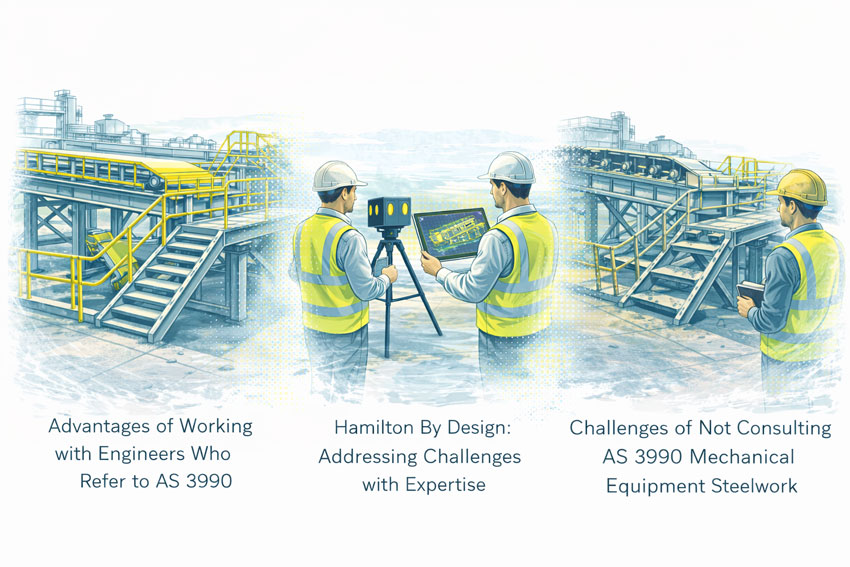

Engineers using LiDAR scanning and digital models to address challenges caused by not consulting AS 3990 mechanical equipment steelwork standards

When Businesses Typically Call a Mechanical Engineer

Most clients contact us when something critical is no longer working as it should โ€” not when everything is running smoothly.

Common triggers include:

  • Production line keeps jamming or backing up
  • Conveyor upgrades are needed to increase throughput
  • Plant layout no longer supports current operations
  • Original equipment supplier is no longer available
  • Compliance issues have been identified during audits or inspections

In these situations, quick fixes often fail because the underlying system was never designed for todayโ€™s operating conditions.


Production Line Keeps Jamming

If bottlenecks, product damage, or stoppages are becoming routine, the problem is often mechanical and systemic โ€” not operator error.

Engineering support can help by:

  • Identifying root causes of flow restrictions
  • Redesigning transfer points and interfaces
  • Improving guarding, access and maintenance zones
  • Reconfiguring equipment layout for smoother material movement

The goal is to improve reliability, not just reset alarms.


Conveyor Upgrade or Replacement Required

Conveyors are often the backbone of production and logistics systems. When capacity increases or materials change, existing conveyors may no longer perform as required.

Mechanical engineering services can support:

  • Conveyor capacity upgrades
  • Drive and structural modifications
  • Transfer chute redesign
  • Integration of new equipment into existing lines

Upgrades can often be achieved without full system replacement when engineered correctly.


Plant Layout No Longer Works

As facilities expand and processes change, original layouts can become inefficient or unsafe.

Engineering reviews can identify opportunities to:

  • Improve workflow and access
  • Reduce unnecessary material handling
  • Improve maintenance clearances
  • Support future equipment additions

Well-planned layout changes reduce downtime, improve safety, and increase operational flexibility.


Equipment Supplier Is No Longer Available

When OEMs stop supporting equipment or close operations, businesses are often left with:

  • No spare parts supply
  • No engineering documentation
  • No upgrade pathway

Mechanical engineers can reverse-engineer components, redesign systems, and develop replacement solutions that integrate with existing plant โ€” often improving performance at the same time.


Compliance Issues Raised

Compliance notices, insurance requirements, or safety audits can quickly become business-critical.

Engineering services can support:

  • Mechanical and structural assessments
  • Design of compliant modifications
  • Certification documentation where required
  • Implementation planning to minimise downtime

Addressing compliance early reduces operational and legal risk.


What We Provide

Our mechanical engineering services typically include:

  • Site assessments and problem diagnosis
  • Concept and detailed design solutions
  • Engineering drawings and documentation
  • Support for fabrication and installation
  • Design verification and compliance support

Where required, engineering services can be supported by 3D laser scanning and as-built modelling to ensure new designs fit accurately into existing facilities.


Why Use an Engineering Consultant Instead of Labour Hire

Labour hire provides people. Engineering consultants provide solutions and accountability.

Using an engineering service means:

  • Problems are diagnosed, not just worked around
  • Designs are developed and documented
  • Risk is managed through professional responsibility
  • Solutions are built to last, not patched temporarily

This approach reduces repeat failures and long-term maintenance costs.


Hamilton By Design logo displayed on a blue tilted rectangle with a grey gradient background

3D LiDAR scanning and 3D modelling service button โ€” laser scanner capturing a point cloud for engineering and CAD modelling
Mechanical engineering services

Supporting Businesses Across Sydney

We support manufacturing, processing, logistics, and industrial facilities across Sydney and surrounding regions, providing responsive engineering services for operating environments where downtime and rework are costly.

Whether the issue is urgent or part of a planned upgrade, engineering support can help stabilise operations and support future growth.


Talk to an Engineer About Your Plant Issues

If production problems, equipment limitations, or compliance risks are affecting your operation, early engineering input can prevent escalation into major shutdowns or capital replacements.

Contact us to discuss your facility and weโ€™ll help identify practical next steps.

Name
Would you like us to arrange a phone consultation for you?
Address

Related Sydney Services

Hamilton By Design provides engineering-led 3D scanning, LiDAR scanning, mechanical engineering and digital engineering services throughout Sydney and Greater Sydney.

Explore our related Sydney services:


  • 3D Scanning Sydney โ€“ Engineering-grade terrestrial laser scanning, as-built surveys and point cloud capture for industrial, infrastructure and commercial projects.
  • Reality Capture Sydney โ€“ High-accuracy reality capture, digital twins, asset documentation and engineering-grade site verification.
  • Scan to CAD Sydney โ€“ Convert point cloud data into AutoCAD, SolidWorks, Inventor and other engineering-ready CAD deliverables.
  • Point Cloud Modelling Sydney โ€“ Engineering-grade point cloud processing, clash detection, as-built verification and 3D modelling.
  • Mechanical Engineering Sydney โ€“ Mechanical design, plant upgrades, materials handling systems, conveyors, chutes, platforms and engineering support.
  • Structural Drafting Sydney โ€“ Structural steel drafting, fabrication drawings, GA drawings, workshop detailing and as-built documentation.

Hamilton By Design supports projects throughout Sydney CBD, Parramatta, Liverpool, Penrith, Blacktown, Chatswood, Alexandria, Mascot, Newcastle and the Central Coast.

Blue banner graphic displaying the text "Point Cloud to CAD - Australia" in large white lettering, representing point cloud processing, scan-to-CAD conversion and digital engineering services across Australia.
Blue banner graphic displaying the text "Scan to CAD Sydney" in large white lettering, representing engineering-led point cloud to CAD conversion, LiDAR scanning and digital engineering services in Sydney.
Blue banner graphic displaying the text "Reality Capture Sydney - CBD" in large white lettering, representing engineering-led reality capture, LiDAR scanning and digital engineering services within Sydney CBD commercial buildings and infrastructure.

Lessons from a Landmark Case:

The Importance of Robust Structural Design Review

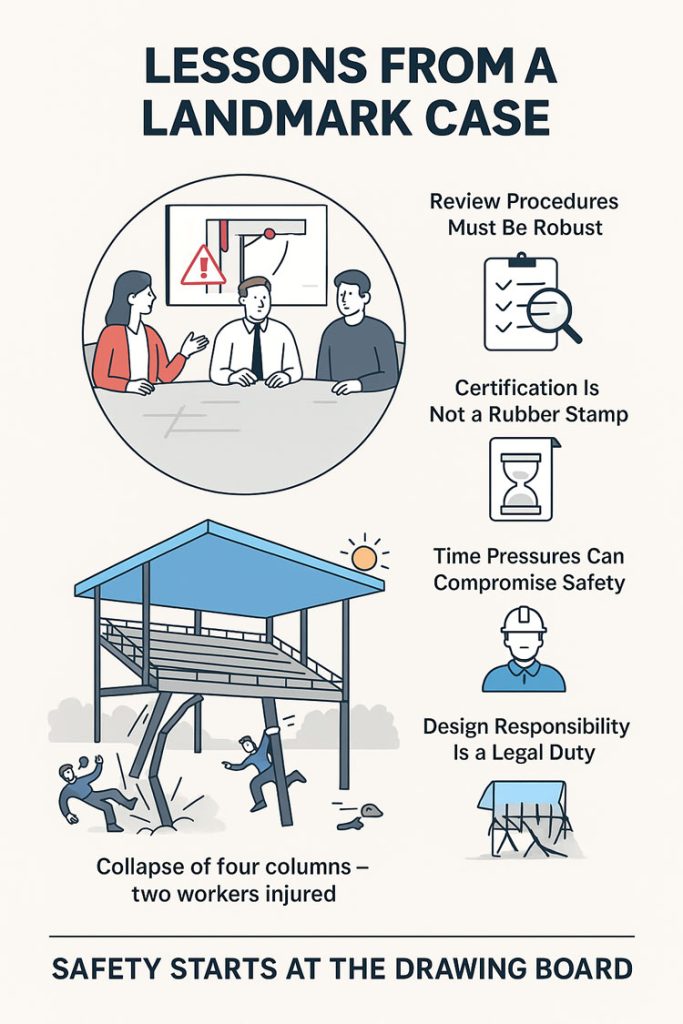
In 2024, SafeWork SA concluded a landmark case involving a spectator-roof collapse during a football club redevelopment project in South Australia. While no life-threatening injuries occurred, the incident highlighted how critical it is for design, review, and certification processes to work together to ensure safety on site.

This was the first successful design-related prosecution under South Australiaโ€™s Work Health and Safety Act, sending a clear signal to the engineering and construction sector: design decisions carry legal and safety obligations, not just technical ones.

Infographic titled โ€œLessons from a Landmark Case,โ€ showing engineers reviewing a design, icons highlighting robust review procedures, proper certification, time-pressure risks, and legal design responsibilities. The lower illustration depicts a structure collapsing after four column failures with two workers falling, emphasising the message โ€œSafety starts at the drawing board

What Happened (Briefly)

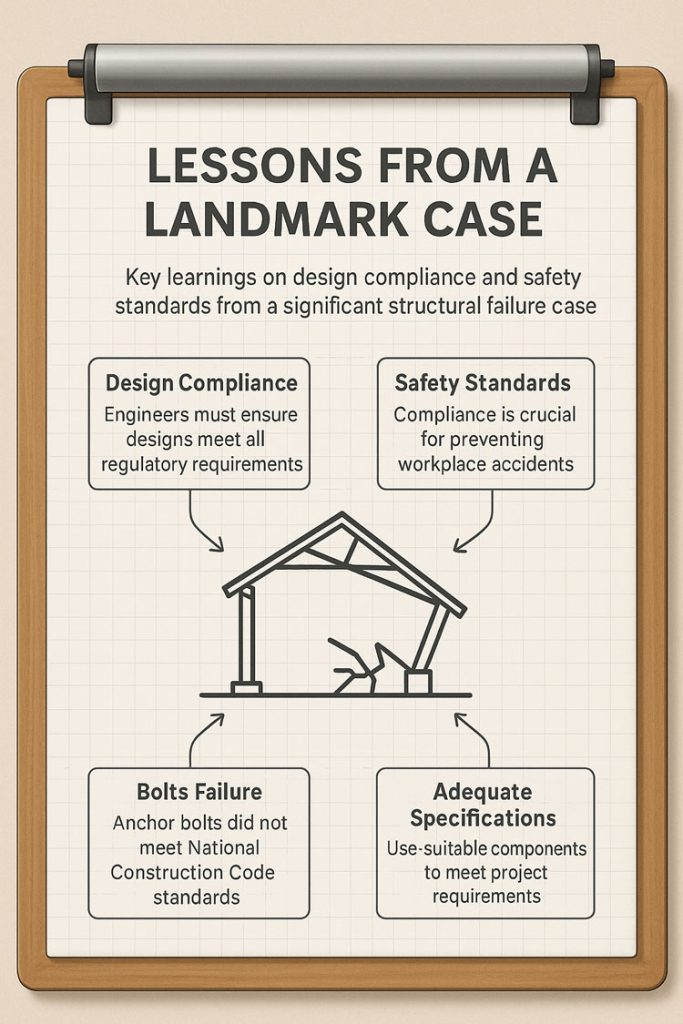
During roof sheeting works in late 2021, four of seven supporting columns of a cantilevered spectator roof failed, causing two apprentices to slide down the roof sheets. SafeWork SAโ€™s investigation found that the anchor bolts specified for the column base plates were inadequate and did not meet the requirements of the National Construction Code (NCC).

An independent compliance review also failed to detect this issue, allowing the error to pass unchecked into construction. The result was a collapse that could have had far more severe consequences had the roof been fully loaded or occupied.

Key Learnings for the Industry

This case underscores several important lessons for engineers, designers, project managers, and certifiers:

1. Design Responsibility Is a WHS Duty

Under the WHS Act, designers have a duty to ensure their work is safe not just in its intended use, but during construction. This means bolts, connections, and base plates must be designed for real-world loads โ€” including wind uplift, combined shear and tension, and concrete breakout limits per NCC and relevant Australian Standards.

2. Review Procedures Must Be Robust โ€” and Followed

Having a documented review procedure is not enough if it isnโ€™t rigorously applied. Independent verification and internal peer review are critical to catching design errors before they reach site.

3. Certification Is Not a Rubber Stamp

Independent certifiers play a key role in safeguarding public safety. They must actively verify that designs meet compliance, rather than simply sign off on documentation.

4. Time Pressures Can Compromise Safety

Compressed project timelines were noted as a factor in missed opportunities to catch the error. Project teams must resist the temptation to shortcut review steps when schedules are tight โ€” safety must remain non-negotiable.

5. Documentation & Traceability Protect Everyone

Maintaining calculation records, checklists, and review signoffs creates a clear audit trail. This helps demonstrate due diligence if something goes wrong.

Infographic titled โ€˜Lessons From a Landmark Caseโ€™ displayed on a clipboard. It highlights key learnings from a structural failure case: design compliance, safety standards, bolts failure, and adequate specifications. At the centre is a simple line drawing of a collapsed structure, with arrows pointing to four labelled boxes describing the importance of regulatory compliance, workplace safety standards, anchor bolt failures, and using suitable components to meet project requirements

Why This Matters

The collapse at Angaston Football Club was a relatively small incident with minor injuries โ€” but it could easily have been catastrophic. By learning from cases like this, the industry can improve its processes and prevent future failures.

As professionals, our role is to design for safety, verify rigorously, and document clearly. Doing so protects workers, end-users, and our own organisations.

Legal & Ethical Considerations

This post is intended as a learning resource, not as an allocation of blame. The case referenced is a matter of public record through SafeWork SA and SAET decisions, and all commentary here focuses on general principles of safe design and compliance.

We recommend that other practitioners review their own QA and certification procedures in light of this case to ensure compliance with the National Construction Code and WHS obligations.

More Information —> The Advertiser / Adelaide Now

Hamilton By Design logo displayed on a blue tilted rectangle with a grey gradient background

Mechanical Engineering | Structural Engineering

Mechanical Drafting | Structural Drafting

3D CAD Modelling | 3D Scanning

Chute Design

SolidWorks Contractors in Australia

Hamilton By Design โ€“ Blog

Finite Element Analysis (FEA) engineering simulation button
Mechanical engineering services