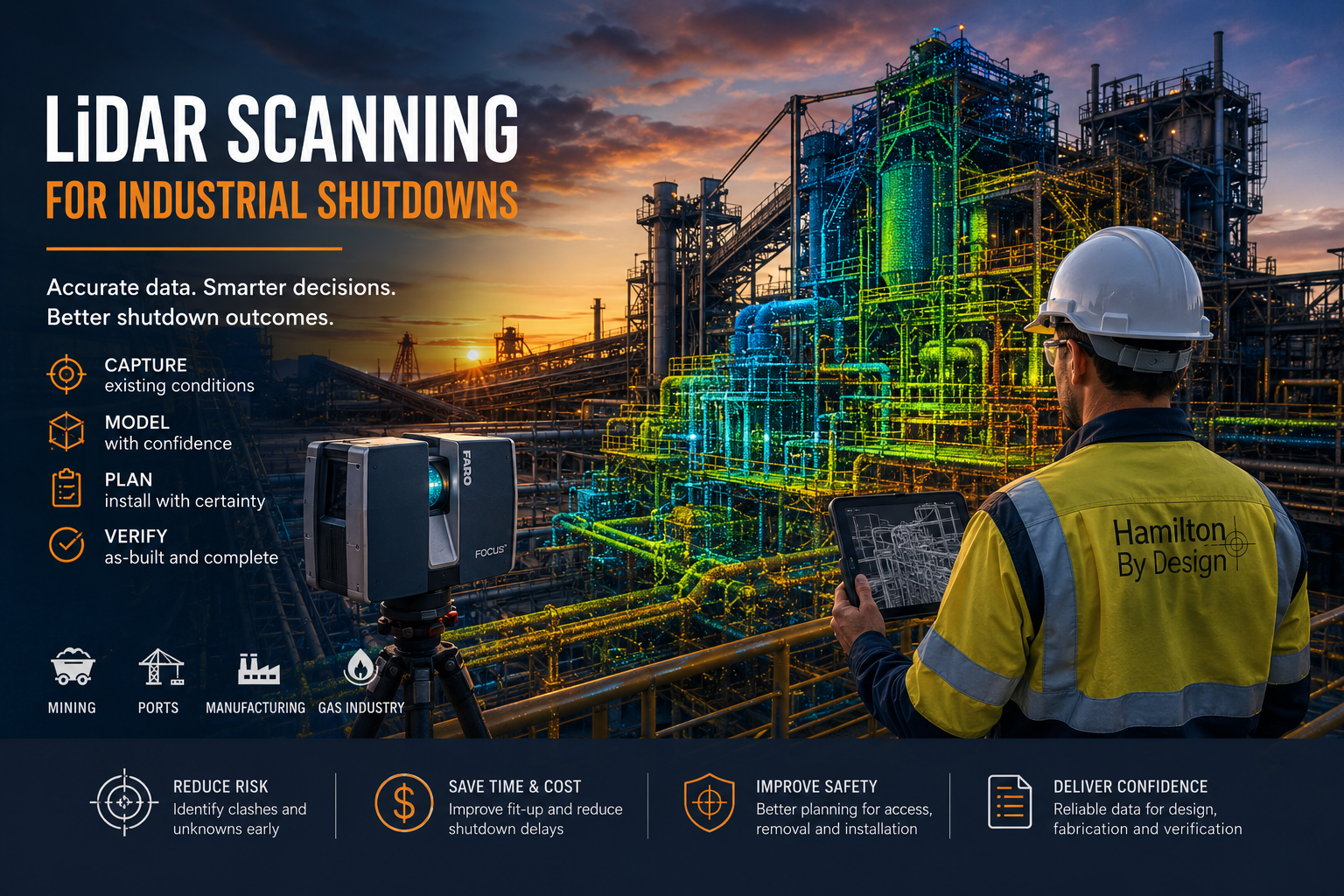
LiDAR Scanning for Industrial Shutdowns: Reducing Risk Across Mining, Ports, Manufacturing and Gas Facilities
Industrial shutdowns provide a limited opportunity to inspect, modify, repair and replace critical plant and infrastructure. Every activity must be carefully planned because unexpected site conditions, inaccurate drawings or poorly fitting components can delay the restart of an entire operation.
LiDAR scanning can reduce this uncertainty by capturing a detailed three-dimensional record of the plant before or during the shutdown. The resulting point-cloud data can support engineering design, fabrication, installation planning, clash detection and final as-built verification.
Hamilton By Design provides engineering-grade 3D laser scanning for mining and industrial plants, combining site capture with practical mechanical engineering, CAD modelling and fabrication experience.
Rather than treating scanning as a standalone surveying activity, the objective is to collect the right information for the engineering decisions that follow.
Why Accurate Existing-Condition Data Matters During a Shutdown
Shutdown projects often involve brownfield plant that has been modified repeatedly over many years. Existing drawings may be incomplete, outdated or inconsistent with the current installation.
Small dimensional discrepancies can create major problems when replacement equipment, structural steel, pipe spools, platforms or mechanical components arrive on site. Typical problems include:
- Bolt holes that do not align
- Pipe flanges with incorrect positions or orientations
- Structural members that clash with existing services
- Replacement equipment that cannot pass through the planned access route
- Platforms or stairs that interfere with nearby plant
- Insufficient crane, rigging or installation clearances
- Fabricated components that require modification on site
These problems are particularly costly during a shutdown because labour, cranes, contractors and production schedules have already been committed.
LiDAR scanning helps establish a reliable geometric record of what is actually present. Millions of spatial measurements are collected to form a point cloud representing equipment, structures, pipework, access systems and surrounding plant.
This data can then be referenced during design and reviewed before fabrication begins.
Scanning Before, During and After a Shutdown
LiDAR scanning can be used at several stages of the shutdown lifecycle.
Pre-shutdown scanning
Scanning before the shutdown allows the project team to develop a detailed understanding of the existing plant while there is still time to resolve design issues.
Pre-shutdown scanning can support:
- Existing-condition verification
- Scope development
- Mechanical and structural design
- Pipework and flange tie-in verification
- Equipment replacement planning
- Clash detection
- Removal and installation studies
- Crane and rigging access reviews
- Fabrication of replacement components
- Constructability reviews
Where the plant remains operational, the scanning plan must consider moving equipment, restricted access, line-of-sight limitations and operational safety requirements.
Scanning during the shutdown
Some areas cannot be captured while the plant is operating. Guards, covers, liners, access panels and equipment components may need to be removed before the relevant geometry becomes visible.
Shutdown scanning can capture:
- Internal chute geometry
- Hidden equipment interfaces
- Wear surfaces
- Equipment mounting points
- Flange faces and pipework connections
- Internal vessel or tank conditions
- Structural connections
- Areas normally obstructed by operating equipment
This information can assist with unexpected conditions identified after isolation and disassembly.
Post-installation scanning
A final scan can provide an independent record of completed work. It may be used to verify equipment location, clearances, structural geometry and the final arrangement of modified plant.
Post-installation data can also support drawing updates, asset records and future maintenance planning.
LiDAR Scanning for Mining Shutdowns
Mining and mineral-processing facilities contain complex combinations of conveyors, chutes, crushers, screens, pumps, tanks, pipework and structural steel. These assets may operate continuously, leaving only short periods for major inspections and modifications.
Hamilton By Design provides dedicated 3D scanning for mining shutdown projects where reliable existing-condition information is required for plant upgrades and replacement works.
Typical mining shutdown applications include:
- Chute and transfer-station replacement
- Conveyor upgrades and realignment
- Crusher and screen replacement
- Pump and piping modifications
- Hopper and bin refurbishment
- Wear-liner replacement
- Structural steel modifications
- Platform, stair and handrail upgrades
- Equipment foundation verification
- Brownfield plant expansions
For a chute replacement, for example, the scan can capture the inlet and discharge interfaces, surrounding structural steel, conveyor geometry, pulley locations, maintenance access and nearby services.
The replacement chute can then be designed within the scanned environment, reducing reliance on isolated manual dimensions or outdated drawings.
LiDAR Scanning for Ports and Bulk Materials Handling
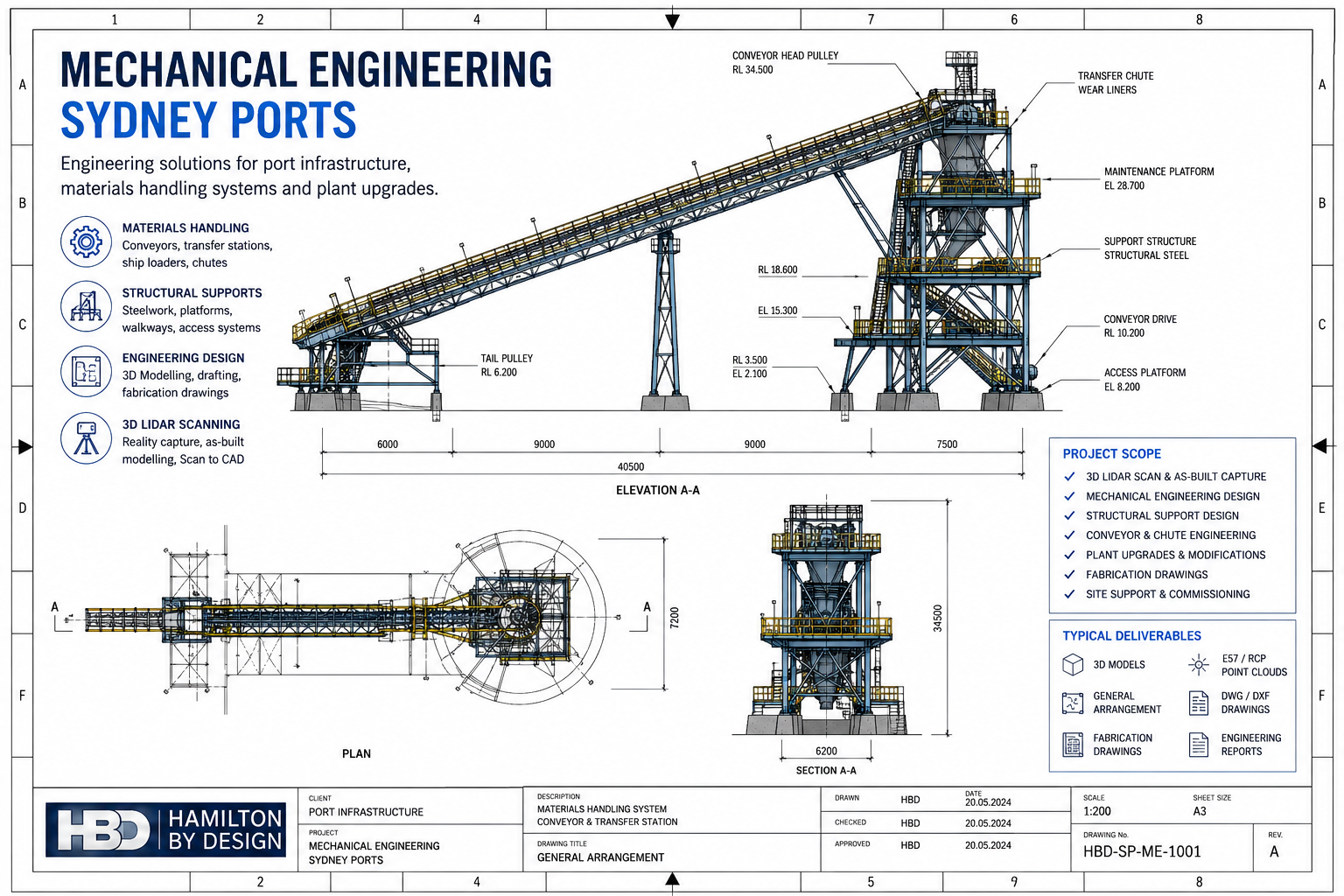
Ports and export terminals often contain large mobile and fixed assets operating around restricted shipping and loading schedules. Access may involve work at height, over water or around active bulk-materials-handling equipment.
LiDAR scanning can support shutdown and maintenance work involving:
- Ship loaders and unloaders
- Conveyors and transfer towers
- Hoppers and loading chutes
- Gantries and structural frames
- Wharf infrastructure
- Rail-mounted equipment
- Maintenance platforms
- Access stairs and walkways
- Hydraulic and mechanical systems
- Pipework and services
Scanning is particularly useful when a project requires an understanding of the relationship between multiple systems rather than one isolated dimension.
A ship-loader modification, for example, may require verification of structural geometry, conveyor interfaces, maintenance clearances, access routes and the position of nearby equipment. Capturing these elements within one coordinated point cloud gives designers a broader understanding of the installation environment.
It can also reduce repeated site visits and the amount of time personnel need to spend in difficult-access areas.
LiDAR Scanning for Manufacturing Shutdowns
Manufacturing facilities commonly schedule maintenance and installation work over weekends, public holidays or planned production shutdowns. The available period may be extremely limited, and a delayed restart can affect production targets, customers and downstream operations.
Applications include:
- Production-line modifications
- New machinery installation
- Equipment relocation
- Ducting and extraction upgrades
- Process-pipework modifications
- Utility-routing studies
- Machine guarding
- Platforms and access systems
- Equipment foundation verification
- Factory layout documentation
LiDAR scanning can capture the relationship between machinery, building structures, overhead services, pipework, platforms and access areas.
This is valuable when new equipment is being designed or supplied before the existing machinery is removed. The proposed installation can be modelled within the scanned environment to identify possible clashes and confirm maintenance access.
Scanning can also document areas that become visible only when the production line is shut down, cleaned or partially dismantled.
LiDAR Scanning for Gas and Process Facilities
Gas and process facilities require careful management of brownfield interfaces, hazardous areas, permits, isolation requirements and engineering records.
Common scanning applications include:
- Pipe-rack documentation
- Brownfield piping tie-ins
- Flange-position verification
- Valve and instrument access studies
- Vessel and skid replacement
- Nozzle-position verification
- Pipe-support modifications
- Structural framing upgrades
- Removal and installation-path studies
- As-built documentation
Where pipe spools are fabricated before a shutdown, accurate tie-in information is essential. The position, angle and orientation of each connection must be correctly understood.
LiDAR scanning can provide a detailed spatial reference for pipework and surrounding plant. However, critical flange faces, bolt patterns and connection details may also require verification using traditional measurement methods or appropriate survey controls.
Scanning should therefore form part of a fit-for-purpose measurement strategy rather than being applied without consideration of the required tolerance.
From Point Cloud to Engineering Deliverables
A point cloud is a valuable source of information, but it is not automatically an engineering solution.
The required deliverables should be established before scanning begins. Hamilton By Design integrates scanning with SMP project delivery and brownfield engineering workflows so that the captured data can be converted into information suited to the project.
Potential deliverables include:
- Registered E57, RCP, RCS or LAS point clouds
- Existing-condition CAD models
- SolidWorks or Inventor assemblies
- STEP, SAT or Parasolid geometry
- AutoCAD plans and layouts
- General arrangement drawings
- Plans, sections and elevations
- Fabrication-reference models
- Pipe and flange interface records
- Clash-detection models
- Existing-condition reports
- Redline and as-built drawing updates
The required modelling level should reflect the intended use. A broad plant-layout study may only require simplified geometry, while a shutdown-critical fabricated component may require more detailed modelling and verification of specific interfaces.
Planning a Fit-for-Purpose Shutdown Scan
A successful scan begins with a clear understanding of the project problem.
Before mobilising, the scanning team should consider:
- What is being designed, replaced or inspected?
- Which dimensions and interfaces are critical?
- What equipment will be operating?
- What becomes accessible only during the shutdown?
- What scan density and coverage are required?
- Are survey controls required?
- Are there hazardous-area restrictions?
- Will dust, steam, rain or reflective surfaces affect capture?
- What file formats are required?
- What CAD or drawing deliverables will be produced?
The scanning envelope should include more than the immediate component. Surrounding structures, services, access routes and potential clash points may be equally important.
Hamilton By Design’s broader engineering services allow scanning information to be reviewed in the context of mechanical design, plant modifications, constructability and fabrication requirements.
Frequently Asked Questions
Can LiDAR scanning be completed while the plant is operating?
Yes, in many situations. However, moving machinery, mobile equipment, dust, restricted access and safety requirements must be considered. Some areas may need to be captured after isolation or during the shutdown.
How accurate is industrial LiDAR scanning?
Accuracy depends on the scanner, distance, environment, registration method, surface condition and required deliverable. The project tolerance should be established before scanning. Critical interfaces may require additional verification.
Can scanning prevent fabricated components from not fitting?
Scanning can significantly reduce fit-up risk by providing accurate existing-condition geometry. It cannot eliminate every risk, particularly where surfaces are hidden or project tolerances have not been properly defined.
What can be scanned during a mining shutdown?
Typical assets include conveyors, chutes, crushers, screens, hoppers, pipework, tanks, equipment bases, platforms, stairs, handrails and structural steel.
Can point-cloud data be converted into CAD?
Yes. Relevant geometry can be converted into SolidWorks, Inventor or AutoCAD models and drawings. The amount of modelling required depends on the intended engineering use.
Does every part of the point cloud need to be modelled?
No. Modelling the entire environment may add unnecessary cost and time. A fit-for-purpose model should focus on the equipment, structures and interfaces needed for the project.
Can scanning be used for pipework tie-ins?
Yes. It can capture pipe routes, surrounding structures, supports and connection locations. Critical flange and tie-in details should be verified to the accuracy required for fabrication.
When is the best time to complete the scan?
Where possible, an initial scan should be completed early enough to support design and fabrication. Additional scanning may be undertaken during the shutdown when hidden areas become accessible.
Reduce Shutdown Uncertainty with Engineering-Led LiDAR Scanning
The primary value of LiDAR scanning during a shutdown is not simply the speed of measurement. Its value comes from reducing uncertainty before fabrication and installation begin.
By capturing the plant accurately, project teams can identify clashes, verify interfaces, plan access and develop modifications against the actual site environment.
For mining, ports, manufacturing and gas facilities, engineering-led LiDAR scanning can support safer planning, improved fit-up and a more controlled return to operation.
Contact Hamilton By Design to discuss the scanning envelope, required accuracy, site conditions and engineering deliverables for your next shutdown project.

Contact Us – Talk To Us
Our clients: