3D Laser Scanning in New Caledonia โ€“ Engineering Certainty in a Remote Environment

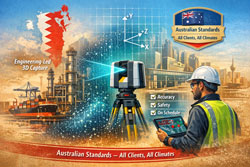
Illustration of 3D laser scanning in New Caledonia showing a LiDAR scanner capturing an industrial site over a coloured map with the Kanak flag and point cloud overlay.

3D Laser Scanning New Caledonia | Hamilton By Design

Engineering projects in New Caledonia operate in a unique environment. Nickel processing plants, port facilities, power stations and infrastructure are often decades old, heavily modified and located far from design offices. Accurate site information is the difference between a smooth project and an expensive lesson.

3D laser scanning has become the most reliable way to capture existing conditions across Noumรฉa, Konรฉ and the remote mine sites of the Grande Terre. Instead of relying on tape measures and assumptions, LiDAR technology records millions of precise measurements to create a true digital twin of the asset.


The Challenge of Brownfields Projects in New Caledonia

Many facilities in New Caledonia share the same constraints:

  • Limited shutdown windows
  • Corrosive coastal environments
  • Historical modifications with poor drawings
  • Logistics that make repeat site visits costly
  • Multi-discipline coordination between local and overseas teams

Traditional survey methods struggle to capture congested pipe racks, structural steel distortions or equipment that has shifted over time. When drawings do not match reality, fabrication delays and site rework quickly follow.


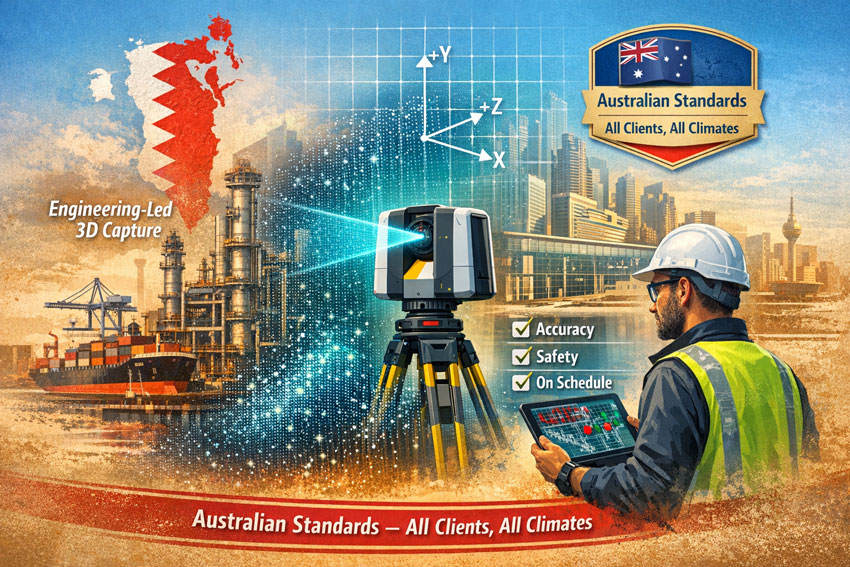
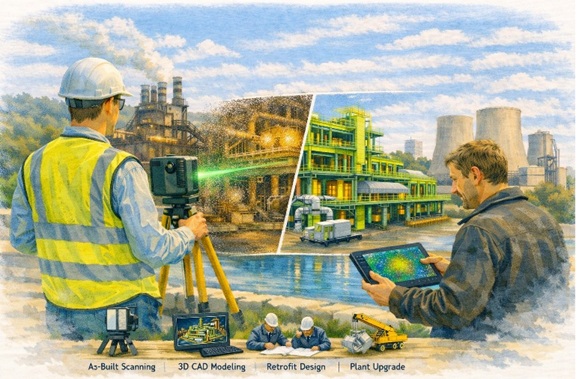
3D laser scanning New Caledonia graphic with national colours, flag on map, industrial facility and workflow from scan to first-time fit.

The Scan Is the Backbone of the Project

The initial scan quality sets the tone for every task that follows. The point cloud becomes the backbone of the projectโ€”design, detailing, fabrication and construction all rely on it.

If you start with a broken backbone, you will have problems everywhere else:

  • Simple tasks become difficult
  • Measurements are questioned
  • models need rework
  • fabricators lose confidence
  • schedules start to slip

A clean, well-registered scan makes coordination easy. A poor scan multiplies effort for every member of the team.


Protecting the Whole Project Team

3D laser scanning is not just about creating a modelโ€”it is about protecting everyone involved:

  • Project managers who must control time and cost
  • Engineers responsible for safe and compliant designs
  • Designers and draftspersons who need reliable geometry
  • Fabricators who must build components that fit
  • Construction crews who install the work on short shutdowns

When the as-built data is right, the entire chain works with confidence. When it is wrong, every discipline inherits the problem.


How 3D Laser Scanning Changes the Outcome

A terrestrial laser scanner captures a complete point cloud of the site in hours rather than weeks. The data can then be used for:

  • Accurate as-built models for upgrades and expansions
  • Tie-in design for new conveyors, tanks and platforms
  • Structural verification of aging infrastructure
  • Clash detection before fabrication
  • Shutdown planning and risk reduction
  • Asset documentation for long-term maintenance

For New Caledonian projects, the biggest benefit is capture once, design anywhere. Local scanning crews can collect the data while engineering teams in Australia or New Zealand work from the same digital environment without further travel.


Typical Applications Across New Caledonia

Mining & Processing

  • Nickel plant upgrades
  • Conveyor replacements
  • Chute and transfer redesign
  • Tank and thickener modifications
  • Access platforms and walkways

Ports & Infrastructure

  • Wharf structural assessments
  • Ship loader interfaces
  • Pipe bridges and services
  • Electrical and control building upgrades

Energy & Utilities

  • Power station retrofits
  • Water treatment facilities
  • Fuel storage terminals

From Point Cloud to Deliverables

A professional workflow generally includes:

  1. On-site LiDAR capture with survey control
  2. Registration and quality assurance
  3. Creation of usable formats for Revit, AutoCAD, SolidWorks or Navisworks
  4. Extraction of models, drawings or clash reports
  5. Ongoing support during fabrication and installation

The result is engineering data you can trustโ€”without the need for multiple trips to site.

3D LiDAR scanning and 3D modelling service button โ€” laser scanner capturing a point cloud for engineering and CAD modelling
Mechanical engineering services

Hamilton By Design logo displayed on a blue tilted rectangle with a grey gradient background

Ready to De-Risk Your Project?

Whether your project is in Noumรฉa, Konรฉ or a remote mine site, 3D laser scanning provides the foundation for safe, predictable and efficient engineering. Get the backbone right at the start and the rest of the project becomes easier.


Name
Would you like us to arrange a phone consultation for you?
Address

3D CAD Modelling Australia service banner for Hamilton By Design

Engineering-Led 3D Scanning for Inner West Sydney Refurbishments

Engineer and client reviewing 3D laser scan data inside an Inner West Sydney heritage building with ANZAC Bridge and Sydney Fish Market in the background.

Refineries, Heritage Buildings & Industrial Retrofits Done Right

The Inner West of Sydney is home to some of the cityโ€™s most complex refurbishment environments.
From legacy refinery and industrial sites through to heritage-listed warehouses, factories, and commercial buildings, these assets were never designed with modern codes, loading requirements, or services in mind.

Yet today, theyโ€™re being asked to support:

  • New plant and equipment
  • Adaptive re-use and change of occupancy
  • Heavier floor loads
  • Updated fire, seismic, and structural standards
  • Modern services routing in very old structures

This is where many refurbishment projects run into trouble โ€” not because the design is poor, but because the starting information is wrong or incomplete.


The Inner West Problem: Old Buildings, New Standards

Much of the Inner Westโ€™s industrial and heritage building stock was constructed:

  • Under superseded Australian Standards
  • With unknown material properties
  • Using construction methods no longer permitted
  • With undocumented modifications over decades of use

What often looks acceptable visually may be:

  • Structurally marginal under modern load cases
  • Locally compromised due to corrosion, settlement, or fatigue
  • Modified in ways that no longer match original drawings

When these issues are discovered late in the design process, the outcome is almost always the same:

  • Redesign
  • Strengthening
  • Programme delays
  • Budget escalation

Engineering-led 3D scanning of an existing Inner West Sydney industrial building prior to refurbishment and structural assessment.

Why Waiting Until โ€œDetailed Designโ€ Is Too Late

A common scenario we see in Inner West refurbishments:

  1. Concept design proceeds based on legacy drawings or assumptions
  2. Floor layouts, equipment, and architectural intent are developed
  3. Engineering review begins
  4. Structural checks identify:
    • Inadequate floor capacity
    • Unsupported penetrations
    • Changed load paths
    • Degraded or altered members
  5. Design is forced to change โ€” often significantly

At this point, the engineer isnโ€™t blocking creativity โ€” theyโ€™re responding to reality.

The issue isnโ€™t engineering input.
The issue is when the true condition of the structure becomes visible.


Start With a Scan: Let Designers Create With Confidence

Engineering-grade 3D laser scanning at the very beginning of a refurbishment changes the entire dynamic of a project.

Instead of reacting to unknowns later, the project team starts with:

  • Verified geometry
  • True floor levels and deflection
  • Structural alignment and deformation
  • Accurate column, beam, and slab positions
  • Measured deviations from original drawings

This gives architects and designers something powerful:

Freedom to design within known constraints โ€” not guessed ones.


Heritage & Industrial Retrofits: Why Scanning Matters Even More

Heritage Buildings

Heritage structures often prohibit invasive investigation early on.
3D scanning allows:

  • Non-intrusive verification of geometry
  • Identification of movement or deformation
  • Assessment of tolerance drift over time
  • Planning of sympathetic strengthening solutions

Refineries & Legacy Industrial Sites

Inner West refinery and process facilities bring additional challenges:

  • Tight access
  • Live plant interfaces
  • Safety-critical environments
  • Brownfield congestion

Scanning provides:

  • Safe remote measurement
  • Clash-free retrofit design
  • Confidence before shutdowns
  • Reduced rework during construction

When Standards Change, Reality Matters

One of the most common late-stage surprises in refurbishments is floor capacity.

Buildings that performed adequately for decades may no longer comply with:

  • Current live load requirements
  • Change-of-use provisions
  • Equipment point loads
  • Modern safety factors

Without accurate structural geometry and context, engineers are forced to:

  • Assume worst-case scenarios
  • Over-design strengthening
  • Restrict layouts unnecessarily

Early scanning supports informed engineering judgement, often resulting in:

  • Targeted strengthening instead of blanket solutions
  • Retention of original fabric where possible
  • Reduced material and construction costs

Blue banner graphic displaying the text "Point Cloud to CAD - Australia" in large white lettering, representing point cloud processing, scan-to-CAD conversion and digital engineering services across Australia.
Blue banner graphic displaying the text "Scan to CAD Sydney" in large white lettering, representing engineering-led point cloud to CAD conversion, LiDAR scanning and digital engineering services in Sydney.
Blue banner graphic displaying the text "Reality Capture Sydney - CBD" in large white lettering, representing engineering-led reality capture, LiDAR scanning and digital engineering services within Sydney CBD commercial buildings and infrastructure.

From Point Cloud to Engineering Decisions

At Hamilton By Design, scanning is not a standalone service โ€” itโ€™s an engineering tool.

Our process typically supports:

  • Structural verification of existing buildings
  • Floor flatness, level, and deflection assessment
  • Alignment checks of columns and frames
  • Scan-to-CAD models for design integration
  • Fit-for-purpose information for refurbishment decisions

This is especially critical in Inner West projects, where:

  • Every millimetre matters
  • Access is limited
  • Heritage considerations are real
  • Late changes are costly

Design With Knowledge, Not Surprises

Refurbishments donโ€™t fail because buildings are old.
They fail because assumptions survive too long.

By starting with an engineering-led scan:

  • Designers get space to create
  • Engineers get data they can trust
  • Asset owners avoid late-stage shocks
  • Projects move forward with confidence

If youโ€™re planning a refinery upgrade, heritage refurbishment, or adaptive re-use project in Inner West Sydney, the smartest decision you can make is to scan first โ€” before concept becomes constraint.


Thinking about a refurbishment or retrofit in the Inner West?

Engineering-grade 3D scanning at the start gives your project clarity, confidence, and creative freedom โ€” not limitations.

3D LiDAR scanning and 3D modelling service button โ€” laser scanner capturing a point cloud for engineering and CAD modelling
Mechanical engineering services
Name
Would you like us to arrange a phone consultation for you?
Address
3D CAD Modelling Australia service banner for Hamilton By Design

How AS 1100 and LiDAR Scanning Work Together: From Point Cloud to Compliant Drawings

Graduate engineer and senior engineer using LiDAR scanning on a Parramatta River construction site, reviewing point cloud data for accurate design.

AS 1100 & LiDAR Scanning: Compliant Engineering Drawings from Point Clouds

If youโ€™ve ever tried to update old plant drawings, verify a brownfield tie-in, or issue โ€œas-builtโ€ documentation after a shutdown, youโ€™ll know the pain: the site never matches the drawings, access is limited, and the smallest dimensional miss can cascade into rework, clashes, and schedule blowouts.

Thatโ€™s where engineering-grade LiDAR scanning and AS 1100 (the Australian Standard for technical drawing) make a powerful combination. LiDAR gives you truth data (reality capture), and AS 1100 gives you a shared language for turning that truth into clear, consistent, contract-ready documentation.

At Hamilton By Design, we treat scanning and drawing as one joined workflow: capture accurately โ†’ model intelligently โ†’ document to AS 1100 so everyone downstream can build, fabricate, install, and sign off with confidence.
(If you want to see the service side of this workflow, start here: https://www.hamiltonbydesign.com.au/home/engineering-services/3d-laser-scanning/3d-laser-scanning-for-engineering-projects/ and here: https://www.hamiltonbydesign.com.au/home/3d-lidar-scanning-digital-quality-assurance/)


What AS 1100 actually โ€œdoesโ€ in the real world

AS 1100 standardises the way we communicate engineering information through drawings: layout, line types, projection methods, dimensioning rules, tolerancing conventions, symbols, notes, and drawing presentation.

In practice, AS 1100 helps you answer questions like:

  • Which edges are visible vs hidden? (line conventions)
  • How are views arranged and interpreted? (projection and view layout)
  • How do we dimension so the fabricator canโ€™t misread it? (dimensioning rules)
  • How do we document what matters vs whatโ€™s โ€œreference onlyโ€? (notes and drawing hierarchy)
  • How do we keep drawing sets consistent across multiple contributors? (formatting + standards)

That consistency is exactly whatโ€™s needed after a scanโ€”because point clouds are rich, but theyโ€™re not automatically โ€œcommunicableโ€ in the way a compliant drawing set is.


What LiDAR scanning adds that drawings alone canโ€™t

A LiDAR scanner captures millions (often billions) of spatial points that represent real surfacesโ€”steel, concrete, pipe, equipment, structureโ€”creating a point cloud that can be registered into a unified coordinate system.

Dassault Systรจmes SolidWorks Professional Weldments certification badge

In the engineering context, the big advantages are:

  • Speed: capture complex geometry quickly, often with minimal disruption
  • Coverage: see whatโ€™s hard to measure with tape/total station (overhead services, congested pipe racks, odd geometry)
  • Context: capture โ€œeverything,โ€ not just what someone remembered to measure
  • Traceability: you can always โ€œgo backโ€ to the scan for verification and queries
  • Clash prevention: scan-to-CAD makes it far easier to design upgrades that actually fit

But hereโ€™s the key: a point cloud isnโ€™t a deliverable most trades can fabricate from directly.
Thatโ€™s why AS 1100 becomes the bridge between capture and construction.


The combined workflow: Point cloud โ†’ model โ†’ AS 1100 drawings

1) Capture the site as it really is

We scan the area of interest and register scans into a coordinated dataset. This becomes the base truth for everything that follows. If the project is shutdown-driven, we plan scanning around access windows and risk controls (often capturing adjacent tie-in zones too, because โ€œnearbyโ€ services are where surprises live).

2) Establish intent: โ€œWhat are we delivering?โ€

Not every project needs the same output. Typical outcomes include:

  • As-built drawings for existing assets
  • As-found models to support new design work
  • Dimensional verification for fit-up and prefabrication
  • Digital QA against design intent (scan-vs-model comparison)

Hamilton By Design leans hard into this QA piece where it matters mostโ€”because catching a misalignment early is cheaper than discovering it on install day.
More on the QA angle here: https://www.hamiltonbydesign.com.au/home/3d-lidar-scanning-digital-quality-assurance/

3) Convert scan data into engineering geometry (as much as needed)

Sometimes the best output is a controlled 3D model (plant layout, pipe spools, structural members). Other times the project is best served by 2D drawings extracted from a model.

Weโ€™ll typically create:

  • key datums and grids
  • primary steel / structure
  • equipment envelopes and critical interfaces
  • piping runs and connection points (where relevant)
  • floor levels, platforms, access constraints, clearance zones

4) Document to AS 1100 so the drawing set is unambiguous

This is where AS 1100 shines. We turn geometry into drawings that read cleanly and consistently across teams.

That includes:

  • correct view layouts (plan/elevation/section/detail)
  • line conventions (visible/hidden/centre lines)
  • clear dimensioning strategy (functional dims first)
  • consistent annotation and notes
  • drawing borders, title blocks, revision control, and drawing register discipline

In short: LiDAR gives accuracy, AS 1100 gives clarity.


Where AS 1100 + LiDAR scanning delivers immediate value

Brownfield upgrades and tie-ins

Tie-ins fail when the โ€œas-builtโ€ condition is wrong. A scan gives you real geometry; AS 1100 drawings package it so designers, fabricators, and installers share the same reference. This is especially useful when multiple contractors are interfacing.

Fabrication and spool accuracy

If youโ€™re fabricating offsite (pipe spools, platform steel, handrail sections, ducting), you need dependable dimensions and an agreed drawing language. Scan-derived models support accuracy; AS 1100 drawings support fabrication interpretation and QA sign-off.

Shutdown planning and constructability

A point cloud is a brilliant planning toolโ€”access routes, crane clearances, removal paths, temporary works, and โ€œwhatโ€™s in the way.โ€ But shutdown packages still need compliant drawings for permits, isolations, install workpacks, and handover packs. AS 1100 keeps those packages readable and defensible.

Verification and โ€œwhat changed?โ€

Sites evolve. A scan provides a timestamped snapshot. Drawings updated to AS 1100 become the controlled record: what was there, what was installed, and what the current state is. That matters for maintenance, safety, and future projects.


Practical example: Turning a congested pipe rack into a buildable upgrade

Imagine youโ€™re adding a new line through an existing pipe rack:

  1. Scan the rack to capture all existing services, supports, cable trays, and steel
  2. Model critical geometry (existing plus proposed) to check routing and supports
  3. Clash check before fabrication begins
  4. Issue AS 1100 drawings for:
    • support details
    • spool isometrics (if applicable)
    • arrangement drawings showing tie-in locations
    • sections through congestion zones
    • installation notes and tolerances where appropriate
  5. Verify post-install with a follow-up scan if required for QA/closeout

Thatโ€™s the โ€œwork togetherโ€ part: the scan stops guesswork, and AS 1100 stops misinterpretation.


Common mistakes when scanning isnโ€™t tied back to AS 1100

  • Delivering point clouds without a drawing strategy (stakeholders canโ€™t use them effectively)
  • Over-modelling everything (time is spent modelling non-critical items instead of delivering useful documentation)
  • Unclear dimensioning (scan accuracy is wasted if dimensions are presented ambiguously)
  • No controlled datums (people argue about โ€œwhere zero isโ€ and models drift between disciplines)
  • Weak revision control (the drawing set becomes untrustworthy fast)

A standards-led drawing approach prevents most of these.


How we approach it at Hamilton By Design

Our angle is simple: engineering-led scanningโ€”not scanning for its own sake.

  • We capture reality with LiDAR.
  • We translate it into the level of model detail the project actually needs.
  • We document outputs with the discipline and consistency expected in Australian engineering environments.

If you want the practical breakdown of how we do scan capture and modelling for projects, start here:
https://www.hamiltonbydesign.com.au/home/engineering-services/3d-laser-scanning/3d-laser-scanning-for-engineering-projects/

And if your priority is dimensional verification, fit-up confidence, or proving compliance against design intent, this page explains our digital QA approach:
https://www.hamiltonbydesign.com.au/home/3d-lidar-scanning-digital-quality-assurance/


Hamilton By Design logo displayed on a blue tilted rectangle with a grey gradient background

Closing thought: accuracy is only valuable if itโ€™s understandable

LiDAR scanning can deliver millimetre-grade spatial truth. But in real projects, truth still has to travel through peopleโ€”engineers, drafters, fabricators, installers, supervisors, and asset owners.

AS 1100 makes that truth readable.
LiDAR makes it reliable.

3D LiDAR scanning and 3D modelling service button โ€” laser scanner capturing a point cloud for engineering and CAD modelling
Mechanical engineering services

Together, they turn messy real-world geometry into clear, controlled documentation that supports safer installs, faster shutdowns, and fewer surprises.

Name
Would you like us to arrange a phone consultation for you?
Address

3D Laser Scanning on the Central Coast NSW: From Point Cloud to Build-Ready CAD

From laser scan to CAD: point cloud of Avoca Beach foreshore assets converted into build-ready engineering drawings.

Accurate site data is the difference between a smooth upgrade and a shutdown full of surprises.
At Hamilton By Design, we provide engineering-grade 3D laser scanning (LiDAR) across the Central Coast NSW โ€” including Wyong, Gosford, Tuggerah and Somersby โ€” and convert that data into design-ready CAD and 3D models for industrial and building projects.

If youโ€™re planning equipment upgrades, new conveyors, structural modifications or fabrication packages, scanning gives you reliable geometry before steel is cut or contractors mobilise.


Who this service is for

Our Central Coast scanning services are typically used by:

  • Project engineers planning plant or building upgrades
  • Maintenance teams preparing shutdown scopes
  • Fabricators needing accurate tie-in dimensions
  • Asset owners updating as-built records
  • Consultants managing brownfield modifications

If drawings donโ€™t match reality โ€” or donโ€™t exist at all โ€” scanning becomes the safest and fastest way to establish an accurate baseline.


3D LiDAR scanning services on the Central Coast providing engineering-grade laser scanning, point cloud capture, scan-to-CAD modelling and industrial reality capture for infrastructure and industrial projects.
Drafting services on the Central Coast providing engineering drawings, fabrication detailing, as-built documentation, reverse engineering and CAD drafting for industrial and infrastructure projects.
Mechanical engineering services on the Central Coast providing industrial design, plant inspections, pump calculations, reverse engineering and engineering support for manufacturing, infrastructure and heavy industry projects.

From scan to CAD: turning site data into buildable designs

A point cloud on its own doesnโ€™t solve project risk.
What matters is converting scan data into usable engineering outputs.

Our workflow supports:

  • 2D CAD drawings (plans, sections, elevations)
  • 3D CAD models for layout and clash detection
  • Tie-in modelling for new equipment and structures
  • Verification of clearances and access zones
  • Fabrication-ready geometry for workshop drawings

This scan-to-CAD process is especially valuable for retrofit projects where new components must integrate with existing assets.


Why 3D scanning is ideal for brownfield upgrades

Most Central Coast industrial and commercial sites are brownfield environments โ€” tight access, legacy equipment and undocumented modifications.

3D laser scanning helps to:

  • Reduce site re-visits and manual re-measuring
  • Identify clashes early in the design phase
  • Support off-site prefabrication
  • Shorten shutdown windows
  • Improve safety by limiting exposure time on site

When combined with engineering design, scanning becomes a risk-reduction tool, not just a survey method.


Engineer using 3D laser scanner at Avoca Beach foreshore with point cloud and CAD model showing upgrade of coastal stairs and seawall.

Typical Central Coast applications

We regularly support projects across:

Manufacturing and processing facilities

Equipment replacements, conveyor upgrades, access platform modifications.

Warehousing and logistics buildings

Structural modifications, mezzanine installations, services coordination.

Building services upgrades

Plantroom retrofits, mechanical services coordination, compliance verification.

Mining-related fabrication and off-site packages

Where Central Coast workshops are producing components for remote sites.


Local coverage: Wyong, Gosford, Tuggerah and Somersby

Being based on the Central Coast means we can support:

  • Rapid site capture
  • Staged scanning across multiple areas
  • Follow-up verification scans as scope evolves

That flexibility is important when designs change during live projects or shutdown preparation.


How accurate is engineering-grade LiDAR scanning?

Accuracy depends on site conditions and scope, but scanning provides consistent, repeatable geometry across complex environments that would be difficult and time-consuming to measure manually.

More importantly, it captures:

  • Spatial relationships
  • Real clearances
  • True equipment alignment

which are critical for retrofit engineering and fabrication.


When is scanning worth the investment?

Scanning typically delivers the best value when:

  • Drawings are outdated or incomplete
  • Fabrication must fit first time
  • Shutdown time is expensive
  • Access is restricted or unsafe
  • Multiple trades must coordinate in tight spaces

In many projects, preventing one major clash or rework cycle pays for the scan many times over.


Hamilton By Design logo displayed on a blue tilted rectangle with a grey gradient background

3D LiDAR scanning and 3D modelling service button โ€” laser scanner capturing a point cloud for engineering and CAD modelling
Mechanical engineering services

Planning an upgrade or fabrication project on the Central Coast?

If youโ€™re preparing for a shutdown, equipment upgrade or fabrication package across the Central Coast, early scanning can significantly reduce downstream risk.

Talk to Hamilton By Design about 3D laser scanning and point cloud to CAD support for your project.
Weโ€™ll help define the scope and deliverables that best suit your engineering and construction needs.

Name
Would you like us to arrange a phone consultation for you?
Address

Mechanical Engineering and 3D Scanning Services in Darwin

Industrial plant in Darwin being digitally captured with 3D scanning to support engineering design and upgrade planning.

Mechanical Engineering and 3D Scanning Services in Darwin

Supporting defence, industrial and infrastructure projects across Northern Australia

Darwin is a strategic industrial hub for Northern Australia, supporting defence facilities, oil and gas operations, ports, power generation and remote infrastructure servicing. Many of these assets operate in harsh environments and have been upgraded over long periods, making accurate design and modification work highly dependent on reliable as-built information.

Hamilton By Design provides engineering-led 3D laser scanning and mechanical engineering services in Darwin, supporting safer, faster and more accurate project delivery across operating facilities.


Engineer using LiDAR scanner to capture an industrial processing plant near Darwin in the Northern Territory for mechanical and structural design.

Engineering Challenges in Northern Australian Facilities

Industrial and infrastructure assets in the Top End face unique challenges, including:

  • High humidity and corrosion
  • Cyclone-rated structural requirements
  • Remote logistics and limited shutdown windows
  • Ageing infrastructure with incomplete documentation

These factors increase project risk when modifications rely on outdated drawings or manual site measurements.

Engineering-grade reality capture allows accurate design to be completed off-site, reducing rework and improving safety outcomes during installation.


How 3D Laser Scanning Supports Darwin Projects

Plant and Facility Upgrades

When upgrading mechanical systems, pipework, conveyors or process equipment, laser scanning provides accurate spatial data so new components can be designed to fit existing layouts before fabrication.

This is particularly valuable for:

  • Fuel and gas facilities
  • Power generation assets
  • Water and wastewater plants
  • Defence infrastructure

Shutdown and Maintenance Planning

Short shutdown windows are common in remote facilities. Point cloud models support:

  • Access and lifting studies
  • Installation sequencing
  • Safety and exclusion zone planning

This reduces uncertainty and improves coordination between trades during critical maintenance periods.


Structural and Mechanical Retrofits

For strengthening structures, replacing worn equipment or installing new platforms, scanning provides geometry suitable for:

  • Fabrication drawings
  • Structural connection design
  • Mechanical interface modelling

Minimising the need for repeated site visits in high-risk environments.


Mechanical Engineering Services Supported by Reality Capture

Hamilton By Design integrates 3D scanning directly into engineering workflows, including:

  • Mechanical design and drafting
  • Structural support and modification design
  • Scan-to-CAD and scan-to-BIM modelling
  • Fabrication drawing development
  • Installation and constructability reviews

This ensures reality capture delivers practical engineering outcomes, not just visual documentation.


Industries Supported in the Darwin Region

Our engineering and scanning services support a wide range of industries, including:

  • Defence and military facilities
  • Oil and gas processing and storage
  • Port infrastructure and materials handling
  • Power generation and utilities
  • Remote industrial facilities and camps
  • Food and bulk materials processing

These sectors require high levels of accuracy, safety and reliability when modifying operating assets.


Why Engineering-Grade LiDAR Matters

Not all scanning technologies are suitable for industrial engineering.

For mechanical and structural design, projects typically require:

  • Millimetre-level accuracy
  • Long-range capture across large facilities
  • Reliable reference for fabrication and installation

Engineering-grade LiDAR systems provide the precision required to support fabrication-ready design and clash-free installation.


Benefits for Project Owners and Contractors

Using engineering-led reality capture provides measurable advantages:

  • Reduced re-measurement on site
  • Fewer design clashes
  • Improved constructability
  • Safer design development
  • Shorter shutdown durations
  • Greater confidence in project outcomes

In remote locations, avoiding rework and delays has a major impact on overall project cost and schedule.


Supporting Projects Across Northern Australia

While based on the east coast, Hamilton By Design regularly supports regional and remote projects using a combination of:

  • On-site scanning campaigns
  • Remote engineering and modelling workflows
  • Digital collaboration and model review

This allows Darwin-based projects to access specialist engineering and scanning capability without requiring permanent local resourcing.


Final Thoughts

For industrial and infrastructure projects in Darwin, combining mechanical engineering with engineering-grade 3D scanning provides a safer, faster and more reliable way to deliver upgrades in challenging operating environments.

By integrating reality capture directly into design and fabrication workflows, project teams can reduce risk, improve coordination and achieve better construction outcomes across Northern Australiaโ€™s critical assets.

Hamilton By Design logo displayed on a blue tilted rectangle with a grey gradient background
3D LiDAR scanning and 3D modelling service button โ€” laser scanner capturing a point cloud for engineering and CAD modelling
Mechanical engineering services
Name
Would you like us to arrange a phone consultation for you?
Address

Establish a Baseline for Wall Movement in Your Property

Wall Crack Monitoring & Structural Movement Baseline Scans | NSW

Know When Cracks Are Cosmetic โ€” and When Theyโ€™re Not

Cracks in walls are common, but not all cracks are harmless. The real risk isnโ€™t just that a crack exists โ€” itโ€™s how fast itโ€™s changing. Without a baseline, thereโ€™s no reliable way to tell whether your property is stable or slowly moving toward serious structural damage.

Thatโ€™s where our Property Wall Movement Baseline Scan comes in.


What Is a Baseline Scan?

A baseline scan is a highโ€‘accuracy digital survey of your property taken at the moment cracking is first observed. Using precision scanning technology, we capture:

  • Wall alignment and deflection
  • Crack location, length, and width
  • Floor and ceiling reference planes
  • Structural reference points across the building

This scan becomes your timeโ€‘zero reference point โ€” a measurable snapshot of your buildingโ€™s condition today.


Why a Baseline Matters

Without a baseline:

  • Cracks are judged visually (subjective and unreliable)
  • Engineers lack historical movement data
  • Insurance claims become harder to substantiate
  • Small issues can quietly become major repairs

With a baseline:

  • Movement can be quantified in millimetres
  • Crack growth rates can be tracked over time
  • Engineers can make confident, dataโ€‘driven decisions
  • You gain early warning before damage becomes critical

How the Process Works

1. Initial Scan

We perform a nonโ€‘invasive scan of affected areas and key structural zones to establish your baseline condition.

2. Data Archiving

All scan data is securely stored and referenced to fixed control points within your property.

3. Followโ€‘Up Scans

Repeat scans (3, 6, or 12 months later) are compared against the baseline to calculate:

  • Crack propagation rate
  • Wall movement direction
  • Structural settlement or heave

4. Clear Reporting

You receive a clear, easyโ€‘toโ€‘understand report showing:

  • Measured movement (if any)
  • Rate of change over time
  • Professional recommendations

Ideal For

  • Homeowners noticing new or worsening cracks
  • Properties affected by reactive soils or subsidence
  • Buildings near excavation or construction activity
  • Insurance documentation and dispute resolution
  • Engineers requiring longโ€‘term movement data

Early Data Saves Money

Monitoring movement early often means minor intervention instead of major reconstruction. A baseline scan gives you certainty, evidence, and peace of mind.

If nothing is moving โ€” youโ€™ll know.
If something is โ€” youโ€™ll know before itโ€™s too late.


Hamilton By Design logo displayed on a blue tilted rectangle with a grey gradient background
3D LiDAR scanning and 3D modelling service button โ€” laser scanner capturing a point cloud for engineering and CAD modelling
Mechanical engineering services

Book a Baseline Scan

If youโ€™ve noticed cracking, now is the right time to act.

Contact us today to establish your propertyโ€™s movement baseline and protect its longโ€‘term structural integrity.


Precision data. Clear answers. Smarter decisions.

Name
Would you like us to arrange a phone consultation for you?
Address
3D LiDAR scanning and 3D modelling service button โ€” laser scanner capturing a point cloud for engineering and CAD modelling
Mechanical engineering services
Finite Element Analysis (FEA) engineering simulation button
Mechanical engineering services