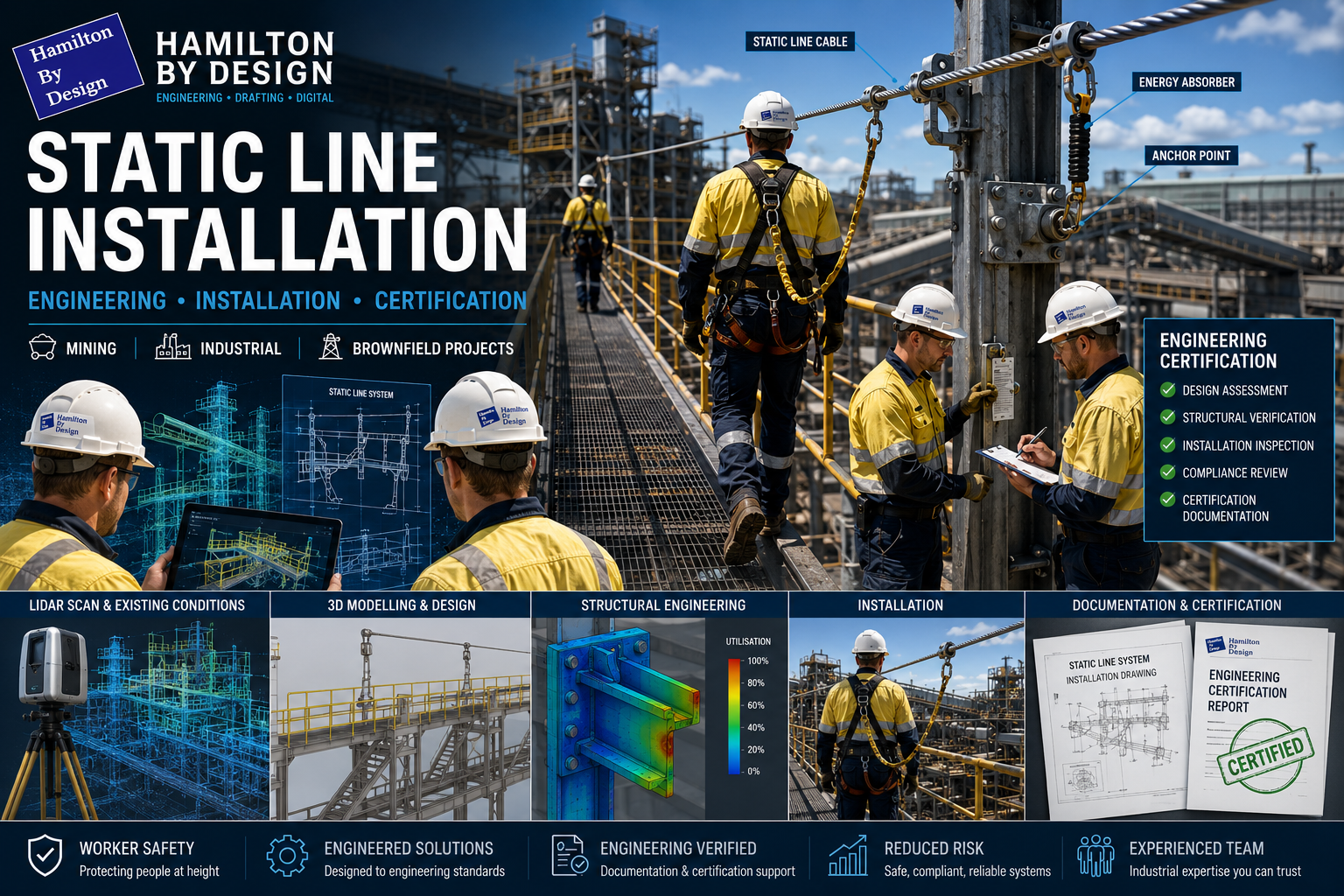
Static Line Installation and Engineering Certification for Mining and Industrial Facilities

Hamilton By Design static line installation and engineering certification for mining and industrial facilities showing workers at height, structural engineering assessment, LiDAR scanning and installation support.

Static line systems play an important role in protecting personnel working at heights across mining, manufacturing, processing plants, smelters and heavy industrial environments. While a static line system may appear simple, effective implementation requires significantly more than installing a cable between two points.

A static line system is an engineered safety system requiring assessment of supporting structures, installation planning, documentation and engineering verification to ensure safe operation throughout its service life.

Why Engineering Assessment Matters

Static line systems can transfer significant loads into supporting structures during operation and potential fall events. Existing platforms, structural steel, roof systems and access structures may not have originally been designed for these additional loading conditions.

Potential risks may include:

  • Structural overload
  • Excessive cable deflection
  • Anchor point failure
  • Reduced fall clearance
  • Interference with plant infrastructure
  • Installation conflicts with existing services

Engineering assessment helps ensure the complete system performs safely and integrates correctly with existing facility infrastructure.


Brownfield Installation Challenges

Many industrial facilities have undergone modifications over many years and existing drawings do not always reflect current site conditions.

Common challenges include:

  • Structural changes not reflected in drawings
  • Additional pipework and services
  • Restricted installation access
  • Congested steelwork layouts
  • Equipment interferences
  • Unknown structural details

Capturing existing conditions before installation can reduce uncertainty and improve design confidence.

Engineering-grade LiDAR scanning and site verification can assist with:

  • Existing-condition capture
  • Structural geometry verification
  • Access assessment
  • Clash identification
  • As-built modelling
  • Installation planning

Typical Static Line Engineering Process

Site Inspection and Existing Asset Review

The process generally begins with:

  • Site inspections
  • Existing drawing review
  • Structural assessment
  • Access reviews
  • Existing-condition verification
  • Asset condition assessment

3D CAD Modelling Australia service banner for Hamilton By Design

Structural Engineering Assessment

Supporting structures are assessed for:

  • Structural member capacity
  • Connection capacity
  • Anchor loading requirements
  • Dynamic loading conditions
  • Multiple-user requirements
  • Deflection limits
  • Existing loading conditions
  • Corrosion and asset condition

Where required, structural modifications or strengthening works may be developed.


Design Documentation

Typical engineering deliverables may include:

  • Static line layouts
  • General Arrangement (GA) drawings
  • Structural details
  • Anchor point details
  • Installation drawings
  • Load calculations
  • Fabrication documentation

Clear documentation reduces installation uncertainty and assists construction and maintenance activities.


Installation Verification

Following installation, verification activities may include:

  • Anchor inspections
  • Fixing verification
  • Installation checks
  • Dimensional confirmation
  • Asset tagging
  • Documentation review

Engineering Certification

Engineering certification documentation may include:

  • Design calculations
  • Compliance documentation
  • Inspection records
  • Installation drawings
  • Certification statements
  • Asset schedules
  • Maintenance requirements

Certification provides confidence that the installed system aligns with engineering design intent and project requirements.


How Hamilton By Design Can Support Static Line Projects

Hamilton By Design has a team capable of supporting the design, fabrication, installation and engineering certification process for static line systems and working-at-height access solutions for mining and industrial facilities.

Our engineering-led approach may include:

  • Existing-condition site inspections
  • Engineering-grade LiDAR scanning and verification
  • Structural and mechanical assessment
  • Static line and anchor layout development
  • Fabrication drawings and installation documentation
  • Site coordination and construction support
  • Engineering review and certification documentation

Whether for new installations or brownfield modifications, our objective is to deliver systems designed and installed to relevant engineering requirements and project standards while integrating with existing infrastructure.

This provides clients with a complete workflow from concept and site capture through to installation support and engineering verification.


Benefits of an Engineered Approach

A structured engineering approach can provide:

  • Improved worker safety
  • Reduced project risk
  • Better installation outcomes
  • Reduced rework
  • Improved documentation
  • Increased confidence in long-term asset performance
  • Improved lifecycle management

Final Thoughts

Static line systems are critical safety assets and should be treated as engineered systems rather than standalone products. Proper installation, engineering assessment and certification help ensure systems perform as intended and integrate safely within operating facilities.

For mining and industrial environments, combining engineering assessment with existing-condition verification and structured project documentation can significantly reduce uncertainty and improve installation outcomes.


Hamilton By Design logo displayed on a blue tilted rectangle with a grey gradient background
3D LiDAR scanning and 3D modelling service button โ€” laser scanner capturing a point cloud for engineering and CAD modelling
Mechanical engineering services
Name
Would you like us to arrange a phone consultation for you?
Address
Finite Element Analysis (FEA) engineering simulation button
Mechanical engineering services

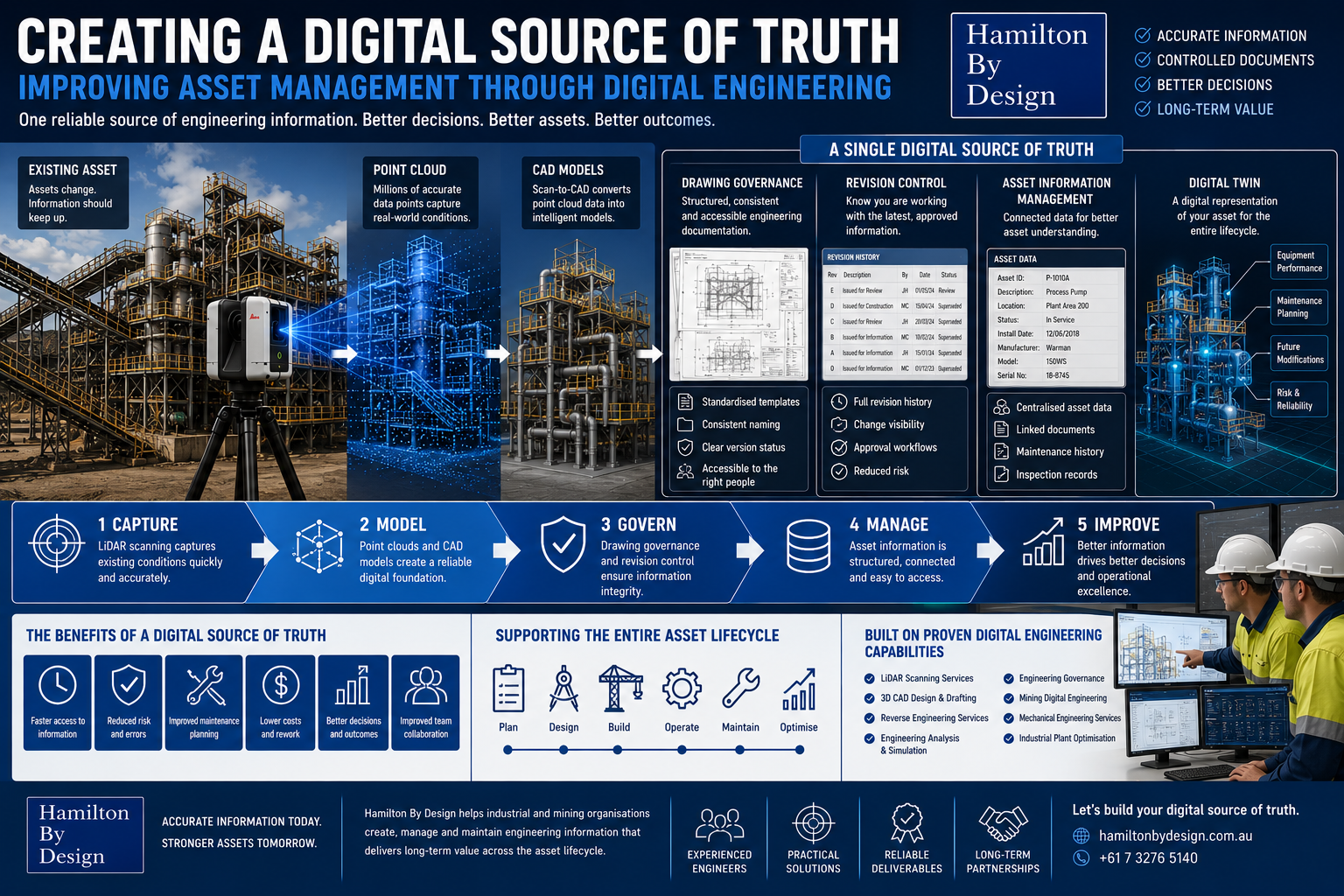
Creating a Digital Source of Truth: Improving Asset Management Through Digital Engineering

Engineering-grade LiDAR scanning and digital engineering workflow showing how a digital source of truth improves long-term asset management.

Industrial assets change over time. Equipment is upgraded, drawings are revised, platforms are modified, components are replaced, and maintenance activities gradually reshape the plant.

When engineering information is spread across old drawings, uncontrolled PDFs, manual mark-ups, spreadsheets, and individual folders, asset management becomes harder than it needs to be.

A digital source of truth helps bring engineering information together so teams can make decisions using reliable, current, and controlled data.

At Hamilton By Design, we support digital engineering asset management by combining LiDAR scanning, CAD modelling, drawing governance, revision control, and digital engineering workflows.

What is a Digital Source of Truth?

A digital source of truth is a controlled location where accurate engineering information can be stored, managed, accessed, and updated.

It may include:

  • Engineering drawings
  • CAD models
  • Point cloud data
  • Asset information
  • Revision history
  • Inspection records
  • Fabrication documentation
  • Engineering reports

The goal is simple:

One reliable place for engineering information.

Why Asset Information Management Matters

Poorly controlled information can create:

  • Outdated drawings
  • Duplicate files
  • Missing revisions
  • Conflicting information
  • Fabrication errors
  • Shutdown delays
  • Maintenance confusion

Good asset information management improves:

  • Decision making
  • Project planning
  • Maintenance efficiency
  • Drawing control
  • Long-term asset performance

Digital Engineering Workflows

Hamilton By Design can support workflows such as:

  • Engineering-grade LiDAR scanning
  • Existing condition capture
  • Point cloud generation
  • Scan-to-CAD conversion
  • CAD modelling
  • Engineering drawings
  • Revision-controlled documentation
  • Digital asset records

This turns real-world site information into usable engineering data.

Drawing Governance and Revision Control

Drawing governance helps ensure the right people are using the right information.

This includes:

  • Controlled drawing revisions
  • Clear document naming
  • Updated engineering records
  • Managed mark-ups
  • Approval workflows
  • Accessible project information
3D CAD Modelling Australia service banner for Hamilton By Design

Without revision control, teams may unknowingly use superseded drawings.

Digital Twins and Long-Term Asset Management

A digital twin does not need to start as a complex system. For many industrial sites, it begins with accurate geometry, controlled drawings, and reliable asset records.

Digital engineering can support:

  • Plant upgrades
  • Maintenance planning
  • Shutdown preparation
  • Reverse engineering
  • Engineering analysis
  • Future modifications

Long-Term Operational Efficiency

A digital source of truth can reduce:

  • Time spent searching for drawings
  • Rework caused by outdated information
  • Repeated site measurements
  • Fabrication errors
  • Project uncertainty

It can improve:

  • Maintenance planning
  • Engineering confidence
  • Asset visibility
  • Operational efficiency
  • Project delivery

How Hamilton By Design Supports This

Hamilton By Design supports digital engineering asset management through:

  • 3D CAD Design & Drafting
  • Engineering Governance
  • LiDAR Scanning Services
  • Industrial Plant Optimisation
  • Engineering Analysis & Simulation
  • Mining Digital Engineering
  • Mechanical Engineering Services
  • Reverse Engineering Services

The objective is not just to create drawings or models.

The objective is to create engineering information that remains useful throughout the asset lifecycle.

3D LiDAR scanning and 3D modelling service button โ€” laser scanner capturing a point cloud for engineering and CAD modelling
Mechanical engineering services

Conclusion

Industrial asset management depends on reliable information.

A digital source of truth helps organisations move from scattered documents and outdated drawings toward controlled, current, and usable engineering data.

Better information supports better asset decisions.

Hamilton By Design logo displayed on a blue tilted rectangle with a grey gradient background

Our Clients:

Name
Would you like us to arrange a phone consultation for you?
Address
3D CAD Modelling Australia service banner for Hamilton By Design
Australian Drafting logo featuring bold white text reading "Australian Drafting" centred on a blue rounded rectangle background.
Engineering Governance title graphic featuring bold white text reading "Engineering Governance" centred on a blue rounded rectangle background.
Mechanical, Structural & Pipework Drafting service banner by Hamilton By Design featuring white text on a blue background.
Mechanical engineering services
Blue rounded button with the text โ€œSolidWorks Designโ€ in white.
Finite Element Analysis (FEA) engineering simulation button
3D LiDAR Scanning Darwin for engineering surveys, laser scanning, reality capture and point cloud modelling services
3D LiDAR Scanning Australia engineering services for laser scanning, reality capture, scan-to-CAD, Scan-to-BIM and as-built documentation across Australia
3D LiDAR scanning services on the Central Coast providing engineering-grade laser scanning, point cloud capture, scan-to-CAD modelling and industrial reality capture for infrastructure and industrial projects.
3D LiDAR Scanning Perth for engineering surveys, laser scanning, reality capture and point cloud modelling services
3D LiDAR Scanning Sydney for engineering surveys, laser scanning, reality capture and point cloud modelling services
3D LiDAR Scanning Brisbane for engineering surveys, laser scanning, reality capture and point cloud modelling services
3D LiDAR Scanning Canberra for engineering surveys, laser scanning, reality capture and point cloud modelling services
3D LiDAR Scanning Newcastle for engineering surveys, laser scanning, reality capture and point cloud modelling services
3D LiDAR Scanning Adelaide for engineering surveys, laser scanning, reality capture and point cloud modelling services

Understanding AS1657: Fixed Platforms, Walkways, Stairways and Ladders

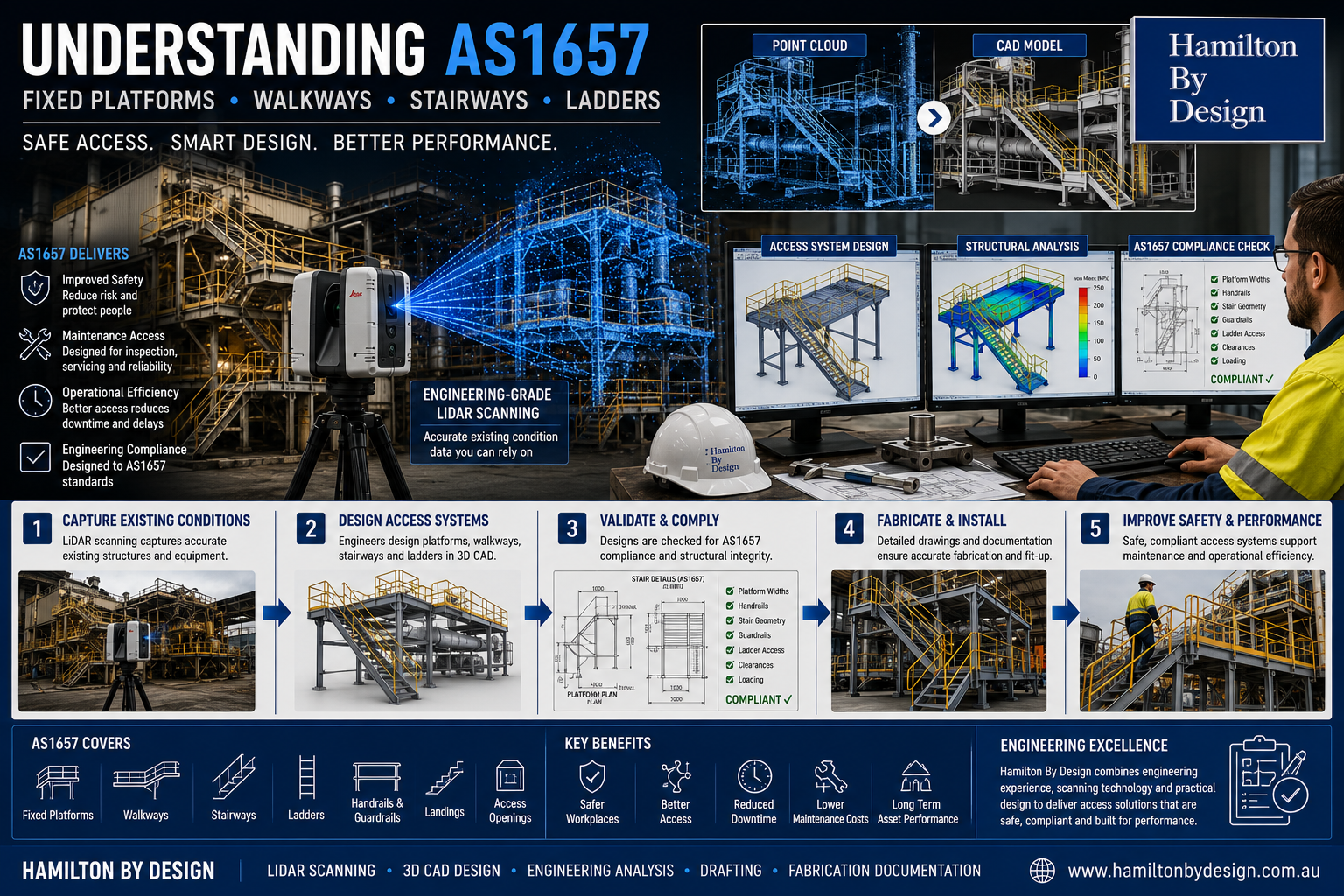
Engineering-grade LiDAR scanning and CAD modelling workflow for AS1657 industrial access systems including platforms, walkways, stairways, and ladders.

Industrial facilities are built around more than machinery and production systems. Personnel require safe and reliable access to equipment, maintenance areas, inspection locations, and operational assets. Whether within mining operations, manufacturing facilities, timber processing plants, or industrial processing environments, access systems play an important role in both safety and productivity.

Poorly designed access systems can create operational inefficiencies, increase maintenance time, and introduce unnecessary risk. Access systems designed around practical engineering requirements can improve not only safety outcomes but also long-term operational performance.

In Australia, one of the key standards governing these systems is AS1657 โ€“ Fixed Platforms, Walkways, Stairways and Ladders โ€“ Design, Construction and Installation.

Understanding the purpose of AS1657 helps organisations design access systems that support safer operations, maintenance efficiency, and engineering compliance.

What is AS1657?

AS1657 establishes requirements and guidance for the design, construction, and installation of fixed access systems within industrial facilities.

The standard applies to systems including:

  • Fixed platforms
  • Walkways
  • Stairways
  • Fixed ladders
  • Handrails
  • Guardrails
  • Landings
  • Access openings

The objective of the standard is providing safe and practical access throughout industrial facilities while reducing hazards associated with working at heights and movement around equipment.

AS1657 is commonly applied across:

  • Mining operations
  • Processing plants
  • Manufacturing facilities
  • Bulk materials handling facilities
  • Timber processing operations
  • Infrastructure projects
  • Industrial processing sites
3D CAD Modelling Australia service banner for Hamilton By Design

Why Proper Access Design Matters

Access systems are often viewed as secondary structures supporting primary equipment.

In practice, access systems influence:

  • Worker safety
  • Equipment accessibility
  • Maintenance efficiency
  • Shutdown performance
  • Operational productivity
  • Long-term operating costs

Poor access design can create:

  • Restricted access zones
  • Congestion around equipment
  • Increased manual handling risks
  • Longer shutdown activities
  • Reduced maintenance efficiency
  • Higher maintenance costs

Well-designed systems can improve operational performance while supporting safer working conditions.

Fixed Platforms and Walkways

Fixed platforms and walkways provide safe movement and work areas around equipment and operational assets.

Typical design considerations include:

  • Platform dimensions
  • Walkway widths
  • Surface materials
  • Guardrail systems
  • Toe plates
  • Access clearances
  • Slip resistance requirements
  • Structural loading considerations

Effective access design supports maintenance teams by improving movement around equipment and reducing access difficulties.

Stairways and Ladder Requirements

Stairways and ladders require practical engineering consideration beyond simply connecting two elevations.

Important design factors may include:

Stairways

  • Rise and going dimensions
  • Stair angles
  • Handrail requirements
  • Intermediate landings
  • Head clearances
  • User movement requirements

Ladders

  • Ladder height limitations
  • Cage requirements
  • Fall protection systems
  • Landing arrangements
  • Access openings

The frequency of use and maintenance requirements often influence whether ladders or stairways provide the most suitable solution.

Maintenance Access Considerations

Maintenance activities often represent one of the most frequent interactions personnel have with industrial assets.

Access systems should support:

  • Inspection activities
  • Equipment removal
  • Maintenance tasks
  • Shutdown work
  • Routine servicing

Poor maintenance access can lead to:

  • Extended downtime
  • Increased labour requirements
  • Manual handling issues
  • Higher operational costs

Designing around maintenance requirements during early project stages can reduce ongoing operational challenges.

Brownfield Applications Create Additional Challenges

Brownfield facilities rarely reflect original design documentation.

Industrial sites commonly contain:

  • Historical modifications
  • Existing structural steel
  • Congested layouts
  • Pipework interferences
  • Equipment additions
  • Legacy infrastructure

Designing new access systems in these environments can become challenging without accurate existing information.

Hamilton By Design supports brownfield projects using engineering-grade 3D LiDAR scanning to capture:

  • Existing structures
  • Platforms
  • Walkways
  • Equipment
  • Pipework
  • Access systems

Existing condition capture allows engineering decisions to be based on measured information rather than assumptions.

Supporting Engineering Compliance

Engineering compliance extends beyond simply meeting dimensional requirements.

Good engineering practice should also consider:

  • Safety outcomes
  • Practical useability
  • Constructability
  • Maintenance efficiency
  • Future modifications
  • Long-term operational performance

Compliance should support functionality rather than becoming a checklist exercise.

How Hamilton By Design Supports Industrial Access Projects

Hamilton By Design combines practical engineering experience with digital engineering workflows to support industrial access projects through:

  • Engineering-grade 3D LiDAR scanning
  • Existing condition capture
  • Scan-to-CAD workflows
  • Mechanical design
  • Structural assessment
  • Engineering analysis and simulation
  • CAD modelling
  • Fabrication documentation

Our approach supports projects from initial site capture through to fabrication-ready deliverables.

3D LiDAR scanning and 3D modelling service button โ€” laser scanner capturing a point cloud for engineering and CAD modelling
Mechanical engineering services

Moving Beyond Minimum Compliance

AS1657 exists to support safer and more effective industrial access systems.

However, successful access systems do more than satisfy compliance requirements.

They improve:

  • Safety performance
  • Maintenance efficiency
  • Operational productivity
  • Long-term asset performance

Well-designed access systems help people interact safely and effectively with industrial assets every day.

Better access systems support better operational outcomes.

Hamilton By Design logo displayed on a blue tilted rectangle with a grey gradient background
Name
Would you like us to arrange a phone consultation for you?
Address

Our Clients:

https://www.hamiltonbydesign.com.au/understanding-as1657-fixed-platforms-walkways-stairways-ladders
Finite Element Analysis (FEA) engineering simulation button
Mechanical engineering services

Why Existing Conditions Matter: Reducing Safety Risks with Engineering-Grade LiDAR Scanning

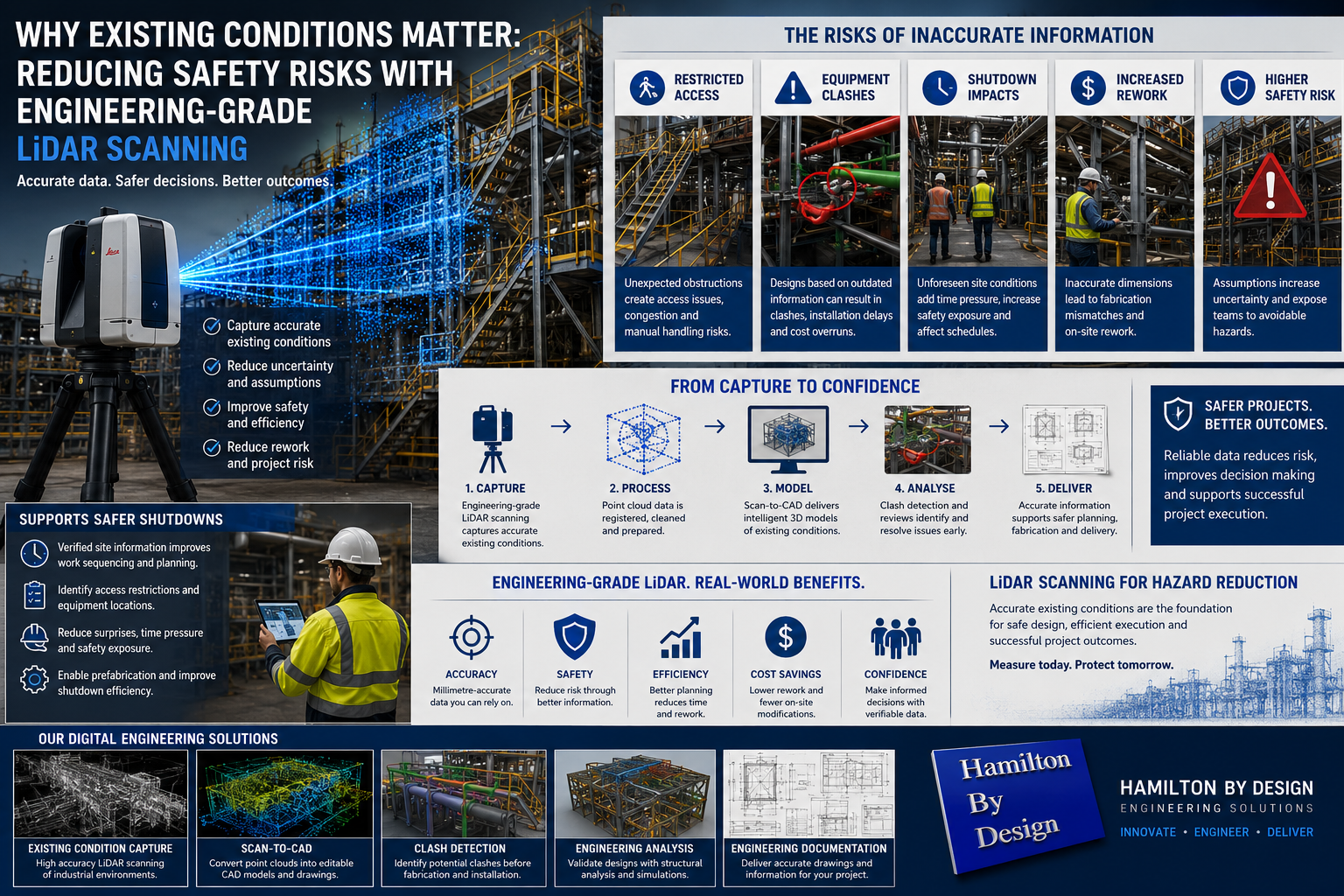
Engineering-grade LiDAR scanning workflow showing how existing condition capture reduces safety risks through clash detection, scan-to-CAD modelling, engineering analysis, and improved shutdown planning in industrial facilities.

Industrial projects are often built around a simple assumption:

“The existing drawings are correct.”

Unfortunately, in many industrial facilities that assumption can introduce significant risk.

Mining plants, processing facilities, manufacturing sites, and timber processing operations commonly undergo years or decades of modifications. Equipment changes, structural additions, maintenance alterations, temporary fixes, and undocumented upgrades can gradually move facilities away from their original engineering documentation.

When engineering decisions are based on outdated drawings or manual measurements, project teams may unknowingly introduce safety risks that affect shutdown activities, maintenance work, and plant upgrades.

At Hamilton By Design, engineering-grade LiDAR scanning supports safer project outcomes by replacing assumptions with measurable site information.

Why Existing Conditions Matter

Existing conditions represent the actual site environment rather than what historical drawings suggest exists.

In industrial environments, discrepancies can develop through:

  • Historical modifications
  • Unrecorded changes
  • Structural alterations
  • Equipment replacements
  • Temporary repairs becoming permanent solutions
  • Missing documentation
  • Inaccurate field measurements

A few centimetres of difference can appear minor on a drawing but become significant when:

  • Installing new equipment
  • Modifying conveyor systems
  • Designing platforms
  • Routing pipework
  • Planning shutdown activities
  • Fabricating structural steel

Small errors can create larger project impacts.

Safety Risks Created by Inaccurate Information

Assumptions can introduce several operational and safety challenges.

3D CAD Modelling Australia service banner for Hamilton By Design

Examples include:

Restricted Access Areas

Access routes may differ from original layouts, creating:

  • Maintenance access issues
  • Congestion
  • restricted clearances
  • Manual handling risks

Equipment Clashes

New designs based on incorrect information may result in:

  • Structural clashes
  • Pipework interferences
  • Equipment conflicts
  • Installation delays

Increased Exposure During Shutdown Activities

Shutdown periods often involve:

  • Tight schedules
  • Multiple work groups
  • Limited access windows
  • High activity levels

Unexpected site conditions discovered during shutdowns can increase:

  • Time pressure
  • Additional field modifications
  • Safety exposure
  • Project costs

Brownfield Projects Present Additional Challenges

Brownfield environments rarely match original design documentation.

Common challenges include:

  • Congested plant layouts
  • Existing services
  • Structural interferences
  • Legacy equipment
  • Multiple generations of modifications

Designing around assumptions in these environments increases uncertainty.

Existing Condition Capture Using Engineering-Grade LiDAR

Engineering-grade LiDAR scanning captures existing conditions by collecting highly accurate site geometry and generating point cloud data.

Capture can include:

  • Structural steel
  • Platforms
  • Conveyors
  • Pipework
  • Equipment
  • Buildings
  • Access systems
  • Existing plant layouts

Rather than relying solely on manual measurements, project teams gain access to measurable site information.

Benefits can include:

  • Improved accuracy
  • Existing condition verification
  • Better planning
  • Reduced uncertainty
  • Reduced installation risk

Clash Detection Before Construction

Once captured, point cloud information can be integrated into engineering workflows.

Scan-to-CAD processes allow:

  • Existing condition modelling
  • Design development
  • Clash detection
  • Constructability reviews
  • Layout optimisation

Potential problems can be identified before fabrication and site installation begin.

Finding issues digitally generally costs less than discovering them during construction activities.

Supporting Shutdown Planning

Shutdown windows are often measured in hours or days rather than weeks.

Unexpected field discoveries can quickly affect:

  • Production schedules
  • Labour requirements
  • Equipment availability
  • Project budgets

LiDAR scanning can support shutdown planning by:

  • Capturing actual site conditions
  • Identifying access restrictions
  • Verifying equipment locations
  • Improving work sequencing
  • Supporting prefabrication

Better information often leads to more predictable project execution.

Reducing Site Rework

Rework commonly results from:

  • Inaccurate dimensions
  • Design clashes
  • Existing condition errors
  • Fabrication mismatches

Reducing rework can improve:

  • Safety performance
  • Project schedules
  • Labour efficiency
  • Installation outcomes
  • Overall project cost

How Hamilton By Design Supports Safer Industrial Projects

Hamilton By Design combines practical engineering experience with digital engineering workflows to support safer project delivery.

Services can include:

Engineering-Grade LiDAR Scanning

Capture accurate site geometry and existing conditions.

Scan-to-CAD Workflows

Convert point cloud information into:

  • Editable CAD models
  • Engineering drawings
  • Existing condition layouts

Engineering Analysis

Support project decisions through:

  • Design validation
  • Engineering reviews
  • Structural assessment
  • Simulation and analysis
3D LiDAR scanning and 3D modelling service button โ€” laser scanner capturing a point cloud for engineering and CAD modelling
Mechanical engineering services

Engineering Documentation

Deliver:

  • General arrangement drawings
  • Fabrication drawings
  • Engineering models
  • Project information

Moving Beyond Assumptions

Existing conditions influence safety, constructability, and project outcomes.

When projects rely on assumptions rather than measurable information, risks can increase.

Engineering-grade LiDAR scanning helps organisations move from:

Estimated conditions โ†’ Verified conditions

The result is improved confidence, reduced risk, safer project execution, and better engineering decisions.

Finite Element Analysis (FEA) engineering simulation button
Mechanical engineering services

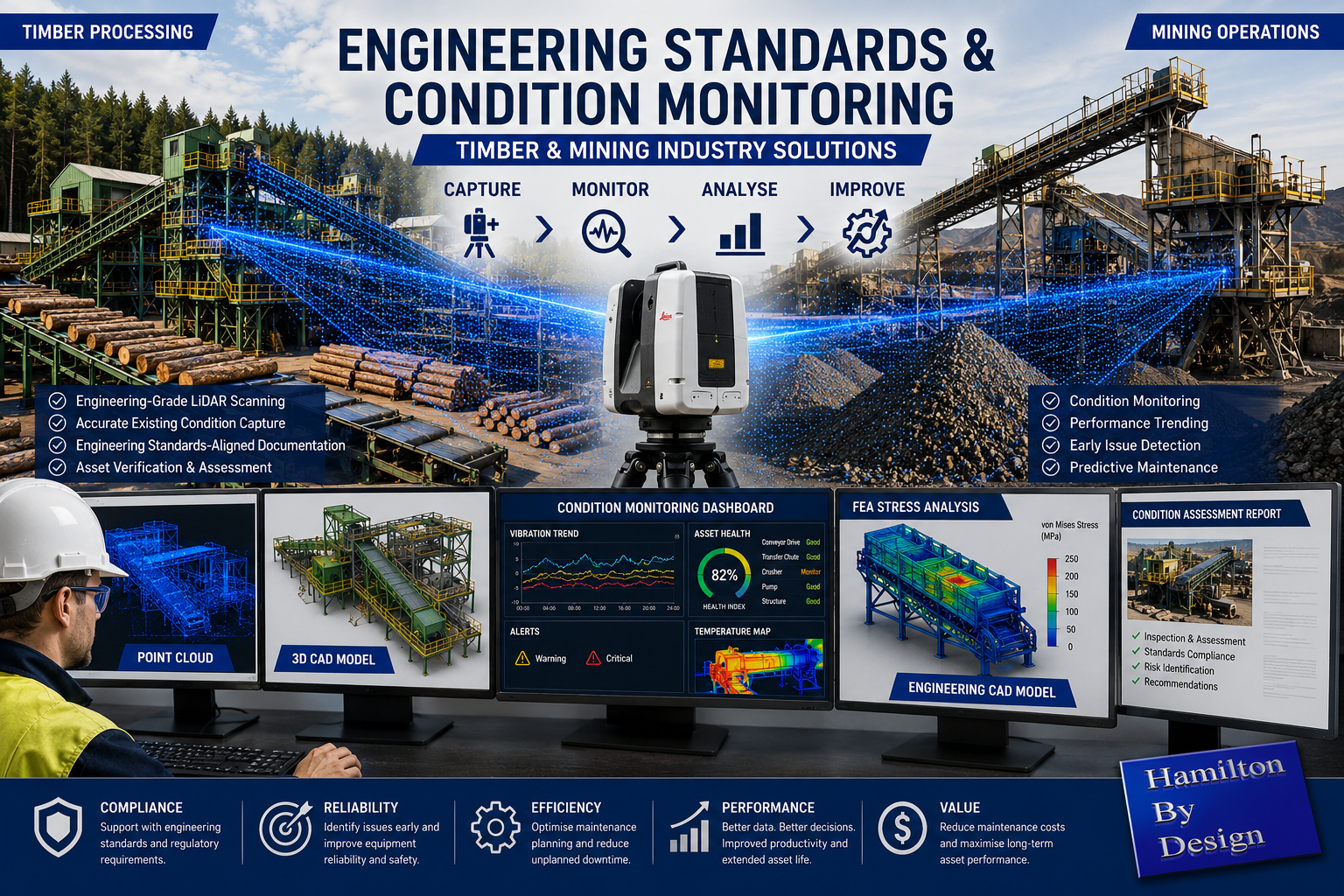
Engineering Standards & Condition Monitoring: Supporting Reliability in Timber and Mining Operations

Engineering-grade LiDAR scanning, condition monitoring, and FEA analysis workflow for timber processing and mining equipment reliability.

Industries such as timber processing and mining operate in demanding environments where equipment reliability directly affects productivity, maintenance costs, and operational performance. Conveyor systems, transfer chutes, rotating equipment, processing machinery, structural assets, and supporting infrastructure are often exposed to continuous loading, wear, vibration, fatigue, and harsh operating conditions.

While machinery failures may appear sudden, many develop gradually through changes in operating conditions, deterioration, or inadequate monitoring and maintenance practices.

Engineering standards and condition monitoring help organisations move from reactive maintenance toward informed engineering decisions and improved asset performance.

At Hamilton By Design, we support mining and timber processing industries through engineering-led approaches that combine engineering standards, digital engineering workflows, reality capture technologies, and practical engineering solutions.

Why Engineering Standards Matter

Engineering standards provide a structured framework for designing, assessing, operating, and maintaining equipment.

Standards help organisations achieve:

  • Improved safety
  • Greater consistency
  • Reduced risk
  • Improved reliability
  • Better maintenance planning
  • Regulatory compliance
  • Improved operational performance

Examples of standards commonly applied within industrial projects may include:

Structural and Mechanical Standards

  • AS 4100 โ€“ Steel structures
  • AS 1170 โ€“ Structural design actions
  • AS 3996 โ€“ Access covers and grates
  • AS 1657 โ€“ Fixed platforms, walkways, stairways and ladders
  • AS 1554 โ€“ Structural welding

Asset and Equipment Considerations

  • Fatigue assessment
  • Structural integrity
  • Mechanical reliability
  • Equipment life assessment
  • Materials handling performance

Engineering standards support more than design compliance. They help establish long-term operational reliability.

What is Condition Monitoring?

Condition monitoring involves collecting information about equipment performance and asset condition to identify potential issues before failures occur.

Rather than waiting for breakdowns, monitoring allows maintenance and engineering teams to make decisions using measurable data.

Condition monitoring can involve:

  • Equipment inspections
  • Structural assessments
  • Wear monitoring
  • Vibration monitoring
  • Alignment assessment
  • Existing condition capture
  • Thermal assessments
  • Trend analysis
  • Performance assessment

The objective is identifying deterioration before operational impacts occur.

Timber Industry Applications

Timber processing facilities operate continuously with significant material handling demands.

Common assets include:

  • Log conveyors
  • Timber handling systems
  • Chippers
  • Screening systems
  • Structural platforms
  • Transfer systems
  • Processing machinery

Typical challenges may include:

  • Equipment wear
  • Misalignment
  • Build-up
  • Fatigue
  • Structural deterioration
  • Conveyor performance issues

Engineering monitoring and assessment can improve:

  • Throughput
  • Reliability
  • Maintenance planning
  • Downtime reduction
  • Equipment life

Mining Industry Applications

Mining operations often involve harsh operating environments and heavy-duty equipment subjected to high loading conditions.

Applications can include:

  • Conveyor systems
  • Transfer chutes
  • Processing plants
  • Crushers
  • Pump systems
  • Structural assets
  • Materials handling systems

Common challenges may include:

  • Wear
  • Fatigue loading
  • Structural movement
  • Equipment deterioration
  • Production interruptions

Condition monitoring allows operational teams to move toward predictive maintenance approaches rather than emergency repairs.

How Hamilton By Design Supports Engineering Standards and Condition Monitoring

Hamilton By Design supports projects through a combination of engineering tools and practical experience.

Our services can include:

Engineering-Grade 3D LiDAR Scanning

Capture accurate existing conditions and generate point cloud information for:

  • Existing plant geometry
  • Structural assessment
  • Brownfield modifications
  • Asset verification
3D CAD Modelling Australia service banner for Hamilton By Design

Scan-to-CAD Workflows

Convert site information into:

  • Editable engineering models
  • Existing condition documentation
  • Engineering drawings

Engineering Analysis and Simulation

Support asset assessments through:

  • Finite Element Analysis (FEA)
  • Structural assessments
  • Load analysis
  • Design validation

Engineering Documentation

Deliver:

  • Drawings
  • Assessment reports
  • Design documentation
  • Asset information
3D LiDAR scanning and 3D modelling service button โ€” laser scanner capturing a point cloud for engineering and CAD modelling
Mechanical engineering services

Supporting Long-Term Asset Performance

Successful operations are not built around simply repairing equipment after failure.

Long-term value often comes from:

  • Improved reliability
  • Reduced maintenance costs
  • Better planning
  • Increased productivity
  • Reduced downtime
  • Improved asset life
  • Better engineering decisions

By combining engineering standards, condition monitoring, digital engineering workflows, and practical engineering solutions, organisations can move beyond assumptions and improve operational performance.

Hamilton By Design supports timber processing and mining industries by helping transform engineering information into practical decisions and measurable outcomes.

Hamilton By Design logo displayed on a blue tilted rectangle with a grey gradient background
Name
Would you like us to arrange a phone consultation for you?
Address

Our Clients:

3D CAD Modelling Australia service banner for Hamilton By Design
Australian Drafting logo featuring bold white text reading "Australian Drafting" centred on a blue rounded rectangle background.
Engineering Governance title graphic featuring bold white text reading "Engineering Governance" centred on a blue rounded rectangle background.
Mechanical, Structural & Pipework Drafting service banner by Hamilton By Design featuring white text on a blue background.
Mechanical engineering services
Blue rounded button with the text โ€œSolidWorks Designโ€ in white.
Finite Element Analysis (FEA) engineering simulation button
3D LiDAR Scanning Darwin for engineering surveys, laser scanning, reality capture and point cloud modelling services
3D LiDAR Scanning Australia engineering services for laser scanning, reality capture, scan-to-CAD, Scan-to-BIM and as-built documentation across Australia
3D LiDAR scanning services on the Central Coast providing engineering-grade laser scanning, point cloud capture, scan-to-CAD modelling and industrial reality capture for infrastructure and industrial projects.
3D LiDAR Scanning Perth for engineering surveys, laser scanning, reality capture and point cloud modelling services
3D LiDAR Scanning Sydney for engineering surveys, laser scanning, reality capture and point cloud modelling services
3D LiDAR Scanning Brisbane for engineering surveys, laser scanning, reality capture and point cloud modelling services
3D LiDAR Scanning Canberra for engineering surveys, laser scanning, reality capture and point cloud modelling services
3D LiDAR Scanning Newcastle for engineering surveys, laser scanning, reality capture and point cloud modelling services
3D LiDAR Scanning Adelaide for engineering surveys, laser scanning, reality capture and point cloud modelling services

Forestry Industry & Timber Processing: Engineering Machinery for Productivity and Long-Term Value

Engineering-grade LiDAR scanning and FEA simulation workflow for forestry and timber processing equipment design.

The forestry and timber processing industries operate in demanding environments where productivity, reliability, and equipment performance directly influence profitability. Whether processing logs, handling timber products, operating sawmills, or managing materials handling systems, machinery downtime and inefficiencies can significantly affect production output and operating costs.

Modern engineering is moving beyond traditional design approaches and increasingly using digital engineering tools to optimise equipment before fabrication and installation begins.

At Hamilton By Design, we combine engineering-grade 3D LiDAR scanning, 3D modelling, and Finite Element Analysis (FEA) to support forestry and timber processing operations by delivering machinery and engineered systems designed for productivity, reliability, and long-term return on investment.

Designing for More Than Initial Cost

The lowest purchase price does not always provide the lowest operating cost.

Machinery and processing systems can incur substantial ongoing costs through:

  • Excessive wear
  • Unplanned maintenance
  • Downtime
  • Energy consumption
  • Material build-up
  • Inefficient layouts
  • Reduced production capacity
  • Premature equipment failure

Engineering decisions made during the design stage can influence the total lifecycle cost of equipment for many years after installation.

The objective is not simply designing machinery that works.

The objective is designing machinery that continues to perform efficiently throughout its operational life.

Engineering-Grade 3D LiDAR Scanning

For existing timber processing plants and brownfield facilities, one of the biggest challenges is understanding current conditions accurately.

Many facilities contain:

  • Existing conveyors
  • Timber processing machinery
  • Structural steel
  • Pipework
  • Platforms and access systems
  • Building constraints
  • Historical modifications

Outdated drawings or manual measurements can introduce risk into engineering projects.

Hamilton By Design uses engineering-grade 3D LiDAR scanning to capture accurate existing conditions and generate high-quality point cloud data.

This provides:

  • Accurate plant geometry
  • Existing condition verification
  • Reduced design assumptions
  • Improved fit-up accuracy
  • Reduced installation risk
  • Faster project development

Rather than designing around assumptions, engineering decisions can be based on actual site information.

3D Modelling for Better Project Outcomes

Once site information has been captured, point cloud data can be converted into editable engineering models.

3D CAD Modelling Australia service banner for Hamilton By Design

3D modelling provides benefits including:

  • Improved visualisation
  • Clash detection
  • Layout optimisation
  • Equipment integration
  • Fabrication planning
  • Improved communication

For forestry and timber processing projects this may include:

  • Log handling systems
  • Conveyors
  • Transfer systems
  • Chutes
  • Processing equipment
  • Access platforms
  • Structural modifications
  • Production upgrades

Digital models help identify issues before they become site problems.

Finite Element Analysis (FEA)

Engineering performance extends beyond appearance and fit-up.

Equipment must withstand:

  • Dynamic loading
  • Material impacts
  • Fatigue
  • Wear
  • Structural loading
  • Operational forces

Hamilton By Design can support projects through Finite Element Analysis (FEA) to evaluate equipment and structural performance before fabrication begins.

FEA can assist with:

  • Stress assessment
  • Deflection analysis
  • Structural performance
  • Design optimisation
  • Weight reduction opportunities
  • Reliability improvements

Rather than overdesigning equipment or relying on assumptions, designs can be refined using measurable engineering information.

Maximising Return on Investment

A successful project should not simply focus on reducing initial capital cost.

The real value often comes from:

  • Increased production rates
  • Reduced maintenance costs
  • Improved reliability
  • Reduced downtime
  • Improved safety
  • Lower lifecycle costs
  • Longer equipment life
  • Improved operational efficiency
3D LiDAR scanning and 3D modelling service button โ€” laser scanner capturing a point cloud for engineering and CAD modelling
Mechanical engineering services

Engineering decisions made early in a project often have long-term financial impacts.

How Hamilton By Design Supports Forestry and Timber Processing

Hamilton By Design combines digital engineering tools with practical engineering experience to support projects from concept through to delivery.

Our services include:

  • Engineering-grade 3D LiDAR scanning
  • Scan-to-CAD workflows
  • 3D modelling
  • Mechanical engineering design
  • Finite Element Analysis (FEA)
  • Engineering drawings
  • Fabrication documentation
  • Existing condition verification
  • Brownfield project support

By integrating reality capture, digital modelling, and engineering analysis, projects can move from assumptions toward measurable engineering outcomes.

The goal is simple:

Design machinery and systems that maximise productivity while delivering stronger long-term returns on investment.

3D CAD Modelling Australia service banner for Hamilton By Design
Australian Drafting logo featuring bold white text reading "Australian Drafting" centred on a blue rounded rectangle background.
Engineering Governance title graphic featuring bold white text reading "Engineering Governance" centred on a blue rounded rectangle background.
Mechanical, Structural & Pipework Drafting service banner by Hamilton By Design featuring white text on a blue background.
Mechanical engineering services
Blue rounded button with the text โ€œSolidWorks Designโ€ in white.
Finite Element Analysis (FEA) engineering simulation button
3D LiDAR Scanning Darwin for engineering surveys, laser scanning, reality capture and point cloud modelling services
3D LiDAR Scanning Australia engineering services for laser scanning, reality capture, scan-to-CAD, Scan-to-BIM and as-built documentation across Australia
3D LiDAR scanning services on the Central Coast providing engineering-grade laser scanning, point cloud capture, scan-to-CAD modelling and industrial reality capture for infrastructure and industrial projects.
3D LiDAR Scanning Perth for engineering surveys, laser scanning, reality capture and point cloud modelling services
3D LiDAR Scanning Sydney for engineering surveys, laser scanning, reality capture and point cloud modelling services
3D LiDAR Scanning Brisbane for engineering surveys, laser scanning, reality capture and point cloud modelling services
3D LiDAR Scanning Canberra for engineering surveys, laser scanning, reality capture and point cloud modelling services
3D LiDAR Scanning Newcastle for engineering surveys, laser scanning, reality capture and point cloud modelling services
3D LiDAR Scanning Adelaide for engineering surveys, laser scanning, reality capture and point cloud modelling services