
The High Court Just Changed Engineering Liability โ€” Why โ€œAs-Built Guessingโ€ Is No Longer Enough

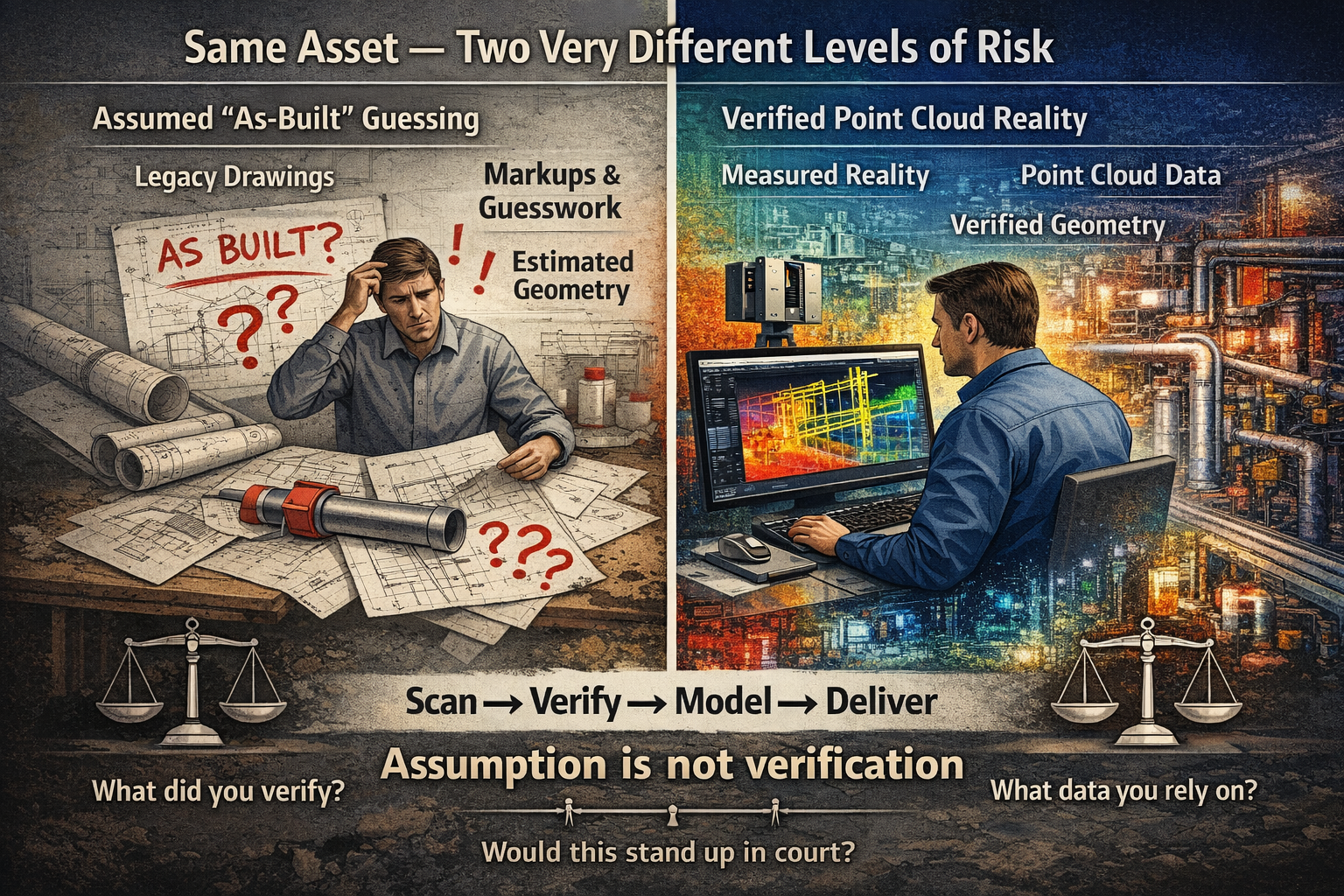
Split-screen engineering graphic comparing assumed as-built drawings with verified point cloud scanning data, highlighting the difference between estimated geometry and measured reality.

The recent High Court decision in Pafburn Pty Ltd v The Owners โ€“ Strata Plan No 84674 has been widely discussed across the construction and legal sectors. Most commentary has focused on developers and builders, particularly the finding that they can be held fully liable for defects and cannot rely on proportionate liability to distribute responsibility.

But for engineers, designers, and anyone working in brownfield environments, the real impact runs deeper.

This case signals a clear shift in expectation โ€” away from assumption, and toward verified reality.


3D LiDAR scanning and 3D modelling service button โ€” laser scanner capturing a point cloud for engineering and CAD modelling
Mechanical engineering services

The Hidden Risk in โ€œAs-Builtโ€ Drawings

Across many projects, particularly in retrofit, maintenance, and upgrade work, design offices rely on what are commonly referred to as โ€œas-builtโ€ drawings.

In theory, these drawings represent what has actually been constructed on site.

In practice, however, that is not always the case.

Many โ€œas-builtsโ€ are produced through:

  • Manual markups during construction
  • Redline drawings updated after installation
  • Verbal confirmation from site teams
  • Interpretation of incomplete or outdated information

In some cases, they are never formally verified at all.

This creates a fundamental problem.

The design office is making decisions based on information that may be:

  • Incomplete
  • Inaccurate
  • Or in the worst case โ€” assumed

The Question That Is Now Being Asked

Following this High Court decision, the legal environment is changing.

It is no longer sufficient to say:

โ€œI worked from the drawings provided.โ€

Instead, the question is becoming:

What should a competent engineer have verified?

This is a significant shift.

It places responsibility not just on what information was used โ€” but on whether that information should have been trusted in the first place.


Assumption vs Measured Reality

At its core, this issue comes down to a simple comparison:

Does guessing what has been built offer the same level of coverage as measured data?

The answer is increasingly clear โ€” it does not.

When geometry is assumed:

  • Tolerances are unknown
  • Deviations from design are hidden
  • Errors compound as projects progress
  • Rework risk increases

More importantly, from a legal standpoint:

There is no defensible evidence of what actually existed at the time decisions were made.


The Role of Point Cloud Scanning

This is where point cloud scanning and reality capture fundamentally change the workflow.

Rather than relying on interpretation, point cloud data provides a direct measurement of site conditions.

A properly captured scan:

  • Records millions of measured points across the asset
  • Captures geometry exactly as installed
  • Provides a timestamped dataset of site conditions
  • Can be referenced, rechecked, and validated at any time

Most importantly, it creates a feedback loop between site and design.

Instead of guessing what has been built, the design office receives:

  • Accurate geometry
  • Verified spatial relationships
  • Real-world constraints

This allows models and drawings to be developed based on reality, not assumption.


Feeding Reality Back Into the Design Office

One of the most overlooked issues in engineering workflows is the disconnect between site and design.

Information typically flows in one direction:

  • Design โ†’ Construction

But the return flow:

  • Construction โ†’ Design

Is often inconsistent or incomplete.

Point cloud scanning closes this gap.

By scanning installed conditions and feeding that data back into the design environment, engineers can:

  • Align models with actual site geometry
  • Identify clashes before fabrication or installation
  • Validate clearances and fitment
  • Reduce the risk of downstream errors

This is not just about accuracy โ€” it is about confidence.


Why This Matters More After the High Court Decision

The implications of Pafburn Pty Ltd v The Owners โ€“ Strata Plan No 84674 go beyond contractual structures.

They influence how engineering decisions are evaluated.

When something goes wrong, the question is no longer simply:

โ€œWho was responsible for the design?โ€

It becomes:

  • What information was relied upon?
  • Was it reasonable to rely on that information?
  • Could the actual conditions have been verified?

If the tools to verify existed โ€” and were not used โ€” that becomes part of the discussion.


From Design Intent to Verified Condition

The industry is moving through a transition.

Historically, projects were driven by:

  • Design intent
  • Nominal dimensions
  • Idealised geometry

Today, the expectation is shifting toward:

  • Verified condition
  • Measured data
  • Real-world constraints

This shift is particularly important in:

  • Brownfield upgrades
  • Industrial plants
  • Mining infrastructure
  • Retrofit and modification projects

Where existing conditions rarely match original design documentation.


Practical Implications for Engineers

For engineers and designers, this means a change in approach.

Relying solely on drawings โ€” particularly for existing assets โ€” introduces risk.

A more robust workflow includes:

  • Verification of critical geometry
  • Clear documentation of data sources
  • Separation of assumed vs measured information
  • Use of reality capture where accuracy matters

This is not about replacing engineering judgement.

It is about supporting that judgement with evidence.


Conclusion: Coverage, Confidence, and Accountability

At the centre of this discussion is a simple idea:

Not all information offers the same level of coverage.

โ€œAs-builtโ€ drawings based on interpretation provide one level of confidence.

Measured point cloud data provides another.

As legal expectations evolve, the difference between the two becomes more significant.

Guessing what has been built โ€” even when done carefully โ€” does not offer the same level of coverage as data that can be measured, verified, and defended.


How We Approach It

At Hamilton By Design, our workflow is built around this principle:

Scan โ†’ Verify โ†’ Model โ†’ Deliver

By capturing real-world conditions and feeding that data back into the design process, we reduce uncertainty and provide a clear basis for engineering decisions.

Not just for better outcomes โ€” but for greater accountability.


If your next project relies on โ€œas-builtโ€ drawings alone, it is worth asking:

Are they measuredโ€ฆ or assumed?

3D CAD Modelling Australia service banner for Hamilton By Design

Our clients

3D LiDAR Laser Scanning Services in Bahrain

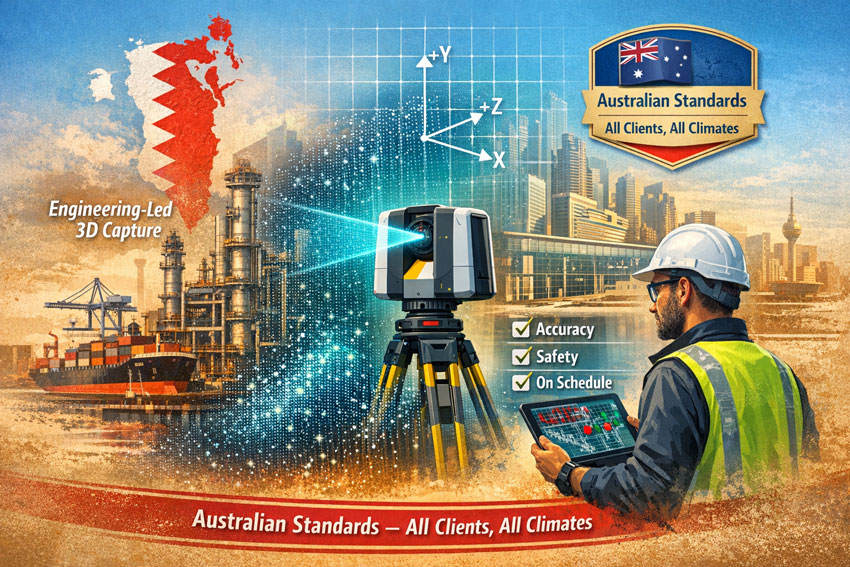
Watercolour illustration of 3D LiDAR laser scanning in Bahrain showing engineers capturing an industrial site with a scanner and tablet, styled in Bahrain flag colours with Australian quality standards message.

3D LiDAR Laser Scanning Services in Bahrain | Australian Standards

Engineering Certainty Through Measured Reality

Bahrainโ€™s construction, industrial and infrastructure sectors are evolving rapidly. Successful projects depend on accurate knowledge of existing conditions rather than historical drawings or assumptions. 3D LiDAR laser scanning services in Bahrain provide that verified foundation.

Hamilton By Design delivers engineering-led 3D LiDAR scanning services in Bahrain, capturing complex facilities and structures with millimetre precision so that design, analysis and construction can proceed from fact.


Verification Before Calculation

Many Bahrain projects involve brownfield environments where documentation no longer reflects reality. Modifications, corrosion, settlement and incremental upgrades create risk for designers and contractors.

Terrestrial LiDAR scanning enables:

  • Objective measurement of existing assets
  • Accurate tie-ins for new works
  • Reduction of site variations
  • Shorter shutdown durations
  • Remote engineering collaboration
  • Reliable prefabrication

The scan is the backbone of the project.
The quality of the initial capture determines the ease of every task that follows. If the backbone is compromised, even simple engineering becomes difficult.


3D laser scanning services Bahrain visual showing LiDAR capture, point cloud workflow and Australian Standards compliance in watercolour engineering style.

Engineering-Led 3D LiDAR Scanning in Bahrain

Our services are not limited to data collection. We approach every Bahrain project as engineers first, ensuring the capture supports:

  • Structural and mechanical verification
  • Constructability and access reviews
  • Interface definition for fabrication
  • Maintenance and shutdown planning
  • Risk reduction for project teams

This perspective protects project managers, engineers, designers and fabricators from decisions based on assumption.


Tailored to Your Systems

Hamilton By Design delivers vendor-neutral outputs that integrate with your existing workflows.

We tailor Bahrain LiDAR deliverables to suit your:

  • CAD platforms
  • BIM environments
  • FEA and analysis tools
  • Engineering and asset systems

Our role is to provide accurate engineering information โ€” your team chooses the software.


Australian Quality โ€“ Across All Clients and All Climates

All 3D LiDAR laser scanning services in Bahrain are delivered in accordance with:

  • Australian quality expectations
  • Australian build standards
  • Proven engineering procedures
  • Consistent methodology across all climates

Our workflows are designed for heat, humidity, coastal exposure and heavy industrial environments common to Bahrain, providing defensible and traceable data for every client.


Sectors Supported in Bahrain

  • Oil & gas and process facilities
  • Ports and marine structures
  • Commercial and mixed-use buildings
  • Transport and utilities
  • Manufacturing and logistics
  • Heritage and architectural assets

Whether the requirement is a single tie-in or a full facility digital record, the principle remains the same โ€” measure first, then engineer.


Hamilton By Design logo displayed on a blue tilted rectangle with a grey gradient background

3D LiDAR scanning and 3D modelling service button โ€” laser scanner capturing a point cloud for engineering and CAD modelling
Mechanical engineering services

The Hamilton By Design Process

  1. Investigate โ€“ High-accuracy LiDAR capture on site in Bahrain
  2. Verify โ€“ Registration and quality assurance
  3. Design โ€“ Data prepared for your engineering workflow

This structured approach ensures Bahrain projects commence with measured reality rather than interpretation.


Engage 3D LiDAR Laser Scanning Services in Bahrain

If your Bahrain project requires reliable as-built information, Hamilton By Design can mobilise to capture, process and deliver engineering-ready data aligned with Australian standards.

Start your project with certainty, not assumption.

Contact Hamilton By Design to discuss 3D LiDAR laser scanning services in Bahrain.

Name
Would you like us to arrange a phone consultation for you?
Address
3D CAD Modelling Australia service banner for Hamilton By Design

You wouldnโ€™t expect plasticine to hold up a roof

So why expect precision measurement from a low-grade scanner?

You would never expect plasticine to hold up a roof.

It is simply not designed for that purpose.

So why would you expect precision, fabrication-grade measurements from a low-grade scanner that was never intended for engineering, structural verification, or load-critical decision-making?

At Hamilton By Design, this distinction matters โ€” because the consequences of poor data do not appear on a screen.
They appear later, on site, in steel, time, cost, and risk.


The problem with โ€œone-size-fits-allโ€ scanning

The term โ€œ3D scanningโ€ is often used to describe vastly different technologies with vastly different outcomes.

A phone-based scan, poly scan, or real-estate laser capture tool is designed to:

  • Look good
  • Be fast
  • Be easy to use
  • Support visualisation and marketing

An engineering-grade laser scanner is designed to:

  • Capture true geometry
  • Provide repeatable, verifiable measurements
  • Support CAD modelling, fabrication drawings, and structural assessment

These tools are not interchangeable, even if the outputs look similar at first glance.

Visual accuracy is not structural accuracy.


When โ€œclose enoughโ€ becomes very expensive

Low-grade scanners may produce models that appear accurate, but engineering does not work on appearances.

When steel is being fabricated, installed, or retrofitted, millimetres matter.

Errors in geometry can lead to:

  • Beams that are too short to achieve adequate bearing
  • Misaligned columns or plates
  • Clashes with existing services or structure
  • Forced site modifications and rework
  • Extended shutdowns and access costs

This is why Hamilton By Design approaches scanning as an engineering input, not a visual product.

๐Ÿ‘‰ Related service: 3D Laser Scanning Services


You cannot engineer what you cannot see

Phone scans and visual capture methods only record what is visible.

They cannot:

  • Establish footing depth
  • Confirm foundation geometry
  • Identify slab thickening or edge beams
  • Verify load paths below ground

If you cannot see or verify how loads are transferred into the ground, you cannot responsibly design the structure above it.

Hamilton By Design addresses this gap through an engineering-led approach that combines:

  • Measured geometry
  • Subsurface investigation (where appropriate)
  • Structural logic and interpretation

๐Ÿ‘‰ Related service: Ground Penetrating Radar (GPR) Services
๐Ÿ‘‰ Related service: As-Built Documentation


Beam length, bearing, and support are not optional details

A structural beam does not just need to โ€œfit in the spaceโ€.

It must:

  • Span between actual supports
  • Achieve sufficient bearing length
  • Align with load-bearing elements
  • Transfer load safely and compliantly

Low-grade scanning tools often:

  • Smooth over out-of-square conditions
  • Hide offsets and construction tolerances
  • Mask inadequate support conditions

Engineering-grade scanning reveals what really exists, not what drawings or assumptions suggest.

๐Ÿ‘‰ Related service: Scan-to-CAD Modelling
๐Ÿ‘‰ Related service: Structural Drafting


Why engineering-grade scanners exist

Industrial laser scanners are not expensive or complex by accident.

They exist because engineering requires:

  • Known accuracy performance
  • Repeatable measurement results
  • Controlled registration and QA
  • Traceable geometry suitable for design and fabrication

Just as structural steel exists because plasticine cannot carry load, engineering scanners exist because consumer tools cannot provide engineering certainty.

Hamilton By Design uses engineering-grade scanners because the outcomes demand it.

๐Ÿ‘‰ Learn more: Reality Capture for Engineering


Scanning is not the outcome โ€” engineering is

At Hamilton By Design, scanning is never delivered in isolation.

It is part of a single-source engineering workflow that connects:

  • Reality capture
  • Subsurface understanding
  • CAD modelling
  • Fabrication-ready documentation

This reduces:

  • Misinterpretation of raw data
  • Risk transfer between consultants
  • Late design changes
  • Site improvisation

๐Ÿ‘‰ Related service: Mechanical Engineering Services
๐Ÿ‘‰ Related service: Fabrication Drawings


Where low-grade scanning does make sense

This is not about dismissing phone scans entirely.

They are suitable when:

  • The outcome is visualisation
  • Measurements are indicative only
  • No structural or fabrication decisions depend on the data

They are not suitable when:

  • Steel is being fabricated
  • Loads are being introduced or modified
  • Compliance and safety are required
  • Errors would surface on site

You match the tool to the consequence.


The Hamilton By Design position

Hamilton By Design exists to support projects where:

  • Accuracy matters
  • Geometry drives cost
  • Fabrication must fit first time
  • Engineering accountability is required

We do not promise โ€œquick scansโ€.
We deliver engineering confidence.

๐Ÿ‘‰ Explore projects by region:


The simple truth

You would not trust plasticine to hold up a roof.

And you should not trust a low-grade scanner to deliver precision geometry for structural or mechanical engineering.

If the outcome needs to be safe, compliant, and fit-first-time, the data must be engineered โ€” not approximated.


Next steps

If you are planning:

  • Structural modifications
  • Beam or column installation
  • Retrofit or upgrade works
  • Fabrication based on existing geometry

Talk to Hamilton By Design about engineering-grade reality capture and a workflow designed for real-world outcomes.

Hamilton By Design logo displayed on a blue tilted rectangle with a grey gradient background
3D LiDAR scanning and 3D modelling service button โ€” laser scanner capturing a point cloud for engineering and CAD modelling
Mechanical engineering services

Our clients:
Name
Would you like us to arrange a phone consultation for you?
Address