Engineering-Grade 3D Laser Scanning & Mechanical Engineering Services in Rutherford NSW

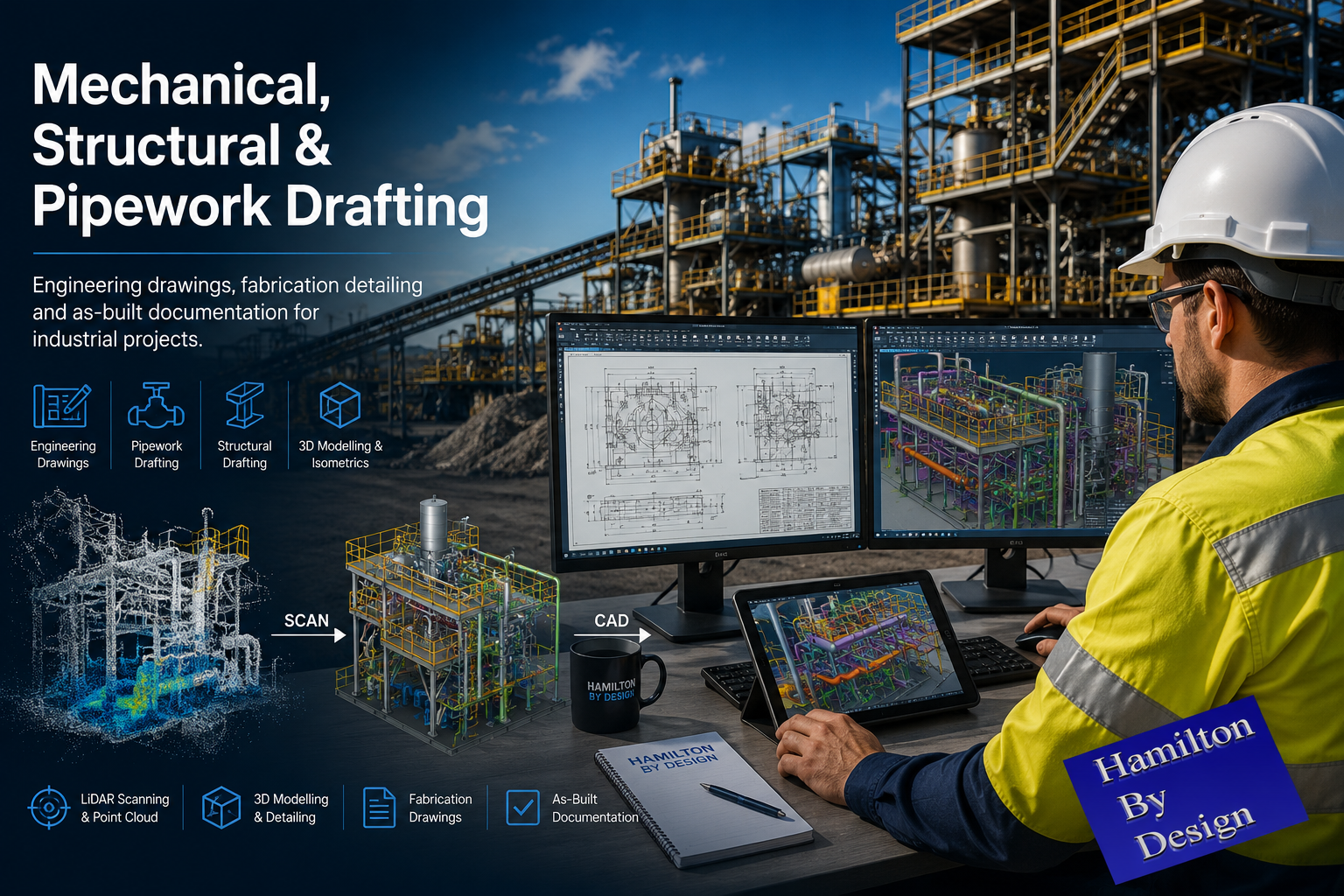
Mechanical, Structural & Pipework Drafting engineering banner showing an engineer reviewing CAD models, point cloud data and fabrication drawings for an industrial processing plant.

Rutherford NSW is one of the Hunter Region’s leading engineering, manufacturing, and mining support centres. Located within the Maitland industrial corridor and providing direct access to Newcastle, Singleton, Muswellbrook, and the Upper Hunter mining regions, Rutherford is home to a diverse range of fabrication workshops, maintenance providers, manufacturing facilities, and industrial service companies.

At Hamilton By Design, we provide engineer-led 3D laser scanning, mechanical engineering, drafting, reverse engineering, and industrial design services to support industrial operations throughout Rutherford and the broader Hunter Valley.

Supporting Rutherford’s Industrial Sector

Many facilities throughout Rutherford operate in industries such as:

  • Mining and mining services
  • Manufacturing
  • Heavy engineering
  • Fabrication
  • Bulk materials handling
  • Power generation
  • Transport and logistics
  • Industrial maintenance

As facilities grow and evolve, engineering teams often face challenges associated with outdated drawings, undocumented modifications, and the need to integrate new equipment into existing infrastructure.

Hamilton By Design helps bridge this gap by capturing accurate site information and converting it into practical engineering deliverables.

Engineering-Grade 3D Laser Scanning

Our engineering-grade LiDAR scanning services provide accurate existing-condition data for industrial projects.

We regularly scan:

  • Manufacturing facilities
  • Workshops
  • Conveyor systems
  • Transfer chutes
  • Structural steel
  • Pipework systems
  • Pump stations
  • Processing plants
  • Access platforms and walkways

Deliverables can include:

  • Registered point clouds
  • Scan-to-CAD modelling
  • Existing-condition drawings
  • Mechanical layouts
  • Structural layouts
  • Equipment models
  • Fabrication-ready drawings

Our focus is not simply creating a visual model. Our objective is to provide engineering information that can be used for design, fabrication, maintenance, and construction activities.

Mechanical Engineering & Drafting Services

Hamilton By Design provides practical engineering support for industrial facilities throughout Rutherford.

Our services include:

  • Mechanical design
  • Mechanical drafting
  • Structural drafting
  • SolidWorks modelling
  • Reverse engineering
  • Conveyor design
  • Chute design
  • Pump and piping modifications
  • Plant upgrade documentation
  • Fabrication drawing packages

Whether supporting a shutdown project, plant upgrade, equipment replacement, or brownfield expansion, we provide engineering documentation that assists contractors, fabricators, and project teams.

Reverse Engineering & Asset Documentation

Many industrial facilities operate equipment for which original drawings no longer exist.

Using a combination of LiDAR scanning, field measurements, and engineering assessment, we can develop:

  • Manufacturing drawings
  • Assembly drawings
  • General arrangement drawings
  • 3D CAD models
  • Equipment documentation
  • Asset records

This allows businesses to better manage ageing infrastructure and maintain critical equipment throughout its operational life.

Supporting the Hunter Valley Mining Industry

Rutherford is strategically positioned between Newcastle’s industrial precinct and the mining operations of the Upper Hunter.

The region supports industries including:

  • Coal mining
  • Bulk materials handling
  • Coal preparation plants
  • Power generation
  • Quarry operations
  • Heavy manufacturing
  • Rail infrastructure

Hamilton By Design understands the requirements of mining and industrial clients, providing engineering solutions that consider safety, constructability, maintenance access, and long-term asset performance.

Why Choose Hamilton By Design?

At Hamilton By Design, we are engineers first.

Our experience spans mechanical engineering, drafting, fabrication, manufacturing, maintenance, and industrial project delivery.

This means we understand the difference between simply collecting data and delivering engineering information that can be used in the real world.

Our goal is to provide practical, engineering-grade solutions that help clients reduce risk, improve project planning, and support successful project delivery.

Engineering Services for Rutherford NSW

Hamilton By Design proudly supports clients throughout Rutherford, Maitland, Newcastle, Singleton, Muswellbrook, and the wider Hunter Valley.

Our services include:

  • Engineering-grade 3D laser scanning
  • Scan-to-CAD modelling
  • Mechanical engineering
  • Mechanical drafting
  • Structural drafting
  • Reverse engineering
  • Conveyor and chute design
  • Brownfield project support
  • Shutdown planning and engineering documentation

Whether you require accurate as-built information, fabrication-ready drawings, or engineering support for an upcoming project, Hamilton By Design can assist.

Hamilton By Design – Engineering-Led 3D Laser Scanning, Mechanical Engineering, Reverse Engineering, and Industrial Drafting Services in Rutherford NSW.


Hamilton By Design logo displayed on a blue tilted rectangle with a grey gradient background
Mechanical engineering services
Mechanical, Structural & Pipework Drafting service banner by Hamilton By Design featuring white text on a blue background.

Name
Would you like us to arrange a phone consultation for you?
Address
3D LiDAR Scanning Hunter & Newcastle banner with white text on a blue background promoting engineering-grade laser scanning services for industrial, mining and infrastructure projects across the Hunter Valley and Newcastle region.
Mechanical Engineering Hunter & Newcastle banner promoting mechanical engineering services for mining, industrial plants, power generation, manufacturing and heavy industry throughout the Hunter Valley and Newcastle region.
Structural Drafting Hunter & Newcastle banner promoting structural drafting services for mining, industrial plants, power generation, manufacturing and infrastructure projects across the Hunter Valley and Newcastle region.
CHPP Engineering title graphic featuring bold white text reading "CHPP Engineering" centred on a blue rounded rectangle background.
Pipework Drafting title graphic featuring bold white text reading "Pipework Drafting" centred on a blue rounded rectangle background.
3D LiDAR Scanning for Engineering Projects title graphic featuring bold white text on a blue rounded rectangle background.
Mechanical engineering services
Australian Drafting logo featuring bold white text reading "Australian Drafting" centred on a blue rounded rectangle background.

Not All Scans, Point Clouds or Meshes Are Equal – The Hamilton By Design Philosophy

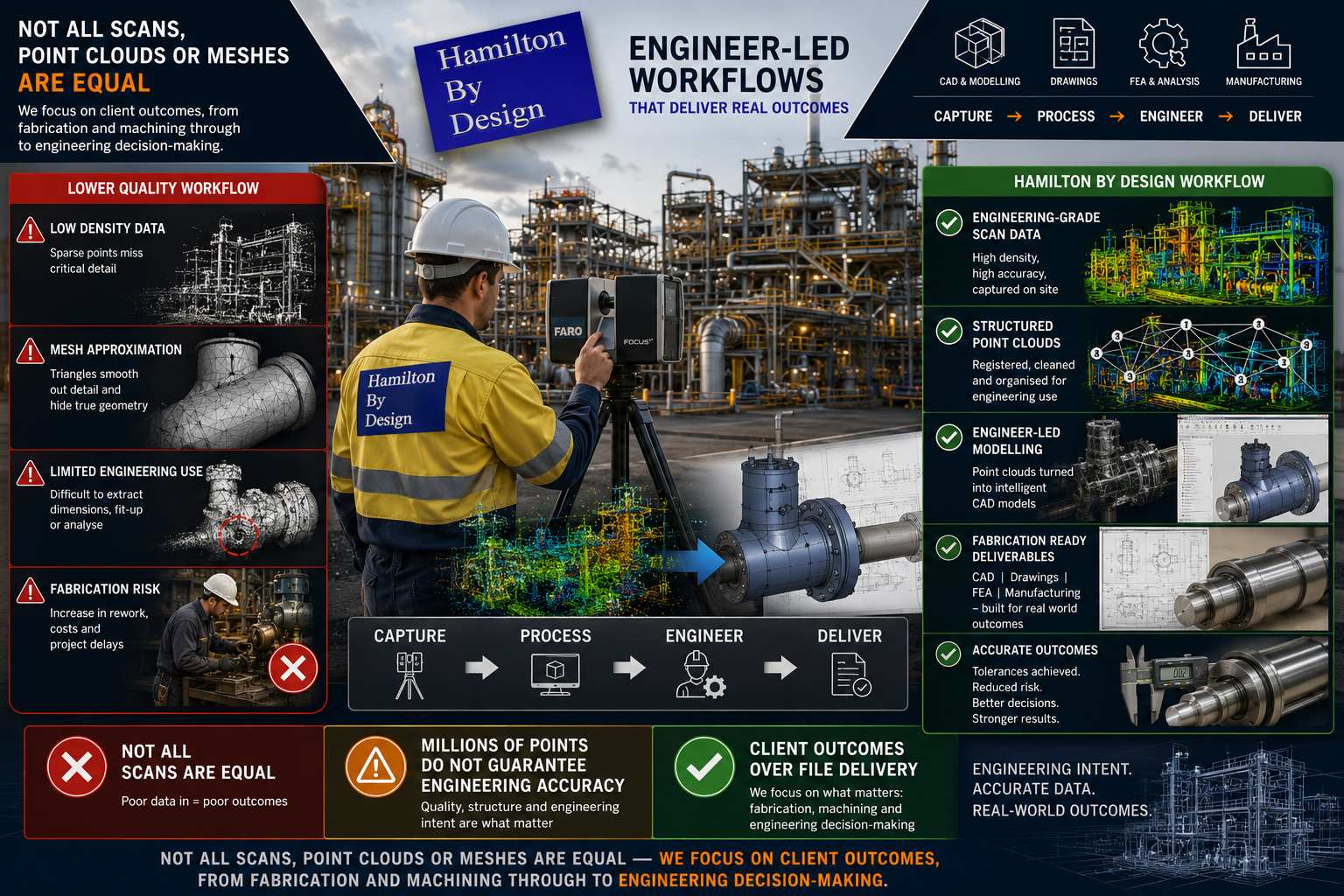
Hamilton By Design engineer-led LiDAR scanning workflow showing engineering-grade point cloud capture, CAD modelling, fabrication-ready deliverables, and comparison between low-quality scans and structured engineering data

Based on a number of enquiries received this week, we thought it would be useful to clarify and streamline the Hamilton By Design philosophy regarding engineering-grade reality capture, drafting and engineering outcomes.

Not all scans are equal.

Not all point clouds are equal.

Not all meshes are equal.

One of the biggest misconceptions in industry is that once a point cloud has been generated, or once a mesh file or STL model has been created, the engineering work is complete. In reality, capturing a scan is only the beginning of the process.

The value does not come from simply obtaining a file.

The value comes from understanding the required outcome and ensuring the data collected is appropriate for that purpose.

At Hamilton By Design, we are engineer-led and provide engineering-grade scanning and reality capture services designed around the intended engineering outcome.

Whether you require outcomes associated with:

  • Fabrication and steel fit-up
  • Mechanical drafting
  • Reverse engineering
  • Plant modifications
  • Mechanical assemblies
  • Precision machining
  • Toolmaking
  • Engineering studies and analysis

our process begins by understanding the final requirement rather than assuming one scan methodology can satisfy every project.

Because different engineering outcomes require different levels of information.

A Scan Is Not the Final Product

Many discussions begin with questions such as:

“Can you provide a point cloud?”

“Can you create a mesh?”

“Can you provide an STL file?”

These are important questions; however, they often miss the larger engineering discussion.

The better question is:

What are you trying to achieve?

The same scan dataset may be used for several completely different purposes:

  • General plant layouts
  • Fabrication fit-up
  • Reverse engineering
  • Structural modifications
  • Mechanical assemblies
  • Existing condition verification
  • Bearing and shaft measurements
  • Precision tooling

The level of detail required for these outcomes can vary significantly.

A dataset that may be suitable for one application may be completely unsuitable for another.

Drafting Is More Than Drawing Lines

Modern industrial drafting has evolved considerably.

A capable draftsperson or designer should understand:

  • Point cloud datasets
  • Mesh and STL files
  • Scan quality and limitations
  • Measurable geometry development
  • CAD model generation
  • Manufacturing requirements
  • Installation requirements
  • Practical engineering considerations

The objective is not simply creating a drawing.

The objective is converting real-world conditions into useful engineering information.

Drafting Should Understand Manufacturing Reality

At Hamilton By Design we believe drafting extends beyond geometry displayed on a screen.

Strong design outcomes often come from understanding how components are actually manufactured, assembled and maintained.

Experience or understanding in areas such as:

  • Fabrication
  • Machining
  • Toolmaking
  • Manufacturing processes
  • Site installation
  • Plant maintenance

can significantly improve engineering decisions.

Understanding manufacturing realities affects:

  • Material selection
  • Weld access
  • Machining stock allowances
  • Tolerances
  • Assembly methods
  • Maintenance requirements
  • Manufacturing costs

A component may appear correct in CAD while still creating practical manufacturing issues.

Questions still need to be asked:

  • Can the component actually be manufactured?
  • Can welding equipment physically access the location?
  • Is sufficient machining stock available?
  • Can bearings be assembled correctly?
  • Can maintenance personnel access components?

Good drafting is not simply producing drawings.

Good drafting understands the complete journey from concept through to manufacture and operation.

Data Quality In = Data Quality Out

At Hamilton By Design we regularly work with:

  • Engineering-grade point clouds
  • Surface meshes
  • STL datasets
  • Reverse engineered components
  • Existing CAD models

One engineering principle remains consistent:

You cannot create information that was never captured.

Software may improve visual appearance and optimise workflows; however, software cannot accurately create missing information.

Examples include:

  • Higher point density generally captures more geometric detail
  • Lower point density captures less information
  • Reduced mesh resolution removes geometric definition
  • STL files can contain smoothing effects
  • Mesh reduction can remove critical engineering features

Reducing points reduces available information.

At some point, a measured representation becomes an approximation.

Bigger Data Sets Are Not Always Better

Many people assume larger datasets automatically create better outcomes.

The reality is there is a balance between detail and practicality.

Large datasets may increase:

  • Processing time
  • Storage requirements
  • Hardware demands
  • Registration effort
  • Modelling time
  • File management complexity
  • Project delivery time

The objective should not be creating the largest point cloud possible.

The objective should be collecting sufficient information to satisfy the engineering requirement.

Greater Accuracy Usually Comes With Greater Cost

Higher accuracy requirements typically require greater effort.

As required accuracy increases, additional work may include:

  • Increased point density
  • Larger point cloud datasets
  • Higher mesh resolution
  • Additional scan positions
  • Greater registration effort
  • Increased verification requirements
  • Additional modelling effort
  • More engineering review

As detail increases:

  • File sizes increase
  • Processing requirements increase
  • Engineering effort increases
  • Costs may increase

The objective should not be maximum data.

The objective should be the correct data.

One Project Can Contain Multiple Tolerances

One of the most common misunderstandings is assuming an entire project operates under one tolerance requirement.

Real engineering projects rarely operate this way.

Consider a pulley assembly.

The fabricated support structure, guards and mounting arrangement may comfortably operate within fabrication tolerances of:

Approximately ±2 mm

However, the same assembly may also include:

  • Shaft diameters
  • Bearing journals
  • Keyways
  • Bearing fits
  • Machined interfaces

These features may require significantly tighter dimensional control.

Typical examples include:

Fabrication and steel fit-up
Approximately ±2 mm

Machined components and mechanical interfaces
Approximately ±0.1 mm

Precision tooling and specialised manufacturing
Potentially <0.1 mm

A fabricator and a toolmaker are not working to the same expectations.

Applying toolmaking tolerances to general fabrication may unnecessarily increase complexity and cost.

Likewise, applying fabrication assumptions to precision-machined components may create significant issues.

One mesh does not automatically solve every engineering requirement.

The Hamilton By Design Approach

At Hamilton By Design we work backwards from the final outcome.

Questions we commonly ask include:

  • Is the project for fabrication?
  • Is machining required?
  • Is reverse engineering required?
  • Is there a critical bearing or shaft interface?
  • Is this for plant modifications?
  • Is this for a precision component?
  • Is this for engineering studies?

These answers determine:

  • Scan methodology
  • Point cloud density
  • Registration strategy
  • Modelling approach
  • Verification requirements
  • Engineering effort
  • Final deliverables

We focus on providing the right information at the right level for the intended purpose.

Because engineering-grade scanning is not about creating the biggest point cloud.

Engineering-grade scanning is not about creating the largest mesh.

Engineering-grade scanning is about producing reliable information that supports real-world engineering outcomes.

Hamilton By Design logo displayed on a blue tilted rectangle with a grey gradient background

Our clients

3D LiDAR scanning and 3D modelling service button — laser scanner capturing a point cloud for engineering and CAD modelling
Mechanical engineering services
Finite Element Analysis (FEA) engineering simulation button
Mechanical engineering services
Name
Would you like us to arrange a phone consultation for you?
Address
3D CAD Modelling Australia service banner for Hamilton By Design
Australian Drafting logo featuring bold white text reading "Australian Drafting" centred on a blue rounded rectangle background.
Engineering Governance title graphic featuring bold white text reading "Engineering Governance" centred on a blue rounded rectangle background.
Mechanical, Structural & Pipework Drafting service banner by Hamilton By Design featuring white text on a blue background.
Mechanical engineering services
Blue rounded button with the text “SolidWorks Design” in white.
Finite Element Analysis (FEA) engineering simulation button
3D LiDAR Scanning Darwin for engineering surveys, laser scanning, reality capture and point cloud modelling services
3D LiDAR Scanning Australia engineering services for laser scanning, reality capture, scan-to-CAD, Scan-to-BIM and as-built documentation across Australia
3D LiDAR scanning services on the Central Coast providing engineering-grade laser scanning, point cloud capture, scan-to-CAD modelling and industrial reality capture for infrastructure and industrial projects.
3D LiDAR Scanning Perth for engineering surveys, laser scanning, reality capture and point cloud modelling services
3D LiDAR Scanning Sydney for engineering surveys, laser scanning, reality capture and point cloud modelling services
3D LiDAR Scanning Brisbane for engineering surveys, laser scanning, reality capture and point cloud modelling services
3D LiDAR Scanning Canberra for engineering surveys, laser scanning, reality capture and point cloud modelling services
3D LiDAR Scanning Newcastle for engineering surveys, laser scanning, reality capture and point cloud modelling services
3D LiDAR Scanning Adelaide for engineering surveys, laser scanning, reality capture and point cloud modelling services

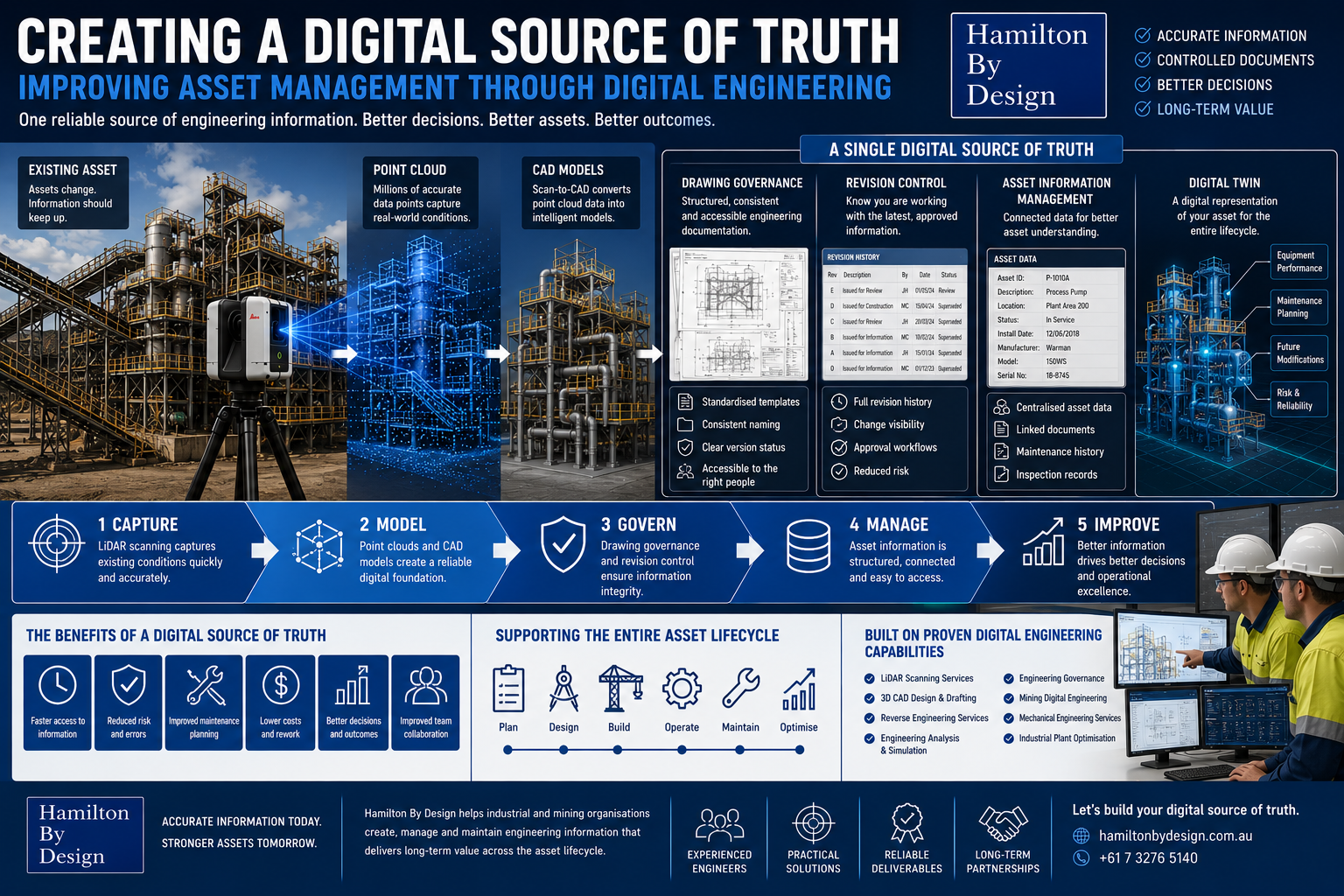
Creating a Digital Source of Truth: Improving Asset Management Through Digital Engineering

Engineering-grade LiDAR scanning and digital engineering workflow showing how a digital source of truth improves long-term asset management.

Industrial assets change over time. Equipment is upgraded, drawings are revised, platforms are modified, components are replaced, and maintenance activities gradually reshape the plant.

When engineering information is spread across old drawings, uncontrolled PDFs, manual mark-ups, spreadsheets, and individual folders, asset management becomes harder than it needs to be.

A digital source of truth helps bring engineering information together so teams can make decisions using reliable, current, and controlled data.

At Hamilton By Design, we support digital engineering asset management by combining LiDAR scanning, CAD modelling, drawing governance, revision control, and digital engineering workflows.

What is a Digital Source of Truth?

A digital source of truth is a controlled location where accurate engineering information can be stored, managed, accessed, and updated.

It may include:

  • Engineering drawings
  • CAD models
  • Point cloud data
  • Asset information
  • Revision history
  • Inspection records
  • Fabrication documentation
  • Engineering reports

The goal is simple:

One reliable place for engineering information.

Why Asset Information Management Matters

Poorly controlled information can create:

  • Outdated drawings
  • Duplicate files
  • Missing revisions
  • Conflicting information
  • Fabrication errors
  • Shutdown delays
  • Maintenance confusion

Good asset information management improves:

  • Decision making
  • Project planning
  • Maintenance efficiency
  • Drawing control
  • Long-term asset performance

Digital Engineering Workflows

Hamilton By Design can support workflows such as:

  • Engineering-grade LiDAR scanning
  • Existing condition capture
  • Point cloud generation
  • Scan-to-CAD conversion
  • CAD modelling
  • Engineering drawings
  • Revision-controlled documentation
  • Digital asset records

This turns real-world site information into usable engineering data.

Drawing Governance and Revision Control

Drawing governance helps ensure the right people are using the right information.

This includes:

  • Controlled drawing revisions
  • Clear document naming
  • Updated engineering records
  • Managed mark-ups
  • Approval workflows
  • Accessible project information
3D CAD Modelling Australia service banner for Hamilton By Design

Without revision control, teams may unknowingly use superseded drawings.

Digital Twins and Long-Term Asset Management

A digital twin does not need to start as a complex system. For many industrial sites, it begins with accurate geometry, controlled drawings, and reliable asset records.

Digital engineering can support:

  • Plant upgrades
  • Maintenance planning
  • Shutdown preparation
  • Reverse engineering
  • Engineering analysis
  • Future modifications

Long-Term Operational Efficiency

A digital source of truth can reduce:

  • Time spent searching for drawings
  • Rework caused by outdated information
  • Repeated site measurements
  • Fabrication errors
  • Project uncertainty

It can improve:

  • Maintenance planning
  • Engineering confidence
  • Asset visibility
  • Operational efficiency
  • Project delivery

How Hamilton By Design Supports This

Hamilton By Design supports digital engineering asset management through:

  • 3D CAD Design & Drafting
  • Engineering Governance
  • LiDAR Scanning Services
  • Industrial Plant Optimisation
  • Engineering Analysis & Simulation
  • Mining Digital Engineering
  • Mechanical Engineering Services
  • Reverse Engineering Services

The objective is not just to create drawings or models.

The objective is to create engineering information that remains useful throughout the asset lifecycle.

3D LiDAR scanning and 3D modelling service button — laser scanner capturing a point cloud for engineering and CAD modelling
Mechanical engineering services

Conclusion

Industrial asset management depends on reliable information.

A digital source of truth helps organisations move from scattered documents and outdated drawings toward controlled, current, and usable engineering data.

Better information supports better asset decisions.

Hamilton By Design logo displayed on a blue tilted rectangle with a grey gradient background

Our Clients:

Name
Would you like us to arrange a phone consultation for you?
Address
3D CAD Modelling Australia service banner for Hamilton By Design
Australian Drafting logo featuring bold white text reading "Australian Drafting" centred on a blue rounded rectangle background.
Engineering Governance title graphic featuring bold white text reading "Engineering Governance" centred on a blue rounded rectangle background.
Mechanical, Structural & Pipework Drafting service banner by Hamilton By Design featuring white text on a blue background.
Mechanical engineering services
Blue rounded button with the text “SolidWorks Design” in white.
Finite Element Analysis (FEA) engineering simulation button
3D LiDAR Scanning Darwin for engineering surveys, laser scanning, reality capture and point cloud modelling services
3D LiDAR Scanning Australia engineering services for laser scanning, reality capture, scan-to-CAD, Scan-to-BIM and as-built documentation across Australia
3D LiDAR scanning services on the Central Coast providing engineering-grade laser scanning, point cloud capture, scan-to-CAD modelling and industrial reality capture for infrastructure and industrial projects.
3D LiDAR Scanning Perth for engineering surveys, laser scanning, reality capture and point cloud modelling services
3D LiDAR Scanning Sydney for engineering surveys, laser scanning, reality capture and point cloud modelling services
3D LiDAR Scanning Brisbane for engineering surveys, laser scanning, reality capture and point cloud modelling services
3D LiDAR Scanning Canberra for engineering surveys, laser scanning, reality capture and point cloud modelling services
3D LiDAR Scanning Newcastle for engineering surveys, laser scanning, reality capture and point cloud modelling services
3D LiDAR Scanning Adelaide for engineering surveys, laser scanning, reality capture and point cloud modelling services

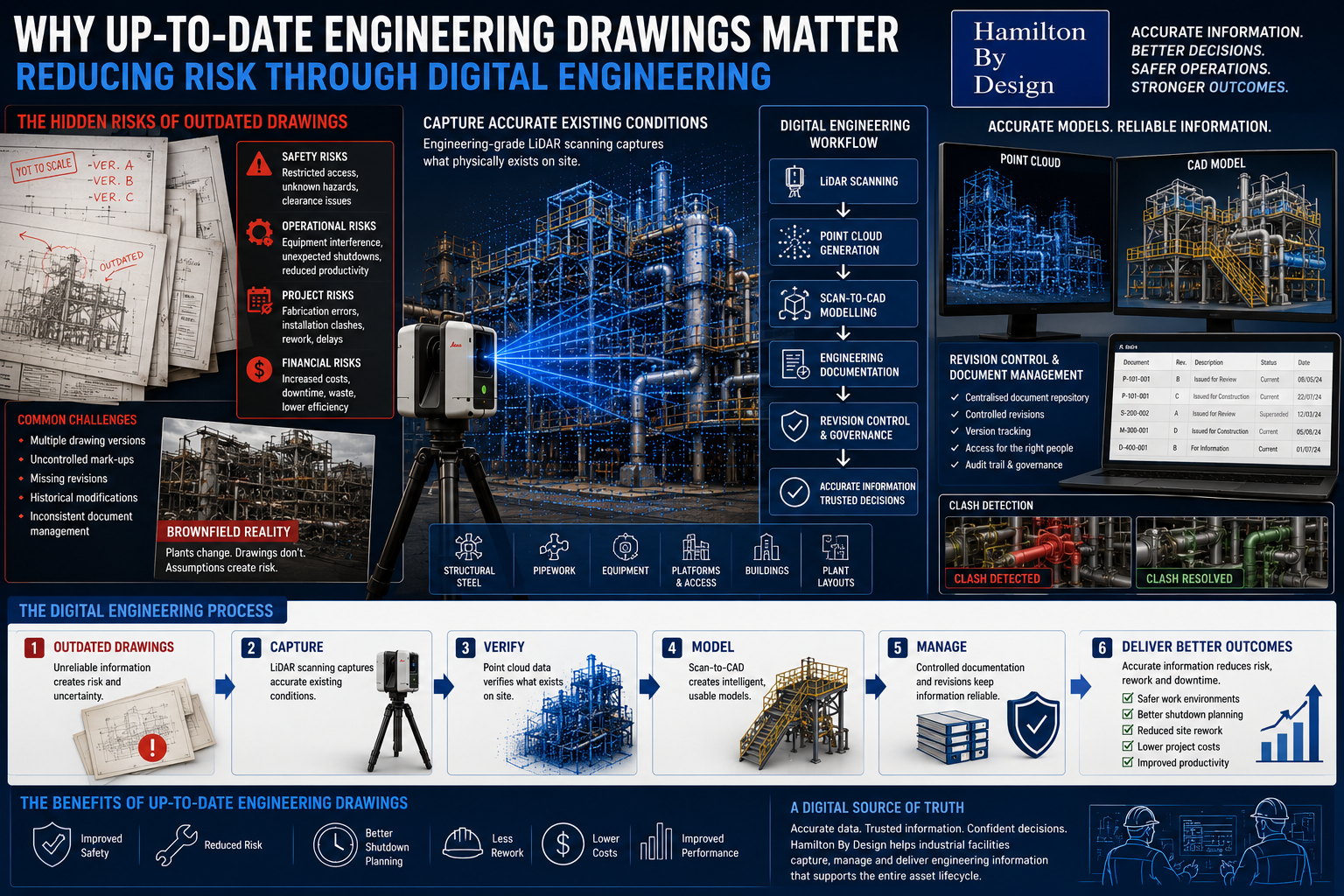
Why Up-to-Date Engineering Drawings Matter: Reducing Risk Through Digital Engineering

Engineering-grade LiDAR scanning and digital engineering workflow showing how updated engineering drawings reduce project risk and improve asset management.

Industrial facilities rarely remain unchanged throughout their operating life. Equipment is upgraded, structural modifications occur, pipework is rerouted, platforms are added, and maintenance-driven changes become part of everyday operations.

Over time, these modifications can create a disconnect between what exists on site and what engineering documentation says exists.

When engineering drawings no longer accurately represent site conditions, the consequences can extend beyond inconvenience. Outdated information can introduce operational risk, safety concerns, project delays, and increased costs.

At Hamilton By Design, we believe engineering decisions should be based on accurate, measured information rather than assumptions.

Digital engineering workflows help transform existing assets into reliable engineering information that supports safer and more efficient project outcomes.

Why Engineering Drawings Matter

Engineering drawings provide more than dimensions and layouts.

They support:

  • Equipment maintenance
  • Plant upgrades
  • Shutdown activities
  • Fabrication works
  • Safety planning
  • Operational decisions
  • Future modifications

Drawings often become the primary source of information used by:

  • Engineers
  • Maintenance personnel
  • Project teams
  • Contractors
  • Fabricators
  • Operations personnel

If the information is incorrect, downstream decisions may also become incorrect.

3D CAD Modelling Australia service banner for Hamilton By Design

Risks Created by Outdated Drawings

Even relatively small discrepancies between site conditions and engineering documentation can create significant problems.

Potential risks include:

Safety Risks

Outdated information may create:

  • Restricted access areas
  • Unidentified hazards
  • Clearance issues
  • Manual handling challenges
  • Unsafe work conditions

Operational Risks

Incorrect information can contribute to:

  • Equipment interference
  • Unexpected shutdown activities
  • Reduced productivity
  • Increased maintenance complexity

Project Risks

Engineering teams may encounter:

  • Fabrication errors
  • Installation clashes
  • Rework requirements
  • Increased labour costs
  • Schedule delays

Financial Risks

Minor inaccuracies can result in:

  • Increased project costs
  • Extended downtime
  • Material waste
  • Reduced project efficiency

Drawing Revisions and Version Control

Many industrial facilities operate using drawings developed over long periods of time.

Common challenges include:

  • Multiple drawing versions
  • Uncontrolled mark-ups
  • Missing revisions
  • Historical modifications
  • Inconsistent document management

Without effective version control, personnel may unknowingly use outdated information.

Digital engineering workflows support:

  • Revision tracking
  • Controlled updates
  • Centralised documentation
  • Improved information accessibility
  • Better engineering governance

Maintaining a controlled environment for engineering information helps reduce risk.

Existing Condition Capture

One of the most effective methods of maintaining drawing accuracy is capturing what physically exists on site.

Hamilton By Design supports projects through engineering-grade 3D LiDAR scanning to capture:

  • Structural steel
  • Pipework
  • Platforms
  • Mechanical equipment
  • Buildings
  • Existing plant layouts
  • Access systems

Existing condition capture allows engineering teams to work with measured information rather than assumptions.

Brownfield Projects Create Additional Challenges

Brownfield environments commonly include:

  • Historical modifications
  • Legacy equipment
  • Congested layouts
  • Existing structures
  • Limited access areas
  • Undocumented changes

Original documentation often no longer reflects actual site conditions.

Using inaccurate information during brownfield projects can increase:

  • Design uncertainty
  • Installation difficulties
  • Rework
  • Shutdown impacts
  • Fabrication risk

Engineering Governance and Digital Engineering

Digital engineering supports a structured approach to managing engineering information.

Engineering governance may include:

  • Revision control systems
  • Centralised documentation
  • Scan-to-CAD workflows
  • Digital asset information
  • Controlled engineering updates
  • Long-term information management

The objective is creating a digital source of truth where project teams can access reliable information.

Supporting Shutdown Planning

Shutdown periods are often constrained by:

  • Time limitations
  • Labour availability
  • Production requirements
  • Safety considerations

Incorrect engineering information during shutdowns can create:

  • Unexpected site modifications
  • Delays
  • Increased labour requirements
  • Reduced productivity

Accurate digital engineering information supports:

  • Improved planning
  • Better coordination
  • Reduced uncertainty
  • Reduced downtime

Reducing Site Rework

Site rework often results from discovering problems after fabrication or installation begins.

Typical causes include:

  • Missing dimensions
  • Existing condition inaccuracies
  • Equipment clashes
  • Incorrect assumptions
  • Documentation errors

Digital workflows including:

  • Existing condition capture
  • Point cloud modelling
  • Scan-to-CAD processes
  • Clash detection

can help identify issues before they become site problems.

How Hamilton By Design Supports Digital Engineering

Hamilton By Design combines engineering experience with digital workflows including:

  • Engineering-grade 3D LiDAR scanning
  • Existing condition capture
  • Scan-to-CAD workflows
  • CAD modelling
  • Engineering documentation
  • Engineering governance
  • Fabrication-ready deliverables

The goal is not simply creating drawings.

The goal is creating reliable engineering information that supports better operational decisions.

3D LiDAR scanning and 3D modelling service button — laser scanner capturing a point cloud for engineering and CAD modelling
Mechanical engineering services

Better Information Creates Better Outcomes

Drawings influence every stage of an asset lifecycle.

When information becomes outdated, risk increases.

Maintaining accurate engineering documentation supports:

  • Safety improvements
  • Reduced project risk
  • Better shutdown outcomes
  • Reduced rework
  • Improved operational performance

Up-to-date engineering drawings create confidence across engineering, maintenance, and project delivery activities.

Hamilton By Design logo displayed on a blue tilted rectangle with a grey gradient background

Our Clients:

Name
Would you like us to arrange a phone consultation for you?
Address
Finite Element Analysis (FEA) engineering simulation button
Mechanical engineering services

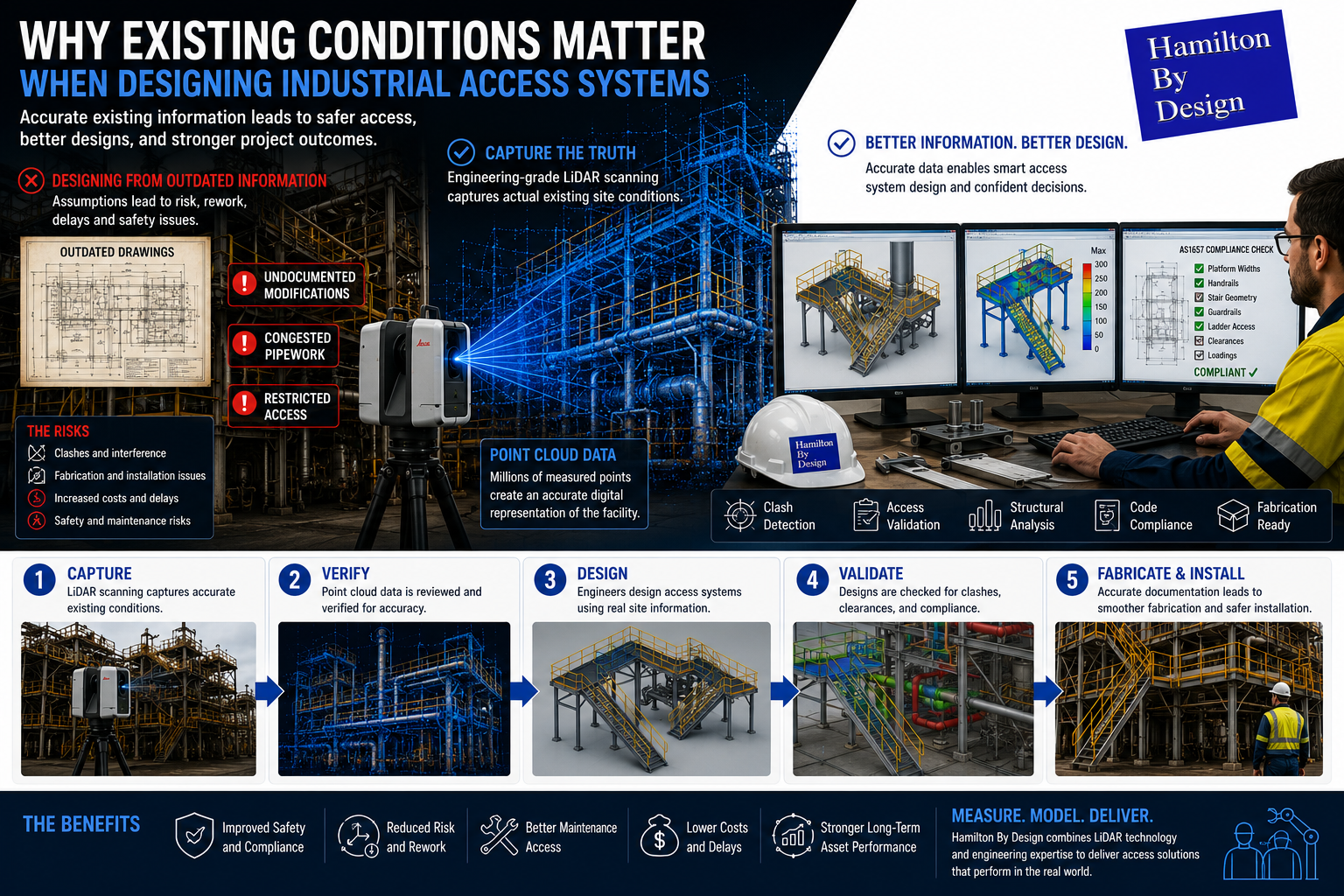
Why Existing Conditions Matter When Designing Industrial Access Systems

Engineering-grade LiDAR scanning and CAD workflow showing existing condition capture for industrial access system design.

Industrial access systems are often viewed as secondary structures within a facility. Platforms, walkways, stairways, and ladders are frequently designed around existing equipment after primary process systems have already been established.

However, in industrial environments, access systems directly influence:

  • Worker safety
  • Maintenance efficiency
  • Equipment accessibility
  • Shutdown activities
  • Project cost
  • Long-term operational performance

When new access systems are designed using assumptions or outdated information, project teams can unknowingly introduce significant risk.

At Hamilton By Design, engineering decisions begin with understanding one important factor:

What actually exists on site today?

Existing condition capture provides measured information that supports safer, more efficient access system design.

Why Existing Conditions Matter

Industrial facilities rarely remain unchanged over their operational life.

Over time sites commonly experience:

  • Equipment upgrades
  • Structural modifications
  • Additional pipework
  • Maintenance repairs
  • Temporary installations becoming permanent
  • New process equipment
  • Historical undocumented changes

As facilities evolve, original engineering documentation can gradually become disconnected from actual site conditions.

This creates challenges when developing:

  • New platforms
  • Walkways
  • Stairways
  • Ladders
  • Handrails
  • Maintenance access systems

Designing around incorrect information can create downstream issues during fabrication and installation.

Risks of Designing Around Assumptions

Even relatively small dimensional differences can create larger problems during construction activities.

Potential issues may include:

Restricted Maintenance Access

Poorly positioned access systems can create:

  • Congested work areas
  • Difficult equipment access
  • Manual handling risks
  • Longer maintenance durations

Structural Interference

Undocumented changes can result in:

  • Platform clashes
  • Pipework conflicts
  • Equipment interference
  • Structural rework

Installation Difficulties

Fabricated structures designed from inaccurate information may require:

  • Site modification
  • Additional labour
  • Rework
  • Schedule changes

Safety Risks

Poor access layouts can increase:

  • Working at height exposure
  • Congested access routes
  • Maintenance hazards
  • Human factors risks
3D CAD Modelling Australia service banner for Hamilton By Design

Brownfield Facilities Create Additional Challenges

Brownfield environments are often significantly different from greenfield projects.

Typical challenges include:

  • Congested plant layouts
  • Existing structures
  • Legacy equipment
  • Historical modifications
  • Limited clearances
  • Restricted access areas

In many facilities, existing drawings may not accurately represent the current operating environment.

Designing access systems without verified information increases project uncertainty.

Existing Condition Capture Through Engineering-Grade LiDAR Scanning

Hamilton By Design supports industrial projects using engineering-grade 3D LiDAR scanning to capture actual site geometry.

Scanning may capture:

  • Structural steel
  • Existing platforms
  • Walkways
  • Pipework
  • Equipment
  • Access systems
  • Buildings
  • Operating environments

Rather than relying solely on manual measurements, engineers gain measurable spatial information.

Benefits can include:

  • Existing condition verification
  • Improved accuracy
  • Reduced assumptions
  • Reduced installation risk
  • Improved project confidence

From Point Clouds to Access System Design

Once site information is captured, scan data can be converted into engineering information through Scan-to-CAD workflows.

This allows development of:

  • Existing condition models
  • Platform layouts
  • Access systems
  • Stairways
  • Structural designs
  • Fabrication drawings

Potential issues can be identified digitally before fabrication begins.

Improving Maintenance Access

Access systems should support how equipment is maintained, not simply how equipment is installed.

Maintenance activities commonly require:

  • Equipment removal space
  • Inspection access
  • Safe movement paths
  • Tool handling areas
  • Shutdown activities

Considering these requirements early can improve:

  • Safety performance
  • Maintenance efficiency
  • Downtime reduction
  • Long-term asset performance

Supporting Engineering Compliance

Access system design frequently involves consideration of standards including:

  • AS1657 – Fixed Platforms, Walkways, Stairways and Ladders
  • AS3996 – Access Covers and Grates
  • Structural loading requirements
  • Site-specific standards

Compliance becomes more effective when based on accurate existing information.

How Hamilton By Design Supports Industrial Access Projects

Hamilton By Design supports industrial access projects through:

  • Engineering-grade 3D LiDAR scanning
  • Existing condition capture
  • Scan-to-CAD workflows
  • Mechanical and structural design
  • Engineering analysis and simulation
  • CAD modelling
  • Fabrication documentation

The objective is not simply designing platforms.

The objective is creating access systems that support safety, maintenance activities, and operational performance.

3D LiDAR scanning and 3D modelling service button — laser scanner capturing a point cloud for engineering and CAD modelling
Mechanical engineering services

Moving Beyond Assumptions

Industrial facilities evolve over time.

Successful access systems should be designed around what exists today rather than what historical drawings suggest exists.

Better existing condition information supports better engineering decisions.

Hamilton By Design logo displayed on a blue tilted rectangle with a grey gradient background

Name
Would you like us to arrange a phone consultation for you?
Address
Finite Element Analysis (FEA) engineering simulation button
Mechanical engineering services

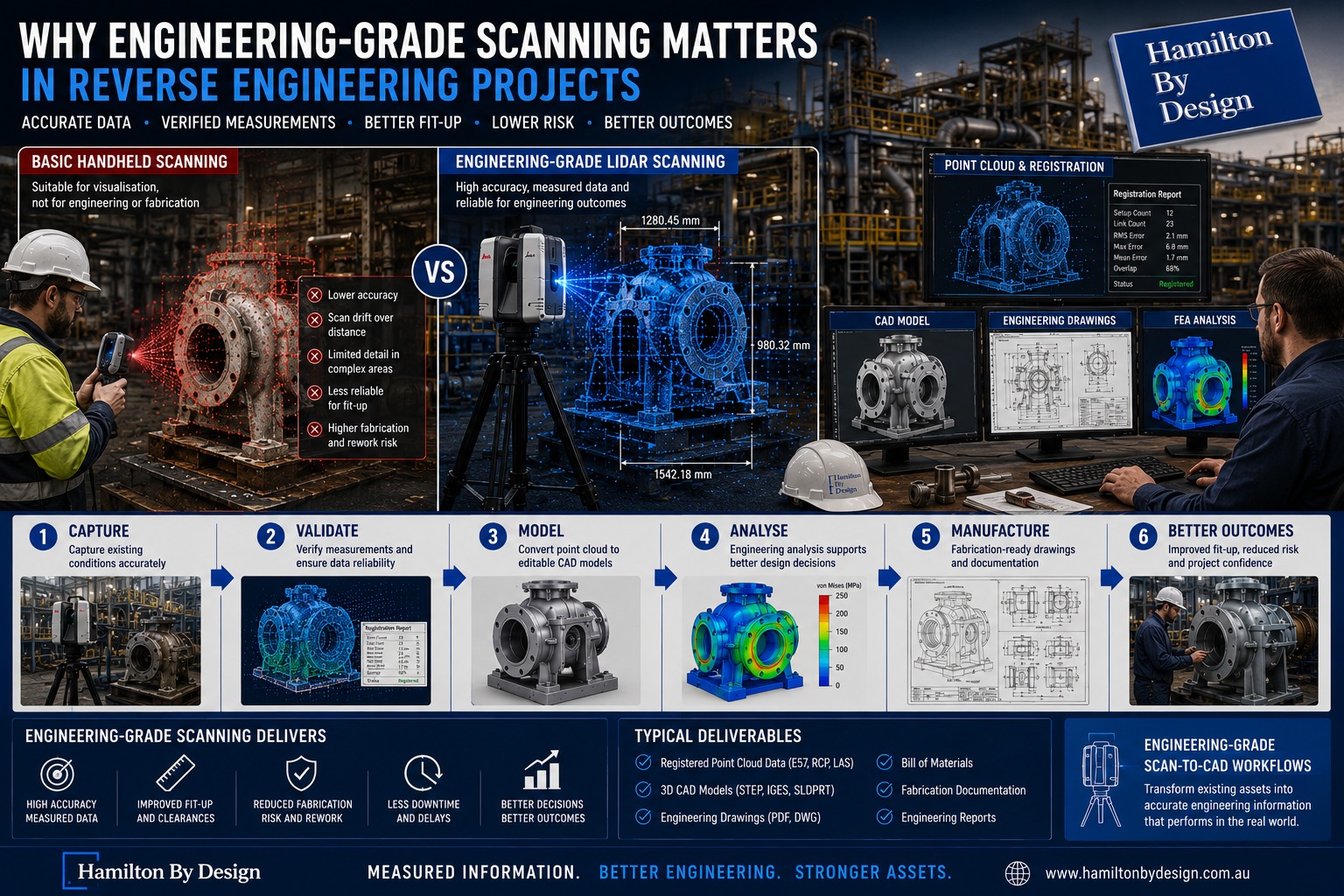
Why Engineering-Grade Scanning Matters in Reverse Engineering Projects

Engineering-grade LiDAR scanning workflow comparing basic scanning and reverse engineering processes for industrial equipment.

Reverse engineering projects often begin with a simple challenge:

“We have the component, but we do not have the engineering information.”

Mining and industrial operations frequently rely on equipment that has been modified, repaired, or operating for many years beyond original installation. Drawings may no longer exist, replacement parts may be difficult to source, and physical components may have changed from their original design.

In these situations, reverse engineering allows existing equipment to be captured and converted into usable engineering information.

However, not all scanning methods deliver the same outcome.

At Hamilton By Design, we use engineering-grade scanning workflows to support reverse engineering projects where accuracy, fit-up, and fabrication outcomes matter.

The objective is not simply creating a visual model.

The objective is creating reliable engineering information.

Why Scanning Accuracy Matters

Reverse engineering projects frequently involve components where small dimensional variations can create significant downstream impacts.

Examples may include:

  • Pump assemblies
  • Conveyor systems
  • Transfer chutes
  • Shafts and couplings
  • Structural components
  • Wear liners
  • Mechanical assemblies

Minor dimensional errors can potentially create:

  • Misalignment
  • Installation difficulties
  • Increased wear
  • Rework
  • Downtime
  • Manufacturing delays

A model that looks correct visually may not necessarily be suitable for fabrication or engineering analysis.

For engineering projects, measured information is critical.

Handheld Scanning vs Terrestrial Scanning

Different scanning technologies are suited to different applications.

3D CAD Modelling Australia service banner for Hamilton By Design

Handheld Scanning Systems

Handheld systems may provide advantages including:

  • Rapid scanning
  • Mobility
  • Convenience
  • Fast visualisation

These systems are commonly used for:

  • Demonstrations
  • General visual models
  • Consumer products
  • Smaller objects
  • Architectural walkthroughs

However, challenges may include:

  • Drift over larger areas
  • Reduced positional control
  • Limited accuracy over extended environments
  • Difficulty in complex industrial sites

Engineering-Grade Terrestrial Scanning

Engineering-grade terrestrial LiDAR systems are typically designed for:

  • Existing condition capture
  • Industrial facilities
  • Brownfield environments
  • Structural information
  • Mechanical equipment
  • Engineering workflows

Potential benefits include:

  • High positional accuracy
  • Measured spatial relationships
  • Existing condition verification
  • Repeatable information capture
  • Better support for engineering decisions

The goal is producing information suitable for engineering use rather than visualisation alone.

Measurement Validation

Engineering workflows often require verification rather than assumptions.

Validation processes may include:

  • Dimensional checks
  • Registration reports
  • Measurement verification
  • Control point assessment
  • Existing condition review

Measurement validation helps ensure information can support:

  • Design development
  • Engineering analysis
  • Manufacturing
  • Construction activities

Confidence in the information improves confidence in the outcome.

Mechanical Fit-Up Requirements

Reverse engineering projects frequently involve equipment that must physically integrate with existing systems.

Examples may include:

  • Conveyor modifications
  • Pump replacements
  • Structural upgrades
  • Access platforms
  • Mechanical assemblies
  • Wear components

Poor fit-up can create:

  • Site rework
  • Delays
  • Fabrication changes
  • Additional labour
  • Installation difficulties

Engineering-grade capture helps reduce uncertainty before fabrication begins.

Brownfield Environments Create Additional Challenges

Brownfield facilities rarely match original documentation.

Industrial sites commonly include:

  • Historical modifications
  • Congested layouts
  • Existing pipework
  • Structural changes
  • Equipment additions
  • Limited access areas

These environments create challenges for reverse engineering because:

  • Drawings may be outdated
  • Components may differ from original designs
  • Existing clearances may be limited

Engineering-grade scanning provides measurable information from the actual operating environment.

Reducing Fabrication Risk

Fabrication errors can become expensive when discovered during installation.

Typical causes of fabrication risk may include:

  • Missing dimensions
  • Incorrect assumptions
  • Clash issues
  • Existing condition inaccuracies
  • Poor fit-up

Engineering-grade scanning can support:

  • Existing condition verification
  • Improved design development
  • Clash detection
  • Better fabrication planning
  • Reduced site modifications

Identifying problems digitally generally costs less than discovering them during installation.

How Hamilton By Design Supports Reverse Engineering Projects

Hamilton By Design combines engineering experience with digital engineering workflows including:

  • Engineering-grade 3D LiDAR scanning
  • Existing condition capture
  • Scan-to-CAD workflows
  • CAD modelling
  • Engineering drawings
  • Engineering analysis and simulation
  • Fabrication documentation
  • Mechanical engineering services

Our workflows naturally support broader engineering services including:

  • 3D CAD Design & Drafting
  • Engineering Analysis & Simulation
  • Mining Mechanical Engineering
  • Engineering Documentation & Digital Engineering
  • Industrial Plant Optimisation
  • LiDAR Scanning Services
3D LiDAR scanning and 3D modelling service button — laser scanner capturing a point cloud for engineering and CAD modelling
Mechanical engineering services

Moving Beyond Visual Models

Reverse engineering projects require more than attractive 3D models.

They require engineering information that supports:

  • Manufacturing
  • Installation
  • Reliability
  • Maintenance
  • Long-term asset management

Engineering-grade scanning helps transform physical assets into measurable engineering information that reduces risk and improves confidence in project outcomes.

Better information supports better engineering decisions.

Hamilton By Design logo displayed on a blue tilted rectangle with a grey gradient background

Our Clients:

Name
Would you like us to arrange a phone consultation for you?
Address
3D CAD Modelling Australia service banner for Hamilton By Design
Australian Drafting logo featuring bold white text reading "Australian Drafting" centred on a blue rounded rectangle background.
Engineering Governance title graphic featuring bold white text reading "Engineering Governance" centred on a blue rounded rectangle background.
Mechanical, Structural & Pipework Drafting service banner by Hamilton By Design featuring white text on a blue background.
Mechanical engineering services
Blue rounded button with the text “SolidWorks Design” in white.
Finite Element Analysis (FEA) engineering simulation button
3D LiDAR Scanning Darwin for engineering surveys, laser scanning, reality capture and point cloud modelling services
3D LiDAR Scanning Australia engineering services for laser scanning, reality capture, scan-to-CAD, Scan-to-BIM and as-built documentation across Australia
3D LiDAR scanning services on the Central Coast providing engineering-grade laser scanning, point cloud capture, scan-to-CAD modelling and industrial reality capture for infrastructure and industrial projects.
3D LiDAR Scanning Perth for engineering surveys, laser scanning, reality capture and point cloud modelling services
3D LiDAR Scanning Sydney for engineering surveys, laser scanning, reality capture and point cloud modelling services
3D LiDAR Scanning Brisbane for engineering surveys, laser scanning, reality capture and point cloud modelling services
3D LiDAR Scanning Canberra for engineering surveys, laser scanning, reality capture and point cloud modelling services
3D LiDAR Scanning Newcastle for engineering surveys, laser scanning, reality capture and point cloud modelling services
3D LiDAR Scanning Adelaide for engineering surveys, laser scanning, reality capture and point cloud modelling services