Machine Guarding in Australia: A Decade of Lessons for Leaders, Asset Owners, and Engineers

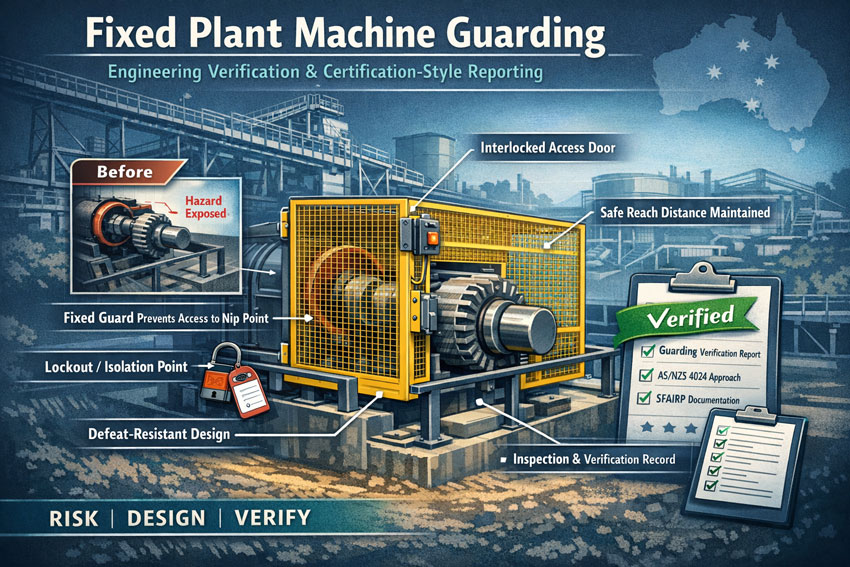
ndustrial machine guarding solutions showing a conveyor system, a robotic cell, and a belt drive with fixed guards designed to prevent access to hazardous moving parts.

Machine guarding examples showing a guarded conveyor, enclosed robotic cell, and belt drive with safety covers

3D LiDAR scanning and 3D modelling service button — laser scanner capturing a point cloud for engineering and CAD modelling
Mechanical engineering services

Machine guarding remains one of the most persistent and preventable safety risks across Australian industry.
Despite improvements in automation, safety culture, and regulatory oversight, serious injuries and fatalities involving machinery continue to occur every year, particularly in manufacturing, mining, food processing, and materials handling.

Over the past decade, regulators, courts, and insurers have consistently reinforced one message:
machine guarding is not optional, not administrative, and not a “fit-later” activity — it is a core engineering and governance responsibility.

This article examines:

  • The international and Australian standards framework for machine guarding
  • Accident and injury trends over the past ten years
  • Legal and enforcement signals emerging from prosecutions
  • Why machine guarding must be treated as a strategic asset-risk issue, not just a safety task

The Global Framework: International Standards for Machine Guarding

Machine guarding is governed globally through standards developed by the International Organization for Standardization (ISO).


ISO standards portal
Core International Standards

ISO 12100 Risk assessment

ISO 14120 Guard design

ISO 13857 Safety distances

ISO 13849-1 Interlocks & control systems

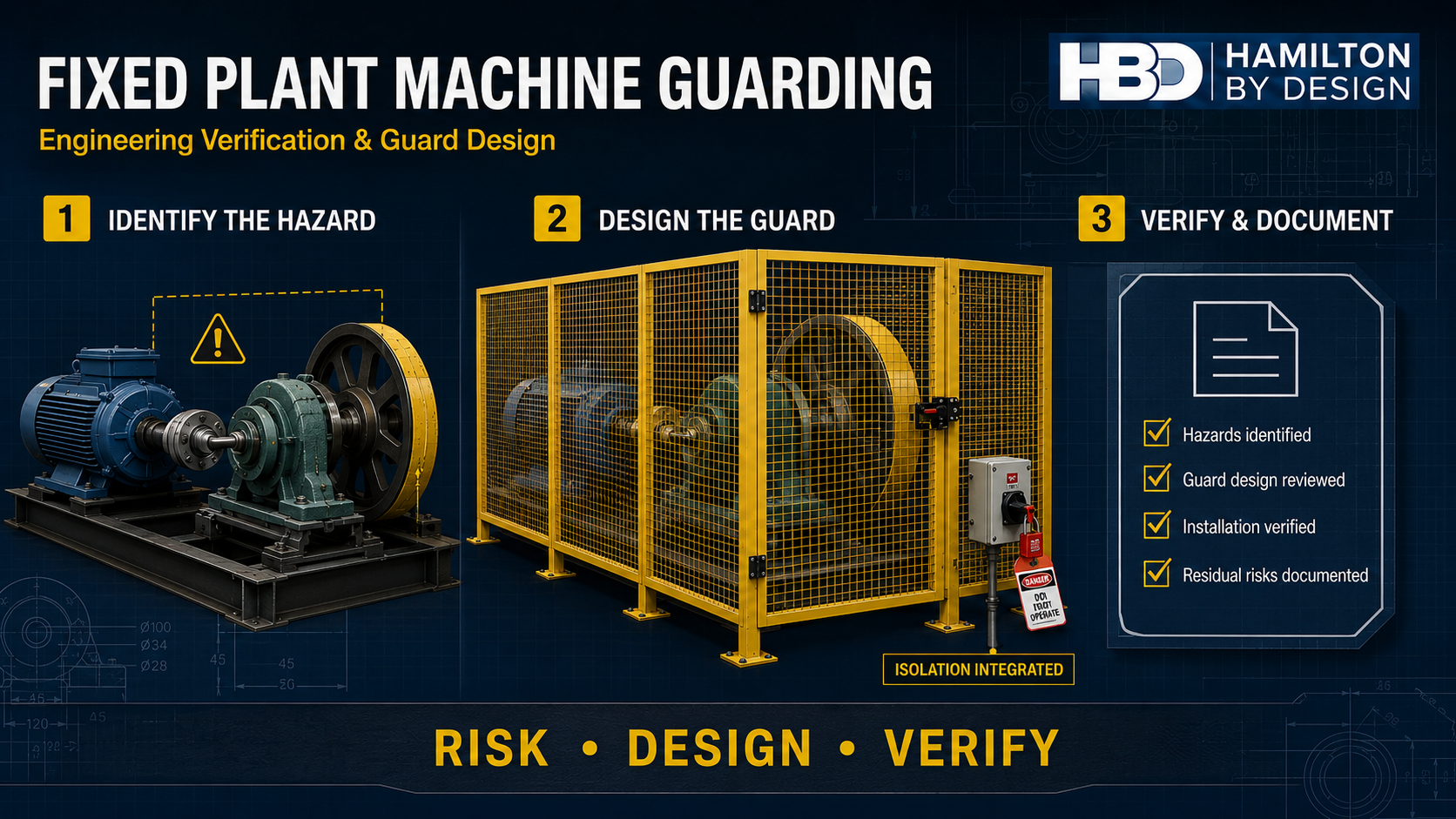
These standards establish a risk-based engineering approach, requiring hazards to be:

  1. Identified
  2. Eliminated where possible
  3. Engineered out through guards and control systems
  4. Verified through geometry, distances, and fail-safe logic

This methodology underpins CE marking, global OEM compliance, and multinational EPC project delivery.


The Australian Context: AS 4024 and WHS Expectations

Australia adopts and localises ISO principles through AS 4024 – Safety of Machinery, referenced extensively by regulators under Work Health and Safety (WHS) legislation.

Standards Australia – AS 4024 Series
Key Australian Standards

AS 4024.1201 Risk assessment

AS 4024.1601 Guards

AS 4024.1602 Interlocks

AS 4024.1801 Safety distances

AS 4024.1501 Safety control systems

While standards themselves are not legislation, courts and regulators consistently use AS 4024 as the benchmark for determining whether risks have been managed so far as is reasonably practicable.


Australia does not publish a dedicated “machine guarding accident” metric. However, national data from Safe Work Australia clearly shows machinery remains a leading cause of serious harm.

Safe Work Australia – Key WHS statistics:
National Trends (Approximate – Last 10 Years)

MetricEvidence Source
~1,850+ traumatic work fatalitiesSafework Australia
~180–200 fatalities per yearSafework Australia
Highest fatality rateMachinery operators & drivers
~130,000–140,000 serious injury claims annuallyAustralian Institute of health and welfare
Common mechanismsTrapped by machinery, struck by moving objects

Machinery operators consistently record:

  • The highest fatality rates of all occupation groups
  • Disproportionate representation in serious injury claims
  • Higher exposure to entanglement, crush, shear, and impact hazards

These mechanisms are directly linked to guarding effectiveness, not worker behaviour alone.


What Hasn’t Changed — and Why It Matters

1. Legacy Plant Remains a Key Risk

Many incidents involve:

  • Older machinery
  • Brownfield modifications
  • Equipment altered without re-engineering guarding

Australian WHS law does not grandfather unsafe plant.


2. Guarding Is Still Added Too Late

Common failures include:

  • Guards designed post-fabrication
  • Inadequate reach distances
  • Interlocks added without validated performance levels

This often leads to bypassing, removal, or unsafe maintenance practices.


3. Lack of Engineering Documentation

Post-incident investigations frequently identify:

  • No formal risk assessment
  • No justification against AS 4024 or ISO standards
  • No evidence that guarding was engineered, tested, or validated

In legal proceedings, absence of documentation is treated as absence of control.


Australian regulators (WorkSafe NSW, WorkSafe VIC, SafeWork QLD, SafeWork SA) have consistently prosecuted machine-guarding failures, particularly where:

  • Hazards were known
  • Improvement notices were ignored
  • Guards were removed or ineffective

Regulator portals:

Courts have reinforced that:

  • Training does not replace guarding
  • PPE does not replace guarding
  • Signage does not replace guarding

Guarding as a Governance Issue

For executives and boards, machine guarding intersects with:

  • Officer due diligence obligations
  • Asset lifecycle risk
  • Insurance and liability exposure
  • Business continuity and ESG performance

Well-designed guarding:

  • Reduces downtime
  • Enables safer automation
  • Improves workforce confidence
  • Creates defensible compliance positions

The Engineering Reality: Geometry Drives Compliance

Modern compliance relies on:

  • Verified reach distances
  • Measured openings and clearances
  • Validated interlock logic

This is why accurate:

  • As-built capture
  • 3D modelling
  • Engineering-grade spatial data

are increasingly essential for brownfield and high-risk plant.


Looking Ahead: The Next Decade

Trends indicate:

  • Greater scrutiny of legacy machinery
  • Stronger linkage between standards and prosecutions
  • Higher expectations for engineering evidence
  • Increased use of digital engineering to prove compliance

Organisations that integrate guarding early into engineering workflows will be better protected legally, operationally, and reputationally.


Hamilton By Design logo displayed on a blue tilted rectangle with a grey gradient background

Final Thought

Machine guarding is not about mesh and fences.
It is about engineering intent, risk ownership, and accountability.

The last decade of Australian data, prosecutions, and standards alignment is clear:
when guarding fails, the outcomes are predictable — and preventable.

Structural drafting services button
3D LiDAR scanning and 3D modelling services button
Mechanical drafting services button

Our clients:

Name
Would you like us to arrange a phone consultation for you?
Address

#Machine guarding standards Australia #Machinery safety best practices #AS/NZS 4024 machine guarding #Workplace safety machinery #Industrial safety compliance #Machine guarding lessons for engineers

Finite Element Analysis (FEA) engineering simulation button
Mechanical engineering services

Fabrication & Product Design

Light Fabrication for Residential and Commercial Applications

Hamilton By Design provides product design and fabrication development for light steel fabrication used in residential and commercial environments. This service is focused on bespoke steel products that require accurate design, clear fabrication documentation, and reliable installation outcomes.

Our work sits between concept and fabrication. We develop fabrication-ready designs that integrate with existing buildings, services, and site conditions, supporting builders, fabricators, and property owners who require confidence that components will fit first time.

This service complements our mechanical engineering, 3D scanning, and CAD capabilities and is typically engaged where off-the-shelf products are unsuitable or where site-specific conditions must be addressed early.


Engineer reviewing fabrication drawings beside a steel truck tray frame on trestles, with a fabricator working on the frame, a light commercial truck chassis waiting for installation, and a LiDAR scanner in the foreground.
3D LiDAR scanning and 3D modelling service button — laser scanner capturing a point cloud for engineering and CAD modelling
Mechanical engineering services

Design-for-Fabrication Approach

All products within this category are developed using design-for-fabrication principles. This means geometry, tolerances, fixing methods, and installation constraints are considered during design, not left to be resolved on site.

Where required, designs are informed by existing-condition data captured through our 3D scanning services:
https://www.hamiltonbydesign.com.au/home/engineering-services/3d-laser-scanning/

Design development and detailing are carried out using SolidWorks-based 3D CAD workflows to produce fabrication-ready outputs:
https://www.hamiltonbydesign.com.au/home/engineering-services/3d-cad/


Gates & Access Steel

We design bespoke gates and access steel for residential and commercial properties, tailored to site geometry, fixing conditions, and operational requirements.

Typical applications include sliding gates, swing gates, cantilever gates, pedestrian access gates, and commercial entry gates. Designs consider post fixings, ground interfaces, clearances, and integration with surrounding structures.

Related engineering capability:
https://www.hamiltonbydesign.com.au/home/engineering-services/mechanical-engineering/


Door & Window Grills

Door and window grills are often required to balance security, ventilation, and architectural intent. We develop opening-specific grill designs that suit residential retrofits and commercial refurbishments.

Products may include security door grills, window grills, decorative architectural grills, and removable systems where access or maintenance is required. Geometry and fixing are resolved during design to support clean fabrication and installation.

Supporting drafting capability:
https://www.hamiltonbydesign.com.au/home/engineering-services/structural-drafting/


Balustrades, Handrails & Guarding

Balustrades, handrails, and guarding systems are safety-critical elements commonly introduced during upgrades and renovations. We provide fabrication-ready designs for residential and commercial settings where existing conditions vary and standard systems are unsuitable.

Designs consider fixing interfaces, load paths, and integration with existing slabs, stairs, or structures.

Engineering certification can be provided where required:
https://www.hamiltonbydesign.com.au/home/engineering-services/engineering-certification/


Screens & Architectural Steel

Steel screens and feature panels are used for privacy, shading, boundary definition, and architectural expression. We design lightweight fabricated steel screens suited to balconies, courtyards, façades, and internal spaces.

Design development includes panelisation, fixing strategy, finishes, and installation sequencing to ensure the product can be fabricated and installed efficiently.

Related CAD and documentation services:
https://www.hamiltonbydesign.com.au/home/engineering-services/3d-cad-drawings/


Stairs, Ladders & Access Systems

We design light-duty stairs, ladders, and access systems for residential and commercial environments where space constraints or existing geometry require a bespoke solution.

Applications include compact staircases, mezzanine access stairs, fixed ladders, and maintenance access systems. Accurate geometry is critical, and designs are developed to suit fabrication and on-site installation.

Mechanical engineering support:
https://www.hamiltonbydesign.com.au/home/engineering-services/mechanical-engineering/


Bollards, Barriers & Protective Steel

Protective steel elements such as bollards and barriers are commonly introduced to manage vehicle movement, protect assets, and improve pedestrian safety.

We design light fabricated protective steel for car parks, commercial sites, and mixed-use developments, resolving fixing, spacing, and integration with existing pavements or structures.


Custom Frames, Brackets & Light Steel Assemblies

Many light fabrication projects involve custom brackets, frames, or small assemblies to support equipment, services, or architectural elements.

We develop fabrication-ready designs for mounting frames, brackets, skids, and small steel assemblies, ensuring interfaces with client equipment and existing buildings are clearly defined.

Supporting CAD workflows:
https://www.hamiltonbydesign.com.au/home/engineering-services/3d-cad/


Ute Trays & Light Commercial Vehicle Trays

For residential and commercial trade use, we design custom ute trays and light commercial vehicle trays where off-the-shelf solutions do not meet operational requirements.

Designs consider vehicle mounting, load distribution, accessory integration, and fabrication practicality. This service is limited to light commercial use and does not extend to heavy vehicle manufacturing.


Van & Light Commercial Vehicle Fit-Outs

We provide design support for internal van fit-outs involving light steel fabrication only. Typical applications include shelving systems, equipment mounting frames, internal partitions, and support structures.

Designs are vehicle-specific and focused on safe mounting, durability, and ease of installation.

Engineering certification can be provided where required:
https://www.hamiltonbydesign.com.au/home/engineering-services/engineering-certification/


Engineering Certification

All products within this category can be mechanically engineered and certified where required. Certification scope is defined on a project-by-project basis and may support approvals, compliance requirements, or handover documentation.

Certification services are delivered in conjunction with documented design and fabrication information.


Hamilton By Design logo displayed on a blue tilted rectangle with a grey gradient background

Scope Clarification

This service category is limited to light steel fabrication for residential and commercial applications. It does not include heavy industrial fabrication, structural building frames, or large infrastructure works.

This clear scope ensures consistent quality, reliable delivery, and alignment with fabrication-ready outcomes.


Our clients

Name
Would you like us to arrange a phone consultation for you?
Address
3D LiDAR scanning and 3D modelling service button — laser scanner capturing a point cloud for engineering and CAD modelling
Mechanical engineering services
Finite Element Analysis (FEA) engineering simulation button
Mechanical engineering services

Mining & Mineral Processing

LiDAR laser scanner capturing a mining and mineral processing plant to create an accurate 3D digital model for engineering and fabrication
Blue icon of a conveyor belt carrying material into a crusher or processing unit

We support mining and mineral processing operations with engineering-grade LiDAR scanning and mechanical design for CHPPs, conveyors, transfer stations, plant upgrades, and brownfield modifications. Our experience in live operating environments helps reduce shutdown risk, rework, and costly fabrication errors.

Mining & Mineral Processing Engineering Services

Hamilton By Design supports mining and mineral processing operations with engineering-grade LiDAR scanning, mechanical engineering, and design support for complex, live operating environments.
Our work focuses on delivering accurate existing-condition data and engineering outcomes that reduce shutdown risk, minimise rework, and support safe, efficient plant upgrades.

We work across the full project lifecycle — from early site capture and feasibility through to detailed design, fabrication support, and construction verification — with a strong emphasis on brownfield and retrofit projects where getting the geometry right is critical.


Mining Engineering Services

Our mining engineering services are built around a clear principle: engineering decisions must be based on accurate site data. We combine reality capture with mechanical engineering to support informed design, modification, and execution of mining projects.

These services support:

  • Existing asset validation
  • Upgrade and modification planning
  • Engineering design development
  • Risk reduction in live operating plants

By integrating scanning and engineering under one workflow, we provide mining teams with confidence that designs reflect real-world conditions.


Mining & Industrial Engineering

Mining operations rely on complex industrial systems that must perform reliably under demanding conditions. Hamilton By Design works at the interface between mining infrastructure and industrial plant systems, supporting projects where mechanical, structural, and operational requirements overlap.

Our experience includes:

  • Mineral processing facilities and CHPPs
  • Materials handling systems
  • Industrial plant equipment within mining sites
  • Brownfield integration and asset upgrades

This cross-disciplinary approach allows us to support mining clients with solutions that are practical, buildable, and aligned with operational constraints.


Mining Services

Our mining services focus on practical project delivery support. We work alongside site teams, engineers, and contractors to capture existing conditions, verify designs, and support construction and shutdown activities.

Typical services include:

  • Engineering-grade LiDAR and as-built capture
  • Existing condition verification
  • Design coordination support
  • Construction and installation validation

These services help reduce uncertainty on site and provide a reliable digital foundation for engineering and fabrication activities.


Mechanical Engineering in Mining

Mechanical engineering is central to the safe and efficient operation of mining assets. Hamilton By Design provides mechanical engineering support informed directly by site-captured data, ensuring designs are suitable for real operating environments.

Our mechanical engineering capabilities support:

  • Conveyors, chutes, and transfer stations
  • Plant upgrades and modifications
  • Structural and mechanical interfaces
  • Fabrication-ready design documentation

Where required, our work can be supported by engineering verification and analysis to provide additional confidence in design outcomes.


Engineering-Led, Fit-for-Purpose Outcomes

Hamilton By Design operates with a strong focus on:

  • Accuracy over assumption
  • Engineering accountability
  • Fit-first-time outcomes
  • Reduced risk in brownfield environments

By combining reality capture with mechanical engineering, we help mining and mineral processing clients move from uncertain existing conditions to confident engineering decisions.


Hamilton By Design logo displayed on a blue tilted rectangle with a grey gradient background

If you are planning a mining or mineral processing upgrade, modification, or verification project, Hamilton By Design can support your team with engineering-grade scanning and mechanical design services tailored to live operating environments.


Structural drafting services button
3D LiDAR scanning and 3D modelling services button
Mechanical drafting services button

Our clients:

Name
Would you like us to arrange a phone consultation for you?
Address
3D LiDAR scanning and 3D modelling service button — laser scanner capturing a point cloud for engineering and CAD modelling
Mechanical engineering services

3D Laser Scanning

3D LiDAR Scanning – Digital Quality Assurance

Mechanical Engineering Perth WA banner for Hamilton By Design featuring white text on a blue background.
3D Laser Scanning Perth WA banner for Hamilton By Design with white text on a blue background.
SolidWorks Perth WA banner for Hamilton By Design featuring white text on a blue background.

SolidWorks Mechanical Design Services

As-Built Drawings from a LiDAR Scanner

3D LiDAR Scanning and 3D Modelling – Hamilton By Design

3D CAD Modelling Australia service banner for Hamilton By Design
3D LiDAR scanning and 3D modelling service button — laser scanner capturing a point cloud for engineering and CAD modelling
Mechanical engineering services
3D CAD Modelling Australia service banner for Hamilton By Design
Mechanical, Structural & Pipework Drafting service banner by Hamilton By Design featuring white text on a blue background.
Australian Drafting logo featuring bold white text reading "Australian Drafting" centred on a blue rounded rectangle background.
Blue banner graphic displaying the text "Point Cloud to CAD - Australia" in large white lettering, representing point cloud processing, scan-to-CAD conversion and digital engineering services across Australia.
CHPP Engineering title graphic featuring bold white text reading "CHPP Engineering" centred on a blue rounded rectangle background.
Engineering Governance title graphic featuring bold white text reading "Engineering Governance" centred on a blue rounded rectangle background.
Mechanical engineering services
Australian Drafting logo featuring bold white text reading "Australian Drafting" centred on a blue rounded rectangle background.
https://www.hamiltonbydesign.com.au/lidar-scanning-brisbane-2
3D LiDAR Scanning Hunter & Newcastle banner with white text on a blue background promoting engineering-grade laser scanning services for industrial, mining and infrastructure projects across the Hunter Valley and Newcastle region.
Mechanical Engineering Hunter & Newcastle banner promoting mechanical engineering services for mining, industrial plants, power generation, manufacturing and heavy industry throughout the Hunter Valley and Newcastle region.
Structural Drafting Hunter & Newcastle banner promoting structural drafting services for mining, industrial plants, power generation, manufacturing and infrastructure projects across the Hunter Valley and Newcastle region.
Mechanical Engineering Perth WA banner for Hamilton By Design featuring white text on a blue background.
3D Laser Scanning Perth WA banner for Hamilton By Design with white text on a blue background.
SolidWorks Perth WA banner for Hamilton By Design featuring white text on a blue background.
Fabrication and product design services
Finite Element Analysis (FEA) engineering simulation button
3D LiDAR scanning and 3D modelling service button — laser scanner capturing a point cloud for engineering and CAD modelling
Blue rounded button with the text “SolidWorks Design” in white.
Mechanical drafting services button
Structural drafting services button

Mechanical Engineering | Structural Engineering


3D Engineering Services in Brisbane

Watercolour illustration of Hamilton By Design’s 3D engineering workflow in Brisbane, showing LiDAR scanning, point cloud data, CAD modelling, fabrication drawings and workshop steel fabrication.

Engineering-led reality capture, CAD modelling, and fabrication-ready design for Queensland industry

Hamilton By Design provides 3D Engineering Services in Brisbane by integrating engineering-grade reality capture, mechanical engineering, and fabrication-ready documentation into a single accountable workflow.

Our approach builds on proven internal capabilities in Reality Capture and Mechanical Engineering Services ensuring site conditions are accurately understood before design decisions are finalised and steel is cut.


Cartoon illustration showing an engineering-led 3D workflow in Brisbane, from laser scanning and point cloud data to CAD modelling, engineering checks, and fabrication-ready steel.

Why 3D engineering services are critical for Brisbane-managed projects

Many industrial and infrastructure projects managed from Brisbane involve brownfield assets, constrained access, and remote delivery locations. In these environments, incomplete information quickly leads to design risk.

Common challenges include:

  • Outdated or missing as-built documentation
  • Unknown interfaces between new and existing assets
  • Limited opportunities for repeat site access
  • Fabrication errors identified during installation
  • High rework and logistics costs for regional Queensland projects

While services such as

3D laser scanning in Brisbane

can accurately capture site geometry, true risk reduction only occurs when this data is interpreted through an engineering-led process. This is why Hamilton By Design focuses on
Engineering-Grade Laser Scanning rather than survey-only or visual-only capture.


What we mean by “3D Engineering Services”

At Hamilton By Design, 3D Engineering Services represent the integration of:

  1. Verified site reality
  2. Mechanical engineering judgement
  3. Fabrication-driven design intent

Point clouds are not treated as visual references. Instead, they are converted into engineering-grade CAD through our Point cloud to CAD modelling process using Solidworks CAD Modelling that reflect true as-built conditions, tolerances, and identifying interfaces.

This approach differentiates our services from marketing scans, survey deliverables without engineering accountability, and drafting workflows disconnected from site reality.


The Hamilton By Design 3D engineering workflow

Our Brisbane-based services follow a structured workflow designed to protect downstream fabrication and installation.

Engineering-grade site capture

We deploy an Engineering Grade LiDAR and Laser Scanning methods matched to the accuracy, environment, and engineering purpose of the project.

Point cloud verification and QA

Captured data is reviewed and validated to ensure it is suitable for engineering interpretation rather than visualisation alone.

Point cloud to SolidWorks CAD modelling

Verified site data is translated into SolidWorks CAD models representing real-world geometry and constraints.

Engineering interpretation and validation

Models are assessed with consideration of load paths, tolerances, clearances, and installation constraints.

Fabrication-ready deliverables

Design outputs are prepared for shop-floor use via our fabrication support services</a>,
including general arrangement drawings, detailed fabrication drawings, bills of materials, and digital QA models.


Core 3D engineering services delivered in Brisbane

Hamilton By Design provides:

  • Engineering-grade LiDAR and laser scanning
  • Point cloud to CAD modelling
  • Mechanical design and brownfield plant upgrades
  • Structural steel modelling and verification
  • Interface and clearance checks
  • Fabrication drawings and BOMs
  • Digital QA and clash detection
  • As-built documentation

Each service is delivered as part of an integrated engineering workflow designed to eliminate ambiguity before fabrication begins.


Brisbane as an engineering coordination hub for Queensland

Brisbane serves as a central coordination hub for industrial projects delivered across Queensland, including mining, energy, port, and regional processing facilities.

Hamilton By Design supports Brisbane-managed projects across:

  • Bowen Basin
  • Surat Basin
  • Gladstone
  • Townsville
  • Mount Isa

For resource-sector projects, our experience in mechanical engineering for the mining industry ensures designs remain practical, buildable, and aligned with site conditions.


Industries and assets supported

Industries

  • Mining and mineral processing
  • CHPP and bulk materials handling
  • Energy and utilities
  • Ports and logistics
  • Industrial manufacturing

Asset types

  • Conveyor systems and transfer chutes
  • Structural steel platforms and walkways
  • Pipework and mechanical assemblies
  • Brownfield plant upgrades
  • Temporary and permanent industrial structures

Our capability in structural engineering supports projects where compliance, load paths, and interfaces must be verified before fabrication.


Why Hamilton By Design

Clients engage Hamilton By Design for engineering accountability, not just technology.

Our key points of difference include:

  • Engineer-led scanning workflows
  • Single point of responsibility from scan to drawings
  • Mechanical-engineering-driven modelling
  • Fabrication-first mindset
  • Alignment with Australian engineering standards
  • Practical understanding of site and installation constraints

Our broader engineering services are designed to reduce rework, improve confidence, and protect project budgets.


Hamilton By Design logo displayed on a blue tilted rectangle with a grey gradient background
3D LiDAR scanning and 3D modelling service button — laser scanner capturing a point cloud for engineering and CAD modelling
Mechanical engineering services

Discuss a Brisbane-managed project

If you are managing an industrial or infrastructure project from Brisbane and require engineering-grade 3D data to support design, fabrication, or upgrade works, Hamilton By Design can assist.

Early engagement ensures site reality is embedded into the engineering process—reducing risk and improving project certainty.

Contact Hamilton By Design

Our clients:

Name
Would you like us to arrange a phone consultation for you?
Address
Reality Capture Brisbane title graphic with white text on a blue background promoting reality capture, LiDAR scanning and digital engineering services in Brisbane, Queensland.
3D Scanning Brisbane text graphic on a blue background promoting engineering-led laser scanning and reality capture services in Brisbane.

LiDAR Scanning Brisbane title graphic with white text on a blue background promoting terrestrial LiDAR scanning, point cloud capture and reality capture services in Brisbane, Queensland.
SolidWorks Brisbane title graphic with white text on a blue background promoting SolidWorks mechanical design, 3D CAD modelling and engineering drafting services in Brisbane, Queensland.


3D Scanning Brisbane

Engineer completing structural drafting while a LiDAR scanner captures as-built data along the Brisbane River with the Story Bridge in view

3D Scanning Brisbane | Engineering-Led LiDAR & Risk Management


We are engineers. Let us manage your risk.

3D scanning is often treated as a visual exercise. In engineering, it is a measurement task. The difference matters.

At Hamilton By Design, 3D scanning in Brisbane is approached as an engineering activity, not just data capture. Our role is to ensure the information collected on site can be safely relied upon for design, fabrication, and installation — without rework, uncertainty, or guesswork.


What People Mean When They Say “3D Scanning”

When someone searches for 3D scanning Brisbane, they are usually trying to answer one question:

“How do I measure what already exists?”

That might be to:

  • Capture existing site conditions
  • Reduce uncertainty before fabrication
  • Avoid clashes or rework on site

The challenge is that not all scanning methods actually measure geometry.


Cartoon showing a worker asking “How do I measure that?” while looking at complex pipework, illustrating the need for accurate engineering-grade 3D scanning.
3D Scanning in Brisbane – Typical Use Cases

Across Brisbane and South-East Queensland, 3D scanning is commonly used for:

  • Industrial plant upgrades and brownfield sites
  • As-built capture of steel, services, and structures
  • Fabrication completed off-site
  • Retrofit works with limited access
  • Shutdown and tie-in planning

For projects like these, scanning is typically carried out using engineering-grade laser scanning, not visual or consumer-grade tools.
3D Laser Scanning


Scanning Is Not the Same as Measuring

(Simple cartoon here: character looking at an object asking “How do I measure that?”)

Scanning is not the same as measuring.
In fabrication, we measure twice and cut once.
With the right scanner, you only need to scan once.

Many scanning tools create models that look right but are based on inferred or smoothed geometry. For engineering, appearance is not enough — the data must be measurable and accurate.


Not All 3D Scanning Is the Same

There are different ways to “scan” a site, each producing very different outcomes:

  • Phone and visual scans
    Useful for reference and visualisation, but not suitable for engineering.
  • Photogrammetry
    Good for context and large areas, but geometry is inferred rather than directly measured.
  • Engineering-grade LiDAR scanning
    Uses direct distance measurement to generate a true 3D point cloud.

Measured scan data can then be converted into usable engineering information through point cloud modelling workflows.
3D Point Cloud Modelling Brisbane


When Engineering-Grade Scanning Is Required

Engineering-grade scanning is required when:

  • Steelwork must fit first time
  • Pipework or spools are fabricated off-site
  • Structural members must be verified
  • Clearances and clashes carry cost or safety risk
  • There is only one opportunity to access the site

In these cases, scan data is typically followed by a Scan-to-CAD process, where point clouds are converted into accurate 3D models and drawings.
Scan to CAD Brisbane


Our Approach to 3D Scanning

Hamilton By Design treats scanning as part of a complete engineering workflow, not a standalone service.

Our approach includes:

  • Engineer-led scanning
  • Measurement-first mindset
  • Engineering-grade LiDAR equipment
  • Clear understanding of downstream use

By integrating scanning with mechanical engineering services, we maintain single-source accountability from site capture through to fabrication-ready deliverables.
Mechanical Engineering Services


What Happens After the Scan

3D scanning is the starting point, not the end.

Accurate scan data supports:

  • 3D CAD modelling
  • Fabrication and shop drawings
  • Structural verification
  • Clash detection and layout validation

Every downstream decision depends on the quality of the measurement captured at the start.


Talk to an Engineer Before You Scan

Many project issues begin with the wrong question:

“Can you scan this?”

The better question is:

“How do I measure this so it can be engineered?”

If you need 3D scanning in Brisbane that can safely support engineering and fabrication decisions, Hamilton By Design can help you get it right the first time.


We are engineers. Let us manage your risk.


Hamilton By Design logo displayed on a blue tilted rectangle with a grey gradient background

Our clients:

Name
Would you like us to arrange a phone consultation for you?
Address
3D LiDAR scanning and 3D modelling service button — laser scanner capturing a point cloud for engineering and CAD modelling
Mechanical engineering services
Finite Element Analysis (FEA) engineering simulation button
Mechanical engineering services

3D Point Cloud Modelling Brisbane

3D point cloud modelling Brisbane image showing LiDAR scanning of industrial pipework and steelwork, converting site conditions into CAD models and fabrication drawings.

Getting the Data Right First

Blue 3D LiDAR scanner icon on a tripod with scanning waves

Modern engineering, fabrication, and asset upgrades increasingly rely on 3D point cloud data as the foundation for design decisions. However, not all “3D scans” produce data that is suitable for engineering-grade modelling.

At Hamilton By Design, we regularly encounter projects where scanning has already been undertaken, yet the data cannot be safely relied upon for structural checks, fabrication drawings, or fit-first-time installation. The reason is simple: many common scanning technologies do not generate a true, measurable 3D point cloud.


Cartoon illustrating the difference between visual scanning and engineering-grade 3D point cloud scanning, showing how accurate scan data enables fit-first-time fabrication.

What Is a True Engineering 3D Point Cloud?

A true 3D point cloud consists of millions of directly measured XYZ coordinates, captured using survey-grade LiDAR technology. Each point represents a real, measured position in space, with known accuracy and traceable error.

This level of data is essential when:

  • Steelwork must fit without site modification
  • Pipe spools are fabricated off-site
  • Structural members must be verified
  • Clearances and clashes carry cost or safety risk

Visual models, meshes, or approximated surfaces may look correct, but without direct distance measurement and accuracy control, they cannot be relied upon for engineering.


Not All “3D Scans” Produce a Usable Point Cloud

The table below compares common capture methods against engineering-grade LiDAR scanning.
Engineering Data Comparison – 3D Capture Technologies

CriteriaPhone / App ScanPhoto-grammetryReal-Estate / Visual ScannersEngineering LiDAR (Hamilton By Design)
Direct distance measurement❌ No❌ No⚠️ Limited✅ Yes (time-of-flight)
True 3D point cloud output⚠️ Low-density❌ No (mesh only)⚠️ Filtered✅ Raw XYZ data
Global accuracy control❌ None❌ None❌ None✅ Survey-controlled
Typical usable accuracy±20–50 mm±10–30 mm±10–20 mm±1–2 mm
Consistent point density❌ No❌ No❌ No✅ Yes
Steel & reflective surfaces❌ Poor❌ Poor⚠️ Limited✅ Yes
Pipework & beam definition❌ No⚠️ Limited❌ No✅ Yes
Large industrial site capture❌ No⚠️ Limited❌ No✅ Yes
Registration error reporting❌ No❌ No❌ No✅ Yes
Suitable for fabrication drawings❌ No❌ No❌ No✅ Yes
Suitable for structural checks / FEA❌ No❌ No❌ No✅ Yes
Fit-first-time confidence❌ No❌ No❌ No✅ Yes

Why This Matters for Brisbane Projects

In Brisbane and across South-East Queensland, many projects involve:

  • Industrial plant upgrades
  • Infrastructure retrofits
  • Fabrication undertaken off-site
  • Tight shutdown windows

In these environments, millimetres matter. If a beam, pipe, or support cannot be accurately defined in the model, the risk of rework, delays, and site modification increases significantly.

Put simply:

If the data cannot reliably tell you whether something fits, clears, or carries load, it is not suitable for engineering.

Engineer-Led Point Cloud Modelling

Hamilton By Design uses engineering-grade terrestrial LiDAR scanners and an engineer-led workflow to ensure point cloud data is suitable for:

  • SolidWorks 3D modelling
  • Fabrication-ready drawings
  • Structural verification
  • Clash detection and layout validation

By controlling both data capture and modelling, we maintain single-source accountability — reducing risk and ensuring the model reflects reality.

Hamilton By Design logo displayed on a blue tilted rectangle with a grey gradient background
3D LiDAR scanning and 3D modelling service button — laser scanner capturing a point cloud for engineering and CAD modelling
Mechanical engineering services

From Scan to Shop Floor — Done Right

3D point cloud modelling is not about creating a visually impressive model. It is about creating a reliable digital representation of reality that engineers, fabricators, and contractors can trust.

If you are planning a project in Brisbane and need point cloud data that supports real engineering decisions, speak with Hamilton By Design before relying on consumer or visual-only scanning methods.

Our clients:

Name
Would you like us to arrange a phone consultation for you?
Address

3D Scanning Brisbane CBD

Finite Element Analysis (FEA) engineering simulation button
Mechanical engineering services
Reality Capture Brisbane title graphic with white text on a blue background promoting reality capture, LiDAR scanning and digital engineering services in Brisbane, Queensland.
3D Scanning Brisbane text graphic on a blue background promoting engineering-led laser scanning and reality capture services in Brisbane.

LiDAR Scanning Brisbane title graphic with white text on a blue background promoting terrestrial LiDAR scanning, point cloud capture and reality capture services in Brisbane, Queensland.
SolidWorks Brisbane title graphic with white text on a blue background promoting SolidWorks mechanical design, 3D CAD modelling and engineering drafting services in Brisbane, Queensland.