Chute Blockages and Build-Up in Mining Plants

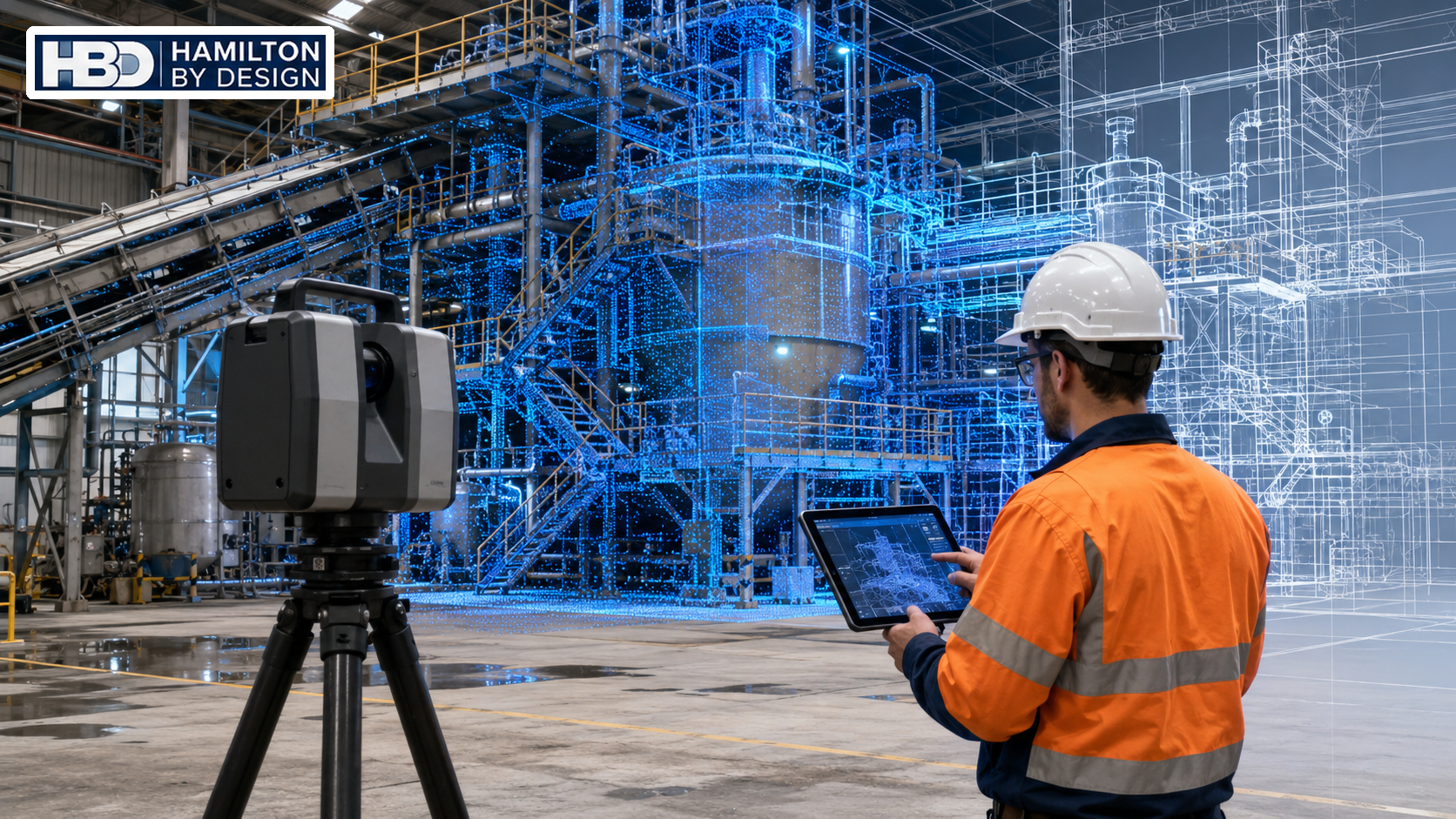
Point cloud mining infrastructure scanning connected to a 3D engineering model of a conveyor transfer chute.

Chute Blockages and Build-Up in Mining Plants | Hamilton By Design Co.

Transfer chute blockages and material build-up are some of the most common and costly problems in mining and bulk materials handling plants. A chute may look simple on paper, but in real operations it must control the flow of difficult materials under changing conditions, often within tight brownfield constraints.

When a chute begins to block, pack up, or accumulate build-up, the result is rarely limited to one small maintenance issue. Restricted flow can lead to reduced plant throughput, unplanned stoppages, excessive wear, spillage, dust, manual clean-outs, and increased shutdown risk.

At Hamilton By Design Co., we use engineering-grade 3D laser scanning, point cloud to CAD modelling, and practical mechanical design workflows to help clients understand why existing transfer chutes are failing and how those problems can be addressed with real-world upgrade solutions.

Why Transfer Chutes Block in Real Plants

A transfer chute does more than direct material from one conveyor to another. It must manage the velocity, direction, confinement, and discharge of a bulk solid that may behave very differently from day to day.

In theory, material should flow cleanly through the chute and load the receiving belt in a controlled manner. In practice, that often does not happen.

Blockages and build-up usually develop because of one or more of the following conditions:

  • Sticky or wet material
  • High fines content
  • Poor internal chute geometry
  • Dead zones or low-velocity regions
  • Sudden changes in direction
  • Inadequate clearances
  • Existing plant modifications not shown on old drawings
  • Wear plates or liners altering the internal flow path over time

This is one of the key lessons from bulk solids handling literature and modern transfer chute simulation work: a chute should be treated as a flow system, not just fabricated steelwork. If the bulk material is not guided correctly, the chute can quickly become the source of recurring reliability issues.

Common Signs of Chute Blockages and Build-Up

Many transfer chutes continue operating badly for months or years before a proper redesign is considered. The warning signs are often already there:

Frequent clean-outs

Operators or maintenance crews may need to manually remove compacted or hung-up material from inside the chute or around discharge points.

Reduced throughput

Partial restriction can reduce the chute’s effective flow area, limiting plant performance without always producing a full blockage.

Spillage and dust

As the internal flow path changes, material may discharge poorly, generating side loading, skirt leaks, and fugitive dust.

Uneven wear

Material build-up often redirects flow, concentrating abrasion and impact into localised wear zones.

Belt loading problems

A blocked or partially restricted chute can cause off-centre loading, surging, or unstable discharge onto the receiving conveyor.

Shutdown surprises

A chute that “kind of works” during operation may become a major problem during shutdown replacement or upgrade works when its actual geometry and surrounding interfaces are finally exposed.

3D laser scanner capturing a blocked mining transfer chute with a digital redesign overlay above a conveyor.

Why Old Drawings Often Do Not Tell the Full Story

One of the most common issues in brownfield mining plants is that the existing chute does not match the drawings.

Over time, sites are modified. Liners are changed. Plates are added. Wear zones are patched. Access platforms are altered. Guards move. Structural members are added or cut back. Conveyor details are updated but not always captured in the plant model.

As a result, a design team can be asked to solve a blockage problem using information that is incomplete, outdated, or simply wrong.

This is where 3D laser scanning of the existing chute and surrounding plant becomes highly valuable. Instead of relying on assumptions, the project can begin with measured site reality.

How 3D Laser Scanning Helps Diagnose Chute Problems

3D laser scanning allows existing transfer stations, chute structures, conveyors, supports, platforms, and surrounding equipment to be captured accurately as an as-built point cloud.

This gives engineers and plant teams a much better starting point for understanding blockage and build-up issues.

With a high-quality site capture, it becomes easier to:

  • Verify the true chute geometry
  • Check whether the internal chute path matches legacy drawings
  • Measure clearances around the chute and conveyors
  • Identify brownfield constraints that will affect upgrades
  • Capture surrounding steelwork, guards, supports, access ways, and services
  • Build a reliable CAD base for redesign or shutdown planning
  • Reduce fit-up risk before fabrication

For blocked or restricted transfer points, this matters because the problem is rarely isolated to one plate or one wear liner. The full transfer arrangement often needs to be understood in context.

Point Cloud to CAD for Chute Upgrade Projects

Once the existing chute and surrounding transfer area have been scanned, the point cloud can be converted into useful engineering models and drawing outputs.

Depending on project requirements, this may include:

  • Existing arrangement models
  • AutoCAD model space layouts
  • General arrangement drawings
  • Section views through critical transfer zones
  • Conveyor interface checks
  • Structural and access reference models
  • Base geometry for redesign concepts

This step is important because scanning alone does not solve the problem. The value comes from turning measured site conditions into a workable engineering model that supports analysis, redesign, communication, and project delivery.

Typical Causes of Chute Build-Up

No two plants are identical, but the same broad patterns appear again and again in mining and bulk materials handling systems.

Poor chute geometry

Flat ledges, abrupt transitions, internal obstructions, and shallow flow surfaces can create low-energy zones where material begins to hang up.

Material variability

A chute may perform reasonably with dry product but fail badly when moisture, fines content, or feed consistency changes.

Wear changing the flow path

As liners wear, the material trajectory and internal contact pattern can change. In some cases, past repairs can unintentionally make the problem worse.

Inadequate discharge control

If the material is not being guided cleanly through the chute, unstable flow can create recirculation, impact concentration, and inconsistent discharge onto the receiving belt.

Brownfield constraints

Legacy chute geometry is often shaped by what could fit at the time, not by what offered the best flow. This is especially true where upgrades have been added over many years.

A Practical Engineering Approach

At Hamilton By Design Co., we see chute blockage problems as both a materials handling issue and a brownfield engineering issue.

That means the practical workflow is often:

1. Capture the existing transfer area

We scan the chute, conveyors, structure, and surrounding plant to create an accurate as-built record.

2. Build the engineering base model

We convert the point cloud into usable CAD references for design, review, and planning.

3. Understand the real constraint

We assess what the current chute is doing, what clearances exist, and where the upgrade risks are likely to sit.

4. Support redesign and upgrade works

The as-built data can then be used to support mechanical design, chute modification concepts, shutdown planning, and fabrication fit-up.

This practical approach is especially useful where the site is already experiencing recurring clean-outs, ongoing maintenance cost, or uncertainty around existing geometry.

Where This Applies

This type of work is relevant across a wide range of bulk materials handling environments, including:

  • Coal handling plants
  • Hard rock mining operations
  • Quarry transfer systems
  • Materials handling conveyors
  • Process plant transfer stations
  • Brownfield chute replacement projects

Why This Matters

Transfer chutes are often underestimated. A poorly performing chute can quietly create lost production, repeated maintenance, high cleanup cost, and shutdown complications for years.

The real lesson from bulk solids handling practice is that a chute should not be designed or upgraded as just a fabricated box. It must be understood as part of a controlled material flow system, operating within the real physical constraints of the plant.

When those constraints are not fully understood, blockage and build-up problems tend to repeat.

That is why 3D laser scanning, point cloud to CAD modelling, and measured as-built engineering data are such valuable first steps in solving restricted or unreliable transfer points.

3D LiDAR scanning and 3D modelling service button — laser scanner capturing a point cloud for engineering and CAD modelling
Mechanical engineering services

Need Support with an Existing Chute Problem?

If your site is dealing with chute blockages, material build-up, inaccurate plant drawings, or shutdown upgrade risk, Hamilton By Design Co. can help capture the existing conditions and provide an engineering-ready base for the next stage of the project.

Hamilton By Design logo displayed on a blue tilted rectangle with a grey gradient background

We support mining and industrial clients with:

  • 3D laser scanning of existing plant
  • Point cloud to CAD conversion
  • Existing condition modelling
  • Brownfield upgrade support
  • Chute and transfer station design workflows

Contact Hamilton By Design Co. to discuss your existing chute, transfer point, or scanning requirement.

Name
Would you like us to arrange a phone consultation for you?
Address

Our clients

CHPP Engineering title graphic featuring bold white text reading "CHPP Engineering" centred on a blue rounded rectangle background.
Pipework Drafting title graphic featuring bold white text reading "Pipework Drafting" centred on a blue rounded rectangle background.
3D LiDAR Scanning for Engineering Projects title graphic featuring bold white text on a blue rounded rectangle background.
3D CAD Modelling Australia service banner for Hamilton By Design

Industrial 3D Scanning Sydney | Mining & Plant Scanning

Sydney industrial sites often involve tight shutdown windows, congested plant areas, ageing infrastructure and limited tolerance for error. Our industrial 3D scanning Sydney service helps project teams capture accurate site conditions before design, fabrication and installation begin.

At Hamilton By Design Co., we provide 3D scanning services in Sydney for mining infrastructure, conveyors, transfer chutes, processing plants, workshops and heavy industrial assets. By converting existing conditions into reliable point cloud data, we help reduce rework, improve fit-up accuracy and support better engineering decisions.

Learn more about our core Sydney scanning capability here:

Engineering-grade scanning delivers measurable geometry — not just visuals — enabling confident decision-making across design, fabrication and construction workflows.


Why Industrial 3D Scanning Matters

Industrial facilities evolve over time. Steelwork is modified, equipment is relocated, and plant layouts drift away from original drawings. This creates significant risk when new components must fit within existing infrastructure.

Our scanning process captures real-world site geometry so engineers and project teams can work from current conditions.

This is especially valuable where:

  • shutdown durations are limited
  • access is restricted
  • plant environments are congested
  • existing drawings are outdated or unreliable
  • fabrication accuracy is critical

For a broader overview of how this applies across Sydney projects:


Industrial 3D Scanning Services in Sydney

We deliver industrial 3D laser scanning in Sydney for:

  • conveyors and conveyor galleries
  • transfer chutes and discharge points
  • bins, hoppers and ore handling systems
  • processing plants and workshops
  • structural steel and support frames
  • pipework and plant interfaces
  • shutdown capture and upgrade areas

These services support engineering workflows where accurate site data feeds directly into CAD modelling, design verification and fabrication planning.


Typical Applications

Conveyor and Chute Upgrades

3D scanning captures the true geometry of existing conveyors and chutes, allowing new designs to fit correctly within tight plant constraints.

Shutdown Planning

Scan data allows detailed engineering work to continue after limited shutdown access windows — reducing risk and repeat site visits.

Brownfield Plant Modifications

For retrofit projects, scanning provides a reliable base for integrating new structures, mechanical systems and access platforms.

👉 See how scanning supports full engineering workflows:


Benefits of Industrial 3D Scanning

Using 3D scanning services in Sydney provides:

  • improved dimensional accuracy
  • reduced reliance on manual measurement
  • fewer design assumptions
  • better fit between new and existing assets
  • earlier clash detection
  • reduced fabrication and installation risk
  • stronger shutdown planning outcomes

Accurate scan data forms a reliable digital record of site conditions, supporting coordination and verification across projects.


From Site Capture to Engineering Outcomes

Our workflow moves beyond scanning into engineering use:

  • site capture using LiDAR scanning
  • registered 3D point cloud generation
  • CAD modelling and layout development
  • design validation and clash detection
  • fabrication-ready engineering outputs

This aligns with a full scan → model → engineer → build workflow used across Sydney projects.

Explore the full workflow here:


Mining and Heavy Industry Focus

This page is specifically positioned for mining, bulk materials handling and heavy industrial applications in Sydney.

Typical systems include:

  • conveyor systems
  • transfer chutes
  • processing infrastructure
  • maintenance shutdown zones
  • structural interfaces for upgrades

Hamilton By Design combines engineering expertise with LiDAR scanning and 3D modelling to support plant design, retrofits and digital engineering workflows.


Supporting Shutdowns and Plant Upgrades

Shutdown work carries high risk and tight time constraints. Accurate as-built data reduces uncertainty before fabrication and installation.

Our industrial 3D scanning Sydney service helps teams:

  • capture plant conditions before shutdown
  • validate upgrade space and constraints
  • reduce rework during installation
  • support fabrication-ready design

For full Sydney coverage and workflows:


Why Work With Hamilton By Design Co.

Hamilton By Design delivers engineering-led 3D scanning, not just data capture.

This means:

  • scan accuracy is defined by engineering requirements
  • outputs are suitable for design and construction
  • data integrates directly into CAD and engineering workflows
  • projects are supported from capture through to design

Our services are designed for real-world outcomes — helping projects fit, function and perform as intended.


Call to Action

If you need industrial 3D scanning in Sydney for conveyors, chutes, plant upgrades or shutdown planning, Hamilton By Design Co. can help.

We deliver accurate, engineering-ready site data so your team can reduce risk, improve accuracy and move forward with confidence.

Start your project here:


FAQ Section

What is industrial 3D scanning?

Industrial 3D scanning uses laser scanners to capture accurate measurements of plant, structures and equipment, creating a point cloud for engineering use.

Can you scan conveyors and transfer chutes?

Yes — conveyors, chutes and bulk materials handling systems are a core application.

Is this useful for shutdowns?

Yes — scanning allows capture during shutdown and continued engineering work afterwards.

3D LiDAR scanning and 3D modelling service button — laser scanner capturing a point cloud for engineering and CAD modelling
Mechanical engineering services

Can the data be used for CAD?

Yes — scan data supports 2D drawings, 3D models and fabrication workflows.

Hamilton By Design logo displayed on a blue tilted rectangle with a grey gradient background


3D Scanning Sydney banner promoting engineering-grade 3D laser scanning, LiDAR scanning, and reality capture services by Hamilton By Design.
Mechanical Engineering Sydney banner with white text on a blue background representing Hamilton By Design's mechanical engineering services in Sydney.
Mechanical Drafting and 3D Modelling Sydney banner highlighting Hamilton By Design's CAD drafting, 3D modelling, and engineering design services in Sydney.

Mechanical Engineering | Structural Engineering


Hamilton By Design provides engineering-led 3D scanning, LiDAR scanning, mechanical engineering and digital engineering services throughout Sydney and Greater Sydney.

Explore our related Sydney services:


  • 3D Scanning Sydney – Engineering-grade terrestrial laser scanning, as-built surveys and point cloud capture for industrial, infrastructure and commercial projects.
  • Reality Capture Sydney – High-accuracy reality capture, digital twins, asset documentation and engineering-grade site verification.
  • Scan to CAD Sydney – Convert point cloud data into AutoCAD, SolidWorks, Inventor and other engineering-ready CAD deliverables.
  • Point Cloud Modelling Sydney – Engineering-grade point cloud processing, clash detection, as-built verification and 3D modelling.
  • Mechanical Engineering Sydney – Mechanical design, plant upgrades, materials handling systems, conveyors, chutes, platforms and engineering support.
  • Structural Drafting Sydney – Structural steel drafting, fabrication drawings, GA drawings, workshop detailing and as-built documentation.

Hamilton By Design supports projects throughout Sydney CBD, Parramatta, Liverpool, Penrith, Blacktown, Chatswood, Alexandria, Mascot, Newcastle and the Central Coast.


Name
Would you like us to arrange a phone consultation for you?
Address

Our clients

CHPP Engineering title graphic featuring bold white text reading "CHPP Engineering" centred on a blue rounded rectangle background.
Pipework Drafting title graphic featuring bold white text reading "Pipework Drafting" centred on a blue rounded rectangle background.
3D LiDAR Scanning for Engineering Projects title graphic featuring bold white text on a blue rounded rectangle background.
Blue banner graphic displaying the text "Point Cloud to CAD - Australia" in large white lettering, representing point cloud processing, scan-to-CAD conversion and digital engineering services across Australia.
Blue banner graphic displaying the text "Scan to CAD Sydney" in large white lettering, representing engineering-led point cloud to CAD conversion, LiDAR scanning and digital engineering services in Sydney.
Blue banner graphic displaying the text "Reality Capture Sydney - CBD" in large white lettering, representing engineering-led reality capture, LiDAR scanning and digital engineering services within Sydney CBD commercial buildings and infrastructure.
3D CAD Modelling Australia service banner for Hamilton By Design
3D LiDAR Scanning Darwin for engineering surveys, laser scanning, reality capture and point cloud modelling services
3D LiDAR Scanning Australia engineering services for laser scanning, reality capture, scan-to-CAD, Scan-to-BIM and as-built documentation across Australia
3D LiDAR scanning services on the Central Coast providing engineering-grade laser scanning, point cloud capture, scan-to-CAD modelling and industrial reality capture for infrastructure and industrial projects.

Point Cloud to CAD Services Sydney

Point cloud to CAD Sydney showing laser scanning of a house with Sydney Harbour Bridge and Opera House in background

Convert 3D Scans into Accurate Engineering Models

Point cloud to CAD services in Sydney are essential for turning raw scan data into usable engineering deliverables.

At Hamilton By Design, we convert 3D laser scans and LiDAR data into accurate AutoCAD and 3D models, enabling engineering design, plant upgrades, and construction planning.

If you already have scan data — or need scanning completed — we provide a complete workflow from site capture through to fabrication-ready models.

👉 Learn more about our scanning services here:


What is Point Cloud to CAD?

Point cloud to CAD is the process of converting laser scan data into structured, accurate engineering drawings and 3D models.

This includes:

  • 2D AutoCAD drawings (plans, sections, elevations)
  • 3D CAD models
  • BIM-ready models
  • As-built documentation

The result is a model that engineers, designers and fabricators can use with confidence.


Our Point Cloud to CAD Services in Sydney

We deliver modelling services across a wide range of applications:

Industrial & Plant Modelling

  • Conveyor systems
  • Transfer chutes
  • Pipework and services
  • Structural steel

Construction & Building Modelling

  • Existing building layouts
  • Fit-out documentation
  • Services coordination

Infrastructure Projects

  • Bridges and structural elements
  • Road and rail interfaces
  • Asset capture and upgrades

Our focus is not just on modelling — but on delivering engineering-ready outputs.


From Scan Data to Engineering Deliverables

Our workflow ensures accuracy at every stage:

  1. Point Cloud Import & Registration
    Clean, verified scan data aligned to project coordinates
  2. Model Development
    Accurate modelling in AutoCAD or 3D platforms
  3. Detailing & Verification
    Ensuring geometry matches real-world conditions
  4. Deliverables Issued
    Drawings and models ready for design, fabrication or construction

Why Accurate Modelling Matters

Poor modelling from point cloud data can lead to:

  • Misalignment during installation
  • Fabrication errors
  • Costly rework
  • Project delays

Our engineering-led approach ensures models are:

  • Fit-for-purpose
  • Accurate to required tolerances
  • Suitable for real-world application

Deliverables We Provide

Depending on your project requirements, we can deliver:

  • 2D AutoCAD drawings
  • 3D CAD models
  • Structural steel models
  • Plant layouts and equipment models
  • As-built documentation
  • BIM-compatible outputs

We tailor deliverables to suit your engineering and project needs.


Applications Across Sydney Projects

Point cloud to CAD is widely used in:

  • Industrial plant upgrades
  • Structural steel design and verification
  • Construction planning and coordination
  • Refurbishments and fit-outs
  • Infrastructure projects

For complex environments, accurate modelling reduces risk and improves project outcomes.


Why Choose Hamilton By Design

We are not just modellers — we are engineers.

✔ Engineering-led modelling approach
✔ Experience in industrial and construction environments
✔ Focus on accuracy and real-world application
✔ Understanding of fabrication and installation requirements

We deliver models that work in the field — not just on screen.


Point Cloud to CAD Sydney — Get Started

If you have scan data and need accurate models — or require a full scan-to-model service — we can help.

👉 Contact Hamilton By Design to discuss your project and modelling requirements.

Or learn more about how we capture data through
Reality Capture Sydney:


3D LiDAR scanning and 3D modelling service button — laser scanner capturing a point cloud for engineering and CAD modelling
Mechanical engineering services
Name
Would you like us to arrange a phone consultation for you?
Address

3D Scanning Sydney banner promoting engineering-grade 3D laser scanning, LiDAR scanning, and reality capture services by Hamilton By Design.
Mechanical Engineering Sydney banner with white text on a blue background representing Hamilton By Design's mechanical engineering services in Sydney.
Mechanical Drafting and 3D Modelling Sydney banner highlighting Hamilton By Design's CAD drafting, 3D modelling, and engineering design services in Sydney.

Mechanical Engineering | Structural Engineering


Our clients


Hamilton By Design provides engineering-led 3D scanning, LiDAR scanning, mechanical engineering and digital engineering services throughout Sydney and Greater Sydney.

Explore our related Sydney services:


  • 3D Scanning Sydney – Engineering-grade terrestrial laser scanning, as-built surveys and point cloud capture for industrial, infrastructure and commercial projects.
  • Reality Capture Sydney – High-accuracy reality capture, digital twins, asset documentation and engineering-grade site verification.
  • Scan to CAD Sydney – Convert point cloud data into AutoCAD, SolidWorks, Inventor and other engineering-ready CAD deliverables.
  • Point Cloud Modelling Sydney – Engineering-grade point cloud processing, clash detection, as-built verification and 3D modelling.
  • Mechanical Engineering Sydney – Mechanical design, plant upgrades, materials handling systems, conveyors, chutes, platforms and engineering support.
  • Structural Drafting Sydney – Structural steel drafting, fabrication drawings, GA drawings, workshop detailing and as-built documentation.

Hamilton By Design supports projects throughout Sydney CBD, Parramatta, Liverpool, Penrith, Blacktown, Chatswood, Alexandria, Mascot, Newcastle and the Central Coast.


3D CAD Modelling Australia service banner for Hamilton By Design
3D LiDAR Scanning Darwin for engineering surveys, laser scanning, reality capture and point cloud modelling services
3D LiDAR Scanning Australia engineering services for laser scanning, reality capture, scan-to-CAD, Scan-to-BIM and as-built documentation across Australia
3D LiDAR scanning services on the Central Coast providing engineering-grade laser scanning, point cloud capture, scan-to-CAD modelling and industrial reality capture for infrastructure and industrial projects.

Reality Capture Sydney – CBD

Reality capture Sydney showing LiDAR scanning across industrial, construction and infrastructure environments

Reality Capture for Sydney CBD Commercial Buildings


Reality Capture Sydney CBD

Sydney CBD contains some of Australia’s most complex commercial buildings, infrastructure assets and operational facilities. From high-rise office towers and hotels to hospitals, transport infrastructure and critical building services, accurate existing-condition information is essential for successful project delivery.

Hamilton By Design provides engineering-led reality capture services throughout Sydney CBD, combining terrestrial LiDAR scanning, digital engineering and practical industry experience to create accurate digital representations of existing environments.

Reality capture enables project teams to document buildings, plant rooms, building services, infrastructure and operational facilities with a level of detail that traditional measurement methods cannot achieve efficiently. The resulting data can support refurbishment projects, services upgrades, asset management programs, digital twin development, engineering design and construction planning.

By capturing measured reality rather than relying on outdated drawings or assumptions, project teams can reduce risk, improve coordination and make better-informed decisions throughout the project lifecycle.

Reality Capture for Sydney CBD Plant Rooms

Plant rooms within Sydney CBD buildings often contain decades of modifications, undocumented services and limited access for traditional measurement methods.

Reality capture provides a fast and accurate method of documenting mechanical services, pipework, structural steel, cable trays and equipment layouts before engineering design begins.

The resulting point cloud allows project teams to work from measured site conditions, reducing uncertainty and improving coordination throughout the design and construction process.

Many Sydney CBD projects involve HVAC upgrades, chiller replacements, pump room modifications, fire service upgrades and electrical infrastructure improvements where accurate existing-condition information is critical. Engineering-grade reality capture provides a reliable foundation for these projects while minimising the need for repeated site visits.

Mechanical engineer and client reviewing construction drawings beside a LiDAR scanner at a Western Sydney construction site with Sydney Olympic Park and Parramatta skyline in the background

Plant Rooms, Building Services & Infrastructure

Many Sydney CBD buildings contain complex mechanical, hydraulic, electrical and fire services installed over decades of operation.

Reality capture allows these environments to be documented quickly and accurately, providing engineers and contractors with reliable information for future modifications, equipment replacements and capacity upgrades.

Applications include:

  • HVAC plant rooms
  • Chiller installations
  • Pump rooms
  • Fire services
  • Electrical services
  • Building services coordination
  • Vertical risers
  • Roof plant installations

Existing Conditions for Refurbishment Projects

Accurate existing-condition information is critical when undertaking refurbishment projects within occupied commercial buildings.

Reality capture allows consultants and contractors to understand structural constraints, service routes, equipment locations and access requirements before design begins.

This reduces project risk, improves coordination and helps minimise costly site modifications during construction.


Heritage & Existing Building Documentation

Sydney CBD contains many historically significant buildings and structures that require accurate documentation before modification or restoration works can proceed.

Reality capture provides a non-invasive method of recording existing conditions while preserving important architectural and structural details.

The resulting datasets can support heritage studies, refurbishment planning, restoration projects and long-term asset management.


Digital Twins for Building Owners

Reality capture forms the foundation of many digital twin initiatives by providing an accurate digital representation of an existing building or facility.

For Sydney CBD asset owners, digital twins can assist with:

  • Facility management
  • Future upgrades
  • Asset lifecycle planning
  • Space management
  • Maintenance planning
  • Building information management

A well-developed digital twin provides a single source of truth for future engineering, maintenance and operational decision-making.


Reality Capture Applications Across Sydney CBD

Reality capture provides value wherever accurate existing-condition information is required before design, construction or asset management decisions are made.

Commercial Office Towers

Sydney CBD contains a large concentration of commercial office buildings that undergo continual refurbishment, tenancy fit-outs and building services upgrades.

Reality capture provides accurate existing-condition information that allows project teams to understand available space, identify constraints and develop coordinated engineering solutions before work reaches site.

Building Services Upgrades

Mechanical, hydraulic, fire and electrical services within operational buildings often evolve over many years, resulting in undocumented modifications and incomplete records.

Reality capture enables engineers and contractors to accurately document existing services and develop upgrade solutions with confidence.

Hotels, Hospitals and Critical Facilities

Hotels, hospitals and critical facilities require detailed planning before modifications can be undertaken.

Reality capture provides a comprehensive digital record of existing conditions, reducing uncertainty and helping project teams minimise disruption to operations during construction activities.

Data Centres and Technology Infrastructure

Sydney CBD continues to experience significant growth in data centre and technology infrastructure projects.

Reality capture supports equipment upgrades, cable routing studies, cooling system modifications and future expansion planning by providing accurate spatial information for engineering and construction teams.

Asset Management and Facility Operations

Accurate digital records support long-term asset management strategies by providing building owners with reliable information about equipment, infrastructure and building services.

Reality capture forms the foundation for future maintenance planning, facility upgrades and digital engineering initiatives throughout the asset lifecycle.

Engineering-Led Reality Capture

Hamilton By Design combines practical engineering experience with advanced reality capture technologies to deliver information that is suitable for engineering, design and construction applications.

Unlike many scanning providers, our team understands how captured data will ultimately be used for mechanical design, structural modifications, services coordination, drafting and project delivery.

This engineering-led approach ensures reality capture data becomes a practical project tool rather than simply a collection of scan files.

Reality Capture Sydney CBD hero image showing an engineer performing LiDAR scanning in a commercial building plant room, with a Sydney CBD skyline, point cloud data and digital twin model overlays representing engineering-led reality capture, asset documentation and existing-condition surveys.

Deliverables

Depending on project requirements, deliverables may include:

  • Registered point clouds (E57, RCP, RCS and LAS)
  • AutoCAD drawings
  • Existing-condition plans, sections and elevations
  • Mechanical CAD models
  • Structural models and drafting
  • Building services layouts
  • General Arrangement drawings
  • Asset documentation
  • Digital engineering models
  • Construction support information

3D LiDAR scanning and 3D modelling service button — laser scanner capturing a point cloud for engineering and CAD modelling
Mechanical engineering services

Hamilton By Design also provides:

  • 3D Scanning Sydney
  • Sydney 3D LiDAR Scanning
  • Scan to CAD Sydney
  • Point Cloud Modelling Sydney
  • Mechanical Drafting Sydney
  • Structural Drafting Sydney
  • Reverse Engineering Sydney

Reality Capture Sydney CBD

Whether your project involves a commercial office tower, hotel, hospital, plant room, data centre or critical infrastructure facility, Hamilton By Design provides engineering-led reality capture services throughout Sydney CBD.

Our combination of terrestrial LiDAR scanning, digital engineering and practical project experience delivers accurate information that supports better engineering, construction and asset management outcomes.


Hamilton By Design logo displayed on a blue tilted rectangle with a grey gradient background

Contact Us – Talk to Us

Name
Would you like us to arrange a phone consultation for you?
Address
3D Scanning Sydney banner promoting engineering-grade 3D laser scanning, LiDAR scanning, and reality capture services by Hamilton By Design.
Mechanical Engineering Sydney banner with white text on a blue background representing Hamilton By Design's mechanical engineering services in Sydney.
Mechanical Drafting and 3D Modelling Sydney banner highlighting Hamilton By Design's CAD drafting, 3D modelling, and engineering design services in Sydney.

Mechanical Engineering | Structural Engineering


Our Clients


Hamilton By Design provides engineering-led 3D scanning, LiDAR scanning, mechanical engineering and digital engineering services throughout Sydney and Greater Sydney.

Explore our related Sydney services:


  • 3D Scanning Sydney – Engineering-grade terrestrial laser scanning, as-built surveys and point cloud capture for industrial, infrastructure and commercial projects.
  • Reality Capture Sydney – High-accuracy reality capture, digital twins, asset documentation and engineering-grade site verification.
  • Scan to CAD Sydney – Convert point cloud data into AutoCAD, SolidWorks, Inventor and other engineering-ready CAD deliverables.
  • Point Cloud Modelling Sydney – Engineering-grade point cloud processing, clash detection, as-built verification and 3D modelling.
  • Mechanical Engineering Sydney – Mechanical design, plant upgrades, materials handling systems, conveyors, chutes, platforms and engineering support.
  • Structural Drafting Sydney – Structural steel drafting, fabrication drawings, GA drawings, workshop detailing and as-built documentation.

Hamilton By Design supports projects throughout Sydney CBD, Parramatta, Liverpool, Penrith, Blacktown, Chatswood, Alexandria, Mascot, Newcastle and the Central Coast.


Blue banner graphic displaying the text "Point Cloud to CAD - Australia" in large white lettering, representing point cloud processing, scan-to-CAD conversion and digital engineering services across Australia.
Blue banner graphic displaying the text "Scan to CAD Sydney" in large white lettering, representing engineering-led point cloud to CAD conversion, LiDAR scanning and digital engineering services in Sydney.
Blue banner graphic displaying the text "Reality Capture Sydney - CBD" in large white lettering, representing engineering-led reality capture, LiDAR scanning and digital engineering services within Sydney CBD commercial buildings and infrastructure.
3D CAD Modelling Australia service banner for Hamilton By Design
3D LiDAR Scanning Darwin for engineering surveys, laser scanning, reality capture and point cloud modelling services
3D LiDAR Scanning Australia engineering services for laser scanning, reality capture, scan-to-CAD, Scan-to-BIM and as-built documentation across Australia
3D LiDAR scanning services on the Central Coast providing engineering-grade laser scanning, point cloud capture, scan-to-CAD modelling and industrial reality capture for infrastructure and industrial projects.

Digital Engineering for Conveyor and Materials Handling Systems

Mining conveyor engineering workflow showing laser scanning, 3D modelling, engineering calculations and installation of a transfer chute.

Mining Conveyor Engineering Design | Digital Engineering for Materials Handling Systems

Conveyor systems form the backbone of many mining and industrial processing operations. From coal handling plants and mineral processing facilities to port loading infrastructure, conveyors and transfer systems move large volumes of material continuously throughout the plant.

As mining infrastructure becomes more complex, engineering teams increasingly rely on digital engineering workflows to design, upgrade and maintain conveyor systems. These workflows combine laser scanning, point cloud modelling and 3D engineering design to improve accuracy and reduce project risk.

Digital engineering allows engineers to capture existing plant conditions, develop accurate engineering models, and design modifications with confidence before construction or shutdown activities begin.


The Role of Conveyor Engineering in Mining Operations

Conveyors transport bulk materials between key processing areas such as crushers, screens, stockpiles and ship loading systems. Because these systems operate continuously, even small design issues can cause major operational problems.

Common engineering challenges include:

  • transfer point blockages
  • excessive belt wear
  • material spillage and dust generation
  • structural fatigue in conveyor galleries
  • poor maintenance access

Effective mining conveyor engineering design focuses on improving reliability, safety and maintainability while ensuring the system integrates correctly with the surrounding plant infrastructure.

For further information on mechanical engineering services supporting mining operations see:
➡ Hamilton By Design Co. –


Using Digital Models to Improve Conveyor Design

Traditional conveyor design often relied on outdated plant drawings or manual site measurements. However, many mining facilities have undergone decades of modifications, meaning the original design documentation no longer reflects the actual plant layout.

Modern engineering teams now use laser scanning and point cloud modelling to capture accurate representations of plant infrastructure.

These digital datasets allow engineers to develop detailed models of:

  • conveyor structures and galleries
  • transfer chutes and material flow points
  • structural steel platforms and walkways
  • access ladders and maintenance areas
  • surrounding plant equipment

By converting scan data into engineering models, designers can evaluate system upgrades with far greater accuracy.

Learn more about how scan data is converted into engineering models here:


Engineering Conveyor Upgrades During Shutdowns

Many conveyor upgrades are implemented during planned shutdowns where plant equipment must be isolated for maintenance or replacement.

During these shutdown windows engineers may install:

  • replacement transfer chutes
  • new conveyor sections
  • structural modifications
  • upgraded dust control systems
  • improved maintenance access platforms

Because shutdown windows are often limited to a few days, engineering design must be completed and validated before work begins.

Digital plant models allow engineers to confirm equipment clearances, identify potential clashes and develop fabrication drawings prior to the shutdown period.

More information on shutdown engineering preparation can be found here:


Transfer Chute Design in Materials Handling Systems

Transfer chutes are critical components in conveyor systems because they control the flow of material between conveyors or processing equipment.

Poor chute design can lead to:

  • material buildup and blockages
  • uneven belt loading
  • excessive dust generation
  • increased wear on belts and liners

Using digital plant models, engineers can analyse the surrounding infrastructure and design chute geometries that improve material flow and reduce maintenance issues.

Further insights into chute engineering design are available here:
https://chutesandtransferstations.blogspot.com/2025/07/designing-for-durability-chutes.html


Hamilton By Design logo displayed on a blue tilted rectangle with a grey gradient background

3D LiDAR scanning and 3D modelling service button — laser scanner capturing a point cloud for engineering and CAD modelling
Mechanical engineering services

Benefits of Digital Engineering for Materials Handling Systems

Digital engineering workflows provide several key advantages for mining infrastructure projects:

Improved design accuracy
Accurate plant models reduce errors caused by outdated drawings or incomplete measurements.

Reduced installation risk
Engineering models allow equipment fit-up to be verified before fabrication and installation.

Faster project delivery
Engineering teams can plan upgrades more efficiently using digital plant models.

Improved maintenance planning
Digital models support better access design and long-term asset management.


The Future of Conveyor Engineering

As mining operations continue to adopt digital engineering technologies, the design and maintenance of conveyor systems is becoming increasingly data-driven.

Technologies such as:

  • 3D laser scanning
  • point cloud modelling
  • digital twins
  • engineering simulation

are helping engineers develop more reliable materials handling systems and reduce operational downtime.

For mining operators planning plant upgrades or shutdown maintenance, integrating digital engineering into conveyor design workflows is becoming an essential part of modern infrastructure planning.

3D laser scanning of coal handling plant conveyors transfer chutes and stockpile systems for engineering design

Name
Would you like us to arrange a phone consultation for you?
Address
3D CAD Modelling Australia service banner for Hamilton By Design
Australian Drafting logo featuring bold white text reading "Australian Drafting" centred on a blue rounded rectangle background.
Engineering Governance title graphic featuring bold white text reading "Engineering Governance" centred on a blue rounded rectangle background.
Mechanical, Structural & Pipework Drafting service banner by Hamilton By Design featuring white text on a blue background.
Mechanical engineering services
Blue rounded button with the text “SolidWorks Design” in white.
Finite Element Analysis (FEA) engineering simulation button
3D LiDAR Scanning Darwin for engineering surveys, laser scanning, reality capture and point cloud modelling services
3D LiDAR Scanning Australia engineering services for laser scanning, reality capture, scan-to-CAD, Scan-to-BIM and as-built documentation across Australia
3D LiDAR scanning services on the Central Coast providing engineering-grade laser scanning, point cloud capture, scan-to-CAD modelling and industrial reality capture for infrastructure and industrial projects.
3D LiDAR Scanning Perth for engineering surveys, laser scanning, reality capture and point cloud modelling services
3D LiDAR Scanning Sydney for engineering surveys, laser scanning, reality capture and point cloud modelling services
3D LiDAR Scanning Brisbane for engineering surveys, laser scanning, reality capture and point cloud modelling services
3D LiDAR Scanning Canberra for engineering surveys, laser scanning, reality capture and point cloud modelling services
3D LiDAR Scanning Newcastle for engineering surveys, laser scanning, reality capture and point cloud modelling services
3D LiDAR Scanning Adelaide for engineering surveys, laser scanning, reality capture and point cloud modelling services

Point Cloud to Engineering Model for Mining Infrastructure

Point cloud mining infrastructure scanning connected to a 3D engineering model of a conveyor transfer chute.

Point Cloud to Engineering Model for Mining Infrastructure

Modern mining infrastructure is complex, constantly evolving, and rarely matches the original construction drawings. Over decades of plant upgrades, maintenance work, and operational modifications, the physical layout of conveyors, chutes, platforms, and structural steel often diverges significantly from historical design documentation.

For engineering teams planning plant upgrades or shutdown work, accurate site information is essential. One of the most effective ways to capture this information is through laser scanning and point cloud modelling, which allows engineers to convert real-world infrastructure into detailed digital engineering models.

The process of converting point cloud mining infrastructure data into engineering models is now widely used across the mining and bulk materials handling industries.


What Is a Point Cloud in Mining Infrastructure?

A point cloud is a dense collection of spatial measurements captured using 3D laser scanning equipment. Each point represents a precise location in space, allowing engineers to reconstruct the geometry of plant infrastructure with extremely high accuracy.

When scanning a mining facility, the point cloud may capture:

  • Conveyors and transfer stations
  • Structural steel platforms and walkways
  • Crushers, screens and processing equipment
  • Stockpile reclaim systems
  • Pipework and mechanical installations
  • Port and ship loading infrastructure

These datasets can contain millions or even billions of measurement points, forming a highly accurate digital representation of the plant environment.


Converting Point Clouds into Engineering Models

While point clouds provide valuable measurement data, they are not directly usable for engineering design. Engineers must convert the scan data into structured mechanical and structural models that can be used for analysis, fabrication and construction planning.

The typical engineering workflow includes:

1. Site Laser Scanning

The plant is scanned using high-accuracy laser scanning equipment to capture the geometry of existing infrastructure.

2. Point Cloud Processing

The raw scan data is registered and combined to form a unified point cloud representing the entire plant area.

3. Engineering Modelling

Engineers interpret the point cloud and convert key infrastructure elements into CAD models including:

  • Structural steel frameworks
  • Conveyor structures and galleries
  • Transfer chutes
  • Access platforms and walkways
  • Mechanical equipment interfaces

4. Engineering Design and Upgrades

The resulting model allows engineers to design plant modifications with confidence, ensuring equipment fits correctly within the existing infrastructure.

This workflow significantly reduces installation risk during shutdowns and upgrade projects.

For further information on mechanical engineering services for mining plants see:


Supporting Shutdown Planning and Plant Upgrades

Mining plants frequently undergo upgrades to improve reliability, throughput and maintenance access. Many of these upgrades are installed during planned shutdowns where downtime must be carefully controlled.

By developing accurate engineering models from point cloud data, engineers can:

  • Confirm clearances for new equipment
  • Identify potential clashes before fabrication
  • Design replacement transfer chutes and conveyors
  • Validate structural modifications
  • Improve maintenance access systems

These digital engineering models are particularly valuable for shutdown preparation.

More information about this process can be found here:


Transfer Chutes and Materials Handling Infrastructure

Transfer chutes are one of the most common areas requiring modification in coal handling plants and mining infrastructure. Poorly designed chutes can lead to excessive belt wear, blockages, dust generation and maintenance challenges.

Using point cloud models, engineers can analyse the surrounding infrastructure and design improved chute geometries that integrate correctly with existing conveyors and structures.

Learn more about chute engineering and materials handling design here:
https://www.hamiltonbydesign.com.au/coal-chute-design/

Additional engineering insight is available in this technical article:
https://chutesandtransferstations.blogspot.com/2025/07/designing-for-durability-chutes.html

Coal plant shutdown engineering using a 3D laser scanner to capture conveyor and transfer chute infrastructure.

Engineering Applications Across Mining Infrastructure

The conversion of point clouds into engineering models is now widely used across many mining environments.

Common applications include:

  • Coal handling plants
  • Bulk materials handling infrastructure
  • Processing plants and concentrators
  • Port loading facilities
  • Conveyor systems and transfer stations
  • Industrial processing plants

By capturing existing infrastructure digitally, engineers can develop highly accurate models that support plant upgrades, shutdown planning and long-term asset management.


The Future of Digital Engineering in Mining

As scanning technology continues to improve, point cloud modelling is becoming a core component of modern mining engineering workflows.

The ability to convert real-world infrastructure into precise digital models allows engineers to design upgrades more efficiently, reduce installation risk and improve plant reliability.

For mining operators and engineering teams planning infrastructure upgrades, the integration of laser scanning, point clouds and engineering modelling is transforming how projects are designed and delivered.


Hamilton By Design logo displayed on a blue tilted rectangle with a grey gradient background

3D LiDAR scanning and 3D modelling service button — laser scanner capturing a point cloud for engineering and CAD modelling
Mechanical engineering services
Name
Would you like us to arrange a phone consultation for you?
Address

CHPP Engineering title graphic featuring bold white text reading "CHPP Engineering" centred on a blue rounded rectangle background.
Pipework Drafting title graphic featuring bold white text reading "Pipework Drafting" centred on a blue rounded rectangle background.
3D LiDAR Scanning for Engineering Projects title graphic featuring bold white text on a blue rounded rectangle background.

3D CAD Modelling Australia service banner for Hamilton By Design