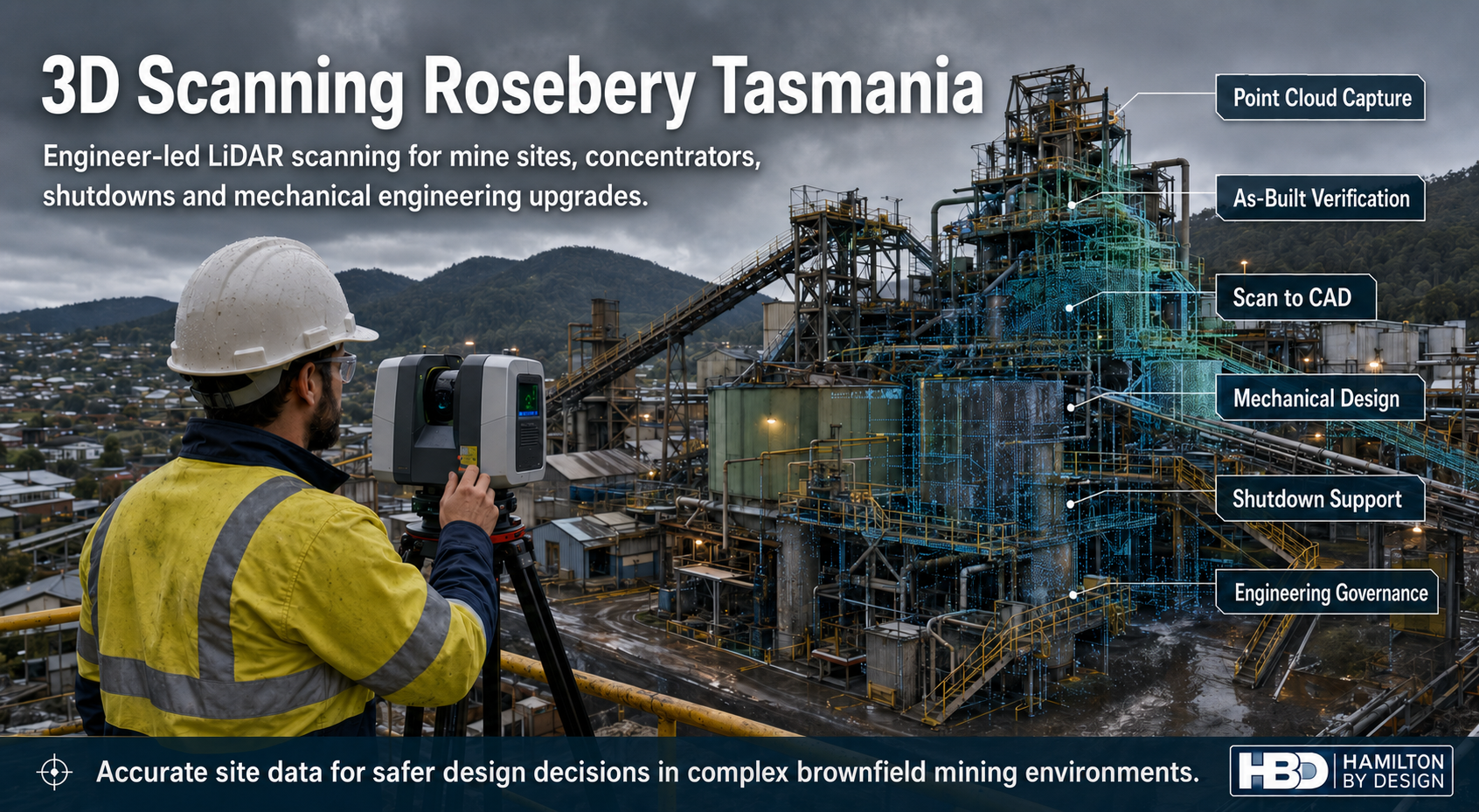
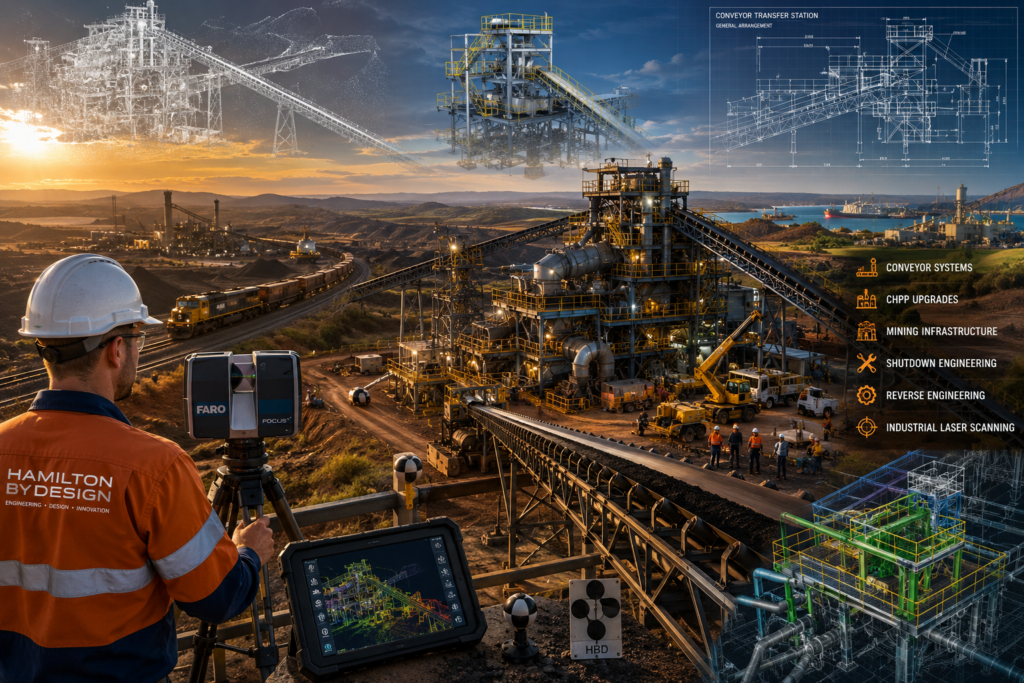
Rosebery is a working mining and processing town where engineering decisions need to be clear, traceable and practical.
On brownfield mining sites, the issue is often not just the design itself. The issue is whether the information behind the design can be trusted. Old drawings may not match the plant. Modifications may have been made during shutdowns. Fabrication details may sit across emails, markups, PDFs, contractor sketches and site knowledge held by fitters and supervisors.
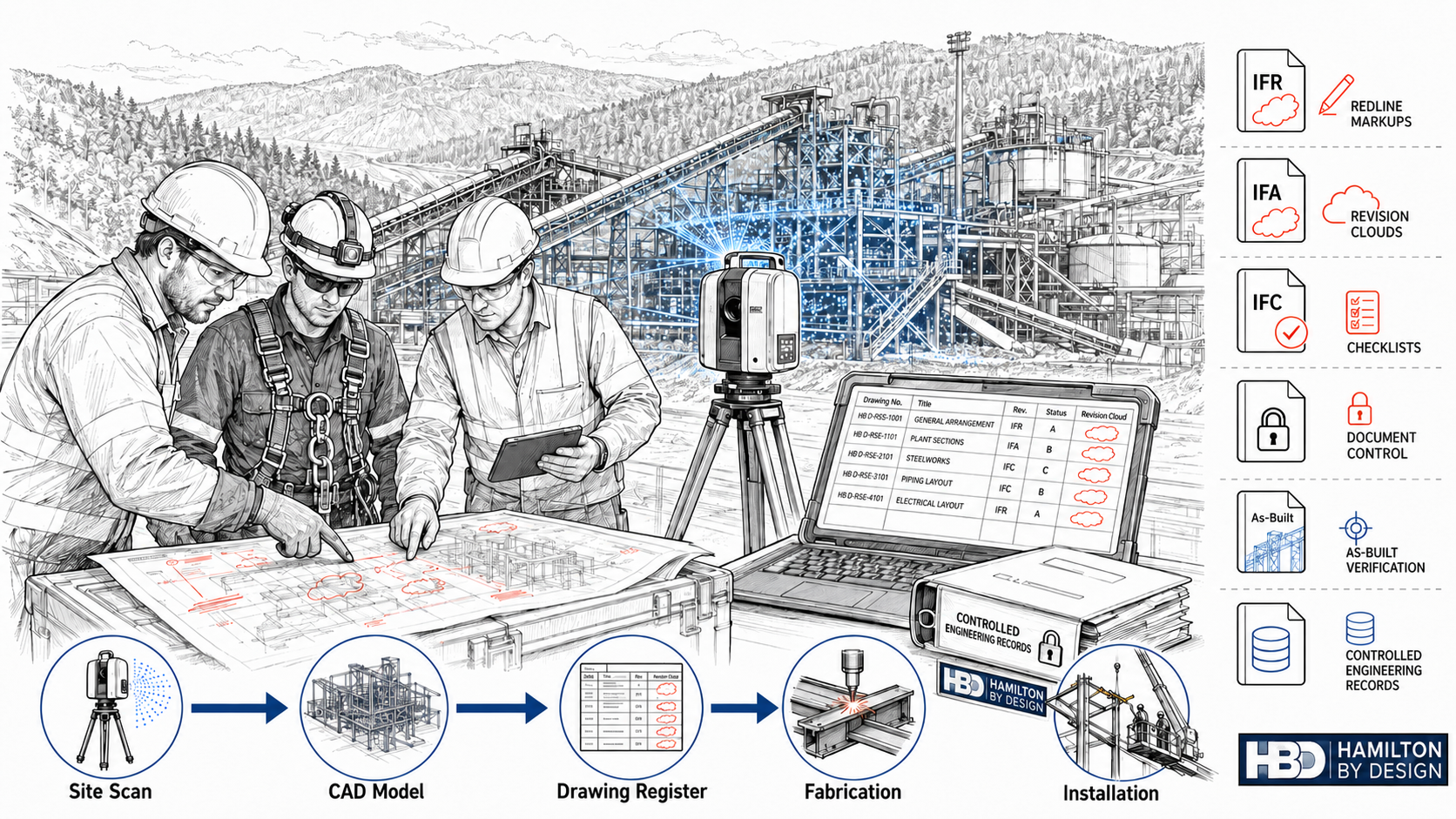
Hamilton By Design supports Rosebery and Tasmania’s west coast with engineering governance documentation, mechanical engineering support, 3D laser scanning, scan-to-CAD, drafting and reverse engineering for mining, concentrator and industrial sites.
What Is Engineering Governance Documentation?
Engineering governance documentation helps show how technical decisions were made, checked and controlled.
For mining and processing sites, this may include:
drawing registers
revision control
design basis documents
site measurement records
scan-to-CAD records
engineering markups
redline drawing updates
scope clarification documents
fabrication drawing control
as-built verification
inspection records
change documentation
technical queries and responses
document transmittals
approval workflows
The goal is to reduce confusion between site, engineering, fabrication and installation teams.
Why It Matters in Rosebery
Remote mining locations can make poor documentation expensive. If the wrong drawing is used, or if a fabrication package is based on outdated information, the result can be rework, delay, unsafe access or a failed installation during a shutdown.
Engineering governance documentation helps answer important questions:
What drawing is current?
What was measured on site?
What changed from the original design?
Who reviewed the information?
What assumptions were made?
What needs client approval?
What information is still missing?
What is suitable for fabrication?
What is suitable for construction or installation?
For Rosebery mining and concentrator work, this is especially useful where plant areas have been modified over many years.
Supporting Fitters, Riggers and Maintenance Teams
Fitters, riggers and maintenance supervisors often know the plant better than anyone. They can see what has worn, what does not fit, what is hard to access and what will cause problems during installation.
Hamilton By Design helps turn that site knowledge into controlled engineering documentation.
This can include:
site inspection notes
redline markups
measured sketches
3D scan records
updated CAD drawings
fabrication-ready details
installation planning documents
clash and clearance checks
reverse engineering records
documented assumptions and exclusions
This gives the site team a clearer path from “we know there is a problem” to “we have controlled information we can act on”.
3D Scanning as a Governance Tool
3D laser scanning is not only a measurement tool. Used properly, it becomes part of the engineering record.
Hamilton By Design can capture existing plant conditions using 3D laser scanning services and use the scan data to support drawing updates, fabrication checks, design reviews and as-built verification.
This is useful for:
chute and hopper replacements
conveyor transfer point upgrades
slurry pipework changes
pump and baseplate replacement
access platform modifications
guarding changes
shutdown planning
brownfield plant upgrades
concentrator plant documentation
Mechanical Engineering and Drawing Control
Hamilton By Design provides mechanical engineering support for practical plant issues where documentation needs to support real-world fabrication and installation.
This may include:
reviewing existing drawings
identifying missing information
checking fit-up constraints
developing design options
preparing general arrangement drawings
preparing fabrication drawings
maintaining drawing registers
managing revision changes
recording design assumptions
supporting technical clarification with site teams
The aim is not paperwork for the sake of paperwork. The aim is controlled information that helps people build, install, inspect and maintain with confidence.
The reverse engineering process can be documented so that future repairs are not dependent on memory, guesswork or one-off site sketches.
Secondment and Embedded Documentation Support
For longer projects, shutdowns or ongoing plant upgrades, Hamilton By Design can also provide secondment services.
This allows experienced engineering, drafting or site-support personnel to work alongside your team to help manage technical documentation, drawing updates, site measurement records and engineering deliverables during peak workload periods.
Servicing Rosebery and Tasmania’s West Coast
Hamilton By Design can support engineering governance documentation for Rosebery and nearby Tasmanian west coast locations, including:
Tullah
Zeehan
Queenstown
Strahan
Burnie
Devonport
broader Tasmanian mining and industrial sites
Need Engineering Governance Documentation Support in Rosebery?
If your Rosebery project needs clearer drawings, controlled revisions, scan-backed as-built records, fabrication documentation or engineering support for brownfield plant changes, Hamilton By Design can assist.
Contact Hamilton By Design to discuss engineering governance documentation, mechanical engineering, 3D scanning, scan-to-CAD or secondment support for Rosebery, Tasmania.
Mechanical Engineering & 3D Scanning Rosebery Tasmania
Rosebery is a working mining town, and the work on site is practical. Fitters, riggers, maintenance crews and supervisors are often dealing with real plant problems before the drawings catch up.
A chute wears out. A pipe spool needs replacing. A pump base does not match what is on the drawing. Access is tight. Shutdown time is limited. The job needs to fit the first time.
Hamilton By Design supports Rosebery and Tasmania’s west coast with mechanical engineering, 3D laser scanning, scan-to-CAD, reverse engineering and drafting support for mining, processing and industrial sites.
Supporting Fitters, Riggers and Maintenance Teams
On brownfield sites, the people closest to the work often understand the problem best.
A fitter may know where the wear is occurring. A rigger may know where the lift or install will be difficult. A maintenance supervisor may know which parts of the plant have been modified over time.
Hamilton By Design helps turn that site knowledge into usable engineering information.
We can assist with:
site measurement and 3D scanning
scan-to-CAD modelling
mechanical drafting
reverse engineering
chute and hopper replacement
conveyor and transfer point modifications
pipework and spool development
pump, bracket and baseplate measurement
shutdown planning support
fabrication-ready drawings
3D Scanning for Rosebery Mining and Processing Sites
Rosebery’s mining and processing environment makes accurate site information important. Existing drawings may be outdated, incomplete or missing. Plant may have changed over years of maintenance, repair and modification.
3D laser scanning captures the actual site conditions before design or fabrication begins.
This can help reduce:
site rework
fabrication errors
unexpected clashes
repeat site visits
shutdown delays
uncertainty during quoting and planning
For mining and concentrator environments, scanning can be used around conveyors, transfer points, chutes, pipework, tanks, pump areas, platforms, stairs, guarding and structural interfaces.
Scan-to-CAD and Mechanical Drafting
Once the site has been scanned, Hamilton By Design can convert the captured information into practical CAD deliverables.
Depending on the job, this may include:
registered point cloud data
E57, RCP or RCS files
3D CAD models
SolidWorks or Inventor models
AutoCAD DWG layouts
general arrangement drawings
fabrication drawings
sections and elevations
clearance and clash checks
The aim is simple: provide information that helps the job move from site problem to fabrication, installation or engineering review.
Mechanical Engineering Support for Concentrator Plant Work
Rosebery includes underground mining and onsite processing, with production of zinc, copper and lead concentrates, as well as gold and silver.
For concentrator and mineral processing work, Hamilton By Design can support:
crushing and grinding area modifications
flotation plant access and layout checks
slurry pipework and pump arrangements
chute and liner replacement
conveyor upgrades
transfer point improvements
platform, stair and access changes
guarding and maintenance access reviews
brownfield plant modifications
This type of work often needs a mix of practical trade understanding, site capture, CAD modelling and mechanical engineering judgement.
Secondment Support for Rosebery Projects
For longer shutdowns, ongoing upgrades or peak workload periods, Hamilton By Design can also provide support through secondment.
This allows experienced engineers, designers, draftspersons, fitters, fabricators and riggers to support your team directly during planning, site measurement, drawing updates, fabrication support or project delivery.
Hamilton By Design can support Rosebery and nearby west coast locations, including:
Tullah
Zeehan
Queenstown
Strahan
Burnie
Devonport
broader Tasmanian mining and industrial sites
Need Mechanical Engineering or 3D Scanning Support in Rosebery?
If you are planning maintenance, shutdown work, fabrication, reverse engineering or plant modification in Rosebery, Hamilton By Design can help capture the site accurately and turn that information into practical engineering deliverables.
Contact Hamilton By Design to discuss your Rosebery site capture, mechanical engineering, scan-to-CAD or secondment support requirements.
Scan to BIM Perth WA | LiDAR Scanning & BIM Modelling
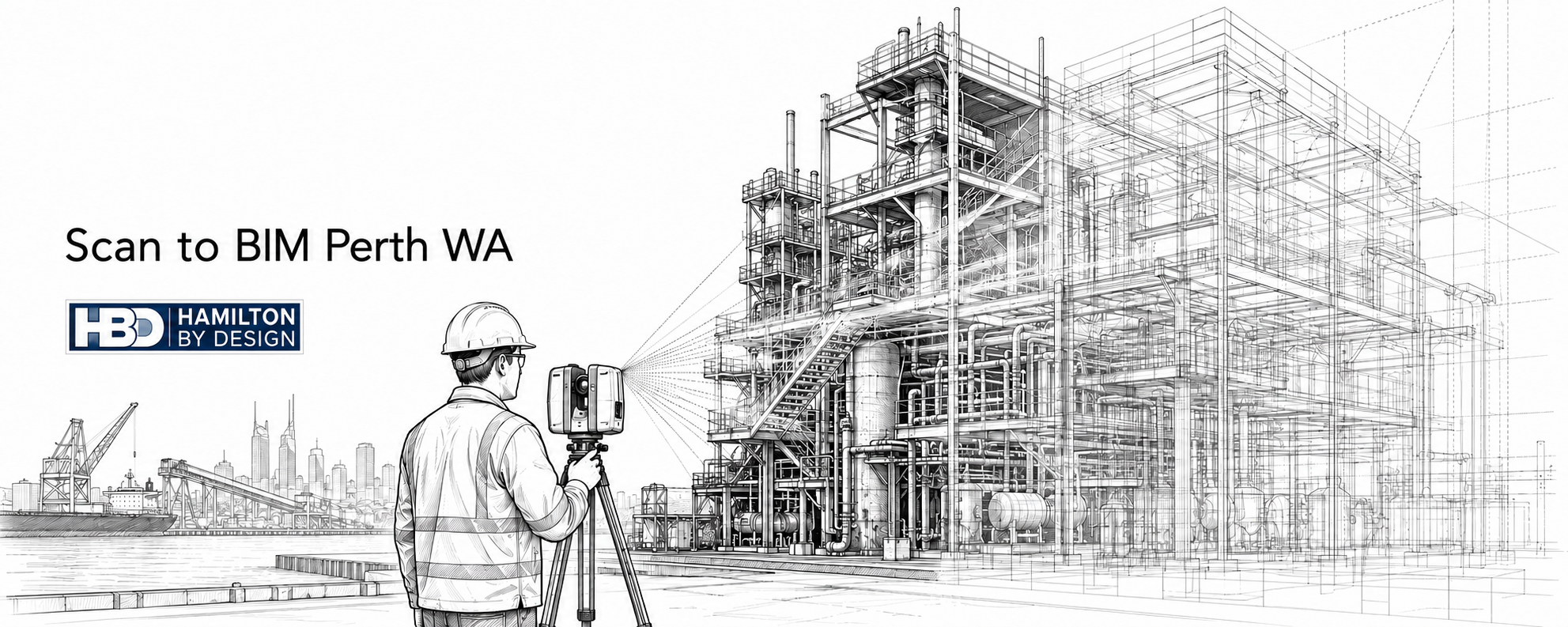
Embracing the idea of Scan to BIM Perth WA would suggest accurate site information is critical for successful engineering, construction, maintenance and upgrade projects. In Perth and across Western Australia, many mining, industrial, commercial and infrastructure assets have changed over time, but the drawings have not always kept up.
Equipment gets replaced. Pipework is modified. Structural steel is strengthened or repaired. Access platforms are changed. Services are rerouted. Buildings are refurbished. Over time, the original drawings may no longer reflect what is actually installed on site.
This is where Scan to BIM Perth becomes valuable.
Scan to BIM is the process of capturing an existing site using 3D laser scanning or LiDAR technology, then converting that point cloud data into an accurate Building Information Model. The result is a usable digital model that helps engineers, project managers, builders, asset owners and maintenance teams make better decisions based on real site conditions.
Hamilton By Design provides engineering-led Scan to BIM services across Perth and Western Australia, supporting mining, industrial, commercial, infrastructure and brownfield upgrade projects.
For projects that require accurate reality capture before design or fabrication begins, Hamilton By Design also provides 3D laser scanning in Perth to capture reliable point cloud data for downstream BIM, CAD and engineering workflows.
The Biggest Problem: Inaccurate or Missing As-Built Information
The biggest problem Scan to BIM solves is the lack of reliable as-built information.
Many Perth and WA sites rely on old drawings, incomplete records or assumptions made from previous projects. In some cases, drawings may exist but do not include later site modifications. In other cases, asset owners may only have PDFs, hand-marked drawings or partial CAD files.
This creates major project risk.
If engineers are designing from inaccurate information, new equipment may not fit. Steelwork may clash with existing structure. Pipe routes may conflict with services. Fabricated parts may arrive on site and require modification. Shutdown work may take longer than planned because the real site does not match the design assumptions.
These issues can lead to:
Design clashes
Fabrication errors
Installation delays
Extra site visits
Shutdown overruns
Safety risks
Increased project costs
Poor coordination between trades
Rework during construction
Poor asset records for future maintenance
For brownfield industrial and mining projects, these risks are especially important because work is often carried out around live plant, restricted access zones, shutdown windows and complex existing infrastructure.
Scan to BIM helps reduce this uncertainty by capturing the actual site and turning it into practical digital information.
What Is Scan to BIM?
Scan to BIM combines two key processes: reality capture and Building Information Modelling.
First, the existing site is captured using 3D laser scanning or LiDAR. The scanner records millions of measurement points across the site. These points form a point cloud, which is a highly accurate 3D representation of the existing conditions.
The point cloud can then be used to create a BIM model. Depending on the project, this model may include building elements, structural steel, pipework, mechanical equipment, platforms, conveyors, access systems, services, walls, slabs, columns and other site features.
The final model may be delivered in formats such as Revit, Navisworks, IFC, DWG or other agreed digital formats.
The key value is that the model is based on measured site data, not guesswork.
Who Uses Scan to BIM in Perth?
Scan to BIM is used by a wide range of organisations and project teams across Perth and Western Australia.
Typical users include:
Mining companies
Industrial plant owners
Commercial property owners
Infrastructure operators
Engineering consultants
Mechanical engineers
Structural engineers
Architects
Builders
Fabricators
Shutdown planners
Asset managers
Maintenance teams
Project managers
Facility managers
For asset owners, Scan to BIM provides better records of what is installed.
For engineers, it provides a more reliable base for design.
For builders and fabricators, it helps reduce clashes and installation problems.
For maintenance teams, it supports planning, access review and future asset management.
Where Is Scan to BIM Used in Perth and WA?
Scan to BIM can be used anywhere existing conditions need to be captured accurately.
In Perth, this may include commercial buildings, hospitals, schools, industrial workshops, warehouses, manufacturing sites, processing plants, water infrastructure, ports and transport facilities.
Across Western Australia, Scan to BIM is also valuable for mining and heavy industrial locations, including processing plants, materials handling facilities, port infrastructure, power generation assets, pump stations, treatment plants and regional industrial sites.
Common WA locations and project areas include:
Perth CBD
Kwinana
Henderson
Welshpool
Canning Vale
Fremantle
Rockingham
Bunbury
Geraldton
Kalgoorlie
Port Hedland
Karratha
Pilbara
Goldfields
Regional Western Australia
Hamilton By Design supports broader engineering and scanning work through its Perth WA engineering and 3D scanning services page, which is a useful internal location hub for Perth-based clients.
How the Scan to BIM Process Works
A typical Scan to BIM workflow includes several stages.
1. Project Scope and Capture Planning
Before scanning begins, the project team needs to understand what the model will be used for.
This is important because not every Scan to BIM project needs the same level of detail. A model for architectural refurbishment may require different information compared with a model for conveyor upgrades, pipework modifications, structural access design or plant layout changes.
Key questions include:
What area needs to be captured?
What level of detail is required?
Is the model for design, construction, asset records or maintenance?
Are mechanical and structural elements required?
Are services and pipework required?
What deliverable format is needed?
Is the work being used for clash detection?
Is the site live, restricted or difficult to access?
Clear scope at the start helps ensure the final model is useful.
2. 3D Laser Scanning or LiDAR Site Capture
The site is captured using professional 3D scanning equipment. The scanner collects accurate spatial data from multiple positions around the site.
For complex industrial facilities, multiple scan positions may be required to capture equipment, steelwork, pipework, access platforms, conveyors and building elements from different angles.
The result is a point cloud that represents the real site geometry.
3. Point Cloud Registration
After site capture, the individual scans are registered together into a single coordinated point cloud.
This stage aligns the scans so the full site can be reviewed as one digital environment.
Typical point cloud formats may include:
E57
RCP
RCS
LAS
The registered point cloud becomes the foundation for the BIM model.
4. BIM Model Development
The point cloud is then used to create a BIM model. Depending on the project, this may include modelling architectural, structural, mechanical or services elements.
For industrial and mining projects, modelled items may include:
Structural steel
Platforms
Stairs
Handrails
Pipework
Tanks
Pumps
Conveyors
Chutes
Hoppers
Mechanical equipment
Access areas
Building structure
Services corridors
The goal is not just to make the model look good. The goal is to create a model that supports real project decisions.
Where CAD deliverables are required rather than a full BIM workflow, Hamilton By Design can also convert point cloud data into engineering models and drawings through its Scan to CAD Perth service.
5. Quality Review Against the Point Cloud
Once the BIM model is created, it should be checked against the point cloud. This helps confirm that the model reflects the captured site conditions and that the required scope has been covered.
Quality review is important because Scan to BIM is only useful if the model is accurate enough for the intended purpose.
A model used for general planning may not require the same detail as a model used for fabrication coordination, clash detection or construction sequencing. The required accuracy and level of detail should match the project outcome.
6. Delivery of BIM and CAD Outputs
Final deliverables depend on the project requirements.
Scan to BIM relies on a combination of capture equipment, point cloud software, BIM software and engineering review.
Useful tools include:
Tool
Purpose
3D laser scanner / LiDAR
Captures accurate site geometry
FARO Focus / terrestrial scanner
Engineering-grade site capture
FARO SCENE
Point cloud registration and processing
Autodesk ReCap
Point cloud preparation for Autodesk workflows
Revit
BIM model development
Navisworks
Coordination and clash review
AutoCAD
2D drawings and CAD outputs
IFC
Model exchange between software platforms
E57 / RCP / RCS / LAS
Point cloud delivery formats
SolidWorks / Inventor
Mechanical modelling where required
The right tools depend on the final use of the data. A commercial building project may require a Revit-focused workflow, while an industrial plant upgrade may need a combination of point cloud, CAD, BIM and mechanical modelling outputs.
Why Engineering-Led Scan to BIM Matters
Not all Scan to BIM providers approach the work the same way.
Some providers focus mainly on scanning and visual modelling. That may be enough for some building documentation projects, but industrial and mining sites often need a deeper understanding of how the asset works.
Engineering-led Scan to BIM is different because the model is developed with practical project outcomes in mind.
For example, in a processing plant, the important question may not simply be “what does the site look like?” The real questions may be:
Will the new equipment fit?
Can the conveyor be modified safely?
Is there enough access for installation?
Will new pipework clash with existing steel?
Can the platform support maintenance access?
What needs to be removed before shutdown?
Can fabrication drawings be developed from the scan data?
What existing structure must remain untouched?
Hamilton By Design’s Scan to BIM approach is suited to mechanical, structural, mining and industrial environments where the digital model needs to support real engineering decisions.
For clients working nationally, the broader Scan to BIM Mining and Industrial Facilities page provides additional context around mining, processing plant, materials handling and heavy industrial applications.
Benefits of Scan to BIM Perth
Scan to BIM provides several important benefits for Perth and WA projects.
Better Design Accuracy
Design teams can work from real site data instead of old drawings or assumptions. This reduces the risk of designing around information that no longer reflects the site.
Reduced Site Rework
Accurate existing-condition data helps reduce fabrication and installation problems. This is particularly valuable where fabricated components need to fit into existing plant, structure or services.
Improved Clash Detection
Models can be reviewed before construction to identify conflicts between new and existing elements.
This helps project teams detect problems before labour, materials and equipment are committed to site work.
Faster Project Planning
Teams can review the site digitally without always needing to return to site.
This is useful for remote WA projects where travel, access and site inductions can add time and cost.
Improved Shutdown Confidence
For mining and industrial projects, accurate scan data helps plan work before shutdown begins.
Shutdowns are often expensive and time-sensitive. Scan to BIM helps reduce uncertainty before work starts.
Better Asset Records
Owners receive a more reliable digital record of existing assets.
This can support future maintenance, inspections, upgrades and long-term asset management.
Improved Collaboration
BIM models provide a shared reference point for engineers, builders, contractors, fabricators and asset managers.
When everyone is working from the same accurate information, coordination improves.
Scan to BIM for Brownfield Projects
Brownfield projects are one of the strongest use cases for Scan to BIM.
Unlike greenfield projects, brownfield sites already contain existing plant, structure, services, access restrictions and operational constraints. The site may have been modified many times over decades.
This makes accurate information critical.
Scan to BIM helps brownfield projects by capturing the real conditions before design or fabrication begins. This reduces the chance of clashes, improves planning and gives project teams a more reliable foundation for decision-making.
For Perth and WA mining, resources, port and industrial projects, this can be the difference between a smooth installation and a costly shutdown delay.
Recommended Page Details
SEO Item
Suggested Detail
Page Name
Scan to BIM Perth WA
URL
/scan-to-bim-perth/
Keyword Focus
Scan to BIM Perth
Location
Perth WA
Meta Description
Engineering-led Scan to BIM services in Perth WA. Convert 3D laser scan data into accurate BIM models for mining, industrial, commercial, infrastructure and brownfield upgrade projects.
FAQs
What is Scan to BIM?
Scan to BIM is the process of capturing an existing site using 3D laser scanning or LiDAR, then converting the point cloud data into a Building Information Model. The model can be used for design, construction planning, asset management, clash detection and future maintenance.
Why is Scan to BIM useful for Perth and WA projects?
Scan to BIM is useful because many Perth and WA assets have incomplete or outdated drawings. By capturing the real site conditions, project teams can reduce assumptions, avoid clashes and plan upgrades with greater confidence.
What industries use Scan to BIM in Perth?
Scan to BIM is used across mining, mineral processing, ports, manufacturing, commercial buildings, infrastructure, water treatment, power generation and industrial facilities.
What deliverables can be provided from a Scan to BIM project?
Typical deliverables may include Revit models, Navisworks models, IFC files, DWG drawings, 2D plans, sections, elevations, registered point clouds, E57 files, RCP files, RCS files and PDF documentation.
Is Scan to BIM only for buildings?
No. Scan to BIM can be used for buildings, but it is also valuable for industrial plants, mining infrastructure, processing facilities, pipework, structural steel, conveyors, platforms, equipment and brownfield engineering projects.
Can Scan to BIM help reduce shutdown risk?
Yes. Scan to BIM can help project teams understand existing site conditions before shutdown work begins. This can reduce clashes, improve sequencing and reduce the risk of unexpected site issues during installation.
What is the difference between Scan to BIM and Scan to CAD?
Scan to BIM usually creates an information-rich model, often used in Revit, Navisworks or IFC workflows. Scan to CAD usually focuses on producing CAD models and drawings for engineering, drafting, fabrication or layout work. The right choice depends on the project outcome.
Do I need a full BIM model for every project?
No. Some projects only need a point cloud, 2D drawings or a Scan to CAD model. Other projects need a full BIM model for coordination, asset management or construction planning. The deliverable should match the project need.
Scan to BIM Perth gives project teams a more reliable way to understand existing buildings, plants and infrastructure before design, fabrication or construction begins.
For Perth and Western Australia, where mining, industrial, commercial and infrastructure assets often involve complex existing conditions, accurate digital information can reduce risk, improve coordination and support better long-term asset management.
By combining 3D laser scanning, point cloud processing, BIM modelling and engineering experience, Hamilton By Design helps turn real site conditions into practical digital deliverables that support better project outcomes.
Engineering-Grade LiDAR Scanning for Ports, Bulk Handling and Brownfield Shiploader Upgrades
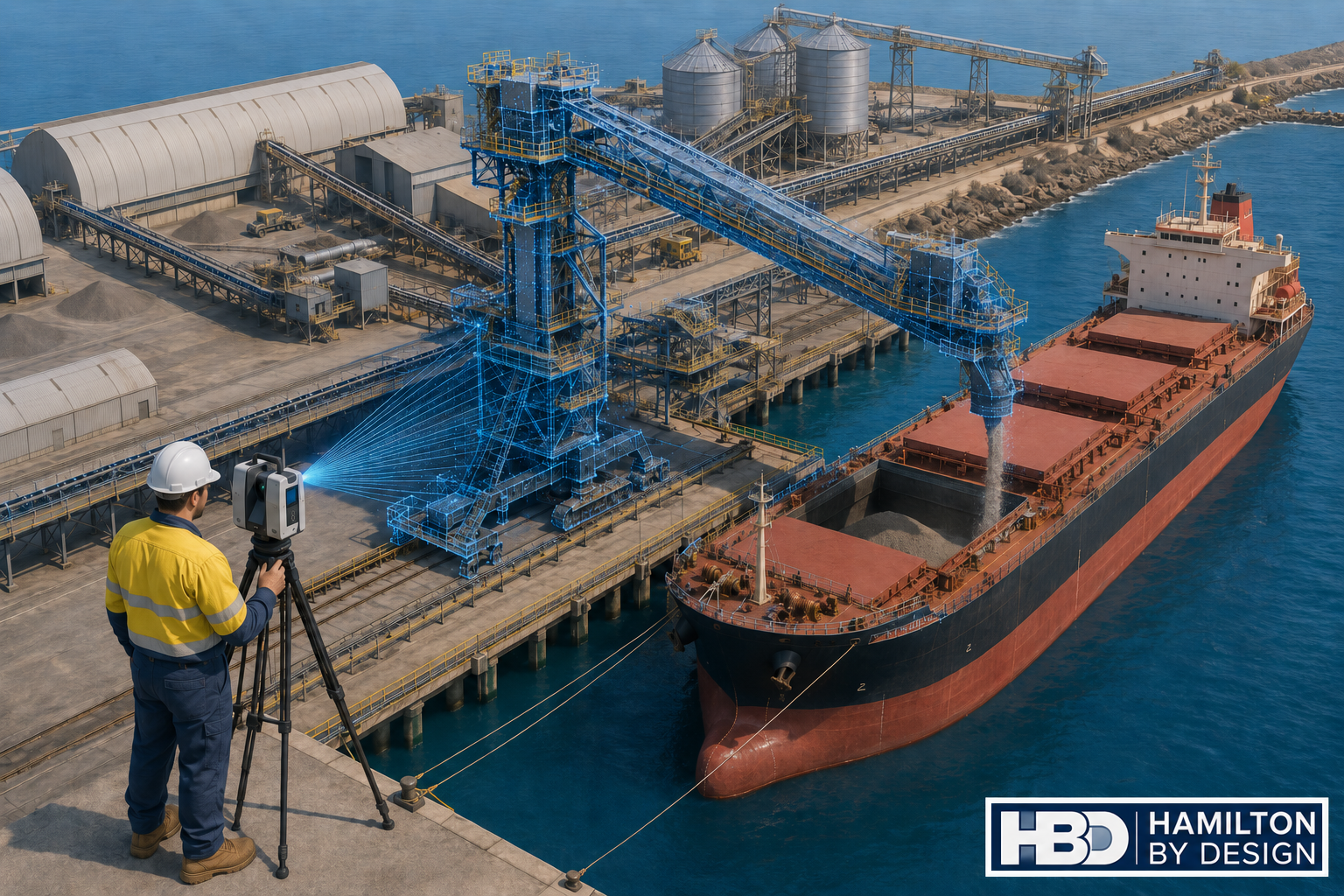
Hamilton By Design provides shiploader 3D scanning in Perth for port operators, bulk handling facilities, engineers, fabricators and maintenance teams working with ageing shiploaders, conveyors, chutes, booms, wharf structures and access platforms.
Shiploaders are large, complex and difficult assets to modify safely. They operate in harsh marine environments, often handling abrasive bulk materials such as minerals, grain, fertiliser, alumina, coal, ore or other export products. Over time, these machines are repaired, strengthened, modified and upgraded. The problem is that the drawings do not always keep up with the real asset.
That creates risk.
When a port operator needs to replace a chute, modify a conveyor, inspect a boom, upgrade access platforms, install guarding, check clearances or plan a shutdown, the team needs accurate existing-condition data. If the project starts with old drawings or incomplete site measurements, the risk of fabrication errors, installation clashes and shutdown delays increases quickly.
Hamilton By Design uses engineering-grade LiDAR scanning to capture accurate site geometry before design, fabrication or shutdown work begins. The scan data can then be used for point cloud review, Scan-to-CAD modelling, clash checking, general arrangement drawings, fabrication support and as-built documentation.
For broader Western Australian site capture and engineering support, see our 3D Scanning Perth services.
Why Shiploader 3D Scanning Matters
A shiploader is not a simple conveyor. It is a complete mechanical, structural and operational system. A typical shiploader may include boom structures, conveyor galleries, transfer chutes, hoppers, skirts, drives, pulleys, take-up systems, dust control equipment, hydraulic systems, electrical routes, access platforms, walkways, stairs, handrails, guarding, rails, wharf interfaces and surrounding port infrastructure.
Many of these areas are difficult to measure manually. Some areas are elevated. Some are close to operating plant. Some are affected by corrosion, impact damage, product build-up, wear or previous modifications. Manual measurement may be suitable for small items, but it is often not enough when the design team needs to understand how the whole asset fits together.
3D scanning captures millions of measured points across the shiploader and surrounding infrastructure. The result is a digital point cloud that can be measured, reviewed and converted into usable engineering deliverables.
This is especially valuable for brownfield port environments where the installed condition often differs from the original drawings.
The Biggest Problem: Inaccurate As-Built Data
The biggest problem for port operators and engineers is that ageing shiploaders often do not have accurate as-built data.
Original drawings may exist, but they may no longer reflect the current condition of the machine. Over many years, shiploaders are maintained, repaired and modified. Chutes are replaced. Guards are added. Platforms are changed. Steelwork is strengthened. Conveyor components are adjusted. Services are rerouted. Dust control systems are modified. Access systems are upgraded.
Each change may make sense at the time, but unless the drawings are updated properly, the asset slowly drifts away from the documentation.
This creates problems when new work is planned.
An engineer may design a replacement chute based on old drawings, only to find that the surrounding structure has changed. A fabricator may manufacture a component that clashes with existing steelwork. A shutdown team may plan an installation sequence without knowing that access is restricted. A maintenance team may discover during the shutdown that the lifting path is blocked.
For a shiploader, these problems can become expensive quickly. Shutdown windows are limited. Port operations are time-sensitive. Fabrication rework can delay installation. A small measurement error can become a major site issue.
3D scanning helps reduce this risk by capturing the real installed condition before design and fabrication decisions are made.
Who Uses Shiploader 3D Scanning?
Shiploader 3D scanning is useful for several project groups.
Port operators use scan data to understand existing assets, plan maintenance and reduce shutdown risk.
Mechanical engineers use point clouds and CAD models to design chute modifications, conveyor interfaces, guards, brackets, transfer points and replacement components.
Structural engineers use scan data to review steelwork, access platforms, stairs, handrails, supports, boom structures and wharf interfaces.
Fabricators use accurate geometry to reduce site fit-up problems and improve confidence before manufacturing.
Maintenance planners use scan data to plan access, lifting, removal sequences and installation work before the asset is taken offline.
EPCM contractors use point cloud information for design coordination, clash checking and constructability review.
Bulk handling operators use scan data to support conveyors, transfer towers, shiploaders, wharf structures and associated plant.
What Can Be Scanned?
Hamilton By Design can scan shiploader and port infrastructure elements including:
Shiploader boom structures
Conveyor galleries
Transfer chutes
Hoppers and skirts
Belt feeders
Drive stations
Pulley areas
Take-up systems
Dust extraction systems
Spray systems
Access platforms
Walkways and stairs
Handrails and guarding
Wharf structures
Rail interfaces
Structural supports
Pipework and services
Cable trays and equipment routes
Maintenance access zones
Adjacent conveyors and transfer points
The aim is not just to create a visual record. The aim is to produce engineering information that can support real project decisions.
Where We Support Shiploader 3D Scanning
Hamilton By Design supports shiploader 3D scanning and port infrastructure projects across Perth and Western Australia, including Perth, Fremantle, Kwinana, Henderson, Cockburn Sound, Rockingham, Bunbury, Geraldton, Port Hedland, Karratha and regional WA bulk handling facilities.
The page focus is Shiploader 3D Scanning Perth, but the same workflow can support port and bulk handling infrastructure across Western Australia.
Perth is a practical engineering base for this work because many WA port, mining, processing and bulk handling projects are planned, managed and engineered from Perth, even when the assets themselves are located across regional WA.
How the 3D Scanning Process Works
1. Project Review
The first step is understanding why the scan is required.
A scan for chute replacement is different from a scan for access platform upgrades. A scan for shutdown planning is different from a scan for fabrication verification. Before scanning begins, Hamilton By Design reviews the project objective, required deliverables, areas of interest and level of detail required.
This helps make sure the scan captures the information that the engineering, maintenance or fabrication team actually needs.
2. Site Walkdown and Scan Planning
The shiploader and surrounding work areas are reviewed to identify key scan locations. The aim is to capture the asset with enough coverage and overlap to produce a reliable point cloud.
Important areas may include transfer points, boom sections, conveyor routes, access platforms, drive areas, structural supports, wharf interfaces and installation paths.
Safety and access requirements are also considered, especially around live plant, elevated work areas, marine environments and shutdown conditions.
3. LiDAR Site Capture
Hamilton By Design uses terrestrial LiDAR scanning to capture the asset. The scanner records millions of measured points, creating a detailed point cloud of the shiploader and surrounding infrastructure.
This method is faster and more complete than relying on manual measurements for large and complex brownfield assets.
4. Point Cloud Registration
After scanning, the scan data is registered into a coordinated point cloud. This creates a single usable dataset that can be opened, reviewed, measured and used for downstream modelling.
Typical point cloud deliverables may include E57, RCP, RCS or LAS files.
These files can support engineering review, CAD modelling, coordination and documentation.
5. Engineering Review
Once the point cloud is prepared, engineers and designers can review the captured asset. They can check clearances, confirm interfaces, measure existing geometry and identify areas that may affect design, fabrication or installation.
This is where engineering-led scanning becomes valuable. Hamilton By Design understands how scan data is used for design, fabrication, maintenance and brownfield modification work.
6. Scan-to-CAD Modelling
Where required, the point cloud can be converted into CAD models or drawings. This may include mechanical components, structural steel, platforms, chutes, guards, conveyor interfaces or general arrangement layouts.
For more detailed point cloud conversion support, see our Scan to CAD Perth services.
7. Drawings and Deliverables
Depending on the project, Hamilton By Design can provide registered point clouds, 2D plans, sections, elevations, general arrangement drawings, 3D CAD models, STEP files, SAT files, Parasolid files, DWG drawings, fabrication drawings, as-built documentation and clash review models.
The deliverables are selected based on the project need. Some clients only require point cloud data. Others require a full scan-to-CAD workflow with engineering drawings and fabrication support.
Tools That Assist Shiploader 3D Scanning
Hamilton By Design uses practical digital engineering tools suitable for industrial, port and bulk handling environments.
These may include FARO Focus terrestrial LiDAR scanning, FARO SCENE point cloud registration, Autodesk ReCap for RCP and RCS workflows, AutoCAD for plans and sections, SolidWorks for mechanical modelling, Autodesk Inventor for mechanical assemblies and Navisworks for coordination and clash checking.
Deliverable formats may include E57, RCP, RCS, LAS, DWG, STEP, SAT and Parasolid.
The purpose of these tools is to move the project from site capture to usable engineering information.
Hamilton By Design can support shiploader and port infrastructure projects with engineering-grade 3D laser scanning, point cloud registration, Scan-to-CAD modelling, mechanical engineering support, structural drafting, as-built documentation, fabrication drawings and shutdown planning support.
Our work can assist with chute modifications, conveyor interfaces, guarding, brackets, access platforms, walkways, stairs, handrails, support frames, replacement components and surrounding infrastructure.
For broader design and engineering capability in Western Australia, see our Perth engineering services page.
Common Shiploader Project Problems We Help Solve
Hamilton By Design can assist when existing drawings are missing, outdated or unreliable.
We can also assist when a chute needs to be replaced, a conveyor interface needs to be checked, a boom structure needs to be documented, access platforms need modification, new guarding is being installed, fabricated parts need accurate site geometry or shutdown work needs better planning.
Shiploader projects often fail because the project team discovers the real site condition too late. A point cloud gives engineers, fabricators and maintenance teams a better understanding before work moves too far into design or fabrication.
Example Use Case: Chute and Conveyor Upgrade
A common shiploader problem is a transfer chute or conveyor interface that needs modification.
The original drawing may show the design intent, but the installed condition may have changed. There may be additional steelwork, modified guards, worn liners, dust control equipment, services or access restrictions.
By scanning the area first, Hamilton By Design can capture the surrounding geometry and provide accurate information for the design team.
This helps engineers confirm available space, model replacement components, check access, reduce clashes and improve fabrication accuracy.
The result is a better chance that the new work will fit during the planned shutdown.
Example Use Case: Access Platform Modification
Shiploaders often require access improvements for inspection, maintenance and safety. This may involve stairs, platforms, handrails, ladders, guards or local structural modifications.
A scan can capture the existing structure and surrounding obstructions so that new access systems can be designed around real site conditions.
This is particularly useful when the asset has been modified over many years and the original access drawings are no longer reliable.
Example Use Case: Shutdown Planning
Shutdown time is expensive. Every hour matters.
By scanning the shiploader before the shutdown, project teams can inspect the asset digitally, measure key areas, plan removal paths, check lifting constraints, model replacement components and identify potential clashes before work begins.
This does not remove every risk, but it gives the project team better information before the asset is taken offline.
Why Engineering-Led Scanning Is Different
Not all 3D scanning is the same.
For a shiploader project, the value is not just in capturing a point cloud. The value is in understanding what the point cloud is needed for.
A survey-only approach may capture the site, but an engineering-led approach considers how the information will be used for design, fabrication, installation and maintenance.
Hamilton By Design combines LiDAR scanning with mechanical engineering, drafting and fabrication-aware modelling. That means the scan is planned around the downstream engineering outcome, not just the visual capture.
This is important for port assets because the cost of getting it wrong can be high. A small clash, incorrect bracket location, missed access constraint or outdated drawing can create real shutdown delays.
Shiploader 3D scanning is the process of using LiDAR scanning equipment to capture accurate three-dimensional data of a shiploader and its surrounding infrastructure. The scan creates a point cloud that can be measured, reviewed and converted into CAD models or drawings.
Why scan a shiploader before an upgrade?
A shiploader should be scanned before an upgrade because existing drawings are often outdated or incomplete. Scanning captures the real installed condition, helping engineers reduce assumptions before design, fabrication and shutdown work begins.
What parts of a shiploader can be scanned?
Hamilton By Design can scan boom structures, conveyors, transfer chutes, hoppers, guards, access platforms, stairs, handrails, wharf interfaces, drives, pulleys, services, dust control systems and surrounding port infrastructure.
Can scan data be converted into CAD drawings?
Yes. Point cloud data can be converted into 2D drawings, 3D CAD models, general arrangement drawings, sections, elevations and fabrication drawings, depending on the project requirements.
What file formats can be supplied?
Typical deliverables may include E57, RCP, RCS, LAS, DWG, STEP, SAT and Parasolid formats. The final format depends on the client’s software and required workflow.
Is shiploader scanning useful for shutdown planning?
Yes. Scanning before a shutdown helps teams check clearances, plan installation paths, identify clashes, review access and reduce the risk of discovering problems after the asset is offline.
Can 3D scanning help with chute replacement?
Yes. Chute replacement is one of the best uses for 3D scanning. The scan captures the surrounding structure, conveyor interfaces, access restrictions and existing geometry so the replacement chute can be designed with better information.
Does Hamilton By Design only work in Perth?
No. Hamilton By Design supports projects across Perth and Western Australia, including Fremantle, Kwinana, Henderson, Bunbury, Geraldton, Port Hedland, Karratha and regional bulk handling sites.
Shiploader 3D Scanning Perth
If you are planning a shiploader upgrade, chute replacement, conveyor modification, access platform change, shutdown project or port infrastructure review, accurate as-built information is the best place to start.
Hamilton By Design provides shiploader 3D scanning Perth services for port operators, engineers, fabricators and maintenance teams working across Perth and Western Australia.
By combining engineering-grade LiDAR scanning, point cloud registration, Scan-to-CAD modelling, mechanical engineering and drafting support, Hamilton By Design helps project teams reduce assumptions, improve fabrication accuracy and plan brownfield work with greater confidence.
Contact Hamilton By Design to discuss your shiploader, conveyor, chute, wharf or port infrastructure scanning requirements.
Engineer-Led 3D Scanning and Mechanical Design Support for Kwinana Industry
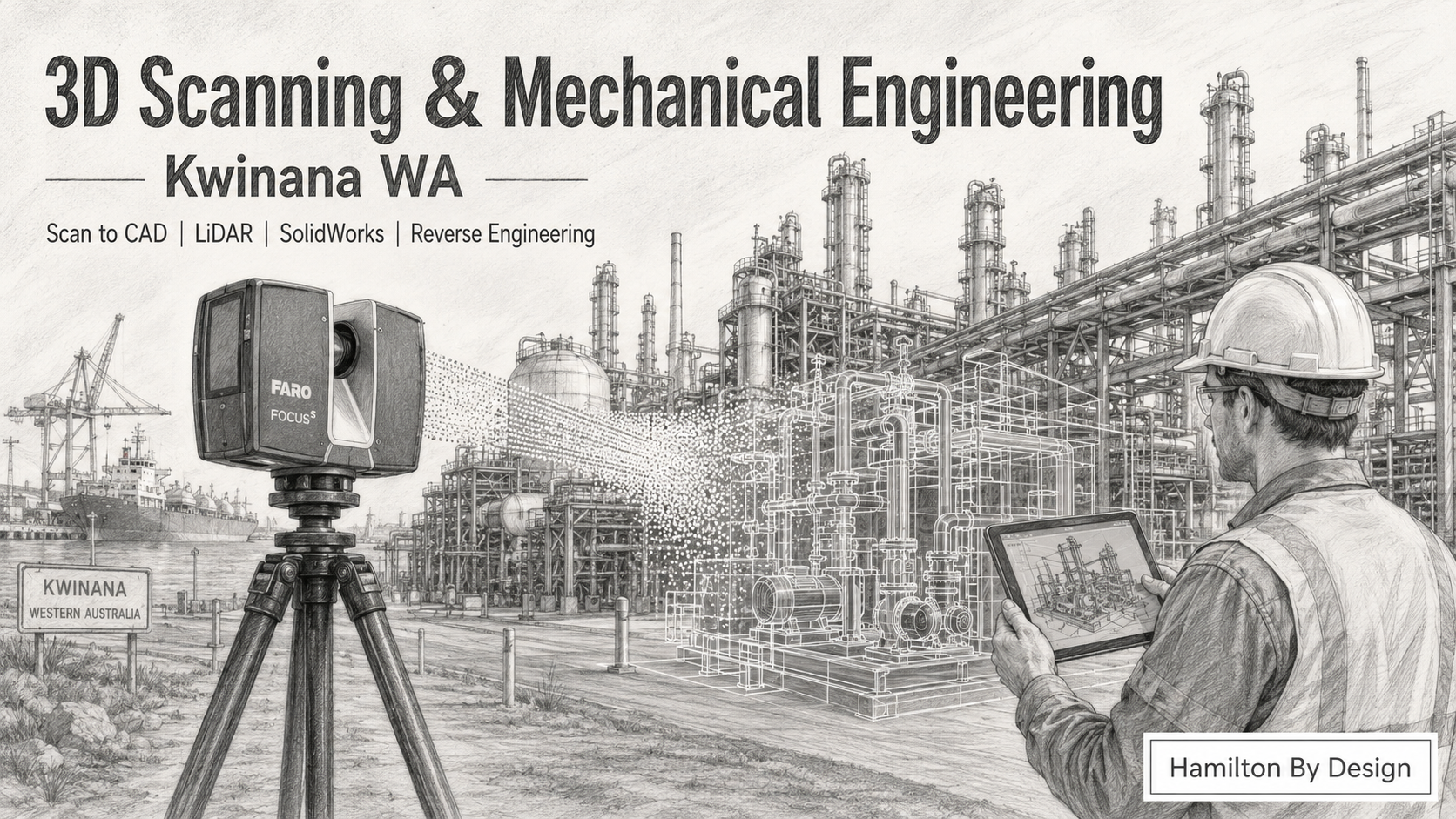
Hamilton By Design provides 3D scanning and mechanical engineering services in Kwinana WA for industrial plants, processing facilities, workshops, fabrication companies, maintenance teams and project engineers.
Kwinana is one of Western Australia’s most important industrial areas. It supports heavy industry, bulk handling, energy, minerals processing, chemical processing, fabrication, marine services, port infrastructure and industrial maintenance. In these environments, accurate site information is essential. When existing drawings are missing, outdated or unreliable, engineering decisions become harder, slower and more expensive.
That is where 3D laser scanning, LiDAR capture and mechanical engineering design support can help.
Hamilton By Design combines site-based 3D scanning, point cloud processing, SolidWorks modelling, mechanical drafting and reverse engineering to help Kwinana businesses understand existing plant conditions before they design, modify, fabricate or install new equipment.
Whether you need accurate site measurements, as-built documentation, Scan to CAD, reverse engineering of obsolete parts, equipment layout verification or mechanical design support, we can help turn real-world site conditions into useful engineering information.
Why 3D Scanning Matters for Kwinana Industrial Sites
Industrial sites in Kwinana often contain complex plant, pipework, tanks, conveyors, platforms, structural steel, access systems, mechanical equipment and services that have changed over many years.
The problem is simple: the drawings do not always match the site.
A plant may have been modified during shutdowns. Pipework may have been rerouted. Platforms may have been added. Equipment may have been replaced. Fabricators may have worked from site measurements instead of updated drawings. Over time, the real site and the drawing register can become very different.
For brownfield projects, this creates risk.
A new chute may clash with existing steel. A replacement pump base may not line up with the real hold-down bolt locations. A platform may interfere with pipework. A new mechanical assembly may fit in CAD but fail during installation because the design was based on old information.
3D scanning reduces this risk by capturing the existing site in accurate three-dimensional detail. Instead of relying only on manual tape measurements, photos and old drawings, project teams can work from a measured point cloud of the real plant.
Common Problems We Help Solve
Hamilton By Design supports Kwinana industrial businesses with practical engineering information for real-world problems.
Common issues include:
Existing drawings are missing, outdated or incomplete
New equipment may clash with existing plant
Fabrication drawings are required before a shutdown
OEM drawings are unavailable
Replacement parts are expensive or have long lead times
Manual site measurements are difficult, unsafe or incomplete
Access platforms, stairs and handrails need to fit around existing equipment
Pipework, conveyors, tanks or structures need to be modelled from site data
Plant upgrades need accurate as-built information
Project teams need better information before approving fabrication
When the plant is complex, old or heavily modified, 3D scanning provides a better starting point.
3D Laser Scanning Services in Kwinana WA
Our 3D scanning service is designed for industrial environments where accurate measurement matters.
We can scan:
Processing plants
Pump stations
Conveyor systems
Chutes and hoppers
Structural steel
Pipe racks and pipework
Tanks and vessels
Access platforms
Stairs and handrails
Maintenance areas
Workshops and fabrication spaces
Marine and port-related infrastructure
Brownfield upgrade areas
Existing equipment layouts
The scan data can be used for design, verification, planning, fabrication, modelling and project review.
For industrial work, the value is not just the scan itself. The value comes from turning scan data into engineering information that designers, project managers, fabricators and site teams can actually use.
Scan to CAD for Kwinana Industrial Projects
Scan to CAD is the process of converting 3D scan data into CAD models, drawings or design references.
For Kwinana industrial sites, Scan to CAD can be useful when a project team needs a reliable model of existing conditions before designing new work.
Hamilton By Design can convert point cloud data into:
SolidWorks models
AutoCAD drawings
STEP files
SAT files
DWG files
DXF files
General arrangement drawings
Section views
Elevations
Fabrication references
Mechanical layout models
As-built CAD geometry
This is especially useful when working around existing plant, services and structures.
A good Scan to CAD workflow can help answer important questions before fabrication starts:
Will the new equipment fit?
Is there enough clearance?
Are the bolt locations correct?
Will the pipework clash?
Can the platform be installed safely?
Does the model match the real site?
These questions are much cheaper to answer in CAD than during installation.
Hamilton By Design also provides mechanical engineering and drafting support for Kwinana businesses.
Our mechanical engineering services can include:
Mechanical design
Equipment layouts
Reverse engineering
Replacement component modelling
Pump and machinery component drawings
Fabrication drawings
General arrangement drawings
Access platform layouts
Chute and hopper design support
Conveyor-related drafting
Pipework drafting support
Brownfield modification design
Site measurement and verification
Engineering-grade CAD modelling
We work with industrial clients who need practical design support that connects the site, the CAD model and the workshop.
This is important because many industrial projects fail at the connection point between design and site reality. A drawing may look correct, but the real plant may tell a different story. By combining 3D scanning with mechanical engineering, the design process starts with better information.
Reverse Engineering for Kwinana Equipment and Parts
Many Kwinana industrial businesses operate equipment where original drawings are unavailable, the OEM no longer supports the part, or replacement lead times are too long.
Reverse engineering can help by measuring the existing component and creating a CAD model or drawing that can support replacement, repair, modification or local manufacture.
Hamilton By Design can assist with reverse engineering of:
Pump components
Shafts
Brackets
Guards
Covers
Frames
Mounts
Housings
Fabricated parts
Machined parts
Wear components
Custom plant items
Depending on the part and project requirement, reverse engineering may involve 3D scanning, manual measurement, CAD modelling, material review, tolerance consideration and production of manufacturing drawings.
This can be useful when an urgent replacement is required, when a part needs to be improved, or when site teams need to reduce reliance on unavailable OEM drawings.
Brownfield Engineering Support
Kwinana contains many brownfield industrial sites where new work must fit around existing infrastructure.
Brownfield work is difficult because there is rarely a clean, empty design space. The design must fit around what is already there.
This may include:
Existing structural steel
Pipework
Electrical services
Access ways
Platforms
Guarding
Tanks
Conveyors
Process equipment
Maintenance access zones
Crane access
Shutdown constraints
3D scanning helps create a digital record of these existing conditions. Mechanical engineering then uses that information to design practical solutions.
This can reduce the risk of rework, installation delays and fabrication changes.
Why Kwinana Businesses Use 3D Scanning Before Fabrication
Fabrication errors can be costly. If steel is fabricated from incorrect dimensions, the problem may not appear until installation. By then, the project may already be in shutdown, cranes may be booked, trades may be waiting and production may be affected.
3D scanning helps avoid this by confirming site conditions before fabrication.
For example, a scan can help check:
Existing steel locations
Floor levels
Equipment footprints
Pipework positions
Access clearances
Tank and vessel locations
Conveyor geometry
Bolt patterns
Existing maintenance access
Interface points between old and new equipment
This gives engineers and fabricators more confidence before cutting steel, ordering material or issuing drawings for manufacture.
Deliverables Available
Depending on the project, Hamilton By Design can provide:
Point cloud files
E57 files
RCP / RCS files
3D CAD models
SolidWorks models
STEP / SAT files
DWG / DXF drawings
General arrangement drawings
Sections and elevations
Fabrication drawings
Reverse engineering drawings
Site verification reports
Mechanical design layouts
The right deliverable depends on the project outcome. Some clients need point cloud data. Others need a full CAD model. Some only need key interface geometry for fabrication. We can help define the right level of detail before the work begins.
Industries We Support Around Kwinana
Hamilton By Design can support industrial clients across Kwinana and surrounding areas including Rockingham, Henderson, Naval Base, Hope Valley, Cockburn, Welshpool, Canning Vale, Forrestdale and the broader Perth industrial region.
Relevant industries include:
Heavy industry
Minerals processing
Chemical processing
Energy and utilities
Bulk materials handling
Port infrastructure
Marine and defence support
Fabrication workshops
Mechanical contractors
Maintenance teams
Industrial construction
Processing plants
Water and wastewater infrastructure
Why Choose Hamilton By Design
Hamilton By Design is not just a scanning business. We understand mechanical engineering, drafting, fabrication, site measurement and industrial design.
This matters because a point cloud on its own does not solve every problem. The real value comes from knowing what to extract from the scan, what needs to be modelled, what needs to be drawn, and what information the workshop or project engineer needs next.
Our approach is practical:
Capture the existing site conditions
Process the scan data
Review the engineering problem
Convert the information into useful CAD or drawings
Support design, fabrication or installation decisions
This helps clients move from uncertainty to usable engineering information.
3D Scanning and Mechanical Engineering for Kwinana WA
If your Kwinana project depends on accurate site information, Hamilton By Design can help.
We support industrial clients with 3D scanning, LiDAR capture, Scan to CAD, mechanical engineering, reverse engineering and drafting services across Kwinana and the wider Perth industrial region.
Whether you are planning a shutdown, replacing obsolete parts, modifying existing plant, designing new equipment or checking site conditions before fabrication, accurate 3D data can reduce risk and improve project confidence.
Need 3D Scanning or Mechanical Engineering Support in Kwinana?
Talk to Hamilton By Design about your Kwinana industrial project.
We can assist with:
3D laser scanning
Scan to CAD
Mechanical engineering
Reverse engineering
SolidWorks modelling
Fabrication drawings
Brownfield plant upgrades
Site verification
Industrial drafting
For engineering-grade 3D scanning and mechanical design support in Kwinana WA, contact Hamilton By Design.
Point Cloud to CAD Modelling for Industrial, Mining and Engineering Projects
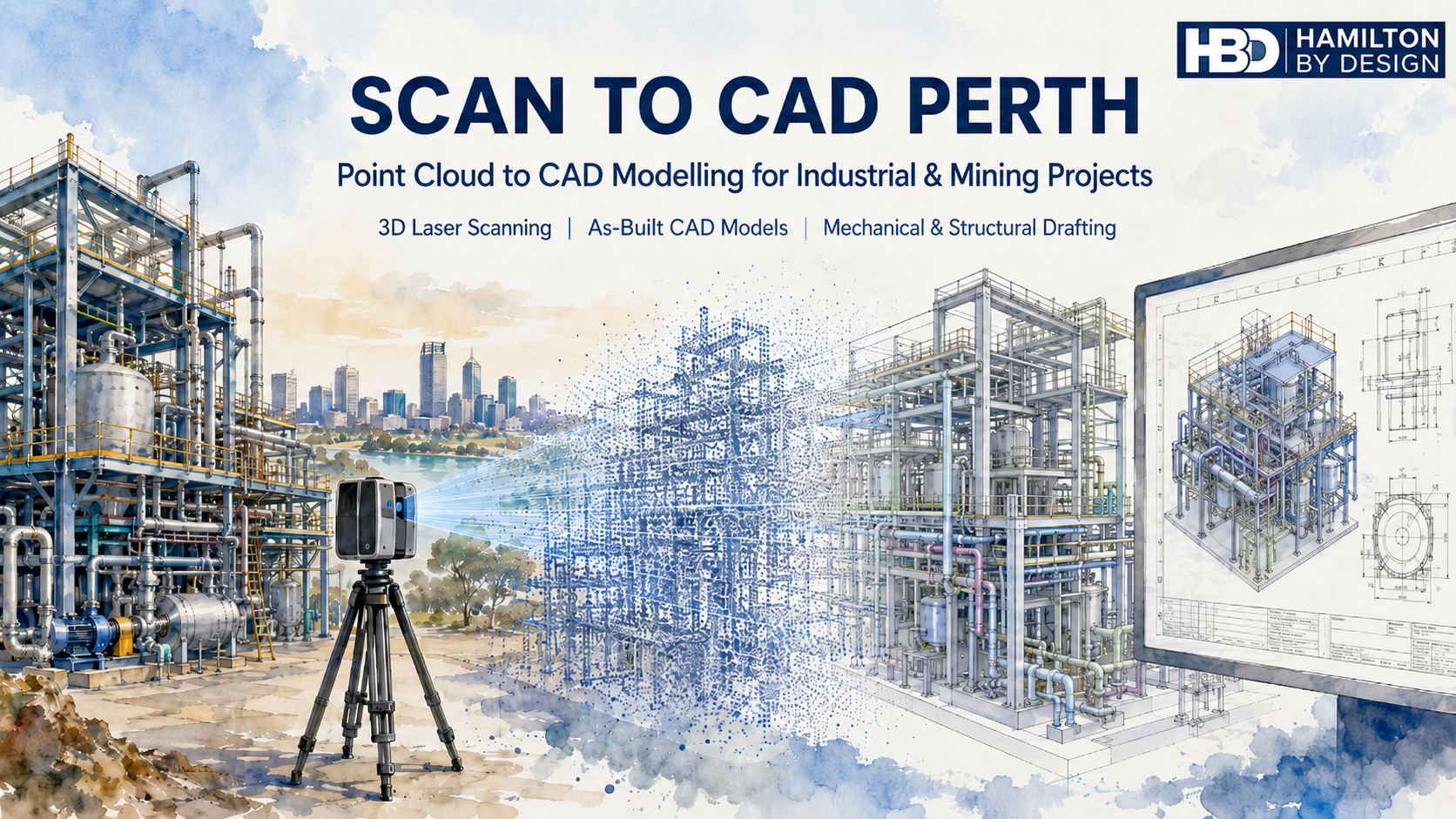
Hamilton By Design provides Scan to CAD Perth services for businesses that need accurate CAD models, drawings and engineering information from existing plant, equipment, structures and sites.
Many Perth and Western Australian businesses work with assets that have been modified over many years. Drawings may be missing, outdated, incomplete or no longer trusted. This creates problems when planning upgrades, replacing equipment, modifying pipework, designing new access platforms or reverse engineering obsolete parts.
Scan to CAD helps solve this problem by converting real-world site conditions into usable CAD data.
Using 3D laser scanning and LiDAR capture, Hamilton By Design can scan existing assets and convert the point cloud into practical engineering deliverables such as 3D CAD models, 2D drawings, as-built layouts, mechanical models, structural layouts, pipework models and fabrication-ready documentation.
Our Scan to CAD Perth services support mining, industrial, manufacturing, marine, infrastructure, water, energy and process plant projects across Perth and Western Australia.
What Is Scan to CAD?
Scan to CAD is the process of capturing an existing object, machine, structure, plant room, building or industrial site using a 3D laser scanner, then converting the scan data into CAD models or drawings.
The scanner captures millions of measurement points from the real-world environment. This creates a point cloud, which can then be processed, registered and used as a reference for CAD modelling.
The CAD output may be simple or detailed depending on the project.
For example, a business may need a basic 3D layout to check whether new equipment will fit. Another project may require detailed CAD models of pipework, steelwork, access platforms, pump components or mechanical assemblies. In some cases, the final deliverable may be a set of fabrication drawings, general arrangement drawings, sections, elevations or 3D model files for engineering design.
Scan to CAD is especially useful for brownfield projects, where new design work needs to fit around existing assets.
Why Perth Businesses Use Scan to CAD Services
Perth businesses use Scan to CAD services when they need reliable information about existing assets.
This is common in mining, ports, processing plants, fabrication workshops, pump stations, utilities, marine facilities and industrial sites. Many of these sites have been changed over many years. Equipment has been replaced, pipework has been rerouted, structures have been modified and old drawings may not reflect the current condition.
When drawings cannot be trusted, engineering work becomes risky.
A new piece of equipment may clash with existing steelwork. A replacement pipe spool may not fit. A platform may be designed around incorrect dimensions. A shutdown job may be delayed because the site information was wrong. These problems can cost far more than the original drafting or scanning work.
Scan to CAD helps reduce this risk by giving engineers, project managers, fabricators and maintenance teams a clearer understanding of the existing site before design, fabrication or installation begins.
One of the biggest problems businesses face is the lack of reliable drawings. In many industrial environments, original drawings are either unavailable or no longer accurate. This is particularly common where plant has been upgraded over many years without the as-built documentation being updated.
Another common problem is that OEM drawings are not available. Equipment suppliers may not provide drawings, or replacement parts may have long lead times and high costs. In these situations, Scan to CAD can assist with reverse engineering by capturing the existing part or assembly and creating CAD models for review, repair, modification or replacement.
Brownfield upgrades are another major reason for using Scan to CAD. Existing structures, conveyors, chutes, tanks, pumps, platforms, walkways and pipework can make new design work difficult. A scan provides a practical way to model the existing environment and check the proposed design before fabrication.
Shutdown work is also a key driver. During a shutdown, there is limited time to complete installation work. If a fabricated part does not fit, the cost can be significant. Scan to CAD helps reduce the chance of site rework, emergency fabrication and installation delays.
Scan to CAD for Mining and Industrial Sites in Perth
Perth is closely connected to Western Australia’s mining, resources, marine, energy and industrial sectors. Many projects are designed, managed or supported from Perth, even when the site itself is located elsewhere in WA.
Hamilton By Design supports Scan to CAD services for mining and industrial applications including:
Conveyors, chutes and transfer points.
Pump stations and pipework.
Processing plants and fixed plant equipment.
Access platforms, stairs, ladders and walkways.
Structural steel layouts.
Mechanical equipment and machine components.
Plant rooms and service areas.
Marine and ship repair projects.
Brownfield upgrade areas.
Reverse engineering of obsolete or unavailable parts.
The purpose is not only to create a point cloud. The purpose is to turn that scan data into useful engineering information.
A point cloud is valuable, but many businesses need more than raw scan data. They need usable CAD information that can support decisions, design work, procurement, fabrication and installation.
Hamilton By Design can convert point cloud data into a range of CAD deliverables, including:
3D CAD models.
2D CAD drawings.
General arrangement drawings.
Sections and elevations.
As-built layouts.
Pipework models.
Structural models.
Mechanical models.
STEP, SAT or Parasolid files.
SolidWorks models.
Inventor models.
AutoCAD drawings.
DWG and DXF files.
Fabrication drawings where required.
The final deliverable depends on the project requirement. A clash detection model may not need the same level of detail as a fabrication drawing. A concept model may not need every bolt and weld. A reverse engineering job may need a much higher level of detail.
This is why it is important to define the scope before scanning and modelling begins.
The Importance of Engineering Understanding
Scan to CAD is not just a software process. It requires engineering judgement.
A scanner records what it can see, but the CAD model needs to be interpreted and built by someone who understands the purpose of the work. This is especially important for mechanical, structural and industrial projects.
For example, pipework may need to be modelled using correct pipe outside diameters and centre lines. Steelwork may need to reflect real member sizes. Platforms and access systems may need to consider Australian Standards such as AS 1657. Mechanical components may need to be modelled with design intent, clearances, tolerances and manufacturing method in mind.
A visually impressive model is not always an engineering-ready model.
Hamilton By Design focuses on practical CAD outputs that can be used by engineers, fabricators, project managers and maintenance teams.
Problems Businesses Can Have With Poor Scan to CAD Services
Not all Scan to CAD services are the same.
A common problem is that businesses receive a large point cloud but do not know how to use it. The file may be too large, the format may not suit their software, or the areas they need may not have been captured properly.
Another problem is unclear scope. If the instruction is only “scan the site and provide CAD”, the result may not match what the business expected. The scope should define what needs to be scanned, what needs to be modelled, the required level of detail, the accuracy expectations, the required file formats and whether drawings are included.
Businesses can also run into trouble when the model is either under-modelled or over-modelled. Under-modelling can miss important details. Over-modelling can waste time and increase cost without adding value.
There can also be line-of-sight issues. Laser scanners cannot see through objects, insulation, guards, cladding or equipment. Hidden areas may require extra scan positions, physical measurement or site verification.
The best results come from planning the scan around the final CAD deliverable.
When Should Scan to CAD Be Used?
Scan to CAD should be considered early in a project, especially when existing information is unreliable.
It is useful before:
Plant upgrades.
Equipment installation.
Shutdown planning.
Pipework replacement.
Structural modification.
Access platform design.
Reverse engineering.
Fabrication.
Clash detection.
Layout planning.
As-built documentation.
The earlier the scan is completed, the more useful it becomes. If the scan is done after design work is already finished, it may only reveal problems late in the project. When scanning is completed early, the design team can work around the real site conditions from the start.
Scan to CAD Perth for Brownfield Engineering
Brownfield engineering is one of the strongest applications for Scan to CAD.
In a brownfield site, the challenge is not simply designing something new. The challenge is making sure the new design fits the existing plant.
This is where Scan to CAD provides value.
By converting existing site conditions into CAD, Hamilton By Design can help identify space restrictions, clashes, tie-in points, access limitations and installation constraints before work reaches site.
This can support better planning, better design decisions and reduced installation risk.
For businesses needing building, facility or infrastructure modelling from scan data, Hamilton By Design also provides Scan to BIM services in Perth WA.
Why Work With Hamilton By Design?
Hamilton By Design combines 3D laser scanning, CAD modelling, mechanical engineering, structural drafting and reverse engineering experience.
This means the Scan to CAD process is approached with the final engineering outcome in mind.
We understand that businesses do not simply need a scan. They need answers.
Will the new equipment fit?
Can the part be reverse engineered?
Can the pipework be modelled accurately?
Can the existing structure be documented?
Can the shutdown risk be reduced?
Can the CAD model be used for design, drafting or fabrication?
Our goal is to provide practical CAD information that helps businesses make better engineering decisions.
Scan to CAD Perth Services
Hamilton By Design provides Scan to CAD Perth services for businesses needing accurate, useful and engineering-focused CAD deliverables from existing assets.
Whether the project involves mining equipment, industrial plant, pipework, structural steel, mechanical components, marine repairs or brownfield upgrades, Scan to CAD can help turn site reality into usable engineering data.
If your business has missing drawings, unreliable site information, obsolete parts, shutdown risk or brownfield design challenges, Scan to CAD may be the right starting point.
Hamilton By Design can assist with 3D laser scanning, point cloud processing, CAD modelling, as-built documentation and engineering drafting for Perth and Western Australian projects.
Need Scan to CAD Support in Perth?
Hamilton By Design provides Scan to CAD services for Perth businesses that need accurate CAD models and drawings from existing plant, equipment and structures.
We can assist with site scanning, point cloud processing, CAD modelling, as-built drawings, reverse engineering and engineering documentation for industrial and mechanical projects.
To provide the best experiences, we use technologies like cookies to store and/or access device information. Consenting to these technologies will allow us to process data such as browsing behaviour or unique IDs on this site. Not consenting or withdrawing consent, may adversely affect certain features and functions.
Functional
Always active
The technical storage or access is strictly necessary for the legitimate purpose of enabling the use of a specific service explicitly requested by the subscriber or user, or for the sole purpose of carrying out the transmission of a communication over an electronic communications network.
Preferences
The technical storage or access is necessary for the legitimate purpose of storing preferences that are not requested by the subscriber or user.
Statistics
The technical storage or access that is used exclusively for statistical purposes.The technical storage or access that is used exclusively for anonymous statistical purposes. Without a subpoena, voluntary compliance on the part of your Internet Service Provider, or additional records from a third party, information stored or retrieved for this purpose alone cannot usually be used to identify you.
Marketing
The technical storage or access is required to create user profiles to send advertising, or to track the user on a website or across several websites for similar marketing purposes.