
Reduce Shutdown Upgrade Fit-Up Risk with 3D Laser Scanning for Your Coal Chute

A replacement coal chute can be fabricated exactly to the drawing and still fail to fit the plant.
Existing supports may have moved. Flanges may have been modified. Additional bracing, pipework or cable trays may occupy the installation space. Older drawings may no longer represent the equipment installed on site.
When these differences are discovered during a shutdown, the consequences can include field cutting, additional welding, revised lifting arrangements and delays to returning the plant to service.
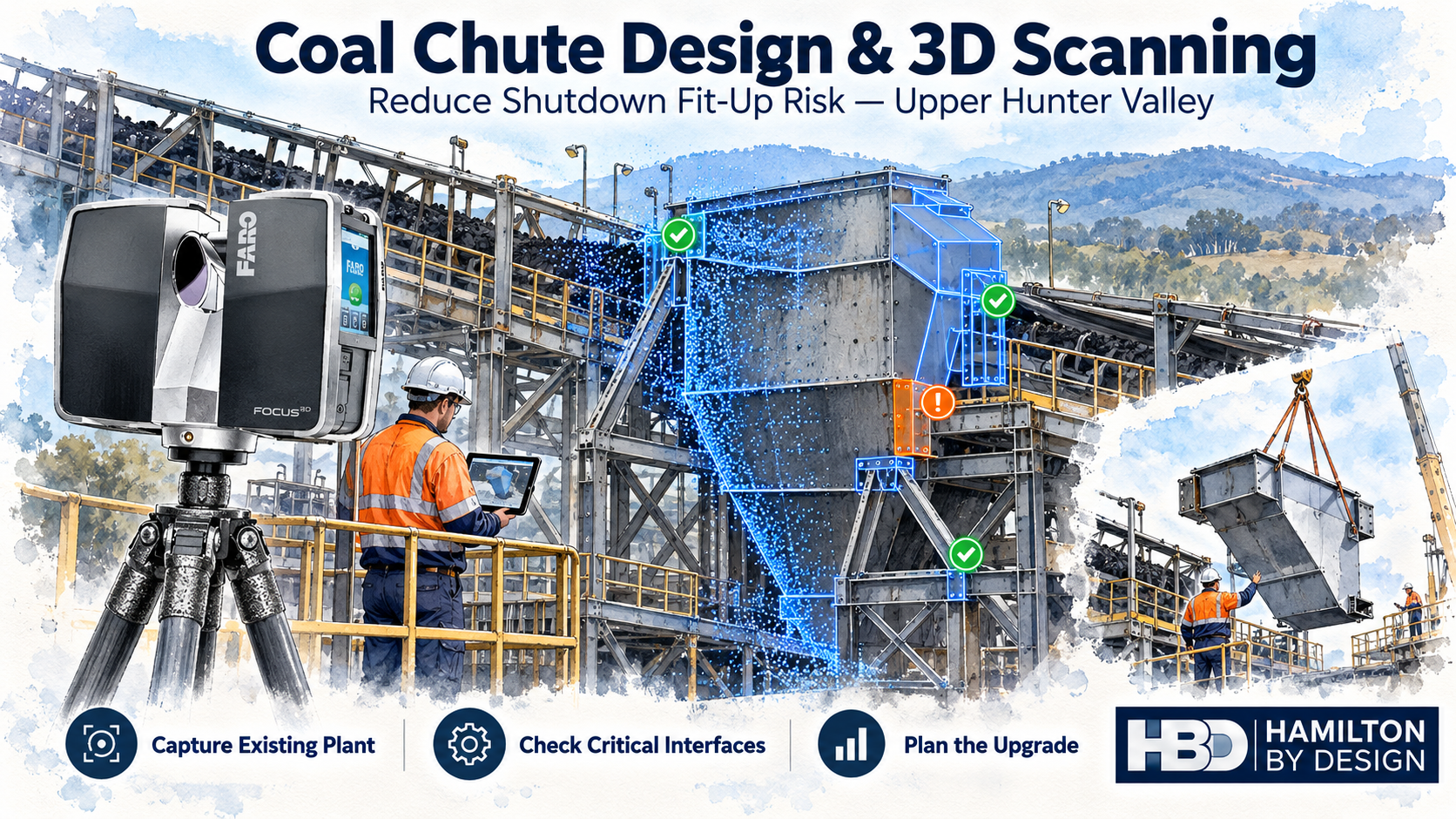
Hamilton By Design provides coal chute design, 3D scanning and mechanical engineering support for projects across Muswellbrook, Singleton and the Upper Hunter Valley. We capture existing plant geometry, develop the proposed chute within its surrounding environment and check critical interfaces before fabrication.
The objective is practical: identify fit-up problems early, when there is still time to resolve them.
Why Coal Chute Upgrades Need Reliable Site Information
Coal chutes connect equipment within a larger materials handling system. Their design must consider the relationship between the incoming conveyor, discharge point, chute supports and receiving equipment.
A replacement chute may need to connect with:
- Existing discharge hoods and head pulley arrangements.
- Receiving conveyors and loading zones.
- Structural supports and mounting plates.
- Skirting and dust containment systems.
- Platforms, walkways and guarding.
- Inspection doors and maintenance access.
- Adjacent pipework, cable trays and services.
Measuring only the chute opening can leave important installation constraints unresolved.
A chute might fit between its connection points but clash with nearby steelwork. A liner access door might open directly into a handrail. A larger replacement assembly might be difficult to move through the available installation route.
Coal chute design needs to consider both the equipment and the space required to install, operate and maintain it.
Use 3D Scanning Before Finalising the Chute Design
3D laser scanning captures the visible geometry of the existing chute and surrounding plant from multiple positions.
The scans are registered into a point cloud that can be used for measurement, modelling and engineering review.
For a coal chute upgrade, the capture scope can include:
- Chute inlet and outlet positions.
- Visible flange and support geometry.
- Conveyor alignment and surrounding equipment.
- Structural steelwork and bracing.
- Access platforms, stairs and handrails.
- Services near the proposed modification.
- Available space for removal and installation.
This provides a broader understanding of the existing installation than a small set of isolated measurements.
The proposed chute model can then be positioned within the point cloud to assess how it relates to the actual plant.
For related regional services, see Mine Conveyor Gallery Scanning Hunter Valley NSW.
Check Critical Interfaces Before Fabrication
Fit-up risk often concentrates at the points where new equipment connects with existing plant.
For coal chutes, these may include mounting faces, support brackets, flange connections and the relationship between the chute outlet and receiving conveyor.
Hamilton By Design uses the scan and engineering model to review these interfaces before drawings are released for fabrication.
Depending on the project, the review can address:
- Connection positions and orientations.
- Support spacing and elevations.
- Clearance around the chute body.
- Access to bolts and installation tools.
- Space for liners and inspection doors.
- Interfaces with existing guarding.
- Allowance for fabrication and installation tolerances.
Critical dimensions require a measurement method suited to their tolerance. Small bolt holes, concealed faces and close-tolerance connections may need direct measurement or supplementary scanning.
The required accuracy should be agreed at the start of the project, with any inaccessible or uncertain interfaces clearly identified.
Coal Chute Design Must Also Consider Material Flow
A chute that fits the plant still needs to handle the coal effectively.
Coal chute design should consider the operating conditions supplied by the client, including:
- Required throughput.
- Incoming belt speed and material trajectory.
- Coal lump size and fines content.
- Bulk density and moisture variation.
- Available transfer height.
- Receiving conveyor arrangement.
- Existing wear, blockage or spillage problems.
These inputs help guide the chute geometry, liner arrangement, access requirements and transfer configuration.
Where material behaviour is complex, specialist material-flow assessment or Discrete Element Method modelling may be appropriate. The level of analysis should match the problem and the consequences of poor performance.
3D scanning establishes the existing geometry. Engineering assessment determines how the proposed coal chute should function within that geometry.
Design for Maintenance and Liner Replacement
Maintenance access should be considered while developing the chute.
A compact design may appear suitable in a general arrangement but become difficult to maintain once installed. Wear liners may be obstructed by supports, fasteners may be inaccessible, or removable sections may lack a practical handling route.
Depending on the scope, chute design can consider:
- Replaceable wear liner sections.
- Access to liner fasteners.
- Inspection and clean-out openings.
- Removable panels and chute sections.
- Space for maintenance tools.
- Component handling and removal paths.
Lifting provisions and structural support changes require appropriate engineering assessment.
Considering these requirements before fabrication helps maintenance teams understand how the chute will be serviced throughout its operating life.
Plan the Shutdown Around the Proposed Installation
A digital model can support discussions between the engineering team, fabricator, maintenance personnel and shutdown planner.
Together, they can review how the existing chute will be removed and how the replacement will reach its final position.
Questions to resolve include:
- Can the chute be installed as one assembly?
- Does it need to be divided into smaller sections?
- Which existing items need temporary removal?
- Are the proposed connections accessible?
- Is enough space available to manoeuvre the assembly?
- What work can be completed before the shutdown?
Resolving these questions early helps define the fabrication package and installation scope.
The scan supports this planning by showing the surrounding geometry. Final lifting methods, temporary works and site execution arrangements still need their own assessment.
From Site Capture to Coal Chute Fabrication Drawings
Hamilton By Design can develop a staged workflow suited to the project.
1. Define the Upgrade
Confirm the reason for the modification, operating requirements, existing problems, shutdown timing and required deliverables.
2. Capture the Existing Plant
Complete 3D scanning and supplementary measurements of the chute, supports, conveyors and relevant surrounding infrastructure.
Internal capture depends on safe access, isolation and visibility. Hidden or obstructed surfaces must be addressed separately.
3. Develop the Chute Design
Model the proposed chute against the captured plant, considering interfaces, material flow, liners, maintenance access and installation constraints.
4. Review the Arrangement
Review the design with the client and relevant site personnel. Resolve outstanding measurements and interface questions before fabrication release.
5. Prepare the Documentation
Depending on the agreed scope, deliverables can include:
- Registered point clouds.
- Existing-condition and proposed CAD models.
- General arrangement drawings.
- Chute fabrication and assembly drawings.
- Wear liner layouts.
- Interface details and installation information.
- STEP, DWG, DXF and PDF files.
Learn more about our Mechanical Engineering Services in Muswellbrook.
Supporting Coal Chute Upgrades Across the Upper Hunter
Hamilton By Design supports coal chute and materials handling projects across Muswellbrook, Singleton, Denman and surrounding Upper Hunter mining areas, together with the wider Hunter Valley.
Typical applications include transfer chute replacements, worn chute reconstruction, conveyor modifications, liner upgrades and brownfield CHPP projects.
Our Hunter Valley Mining Engineering and 3D Laser Scanning Services provide broader regional support.
Frequently Asked Questions
Can 3D scanning reduce coal chute fit-up risk?
Yes. It can help identify differences between existing drawings and visible site conditions, allowing proposed equipment to be reviewed before fabrication. It reduces uncertainty but does not guarantee installation fit.
Do we need scanning if we already have drawings?
Existing drawings are useful starting information. Scanning is particularly valuable where the plant has been modified, dimensions are uncertain or the replacement chute must fit within congested infrastructure.
Can you scan inside a coal chute?
Internal scanning may be possible where the chute is safely isolated, accessible and sufficiently clear. Access conditions and site requirements must be assessed before capture.
Can the existing chute be reverse engineered?
Visible and accessible geometry can support CAD reconstruction. Worn or damaged geometry must be assessed so that the new design reflects the intended function rather than simply copying deterioration.
When should the scan be completed?
Ideally, before detailed design and fabrication. This gives the project team time to resolve interface issues and prepare the upgrade before the shutdown.
Discuss Your Coal Chute Upgrade
If you are planning a coal chute replacement or conveyor transfer upgrade in the Upper Hunter Valley, involve Hamilton By Design before fabrication begins.
We can help establish the existing geometry, develop the chute design and review the interfaces that influence shutdown fit-up.
Capture the existing plant. Check the proposed chute. Prepare the upgrade before the shutdown.
Contact Hamilton By Design to discuss your chute design and 3D scanning requirements.
Contact Us – Talk To Us
Our clients: