Mechanical Engineering | 3D Scanning | 3D Modelling
Category: Engineering Services
Engineering Services brings together practical engineering knowledge that supports real projects, real constraints, and real outcomes.
This category covers how engineering services are applied across design, verification, upgrades, and construction support, with a focus on mechanical and structural engineering in existing and live environments. Topics include engineering decision-making, design development, compliance considerations, and how engineering integrates with 3D scanning, CAD modelling, and as-built documentation.
Articles explain what professional engineering input actually delivers—helping project teams reduce risk, improve buildability, and make informed decisions based on accurate data and sound engineering judgement, not assumptions.
Content is written for asset owners, project engineers, builders, and contractors who want a clearer understanding of how engineering services add value across power, manufacturing, mining, and building & construction projects.
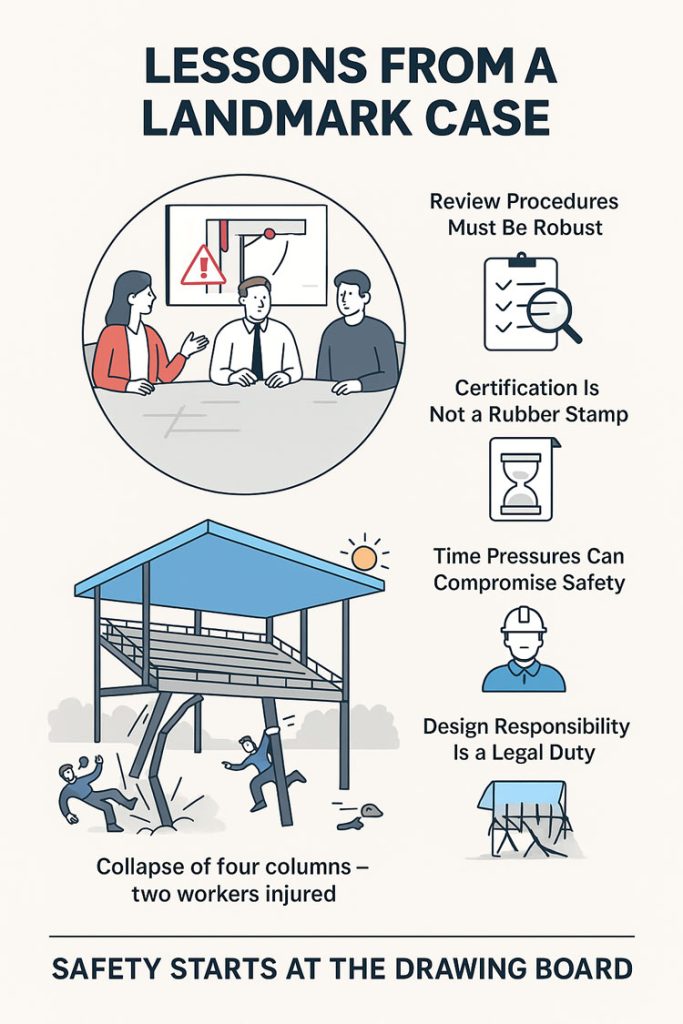
In 2024, SafeWork SA concluded a landmark case involving a spectator-roof collapse during a football club redevelopment project in South Australia. While no life-threatening injuries occurred, the incident highlighted how critical it is for design, review, and certification processes to work together to ensure safety on site.
This was the first successful design-related prosecution under South Australia’s Work Health and Safety Act, sending a clear signal to the engineering and construction sector: design decisions carry legal and safety obligations, not just technical ones.
What Happened (Briefly)
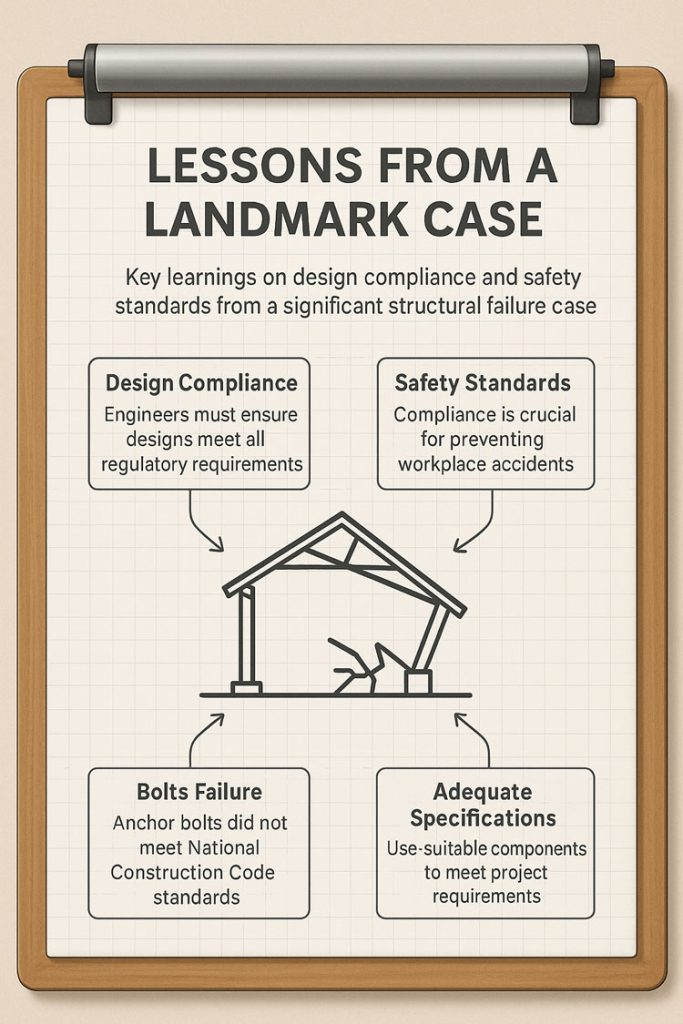
During roof sheeting works in late 2021, four of seven supporting columns of a cantilevered spectator roof failed, causing two apprentices to slide down the roof sheets. SafeWork SA’s investigation found that the anchor bolts specified for the column base plates were inadequate and did not meet the requirements of the National Construction Code (NCC).
An independent compliance review also failed to detect this issue, allowing the error to pass unchecked into construction. The result was a collapse that could have had far more severe consequences had the roof been fully loaded or occupied.
Key Learnings for the Industry
This case underscores several important lessons for engineers, designers, project managers, and certifiers:
1. Design Responsibility Is a WHS Duty
Under the WHS Act, designers have a duty to ensure their work is safe not just in its intended use, but during construction. This means bolts, connections, and base plates must be designed for real-world loads — including wind uplift, combined shear and tension, and concrete breakout limits per NCC and relevant Australian Standards.
2. Review Procedures Must Be Robust — and Followed
Having a documented review procedure is not enough if it isn’t rigorously applied. Independent verification and internal peer review are critical to catching design errors before they reach site.
3. Certification Is Not a Rubber Stamp
Independent certifiers play a key role in safeguarding public safety. They must actively verify that designs meet compliance, rather than simply sign off on documentation.
4. Time Pressures Can Compromise Safety
Compressed project timelines were noted as a factor in missed opportunities to catch the error. Project teams must resist the temptation to shortcut review steps when schedules are tight — safety must remain non-negotiable.
5. Documentation & Traceability Protect Everyone
Maintaining calculation records, checklists, and review signoffs creates a clear audit trail. This helps demonstrate due diligence if something goes wrong.
Why This Matters
The collapse at Angaston Football Club was a relatively small incident with minor injuries — but it could easily have been catastrophic. By learning from cases like this, the industry can improve its processes and prevent future failures.
As professionals, our role is to design for safety, verify rigorously, and document clearly. Doing so protects workers, end-users, and our own organisations.
Legal & Ethical Considerations
This post is intended as a learning resource, not as an allocation of blame. The case referenced is a matter of public record through SafeWork SA and SAET decisions, and all commentary here focuses on general principles of safe design and compliance.
We recommend that other practitioners review their own QA and certification procedures in light of this case to ensure compliance with the National Construction Code and WHS obligations.
Steel has been the backbone of industrial progress for over 150 years. It is the invisible framework behind our skyscrapers, bridges, transport systems, and modern cities. But the industry that gave us the Industrial Revolution is now facing one of the greatest transitions in its history. The combined pressures of climate change, regulatory scrutiny, fluctuating energy costs, and global trade realignments are forcing steelmakers to rethink how steel is made, used, and traded.
Recent news reports show a fascinating picture: a sector in the middle of transformation, experimenting with new technologies like hydrogen-based direct reduction, while still relying on traditional blast furnace smelting to meet soaring demand. In this article, we explore the future direction of the smelting and steelmaking industry, what challenges lie ahead, and where the biggest opportunities are likely to emerge.
The Push for Green Steel
Hydrogen & Direct Reduced Iron (DRI): A Pathway to Decarbonization
Hydrogen-based steel production remains the single most promising pathway for deep decarbonization in the steel sector. Instead of using metallurgical coal and coke to chemically reduce iron ore, hydrogen can be used to produce direct reduced iron (DRI) that can then be melted in an electric arc furnace (EAF). This dramatically cuts CO₂ emissions, especially if the hydrogen is produced using renewable energy.
Projects like Salzgitter’s Salcos program in Germany are leading the way. Salzgitter has been developing one of the most ambitious hydrogen-based steel transformation roadmaps in Europe, gradually phasing in hydrogen reduction units and retiring carbon-intensive blast furnaces. Similarly, Australia’s NeoSmelt initiative, backed by Rio Tinto and ARENA, is exploring a combination of DRI and electric smelting furnaces to create a pathway that works for Australian ore quality and energy markets.
But this transition is anything but smooth. Salzgitter has recently delayed later stages of its program, citing economic and regulatory headwinds, such as the high cost of hydrogen, uncertain carbon pricing, and the slow rollout of renewable energy infrastructure. This highlights a hard truth: the green transition will not be instant or cheap. The next decade will likely be defined by pilot projects, incremental scale-ups, and careful balancing between economic viability and climate commitments.
The Coal Paradox
Even as green steel makes headlines, metallurgical coal is seeing a surprising resurgence. Demand for coal-based blast furnace production remains robust, especially in China and India, where domestic infrastructure spending continues to grow. In fact, recent research from the Global Energy Monitor shows that coal-based capacity is still expanding, even as global climate targets call for steep reductions in emissions.
This paradox points to the transitional nature of the current era. For the foreseeable future, the world will be living in a dual-track steel economy: one track relying on traditional blast furnaces and coke ovens to meet near-term demand, and another experimenting with hydrogen, electric smelting, and alternative reduction technologies.
For businesses, this means they cannot simply abandon existing capacity overnight. Instead, expect to see retrofit investments to improve the efficiency of blast furnaces, capture more waste heat, and install carbon capture and storage (CCS) where feasible. This “cleaner coal” approach will act as a bridge until low-carbon technologies can compete at scale on cost and availability.
Regional Shifts & Strategic Investments
Australia’s Green Steel Ambitions
Australia is emerging as a key player in the global conversation on sustainable steelmaking. The country has vast high-grade iron ore resources, growing renewable energy capacity, and a strategic interest in maintaining domestic steelmaking capability.
BlueScope’s $1.15B blast furnace reline at Port Kembla is one of the largest industrial projects in the nation’s history, designed to keep steel production secure for another 20 years. This investment shows that Australia is taking a pragmatic approach — continuing to support blast furnace technology while planning for a green future.
The NeoSmelt project, which just secured nearly $20M in government funding, is a potential game-changer. It will explore how to combine renewable-powered hydrogen and electric furnaces to make a commercial-scale green steel process that works with Australian ore.
The potential takeover of Whyalla Steelworks by a consortium led by BlueScope could turn the plant into a testbed for low-emissions ironmaking, providing a national blueprint for decarbonizing heavy industry.
Global Trade & Policy Realignment
Meanwhile, trade policy is also shaping the future. The EU and U.S. have resumed talks to revisit steel and aluminium tariffs, with a focus on creating carbon-based trade measures. If implemented, this could reward producers who adopt low-carbon technologies while penalizing those that rely on high-emission processes. For global producers, this will accelerate investment in low-emissions capacity to stay competitive in export markets.
Innovation Beyond Furnaces
The transformation of steelmaking is not just about switching fuels — it’s about reimagining the entire production system.
Modular, low-emission smelting plants like those being developed in Western Australia by Metal Logic allow companies to build capacity closer to demand centers, reduce transport emissions, and scale production up or down as needed.
Digital twins and AI-driven process control are making smelting more efficient. By modeling every step of the steelmaking process, producers can optimize energy use, reduce material losses, and increase yield — all of which improve profitability and lower emissions simultaneously.
Circular economy practices, such as increased use of scrap steel in EAFs, are becoming a central strategy. Recycling steel uses a fraction of the energy required to make virgin steel and fits neatly into the industry’s sustainability narrative.
This convergence of physical and digital innovation will likely create a new generation of steel plants that are smaller, smarter, and cleaner than their 20th-century predecessors.
Where the Industry is Headed
Looking ahead, the future of smelting and steelmaking will be defined by hybridization, regulation, and resilience:
Hybrid production systems will dominate for at least the next decade. Expect blast furnaces to operate alongside hydrogen-based DRI units and electric smelters as companies transition gradually.
Stricter carbon regulations will push companies to adopt low-carbon pathways faster than market forces alone would dictate. Carbon border adjustment mechanisms (CBAMs) will effectively tax “dirty steel” in major economies, making investment in green capacity a competitive necessity.
Domestic capability building will remain critical. The COVID-era supply chain crises reminded governments why domestic production matters. Expect to see policies that support keeping steelmaking onshore, even if that requires subsidies or preferential procurement.
Collaborative innovation will become the norm. Mining giants, energy producers, and technology firms are already forming alliances to solve the “green steel puzzle.” This cross-industry collaboration will unlock new efficiencies and accelerate commercialization.
Final Thoughts
The smelting and steelmaking industry is standing at the crossroads of history. The coming years will test its ability to balance sustainability with profitability, scale with flexibility, and tradition with innovation.
Companies that embrace this challenge — investing in low-carbon technology, digital transformation, and strategic partnerships — will not just survive the coming disruption but thrive as leaders in a new, greener industrial age. Steel may be one of the oldest materials in human civilization, but its future is being forged right now, and it has never been more exciting.
Getting Coal, Hard Rock, and ROM Material Flow Right
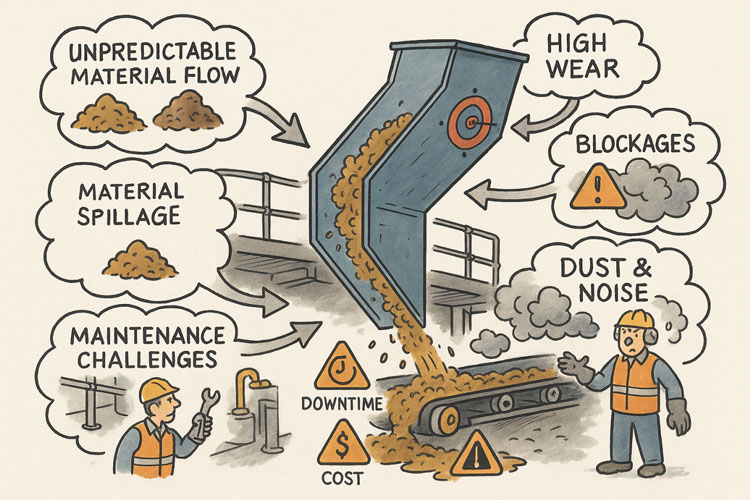
Chute design is one of the most critical yet challenging aspects of mining and mineral processing. Whether you are handling coal, hard rock ore, or raw ROM material, chutes and transfer stations are the unsung workhorses of every operation. When designed well, they guide material smoothly, minimise wear, and keep conveyors running. When designed poorly, they cause blockages, spillage, excessive dust, and expensive downtime.
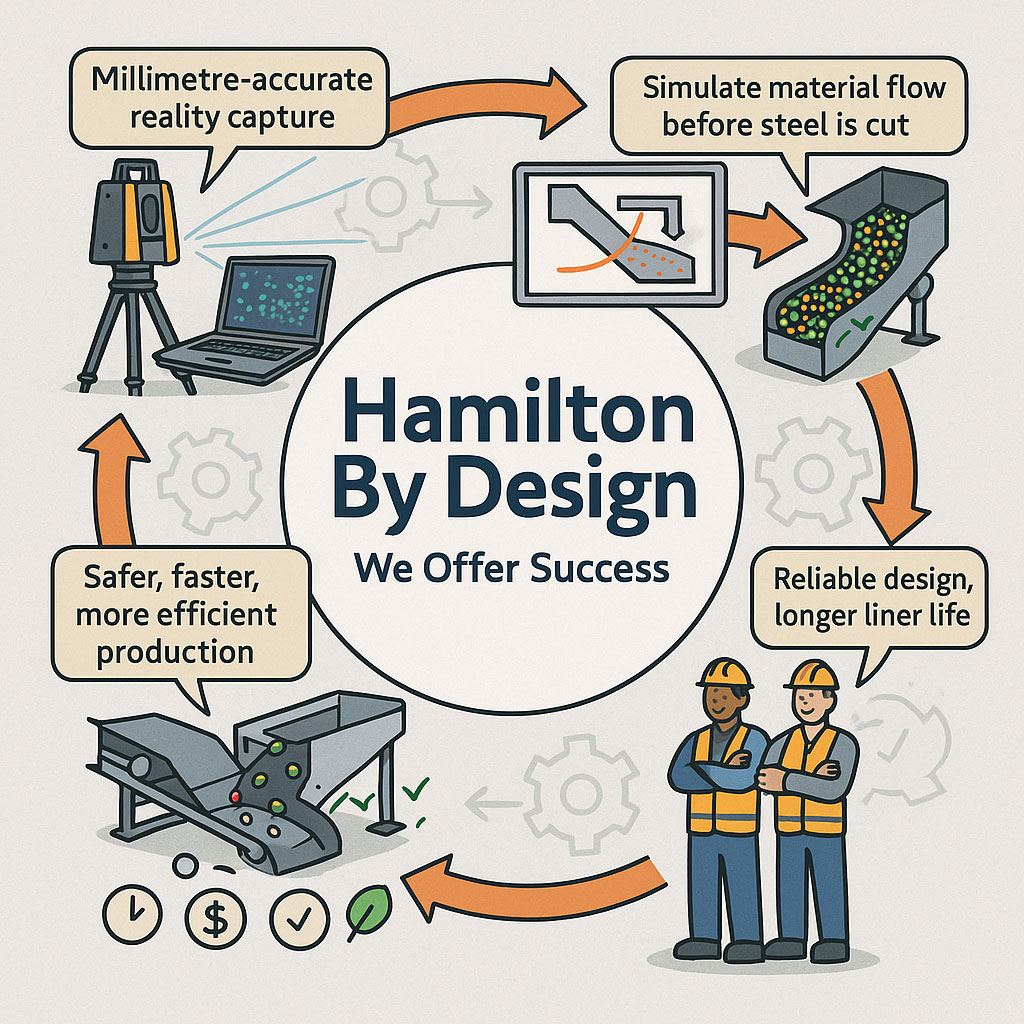
Modern chute design has moved far beyond rules of thumb and back-of-the-envelope sketches. Today, successful projects rely on accurate as-built data, particle trajectory analysis, and advanced Discrete Element Method (DEM) simulation to predict, visualise, and optimise material flow before steel is cut. In this article, we explore why these tools have become essential, how they work together, and where software can — and cannot — replace engineering judgement.
The Challenge of Chute Design
Coal and hard rock have very different flow behaviours. Coal tends to be softer, generate more dust, and be prone to degradation, while hard rock is more abrasive and can damage chutes if impact angles are not controlled. ROM material adds another level of complexity — oversize lumps, fines, and moisture variation can cause hang-ups or uneven flow.
Chute design must balance several competing objectives:
Control the trajectory of incoming material to reduce impact and wear
Prevent blockages by maintaining flowability, even with wet or sticky ore
Manage dust and noise to meet environmental and workplace health requirements
Fit within existing plant space with minimal modification to conveyors and structures
Be maintainable — liners must be accessible and replaceable without excessive downtime
Meeting all these goals without accurate data and simulation is like trying to design in the dark.
Capturing the Truth with 3D Scanning
The first step in any successful chute project is to understand the as-built environment. In many operations, drawings are outdated, modifications have been made over the years, and the real plant geometry may differ from what is on paper. Manual measurement is slow, risky, and often incomplete.
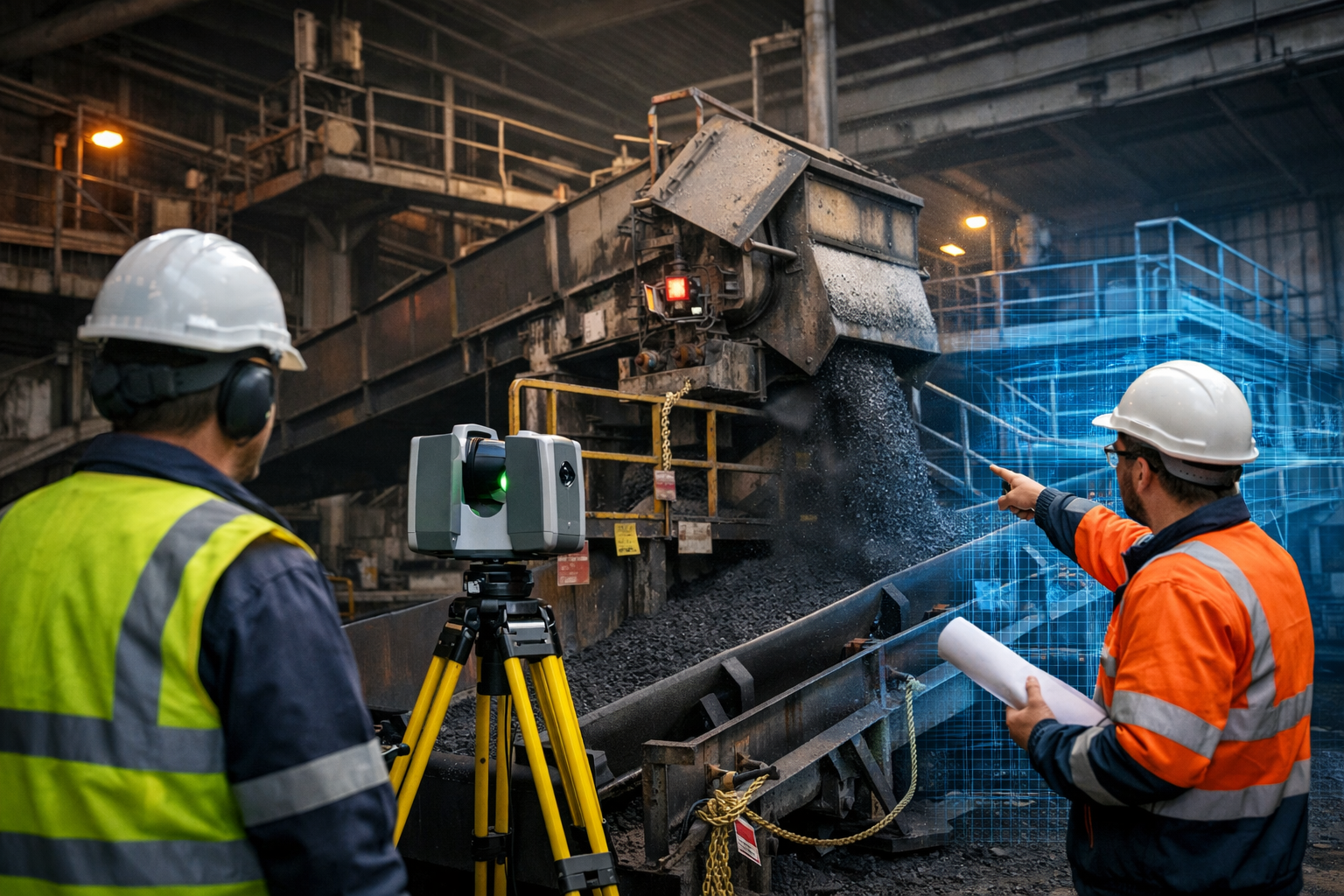
This is where 3D laser scanning changes the game. Using tripod-mounted or mobile LiDAR scanners, engineers can capture the entire transfer station, conveyors, surrounding steelwork, and services in a matter of hours. The result is a dense point cloud with millimetre accuracy that reflects the true state of the plant.
From here, the point cloud is cleaned and converted into a 3D model. This ensures the new chute design will not clash with existing structures, and that all clearances are known. It also allows maintenance teams to plan safe access for liner change-outs and other work, as the scanned model can be navigated virtually to check reach and access envelopes.
Understanding Particle Trajectory
Once the physical environment is known, the next challenge is to understand the particle trajectory — the path that material takes as it leaves the head pulley or previous transfer point.
Trajectory depends on belt speed, material characteristics, and discharge angle. For coal, fine particles may spread wider than the coarse fraction, while for ROM ore, large lumps may follow a ballistic path that needs to be controlled to prevent impact damage.
Accurately modelling trajectory ensures that the material enters the chute in the right location and direction. This minimises impact forces, reducing wear on liners and avoiding the “splash” that creates spillage and dust. It also prevents the material from hitting obstructions or dead zones that could lead to build-up and blockages.
Modern software can plot the trajectory curve for different loading conditions, providing a starting point for chute geometry. This is a critical step — if the trajectory is wrong, the chute design will be fighting against the natural path of the material.
The Power of DEM Simulation
While trajectory gives a first approximation, real-world flow is far more complex. This is where Discrete Element Method (DEM) simulation comes into play. DEM models represent bulk material as thousands (or millions) of individual particles, each following the laws of motion and interacting with one another.
When a DEM simulation is run on a chute design:
You can visualise material flow in 3D, watching how particles accelerate, collide, and settle
Impact zones become clear, showing where liners will wear fastest
Areas of turbulence, dust generation, or segregation are identified
Build-up points and potential blockages are predicted
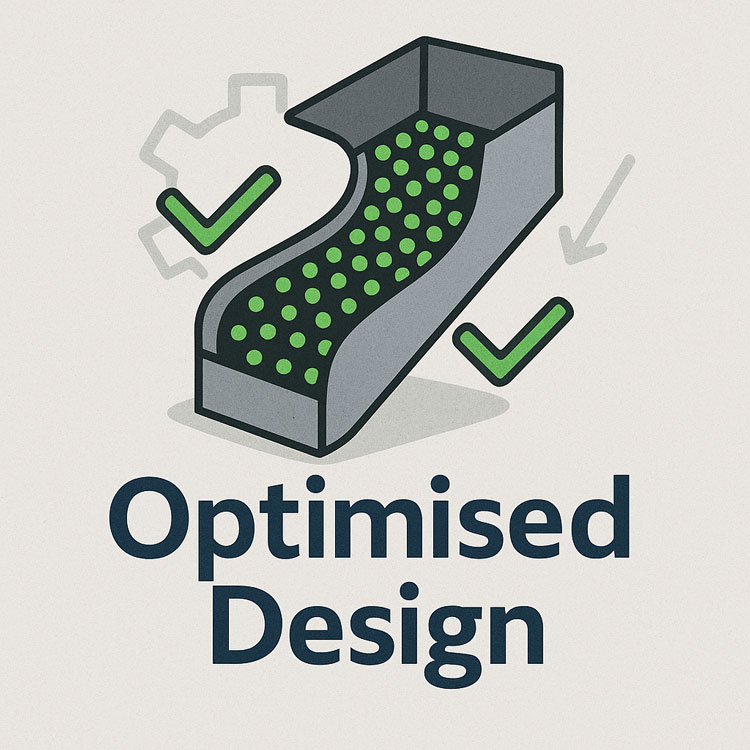
This allows engineers to experiment with chute geometry before fabrication. Angles can be changed, ledges removed, and flow-aiding features like hood and spoon profiles or rock-boxes optimised to achieve smooth, controlled flow.
For coal, DEM can help ensure material lands gently on the receiving belt, reducing degradation and dust. For hard rock, it can ensure that the energy of impact is directed onto replaceable wear liners rather than structural plate. For ROM ore, it can help prevent oversize lumps from wedging in critical locations.
🖥 Strengths and Limitations of Software
Modern DEM packages are powerful, but they are not magic. Software such as EDEM, Rocky DEM, or Altair’s tools can simulate a wide range of materials and geometries, but they rely on good input data and skilled interpretation.
Key strengths include:
Ability to model complex, 3D geometries and particle interactions
High visualisation power for communicating designs to stakeholders
Capability to run multiple scenarios (different feed rates, moisture contents, ore types) quickly
However, there are limitations:
Material calibration is critical. If the particle shape, friction, and cohesion parameters are wrong, the results will not match reality.
Computational cost can be high — detailed simulations of large chutes with millions of particles may take hours or days to run.
Engineering judgement is still needed. Software will not tell you the “best” design — it will only show how a proposed design behaves under given conditions.
That’s why DEM is best used as part of a holistic workflow that includes field data, trajectory analysis, and experienced design review.
From Model to Real-World Results
When the simulation results are validated and optimised, the design can be finalised. The point cloud model ensures the chute will fit in the available space, and the DEM results give confidence that it will perform as intended.
This means fabrication can proceed with fewer changes and less risk. During shutdown, installation goes smoothly, because clashes have already been resolved in the digital model. Once commissioned, the chute delivers predictable flow, less spillage, and longer liner life.
Why It Matters More Than Ever
Today’s mining operations face tighter production schedules, stricter environmental compliance, and increasing cost pressures. Downtime is expensive, and the margin for error is shrinking.
By combining 3D scanning, trajectory modelling, and DEM simulation, operations can move from reactive problem-solving to proactive improvement. Instead of waiting for blockages or failures, they can design out the problems before they occur, saving both time and money.
Partnering for Success
At Hamilton by Design, we specialise in turning raw site data into actionable insights. Our team uses advanced 3D scanning to capture your transfer stations with precision, builds accurate point clouds and CAD models, and runs calibrated DEM simulations to ensure your new chute design performs from day one.
Whether you’re working with coal, hard rock, or ROM ore, we help you deliver designs that fit first time, reduce maintenance headaches, and keep production running.
Contact us today to see how our integrated scanning and simulation workflow can make your next chute project safer, faster, and more reliable.
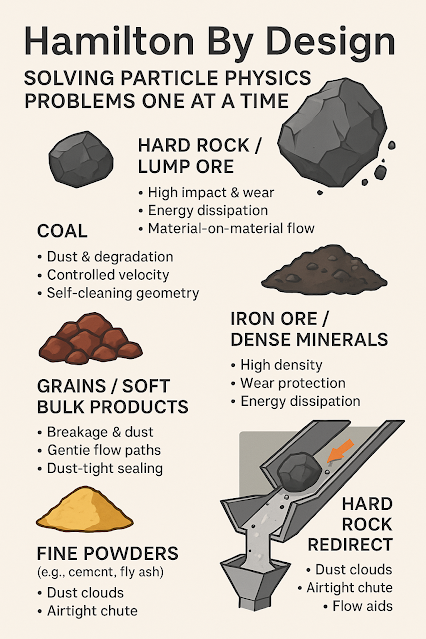
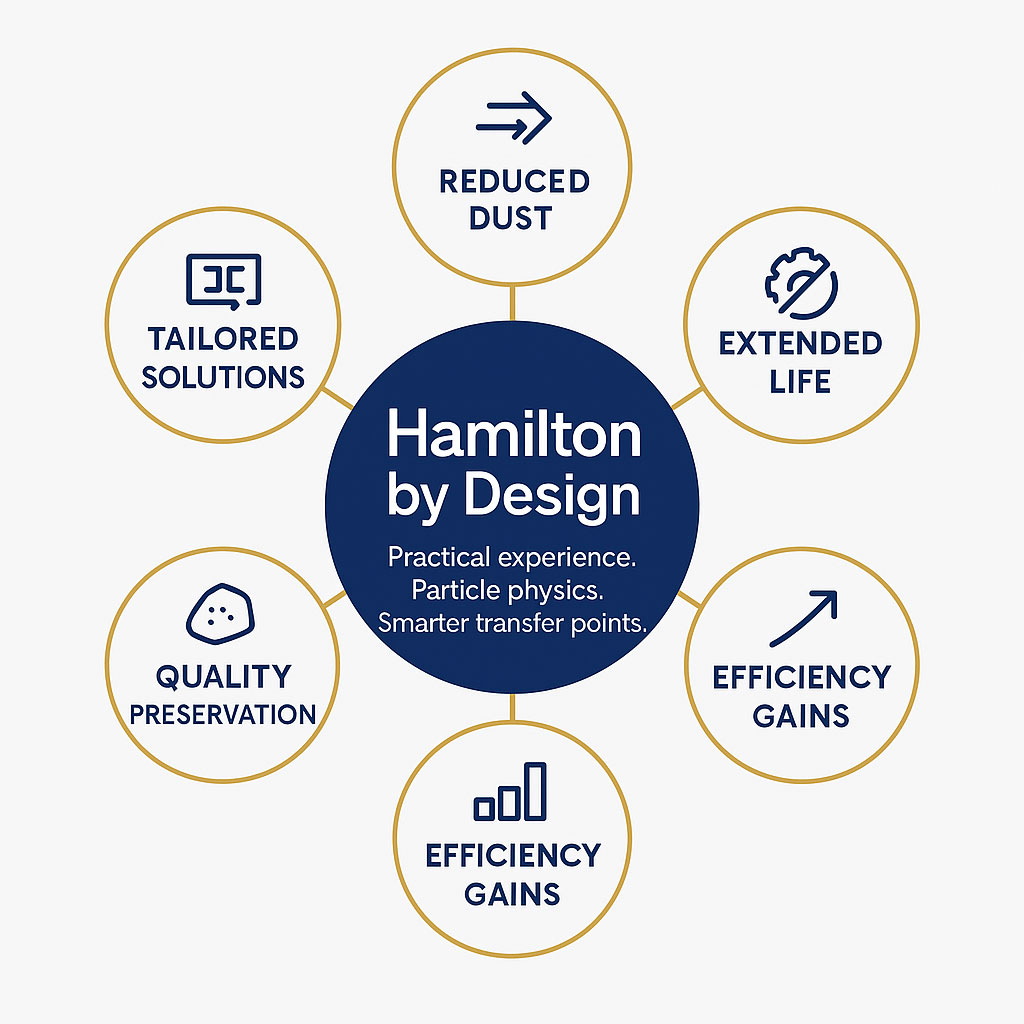
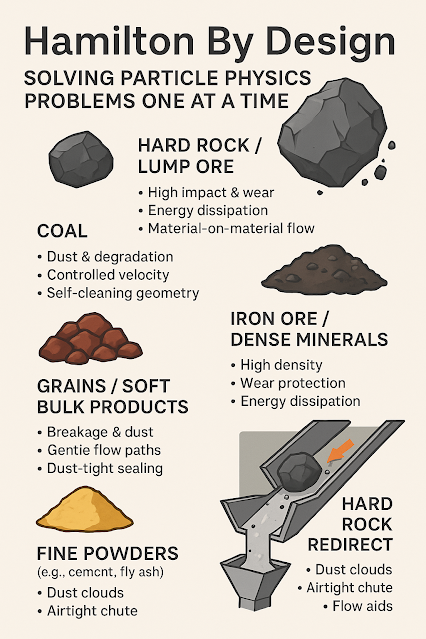
At Hamilton by Design, we see ourselves as more than engineers — we are problem-solvers who bring both science and experience to the table. Every bulk material transfer is unique, and each one carries its own challenges. By combining the principles of particle physics with decades of hands-on site experience, we design chutes and transfer points that perform in the real world, not just on a computer screen.
We are a small, specialised company, not a large corporate machine. That means you deal directly with the people who understand your operation, your materials, and your challenges. We take pride in our ability to stand on-site, watch the flow of material, and recognise behaviours that only years of experience can teach. This gives us the clarity to engineer practical solutions that keep your plant running reliably.
For us, your success is our success. We measure our achievement not by the number of projects we complete, but by the value we add to your operation — less dust, less wear, fewer stoppages, more tonnes moved.
At Hamilton by Design, we believe that every bulk material transfer is an opportunity for improvement. What appears to be a simple flow of rock, coal, grain, or powder is, in reality, a particle physics problem waiting to be solved. By approaching these challenges with precision, creativity, and hands-on knowledge, we deliver chute designs that do more than move material — they protect assets, enhance performance, and improve the bottom line.
We are a small, specialised company with a wealth of on-site experience. Our engineers have spent years in the field, watching, listening, and learning how different materials behave under real conditions. This raw experience gives us a unique advantage: we can see and understand particle flow first-hand, not just through numbers on a screen. While many large organisations rely solely on computer models, we combine advanced simulation with practical insight, ensuring solutions that work not only in theory but also in practice.
Our team thrives on solving the complex problems others overlook:
Redirecting hard rock at speed without spillage or damage.
Handling sticky coal without blockages or hang-ups.
Containing fine powders without dust plumes or health risks.
Transferring fragile grains without breakage or product loss.
Extending chute, liner, and belt life with robust material-on-material flow designs.
We approach every challenge with the mindset that your success is our success. When your plant runs reliably, safely, and efficiently, we succeed alongside you. That’s why we design transfer points that:
Absorb and dissipate energy from high-impact lumps.
Control dust and minimise degradation for cleaner, safer operations.
Extend equipment life by reducing wear and maintenance.
Adapt to variability in feed size, flow, and moisture.
Boost throughput and availability by minimising stoppages.
In a world where margins are tight and environmental responsibility is critical, Hamilton by Design offers a personal, client-focused approach that puts performance and partnership at the centre. We are not a large organisation pushing generic solutions — we are a dedicated team that listens, observes, and engineers smarter outcomes, one particle physics problem at a time.
Crane accidents are among the most visible reminders of the risks inherent in construction. The collapse of a crane at a data centre site in Derrimut, Melbourne, brought attention once again to the vulnerability of temporary lifting structures. While formal investigations are still underway, and no conclusions should be drawn prematurely, the event provides a valuable opportunity for reflection within the engineering community.
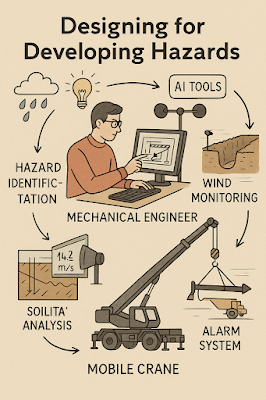
This article considers the collapse not as an isolated failure but as a case study in hazard identification. In particular, it highlights how mechanical engineers must adapt from a static, design-phase view of risk to a dynamic, real-time approach to hazard monitoring. Wind, soil stability, and load conditions are well-known hazards. But with modern tools — including LiDAR scanning for obstacle detection — engineers can move toward a future where developing hazards are continuously tracked, anticipated, and controlled.
From Hazard Identification to Live Hazard Monitoring
Hazard identification has traditionally been a design-phase process: engineers anticipate risks, apply safety factors, and create conservative margins. This remains essential. Yet the Derrimut collapse illustrates the limits of a static model in a dynamic environment.
Cranes are exposed to evolving hazards:
Wind gusts that change minute by minute.
Soil stability that shifts with rainfall, excavation, or groundwater.
Obstacles such as power lines or nearby structures, which can create cascading risks if struck.
Load dynamics, including swinging or sudden movement.
What is needed is a transition from hazard identification to hazard monitoring: a continuous loop where design assumptions are validated against real-time data, and where developing risks are detected before they become failures.
Wind Hazards: Predicting the Unpredictable
Wind is a leading cause of crane collapses. Engineers know the mathematics: pressure rises with the square of velocity. A 50 km/h gust exerts twice the force of a 35 km/h breeze.
Most cranes today are fitted with anemometers and alarms, but these are often basic: a single reading at a single point, with alarms sounding when preset thresholds are exceeded. This approach can miss:
Local gust variability along a long jib.
Interaction with crane orientation (wind hitting the broadside is more critical than aligned wind).
Forecasted conditions that could deteriorate within minutes.
Next-generation wind monitoring could include:
Multi-point sensor arrays on cranes.
Integration with Bureau of Meteorology gust forecasts.
AI models predicting when risk thresholds will be exceeded, not just reporting when they are crossed.
Automatic crane repositioning to minimise wind exposure.
This transforms alarms from reactive to predictive — the difference between warning after a hazard is present and anticipating before it materialises.
Soil Hazards: Stability Under Load
Ground conditions are another silent but critical hazard. Outriggers may impose hundreds of kilonewtons on pads, meaning even small soil weaknesses can lead to tilting or overturning.
Engineering practice already includes soil investigations: boreholes, CPT, SPT, and FEA models. But these tests capture conditions before installation, not necessarily during operation. Soil strength can change due to rainfall, groundwater shifts, or nearby excavation.
Live soil monitoring can be achieved with:
Load cells under mats to track ground reactions.
Settlement gauges to detect tilt.
Piezometers for pore pressure during rain events.
Integrated warnings when ground resistance trends downward.
This approach acknowledges soil as a living hazard that changes daily.
LiDAR and Obstacle Detection: Power Lines and Proximity Hazards
One striking feature of the Derrimut collapse was the crane’s boom striking power lines. Contact with utilities is a recurrent hazard in crane operations worldwide. While operators are trained to maintain exclusion zones, in practice visibility, fatigue, or unexpected boom movement can still lead to contact.
LiDAR scanning offers a solution.
How it works: LiDAR (Light Detection and Ranging) emits laser pulses to map surroundings in 3D with centimetre accuracy. Mounted on a crane, it can create a live digital map of nearby obstacles.
Application in cranes:
Detecting and mapping power lines, buildings, or scaffolding in the lift path.
Setting proximity alarms when a boom, hook, or load approaches a defined clearance.
Combining with wind data to predict if gusts could push the load into restricted zones.
In aviation, LiDAR and radar-based systems are standard for obstacle detection. In construction, adoption is patchy. Yet the technology exists, is cost-effective, and could dramatically reduce risks of contact with hazards like live power lines.
LiDAR’s strength lies not only in static mapping but in detecting movement — for example, when a suspended load begins to swing toward a power line due to a gust. This is a quintessential developing hazard, one that static design could never fully capture.
Integrated Hazard Dashboards
Wind, soil, and LiDAR obstacle detection all provide valuable data. But their true power lies in integration. Imagine a crane operator’s cabin equipped with a single dashboard displaying:
Wind speeds and gust forecasts, colour-coded for risk.
Soil reaction forces under each outrigger, with alerts if settlement is trending.
LiDAR mapping of nearby structures and power lines, with real-time clearance zones.
Predictive risk models showing probability of instability or contact over the next 30 minutes.
This integration mirrors aviation’s cockpit: multiple inputs fused into actionable guidance. For cranes, such systems could shift the operator’s role from reactive decision-maker to proactive risk manager.
AI as a Predictive Partner
Artificial Intelligence has a natural role in hazard monitoring:
Sensor fusion: combining wind, soil, and LiDAR inputs into coherent risk profiles.
Prediction: learning from past crane incidents to forecast when risks are likely to escalate.
Decision support: providing operators with clear options (“safe to continue lift for 20 minutes” / “halt operations — clearance margin < 1m”).
The challenge is balance. AI should not replace human oversight, but augment it. Over-reliance could create new vulnerabilities if operators become complacent. The design challenge is to build AI into systems that support human judgment rather than substitute for it.
Ethics and Engineering Responsibility
The Derrimut collapse underscores the ethical responsibility of mechanical engineers. Hazard identification is not just a design requirement; it is a matter of public safety. The profession has a duty to anticipate, detect, and control risks wherever possible.
The tools now exist to monitor developing hazards — wind sensors, soil gauges, LiDAR scanners, and AI dashboards. If lives and infrastructure can be protected through wider adoption of these tools, then the question becomes one of responsibility: should they be optional, or mandatory?
Open Questions for the Future
Would integrated live monitoring have reduced the risks at Derrimut?
Should all cranes be fitted with LiDAR obstacle detection as standard?
Do we already have enough technology, but lack regulation and enforcement?
What role should AI play in balancing predictive insight with operator autonomy?
The Derrimut incident remains under investigation. No conclusions can be drawn about its specific cause until findings are published. Yet as a case study, it illustrates the broader point that hazards in crane operations are dynamic. Wind, soil, obstacles, and loads evolve minute by minute.
Mechanical engineers have the tools — wind sensors, soil monitors, LiDAR scanners, integrated dashboards, and AI — to detect these developing hazards. The challenge is to move from a culture of static design assumptions to one of continuous hazard monitoring.
The ultimate professional question is this: If aviation can integrate multiple systems to monitor and predict hazards, why can’t construction do the same for cranes? And if we can, how soon will we accept the ethical responsibility to make it standard?
References and Further Reading
ISO 4301 / AS 1418 — Crane standards covering stability and wind.
ISO 12480-1:2003 — Safe use of cranes; includes environmental hazard monitoring.
WorkSafe Victoria Guidance Notes — Crane safety management.
Holický & Retief (2017) — Probabilistic treatment of wind action in structural design.
Nguyen et al. (2020) — Real-time monitoring of crane foundation response under variable soil conditions.
Liebherr LICCON — Example of integrated load and geometry monitoring.
FAA LLWAS — Aviation’s real-time wind shear alert system, model for construction.
Recent research in LiDAR obstacle detection (e.g., IEEE Transactions on Intelligent Transportation Systems) — showing LiDAR’s potential in complex environments.
To provide the best experiences, we use technologies like cookies to store and/or access device information. Consenting to these technologies will allow us to process data such as browsing behaviour or unique IDs on this site. Not consenting or withdrawing consent, may adversely affect certain features and functions.
Functional
Always active
The technical storage or access is strictly necessary for the legitimate purpose of enabling the use of a specific service explicitly requested by the subscriber or user, or for the sole purpose of carrying out the transmission of a communication over an electronic communications network.
Preferences
The technical storage or access is necessary for the legitimate purpose of storing preferences that are not requested by the subscriber or user.
Statistics
The technical storage or access that is used exclusively for statistical purposes.The technical storage or access that is used exclusively for anonymous statistical purposes. Without a subpoena, voluntary compliance on the part of your Internet Service Provider, or additional records from a third party, information stored or retrieved for this purpose alone cannot usually be used to identify you.
Marketing
The technical storage or access is required to create user profiles to send advertising, or to track the user on a website or across several websites for similar marketing purposes.