Mechanical Engineering | 3D Scanning | 3D Modelling
Category: 3D Scanning & Digital Engineering
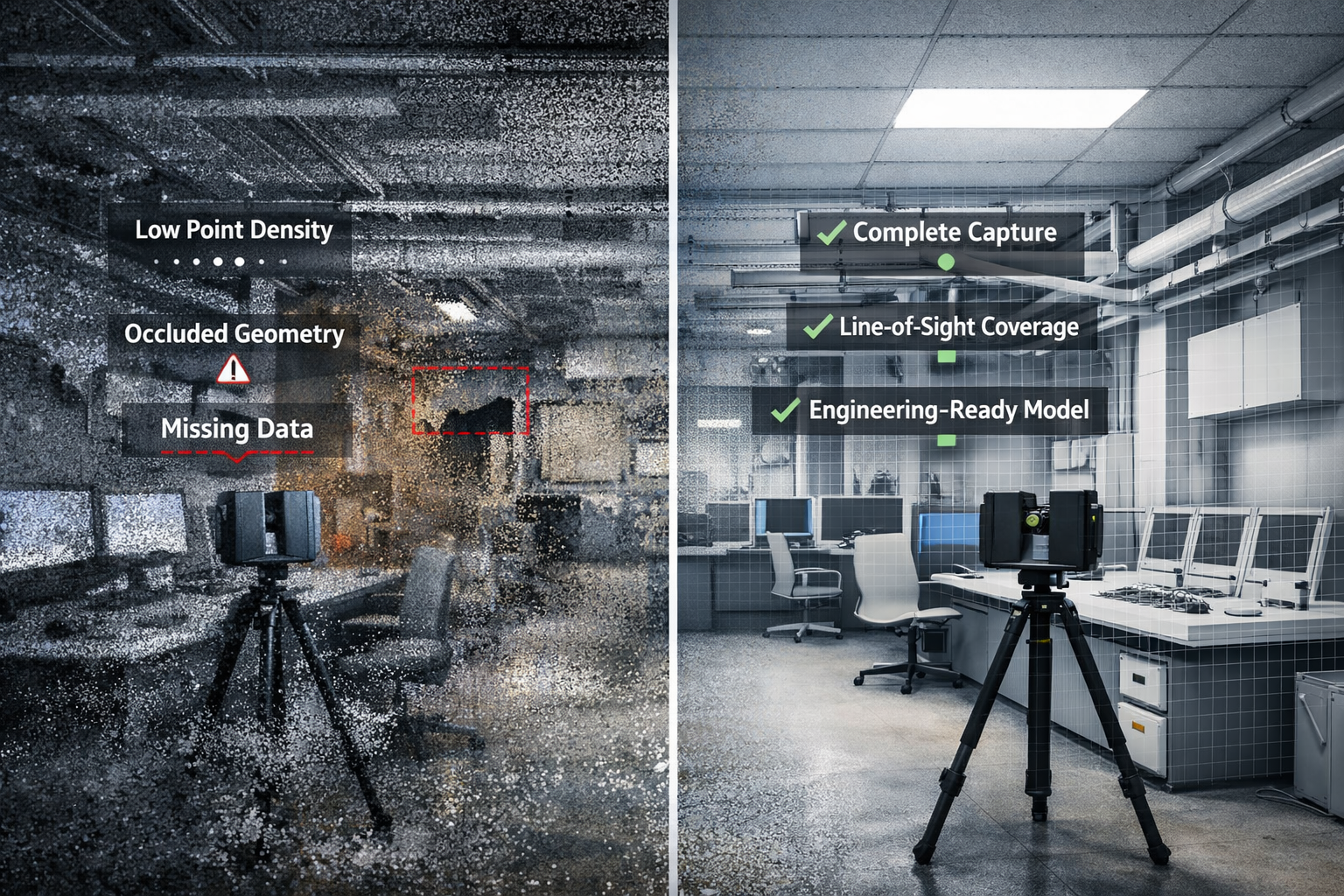
3D Laser Scanning & Reality Capture covers the practical use of engineering-grade 3D laser scanning, LiDAR, and reality capture technologies to accurately document existing assets and site conditions.
This category focuses on how scan data is planned, captured, verified, and converted into usable engineering outputs, including as-built drawings, 3D CAD models, and scan-to-CAD workflows. Content explores real-world applications across power generation, manufacturing, mining, and building & construction, particularly in brownfield and live-site environments where accuracy and control are critical.
Articles in this category examine the difference between visual capture and engineering-grade scanning, the importance of datums, tolerances, and registration, and how reality capture supports Australian Standards–aligned design and documentation.
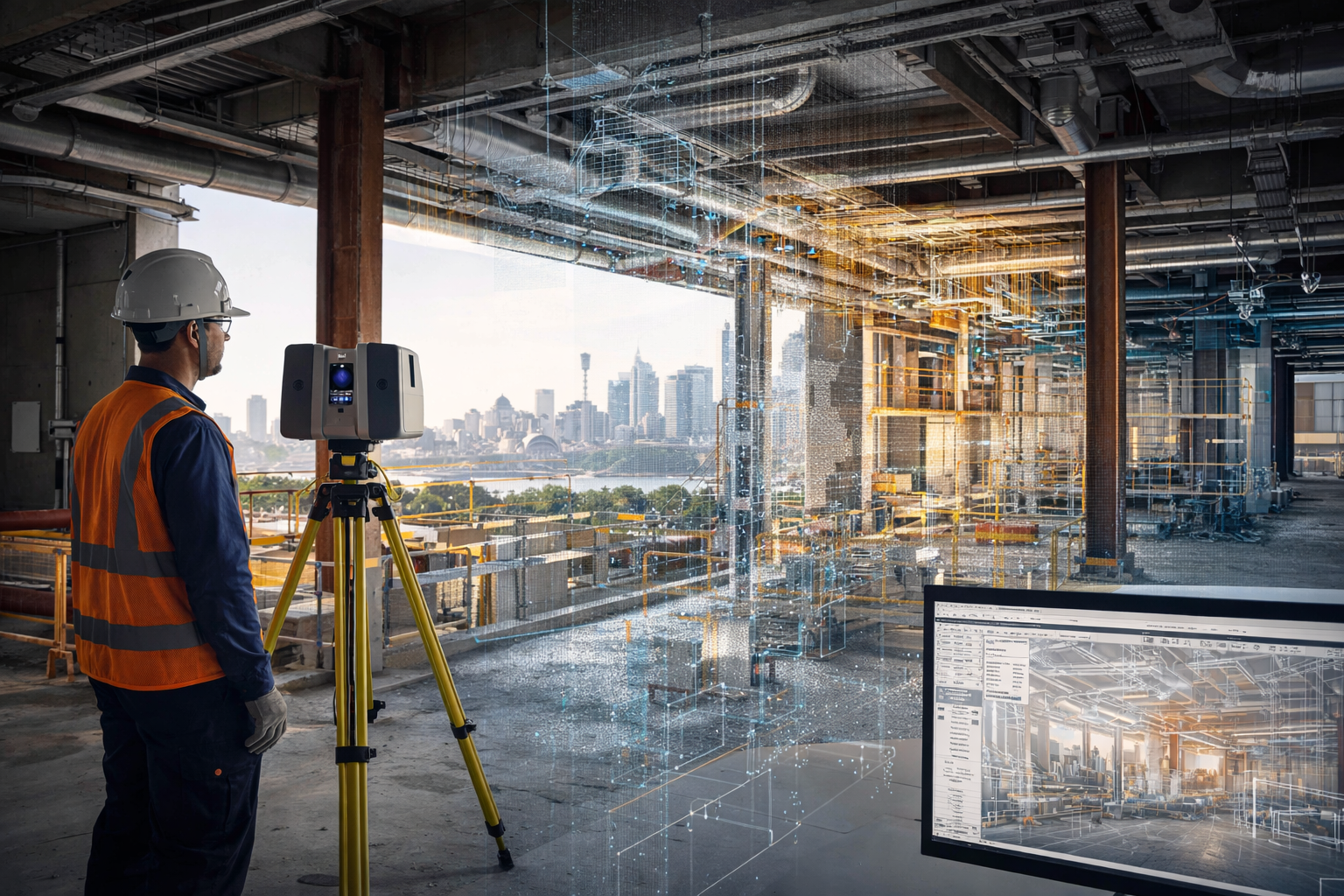
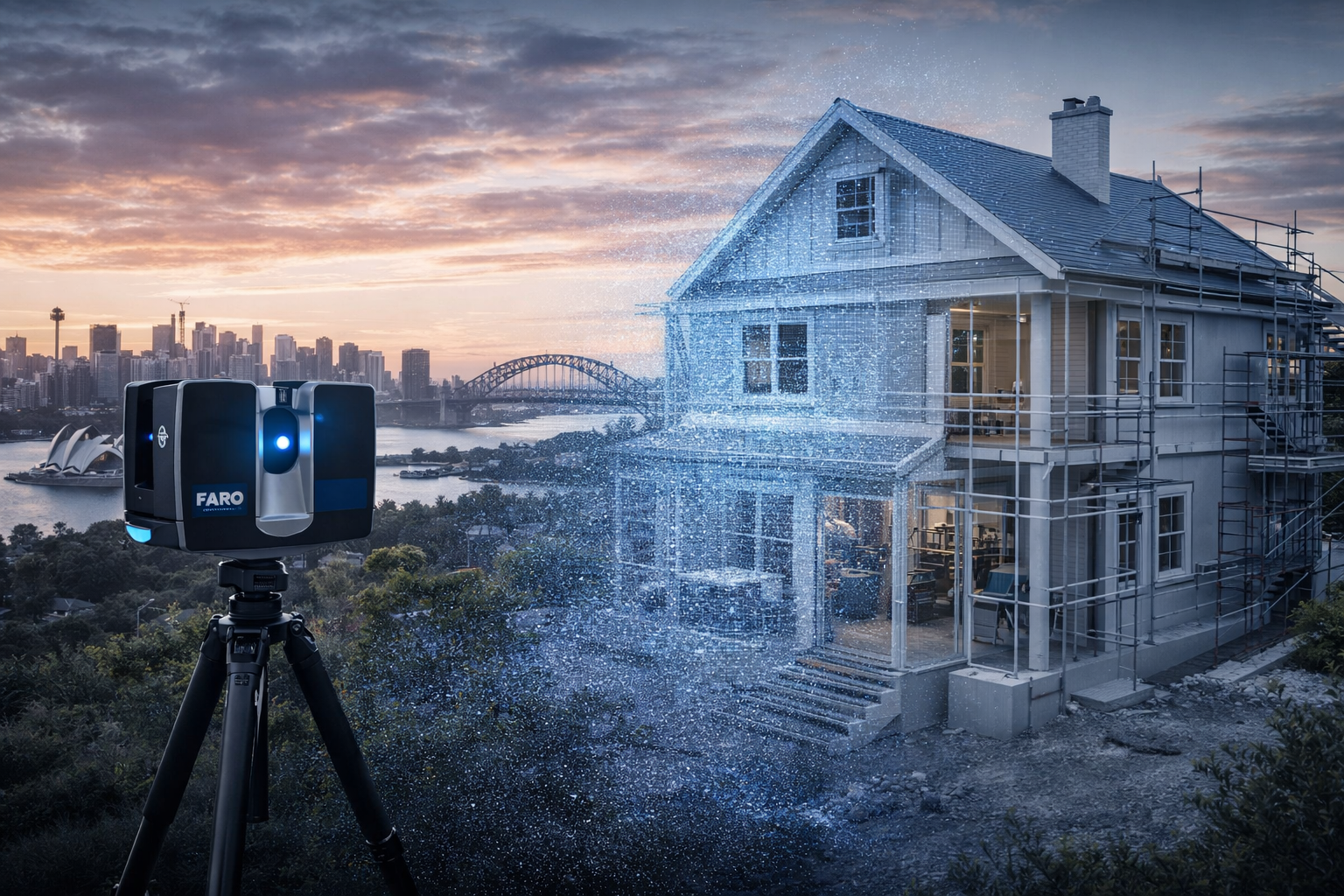
3D laser scanning is being used across Sydney projects to capture accurate existing conditions before design, construction, upgrades, and maintenance work begins. In construction and industrial environments, this technology helps reduce guesswork by providing a reliable digital record of what is actually on site.
For project teams working in live buildings, industrial plants, infrastructure corridors, and brownfield environments, 3D laser scanning can support safer planning, faster design development, and more accurate engineering decisions.
Why 3D Laser Scanning Matters
Many Sydney projects take place in environments where existing information is incomplete, outdated, or missing altogether. Legacy drawings may not reflect years of modifications, and manual site measurements often miss the detail needed for confident design and drafting.
3D laser scanning helps solve that problem by capturing large areas quickly and turning real site conditions into digital information that can be reviewed, measured, modelled, and referenced during project delivery.
This is especially useful where:
access is difficult
shutdown windows are short
geometry is complex
services are congested
existing drawings are unreliable
rework risk needs to be reduced
How 3D Laser Scanning is Used in Sydney Construction Projects
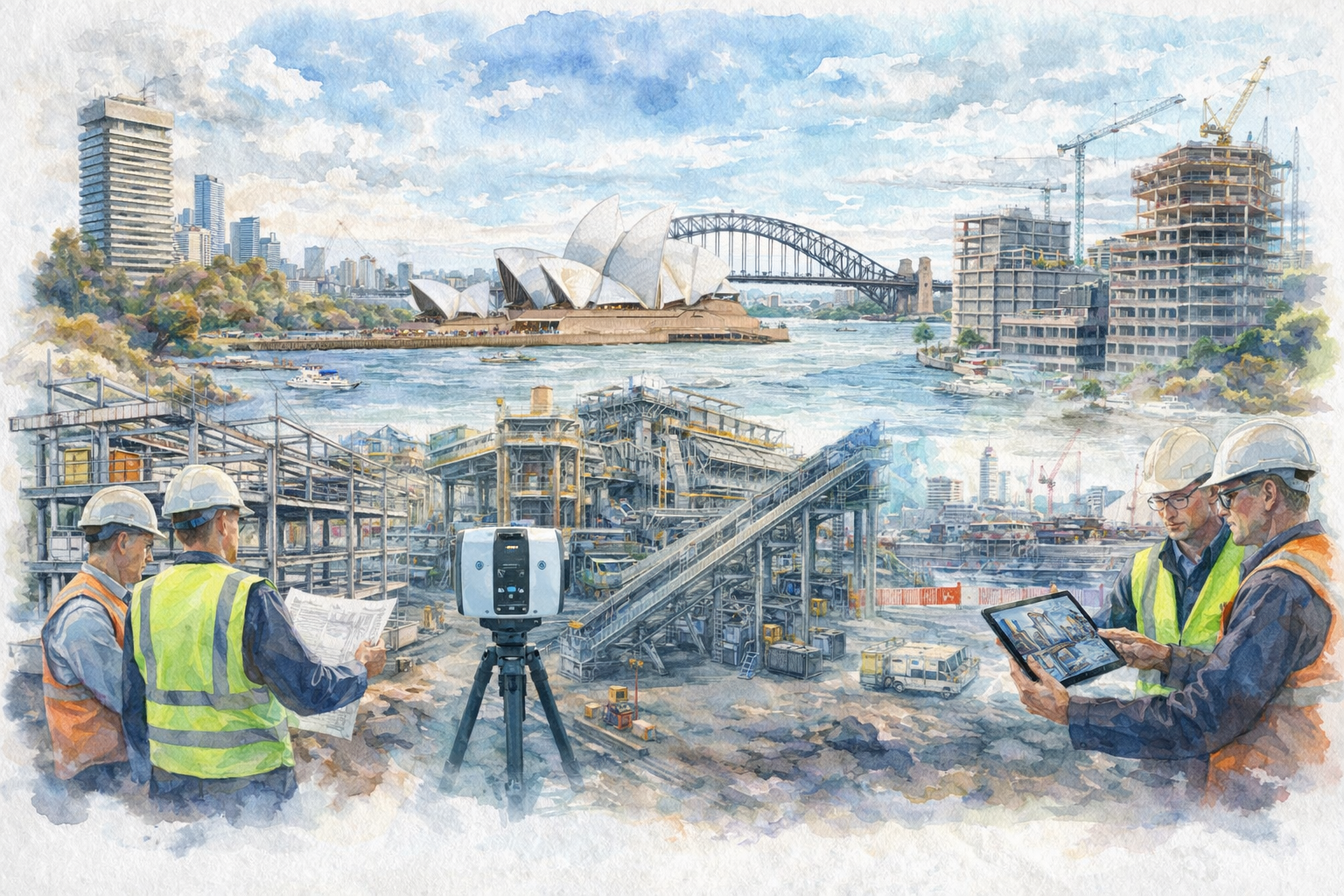
In construction, 3D laser scanning is commonly used to capture existing buildings, structures, and services before new work begins. This helps design teams understand the actual site condition rather than relying only on old plans or assumptions.
Typical construction uses include:
existing building surveys
façade and structural capture
service coordination
refurbishment and fitout planning
steelwork measurement
as-built verification
clash checking before installation
scanning of plant rooms, roof spaces, basements, and service risers
For Sydney construction projects, this can be particularly valuable in older buildings, confined plant areas, and staged redevelopment works where accuracy matters.
How 3D Laser Scanning is Used in Industrial Projects
3D laser scanning is also widely used in industrial and engineering projects across Sydney. This includes manufacturing facilities, processing plants, utilities infrastructure, materials handling systems, and brownfield upgrade works.
Common industrial applications include:
capturing conveyors, chutes, tanks, pipework, and steel structures
documenting existing plant before modifications
scan-to-CAD modelling
drafting support for upgrades and shutdowns
tie-in planning for new equipment
layout verification before fabrication
structural and mechanical design support
point cloud capture for engineering review
For industrial sites, one of the biggest advantages is being able to capture the true geometry of operating plant areas before mechanical or structural work begins.
Use in Brownfield and Upgrade Projects
Brownfield projects often involve uncertainty. Existing assets may have changed over time, undocumented modifications may exist, and available drawings may not reflect current conditions.
In these cases, 3D laser scanning helps teams capture a reliable baseline before design starts. That information can then be used for:
design development
as-built documentation
drafting updates
interference checks
equipment replacement planning
shutdown preparation
fabrication support
This is one of the main reasons laser scanning continues to grow as a practical tool across Sydney engineering and construction work.
Supporting Better Design and Drafting
Laser scanning does not replace engineering or drafting, but it gives those services a much stronger starting point.
Once the site is scanned, the information can be used to support:
2D drafting
3D CAD modelling
engineering layouts
concept development
fabrication drawings
plant modification design
digital coordination between disciplines
This improves confidence in the next stage of the project and can reduce costly errors caused by poor site information.
Industries Using 3D Laser Scanning in Sydney
3D laser scanning is now used across a wide range of Sydney industries, including:
construction
commercial buildings
manufacturing
utilities
mining support facilities
ports and bulk materials handling
infrastructure
industrial processing
plant maintenance and shutdown work
The value is not limited to one sector. Wherever site accuracy is important, scanning can improve project visibility and reduce risk.
Why Sydney Projects Benefit from 3D Laser Scanning
Sydney projects often involve busy sites, limited access, complex existing infrastructure, and tight project windows. In these conditions, accurate site capture can save time and improve decision-making across the full project lifecycle.
Benefits can include:
better visibility of existing conditions
reduced reliance on outdated drawings
improved coordination between disciplines
fewer surprises during fabrication or installation
stronger support for engineering and drafting workflows
better preparation for upgrades and shutdowns
From Site Capture to Engineering Use
The real value of 3D laser scanning is not just in collecting data. It is in how that data is used.
When integrated into drafting, modelling, and engineering workflows, scanning becomes a practical project tool. It helps bridge the gap between what is on site and what needs to be designed, checked, fabricated, or installed.
For businesses working on Sydney-based construction and industrial projects, this can support better outcomes from the earliest planning stages through to delivery.
Related Service
To learn more about engineering-grade scanning support, visit our pillar page:
3D laser scanning is being used across Sydney projects to improve accuracy, support better planning, and reduce project risk. From construction and building upgrades to industrial plant modifications and engineering design, it provides a reliable way to capture real site conditions before important decisions are made.
As more projects move toward digital engineering and better site verification, 3D laser scanning is becoming an increasingly valuable part of the workflow.
Related Sydney Services
Hamilton By Design provides engineering-led 3D scanning, LiDAR scanning, mechanical engineering and digital engineering services throughout Sydney and Greater Sydney.
Explore our related Sydney services:
3D Scanning Sydney – Engineering-grade terrestrial laser scanning, as-built surveys and point cloud capture for industrial, infrastructure and commercial projects.
Reality Capture Sydney – High-accuracy reality capture, digital twins, asset documentation and engineering-grade site verification.
Scan to CAD Sydney – Convert point cloud data into AutoCAD, SolidWorks, Inventor and other engineering-ready CAD deliverables.
Point Cloud Modelling Sydney– Engineering-grade point cloud processing, clash detection, as-built verification and 3D modelling.
Mechanical Engineering Sydney – Mechanical design, plant upgrades, materials handling systems, conveyors, chutes, platforms and engineering support.
Structural Drafting Sydney– Structural steel drafting, fabrication drawings, GA drawings, workshop detailing and as-built documentation.
Hamilton By Design supports projects throughout Sydney CBD, Parramatta, Liverpool, Penrith, Blacktown, Chatswood, Alexandria, Mascot, Newcastle and the Central Coast.
Point cloud to CAD services in Sydney are essential for turning raw scan data into usable engineering deliverables.
At Hamilton By Design, we convert 3D laser scans and LiDAR data into accurate AutoCAD and 3D models, enabling engineering design, plant upgrades, and construction planning.
If you already have scan data — or need scanning completed — we provide a complete workflow from site capture through to fabrication-ready models.
Deliverables Issued Drawings and models ready for design, fabrication or construction
Why Accurate Modelling Matters
Poor modelling from point cloud data can lead to:
Misalignment during installation
Fabrication errors
Costly rework
Project delays
Our engineering-led approach ensures models are:
Fit-for-purpose
Accurate to required tolerances
Suitable for real-world application
Deliverables We Provide
Depending on your project requirements, we can deliver:
2D AutoCAD drawings
3D CAD models
Structural steel models
Plant layouts and equipment models
As-built documentation
BIM-compatible outputs
We tailor deliverables to suit your engineering and project needs.
Applications Across Sydney Projects
Point cloud to CAD is widely used in:
Industrial plant upgrades
Structural steel design and verification
Construction planning and coordination
Refurbishments and fit-outs
Infrastructure projects
For complex environments, accurate modelling reduces risk and improves project outcomes.
Why Choose Hamilton By Design
We are not just modellers — we are engineers.
✔ Engineering-led modelling approach ✔ Experience in industrial and construction environments ✔ Focus on accuracy and real-world application ✔ Understanding of fabrication and installation requirements
We deliver models that work in the field — not just on screen.
Point Cloud to CAD Sydney — Get Started
If you have scan data and need accurate models — or require a full scan-to-model service — we can help.
👉 Contact Hamilton By Design to discuss your project and modelling requirements.
Or learn more about how we capture data through Reality Capture Sydney:
Hamilton By Design provides engineering-led 3D scanning, LiDAR scanning, mechanical engineering and digital engineering services throughout Sydney and Greater Sydney.
Explore our related Sydney services:
3D Scanning Sydney – Engineering-grade terrestrial laser scanning, as-built surveys and point cloud capture for industrial, infrastructure and commercial projects.
Reality Capture Sydney – High-accuracy reality capture, digital twins, asset documentation and engineering-grade site verification.
Scan to CAD Sydney – Convert point cloud data into AutoCAD, SolidWorks, Inventor and other engineering-ready CAD deliverables.
Point Cloud Modelling Sydney– Engineering-grade point cloud processing, clash detection, as-built verification and 3D modelling.
Mechanical Engineering Sydney – Mechanical design, plant upgrades, materials handling systems, conveyors, chutes, platforms and engineering support.
Structural Drafting Sydney– Structural steel drafting, fabrication drawings, GA drawings, workshop detailing and as-built documentation.
Hamilton By Design supports projects throughout Sydney CBD, Parramatta, Liverpool, Penrith, Blacktown, Chatswood, Alexandria, Mascot, Newcastle and the Central Coast.
Reality Capture for Sydney CBD Commercial Buildings
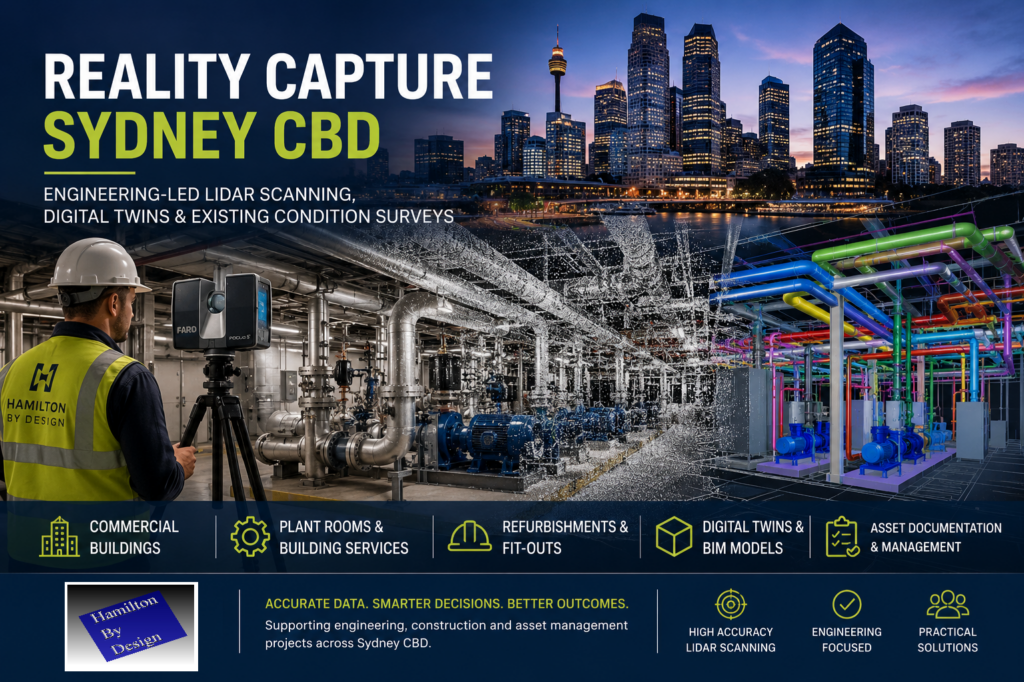
Reality Capture Sydney CBD
Sydney CBD contains some of Australia’s most complex commercial buildings, infrastructure assets and operational facilities. From high-rise office towers and hotels to hospitals, transport infrastructure and critical building services, accurate existing-condition information is essential for successful project delivery.
Hamilton By Design provides engineering-led reality capture services throughout Sydney CBD, combining terrestrial LiDAR scanning, digital engineering and practical industry experience to create accurate digital representations of existing environments.
Reality capture enables project teams to document buildings, plant rooms, building services, infrastructure and operational facilities with a level of detail that traditional measurement methods cannot achieve efficiently. The resulting data can support refurbishment projects, services upgrades, asset management programs, digital twin development, engineering design and construction planning.
By capturing measured reality rather than relying on outdated drawings or assumptions, project teams can reduce risk, improve coordination and make better-informed decisions throughout the project lifecycle.
Reality Capture for Sydney CBD Plant Rooms
Plant rooms within Sydney CBD buildings often contain decades of modifications, undocumented services and limited access for traditional measurement methods.
Reality capture provides a fast and accurate method of documenting mechanical services, pipework, structural steel, cable trays and equipment layouts before engineering design begins.
The resulting point cloud allows project teams to work from measured site conditions, reducing uncertainty and improving coordination throughout the design and construction process.
Many Sydney CBD projects involve HVAC upgrades, chiller replacements, pump room modifications, fire service upgrades and electrical infrastructure improvements where accurate existing-condition information is critical. Engineering-grade reality capture provides a reliable foundation for these projects while minimising the need for repeated site visits.
Plant Rooms, Building Services & Infrastructure
Many Sydney CBD buildings contain complex mechanical, hydraulic, electrical and fire services installed over decades of operation.
Reality capture allows these environments to be documented quickly and accurately, providing engineers and contractors with reliable information for future modifications, equipment replacements and capacity upgrades.
Applications include:
HVAC plant rooms
Chiller installations
Pump rooms
Fire services
Electrical services
Building services coordination
Vertical risers
Roof plant installations
Existing Conditions for Refurbishment Projects
Accurate existing-condition information is critical when undertaking refurbishment projects within occupied commercial buildings.
Reality capture allows consultants and contractors to understand structural constraints, service routes, equipment locations and access requirements before design begins.
This reduces project risk, improves coordination and helps minimise costly site modifications during construction.
Heritage & Existing Building Documentation
Sydney CBD contains many historically significant buildings and structures that require accurate documentation before modification or restoration works can proceed.
Reality capture provides a non-invasive method of recording existing conditions while preserving important architectural and structural details.
The resulting datasets can support heritage studies, refurbishment planning, restoration projects and long-term asset management.
Digital Twins for Building Owners
Reality capture forms the foundation of many digital twin initiatives by providing an accurate digital representation of an existing building or facility.
For Sydney CBD asset owners, digital twins can assist with:
Facility management
Future upgrades
Asset lifecycle planning
Space management
Maintenance planning
Building information management
A well-developed digital twin provides a single source of truth for future engineering, maintenance and operational decision-making.
Reality Capture Applications Across Sydney CBD
Reality capture provides value wherever accurate existing-condition information is required before design, construction or asset management decisions are made.
Commercial Office Towers
Sydney CBD contains a large concentration of commercial office buildings that undergo continual refurbishment, tenancy fit-outs and building services upgrades.
Reality capture provides accurate existing-condition information that allows project teams to understand available space, identify constraints and develop coordinated engineering solutions before work reaches site.
Building Services Upgrades
Mechanical, hydraulic, fire and electrical services within operational buildings often evolve over many years, resulting in undocumented modifications and incomplete records.
Reality capture enables engineers and contractors to accurately document existing services and develop upgrade solutions with confidence.
Hotels, Hospitals and Critical Facilities
Hotels, hospitals and critical facilities require detailed planning before modifications can be undertaken.
Reality capture provides a comprehensive digital record of existing conditions, reducing uncertainty and helping project teams minimise disruption to operations during construction activities.
Data Centres and Technology Infrastructure
Sydney CBD continues to experience significant growth in data centre and technology infrastructure projects.
Reality capture supports equipment upgrades, cable routing studies, cooling system modifications and future expansion planning by providing accurate spatial information for engineering and construction teams.
Asset Management and Facility Operations
Accurate digital records support long-term asset management strategies by providing building owners with reliable information about equipment, infrastructure and building services.
Reality capture forms the foundation for future maintenance planning, facility upgrades and digital engineering initiatives throughout the asset lifecycle.
Engineering-Led Reality Capture
Hamilton By Design combines practical engineering experience with advanced reality capture technologies to deliver information that is suitable for engineering, design and construction applications.
Unlike many scanning providers, our team understands how captured data will ultimately be used for mechanical design, structural modifications, services coordination, drafting and project delivery.
This engineering-led approach ensures reality capture data becomes a practical project tool rather than simply a collection of scan files.
Deliverables
Depending on project requirements, deliverables may include:
Registered point clouds (E57, RCP, RCS and LAS)
AutoCAD drawings
Existing-condition plans, sections and elevations
Mechanical CAD models
Structural models and drafting
Building services layouts
General Arrangement drawings
Asset documentation
Digital engineering models
Construction support information
Related Sydney Services
Hamilton By Design also provides:
3D Scanning Sydney
Sydney 3D LiDAR Scanning
Scan to CAD Sydney
Point Cloud Modelling Sydney
Mechanical Drafting Sydney
Structural Drafting Sydney
Reverse Engineering Sydney
Reality Capture Sydney CBD
Whether your project involves a commercial office tower, hotel, hospital, plant room, data centre or critical infrastructure facility, Hamilton By Design provides engineering-led reality capture services throughout Sydney CBD.
Our combination of terrestrial LiDAR scanning, digital engineering and practical project experience delivers accurate information that supports better engineering, construction and asset management outcomes.
Hamilton By Design provides engineering-led 3D scanning, LiDAR scanning, mechanical engineering and digital engineering services throughout Sydney and Greater Sydney.
Explore our related Sydney services:
3D Scanning Sydney – Engineering-grade terrestrial laser scanning, as-built surveys and point cloud capture for industrial, infrastructure and commercial projects.
Reality Capture Sydney – High-accuracy reality capture, digital twins, asset documentation and engineering-grade site verification.
Scan to CAD Sydney – Convert point cloud data into AutoCAD, SolidWorks, Inventor and other engineering-ready CAD deliverables.
Point Cloud Modelling Sydney– Engineering-grade point cloud processing, clash detection, as-built verification and 3D modelling.
Mechanical Engineering Sydney – Mechanical design, plant upgrades, materials handling systems, conveyors, chutes, platforms and engineering support.
Structural Drafting Sydney– Structural steel drafting, fabrication drawings, GA drawings, workshop detailing and as-built documentation.
Hamilton By Design supports projects throughout Sydney CBD, Parramatta, Liverpool, Penrith, Blacktown, Chatswood, Alexandria, Mascot, Newcastle and the Central Coast.
Engineering-Grade Reality Capture for Construction Projects
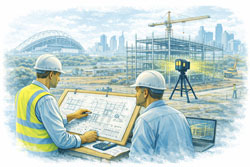
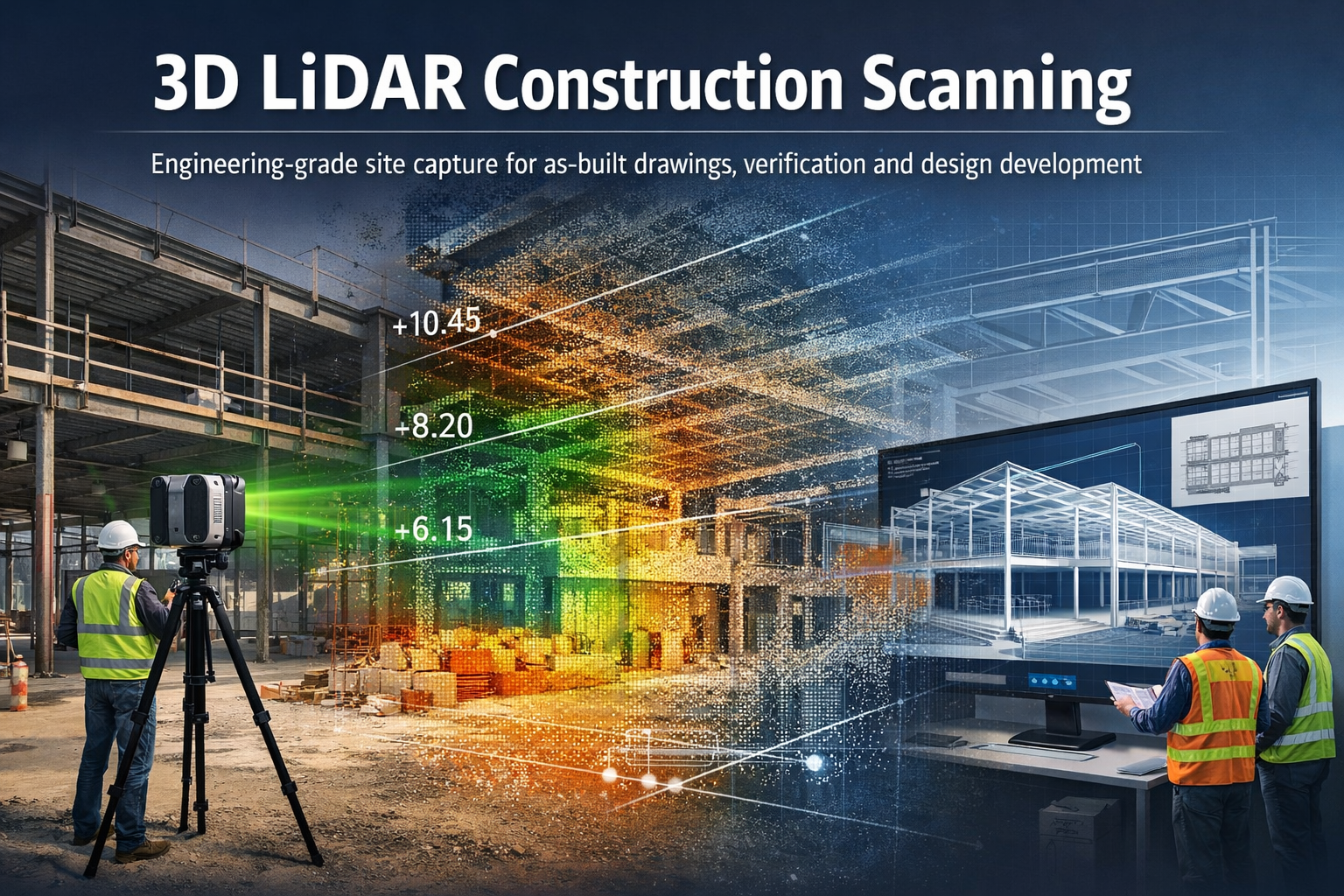
3D LiDAR construction scanning is transforming how engineers, builders, and project teams capture and understand existing site conditions.
Hamilton By Design provides engineering-grade 3D LiDAR scanning services for construction projects, helping capture accurate digital models of buildings, structures, and construction sites before, during, and after construction works. Using advanced laser scanning technology, millions of precise measurements can be captured within minutes to produce detailed 3D point clouds and digital models of real-world structures. These models provide reliable information for planning, design, verification and as-built documentation.
Our scanning workflows allow project teams to move from existing construction conditions to accurate engineering models, helping reduce uncertainty and improve project outcomes.
What is 3D LiDAR Construction Scanning?
3D LiDAR scanning uses laser-based sensors to measure distances between the scanner and surrounding surfaces. The system records millions of measurements which form a point cloud representing the exact geometry of the construction environment.
These point clouds create highly detailed digital representations of buildings, infrastructure and construction sites that can be measured, analysed and modelled in engineering software.
For construction projects this provides a powerful way to:
capture existing building geometry
verify construction progress
generate accurate as-built drawings
support design coordination
analyse levels, clearances and spatial constraints
Modern LiDAR scanning allows engineers to capture entire buildings and construction sites quickly and accurately, creating reliable digital data for planning and engineering workflows.
Applications of LiDAR Scanning in Construction
3D LiDAR scanning supports a wide range of construction and engineering tasks.
As-Built Documentation
Construction drawings often become outdated as projects evolve. LiDAR scanning provides accurate as-built documentation of structures, capturing the exact conditions present on site.
Scanning can be used during construction to verify that structures match the design intent.
Point cloud data can be compared against design models to identify:
structural deviations
alignment issues
level variations
installation conflicts
This helps project teams identify problems early before they become costly construction errors.
Renovation and Refurbishment Projects
Older buildings often have incomplete or inaccurate drawings.
3D LiDAR scanning provides a reliable way to capture existing conditions before renovation works begin. Engineers and designers can then develop new designs directly from the scanned data.
This reduces risk and ensures that new components fit correctly within existing structures.
Construction scanning can also be used to analyse structural geometry and building profiles, including:
roof profiles and screed levels
slab levels and floor flatness
façade alignment
structural steel positioning
drainage and fall verification
These measurements allow engineers to identify geometry problems early and support accurate construction planning.
The Scan to Engineering Model Workflow
Hamilton By Design integrates LiDAR scanning with engineering modelling workflows.
Typical project workflow:
Existing Construction Site ↓ 3D LiDAR Scanning ↓ Point Cloud Processing ↓ Scan-to-CAD Modelling ↓ Engineering Analysis and Design
This workflow allows engineers to work from accurate digital representations of real-world conditions, reducing the need for repeated site visits and manual measurements.
Benefits of LiDAR Scanning for Construction Projects
3D LiDAR scanning provides several advantages compared with traditional measurement methods.
Accurate Site Data
Laser scanners capture millions of measurements quickly, producing detailed datasets that accurately represent site conditions.
Reduced Project Risk
Accurate site data reduces the risk of design errors, construction conflicts and unexpected site conditions.
Faster Site Surveys
Entire buildings and construction areas can be captured in a short time, reducing the need for multiple survey visits.
Improved Project Coordination
Point cloud data can be shared between architects, engineers and contractors, ensuring everyone works from the same information.
Support for Digital Engineering Workflows
LiDAR scanning supports modern design processes such as:
scan-to-CAD modelling
digital twins
BIM coordination
construction verification
Engineering-Grade 3D Laser Scanning
Hamilton By Design provides professional scanning services focused on engineering and industrial applications, not just visualisation.
When is LiDAR Construction Scanning Most Valuable?
3D scanning is particularly useful in situations where accurate geometry is critical.
Examples include:
building renovations
structural modifications
plant installations within buildings
roof level and drainage analysis
verifying construction tolerances
documenting existing conditions before construction
In many cases the cost of scanning is small compared with the potential cost of construction errors.
Talk With Hamilton By Design
If you require 3D LiDAR construction scanning for engineering or building projects, Hamilton By Design can help capture accurate digital models of your site.
Our team specialises in scanning workflows that support engineering analysis, design development and construction planning.
Contact Hamilton By Design to discuss your project requirements.
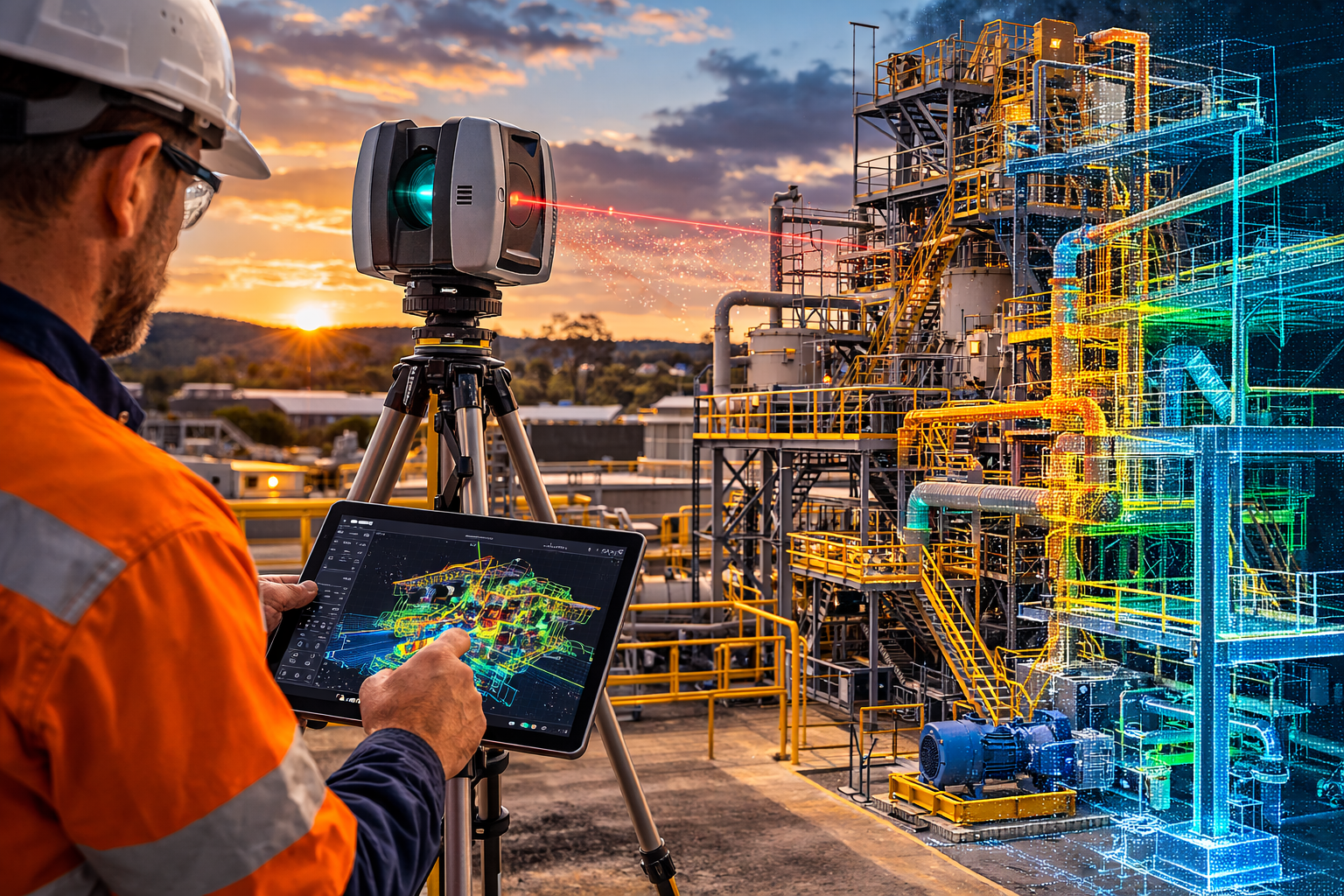
Industrial facilities across the Orange region of New South Wales are increasingly turning to 3D laser scanning to support engineering design, plant upgrades, and infrastructure maintenance.
For engineers working in operating plants, one of the biggest challenges is obtaining accurate measurements of existing equipment and structures. Traditional manual measurements can be slow, disruptive, and often incomplete.
Modern 3D scanning services for industrial facilities in Orange provide a fast and reliable way to capture existing infrastructure in precise detail. Laser scanners record millions of measurement points, creating an accurate digital model of the plant environment.
This data allows engineers to design upgrades and modifications with confidence.
Types of Industrial Facilities in Orange
The Orange and Central West region has a wide range of industrial infrastructure that benefits from 3D scanning engineering services.
Mining Operations and Processing Plants
The Orange region is well known for major mining operations, including the nearby Cadia Valley Operations, one of Australia’s largest gold and copper mines.
Mining operations often contain complex infrastructure such as:
conveyors and transfer chutes
crushing and screening equipment
pump stations
processing plant structures
stockpile and materials handling systems
Laser scanning allows engineers to capture the exact geometry of these facilities, enabling accurate redesign or modification work.
Learn more about mining mechanical engineering services here:
For industrial facilities in Orange, 3D scanning engineering services provide a practical way to capture accurate plant data and support engineering design.
By combining laser scanning technology with mechanical engineering expertise, engineers can deliver reliable solutions for plant upgrades, maintenance planning, and infrastructure improvements.
For mining, manufacturing, and industrial facilities in the Central West region, 3D scanning provides the foundation for modern engineering design and digital plant modelling.
To provide the best experiences, we use technologies like cookies to store and/or access device information. Consenting to these technologies will allow us to process data such as browsing behaviour or unique IDs on this site. Not consenting or withdrawing consent, may adversely affect certain features and functions.
Functional
Always active
The technical storage or access is strictly necessary for the legitimate purpose of enabling the use of a specific service explicitly requested by the subscriber or user, or for the sole purpose of carrying out the transmission of a communication over an electronic communications network.
Preferences
The technical storage or access is necessary for the legitimate purpose of storing preferences that are not requested by the subscriber or user.
Statistics
The technical storage or access that is used exclusively for statistical purposes.The technical storage or access that is used exclusively for anonymous statistical purposes. Without a subpoena, voluntary compliance on the part of your Internet Service Provider, or additional records from a third party, information stored or retrieved for this purpose alone cannot usually be used to identify you.
Marketing
The technical storage or access is required to create user profiles to send advertising, or to track the user on a website or across several websites for similar marketing purposes.