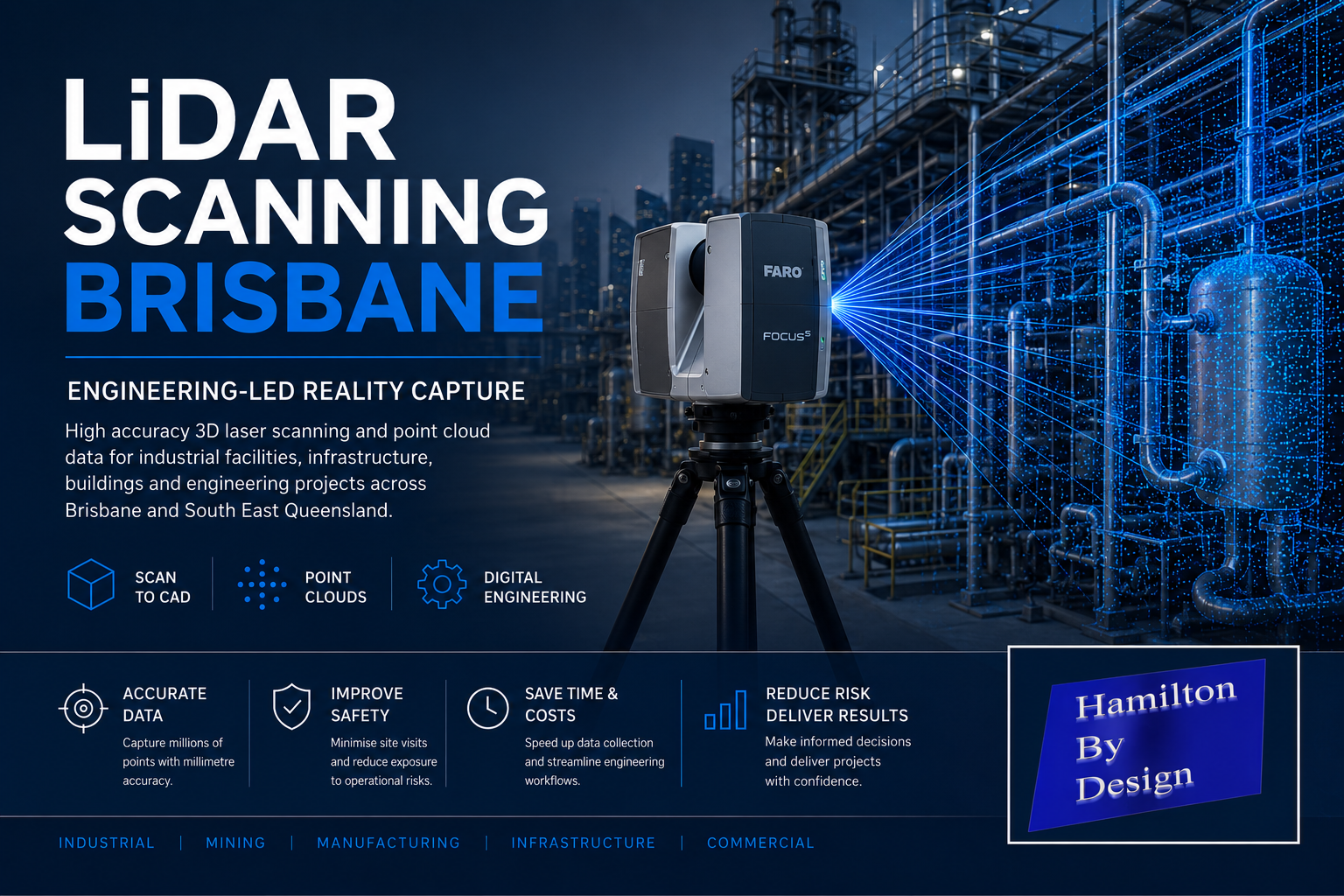
LiDAR Scanning Brisbane | Engineering Grade 3D Laser Scanning & Scan to CAD

Engineering-led LiDAR scanning in Brisbane showing a terrestrial laser scanner capturing an industrial processing plant with point cloud data for Scan to CAD, reality capture and digital engineering services.

LiDAR Scanning Brisbane โ€“ Engineering-Led 3D Laser Scanning & Digital Engineering Services

LiDAR Scanning Brisbane

Blue 3D LiDAR scanner icon on a tripod with scanning waves

Hamilton By Design provides engineering-led LiDAR scanning services throughout Brisbane and South East Queensland, delivering accurate point cloud data for industrial facilities, mining infrastructure, manufacturing plants, commercial buildings, water treatment facilities and large-scale engineering projects.

Unlike traditional survey-only providers, our team combines practical mechanical engineering, drafting and digital engineering experience with advanced terrestrial laser scanning technology. This allows us to capture existing conditions quickly and accurately while understanding how the data will be used during engineering design, shutdown planning, asset management and construction projects.

Whether you require a simple Scan to CAD deliverable or a complete digital engineering solution, our Brisbane LiDAR scanning services provide a reliable foundation for project success.


What is LiDAR Scanning?

LiDAR (Light Detection and Ranging) is a technology that uses laser pulses to measure millions of points in three-dimensional space. The result is a highly detailed digital representation of an asset, structure or facility known as a point cloud.

LiDAR scanning can accurately capture:

  • Structural steelwork
  • Mechanical equipment
  • Pipework systems
  • Conveyors and materials handling systems
  • Processing plants
  • Buildings and facilities
  • Platforms, stairs and access systems
  • Tanks and pressure vessels
  • Mining and mineral processing infrastructure

The collected data can then be converted into engineering drawings, 3D CAD models, BIM models and asset management information.


Engineering-Led LiDAR Scanning

At Hamilton By Design, LiDAR scanning is supported by real engineering experience.

Our team has experience across:

  • Mechanical engineering
  • Structural drafting
  • Pipework drafting
  • Materials handling systems
  • Smelters and refineries
  • Coal handling and preparation plants (CHPP)
  • Mining infrastructure
  • Manufacturing facilities
  • Water and wastewater treatment plants
  • Industrial shutdown projects

Because we understand how engineering information is used, we focus on capturing the information required for successful project delivery rather than simply collecting point cloud data.


LiDAR Scanning Applications

Industrial Facilities

Capture complete facilities for future engineering, expansion projects and asset management.

Mechanical Engineering

Generate accurate as-built information for equipment upgrades, maintenance planning and reverse engineering projects.

Structural Drafting

Produce existing structural steel models and detailed drafting for modifications and compliance assessments.

Pipework Design

Create accurate pipe routing models and clash detection studies before fabrication and installation.

Construction Verification

Verify installed works against design models and identify deviations before project completion.

Shutdown Planning

Reduce site visits and improve engineering productivity by creating a digital twin of the facility.


Scan to CAD Brisbane

Our Scan to CAD services transform LiDAR point cloud data into usable engineering deliverables including:

  • AutoCAD drawings
  • General arrangement drawings
  • Floor plans
  • Sections and elevations
  • Structural steel models
  • Mechanical equipment models
  • Pipework models
  • Inventor models
  • SolidWorks models
  • STEP and SAT files

This process enables engineering teams to work from accurate existing conditions while reducing project risk.


Benefits of LiDAR Scanning

Improved Safety

Reduce the need for repeated site access and minimise exposure to operational hazards.

Increased Accuracy

Capture millions of measurements with engineering-grade accuracy.

Reduced Project Risk

Identify clashes, access issues and existing site constraints before design begins.

Faster Project Delivery

Engineering teams can work from a complete digital record rather than relying on manual measurements.

Future-Proof Asset Information

Create a permanent digital record for future maintenance, upgrades and expansion projects.


Brisbane Industries We Support

Hamilton By Design supports projects throughout Brisbane and South East Queensland including:

  • Mining and mineral processing
  • Smelting and refining
  • Power generation
  • Water and wastewater treatment
  • Manufacturing
  • Food and beverage processing
  • Ports and logistics
  • Infrastructure projects
  • Commercial buildings
  • Government assets

We regularly support projects throughout:

  • Brisbane CBD
  • Eagle Farm
  • Pinkenba
  • Lytton
  • Port of Brisbane
  • Ipswich
  • Logan
  • Redcliffe
  • Caboolture
  • Toowoomba
  • Gold Coast
  • Sunshine Coast

Deliverables

Typical deliverables include:

  • Registered point clouds (E57, RCP, RCS, LAS)
  • Scan to CAD models
  • AutoCAD drawings
  • Structural drafting packages
  • Mechanical drafting packages
  • Pipework models
  • As-built verification reports
  • BIM models
  • Clash detection studies
  • Engineering support documentation

Why Choose Hamilton By Design?

Hamilton By Design combines practical trade experience, engineering expertise and advanced LiDAR technology to deliver real-world outcomes for industrial projects.

Our team brings experience as:

  • Mechanical Engineers
  • Draftspersons
  • Fitters and Turners
  • Site-based Engineering Personnel
  • Project Leaders
  • Digital Engineering Specialists

This combination allows us to understand both the physical asset and the engineering requirements behind every project.


Hamilton By Design logo displayed on a blue tilted rectangle with a grey gradient background

LiDAR Scanning Brisbane โ€“ Get Started

Whether you require a one-day site scan, a complete facility capture or an engineering-led digital twin solution, Hamilton By Design can provide accurate and reliable LiDAR scanning services throughout Brisbane and Southeast Queensland.

Contact Hamilton By Design today to discuss your LiDAR scanning, Scan to CAD, structural drafting, mechanical drafting and digital engineering requirements.

Contact Us – Talk to Us

Name
Would you like us to arrange a phone consultation for you?
Address

Our Clients
Reality Capture Brisbane title graphic with white text on a blue background promoting reality capture, LiDAR scanning and digital engineering services in Brisbane, Queensland.
3D Scanning Brisbane text graphic on a blue background promoting engineering-led laser scanning and reality capture services in Brisbane.

LiDAR Scanning Brisbane title graphic with white text on a blue background promoting terrestrial LiDAR scanning, point cloud capture and reality capture services in Brisbane, Queensland.
SolidWorks Brisbane title graphic with white text on a blue background promoting SolidWorks mechanical design, 3D CAD modelling and engineering drafting services in Brisbane, Queensland.


Engineering-Grade 3D Laser Scanning & Mechanical Engineering Services in Rutherford NSW

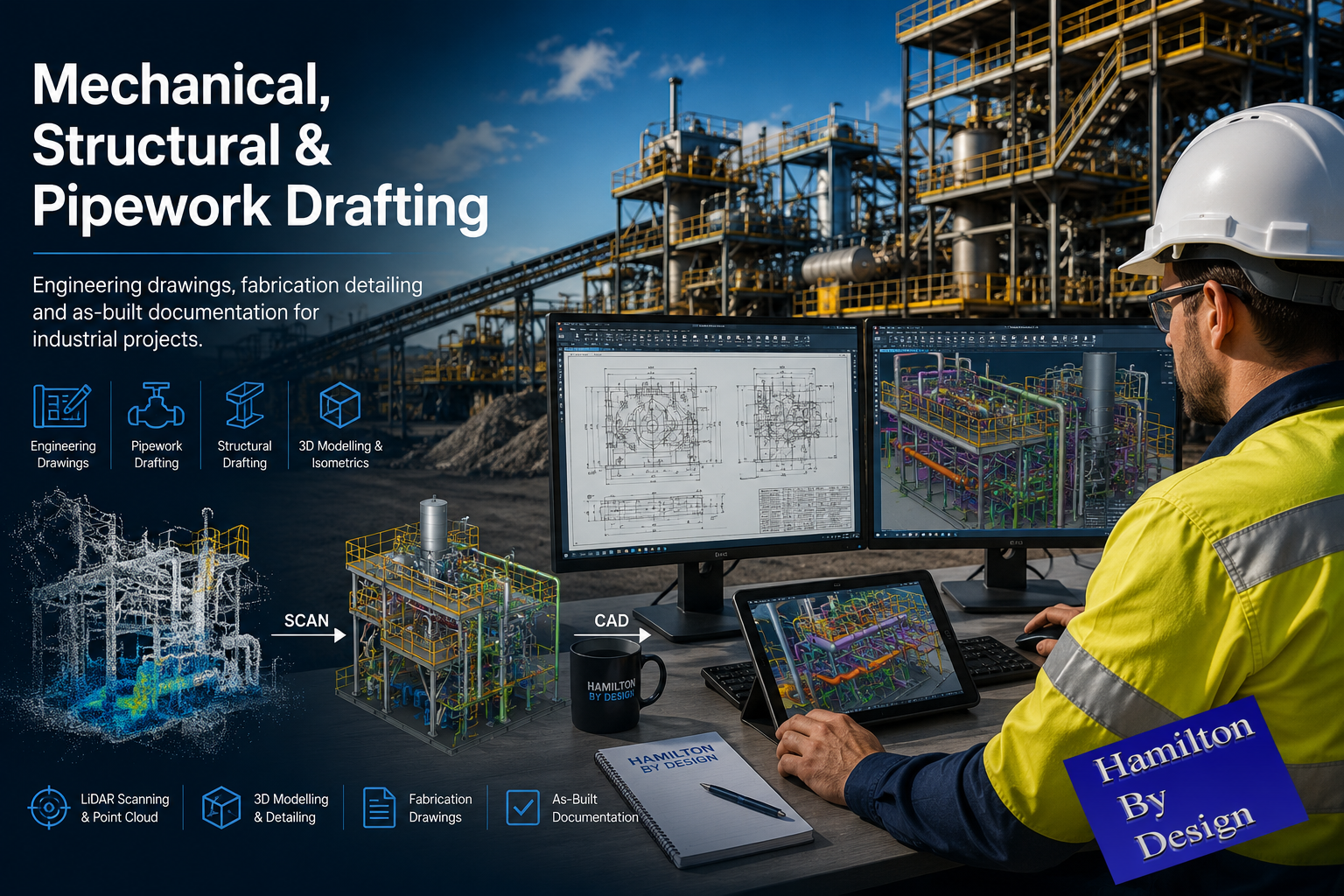
Mechanical, Structural & Pipework Drafting engineering banner showing an engineer reviewing CAD models, point cloud data and fabrication drawings for an industrial processing plant.

Rutherford NSW is one of the Hunter Region’s leading engineering, manufacturing, and mining support centres. Located within the Maitland industrial corridor and providing direct access to Newcastle, Singleton, Muswellbrook, and the Upper Hunter mining regions, Rutherford is home to a diverse range of fabrication workshops, maintenance providers, manufacturing facilities, and industrial service companies.

At Hamilton By Design, we provide engineer-led 3D laser scanning, mechanical engineering, drafting, reverse engineering, and industrial design services to support industrial operations throughout Rutherford and the broader Hunter Valley.

Supporting Rutherford’s Industrial Sector

Many facilities throughout Rutherford operate in industries such as:

  • Mining and mining services
  • Manufacturing
  • Heavy engineering
  • Fabrication
  • Bulk materials handling
  • Power generation
  • Transport and logistics
  • Industrial maintenance

As facilities grow and evolve, engineering teams often face challenges associated with outdated drawings, undocumented modifications, and the need to integrate new equipment into existing infrastructure.

Hamilton By Design helps bridge this gap by capturing accurate site information and converting it into practical engineering deliverables.

Engineering-Grade 3D Laser Scanning

Our engineering-grade LiDAR scanning services provide accurate existing-condition data for industrial projects.

We regularly scan:

  • Manufacturing facilities
  • Workshops
  • Conveyor systems
  • Transfer chutes
  • Structural steel
  • Pipework systems
  • Pump stations
  • Processing plants
  • Access platforms and walkways

Deliverables can include:

  • Registered point clouds
  • Scan-to-CAD modelling
  • Existing-condition drawings
  • Mechanical layouts
  • Structural layouts
  • Equipment models
  • Fabrication-ready drawings

Our focus is not simply creating a visual model. Our objective is to provide engineering information that can be used for design, fabrication, maintenance, and construction activities.

Mechanical Engineering & Drafting Services

Hamilton By Design provides practical engineering support for industrial facilities throughout Rutherford.

Our services include:

  • Mechanical design
  • Mechanical drafting
  • Structural drafting
  • SolidWorks modelling
  • Reverse engineering
  • Conveyor design
  • Chute design
  • Pump and piping modifications
  • Plant upgrade documentation
  • Fabrication drawing packages

Whether supporting a shutdown project, plant upgrade, equipment replacement, or brownfield expansion, we provide engineering documentation that assists contractors, fabricators, and project teams.

Reverse Engineering & Asset Documentation

Many industrial facilities operate equipment for which original drawings no longer exist.

Using a combination of LiDAR scanning, field measurements, and engineering assessment, we can develop:

  • Manufacturing drawings
  • Assembly drawings
  • General arrangement drawings
  • 3D CAD models
  • Equipment documentation
  • Asset records

This allows businesses to better manage ageing infrastructure and maintain critical equipment throughout its operational life.

Supporting the Hunter Valley Mining Industry

Rutherford is strategically positioned between Newcastle’s industrial precinct and the mining operations of the Upper Hunter.

The region supports industries including:

  • Coal mining
  • Bulk materials handling
  • Coal preparation plants
  • Power generation
  • Quarry operations
  • Heavy manufacturing
  • Rail infrastructure

Hamilton By Design understands the requirements of mining and industrial clients, providing engineering solutions that consider safety, constructability, maintenance access, and long-term asset performance.

Why Choose Hamilton By Design?

At Hamilton By Design, we are engineers first.

Our experience spans mechanical engineering, drafting, fabrication, manufacturing, maintenance, and industrial project delivery.

This means we understand the difference between simply collecting data and delivering engineering information that can be used in the real world.

Our goal is to provide practical, engineering-grade solutions that help clients reduce risk, improve project planning, and support successful project delivery.

Engineering Services for Rutherford NSW

Hamilton By Design proudly supports clients throughout Rutherford, Maitland, Newcastle, Singleton, Muswellbrook, and the wider Hunter Valley.
Our services include:

  • Engineering-grade 3D laser scanning
  • Scan-to-CAD modelling
  • Mechanical engineering
  • Mechanical drafting
  • Structural drafting
  • Reverse engineering
  • Conveyor and chute design
  • Brownfield project support
  • Shutdown planning and engineering documentation

Whether you require accurate as-built information, fabrication-ready drawings, or engineering support for an upcoming project, Hamilton By Design can assist.

Hamilton By Design โ€“ Engineering-Led 3D Laser Scanning, Mechanical Engineering, Reverse Engineering, and Industrial Drafting Services in Rutherford NSW.

Hamilton By Design logo displayed on a blue tilted rectangle with a grey gradient background
Mechanical engineering services
Mechanical, Structural & Pipework Drafting service banner by Hamilton By Design featuring white text on a blue background.
Name
Would you like us to arrange a phone consultation for you?
Address
3D LiDAR Scanning Hunter & Newcastle banner with white text on a blue background promoting engineering-grade laser scanning services for industrial, mining and infrastructure projects across the Hunter Valley and Newcastle region.
Mechanical Engineering Hunter & Newcastle banner promoting mechanical engineering services for mining, industrial plants, power generation, manufacturing and heavy industry throughout the Hunter Valley and Newcastle region.
Structural Drafting Hunter & Newcastle banner promoting structural drafting services for mining, industrial plants, power generation, manufacturing and infrastructure projects across the Hunter Valley and Newcastle region.
CHPP Engineering title graphic featuring bold white text reading "CHPP Engineering" centred on a blue rounded rectangle background.
Pipework Drafting title graphic featuring bold white text reading "Pipework Drafting" centred on a blue rounded rectangle background.
3D LiDAR Scanning for Engineering Projects title graphic featuring bold white text on a blue rounded rectangle background.
Mechanical engineering services
Australian Drafting logo featuring bold white text reading "Australian Drafting" centred on a blue rounded rectangle background.

Not All Scans, Point Clouds or Meshes Are Equal โ€“ The Hamilton By Design Philosophy

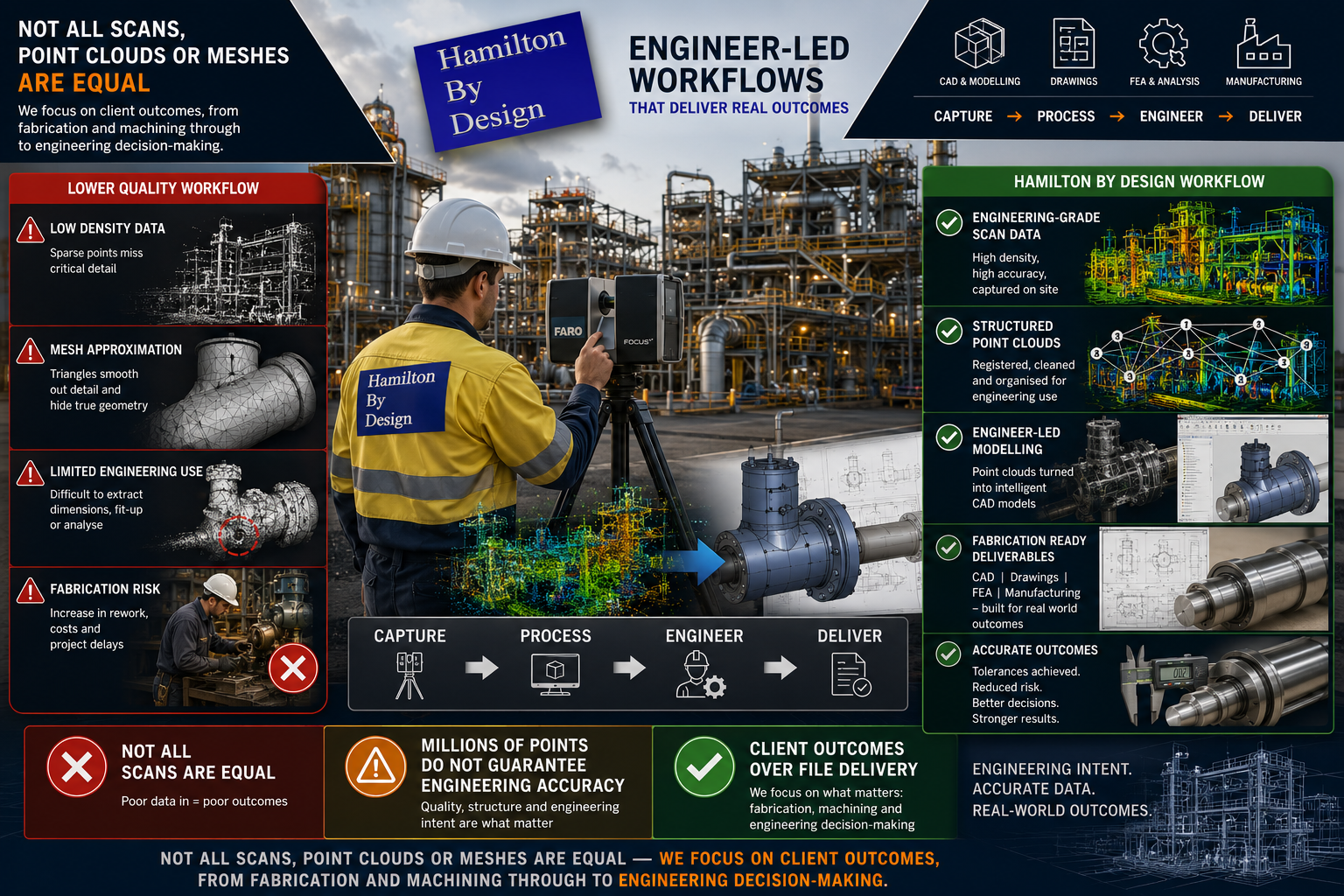
Hamilton By Design engineer-led LiDAR scanning workflow showing engineering-grade point cloud capture, CAD modelling, fabrication-ready deliverables, and comparison between low-quality scans and structured engineering data

Based on a number of enquiries received this week, we thought it would be useful to clarify and streamline the Hamilton By Design philosophy regarding engineering-grade reality capture, drafting and engineering outcomes.

Not all scans are equal.

Not all point clouds are equal.

Not all meshes are equal.

One of the biggest misconceptions in industry is that once a point cloud has been generated, or once a mesh file or STL model has been created, the engineering work is complete. In reality, capturing a scan is only the beginning of the process.

The value does not come from simply obtaining a file.

The value comes from understanding the required outcome and ensuring the data collected is appropriate for that purpose.

At Hamilton By Design, we are engineer-led and provide engineering-grade scanning and reality capture services designed around the intended engineering outcome.

Whether you require outcomes associated with:

  • Fabrication and steel fit-up
  • Mechanical drafting
  • Reverse engineering
  • Plant modifications
  • Mechanical assemblies
  • Precision machining
  • Toolmaking
  • Engineering studies and analysis

our process begins by understanding the final requirement rather than assuming one scan methodology can satisfy every project.

Because different engineering outcomes require different levels of information.

A Scan Is Not the Final Product

Many discussions begin with questions such as:

“Can you provide a point cloud?”

“Can you create a mesh?”

“Can you provide an STL file?”

These are important questions; however, they often miss the larger engineering discussion.

The better question is:

What are you trying to achieve?

The same scan dataset may be used for several completely different purposes:

  • General plant layouts
  • Fabrication fit-up
  • Reverse engineering
  • Structural modifications
  • Mechanical assemblies
  • Existing condition verification
  • Bearing and shaft measurements
  • Precision tooling

The level of detail required for these outcomes can vary significantly.

A dataset that may be suitable for one application may be completely unsuitable for another.

Drafting Is More Than Drawing Lines

Modern industrial drafting has evolved considerably.

A capable draftsperson or designer should understand:

  • Point cloud datasets
  • Mesh and STL files
  • Scan quality and limitations
  • Measurable geometry development
  • CAD model generation
  • Manufacturing requirements
  • Installation requirements
  • Practical engineering considerations

The objective is not simply creating a drawing.

The objective is converting real-world conditions into useful engineering information.

Drafting Should Understand Manufacturing Reality

At Hamilton By Design we believe drafting extends beyond geometry displayed on a screen.

Strong design outcomes often come from understanding how components are actually manufactured, assembled and maintained.

Experience or understanding in areas such as:

  • Fabrication
  • Machining
  • Toolmaking
  • Manufacturing processes
  • Site installation
  • Plant maintenance

can significantly improve engineering decisions.

Understanding manufacturing realities affects:

  • Material selection
  • Weld access
  • Machining stock allowances
  • Tolerances
  • Assembly methods
  • Maintenance requirements
  • Manufacturing costs

A component may appear correct in CAD while still creating practical manufacturing issues.

Questions still need to be asked:

  • Can the component actually be manufactured?
  • Can welding equipment physically access the location?
  • Is sufficient machining stock available?
  • Can bearings be assembled correctly?
  • Can maintenance personnel access components?

Good drafting is not simply producing drawings.

Good drafting understands the complete journey from concept through to manufacture and operation.

Data Quality In = Data Quality Out

At Hamilton By Design we regularly work with:

  • Engineering-grade point clouds
  • Surface meshes
  • STL datasets
  • Reverse engineered components
  • Existing CAD models

One engineering principle remains consistent:

You cannot create information that was never captured.

Software may improve visual appearance and optimise workflows; however, software cannot accurately create missing information.

Examples include:

  • Higher point density generally captures more geometric detail
  • Lower point density captures less information
  • Reduced mesh resolution removes geometric definition
  • STL files can contain smoothing effects
  • Mesh reduction can remove critical engineering features

Reducing points reduces available information.

At some point, a measured representation becomes an approximation.

Bigger Data Sets Are Not Always Better

Many people assume larger datasets automatically create better outcomes.

The reality is there is a balance between detail and practicality.

Large datasets may increase:

  • Processing time
  • Storage requirements
  • Hardware demands
  • Registration effort
  • Modelling time
  • File management complexity
  • Project delivery time

The objective should not be creating the largest point cloud possible.

The objective should be collecting sufficient information to satisfy the engineering requirement.

Greater Accuracy Usually Comes With Greater Cost

Higher accuracy requirements typically require greater effort.

As required accuracy increases, additional work may include:

  • Increased point density
  • Larger point cloud datasets
  • Higher mesh resolution
  • Additional scan positions
  • Greater registration effort
  • Increased verification requirements
  • Additional modelling effort
  • More engineering review

As detail increases:

  • File sizes increase
  • Processing requirements increase
  • Engineering effort increases
  • Costs may increase

The objective should not be maximum data.

The objective should be the correct data.

One Project Can Contain Multiple Tolerances

One of the most common misunderstandings is assuming an entire project operates under one tolerance requirement.

Real engineering projects rarely operate this way.

Consider a pulley assembly.

The fabricated support structure, guards and mounting arrangement may comfortably operate within fabrication tolerances of:

Approximately ยฑ2 mm

However, the same assembly may also include:

  • Shaft diameters
  • Bearing journals
  • Keyways
  • Bearing fits
  • Machined interfaces

These features may require significantly tighter dimensional control.

Typical examples include:

Fabrication and steel fit-up
Approximately ยฑ2 mm

Machined components and mechanical interfaces
Approximately ยฑ0.1 mm

Precision tooling and specialised manufacturing
Potentially <0.1 mm

A fabricator and a toolmaker are not working to the same expectations.

Applying toolmaking tolerances to general fabrication may unnecessarily increase complexity and cost.

Likewise, applying fabrication assumptions to precision-machined components may create significant issues.

One mesh does not automatically solve every engineering requirement.

The Hamilton By Design Approach

At Hamilton By Design we work backwards from the final outcome.

Questions we commonly ask include:

  • Is the project for fabrication?
  • Is machining required?
  • Is reverse engineering required?
  • Is there a critical bearing or shaft interface?
  • Is this for plant modifications?
  • Is this for a precision component?
  • Is this for engineering studies?

These answers determine:

  • Scan methodology
  • Point cloud density
  • Registration strategy
  • Modelling approach
  • Verification requirements
  • Engineering effort
  • Final deliverables

We focus on providing the right information at the right level for the intended purpose.

Because engineering-grade scanning is not about creating the biggest point cloud.

Engineering-grade scanning is not about creating the largest mesh.

Engineering-grade scanning is about producing reliable information that supports real-world engineering outcomes.

Hamilton By Design logo displayed on a blue tilted rectangle with a grey gradient background

Our clients

3D LiDAR scanning and 3D modelling service button โ€” laser scanner capturing a point cloud for engineering and CAD modelling
Mechanical engineering services
Finite Element Analysis (FEA) engineering simulation button
Mechanical engineering services
Name
Would you like us to arrange a phone consultation for you?
Address
3D CAD Modelling Australia service banner for Hamilton By Design
Australian Drafting logo featuring bold white text reading "Australian Drafting" centred on a blue rounded rectangle background.
Engineering Governance title graphic featuring bold white text reading "Engineering Governance" centred on a blue rounded rectangle background.
Mechanical, Structural & Pipework Drafting service banner by Hamilton By Design featuring white text on a blue background.
Mechanical engineering services
Blue rounded button with the text โ€œSolidWorks Designโ€ in white.
Finite Element Analysis (FEA) engineering simulation button
3D LiDAR Scanning Darwin for engineering surveys, laser scanning, reality capture and point cloud modelling services
3D LiDAR Scanning Australia engineering services for laser scanning, reality capture, scan-to-CAD, Scan-to-BIM and as-built documentation across Australia
3D LiDAR scanning services on the Central Coast providing engineering-grade laser scanning, point cloud capture, scan-to-CAD modelling and industrial reality capture for infrastructure and industrial projects.
3D LiDAR Scanning Perth for engineering surveys, laser scanning, reality capture and point cloud modelling services
3D LiDAR Scanning Sydney for engineering surveys, laser scanning, reality capture and point cloud modelling services
3D LiDAR Scanning Brisbane for engineering surveys, laser scanning, reality capture and point cloud modelling services
3D LiDAR Scanning Canberra for engineering surveys, laser scanning, reality capture and point cloud modelling services
3D LiDAR Scanning Newcastle for engineering surveys, laser scanning, reality capture and point cloud modelling services
3D LiDAR Scanning Adelaide for engineering surveys, laser scanning, reality capture and point cloud modelling services

Creating a Digital Source of Truth: Improving Asset Management Through Digital Engineering

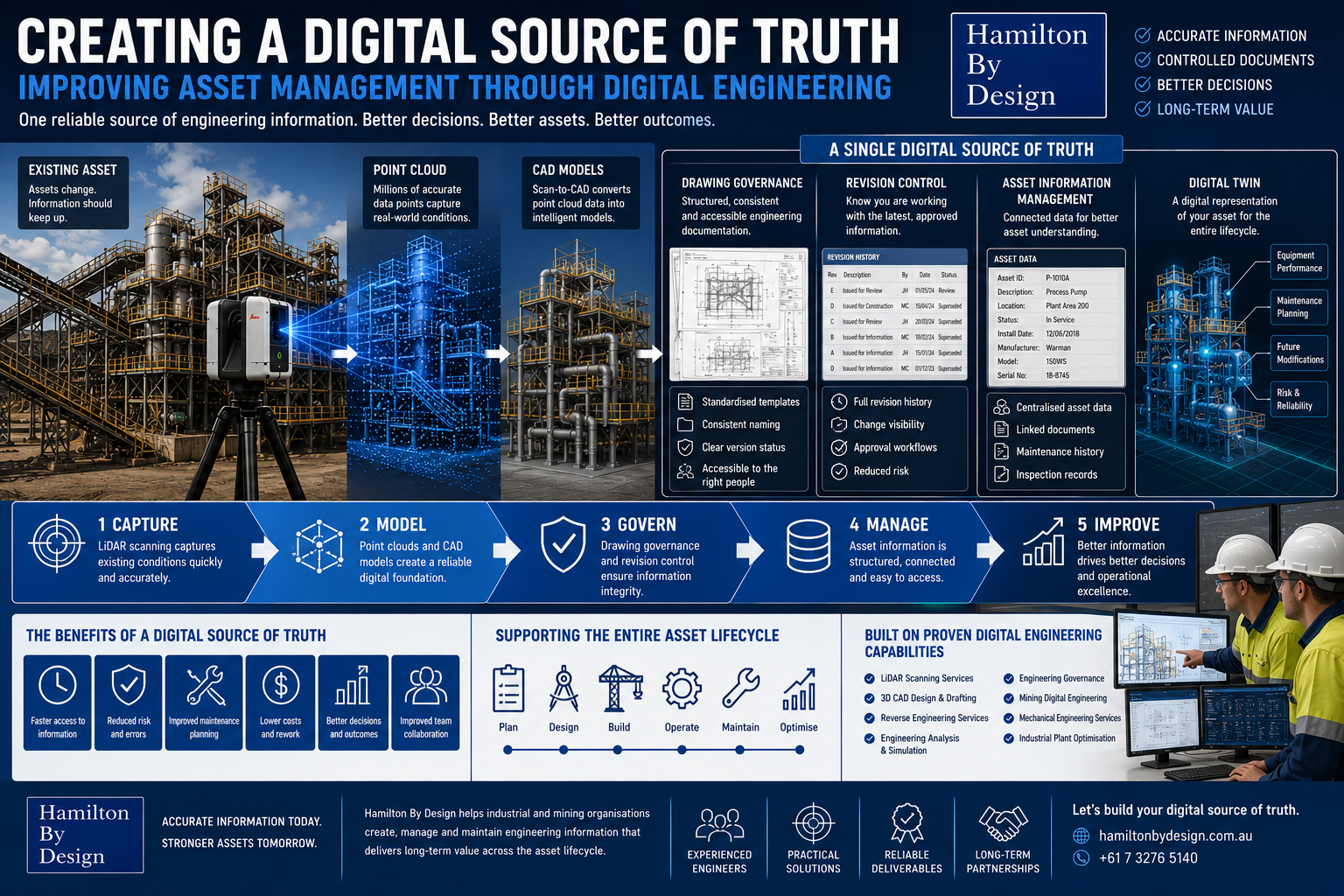
Engineering-grade LiDAR scanning and digital engineering workflow showing how a digital source of truth improves long-term asset management.

Industrial assets change over time. Equipment is upgraded, drawings are revised, platforms are modified, components are replaced, and maintenance activities gradually reshape the plant.

When engineering information is spread across old drawings, uncontrolled PDFs, manual mark-ups, spreadsheets, and individual folders, asset management becomes harder than it needs to be.

A digital source of truth helps bring engineering information together so teams can make decisions using reliable, current, and controlled data.

At Hamilton By Design, we support digital engineering asset management by combining LiDAR scanning, CAD modelling, drawing governance, revision control, and digital engineering workflows.

What is a Digital Source of Truth?

A digital source of truth is a controlled location where accurate engineering information can be stored, managed, accessed, and updated.

It may include:

  • Engineering drawings
  • CAD models
  • Point cloud data
  • Asset information
  • Revision history
  • Inspection records
  • Fabrication documentation
  • Engineering reports

The goal is simple:

One reliable place for engineering information.

Why Asset Information Management Matters

Poorly controlled information can create:

  • Outdated drawings
  • Duplicate files
  • Missing revisions
  • Conflicting information
  • Fabrication errors
  • Shutdown delays
  • Maintenance confusion

Good asset information management improves:

  • Decision making
  • Project planning
  • Maintenance efficiency
  • Drawing control
  • Long-term asset performance

Digital Engineering Workflows

Hamilton By Design can support workflows such as:

  • Engineering-grade LiDAR scanning
  • Existing condition capture
  • Point cloud generation
  • Scan-to-CAD conversion
  • CAD modelling
  • Engineering drawings
  • Revision-controlled documentation
  • Digital asset records

This turns real-world site information into usable engineering data.

Drawing Governance and Revision Control

Drawing governance helps ensure the right people are using the right information.

This includes:

  • Controlled drawing revisions
  • Clear document naming
  • Updated engineering records
  • Managed mark-ups
  • Approval workflows
  • Accessible project information
3D CAD Modelling Australia service banner for Hamilton By Design

Without revision control, teams may unknowingly use superseded drawings.

Digital Twins and Long-Term Asset Management

A digital twin does not need to start as a complex system. For many industrial sites, it begins with accurate geometry, controlled drawings, and reliable asset records.

Digital engineering can support:

  • Plant upgrades
  • Maintenance planning
  • Shutdown preparation
  • Reverse engineering
  • Engineering analysis
  • Future modifications

Long-Term Operational Efficiency

A digital source of truth can reduce:

  • Time spent searching for drawings
  • Rework caused by outdated information
  • Repeated site measurements
  • Fabrication errors
  • Project uncertainty

It can improve:

  • Maintenance planning
  • Engineering confidence
  • Asset visibility
  • Operational efficiency
  • Project delivery

How Hamilton By Design Supports This

Hamilton By Design supports digital engineering asset management through:

  • 3D CAD Design & Drafting
  • Engineering Governance
  • LiDAR Scanning Services
  • Industrial Plant Optimisation
  • Engineering Analysis & Simulation
  • Mining Digital Engineering
  • Mechanical Engineering Services
  • Reverse Engineering Services

The objective is not just to create drawings or models.

The objective is to create engineering information that remains useful throughout the asset lifecycle.

3D LiDAR scanning and 3D modelling service button โ€” laser scanner capturing a point cloud for engineering and CAD modelling
Mechanical engineering services

Conclusion

Industrial asset management depends on reliable information.

A digital source of truth helps organisations move from scattered documents and outdated drawings toward controlled, current, and usable engineering data.

Better information supports better asset decisions.

Hamilton By Design logo displayed on a blue tilted rectangle with a grey gradient background

Our Clients:

Name
Would you like us to arrange a phone consultation for you?
Address
3D CAD Modelling Australia service banner for Hamilton By Design
Australian Drafting logo featuring bold white text reading "Australian Drafting" centred on a blue rounded rectangle background.
Engineering Governance title graphic featuring bold white text reading "Engineering Governance" centred on a blue rounded rectangle background.
Mechanical, Structural & Pipework Drafting service banner by Hamilton By Design featuring white text on a blue background.
Mechanical engineering services
Blue rounded button with the text โ€œSolidWorks Designโ€ in white.
Finite Element Analysis (FEA) engineering simulation button
3D LiDAR Scanning Darwin for engineering surveys, laser scanning, reality capture and point cloud modelling services
3D LiDAR Scanning Australia engineering services for laser scanning, reality capture, scan-to-CAD, Scan-to-BIM and as-built documentation across Australia
3D LiDAR scanning services on the Central Coast providing engineering-grade laser scanning, point cloud capture, scan-to-CAD modelling and industrial reality capture for infrastructure and industrial projects.
3D LiDAR Scanning Perth for engineering surveys, laser scanning, reality capture and point cloud modelling services
3D LiDAR Scanning Sydney for engineering surveys, laser scanning, reality capture and point cloud modelling services
3D LiDAR Scanning Brisbane for engineering surveys, laser scanning, reality capture and point cloud modelling services
3D LiDAR Scanning Canberra for engineering surveys, laser scanning, reality capture and point cloud modelling services
3D LiDAR Scanning Newcastle for engineering surveys, laser scanning, reality capture and point cloud modelling services
3D LiDAR Scanning Adelaide for engineering surveys, laser scanning, reality capture and point cloud modelling services

From Point Cloud to Engineering Documentation: Turning Existing Assets into Usable Information

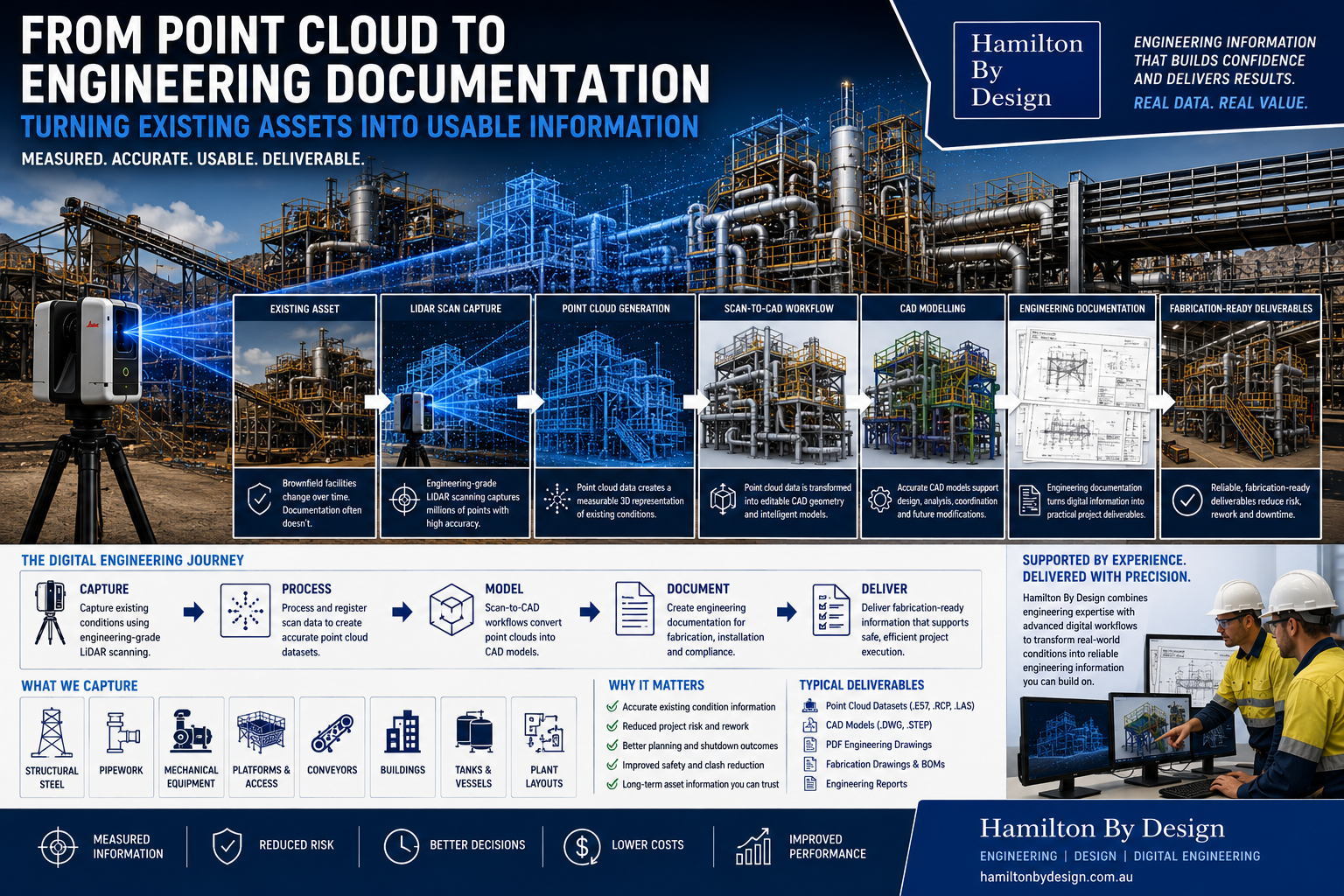
Engineering-grade LiDAR scanning and digital engineering workflow showing point cloud data transformed into CAD models and fabrication-ready engineering documentation.

Industrial facilities are constantly changing. Equipment is upgraded, structures are modified, process lines evolve, and maintenance-driven changes gradually reshape plant layouts over time.

Unfortunately, engineering documentation does not always evolve at the same pace.

Many facilities eventually reach a point where the question becomes:

“What actually exists on site today?”

When drawings become outdated or documentation is missing, engineering teams can face increased project risk, fabrication challenges, and costly rework.

Modern digital engineering workflows now allow physical assets to be transformed into accurate engineering information through engineering-grade LiDAR scanning, point cloud generation, and Scan-to-CAD workflows.

At Hamilton By Design, we support industrial and mining projects by converting real-world conditions into practical engineering deliverables that support design, fabrication, and long-term asset management.

Why Existing Information Matters

Engineering decisions rely on information.

Drawings and documentation support:

  • Plant upgrades
  • Maintenance activities
  • Shutdown planning
  • Equipment replacement
  • Fabrication projects
  • Asset management
  • Future modifications

When information becomes inaccurate, project uncertainty increases.

Potential impacts may include:

  • Installation clashes
  • Fabrication errors
  • Rework
  • Delays
  • Safety risks
  • Increased project cost

Reliable engineering information begins with understanding existing conditions.

Engineering-Grade LiDAR Scanning

The first step involves capturing the physical environment.

Hamilton By Design uses engineering-grade 3D LiDAR scanning to record:

  • Structural steel
  • Pipework
  • Mechanical equipment
  • Platforms and access systems
  • Buildings
  • Conveyors
  • Processing equipment
  • Existing plant layouts

Unlike manual measurements, LiDAR scanning captures millions of measured points from real operating environments.

Benefits can include:

  • Existing condition verification
  • Reduced assumptions
  • Improved accuracy
  • Faster information capture
  • Reduced project risk

Point Cloud Generation

Following site capture, scan information is processed into a point cloud dataset.

Point clouds provide a measurable digital representation of existing assets.

Typical outputs may include:

  • .E57 files
  • .RCP files
  • .LAS files
  • Registration reports

Point cloud datasets provide:

  • Spatial information
  • Existing geometry
  • Equipment relationships
  • Measured dimensions
  • Existing plant layouts

This information forms the foundation for engineering workflows.

Scan-to-CAD Workflows

Point cloud information becomes significantly more valuable when converted into editable engineering data.

Scan-to-CAD workflows allow engineers to transform captured geometry into:

  • Mechanical models
  • Structural models
  • Equipment layouts
  • Existing condition models
  • Plant modifications
  • Engineering assemblies

Rather than working from assumptions, engineers can work from measured information.

CAD Modelling

CAD models transform captured information into usable engineering assets.

Benefits may include:

  • Editable geometry
  • Future design flexibility
  • Improved project coordination
  • Better visualisation
  • Long-term asset information

Typical CAD outputs can include:

  • Solid models
  • Assembly models
  • Layout models
  • Mechanical drawings
  • Structural models

Digital models become valuable engineering assets beyond a single project.

Engineering Documentation

Models alone do not build equipment.

Engineering documentation converts digital information into practical project deliverables.

Documentation may include:

  • General arrangement drawings
  • Detail drawings
  • Fabrication drawings
  • Bills of materials
  • Assembly documentation
  • Engineering reports

Engineering documentation creates information that fabrication and construction teams can use confidently.

Fabrication-Ready Deliverables

The final objective is delivering usable engineering information.

Hamilton By Design deliverables may include:

  • Point cloud datasets
  • CAD models
  • PDF drawings
  • DWG files
  • STEP files
  • Fabrication documentation
  • Engineering reports

The focus is moving beyond visual models toward deliverables that support real-world implementation.

How Hamilton By Design Supports Digital Engineering

Hamilton By Design combines practical engineering knowledge and digital workflows including:

  • Engineering-grade 3D LiDAR scanning
  • Existing condition capture
  • Point cloud generation
  • Scan-to-CAD workflows
  • CAD modelling
  • Engineering documentation
  • Fabrication-ready deliverables

Our objective is creating accurate engineering information that reduces project uncertainty and supports better outcomes.

Turning Existing Assets into Usable Information

Existing assets contain valuable engineering information.

The challenge is transforming that information into something practical and usable.

3D LiDAR scanning and 3D modelling service button โ€” laser scanner capturing a point cloud for engineering and CAD modelling
Mechanical engineering services

Digital engineering workflows allow organisations to move from:

Physical Asset โ†’ Point Cloud โ†’ CAD Model โ†’ Engineering Documentation โ†’ Fabrication

When accurate information supports engineering decisions, project confidence improves.

Measured information creates better engineering outcomes than assumptions.

Hamilton By Design logo displayed on a blue tilted rectangle with a grey gradient background

Our Clients:

Name
Would you like us to arrange a phone consultation for you?
Address
Finite Element Analysis (FEA) engineering simulation button
Mechanical engineering services

Why Up-to-Date Engineering Drawings Matter: Reducing Risk Through Digital Engineering

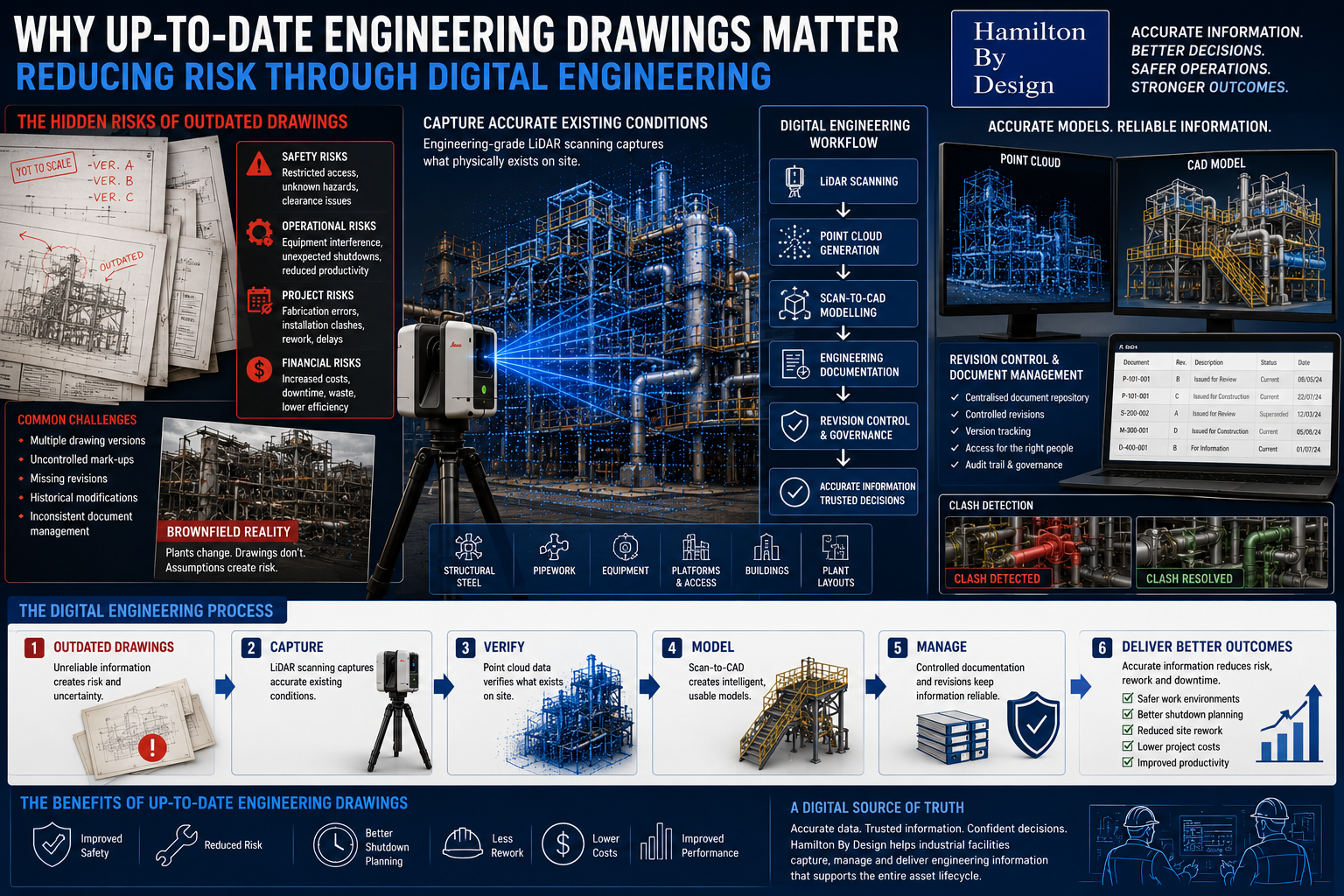
Engineering-grade LiDAR scanning and digital engineering workflow showing how updated engineering drawings reduce project risk and improve asset management.

Industrial facilities rarely remain unchanged throughout their operating life. Equipment is upgraded, structural modifications occur, pipework is rerouted, platforms are added, and maintenance-driven changes become part of everyday operations.

Over time, these modifications can create a disconnect between what exists on site and what engineering documentation says exists.

When engineering drawings no longer accurately represent site conditions, the consequences can extend beyond inconvenience. Outdated information can introduce operational risk, safety concerns, project delays, and increased costs.

At Hamilton By Design, we believe engineering decisions should be based on accurate, measured information rather than assumptions.

Digital engineering workflows help transform existing assets into reliable engineering information that supports safer and more efficient project outcomes.

Why Engineering Drawings Matter

Engineering drawings provide more than dimensions and layouts.

They support:

  • Equipment maintenance
  • Plant upgrades
  • Shutdown activities
  • Fabrication works
  • Safety planning
  • Operational decisions
  • Future modifications

Drawings often become the primary source of information used by:

  • Engineers
  • Maintenance personnel
  • Project teams
  • Contractors
  • Fabricators
  • Operations personnel

If the information is incorrect, downstream decisions may also become incorrect.

3D CAD Modelling Australia service banner for Hamilton By Design

Risks Created by Outdated Drawings

Even relatively small discrepancies between site conditions and engineering documentation can create significant problems.

Potential risks include:

Safety Risks

Outdated information may create:

  • Restricted access areas
  • Unidentified hazards
  • Clearance issues
  • Manual handling challenges
  • Unsafe work conditions

Operational Risks

Incorrect information can contribute to:

  • Equipment interference
  • Unexpected shutdown activities
  • Reduced productivity
  • Increased maintenance complexity

Project Risks

Engineering teams may encounter:

  • Fabrication errors
  • Installation clashes
  • Rework requirements
  • Increased labour costs
  • Schedule delays

Financial Risks

Minor inaccuracies can result in:

  • Increased project costs
  • Extended downtime
  • Material waste
  • Reduced project efficiency

Drawing Revisions and Version Control

Many industrial facilities operate using drawings developed over long periods of time.

Common challenges include:

  • Multiple drawing versions
  • Uncontrolled mark-ups
  • Missing revisions
  • Historical modifications
  • Inconsistent document management

Without effective version control, personnel may unknowingly use outdated information.

Digital engineering workflows support:

  • Revision tracking
  • Controlled updates
  • Centralised documentation
  • Improved information accessibility
  • Better engineering governance

Maintaining a controlled environment for engineering information helps reduce risk.

Existing Condition Capture

One of the most effective methods of maintaining drawing accuracy is capturing what physically exists on site.

Hamilton By Design supports projects through engineering-grade 3D LiDAR scanning to capture:

  • Structural steel
  • Pipework
  • Platforms
  • Mechanical equipment
  • Buildings
  • Existing plant layouts
  • Access systems

Existing condition capture allows engineering teams to work with measured information rather than assumptions.

Brownfield Projects Create Additional Challenges

Brownfield environments commonly include:

  • Historical modifications
  • Legacy equipment
  • Congested layouts
  • Existing structures
  • Limited access areas
  • Undocumented changes

Original documentation often no longer reflects actual site conditions.

Using inaccurate information during brownfield projects can increase:

  • Design uncertainty
  • Installation difficulties
  • Rework
  • Shutdown impacts
  • Fabrication risk

Engineering Governance and Digital Engineering

Digital engineering supports a structured approach to managing engineering information.

Engineering governance may include:

  • Revision control systems
  • Centralised documentation
  • Scan-to-CAD workflows
  • Digital asset information
  • Controlled engineering updates
  • Long-term information management

The objective is creating a digital source of truth where project teams can access reliable information.

Supporting Shutdown Planning

Shutdown periods are often constrained by:

  • Time limitations
  • Labour availability
  • Production requirements
  • Safety considerations

Incorrect engineering information during shutdowns can create:

  • Unexpected site modifications
  • Delays
  • Increased labour requirements
  • Reduced productivity

Accurate digital engineering information supports:

  • Improved planning
  • Better coordination
  • Reduced uncertainty
  • Reduced downtime

Reducing Site Rework

Site rework often results from discovering problems after fabrication or installation begins.

Typical causes include:

  • Missing dimensions
  • Existing condition inaccuracies
  • Equipment clashes
  • Incorrect assumptions
  • Documentation errors

Digital workflows including:

  • Existing condition capture
  • Point cloud modelling
  • Scan-to-CAD processes
  • Clash detection

can help identify issues before they become site problems.

How Hamilton By Design Supports Digital Engineering

Hamilton By Design combines engineering experience with digital workflows including:

  • Engineering-grade 3D LiDAR scanning
  • Existing condition capture
  • Scan-to-CAD workflows
  • CAD modelling
  • Engineering documentation
  • Engineering governance
  • Fabrication-ready deliverables

The goal is not simply creating drawings.

The goal is creating reliable engineering information that supports better operational decisions.

3D LiDAR scanning and 3D modelling service button โ€” laser scanner capturing a point cloud for engineering and CAD modelling
Mechanical engineering services

Better Information Creates Better Outcomes

Drawings influence every stage of an asset lifecycle.

When information becomes outdated, risk increases.

Maintaining accurate engineering documentation supports:

  • Safety improvements
  • Reduced project risk
  • Better shutdown outcomes
  • Reduced rework
  • Improved operational performance

Up-to-date engineering drawings create confidence across engineering, maintenance, and project delivery activities.

Hamilton By Design logo displayed on a blue tilted rectangle with a grey gradient background

Our Clients:

Name
Would you like us to arrange a phone consultation for you?
Address
Finite Element Analysis (FEA) engineering simulation button
Mechanical engineering services