Why Hamilton By Design Has Invested in the FARO Ecosystem

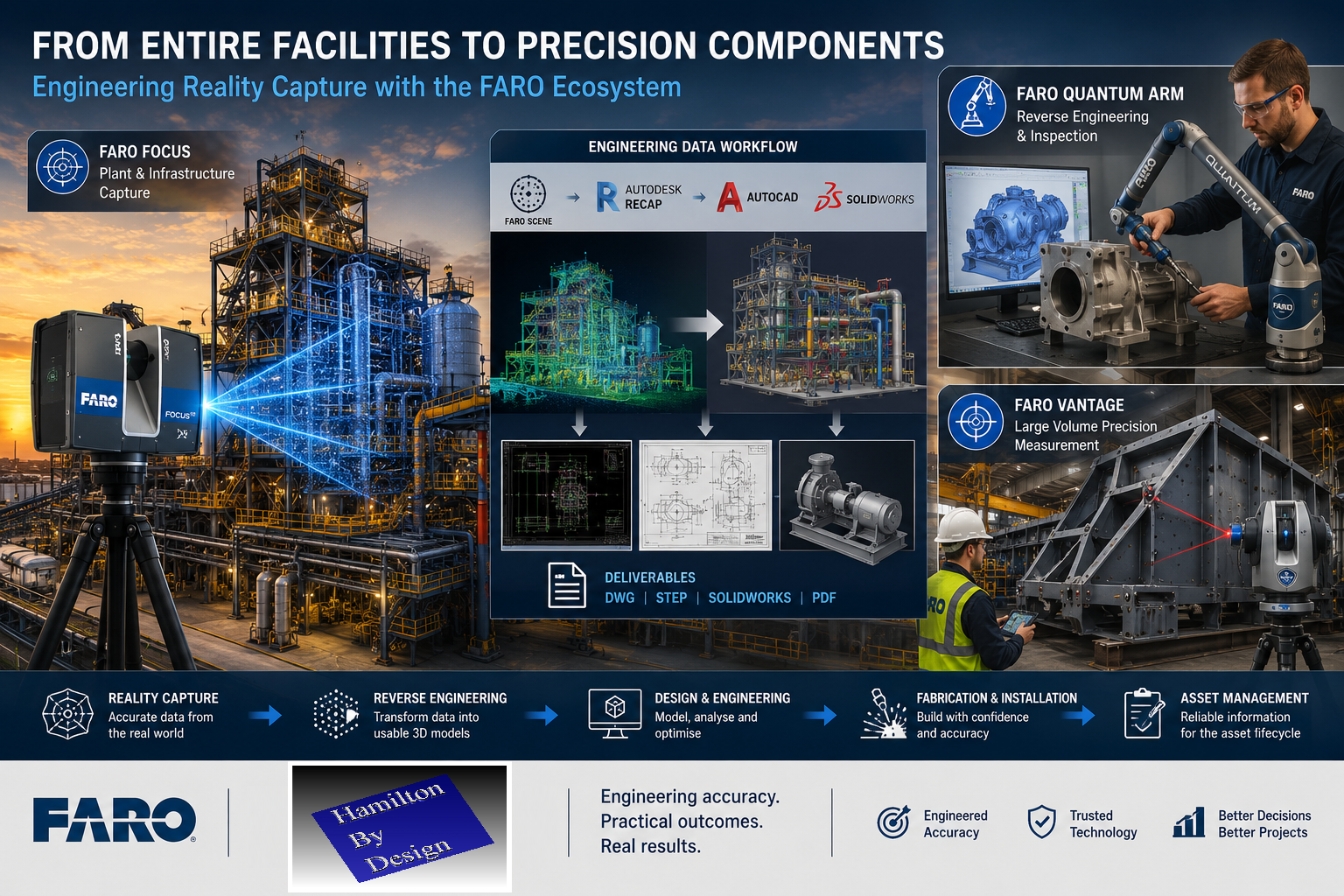
Industrial engineering workflow showing FARO Focus laser scanning of a processing plant, digital Scan-to-CAD modelling, FARO Quantum Arm reverse engineering of a pump housing, and FARO Vantage laser tracker inspection of a fabricated steel structure.

At Hamilton By Design, technology investments are made with one objective in mind: delivering practical engineering outcomes for our clients.

Over the years, the reality capture market has expanded significantly, with a wide range of terrestrial scanners, mobile mapping systems, handheld scanners and metrology solutions available. While each technology has its place, we have chosen to build our reality capture and reverse engineering workflow around the FARO ecosystem because it aligns closely with the work we perform every day.

Our projects typically involve industrial facilities, mining infrastructure, manufacturing plants, process equipment, structural steel, pipework systems, shutdown planning, reverse engineering and Scan-to-CAD workflows. These applications require more than point cloud collection. They require engineering-grade information that can be transformed into practical deliverables.

A Complete Measurement Ecosystem

One of the key strengths of FARO is the breadth of its measurement portfolio.

The FARO platform spans multiple levels of measurement capability:

Large-Scale Reality Capture

The FARO Focus Series provides terrestrial laser scanning solutions capable of capturing facilities ranging from small plant rooms through to large industrial complexes and infrastructure projects.

These systems allow engineers to capture existing conditions with confidence while generating data suitable for:

  • Scan-to-CAD
  • Digital twins
  • Asset management
  • Plant modifications
  • Structural steel detailing
  • Mechanical design
  • Construction verification

Mobile Reality Capture

The FARO Orbis platform introduces mobile mapping capability while remaining connected to the wider FARO ecosystem.

For large facilities requiring rapid data acquisition, mobile scanning provides an efficient solution while maintaining compatibility with engineering workflows.

Portable Metrology

The FARO Quantum Arm extends capability beyond facility measurement into precision engineering applications.

This allows organisations to move seamlessly from measuring an entire processing plant to inspecting a single component with metrology-grade accuracy.

Applications include:

  • Reverse engineering
  • Quality control
  • Manufacturing inspection
  • Component verification
  • Precision measurement

Large Volume Precision Measurement

The FARO Vantage Laser Tracker platform provides another layer of capability for applications requiring high accuracy over large distances.

Industries including aerospace, power generation, heavy manufacturing and industrial construction rely on this technology for alignment and verification tasks where traditional surveying methods may not provide the required level of precision.

Engineering Integration Matters

For Hamilton By Design, scanning is not the final deliverable.

The point cloud is only the beginning of the engineering process.

Our clients generally require:

  • AutoCAD models
  • SolidWorks models
  • STEP files
  • Fabrication drawings
  • General arrangement drawings
  • Structural steel details
  • Mechanical engineering documentation

Because of this, we place significant value on workflows that integrate effectively with engineering software.

Our reality capture workflow commonly includes:

  • FARO Focus
  • FARO SCENE
  • Autodesk ReCap
  • AutoCAD
  • SolidWorks
  • Navisworks

This enables captured information to move efficiently from the field into engineering and manufacturing environments.

From Entire Facilities to Individual Components

One of the reasons the FARO ecosystem is particularly attractive for engineering organisations is its scalability.

A single project may involve:

  • Scanning an entire processing plant using a FARO Focus scanner.
  • Measuring a critical pump housing using a FARO Arm.
  • Verifying installation geometry using a FARO Laser Tracker.
  • Delivering engineering models through AutoCAD and SolidWorks.

All of these activities can occur within a connected measurement ecosystem.

This capability allows engineers to select the most appropriate tool for each measurement challenge rather than forcing every project into a single workflow.

Supporting Industrial Engineering Projects

Hamilton By Design operates primarily within industrial environments.

Typical projects include:

  • Mining operations
  • Mineral processing facilities
  • Manufacturing plants
  • Conveyor systems
  • Chute and hopper design
  • Pipework modifications
  • Structural steel upgrades
  • Shutdown planning
  • Reverse engineering of legacy equipment

These projects require practical engineering solutions supported by reliable measurement data.

The FARO ecosystem provides a range of tools capable of supporting these requirements, from large-scale reality capture through to precision metrology.

Engineering-Led Reality Capture

Technology alone does not guarantee project success.

The value of reality capture comes from the ability to transform measurement data into actionable engineering information.

At Hamilton By Design, our objective is not simply to collect point clouds. Our objective is to help clients make informed engineering decisions, reduce project risk, improve constructability and accelerate project delivery.

The FARO ecosystem supports this objective by providing measurement solutions that span reality capture, mobile mapping, portable metrology and large-volume precision measurement.

For engineering organisations seeking a scalable measurement platform capable of supporting projects from facility-scale scanning through to component-level verification, FARO continues to provide one of the most comprehensive portfolios available within the industry.

By combining proven measurement technology with practical engineering expertise, Hamilton By Design delivers reality capture solutions that move beyond visualisation and into real-world engineering outcomes.
Why Hamilton By Design Has Invested in the FARO Ecosystem

At Hamilton By Design, technology investments are made with one objective in mind: delivering practical engineering outcomes for our clients.

Over the years, the reality capture market has expanded significantly, with a wide range of terrestrial scanners, mobile mapping systems, handheld scanners and metrology solutions available. While each technology has its place, we have chosen to build our reality capture and reverse engineering workflow around the FARO ecosystem because it aligns closely with the work we perform every day.

Our projects typically involve industrial facilities, mining infrastructure, manufacturing plants, process equipment, structural steel, pipework systems, shutdown planning, reverse engineering and Scan-to-CAD workflows. These applications require more than point cloud collection. They require engineering-grade information that can be transformed into practical deliverables.

A Complete Measurement Ecosystem

One of the key strengths of FARO is the breadth of its measurement portfolio.

The FARO platform spans multiple levels of measurement capability:

Large-Scale Reality Capture

The FARO Focus Series provides terrestrial laser scanning solutions capable of capturing facilities ranging from small plant rooms through to large industrial complexes and infrastructure projects.

These systems allow engineers to capture existing conditions with confidence while generating data suitable for:

  • Scan-to-CAD
  • Digital twins
  • Asset management
  • Plant modifications
  • Structural steel detailing
  • Mechanical design
  • Construction verification

Mobile Reality Capture

The FARO Orbis platform introduces mobile mapping capability while remaining connected to the wider FARO ecosystem.

For large facilities requiring rapid data acquisition, mobile scanning provides an efficient solution while maintaining compatibility with engineering workflows.

Portable Metrology

The FARO Quantum Arm extends capability beyond facility measurement into precision engineering applications.

This allows organisations to move seamlessly from measuring an entire processing plant to inspecting a single component with metrology-grade accuracy.

Applications include:

  • Reverse engineering
  • Quality control
  • Manufacturing inspection
  • Component verification
  • Precision measurement

Large Volume Precision Measurement

The FARO Vantage Laser Tracker platform provides another layer of capability for applications requiring high accuracy over large distances.

Industries including aerospace, power generation, heavy manufacturing and industrial construction rely on this technology for alignment and verification tasks where traditional surveying methods may not provide the required level of precision.

Engineering Integration Matters

For Hamilton By Design, scanning is not the final deliverable.

The point cloud is only the beginning of the engineering process.

Our clients generally require:

  • AutoCAD models
  • SolidWorks models
  • STEP files
  • Fabrication drawings
  • General arrangement drawings
  • Structural steel details
  • Mechanical engineering documentation

Because of this, we place significant value on workflows that integrate effectively with engineering software.

Our reality capture workflow commonly includes:

  • FARO Focus
  • FARO SCENE
  • Autodesk ReCap
  • AutoCAD
  • SolidWorks
  • Navisworks

This enables captured information to move efficiently from the field into engineering and manufacturing environments.

From Entire Facilities to Individual Components

One of the reasons the FARO ecosystem is particularly attractive for engineering organisations is its scalability.

A single project may involve:

  • Scanning an entire processing plant using a FARO Focus scanner.
  • Measuring a critical pump housing using a FARO Arm.
  • Verifying installation geometry using a FARO Laser Tracker.
  • Delivering engineering models through AutoCAD and SolidWorks.

All of these activities can occur within a connected measurement ecosystem.

This capability allows engineers to select the most appropriate tool for each measurement challenge rather than forcing every project into a single workflow.

Supporting Industrial Engineering Projects

Hamilton By Design operates primarily within industrial environments.

Typical projects include:

  • Mining operations
  • Mineral processing facilities
  • Manufacturing plants
  • Conveyor systems
  • Chute and hopper design
  • Pipework modifications
  • Structural steel upgrades
  • Shutdown planning
  • Reverse engineering of legacy equipment

These projects require practical engineering solutions supported by reliable measurement data.

The FARO ecosystem provides a range of tools capable of supporting these requirements, from large-scale reality capture through to precision metrology.

Engineering-Led Reality Capture

Technology alone does not guarantee project success.

The value of reality capture comes from the ability to transform measurement data into actionable engineering information.

At Hamilton By Design, our objective is not simply to collect point clouds. Our objective is to help clients make informed engineering decisions, reduce project risk, improve constructability and accelerate project delivery.

The FARO ecosystem supports this objective by providing measurement solutions that span reality capture, mobile mapping, portable metrology and large-volume precision measurement.

For engineering organisations seeking a scalable measurement platform capable of supporting projects from facility-scale scanning through to component-level verification, FARO continues to provide one of the most comprehensive portfolios available within the industry.

By combining proven measurement technology with practical engineering expertise, Hamilton By Design delivers reality capture solutions that move beyond visualisation and into real-world engineering outcomes.
3D LiDAR scanning and 3D modelling services button
Mechanical engineering services
Building and construction services button
Hamilton By Design logo displayed on a blue tilted rectangle with a grey gradient background

Would you like to know more ?

Contact Us – Talk to Us

Name
Would you like us to arrange a phone consultation for you?
Address

Our Clients
3D LiDAR scanning and 3D modelling service button โ€” laser scanner capturing a point cloud for engineering and CAD modelling
Mechanical engineering services

3D Scanning Sydney banner promoting engineering-grade 3D laser scanning, LiDAR scanning, and reality capture services by Hamilton By Design.
Mechanical Engineering Sydney banner with white text on a blue background representing Hamilton By Design's mechanical engineering services in Sydney.
Mechanical Drafting and 3D Modelling Sydney banner highlighting Hamilton By Design's CAD drafting, 3D modelling, and engineering design services in Sydney.
Blue banner graphic displaying the text "Point Cloud to CAD - Australia" in large white lettering, representing point cloud processing, scan-to-CAD conversion and digital engineering services across Australia.
Blue banner graphic displaying the text "Scan to CAD Sydney" in large white lettering, representing engineering-led point cloud to CAD conversion, LiDAR scanning and digital engineering services in Sydney.
Blue banner graphic displaying the text "Reality Capture Sydney - CBD" in large white lettering, representing engineering-led reality capture, LiDAR scanning and digital engineering services within Sydney CBD commercial buildings and infrastructure.

Engineering-Grade LiDAR Scanning vs Scan-as-You-Walk Systems

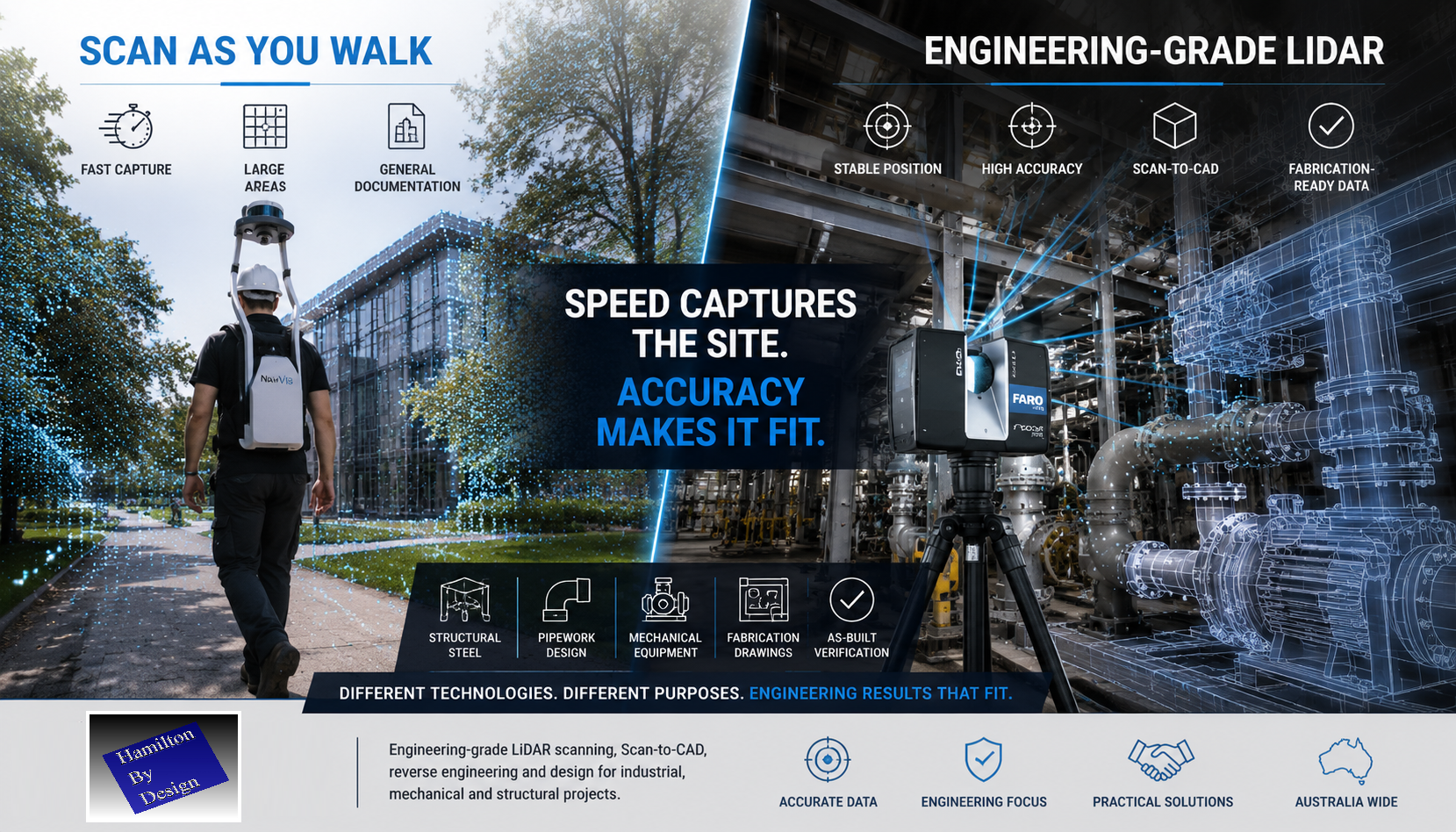
Split-screen comparison of mobile LiDAR scanning and engineering-grade terrestrial laser scanning. The left side shows a wearable scan-as-you-walk LiDAR system capturing a large outdoor environment, while the right side shows a tripod-mounted laser scanner capturing structural steel, pipework and mechanical equipment in an industrial facility. The image highlights the message: "Speed Captures the Site. Accuracy Makes It Fit."

Why Scanner Stability Matters When Accuracy Matters

LiDAR stands for Light Detection and Ranging. It uses laser light to measure distance and create a 3D digital representation of the real world.

But in engineering, the distance measurement is only part of the story.

To produce reliable design, drafting and fabrication data, the scanner also needs to know exactly where it was positioned, how it was orientated, and how every measurement relates to the rest of the site.

That is why stable, engineering-grade scanning matters.


Scan as You Walk Has Its Place

Walk-through LiDAR systems such as NavVis-style mobile scanners are impressive technologies. They allow an operator to move through an environment while capturing large volumes of spatial data quickly.

For some applications, this is a major advantage.

Scan-as-you-walk systems can be useful for:

  • Facility documentation
  • Asset walkthroughs
  • Digital tours
  • Large building capture
  • Universities
  • Shopping centres
  • Hospitals
  • National parks
  • General spatial records

If the objective is to document a large area quickly, mobile scanning can be a practical solution.

But speed is not the same as engineering certainty.


Engineering Accuracy Requires More Than Walking Through a Site

When a scanner is moving, the system must continuously calculate:

  • where the scanner is located
  • which direction it is facing
  • how fast it is moving
  • how it is rotating
  • how each scan position connects to the next

This is normally achieved using SLAM, cameras, IMUs and software-based positioning.

These systems are powerful, but they can still be affected by drift, movement, poor geometry, reflective surfaces, repetitive structures and weak reference points.

In engineering, small errors can become expensive problems.

A point cloud may look good on screen, but that does not always mean it is suitable for mechanical design, structural detailing or fabrication.


Why Hamilton By Design Uses FARO Focus Technology

At Hamilton By Design, we use FARO Focus terrestrial laser scanning for engineering-grade reality capture.

The FARO Focus scanner is set up on a stable tripod position. It captures high-density scan data from fixed locations, allowing the point cloud to be registered, checked and used for design work with confidence.

This approach is slower than simply walking through a site, but it provides the quality of data required for engineering deliverables.

We use FARO scanning for:

  • Scan-to-CAD
  • Reverse engineering
  • Mechanical design
  • Structural steel modelling
  • Pipework layouts
  • Fabrication drawings
  • As-built documentation
  • Clash detection
  • Plant room scanning
  • Industrial site verification
  • Shutdown planning

When structural steel needs to fit, pipework needs to align and fabricated components need to be manufactured from the captured data, accuracy matters.


The Difference Is the Final Outcome

A walk-through scan may be suitable when the purpose is general documentation.

A FARO Focus scan is more suitable when the data will be used to design, manufacture, install or verify engineered components.

That difference matters.

If the objective is to walk through a national park, a mobile scanner may be the right tool.

If the objective is to make sure structural beams, pipe spools, platforms, chutes, hoppers or mechanical components fit together correctly, then engineering-grade LiDAR scanning is the safer choice.

Because when the fabrication team arrives on site, the steel either fits or it does not.


Real-World Engineering Experience

Hamilton By Design is often asked to revisit sites where previous scan data was not suitable for engineering use.

In recent weeks, we have been requested multiple times to rescan building and industrial sites after earlier walk-through scanning did not provide the level of accuracy or detail required for design and drafting.

This does not mean mobile scanning is wrong.

It means the scanning method must match the intended use.

For general site capture, speed may be the priority.

For engineering, fabrication and installation, accuracy must come first.


LiDAR Measures Distance. Engineering Requires Position Certainty.

LiDAR uses light to measure distance.

However, engineering-grade point clouds require more than distance. They require confidence in the scanner position, orientation, registration and final geometry.

A simple way to explain it is this:

A tape measure may be accurate, but if you do not know exactly where the measurement started, the result can still be wrong.

The same applies to LiDAR scanning.

The laser may measure accurately, but if the scanner position is uncertain, the final point cloud may not be suitable for engineering work.


Where FARO Focus Scanning Adds Value

Hamilton By Design provides engineering-led LiDAR scanning for clients who need usable design data, not just a visual point cloud.

Our scanning and modelling services support:

  • Industrial plants
  • Mechanical rooms
  • Processing facilities
  • Mining infrastructure
  • Conveyor systems
  • Structural platforms
  • Pipework and services
  • Equipment layouts
  • Existing buildings
  • Brownfield modification projects

We do not just scan the site.

We understand how the scan data will be used in design, drafting, fabrication and installation.

That engineering understanding is what makes the difference.


Engineering-Grade Deliverables

Depending on the project requirements, Hamilton By Design can provide:

  • Registered point clouds
  • E57 files
  • RCP / RCS files
  • Scan-to-CAD models
  • AutoCAD drawings
  • SolidWorks models
  • Inventor models
  • STEP / SAT / Parasolid files
  • General arrangement drawings
  • Sections and elevations
  • Fabrication drawings
  • As-built verification models

Our focus is to provide practical engineering information that can be used by designers, fabricators, builders, installers and asset owners.


Choose the Right Scanner for the Right Job

Scan-as-you-walk systems are fast and useful for many documentation tasks.

FARO Focus scanning is better suited to engineering-grade work where accuracy, registration and point cloud quality are critical.

At Hamilton By Design, we believe the technology should be selected based on the outcome required.

If you need to document a large space quickly, mobile scanning may be suitable.

If you need structural steel, pipework or mechanical components to fit together first time, FARO Focus scanning is hard to go past.


Hamilton By Design โ€“ Engineering-Led LiDAR Scanning

Hamilton By Design provides engineering-grade LiDAR scanning, Scan-to-CAD, reverse engineering, mechanical drafting and structural design support across Australia.

We combine reality capture with practical engineering experience to help clients move from existing site conditions to accurate design and fabrication deliverables.

For industrial, mechanical and structural projects, the question is not just how fast the site can be scanned.

The real question is:

Can the scan data be trusted when it is time to design, fabricate and install?

That is where engineering-grade LiDAR scanning matters.

3D LiDAR scanning and 3D modelling services button
Mechanical engineering services
Building and construction services button
Hamilton By Design logo displayed on a blue tilted rectangle with a grey gradient background

Would you like to know more ?

Contact Us – Talk to Us

Name
Would you like us to arrange a phone consultation for you?
Address

Our Clients
3D LiDAR scanning and 3D modelling service button โ€” laser scanner capturing a point cloud for engineering and CAD modelling
Mechanical engineering services

3D Scanning Sydney banner promoting engineering-grade 3D laser scanning, LiDAR scanning, and reality capture services by Hamilton By Design.
Mechanical Engineering Sydney banner with white text on a blue background representing Hamilton By Design's mechanical engineering services in Sydney.
Mechanical Drafting and 3D Modelling Sydney banner highlighting Hamilton By Design's CAD drafting, 3D modelling, and engineering design services in Sydney.
Blue banner graphic displaying the text "Point Cloud to CAD - Australia" in large white lettering, representing point cloud processing, scan-to-CAD conversion and digital engineering services across Australia.
Blue banner graphic displaying the text "Scan to CAD Sydney" in large white lettering, representing engineering-led point cloud to CAD conversion, LiDAR scanning and digital engineering services in Sydney.
Blue banner graphic displaying the text "Reality Capture Sydney - CBD" in large white lettering, representing engineering-led reality capture, LiDAR scanning and digital engineering services within Sydney CBD commercial buildings and infrastructure.

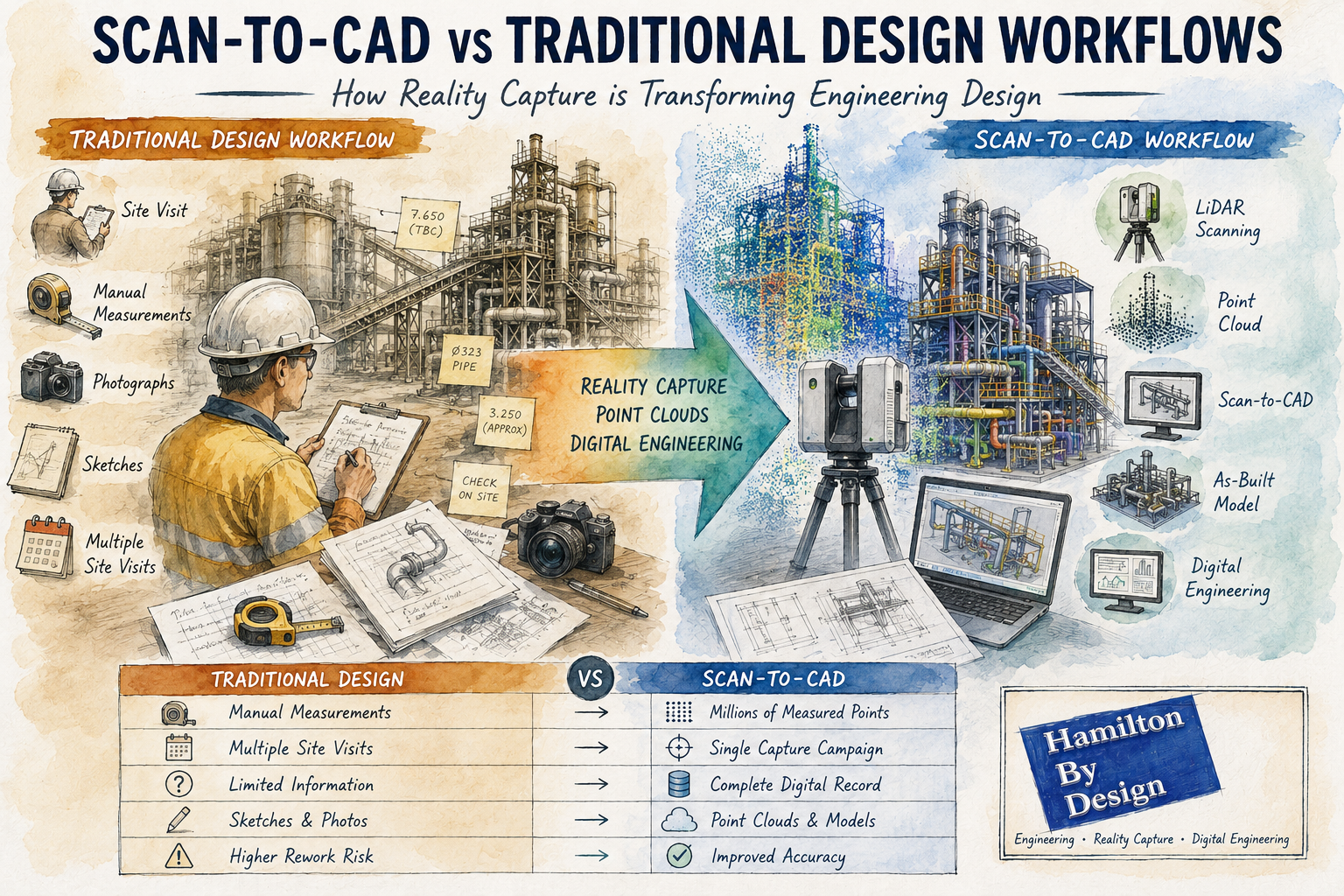
Scan-to-CAD vs Traditional Design Workflows | Which Approach Delivers Better Engineering Outcomes?

Scan-to-CAD vs traditional design workflows infographic showing LiDAR scanning, point cloud modelling, reality capture and digital engineering for industrial plant design and as-built documentation.

Scan-to-CAD vs Traditional Design Workflows: How Reality Capture is Transforming Engineering Design

For decades, engineering and drafting companies have relied on traditional design workflows to create new assets, modify existing facilities and develop construction documentation. These methods typically involve site visits, manual measurements, photographs, sketches and extensive assumptions about existing conditions.

While traditional design processes have successfully delivered countless projects, modern reality capture technologies are changing how engineering data is collected and utilised.

The introduction of terrestrial LiDAR scanning, engineering-grade reality capture and point cloud modelling has given design companies access to highly accurate representations of existing facilities. Rather than starting with assumptions and limited measurements, engineers can now begin with a digital copy of reality.

This approach is commonly known as Scan-to-CAD.

At Hamilton By Design, we have seen first-hand how Scan-to-CAD workflows can improve project accuracy, reduce site visits and provide better information for engineering decision-making. However, traditional design methods still have an important role to play.

The key is understanding where each approach provides the greatest value.


What is a Traditional Design Workflow?

Traditional design workflows generally begin with a site inspection and manual data collection process.

An engineer, designer or draftsperson visits the facility and records information such as:

  • Dimensions
  • Levels
  • Equipment locations
  • Structural arrangements
  • Pipe routing
  • Building layouts
  • Photographs
  • Sketches

The collected information is then used to develop drawings and 3D models.

A typical workflow may include:

  1. Site visit
  2. Manual measurements
  3. Photographic survey
  4. Sketch preparation
  5. CAD model creation
  6. Design development
  7. Drawing production
  8. Construction issue

This process has been the backbone of engineering design for many years.


Challenges with Traditional Design Methods

Although effective, traditional workflows present several challenges.

Limited Data Collection

No matter how experienced the survey team is, it is impossible to measure everything.

Often only dimensions considered important at the time are collected.

If additional information is required later, another site visit may be necessary.

Human Error

Manual measurements introduce opportunities for error.

Common issues include:

  • Incorrect dimensions
  • Missed measurements
  • Recording errors
  • Inconsistent datum references

These errors can propagate throughout the project.

Access Restrictions

Industrial facilities often contain:

  • Confined spaces
  • Elevated structures
  • Operational equipment
  • Hazardous environments

Obtaining measurements in these areas can be difficult and expensive.

Multiple Site Visits

Many projects require repeated visits to verify dimensions and resolve discrepancies.

This increases:

  • Project costs
  • Travel expenses
  • Programme duration

What is Scan-to-CAD?

Scan-to-CAD is the process of using reality capture technologies to create engineering drawings and models.

The workflow begins with a terrestrial LiDAR scan of the facility.

Millions or billions of measured points are captured to create a highly detailed point cloud.

The point cloud then becomes the foundation for:

  • CAD models
  • BIM models
  • General arrangement drawings
  • Structural models
  • Pipework layouts
  • Reverse engineering projects
  • Asset documentation

Rather than manually measuring selected features, Scan-to-CAD captures the entire environment.


How Scan-to-CAD Works

Step 1 โ€“ Reality Capture

A LiDAR scanner records the existing facility.

This may include:

  • Buildings
  • Process plants
  • Pipework
  • Conveyors
  • Tanks
  • Structural steel
  • Mechanical equipment

Step 2 โ€“ Point Cloud Registration

Individual scans are combined into a unified coordinate system.

The result is a complete digital representation of the site.

Step 3 โ€“ Engineering Review

Engineers review the point cloud and determine project requirements.

Step 4 โ€“ CAD Modelling

Relevant assets are modelled from the point cloud.

Outputs may include:

  • 2D drawings
  • 3D CAD models
  • BIM models
  • Fabrication drawings
  • Construction documentation

Step 5 โ€“ Design Development

The design team develops modifications directly against existing conditions.


Comparing Scan-to-CAD and Traditional Design Workflows

Accuracy

Traditional Workflow

Accuracy depends on:

  • Measurement methods
  • Survey coverage
  • Site conditions
  • Human interpretation

Typically, only selected dimensions are recorded.

Scan-to-CAD

Millions of measured points create a detailed digital representation.

Engineering-grade terrestrial LiDAR scanning can provide highly accurate spatial information across entire facilities.

Winner: Scan-to-CAD


Site Time

Traditional Workflow

Complex facilities may require several site visits.

Scan-to-CAD

Most information is captured during a single scanning campaign.

Winner: Scan-to-CAD


Data Availability

Traditional Workflow

Only measured dimensions are available.

Scan-to-CAD

The entire captured environment remains available for future reference.

Winner: Scan-to-CAD


Upfront Cost

Traditional Workflow

Lower initial survey costs.

Scan-to-CAD

Requires specialised scanning equipment and processing.

Winner: Traditional Workflow


Long-Term Value

Traditional Workflow

Information is often project-specific.

Scan-to-CAD

Point clouds become long-term digital assets.

Winner: Scan-to-CAD


Why Design Companies Are Adopting Scan-to-CAD

Increasingly, engineering consultancies and drafting companies are integrating reality capture into their workflows.

Benefits include:

Reduced Rework

Designs can be developed against actual site conditions.

Improved Clash Detection

Existing assets can be modelled accurately.

Better Stakeholder Communication

Point clouds and digital models improve project visualisation.

Enhanced Project Planning

Engineers can assess access and constructability earlier.

Faster Design Iterations

Additional measurements are often available without returning to site.


Applications Across Industries

Mining

Mining facilities contain extensive:

  • Conveyors
  • Chutes
  • Crushers
  • Tanks
  • Pipework

Scan-to-CAD can significantly improve brownfield modification projects.

Manufacturing

Production facilities frequently evolve over time.

Reality capture provides accurate documentation of current conditions.

Water and Wastewater

Pump stations and treatment plants often contain complex mechanical layouts.

Scan-to-CAD improves upgrade planning and documentation.

Commercial Buildings

Architects and engineers can generate accurate as-built documentation.

Energy

Power stations and industrial utilities benefit from detailed digital asset records.


When Traditional Workflows Still Make Sense

Despite the advantages of reality capture, traditional methods remain valuable.

Examples include:

Concept Design

Early-stage feasibility studies may not require detailed site data.

Greenfield Projects

When designing on vacant land, no existing assets exist to scan.

Small Modifications

Minor changes may not justify scanning costs.

Budget-Constrained Projects

Some projects require a lower-cost approach.

The most successful engineering organisations understand that both approaches have their place.


The Rise of AI-Assisted Scan-to-CAD

Artificial Intelligence is introducing new capabilities into reality capture workflows.

Emerging technologies can:

  • Identify pipework
  • Classify equipment
  • Recognise structural steel
  • Generate preliminary BIM models
  • Accelerate modelling workflows

Although engineering verification remains essential, AI-assisted modelling is expected to become increasingly common.


Digital Twins and Future Design Workflows

The future of engineering design is likely to combine:

  • Reality capture
  • Scan-to-CAD
  • Scan-to-BIM
  • Digital twins
  • Artificial intelligence
  • Cloud collaboration

Rather than creating drawings from limited measurements, engineering teams will increasingly work from comprehensive digital representations of existing assets.

This shift has the potential to improve project quality, reduce risk and accelerate project delivery.


How Hamilton By Design Supports Scan-to-CAD Projects

Hamilton By Design provides engineering-led reality capture and Scan-to-CAD services throughout Australia.

Our capabilities include:

  • Terrestrial LiDAR scanning
  • Engineering-grade reality capture
  • Point cloud registration
  • Scan-to-CAD
  • Scan-to-BIM
  • Reverse engineering
  • Mechanical design
  • Structural drafting
  • Asset documentation
  • Digital engineering support

We work across:

  • Mining
  • Manufacturing
  • Infrastructure
  • Energy
  • Commercial buildings
  • Water and wastewater

Our approach combines practical engineering experience with modern reality capture technology to deliver accurate and usable engineering information.


Hamilton By Design logo displayed on a blue tilted rectangle with a grey gradient background

Traditional design workflows have served the engineering industry well for decades and continue to play an important role in many projects.

However, the emergence of Scan-to-CAD workflows has fundamentally changed how existing facilities can be documented and modelled.

By capturing measured reality rather than relying solely on manual measurements, engineering teams gain access to more complete information, improved accuracy and greater flexibility throughout the design process.

For brownfield projects, industrial facilities and complex infrastructure, Scan-to-CAD is increasingly becoming the preferred method for developing accurate engineering deliverables.

Rather than replacing traditional design workflows, reality capture enhances them, providing engineers and designers with a richer foundation from which to make informed decisions.


Frequently Asked Questions (FAQ)

What is Scan-to-CAD?

Scan-to-CAD is the process of converting LiDAR scan data or point clouds into CAD drawings and 3D models. It allows engineers to develop designs using accurate representations of existing assets.

How accurate is Scan-to-CAD?

Accuracy depends on the scanning equipment and workflow used. Engineering-grade terrestrial LiDAR scanning can provide highly accurate spatial information suitable for engineering and drafting applications.

What industries benefit most from Scan-to-CAD?

Mining, manufacturing, infrastructure, energy, commercial buildings, water treatment facilities and industrial processing plants all benefit from Scan-to-CAD workflows.

Is Scan-to-CAD better than traditional surveying?

Both approaches have value. Scan-to-CAD generally provides more comprehensive site information, while traditional surveying may be appropriate for smaller or less complex projects.

Can point clouds be used directly in CAD software?

Yes. Many CAD platforms can reference point cloud data directly, allowing engineers to model against real-world measurements.

What is the difference between Scan-to-CAD and Scan-to-BIM?

Scan-to-CAD focuses on creating engineering drawings and CAD models, while Scan-to-BIM creates Building Information Models containing both geometry and asset information.

Does Scan-to-CAD reduce site visits?

In many cases, yes. Capturing comprehensive scan data can significantly reduce the need for repeat measurement visits.

Can AI automatically create CAD models from point clouds?

AI-assisted modelling tools are becoming increasingly capable, but engineering review and verification remain essential for accurate project outcomes.

What deliverables can be produced from a Scan-to-CAD project?

Deliverables may include point clouds, CAD models, BIM models, fabrication drawings, as-built drawings, general arrangement drawings and digital twin models.

Why choose Hamilton By Design for Scan-to-CAD projects?

Hamilton By Design combines engineering-led reality capture, practical industry experience and advanced digital engineering workflows to deliver accurate and usable engineering information for industrial and infrastructure projects throughout Australia.


Mechanical Engineering | Structural Engineering


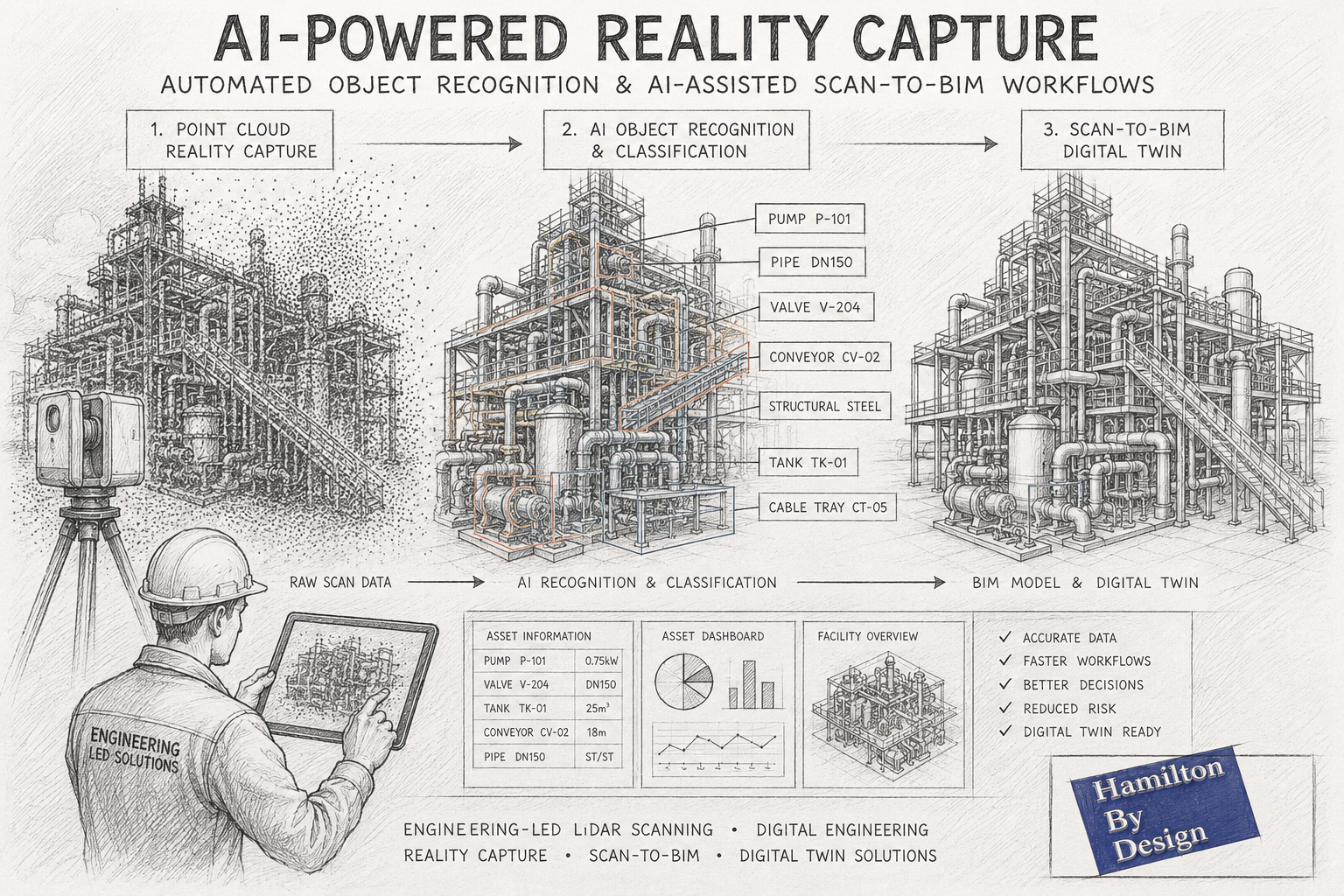
Automated Object Recognition from Point Clouds | AI-Assisted Scan-to-BIM Workflows

AI-assisted Scan-to-BIM workflow illustrated as a pencil sketch showing an industrial processing plant progressing from LiDAR point cloud capture through automated object recognition to a completed BIM digital twin model.

Automated Object Recognition from Point Clouds and AI-Assisted Scan-to-BIM Workflows

How Artificial Intelligence is Transforming Reality Capture and Digital Engineering

The reality capture industry is experiencing a significant transformation. While terrestrial LiDAR scanning, laser scanning and photogrammetry have been widely adopted across mining, manufacturing, construction and infrastructure sectors for many years, the emergence of Artificial Intelligence (AI) is fundamentally changing how point cloud data is processed and utilised.

Traditionally, converting a point cloud into useful engineering information required substantial manual effort. Engineers, designers and BIM technicians would spend hundreds of hours identifying equipment, tracing pipework, modelling structures and generating asset information from raw scan data.

Today, advances in automated object recognition and AI-assisted Scan-to-BIM workflows are reducing these manual processes and opening new opportunities for asset owners, engineering consultants and project teams.

At Hamilton By Design, we continue to monitor and evaluate emerging AI technologies while combining them with engineering-led reality capture workflows to deliver practical outcomes for industrial and infrastructure projects throughout Australia.


What is Automated Object Recognition?

Automated object recognition refers to the ability of software systems to identify and classify objects within a point cloud automatically.

Instead of manually examining millions or billions of points, AI algorithms analyse geometric patterns, spatial relationships, colours and textures to determine what each object represents.

For example, AI systems may automatically identify:

  • Structural steel members
  • Pipework systems
  • Valves
  • Pumps
  • Conveyors
  • Electrical equipment
  • Cable trays
  • Tanks and vessels
  • Building columns
  • Walls and floors
  • Doors and windows
  • Handrails and platforms
  • Mechanical equipment

The objective is to transform unstructured point cloud data into structured engineering information.

This allows project teams to move from raw scan data to usable digital assets much faster than traditional modelling methods.


Understanding Point Clouds

A point cloud is a collection of millions or billions of measured points captured using:

  • Terrestrial LiDAR scanners
  • Mobile mapping systems
  • Drone LiDAR systems
  • Photogrammetry
  • Structured light scanners
  • Handheld scanning systems

Each point contains spatial coordinates representing a physical location in the real world.

Modern scanners can capture:

  • Plant rooms
  • Industrial facilities
  • Processing plants
  • Mining infrastructure
  • Commercial buildings
  • Manufacturing equipment
  • Transport infrastructure
  • Refineries and smelters

The challenge has never been collecting data.

The challenge is turning that data into engineering information.

This is where AI is beginning to provide significant value.


Why Traditional Point Cloud Processing is Time Consuming

Historically, engineering teams have relied on manual modelling workflows.

A typical process might involve:

  1. Capturing scan data
  2. Registering point clouds
  3. Cleaning noise
  4. Importing into CAD or BIM software
  5. Identifying equipment manually
  6. Modelling structures
  7. Modelling pipework
  8. Generating asset information
  9. Producing drawings and deliverables

For complex facilities such as mines, smelters, power stations and manufacturing plants, this work can require hundreds or even thousands of engineering hours.

Although highly accurate, these workflows can be expensive and time intensive.


How AI is Changing Reality Capture

Artificial Intelligence is introducing a new layer of automation.

Modern AI systems can learn from vast datasets of industrial and architectural objects.

Rather than simply displaying a point cloud, AI attempts to understand what the data represents.

Examples include:

Pipe Recognition

AI algorithms can automatically identify cylindrical features and classify them as pipework.

Software can estimate:

  • Pipe centre lines
  • Pipe diameters
  • Connections
  • Elbows
  • Tees
  • Reducers

Structural Steel Recognition

Machine learning systems can identify:

  • Universal beams
  • Columns
  • Channels
  • Angles
  • Bracing members

This can accelerate structural modelling workflows.

Equipment Classification

AI systems are increasingly capable of identifying:

  • Pumps
  • Motors
  • Gearboxes
  • Tanks
  • Vessels
  • Heat exchangers

Although verification is still required, the process can dramatically reduce manual modelling time.

Building Element Recognition

For architectural and BIM applications, AI can automatically detect:

  • Walls
  • Floors
  • Ceilings
  • Doors
  • Windows
  • Roof systems

This enables faster generation of BIM models.


What is AI-Assisted Scan-to-BIM?

Scan-to-BIM is the process of converting reality capture data into Building Information Models.

Traditionally, BIM technicians manually created geometry based on point cloud information.

AI-assisted Scan-to-BIM introduces automated recognition tools that accelerate this process.

The workflow generally follows:

Step 1 โ€“ Reality Capture

A facility is scanned using terrestrial LiDAR technology.

Hamilton By Design typically captures:

  • Industrial facilities
  • Manufacturing plants
  • Mining infrastructure
  • Commercial buildings
  • Mechanical plant rooms
  • Process facilities

Step 2 โ€“ Point Cloud Registration

Individual scans are combined into a single registered dataset.

The result becomes a complete digital representation of the facility.

Step 3 โ€“ AI Object Recognition

Artificial Intelligence analyses the point cloud.

Potential objects are automatically identified and classified.

Step 4 โ€“ BIM Generation

Recognised objects are converted into BIM components.

This may include:

  • Structural members
  • Architectural features
  • Mechanical equipment
  • Pipework
  • Services

Step 5 โ€“ Engineering Verification

Engineers and BIM specialists verify the results.

This remains one of the most important stages.

AI can accelerate workflows, but engineering judgement remains essential.

Step 6 โ€“ Digital Twin Development

The resulting BIM model can support:

  • Asset management
  • Facility upgrades
  • Maintenance planning
  • Shutdown planning
  • Construction sequencing
  • Digital twin initiatives

Applications in Mining and Heavy Industry

Mining operations generate enormous quantities of asset information.

Facilities often contain:

  • Conveyors
  • Crushers
  • Chutes
  • Screens
  • Tanks
  • Pipework
  • Structural steel
  • Electrical infrastructure

AI-assisted recognition has the potential to significantly improve the efficiency of:

Brownfield Modifications

Existing assets can be scanned and classified more rapidly.

Shutdown Planning

Equipment and access areas can be documented more efficiently.

Asset Registers

Physical assets can be linked to digital asset management systems.

Digital Twin Creation

AI can accelerate the development of operational digital twins.

Condition Assessment

Automated recognition may eventually support condition monitoring and defect identification.


Current Limitations of AI Recognition

Despite impressive progress, AI is not yet capable of fully replacing experienced engineers.

Several challenges remain.

Complex Industrial Environments

Industrial facilities contain:

  • Congested pipework
  • Obstructions
  • Corrosion
  • Dust accumulation
  • Non-standard equipment

These conditions can confuse automated systems.

Unique Equipment

Mining and manufacturing plants often contain custom-built equipment.

AI systems trained on generic datasets may struggle to identify these assets accurately.

Data Quality

Recognition performance depends heavily on:

  • Scan quality
  • Resolution
  • Registration accuracy
  • Coverage

Poor quality input data typically produces poor quality output.

Engineering Intent

AI can identify geometry.

Understanding engineering intent remains much more difficult.

An experienced engineer can determine:

  • Why a system was designed a certain way
  • Potential maintenance issues
  • Access requirements
  • Structural concerns
  • Process constraints

This knowledge is difficult to automate.


Why Engineering Expertise Still Matters

At Hamilton By Design, we believe AI should be viewed as an engineering productivity tool rather than a replacement for engineering expertise.

The highest quality outcomes are achieved when:

  • High-quality scan data is captured
  • AI assists with recognition
  • Engineers validate results
  • Designers refine models
  • Project teams apply practical experience

This hybrid approach combines automation with engineering judgement.

For industrial facilities, this remains the most reliable pathway to accurate digital deliverables.


The Future of AI in Reality Capture

Over the next decade we expect to see:

Faster Model Creation

Many routine modelling tasks will become increasingly automated.

Improved Asset Classification

AI systems will recognise a broader range of industrial equipment.

Automated Drawing Generation

Point clouds may eventually generate engineering drawings automatically.

Predictive Asset Management

Digital twins may combine scan data with operational data to predict failures.

Real-Time Facility Updates

Facilities may continuously update digital models as changes occur.

Intelligent Maintenance Planning

AI systems could identify maintenance requirements before failures occur.


How Hamilton By Design Uses Reality Capture Today

Hamilton By Design provides engineering-led reality capture services throughout Australia.

Our services include:

  • Terrestrial LiDAR scanning
  • Engineering-grade reality capture
  • Point cloud registration
  • Scan-to-CAD
  • Scan-to-BIM
  • Reverse engineering
  • Mechanical design
  • Structural modelling
  • Digital engineering support
  • Asset documentation

We work across:

  • Mining
  • Manufacturing
  • Energy
  • Infrastructure
  • Commercial buildings
  • Water and wastewater facilities

Our focus remains on delivering practical engineering outcomes from accurate measured data.

As AI-assisted workflows continue to mature, we expect these technologies to further enhance project efficiency while maintaining the engineering oversight required for complex industrial environments.


Hamilton By Design logo displayed on a blue tilted rectangle with a grey gradient background

Automated object recognition and AI-assisted Scan-to-BIM workflows represent one of the most exciting developments in the reality capture industry.

The ability to automatically identify equipment, classify assets and accelerate BIM creation has the potential to significantly reduce modelling time while improving access to engineering information.

However, successful implementation still depends on high-quality scan data, robust workflows and experienced engineering oversight.

The future of digital engineering is unlikely to be fully manual or fully automated.

Instead, it will combine advanced reality capture technologies, artificial intelligence and practical engineering expertise to create smarter, more efficient project delivery.

For organisations looking to develop accurate digital representations of existing assets, AI-assisted reality capture is rapidly becoming an important part of the engineering toolkit.


Contact Us – Talk to Us

Name
Would you like us to arrange a phone consultation for you?
Address


Mechanical Engineering | Structural Engineering


3D CAD Modelling Australia service banner for Hamilton By Design
Australian Drafting logo featuring bold white text reading "Australian Drafting" centred on a blue rounded rectangle background.
Engineering Governance title graphic featuring bold white text reading "Engineering Governance" centred on a blue rounded rectangle background.
Mechanical, Structural & Pipework Drafting service banner by Hamilton By Design featuring white text on a blue background.
Mechanical engineering services
Blue rounded button with the text โ€œSolidWorks Designโ€ in white.
Finite Element Analysis (FEA) engineering simulation button
3D LiDAR Scanning Darwin for engineering surveys, laser scanning, reality capture and point cloud modelling services
3D LiDAR Scanning Australia engineering services for laser scanning, reality capture, scan-to-CAD, Scan-to-BIM and as-built documentation across Australia
3D LiDAR scanning services on the Central Coast providing engineering-grade laser scanning, point cloud capture, scan-to-CAD modelling and industrial reality capture for infrastructure and industrial projects.
3D LiDAR Scanning Perth for engineering surveys, laser scanning, reality capture and point cloud modelling services
3D LiDAR Scanning Sydney for engineering surveys, laser scanning, reality capture and point cloud modelling services
3D LiDAR Scanning Brisbane for engineering surveys, laser scanning, reality capture and point cloud modelling services
3D LiDAR Scanning Canberra for engineering surveys, laser scanning, reality capture and point cloud modelling services
3D LiDAR Scanning Newcastle for engineering surveys, laser scanning, reality capture and point cloud modelling services
3D LiDAR Scanning Adelaide for engineering surveys, laser scanning, reality capture and point cloud modelling services

SolidWorks Point Cloud to CAD Workflow | From LiDAR Scans to Detailed Engineering Drawings

SolidWorks Workflow for Converting Point Cloud Data into Detailed Engineering Drawings

From Reality Capture to Fabrication Documentation

The rapid adoption of terrestrial LiDAR scanning and engineering-grade reality capture technologies has fundamentally changed the way engineering projects are executed. For decades, engineers, designers and BIM specialists have relied on traditional workflows that begin with conceptual layouts, survey control, architectural envelopes or predefined design models. Today, however, many industrial projects start with something entirely different: a point cloud.

Instead of beginning with assumptions about what exists, engineering teams can now begin with measured reality.

This shift has significant implications for how projects are planned, modelled and documented. It also raises an important discussion regarding the role of Building Information Modelling (BIM), top-down modelling techniques and traditional design workflows when accurate point cloud information is available from the outset.

While BIM remains a powerful methodology, reality capture introduces a different way of thinking that is particularly valuable for brownfield, industrial, mining, manufacturing and infrastructure projects.

The reality is that neither approach is universally better than the other.

As with most engineering decisions, it is often a case of horses for courses.


The Rise of Engineering-Grade Reality Capture

Modern terrestrial LiDAR scanners can capture millions of points every second, producing highly accurate three-dimensional representations of existing facilities.

These systems are now routinely used throughout:

  • Mining operations
  • Mineral processing plants
  • Smelters
  • Power stations
  • Water treatment facilities
  • Manufacturing plants
  • Commercial buildings
  • Hospitals
  • Transport infrastructure
  • Refineries

Unlike traditional survey methods that capture selected points, LiDAR scanning captures entire environments.

The resulting point cloud becomes a digital record of reality.

Engineers can then revisit the site virtually, long after the field work has been completed.

This offers significant advantages including:

  • Reduced site visits
  • Improved safety
  • Faster design development
  • Better clash detection
  • Enhanced stakeholder collaboration
  • Improved asset documentation
  • Accurate retrofit design

For industrial facilities where access may be restricted, hazardous or costly, point cloud data often becomes one of the most valuable project assets available.


Understanding Point Clouds

A point cloud is a collection of millions or billions of measured XYZ coordinates.

Each point represents a location in space.

When combined, these points create a highly detailed representation of physical objects including:

  • Structural steel
  • Pipework
  • Equipment
  • Conveyors
  • Tanks
  • Buildings
  • Mechanical components
  • Electrical services
  • Access systems

Modern scanners may also capture colour information, intensity data and imagery, creating a realistic digital twin of the physical environment.

Unlike traditional CAD models, point clouds contain measured information rather than designed information.

This distinction is important.

A CAD model represents what was intended.

A point cloud represents what actually exists.

For brownfield engineering projects this difference can be substantial.


Why Traditional BIM Workflows Can Struggle

Building Information Modelling originated primarily within the architectural and construction sectors.

The traditional BIM process generally follows a sequence such as:

Concept Design โ†’ Schematic Design โ†’ Detailed Design โ†’ Construction โ†’ Asset Management

The model evolves as the project progresses.

In many BIM workflows the process begins with an architectural envelope or predefined design geometry.

Walls, floors, columns and services are created within a structured modelling environment.

This approach works exceptionally well for:

  • New buildings
  • Greenfield developments
  • Commercial construction
  • Architectural projects
  • Civil infrastructure projects

However, industrial facilities rarely fit neatly into these categories.

A mining plant built over 40 years may contain:

  • Multiple undocumented modifications
  • Legacy equipment
  • Inaccurate drawings
  • Informal field changes
  • Missing records
  • Deformed structures
  • Equipment relocations

In these situations the design model is often less accurate than the physical asset itself.

This creates a challenge.

Traditional BIM workflows frequently assume the model is the primary source of truth.

Reality capture reverses that assumption.

The point cloud becomes the source of truth.

The model simply becomes a representation of measured reality.


Reality-First Engineering

A reality-first workflow begins with data acquisition rather than design assumptions.

The process typically follows:

  1. Site Scanning
  2. Point Cloud Registration
  3. Quality Assurance
  4. Point Cloud Optimisation
  5. Model Development
  6. Engineering Analysis
  7. Drawing Production
  8. Construction Documentation

Instead of asking:

“What should this facility look like?”

The workflow asks:

“What does this facility actually look like?”

This subtle change can significantly improve project outcomes.


SolidWorks and Point Cloud Modelling

SolidWorks has evolved into a powerful platform for working with reality capture data.

While originally developed as a mechanical design system, modern versions provide excellent capabilities for integrating scan data into engineering workflows.

Point clouds can be imported through various formats including:

  • E57
  • LAS
  • XYZ
  • PLY
  • STL
  • OBJ
  • Mesh formats

Depending on project requirements, the workflow may involve:

  • Direct point cloud reference
  • Mesh generation
  • Surface modelling
  • Parametric feature creation
  • Reverse engineering
  • Assembly development

The chosen approach depends on the intended deliverable.


The Importance of Top-Down Modelling

Top-down modelling becomes particularly valuable when working from point cloud data.

Traditional bottom-up modelling involves creating individual components separately before assembling them.

Top-down modelling reverses this process.

The assembly becomes the master model.

Individual components are then developed within the context of the larger system.

For industrial facilities this approach offers significant advantages.


Why Top-Down Modelling Works Well with Point Clouds

A point cloud already contains contextual information.

Pipework exists relative to equipment.

Equipment exists relative to structures.

Structures exist relative to buildings.

Everything already has a defined relationship.

Top-down modelling allows engineers to preserve these relationships.

For example:

A conveyor transfer chute may be modelled directly within the context of:

  • Existing conveyor structure
  • Existing walkways
  • Existing pipework
  • Existing electrical services
  • Existing maintenance access

The design develops within the reality captured environment.

This significantly reduces the risk of clashes.


Skeleton Models and Layout Control

One of the most effective top-down approaches involves the use of skeleton models.

A skeleton model contains:

  • Key reference geometry
  • Design planes
  • Centre lines
  • Control sketches
  • Interface locations

When working from point clouds, the skeleton model can be created directly from measured geometry.

This establishes a reliable framework for the remainder of the design.

Individual components then inherit relationships from the skeleton model.

Benefits include:

  • Improved consistency
  • Faster design changes
  • Better design intent control
  • Reduced assembly errors

Scan-to-CAD Workflow

A typical Scan-to-CAD workflow within SolidWorks may follow the following sequence.

Step 1 โ€“ Site Capture

Engineering-grade LiDAR scanning is completed on site.

Data is collected from multiple scanner positions.

The objective is to capture sufficient coverage while maintaining registration quality.


Step 2 โ€“ Registration

Individual scans are registered into a unified coordinate system.

This produces a complete point cloud.

Quality control is performed to verify registration accuracy.

Typical industrial projects may achieve overall accuracies within several millimetres.


Step 3 โ€“ Point Cloud Cleaning

Noise is removed.

Unwanted objects may be filtered.

Temporary equipment can be excluded.

The objective is to create a usable engineering dataset.


Step 4 โ€“ Import into Modelling Environment

The point cloud is imported into the modelling platform.

At this stage the cloud becomes a digital reference.

The cloud itself is generally not modified.

Instead, engineering geometry is created around it.


Step 5 โ€“ Create Reference Geometry

Reference planes, axes and coordinate systems are established.

These form the foundation of the modelling process.

Top-down methodologies become particularly valuable at this stage.


Step 6 โ€“ Build Parametric Models

Engineering components are modelled using parametric features.

Examples include:

  • Structural steel
  • Tanks
  • Pipework
  • Chutes
  • Platforms
  • Conveyors
  • Ductwork

The resulting model remains editable and fully configurable.


Step 7 โ€“ Validation

The model is compared against the point cloud.

Engineers verify fit, alignment and geometry.

Potential clashes are identified early.


Step 8 โ€“ Drawing Production

Detailed drawings are generated directly from the validated model.

Deliverables may include:

  • General arrangements
  • Fabrication drawings
  • Assembly drawings
  • Pipe spool drawings
  • Structural steel details
  • Installation drawings
  • Bill of materials

Reverse Engineering Using Point Clouds

Reverse engineering is one of the most powerful applications of reality capture.

Many industrial facilities contain components with:

  • Missing drawings
  • Obsolete equipment
  • Unknown suppliers
  • Legacy modifications

Point clouds provide a practical starting point.

Engineers can recreate:

  • Mechanical components
  • Structural systems
  • Pipework networks
  • Fabricated assemblies

The resulting CAD models become valuable engineering assets.


Parametric Models versus Mesh Models

A common mistake is assuming that a mesh model is equivalent to a CAD model.

It is not.

A mesh represents geometry.

A parametric model represents engineering intent.

This distinction is critical.

A parametric SolidWorks model allows:

  • Dimension changes
  • Configuration control
  • Design modifications
  • Manufacturing documentation
  • Finite element analysis

For most engineering applications, converting point clouds into intelligent parametric models provides significantly greater value than simply generating meshes.


Producing Detailed Engineering Drawings

Once a validated model exists, drawing production becomes straightforward.

SolidWorks can automatically generate:

  • Orthographic views
  • Sections
  • Detail views
  • Exploded views
  • Bills of materials
  • Weldment cut lists

This dramatically reduces drafting effort.

Because the drawings originate from the model, consistency is maintained throughout the project.


Brownfield Projects Benefit Most

The reality-first workflow delivers the greatest value in brownfield environments.

These include:

  • Operating mines
  • Smelters
  • Refineries
  • Processing plants
  • Manufacturing facilities
  • Water treatment plants

In these environments accurate existing-condition information is often more valuable than historic drawings.

A point cloud provides a measurable record of the asset as it exists today.


BIM versus Point Cloud Driven Engineering

This discussion is sometimes framed as:

“BIM versus Reality Capture.”

In practice this is the wrong question.

Reality capture and BIM should not be viewed as competing technologies.

They solve different problems.

BIM provides:

  • Information management
  • Design coordination
  • Asset lifecycle management
  • Construction planning
  • Facility management integration

Reality capture provides:

  • Existing-condition verification
  • Accurate geometry
  • Retrofit design support
  • Asset documentation
  • Digital twin creation

The most successful projects often combine both approaches.


A Modern Hybrid Workflow

Increasingly, engineering organisations are adopting a hybrid workflow.

The process becomes:

Reality Capture โ†’ Engineering Model โ†’ BIM Integration

Rather than creating BIM models based on assumptions, the BIM environment is populated using measured reality.

This approach improves confidence throughout the project lifecycle.

The BIM system benefits from more accurate geometry.

The engineering team benefits from reliable site information.

The asset owner benefits from better data quality.

Everybody wins.


The Future of Digital Engineering

The future of engineering is likely to become increasingly reality driven.

Advancements in:

  • LiDAR technology
  • Mobile scanning
  • Drone scanning
  • Artificial Intelligence
  • Automated feature extraction
  • Digital twins

will continue to accelerate the adoption of reality capture workflows.

However, traditional engineering principles remain essential.

Engineers still need to understand:

  • Design intent
  • Structural behaviour
  • Manufacturing processes
  • Construction methods
  • Asset management requirements

Technology provides information.

Engineering provides understanding.


SolidWorks provides an exceptionally capable platform for converting point cloud data into detailed engineering models and fabrication drawings. When combined with top-down modelling methodologies, point clouds become far more than visual references; they become the foundation of the engineering workflow.

Traditional BIM methodologies remain highly effective for greenfield projects and building-centric developments where the design model drives project delivery. However, in brownfield industrial environments the reality often differs from the original design documentation. In these situations, a point cloud frequently becomes the most accurate representation of the asset available.

Rather than viewing BIM and reality capture as competing philosophies, modern engineering teams should recognise the strengths of each approach. BIM excels at information management, coordination and lifecycle planning, while point cloud-driven workflows excel at capturing existing conditions and enabling accurate retrofit design.

Ultimately, the most effective solution is often a hybrid approach that combines the strengths of both. By starting with measured reality, developing intelligent parametric models in SolidWorks and integrating those models into broader BIM environments where appropriate, engineers can reduce risk, improve accuracy and deliver higher quality outcomes.

As digital engineering continues to evolve, the question is no longer whether point clouds should be used. The question is how effectively organisations can transform reality capture data into actionable engineering information that supports design, construction, operation and long-term asset management.

Hamilton By Design logo displayed on a blue tilted rectangle with a grey gradient background

Contact Us – Talk to Us

Name
Would you like us to arrange a phone consultation for you?
Address

Our Clients:

3D CAD Modelling Australia service banner for Hamilton By Design
3D LiDAR scanning and 3D modelling service button โ€” laser scanner capturing a point cloud for engineering and CAD modelling
Mechanical engineering services
3D CAD Modelling Australia service banner for Hamilton By Design
Mechanical, Structural & Pipework Drafting service banner by Hamilton By Design featuring white text on a blue background.
Australian Drafting logo featuring bold white text reading "Australian Drafting" centred on a blue rounded rectangle background.
Blue banner graphic displaying the text "Point Cloud to CAD - Australia" in large white lettering, representing point cloud processing, scan-to-CAD conversion and digital engineering services across Australia.
CHPP Engineering title graphic featuring bold white text reading "CHPP Engineering" centred on a blue rounded rectangle background.
Engineering Governance title graphic featuring bold white text reading "Engineering Governance" centred on a blue rounded rectangle background.
Mechanical engineering services
Australian Drafting logo featuring bold white text reading "Australian Drafting" centred on a blue rounded rectangle background.
3D LiDAR Scanning Hunter & Newcastle banner with white text on a blue background promoting engineering-grade laser scanning services for industrial, mining and infrastructure projects across the Hunter Valley and Newcastle region.
Mechanical Engineering Hunter & Newcastle banner promoting mechanical engineering services for mining, industrial plants, power generation, manufacturing and heavy industry throughout the Hunter Valley and Newcastle region.
Structural Drafting Hunter & Newcastle banner promoting structural drafting services for mining, industrial plants, power generation, manufacturing and infrastructure projects across the Hunter Valley and Newcastle region.
Mechanical Engineering Perth WA banner for Hamilton By Design featuring white text on a blue background.
3D Laser Scanning Perth WA banner for Hamilton By Design with white text on a blue background.
SolidWorks Perth WA banner for Hamilton By Design featuring white text on a blue background.
Fabrication and product design services
Finite Element Analysis (FEA) engineering simulation button
3D LiDAR scanning and 3D modelling service button โ€” laser scanner capturing a point cloud for engineering and CAD modelling
Blue rounded button with the text โ€œSolidWorks Designโ€ in white.
Mechanical drafting services button
Structural drafting services button

Mechanical Engineering | Structural Engineering


LiDAR Scanning Greater Brisbane | Engineering Grade Reality Capture & Scan to CAD

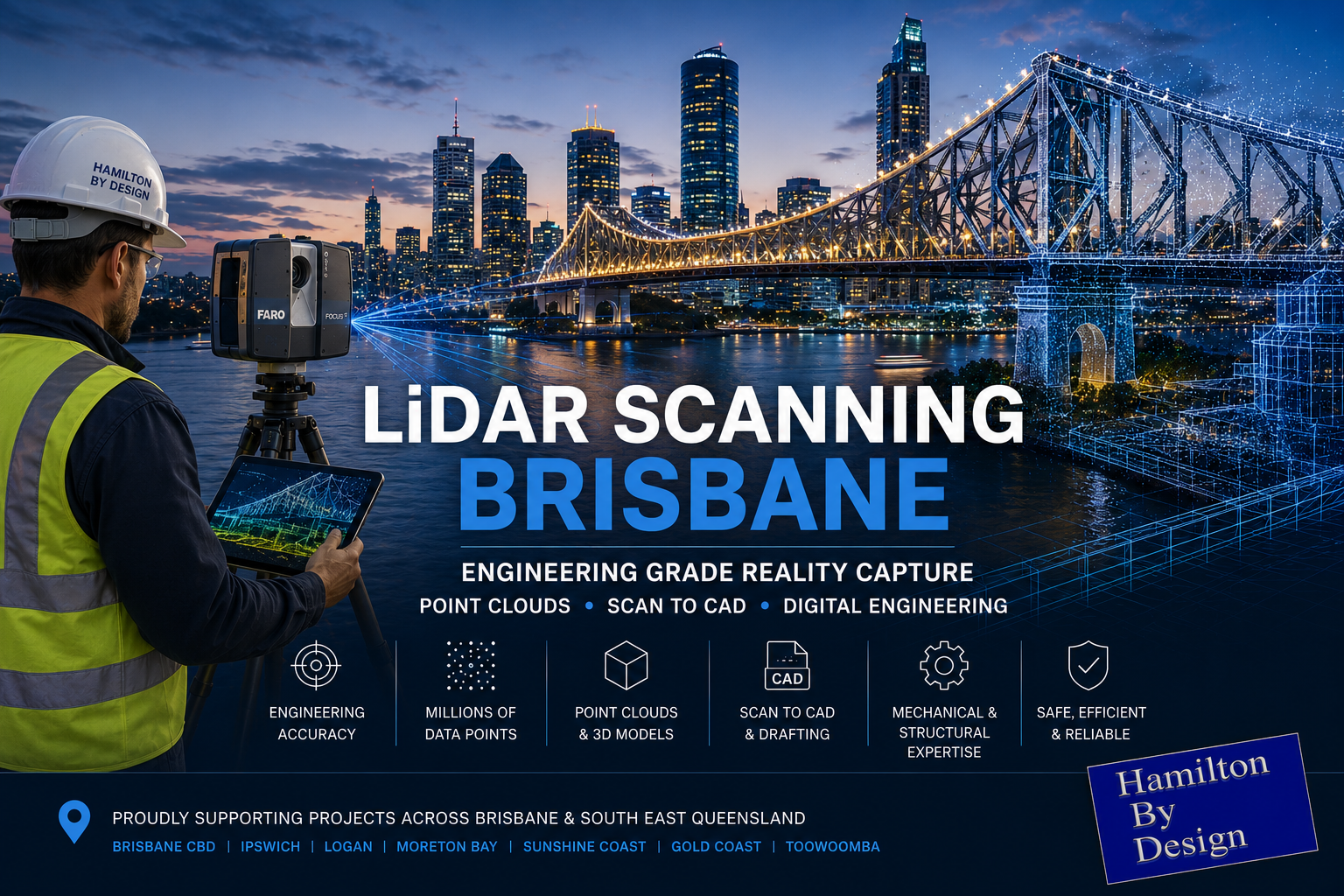
Engineering-grade LiDAR scanning in Brisbane featuring the Story Bridge, Brisbane River and CBD skyline with a terrestrial laser scanner capturing point cloud data for reality capture, Scan to CAD and digital engineering services.

LiDAR Scanning Greater Brisbane โ€“ Engineering Grade Reality Capture, Point Clouds & Scan to CAD Services

Engineering-Led LiDAR Scanning Services Across Greater Brisbane and Southeast Queensland

Blue 3D LiDAR scanner icon on a tripod with scanning waves

Hamilton By Design provides engineering-grade LiDAR scanning Brisbane services for industrial facilities, mining operations, manufacturing plants, infrastructure projects, commercial buildings and complex engineering environments throughout Brisbane and Southeast Queensland.

Unlike many surveying and scanning providers, our team combines practical site experience, mechanical engineering knowledge, drafting expertise and advanced reality capture technology to deliver accurate digital representations of existing assets. This allows clients to confidently plan upgrades, shutdowns, modifications, maintenance projects and future developments using reliable as-built information.

Using terrestrial LiDAR scanners and industry-leading software platforms, Hamilton By Design captures millions of highly accurate measurement points to create comprehensive point cloud datasets, engineering models and digital asset records.

Whether your project requires Scan to CAD services, reverse engineering, structural drafting, mechanical drafting, plant layout verification or digital engineering support, our Brisbane LiDAR scanning services provide the foundation for informed engineering decisions.


What is LiDAR Scanning?

LiDAR (Light Detection and Ranging) is an advanced measurement technology that uses laser pulses to accurately capture the shape, location and geometry of physical assets and environments.

During scanning, the LiDAR instrument records millions of measurements every second, creating a highly detailed digital representation known as a point cloud.

The resulting point cloud provides accurate spatial information that can be used for:

  • Engineering design
  • Mechanical drafting
  • Structural drafting
  • Plant modifications
  • Asset management
  • As-built verification
  • Construction planning
  • Digital twins
  • Building Information Modelling (BIM)
  • Reverse engineering
  • Infrastructure upgrades

LiDAR scanning significantly reduces the need for traditional manual measurement methods while improving safety, accuracy and project efficiency.


Why Choose Engineering-Led LiDAR Scanning?

Many scanning providers focus solely on data collection.

Hamilton By Design takes a different approach.

Our team understands:

  • Mechanical systems
  • Structural systems
  • Pipework layouts
  • Conveyors
  • Chutes and hoppers
  • Processing plants
  • Industrial facilities
  • Mining infrastructure
  • Manufacturing operations
  • Construction environments

This engineering understanding allows us to capture the information that designers, engineers, fabricators and project managers actually need.

Rather than simply delivering a point cloud, we can assist with:

  • Engineering interpretation
  • Design development
  • CAD modelling
  • Fabrication drawings
  • Structural layouts
  • Mechanical modifications
  • Asset documentation

This engineering-first approach helps reduce project risk and improve design outcomes.


LiDAR Scanning Brisbane for Industrial Facilities

Industrial facilities are continually evolving.

Equipment upgrades, plant expansions, shutdown projects and maintenance activities often require accurate information regarding existing infrastructure.

Hamilton By Design supports industrial clients throughout Brisbane by providing:

Existing Plant Capture

Comprehensive scanning of:

  • Process plants
  • Manufacturing facilities
  • Warehouses
  • Distribution centres
  • Water treatment plants
  • Wastewater facilities
  • Power generation assets

Plant Modifications

LiDAR scanning provides engineers with accurate information before:

  • Equipment replacement
  • Conveyor upgrades
  • Pipework modifications
  • Structural alterations
  • Mechanical installations
  • Maintenance shutdowns

Clash Detection

Point clouds allow proposed designs to be checked against existing infrastructure before fabrication and installation.

This helps minimise:

  • Site rework
  • Installation delays
  • Fabrication errors
  • Cost overruns

Mining Industry LiDAR Scanning Brisbane

Hamilton By Design has extensive experience supporting mining and resource sector projects.

LiDAR scanning can be used for:

Conveyor Systems

Capture existing:

  • Conveyors
  • Transfer stations
  • Drives
  • Walkways
  • Access platforms

Supporting:

  • Upgrade projects
  • Belt replacements
  • Structural modifications
  • Capacity improvements

CHPP Facilities

Coal Handling and Preparation Plants require accurate information for:

  • Shutdown planning
  • Asset replacement
  • Structural inspections
  • Equipment upgrades

Processing Plants

We support projects involving:

  • Crushing circuits
  • Screening plants
  • Material handling systems
  • Ore processing facilities
  • Smelters
  • Refineries

Accurate reality capture allows engineering teams to design confidently using reliable site information.


Reality Capture Brisbane

Reality capture is the process of digitally documenting existing environments using advanced scanning technologies.

LiDAR scanning forms the foundation of modern reality capture workflows.

Benefits include:

  • Improved project planning
  • Reduced site visits
  • Better collaboration
  • Enhanced design accuracy
  • Improved safety outcomes
  • Reduced project risk

Reality capture allows project teams to virtually revisit a site at any time without requiring additional travel or site access.

This is particularly valuable for remote locations, operating facilities and shutdown environments.


Point Cloud Scanning Brisbane

A point cloud is a highly detailed digital dataset created during the LiDAR scanning process.

Each point contains precise spatial coordinates representing the physical environment.

Point clouds can be used directly or converted into:

  • CAD models
  • BIM models
  • Engineering drawings
  • Structural models
  • Mechanical layouts
  • Asset management systems

Point cloud technology provides an accurate representation of real-world conditions and eliminates many of the assumptions associated with traditional measurement techniques.


Scan to CAD Brisbane

One of the most common applications of LiDAR scanning is Scan to CAD.

Hamilton By Design converts point cloud data into usable engineering deliverables including:

2D Drawings

  • General arrangements
  • Floor plans
  • Elevations
  • Sections
  • Layout drawings

3D CAD Models

  • Mechanical assemblies
  • Structural steelwork
  • Pipework systems
  • Equipment models
  • Architectural elements

Fabrication Drawings

Accurate fabrication drawings can be developed from captured site information, reducing the likelihood of costly fit-up issues during installation.


Mechanical Engineering Applications

LiDAR scanning provides significant value for mechanical engineering projects.

Applications include:

Equipment Replacement

Capture existing assets before replacement.

Reverse Engineering

Generate CAD models from existing equipment where original drawings are unavailable.

Pipework Design

Accurately model existing piping systems to support:

  • New installations
  • Tie-ins
  • Modifications
  • Upgrades

Material Handling Systems

Support design activities involving:

  • Conveyors
  • Chutes
  • Hoppers
  • Feed systems
  • Transfer stations

Structural Engineering Applications

Structural engineers increasingly rely on LiDAR scanning to obtain accurate site information.

Applications include:

  • Structural steel verification
  • Building assessments
  • Platform design
  • Stair and handrail design
  • Existing structure documentation
  • Construction verification

LiDAR scanning significantly improves design confidence when working within existing facilities.


Construction and Infrastructure Projects

LiDAR scanning is becoming an essential tool across the construction sector.

Applications include:

Existing Conditions Surveys

Capture:

  • Buildings
  • Infrastructure
  • Roads
  • Bridges
  • Industrial facilities

Construction Verification

Verify completed construction against design intent.

Asset Documentation

Create accurate digital records for ongoing maintenance and asset management.

Redevelopment Projects

Accurate scanning provides a reliable basis for refurbishment and expansion projects.


Benefits of LiDAR Scanning

Improved Accuracy

Millions of measurement points are captured to provide highly detailed spatial information.

Enhanced Safety

Reduces the need for personnel to access hazardous areas for manual measurements.

Reduced Site Visits

Project teams can reference captured data without returning to site.

Faster Project Delivery

Accurate information improves engineering efficiency and reduces redesign.

Better Decision Making

Reliable site information allows stakeholders to make informed project decisions.

Reduced Project Risk

Accurate as-built information reduces uncertainty throughout the project lifecycle.


Typical Deliverables

Hamilton By Design can provide:

Point Cloud Deliverables

  • E57
  • RCP
  • RCS
  • LAS

CAD Deliverables

  • DWG
  • DXF
  • STEP
  • SAT
  • Parasolid

Engineering Deliverables

  • General arrangement drawings
  • Mechanical models
  • Structural models
  • Fabrication drawings
  • Layout plans
  • Engineering documentation

Deliverables can be tailored to suit project requirements.


Industries We Support

Hamilton By Design provides LiDAR scanning services across numerous industries including:

Mining

  • Coal
  • Gold
  • Copper
  • Zinc
  • Lead
  • Mineral processing

Manufacturing

  • Food processing
  • FMCG facilities
  • Industrial manufacturing
  • Warehousing

Energy

  • Power stations
  • Renewable energy projects
  • Utilities infrastructure

Water and Wastewater

  • Treatment plants
  • Pump stations
  • Infrastructure upgrades

Commercial and Infrastructure

  • Buildings
  • Transport infrastructure
  • Public facilities
  • Construction projects

Brisbane and South East Queensland Coverage

Hamilton By Design supports projects throughout:

  • Brisbane CBD
  • Eagle Farm
  • Pinkenba
  • Hemmant
  • Rocklea
  • Acacia Ridge
  • Richlands
  • Wacol
  • Darra
  • Ipswich
  • Logan
  • Redcliffe
  • Moreton Bay
  • Caboolture
  • Sunshine Coast
  • Gold Coast
  • Toowoomba

We also regularly support projects throughout Queensland, New South Wales, Western Australia, the Northern Territory and regional Australia.


3D Scanning Brisbane text graphic on a blue background promoting engineering-led laser scanning and reality capture services in Brisbane.
3D LiDAR Scanning for Engineering Projects title graphic featuring bold white text on a blue rounded rectangle background.
Australian Drafting logo featuring bold white text reading "Australian Drafting" centred on a blue rounded rectangle background.

Why Hamilton By Design?

Hamilton By Design combines:

  • Mechanical engineering expertise
  • Practical site experience
  • Advanced LiDAR technology
  • Industrial project knowledge
  • CAD modelling capability
  • Drafting services
  • Engineering design support

Our team understands that successful projects require more than simply capturing data.

We provide engineering-led reality capture services that transform physical assets into accurate digital information that can be used throughout the project lifecycle.

From initial site capture through to engineering design, drafting and asset documentation, Hamilton By Design delivers practical solutions that support safer, more efficient and more successful projects.


Frequently Asked Questions

What is LiDAR scanning?

LiDAR scanning uses laser technology to capture millions of accurate measurements and create a detailed digital representation of an environment.

What accuracy can be achieved?

Accuracy depends on project requirements, scanning methodology and site conditions. Engineering-grade scanning typically provides highly accurate datasets suitable for design and verification purposes.

What is a point cloud?

A point cloud is a digital dataset containing millions of measured points representing physical assets and environments.

Can point clouds be converted into CAD models?

Yes. Point clouds can be converted into 2D drawings, 3D CAD models and engineering deliverables.

Do you provide Scan to CAD services?

Yes. Hamilton By Design regularly converts point cloud data into engineering models, drafting packages and fabrication drawings.

Can scanning be completed during shutdowns?

Yes. LiDAR scanning is commonly used during maintenance shutdowns and plant outages.

What industries do you support?

We support mining, manufacturing, energy, infrastructure, water, wastewater, commercial and industrial sectors.

What areas of Brisbane do you service?

We service Brisbane CBD, Ipswich, Logan, Moreton Bay, Redcliffe, Caboolture, Sunshine Coast, Gold Coast and surrounding regions throughout South East Queensland.

Our Clients
Contact Us – Talk to Us

Name
Would you like us to arrange a phone consultation for you?
Address
Reality Capture Brisbane title graphic with white text on a blue background promoting reality capture, LiDAR scanning and digital engineering services in Brisbane, Queensland.
3D Scanning Brisbane text graphic on a blue background promoting engineering-led laser scanning and reality capture services in Brisbane.

LiDAR Scanning Brisbane title graphic with white text on a blue background promoting terrestrial LiDAR scanning, point cloud capture and reality capture services in Brisbane, Queensland.
SolidWorks Brisbane title graphic with white text on a blue background promoting SolidWorks mechanical design, 3D CAD modelling and engineering drafting services in Brisbane, Queensland.