

Practical engineering for marine facilities, fabrication workshops and industrial plant

Hamilton By Design provides 3D LiDAR scanning and mechanical engineering support in Henderson, Western Australia, helping businesses capture existing equipment, develop CAD models and plan modifications before fabrication begins.
Our approach connects site measurement with mechanical design. Whether you are replacing a pump skid, modifying workshop equipment or planning a new installation within an existing facility, we help turn site conditions into usable engineering information.
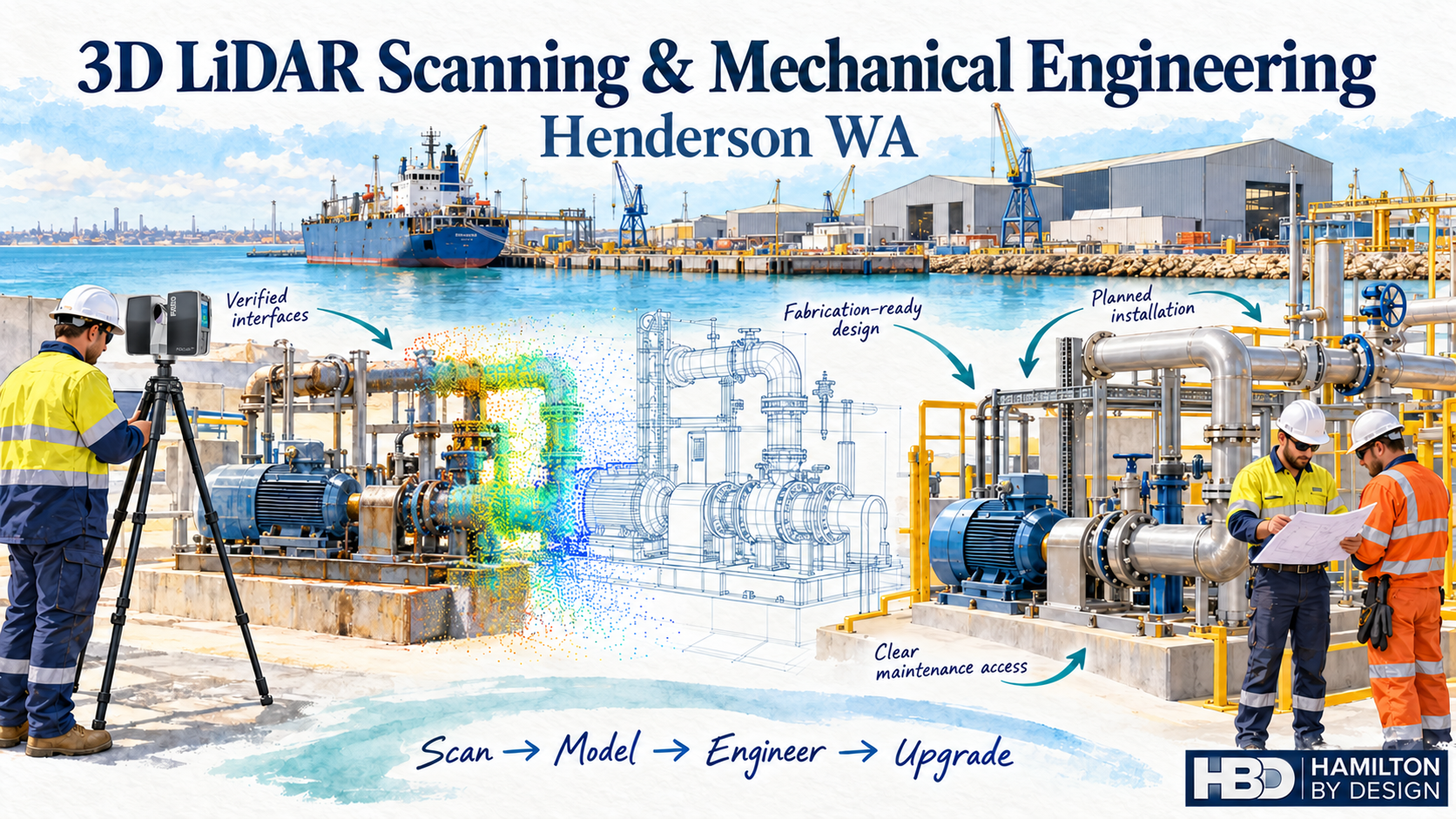
Scan → Model → Engineer → Upgrade
Supporting Henderson’s marine and industrial precinct
Henderson is home to the Australian Marine Complex, a major precinct supporting manufacturing, fabrication, assembly and maintenance for the marine, defence, energy and resources industries. These activities create a strong need for reliable information about existing equipment and installation spaces.
For businesses working in these environments, an equipment upgrade often involves more than designing a new component. The design must also consider surrounding pipework, access routes, maintenance space and connections to existing assets.
Older drawings may not reflect modifications made during years of operation. A bracket may have moved, a pipe route may have changed, or additional equipment may now occupy the intended installation area.
3D LiDAR scanning helps establish what exists before decisions are made about what comes next.
3D LiDAR scanning for existing facilities and equipment
Laser scanning captures visible surfaces as a three-dimensional point cloud. This provides a spatial reference that can be reviewed during layout planning, modelling and design.
For a Henderson project, the scanning scope could include:
- Workshop interiors and machinery layouts.
- Pump installations and mechanical equipment packages.
- Existing pipework routes and connection areas.
- Fabricated assemblies and equipment interfaces.
- Platforms, access areas and maintenance clearances.
- Machinery foundations and surrounding installation space.
- Selected vessel machinery spaces, subject to access and project requirements.
The scan coverage is planned around the engineering task. A replacement equipment package may require detailed capture of a small installation area, while a workshop reconfiguration may require a broader record of the facility.
Capturing the relevant surroundings early helps identify constraints that could otherwise emerge during installation.
Mechanical engineering that uses the scan data
A point cloud becomes more useful when it informs a practical engineering decision.
Hamilton By Design combines LiDAR scanning with mechanical design, CAD modelling and drafting to support equipment modifications, brownfield upgrades and fabrication documentation.
For Henderson businesses, this approach can support:
- Pump skid layouts and equipment integration.
- Mechanical brackets, mounts and fabricated assemblies.
- Conveyor and materials handling modifications.
- Machine guarding and maintenance access improvements.
- Replacement component modelling.
- General arrangement and fabrication drawings.
- Coordination of mechanical equipment with surrounding services.
The aim is to understand both the equipment and its working environment. A component may fit within the available footprint but still obstruct maintenance access, interfere with nearby pipework or be difficult to install.
Considering these issues during design gives the workshop and installation team clearer information before work begins.
Marine equipment upgrades and machinery space planning
Marine refits and equipment replacements can involve confined spaces, complex arrangements and limited installation access.
A new pump, auxiliary unit or mechanical package may need to fit around existing services while retaining access for operation and maintenance.
A scan-informed design review can help assess:
- Available space around the proposed equipment.
- Connections to existing mechanical systems.
- Installation and removal routes.
- Access to serviceable components.
- Interference with surrounding equipment.
- Areas requiring further inspection or measurement.
For example, replacing a pump package could involve scanning the existing installation, modelling the proposed equipment and reviewing the arrangement before preparing modification drawings.
The project scope should identify any vessel-specific design approvals or specialist reviews required.
Scan-to-CAD for fabrication and installation
Scan-to-CAD converts selected information from the point cloud into CAD geometry that can be used for design and documentation.
The level of modelling depends on the project. An equipment layout may need simplified representations of surrounding assets, while a replacement assembly may require detailed geometry at its connection points.
Potential deliverables include:
- Existing-condition CAD models.
- Proposed equipment layouts.
- General arrangement drawings.
- Mechanical fabrication drawings.
- Installation interface details.
- Point cloud datasets for coordination.
- Updated drawings reflecting the agreed scope.
Agreeing the deliverables at the start helps ensure the model contains the information needed by the people designing, fabricating and installing the equipment.
Reverse engineering when drawings are missing
When an existing component has no reliable drawing, reverse engineering can help establish a basis for replacement or modification.
Typical applications include guards, brackets, covers, housings and fabricated mechanical assemblies.
The measurement method must suit the component. Terrestrial LiDAR is useful for larger equipment and its surroundings. Small features, machined fits and tight tolerances may require handheld metrology scanning, direct measurement or additional inspection.
A worn part also needs careful interpretation. Its current shape may differ from the intended design, so reproducing the measured geometry alone may reproduce wear or damage.
The objective is a usable replacement design supported by appropriate measurements.
Plan upgrades before the shutdown begins
For operating facilities, preparation can make a substantial difference to installation planning.
Capturing existing conditions before a shutdown allows the project team to review proposed layouts, identify uncertain interfaces and prepare drawings while the equipment remains available for inspection.
Useful questions include:
- Can the new assembly reach its installation position?
- Is there enough space for tools and fastening?
- Can maintenance personnel access the equipment afterwards?
- Are nearby services likely to interfere?
- Which dimensions need direct verification before fabrication?
Scanning provides a record of accessible, visible surfaces. Hidden connections and obstructed areas should be identified so that additional checks can be planned.
Our project approach
1. Define the engineering task
We establish what is being changed, the required outputs and the critical interfaces.
2. Capture existing conditions
Site scanning and supplementary measurements are planned around access, visibility and the required accuracy.
3. Develop the model and design
Relevant existing geometry is modelled and used to develop the proposed mechanical arrangement.
4. Review the installation
The design is reviewed for fit, access, maintainability and coordination with surrounding equipment.
5. Prepare the agreed documentation
CAD files and drawings are issued to support the agreed fabrication, installation or planning scope.
Frequently asked questions
Can you scan a workshop before new machinery is installed?
Yes. Scanning can provide an existing-condition reference for assessing machinery layouts, service connections, access routes and maintenance space.
Can LiDAR data be used in SolidWorks or AutoCAD workflows?
Yes. Point cloud information can be used as a reference for developing CAD models and drawings. The required file formats and modelling scope should be agreed before work starts.
Do we need to stop operations for scanning?
This depends on the site. Some areas may be captured during normal operations, while moving equipment, restricted access or isolation requirements may require a planned shutdown or controlled access period.
Can scanning guarantee that a fabricated assembly will fit?
Fit depends on the complete measurement, design and fabrication process. Critical interfaces require appropriate verification, particularly where surfaces are hidden or tolerances are tight.
Can you provide mechanical design as well as scanning?
Yes. Hamilton By Design can combine scanning, CAD modelling, mechanical design and drafting within an agreed project scope.
What information should we provide for a quotation?
Provide the site location, photographs, available drawings, equipment details, proposed modifications, access requirements and required delivery date. Identify any critical dimensions or installation constraints.
Discuss your Henderson project
Planning a workshop upgrade, equipment replacement or mechanical modification in Henderson?
Hamilton By Design can help capture existing conditions and develop practical engineering information for your next stage of work.
Send us your photographs, drawings and project requirements to discuss 3D LiDAR scanning and mechanical engineering support in Henderson WA.
[Explore our Perth 3D scanning
3D LiDAR Scanning and Mechanical Engineering Henderson WA
Practical engineering for marine facilities, fabrication workshops and industrial plant
Hamilton By Design provides 3D LiDAR scanning and mechanical engineering support in Henderson, Western Australia, helping businesses capture existing equipment, develop CAD models and plan modifications before fabrication begins.
Our approach connects site measurement with mechanical design. Whether you are replacing a pump skid, modifying workshop equipment or planning a new installation within an existing facility, we help turn site conditions into usable engineering information.
Scan → Model → Engineer → Upgrade
Supporting Henderson’s marine and industrial precinct
Henderson is home to the Australian Marine Complex, a major precinct supporting manufacturing, fabrication, assembly and maintenance for the marine, defence, energy and resources industries. These activities create a strong need for reliable information about existing equipment and installation spaces.
For businesses working in these environments, an equipment upgrade often involves more than designing a new component. The design must also consider surrounding pipework, access routes, maintenance space and connections to existing assets.
Older drawings may not reflect modifications made during years of operation. A bracket may have moved, a pipe route may have changed, or additional equipment may now occupy the intended installation area.
3D LiDAR scanning helps establish what exists before decisions are made about what comes next.
3D LiDAR scanning for existing facilities and equipment
Laser scanning captures visible surfaces as a three-dimensional point cloud. This provides a spatial reference that can be reviewed during layout planning, modelling and design.
For a Henderson project, the scanning scope could include:
- Workshop interiors and machinery layouts.
- Pump installations and mechanical equipment packages.
- Existing pipework routes and connection areas.
- Fabricated assemblies and equipment interfaces.
- Platforms, access areas and maintenance clearances.
- Machinery foundations and surrounding installation space.
- Selected vessel machinery spaces, subject to access and project requirements.
The scan coverage is planned around the engineering task. A replacement equipment package may require detailed capture of a small installation area, while a workshop reconfiguration may require a broader record of the facility.
Capturing the relevant surroundings early helps identify constraints that could otherwise emerge during installation.
Mechanical engineering that uses the scan data
A point cloud becomes more useful when it informs a practical engineering decision.
Hamilton By Design combines LiDAR scanning with mechanical design, CAD modelling and drafting to support equipment modifications, brownfield upgrades and fabrication documentation.
For Henderson businesses, this approach can support:
- Pump skid layouts and equipment integration.
- Mechanical brackets, mounts and fabricated assemblies.
- Conveyor and materials handling modifications.
- Machine guarding and maintenance access improvements.
- Replacement component modelling.
- General arrangement and fabrication drawings.
- Coordination of mechanical equipment with surrounding services.
The aim is to understand both the equipment and its working environment. A component may fit within the available footprint but still obstruct maintenance access, interfere with nearby pipework or be difficult to install.
Considering these issues during design gives the workshop and installation team clearer information before work begins.
Marine equipment upgrades and machinery space planning
Marine refits and equipment replacements can involve confined spaces, complex arrangements and limited installation access.
A new pump, auxiliary unit or mechanical package may need to fit around existing services while retaining access for operation and maintenance.
A scan-informed design review can help assess:
- Available space around the proposed equipment.
- Connections to existing mechanical systems.
- Installation and removal routes.
- Access to serviceable components.
- Interference with surrounding equipment.
- Areas requiring further inspection or measurement.
For example, replacing a pump package could involve scanning the existing installation, modelling the proposed equipment and reviewing the arrangement before preparing modification drawings.
The project scope should identify any vessel-specific design approvals or specialist reviews required.
Scan-to-CAD for fabrication and installation
Scan-to-CAD converts selected information from the point cloud into CAD geometry that can be used for design and documentation.
The level of modelling depends on the project. An equipment layout may need simplified representations of surrounding assets, while a replacement assembly may require detailed geometry at its connection points.
Potential deliverables include:
- Existing-condition CAD models.
- Proposed equipment layouts.
- General arrangement drawings.
- Mechanical fabrication drawings.
- Installation interface details.
- Point cloud datasets for coordination.
- Updated drawings reflecting the agreed scope.
Agreeing the deliverables at the start helps ensure the model contains the information needed by the people designing, fabricating and installing the equipment.
Reverse engineering when drawings are missing
When an existing component has no reliable drawing, reverse engineering can help establish a basis for replacement or modification.
Typical applications include guards, brackets, covers, housings and fabricated mechanical assemblies.
The measurement method must suit the component. Terrestrial LiDAR is useful for larger equipment and its surroundings. Small features, machined fits and tight tolerances may require handheld metrology scanning, direct measurement or additional inspection.
A worn part also needs careful interpretation. Its current shape may differ from the intended design, so reproducing the measured geometry alone may reproduce wear or damage.
The objective is a usable replacement design supported by appropriate measurements.
Plan upgrades before the shutdown begins
For operating facilities, preparation can make a substantial difference to installation planning.
Capturing existing conditions before a shutdown allows the project team to review proposed layouts, identify uncertain interfaces and prepare drawings while the equipment remains available for inspection.
Useful questions include:
- Can the new assembly reach its installation position?
- Is there enough space for tools and fastening?
- Can maintenance personnel access the equipment afterwards?
- Are nearby services likely to interfere?
- Which dimensions need direct verification before fabrication?
Scanning provides a record of accessible, visible surfaces. Hidden connections and obstructed areas should be identified so that additional checks can be planned.
Our project approach
1. Define the engineering task
We establish what is being changed, the required outputs and the critical interfaces.
2. Capture existing conditions
Site scanning and supplementary measurements are planned around access, visibility and the required accuracy.
3. Develop the model and design
Relevant existing geometry is modelled and used to develop the proposed mechanical arrangement.
4. Review the installation
The design is reviewed for fit, access, maintainability and coordination with surrounding equipment.
5. Prepare the agreed documentation
CAD files and drawings are issued to support the agreed fabrication, installation or planning scope.
Frequently asked questions
Can you scan a workshop before new machinery is installed?
Yes. Scanning can provide an existing-condition reference for assessing machinery layouts, service connections, access routes and maintenance space.
Can LiDAR data be used in SolidWorks or AutoCAD workflows?
Yes. Point cloud information can be used as a reference for developing CAD models and drawings. The required file formats and modelling scope should be agreed before work starts.
Do we need to stop operations for scanning?
This depends on the site. Some areas may be captured during normal operations, while moving equipment, restricted access or isolation requirements may require a planned shutdown or controlled access period.
Can scanning guarantee that a fabricated assembly will fit?
Fit depends on the complete measurement, design and fabrication process. Critical interfaces require appropriate verification, particularly where surfaces are hidden or tolerances are tight.
Can you provide mechanical design as well as scanning?
Yes. Hamilton By Design can combine scanning, CAD modelling, mechanical design and drafting within an agreed project scope.
What information should we provide for a quotation?
Provide the site location, photographs, available drawings, equipment details, proposed modifications, access requirements and required delivery date. Identify any critical dimensions or installation constraints.
Discuss your Henderson project
Planning a workshop upgrade, equipment replacement or mechanical modification in Henderson?
Hamilton By Design can help capture existing conditions and develop practical engineering information for your next stage of work.
Send us your photographs, drawings and project requirements to discuss 3D LiDAR scanning and mechanical engineering support in Henderson WA.
Contact Us – Talk To Us
Our clients:















Related Engineering and 3D Scanning Services
Explore services supporting Henderson marine, fabrication and industrial projects, from existing-condition capture to CAD modelling and engineering documentation.
3D Scanning and Mechanical Engineering Kwinana
Explore scanning and engineering support for the nearby Kwinana industrial region. Capture existing plant geometry to inform equipment modifications and upgrade planning.
Explore Kwinana services →3D LiDAR Scanning in Perth and Western Australia
Document accessible existing conditions using terrestrial LiDAR. Registered point clouds support layout review, design coordination and asset documentation.
Explore Perth LiDAR scanning →Scan to CAD Perth
Convert captured site geometry into selected CAD models and drawings. Define the deliverables needed for design, modification and installation planning.
Explore Scan to CAD services →Structural Drafting Perth
Explore drafting services for steelwork and industrial infrastructure. Clear drawings help communicate geometry, interfaces and fabrication requirements.
Explore Perth drafting services →Shiploader 3D Scanning Perth
Capture existing shiploader and port infrastructure geometry. Scan data supports reviewing access, equipment interfaces and proposed modifications.
Explore shiploader scanning →Reverse Engineering Industrial Equipment
Develop useful engineering information from existing equipment when drawings are incomplete or unavailable. Scanning supports geometry capture for replacement and modification projects.
Explore equipment reverse engineering →SolidWorks Mechanical Design Services
Develop mechanical CAD models for equipment, assemblies and proposed upgrades. Modelling supports design review and preparation of agreed engineering documentation.
Explore SolidWorks design services →Engineering and 3D Scanning Services Perth WA
Explore Hamilton By Design services across Perth and Western Australia, including support for Henderson, Kwinana and regional industrial projects.
Explore Perth engineering services →