


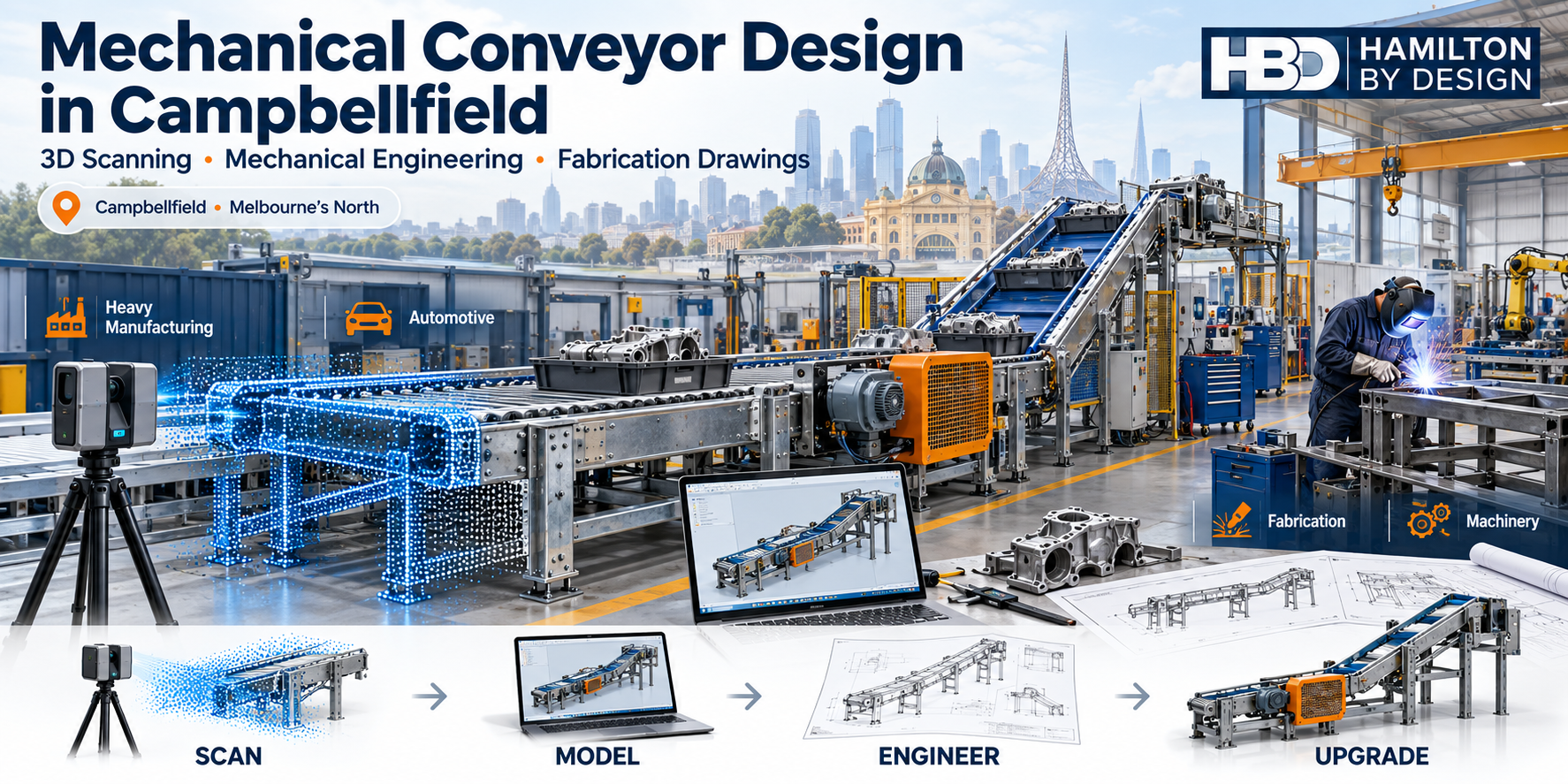
Conveyor engineering for heavy manufacturing, automotive, fabrication and machinery

Hamilton By Design provides mechanical conveyor design in Campbellfield, helping manufacturers, fabricators and machinery businesses plan new installations, modify existing equipment and improve material handling.
A conveyor needs to do more than move a product from one point to another. It must suit the material, fit the available space, connect with surrounding machinery and allow practical access for operation and maintenance.
We bring together mechanical engineering, 3D LiDAR scanning, SolidWorks modelling and fabrication drawings to develop conveyor designs around those requirements.
Whether you are adding production equipment, replacing an ageing conveyor or changing your factory layout, our approach follows a connected process:
Scan → Model → Engineer → Upgrade
Practical conveyor design built on engineering experience
Hamilton By Design’s principal mechanical engineer, Anthony Hamilton, brings approximately 30 years of experience working with conveyors and materials handling equipment.
That experience supports a practical approach to design: understand the operating requirement, check the interfaces and develop documentation that fabricators and installation teams can use.
For Campbellfield businesses, conveyor projects may involve:
- Moving manufactured components between workstations.
- Feeding or discharging production machinery.
- Handling fabricated assemblies and heavy parts.
- Transferring products to inspection, packing or dispatch.
- Collecting offcuts, scrap or process waste.
- Modifying conveyors to accommodate new machinery.
- Replacing worn components or unsupported equipment.
The design scope is developed around your process, site conditions and project priorities.
Conveyor design for Campbellfield’s industrial businesses
Heavy manufacturing
Heavy manufacturing applications require careful consideration of product weight, loading conditions, duty cycle and the working environment.
We can assist with conveyor frames, equipment supports, transfer arrangements and mechanical interfaces. Design considerations may include concentrated loads, impact during loading, uneven weight distribution and access for replacing wear components.
For an existing installation, we also consider how the proposed changes affect nearby equipment and supporting arrangements.
Automotive and component manufacturing
Automotive and component manufacturing applications often depend on controlled movement between machining, assembly, inspection and packing operations.
A conveyor may need to accommodate different component sizes, support a carrier or fixture, or transfer products at a defined working height.
Hamilton By Design can develop the mechanical layout and interface details, coordinating with machinery suppliers and electrical or automation specialists where those disciplines form part of the project.
Fabrication workshops
Fabrication workshops need material handling arrangements that suit their products and available floor space.
Applications may include roller conveyors beside cutting equipment, transfer tables between work areas, or handling arrangements for fabricated components.
We consider loading methods, forklift movements, crane access and the space required around the equipment. The aim is to develop a layout that supports production while retaining practical access through the workshop.
Machinery builders and equipment upgrades
For machinery builders, the conveyor is often one part of a larger system.
We can assist with conveyor infeed and discharge arrangements, mounting interfaces, transition sections, guarding and maintenance clearances.
Where existing machinery is being relocated or upgraded, capturing the surrounding geometry early helps establish how the new arrangement will fit.
Capture the existing factory before designing the upgrade
Older drawings may no longer reflect the equipment on site. Conveyors may have been extended, machinery relocated or services installed across a proposed route.
3D LiDAR scanning provides a measured reference for the visible site geometry, helping establish the relationship between conveyors, machinery, columns, platforms and surrounding services.
The scan data can support:
- Factory and workshop layout planning.
- Conveyor route and elevation development.
- Identification of potential clashes.
- Connection points with existing equipment.
- Access and maintenance reviews.
- Planning for prefabricated assemblies.
Scan coverage, accuracy requirements and critical dimensions are agreed for the project. Machined fits, bolt-hole positions and other close-tolerance interfaces may require additional measurement or verification.
This helps ensure the design uses measurement methods appropriate to each feature.
New conveyor layouts and existing conveyor modifications
A conveyor project does not always require a complete replacement.
Sometimes the most useful improvement is a revised transfer point, a new discharge arrangement or a change to the equipment layout.
Hamilton By Design can assist with:
- Conveyor extensions and route changes.
- Revised infeed and discharge heights.
- Transfer chutes and transition sections.
- Conveyor frames and mounting brackets.
- Guarding and removable access panels.
- Wear liners and replaceable components.
- Interfaces with bins, hoppers and production machinery.
Before developing a modification, we review the operating problem and the existing arrangement. This helps establish whether the issue relates to geometry, product handling, wear, access or another part of the process.
For bulk material applications, learn more about our chute, hopper and materials handling design services.
Reverse engineering conveyor components
When drawings are missing or equipment has become obsolete, reverse engineering can provide a basis for replacement design.
Depending on the project, this may include:
- Conveyor brackets and mounting assemblies.
- Guards, covers and enclosures.
- Transfer chute bodies.
- Roller mounting arrangements.
- Frames and equipment interfaces.
- Worn or modified mechanical components.
We combine suitable measurement methods with CAD modelling and engineering review to establish the replacement requirements.
A worn component should not automatically be reproduced exactly as measured. Wear, deformation and previous repairs need to be considered when deciding the intended replacement geometry.
Read more about reverse engineering and 3D scanning in Melbourne.
SolidWorks models and fabrication drawings
A clear 3D model helps the project team review the conveyor arrangement before fabrication begins.
Hamilton By Design uses SolidWorks and AutoCAD to develop models and drawings appropriate to the agreed scope.
Deliverables can include:
- Conveyor arrangement models.
- General arrangement drawings.
- Fabrication and assembly drawings.
- Sheet-metal and guard details.
- Chute and liner layouts.
- Bills of materials.
- Equipment interface details.
- Installation reference dimensions.
Models can also help operators and maintenance personnel review working clearances, removal paths and access to serviceable components.
Where scan data forms part of the project, our 3D scanning for fabrication in Melbourne service connects site capture with modelling and drawing preparation.
Consider maintenance and guarding from the start
Maintenance access is best considered while the conveyor layout is being developed.
A design review may examine access to bearings, drives and take-up arrangements, along with the space needed to remove guards or replace components.
Other considerations include:
- Potential nip, crush and entanglement points.
- Cleaning and inspection access.
- Guard attachment and removal.
- Product accumulation and spillage.
- Isolation requirements.
- Interfaces with walkways and workstations.
The applicable safety requirements and any specialist assessment are established for the project. Electrical controls, emergency stops and safety control systems require coordination with the relevant specialists.
Our conveyor design process
1. Define the operating requirement
We begin with the material or product being handled, required throughput, loading method, operating conditions and the problem you want to solve.
For an upgrade, photographs, existing drawings and feedback from operators are useful starting points.
2. Capture and verify site conditions
Where required, we scan the installation and check critical interfaces. This establishes the available space and the connection requirements.
3. Develop the concept
We prepare the proposed conveyor arrangement and review its relationship with production machinery, access routes and surrounding equipment.
4. Complete the mechanical design
The agreed concept is developed into detailed models, calculations and component arrangements appropriate to the scope. Specialist inputs are coordinated where required.
5. Prepare the drawing package
Drawings and supporting information are prepared for review and fabrication, with revisions clearly identified.
6. Support fabrication and installation
We can assist with technical queries, interface clarification and agreed drawing updates during fabrication and installation.
Supporting Campbellfield conveyor projects
Hamilton By Design supports Campbellfield businesses planning new production equipment, factory changes and conveyor upgrades.
We work with asset owners, maintenance teams, machinery suppliers and fabricators to connect the operating requirement with a practical mechanical design.
Our broader mechanical engineering services in Melbourne can support related equipment modifications and plant integration.
Frequently asked questions
Can you modify an existing conveyor?
Yes. We can assess the existing arrangement and develop a design for extensions, transfer changes, guarding, component replacement or revised machinery interfaces. The scope depends on the condition and requirements of the installation.
Do you need existing conveyor drawings?
Existing drawings are helpful, but they are not always available. Site scanning, direct measurement and reverse engineering can help establish the information needed for design.
Can you design around our current factory layout?
Yes. Site measurements or 3D scanning can provide a reference for developing the conveyor arrangement around existing machinery and visible site constraints.
Do you provide fabrication drawings?
Fabrication drawings can form part of the agreed scope, together with general arrangements, assembly details and bills of materials.
Can you work with our fabricator or machinery supplier?
Yes. We can coordinate mechanical interfaces and drawing requirements with your nominated suppliers and installation team.
What information do you need for a quote?
Useful information includes photographs, existing drawings, product dimensions and weights, required throughput, proposed layout changes and your delivery timeframe.
Discuss your Campbellfield conveyor project
Are you planning a conveyor installation, machinery upgrade or factory layout change?
Hamilton By Design can help you establish the site conditions, develop the mechanical arrangement and prepare the documentation needed to move the project forward.
Send us your photographs, available drawings and a brief description of the work required.
Contact Hamilton By Design to discuss mechanical conveyor design in Campbellfield.

Contact Us – Talk To Us
Our clients:























Related Engineering Services for Campbellfield Conveyor Projects
Explore Hamilton By Design services supporting conveyor upgrades, manufacturing equipment, factory layouts and fabrication projects in Campbellfield and across Melbourne.
Mechanical Engineering Melbourne
Develop mechanical designs for equipment modifications and plant upgrades, with consideration for machinery interfaces, maintenance access and installation.
Explore mechanical engineering →3D Laser Scanning Melbourne
Capture existing factory geometry to support conveyor routes, equipment positioning and layout reviews before developing proposed modifications.
Explore Melbourne laser scanning →SolidWorks Melbourne
Develop 3D mechanical models and workshop drawings for conveyor assemblies, frames, guards and equipment interfaces.
Explore SolidWorks modelling →Reverse Engineering 3D Scanning Melbourne
Reconstruct engineering information for worn, modified or obsolete conveyor components when original drawings are missing or incomplete.
Explore Melbourne reverse engineering →3D Scanning for Fabrication Melbourne
Capture surrounding equipment and connection geometry to support fit-up reviews for replacement guards, chutes and mechanical assemblies.
Explore fabrication scanning →Materials Handling, Chute & Hopper Design
Develop bulk material transfer arrangements with consideration for chute geometry, wear protection, lining layouts, dust control and maintenance access.
Explore materials handling design →Point Cloud to AutoCAD
Convert registered scan data into CAD drawings to document existing layouts and support conveyor planning, equipment changes and project coordination.
Explore point cloud to AutoCAD →Australian Design & Drafting Services
Prepare CAD models and technical drawings to support manufacturing, mechanical equipment replacement and fabrication within the agreed project scope.
Explore design and drafting →