


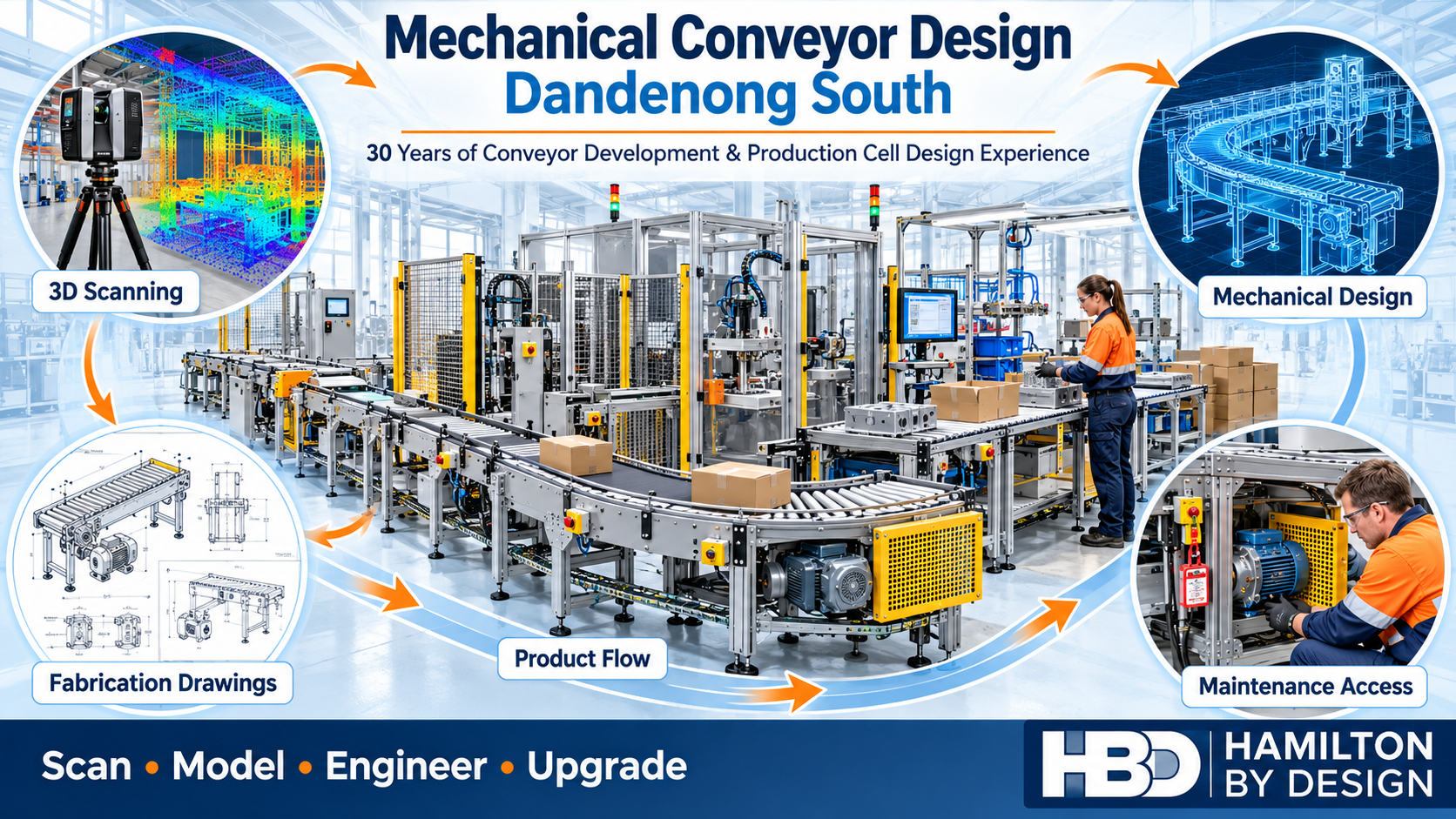
30 Years of Experience Developing Conveyors for Production Cells
Hamilton By Design provides mechanical conveyor design in Dandenong South for manufacturers planning new production cells, equipment integration and conveyor upgrades. Our principal brings 30 years of experience developing and designing conveyors for production cells, supported by 3D scanning, SolidWorks modelling and fabrication drawings.
For 30 years, the principal at Hamilton By Design has worked on the development and design of conveyors for production cells. That experience shapes a practical approach to moving products between machines, workstations and process stages.
A successful conveyor design starts with understanding your production requirements. What needs to move? How quickly? In what orientation? How will operators interact with the equipment, and how will maintenance staff access it?
By combining mechanical design, 3D modelling, LiDAR scanning and engineering drawings, Hamilton By Design helps businesses develop conveyor arrangements that suit their products, processes and available factory space.
Conveyor Design That Fits Your Production Process
Conveyors connect individual machines into a working production system. Their performance depends on how well they integrate with the equipment upstream and downstream.
A conveyor may need to receive components from a machine, present products to an operator, feed a packaging station or transfer completed assemblies to the next process. Each application has different requirements for speed, spacing, loading and product handling.
Our design process considers:
- Product dimensions, weight and orientation.
- Required throughput and operating duty.
- Conveyor length, width and working height.
- Transfer points between conveyors and machines.
- Available floor space and surrounding equipment.
- Operator access and manual handling.
- Cleaning, inspection and maintenance requirements.
- Fabrication, assembly and installation constraints.
The aim is to develop a conveyor arrangement that supports the whole production cell.
New Conveyors and Existing Conveyor Modifications
Hamilton By Design can support new conveyor concepts and targeted modifications to existing systems.
Depending on the application, the mechanical design scope may include belt conveyors, roller conveyors, gravity transfers, product guides, support frames and machine interfaces.
For an existing production line, modifications might involve:
- Extending or shortening a conveyor.
- Changing the conveyor height or direction.
- Connecting new machinery to an existing line.
- Modifying product guides or transfer arrangements.
- Replacing deteriorated frames and brackets.
- Improving maintenance access.
- Developing guarding and access arrangements.
- Updating drawings to reflect the equipment installed.
Sometimes a targeted modification provides the improvement a business needs. We begin by understanding the issue and assessing the existing arrangement before developing the design scope.
Integrating Conveyors into Production Cells
Production-cell conveyor design requires attention to the interaction between people, products and machinery.
For example, installing a faster conveyor will not necessarily increase output if the next machine cannot accept products at that rate. Similarly, a compact layout may save floor space while making cleaning or maintenance difficult.
Hamilton By Design considers the proposed conveyor within the wider production process, including:
Product Flow
We assess how products enter, travel through and leave the conveyor. Product stability, spacing and transfer geometry can influence whether the arrangement operates smoothly.
Machine Interfaces
Conveyor heights, entry points and discharge positions need to coordinate with the equipment they serve. Mechanical interfaces should be established early so that brackets, guides and transition details can be developed around agreed dimensions.
Operator Interaction
Loading, unloading, inspection and assembly tasks influence conveyor positioning. The layout should account for how operators carry out their work and move through the production area.
Maintenance Access
Bearings, rollers, drives and adjustment points need suitable access. Considering component removal and maintenance tasks during design helps avoid difficult arrangements after installation.
Electrical controls, sensors and automation interfaces can be coordinated with the client’s nominated electrical or automation specialists.
3D Scanning Before Conveyor Upgrades
When a new conveyor must fit into an existing factory, reliable information about the surrounding equipment is valuable.
Older drawings may not show machinery relocations, additional services or previous modifications. Measuring only the proposed conveyor footprint can also miss obstructions above or beside it.
Hamilton By Design’s 3D laser scanning services can capture visible existing conditions to support layout planning and mechanical design.
A scan can help establish:
- Existing conveyor routes and elevations.
- Machine positions and external geometry.
- Columns, walls and nearby services.
- Available space for new equipment.
- Access routes and installation constraints.
- Potential clashes with surrounding plant.
Capturing the factory before finalising a layout allows proposed equipment to be assessed against the existing environment.
Where close-tolerance interfaces are required, critical dimensions can be identified for separate verification. This is particularly relevant to mounting holes, shafts, bearings and machined connections.
3D Modelling for Conveyor Layouts
A coordinated 3D model makes the proposed conveyor arrangement easier to review before fabrication begins.
Hamilton By Design uses SolidWorks and CAD tools to develop mechanical assemblies and communicate the relationship between conveyors, machines, support frames and surrounding plant.
Models can support reviews of:
- Overall conveyor geometry.
- Product entry and discharge positions.
- Frame and support arrangements.
- Drive locations and component access.
- Guarding envelopes.
- Installation and assembly space.
- Interfaces with existing equipment.
Production staff, maintenance personnel and fabricators can review the same arrangement and identify practical issues while changes are still straightforward to make.
For businesses in Dandenong South planning a production-cell upgrade, this provides an opportunity to resolve layout questions before committing to fabrication.
Mechanical Design and Fabrication Drawings
Once the arrangement is agreed, the design can progress into drawings and documentation appropriate to the project.
Our mechanical drafting services can support the manufacture, assembly and installation of new or modified conveyor equipment.
Depending on the agreed scope, deliverables may include:
- General arrangement drawings.
- Conveyor assembly drawings.
- Frame and bracket fabrication details.
- Sheet-metal and product-guide details.
- Component drawings.
- Bills of materials.
- DXF cutting profiles.
- STEP files for supplier coordination.
- Installation and interface drawings.
The documentation package is established around the needs of the client, fabricator and installation team.
Designing for Maintenance and Practical Operation
A conveyor should be assessed over its working life, including the tasks needed to keep it operating.
During design, we consider questions such as:
- Can the belt or rollers be replaced without dismantling surrounding equipment?
- Are adjustment points accessible?
- Can debris be removed from beneath the conveyor?
- Is there space to inspect and maintain the drive?
- Can guards be removed and reinstated for authorised maintenance?
- Are wear components practical to source and replace?
These decisions affect maintenance effort, downtime and the usefulness of the final installation.
Machinery hazards and guarding requirements should also be considered during design. Conveyor safety depends on the complete arrangement, including access, controls, operating procedures and maintenance tasks.
A Practical Process from Concept to Installation Support
Hamilton By Design’s mechanical engineering consulting can be tailored to a focused conveyor modification or a broader production-cell project.
1. Define the Requirement
We discuss the product, production target, existing problems, available space and project timing.
2. Establish Existing Conditions
Relevant drawings, measurements and site information are reviewed. Where useful, 3D scanning captures the surrounding plant.
3. Develop the Concept
Proposed layouts and mechanical arrangements are developed for review with the people who operate and maintain the equipment.
4. Complete the Detailed Design
The agreed concept progresses into component selection, mechanical details and the required design checks.
5. Prepare the Documentation
Models, drawings and supporting information are prepared for the agreed fabrication and installation scope.
6. Support Fabrication and Installation
Where included, we assist with technical queries and review changes that arise during manufacture or installation.
Frequently Asked Questions
Can Hamilton By Design modify an existing conveyor?
Yes. We can assess the existing arrangement and develop mechanical modifications to suit a new machine, revised product flow or changed production requirement.
Do we need a 3D scan for every conveyor project?
No. A straightforward conveyor may be designed using verified measurements and suitable drawings. Scanning is particularly useful where the factory is congested, records are incomplete or several equipment interfaces need coordination.
Can you design a conveyor around our available factory space?
Yes. Available space, equipment positions, access and maintenance requirements can be incorporated into the layout process. Providing information early helps establish the constraints before detailed design begins.
Can you provide drawings for our preferred fabricator?
Yes. The drawing package can be developed around the agreed fabrication scope and your fabricator’s requirements.
Can you assist before we purchase new machinery?
Yes. Early layout planning can help establish conveyor interfaces, working heights, access requirements and available installation space before machinery positions are finalised.
Discuss Your Conveyor Project in Dandenong South
Are you planning a new production cell, adding machinery or modifying an existing conveyor?
Hamilton By Design brings together 30 years of conveyor development and design experience, mechanical engineering, 3D scanning, CAD modelling and fabrication documentation.
Send us your existing drawings, photographs or a description of the production issue. Include the product being handled, your required throughput and any installation deadline so we can discuss a suitable scope.
Contact Hamilton By Design to discuss mechanical conveyor design in Dandenong South.

Contact Us – Talk To Us
Our clients:

























Related Services for Conveyor and Production Cell Projects
Explore Hamilton By Design services that support conveyor design, factory upgrades and equipment integration in Dandenong South.
Mechanical Engineering Consulting
Develop practical mechanical designs for conveyor modifications, equipment interfaces and plant upgrades, with attention to fabrication, installation and maintenance.
Explore mechanical engineering services →3D Laser Scanning
Capture existing machinery, conveyors and surrounding factory geometry to support layout planning and identify spatial constraints before detailed design.
Explore 3D laser scanning →SolidWorks 3D Modelling
Visualise conveyor assemblies, support frames and machine interfaces in 3D, helping project teams review equipment arrangements before manufacture.
Explore SolidWorks modelling →Mechanical Drafting
Turn agreed conveyor designs into general arrangements, component details and fabrication drawings that communicate how equipment is built and assembled.
Explore mechanical drafting →Fabrication & Product Design
Develop fabricated components and equipment details with practical consideration of materials, manufacturing methods and assembly requirements.
Explore fabrication and product design →Manufacturing and Production
Connect conveyor development with broader production requirements, including machinery integration, equipment layouts and improvements to existing processes.
Explore manufacturing and production support →FEA and Mechanical Assessment
Assess stresses and deflections in mechanical components, brackets and equipment frames where engineering analysis is required for the proposed design.
Explore FEA and mechanical assessment →Bulk Materials Handling
For conveyors handling bulk materials, explore chute, hopper and transfer-point design with consideration of material flow, wear and maintenance access.
Explore bulk materials handling →