


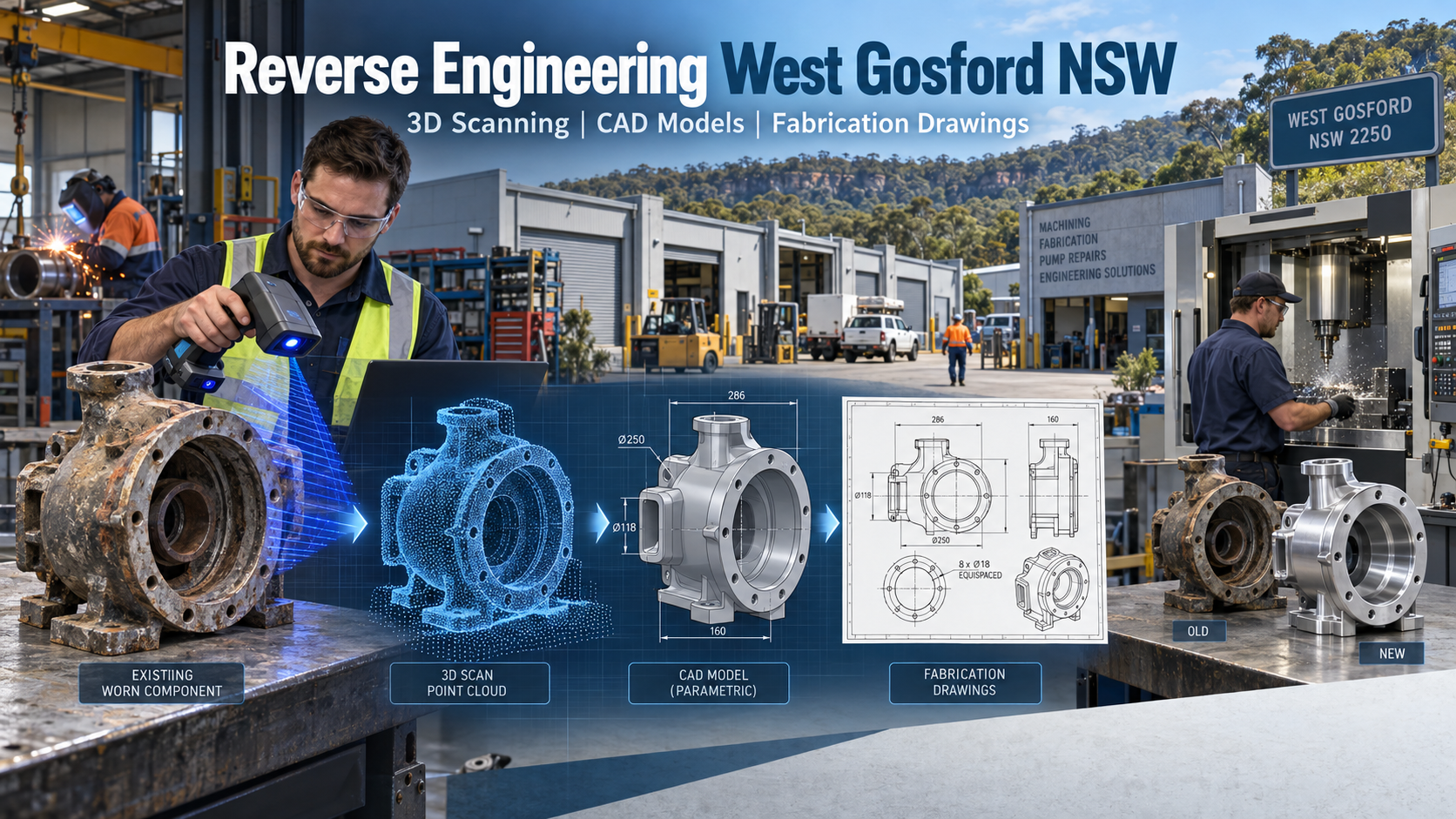
Local 3D Scanning, Mechanical Engineering and Manufacturing Support

West Gosford is one of the Central Coast’s most established industrial precincts. The area supports CNC machining, metal fabrication, pump repairs, vehicle modifications, machinery servicing, electrical manufacturing, industrial supply and other specialist trades.
Many of these businesses work with equipment that has remained in service for years or even decades. Original drawings may have been lost, suppliers may no longer support the equipment, or previous modifications may not have been documented. When a critical component wears out or fails, the only available reference may be the existing physical part.
Hamilton By Design provides reverse engineering in West Gosford for machinery, industrial components and fabricated assemblies. We combine metrology 3D scanning, direct measurement, practical mechanical engineering, 3D CAD modelling and fabrication drawings to help clients recover important engineering information.
Our Central Coast head office is located at Wyong, and we provide mobile site services throughout West Gosford, Gosford, North Gosford, Point Clare, Kariong, Somersby, Lisarow, Tuggerah and surrounding areas.
The objective is not simply to copy a worn component. It is to understand what the component does, identify its important interfaces and produce useful engineering information for local manufacturing.
Supporting Local Manufacturing in West Gosford
West Gosford has a valuable network of machine shops, fabricators, repair workshops and industrial service businesses. These local businesses often have the equipment and practical skills required to machine, weld, cut, fold, repair and assemble replacement components.
However, even an experienced workshop needs reliable information before manufacture begins.
Hamilton By Design can provide the link between the existing physical component and the local manufacturer. We inspect and capture the component, reconstruct it as a controlled CAD model and prepare the drawings or digital files required for production.
Our services can support:
- CNC machine shops
- Metal fabricators
- Pump and rotating-equipment repairers
- Machinery-maintenance companies
- Vehicle and trailer manufacturers
- Marine and generator specialists
- Production facilities
- Industrial electrical manufacturers
- Maintenance contractors
- Equipment owners
- Councils and infrastructure operators
- Manufacturers operating legacy machinery
We can work directly for the equipment owner or collaborate with the client’s preferred West Gosford or Central Coast workshop.
This approach supports local manufacturing by giving fabricators and machinists clearer information before material is ordered or machining begins.
What Is Reverse Engineering?
Reverse engineering is the process of examining an existing component or machine and recreating the design information needed to understand, reproduce or improve it.
The process may be required when:
- Original drawings are unavailable
- The manufacturer no longer supplies the part
- A replacement component has a long delivery time
- The equipment has been modified
- Existing drawings do not match the machinery
- A worn component must be reconstructed
- A local workshop needs manufacturing information
- A spare part is required before the original fails
- A component needs to be redesigned
- An existing asset must be documented for future maintenance
Reverse engineering may begin with a physical component, but the final deliverable is usually a controlled engineering record. This could include a 3D CAD model, a machining drawing, a fabrication drawing, an inspection report or a complete assembly model.
Hamilton By Design’s reverse engineering and 3D scanning service combines measurement technology with engineering and manufacturing knowledge.
Metrology 3D Scanning and Direct Measurement
Different components require different measurement methods.
Hamilton By Design can use portable metrology 3D scanning for suitable machinery components and complex surfaces. Larger machines, workshop environments and surrounding plant can be captured using terrestrial LiDAR scanning.
Direct measurement may also include:
- Vernier calipers
- Micrometers
- Bore gauges
- Tape measurements
- Angle measurements
- Bolt-pattern checks
- Shaft and hole measurements
- Flange and mounting-face verification
A scanner should not automatically replace conventional measurement. Critical diameters, bearing fits, sealing surfaces and machined interfaces may still require direct checking.
Metrology 3D scanning is particularly useful for:
- Cast components
- Irregular shapes
- Curved surfaces
- Covers and guards
- Pump components
- Worn machinery parts
- Fabricated assemblies
- Vehicle components
- Patterns and moulds
- Parts with limited drawings
The scan creates a detailed digital representation of the visible surface. This information can then be used as a reference when developing the CAD model.
For larger equipment and surrounding environments, Hamilton By Design also provides 3D scanning services across the Central Coast.
From Scan Data to a 3D CAD Model
A scan mesh or point cloud is not automatically a manufacturing model.
Raw scan data may contain surface texture, wear, damage, corrosion, dirt and small variations that should not be reproduced in the finished part. Engineering interpretation is needed to distinguish useful design geometry from the condition of the component as found.
The development of 3D CAD models may require consideration of:
- Symmetry
- Original design intent
- Bearing and shaft centres
- Bolt circles
- Sealing faces
- Machined surfaces
- Wall thicknesses
- Clearances
- Manufacturing methods
- Assembly sequence
- Mating components
- Maintenance requirements
Hamilton By Design develops CAD models using SolidWorks and other appropriate engineering systems. The model can be constructed with controlled features and nominal dimensions rather than being treated as an uncontrolled surface copy.
This provides a more useful basis for future modifications, manufacturing drawings and engineering review.
Our 3D CAD modelling and mechanical drafting services can convert sketches, measurements, scans and legacy drawings into organised engineering models.
Reverse Engineering Worn Components
One of the greatest risks in reverse engineering is copying wear or damage.
A used component may no longer represent its original geometry. It may have experienced:
- Abrasive wear
- Corrosion
- Impact damage
- Distortion
- Fatigue cracking
- Previous welding repairs
- Repeated machining
- Heat damage
- Misalignment
- Uneven loading
If the part is scanned and copied without interpretation, the replacement may reproduce the same defect.
A worn shaft may no longer indicate its original bearing fit. A pump casing may have lost material. A fabricated bracket may have bent under load. A previously repaired hole may no longer be in its intended position.
Hamilton By Design reviews the component’s function, interfaces and condition before finalising the replacement geometry. Where possible, information is gathered from mating parts, maintenance records, old drawings, photographs, catalogues and operating personnel.
Some components may also require material testing, hardness testing, non-destructive examination or specialist analysis. A scan can establish visible geometry, but it cannot identify material grade, heat treatment or internal condition.
Fabrication Drawings for Local Workshops
Once the design has been reconstructed and reviewed, the 3D model can be converted into practical fabrication drawings or machining information.
Depending on the project, deliverables may include:
- Part drawings
- Assembly drawings
- General arrangement drawings
- Machining drawings
- Welded fabrication drawings
- Plate-development drawings
- DXF cutting profiles
- STEP files
- Parasolid files
- Bills of materials
- Cutting lists
- Inspection dimensions
- Material notes
- Weld symbols
- Surface-finish requirements
- Revision-controlled drawing packages
The required level of detail should be agreed before work begins. A simple laser-cut plate does not require the same documentation as a shaft, pump component or safety-critical machinery assembly.
Hamilton By Design can communicate with the nominated manufacturer during the drawing process. This allows the design to consider available machines, preferred materials and practical workshop methods.
Our role is to provide information that can be understood and used by the people making the component.
Dimensional Inspection Reports
Reverse engineering can also support dimensional inspection and quality assurance.
A dimensional inspection report can compare selected measurements from an existing or newly manufactured part against the nominated CAD model or drawing.
The report may record:
- Overall dimensions
- Hole sizes and positions
- Bolt-pattern geometry
- Shaft diameters
- Flange dimensions
- Mounting locations
- Alignment measurements
- Selected tolerances
- Deviations from the nominated model
- Inspection limitations
Dimensional inspection reports can be useful when:
- Checking whether a manufactured component matches the drawing
- Comparing a spare part with the installed component
- Investigating repeated fit-up problems
- Recording the dimensions of an undocumented part
- Confirming important interfaces before installation
- Supporting discussions between the client and manufacturer
The report should clearly state what was measured, how it was measured and what tolerances or acceptance criteria were applied.
Not every feature visible in a scan requires inspection. The priority should be the dimensions that control fit, function, alignment or assembly.
Common West Gosford Engineering Problems
Obsolete machinery parts
A machine may remain productive even though the original manufacturer no longer supports it. Reverse engineering can help create the information required for local manufacture.
Missing drawings
The client may have no drawings or only an old sketch. The existing component can be measured and converted into a controlled digital record.
Drawings that do not match the equipment
Machinery may have been changed without corresponding drawing updates. Scanning the actual equipment reduces reliance on outdated information.
Replacement components that do not fit
A component can be accurately manufactured to an incorrect drawing. Capturing the mating equipment and surrounding interfaces can reduce this risk.
Production downtime
Waiting for an overseas part can extend a shutdown. Where technically and legally appropriate, local reverse engineering and manufacturing may provide another pathway.
Limited maintenance records
Creating CAD models, drawings and inspection data gives the asset owner a more reliable record for future maintenance and replacement.
Uncertain original geometry
Wear, corrosion and previous repairs can make the original shape difficult to establish. Engineering judgement and supporting information are needed before the replacement is defined.
Pump and Rotating-Equipment Applications
West Gosford has a strong history of pump, motor, generator, diesel and machinery-repair services. This makes reverse engineering particularly relevant to rotating and fluid-handling equipment.
Potential applications include:
- Pump casings
- Pump covers
- Baseplates
- Motor adaptor plates
- Coupling guards
- Bearing housings
- Shaft sleeves
- Pipe and flange interfaces
- Equipment mounts
- Service tools
- Maintenance fixtures
- Protective covers
Rotating equipment requires careful assessment. Operating speed, balance, materials, fatigue, alignment, fits and clearances may all influence whether a replacement component is suitable.
Hamilton By Design can connect reverse engineering with our industrial pump rebuild and water-engineering services.
Where specialist balancing, metallurgical testing, pressure assessment or certification is required, the relevant specialist should be included in the project.
A Practical Reverse-Engineering Process
A typical project may follow these stages.
1. Define the problem
We establish what has failed, what information is available and whether the client requires a copy, an improved part or a long-term engineering record.
2. Inspect the component
The component is reviewed for wear, damage, corrosion, repairs and features that may affect measurement.
3. Capture the geometry
The item is measured using the most appropriate combination of 3D scanning and direct measurement.
4. Review the interfaces
Mating components, mounting faces, surrounding equipment and installation clearances are checked where practical.
5. Develop the CAD model
A controlled model is created using the scan data, measurements and available engineering information.
6. Review the design
The client, maintainer and proposed manufacturer can review the model before the drawings are finalised.
7. Prepare manufacturing information
The approved model is converted into the required fabrication drawings, machining drawings or digital manufacturing files.
8. Support manufacture and installation
Hamilton By Design can respond to workshop queries, review approved changes and update the final records.
This process keeps responsibility connected from the initial inspection through to the manufacturing documentation.
Engineering Standards and Responsibilities
Applicable Australian Standards depend on the component, machinery and operating environment.
Standards that may be relevant include:
- AS 1100 series for technical drawing
- AS/NZS 4024 series for machinery safety
- AS 3990 for mechanical equipment steelwork
- AS/NZS 1554 series for structural welding
- AS 1657 for fixed platforms, walkways, stairs and ladders
- AS 4991 for lifting devices
- AS 4041 for pressure piping
- AS 1210 for pressure vessels
Standards should be selected according to the actual scope. Reverse engineering an existing part does not automatically establish that the original design complied with current requirements.
The client should also confirm that it has the legal right to reproduce proprietary equipment or components. Intellectual-property and licensing requirements may apply.
Hamilton By Design provides mechanical engineering, 3D scanning and drafting. Where specialist electrical, structural, pressure-equipment or other certification is required, an appropriately qualified practitioner should be engaged.
Why Choose Hamilton By Design?
Hamilton By Design has operated since 2001 and has been based on the Central Coast since 2010.
Our capability combines:
- Mechanical engineering
- Trade experience as a fitter and turner
- CNC machining knowledge
- Mechanical drafting
- Metrology 3D scanning
- Terrestrial LiDAR scanning
- SolidWorks CAD modelling
- Fabrication-drawing experience
- Manufacturing knowledge
- Industrial maintenance experience
- Controlled engineering documentation
This combination is particularly useful for reverse engineering. We understand the complete workflow from the physical component through measurement, modelling, drawing, manufacturing and installation.
Unlike a scan-only provider, we can convert captured geometry into engineering models and practical drawings. Unlike a remote drafting provider, we can inspect the component, discuss the problem with the workshop and remain involved as the project develops.
Frequently Asked Questions
Do you provide reverse engineering in West Gosford?
Yes. Hamilton By Design provides mobile inspection, scanning, modelling and drafting services throughout West Gosford and the wider Central Coast.
Can you scan a single machinery component?
Yes, where the component is suitable and there is a defined engineering outcome. Photographs and approximate dimensions help us determine the most appropriate approach.
Can you copy a worn or broken part?
Often, but it should not be copied blindly. Wear, distortion and previous repairs must be considered before defining the replacement geometry.
Can a scan determine the material?
No. A scan records visible geometry. Material grade, hardness and heat treatment must be established from records, testing or an appropriate engineering specification.
Can you prepare fabrication or machining drawings?
Yes. We can prepare manufacturing drawings, general arrangements, assemblies, DXF profiles and suitable 3D CAD files according to the agreed scope.
Can you work with our preferred West Gosford manufacturer?
Yes. We can communicate with the client’s selected machinist or fabricator to help align the drawings with the proposed manufacturing process.
Can you inspect a newly manufactured part?
Yes. Selected dimensions can be compared with the approved drawing or CAD model and recorded in a dimensional inspection report.
What file formats can you supply?
Typical formats include PDF, DWG, DXF, STEP, Parasolid, native SolidWorks files, E57, RCP, RCS and LAS.
How long does reverse engineering take?
The timeframe depends on the size and complexity of the component, required accuracy, available information and level of engineering assessment.
What information is required for a quotation?
Useful information includes photographs, approximate dimensions, equipment function, known materials, failure history, required deliverables, location and target completion date.
Local Engineering Supporting Local Manufacturing
West Gosford has the workshops, trades and practical manufacturing capability needed to support a wide range of industrial equipment.
Hamilton By Design adds the engineering and digital-information layer required to turn an existing component into a controlled manufacturing package.
We can inspect the part, capture its geometry, develop the 3D CAD model, prepare fabrication drawings and assist with dimensional inspection. We can then work with the client’s preferred local workshop to help move the project from an existing physical asset to a practical replacement.
Contact Hamilton By Design through our online contact page to discuss reverse engineering, metrology 3D scanning or manufacturing drawings for your West Gosford project.
Hamilton By Design – local engineering supporting local manufacturing on the Central Coast.

Contact Us – Talk To Us
Our clients:

























Related Hamilton By Design Resources
From Existing Component to Fabrication Drawing
Learn how 3D scanning and scan-to-CAD workflows convert existing industrial components into controlled CAD models and practical fabrication drawings.
Read moreReverse Engineering Industrial Equipment
Discover how reverse engineering can recover missing design information, support replacement-part manufacture and extend the service life of ageing industrial equipment.
Read moreWhy Shutdown Parts Don’t Fit
Examine the measurement, drawing and interface errors that cause replacement components to require rework during critical plant shutdowns.
Read moreManufacturing and Factory Layout Design
See how measured site information, 3D modelling and practical engineering support machinery layouts, production changes and factory upgrades.
Read more