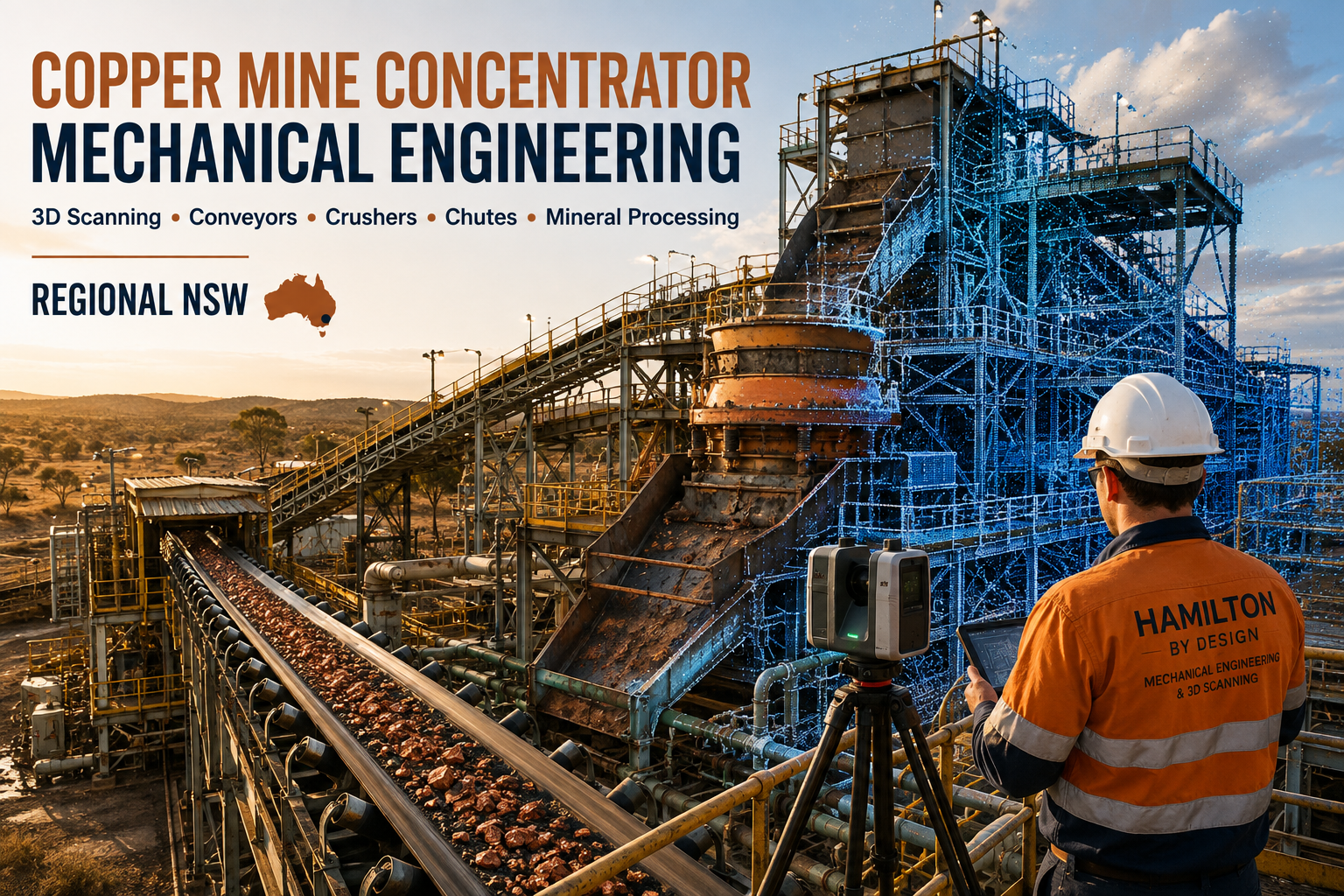

Copper mineral processing plants operate in demanding environments where crushers, conveyors, transfer chutes, hoppers, pumps, pipework and supporting structures must work together continuously and reliably. When these facilities are modified or upgraded, one of the biggest engineering challenges is often not designing the new equipment—it is establishing exactly what already exists.
Across established mining areas such as Cobar and Nyngan in regional NSW, concentrators and materials-handling plants may have undergone decades of repairs, equipment replacements and incremental modifications. Original drawings may no longer accurately represent the installed plant.
Hamilton By Design provides mechanical engineering, 3D laser scanning, CAD modelling and engineering drafting services to support brownfield mineral-processing projects. Our approach combines practical mechanical engineering with accurate existing-condition capture so modifications can be developed around the actual plant rather than assumptions based on historical drawings.
For operations in the Cobar mining region, our broader Mining Engineering Services in Cobar NSW can support projects involving crushing, conveying, materials handling and plant upgrades.
Mechanical Engineering for Copper Mineral Processing Plants
A copper concentrator contains interconnected mechanical systems. A modification to one area can have consequences elsewhere in the process.
Replacing a crusher, for example, may change discharge geometry, chute arrangements, access requirements or structural loads. Increasing conveyor capacity may require changes to transfer points, liners, skirting, supporting structures or maintenance access.
Hamilton By Design can assist with mechanical engineering associated with:
- crushers and crusher interfaces
- belt conveyors and conveyor modifications
- transfer stations
- chutes and spoon arrangements
- feed and discharge hoppers
- bins and bulk-material storage
- feeders
- screens and equipment interfaces
- slurry pumps and pump arrangements
- process pipework
- mechanical equipment supports
- machinery guarding
- maintenance platforms and access
- brownfield equipment replacements
- plant layout changes
- fabrication and installation documentation.
Our broader approach to Mechanical Engineering in Mining Infrastructure considers conveyors, crushing and screening equipment, pumping systems, slurry transport, chutes, bins and mechanical plant modifications as interconnected parts of the processing facility.
Engineering Around Existing Plant Geometry
One of the greatest risks on a brownfield mineral-processing project is relying on information that no longer reflects the plant.
A drawing may show where a conveyor was originally designed to run, but the installed conveyor may differ slightly. Structural steel may have been altered during previous shutdowns. Platforms, pipework, cable trays, guards and equipment may have been added over time.
Small dimensional differences can become significant when a new chute, conveyor section, pump skid or structural frame has already been fabricated.
This is where Hamilton By Design’s 3D Laser Scanning for Cobar Mining can become an important part of the mechanical engineering workflow.
Engineering-grade LiDAR scanning can capture the existing arrangement of:
- conveyors
- crusher structures
- pulleys
- transfer stations
- structural steel
- equipment bases
- floors and concrete
- pipework
- platforms
- stairs
- guards
- surrounding services.
The resulting point cloud can be used directly within the mechanical design process.
Rather than treating scanning as an isolated surveying exercise, Hamilton By Design uses an engineering-led capture approach. Our Engineering-Led LiDAR and Mechanical Design services in Cobar are intended to connect site capture directly with engineering design, modelling and documentation.
Conveyor Engineering and Materials Handling
Conveyors form critical links between crushing, screening, storage and downstream mineral-processing operations.
Mechanical engineering may be required when changing:
- conveyor head or tail arrangements
- drive locations
- pulley positions
- conveyor trajectories
- discharge arrangements
- loading zones
- supporting frames
- guards
- access platforms
- transfer chutes.
For belt conveyors handling bulk material, AS/NZS 4024.3611 – Safety of machinery, Conveyors – Belt conveyors for bulk materials handling is particularly relevant. It establishes lifecycle safety requirements for belt conveyors used for bulk-material handling.
The broader AS 4024 Safety of Machinery series may also apply when considering machinery hazards, guarding, access and risk reduction.
For a copper concentrator, compliance needs to be considered as part of the mechanical design process rather than added to the design afterwards.
Chutes and Transfer Points
Transfer points can have a disproportionate effect on mineral-processing plant performance.
A poorly performing chute can contribute to:
- excessive liner wear
- belt mistracking
- spillage
- dust
- blockages
- poor material presentation
- high impact loads
- maintenance problems
- shutdown requirements.
Hamilton By Design provides Conveyor Transfer Chute Design for Mining as part of its mechanical and bulk-materials-handling capability.
Where required, chute development can consider material trajectory, impact zones, wear areas, replaceable liners, access, fabrication requirements and the relationship between the chute and surrounding equipment.
For more difficult material-flow problems, our approach to Chute Design in the Mining Industry can incorporate accurate as-built geometry and engineering analysis, with DEM simulation considered where appropriate.
The objective is not simply to make a chute that fits. It is to develop a practical mechanical arrangement that considers flow, wear, maintainability, safety and fabrication.
Hoppers, Bins and Feed Arrangements
Copper processing plants can include feed hoppers, surge bins and other bulk-solids containment equipment.
When modifying these systems, engineers may need to consider:
- material density
- stored volume
- wall loads
- discharge conditions
- eccentric loading
- flow characteristics
- liners
- feeder interfaces
- supporting steelwork.
AS 3774 – Loads on bulk solids containers may be relevant where the equipment falls within the standard’s scope. The standard deals with determination of loads used in designing structures for the mass storage of bulk solids.
Supporting steelwork may also require assessment against AS 4100 – Steel structures, together with relevant structural design actions under the AS/NZS 1170 series.
Slurry Pumps and Process Pipework
Mechanical engineering in a copper concentrator extends beyond dry materials handling.
Once ore enters wet processing stages, slurry pumping and process-water systems become important elements of plant reliability.
Hamilton By Design can assist with engineering and modelling associated with:
- pump replacement arrangements
- pump bases and supports
- suction and discharge layouts
- pipe routing
- equipment clearances
- maintenance access
- existing pipework verification
- plant modifications around pumps and piping.
Where pressure piping falls within its scope, AS 4041 – Pressure piping may be applicable.
The exact design standard should be established during the project because mineral-processing pipe systems vary significantly in pressure, material, duty and service conditions.
Maintenance Access and Machinery Safety
A mechanical modification also needs to be maintainable.
A technically functional chute or conveyor modification is of limited value if maintenance crews cannot safely inspect it, remove liners, access bearings or replace components.
AS 1657 – Fixed platforms, walkways, stairways and ladders is therefore particularly relevant to mineral-processing projects where modifications affect permanent access for operators and maintenance personnel.
Mechanical design should consider access requirements early enough that platforms, stairs, handrails and equipment removal paths form part of the plant arrangement.
Machine guarding and hazardous machinery interfaces should similarly be considered against the applicable AS 4024 series requirements.
Structural Steel Supporting Mechanical Equipment
Although the project may be driven by mechanical engineering, mineral-processing equipment must usually connect to structural steel.
New chutes, conveyors, pumps and equipment can introduce loads into existing structures.
Relevant standards can include:
- AS 4100 – Steel structures
- AS/NZS 1170 series – Structural design actions
- AS/NZS 5131 – Structural steelwork fabrication and erection
- AS/NZS 1554 series – Structural steel welding.
The specific standards and engineering checks required depend on the scope, existing structure, loads and mine requirements.
Engineering for Shutdown Installation
Mineral-processing shutdowns place additional pressure on brownfield design.
Fabricated equipment may have only a short installation window. Discovering during shutdown that a chute does not fit, a pipe clashes with structural steel or a support frame is incorrectly dimensioned can quickly affect the shutdown schedule.
Hamilton By Design’s approach to 3D Scanning for Mining Shutdown Projects is based on capturing existing conditions before the shutdown and using that information for mechanical design and verification.
The workflow can be:
Site inspection → 3D laser scanning → registered point cloud → mechanical CAD model → design development → clash checking → fabrication drawings → shutdown installation.
Our additional 3D Scanning Engineering services in Cobar can support the transition from existing-condition capture through to usable engineering information for plant modification projects.
Practical Mechanical Engineering for Regional NSW Mining
The value Hamilton By Design brings to mineral-processing projects is the combination of mechanical engineering, practical manufacturing knowledge and digital site capture.
For copper concentrator projects around Cobar, Nyngan and regional NSW, this approach can support everything from a relatively small chute modification through to larger conveyor, crusher, pump or processing-plant upgrades.
The objective is straightforward: understand the existing plant accurately, engineer the modification practically and identify potential problems before fabrication and shutdown installation.
Australian Standards are then incorporated according to the actual scope of work, including machinery safety, conveyor safety, access, structural steel, bulk-solids loads, piping and fabrication requirements.
Frequently Asked Questions
What mechanical engineering services can Hamilton By Design provide for a copper concentrator?
Hamilton By Design can assist with conveyor modifications, transfer chutes, crusher interfaces, hoppers, feeders, slurry pump arrangements, process pipework, mechanical equipment layouts, machinery guarding, maintenance access, equipment supports, reverse engineering and fabrication documentation.
Why use 3D laser scanning before modifying a mineral-processing plant?
Brownfield plants frequently differ from historical drawings. Laser scanning captures the actual location of equipment, structural steel, pipework and surrounding infrastructure so mechanical modifications can be designed around existing conditions.
Can Hamilton By Design design conveyor transfer chutes?
Yes. Transfer chute work can include existing-condition capture, mechanical arrangement development, material trajectory considerations, wear areas, liners, supporting structures, maintenance access and fabrication documentation.
What Australian Standard applies to mining conveyors?
AS/NZS 4024.3611 specifically addresses safety requirements for belt conveyors used for bulk-material handling. Other parts of the AS 4024 series may also apply depending on the machinery and hazards involved.
What standard applies to mining access platforms and stairs?
AS 1657 covers fixed platforms, walkways, stairways and ladders and is commonly relevant when designing permanent access around mineral-processing equipment.
What Australian Standards may apply to hoppers and bins?
AS 3774 may apply to the determination of loads for bulk-solids containers where the equipment falls within its scope. AS 4100 and the AS/NZS 1170 series may also apply to supporting structural steel.
Can existing plant be scanned before a shutdown?
Yes. This can be one of the most valuable uses of engineering-grade 3D scanning. The existing plant can be captured before shutdown so equipment can be modelled, designed and checked while the plant remains in service, subject to site access and operational requirements.
Can Hamilton By Design produce fabrication drawings?
Yes. Mechanical design can progress into 3D CAD models, assemblies, fabrication drawings, DXF information, bills of materials and installation documentation as required by the project.
Does Hamilton By Design only provide 3D scanning?
No. The key distinction is that Hamilton By Design combines 3D scanning with mechanical engineering and CAD design. For mineral-processing projects, scanning is used to obtain reliable existing-condition information that supports the engineering process.
Which Australian Standards apply to a copper concentrator modification?
There is no single Australian Standard covering every concentrator modification. Depending on the project, relevant standards may include AS/NZS 4024.3611, the AS 4024 series, AS 1657, AS 4100, AS/NZS 1170, AS 3774, AS 4041, AS/NZS 5131 and AS/NZS 1554. The applicable standards should be established for each engineering scope, together with the mine operator’s specifications and statutory requirements.

Contact Us – Talk To Us
Our clients: