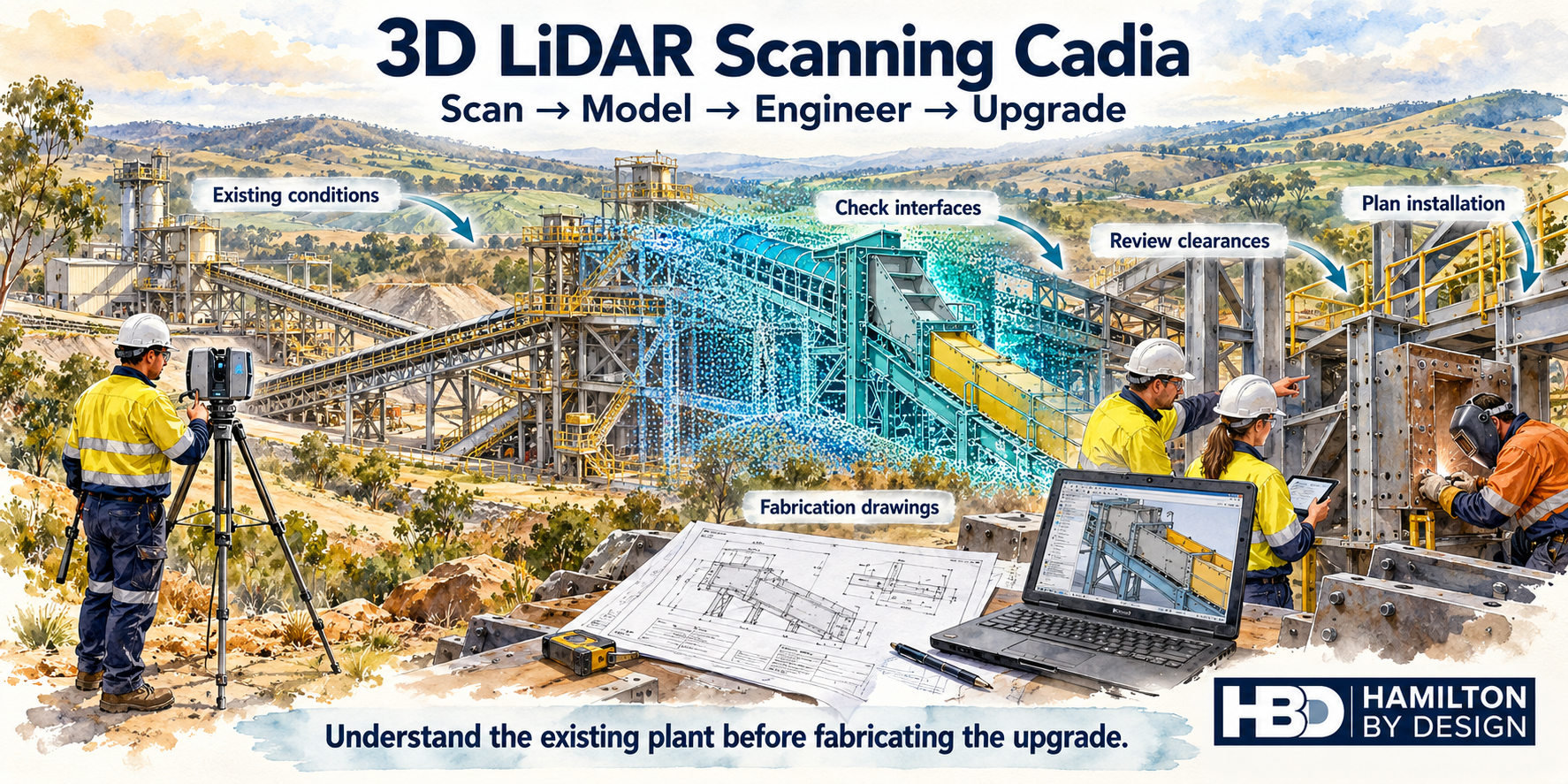
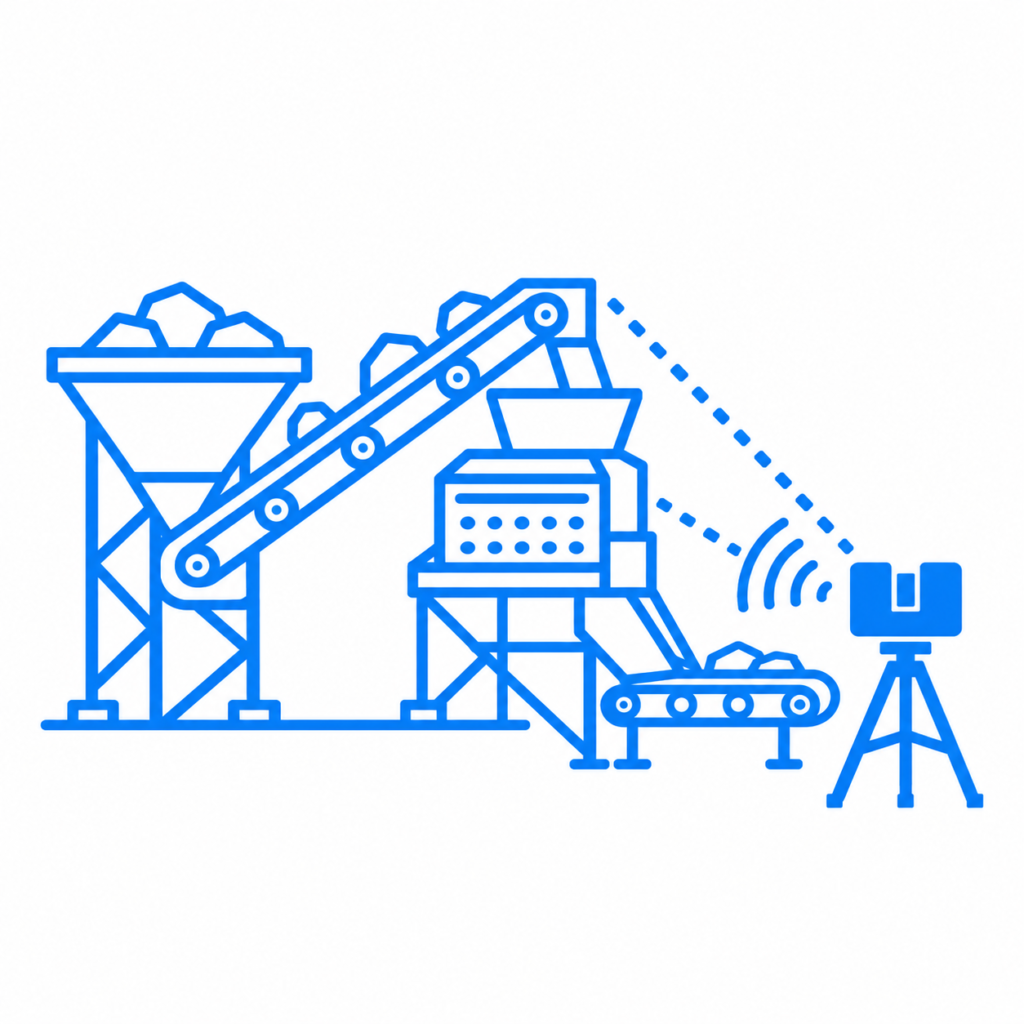
Hamilton By Design offers 3D LiDAR scanning for Cadia mining and processing plant projects, helping engineers, maintenance teams and fabrication contractors understand existing plant geometry before designing and installing modifications.
From replacement chutes and conveyor interfaces to pump skids and pipework, successful upgrades depend on knowing what is already there. A registered point cloud provides a detailed spatial reference for developing designs, checking clearances and planning installation.
Our approach connects scan → model → engineer → upgrade, turning captured site geometry into practical engineering information.
Supporting Mining Projects Around Cadia and Orange
Cadia is a major gold and copper mining operation owned by Newmont, located approximately 25 kilometres from Orange in Central West NSW. Its scale and industrial setting make existing plant information an important consideration for maintenance and upgrade planning.
For projects in this environment, drawings may need to be checked against equipment that has changed over time. Added pipework, modified supports, replacement machinery and altered access arrangements can affect how a new component fits.
Hamilton By Design can support project teams working in the Cadia and Orange region with site scanning, point cloud processing, mechanical modelling and drawing development. Site work is arranged around the agreed scope, access requirements and operating conditions.
Why Scan Before Designing a Plant Upgrade?
A replacement component may match the original drawing yet still clash with the current installation.
Common sources of uncertainty include:
- Connection points that differ from the drawings.
- Pipework or cable trays crossing the proposed installation area.
- Limited clearance around conveyors and transfer points.
- Existing steelwork affecting equipment placement.
- Restricted access for lifting, assembly and maintenance.
- Changes made during previous shutdowns.
3D LiDAR scanning captures visible surfaces across the work area, allowing the proposed design to be reviewed against its surroundings.
This helps project teams identify potential problems earlier, when changes are generally easier to manage than during fabrication or installation.
3D LiDAR Scanning for Chutes and Conveyor Interfaces
Chute replacements and conveyor modifications require more than the dimensions of the component being replaced. The surrounding arrangement influences the design, installation sequence and future maintenance access.
Scanning can capture:
- Conveyor positions and transfer point geometry.
- Existing chute envelopes and accessible connections.
- Supporting steelwork and nearby platforms.
- Adjacent services and equipment.
- Available space for removal and installation.
The point cloud can then support a mechanical model of the proposed arrangement.
For example, a replacement transfer chute can be reviewed against surrounding steelwork, pipework and access platforms before drawings are issued for fabrication. Critical connection dimensions can be identified for additional verification.
Pump Skids, Pipework and Service Modifications
Installing a new pump or changing a pipe route can create challenges in a congested processing plant.
An existing layout may provide enough space for the equipment itself while leaving insufficient room for valves, maintenance activities or removal of major components.
A scan-based model can help assess:
- Pump skid placement and surrounding clearances.
- Accessible flange locations and pipe routes.
- Potential clashes with existing equipment.
- Space for valve operation and maintenance.
- Proposed support locations.
- Installation and component removal paths.
Capturing the surrounding area provides context for these decisions. It helps the designer consider how the equipment will be installed, operated and maintained.
Scan-to-CAD for Mechanical Design and Fabrication
A point cloud becomes more useful when it is connected to the required engineering deliverable.
Hamilton By Design can use registered scan data as a reference for developing CAD models in SolidWorks and AutoCAD. Depending on the project scope, deliverables may include:
- Registered point clouds.
- Models of selected existing equipment.
- Proposed mechanical equipment models.
- General arrangement drawings.
- Fabrication and assembly drawings.
- Interface details and dimensional review information.
- STEP, DXF or other agreed CAD exchange files.
The level of modelling is selected to suit the task. A layout study may need equipment envelopes and principal interfaces, while a fabrication package requires more detailed geometry and verified connection information.
This keeps the work focused on the decisions the project team needs to make.
Planning Component Fit Before Fabrication
One of the most useful applications of 3D LiDAR scanning at Cadia is checking the proposed component against the existing plant before fabrication begins.
A typical workflow is:
- Define the interfaces: Identify connection points, critical dimensions and required clearances.
- Capture the work area: Scan the component location and relevant surrounding equipment.
- Register and review the data: Check coverage and identify areas requiring further measurement.
- Develop the model: Position the proposed component within the existing geometry.
- Review fit and access: Assess clashes, assembly requirements and maintenance space.
- Prepare the drawings: Document the agreed arrangement and fabrication details.
Scanning supports fit-up planning, but concealed surfaces and fine features may require additional measurement. Bolt holes, machined faces and tight tolerance connections should be assessed individually rather than assumed to be fully defined by a general plant scan.
Supporting Shutdown and Installation Planning
Shutdown work benefits from early decisions about component fit, removal routes and installation access.
A scan-based model can help teams consider questions such as:
- Can the existing component be removed through the available opening?
- Will the replacement need to be installed in sections?
- Does nearby pipework restrict the installation path?
- Is there enough space to access the connections?
- Which dimensions need verification before fabrication?
These reviews can support discussions between engineering, maintenance, fabrication and installation teams.
Scanning is most valuable when completed early enough for the findings to influence the design and work plan.
Accuracy Matched to the Engineering Task
The required accuracy should be established before scanning begins.
A broad plant layout study has different requirements from a replacement component with tightly controlled interfaces. Scan coverage, distance, surface condition, visibility and registration all affect the usefulness of the resulting data.
Hamilton By Design works with the project team to identify:
- The purpose of the scan.
- Critical interfaces and tolerances.
- Areas requiring detailed capture.
- Features needing supplementary measurement.
- Required file formats and drawing outputs.
This creates a clear basis for the work and helps distinguish captured geometry from dimensions that still need verification.
Frequently Asked Questions
Can scanning help check whether a replacement chute will fit?
Yes. A point cloud can support a model of the replacement chute within the surrounding plant. This helps identify clashes and access constraints. Critical fabrication interfaces may also need direct measurement.
Can you work from an existing point cloud?
Yes. Hamilton By Design can review supplied scan data for modelling and drawing development. Its suitability depends on coverage, registration quality and the detail available around the required interfaces.
Does every scanned item need to be modelled?
No. Modelling can focus on the equipment, surfaces and connections relevant to the project. The remaining point cloud can provide surrounding context.
Can scanning take place while the plant is operating?
This depends on site approval, access and conditions. Moving equipment, dust, vibration and obstructed views may limit capture. Some areas may require isolation or shutdown access.
Can you provide drawings as well as scanning?
Yes. The scope can include point cloud processing, mechanical modelling, general arrangements and fabrication drawings, with deliverables agreed before work begins.
Discuss Your Cadia Scanning Project
Planning a chute replacement, conveyor modification, pump installation or processing plant upgrade near Cadia?
Contact Hamilton By Design to discuss 3D LiDAR scanning, scan-to-CAD modelling and mechanical design support.
Send photographs, existing drawings and a brief description of the proposed work so we can identify the required scan coverage, critical interfaces and suitable deliverables.
Capture the existing plant. Check the proposed fit. Develop the upgrade with better information.
Contact Us – Talk To Us
Our clients: