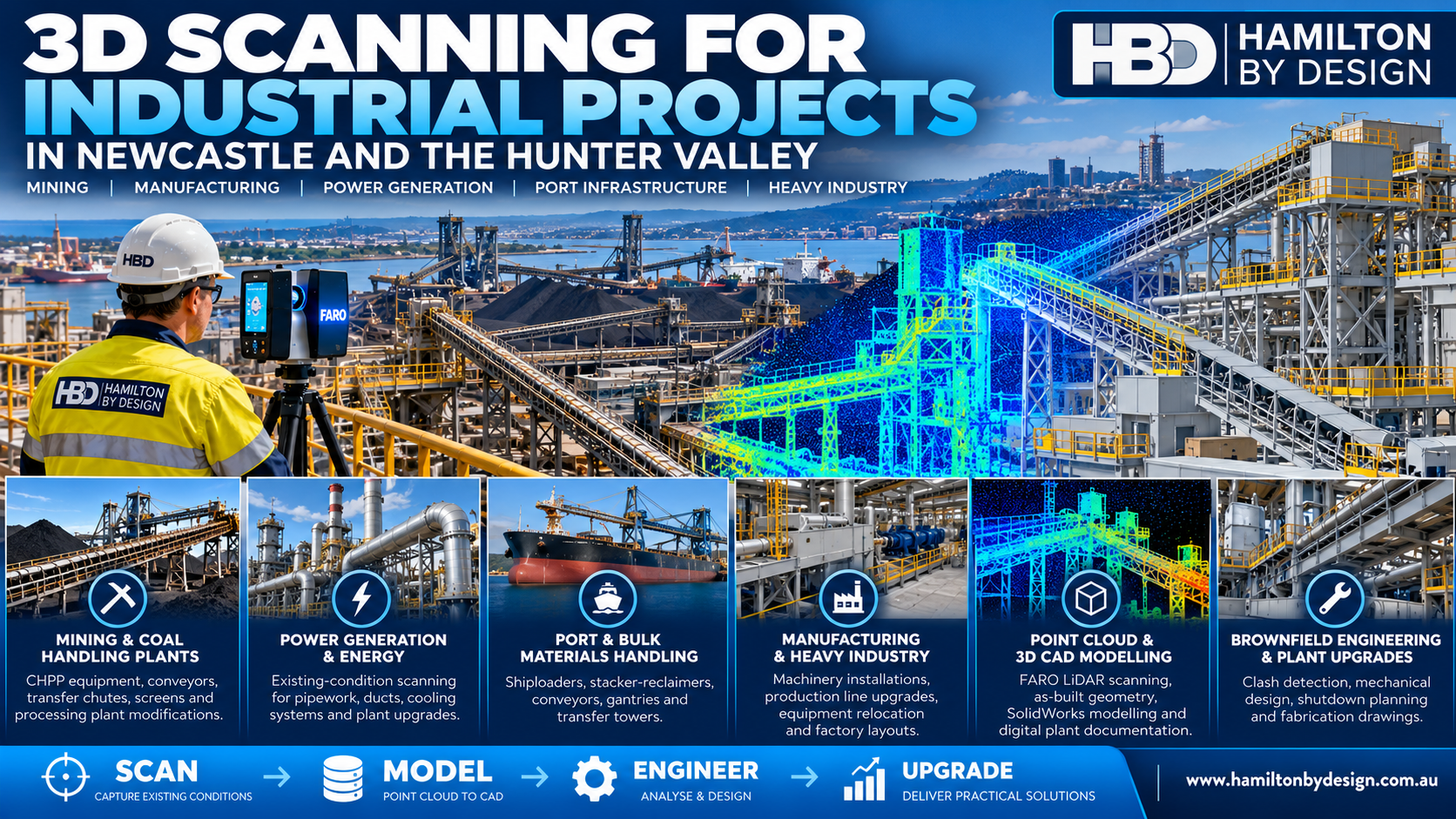
3D Scanning for Industrial Projects in Newcastle and the Hunter Valley

3D LiDAR scanning for industrial projects in Newcastle and the Hunter Valley by Hamilton By Design, showing FARO laser scanning, coal handling plants, conveyors, port infrastructure, 3D point cloud modelling and mechanical engineering for industrial plant upgrades.

Engineering the Hunter: Precision Meets Industry

Few regions in Australia represent heavy industry quite like Newcastle and the Hunter Valley.
From the coal mines at Bengalla and Mount Thorley, to the power stations at Bayswater and Eraring, to the Port of Newcastleโ€™s massive shiploaders and conveyors, this region has powered Australia for generations.

But with age, complexity, and constant upgrades come challenges:

  • Outdated drawings
  • Tight shutdown schedules
  • Complex brownfield modifications
  • Difficult site access

Thatโ€™s where 3D scanning and LiDAR modelling are transforming how industrial projects are designed, verified, and delivered โ€” ensuring every bolt, beam, and bracket fits perfectly the first time.

At Hamilton By Design, we bring together field experience, digital precision, and local knowledge to help the Hunterโ€™s industries design, maintain, and modernise with confidence.
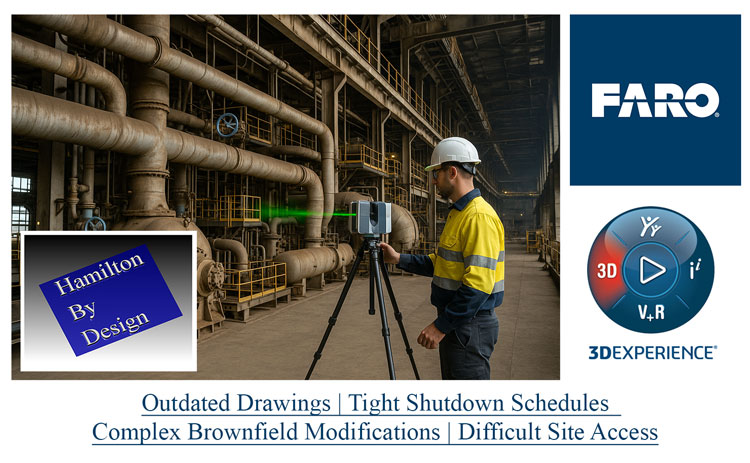

Technician operating a FARO 3D laser scanner inside an industrial plant to capture accurate geometry for brownfield upgrades, shown alongside Hamilton By Design and 3DEXPERIENCE logos with highlighted challenges such as outdated drawings and tight shutdown schedules
3D LiDAR scanning and 3D modelling service button โ€” laser scanner capturing a point cloud for engineering and CAD modelling
Mechanical engineering services

What Is 3D Scanning โ€” and Why It Matters in Industry

3D laser scanning, also known as LiDAR (Light Detection and Ranging), captures millions of data points across an industrial site to create a precise digital representation โ€” known as a point cloud.

This point cloud forms the foundation of a digital twin of your plant or asset โ€” an exact, measurable 3D environment that engineers can design within using SolidWorks, AutoCAD, or Navisworks.

The result?
Every measurement is accurate, every clash is detected before fabrication, and every installation happens exactly as planned.


Why Newcastle and the Hunter Valley Need Scanning More Than Ever

The Hunter is an engineering powerhouse โ€” but much of its infrastructure was built decades ago.
Many coal handling plants, power stations, and smelters are now in a constant cycle of refurbishment, retrofit, and compliance upgrade.

The challenges are familiar:

  • Old 2D drawings donโ€™t reflect todayโ€™s reality.
  • Assets have been modified repeatedly over decades.
  • Shutdown windows are shrinking.
  • Every error adds cost and delays production.

By scanning before you design, you remove uncertainty.
You donโ€™t guess clearances โ€” you know them.
You donโ€™t estimate tie-in points โ€” you model them.
You donโ€™t hope it fits โ€” you prove it digitally.

Thatโ€™s the power of 3D scanning in todayโ€™s industrial environment.


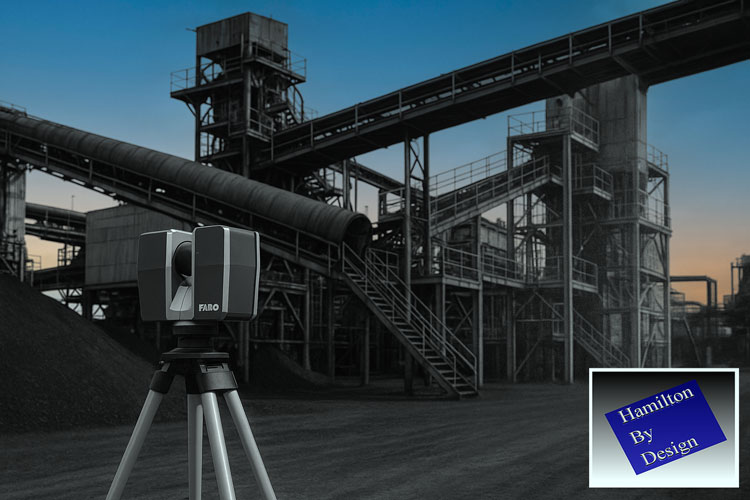
FARO 3D laser scanner set up on a tripod capturing an industrial plant for LiDAR scanning and digital modelling, with Hamilton By Design branding in the corner
3D LiDAR Scanning Hunter & Newcastle banner with white text on a blue background promoting engineering-grade laser scanning services for industrial, mining and infrastructure projects across the Hunter Valley and Newcastle region.
Mechanical Engineering Hunter & Newcastle banner promoting mechanical engineering services for mining, industrial plants, power generation, manufacturing and heavy industry throughout the Hunter Valley and Newcastle region.
Structural Drafting Hunter & Newcastle banner promoting structural drafting services for mining, industrial plants, power generation, manufacturing and infrastructure projects across the Hunter Valley and Newcastle region.

Where Scanning Adds Value Across the Hunterโ€™s Industries

โš™๏ธ Power Generation

The Bayswater, Eraring, and Vales Point Power Stations are engineering icons.
Upgrades to cooling systems, ducts, platforms, and access structures require millimetre accuracy.
3D scanning ensures:

  • Every retrofit aligns with existing steelwork and pipework.
  • Structural interferences are caught before fabrication.
  • Shutdown work can be completed on time โ€” without rework.

Whether itโ€™s a fan casing replacement or a duct reroute, laser scanning removes the guesswork from aging assets.


โ›๏ธ Coal Handling and CHPP Facilities

The Hunter Valleyโ€™s CHPP network โ€” Mount Thorley Warkworth, Ravensworth, Bengalla, Hunter Valley Operations โ€” all depend on reliable mechanical systems.
These plants evolve continuously: diverter chutes, screen replacements, conveyors, and wash plant modifications.

Scanning delivers:

  • Accurate as-built geometry for plant upgrades.
  • Clash detection between new and existing equipment.
  • Shutdown planning certainty โ€” no unexpected fit-up issues.
  • Integration of SolidWorks models directly into point clouds for visual verification.

For CHPP managers and maintenance engineers, 3D scanning is now as essential as the plant itself.
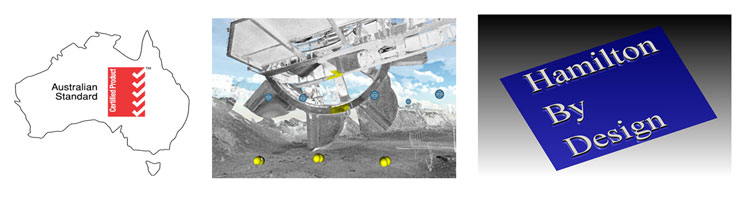
Composite image showing an Australian Standard compliance graphic, a LiDAR point-cloud scan of a coal reclaimer with inspection markers, and the Hamilton By Design logo

โš“ Port of Newcastle and Coal Export Terminals

Newcastleโ€™s port is the lifeline of the Hunterโ€™s economy.
Facilities such as Port Waratah Coal Services (PWCS), Newcastle Coal Infrastructure Group (NCIG), and Carrington Terminal handle massive volumes of coal every hour.

The complexity of these sites โ€” shiploaders, conveyors, gantries, and stacker-reclaimers โ€” demands accuracy during maintenance and upgrade works.
3D scanning supports:

  • Shiploader upgrades and boom extensions.
  • Conveyor and transfer tower alignment checks.
  • Wharf structure condition monitoring.
  • Integration with mechanical and electrical systems.

By scanning before modification, downtime is reduced, safety improves, and project teams gain total confidence in every fit-up.


๐Ÿญ Aluminium and Heavy Manufacturing

At Tomago Aluminium Smelter, precision is everything.
The scale of the site โ€” from potlines to switchyards โ€” makes manual measurement impractical and unsafe.

Laser scanning captures geometry accurately across large areas, enabling:

  • Retrofit planning without full shutdowns.
  • Clearance checks for cranes, ducts, and potline infrastructure.
  • Digital twins for long-term maintenance and asset management.

Beyond Tomago, manufacturers in Waratah, Beresfield, and Thornton use scanning to validate jigs, fixtures, and workshop layouts โ€” ensuring local fabrication accuracy that matches site requirements.


๐Ÿ”‹ Emerging Energy and Infrastructure

As the Hunter region transitions toward renewable and low-emission industries, scanning plays a critical role in planning new infrastructure around existing sites.
This includes:

  • Hydrogen and gas pipeline tie-ins.
  • Solar and battery installations near existing grid connections.
  • Conversion of existing power plant structures for new technology.

Accurate point-cloud data ensures new energy meets old infrastructure safely and efficiently.


From Field to Fabrication: The Hamilton By Design Process

At Hamilton By Design, our 3D scanning workflow is built around practical, industrial needs:

  1. Site Scan & Data Capture
    Using high-precision LiDAR scanners, we safely capture full site geometry in hours, not weeks.
    Scans are performed during operation or short shutdowns, without interrupting production.
  2. Point Cloud Registration & Processing
    Multiple scans are aligned to create a unified, accurate model of your facility.
    The result is a true โ€œdigital twinโ€ of your asset, complete with millimetre accuracy.
  3. SolidWorks Modelling & Integration
    Our design team converts scan data into fully functional 3D models โ€” chutes, pipework, platforms, or structural frames โ€” ready for fabrication.
  4. Clash Detection & Design Validation
    Every new design is tested within the digital twin, ensuring it fits the first time.
  5. Fabrication Drawings & e-Drawings
    Detailed 2D and 3D deliverables are provided for fabricators, site crews, and certifiers โ€” ensuring seamless communication between design and construction.

Why Local Expertise Matters

Many engineering firms offer scanning โ€” but few understand what it takes to work on a live plant in the Hunter Valley.

Hamilton By Design combines trade experience, mechanical design, and regional understanding.
Weโ€™ve worked with the same assets, fabricators, and contractors who keep the regionโ€™s power, port, and manufacturing industries running.

We design for real fabrication conditions โ€” using Australian Standards, local materials, and practical build methods.
That means fewer redesigns, faster turnarounds, and safer installations.


Safety and Access: Scanning Without Shutdowns

Traditional site measurement often means working at heights, in confined spaces, or around operating equipment.
3D scanning eliminates those risks.

Our scanners capture data safely from the ground โ€” even in restricted or hazardous areas.
This not only improves safety but also allows projects to continue without halting production.

For large plants like Eraring or PWCS, scanning entire structures during live operation is now standard practice โ€” enabling ongoing maintenance and long-term asset integrity planning.


Case Example: Port Upgrade Without Rework

A local contractor approached Hamilton By Design for a conveyor and tower modification project at the Port of Newcastle.
Existing drawings were decades old, and the structure had been modified repeatedly.

We performed a 3D scan of the tower and adjacent conveyors, capturing the as-built geometry in one day.
The resulting model revealed several misalignments between the planned chute and existing supports.
By correcting these in SolidWorks before fabrication, the contractor avoided at least 48 hours of site rework and kept the shutdown on schedule.

Thatโ€™s measurable ROI โ€” precision that pays for itself.


The ROI of 3D Scanning in Heavy Industry

A single hour of lost production at a CHPP or power station can cost $20,000 to $50,000.
A single dayโ€™s delay can exceed $500,000 in lost revenue and labour costs.

3D scanning reduces that risk by eliminating rework and ensuring every component fits right the first time.
Typical return on investment (ROI):

  • Scanning cost: <1% of total project value.
  • Rework savings: 3โ€“10% of total cost.
  • Downtime reduction: 1โ€“3 days saved per shutdown.

When accuracy drives reliability, 3D scanning isnโ€™t an expense โ€” itโ€™s insurance.


Supporting the Hunterโ€™s Future

Newcastle and the Hunter Valley are evolving โ€” from coal and power to renewables, advanced manufacturing, and logistics.
But one thing hasnโ€™t changed: the regionโ€™s foundation in engineering, precision, and hard work.

Hamilton By Design supports that legacy with the next generation of technology โ€” scanning, digital modelling, and mechanical design that keep the regionโ€™s assets efficient, safe, and ready for the future.

Weโ€™re not an offshore CAD vendor.
Weโ€™re local engineers whoโ€™ve worked in the field, understand your equipment, and speak the same language as your crews.


Letโ€™s Build the Future of Hunter Industry โ€“ Accurately

Every project starts with one question: โ€œDo we have accurate site data?โ€

With Hamilton By Design, the answer is always yes.

We deliver:
โœ… 3D laser scanning and LiDAR modelling
โœ… Point-cloud to SolidWorks integration
โœ… Reverse engineering and FEA validation
โœ… Fabrication drawings tailored for local workshops
โœ… On-site consultation with practical engineering insight

Whether youโ€™re upgrading a conveyor at Bayswater, fabricating platforms for Tomago, or retrofitting process piping at Kooragang, we ensure your next project fits perfectly โ€” before steel is cut.

Banner displaying Hamilton By Design alongside partner and technology logos including SolidWorks, UTS, Dassault Systรจmes 3DEXPERIENCE, and FARO, with the text โ€˜3D Scanning 3D Modellingโ€™ and website www.hamiltonbydesign.com.au.

๐Ÿ‘‰ Get your industrial site scanned and modelled before your next shutdown.
Visit www.hamiltonbydesign.com.au or contact us to request a capability statement today.

Mechanical Engineering | Structural Engineering

Mechanical Drafting | Structural Drafting

3D CAD Modelling | 3D Scanning

Hamilton By Design logo displayed on a blue tilted rectangle with a grey gradient background

Our clients;

Name
Would you like us to arrange a phone consultation for you?
Address

Stop Guessing, Start Scanning: How 3D Laser Scanning Prevents Costly Shutdown Delays

The Cost of Guesswork in Shutdowns

Every shutdown comes with pressure โ€” time, budget, and safety. When mechanical upgrades or maintenance are based on outdated drawings or manual measurements, the risk of error skyrockets. A misaligned chute, an incorrectly measured pipe, or a bracket that doesnโ€™t quite fit can turn a planned three-day outage into a five-day scramble.
In industries where every hour offline costs tens of thousands of dollars, guesswork is expensive.

Illustrated scene showing a 3D laser scanner capturing an industrial plant while engineers observe and review data, highlighting how scanning prevents costly shutdown delays.
3D LiDAR scanning and 3D modelling service button โ€” laser scanner capturing a point cloud for engineering and CAD modelling
Mechanical engineering services

3D Laser Scanning: Seeing the Plant as It Really Is

Thatโ€™s where 3D laser scanning and LiDAR technology change the game. Using a FARO or similar high-accuracy scanner, Hamilton By Design captures millions of data points in a matter of minutes โ€” creating a precise digital replica of your plant or structure.
This point cloud model forms the foundation for all design work. Every pipe, beam, and bracket is located exactly where it exists in the real world, not where an old drawing says it should be.

From Scan to SolidWorks: Accurate Models, Confident Designs

Once the scan is complete, the data is reverse-modelled into SolidWorks or similar 3D design environments.
This means upgrades, chutes, handrails, and structural supports can be designed within the scanned environment โ€” guaranteeing they fit perfectly on installation day.
Our clients use this workflow to plan shutdowns with confidence, knowing that every fabricated part will bolt straight in.

Eliminating Fit-Up Errors and Rework

Traditional upgrade projects rely on tape measures, rough sketches, or outdated general arrangement drawings. Even a 10 mm error can cause weeks of rework once site access is restricted.
With 3D scanning, those errors disappear.
Before fabrication begins, engineers can check for:

  • Clashes and interferences between new and existing plant structures.
  • Clearances for maintenance and access.
  • Alignment with conveyors, supports, and existing chutes.

That level of insight is impossible with 2D drawings alone.

Shorter Shutdowns, Safer Teams

Fewer surprises mean faster, safer installations.
When every component is designed and verified within the scanned model, shutdown crews spend less time cutting, grinding, or reworking in the field.
Thatโ€™s not only a productivity win, itโ€™s a safety win โ€” fewer sparks, less manual handling, and minimal hot work in confined spaces.

Applications Across Mining and Processing

Hamilton By Designโ€™s scanning and modelling process is trusted across the Bowen Basin, Surat Basin, Hunter Valley, and Central West NSW.
Typical projects include:

  • CHPP upgrades โ€” chute replacements, diverter modifications, and screen structure changes.
  • Conveyor realignments โ€” ensuring belt runs are perfectly centred before shutdown.
  • Pipework and pump station retrofits โ€” avoiding rework when tie-ins occur.
  • Structural verification โ€” validating as-built conditions before new platforms or walkways are installed.
FARO 3D laser scanner set up on a tripod capturing an industrial plant for LiDAR scanning and digital modelling, with Hamilton By Design branding in the corner.

Real-World ROI

Clients routinely report saving days of downtime and thousands in rework costs by scanning before fabrication.
When you consider that a typical CHPP shutdown might cost $20,000โ€“$50,000 per hour in lost production, the return on investment is obvious.
A few hours spent scanning can mean days of avoided delay.

Stop Guessing, Start Scanning

If your next shutdown involves tight spaces, limited access, or unknown conditions โ€” donโ€™t rely on old drawings or assumptions.
Hamilton By Design provides LiDAR scanning, point-cloud modelling, and SolidWorks-based mechanical design to ensure your upgrades install exactly as intended.

๐Ÿ‘‰ Book a site scan before your next shutdown.
Visit www.hamiltonbydesign.com.au or contact us to discuss your upcoming project.

3D CAD Modelling | 3D Scanning

Hamilton By Design logo displayed on a blue tilted rectangle with a grey gradient background

Chute Design

Mechanical Engineering | Structural Engineering

Our clients

Name
Would you like us to arrange a phone consultation for you?
Address

3D Scanning Sydney banner promoting engineering-grade 3D laser scanning, LiDAR scanning, and reality capture services by Hamilton By Design.
Mechanical Engineering Sydney banner with white text on a blue background representing Hamilton By Design's mechanical engineering services in Sydney.
Mechanical Drafting and 3D Modelling Sydney banner highlighting Hamilton By Design's CAD drafting, 3D modelling, and engineering design services in Sydney.

Mechanical Engineering | Structural Engineering


Mechanical Engineering Lift Sydney: Why Standards Like AS 4991 Matter

Safety and Precision in Mechanical Engineering Lifts

In the fast-paced world of Sydney construction and infrastructure, precision lifting is an everyday necessity. From hoisting prefabricated modules on high-rise towers to positioning steel frameworks and heavy plant components, each lift depends on one critical factor โ€” the integrity of the lifting device.

A mechanical engineering lift is more than just machinery; itโ€™s the result of careful design, analysis, and compliance with national safety standards. The Australian Standard AS 4991: Lifting Devices provides the engineering framework to ensure that every lifting beam, clamp, and spreader frame is designed, tested, and certified for safe performance.
In the dynamic environment of Sydneyโ€™s construction and manufacturing sectors, adhering to AS 4991 is not only a compliance issue โ€” itโ€™s essential to safety, reliability, and professional reputation.

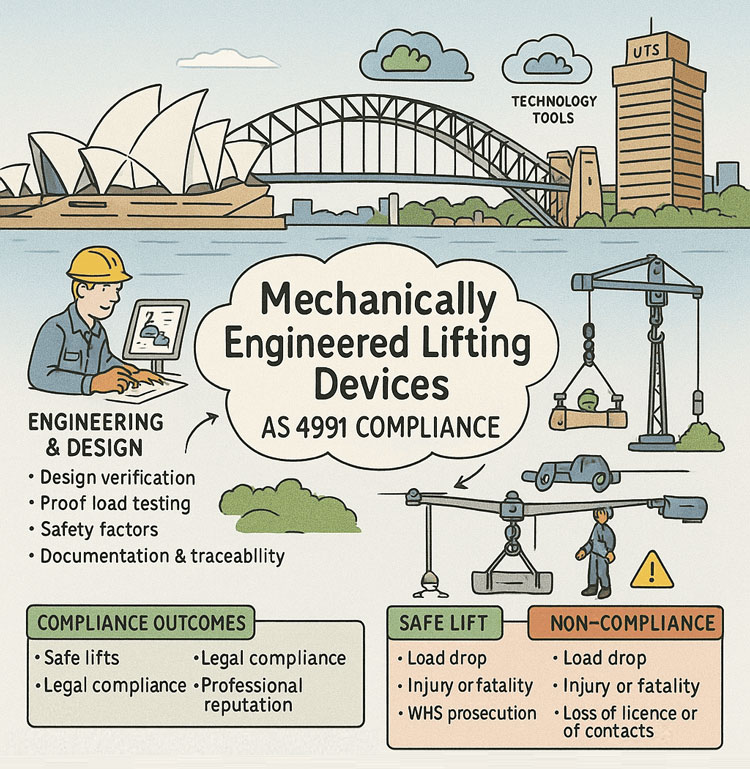
Illustrated infographic explaining AS 4991 mechanically engineered lifting devices, showing engineering design steps, safe lifting practices, compliance outcomes, and non-compliance risks, with Sydney landmarks in the background

3D LiDAR scanning and 3D modelling service button โ€” laser scanner capturing a point cloud for engineering and CAD modelling
Mechanical engineering services

What AS 4991 Means for Mechanical Engineering in Sydney

AS 4991: Lifting Devices is the Australian benchmark for the design, manufacture, proof testing, and maintenance of all mechanically engineered lifting attachments used with cranes and hoists.

It covers:

  • Design verification by qualified engineers
  • Proof load testing (typically 1.5 times the Working Load Limit)
  • Identification markings such as WLL, serial number, and manufacture date
  • Regular inspection and maintenance schedules
  • Documented certification and traceability

For Sydney-based mechanical engineering projects โ€” from Parramattaโ€™s commercial developments to the infrastructure of the Eastern Suburbs โ€” these requirements ensure every lift is carried out with confidence and safety.


The Role of Mechanical Engineers in Safe Lifting

Mechanical engineers play a vital role in ensuring every lifting device performs predictably under real-world conditions. Each lifting beam, frame, or clamp must be:

  • Designed for static and dynamic loading
  • Resistant to fatigue, buckling, and corrosion
  • Built from materials tested for strength and durability
  • Verified through engineering analysis and proof testing

By applying AS 4991, mechanical engineers in Sydney create lifting devices that not only meet technical standards but also withstand the operational demands of construction, mining, and industrial settings across New South Wales.


Why Non-Compliance is Never Worth the Risk

Sydneyโ€™s worksites are under strict safety scrutiny, and incidents involving lifting equipment failures have resulted in serious injuries, fatalities, and prosecutions.

Examples from across Australia include:

  • Unmarked or uncertified lifting beams that failed under load due to poor design.
  • Vacuum lifters that detached unexpectedly after seals deteriorated from lack of inspection.
  • Improvised lifting points on machinery leading to crush injuries and WHS enforcement actions.

These events share a common cause: failure to meet the design, inspection, and documentation requirements of AS 4991.

For any mechanical engineering lift in Sydney, non-compliance risks not just equipment damage but also:

  • Work Health and Safety (WHS) prosecutions
  • Civil negligence claims
  • Loss of accreditation and contracts
  • Damage to professional reputation

While AS 4991 is not legislation, it defines the expected standard of care under Australiaโ€™s WHS laws. Regulators such as SafeWork NSW use compliance with standards like AS 4991 as evidence of due diligence.

For mechanical engineers, fabricators, and construction managers, compliance means:

  • Designs verified by competent engineers
  • Devices tested and certified to meet load requirements
  • Inspection records that prove ongoing safety
  • Training to ensure operators understand correct usage

In Sydneyโ€™s competitive engineering market, adherence to AS 4991 isnโ€™t just about avoiding penalties โ€” itโ€™s about demonstrating leadership in professional safety.


Building a Culture of Inspection and Traceability

A key part of AS 4991 is documentation. Each lifting device should have a design verification report, proof load certificate, and inspection record.
This traceability ensures that every lift on a Sydney site can be traced back to certified engineering.

Companies should maintain:

  • A register of lifting devices with serial numbers and inspection dates
  • Clear tagging systems for quick identification
  • Routine re-certification for high-use environments
  • Operator awareness training on compliance indicators

These processes turn safety standards into practical habits that protect workers and ensure smooth site operations.


Mechanical Engineering Lift Sydney: Innovation Meets Safety

Sydney is a hub of engineering innovation, with advanced tools like 3D scanning, LiDAR, and Finite Element Analysis (FEA) enhancing how lifting devices are designed and validated.

At Hamilton By Design, our mechanical engineers use these technologies to create custom lifting systems for complex sites across Sydney โ€” from tight urban projects in Chatswood and Parramatta to industrial installations in the Inner West.

Yet, even with the latest modelling tools, every design is checked against AS 4991 to guarantee that each lift meets both engineering and safety expectations.


Conclusion: Lifting Sydney Safely

In mechanical engineering, safety begins long before the crane hook rises. It starts with standards โ€” and in Australia, AS 4991 is the foundation.

For every mechanical engineering lift in Sydney, compliance ensures more than safety: it provides reliability, traceability, and peace of mind. By following the standard, engineers not only protect lives but also elevate the quality and professionalism of Sydneyโ€™s construction and manufacturing industries.

At Hamilton By Design, our commitment is simple: lift Sydney safely, lift with engineering excellence, and lift to the standard โ€” AS 4991.


Hamilton By Design logo displayed on a blue tilted rectangle with a grey gradient background

Hamilton By Design provides engineering-led 3D scanning, LiDAR scanning, mechanical engineering and digital engineering services throughout Sydney and Greater Sydney.

Explore our related Sydney services:


  • 3D Scanning Sydney โ€“ Engineering-grade terrestrial laser scanning, as-built surveys and point cloud capture for industrial, infrastructure and commercial projects.
  • Reality Capture Sydney โ€“ High-accuracy reality capture, digital twins, asset documentation and engineering-grade site verification.
  • Scan to CAD Sydney โ€“ Convert point cloud data into AutoCAD, SolidWorks, Inventor and other engineering-ready CAD deliverables.
  • Point Cloud Modelling Sydney โ€“ Engineering-grade point cloud processing, clash detection, as-built verification and 3D modelling.
  • Mechanical Engineering Sydney โ€“ Mechanical design, plant upgrades, materials handling systems, conveyors, chutes, platforms and engineering support.
  • Structural Drafting Sydney โ€“ Structural steel drafting, fabrication drawings, GA drawings, workshop detailing and as-built documentation.

Hamilton By Design supports projects throughout Sydney CBD, Parramatta, Liverpool, Penrith, Blacktown, Chatswood, Alexandria, Mascot, Newcastle and the Central Coast.


Our clients:

Name
Would you like us to arrange a phone consultation for you?
Address
Blue banner graphic displaying the text "Point Cloud to CAD - Australia" in large white lettering, representing point cloud processing, scan-to-CAD conversion and digital engineering services across Australia.
Blue banner graphic displaying the text "Scan to CAD Sydney" in large white lettering, representing engineering-led point cloud to CAD conversion, LiDAR scanning and digital engineering services in Sydney.
Blue banner graphic displaying the text "Reality Capture Sydney - CBD" in large white lettering, representing engineering-led reality capture, LiDAR scanning and digital engineering services within Sydney CBD commercial buildings and infrastructure.

Mechanical Engineering | Structural Engineering


Why Millimeter Precision Matters

When youโ€™re fabricating or installing mechanical, structural or piping components on site, even a small misalignment of a few millimeters can lead to costly rework, construction delays, and wasted resources.

Thatโ€™s why โ€œgood enoughโ€ isnโ€™t good enough. For modern projects โ€” especially in mining, processing, retrofit, or shutdown environments โ€” you need millimeter precision.

At Hamilton By Design, we combine LiDAR 3D scanning, advanced point-cloud processing, and robust 3D modelling to capture the exact as-built conditions of your site โ€” delivering accurate, install-ready digital models that reduce risk and increase confidence.


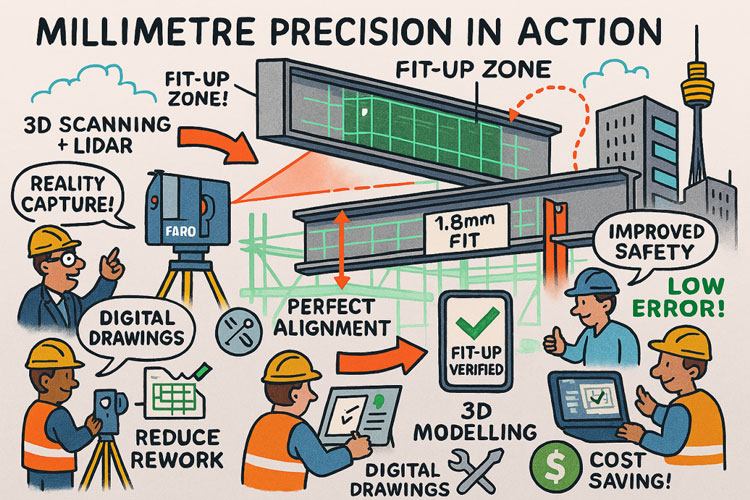
Illustrated graphic showing millimetre precision in action using 3D scanning and LiDAR to verify a 1.8 mm fit-up, with digital drawings, 3D modelling, reduced rework, cost savings, and improved safety during structural alignment.

What Is LiDAR 3D Scanning โ€” And Why It Gives True Precision

LiDAR (Light Detection and Ranging) uses laser-based scanning to generate detailed, high-density point cloud data that reflects the real-world geometry of your plant, structure or equipment. Traditional surveying and manual measurements can introduce errors and assumptions โ€” but LiDAR captures actual surfaces, edges, and spatial relationships without guesswork. Hamilton By Design+2Measure Australia+2

With a properly calibrated LiDAR system and experienced processing, itโ€™s possible to achieve high repeatability and precision, generating data that forms a reliable foundation for 3D CAD or BIM modelling. Measure Australia+1


From Scan to 3D Model: How We Turn Data into Build-Ready Accuracy

Once the LiDAR scan is complete, Hamilton By Designโ€™s workflow transforms raw point-cloud data into intelligent 3D CAD models:

  • Clean and register the point cloud to remove noise or distortions
  • Rebuild accurate geometry (structural frames, piping, equipment surfaces)
  • Import into major CAD/BIM platforms (e.g. SolidWorks, AutoCAD, Revit, Plant 3D) for seamless integration with your design workflows Hamilton By Design
  • Perform clash detection, alignment checks, and clearance validation before fabrication
  • Generate fabrication-ready drawings and installation documentation

This digital-first workflow delivers confidence that whatโ€™s built in the shop will fit perfectly on site โ€” first time.


Key Benefits of Millimeter-Precision LiDAR Scanning & 3D Modelling

  • True-to-site accuracy โ€” Reduce guesswork; measure the real plant geometry. Fibrox 3D+1
  • Less rework, fewer delays โ€” Early clash detection means fewer surprises during installation. Hamilton By Design
  • Faster turnaround โ€” Rapid data capture, even in complex or hard-to-access zones. Fibrox 3D+1
  • Improved safety โ€” Scan from a safe distance; limit time in hazardous environments. Hamilton By Design
  • Better coordination across disciplines โ€” Mechanical, structural, and piping engineers all working from the same accurate model. Hamilton By Design

Who Benefits โ€” Applications That Demand Precision

This level of accuracy is critical for:

  • Mining and mineral-processing plants (brownfield upgrades, retrofit)
  • Oil, gas, and energy facilities
  • Heavy manufacturing and industrial plants
  • Water and wastewater treatment plants
  • Shutdown / maintenance / upgrade projects with tight tolerances

No matter how complex the site or tight the installation requirements, LiDAR-based scanning + precise 3D modelling removes the guesswork. Hamilton By Design


Real-World Outcomes: What Clients Actually See

Clients who adopt our millimeter-precision workflow often report:

  • Up to 50% reduction in on-site rework
  • Faster install times and shorter shutdown windows
  • Smooth cross-discipline collaboration
  • Higher quality fabrication and installation finishes

By identifying spatial conflicts before procurement or fabrication, projects run smoother โ€” saving time, materials, and risk. Hamilton By Design


Why โ€œMillimeter Precision Through LiDAR Scanningโ€ Is More Than Just a Buzzphrase

Some 3D scanning or survey methods capture approximate geometry โ€” fine for rough layout, but insufficient for precision fabrication and fit-up.

With high-quality LiDAR scanning, proper registration, and careful modelling, we deliver real millimeter-level precision โ€” the kind that avoids costly rework, ensures first-fit alignment, and delivers project certainty.

If your project demands this level of accuracy โ€” whether for plant upgrades, mechanical fit-up, pipe spooling, structural retrofits or brownfield refurbishments โ€” you need the reliability that only a LiDAR-based digital workflow can deliver.


Talk to Hamilton By Design: Get Millimeter-Accurate Data That Fits

If your next project needs tight tolerances, retrofit accuracy, or complex mechanical fit-ups, our team can help. Based in Australia but working nationwide โ€” combining cutting-edge scanning tech with real-world engineering know-how.

Email: [email protected]
Website: www.hamiltonbydesign.com.au

Capture. Model. Design. Deliver โ€” with millimeter precision, every time.

3D CAD Modelling | 3D Scanning

Hamilton By Design logo displayed on a blue tilted rectangle with a grey gradient background

Mechanical Engineering | Structural Engineering

Hamilton By Design

Our clients:

Name
Would you like us to arrange a phone consultation for you?
Address
3D LiDAR scanning and 3D modelling service button โ€” laser scanner capturing a point cloud for engineering and CAD modelling
Mechanical engineering services
Finite Element Analysis (FEA) engineering simulation button
Mechanical engineering services

NSW Central Coast

The Unique Character of the NSW Central Coast

The Central Coast of New South Wales is a region defined by balance โ€” where coastal living meets industrial progress, and where families, businesses, and innovation all thrive together. Perfectly positioned between Sydney and Newcastle, the Central Coast offers the advantages of urban connectivity without sacrificing the relaxed pace and natural beauty of a regional lifestyle.


Composite image of three scenic coastal landscapes from the NSW Central Coast, with the text โ€˜NSW Central Coast โ€“ A Great Place for Businessโ€™ displayed below

A Great Place to Raise a Family

The Central Coast is widely recognised as one of Australiaโ€™s most liveable regions. With its pristine beaches, lakes, and bushland, it provides an exceptional environment for families seeking space, safety, and community.
The area features quality schools, TAFE NSW campuses, and the University of Newcastleโ€™s Ourimbah campus โ€” offering pathways from education to skilled employment close to home. Local parks, sports clubs, and community centres strengthen neighbourhood connections, while the mild coastal climate supports year-round outdoor living.

Families enjoy affordable housing, short commute times, and access to both Sydney and Newcastle via the M1 Pacific Motorway and rail network. This lifestyle balance makes the Central Coast a region where professionals can build meaningful careers while enjoying family life in a welcoming, coastal community.


3D LiDAR scanning services on the Central Coast providing engineering-grade laser scanning, point cloud capture, scan-to-CAD modelling and industrial reality capture for infrastructure and industrial projects.
Drafting services on the Central Coast providing engineering drawings, fabrication detailing, as-built documentation, reverse engineering and CAD drafting for industrial and infrastructure projects.
Mechanical engineering services on the Central Coast providing industrial design, plant inspections, pump calculations, reverse engineering and engineering support for manufacturing, infrastructure and heavy industry projects.

A Thriving Region for Business and Industry

Beyond its lifestyle appeal, the Central Coast has evolved into one of NSWโ€™s most active regional economies.
Centred around Wyong, Tuggerah, Somersby, and West Gosford, the regionโ€™s industrial estates host a diverse range of businesses in manufacturing, logistics, food processing, engineering, and advanced fabrication.

Infrastructure investment continues to strengthen the local economy, with upgrades to road, rail, and utilities improving connectivity and efficiency. This makes the region an attractive base for both established firms and growing enterprises.

For companies involved in mechanical engineering, fabrication, and industrial design, the Central Coast provides ready access to skilled tradespeople, degree-qualified engineers, and specialised suppliers. The strong network of local industries encourages collaboration, innovation, and shared growth.


Engineering and Innovation on the Central Coast

Mechanical engineering plays a vital role in the regionโ€™s industrial success.
Local firms design and build systems for manufacturing, water management, food processing, and construction โ€” translating mechanical calculations and CAD drawings into reliable, real-world solutions.

Mechanical engineers on the Central Coast contribute to:

  • The design of platforms, frames, and lifting systems.
  • Efficiency upgrades in manufacturing and packaging plants.
  • Water treatment and stormwater infrastructure.
  • Automation and materials handling systems.

These services support not only local companies but also council and state infrastructure projects, helping the region grow sustainably while maintaining technical excellence.


Strong Community, Strong Opportunity

What makes the Central Coast unique is its sense of community. Businesses here operate in a collaborative environment where partnerships often extend beyond contracts โ€” where reputation, reliability, and relationships truly matter.
The Central Coast Council, Regional Development Australia, and Central Coast Industry Connect provide active support to local enterprises, fostering innovation and sustainable development.

With an expanding population of more than 340,000 people, demand for skilled services, reliable infrastructure, and technical design continues to grow. This creates consistent opportunities for engineering firms to contribute to the regionโ€™s progress.


A Balanced Future

The Central Coast stands out as a region where family life and business success go hand in hand.
It offers the resources of a major industrial hub, the natural appeal of a coastal community, and the connectivity of a key transport corridor. For companies and professionals in mechanical engineering, it provides the ideal setting to live, work, and build for the future โ€” combining technical innovation with quality of life.

Mechanical Engineering | Structural Engineering

Hamilton By Design logo displayed on a blue tilted rectangle with a grey gradient background

Mechanical Drafting | Structural Drafting

3D CAD Modelling | 3D Scanning

3D LiDAR Scanning Hunter & Newcastle banner with white text on a blue background promoting engineering-grade laser scanning services for industrial, mining and infrastructure projects across the Hunter Valley and Newcastle region.
Mechanical Engineering Hunter & Newcastle banner promoting mechanical engineering services for mining, industrial plants, power generation, manufacturing and heavy industry throughout the Hunter Valley and Newcastle region.
Structural Drafting Hunter & Newcastle banner promoting structural drafting services for mining, industrial plants, power generation, manufacturing and infrastructure projects across the Hunter Valley and Newcastle region.

Our clients:

Name
Would you like us to arrange a phone consultation for you?
Address

3D Scanning Sydney banner promoting engineering-grade 3D laser scanning, LiDAR scanning, and reality capture services by Hamilton By Design.
Mechanical Engineering Sydney banner with white text on a blue background representing Hamilton By Design's mechanical engineering services in Sydney.
Mechanical Drafting and 3D Modelling Sydney banner highlighting Hamilton By Design's CAD drafting, 3D modelling, and engineering design services in Sydney.

Mechanical Engineering | Structural Engineering


AutoCAD Is Still in the 1980s โ€” Gasping for Air in a 3D World

In the 1980s, AutoCAD was revolutionary. It replaced drafting boards and sharpened pencils with a digital drawing tool. Architects, engineers, and designers suddenly had a new way to bring ideas to life โ€” faster, cleaner, and more accurate than ever before.

But hereโ€™s the problem: itโ€™s 2025 now, and AutoCAD is still trying to breathe the same thin air it did back then.

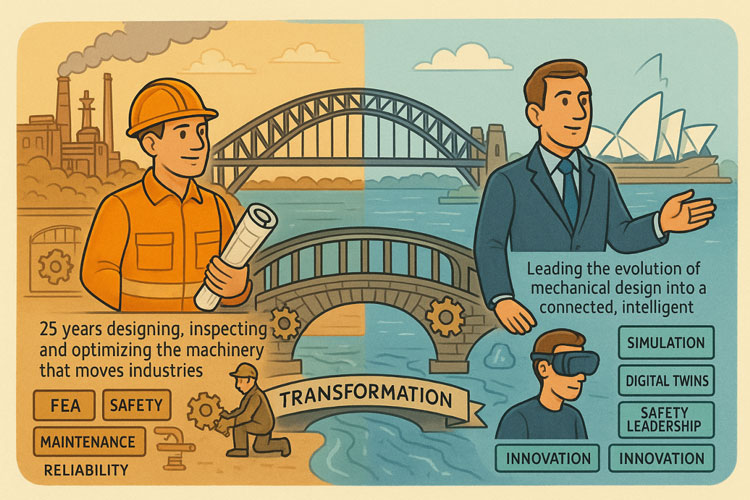
Illustrated comparison showing traditional mechanical engineering on one side and modern digital engineering on the other, with the Sydney Harbour Bridge and Opera House in the background, highlighting themes of maintenance, safety, reliability, simulation, digital twins, and innovation.

Stuck in 2D While the World Moved On

Todayโ€™s engineering isnโ€™t about drawing โ€” itโ€™s about designing.
Itโ€™s about simulating real-world forces, visualizing assemblies, testing tolerances, and producing manufacturable parts before a single prototype is built.

AutoCAD, at its core, is still a 2D drafting platform trying to wear a 3D mask. The workflows are fragmented, the feature set feels patched together, and it lacks the intelligence modern teams demand.

By contrast, SOLIDWORKS was built for this century โ€” fully parametric, model-driven, and collaborative. When you make a change to a design in SOLIDWORKS, every part, drawing, and assembly updates instantly. Thatโ€™s not an upgrade; thatโ€™s evolution.


Design Needs Intelligence, Not Layers

AutoCAD still asks you to think in layers and lines โ€” the language of draftsmen.
SOLIDWORKS speaks the language of relationships, assemblies, and constraints โ€” the language of engineers and innovators.

Modern design tools must integrate simulation, visualization, and manufacturability. They must predict behavior, test fit, and optimize before production. AutoCAD just canโ€™t breathe in that environment anymore โ€” itโ€™s stuck flipping between tabs while SOLIDWORKS users are already printing parts.


Collaboration and Data: The New Oxygen

The world doesnโ€™t design in isolation anymore. Teams are global, deadlines are tighter, and innovation cycles are shorter.
AutoCADโ€™s file-based approach is like passing blueprints across a fax machine.

SOLIDWORKS integrates cloud data management, real-time collaboration, and digital twin technology โ€” letting design teams iterate and innovate in real time, anywhere in the world.


The Future Is 3D โ€” and Itโ€™s Already Here

You wouldnโ€™t build an electric vehicle using a typewriter.
So why design modern products with 1980s software?

SOLIDWORKS represents the present and the future โ€” intelligent modeling, simulation-driven design, and integrated manufacturing tools that push boundaries instead of tracing them.

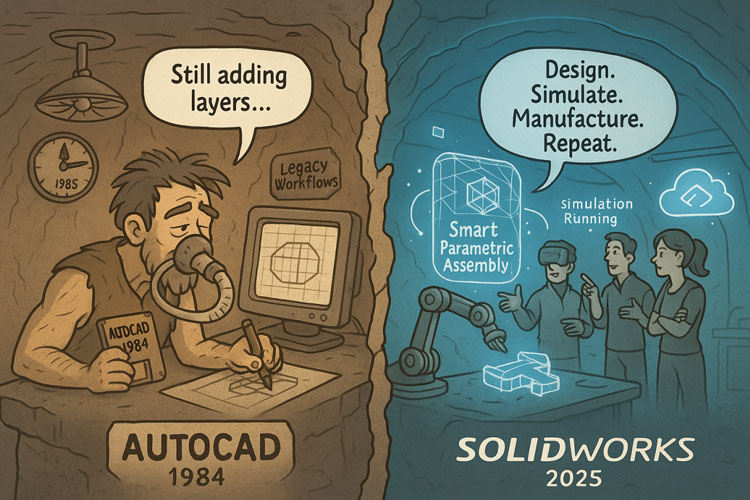
Humorous comparison illustration showing outdated AutoCAD workflows from 1984 versus modern SolidWorks 2025 with smart parametric assembly, simulation, and advanced design automation

Final Thoughts

AutoCAD made history โ€” no one can deny that. But history belongs in the museum, not the manufacturing floor.

If your software is still gasping for air in a 2D world, maybe itโ€™s time to give it a well-earned retirement.
SOLIDWORKS doesnโ€™t imitate innovation โ€” it defines it.

Mechanical Engineers in Sydney

Hamilton By Design logo displayed on a blue tilted rectangle with a grey gradient background

3D Scanning Sydney

Engineering Services

Our clients:

Name
Would you like us to arrange a phone consultation for you?
Address
3D LiDAR scanning and 3D modelling service button โ€” laser scanner capturing a point cloud for engineering and CAD modelling
Mechanical engineering services
Finite Element Analysis (FEA) engineering simulation button
Mechanical engineering services

3D Scanning Sydney banner promoting engineering-grade 3D laser scanning, LiDAR scanning, and reality capture services by Hamilton By Design.
Mechanical Engineering Sydney banner with white text on a blue background representing Hamilton By Design's mechanical engineering services in Sydney.
Mechanical Drafting and 3D Modelling Sydney banner highlighting Hamilton By Design's CAD drafting, 3D modelling, and engineering design services in Sydney.

Mechanical Engineering | Structural Engineering