Engineering Confidence: Using FEA to Validate Real-World Designs

Mechanical engineering has always been a balance between creativity and certainty.
Every bracket, frame, chute, or structural support we design must perform under real loads, temperatures, and conditions โ€” often in environments where failure simply isnโ€™t an option.

Thatโ€™s where Finite Element Analysis (FEA) earns its place as one of the most powerful tools in modern design. It allows engineers to move from assumption to verification โ€” transforming the way we predict, test, and optimise mechanical systems.


What Is FEA โ€” and Why It Matters

FEA divides complex geometry into a network of small, interconnected elements.
By solving the physical equations that govern stress, strain, and displacement across those elements, engineers can predict how a structure behaves under load, vibration, or temperature.

Instead of relying solely on hand calculations or over-built safety factors, FEA provides quantitative insight into performance โ€” letting us see where structures flex, where stress concentrates, and how design choices affect real-world outcomes.

In mechanical engineering, that means fewer prototypes, lower material costs, and far greater design confidence.


1. Static Analysis โ€” The Foundation of Structural Validation

Static linear analysis is the foundation of most FEA work.
It evaluates how a structure responds to steady, time-independent loads such as gravity, pressure, or fixed equipment weight.

Through static analysis, engineers can:

  • Visualise stress and displacement distribution across a part or assembly.
  • Evaluate safety factors under different loading conditions.
  • Check stiffness and material utilisation before fabrication.
  • Identify weak points or stress concentrations early in design.

This baseline validation is the difference between a design that โ€œshouldโ€ work and one that will.


2. Assembly-Level Simulation โ€” Seeing the Whole System

Few machines fail because a single part breaks.
Most failures happen when components interact under load โ€” bolts shear, brackets twist, or welds experience unplanned tension.

FEA allows engineers to simulate entire assemblies, including:

  • Contact between parts (bonded, sliding, or frictional).
  • Realistic boundary conditions such as bearings, springs, or pinned joints.
  • The influence of welds, fasteners, or gaskets on overall performance.

This system-level view helps mechanical engineers design not only for strength, but also for compatibility and reliability across the full structure.


3. Mesh Control โ€” Accuracy Where It Counts

A simulation is only as good as its mesh.
By controlling element size and density, engineers can capture critical detail in stress-sensitive regions like fillets, bolt holes, and weld toes.

Modern FEA tools use adaptive meshing โ€” refining the model automatically in areas of high stress until the solution converges.
That means precise, efficient results without excessive computation time.


4. Thermal-Structural Interaction โ€” When Heat Becomes a Load

Many mechanical systems face thermal as well as mechanical challenges.
Whether itโ€™s ducting in a process plant or hoppers near heat sources, temperature gradients can cause expansion, distortion, or thermal stress.

FEA allows engineers to:

  • Model steady-state or transient heat transfer through solids.
  • Apply convection, radiation, or temperature boundary conditions.
  • Combine thermal and structural analyses to study thermal expansion and thermal fatigue.

Understanding how heat and load combine helps ensure equipment remains stable, safe, and accurate throughout its lifecycle.


5. Modal and Buckling Analysis โ€” Designing Against Instability

Some risks are invisible until theyโ€™re simulated.
Vibration and buckling are two of the most overlooked โ€” yet most common โ€” causes of structural failure.

Modal Analysis

Determines a structureโ€™s natural frequencies and mode shapes, helping designers avoid resonance with operating machinery, fans, or conveyors.

Buckling Analysis

Predicts the critical load at which slender members or thin-walled panels lose stability โ€” allowing engineers to reinforce and optimise designs early.

By identifying these limits before fabrication, engineers can prevent problems that are expensive and dangerous to discover on site.


Design Optimisation โ€” Smarter, Lighter, Stronger

Good design is rarely about adding material; itโ€™s about using it wisely.
FEA supports parametric and goal-based optimisation, enabling engineers to vary geometry, thickness, or material and automatically test multiple configurations.

You can set objectives such as:

  • Minimising weight while maintaining strength.
  • Reducing deflection under fixed loads.
  • Optimising gusset or flange size for stiffness.

This process of โ€œdigital lightweightingโ€ drives better performance and cost efficiency โ€” especially valuable in industries where both material and downtime are expensive.


7. Communication and Confidence

FEA isnโ€™t only a calculation tool โ€” itโ€™s a communication tool.
Colour-coded plots, animations, and automated reports make it easier to explain complex mechanical behaviour to project managers, clients, or certifying bodies.

Clear visuals turn stress distributions and displacement fields into a shared language โ€” helping stakeholders understand why certain design choices are made.


Real-World Applications Across Mechanical Engineering

ApplicationType of AnalysisKey Benefit
Chutes & HoppersStatic + BucklingConfirm wall thickness and frame design for structural load and vibration
Conveyor FramesModal + StaticAvoid resonance and ensure adequate stiffness
Pressure EquipmentThermal + StaticEvaluate thermal stress and hoop stress under load
Machine BracketsStatic + OptimisationReduce weight while maintaining rigidity
Platforms & GuardingBucklingValidate stability under safety loading
Welded Frames & SupportsStaticCheck deformation, stress, and weld performance

These examples show how FEA becomes an everyday design partner โ€” embedded in the workflow of mechanical engineers across manufacturing, resources, and infrastructure.


The Engineerโ€™s Advantage: Data Over Assumption

In traditional design, engineers often relied on prototypes and conservative safety factors.
Today, simulation delivers the same assurance โ€” without the waste.

By applying FEA early in the design cycle, mechanical engineers can:

  • Predict failure modes before they occur.
  • Shorten development time.
  • Reduce material usage.
  • Justify design decisions with quantitative proof.

FEA enables engineers to focus less on guesswork and more on innovation โ€” designing structures that are both efficient and dependable.


Engineering Integrity in Practice

At Hamilton By Design, we integrate FEA into every stage of mechanical design and development.
Itโ€™s how we ensure that every frame, chute, and mechanical system we deliver performs as intended โ€” safely, efficiently, and reliably.

We use FEA not just to find the limits of materials, but to push the boundaries of design quality โ€” delivering engineering solutions that last in the toughest industrial environments.

Design backed by data isnโ€™t a slogan โ€” itโ€™s how we engineer confidence.


Building a Culture of Verified Design

When FEA becomes part of everyday engineering culture, it changes how teams think.
Designers begin to see structures not just as drawings, but as living systems under real forces.

That shift builds trust โ€” between engineer and client, between concept and reality.
Itโ€™s what defines the future of mechanical design: informed, optimised, and proven before the first bolt is tightened.


3D LiDAR scanning and 3D modelling service button โ€” laser scanner capturing a point cloud for engineering and CAD modelling
Mechanical engineering services
Finite Element Analysis (FEA) engineering simulation button
Mechanical engineering services

3D Scanning Sydney banner promoting engineering-grade 3D laser scanning, LiDAR scanning, and reality capture services by Hamilton By Design.
Mechanical Engineering Sydney banner with white text on a blue background representing Hamilton By Design's mechanical engineering services in Sydney.
Mechanical Drafting and 3D Modelling Sydney banner highlighting Hamilton By Design's CAD drafting, 3D modelling, and engineering design services in Sydney.

Mechanical Engineering | Structural Engineering


TAFE Australia: How Owning the VET Space Could Transform Skills, GDP, and Housing

Australia is at an inflection point. For decades, weโ€™ve debated the skills shortage, the housing crisis, and the disconnect between education and industry. What if the solution wasnโ€™t three separate reforms โ€” but one bold move?

Imagine if TAFE became the sole provider of vocational education and training (VET), phasing out the patchwork of private colleges over five years. Then imagine that re-built national system being spun out as a listed or privately held company โ€” โ€œTAFE Australia Ltdโ€ โ€” with government oversight but commercial freedom.

Add one more layer: before any student (local or international) enters university, they complete a TAFE English bridging course to lift language, employability, and readiness.

It sounds ambitious. But the economic logic is powerful โ€” and the housing implications could be profound.


1. A Unified Skills Engine

Australia currently has over 4,000 registered training organisations (RTOs) โ€” most of them private. Quality varies wildly, completion rates hover around 55 %, and duplication wastes billions.

Consolidating all vocational training under a single national brand โ€” TAFE Australia โ€” would fix that fragmentation.
Over five years, TAFE would absorb or teach out private providers, modernise workshops, and scale capacity.

Once stable, corporatisation (either ASX-listing or private equity with a public charter) could inject capital for new campuses, digital delivery, and industry-specific facilities โ€” especially in construction, renewable energy, aged care, and advanced manufacturing.


2. Short-Term Pain, Long-Term Productivity

The transition wouldnโ€™t be painless. For the first two or three years:

  • Training capacity would dip as private RTOs wind down.
  • Labour shortages in construction might worsen temporarily.
  • Housing completions could fall 5โ€“10 %, keeping rents tight.

But once the new TAFE pipeline matures, the effects reverse dramatically.

By year 6 to 8, completions of apprentices and trade certificates could rise by 20โ€“30 %.
That translates into 10โ€“15 % more homes built each year โ€” roughly 30,000 extra dwellings โ€” easing vacancy rates and stabilising prices.


3. GDP: From Cost to Growth Driver

The macro picture is surprisingly strong.

HorizonEconomic effectApproximate GDP impact
Years 1โ€“3Transition costs, slower training outputโˆ’0.2 % to โˆ’0.4 % p.a.
Years 4โ€“8Faster housing build, higher productivity+0.5 % to +1.0 % by Year 8
Years 9โ€“12Mature skills base, advanced-industry output+1.5 % to +2.5 % above BAU

Public investment of A$10โ€“15 billion in the build-out is paid back through higher construction output, tax receipts, and exportable VET capacity.
Once corporatised, TAFE Australia could even return A$2โ€“4 billion annually to the budget through dividends, taxes, and reduced subsidies.


4. Housing Supply and Affordability

By the end of the decade, a steady flow of skilled tradies would lift completions from about 170,000 dwellings a year today to 200,000 plus.
More supply means:

  • Vacancies returning to ~2 % (healthy market level)
  • Rent growth slowing to CPI
  • Price-to-income ratios stabilising after years of runaway inflation

Itโ€™s the kind of structural fix that interest-rate tweaks can never deliver.


5. The English Bridging Effect

Requiring every university entrant to complete a TAFE English for Tertiary Readiness (ETR) course has two knock-on benefits:

  1. Quality & completion โ€” domestic and international students arrive better prepared, cutting first-year attrition by up to 5 percentage points.
  2. Housing stability โ€” international students spend their first months in purpose-built student housing (PBSA) or regional campuses instead of competing for scarce CBD rentals.

Itโ€™s a subtle policy lever that improves both education quality and urban housing balance.


6. Fiscal and Governance Model

After corporatisation:

  • Government retains a golden share to enforce price caps and regional-service obligations.
  • TAFE Australia Ltd operates like a regulated utility โ€” commercial, but mission-bound.
  • Public funding shifts from subsidies to outcome-based contracts and income-contingent loans.

The result: less budget drag, more private capital in education, and steady dividends from a profitable, skills-based enterprise.


7. Lessons from Abroad

  • Singaporeโ€™s ITE and Polytechnics show how centralised public training, partnered with industry, can achieve near-full employment for graduates.
  • Germany and Switzerlandโ€™s dual systems prove the value of strong employer alignment and national brand recognition.
  • New Zealandโ€™s Te Pลซkenga warns of transition risk: merging dozens of providers too quickly strains finances and morale. The key is staged rollout and clear accountability.

TAFE Australia could combine Singaporeโ€™s efficiency with Germanyโ€™s apprenticeship culture โ€” if the politics stay disciplined.


8. Risks Worth Managing

RiskMitigation
Temporary trade-skill shortageTransitional grants, accelerated trainer hiring, targeted skilled-migration visas
Fee inflation post-saleCPI-X price caps, HECS-style income-contingent loans
Regional access gapsMandatory campus coverage; cross-subsidy funding model
Bureaucratic inertiaIndependent transition authority; quarterly milestone reporting

9. Why It Matters

This reform links three national priorities:

  1. Skills sovereignty โ€” training Australians (and skilled migrants) for the industries that matter.
  2. Housing affordability โ€” fixing the bottleneck that keeps supply chronically short.
  3. Fiscal responsibility โ€” turning education from a cost centre into a productive asset.

In a single move, Australia could re-engineer its training ecosystem, supercharge GDP growth, and make housing attainable again.


10. The Bigger Picture

For fifty years, weโ€™ve talked about โ€œclosing the skills gapโ€ and โ€œfixing housing.โ€
But those arenโ€™t separate problems โ€” theyโ€™re two sides of the same system.
You canโ€™t build homes without skilled people, and you canโ€™t sustain skilled people without an education system that works.

TAFE Australia Ltd โ€” a single, world-class, commercially driven, publicly accountable provider โ€” could be the bridge between them.

And it might just be the reform that finally lets Australia build its own future again.

Mechanical Engineering | Structural Engineering

3D Scanning Sydney banner promoting engineering-grade 3D laser scanning, LiDAR scanning, and reality capture services by Hamilton By Design.
Mechanical Engineering Sydney banner with white text on a blue background representing Hamilton By Design's mechanical engineering services in Sydney.
Mechanical Drafting and 3D Modelling Sydney banner highlighting Hamilton By Design's CAD drafting, 3D modelling, and engineering design services in Sydney.

Mechanical Drafting | Structural Drafting

3D CAD Modelling | 3D Scanning

Chute Design

SolidWorks Contractors in Australia

Hamilton By Design โ€“ Blog

Custom Designed – Shipping Containers

Coal Chute Design

Mechanical Engineers in Sydney

3D LiDAR scanning and 3D modelling service button โ€” laser scanner capturing a point cloud for engineering and CAD modelling
Mechanical engineering services


Finite Element Analysis (FEA) engineering simulation button
Mechanical engineering services


3D CAD Modelling Australia service banner for Hamilton By Design


CHPP Engineering title graphic featuring bold white text reading "CHPP Engineering" centred on a blue rounded rectangle background.
Pipework Drafting title graphic featuring bold white text reading "Pipework Drafting" centred on a blue rounded rectangle background.
3D LiDAR Scanning for Engineering Projects title graphic featuring bold white text on a blue rounded rectangle background.


Finite Element Analysis (FEA) engineering simulation button
Structural drafting services button
Mechanical drafting services button


Australian Drafting logo featuring bold white text reading "Australian Drafting" centred on a blue rounded rectangle background.
Engineering Governance title graphic featuring bold white text reading "Engineering Governance" centred on a blue rounded rectangle background.
Engineering-Grade LiDAR Scanning title graphic featuring bold white text on a blue rounded rectangle background.


3D Scanning Sydney banner promoting engineering-grade 3D laser scanning, LiDAR scanning, and reality capture services by Hamilton By Design.
Mechanical Engineering Sydney banner with white text on a blue background representing Hamilton By Design's mechanical engineering services in Sydney.
Mechanical Drafting and 3D Modelling Sydney banner highlighting Hamilton By Design's CAD drafting, 3D modelling, and engineering design services in Sydney.

Mechanical Engineering | Structural Engineering


Mechanical Engineers in Sydney โ€“ Hamilton By Design

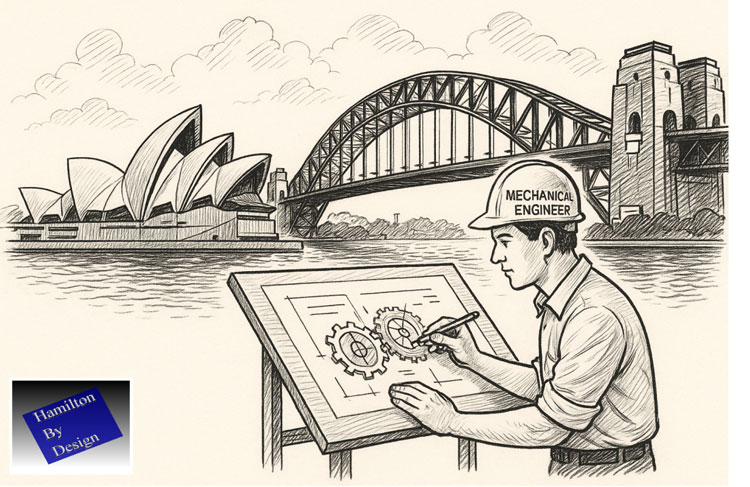
Illustrated mechanical engineer drafting gear designs at a drawing board with the Sydney Opera House and Harbour Bridge in the background, alongside the Hamilton By Design logo

Leading Mechanical Engineers in Sydney

Blue 3D LiDAR scanner icon on a tripod with scanning waves

At Hamilton By Design, we specialise in delivering practical and innovative solutions for industrial, commercial, and infrastructure projects. As experienced mechanical engineers in Sydney, we provide expert services in mechanical design, structural engineering, drafting, and 3D scanning. Our team is committed to helping clients across Sydney achieve safe, cost-effective, and fully compliant project outcomes.


Our Services in Sydney

Mechanical Engineering & Design

  • Custom design of process equipment such as chutes, hoppers, and conveyors
  • Pump and piping system layouts for reliable fluid and material transfer
  • Plant layout optimisation, retrofits, and system upgrades
  • Failure diagnosis, problem-solving, and performance improvement
Infographic outlining Hamilton By Designโ€™s mechanical engineering workflow in Sydney, showing client needs, project intake, 3D LiDAR scanning, point-cloud-to-CAD modelling, drafting, validation, and compliance outcomes such as safe installation, reduced rework, and accurate fit

Structural Engineering

  • Steel structures, platforms, and support framework design
  • Structural modifications and like-for-like replacements
  • Load assessments, foundation design, and audits for compliance
  • Integration of mechanical systems with structural solutions

Drafting & CAD Services

  • Accurate shop drawings, assemblies, and fabrication details
  • P&IDs, BOMs, and detailed documentation for construction and manufacturing
  • Mechanical and structural drafting compliant with Australian Standards
  • CAD drafting that integrates seamlessly with site data

3D Laser & LiDAR Scanning

  • High-precision scans of facilities, plants, and infrastructure in Sydney
  • As-built data capture to reduce costly site visits
  • Point cloud conversion into detailed CAD models
  • Digital twins, clash detection, and retrofit planning
FARO Focus 3D laser scanner mounted on a tripod, used for high-accuracy LiDAR surveying and 3D point-cloud capture

SolidWorks & CAD Contracting

  • Expert SolidWorks design, modelling, and validation
  • Reverse engineering and interference detection
  • Flexible CAD resource support for Sydney businesses and projects

Project Support & Compliance

  • End-to-end project support from concept through to fabrication drawings
  • On-site validation, quality assurance, and safety compliance
  • Independent inspections and reporting for reliable project delivery
  • Collaboration with multidisciplinary teams across Sydney

Why Choose Hamilton By Design?

  • Trusted mechanical engineers in Sydney with national project experience
  • Flexible services tailored to projects of all sizes
  • Advanced tools including SolidWorks, CAD, and LiDAR scanning
  • Proven track record supporting manufacturing, industrial, and infrastructure clients

Hamilton By Design logo displayed on a blue tilted rectangle with a grey gradient background

Industries We Support

Hamilton By Design provides mechanical engineering services throughout Sydney for manufacturing facilities, materials handling systems, water treatment plants, food processing facilities, mining infrastructure, industrial plants and commercial developments.

Our practical engineering experience supports equipment upgrades, plant modifications, shutdown projects, asset improvement initiatives and brownfield engineering works.

Hamilton By Design supports projects throughout Sydney CBD, Parramatta, Liverpool, Penrith, Chatswood, Alexandria, Mascot, Newcastle and the Central Coast with practical mechanical engineering services. Our experience includes materials handling systems, plant upgrades, shutdown engineering, equipment design and brownfield project support.


Our clients:


Looking for reliable mechanical engineers in Sydney to support your next project?
Hamilton By Design offers the expertise and tools to get the job done right.

Mechanical Engineering | Structural Engineering

Hamilton By Design supports projects throughout Sydney CBD, Parramatta, Liverpool, Penrith, Blacktown, Chatswood, Alexandria, Mascot, Newcastle and the Central Coast.


Blue banner graphic displaying the text "Point Cloud to CAD - Australia" in large white lettering, representing point cloud processing, scan-to-CAD conversion and digital engineering services across Australia.
Blue banner graphic displaying the text "Scan to CAD Sydney" in large white lettering, representing engineering-led point cloud to CAD conversion, LiDAR scanning and digital engineering services in Sydney.
Blue banner graphic displaying the text "Reality Capture Sydney - CBD" in large white lettering, representing engineering-led reality capture, LiDAR scanning and digital engineering services within Sydney CBD commercial buildings and infrastructure.

Mechanical Drafting | Structural Drafting

3D CAD Modelling | 3D Scanning

SolidWorks Contractors in Australia

Hamilton By Design โ€“ Blog

Contact Us

Name
Would you like us to arrange a phone consultation for you?
Address
3D Scanning Sydney banner promoting engineering-grade 3D laser scanning, LiDAR scanning, and reality capture services by Hamilton By Design.
Mechanical Engineering Sydney banner with white text on a blue background representing Hamilton By Design's mechanical engineering services in Sydney.
Mechanical Drafting and 3D Modelling Sydney banner highlighting Hamilton By Design's CAD drafting, 3D modelling, and engineering design services in Sydney.

Unlocking the Future of Design

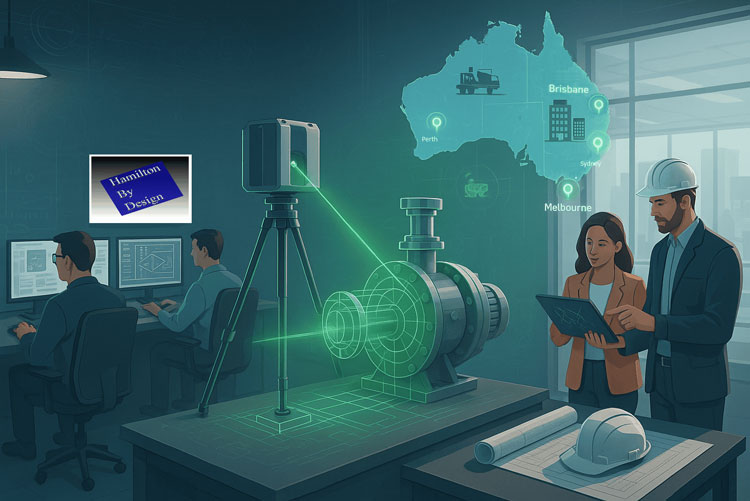
Illustration of an engineering workspace where a tripod-mounted 3D LiDAR scanner captures a green point-cloud of an industrial pump assembly. Two engineers review scan data on a tablet beside technical drawings, while two others model components on computer workstations. A digital map of Australia is displayed in the background, highlighting Hamilton By Designโ€™s service locations including Perth, Brisbane, Sydney, and Melbourne. The scene emphasises advanced 3D scanning, digital engineering, and nationwide support.

3D Laser Scanning & Mechanical Engineering Solutions

In todayโ€™s fast-paced engineering and construction industries, precision and efficiency are everything. Whether youโ€™re managing a large-scale infrastructure project in Brisbane, creating a mechanical prototype in Perth, or needing accurate as-built data for a site in the Hunter Valley, 3D laser scanning and expert mechanical design services are game changers.

At Hamilton By Design, we specialise in connecting cutting-edge scanning technology with skilled mechanical designers and structural drafting services to deliver seamless, accurate solutions for every stage of your project.


The Power of 3D Laser Scanning

3D laser scanning is transforming the way engineers, architects, and manufacturers work. By capturing millions of data points with millimetre accuracy, laser scanning creates a highly detailed 3D representation of your asset, site, or structure.

Our team provides 3D laser scanning services in Perth, Brisbane, and Melbourne, as well as laser scanning in the Hunter Valley, helping clients save time and avoid costly rework. This technology is ideal for:

  • Capturing as-built conditions before design or construction.
  • Supporting plant upgrades and facility expansions.
  • Documenting heritage structures and complex geometries.
  • Reducing site visits with accurate digital models.

Reverse Engineering & Mechanical Design

In addition to scanning, we offer reverse engineering services in Perth and beyond. By combining point cloud data with CAD modelling, we can recreate components, optimise designs, and prepare manufacturing-ready files.

Our mechanical engineers and mechanical designers bring years of experience in 3D mechanical engineering, design and manufacturing mechanical engineering, and problem-solving for a wide range of industries. From bespoke machinery to process equipment, we deliver solutions that work.


Structural Drafting & Project Support

No project is complete without clear, accurate documentation. Our skilled drafters at Hamilton By Design provide high-quality structural drafting services that integrate seamlessly with your workflows.

Whether you need shop drawings, fabrication details, or BIM-ready models, our team ensures every line and dimension is correct โ€” saving you time and cost on-site.


Why Choose Hamilton By Design?

  • Nationwide Reach: Serving clients with 3D scanning services in Perth, Brisbane, and Melbourne, and supporting projects in the Hunter Valley.
  • Complete Solutions: From scanning to modelling to mechanical engineering design.
  • Accuracy & Efficiency: Reduce project risk and improve decision-making with reliable data.
  • Experienced Team: Skilled mechanical engineers and drafters who understand your industry.

Hamilton By Design logo displayed on a blue tilted rectangle with a grey gradient background

Ready to Get Started?

If youโ€™re looking for mechanical engineering companies that deliver precision, innovation, and reliability, Hamilton By Design is ready to help. Whether you need laser scanning in Perth or Brisbane, structural drafting, or full mechanical design services, our team can support your next project from concept to completion.

Contact us today to discuss your project requirements and find out how our 3D laser scanning and mechanical engineering design solutions can save you time and money.


Name
Would you like us to arrange a phone consultation for you?
Address

3D LiDAR scanning and 3D modelling service button โ€” laser scanner capturing a point cloud for engineering and CAD modelling
Mechanical engineering services
Finite Element Analysis (FEA) engineering simulation button
Mechanical engineering services
3D CAD Modelling Australia service banner for Hamilton By Design
3D LiDAR scanning and 3D modelling service button โ€” laser scanner capturing a point cloud for engineering and CAD modelling
Mechanical engineering services
3D CAD Modelling Australia service banner for Hamilton By Design
Mechanical, Structural & Pipework Drafting service banner by Hamilton By Design featuring white text on a blue background.
Australian Drafting logo featuring bold white text reading "Australian Drafting" centred on a blue rounded rectangle background.
Blue banner graphic displaying the text "Point Cloud to CAD - Australia" in large white lettering, representing point cloud processing, scan-to-CAD conversion and digital engineering services across Australia.
CHPP Engineering title graphic featuring bold white text reading "CHPP Engineering" centred on a blue rounded rectangle background.
Engineering Governance title graphic featuring bold white text reading "Engineering Governance" centred on a blue rounded rectangle background.
Mechanical engineering services
Australian Drafting logo featuring bold white text reading "Australian Drafting" centred on a blue rounded rectangle background.
3D LiDAR Scanning Hunter & Newcastle banner with white text on a blue background promoting engineering-grade laser scanning services for industrial, mining and infrastructure projects across the Hunter Valley and Newcastle region.
Mechanical Engineering Hunter & Newcastle banner promoting mechanical engineering services for mining, industrial plants, power generation, manufacturing and heavy industry throughout the Hunter Valley and Newcastle region.
Structural Drafting Hunter & Newcastle banner promoting structural drafting services for mining, industrial plants, power generation, manufacturing and infrastructure projects across the Hunter Valley and Newcastle region.
Mechanical Engineering Perth WA banner for Hamilton By Design featuring white text on a blue background.
3D Laser Scanning Perth WA banner for Hamilton By Design with white text on a blue background.
SolidWorks Perth WA banner for Hamilton By Design featuring white text on a blue background.
Fabrication and product design services
Finite Element Analysis (FEA) engineering simulation button
3D LiDAR scanning and 3D modelling service button โ€” laser scanner capturing a point cloud for engineering and CAD modelling
Blue rounded button with the text โ€œSolidWorks Designโ€ in white.
Mechanical drafting services button
Structural drafting services button

3D Scanning Sydney banner promoting engineering-grade 3D laser scanning, LiDAR scanning, and reality capture services by Hamilton By Design.
Mechanical Engineering Sydney banner with white text on a blue background representing Hamilton By Design's mechanical engineering services in Sydney.
Mechanical Drafting and 3D Modelling Sydney banner highlighting Hamilton By Design's CAD drafting, 3D modelling, and engineering design services in Sydney.

Mechanical Engineering | Structural Engineering


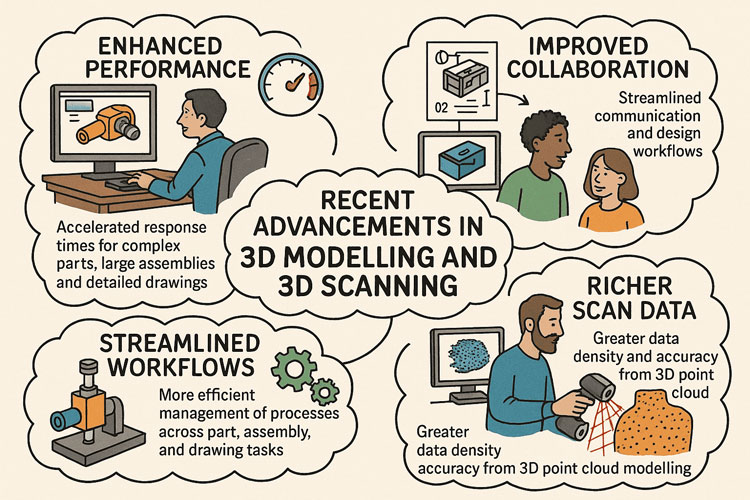
Next-Generation 3D Modelling & Scanning Advances in 2025

Illustrated infographic titled โ€œRecent Advancements in 3D Modelling and 3D Scanning.โ€ It features four themed sections around a central title. โ€œEnhanced Performanceโ€ shows a person working on a computer with faster response times for complex parts and assemblies. โ€œImproved Collaborationโ€ depicts two people discussing streamlined design communication. โ€œStreamlined Workflowsโ€ shows a microscope and gears representing improved management of part, assembly, and drawing processes. โ€œRicher Scan Dataโ€ shows a technician scanning an object and a computer displaying a dense point cloud model, emphasising greater accuracy and data density. The overall image highlights modern improvements in modelling, collaboration, workflows, and point cloud scanning.

1. Collaboration and Data Management

Collaboration is increasingly centred around 3D data. Modern platforms now let teams review, comment on, and markup native 3D models directly inside the design environment. Instead of relying solely on screenshots or static drawings, stakeholders can spin, section, and measure live models for better context. Real-time update notifications and cloud-connected revision control ensure that scanned 3D data and parametric CAD models stay synchronized โ€” critical when working with reality capture data that represents the as-built environment. Hybrid data management options combine local PDM systems with cloud platforms, supporting distributed teams handling massive point clouds or mesh data. This tight integration means that model changes โ€” whether from new design iterations or updated scans โ€” propagate instantly across the project team. Decision-making becomes more visual and informed, keeping everyone aligned around a single, authoritative 3D dataset. Collaboration is no longer a separate process but embedded into daily 3D workflows.


2. Smarter Part Modelling

3D modelling tools are now more intelligent and better suited for working with scan-derived geometry. Designers can quickly apply chamfers, fillets, and shells across complex surfaces, even those imported from meshes or point cloud extractions. Automated bend notch creation and sheet metal tools are optimized to work with geometry derived from scanning existing parts, making reverse-engineering and fabrication preparation much faster. Reference geometry patterning allows engineers to build parametric frameworks over point cloud regions, speeding up master model creation. Cleanup utilities now support selectively removing unnecessary features or smoothing noisy scan data without rebuilding the entire model history. These advances turn what used to be a labour-intensive process into a streamlined workflow that transforms raw reality capture data into production-ready models. The focus is on reducing friction between physical and digital โ€” allowing engineers to move quickly from scan to design, then to manufacturing.


3. Large Assembly Performance

Point cloud and mesh datasets are often extremely large, so performance improvements are critical. Modern CAD platforms now handle assemblies containing both traditional parametric models and massive scan data without bringing systems to a crawl. Engineers can duplicate components while maintaining mates, overlay scans onto assemblies to check fit, and perform interference detection even in lightweight modes. Visualization performance has been tuned for high-density point clouds, allowing smooth pan, zoom, and rotate interactions even with billions of points. Simplification and decimation tools let users strip out unneeded scan detail for faster load times while retaining critical geometry. Seamless transitions between lightweight review and full edit mode make it possible to work interactively with scanned environments. This capability is especially valuable for plant layout, construction validation, and retrofitting projects, where the ability to handle large, mixed-format 3D datasets directly within assemblies is a competitive advantage.


4. Enhanced Drawings and Documentation

Although 3D is the primary medium, 2D documentation remains essential โ€” especially for suppliers and manufacturing partners. Modern CAD environments generate drawings directly from parametric models or scan-based reconstructions, ensuring that documentation matches the latest as-built conditions. Multi-approval stamps, BOM quantity overrides, and standards compliance tools make it easy to document parts created from reverse engineering or field measurement data. Automatic view generation and model-based definition (MBD) help reduce the reliance on fully manual drawings, embedding dimensions and tolerances directly into the 3D model where possible. For projects using scans, section views can be cut through the point cloud or mesh to produce accurate reference drawings without redrawing geometry. These improvements ensure that documentation is both faster to produce and more accurate โ€” giving fabrication teams confidence that the deliverables reflect real-world conditions rather than idealized design intent.


5. Seamless ECAD/MCAD Integration

The convergence of 3D scanning and electronics integration is enabling more precise mechatronic design. Point cloud models of housings, enclosures, and factory floors can be combined with PCB outlines and component data for fit validation. Modern tools allow importing copper traces, vias, and keep-out regions into the mechanical model to run thermal or clearance checks directly against scanned geometry. This prevents collisions and ensures proper heat management early in the design cycle. Real-time synchronization between ECAD and MCAD domains means that if a scanned housing reveals unexpected tolerances, electrical designers can adjust their board layout accordingly. The result is a more accurate digital twin that accounts for both the designed and as-built states. This tighter integration avoids costly late-stage changes, shortens time-to-market, and ensures that mechanical and electrical systems are developed with a shared, reliable 3D reference that reflects physical reality.


6. Performance and Visualization

Visualization is where 3D scanning truly shines. GPU-accelerated engines now render massive point clouds, meshes, and parametric geometry in real time, allowing teams to virtually โ€œwalk throughโ€ captured environments or inspect reverse-engineered parts at full fidelity. Silhouette-based defeature tools can strip away irrelevant details while maintaining enough geometry for accurate reviews and clash detection. Cached mass property calculations extend to mesh and hybrid models, giving accurate weight and center of gravity data even from scan-derived parts. Photorealistic rendering using real-time ray tracing allows stakeholders to experience designs exactly as they will look, bridging the gap between scanned reality and proposed modifications. This level of visual fidelity improves collaboration, reduces the need for physical mock-ups, and accelerates stakeholder buy-in. High-quality 3D visualization is no longer a luxury โ€” it is a daily tool for engineers, designers, and decision-makers alike.


7. Future Outlook

The future of 3D modelling is increasingly driven by AI and reality capture. Expect CAD platforms to automatically recognize features within point clouds โ€” holes, slots, threads โ€” and generate parametric features with minimal user input. Cloud-native workflows will make it easier to process extremely large scan datasets without local performance bottlenecks. Automated drawing generation and model-based definition will continue to reduce documentation overhead, while digital twin technology will tie live sensor data to scanned geometry for ongoing validation. Generative design powered by AI will be able to work directly with scanned environments, proposing optimized solutions that account for real-world constraints. This convergence of scanning, modelling, and simulation promises a future where physical and digital coexist seamlessly โ€” enabling engineers to capture, design, simulate, and validate with unprecedented speed and accuracy, ultimately transforming how products, factories, and infrastructure are created and maintained.

Hamilton By Design logo displayed on a blue tilted rectangle with a grey gradient background

3D Modelling | 3D Scanning | Point Cloud Scanning

Our clients:

Name
Would you like us to arrange a phone consultation for you?
Address

3D Laser Scanning of Hotels

3D Scanning for Construction in Sydney

3d laser scanning for engineering

Finite Element Analysis (FEA) engineering simulation button
Mechanical engineering services

3D Scanning Sydney banner promoting engineering-grade 3D laser scanning, LiDAR scanning, and reality capture services by Hamilton By Design.

Mechanical Engineering Sydney banner with white text on a blue background representing Hamilton By Design's mechanical engineering services in Sydney.
Mechanical Drafting and 3D Modelling Sydney banner highlighting Hamilton By Design's CAD drafting, 3D modelling, and engineering design services in Sydney.

Mechanical Engineering | Structural Engineering


Transforming Projects with 3D Scanning in Sydney

3D Lidar Scanning in Sydney

Sydneyโ€™s construction and engineering sectors are evolving fast โ€” and 3D laser scanning is at the heart of this transformation. Whether youโ€™re upgrading an industrial plant, planning a new commercial development, or managing complex infrastructure projects, having an accurate digital representation of your site is crucial.

3D scanning in Sydney delivers millimetre-precise point clouds that eliminate guesswork, reduce rework, and streamline project timelines. By capturing every detail โ€” from structural steel to pipework โ€” in a single, high-resolution scan, project teams can make faster, smarter decisions.

3D Scanning Sydney

At Hamilton by Design, we provide professional 3D laser scanning services across Sydney, helping engineers, architects, and builders create reliable as-built models, detect potential clashes before construction begins, and improve overall project efficiency.

This intro does three important things:
–ย Localizes the service by highlighting Sydney projects.
–ย Uses your primary keyword (โ€œ3D scanning Sydneyโ€) naturally for SEO.
–ย Sets up the value proposition โ€” accuracy, time savings, risk reduction โ€” encouraging readers to keep reading.

Would you like me to also write two or three follow-up paragraphs to turn this into a standalone blog article specifically for Sydney, including local case study examples or industry use cases (e.g., infrastructure upgrades, commercial builds, heritage sites)? This would help it rank for long-tail search queries like โ€œ3D scanning services Sydney for constructionโ€.

For more info Hamilton By Design

3d Scanning Sydney

Lidar Scanning Sydney | Point Cloud Scanning Sydney | 3D Modeling Sydney


Our clients:

Name
Would you like us to arrange a phone consultation for you?
Address
3D Scanning Sydney banner promoting engineering-grade 3D laser scanning, LiDAR scanning, and reality capture services by Hamilton By Design.
Mechanical Engineering Sydney banner with white text on a blue background representing Hamilton By Design's mechanical engineering services in Sydney.
Mechanical Drafting and 3D Modelling Sydney banner highlighting Hamilton By Design's CAD drafting, 3D modelling, and engineering design services in Sydney.
Blue banner graphic displaying the text "Point Cloud to CAD - Australia" in large white lettering, representing point cloud processing, scan-to-CAD conversion and digital engineering services across Australia.
Blue banner graphic displaying the text "Scan to CAD Sydney" in large white lettering, representing engineering-led point cloud to CAD conversion, LiDAR scanning and digital engineering services in Sydney.
Blue banner graphic displaying the text "Reality Capture Sydney - CBD" in large white lettering, representing engineering-led reality capture, LiDAR scanning and digital engineering services within Sydney CBD commercial buildings and infrastructure.

Hamilton By Design provides engineering-led 3D scanning, LiDAR scanning, mechanical engineering and digital engineering services throughout Sydney and Greater Sydney.

Explore our related Sydney services:


  • 3D Scanning Sydney โ€“ Engineering-grade terrestrial laser scanning, as-built surveys and point cloud capture for industrial, infrastructure and commercial projects.
  • Reality Capture Sydney โ€“ High-accuracy reality capture, digital twins, asset documentation and engineering-grade site verification.
  • Scan to CAD Sydney โ€“ Convert point cloud data into AutoCAD, SolidWorks, Inventor and other engineering-ready CAD deliverables.
  • Point Cloud Modelling Sydney โ€“ Engineering-grade point cloud processing, clash detection, as-built verification and 3D modelling.
  • Mechanical Engineering Sydney โ€“ Mechanical design, plant upgrades, materials handling systems, conveyors, chutes, platforms and engineering support.
  • Structural Drafting Sydney โ€“ Structural steel drafting, fabrication drawings, GA drawings, workshop detailing and as-built documentation.

Hamilton By Design supports projects throughout Sydney CBD, Parramatta, Liverpool, Penrith, Blacktown, Chatswood, Alexandria, Mascot, Newcastle and the Central Coast.


3D LiDAR scanning and 3D modelling service button โ€” laser scanner capturing a point cloud for engineering and CAD modelling
Mechanical engineering services
Finite Element Analysis (FEA) engineering simulation button
Mechanical engineering services

Mechanical Engineering | Structural Engineering