Scan to CAD Services for Sydney Ports

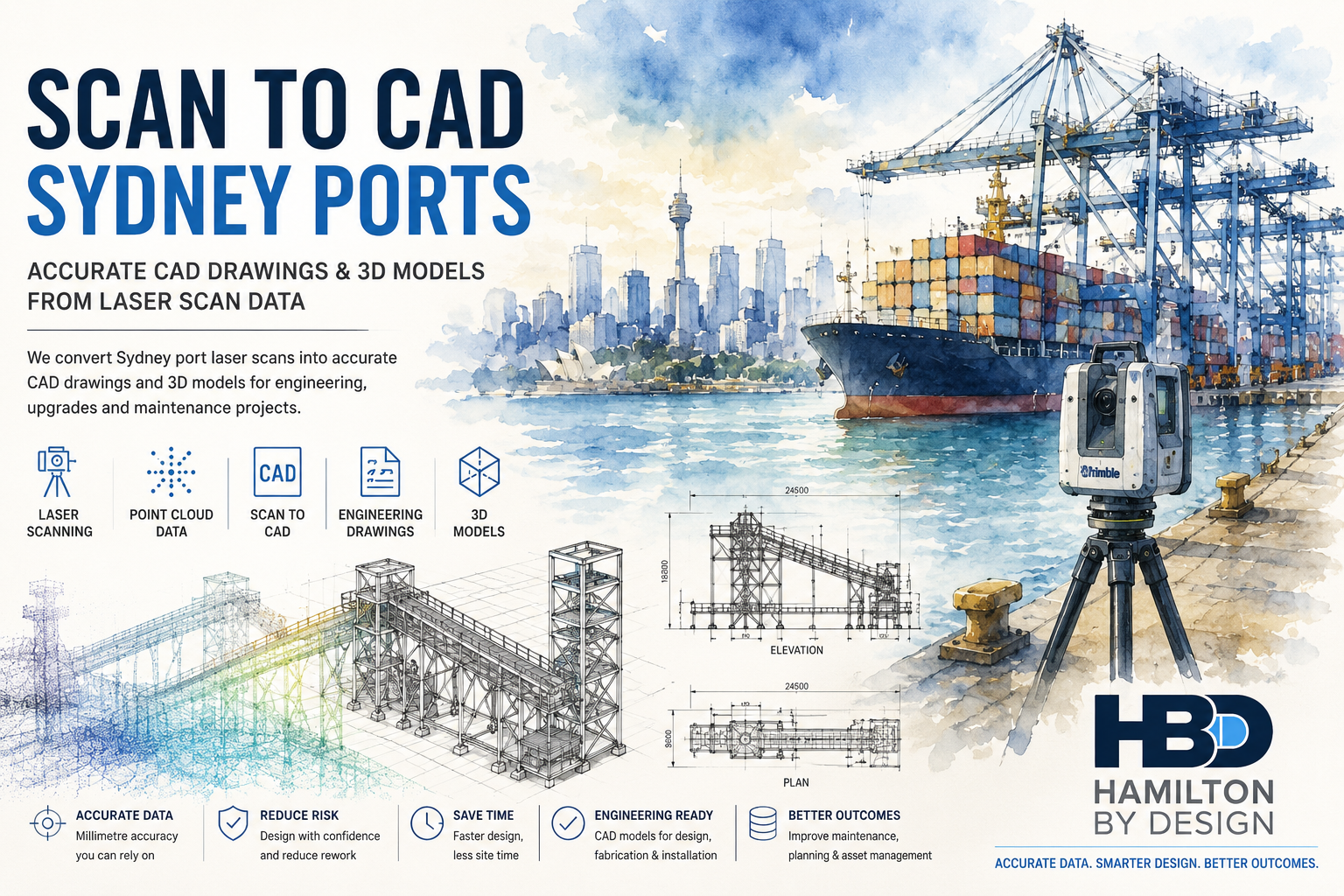
Scan to CAD Sydney Ports hero image showing Sydney Harbour port infrastructure, container terminal operations, LiDAR scanning equipment, point cloud data and engineering CAD models used for mechanical engineering, drafting and asset management projects.

Sydney’s ports and marine infrastructure are constantly evolving through maintenance programs, equipment upgrades, expansion projects and operational improvements. Accurate information about existing assets is essential for successful engineering design, fabrication and construction.

Hamilton By Design provides professional Scan to CAD services for Sydney ports, transforming laser scan and LiDAR point cloud data into accurate CAD drawings, 3D models and engineering documentation.

Our engineering-led approach ensures point cloud data is converted into practical deliverables that support mechanical engineering, drafting, fabrication, asset management and infrastructure upgrades.

Whether you require a simple as-built drawing or a complete 3D plant model, our Scan to CAD services provide accurate digital information that helps reduce project risk and improve engineering outcomes.


What is Scan to CAD?

Scan to CAD is the process of converting laser scan data into usable engineering drawings and 3D models.

Using point cloud data captured through terrestrial LiDAR scanning, engineers and drafters can create:

  • AutoCAD Drawings
  • General Arrangement Drawings
  • Plant Layouts
  • Structural Models
  • Mechanical Equipment Models
  • Pipework Models
  • As-Built Documentation
  • BIM Models
  • Digital Twin Assets

This process allows existing facilities to be accurately documented without relying on outdated or incomplete drawings.


Why Sydney Ports Require Scan to CAD Services

Many port facilities have been modified numerous times throughout their operational life.

Common challenges include:

  • Missing documentation
  • Outdated drawings
  • Unknown modifications
  • Congested infrastructure
  • Limited access areas
  • Restricted shutdown windows
  • Complex equipment layouts

By converting reality capture data into engineering-ready CAD models, project teams can work from accurate information that reflects actual site conditions.


Typical Sydney Port Infrastructure We Model

Container Terminals

We create CAD models and drawings for:

  • Container handling equipment
  • Crane support structures
  • Storage facilities
  • Maintenance workshops
  • Access infrastructure

Bulk Materials Handling Facilities

Our Scan to CAD services support:

  • Conveyors
  • Transfer stations
  • Chutes
  • Hoppers
  • Ship loaders
  • Stackers
  • Reclaimers

Marine Infrastructure

We can model:

  • Wharves
  • Jetties
  • Berths
  • Marine loading facilities
  • Access walkways
  • Structural steelwork

Industrial Plant Infrastructure

Including:

  • Pipework systems
  • Pump stations
  • Mechanical equipment
  • Structural steel
  • Maintenance platforms
  • Process infrastructure

Engineering Applications of Scan to CAD

Mechanical Engineering

Accurate CAD models provide the foundation for:

  • Equipment replacement projects
  • Plant upgrades
  • Retrofit design
  • Conveyor modifications
  • Maintenance planning
  • Shutdown engineering

Engineers can design around actual site conditions, reducing installation risks and minimising costly modifications.


Engineering Drafting

Point cloud data can be converted into:

  • Fabrication Drawings
  • General Arrangement Drawings
  • Layout Drawings
  • Equipment Drawings
  • Structural Steel Drawings
  • Installation Documentation

This allows engineering teams to produce reliable documentation from accurate site information.


Brownfield Engineering Projects

Scan to CAD is particularly valuable for brownfield projects where original drawings may no longer reflect existing conditions.

Benefits include:

  • Reduced site visits
  • Improved design accuracy
  • Clash detection
  • Better installation planning
  • Reduced construction risk

Shutdown Planning

Port shutdowns involve significant planning and coordination.

Accurate CAD models allow project teams to:

  • Verify clearances
  • Plan installations
  • Assess access requirements
  • Identify clashes
  • Improve shutdown efficiency

CAD Deliverables Available

Hamilton By Design can provide a range of engineering deliverables depending on project requirements.

2D Deliverables

  • AutoCAD Drawings
  • Floor Plans
  • Elevations
  • Sections
  • Layout Drawings
  • General Arrangement Drawings
  • As-Built Documentation

3D Deliverables

  • SolidWorks Models
  • Inventor Models
  • STEP Files
  • SAT Files
  • Parasolid Files
  • Plant Models

BIM Deliverables

  • Revit Models
  • IFC Models
  • Asset Information Models
  • Scan to BIM Models

Benefits of Scan to CAD for Sydney Port Projects

Accurate Engineering Information

CAD models are created directly from point cloud data, providing confidence that designs are based on actual site conditions.


Reduced Design Risk

Accurate models help identify clashes and installation issues before fabrication begins.


Faster Project Delivery

Engineering teams can begin work immediately without waiting for extensive site measurements.


Improved Asset Management

Accurate CAD documentation supports maintenance planning, inspections and future upgrades.


Better Project Outcomes

Reliable information results in improved decision making throughout the project lifecycle.


Why Choose Hamilton By Design?

Hamilton By Design combines:

  • Scan to CAD Services
  • 3D LiDAR Scanning
  • Mechanical Engineering
  • Engineering Drafting
  • Reverse Engineering
  • Scan to BIM
  • Asset Management Support

Unlike traditional drafting providers, we understand how engineering models are used throughout design, fabrication, installation and maintenance activities.

Our engineering-first approach ensures practical outcomes that support the long-term management and improvement of port infrastructure assets.


Sydney Port Facilities We Support

We provide Scan to CAD services throughout:

  • Port Botany
  • White Bay
  • Glebe Island
  • Sydney Harbour Industrial Facilities
  • Container Terminals
  • Bulk Handling Facilities
  • Marine Infrastructure Assets
  • Intermodal Freight Terminals

We also support projects throughout:

  • Sydney
  • Newcastle
  • Central Coast
  • Wollongong
  • Regional NSW
  • Australia-wide

Hamilton By Design logo displayed on a blue tilted rectangle with a grey gradient background

Need Scan to CAD Services for a Sydney Port Project?

Whether you require accurate as-built drawings, 3D plant models, mechanical engineering support or asset documentation, Hamilton By Design can convert your laser scan data into engineering-ready CAD deliverables.

Our Services Include:

โœ” Scan to CAD
โœ” 3D LiDAR Scanning
โœ” Mechanical Engineering
โœ” Engineering Drafting
โœ” Reverse Engineering
โœ” Scan to BIM
โœ” Digital Twin Development
โœ” Asset Documentation

Contact Hamilton By Design today to discuss your Sydney port infrastructure project and obtain a tailored proposal.

Talk to Us – Contact Us

Name
Would you like us to arrange a phone consultation for you?
Address

Our clients:


Frequently Asked Questions โ€“ Scan to CAD Sydney Ports

1. What is Scan to CAD and how is it used in Sydney ports?

Scan to CAD is the process of converting laser scan or LiDAR point cloud data into accurate 2D drawings and 3D CAD models. Sydney port operators use Scan to CAD for engineering design, maintenance planning, equipment upgrades and asset management projects.


2. What types of port infrastructure can be converted into CAD models?

Hamilton By Design can create CAD models of:

  • Container terminals
  • Wharves and jetties
  • Ship loaders
  • Conveyors
  • Chutes and hoppers
  • Pipework systems
  • Structural steelwork
  • Pump stations
  • Marine loading facilities
  • Industrial plant equipment

3. Why use Scan to CAD instead of traditional site measurements?

Scan to CAD uses millions of measured data points captured by LiDAR scanners, creating a far more detailed and accurate representation of existing conditions than traditional manual measurements.


4. What CAD deliverables can be produced from point cloud data?

Common deliverables include:

  • AutoCAD drawings
  • General arrangement drawings
  • Layout drawings
  • Structural steel models
  • Mechanical equipment models
  • Pipework models
  • Fabrication drawings
  • As-built documentation

5. Can Scan to CAD support brownfield port upgrades?

Yes. Scan to CAD is particularly valuable for brownfield projects where original drawings may be outdated, missing or no longer reflect actual site conditions. Accurate models help reduce design risks and improve project outcomes.


6. What file formats can Hamilton By Design provide?

We can provide deliverables in formats including:

  • DWG
  • DXF
  • STEP
  • SAT
  • Parasolid
  • SolidWorks
  • Inventor
  • IFC
  • Revit

Depending on project requirements.


7. How does Scan to CAD reduce engineering project risk?

Accurate CAD models allow engineers to verify dimensions, identify clashes, check clearances and develop designs based on actual site conditions. This reduces rework, installation issues and costly construction delays.


8. Can point cloud data be used for mechanical engineering projects?

Absolutely. Point cloud data provides the foundation for equipment upgrades, conveyor modifications, plant expansions, structural changes and reverse engineering projects commonly undertaken within Sydney ports.


9. Can Scan to CAD data be used for BIM and digital twin projects?

Yes. CAD models generated from laser scan data can be incorporated into BIM workflows, digital twin platforms, asset management systems and future infrastructure planning projects.


10. Why choose Hamilton By Design for Scan to CAD services in Sydney ports?

Hamilton By Design combines:

  • 3D LiDAR Scanning
  • Scan to CAD
  • Mechanical Engineering
  • Engineering Drafting
  • Reverse Engineering
  • Scan to BIM
  • Digital Twin Development

Unlike drafting-only providers, we understand how engineering models are used throughout design, fabrication, construction and maintenance, ensuring practical outcomes for port infrastructure projects.
Coffs Harbour Manufacturing & Industrial Engineering

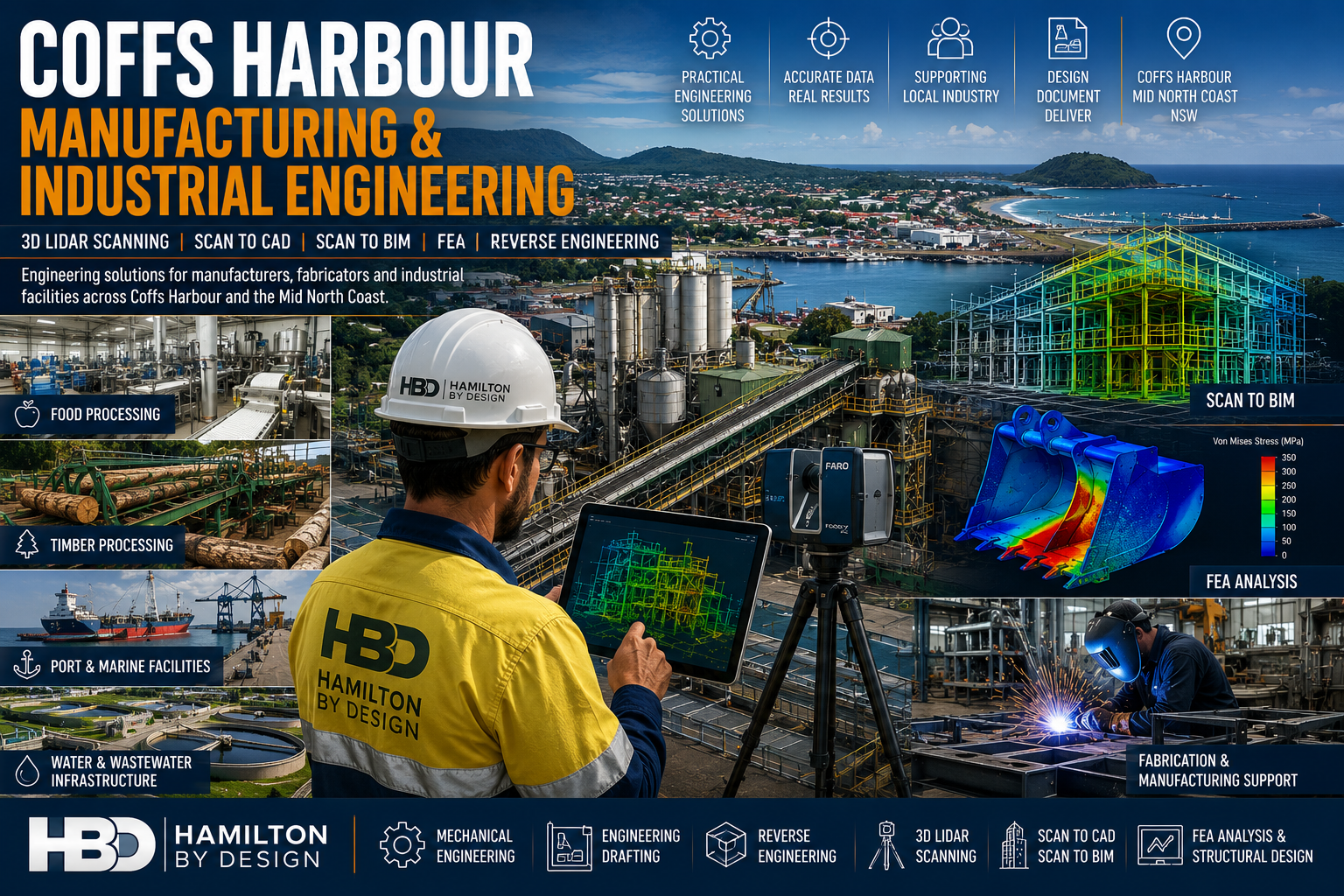
Coffs Harbour manufacturing and industrial engineering services featuring 3D LiDAR scanning, Scan to BIM, FEA analysis, food processing facilities, timber processing plants, marine infrastructure and fabrication workshops.

Coffs Harbour Manufacturing & Industrial Engineering

Engineering Solutions for Manufacturers, Fabricators & Industrial Facilities Across the Coffs Coast

Hamilton By Design provides engineering-led mechanical engineering, 3D LiDAR scanning, Scan to CAD, Scan to BIM, reverse engineering, finite element analysis (FEA) and engineering drafting services throughout Coffs Harbour, Toormina, Sawtell, Woolgoolga, Grafton and the wider North Coast region.

Coffs Harbour is one of regional New South Wales’ most diverse industrial centres, supporting manufacturing, food processing, timber processing, transport infrastructure, marine industries, water utilities and industrial facilities.

As facilities expand and equipment ages, accurate engineering information becomes critical for reducing project risk, improving asset reliability and supporting future growth.

Hamilton By Design helps manufacturers, engineers, fabricators and industrial asset owners capture existing conditions, develop accurate engineering models and deliver practical engineering solutions for both brownfield and greenfield projects.


Engineering Services for Manufacturing & Industry

Supporting Regional Industry Growth

Our services support:

  • Manufacturers
  • Fabricators
  • Timber Processing Facilities
  • Food Processing Plants
  • Water Utilities
  • Industrial Workshops
  • Logistics Facilities
  • Airport Infrastructure
  • Marine Facilities
  • Government Infrastructure

Services include:

  • Mechanical Engineering
  • Engineering Design
  • Reverse Engineering
  • Engineering Drafting
  • FEA Analysis
  • 3D LiDAR Scanning
  • Scan to CAD
  • Scan to BIM
  • Asset Documentation

3D LiDAR Scanning Coffs Harbour

Engineering Grade Reality Capture

Hamilton By Design provides engineering-grade terrestrial laser scanning services throughout Coffs Harbour and Northern NSW.

Laser scanning captures highly accurate site information that can be used for:

  • Existing Condition Surveys
  • Industrial Plant Upgrades
  • Manufacturing Facility Modifications
  • Structural Steel Modelling
  • Pipework Modelling
  • Asset Management
  • Construction Verification

Applications include:

Food Processing Facilities

Capture production equipment, processing lines, conveyors and services prior to upgrades and expansions.

Timber Processing Facilities

Accurately model sawmills, conveyors, log handling systems and timber processing infrastructure.

Industrial Manufacturing Facilities

Document existing plant conditions for engineering design and construction planning.


Sawmill & Timber Processing Engineering

Supporting Brownfield Upgrades

The North Coast has a strong timber processing industry with facilities often containing decades of modifications and undocumented changes.

Hamilton By Design supports:

  • Sawmill Expansions
  • Conveyor Upgrades
  • Dust Extraction Systems
  • Structural Modifications
  • Equipment Replacements
  • Facility Modernisation Projects

Using 3D LiDAR scanning and engineering modelling, we help reduce project risk and improve fabrication accuracy.


Scan to BIM Services

Building Information Modelling for Existing Assets

Hamilton By Design develops BIM models from laser scan data for:

  • Buildings
  • Manufacturing Facilities
  • Industrial Plants
  • Water Infrastructure
  • Utilities
  • Government Assets
  • Airport Infrastructure
  • Processing Facilities

Benefits include:

  • Improved project coordination
  • Reduced design clashes
  • Better asset management
  • Digital Twin Development
  • Enhanced project planning

Finite Element Analysis (FEA)

Engineering Validation Before Fabrication

Hamilton By Design provides FEA services for:

Loader Buckets

  • Wear analysis
  • Structural assessment
  • Reinforcement design

Excavator Buckets

  • Impact load analysis
  • Structural integrity reviews

Grader Blades

  • Ground engagement loading
  • Structural performance verification

Chutes & Hoppers

  • Material loading analysis
  • Wear zone identification
  • Structural optimisation

Industrial Structures

  • Platforms
  • Walkways
  • Support frames
  • Access systems

Reverse Engineering Services

When drawings are unavailable or outdated, reverse engineering allows valuable engineering information to be recovered.

Applications include:

  • Pumps
  • Shafts
  • Castings
  • Conveyor Components
  • Machine Components
  • Structural Assemblies
  • Wear Parts

Deliverables include:

  • SolidWorks Models
  • STEP Files
  • SAT Files
  • Manufacturing Drawings
  • Fabrication Documentation

Why Choose Hamilton By Design?

Engineering-Led Solutions

We understand how engineering information is used throughout the project lifecycle.

Practical Industry Experience

Supporting:

  • Manufacturing
  • Timber Processing
  • Food Processing
  • Utilities
  • Infrastructure
  • Industrial Facilities

Advanced Technology

Using:

  • FARO Focus Laser Scanners
  • FARO Orbis
  • FARO SCENE
  • SolidWorks
  • ANSYS
  • Autodesk Inventor
  • AutoCAD
  • Navisworks

Regional NSW Support

Providing engineering services throughout:

  • Coffs Harbour
  • Sawtell
  • Toormina
  • Woolgoolga
  • Grafton
  • Port Macquarie
  • Kempsey
  • Northern NSW
Hamilton By Design logo displayed on a blue tilted rectangle with a grey gradient background

Talk to Us – Contact Us

Name
Would you like us to arrange a phone consultation for you?
Address

Our clients:

3D LiDAR Scanning Darwin for engineering surveys, laser scanning, reality capture and point cloud modelling services
3D LiDAR Scanning Australia engineering services for laser scanning, reality capture, scan-to-CAD, Scan-to-BIM and as-built documentation across Australia
3D LiDAR scanning services on the Central Coast providing engineering-grade laser scanning, point cloud capture, scan-to-CAD modelling and industrial reality capture for infrastructure and industrial projects.

Port Macquarie Manufacturing & Industrial Engineering

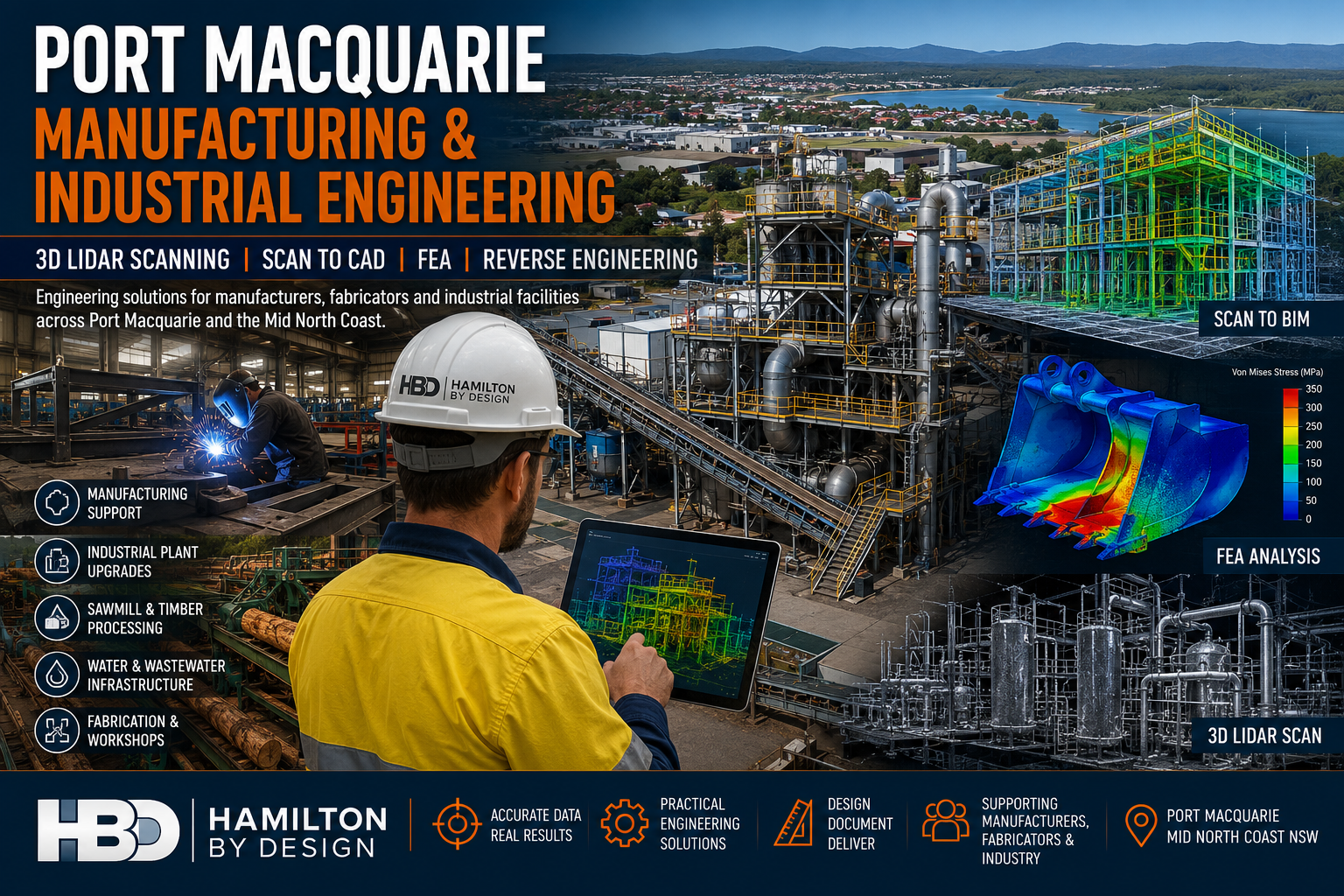
Port Macquarie manufacturing and industrial engineering services featuring 3D LiDAR scanning, Scan to BIM, FEA analysis, fabrication support and industrial plant upgrades by Hamilton By Design.

Port Macquarie Manufacturing & Industrial Engineering

Engineering Solutions for Manufacturers, Fabricators & Industrial Facilities Across the Mid North Coast

Hamilton By Design provides engineering-led mechanical engineering, 3D LiDAR scanning, Scan to CAD, Scan to BIM, reverse engineering, finite element analysis (FEA) and engineering drafting services throughout Port Macquarie, Wauchope, Kempsey, Southwest Rocks, Laurieton and the wider Mid North Coast region.

The Port Macquarie region is home to a growing manufacturing and industrial sector that supports timber processing, food manufacturing, fabrication workshops, transport operators, water infrastructure, marine industries and industrial processing facilities.

As facilities grow and equipment ages, accurate engineering information becomes critical for maintaining productivity, reducing downtime and planning future upgrades.

Hamilton By Design helps manufacturers, engineers, fabricators and asset owners capture existing conditions, develop accurate engineering models and deliver practical solutions for brownfield and greenfield projects.

Whether your project involves upgrading a sawmill, replacing ageing equipment, scanning a processing plant, developing fabrication drawings or validating a design using Finite Element Analysis, our team provides practical engineering support backed by decades of industry experience.


Engineering Services for Manufacturers

Supporting Manufacturing Growth Across Port Macquarie

Manufacturing businesses face increasing pressure to improve productivity, reduce maintenance costs and modernise existing facilities.

Hamilton By Design supports manufacturers by providing:

  • Mechanical Engineering
  • Equipment Design
  • Plant Layout Design
  • Reverse Engineering
  • Engineering Drafting
  • 3D Laser Scanning
  • Scan to CAD
  • Finite Element Analysis
  • Asset Documentation
  • Brownfield Upgrade Support

Our engineering services help manufacturers make informed decisions based on accurate site information and engineering data.


Industrial Plant Engineering

Engineering Support for Existing Facilities

Many industrial facilities have evolved over decades through multiple modifications and expansions.

Unfortunately, original drawings often no longer reflect actual site conditions.

Hamilton By Design provides engineering solutions that allow businesses to accurately document and understand their facilities before commencing upgrades or maintenance projects.

Typical facilities include:

  • Manufacturing Plants
  • Timber Processing Facilities
  • Food Processing Facilities
  • Water Treatment Plants
  • Wastewater Facilities
  • Recycling Facilities
  • Quarry Operations
  • Industrial Workshops
  • Processing Plants

3D LiDAR Scanning Port Macquarie

Engineering Grade Reality Capture

Hamilton By Design provides engineering-grade terrestrial laser scanning services that capture millions of highly accurate measurements.

Laser scanning creates an accurate digital representation of existing facilities and equipment, allowing engineering teams to design with confidence.

Applications include:

  • Manufacturing Facilities
  • Industrial Plants
  • Sawmills
  • Warehouses
  • Water Infrastructure
  • Processing Facilities
  • Structural Steel
  • Pipework Systems
  • Mechanical Equipment

Deliverables include:

  • E57 Files
  • RCP Files
  • RCS Files
  • LAS Files
  • Registered Point Clouds
  • Existing Condition Models
  • Engineering Drawings

Sawmill & Timber Processing Engineering

Supporting Brownfield Upgrades

The Mid North Coast has a long history of timber processing and sawmill operations.

Many facilities have grown over decades and contain a mixture of original equipment, modifications and undocumented changes.

Hamilton By Design supports sawmill operators with:

  • Existing Condition Surveys
  • 3D Laser Scanning
  • Conveyor Design
  • Structural Modifications
  • Dust Extraction Upgrades
  • Equipment Replacement Projects
  • Scan to CAD Services
  • Engineering Documentation

Laser scanning enables accurate modelling of existing plant conditions, reducing project risk and improving installation outcomes.


Scan to CAD Services

Converting Reality into Engineering Information

Point cloud data becomes significantly more valuable when converted into usable engineering deliverables.

Hamilton By Design converts laser scan data into:

  • AutoCAD Drawings
  • Plant Layouts
  • General Arrangement Drawings
  • Equipment Layout Drawings
  • Structural Drawings
  • Mechanical Drawings
  • Fabrication Drawings

These deliverables assist engineers, fabricators and project teams during design and construction activities.


Scan to BIM Services

Building Information Modelling for Existing Assets

Hamilton By Design develops BIM models from laser scan data to support engineering, construction and asset management projects.

We develop BIM models for:

  • Buildings
  • Infrastructure
  • Industrial Facilities
  • Processing Plants
  • Utilities
  • Manufacturing Facilities
  • Water Treatment Facilities
  • Government Assets

Benefits include:

  • Improved project coordination
  • Reduced design clashes
  • Improved construction planning
  • Better asset management
  • Digital Twin Development
  • Enhanced lifecycle management

For industrial facilities and manufacturing operations, Scan to BIM provides an accurate digital foundation for future upgrades and expansion projects.


Mechanical Engineering Services

Practical Engineering Solutions

Hamilton By Design provides mechanical engineering services focused on practical, buildable and maintainable outcomes.

Services include:

  • Mechanical Design
  • Equipment Design
  • Conveyor Design
  • Chute Design
  • Hopper Design
  • Materials Handling Systems
  • Structural Interfaces
  • Equipment Modifications
  • Design Reviews
  • Shutdown Engineering

Our experience spans manufacturing, mining, industrial processing and infrastructure projects throughout Australia.


Finite Element Analysis (FEA)

Engineering Validation Before Fabrication

Finite Element Analysis allows engineers to assess how components and structures perform under load before manufacturing begins.

Hamilton By Design provides FEA services for:

Loader Buckets

Assessment of:

  • Wear zones
  • Reinforcement design
  • Fatigue performance
  • Structural adequacy

Excavator Buckets

Analysis of:

  • Impact loading
  • Structural integrity
  • Wear protection systems
  • Load distribution

Grader Blades

Verification of:

  • Structural support systems
  • Ground engagement loads
  • Deflection performance
  • Wear areas

Chutes & Hoppers

Evaluation of:

  • Material loading
  • Structural performance
  • Impact zones
  • Reinforcement requirements

Industrial Structures

Assessment of:

  • Platforms
  • Walkways
  • Equipment Supports
  • Access Systems
  • Structural Frames

FEA provides confidence that designs will perform safely and efficiently under operational conditions.


Reverse Engineering Services

Recreating Existing Assets

When original engineering drawings are unavailable, reverse engineering can recover valuable engineering information.

Hamilton By Design provides reverse engineering services for:

  • Mechanical Components
  • Pumps
  • Shafts
  • Castings
  • Conveyor Components
  • Wear Liners
  • Structural Components
  • Machinery Assemblies

Deliverables include:

  • SolidWorks Models
  • STEP Files
  • SAT Files
  • Fabrication Drawings
  • Manufacturing Drawings

Engineering Drafting Services

Professional Documentation for Construction & Fabrication

Our drafting services provide accurate engineering documentation for manufacturing, industrial and infrastructure projects.

Services include:

  • Mechanical Drafting
  • Structural Drafting
  • Fabrication Drawings
  • Workshop Drawings
  • As-Built Drawings
  • Construction Documentation
  • Plant Layout Drawings

Using:

  • SolidWorks
  • Autodesk Inventor
  • AutoCAD
  • Navisworks
  • FARO SCENE
  • Autodesk ReCap

Why Choose Hamilton By Design?

Engineering-Led Approach

We understand how engineering information is used throughout the project lifecycle.

Practical Industry Experience

Experience supporting:

  • Manufacturers
  • Fabricators
  • Mining Operations
  • Industrial Facilities
  • Utilities
  • Infrastructure Owners

Advanced Technology

Including:

  • FARO Focus Laser Scanners
  • FARO Orbis Mobile Scanning
  • FARO SCENE
  • SolidWorks
  • ANSYS
  • Autodesk Inventor
  • AutoCAD
  • Navisworks

Australia-Wide Capability

Supporting projects across:

  • Port Macquarie
  • Mid North Coast
  • Newcastle & Hunter
  • Sydney
  • Brisbane
  • Melbourne
  • Adelaide
  • Perth

Hamilton By Design logo displayed on a blue tilted rectangle with a grey gradient background

Need Engineering Support in Port Macquarie?

Whether your project involves manufacturing facilities, industrial plants, sawmills, water infrastructure or brownfield upgrades, Hamilton By Design provides practical engineering solutions backed by real industry experience.

Our Services

โœ” Manufacturing Engineering
โœ” Industrial Engineering
โœ” Mechanical Engineering
โœ” 3D LiDAR Scanning
โœ” Scan to CAD
โœ” Scan to BIM
โœ” Reverse Engineering
โœ” Finite Element Analysis (FEA)
โœ” Engineering Drafting
โœ” Sawmill Engineering Support
โœ” Industrial Plant Upgrades
โœ” Brownfield Engineering Projects

Talk to Us – Contact Us

Name
Would you like us to arrange a phone consultation for you?
Address

Our clients:

3D LiDAR Scanning Darwin for engineering surveys, laser scanning, reality capture and point cloud modelling services
3D LiDAR Scanning Australia engineering services for laser scanning, reality capture, scan-to-CAD, Scan-to-BIM and as-built documentation across Australia
3D LiDAR scanning services on the Central Coast providing engineering-grade laser scanning, point cloud capture, scan-to-CAD modelling and industrial reality capture for infrastructure and industrial projects.

Scan to BIM Newcastle & Hunter

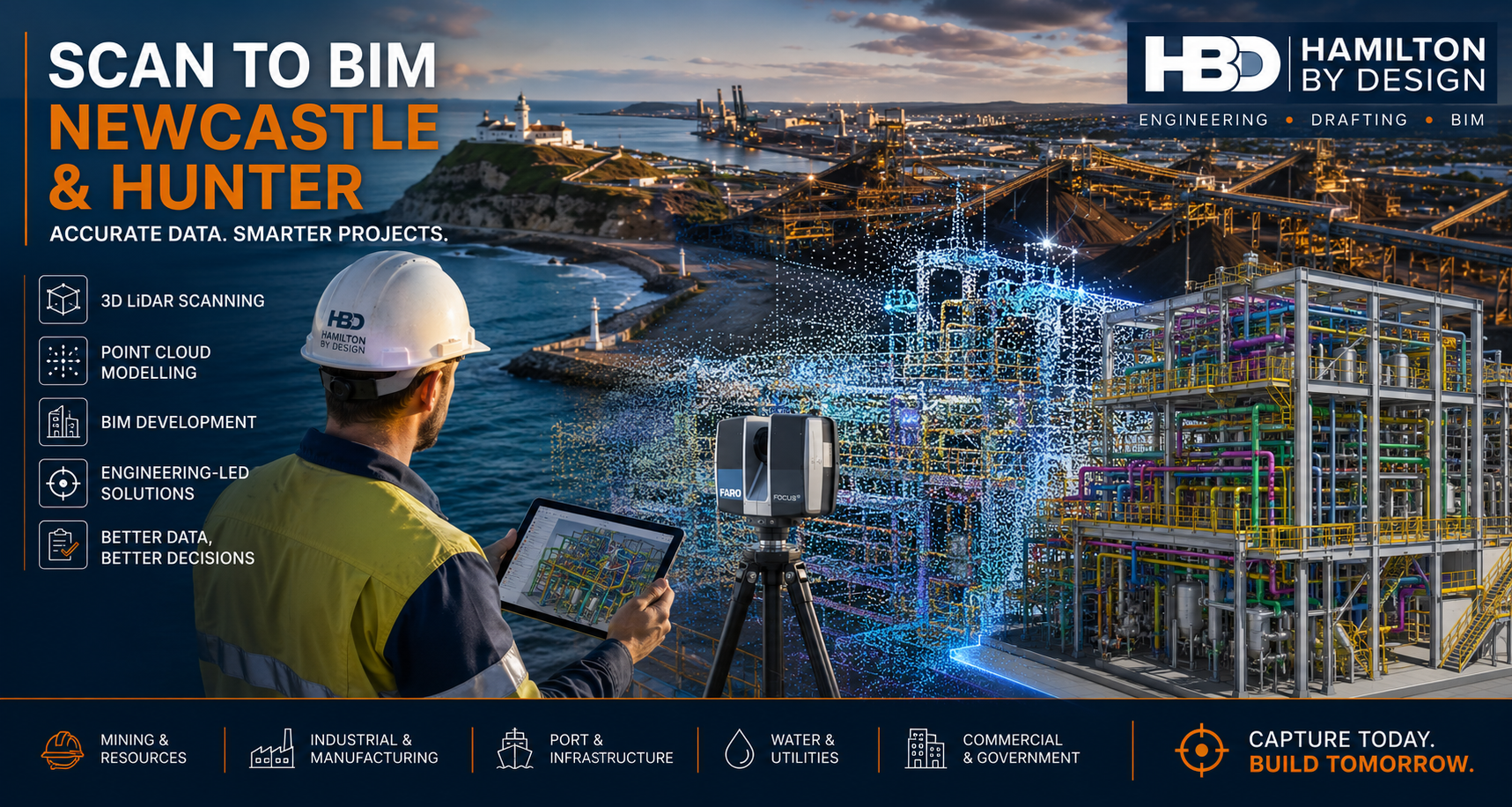
Scan to BIM Newcastle and Hunter showing 3D LiDAR scanning, point cloud modelling and BIM development for industrial, mining and port infrastructure projects in the Hunter Valley region.

Scan to BIM Newcastle & Hunter | 3D LiDAR Scanning & BIM Modelling

Engineering-Led Scan to BIM Services Across Newcastle, the Hunter Valley and Regional NSW

Hamilton By Design provides professional Scan to BIM Newcastle & Hunter services for industrial, mining, manufacturing, infrastructure, commercial and government projects throughout the region.

Using advanced 3D LiDAR scanning, point cloud processing and BIM modelling technologies, we transform existing buildings, plants and infrastructure into accurate digital models that support engineering, design, construction and asset management workflows.

Whether your project is located in Newcastle CBD, the Port of Newcastle, Kooragang Island, Tomago, Maitland, Singleton, Muswellbrook, Cessnock, Kurri Kurri, Raymond Terrace or the wider Hunter Valley, our engineering-led approach helps deliver accurate information from the very beginning of a project.


Why Scan to BIM is Important for Newcastle & Hunter Projects

The Newcastle and Hunter region is home to some of Australia’s most significant:

  • Mining operations
  • Coal handling facilities
  • Power generation assets
  • Manufacturing plants
  • Port infrastructure
  • Water treatment facilities
  • Rail infrastructure
  • Heavy industrial sites
  • Commercial developments
  • Health and education facilities

Many of these assets have been operating for decades.

As facilities evolve, original drawings often become outdated, modifications are undocumented and site conditions differ significantly from available records.

Scan to BIM provides a reliable method of capturing existing conditions before design, construction or upgrade work begins.


What is Scan to BIM?

Scan to BIM is the process of converting high-accuracy 3D laser scan data into intelligent BIM models and engineering documentation.

The workflow typically includes:

Stage 1 โ€“ Site Capture

Using professional 3D LiDAR scanning equipment, millions of measurements are collected across the site.

The result is a highly detailed digital representation of existing conditions.

Stage 2 โ€“ Point Cloud Registration

Individual scans are aligned and registered into a unified coordinate system.

This creates an accurate point cloud representing the entire site.

Stage 3 โ€“ BIM Development

The point cloud is converted into BIM models, CAD drawings or digital engineering deliverables suitable for project requirements.

Stage 4 โ€“ Engineering Integration

The resulting information can be used for:

  • Design development
  • Asset management
  • Refurbishment projects
  • Structural modifications
  • Mechanical upgrades
  • Clash detection
  • Construction planning
  • As-built documentation

Engineering-Led Site Capture

Hamilton By Design is not simply a scanning provider.

We are mechanical engineering, drafting and design professionals who understand how the information will be used downstream.

This distinction is important.

Many scanning providers deliver a point cloud and leave interpretation to the client.

Our engineering-led approach focuses on creating deliverables that support:

  • Mechanical engineering
  • Structural engineering
  • Plant upgrades
  • Access system design
  • Fabrication projects
  • Shutdown planning
  • Asset management

The result is information that can be used immediately by engineers, designers, fabricators and project teams.


Scan to BIM for Mining Operations

The Hunter Valley remains Australia’s largest coal-producing region.

Mining operations continually require:

  • Conveyor upgrades
  • Transfer chute modifications
  • Structural upgrades
  • Processing plant improvements
  • Materials handling projects
  • Shutdown planning
  • Asset inspections

Scan to BIM allows project teams to capture existing conditions before engineering begins.

Benefits include:

  • Reduced site revisits
  • Improved design accuracy
  • Better project planning
  • Improved safety outcomes
  • Reduced rework during installation

For active mining sites, accurate digital information significantly reduces project risk.


Scan to BIM for Manufacturing Facilities

The Newcastle and Hunter region hosts a diverse manufacturing sector including:

  • Food processing
  • Packaging
  • Steel fabrication
  • Chemical processing
  • Industrial manufacturing
  • Warehousing and logistics

Plant modifications often occur within operational facilities where downtime is expensive.

Scan to BIM provides:

  • Existing plant layouts
  • Equipment locations
  • Pipe routing verification
  • Structural verification
  • Access and maintenance assessments

This information supports more efficient project execution and improved design coordination.


Port and Infrastructure Applications

The Port of Newcastle and associated industrial infrastructure continue to undergo significant upgrades and maintenance programs.

Scan to BIM is ideally suited for:

  • Port facilities
  • Ship loading infrastructure
  • Bulk materials handling systems
  • Rail infrastructure
  • Water treatment assets
  • Industrial terminals
  • Civil infrastructure

Accurate digital twins improve planning and reduce uncertainty before construction activities commence.


Scan to BIM Deliverables

Depending on project requirements, Hamilton By Design can provide:

Point Cloud Deliverables

  • E57 Files
  • LAS Files
  • RCP Files
  • RCS Files
  • Registered point clouds

BIM Deliverables

  • Revit Models
  • BIM Coordination Models
  • Existing Condition Models
  • Architectural Models
  • Structural Models
  • Mechanical Models

CAD Deliverables

  • AutoCAD Drawings
  • Floor Plans
  • Sections
  • Elevations
  • General Arrangement Drawings
  • Fabrication Support Models

Engineering Deliverables

  • Plant Layout Models
  • Equipment Models
  • Structural Steel Models
  • Access Platform Designs
  • Mechanical Engineering Documentation

Brownfield Engineering Projects

Most projects throughout Newcastle and the Hunter are brownfield projects.

These sites often present challenges including:

  • Missing drawings
  • Incomplete records
  • Historic modifications
  • Access restrictions
  • Complex service routes

Scan to BIM significantly reduces uncertainty by creating an accurate representation of existing conditions.

This allows project teams to design around real-world constraints rather than assumptions.


Digital Engineering and Asset Management

Beyond design and construction, Scan to BIM supports long-term asset management.

Benefits include:

  • Accurate asset records
  • Improved maintenance planning
  • Digital twin development
  • Lifecycle management
  • Future project planning
  • Improved facility documentation

As infrastructure owners increasingly adopt digital engineering strategies, accurate existing-condition models become a valuable long-term asset.


Why Choose Hamilton By Design?

Hamilton By Design combines:

  • Engineering expertise
  • 3D LiDAR scanning
  • Mechanical design
  • Structural drafting
  • BIM development
  • CAD modelling
  • Industrial project experience

Our team understands both the technology and the engineering outcomes required by clients.

This allows us to provide practical solutions that support project delivery rather than simply producing scan data.


Areas We Service

We support projects across:

  • Newcastle
  • Hunter Valley
  • Maitland
  • Singleton
  • Muswellbrook
  • Kurri Kurri
  • Cessnock
  • Raymond Terrace
  • Port Stephens
  • Lake Macquarie
  • Kooragang Island
  • Tomago
  • Central Coast
  • Upper Hunter
  • Mid North Coast

We also regularly support clients throughout regional NSW and interstate.


Hamilton By Design logo displayed on a blue tilted rectangle with a grey gradient background

Need a Scan to BIM Newcastle & Hunter Quote?

If you require accurate existing-condition information for an upcoming engineering, construction, mining or industrial project, Hamilton By Design can help.

Our Scan to BIM services provide reliable digital information that supports better decision-making, improved design outcomes and reduced project risk.

Contact Hamilton By Design today to discuss your Scan to BIM Newcastle & Hunter project.

Talk to Us – Contact Us

Name
Would you like us to arrange a phone consultation for you?
Address

Our clients:

3D LiDAR Scanning Darwin for engineering surveys, laser scanning, reality capture and point cloud modelling services
3D LiDAR Scanning Australia engineering services for laser scanning, reality capture, scan-to-CAD, Scan-to-BIM and as-built documentation across Australia
3D LiDAR scanning services on the Central Coast providing engineering-grade laser scanning, point cloud capture, scan-to-CAD modelling and industrial reality capture for infrastructure and industrial projects.
3D LiDAR Scanning Perth for engineering surveys, laser scanning, reality capture and point cloud modelling services
3D LiDAR Scanning Sydney for engineering surveys, laser scanning, reality capture and point cloud modelling services
3D LiDAR Scanning Brisbane for engineering surveys, laser scanning, reality capture and point cloud modelling services
3D LiDAR Scanning Canberra for engineering surveys, laser scanning, reality capture and point cloud modelling services
3D LiDAR Scanning Newcastle for engineering surveys, laser scanning, reality capture and point cloud modelling services
3D LiDAR Scanning Adelaide for engineering surveys, laser scanning, reality capture and point cloud modelling services
https://www.hamiltonbydesign.com.au/scan-to-bim-services-australia-lidar-point-clouds-cad-modelling

Scan to CAD Perth

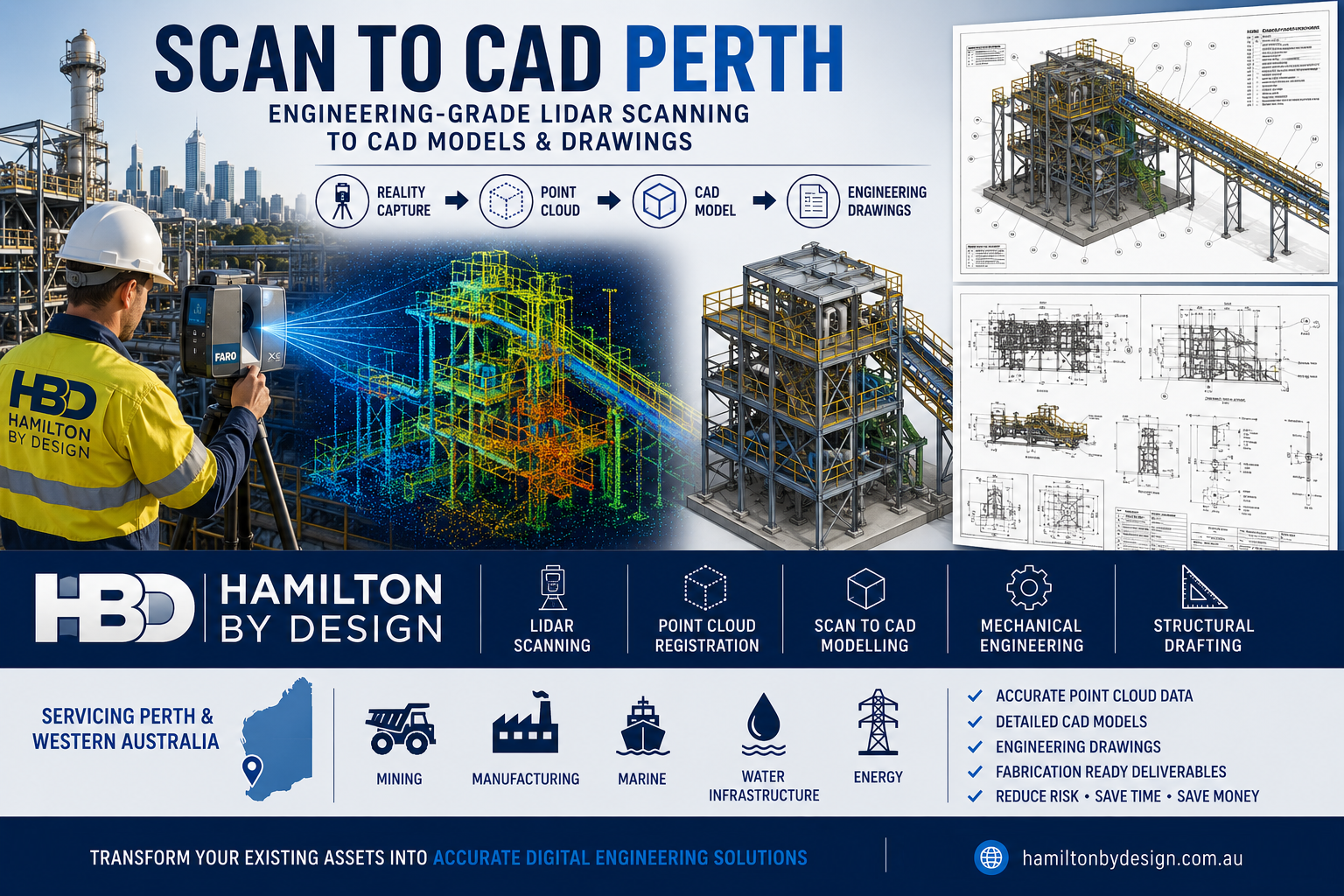
Scan to CAD Perth workflow by Hamilton By Design showing engineering-grade LiDAR scanning of an industrial processing facility in Perth, Western Australia. The image illustrates the complete reality capture process from laser scanning and point cloud registration through to 3D CAD modelling, engineering drawings, mechanical engineering and structural drafting. Featured are a field engineer operating a FARO laser scanner, a coloured point cloud model, a detailed industrial plant CAD model, fabrication drawings and industries including mining, manufacturing, marine, water infrastructure and energy.

Engineering-Grade Point Cloud to CAD Services

Scan to CAD Perth

Blue 3D LiDAR scanner icon on a tripod with scanning waves

When existing facilities, equipment, structures, and process plants need to be modified, expanded, or documented, accurate information is critical. Unfortunately, many sites across Perth and Western Australia rely on outdated drawings, incomplete documentation, or site measurements that do not reflect what has actually been built.

Hamilton By Design provides professional Scan to CAD Perth services, combining engineering-grade LiDAR scanning with experienced mechanical and structural drafting to create accurate CAD models and drawings from real-world assets.

Rather than relying on tape measures or assumptions, we capture the existing environment using advanced 3D laser scanning technology and convert the resulting point cloud data into usable engineering deliverables.


What is Scan to CAD?

Scan to CAD is the process of converting physical assets into accurate digital engineering models and drawings.

The workflow typically includes:

  1. Site scanning using LiDAR technology
  2. Registration of the point cloud data
  3. Creation of CAD models
  4. Production of engineering drawings
  5. Verification against captured site conditions

The result is a highly accurate digital representation of the existing asset that can be used for engineering, maintenance, fabrication, and future upgrades.


Why Use Scan to CAD?

Many projects fail because existing site information is incorrect.

Common challenges include:

  • Missing drawings
  • Outdated drawings
  • Unrecorded modifications
  • Unknown equipment locations
  • Limited shutdown windows
  • Expensive site revisits
  • Fabrication errors
  • Installation clashes

Scan to CAD helps eliminate these issues by providing a reliable digital record of the actual site conditions.


Our Scan to CAD Workflow

1. Site Capture

Hamilton By Design uses engineering-grade LiDAR scanning equipment to capture millions of measurement points across the site.

Applications include:

  • Mining facilities
  • Processing plants
  • Structural steel installations
  • Pipework systems
  • Conveyor systems
  • Water treatment facilities
  • Manufacturing plants
  • Marine facilities

2. Point Cloud Registration

Individual scans are combined into a single registered dataset.

This process creates a coordinated point cloud representing the complete facility.

Deliverable formats can include:

  • E57
  • RCP
  • RCS
  • LAS

3. CAD Modelling

The point cloud is imported into engineering software where accurate models are developed.

Software used includes:

  • SOLIDWORKS
  • AutoCAD
  • Autodesk Inventor
  • Navisworks

Models may include:

  • Structural steel
  • Pipework
  • Mechanical equipment
  • Platforms and access systems
  • Buildings and facilities
  • Process infrastructure

4. Engineering Drawings

Once modelling is complete, the information can be converted into detailed engineering documentation.

Typical deliverables include:

  • General Arrangement Drawings
  • Fabrication Drawings
  • As-Built Drawings
  • Layout Drawings
  • Structural Steel Drawings
  • Mechanical Drawings
  • Pipework Drawings

Industries We Support in Perth

Hamilton By Design supports clients throughout Perth and Western Australia including:

Mining

  • Iron Ore
  • Gold
  • Lithium
  • Nickel
  • Mineral Processing

Manufacturing

  • Food Processing
  • Packaging Facilities
  • Industrial Production

Energy

  • Power Generation
  • Renewable Energy Facilities
  • Oil and Gas Infrastructure

Water Infrastructure

  • Water Treatment Plants
  • Pump Stations
  • Wastewater Facilities

Marine and Ports

  • Ship Repair Facilities
  • Port Infrastructure
  • Bulk Handling Equipment

Benefits of Scan to CAD

Reduce Site Visits

Capture everything during a single visit and continue working remotely.

Improve Design Accuracy

Design directly from measured site conditions.

Reduce Fabrication Risk

Accurate models help reduce costly fabrication errors.

Improve Safety

Less time measuring equipment in operational environments.

Support Future Projects

Create a digital record that can be reused for future upgrades.


Typical Scan to CAD Deliverables

Hamilton By Design can provide:

  • Point Cloud Files
  • AutoCAD Drawings
  • SOLIDWORKS Models
  • Inventor Models
  • STEP Files
  • SAT Files
  • DWG Files
  • DXF Files
  • Structural Steel Models
  • Mechanical Equipment Models
  • Pipework Models
  • Fabrication Drawings

Why Hamilton By Design?

Hamilton By Design combines reality capture technology with practical engineering experience.

Our team understands:

  • Mechanical Engineering
  • Structural Steel Design
  • Fabrication Workflows
  • Mining Infrastructure
  • Process Plants
  • Site Installation Requirements

This means we do more than simply collect scan data. We transform site information into practical engineering deliverables that support project execution.


Perth Service Area

We provide Scan to CAD services across:

  • Perth CBD
  • Kwinana
  • Henderson
  • Welshpool
  • Canning Vale
  • Malaga
  • Osborne Park
  • Rockingham
  • Fremantle
  • Bunbury
  • Geraldton
  • Kalgoorlie
  • Port Hedland
  • Karratha
  • Pilbara Region

  • 3D Laser Scanning Perth
  • LiDAR Scanning Perth
  • Mechanical Engineering Perth
  • Reverse Engineering Perth
  • Structural Drafting Perth
  • Point Cloud to CAD Modelling
  • As-Built Documentation
  • Industrial Reality Capture

Frequently Asked Questions

What is Scan to CAD?

Scan to CAD is the process of converting laser scan data into CAD models and engineering drawings.

What industries use Scan to CAD?

Mining, manufacturing, energy, water, marine, construction, and industrial facilities commonly use Scan to CAD workflows.

What file formats can be delivered?

DWG, DXF, STEP, SAT, Parasolid, E57, RCP, RCS, and PDF.

Can Scan to CAD be used for structural steel?

Yes. Existing structures can be scanned and converted into detailed structural steel models and fabrication drawings.

Can Scan to CAD be used for pipework?

Yes. Pipework systems can be modelled directly from point cloud data to support modifications and upgrades.

Do you provide services outside Perth?

Yes. Hamilton By Design supports projects throughout Western Australia and across Australia.


Our Clients


Contact Hamilton By Design

If you require accurate site information for design, fabrication, maintenance, or asset management, Hamilton By Design can help.

Our engineering-led Scan to CAD Perth services transform real-world assets into accurate digital engineering deliverables, helping projects move forward with confidence.

Hamilton By Design โ€“ Engineering, LiDAR Scanning, CAD Modelling and Drafting Services Across Perth and Western Australia.

Hamilton By Design logo displayed on a blue tilted rectangle with a grey gradient background
Name
Would you like us to arrange a phone consultation for you?
Address

Where are we in Perth

https://www.hamiltonbydesign.com.au/perth-wa
3D CAD Modelling Australia service banner for Hamilton By Design
Australian Drafting logo featuring bold white text reading "Australian Drafting" centred on a blue rounded rectangle background.
Engineering Governance title graphic featuring bold white text reading "Engineering Governance" centred on a blue rounded rectangle background.
Mechanical, Structural & Pipework Drafting service banner by Hamilton By Design featuring white text on a blue background.
Mechanical engineering services
Blue rounded button with the text โ€œSolidWorks Designโ€ in white.
Finite Element Analysis (FEA) engineering simulation button
3D LiDAR Scanning Darwin for engineering surveys, laser scanning, reality capture and point cloud modelling services
3D LiDAR Scanning Australia engineering services for laser scanning, reality capture, scan-to-CAD, Scan-to-BIM and as-built documentation across Australia
3D LiDAR scanning services on the Central Coast providing engineering-grade laser scanning, point cloud capture, scan-to-CAD modelling and industrial reality capture for infrastructure and industrial projects.
3D LiDAR Scanning Perth for engineering surveys, laser scanning, reality capture and point cloud modelling services
3D LiDAR Scanning Sydney for engineering surveys, laser scanning, reality capture and point cloud modelling services
3D LiDAR Scanning Brisbane for engineering surveys, laser scanning, reality capture and point cloud modelling services
3D LiDAR Scanning Canberra for engineering surveys, laser scanning, reality capture and point cloud modelling services
3D LiDAR Scanning Newcastle for engineering surveys, laser scanning, reality capture and point cloud modelling services
3D LiDAR Scanning Adelaide for engineering surveys, laser scanning, reality capture and point cloud modelling services
https://www.hamiltonbydesign.com.au/scan-to-bim-services-australia-lidar-point-clouds-cad-modelling

Trimble Scanners vs FARO Scanners | Which is Best for Engineering?

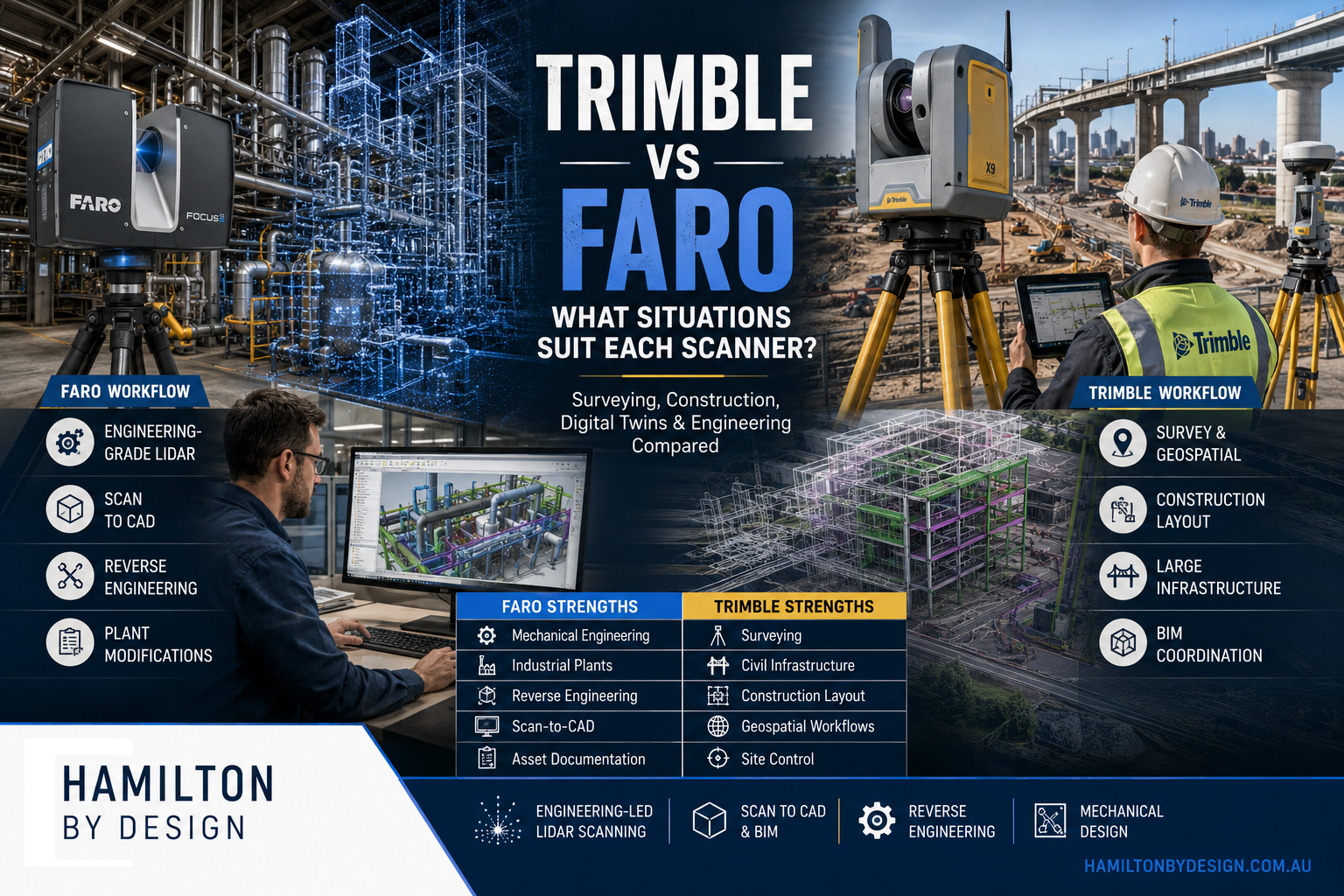
Comparison graphic showing FARO and Trimble 3D laser scanning technologies for engineering, surveying and construction projects. The left side features a FARO Focus scanner capturing an industrial processing plant with point cloud and CAD modelling workflows, highlighting engineering-grade LiDAR, scan-to-CAD, reverse engineering and plant modifications. The right side shows a Trimble scanner on a large infrastructure construction site, highlighting surveying, geospatial data collection, BIM coordination, construction layout and civil infrastructure applications.

Trimble Scanners vs FARO Scanners |Which Technology Is Right for Your Project?

The laser scanning industry has evolved significantly over the last decade. Modern reality capture systems can document entire buildings, processing plants, infrastructure assets, mining operations, and manufacturing facilities with remarkable speed and accuracy.

Two of the most recognised names in the terrestrial laser scanning market are Trimble and FARO Technologies.

Both manufacturers produce capable scanning equipment, but they were developed with different target markets and project requirements in mind.

The question is not necessarily which scanner is better.

The real question is:

Which scanner is best suited to the type of project you are trying to complete?

At Hamilton By Design, we focus primarily on engineering, industrial facilities, manufacturing plants, mining infrastructure, reverse engineering, and Scan-to-CAD projects. Because of this, our requirements differ significantly from those of surveyors, construction layout teams, BIM consultants, or mobile mapping providers.

This article explains where Trimble systems excel, where FARO systems excel, and which technology may be the best fit for your application.


Understanding Laser Scanning Objectives

Before comparing scanner brands, it is important to understand the purpose of the project.

Most scanning projects fall into one of the following categories:

Surveying

Surveyors typically require:

  • Geospatial accuracy
  • Coordinate control
  • GIS integration
  • Large-scale topographic surveys
  • Infrastructure corridors
  • Road and rail mapping

Construction

Construction projects often require:

  • BIM coordination
  • Progress monitoring
  • Clash detection
  • Layout verification
  • Digital twins

Engineering

Engineering projects typically require:

  • Mechanical design
  • Reverse engineering
  • Fabrication drawings
  • Plant modifications
  • Structural steel detailing
  • Pipework design

Asset Management

Asset owners often require:

  • Digital records
  • Facility management
  • Lifecycle documentation
  • Maintenance planning

Different scanners have been optimised for different objectives.


Trimble Overview

Trimble has built its reputation through:

  • Surveying equipment
  • GPS systems
  • Construction technology
  • Machine control
  • Geospatial software
  • BIM workflows

Their scanning solutions are designed to integrate into broader construction and survey ecosystems.

Popular Trimble scanners include:

Trimble X7

A compact scanner targeting:

  • Surveyors
  • Construction professionals
  • BIM teams

Trimble X9

A higher-performance evolution of the X7 featuring:

  • Greater range
  • Faster scanning
  • Improved workflows

Trimble SX12

A hybrid scanner and total station offering:

  • Survey functionality
  • Laser scanning
  • High-precision measurement

Trimble MX Series

Vehicle-mounted mobile mapping systems designed for:

  • Roads
  • Railways
  • Utility corridors
  • City modelling

FARO Overview

FARO Technologies has historically focused on:

  • Industrial measurement
  • Manufacturing
  • Metrology
  • Quality control
  • Engineering documentation

Their scanners are widely used for:

  • Industrial plants
  • Refineries
  • Manufacturing facilities
  • Reverse engineering
  • Scan-to-CAD

Popular FARO systems include:

FARO Focus S70

Optimised for:

  • Engineering projects
  • Indoor scanning
  • Plant scanning
  • Industrial facilities

FARO Focus Premium

Provides:

  • Extended range
  • Faster scan speeds
  • Improved HDR imaging

FARO Orbis

A mobile scanning system designed for:

  • Walking surveys
  • Rapid reality capture
  • Large facilities

FARO Quantum Arm

A portable coordinate measuring machine (CMM) used for:

  • Metrology
  • Manufacturing inspection
  • Reverse engineering

Accuracy Comparison

Accuracy is often the first specification people examine.

However, accuracy must be considered within the context of the project.

Trimble

Trimble systems generally provide excellent accuracy for:

  • Surveying
  • Construction
  • Geospatial projects

Their workflows place strong emphasis on:

  • Coordinate systems
  • Site control
  • Survey networks

This makes them highly attractive to surveyors and construction teams.


FARO

FARO scanners have traditionally focused on:

  • Engineering accuracy
  • Mechanical systems
  • Industrial facilities

When documenting:

  • Pipework
  • Structural steel
  • Mechanical equipment
  • Fabrication interfaces

FARO scanners have established a strong reputation for producing dense, high-quality point clouds suitable for engineering design.


Range Comparison

Range requirements vary significantly between projects.

Trimble Range Strengths

Trimble performs exceptionally well when scanning:

  • Roads
  • Bridges
  • Rail corridors
  • Civil infrastructure
  • Large construction sites

These environments benefit from long-range scanning and integration with survey control.


FARO Range Strengths

The FARO Focus series performs extremely well in:

  • Buildings
  • Processing plants
  • Manufacturing facilities
  • Mechanical rooms
  • Industrial environments

For many engineering projects, scanners are positioned:

  • 5โ€“40 metres from equipment
  • 5โ€“50 metres from structures

In these situations, extremely long-range scanning is often unnecessary.


Mobile Mapping Comparison

One of the biggest changes in recent years has been the growth of mobile mapping.


Trimble Mobile Mapping

Trimble has invested heavily in:

  • Vehicle-mounted systems
  • Corridor mapping
  • Geospatial workflows

Ideal applications include:

  • Road surveys
  • Utility networks
  • Large infrastructure projects

FARO Orbis

The FARO Orbis allows operators to:

  • Walk through facilities
  • Capture large areas quickly
  • Reduce field time

Applications include:

  • Warehouses
  • Airports
  • Shopping centres
  • Large industrial facilities

The advantage is speed.

The limitation is that mobile systems generally require more processing and validation than static scanning.


Registration Workflows

Registration is the process of combining scans into a unified point cloud.


Trimble Registration

Trimble provides strong registration tools aimed at:

  • Survey workflows
  • Construction workflows
  • BIM projects

Their ecosystem integrates effectively with coordinate control networks.


FARO Registration

FARO’s software platform, particularly FARO SCENE, has become a well-established standard for industrial registration.

Strengths include:

  • Target-based registration
  • Cloud-to-cloud registration
  • Engineering workflows
  • Industrial documentation

For plant environments, SCENE remains a highly capable platform.


Surveying Applications

Where Trimble excels:

Large Survey Projects

Examples include:

  • Highways
  • Rail networks
  • Airports
  • Utility corridors

Trimble’s heritage in surveying makes these projects a natural fit.

Construction Control

Projects requiring:

  • Set-out
  • Coordinate control
  • Site surveys

benefit from Trimble’s integrated ecosystem.


Engineering Applications

Where FARO excels:

Reverse Engineering

Examples include:

  • Pumps
  • Conveyors
  • Structural steel
  • Mechanical assemblies

The ability to create engineering-grade point clouds is critical.


Plant Modification Projects

Examples include:

  • Pipe rerouting
  • Chute redesign
  • Conveyor upgrades
  • Equipment replacement

The scanner becomes the foundation of the design process.


Fabrication Projects

Fabrication projects often require:

  • As-built verification
  • Fit-up confirmation
  • Clash detection

FARO scanners are commonly used for these tasks.


Mining Industry Comparison

Mining presents unique challenges.

Projects often involve:

  • Dust
  • Restricted access
  • Complex plant layouts

Trimble in Mining

Common uses:

  • Site surveys
  • Civil infrastructure
  • Haul roads
  • Tailings facilities

FARO in Mining

Common uses:

  • CHPP plants
  • Conveyors
  • Crushers
  • Structural steel
  • Transfer stations

Engineering teams frequently prefer detailed plant scans for design work.


Scan-to-CAD Workflows

This is where many engineering firms spend most of their time.

The objective is not merely collecting data.

The objective is producing:

  • CAD models
  • Drawings
  • Fabrication packages

Trimble Workflow

Often integrated into:

  • BIM
  • Construction
  • Survey deliverables

FARO Workflow

Frequently integrated into:

  • AutoCAD
  • SolidWorks
  • Inventor
  • Navisworks
  • Plant design software

For engineering-driven Scan-to-CAD workflows, FARO has become particularly popular.


Metrology Comparison

This category creates the biggest distinction between the two companies.


Trimble

Trimble’s focus is largely:

  • Geospatial
  • Construction
  • Infrastructure

FARO

FARO offers dedicated metrology products such as the:

FARO Quantum Arm

Applications include:

  • Manufacturing inspection
  • Tooling verification
  • Reverse engineering
  • Precision measurement

Measurement uncertainty can be measured in fractions of a millimetre.

This is an entirely different category from traditional terrestrial scanning.


Digital Twin Applications

Both systems can contribute to digital twin projects.


Trimble Advantages

Particularly strong when projects involve:

  • BIM integration
  • Construction workflows
  • Asset management

FARO Advantages

Particularly strong when projects involve:

  • Engineering assets
  • Industrial plants
  • Manufacturing facilities

Cost Considerations

Scanner purchase decisions should not be based solely on hardware cost.

Consider:

  • Software
  • Training
  • Registration
  • Processing
  • Deliverables

The cheapest scanner often becomes the most expensive solution if it fails to meet project requirements.


When Trimble Is the Better Choice

Choose Trimble when your primary focus is:

Surveying

  • Geospatial control
  • Land surveying
  • Corridor mapping

Construction

  • BIM coordination
  • Progress monitoring
  • Site verification

Infrastructure

  • Roads
  • Rail
  • Utilities

Mobile Mapping

  • Vehicle-based capture
  • Large-area mapping

When FARO Is the Better Choice

Choose FARO when your primary focus is:

Mechanical Engineering

  • Equipment design
  • Reverse engineering
  • Plant modifications

Industrial Facilities

  • Refineries
  • Processing plants
  • Manufacturing sites

Structural Steel

  • Existing structure capture
  • Fabrication verification

Scan-to-CAD

  • AutoCAD workflows
  • SolidWorks workflows
  • Inventor workflows

Metrology

  • Inspection
  • Precision measurement
  • Manufacturing verification

The Hamilton By Design Perspective

At Hamilton By Design, our work typically involves:

  • Mining plants
  • Manufacturing facilities
  • Process equipment
  • Structural steel
  • Conveyors
  • Chutes
  • Pipework
  • Mechanical upgrades

We are generally not:

  • Surveying housing estates
  • Mapping road corridors
  • Building GIS databases
  • Performing civil infrastructure surveys

Our goal is usually to answer engineering questions such as:

  • Will the new chute fit?
  • Can the conveyor be upgraded?
  • Does the pipe clash?
  • Can the fabricated structure be installed?
  • What does the existing plant actually look like?

For those objectives, the combination of:

  • FARO Focus S70
  • FARO SCENE
  • AutoCAD
  • SOLIDWORKS

provides an efficient engineering workflow.


Conclusion

Neither Trimble nor FARO is universally better.

They were developed to solve different problems.

Trimble is exceptionally strong in:

  • Surveying
  • Construction
  • Geospatial workflows
  • Infrastructure mapping
  • Coordinate control

FARO is exceptionally strong in:

  • Mechanical engineering
  • Industrial facilities
  • Reverse engineering
  • Scan-to-CAD
  • Metrology
  • Plant modification projects

If your objective is mapping kilometres of roadway, Trimble may be the logical choice.

If your objective is redesigning a conveyor transfer chute, replacing a pump station, upgrading a processing plant, or creating fabrication-ready CAD models from existing infrastructure, FARO is often the more suitable engineering-focused solution.

The best scanner is not the one with the longest specification sheet. The best scanner is the one that produces the deliverable your project actually needs. For many industrial engineering projects, that deliverable is not a point cloudโ€”it is an accurate model, drawing package, fabrication detail, or engineered solution built from the scan data.

Australian Drafting logo featuring bold white text reading "Australian Drafting" centred on a blue rounded rectangle background.
Engineering Governance title graphic featuring bold white text reading "Engineering Governance" centred on a blue rounded rectangle background.
Mechanical, Structural & Pipework Drafting service banner by Hamilton By Design featuring white text on a blue background.
Mechanical engineering services
Blue rounded button with the text โ€œSolidWorks Designโ€ in white.
Finite Element Analysis (FEA) engineering simulation button
3D LiDAR Scanning Darwin for engineering surveys, laser scanning, reality capture and point cloud modelling services
3D LiDAR Scanning Australia engineering services for laser scanning, reality capture, scan-to-CAD, Scan-to-BIM and as-built documentation across Australia
3D LiDAR scanning services on the Central Coast providing engineering-grade laser scanning, point cloud capture, scan-to-CAD modelling and industrial reality capture for infrastructure and industrial projects.
3D LiDAR Scanning Perth for engineering surveys, laser scanning, reality capture and point cloud modelling services
3D LiDAR Scanning Sydney for engineering surveys, laser scanning, reality capture and point cloud modelling services
3D LiDAR Scanning Brisbane for engineering surveys, laser scanning, reality capture and point cloud modelling services
3D LiDAR Scanning Canberra for engineering surveys, laser scanning, reality capture and point cloud modelling services
3D LiDAR Scanning Newcastle for engineering surveys, laser scanning, reality capture and point cloud modelling services
3D LiDAR Scanning Adelaide for engineering surveys, laser scanning, reality capture and point cloud modelling services
https://www.hamiltonbydesign.com.au/scan-to-bim-services-australia-lidar-point-clouds-cad-modelling