Systems Engineering, Hazard Identification and Mining Safety

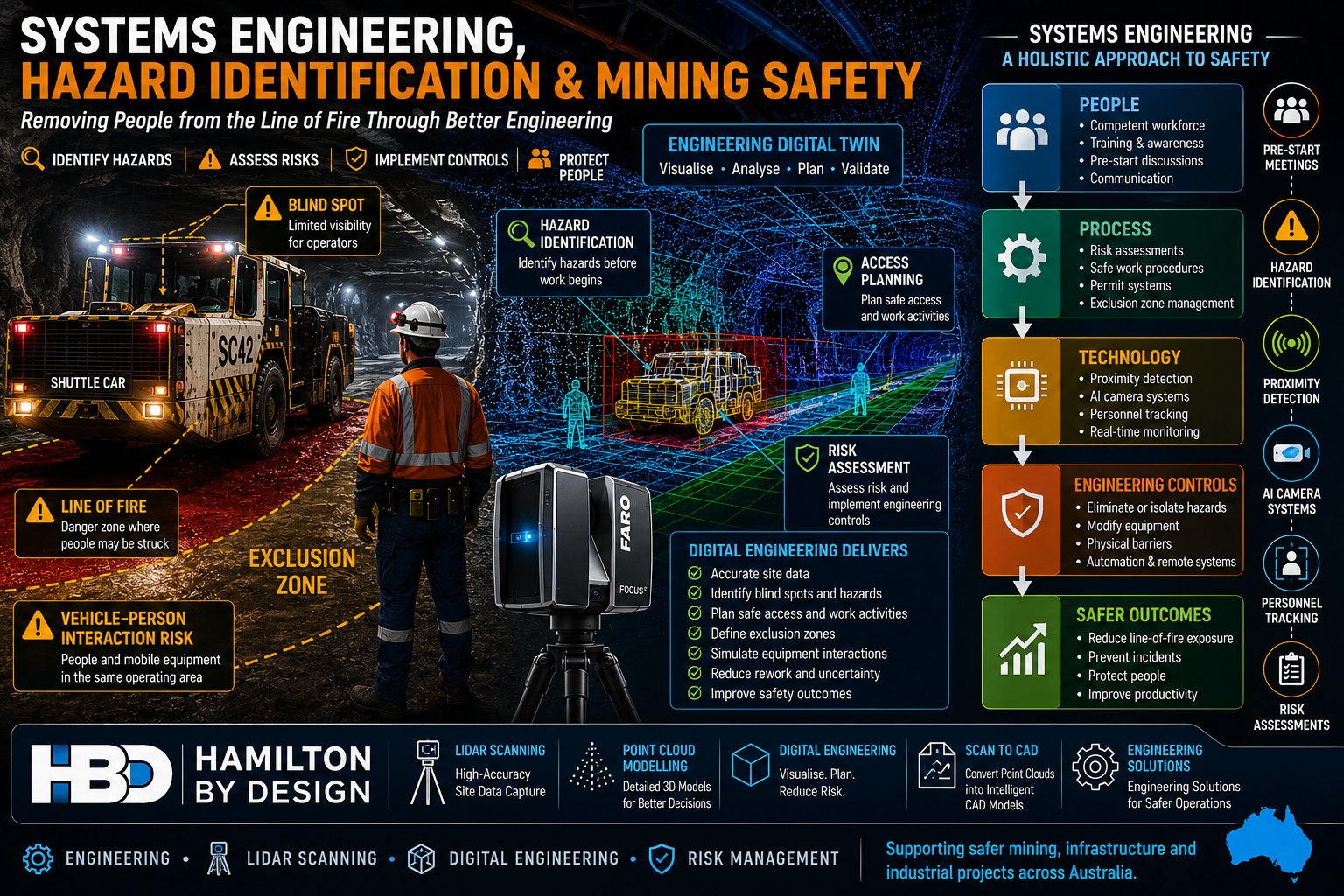
Systems engineering and mining safety infographic showing an underground shuttle car, exclusion zones, hazard identification, engineering digital twin, LiDAR scanning, risk assessment and engineering controls used to reduce line-of-fire risks and improve workplace safety in mining operations.

Lessons from a Preventable Underground Coal Mine Incident

The Technology Exists โ€“ So Why Are We Still Seeing These Incidents?

A recent Resources Safety & Health Queensland (RSHQ) investigation into a near-fatal underground coal mining incident has once again highlighted a challenge that continues to confront the mining industry.

The incident occurred at an underground coal mine near Emerald in Queensland’s Bowen Basin when a worker entered the blind spot of a shuttle car and was struck by the machine. Investigators identified several contributing factors including poor visibility, inadequate communication, high background noise, blind spots around mobile equipment and the absence of proximity detection technology. RSHQ described the event as entirely preventable and encouraged operators to consider technologies already being used successfully at other Queensland mines.

While incidents such as this are often discussed from an operational perspective, they also highlight a broader engineering challenge.

The real question is:

How do we design systems that prevent workers from being exposed to hazards in the first place?

This is where systems engineering becomes critically important.


What is Systems Engineering?

Systems engineering is the disciplined approach of understanding how people, equipment, processes, technology, procedures and the operating environment interact as a complete system.

Rather than focusing on individual components, systems engineering examines:

  • Human factors
  • Equipment design
  • Communication systems
  • Work procedures
  • Environmental conditions
  • Technology controls
  • Organisational culture
  • Training and competency
  • Risk management processes

When a serious incident occurs, it is rarely caused by a single failure.

Instead, multiple weaknesses align simultaneously.

In the Emerald incident, the shuttle car itself was not necessarily defective.

The system failed because:

  • Workers changed position without positive communication.
  • The vehicle operator was unaware of the workers’ location.
  • Visibility was limited.
  • Background noise masked movement.
  • No proximity detection technology was available.
  • Workers entered a line-of-fire zone.

A systems engineering approach asks:

What combination of controls could have prevented the event regardless of human error?


The Hierarchy of Controls

One of the most important principles in safety engineering is the Hierarchy of Controls.

Controls are generally ranked from most effective to least effective:

  1. Elimination
  2. Substitution
  3. Engineering Controls
  4. Administrative Controls
  5. Personal Protective Equipment

Many organisations rely heavily on procedures, training and pre-start discussions.

While these are important, they sit relatively low in the hierarchy.

Engineering controls are often more reliable because they do not depend entirely on human behaviour.

Examples include:

  • Proximity detection systems
  • AI camera systems
  • Collision avoidance systems
  • Personnel tracking systems
  • Physical barriers
  • Interlocks
  • Remote operation technology
  • Autonomous equipment

The objective should always be to engineer hazards out of the system wherever practical.


Hazard Identification Starts Before Work Begins

One of the most effective safety tools available is proactive hazard identification.

Many incidents occur because hazards are recognised only after work has commenced.

Hazard identification should occur during:

Project Planning

Before construction or maintenance work begins.

Design Reviews

Before equipment is fabricated or modified.

Shutdown Planning

Before personnel enter operational areas.

Pre-Start Meetings

Before workers commence each shift.

Field Risk Assessments

Immediately before performing a task.

A robust hazard identification process considers:

  • Mobile equipment interactions
  • Blind spots
  • Stored energy
  • Working at heights
  • Falling objects
  • Confined spaces
  • Vehicle movements
  • Emergency access
  • Simultaneous operations
  • Human factors

The goal is simple:

Identify hazards before they have an opportunity to cause harm.


Why Pre-Start Meetings Matter

In many operations, pre-start meetings can become routine.

Unfortunately, routine often leads to complacency.

The most effective pre-start meetings are not simply administrative exercises.

They provide an opportunity to discuss:

What Has Changed?

  • New equipment
  • New personnel
  • Different environmental conditions
  • Weather impacts
  • Operational changes

What Are Today’s Hazards?

  • Vehicle interactions
  • Exclusion zones
  • Ground conditions
  • Overhead hazards
  • Isolation requirements

What Are the Critical Controls?

  • Spotters
  • Communication methods
  • Isolation procedures
  • Permit requirements
  • Emergency response arrangements

What Could Go Wrong?

This question alone can significantly improve hazard awareness.

A quality pre-start discussion encourages workers to actively think about risk before entering the workplace.


Line-of-Fire Hazards Remain a Major Industry Risk

Across mining, construction, manufacturing and heavy industry, line-of-fire incidents continue to be one of the leading causes of serious injury and fatalities.

Line-of-fire hazards include situations where workers are exposed to:

  • Moving vehicles
  • Rotating equipment
  • Suspended loads
  • Stored energy
  • Pressurised systems
  • Falling objects
  • Uncontrolled equipment movement

Recent Queensland mining safety alerts have repeatedly highlighted similar themes:

  • Workers trapped between vehicles.
  • Workers entering exclusion zones.
  • Poor communication.
  • Lack of positive isolation.
  • Mobile equipment interactions.

The underlying hazards are often well understood.

The challenge is ensuring controls remain effective in real-world operating environments.


The Role of Digital Engineering and LiDAR Scanning

Modern engineering tools are creating new opportunities to identify and manage risk before work begins.

Engineering-grade LiDAR scanning and digital engineering workflows allow project teams to create accurate digital representations of operational facilities.

Applications include:

Access Planning

Identifying safe access routes.

Equipment Interaction Analysis

Assessing vehicle and personnel separation.

Shutdown Planning

Visualising work fronts before crews arrive onsite.

Clash Detection

Identifying conflicts before installation.

Exclusion Zone Development

Understanding hazardous interaction areas.

Emergency Planning

Reviewing evacuation routes and emergency access.

Hamilton By Design regularly supports projects through:

  • Engineering-grade LiDAR scanning
  • Point cloud modelling
  • Scan-to-CAD workflows
  • Digital engineering
  • Mechanical engineering
  • Brownfield modifications
  • As-built documentation

These tools provide project teams with accurate information that can improve both productivity and safety outcomes.


Proximity Detection Technology is Not New

One of the most significant observations from the recent incident is that proximity detection technology already exists.

In fact, underground mining industries have been investigating and deploying proximity detection systems around continuous miners and shuttle cars for many years. These systems can identify personnel entering predefined warning or hazard zones and initiate alarms, slowdowns or machine intervention depending on the system design.

Modern systems can provide:

  • Warning zones
  • Slow-down zones
  • Automatic stop functions
  • Personnel tracking
  • Vehicle interaction monitoring
  • AI-assisted hazard detection

The question is no longer whether the technology is available.

The question is how quickly and consistently industry adopts it.


Building Safer Systems

A mature safety culture understands that procedures alone are rarely enough.

The strongest organisations focus on building multiple layers of protection.

This includes:

People

  • Training
  • Competency
  • Communication

Processes

  • Risk assessments
  • Safe work procedures
  • Permit systems

Technology

  • Proximity detection
  • AI vision systems
  • Personnel tracking

Engineering

  • Equipment redesign
  • Physical barriers
  • Elimination of hazards

Leadership

  • Safety culture
  • Accountability
  • Continuous improvement

When these elements work together, the likelihood of serious incidents is dramatically reduced.


Final Thoughts

The recent underground coal mining incident serves as a powerful reminder that safety is fundamentally a systems engineering challenge.

The objective should not simply be to react to incidents.

The objective should be to design work environments where incidents are far less likely to occur.

Hazard identification, risk assessment, effective pre-start meetings, engineering controls and modern technologies all play a critical role in achieving this outcome.

As the mining industry continues to embrace digital engineering, LiDAR scanning, automation, AI systems and proximity detection technologies, there is a significant opportunity to remove people from the line of fire and create safer workplaces.

The technology exists.

The challenge is ensuring it is implemented before the next near miss becomes a fatality.


Hamilton By Design logo displayed on a blue tilted rectangle with a grey gradient background

References

  1. Resources Safety & Health Queensland (RSHQ) โ€“ Safety Alert: Underground shuttle car incident.
  2. Resources Safety & Health Queensland (RSHQ) โ€“ Vehicle interaction and line-of-fire safety alerts.
  3. Proximity Detection Systems in Underground Mines โ€“ Queensland Mining Industry Health and Safety Conference.
  4. Proximity Detection Options on Underground Mining Equipment.
  5. Safe to Work โ€“ Coal mine collision highlights parking procedure risks.

Contact Us – Talk to Us

Name
Would you like us to arrange a phone consultation for you?
Address
Australian Drafting logo featuring bold white text reading "Australian Drafting" centred on a blue rounded rectangle background.
Engineering Governance title graphic featuring bold white text reading "Engineering Governance" centred on a blue rounded rectangle background.
Mechanical, Structural & Pipework Drafting service banner by Hamilton By Design featuring white text on a blue background.
Mechanical engineering services
Blue rounded button with the text โ€œSolidWorks Designโ€ in white.
Finite Element Analysis (FEA) engineering simulation button
3D LiDAR Scanning Darwin for engineering surveys, laser scanning, reality capture and point cloud modelling services
3D LiDAR Scanning Australia engineering services for laser scanning, reality capture, scan-to-CAD, Scan-to-BIM and as-built documentation across Australia
3D LiDAR scanning services on the Central Coast providing engineering-grade laser scanning, point cloud capture, scan-to-CAD modelling and industrial reality capture for infrastructure and industrial projects.
3D LiDAR Scanning Perth for engineering surveys, laser scanning, reality capture and point cloud modelling services
3D LiDAR Scanning Sydney for engineering surveys, laser scanning, reality capture and point cloud modelling services
3D LiDAR Scanning Brisbane for engineering surveys, laser scanning, reality capture and point cloud modelling services
3D LiDAR Scanning Canberra for engineering surveys, laser scanning, reality capture and point cloud modelling services
3D LiDAR Scanning Newcastle for engineering surveys, laser scanning, reality capture and point cloud modelling services
3D LiDAR Scanning Adelaide for engineering surveys, laser scanning, reality capture and point cloud modelling services
https://www.hamiltonbydesign.com.au/scan-to-bim-services-australia-lidar-point-clouds-cad-modelling

Static Line Installation and Engineering Certification for Mining and Industrial Facilities

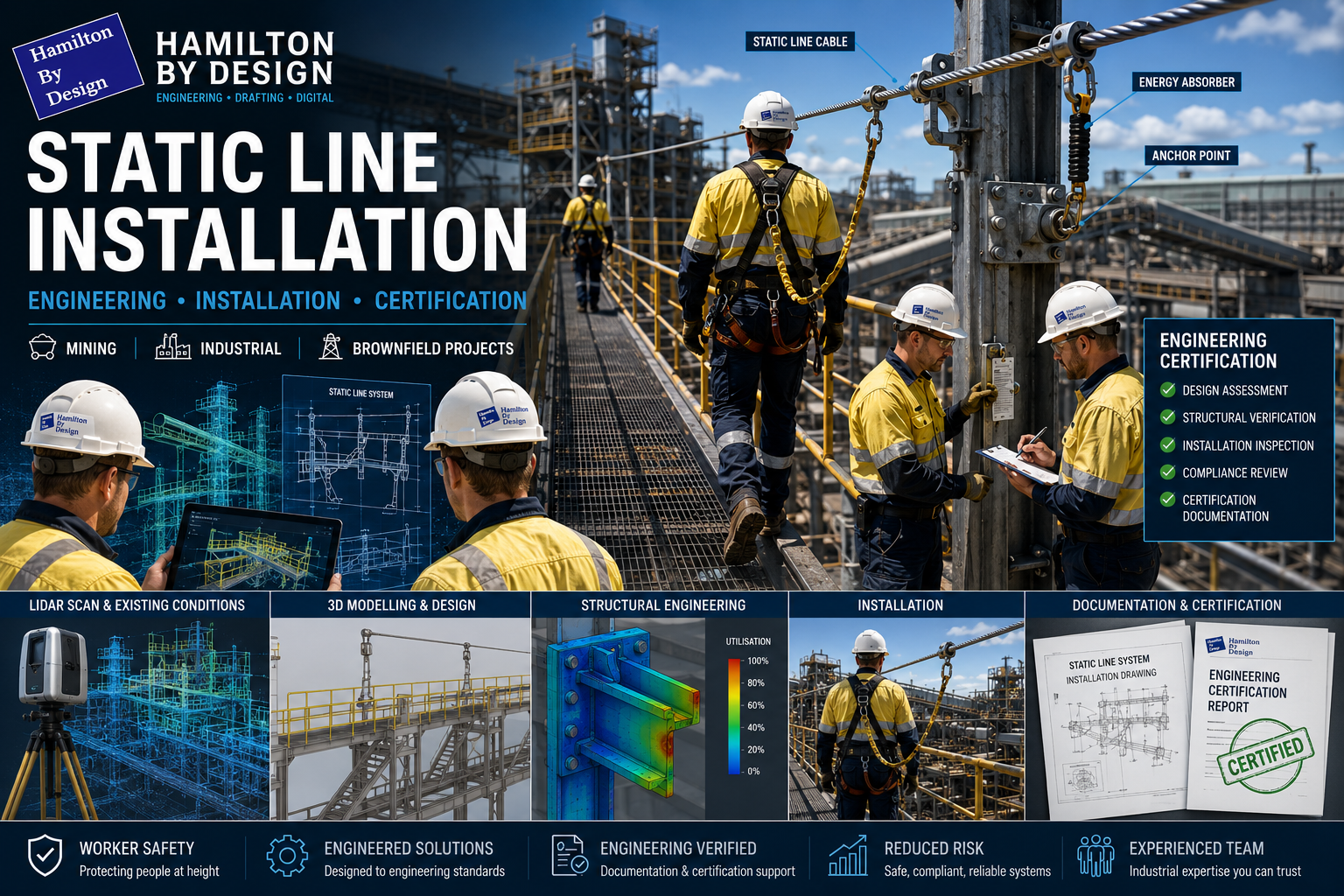
Hamilton By Design static line installation and engineering certification for mining and industrial facilities showing workers at height, structural engineering assessment, LiDAR scanning and installation support.

Static line systems play an important role in protecting personnel working at heights across mining, manufacturing, processing plants, smelters and heavy industrial environments. While a static line system may appear simple, effective implementation requires significantly more than installing a cable between two points.

A static line system is an engineered safety system requiring assessment of supporting structures, installation planning, documentation and engineering verification to ensure safe operation throughout its service life.

Why Engineering Assessment Matters

Static line systems can transfer significant loads into supporting structures during operation and potential fall events. Existing platforms, structural steel, roof systems and access structures may not have originally been designed for these additional loading conditions.

Potential risks may include:

  • Structural overload
  • Excessive cable deflection
  • Anchor point failure
  • Reduced fall clearance
  • Interference with plant infrastructure
  • Installation conflicts with existing services

Engineering assessment helps ensure the complete system performs safely and integrates correctly with existing facility infrastructure.


Brownfield Installation Challenges

Many industrial facilities have undergone modifications over many years and existing drawings do not always reflect current site conditions.

Common challenges include:

  • Structural changes not reflected in drawings
  • Additional pipework and services
  • Restricted installation access
  • Congested steelwork layouts
  • Equipment interferences
  • Unknown structural details

Capturing existing conditions before installation can reduce uncertainty and improve design confidence.

Engineering-grade LiDAR scanning and site verification can assist with:

  • Existing-condition capture
  • Structural geometry verification
  • Access assessment
  • Clash identification
  • As-built modelling
  • Installation planning

Typical Static Line Engineering Process

Site Inspection and Existing Asset Review

The process generally begins with:

  • Site inspections
  • Existing drawing review
  • Structural assessment
  • Access reviews
  • Existing-condition verification
  • Asset condition assessment

3D CAD Modelling Australia service banner for Hamilton By Design

Structural Engineering Assessment

Supporting structures are assessed for:

  • Structural member capacity
  • Connection capacity
  • Anchor loading requirements
  • Dynamic loading conditions
  • Multiple-user requirements
  • Deflection limits
  • Existing loading conditions
  • Corrosion and asset condition

Where required, structural modifications or strengthening works may be developed.


Design Documentation

Typical engineering deliverables may include:

  • Static line layouts
  • General Arrangement (GA) drawings
  • Structural details
  • Anchor point details
  • Installation drawings
  • Load calculations
  • Fabrication documentation

Clear documentation reduces installation uncertainty and assists construction and maintenance activities.


Installation Verification

Following installation, verification activities may include:

  • Anchor inspections
  • Fixing verification
  • Installation checks
  • Dimensional confirmation
  • Asset tagging
  • Documentation review

Engineering Certification

Engineering certification documentation may include:

  • Design calculations
  • Compliance documentation
  • Inspection records
  • Installation drawings
  • Certification statements
  • Asset schedules
  • Maintenance requirements

Certification provides confidence that the installed system aligns with engineering design intent and project requirements.


How Hamilton By Design Can Support Static Line Projects

Hamilton By Design has a team capable of supporting the design, fabrication, installation and engineering certification process for static line systems and working-at-height access solutions for mining and industrial facilities.

Our engineering-led approach may include:

  • Existing-condition site inspections
  • Engineering-grade LiDAR scanning and verification
  • Structural and mechanical assessment
  • Static line and anchor layout development
  • Fabrication drawings and installation documentation
  • Site coordination and construction support
  • Engineering review and certification documentation

Whether for new installations or brownfield modifications, our objective is to deliver systems designed and installed to relevant engineering requirements and project standards while integrating with existing infrastructure.

This provides clients with a complete workflow from concept and site capture through to installation support and engineering verification.


Benefits of an Engineered Approach

A structured engineering approach can provide:

  • Improved worker safety
  • Reduced project risk
  • Better installation outcomes
  • Reduced rework
  • Improved documentation
  • Increased confidence in long-term asset performance
  • Improved lifecycle management

Final Thoughts

Static line systems are critical safety assets and should be treated as engineered systems rather than standalone products. Proper installation, engineering assessment and certification help ensure systems perform as intended and integrate safely within operating facilities.

For mining and industrial environments, combining engineering assessment with existing-condition verification and structured project documentation can significantly reduce uncertainty and improve installation outcomes.

Hamilton By Design logo displayed on a blue tilted rectangle with a grey gradient background
3D LiDAR scanning and 3D modelling service button โ€” laser scanner capturing a point cloud for engineering and CAD modelling
Mechanical engineering services
Name
Would you like us to arrange a phone consultation for you?
Address
Finite Element Analysis (FEA) engineering simulation button
Mechanical engineering services

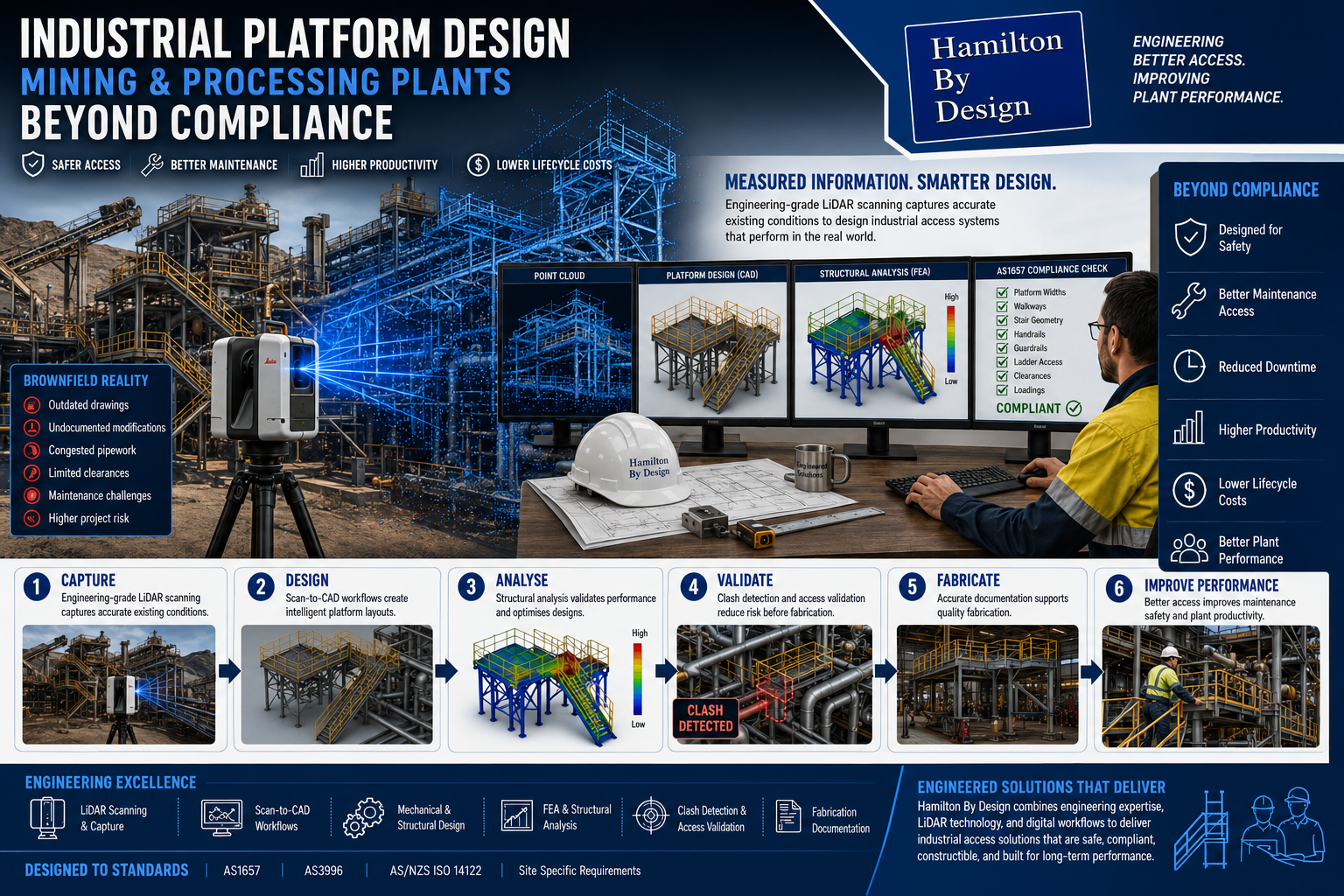
Industrial Platform Design for Mining and Processing Plants: Beyond Compliance

Engineering-grade Scan-to-CAD reverse engineering workflow converting existing industrial equipment into CAD models and fabrication-ready drawings.

Industrial platforms are commonly viewed as supporting structures that simply provide access to equipment and operating areas. In many projects the design process focuses heavily on meeting minimum standards and compliance requirements.

While compliance is essential, successful platform design extends beyond satisfying engineering checklists.

Mining and processing facilities rely on platforms every day for:

  • Maintenance activities
  • Equipment inspections
  • Shutdown work
  • Operational access
  • Plant monitoring
  • Emergency access
  • Equipment removal and installation

Poor platform design can create safety concerns, maintenance challenges, and operational inefficiencies that remain throughout the life of the asset.

At Hamilton By Design, we view platform design as an engineering solution supporting productivity, maintenance, and long-term operational performance rather than simply meeting minimum requirements.

Why Industrial Platform Design Matters

Platforms directly affect how personnel interact with equipment and infrastructure.

Well-designed systems can improve:

  • Worker safety
  • Maintenance access
  • Equipment accessibility
  • Shutdown performance
  • Plant productivity
  • Long-term operating costs

Poor platform layouts may create:

  • Congested access areas
  • Restricted maintenance access
  • Increased manual handling risks
  • Difficult equipment removal
  • Longer shutdown durations
  • Increased project costs

Platform design influences how effectively a facility operates every day.

Compliance is the Starting Point

Mining and processing facilities frequently consider standards including:

  • AS1657 โ€“ Fixed Platforms, Walkways, Stairways and Ladders
  • AS3996 โ€“ Access Covers and Grates
  • Structural loading requirements
  • Site-specific engineering requirements

Standards establish minimum requirements for:

  • Platform dimensions
  • Walkway widths
  • Guardrails
  • Handrails
  • Stair geometry
  • Ladder systems
  • Access openings

Compliance is important, but meeting minimum requirements alone does not guarantee an efficient design.

3D CAD Modelling Australia service banner for Hamilton By Design

Maintenance Access Often Drives Better Outcomes

Maintenance teams commonly interact with platforms more frequently than operations personnel.

Platform design should consider:

  • Equipment removal paths
  • Tool access requirements
  • Safe working zones
  • Inspection locations
  • Clearance requirements
  • Shutdown activities
  • Future maintenance needs

Questions often worth asking include:

  • Can pumps or motors be removed safely?
  • Can maintenance teams work comfortably?
  • Is lifting equipment accessible?
  • Can personnel safely carry tools and equipment?
  • Is there room for future upgrades?

Designing around maintenance activities often improves long-term outcomes.

Human Factors Matter

Platform systems should be designed around how people actually move and work.

Human considerations can include:

  • Visibility
  • Reach distances
  • Working posture
  • Congestion
  • Manual handling requirements
  • Access frequency
  • Emergency escape routes

Designs that ignore human interaction can create unnecessary operational difficulties.

Brownfield Environments Create Additional Challenges

Most mining and processing facilities are not greenfield sites.

Brownfield facilities commonly include:

  • Existing structural steel
  • Pipework congestion
  • Historical modifications
  • Equipment additions
  • Limited clearances
  • Legacy infrastructure

Existing drawings may no longer represent current operating conditions.

Designing new platforms around assumptions can increase:

  • Fabrication risk
  • Site rework
  • Installation delays
  • Shutdown costs

Engineering-Grade LiDAR Scanning for Existing Condition Capture

Hamilton By Design supports platform projects through engineering-grade 3D LiDAR scanning.

Scanning may capture:

  • Structural steel
  • Existing platforms
  • Pipework
  • Equipment
  • Access systems
  • Buildings
  • Existing clearances

Measured information supports engineering decisions using actual site conditions rather than assumptions.

From Point Clouds to Platform Design

Captured information can be processed into engineering workflows through Scan-to-CAD systems.

This supports:

  • Existing condition modelling
  • Platform layouts
  • Structural design
  • Clash detection
  • Access validation
  • Fabrication drawings

Potential problems can often be identified digitally before fabrication begins.

Engineering Analysis and Validation

Platform systems frequently require engineering validation beyond simple geometry.

Hamilton By Design may support projects through:

  • Structural assessment
  • Finite Element Analysis (FEA)
  • Load validation
  • Design optimisation
  • Fabrication documentation

The objective is delivering practical designs that perform in operating environments.

How Hamilton By Design Supports Industrial Platform Projects

Hamilton By Design combines practical engineering experience and digital engineering workflows including:

  • Engineering-grade 3D LiDAR scanning
  • Existing condition capture
  • Scan-to-CAD workflows
  • Mechanical and structural design
  • Engineering analysis and simulation
  • CAD modelling
  • Fabrication documentation
3D LiDAR scanning and 3D modelling service button โ€” laser scanner capturing a point cloud for engineering and CAD modelling
Mechanical engineering services

Beyond Compliance

Industrial platform design should support more than standards compliance.

Successful designs support:

  • Safer workplaces
  • Better maintenance access
  • Reduced downtime
  • Improved operational efficiency
  • Lower lifecycle costs
  • Long-term asset performance

Standards establish minimum requirements.

Engineering adds value beyond them.

Better platform design supports better plant performance.

Hamilton By Design logo displayed on a blue tilted rectangle with a grey gradient background

Our Clients:

Name
Would you like us to arrange a phone consultation for you?
Address
3D CAD Modelling Australia service banner for Hamilton By Design
Australian Drafting logo featuring bold white text reading "Australian Drafting" centred on a blue rounded rectangle background.
Engineering Governance title graphic featuring bold white text reading "Engineering Governance" centred on a blue rounded rectangle background.
Mechanical, Structural & Pipework Drafting service banner by Hamilton By Design featuring white text on a blue background.
Mechanical engineering services
Blue rounded button with the text โ€œSolidWorks Designโ€ in white.
Finite Element Analysis (FEA) engineering simulation button
3D LiDAR Scanning Darwin for engineering surveys, laser scanning, reality capture and point cloud modelling services
3D LiDAR Scanning Australia engineering services for laser scanning, reality capture, scan-to-CAD, Scan-to-BIM and as-built documentation across Australia
3D LiDAR scanning services on the Central Coast providing engineering-grade laser scanning, point cloud capture, scan-to-CAD modelling and industrial reality capture for infrastructure and industrial projects.
3D LiDAR Scanning Perth for engineering surveys, laser scanning, reality capture and point cloud modelling services
3D LiDAR Scanning Sydney for engineering surveys, laser scanning, reality capture and point cloud modelling services
3D LiDAR Scanning Brisbane for engineering surveys, laser scanning, reality capture and point cloud modelling services
3D LiDAR Scanning Canberra for engineering surveys, laser scanning, reality capture and point cloud modelling services
3D LiDAR Scanning Newcastle for engineering surveys, laser scanning, reality capture and point cloud modelling services
3D LiDAR Scanning Adelaide for engineering surveys, laser scanning, reality capture and point cloud modelling services

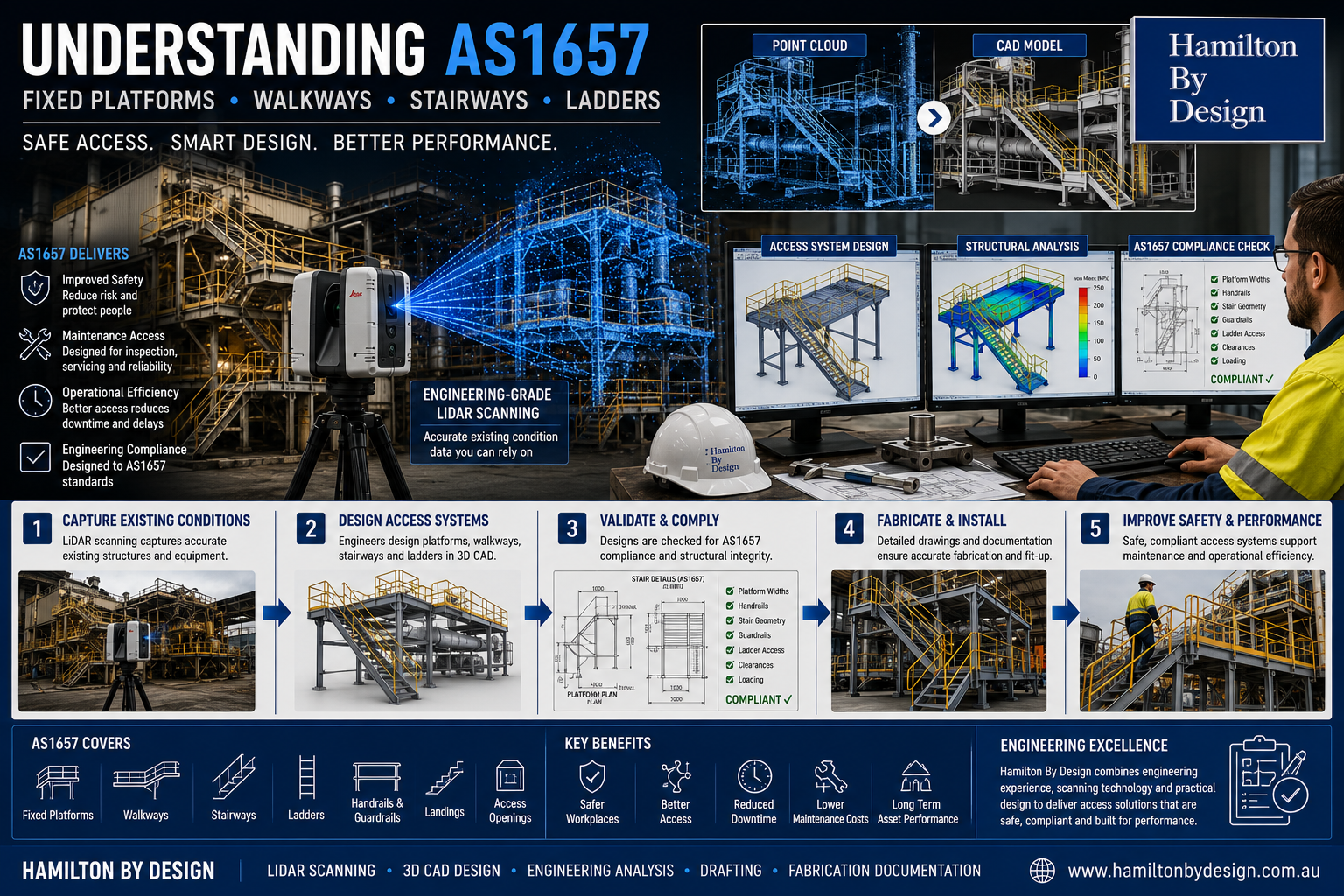
Understanding AS1657: Fixed Platforms, Walkways, Stairways and Ladders

Engineering-grade LiDAR scanning and CAD modelling workflow for AS1657 industrial access systems including platforms, walkways, stairways, and ladders.

Industrial facilities are built around more than machinery and production systems. Personnel require safe and reliable access to equipment, maintenance areas, inspection locations, and operational assets. Whether within mining operations, manufacturing facilities, timber processing plants, or industrial processing environments, access systems play an important role in both safety and productivity.

Poorly designed access systems can create operational inefficiencies, increase maintenance time, and introduce unnecessary risk. Access systems designed around practical engineering requirements can improve not only safety outcomes but also long-term operational performance.

In Australia, one of the key standards governing these systems is AS1657 โ€“ Fixed Platforms, Walkways, Stairways and Ladders โ€“ Design, Construction and Installation.

Understanding the purpose of AS1657 helps organisations design access systems that support safer operations, maintenance efficiency, and engineering compliance.

What is AS1657?

AS1657 establishes requirements and guidance for the design, construction, and installation of fixed access systems within industrial facilities.

The standard applies to systems including:

  • Fixed platforms
  • Walkways
  • Stairways
  • Fixed ladders
  • Handrails
  • Guardrails
  • Landings
  • Access openings

The objective of the standard is providing safe and practical access throughout industrial facilities while reducing hazards associated with working at heights and movement around equipment.

AS1657 is commonly applied across:

  • Mining operations
  • Processing plants
  • Manufacturing facilities
  • Bulk materials handling facilities
  • Timber processing operations
  • Infrastructure projects
  • Industrial processing sites
3D CAD Modelling Australia service banner for Hamilton By Design

Why Proper Access Design Matters

Access systems are often viewed as secondary structures supporting primary equipment.

In practice, access systems influence:

  • Worker safety
  • Equipment accessibility
  • Maintenance efficiency
  • Shutdown performance
  • Operational productivity
  • Long-term operating costs

Poor access design can create:

  • Restricted access zones
  • Congestion around equipment
  • Increased manual handling risks
  • Longer shutdown activities
  • Reduced maintenance efficiency
  • Higher maintenance costs

Well-designed systems can improve operational performance while supporting safer working conditions.

Fixed Platforms and Walkways

Fixed platforms and walkways provide safe movement and work areas around equipment and operational assets.

Typical design considerations include:

  • Platform dimensions
  • Walkway widths
  • Surface materials
  • Guardrail systems
  • Toe plates
  • Access clearances
  • Slip resistance requirements
  • Structural loading considerations

Effective access design supports maintenance teams by improving movement around equipment and reducing access difficulties.

Stairways and Ladder Requirements

Stairways and ladders require practical engineering consideration beyond simply connecting two elevations.

Important design factors may include:

Stairways

  • Rise and going dimensions
  • Stair angles
  • Handrail requirements
  • Intermediate landings
  • Head clearances
  • User movement requirements

Ladders

  • Ladder height limitations
  • Cage requirements
  • Fall protection systems
  • Landing arrangements
  • Access openings

The frequency of use and maintenance requirements often influence whether ladders or stairways provide the most suitable solution.

Maintenance Access Considerations

Maintenance activities often represent one of the most frequent interactions personnel have with industrial assets.

Access systems should support:

  • Inspection activities
  • Equipment removal
  • Maintenance tasks
  • Shutdown work
  • Routine servicing

Poor maintenance access can lead to:

  • Extended downtime
  • Increased labour requirements
  • Manual handling issues
  • Higher operational costs

Designing around maintenance requirements during early project stages can reduce ongoing operational challenges.

Brownfield Applications Create Additional Challenges

Brownfield facilities rarely reflect original design documentation.

Industrial sites commonly contain:

  • Historical modifications
  • Existing structural steel
  • Congested layouts
  • Pipework interferences
  • Equipment additions
  • Legacy infrastructure

Designing new access systems in these environments can become challenging without accurate existing information.

Hamilton By Design supports brownfield projects using engineering-grade 3D LiDAR scanning to capture:

  • Existing structures
  • Platforms
  • Walkways
  • Equipment
  • Pipework
  • Access systems

Existing condition capture allows engineering decisions to be based on measured information rather than assumptions.

Supporting Engineering Compliance

Engineering compliance extends beyond simply meeting dimensional requirements.

Good engineering practice should also consider:

  • Safety outcomes
  • Practical useability
  • Constructability
  • Maintenance efficiency
  • Future modifications
  • Long-term operational performance

Compliance should support functionality rather than becoming a checklist exercise.

How Hamilton By Design Supports Industrial Access Projects

Hamilton By Design combines practical engineering experience with digital engineering workflows to support industrial access projects through:

  • Engineering-grade 3D LiDAR scanning
  • Existing condition capture
  • Scan-to-CAD workflows
  • Mechanical design
  • Structural assessment
  • Engineering analysis and simulation
  • CAD modelling
  • Fabrication documentation

Our approach supports projects from initial site capture through to fabrication-ready deliverables.

3D LiDAR scanning and 3D modelling service button โ€” laser scanner capturing a point cloud for engineering and CAD modelling
Mechanical engineering services

Moving Beyond Minimum Compliance

AS1657 exists to support safer and more effective industrial access systems.

However, successful access systems do more than satisfy compliance requirements.

They improve:

  • Safety performance
  • Maintenance efficiency
  • Operational productivity
  • Long-term asset performance

Well-designed access systems help people interact safely and effectively with industrial assets every day.

Better access systems support better operational outcomes.

Hamilton By Design logo displayed on a blue tilted rectangle with a grey gradient background
Name
Would you like us to arrange a phone consultation for you?
Address

Our Clients:

https://www.hamiltonbydesign.com.au/understanding-as1657-fixed-platforms-walkways-stairways-ladders
Finite Element Analysis (FEA) engineering simulation button
Mechanical engineering services

AS 3996 Grate & Access Cover Design Australia (Class D, E & F)

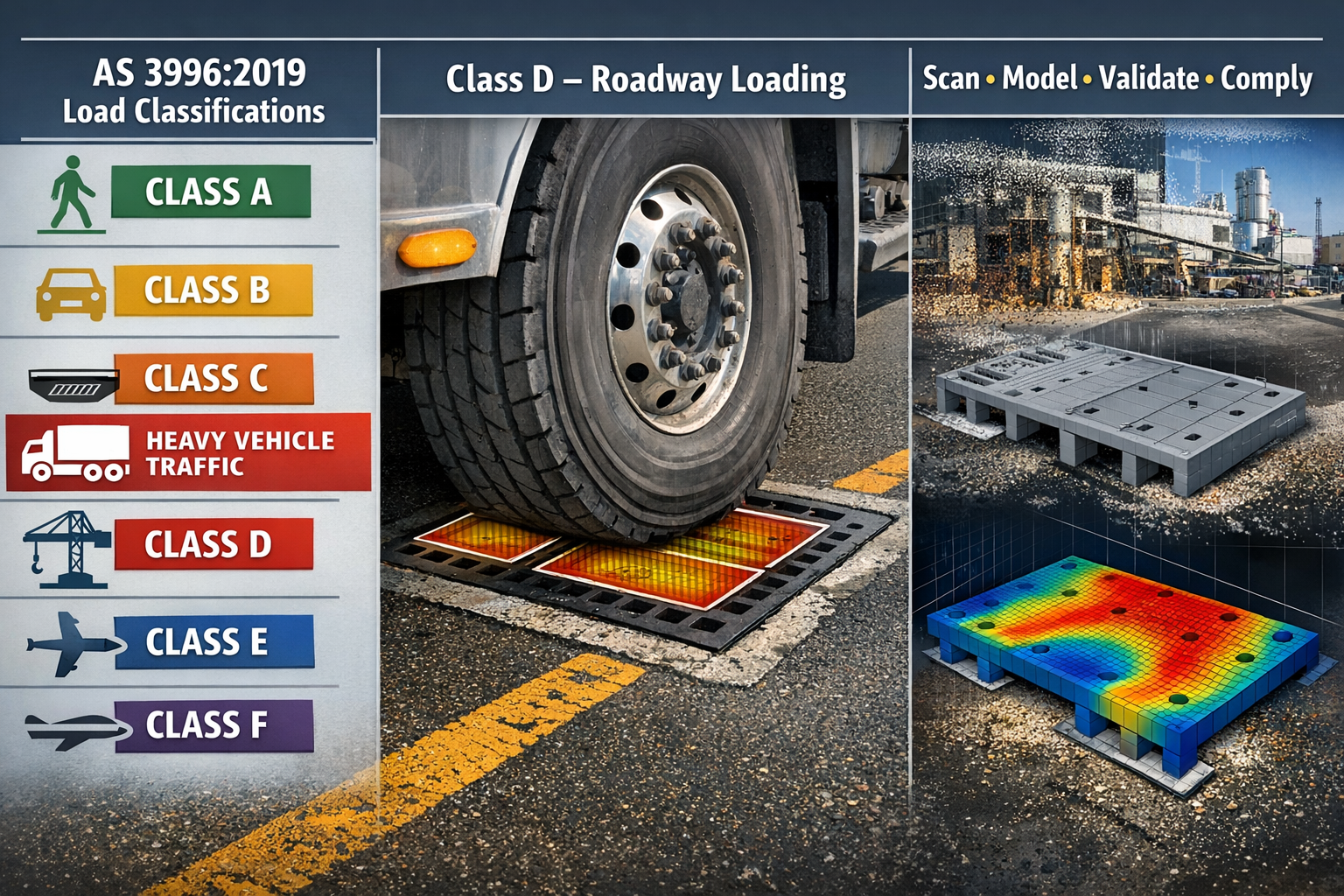
Engineering validation of AS 3996 access cover showing truck tyre load, structural model and stress contours

Engineering-Grade Design, Validation & Compliance

When designing access covers and grates for roads, industrial facilities, and infrastructure projects, compliance with AS 3996:2019 is critical.

At Hamilton By Design, we provide engineering-led design, validation, and documentation to ensure access covers and grate systems meet real-world loading conditionsโ€”not just theoretical requirements.

We combine:

  • 3D laser scanning (LiDAR)
  • Mechanical and structural engineering
  • Finite Element Analysis (FEA)
  • Fabrication-ready drafting

to deliver compliant, buildable, and reliable solutions.


What is AS 3996 and Why It Matters

AS 3996 defines the requirements for:

  • Access covers (manholes)
  • Drainage grates
  • Frames and supporting structures

It ensures these systems can safely withstand loads from:

  • Pedestrians
  • Passenger vehicles
  • Heavy trucks
  • Industrial and extreme loading conditions

Failure to properly design to AS 3996 can result in:

  • Structural failure
  • Safety risks
  • Non-compliance with approvals
  • Costly rework

AS 3996 Load Classifications Explained

Class A โ€“ Pedestrian Areas

  • Footpaths, parks, landscaped areas
  • Light-duty applications

Class B โ€“ Light Vehicles

  • Car parks and low-speed traffic zones

Class C โ€“ Road Edges & Gutters

  • Kerbside and non-primary load zones

Class D โ€“ Roadways (Most Common)

  • Public roads and industrial access roads
  • Designed for heavy vehicle traffic

Class E โ€“ Heavy Industrial

  • Freight terminals, ports, and logistics hubs

Class F โ€“ Extreme Loads

  • Airports and specialised heavy load zones

Class D Design โ€“ The Industry Standard

Most infrastructure projects require Class D compliance, covering:

  • B-double and heavy vehicle traffic
  • Waste collection vehicles
  • Construction and service vehicles

Engineering Considerations for Class D

  • Tyre load distribution (dual tyres, contact patches)
  • Plate thickness and stiffness
  • Support frame design
  • Fatigue under repeated loading
  • Localised stress concentrations

Designing to Class D is not just about selecting a ratingโ€”it requires engineering validation.


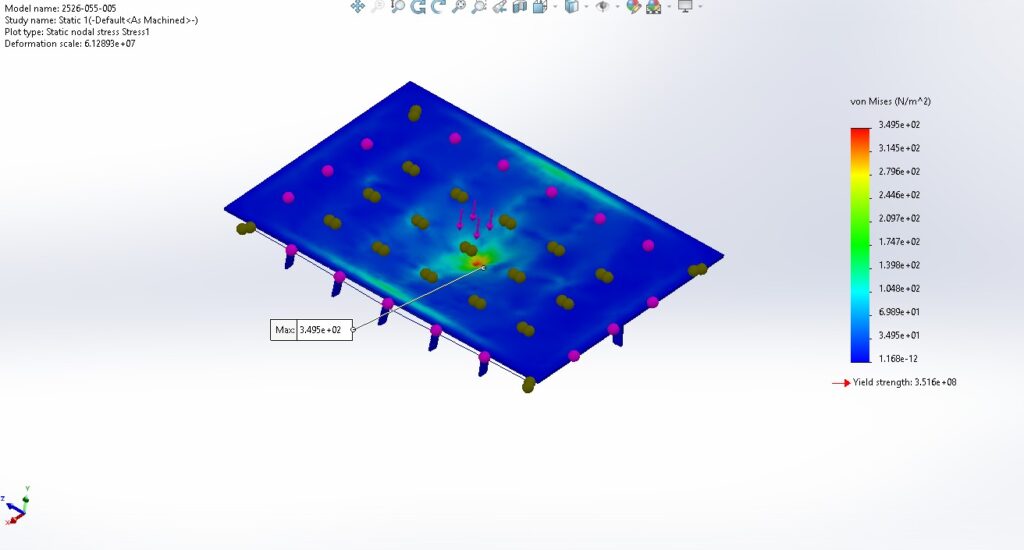
FEA stress contour and mesh quality for load-rated steel plate under roadway loading conditions

Our Engineering Approach (What Sets Us Apart)

1. Capture Existing Conditions (Critical Step)

In brownfield environments, assumptions are risky.

We use engineering-grade 3D laser scanning to:

  • Capture exact pit and frame geometry
  • Identify misalignment or deformation
  • Reduce design risk before fabrication

๐Ÿ‘‰ Capture first. Design second.


2. Design to Suit Real Conditions

We donโ€™t force standard products into non-standard environments.

We design:

  • Custom grate systems
  • Retrofit solutions
  • Plate and frame assemblies
  • Structural reinforcement (RHS, PFC, ribbed plates)

All tailored to:

  • Actual site geometry
  • Load requirements
  • Installation constraints

3. Validate Using FEA (Finite Element Analysis)

We apply finite element analysis (FEA) to:

  • Simulate heavy vehicle loading
  • Identify stress concentrations
  • Verify performance against material limits
  • Ensure compliance with AS 3996 intent

This ensures:

  • No overstressing
  • Adequate stiffness
  • Long-term durability

4. Deliver Fabrication-Ready Outputs

We provide:

  • Detailed shop drawings
  • Bill of materials (BOM)
  • Installation details
  • Engineering documentation

Ready for:

  • Fabricators
  • Contractors
  • Approval authorities

Brownfield vs Greenfield Design

Greenfield

  • Clean geometry
  • Standard solutions often suitable

Brownfield (Where We Excel)

  • Existing infrastructure constraints
  • Misaligned frames
  • Limited access
  • Unknown geometry

This is where engineering-led scanning and design makes the difference.


Common Mistakes We Help Avoid

  • Assuming load class without traffic assessment
  • Ignoring tyre load distribution
  • Undersized or flexible plates
  • Poor support conditions
  • No validation of existing geometry
  • Lack of engineering sign-off

Typical Applications

We support projects across:

  • Roads and civil infrastructure
  • Mining and industrial plants
  • Water and drainage systems
  • Ports and logistics facilities
  • Retrofit upgrades and compliance works

Integrated Services

Hamilton By Design provides a complete workflow:

  • 3D Laser Scanning (LiDAR)
  • Point Cloud to CAD Modelling
  • Mechanical & Structural Design
  • FEA Validation
  • Drafting & Documentation
  • Engineering Support & Sign-Off

Why Work With Hamilton By Design

  • Engineer-led approach (not just drafting)
  • Proven experience in brownfield environments
  • Integration of scanning + design + validation
  • Practical, buildable solutions
  • Focus on reducing project risk

  • AS 3996 Explained (Blog Post)
  • Class D Grate Design Case Study
  • 3D Laser Scanning for Infrastructure Projects
  • Reducing Risk in Brownfield Upgrades

Hamilton By Design logo displayed on a blue tilted rectangle with a grey gradient background

3D LiDAR scanning and 3D modelling service button โ€” laser scanner capturing a point cloud for engineering and CAD modelling
Mechanical engineering services

Get in Touch

If your project requires:

  • AS 3996-compliant design
  • Upgrade of existing grates or covers
  • Engineering validation of load capacity

๐Ÿ‘‰ Visit: https://www.hamiltonbydesign.com.au
๐Ÿ‘‰ Contact us to discuss your project

Experience the difference with Hamilton By Design.

Name
Would you like us to arrange a phone consultation for you?
Address
3D CAD Modelling Australia service banner for Hamilton By Design
Australian Drafting logo featuring bold white text reading "Australian Drafting" centred on a blue rounded rectangle background.
Engineering Governance title graphic featuring bold white text reading "Engineering Governance" centred on a blue rounded rectangle background.
Mechanical, Structural & Pipework Drafting service banner by Hamilton By Design featuring white text on a blue background.
Mechanical engineering services
Blue rounded button with the text โ€œSolidWorks Designโ€ in white.
Finite Element Analysis (FEA) engineering simulation button
3D LiDAR Scanning Darwin for engineering surveys, laser scanning, reality capture and point cloud modelling services
3D LiDAR Scanning Australia engineering services for laser scanning, reality capture, scan-to-CAD, Scan-to-BIM and as-built documentation across Australia
3D LiDAR scanning services on the Central Coast providing engineering-grade laser scanning, point cloud capture, scan-to-CAD modelling and industrial reality capture for infrastructure and industrial projects.
3D LiDAR Scanning Perth for engineering surveys, laser scanning, reality capture and point cloud modelling services
3D LiDAR Scanning Sydney for engineering surveys, laser scanning, reality capture and point cloud modelling services
3D LiDAR Scanning Brisbane for engineering surveys, laser scanning, reality capture and point cloud modelling services
3D LiDAR Scanning Canberra for engineering surveys, laser scanning, reality capture and point cloud modelling services
3D LiDAR Scanning Newcastle for engineering surveys, laser scanning, reality capture and point cloud modelling services
3D LiDAR Scanning Adelaide for engineering surveys, laser scanning, reality capture and point cloud modelling services

How Lighting Design Improves Workplace Environments โ€” and Gets People Back On Site

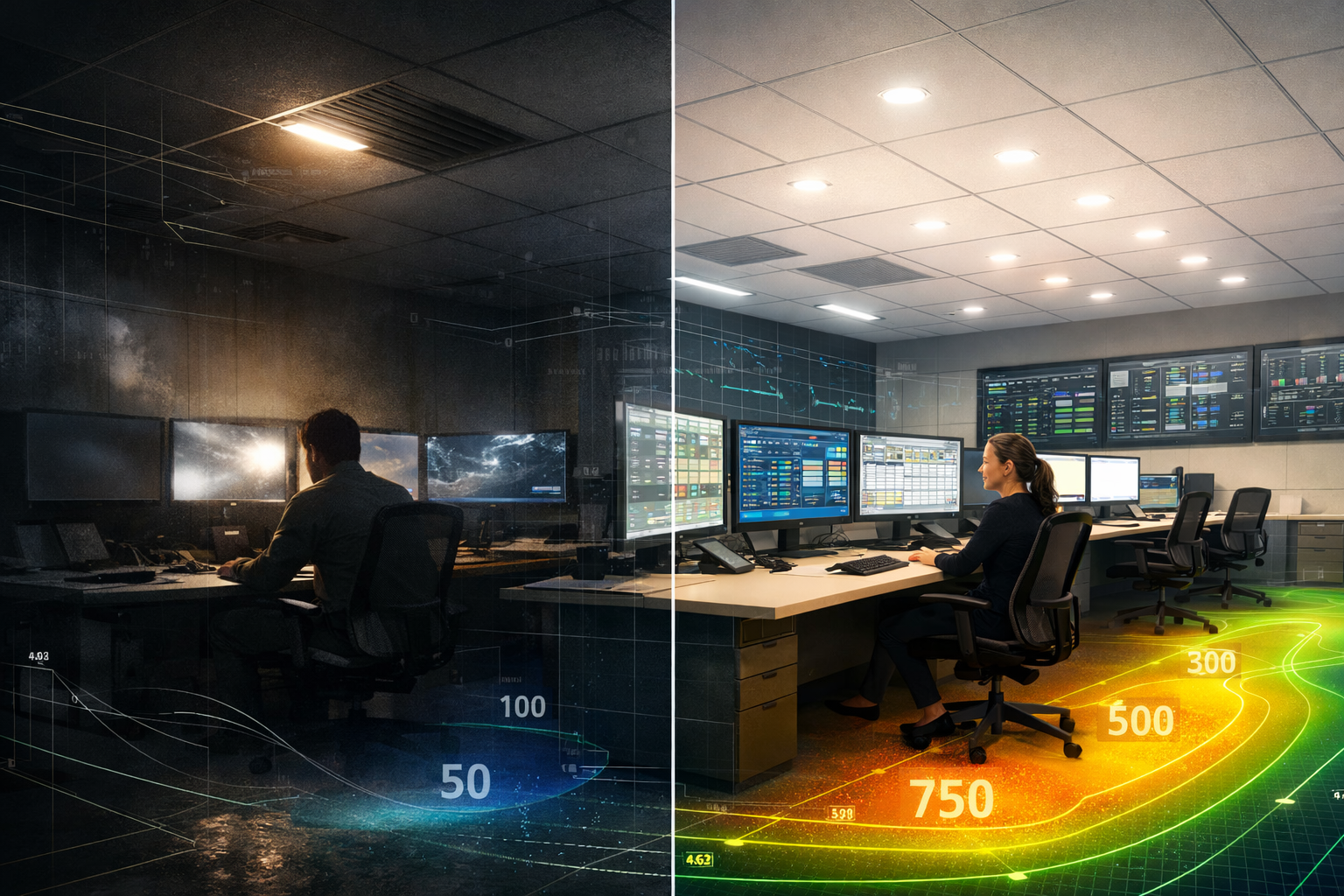
Workplace lighting design comparison showing poorly lit control room versus optimised lighting with AGi32 simulation

Why Workplace Environment Matters More Than Ever

Workplace expectations have changed.

If an environment is uncomfortable, poorly lit, or outdated โ€” people will choose to work from home.

But when a workplace is well-designed, functional, and comfortable:

People actually want to be there.

One of the most overlooked factors in this shift is lighting design.


Lighting Directly Impacts Performance

Lighting is not just about visibility โ€” it directly impacts how people feel and perform.

Poor lighting can lead to:

  • Eye strain
  • Fatigue
  • Reduced concentration
  • Increased safety risks

Whereas well-designed lighting delivers:

  • Consistent illumination
  • Reduced glare
  • Improved visibility of screens and equipment
  • A more comfortable and professional environment

Engineering the Outcome with AGi32

At Hamilton By Design, we support lighting designers using AGi32 to simulate and validate lighting performance before installation.

This allows us to:

  • Predict light levels across the entire space
  • Identify dark zones and over-lit areas
  • Optimise fixture placement
  • Validate compliance with lighting standards

๐Ÿ‘‰ Instead of guessing โ€” we engineer the outcome.


3D LiDAR scanning and 3D modelling service button โ€” laser scanner capturing a point cloud for engineering and CAD modelling
Mechanical engineering services

Real-World Application: Control Room Upgrade

In a recent Brisbane project, we developed a 3D AutoCAD model from LiDAR scan data to support lighting design in AGi32 .

The objective was not just compliance โ€” but improving the working environment inside a live operational space.

This included:

  • Accurate modelling of walls, desks, and equipment
  • Providing a clean, lightweight model for simulation
  • Supporting lighting redesign based on how the space is actually used today

This workflow typically starts with engineering-grade 3D laser scanning, ensuring the environment is captured accurately before any design work begins.


Designing for How People Work Today

Many facilities havenโ€™t changed structurally โ€” but the way people use them has.

Equipment moves. Workflows evolve. Technology changes.

Lighting design needs to reflect:

  • Current layouts
  • Real working conditions
  • Actual line-of-sight requirements

This is where point cloud to CAD modelling becomes critical โ€” translating real-world conditions into a usable design model.


The Outcome: Better Environments, Better Engagement

When lighting is done properly:

  • Spaces feel safer and more modern
  • Employees experience less fatigue
  • Visibility improves across all tasks
  • The workplace becomes somewhere people want to be

Final Thought

If you want to encourage people back into the workplace:

Start with the environment.

And one of the most effective, measurable improvements you can make is:

Well-designed, engineered lighting.

Our Clients


Need Help Improving Your Workplace Environment?

If youโ€™re planning:

  • Workplace upgrades
  • Control room improvements
  • Lighting redesigns
  • Or working from outdated drawings
Hamilton By Design logo displayed on a blue tilted rectangle with a grey gradient background

Hamilton By Design can support you with:

  • 3D laser scanning
  • Point cloud to CAD modelling
  • Engineering-led design workflows

Visit: https://www.hamiltonbydesign.com.au

Get in touch to discuss your project

Name
Would you like us to arrange a phone consultation for you?
Address
3D CAD Modelling Australia service banner for Hamilton By Design
Reality Capture Brisbane title graphic with white text on a blue background promoting reality capture, LiDAR scanning and digital engineering services in Brisbane, Queensland.
3D Scanning Brisbane text graphic on a blue background promoting engineering-led laser scanning and reality capture services in Brisbane.

LiDAR Scanning Brisbane title graphic with white text on a blue background promoting terrestrial LiDAR scanning, point cloud capture and reality capture services in Brisbane, Queensland.
SolidWorks Brisbane title graphic with white text on a blue background promoting SolidWorks mechanical design, 3D CAD modelling and engineering drafting services in Brisbane, Queensland.