

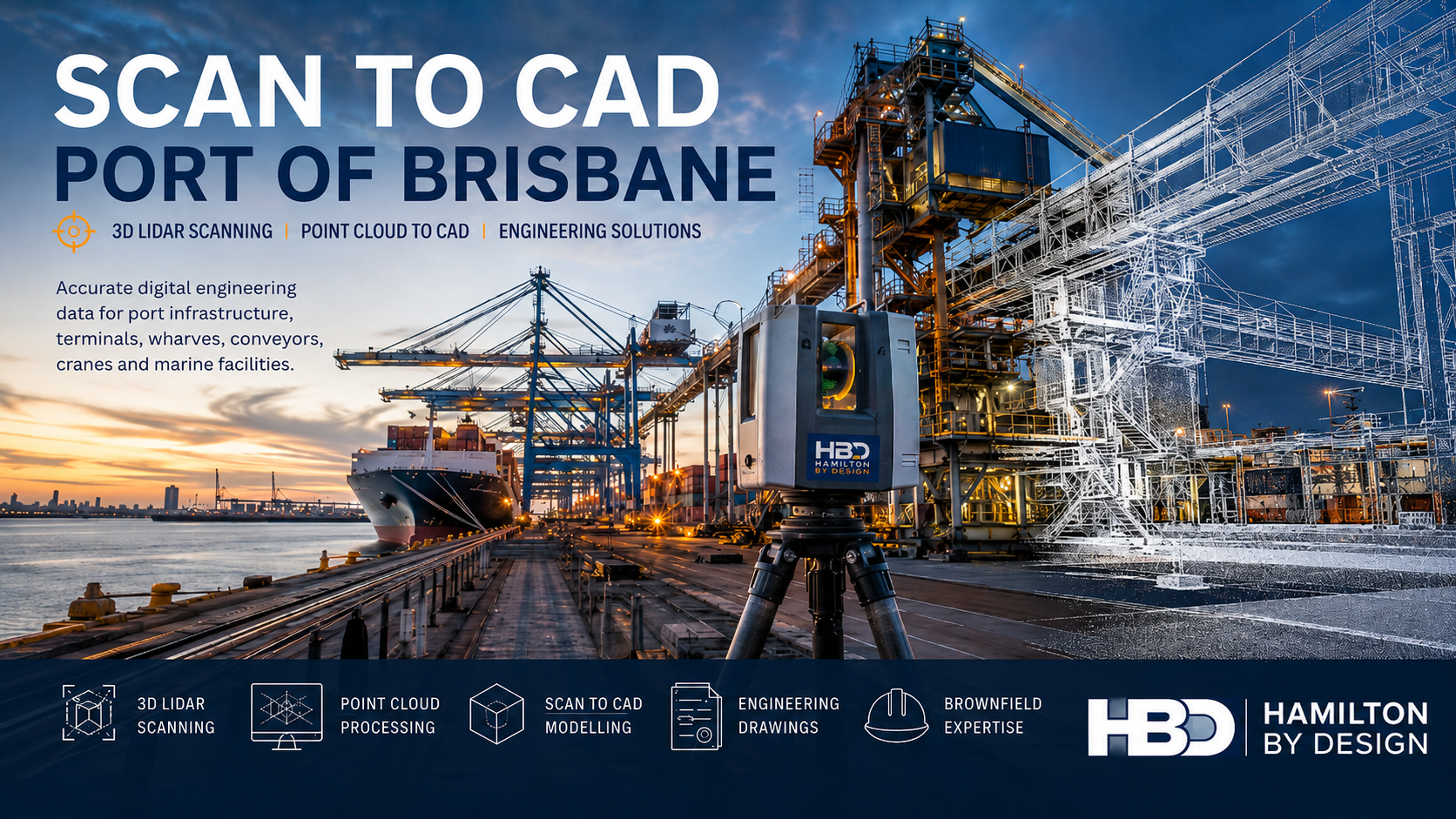
Scan to CAD Port of Brisbane | 3D LiDAR Scanning

Scan to CAD at the Port of Brisbane showing a 3D LiDAR scanner, container ship, port cranes and point-cloud CAD model of industrial infrastructure.

Scan to CAD Port of Brisbane

Engineering-Grade 3D LiDAR Scanning and CAD Modelling for Port Facilities

Blue 3D LiDAR scanner icon on a tripod with scanning waves

Port facilities are complex industrial environments containing wharves, container terminals, conveyors, ship-loading equipment, cranes, structural steel, pipework, access systems and marine infrastructure.

Over time, port equipment may be repaired, reinforced, relocated, replaced or modified without every change being accurately reflected in the original drawings.

Hamilton By Design provides Scan to CAD services for the Port of Brisbane, converting engineering-grade LiDAR point-cloud data into practical CAD models, drawings and digital engineering information.

Our engineer-led workflow combines LiDAR scanning in Brisbane with point cloud to CAD modelling, mechanical engineering and fabrication-focused drafting.

This enables project teams to design around the actual port facility rather than relying on incomplete drawings, isolated site measurements or assumptions.


What Is Scan to CAD?

Scan to CAD is the process of capturing an existing asset or facility with 3D laser scanning and converting the resulting point cloud into structured CAD geometry.

A typical workflow includes:

Project planning โ†’ Site scanning โ†’ Point-cloud registration โ†’ CAD modelling โ†’ Engineering drawings

The completed models and drawings may be prepared for use in:

  • AutoCAD
  • SolidWorks
  • Autodesk Inventor
  • Navisworks
  • Revit
  • Plant-design software
  • Structural-drafting systems
  • Fabrication and construction documentation

Hamilton By Design provides more than a visual point cloud. Our engineering-led 3D scanning services in Brisbane are structured around the projectโ€™s intended engineering, fabrication, maintenance or construction outcome.


Scan to CAD for the Port of Brisbane

The Port of Brisbane is a major Queensland trade and logistics hub supporting containerised cargo, bulk products, motor vehicles, general cargo and other maritime activities.

Its facilities include container berths, bulk-handling terminals, common-user facilities and the Brisbane Multimodal Terminal, which provides an interface between rail, road and container-terminal operations.

Infrastructure in and around the port may include:

  • Container-handling equipment
  • Ship-to-shore cranes
  • Automated stacking-crane infrastructure
  • Conveyors and transfer stations
  • Ship loaders and unloaders
  • Hoppers and chutes
  • Wharf structures
  • Marine loading equipment
  • Fuel and chemical infrastructure
  • Rail and road interfaces
  • Maintenance workshops
  • Structural-steel platforms
  • Stairs, ladders and handrails
  • Pipe racks and process pipework

The Port of Brisbaneโ€™s container facilities include multiple container berths operated by major stevedores using automated container-handling equipment.

Scan to CAD provides an accurate digital baseline before modification, maintenance or upgrade work begins.


Why Port Facilities Benefit from Scan to CAD

Traditional site measurement usually requires designers to identify every required dimension before attending site.

When another measurement is needed later, another site visit may be required.

This can be difficult within an operating port environment where access may involve:

  • Port or terminal inductions
  • Maritime-security controls
  • Work permits
  • Escort requirements
  • Traffic-management arrangements
  • Crane and mobile-equipment movements
  • Restricted wharf access
  • Work near water
  • Vessel movements
  • Limited shutdown windows
  • Coordination with operations personnel

A coordinated 3D point-cloud scan captures millions of measured points throughout the work area.

Once registered, the point cloud allows engineers and designers to revisit the digital site and review:

  • Dimensions
  • Elevations
  • Clearances
  • Structural interfaces
  • Pipework locations
  • Equipment positions
  • Access constraints
  • Installation routes
  • Surrounding obstructions

This can reduce repeated site attendance while providing a more complete understanding of the existing environment.


Scan Existing Port Infrastructure Once and Use It Repeatedly

A well-planned scan can become a reusable digital reference for engineering, drafting, fabrication and maintenance teams.

The point cloud may be used to support:

  • Concept development
  • Detailed design
  • Equipment replacement
  • Structural modifications
  • Fabrication drawings
  • Clash detection
  • Installation planning
  • Shutdown planning
  • As-built documentation
  • Maintenance-access reviews
  • Future upgrade projects

Hamilton By Designโ€™s reality capture services in Brisbane integrate site capture with Scan to CAD, as-built documentation and engineering design.

This means the scan is planned around what the project team needs to achieve, rather than simply collecting large quantities of unstructured data.


Port Equipment and Infrastructure We Can Capture

Wharves and Marine Structures

LiDAR scanning can capture the accessible and visible geometry of:

  • Wharf decks
  • Structural framing
  • Fender-support structures
  • Bollards
  • Mooring equipment
  • Access ladders
  • Handrails
  • Service trenches
  • Crane rails
  • Wharf-mounted equipment
  • Pipework and services
  • Equipment foundations

The resulting CAD model can support maintenance planning, structural modifications, equipment installation and existing-condition documentation.

For projects involving broader building or infrastructure information, Hamilton By Design can also provide Scan to BIM services in Brisbane.


Container-Terminal Infrastructure

Container terminals contain complex interfaces between cranes, automated equipment, road vehicles, rail infrastructure, barriers, services and maintenance areas.

Scan to CAD can assist with projects involving:

  • Ship-to-shore crane interfaces
  • Automated stacking-crane areas
  • Container-transfer equipment
  • Crane rails
  • Maintenance access
  • Safety barriers
  • Equipment foundations
  • Cable routes
  • Traffic interfaces
  • Structural modifications
  • Services and utilities

The point cloud allows proposed equipment and structures to be reviewed within the measured terminal environment before fabrication or installation.


Conveyors, Chutes and Bulk-Materials Equipment

Bulk-handling equipment is often congested, elevated and difficult to measure manually.

Hamilton By Design can scan:

  • Belt conveyors
  • Transfer stations
  • Chutes
  • Hoppers
  • Bins
  • Feeders
  • Ship loaders
  • Ship unloaders
  • Scrapers
  • Support structures
  • Walkways
  • Maintenance platforms
  • Dust-extraction systems

Our chute design and materials-handling services can combine accurate existing-condition data with CAD modelling and engineering design.

This can support chute replacement, conveyor modification, wear assessment and materials-handling upgrades.


Ship Loaders and Port-Loading Equipment

Ship loaders contain large structural, mechanical and materials-handling systems that can be difficult to document with conventional measurement methods.

Scan to CAD can support:

  • Structural-steel modifications
  • Conveyor replacement
  • Chute upgrades
  • Access-platform design
  • Mechanical-equipment replacement
  • Slew and travel interfaces
  • Maintenance-access studies
  • Pipework and service modifications
  • As-built documentation
  • Installation and shutdown planning

Hamilton By Designโ€™s experience with ship-loader 3D scanning demonstrates how engineering-grade point clouds can support Scan to CAD, port infrastructure modifications and brownfield design.


Mechanical Equipment and Pipework

Scan to CAD can also document:

  • Pumps
  • Valves
  • Pipework
  • Ducting
  • Tanks
  • Mechanical skids
  • Loading systems
  • Hydraulic equipment
  • Equipment supports
  • Service platforms
  • Maintenance-access systems
  • Replacement components

Where existing components must be reproduced or redesigned, the scan can form part of a structured reverse-engineering process.


Rail and Road Interfaces

Port operations depend on coordinated movement between marine, road and rail systems.

LiDAR scanning can capture:

  • Rail alignments
  • Road interfaces
  • Loading areas
  • Transfer zones
  • Traffic barriers
  • Equipment clearances
  • Structures
  • Services
  • Signage supports
  • Access routes
  • Vehicle envelopes

The Brisbane Multimodal Terminal provides a designated interface between rail, road and the Port of Brisbane container terminals.

A coordinated point cloud can help project teams assess how proposed modifications interact with these operating areas.


Scan to CAD for Brownfield Port Upgrades

Most port modification projects are brownfield projects.

New equipment must fit around existing structures, pipework, electrical services, access platforms and operating systems.

Even a relatively small dimensional discrepancy can result in:

  • Fabrication rework
  • Installation delays
  • Site cutting and welding
  • Crane delays
  • Extended shutdowns
  • Access problems
  • Service clashes
  • Additional engineering work
  • Increased safety exposure
  • Higher project costs

Hamilton By Designโ€™s Scan to CAD workflow allows proposed equipment to be developed within the measured site environment.

This helps the project team understand:

  • What is actually installed
  • Where surrounding structures are located
  • Whether sufficient access is available
  • How the equipment may be installed
  • Whether fabricated components can reach their final position
  • Where clashes may occur
  • Which existing assets may require modification

Supporting Port Modification Projects

Scan to CAD can support a wide range of port projects, including:

  • Conveyor replacements
  • Transfer-chute upgrades
  • New maintenance platforms
  • Crane-access modifications
  • Equipment relocations
  • Pipework upgrades
  • Dust-extraction improvements
  • Ship-loader modifications
  • Wharf-service upgrades
  • Structural-steel additions
  • Machine guarding
  • Safety-access improvements
  • Demolition planning
  • Shutdown projects
  • As-built documentation

Hamilton By Design can combine Scan to CAD with broader engineering services, including mechanical design, structural drafting, 3D modelling and fabrication documentation.


Our Port of Brisbane Scan to CAD Workflow

1. Project Scope and Scan Planning

Before attending site, we establish:

  • The project objective
  • The required scan area
  • The required CAD deliverables
  • Critical equipment interfaces
  • Required level of detail
  • Accuracy expectations
  • Site-access conditions
  • Operational restrictions
  • Safety requirements
  • Coordinate-system requirements
  • File-format requirements

Planning the scan around the intended deliverable helps ensure that the required geometry is captured.


2. Site Access and Safety Planning

Port work can involve moving machinery, suspended loads, heavy vehicles, vessel operations, operating conveyors and water-edge hazards.

The scanning methodology may need to consider:

  • Port and terminal inductions
  • Safe Work Method Statements
  • Take 5 risk assessments
  • Exclusion zones
  • Traffic movements
  • Crane operations
  • Work near water
  • Restricted areas
  • Communication requirements
  • Shutdowns and isolations

Scanning positions are selected to capture the required information while minimising interference with port operations.


3. Engineering-Grade LiDAR Capture

Hamilton By Design uses professional terrestrial LiDAR equipment to capture detailed site geometry.

Multiple scan positions are typically established around the work area to reduce shadows and improve coverage around:

  • Structural members
  • Pipework
  • Mechanical equipment
  • Conveyor systems
  • Platforms
  • Services
  • Access routes
  • Equipment interfaces

Further information about our national scanning capability is available through our engineering-grade 3D laser scanning service.


4. Point-Cloud Registration

Individual scans are aligned into a coordinated point-cloud dataset.

The registered point cloud is reviewed for:

  • Alignment quality
  • Site coverage
  • Noise and unwanted data
  • Missing areas
  • Critical interfaces
  • Dimensional consistency
  • Coordinate control

The registered dataset may then be supplied directly or used as the basis for CAD modelling and engineering documentation.


5. CAD Modelling

Required geometry is extracted from the point cloud and converted into fit-for-purpose CAD information.

Depending on the project, this may include:

  • Simplified spatial models
  • Mechanical-equipment models
  • Structural-steel models
  • Pipework models
  • Conveyor models
  • Equipment envelopes
  • Platforms and access systems
  • Existing-condition drawings
  • Fabrication-ready models

Not every visible object needs to be modelled.

The required level of detail should be established according to the engineering purpose of the project.


6. Engineering and Constructability Review

Where required, the scan-derived CAD model can support:

  • Mechanical design
  • Structural-arrangement development
  • Clash detection
  • Access reviews
  • Installation planning
  • Equipment fit checks
  • Maintenance-access studies
  • Fabrication documentation
  • Engineering verification

Hamilton By Designโ€™s SolidWorks services in Brisbane can be used to develop mechanical models, assemblies and drawings from the measured site data.


7. Project Deliverables

Available project deliverables may include:

  • Registered point clouds
  • E57 files
  • RCP files
  • RCS files
  • LAS files
  • AutoCAD DWG drawings
  • DXF files
  • SolidWorks models
  • Autodesk Inventor models
  • STEP files
  • SAT files
  • Parasolid files
  • Navisworks coordination models
  • General-arrangement drawings
  • Plans, sections and elevations
  • Fabrication drawings
  • Existing-condition reports

The final deliverables are agreed during project scoping so the capture, processing and modelling effort remains aligned with the intended use.


Engineer-Led Scan to CAD

The value of a Scan to CAD project depends on more than the scanner being used.

The person planning the capture needs to understand what engineers, designers and fabricators will require from the data.

Hamilton By Design combines:

  • Mechanical-engineering experience
  • Industrial LiDAR scanning
  • Point-cloud registration
  • SolidWorks modelling
  • AutoCAD drafting
  • Structural and mechanical drafting
  • Fabrication knowledge
  • Brownfield-design experience
  • Practical site experience

Our 3D scanning engineering service in Brisbane combines site capture with CAD modelling, mechanical design and fabrication-ready drafting.

This integrated approach helps ensure important interfaces are captured and the final model is appropriate for its intended engineering purpose.


Designing Around Real Port Conditions

Port equipment may have been:

  • Repaired
  • Reinforced
  • Replaced
  • Relocated
  • Modified
  • Distorted
  • Worn
  • Supplemented with additional steelwork
  • Changed without drawing updates

An original drawing should therefore not automatically be treated as a reliable as-built record.

Scan to CAD allows designers to compare physical site conditions against available drawings and establish a more dependable basis for new work.

This is particularly valuable when designing:

  • Replacement components
  • New platforms
  • Conveyor modifications
  • Pipe supports
  • Equipment foundations
  • Structural frames
  • Guards and barriers
  • Maintenance-access systems
  • Retrofit steelwork

Clash Detection Before Fabrication

A scan-derived model can be combined with the proposed design to identify potential clashes before materials are ordered or components are fabricated.

Possible clashes may involve:

  • Existing structural steel
  • Pipework
  • Cable trays
  • Handrails
  • Mechanical equipment
  • Conveyor components
  • Access routes
  • Crane operating envelopes
  • Maintenance-removal paths
  • Vehicle clearances

Identifying these issues during the CAD stage is generally safer and less disruptive than discovering them during installation or a restricted port shutdown.


Installation and Shutdown Planning

Port shutdowns and installation windows may be tightly controlled.

Scan to CAD can assist project teams in reviewing:

  • Component sizes
  • Lift requirements
  • Crane positions
  • Installation sequences
  • Temporary access
  • Removal paths
  • Laydown areas
  • Existing obstructions
  • Required demolition
  • Temporary-support requirements

A coordinated point cloud also allows contractors, fabricators and project stakeholders to review the site remotely before mobilisation.


As-Built Verification

Following installation, selected areas may be rescanned and compared with the design model.

This can help verify:

  • Equipment position
  • Structural alignment
  • Pipe routing
  • Clearances
  • Installed geometry
  • Construction tolerances
  • Differences between design and installation

The resulting model can provide a dependable digital record for future maintenance, modification and asset-management activities.


Scan to CAD Compared with Manual Measurement

Manual measurement remains suitable for simple and accessible assets.

However, conventional measurement becomes more difficult where a project contains:

  • Complex geometry
  • Congested equipment
  • Elevated structures
  • Multiple operating levels
  • Restricted access
  • Large work areas
  • Irregular surfaces
  • Numerous equipment interfaces
  • Limited time on site

LiDAR scanning captures the spatial relationship between assets instead of producing a disconnected collection of individual measurements.

Critical dimensions may still be independently verified where required, but the point cloud provides the broader engineering context.


Benefits for Port Owners and Operators

Scan to CAD can provide:

  • Better existing-condition information
  • Reduced reliance on outdated drawings
  • Fewer repeated site visits
  • Improved design coordination
  • Earlier clash identification
  • Better installation planning
  • Reduced fabrication uncertainty
  • Improved asset documentation
  • A reusable digital record
  • Safer remote project reviews

Benefits for Engineers and Designers

Engineering teams can use the scan-derived model to:

  • Design around measured geometry
  • Check structural and mechanical interfaces
  • Develop accurate layouts
  • Create sections through complex areas
  • Review access and maintainability
  • Coordinate engineering disciplines
  • Produce fabrication drawings
  • Reduce assumptions
  • Communicate proposed modifications clearly

Benefits for Fabricators and Contractors

Fabricators and contractors can benefit from:

  • Better-defined interfaces
  • Clearer fabrication drawings
  • Reduced dimensional uncertainty
  • Improved fit-up confidence
  • Better lift planning
  • Better installation planning
  • Fewer unexpected site modifications
  • Reduced rework
  • Improved communication with the engineering team

Port of Brisbane Areas Serviced

Hamilton By Design can support Scan to CAD projects throughout:

  • Port of Brisbane
  • Fisherman Islands
  • Lytton
  • Pinkenba
  • Bulwer Island
  • Hemmant
  • Murarrie
  • Eagle Farm
  • Brisbane
  • South East Queensland
  • Regional Queensland

Port, wharf and terminal access remains subject to the requirements of the relevant facility owner, operator or tenant.


Why Choose Hamilton By Design?

Hamilton By Design provides an integrated digital-engineering service covering:

Rather than separating scanning, modelling, drafting and engineering between unrelated suppliers, Hamilton By Design can provide a coordinated workflow from physical site capture through to practical engineering documentation.


Frequently Asked Questions

Can Scan to CAD be completed while a port facility remains operational?

In many situations, yes.

LiDAR scanning is a non-contact measurement method and can often be performed around normal operations. However, scanning may need to be coordinated around traffic, cranes, vessels, conveyors, operating machinery and controlled exclusion zones.


Can you scan conveyors and ship-loading equipment?

Yes.

LiDAR scanning can capture conveyors, transfer chutes, hoppers, ship loaders, support structures, access platforms and surrounding equipment.


Can the point cloud be used in AutoCAD?

Yes.

Registered point-cloud data may be supplied in formats such as RCP, RCS and E57. Structured geometry and drawings can also be developed in AutoCAD DWG format.


Can you create SolidWorks models from the scan?

Yes.

Point-cloud information can be used to develop SolidWorks parts, assemblies, structural layouts, equipment envelopes and mechanical designs.


Do you provide the registered point-cloud data?

Registered point-cloud data can be included within the agreed project deliverables.

The required file format, coordinate system, file size and data-transfer method should be confirmed during project scoping.


Can you model only the project area?

Yes.

Targeted modelling is often more economical than modelling an entire port facility. The model can be limited to the structures, equipment and interfaces relevant to the project.


Can the CAD model be used for fabrication?

Yes, where fabrication-ready modelling and drawings are included within the agreed scope.

A raw point cloud should not automatically be treated as fabrication documentation without engineering interpretation and suitable drawing development.


Can you compare the scan with existing drawings?

Yes.

Existing drawings or CAD models can be compared with the measured point cloud to identify differences and support drawing updates.


Can scanning be performed near a wharf edge?

Potentially, subject to site access and project-specific safety controls.

Work near water may require exclusion zones, suitable personal protective equipment, communication arrangements, controlled access and coordination with port operations.


What scanning accuracy can be achieved?

The achievable accuracy depends on scan distance, site geometry, surface condition, environmental conditions, registration control and the required deliverable.

The appropriate scanning and modelling tolerance should be established during project planning.


Discuss Your Port of Brisbane Scan to CAD Project

Accurate engineering starts with a reliable understanding of the existing facility.

Hamilton By Design provides engineer-led Scan to CAD services for the Port of Brisbane, helping port operators, terminal operators, engineering consultants, contractors and fabricators convert existing infrastructure into reliable digital engineering information.

Whether your project involves a conveyor modification, maintenance platform, pipework upgrade, ship loader, wharf structure, crane interface, equipment replacement or broader brownfield upgrade, we can develop a scanning and modelling scope suited to the project.

Contact Hamilton By Design to discuss 3D LiDAR scanning, point-cloud processing and Scan to CAD services for your Port of Brisbane project.

Hamilton By Design logo displayed on a blue tilted rectangle with a grey gradient background

Contact Us – Talk To Us

Name
Would you like us to arrange a phone consultation for you?
Address

Our clients:
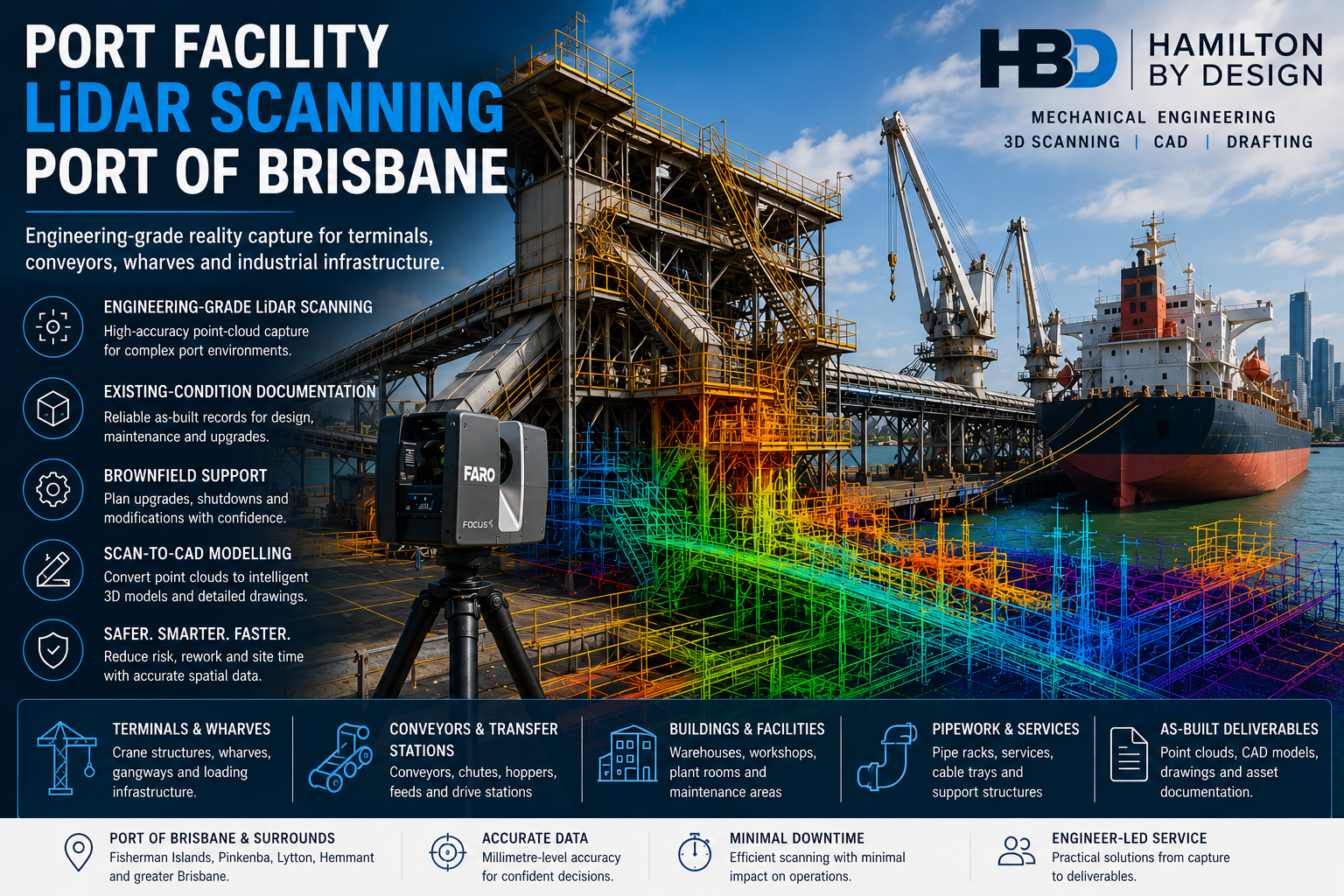

Port Facility LiDAR Scanning Port of Brisbane | Asset Capture

Port facility LiDAR scanning at the Port of Brisbane showing a FARO scanner, conveyors, wharf infrastructure, cargo ship and coloured point-cloud overlay.

Port Facility LiDAR Scanning Port of Brisbane

Engineering-Grade Reality Capture for Terminals, Wharves, Conveyors and Brownfield Port Infrastructure

Port facilities contain some of the most complex engineering environments in industry. Container-handling equipment, conveyors, transfer stations, structural steel, pipework, access systems, wharf infrastructure and mobile plant often operate within restricted areas and tightly controlled shutdown windows.

Hamilton By Design provides port facility LiDAR scanning at the Port of Brisbane, supporting terminal operators, asset owners, engineering consultants, maintenance teams, contractors and fabricators working across Fisherman Islands, Pinkenba, Lytton, Hemmant and the wider Brisbane port precinct.

Our service is focused on capturing reliable existing-condition data for engineering, asset documentation, maintenance planning, tender development, brownfield modifications and fabrication coordination.

Unlike the broader Port of Brisbane engineering and 3D laser scanning service, this page focuses specifically on facility-wide LiDAR capture, port asset documentation and engineering-ready point-cloud delivery.


Why Port Facilities Need Reliable Existing-Condition Data

Port infrastructure changes throughout its operating life.

Conveyors may be extended, platforms altered, guards replaced, pipework rerouted and equipment upgraded without every modification being transferred back to the original drawings.

This can create uncertainty when planning:

  • Terminal upgrades
  • Conveyor replacements
  • Chute modifications
  • New access systems
  • Wharf maintenance
  • Equipment relocation
  • Structural alterations
  • Shutdown work
  • Fabrication and installation
  • Asset-management programs

Traditional site measurement can be slow and incomplete when assets are large, congested, elevated or difficult to access safely.

Engineering-grade LiDAR scanning captures millions of spatial measurements and produces a measurable three-dimensional record of the visible environment. Hamilton By Design uses this approach across industrial and infrastructure projects where point-cloud data must support engineering, design and fabrication decisions.


What Is Port Facility LiDAR Scanning?

LiDAR means Light Detection and Ranging. A laser scanner emits light pulses and records the distance to visible surfaces, creating a dense collection of three-dimensional measurement points known as a point cloud.

For a port facility, the registered point cloud may capture the spatial relationship between:

  • Buildings
  • Wharves
  • Conveyors
  • Transfer towers
  • Loading equipment
  • Structural steel
  • Mechanical assets
  • Platforms and stairs
  • Pipework and services
  • Roads and hardstands
  • Maintenance areas
  • Adjacent infrastructure

The point cloud can then be reviewed, measured and converted into suitable engineering or asset-management deliverables.


Port Assets That Can Be Captured

Hamilton By Design can use terrestrial LiDAR scanning to document visible port and terminal assets such as:

Container-terminal infrastructure

  • Container-handling areas
  • Crane-support infrastructure
  • Equipment clearances
  • Terminal buildings
  • Maintenance zones
  • Traffic and operational interfaces

Bulk-material handling systems

  • Conveyors
  • Transfer stations
  • Chutes
  • Hoppers
  • Bins
  • Feeders
  • Drive stations
  • Support frames
  • Walkways and platforms

Wharf and marine-side infrastructure

  • Wharf-access structures
  • Loading and unloading equipment
  • Gangways
  • Mooring-related structures
  • Service connections
  • Pipe bridges
  • Above-water structural geometry
  • Crane rails and associated steelwork

Buildings and supporting facilities

  • Warehouses
  • Workshops
  • Plant rooms
  • Maintenance buildings
  • Service corridors
  • Electrical rooms
  • Equipment foundations
  • Structural framing

Where below-water geometry is required, terrestrial scanning may need to be combined with hydrographic, bathymetric or specialist subsea survey methods.


Facility-Wide Existing-Condition Capture

A port facility scan can extend beyond one isolated item of equipment.

Where required, Hamilton By Design can establish a broader digital record of:

  • Multiple conveyor routes
  • Transfer stations
  • Terminal buildings
  • Wharf structures
  • Road and equipment interfaces
  • Mechanical plant areas
  • Access systems
  • Existing services
  • Maintenance zones
  • Surrounding structural steel

This wider capture can help project teams understand how one proposed modification may affect other parts of the terminal.

It can also reduce repeated site visits by allowing engineers, designers and contractors to revisit the measured environment remotely.


Point-Cloud Deliverables

The registered point cloud can be supplied in formats selected to suit the clientโ€™s software and intended workflow.

Typical deliverables may include:

  • E57 point clouds
  • Autodesk RCP files
  • Autodesk RCS files
  • LAS files
  • Registered scan databases
  • Scan-location documentation
  • Coverage images
  • Selected measurements
  • Point-cloud viewing files
  • Cropped project areas
  • Coordinate or survey-control information where applicable

Hamilton By Design also provides 3D point-cloud scanning in Brisbane for projects requiring traceable, fit-for-purpose spatial information for engineering and construction decisions.


Scan-to-CAD for Port Facilities

A point cloud is a measurement dataset rather than a complete engineering model.

Where required, selected geometry can be converted into CAD representations of:

  • Structural steel
  • Conveyors
  • Chutes and hoppers
  • Mechanical equipment
  • Platforms and access structures
  • Pipework
  • Machinery guards
  • Equipment foundations
  • Buildings and plant rooms
  • Replacement components

The required modelling level should be defined according to the project purpose.

A broad coordination model may be sufficient for clash detection, while equipment replacement or fabrication work may require more detailed geometry and independently verified interfaces.

Hamilton By Designโ€™s Brisbane scanning and engineering service connects site capture with mechanical and structural engineering, CAD modelling and fabrication-ready drafting.


As-Built Documentation for Port Assets

Port facility LiDAR scanning can support the preparation of:

  • Existing-condition plans
  • General arrangement drawings
  • Floor plans
  • Sections and elevations
  • Structural layouts
  • Equipment-location drawings
  • Conveyor layouts
  • Pipe and service layouts
  • Clearance envelopes
  • Access-system drawings
  • Asset registers
  • Three-dimensional as-built models

These records can provide a more reliable basis for future maintenance, design and tender work than drawings that may not include later site modifications.


Brownfield Port Upgrades

Brownfield work is completed within an existing operational facility, where new equipment must fit around assets that remain in place.

Typical constraints include:

  • Incomplete drawings
  • Undocumented modifications
  • Restricted installation space
  • Existing services
  • Active operations
  • Limited shutdown periods
  • Difficult lifting access
  • Corrosion or wear
  • Multiple project interfaces

Hamilton By Design uses engineering-led LiDAR capture to reduce uncertainty in these environments.

A typical workflow may include:

  1. Defining the intended engineering use of the scan
  2. Capturing the existing facility and relevant interfaces
  3. Registering and reviewing the point-cloud data
  4. Isolating the project area
  5. Modelling the proposed equipment
  6. Positioning the design within the existing point cloud
  7. Reviewing clashes, access and constructability
  8. Preparing drawings for fabrication or installation

This approach is similar to the scan-led workflows Hamilton By Design applies to brownfield port engineering and industrial retrofit projects.


Conveyor and Transfer-Station Scanning

Port conveyors and transfer systems are often difficult to measure because they contain elevated steelwork, guarding, moving equipment, worn components and restricted access.

LiDAR scanning can document:

  • Conveyor stringers
  • Gantries
  • Head and tail stations
  • Pulley positions
  • Drive frames
  • Transfer towers
  • Chutes
  • Hoppers
  • Walkways
  • Platforms
  • Guarding
  • Pipework
  • Cable trays
  • Nearby structures

The resulting dataset can support:

  • Conveyor modifications
  • Replacement chute design
  • Guarding upgrades
  • Access improvements
  • Structural coordination
  • Wear assessments
  • Shutdown planning
  • Fabrication documentation

Wharf and Berth Infrastructure

Terrestrial LiDAR scanning may be used to document visible wharf and berth infrastructure from safe scanner locations.

Possible applications include:

  • Wharf-access upgrades
  • Loading-equipment modifications
  • Service-routing projects
  • Gangway replacement
  • Platform alterations
  • Structural-steel verification
  • Clearance studies
  • Crane-support interfaces
  • Pipe-bridge modifications
  • Maintenance planning

A scanner can capture geometry that would otherwise require numerous manual measurements at height or near operational equipment.

All site work remains subject to the port operatorโ€™s access, permit, exclusion-zone and water-edge requirements.


Crane and Heavy-Equipment Interfaces

Port cranes and heavy mechanical equipment frequently interact with surrounding steelwork, rails, services and operational areas.

LiDAR scanning can assist with:

  • Existing equipment envelopes
  • Crane-support geometry
  • Crane rail locations
  • Access-platform modifications
  • Guarding design
  • Structural interfaces
  • Maintenance clearances
  • Removal and installation paths
  • Surrounding obstructions
  • Clash detection

Where a project requires formal alignment, settlement, deformation or high-precision tolerance reporting, specialist survey control or metrology may also be needed.


Shutdown Planning and Work-Pack Development

Port shutdowns can involve significant operational and commercial consequences.

Pre-shutdown scanning may help project teams:

  • Confirm existing interfaces
  • Review demolition boundaries
  • Check replacement-component dimensions
  • Plan lifting access
  • Review crane positions
  • Examine installation routes
  • Identify obstructions
  • Coordinate temporary works
  • Prepare contractor work packs
  • Reduce dependence on shutdown measurements

The point cloud can be reviewed before mobilisation, allowing more project questions to be resolved while changes remain less expensive.


Clash Detection and Spatial Coordination

Proposed equipment can be positioned within the registered point cloud to identify conflicts with:

  • Structural steel
  • Conveyors
  • Pipework
  • Cable trays
  • Platforms
  • Handrails
  • Buildings
  • Existing machinery
  • Vehicle routes
  • Maintenance envelopes

Clash detection does not replace engineering verification, but it can identify spatial conflicts before fabrication or installation.

This is particularly valuable where replacement equipment must be fabricated off site before an existing asset is removed.


Asset Management and Digital Baselines

A registered point cloud can provide a digital baseline of a port facility at a specific time.

Depending on the project methodology, future scans may be compared with the baseline to support:

  • Asset-condition monitoring
  • Change documentation
  • Upgrade records
  • Maintenance planning
  • Wear studies
  • Structural reviews
  • Refurbishment planning
  • Digital twin development

Reality capture is commonly used as a foundation for digital representations of existing assets and infrastructure. Hamilton By Designโ€™s broader reality-capture services use LiDAR data to support as-built records and digital engineering workflows.


Repeat Scanning and Change Assessment

Repeat scans may help identify geometric change between two points in time.

Applications may include:

  • Chute wear
  • Hopper wear
  • Structural movement
  • Equipment replacement
  • Progressive modifications
  • Stockpile or volume studies
  • Construction progress
  • As-built verification

Meaningful comparison requires appropriate control, registration, scan coverage, resolution and consistency between datasets.

The methodology should be defined before the first baseline scan if repeat comparison is an important project requirement.


Scanning Around Operating Plant

Some port areas may be captured while surrounding operations continue, provided the work is permitted and suitable controls are in place.

Important considerations include:

  • Moving vehicles
  • Operating conveyors
  • Rotating machinery
  • Exclusion zones
  • Water edges
  • Lighting
  • Dust
  • Weather
  • Reflective surfaces
  • Restricted access
  • Line-of-sight limitations

Moving surfaces may appear incomplete or distorted in the scan.

Where accurate geometry of a belt, pulley, crane component or other moving equipment is required, the equipment may need to be isolated and stationary.


Engineering-Led Scan Planning

A large point cloud is not automatically a useful engineering deliverable.

The scanning plan should consider:

  • What equipment is being modified
  • Which interfaces are critical
  • Required accuracy
  • Required level of detail
  • Intended CAD outputs
  • Survey-control requirements
  • Areas requiring repeat scanning
  • Site access restrictions
  • File size and software compatibility
  • Fabrication and installation tolerances

Hamilton By Design plans scanning around the intended engineering outcome rather than treating scanning as a standalone photographic exercise.


Typical Port Facility Projects

Port facility LiDAR scanning can support:

  • Container-terminal modifications
  • Conveyor upgrades
  • Chute replacement
  • Hopper modifications
  • Wharf-access projects
  • Crane-support work
  • Maintenance platforms
  • Machine guarding
  • Pipework changes
  • Warehouse upgrades
  • Equipment relocation
  • Structural alterations
  • Fabrication verification
  • Shutdown planning
  • Asset documentation
  • Brownfield engineering
  • Construction coordination
  • Digital twin development

Port Safety and Access Requirements

Work within a port facility may require:

  • Site-specific inductions
  • Maritime Security Identification Card requirements
  • Safe work method statements
  • Task-risk assessments
  • Work permits
  • Working-at-heights controls
  • Water-edge controls
  • Traffic-management arrangements
  • Exclusion zones
  • Personal protective equipment
  • Site escorts
  • Operational coordination
  • Environmental controls

Hamilton By Design develops the scanning methodology around the requirements established by the relevant facility or terminal operator.


Areas Serviced

Port facility LiDAR scanning can be provided throughout:

  • Port of Brisbane
  • Fisherman Islands
  • Pinkenba
  • Lytton
  • Hemmant
  • Murarrie
  • Wynnum
  • Eagle Farm
  • Greater Brisbane
  • South-East Queensland

Hamilton By Design also supports port, industrial, mining and infrastructure projects throughout Australia through its national engineering-grade LiDAR service.


Why Choose Hamilton By Design?

Engineering-led site capture

The scan scope is developed around how the data will be used by engineers, designers, contractors and fabricators.

Port and industrial project focus

Our workflows are suited to conveyors, chutes, mechanical equipment, structural steel, platforms and brownfield infrastructure.

Integrated deliverables

Point-cloud processing, CAD modelling, mechanical engineering and drafting can be provided through a coordinated workflow.

Reduced repeat attendance

A well-planned scan can allow measurements and interfaces to be revisited remotely.

Fabrication and installation support

The captured data can be used to prepare models and drawings around verified existing geometry.

Flexible project scope

Projects can range from registered point-cloud delivery to complete scan-to-CAD and engineering documentation.


Frequently Asked Questions

What is port facility LiDAR scanning?

Port facility LiDAR scanning uses terrestrial laser scanners to create a measurable three-dimensional point cloud of visible port infrastructure, buildings, equipment and surrounding assets.

What can be scanned at the Port of Brisbane?

Visible assets may include conveyors, transfer stations, chutes, hoppers, structural steel, platforms, cranes, wharf equipment, buildings, pipework, roads and terminal infrastructure.

Can a complete terminal be scanned?

Yes, subject to project size, access, line of sight, operational restrictions and the required level of detail. Large facilities may be divided into stages or priority zones.

Can scanning be completed during normal operations?

Some areas may be scanned while operations continue, provided the activity is approved and appropriate controls are established. Moving equipment may need to be stopped when precise component geometry is required.

What files can be supplied?

Typical files include E57, RCP, RCS and LAS point clouds, together with CAD models, drawings or selected measurements where these form part of the scope.

Can the scan data be used in SolidWorks?

Yes. Point-cloud data can be used as a reference for SolidWorks modelling, and selected geometry can be converted into engineering CAD models.

Can the scans support fabrication drawings?

Yes. Where the project includes engineering and drafting, the point cloud can support the preparation of general arrangements, fabrication drawings and installation documentation.

Can scans be compared over time?

Yes, provided suitable control, coverage and registration methods are used. Repeat scanning should be planned from the beginning where change assessment is required.

Is Hamilton By Design affiliated with Port of Brisbane Pty Ltd?

No. Hamilton By Design is an independent engineering and LiDAR scanning service provider. This page describes services available for projects in the Port of Brisbane area and does not imply endorsement, appointment or affiliation.


Discuss Port Facility LiDAR Scanning at the Port of Brisbane

Hamilton By Design can assist with:

  • Facility-wide terrestrial LiDAR scanning
  • Registered point-cloud delivery
  • Port asset documentation
  • Existing-condition capture
  • Scan-to-CAD modelling
  • As-built drawings
  • Conveyor and transfer-station scanning
  • Wharf and terminal scanning
  • Clash detection
  • Shutdown planning
  • Brownfield project support
  • Mechanical engineering and drafting

Explore the broader Port of Brisbane engineering and 3D laser scanning service or contact Hamilton By Design to discuss the facility, scan coverage, required accuracy and intended project deliverables.

Hamilton By Design logo displayed on a blue tilted rectangle with a grey gradient background

Contact Us – Talk To Us

Name
Would you like us to arrange a phone consultation for you?
Address

Our clients:
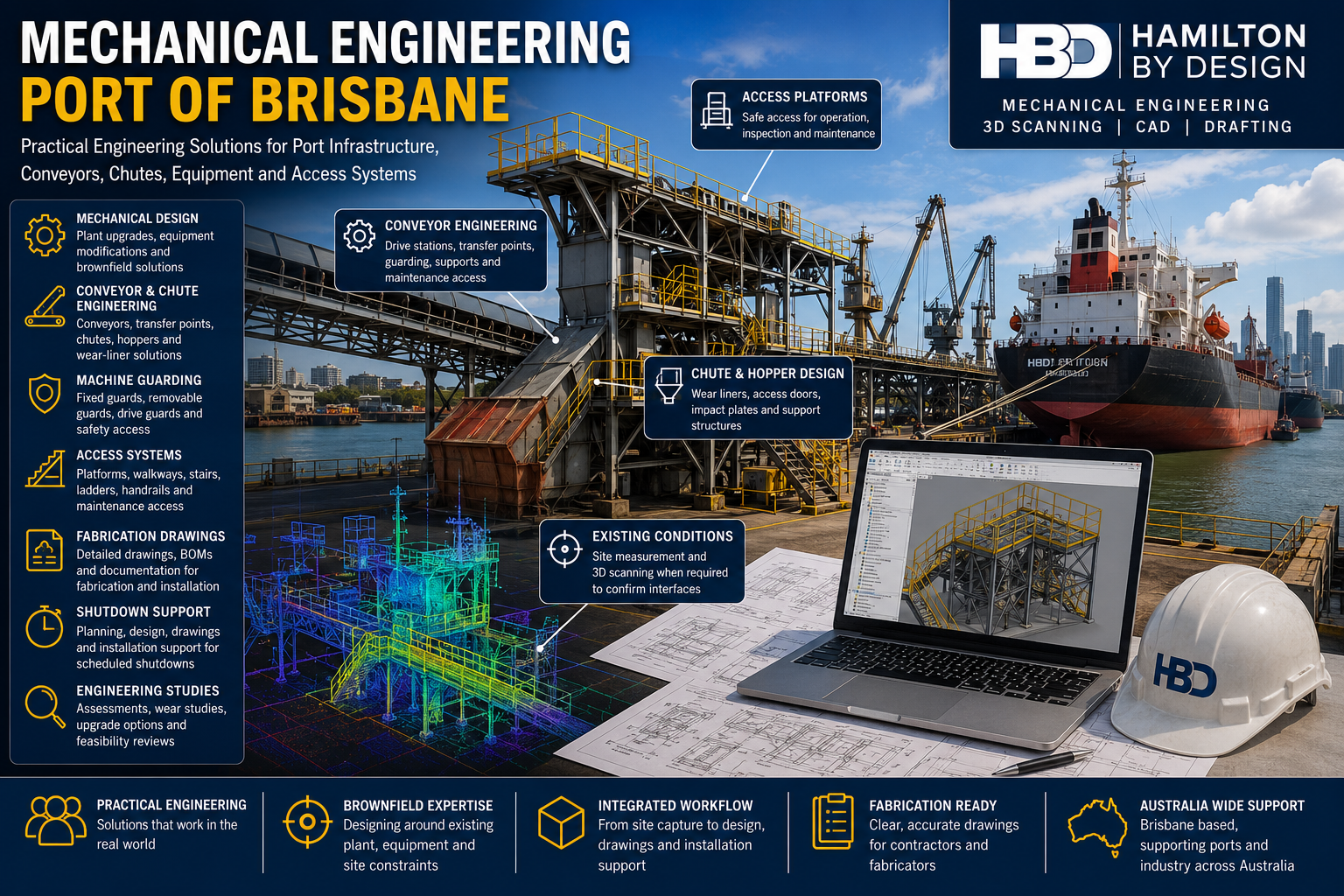


Mechanical Engineering Port of Brisbane | Plant & Equipment Design

Mechanical engineering services for Port of Brisbane conveyors, chutes, access platforms, machine guarding and brownfield plant upgrades.

Mechanical Engineering Port of Brisbane

Mechanical Design, Plant Upgrades and Engineering Support for Port Infrastructure

Hamilton By Design provides mechanical engineering services for Port of Brisbane projects, supporting port operators, terminal operators, contractors, fabricators and maintenance teams working across Fisherman Islands, Pinkenba, Lytton, Hemmant and surrounding Brisbane industrial areas.

This page should be positioned differently from the existing Port of Brisbane Engineering and 3D Laser Scanning Services article.

The existing page should remain focused on:

  • 3D laser scanning
  • LiDAR capture
  • Point clouds
  • Scan-to-CAD
  • As-built documentation

This new page should focus primarily on:

  • Mechanical design
  • Plant and equipment modifications
  • Conveyor and chute engineering
  • Machine guarding
  • Maintenance access
  • Fabrication drawings
  • Shutdown engineering
  • Engineering studies

That separation reduces the risk of both pages competing for the same search terms.


Mechanical Engineering for Port and Terminal Assets

Port facilities rely on mechanical systems that must operate safely, reliably and within tightly controlled shutdown windows.

Hamilton By Design can assist with engineering projects involving:

  • Conveyors and transfer stations
  • Chutes and hoppers
  • Loading and unloading equipment
  • Mechanical support frames
  • Maintenance platforms
  • Stairs, ladders and walkways
  • Machine guarding
  • Pipe supports
  • Equipment bases
  • Access systems
  • Wear liners
  • Replacement machinery
  • Structural interfaces
  • Brownfield plant modifications

Our work is suited to existing facilities where equipment has been altered over time and original drawings may no longer match what is installed.

For projects requiring accurate site capture, our separate Port of Brisbane engineering and 3D laser scanning service can establish the existing geometry before mechanical design begins.


Conveyor and Transfer-Station Engineering

Conveyor systems are central to many port and bulk-material handling operations.

Hamilton By Design can support mechanical engineering work involving:

  • Conveyor modifications
  • Head and tail pulley arrangements
  • Drive-station layouts
  • Transfer-point upgrades
  • Conveyor guarding
  • Skirt systems
  • Maintenance access
  • Support frames
  • Walkways and platforms
  • Replacement components
  • Equipment-clearance reviews

Existing conveyor systems are often congested by structural steel, services, electrical equipment and previous modifications.

Mechanical designs should therefore consider not only the new equipment but also installation access, maintenance requirements, removal paths and surrounding plant.


Chute and Hopper Design

Transfer chutes and hoppers can experience wear, blockage, poor material flow and difficult maintenance access.

Mechanical engineering services may include:

  • Replacement chute design
  • Chute geometry modifications
  • Hopper modifications
  • Wear-liner arrangements
  • Inspection-door design
  • Access improvements
  • Deflector and impact-plate design
  • Support-frame design
  • Flange and interface detailing
  • Fabrication drawings
  • Installation planning

Where site geometry is uncertain, engineering-grade scanning can be used to confirm the interfaces before the chute or hopper is modelled.

Hamilton By Design also provides wear and erosion studies for materials-handling equipment.


Brownfield Mechanical Upgrades

Brownfield port projects require new equipment to fit within an operating environment.

Mechanical upgrade projects may involve:

  • Replacing obsolete equipment
  • Increasing throughput
  • Improving maintenance access
  • Relocating machinery
  • Modifying conveyors
  • Installing new guards
  • Replacing worn structural supports
  • Adding platforms or walkways
  • Altering pipework interfaces
  • Integrating new plant with existing assets

The design process should account for:

  • Existing geometry
  • Installation sequence
  • Lifting requirements
  • Maintenance clearances
  • Operational constraints
  • Shutdown duration
  • Temporary works
  • Fabrication tolerances
  • Access restrictions

Hamilton By Designโ€™s engineering studies and assessments can help define the existing problem before detailed design begins.


Machine Guarding for Port Equipment

Conveyors, pulleys, drives, shafts, couplings and rotating machinery may require new or upgraded guarding.

Hamilton By Design can assist with:

  • Fixed guards
  • Removable guards
  • Drive guards
  • Pulley and nip-point guarding
  • Conveyor side guarding
  • Access gates
  • Inspection openings
  • Maintenance-removal arrangements
  • Guard-support frames
  • Fabrication drawings

A practical guard design must control access to hazardous areas while still allowing inspection, maintenance and component removal.

The final guarding arrangement should be reviewed against the machinery, risk assessment, applicable legislation, relevant standards and site-specific requirements.


Maintenance Platforms, Walkways and Access Systems

Safe access is essential around port machinery and materials-handling equipment.

Mechanical and structural access projects may include:

  • Maintenance platforms
  • Conveyor walkways
  • Stairs
  • Ladders
  • Crossovers
  • Step-over platforms
  • Handrails
  • Guardrails
  • Removable floor sections
  • Equipment-access frames
  • Inspection platforms

The design should consider:

  • Normal operating access
  • Maintenance activities
  • Emergency egress
  • Headroom
  • Fall risks
  • Machinery clearances
  • Lifting and removal paths
  • Existing services
  • Future equipment replacement

For projects involving existing steelwork and restricted interfaces, structural drafting and 3D scanning in Brisbane can support the development of coordinated access designs.


Mechanical Equipment Replacement

Replacing existing machinery can be difficult where the original drawings are unavailable or the surrounding plant has changed.

Hamilton By Design can assist with:

  • Existing-equipment assessment
  • Replacement-equipment layouts
  • Baseplate and mounting design
  • Support-frame modifications
  • Shaft and coupling interfaces
  • Guarding
  • Access provisions
  • Equipment-clearance studies
  • Installation planning
  • Fabrication documentation

Where required, reverse engineering with 3D scanning can be used to develop CAD geometry from the installed asset.


Engineering Drafting and Fabrication Documentation

Port contractors and fabricators may require clear documentation that can be used for pricing, manufacture and installation.

Hamilton By Design can prepare:

  • General arrangement drawings
  • Mechanical layouts
  • Fabrication drawings
  • Assembly drawings
  • Weldment drawings
  • Structural-steel details
  • Platform and handrail drawings
  • Chute and hopper drawings
  • Guarding drawings
  • Equipment-interface drawings
  • Sections and elevations
  • Bills of materials
  • Installation drawings
  • As-built drawings

Deliverables can be prepared using SolidWorks, Autodesk Inventor and AutoCAD, depending on the project requirements.

Our SolidWorks Brisbane services support mechanical modelling, assemblies and fabrication-ready documentation for port and industrial projects.


Shutdown Engineering Support

Port shutdowns are often tightly scheduled, with limited time available for removal, modification and installation.

Mechanical engineering support before a shutdown may include:

  • Defining the work scope
  • Confirming equipment interfaces
  • Reviewing access restrictions
  • Preparing demolition drawings
  • Developing replacement designs
  • Checking lifting and installation space
  • Reviewing installation sequences
  • Preparing fabrication drawings
  • Identifying potential clashes
  • Developing contingency options

Accurate planning before the shutdown can reduce the risk of fabrication errors, unexpected obstructions and delayed restart.


Engineering Studies and Condition Assessments

Not every project should proceed directly to detailed design.

An engineering study can help define:

  • The existing problem
  • Likely failure mechanisms
  • Design constraints
  • Available options
  • Maintenance implications
  • Access requirements
  • Preliminary costs
  • Recommended next steps

Typical studies may include:

  • Existing-condition assessments
  • Wear and erosion studies
  • Machinery-access reviews
  • Conveyor and chute assessments
  • Guarding reviews
  • Constructability studies
  • Equipment-replacement studies
  • Upgrade feasibility studies
  • Refurbishment planning

Typical Port of Brisbane Mechanical Engineering Projects

Hamilton By Design can support projects involving:

  • Conveyor upgrades
  • Transfer-chute replacement
  • Hopper modifications
  • Machine guarding
  • Maintenance platforms
  • Walkways and stairs
  • Equipment support frames
  • Mechanical equipment replacement
  • Bulk-material handling systems
  • Wharf-access equipment
  • Crane-related access structures
  • Pipe and service supports
  • Wear-liner arrangements
  • Fabrication documentation
  • Brownfield plant modifications
  • Shutdown planning

Our Mechanical Engineering Workflow

1. Define the Problem

We review the existing asset, operating issue, maintenance requirement and required project outcome.

2. Establish Existing Conditions

Available drawings, photographs and site information are reviewed. Where required, site measurement or 3D laser scanning is completed.

3. Develop Engineering Options

Practical concepts are developed around safety, operation, access, fabrication and installation constraints.

4. Prepare the Design

The selected option is developed into a coordinated mechanical arrangement and supporting CAD model.

5. Complete Engineering Review

The design is reviewed against the required loads, interfaces, clearances, standards and project requirements.

6. Produce Drawings

General arrangements, details, fabrication drawings and bills of materials are prepared as required.

7. Support Fabrication and Installation

Clarifications, drawing revisions and installation support can be provided within the agreed scope.


Why Choose Hamilton By Design?

Practical Mechanical Engineering

Our approach considers how equipment will be fabricated, installed, operated and maintained.

Brownfield Experience

We understand the challenges of designing around existing machinery, steelwork, services and access restrictions.

Integrated Site Capture and Design

Where reliable drawings are unavailable, LiDAR scanning can be incorporated without making scanning the primary focus of this page.

Fabrication-Ready Documentation

Our mechanical designs can be developed into detailed CAD models and drawings suitable for contractor and fabricator use.

Brisbane and National Project Support

Hamilton By Design supports industrial and infrastructure projects in Brisbane and throughout Australia. Its broader Brisbane offering integrates LiDAR scanning, mechanical engineering and fabrication drafting for complex industrial work.


Areas Serviced

Mechanical engineering support is available for projects throughout:

  • Port of Brisbane
  • Fisherman Islands
  • Pinkenba
  • Lytton
  • Hemmant
  • Murarrie
  • Eagle Farm
  • Greater Brisbane
  • South-East Queensland

Travel can also be arranged for regional port, mining and industrial projects.


Frequently Asked Questions

What mechanical engineering services are available for Port of Brisbane projects?

Services can include conveyor and chute design, machine guarding, equipment replacement, access platforms, fabrication drawings, engineering studies and shutdown support.

Do you provide 3D laser scanning?

Yes. Laser scanning is available where accurate existing-condition data is required. The detailed scanning service is covered on the separate Port of Brisbane 3D laser scanning page.

Can you produce fabrication drawings?

Yes. Fabrication and assembly drawings can be prepared for suitable mechanical and structural items within the agreed engineering scope.

Can you assist with existing equipment where drawings are missing?

Yes. Existing equipment can be measured, scanned or reverse engineered to support replacement or modification work.

Can you design conveyor guards and access platforms?

Yes. Hamilton By Design can develop guarding and access concepts, CAD models and fabrication documentation for existing machinery and conveyor systems.

Do you provide shutdown engineering support?

Yes. Support can include site verification, replacement design, fabrication drawings, access reviews, clash checks and installation planning.

Are you affiliated with Port of Brisbane Pty Ltd?

No. Hamilton By Design is an independent mechanical engineering and digital engineering service provider. This page describes services available for projects in the Port of Brisbane area and does not imply endorsement or affiliation.


Discuss a Port of Brisbane Mechanical Engineering Project

Hamilton By Design can assist with:

  • Conveyor and chute engineering
  • Mechanical equipment modifications
  • Machine guarding
  • Platforms and access systems
  • Reverse engineering
  • Engineering studies
  • Fabrication drawings
  • Brownfield upgrades
  • Shutdown planning
  • Installation support

Contact Hamilton By Design to discuss your Port of Brisbane mechanical engineering requirements.

Hamilton By Design logo displayed on a blue tilted rectangle with a grey gradient background

Contact Us – Talk To Us

Name
Would you like us to arrange a phone consultation for you?
Address

Our clients:
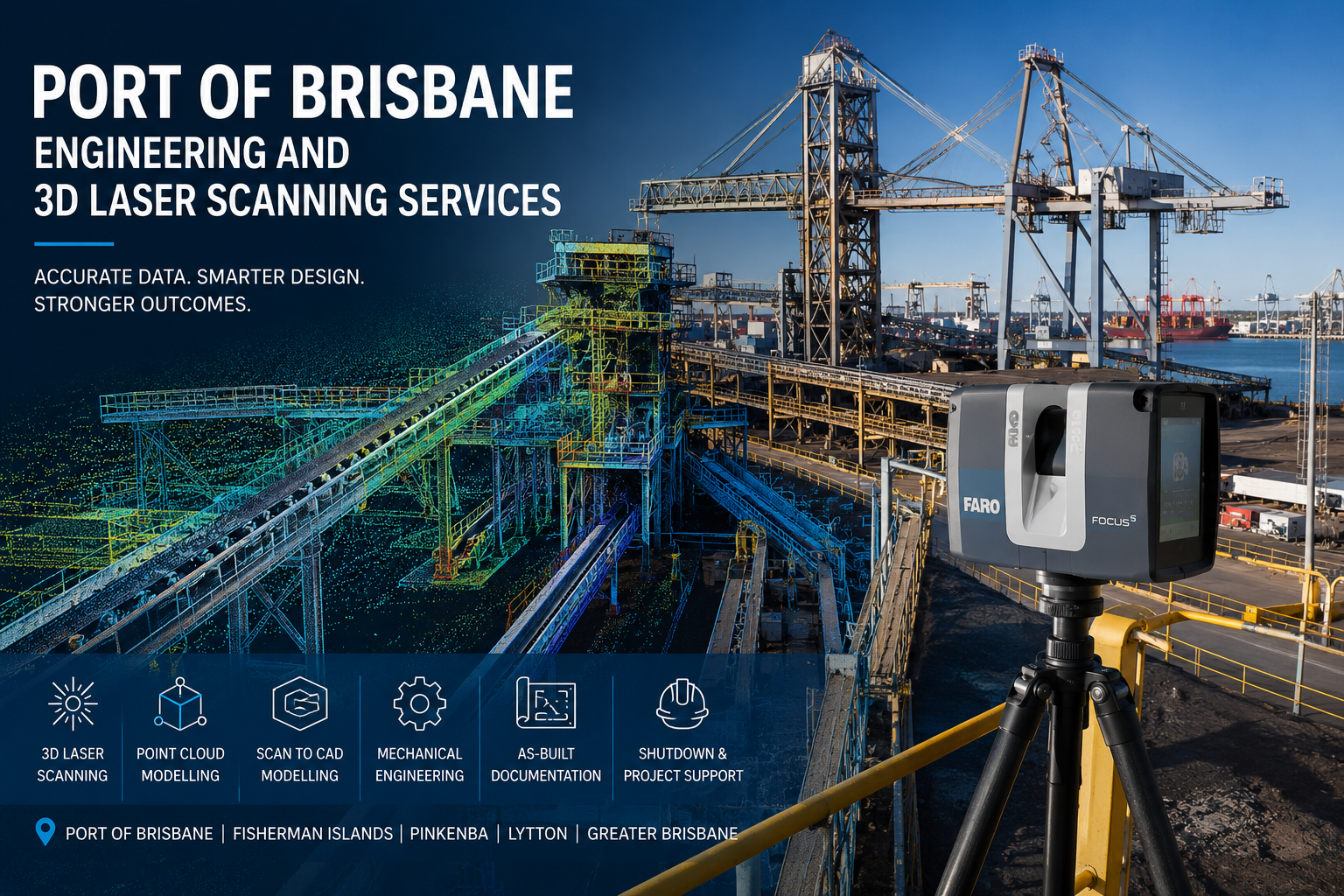


Port of Brisbane Engineering & 3D Laser Scanning

Port of Brisbane container terminal and bulk-handling infrastructure being captured with a FARO 3D laser scanner and coloured point-cloud overlay.

Port of Brisbane Engineering and 3D Laser Scanning Services

Engineer-Led LiDAR Scanning, Mechanical Design and As-Built Documentation for Brisbane Port Facilities

The Port of Brisbane is a major multi-cargo port supporting container handling, general cargo, motor vehicles, roll-on/roll-off operations, bulk commodities, warehousing and associated logistics activities. Its terminals and industrial precincts contain a complex mix of wharves, cranes, conveyors, storage systems, buildings, roads and mechanical infrastructure.

Hamilton By Design provides engineering and 3D laser scanning services for projects at and around the Port of Brisbane, Fisherman Islands, Pinkenba, Lytton and surrounding Brisbane industrial areas.

Our services combine engineering-grade LiDAR scanning with mechanical engineering, point-cloud processing, reverse engineering, 3D CAD modelling and fabrication-ready drafting.

This integrated approach allows port operators, terminal operators, engineering consultants, maintenance teams, contractors and fabricators to work from reliable existing-condition information rather than incomplete drawings or manually measured approximations.

Accurate site capture, engineering-ready point clouds and practical design documentation for complex port and industrial environments.


Engineering Services for Port of Brisbane Projects

Port facilities are continually maintained, upgraded and modified. Original drawings may no longer accurately represent what is physically installed because of previous repairs, plant modifications, equipment replacements and undocumented site changes.

Traditional measurement can also be difficult where equipment is:

  • Large or geometrically complex
  • Installed above conveyors or operating machinery
  • Surrounded by structural steel, services or pipework
  • Close to wharves or exposed water edges
  • Located within active vehicle or cargo-handling areas
  • Accessible only during a planned shutdown
  • Difficult to measure safely using tapes and hand tools

Our 3D scanning services in Brisbane capture millions of spatial measurements from multiple scanner positions to create a detailed three-dimensional record of the facility.

The resulting point cloud can support engineering, design, verification, fabrication, construction planning and maintenance without relying solely on repeated site measurements.


Port of Brisbane 3D Laser Scanning

Hamilton By Design uses terrestrial LiDAR scanning to document the visible geometry of port infrastructure, industrial equipment and surrounding structures.

Our broader Brisbane 3D scanning service can be applied to projects involving:

  • Container-terminal infrastructure
  • General-cargo facilities
  • Bulk-material handling systems
  • Conveyor systems
  • Transfer stations
  • Hoppers and bins
  • Chutes and wear liners
  • Wharves and berths
  • Crane rails and support structures
  • Loading and unloading equipment
  • Maintenance platforms
  • Stairs and handrails
  • Pipework and mechanical services
  • Warehouses and workshops
  • Equipment foundations
  • Roads, hardstands and vehicle clearances
  • Marine and waterfront infrastructure

The captured point cloud provides a measurable digital representation of the existing area. Engineers, designers and project personnel can navigate the dataset, extract measurements and review spatial relationships after the site visit.

For projects requiring engineering or fabrication decisions, our approach is based on collecting the right information for the intended purposeโ€”not simply creating the largest possible point cloud. This principle is explained further in Not All Scans, Point Clouds or Meshes Are Equal.


Existing-Condition and As-Built Documentation

Accurate existing-condition information is particularly important when new equipment must connect to older port infrastructure.

Hamilton By Design can use registered scan data to prepare:

  • Existing-condition plans
  • General arrangement drawings
  • Floor plans
  • Sections and elevations
  • Structural-steel layouts
  • Equipment-location drawings
  • Pipe and service layouts
  • Interface drawings
  • Clearance envelopes
  • Dimensional verification drawings
  • Three-dimensional as-built models

Our engineering-grade 3D point-cloud scanning service in Brisbane can help verify existing geometry, identify spatial constraints and create an accurate foundation for proposed modifications.


Scan-to-CAD Modelling

A registered point cloud contains valuable measurement information, but many engineering projects also require usable CAD geometry.

Hamilton By Design can convert selected point-cloud information into models representing:

  • Structural steel
  • Mechanical equipment
  • Conveyor assemblies
  • Chutes and transfer stations
  • Platforms and access systems
  • Pipework and services
  • Machinery guards
  • Buildings and industrial rooms
  • Equipment foundations
  • Proposed replacement components

Depending on the project requirements, deliverables may include:

  • SolidWorks models
  • Autodesk Inventor models
  • AutoCAD drawings
  • STEP files
  • SAT files
  • Parasolid files
  • DWG files
  • DXF files
  • Navisworks-compatible coordination models
  • Registered E57 point clouds
  • Autodesk RCP or RCS files
  • LAS point-cloud files

The level of modelling can be matched to the intended project outcome, whether the client requires general spatial coordination, detailed reverse engineering or fabrication documentation.


Mechanical Engineering for Port Infrastructure

Hamilton By Design provides mechanical-engineering support for port, logistics, industrial and materials-handling projects.

Our services can include:

  • Existing-equipment assessments
  • Engineering studies
  • Concept and feasibility development
  • Mechanical arrangement design
  • Conveyor modifications
  • Transfer-chute design
  • Hopper and bin modifications
  • Machine-guarding design
  • Maintenance-access improvements
  • Equipment replacement planning
  • Platforms, stairs and handrails
  • Structural-support concepts
  • Reverse engineering
  • Wear and erosion assessments
  • Design verification
  • Fabrication drawings
  • Installation planning
  • Shutdown planning

Our wider engineering studies and assessments can be combined with LiDAR data to establish the existing condition of an asset before a design or maintenance decision is made.

The principal advantage of integrating engineering and scanning is that proposed designs can be developed directly around verified site geometry.


Conveyor and Bulk-Materials-Handling Projects

Port facilities may include extensive conveyor, loading, storage and transfer infrastructure. These systems frequently contain worn components, irregular geometry, restricted access and modifications that are not shown on the original drawings.

LiDAR scanning can capture:

  • Conveyor stringers
  • Conveyor gantries
  • Head and tail pulley arrangements
  • Drive stations
  • Transfer towers
  • Chutes
  • Hoppers
  • Bins
  • Wear liners
  • Walkways
  • Maintenance platforms
  • Support frames
  • Adjacent pipework
  • Electrical services
  • Access restrictions

The resulting point cloud can support the design of replacement equipment and help determine how proposed components will interface with the surrounding plant.

This is especially valuable where shutdown time is limited and equipment must be designed and fabricated before the existing assembly is removed.

Our approach to establishing a reliable digital baseline for mechanical, structural and piping work is also described in 3D Laser Scanning for SMP Project Delivery.


Wharf, Berth and Marine Infrastructure Scanning

Port projects may involve a combination of mechanical, structural, civil and marine infrastructure.

Three-dimensional laser scanning may assist with:

  • Wharf-access structures
  • Loading and unloading equipment
  • Fender-support arrangements
  • Mooring infrastructure
  • Gangways
  • Access platforms
  • Crane-support structures
  • Pipe bridges
  • Marine-loading equipment
  • Equipment foundations
  • Structural-steel verification
  • Service connections
  • Clearance studies

Terrestrial LiDAR can document visible above-water geometry from safe and accessible scanner positions.

Where below-water geometry is required, terrestrial laser scanning may need to be coordinated with hydrographic, bathymetric or specialist subsea-survey methods.


Crane and Heavy-Equipment Scanning

Port cranes and heavy mechanical equipment can be difficult to measure using conventional site techniques.

LiDAR scanning may support:

  • Crane-rail assessments
  • Existing-geometry verification
  • Equipment-envelope studies
  • Structural-member location
  • Access-platform modifications
  • Replacement-machinery planning
  • Guarding design
  • Exclusion-zone planning
  • Maintenance-clearance assessment
  • Clash detection
  • Installation-path planning

A coordinated point cloud can show the relationship between the crane or mechanical equipment and the surrounding wharf, structural steel, services, access areas and operating environment.

Where formal rail alignment, deformation, settlement or high-precision tolerance reporting is required, the laser-scanning work may need to be supplemented by specialist survey control or metrology.


Reverse Engineering of Existing Port Equipment

Original drawings are not always available for older port equipment. Existing drawings may also be inaccurate because the machinery has been repaired or modified during its operating life.

Hamilton By Design can use laser scanning, direct measurements and 3D CAD modelling to reverse engineer:

  • Chutes
  • Hoppers
  • Machinery guards
  • Covers
  • Frames
  • Brackets
  • Platforms
  • Ducting
  • Pipe supports
  • Access structures
  • Wear liners
  • Replacement structural assemblies
  • Mechanical components

The resulting CAD model can form the basis for design review, equipment modification and the preparation of fabrication drawings.

Where components contain fine tolerances or small features, LiDAR data may be supplemented with direct measurement, close-range scanning, photogrammetry or specialist metrology.


Brownfield Port Upgrades

Brownfield projects are challenging because new equipment must often fit within an operating facility containing existing structures, services and machinery.

A scan-based project workflow can involve:

  1. Capturing the existing area before detailed design begins
  2. Registering the individual scans into a coordinated point cloud
  3. Identifying relevant interfaces and surrounding obstructions
  4. Creating a model of the proposed equipment
  5. Positioning the proposed design within the point cloud
  6. Reviewing access, clearances and possible clashes
  7. Preparing drawings around verified site geometry
  8. Supporting off-site fabrication
  9. Reviewing installation conditions before mobilisation

This approach can reduce the likelihood of replacement equipment arriving on site and failing to fit the existing interfaces.


Shutdown Planning

Port shutdowns and operational interruptions can be expensive and tightly controlled.

Incomplete drawings, missing dimensions and unexpected obstructions can delay demolition, fabrication or installation activities.

Pre-shutdown laser scanning can assist project teams with:

  • Confirming equipment interfaces
  • Planning demolition boundaries
  • Locating structural members
  • Checking available lifting space
  • Reviewing crane access
  • Planning removal routes
  • Planning installation routes
  • Coordinating temporary works
  • Identifying potential service clashes
  • Verifying replacement-component dimensions
  • Developing contractor work packs
  • Reviewing maintenance access

Project personnel can use the registered point cloud to become familiar with the work area before the shutdown begins.

A detailed digital record can also support future engineering studies and asset assessments after the immediate project has been completed.


Clash Detection and Constructability Review

New equipment can be modelled within the existing-condition point cloud to check how it relates to surrounding infrastructure.

Potential clashes may involve:

  • Structural steel
  • Conveyor frames
  • Pipework
  • Cable trays
  • Electrical equipment
  • Handrails
  • Access platforms
  • Existing machinery
  • Building elements
  • Vehicle envelopes
  • Maintenance-removal zones

Clash detection does not replace formal engineering review. However, it can identify obvious spatial conflicts while the proposed design can still be adjusted economically.

Our Brisbane structural drafting and 3D scanning services can also support projects where structural arrangements must be developed around the verified existing environment.


Machine Guarding and Safe Access

Port and materials-handling equipment may require new or upgraded guarding around conveyors, drives, pulleys, shafts, couplings and other moving components.

Laser scanning can help establish:

  • Existing machinery geometry
  • Hazard locations
  • Available mounting positions
  • Access requirements
  • Maintenance-removal zones
  • Guard clearances
  • Structural attachment points
  • Relationships with platforms and walkways

Hamilton By Design can then develop machine-guarding concepts and fabrication drawings appropriate to the identified machinery and project requirements.

The final design must be assessed against the legislation, standards, site rules and risk controls applicable to the particular facility and item of equipment.


Platforms, Stairs, Walkways and Handrails

Port and terminal facilities frequently require access improvements to support operation, inspection and maintenance.

Hamilton By Design can assist with the scanning and design of:

  • Maintenance platforms
  • Conveyor walkways
  • Access stairs
  • Step-over platforms
  • Crossovers
  • Handrails
  • Guardrails
  • Access ladders
  • Equipment-support frames
  • Removable access sections

Capturing the surrounding area helps ensure that the proposed access system accounts for existing machinery, operating clearances and maintenance requirements.


Wear and Erosion Studies

Chutes, hoppers, transfer points and other materials-handling equipment are subject to progressive wear and erosion.

Periodic scanning may help engineering and maintenance teams:

  • Establish a baseline geometry
  • Compare an asset at different points in time
  • Identify visible geometric changes
  • Locate concentrated wear areas
  • Quantify material loss where suitable data is available
  • Plan liner replacement
  • Prioritise maintenance
  • Create replacement geometry
  • Develop a digital condition record

Hamilton By Designโ€™s wear and erosion studies can combine site observations, engineering assessment and digital measurement to support maintenance and refurbishment decisions.

Repeat scans should be collected using a controlled methodology where meaningful comparison between datasets is required.


Typical Port of Brisbane Projects

Hamilton By Design can assist with projects involving:

  • Container-terminal upgrades
  • Conveyor modifications
  • Transfer-chute replacement
  • Bulk-material handling equipment
  • Wharf-access improvements
  • Crane infrastructure
  • Crane rails and support structures
  • Maintenance platforms
  • Machine guarding
  • Warehouse alterations
  • Pipework modifications
  • Equipment relocation
  • Fabrication verification
  • Structural-steel detailing
  • As-built documentation
  • Shutdown planning
  • Reverse engineering
  • Asset-condition capture
  • Equipment-interface verification
  • Installation planning
  • Lift and access planning

Our Engineering and Scanning Workflow

1. Define the Project Requirements

We review the asset, required scan coverage, access conditions, site restrictions, accuracy requirements, final deliverables and intended engineering use of the information.

2. Plan the Site Capture

The scanning methodology is developed around site inductions, work permits, exclusion zones, operating equipment, vehicle movements, water-edge risks and access limitations.

3. Complete the On-Site Scanning

Multiple scanner positions are used to capture the equipment and surrounding environment.

Critical dimensions or important interfaces can also be independently checked where required.

4. Register the Point Cloud

The individual scans are aligned into a coordinated three-dimensional dataset and reviewed for coverage and registration quality.

5. Conduct the Engineering Review

The registered point cloud is examined to identify important interfaces, clearances, obstructions and areas that may require further investigation.

6. Prepare CAD Models and Drawings

Selected geometry is converted into the required CAD models, general arrangements, sections, details or fabrication drawings.

7. Coordinate the Proposed Design

Proposed equipment can be positioned within the point cloud to support clash detection, access assessment and constructability review.

8. Deliver the Project Information

The final information is supplied in the agreed point-cloud, CAD, drawing or report formats.


Why Choose Hamilton By Design?

Engineer-Led Reality Capture

Our scanning work is planned with an understanding of how the captured information will be used for engineering, design, fabrication and installation.

Industrial and Materials-Handling Experience

Our project experience includes conveyors, chutes, hoppers, machine guarding, access structures, mechanical equipment and brownfield plant modifications.

Integrated Project Delivery

Site capture, point-cloud registration, CAD modelling, mechanical engineering and drafting can be delivered through one coordinated workflow.

Reduced Site Reattendance

A comprehensive point cloud allows many measurements and interfaces to be reviewed remotely after the site visit.

Support for Off-Site Fabrication

Fabricators can receive models and drawings developed around captured existing conditions.

Engineering-Ready Information

Our focus is on creating information that engineers, project managers, maintenance teams, contractors and fabricators can use.

Hamilton By Design also provides engineering-grade 3D laser scanning throughout Australia for clients with projects across multiple states or industrial locations.


Port Safety and Site Requirements

Work at an operational port may require:

  • Site-specific inductions
  • Maritime Security Identification Card requirements
  • Work permits
  • Safe work method statements
  • Take 5 or task-risk assessments
  • Working-at-heights controls
  • Water-edge controls
  • Traffic-management arrangements
  • Exclusion zones
  • Personal protective equipment
  • Site escorts
  • Coordination with terminal operations
  • Weather and lighting considerations
  • Tidal or marine-operational considerations

The final scanning methodology will be developed around the access, safety and operational requirements established by the relevant site operator.


Areas Serviced

Hamilton By Design can support port, industrial and infrastructure projects throughout:

  • Port of Brisbane
  • Fisherman Islands
  • Pinkenba
  • Lytton
  • Hemmant
  • Murarrie
  • Wynnum
  • Manly
  • Eagle Farm
  • Brisbane Airport industrial precinct
  • Greater Brisbane
  • South-East Queensland

Our main LiDAR scanning Brisbane service also supports industrial, manufacturing, infrastructure, construction and regional Queensland projects.

Travel can be arranged for port, mining and industrial projects throughout Queensland and other Australian locations.


Frequently Asked Questions

What can be scanned at the Port of Brisbane?

LiDAR can capture visible geometry including conveyors, buildings, platforms, structural steel, pipework, machinery, crane infrastructure, wharf equipment and surrounding industrial areas.

Can scanning be completed while a port facility remains operational?

Scanning can often be completed while surrounding operations continue, provided suitable access, permits, exclusion zones and operating controls are established.

Some equipment may need to be stopped where accurate capture of moving components is required.

How accurate is 3D laser scanning?

Accuracy depends on the scanner, distance, site geometry, surface characteristics, environmental conditions, registration method and required deliverable.

The project accuracy requirements should be established before the scanning methodology is selected.

Can point-cloud information be used in SolidWorks?

Yes. Registered point clouds can be used as references when developing SolidWorks models. Selected equipment and structural geometry can also be converted into usable CAD models.

Can Hamilton By Design produce fabrication drawings?

Yes. Fabrication drawings can be prepared for suitable mechanical and structural assemblies, subject to the agreed engineering scope and required design review.

Can equipment above water be scanned?

Visible above-water infrastructure can generally be captured from safe and accessible scanner positions.

Below-water geometry requires an appropriate hydrographic, bathymetric or subsea-survey method.

Can moving conveyors and machinery be scanned?

Stationary infrastructure surrounding operational equipment can often be captured safely, subject to site controls.

Moving belts, rotating machinery and other moving surfaces may appear incomplete or distorted. The equipment may need to be stopped when accurate component geometry is required.

Can scans from different dates be compared?

Yes. Repeat scan datasets may be compared to identify geometric changes where suitable survey control, coverage, resolution and registration methods have been used.

Can Hamilton By Design provide the registered point cloud without modelling?

Yes. A project can be scoped for site scanning and registered point-cloud delivery only.

Additional services such as scan-to-CAD modelling, engineering assessment and drafting can be included where required.

Is Hamilton By Design affiliated with Port of Brisbane Pty Ltd?

No. Hamilton By Design is an independent engineering and 3D laser scanning service provider.

This page describes services that may be provided for projects located at or around the Port of Brisbane. It does not imply endorsement, appointment, partnership or affiliation with Port of Brisbane Pty Ltd.


Discuss a Port of Brisbane Project

Reliable existing-condition information can reduce uncertainty before design, fabrication and installation begin.

Hamilton By Design can assist with:

  • Engineering-grade 3D laser scanning
  • Registered point-cloud creation
  • Existing-condition documentation
  • Scan-to-CAD modelling
  • Mechanical engineering
  • Reverse engineering
  • Conveyor and chute modifications
  • Machine guarding
  • Platforms and access structures
  • Fabrication drawings
  • Clash detection
  • Brownfield upgrade planning
  • Shutdown engineering support

Explore our broader 3D laser scanning services or contact Hamilton By Design to discuss the equipment, facility, required accuracy and intended deliverables for your Port of Brisbane project.

Hamilton By Design logo displayed on a blue tilted rectangle with a grey gradient background

Contact Us – Talk To Us

Name
Would you like us to arrange a phone consultation for you?
Address

Our clients:























