Bridging Reality and Design: How 3D Scanning + 3D Modelling Supercharge Mining Process Plants

In mining and mineral processing environments, small mis-fits, outdated drawings, or inaccurate assumptions can translate into shutdowns, costly rework, or worse, safety incidents. For PMs, superintendents, engineering managers and plants operating under heavy uptime and safety constraints, combining 3D scanning and 3D modelling isnโ€™t just โ€œnice to haveโ€ โ€” itโ€™s becoming essential. At Hamilton By Design, weโ€™ve leveraged this combination to deliver greater predictability, lower cost, and improved safety across multiple projects.


What are 3D Scanning and 3D Modelling?

  • 3D Scanning (via LiDAR, laser, terrestrial/mobile scanners): captures the existing geometry of structures, equipment, piping, chutes, supports, tanks, etc., as a dense point cloud. Creates a digital โ€œreality captureโ€ of the plant in its current (often messy) state.
  • 3D Modelling: turning that data (point clouds, mesh) into clean, usable engineering-geometry โ€” CAD models, as-built / retrofit layouts, clash-detection, wear mapping, digital twins, etc.

The power comes when you integrate the two โ€” when the reality captured in scan form feeds directly into your modelling/design workflows rather than being a separate survey activity thatโ€™s then โ€œinterpretedโ€ or โ€œassumed.โ€


Why Combine Scanning + Modelling? Key Benefits

Here are the main advantages you get when you deploy both in an integrated workflow:

BenefitWhat it Means for PMs / Engineering / Plant OpsExamples / Impacts
Accuracy & Reality VerificationVerify whatโ€™s actually in the plant vs what drawings say. Identify deformations, misalignments, wear, obstructions, or changes that werenโ€™t captured in paper drawings.Mill liner wear profiles; chute/hopper buildup; misaligned conveyors or supports discovered post-scan.
Reduced Risk, Safer AccessScanning can be done with limited or no shutdown, and from safer vantage points. Less need for personnel to enter hazardous or confined spaces.Scanning inside crushers, under conveyors, or at height without scaffolding.
Time & Cost SavingsFaster surveying; fewer repeat field trips; less rework; fewer surprises during shutdowns or retrofit work.Scan once, model many; clashes found in model instead of in the field; pre-fabrication of replacement parts.
Better Shutdown / Retrofit PlanningUse accurate as-built models so new equipment fits, interferences are caught, installation time is optimized.New pipelines routed without conflict; steelwork/supports prefabricated; shutdown windows shortened.
Maintenance & Asset Lifecycle ManagementScan history becomes a baseline for monitoring wear or deformation. Enables predictive maintenance rather than reactive.Comparing scans over time to track wear; scheduling relining of chutes; monitoring structural integrity.
Improved Decision Making & VisualisationEngineers, superintendents, planners can visualise the plant as it is โ€” space constraints, access routes, clearances โ€” before making decisions.Clash-detection between new and existing frames; planning maintenance access; safety audits.
Digital Twin / Integration for Future-Ready PlantOnce you have accurate geometric models you can integrate with IoT, process data, simulation tools, condition monitoring etc.Digital twins that simulate flow, energy use, wear; using scan data to feed CFD or FEA; feeding into operational dashboards.

Challenges & How to Overcome Them

Of course, there are pitfalls. Ensuring scanning + modelling delivers value requires attention to:

  • Planning the scanning campaign (scan positions, control points, resolution) to avoid shadow zones or missing data.
  • Choosing hardware and equipment that can operate under plant conditions (dust, vibration, temperature, restricted access).
  • Processing & registration of point clouds, managing the large data sets, and ensuring clean, usable models.
  • Ensuring modelling workflow aligns with engineering design tools (CAD systems, formats, tolerances) so that the scan data is usable without excessive cleanup.
  • Maintaining the model: when plant layouts or equipment change, keeping the scan or model up to date so your decisions are based on recent reality.

At Hamilton By Design we emphasise these aspects; our scan-to-CAD workflows are built to align with plant engineering needs, and we help clients plan and manage the full lifecycle.


Real World Applications in Mining & Process Plants

Hereโ€™s how combined scanning + modelling is applied (and what you might look for in your own facility):

  • Wear & Relining: scanning mill, crusher liners, chutes or hoppers to model wear profiles; predict failures; design replacement parts that fit exactly.
  • Retrofits & Expansions: mapping existing steel, pipe racks, conveyors, etc., creating accurate โ€œas builtโ€ model, checking for clashes, optimizing layouts, prefabricating supports.
  • Stockpile / Volumetric Monitoring: using scans or LiDAR to measure stockpile volumes for planning and reporting; integrating with models to monitor material movement and flow.
  • Safety & Clearance Checking: verifying that walkways, egress paths, platforms have maintained their clearances; assess structural changes; check for deformation or damage.
  • Shutdown Planning: using accurate 3D models to plan the scope, access, scaffold/frame erection, pipe removal etc., so shutdown time is minimised.

Why Choose Hamilton By Design

To get full value from the scan + model combination, you need more than just โ€œweโ€™ll scan itโ€ or โ€œweโ€™ll make a modelโ€ โ€” you need a partner who understands both the field realities and the engineering rigour. Here’s where Hamilton By Design excels:

  • Strong engineering experience in mining & processing plant settings, so we know what level of detail, what tolerances, and what access constraints matter.
  • Proven tools & workflows: from LiDAR / laser scanner work that captures site conditions even under harsh conditions, to solid CAD modelling/reporting that aligns with your fabrication/installation requirements.
  • Scan-to-CAD workflows: not just raw point clouds, but models that feed directly into design, maintenance, procurement and operations.
  • Focus on accuracy, safety, and reduced downtime: ensuring that field work, design, installation etc., are as efficient and risk-averse as possible.
  • Use of modern digital techniques (digital twins, clash detection etc.) so that data isnโ€™t just stored, but actively used to drive improvements.

Practical Steps to Get Started / Best Practice Tips

If youโ€™re managing a plant or engineering project, here are some steps to adopt scanning + modelling optimally:

  1. Define Clear Objectives: What do you want from this scan + model? Wear profiles, retrofit, layout changes, safety audit etc.
  2. Survey Planning: Decide scan positions, control points, resolution (density) based on the objectives and site constraints. Consider access, safety, shutdown windows.
  3. Use Appropriate Hardware: Choose scanners suited to environment (dust, heat), also ensure regulatory and IP protection etc.
  4. Data Processing & Modelling Tools: Have the capacity/software to register, clean, mesh or extract CAD geometry.
  5. Integrate into Existing Engineering Processes: Ensure the outputs are compatible with your CAD standards, procurement, installation etc.
  6. Iterate & Maintain: Frequent scans over time to track changes; update models when plant changes; feed maintenance, design and operations with new data.

Conclusion

In mining process plants, time, safety, and certainty matter. By combining 3D scanning with sound 3D modelling you donโ€™t just get a snapshot of your plant โ€” you gain a powerful toolset to reduce downtime, avoid rework, improve safety, and enhance decision-making.

If youโ€™re responsible for uptime, capital works, maintenance or process improvements, this integration can reshape how you plan, maintain, and operate. At Hamilton By Design, weโ€™re helping clients in Australia harness this power โ€” turning reality into design confidence, and giving stakeholders peace of mind that the layout, equipment, and safety are aligned not to yesterdayโ€™s drawings but to todayโ€™s reality.

Name
Would you like us to arrange a phone consultation for you?
Address
3D LiDAR scanning and 3D modelling service button โ€” laser scanner capturing a point cloud for engineering and CAD modelling
Mechanical engineering services
Finite Element Analysis (FEA) engineering simulation button
Mechanical engineering services

Engineering Integrity, Failure Evolution, and Energy Transition: A Mechanical Engineerโ€™s Perspective on Australiaโ€™s Ageing Coal Fleet

This paper examines the mechanical degradation, failure mechanisms, and system-level reliability implications of Australiaโ€™s ageing coal-fired power generation assets, focusing on Callide Power Station (Queensland) and Yallourn Power Station (Victoria). Both stations have experienced significant mechanical failures in the past five years, exposing vulnerabilities in maintenance, asset management, and risk governance under conditions of declining reinvestment.
From a mechanical engineering standpoint, these failures illustrate the predictable end-of-life behaviour of large rotating and pressure-bound systems when maintenance expenditure, material renewal, and operational monitoring decline. The paper argues that sustained industrial reliabilityโ€”and thus national energy and employment securityโ€”requires engineering-informed policy that balances decarbonisation with technical integrity management.


Coal-fired power stations are among the most complex mechanical systems ever built in Australia. They integrate high-temperature, high-pressure thermodynamic processes with massive rotating equipment, lubrication systems, and precision alignment tolerances.

From a mechanical engineerโ€™s perspective, their reliability depends on three interlinked pillars:

  1. Structural and material integrity,
  2. Lubrication and vibration control, and
  3. Predictive maintenance and monitoring.

However, as the nation accelerates toward renewable transition targets, investment in these legacy systems has declined. Mechanical failures at Callide and Yallourn are therefore not random accidents but the mechanical manifestation of economic and policy choices.

This analysis seeks to understand those failures in engineering terms, predict future risks, and outline how a re-commitment to industrial infrastructure and jobs requires a concurrent commitment to mechanical reliability.


Technical Overview of Recent Failures

Callide Power Station

Callideโ€™s units span several generations of design and material technology. The C4 explosion (2021) was catastrophic: the failure originated within the turbine hall, leading to structural collapse and large-scale ejection of debris.
Subsequent analysis by CS Energy and external investigators identified battery charger replacement errors, inadequate isolation protocols, and loss of process safety discipline as initiators.

From an engineering integrity perspective, the incident represents a compound failure:

  • Mechanical systems operated under degraded conditions;
  • Electrical and process-control systems failed to detect early anomalies;
  • Organisational maintenance controls were insufficient to interrupt escalation.

Later failures โ€” including the C3 boiler pressure event (2025) and cooling tower collapse (2022) โ€” further confirm that structural materials, corrosion protection, and load-carrying assemblies had entered the fatigueโ€“creep interaction phase of their service life.

Yallourn Power Station

At Yallourn, the August 2025 low-pressure turbine dislodgement occurred after decades of vibration monitoring alarms and bearing wear signals. Earlier (2024) shutdowns for โ€œhigh vibration alarmsโ€ indicated growing rotor dynamic instability.
When the Unit 2 turbine dislodged, the damage pattern suggested bearing wear, misalignment, or bolt relaxation leading to component displacement.

In mechanical engineering terms, this is a classic late-life failure sequence:

  1. Fatigue crack initiation in critical load-carrying components (rotor or coupling bolts),
  2. Progressive loosening and unbalance,
  3. Dynamic amplification under operating RPM,
  4. Catastrophic structural displacement.

The turbineโ€™s dislodgement was therefore an expected end-of-life event, accelerated by reduced overhaul investment and ageing metallurgical properties.


Comparative Engineering Analysis

Engineering DimensionCallideYallournComparison / Insight
Failure TypeExplosion / Pressure Containment BreachTurbine Mechanical DislodgementCallide shows energy-release failure; Yallourn a structural integrity loss.
Root Mechanical CauseOverpressure / process safetyFatigue, unbalance, bearing or bolt failureBoth reflect cumulative degradation.
Indicative Material StateCreep-fatigued pressure shells; corroded supportsThermal-fatigued steel, worn journalsMetallurgical ageing dominates both.
Maintenance CultureProcess-safety erosionReactive, โ€œrun-to-retirementโ€Organisational degradation common factor.
System OutcomeExplosion and total destructionSevere mechanical damage, unit outageBoth reduce grid reliability and reveal systemic neglect.

These failures share a unifying pattern recognised in mechanical reliability theory:

Late-life degradation compounded by maintenance deferral and organisational fatigue produces cascading mechanical failure modes that were once preventable.


Predicting Future Failure Behaviour

Mechanical engineers use reliability-centred maintenance (RCM) models to quantify end-of-life risk.
For rotating equipment, mean time to failure (MTTF) typically decreases exponentially once fatigue propagation exceeds ~70 % of material endurance life.

Data from the National Electricity Market (NEM) indicates:

  • Forced outage frequency has doubled since 2012.
  • Vibration and lubrication alarms are rising in frequency.
  • Unit unavailability correlates strongly (Rยฒ > 0.8) with turbine age and last major overhaul date.

Projected forward, these indicators imply that without major overhauls or component replacements, most Australian coal units will face critical mechanical reliability decline by 2032โ€“2035.


Engineering Economics and Policy Interaction

From an engineering management perspective, the problem is not purely technical โ€” it is thermo-economic.

  • A major turbine retrofit (~A$25โ€“40 million per unit) is uneconomic for plants scheduled for closure in under a decade.
  • Operators thus defer maintenance, accepting rising mechanical risk.
  • The probability of catastrophic failure increases sharply as the cost of prevention declines below the cost of repair.

This is the engineering expression of policy-induced obsolescence: political commitments to retire coal reduce the incentive to sustain its mechanical integrity, even while industries still depend on its output.


Industrial Reliability and the Employment Interface

Reliable baseload power is the foundation for industrial continuity.
From the standpoint of a mechanical engineer, industrial productivity is a function of mechanical uptime: Productivity=f(Power Reliability,Maintenance Efficiency)\text{Productivity} = f(\text{Power Reliability}, \text{Maintenance Efficiency})Productivity=f(Power Reliability,Maintenance Efficiency)

When power generation becomes intermittentโ€”whether from renewable intermittency or coal unreliabilityโ€”industrial operations must compensate with redundancy, backup generation, or load-shedding. These add capital and operational costs that ultimately affect employment.

Regional Implications

  • Queensland retains a stronger firm power horizon (coal + gas + hydro until ~2035), giving industry more operational certainty.
  • Victoria, by contrast, will face a reliability inflection point after Yallourn (2028) and Loy Yang A (2035) closures.

Without firm generation or large-scale storage online, manufacturing regions risk power volatilityโ€”directly translating to production downtime and job insecurity.


Engineering the Transition: Commitment to Jobs and Infrastructure

From a mechanical engineering ethics and systems standpoint, a commitment to industry must be synonymous with a commitment to mechanical reliability.
That requires three converging actions:

Asset Integrity Management:
Continuous structural health monitoring, vibration analysis, and overhaul planning for remaining thermal units.
Even in decline, they must be safely and predictably retired.

Design and Commissioning of Replacement Systems:
Engineers must ensure that renewable generation, storage, and transmission assets meet equivalent reliability and maintainability standards.
This includes redundancy design, grid inertia replacement, and mechanical resilience of large rotating machinery (e.g., pumped hydro, turbines, bearings).

Workforce Transition as Engineering Continuity:
The skills used to maintain turbines, bearings, and boilers are transferable to wind, hydro, and hydrogen equipment.
Protecting those jobs preserves both mechanical capability and national energy security.


Engineering Conclusions

From a mechanical engineerโ€™s viewpoint, the failures at Callide and Yallourn are textbook case studies of end-of-life degradation under policy-driven neglect.
They illustrate that:

  1. Mechanical degradation is predictable โ€” vibration, lubrication, and thermal-stress indicators were present years before failure.
  2. Organisational and policy decisions override engineering recommendations โ€” maintenance deferral was economic, not technical.
  3. Systemic reliability cannot be sustained without mechanical investment โ€” whether in turbines, batteries, or hydro equipment, engineering integrity remains central.
  4. A national commitment to industry equals a commitment to engineering.

If Australia seeks to safeguard its industrial base and employment, it must invest not only in new energy technologies but in the mechanical soundness of the systems that bridge the transition.
Neglecting this will reproduce the same failure patternsโ€”just in new forms of infrastructure.


References (Indicative)

  • CS Energy (2024). Callide C4 Incident Investigation Summary.
  • WattClarity (2025). Analysis of Yallourn Unit 2 Trip and Frequency Response.
  • AEMO (2025). Generator Reliability Performance Report.
  • EnergyAustralia (2025). Yallourn Mechanical Maintenance Overview.
  • IEEFA (2025). Delaying Coal Power Exits: Engineering and Economic Implications.
  • ASME (2023). Guidelines on Turbine Rotor Life Assessment and Remaining Life Prediction.
3D LiDAR scanning and 3D modelling service button โ€” laser scanner capturing a point cloud for engineering and CAD modelling
Mechanical engineering services


Finite Element Analysis (FEA) engineering simulation button
Mechanical engineering services


3D CAD Modelling Australia service banner for Hamilton By Design


CHPP Engineering title graphic featuring bold white text reading "CHPP Engineering" centred on a blue rounded rectangle background.
Pipework Drafting title graphic featuring bold white text reading "Pipework Drafting" centred on a blue rounded rectangle background.
3D LiDAR Scanning for Engineering Projects title graphic featuring bold white text on a blue rounded rectangle background.


Finite Element Analysis (FEA) engineering simulation button
Structural drafting services button
Mechanical drafting services button


Australian Drafting logo featuring bold white text reading "Australian Drafting" centred on a blue rounded rectangle background.
Engineering Governance title graphic featuring bold white text reading "Engineering Governance" centred on a blue rounded rectangle background.
Engineering-Grade LiDAR Scanning title graphic featuring bold white text on a blue rounded rectangle background.

Choosing the Right 3D Scanner for Construction, Manufacturing, and Mining Projects

At Hamilton By Design, we know that 3D scanning has become an essential tool for modern engineering โ€” from capturing as-built conditions on construction sites to modeling complex processing plants and validating manufacturing layouts. But not all scanners are created equal, and selecting the right technology is crucial to getting reliable data and avoiding costly surprises later in the project.

3D Scanning for Construction Sites

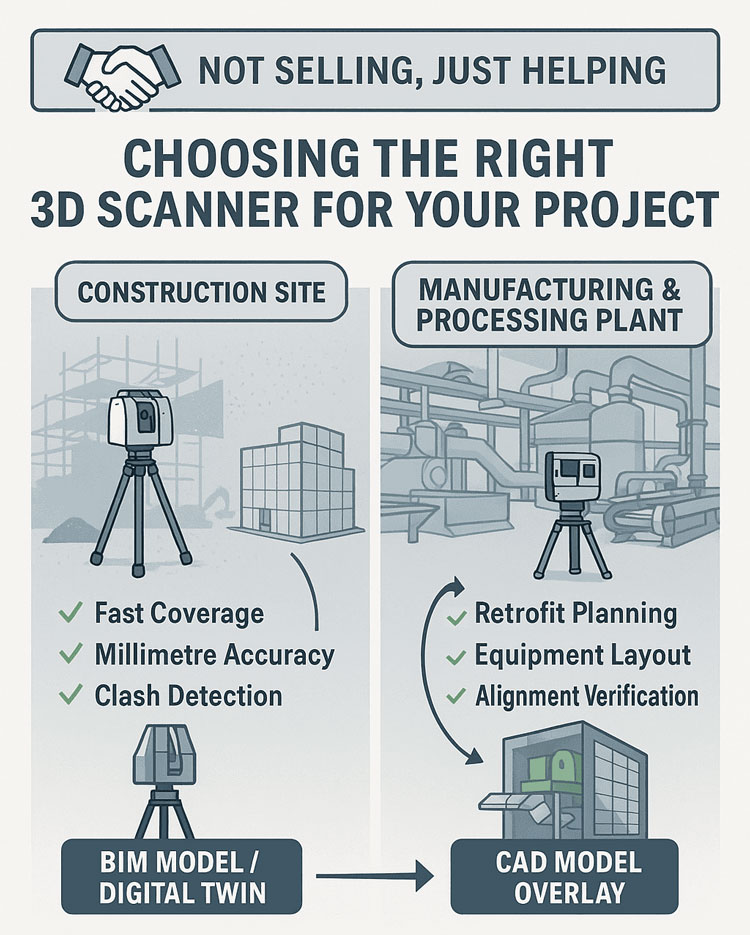
For construction and infrastructure projects, coverage and speed are the top priorities. Terrestrial Laser Scanning (TLS) and LiDAR systems like the FARO Focus S70 are ideal for quickly capturing entire job sites with millimetre-level accuracy. These scanners allow engineers and project managers to:

  • Verify as-built conditions against design models
  • Detect clashes early in the process
  • Support accurate quantity take-offs and progress documentation

TLS works well in tough environments โ€” dust, sunlight, and complex geometry โ€” making it a perfect fit for active building sites.

3D Scanning for Manufacturing & Processing Plants

When it comes to manufacturing facilities and mining processing plants, accuracy and detail matter even more. Scans are often used for:

  • Retrofit planning and clash detection in tight plant rooms
  • Structural steel and conveyor alignment checks
  • Equipment layout for expansion projects

Here, combining TLS with feature-based CAD modeling allows us to deliver data that is usable for engineering design, ensuring that new equipment fits exactly as intended.

Infographic titled โ€˜Choosing the Right 3D Scanner for Your Projectโ€™ with the tagline โ€˜Not Selling, Just Helping.โ€™ The left side shows a construction site with a tripod-mounted 3D scanner and benefits listed: fast coverage, millimetre accuracy, and clash detection, leading to BIM model or digital twin outputs. The right side shows a manufacturing and processing plant with a scanner and benefits: retrofit planning, equipment layout, and alignment verification, leading to CAD model overlay results

Weโ€™re Here to Help

Hamilton By Design doesnโ€™t sell scanners โ€” we focus on providing unbiased, engineering-driven advice. If youโ€™re unsure which scanning approach is right for your project, weโ€™re happy to share our experience and guide you toward the best solution.

Feel free to get in touch to discuss your project needs โ€” whether itโ€™s a construction site, manufacturing facility, or processing plant, we can help you turn accurate scan data into actionable engineering insights.

3D Scanning for Construction Sites |  3D Scanning for Manufacturing | 3D Scanning for Processing Plants

Mechanical Engineering | Structural Engineering

Mechanical Drafting | Structural Drafting

3D CAD Modelling | 3D Scanning
Finite Element Analysis (FEA) engineering simulation button
Mechanical engineering services

Rigid Body Dynamics vs Transient Structural Analysis in Mining

Why Both Matter in Mechanical and Structural Engineering

In the fast-paced and high-stakes environment of the Australian mining industry, reliable engineering design isnโ€™t just a competitive advantage โ€” it’s a necessity. Across regions like the Pilbara, Kalgoorlie, the Hunter Valley, Bowen Basin, and Mount Isa, mining operations depend on complex mechanical systems that must perform under extreme loads, harsh conditions, and round-the-clock operation.

To ensure safety, reliability, and performance, mining engineers increasingly rely on advanced simulation tools like Rigid Body Dynamics (RBD) and Transient Structural Analysis (TSA). While these tools might appear similar, they serve fundamentally different purposes in mechanical and structural engineering. Using the right tool at the right time can dramatically reduce downtime, improve equipment longevity, and lower operating costs.

At Hamilton By Design, we bring the latest in engineering simulation and scanning technology directly to your mining operation โ€” wherever you are in Australia. Whether you’re operating in the iron-rich Pilbara, the gold-rich Kalgoorlie, or deep in Mount Isa’s underground hard rock mines, we deliver world-class engineering solutions on-site or remotely.


What is Transient Structural Analysis?

Transient Structural Analysis (TSA) is a Finite Element Analysis (FEA) technique that models how structures respond to time-varying loads. It provides insights into:

  • Displacement and deformation under dynamic loads
  • Stress and strain distribution over time
  • Vibrations and impact response
  • Fatigue life prediction

This type of simulation is essential when you’re dealing with high-frequency loading, shock events, or long-term structural wear and fatigue. TSA is invaluable for assessing risk in static and semi-dynamic systems across mining sites.

Typical TSA applications in mining include:

  • Vibrating screens and feeder structures
  • Crusher housings and foundations
  • Chutes and hoppers exposed to high-velocity ore impact
  • Structural skids for processing equipment
  • Equipment subject to cyclic fatigue (e.g., slurry pumps, reclaimer arms)

What is Rigid Body Dynamics?

Rigid Body Dynamics (RBD) focuses on the motion of bodies under the assumption they do not deform. This tool models:

  • Position, velocity, and acceleration
  • Reaction forces at joints and actuators
  • Dynamic behaviour of moving parts and linkages
  • Contact, impact, and frictional interaction

Unlike TSA, RBD doesnโ€™t solve for stress or strain. Instead, it calculates the kinematics and kinetics of motion systems โ€” making it ideal for analysing mechanical assemblies where movement, timing, and loads are key.

Common RBD applications in mining include:

  • Stacker-reclaimer arms and boom articulation
  • Mobile equipment with hydraulic or mechanical actuators
  • Diverter chutes and gating systems
  • Rockbreaker arm kinematics
  • Conveyor take-up and tensioning systems

RBD also plays a pivotal role in process optimisation and troubleshooting โ€” helping engineers simulate how mechanisms will respond under load, ensuring operational efficiency before physical prototypes are built.


Why TSA Canโ€™t Replace RBD (and Vice Versa)

While TSA includes rigid body motion as part of the total displacement field, it is not designed for efficient or accurate motion simulation. Trying to model the dynamics of a moving mechanism in TSA can:

  • Lead to slow solve times and high computational cost
  • Produce unstable results due to unconstrained motion
  • Provide limited insight into timing, velocity, or actuation behaviour

Conversely, using RBD for structures that flex, vibrate, or wear over time wonโ€™t give you the data needed to assess material failure or fatigue.

The takeaway? Use TSA when deformation matters. Use RBD when motion matters. Use both when you need the complete picture.


Regional Applications Across Australian Mining

Hamilton By Design supports clients across Australia’s mining regions with tailored simulation services designed to meet real operational needs.

Pilbara โ€“ Iron Ore

With high-capacity iron ore operations, this region depends on large-scale materials handling systems.

  • Use RBD to simulate boom movement, slewing systems, and travel paths of stackers.
  • Use TSA to assess fatigue on booms, rail frames, and conveyor supports exposed to cyclic load.

Hamilton By Design helps model these systems efficiently, ensuring both accurate motion control and structural durability. Contact us for help simulating your Pilbara handling systems.


Kalgoorlie โ€“ Goldfields (Eastern Gold Region)

Gold operations rely on compact, high-force machinery in confined processing facilities.

  • Use TSA to simulate vibration-induced stress in equipment frames and foundations.
  • Use RBD to model diverter gates, hydraulic arms, and transport carts in processing facilities.

Whether you’re retrofitting a plant or building a new line, Hamilton By Design provides flexible support wherever you operate. Email info@hamiltonbydesign.com.au to learn more.


Hunter Valley โ€“ Coal (Thermal)

Thermal coal operations in NSW require robust, wear-resistant infrastructure.

  • RBD helps simulate automated diverters, boom stackers, and actuated gates.
  • TSA ensures the wear-prone chutes and hoppers withstand repetitive impacts.

We provide quick-turn simulations for both brownfield and greenfield projects. Get in touch to scope your simulation needs.


Bowen Basin โ€“ Coal (Metallurgical)

Queenslandโ€™s met coal operations power the global steel industry.

  • RBD enables accurate simulation of take-up systems and longwall motion.
  • TSA supports design of structural supports under repetitive and impact loading.

Our experts work with surface and underground operators, reducing risk through advanced motion and stress analysis. Request a quote at info@hamiltonbydesign.com.au.


Mount Isa โ€“ Hard Rock Mining

Mount Isaโ€™s deep and abrasive ore bodies test every piece of equipment.

  • RBD is ideal for simulating rockbreaker motion, loader paths, and mobile assets.
  • TSA provides insights into vibration effects on headframes, bins, and fixed plant.

Hamilton By Design offers full analysis support for operators in remote locations. Contact us today for tailored advice.


When to Use Both Tools Together

A real advantage emerges when RBD and TSA are used in combination:

  • RBD identifies dynamic forces and timing on moving parts
  • TSA then evaluates the structural response to those forces

For example, in a diverter chute:

  1. RBD determines the acceleration profile, impact forces, and system timing.
  2. TSA uses that input to analyse whether the chute will survive years of repeated service.

This integrated approach results in more accurate models, fewer design revisions, and significantly lower project risk.


Why Work with Hamilton By Design?

As mechanical engineering consultants with national reach, Hamilton By Design offers:

  • Combined RBD and TSA simulation capability
  • Lidar scanning and digital plant modelling
  • Experience with mining-specific assets and constraints
  • Mobile, responsive teams that bring technology to you

From site scoping to final design verification, we help our clients solve the right problem, the right way.

Have a project in mind? Reach out via our contact page or email info@hamiltonbydesign.com.au.


Conclusion: Technology That Moves With You

Rigid Body Dynamics and Transient Structural Analysis are not interchangeable โ€” they are complementary. Each method offers unique insights into how a mining system performs โ€” whether moving, flexing, vibrating, or carrying tonnes of ore.

At Hamilton By Design, we believe engineering technology should move as fast and far as our clients do. Thatโ€™s why we bring simulation, scanning, and design tools directly to you, wherever you operate across Australia.

If your system moves, simulate it with RBD. If your structure flexes, vibrates, or wears, model it with TSA. For full insight? Use both.

Let us help you design smarter, safer mining systems.

Hamilton By Design โ€“ Bringing Engineering Technology to You, Wherever You Are in Australia

Hamilton By Design logo displayed on a blue tilted rectangle with a grey gradient background


3D LiDAR scanning and 3D modelling service button โ€” laser scanner capturing a point cloud for engineering and CAD modelling
Mechanical engineering services


Hamilton By Design | Mechanical Drafting | Structural Drafting | 3-D Lidar Scanning

Our clients:

Name
Would you like us to arrange a phone consultation for you?
Address

Mechanical Engineering at the Heart of Mining on the Central Coast

ย  ๐Ÿ› ๏ธ

1. Setting the Scene: The Central Coast & Its Industrial Backbone

Home to nearly 350,000 people across Gosford, Wyong, Terrigal, and beyond, the Central Coast is well-known for its beaches and bushlandโ€”yet it also supports a robust industrial and miningโ€‘services sector (Jora, Wikipedia). With growing infrastructure demands and proximity to resource projects like the Wallarahโ€ฏ2 coal proposal near Wyong (Wikipedia), mechanical engineers play a pivotal role behind the scenes.

2. What Do Mechanical Engineers Do in Mining on the Coast?

Mechanical engineers in mining and related heavy industries are responsible for:

  • Design & Maintenance: Planning, designing, and overseeing maintenance of critical mineral processing plants, machinery, conveyors, trucks and drilling rigs (Jobsora).

  • Automation Integration: Implementing robotics, programmable logic controllers (PLCs), remote operation systems, and predictive maintenance tools .

  • Health & Safety Compliance: Ensuring mechanical systems meet stringent safety regulations and operator protection standards (Jora).

  • Environmental Efficiency: Optimising equipment to reduce energy use, emissions, and noiseโ€”all while supporting mine rehabilitation efforts .


3. Job Opportunities in the Region

Recent job listings highlight robust opportunities for mechanical engineers across the Coast:

  • Mining Mechanical Engineer roles are regularly advertised in Gosford/Lisarow, appearing in SEEK and Jora job postings (SEEK).

  • Roles span senior design positions to handsโ€‘on maintenance engineeringโ€”offering full-time opportunities with firms like Wabtec, Hyundaiโ€ฏRotem, Boral, and Coffey (SEEK).

  • Entry-level and graduate engineering roles are also available through pathways like Central Coast Council traineeships and TAFE NSW programs (Central Coast Council).


4. Industry Trends and What Youโ€™ll Need

As described by Titan Recruitment, the mining sector is embracing several transformative trends (Titan Recruitment):

  1. Automation & Robotics: Engineers are tasked with integrating autonomous machinery and control systems.

  2. Digital & Data Analytics: Skills in condition monitoring, sensors, and predictive analytics are in demand.

  3. Sustainability Focus: Thereโ€™s emphasis on clean, efficient systems that reduce environmental footprint.

  4. Complex Machine Design: As equipment sophistication grows, so does the need for mechanical expertise.

  5. Asset Reliability & Safety: Mechanical engineers must ensure zero-fault operation in harsh mining environments.

  6. Site-to-System Integration: Engineers coordinate across disciplinesโ€”mechanical, electrical, structuralโ€”to optimise operations.

  7. Continuous Upskilling: Ongoing educationโ€”through TAFE NSW, professional certifications, and in-house trainingโ€”is critical.


5. Training & Career Pathways on the Central Coast

๐ŸŽ“ Education & Apprenticeships

  • TAFE NSW (Hunter & Central Coast) offers mechanical and engineering trade training, forming a strong foundation for local roles (Wikipedia).

  • Central Coast Council provides apprenticeships and traineeships in mechanical fieldsโ€”ideal stepping stones into industry .

๐Ÿข Local Industry Experience

  • Firms like Wabtec, Hyundaiโ€ฏRotem, Boral, Coffey, and Wright Engineering in Somersby/Gosford offer vital on-the-job training and progression (SEEK).

  • Mining-support businesses across the Central Coast employ engineers to design, maintain, and improve heavy-duty plant and machinery.


6. Why the Central Coast Is a Great Base for Mining Engineers

  • Proximity to Projects: Infrastructure supporting coal drilling and mineral processing connects easily with local towns via major transport routes in and out of Gosford (Jobsora, Wikipedia).

  • Balanced Lifestyle: Work-life harmony blends regional industry jobs with coastal living and access to national parks (Indeed).

  • Clear Career Pathways: Education, apprenticeships, and employers form a supportive ecosystemโ€”from bedrock training to senior site leadership.


Final Takeaway

Mechanical engineers are essential to mining operations on the Central Coastโ€”ensuring machinery runs efficiently, safely, and sustainably. With strong local education pathways, active job markets, and growing tech trends, the region offers rewarding careers tied to both industrial innovation and community lifestyle.

Ready to design, maintain, and optimise the backbone of mining? The Central Coast has the foundationโ€”and the opportunityโ€”awaiting mechanical engineers eager to build the future.

Hamilton By Designย |ย Mechanical Draftingย |ย Structural Draftingย |ย 3-D Lidar Scanning

Central Coast | Mount Isa | Brisbane | Cairns | Darwin


Published on Hamiltonโ€ฏbyโ€ฏDesign โ€” shaping engineering futures in NSWโ€™s Central Coast

Hamilton By Design logo displayed on a blue tilted rectangle with a grey gradient background
3D LiDAR scanning and 3D modelling service button โ€” laser scanner capturing a point cloud for engineering and CAD modelling




Mechanical engineering services

Our clients:

Name
Would you like us to arrange a phone consultation for you?
Address
Finite Element Analysis (FEA) engineering simulation button
Mechanical engineering services