Why Good Design Matters More Than Project Management

Why Engineering Design Matters More Than Project Management

Lessons from Tailings Dam Failures in the Global Mining Industry

In engineering-led industries such as mining, construction, and heavy manufacturing, project management is often seen as the key to success โ€” on time, on budget, and on scope.

However, history shows that when failures occur, they are rarely caused by poor project management alone.

Some of the most serious industrial failures in the world โ€” including tailings dam collapses โ€” demonstrate a critical truth:

Project management cannot compensate for poor or marginal engineering design.

At Hamilton By Design, we believe design sets the safety ceiling. Project management operates within it.


Project Management Executes โ€” Design Determines Risk

Project management is essential. It coordinates people, schedules, procurement, and delivery. But it does not:

  • Increase a structureโ€™s factor of safety
  • Prevent liquefaction
  • Change material behaviour
  • Improve drainage capacity
  • Create resilience to abnormal conditions

Those outcomes are locked in at the design stage.

If a system requires perfect execution to remain safe, then the design is already fragile.

Good engineering design assumes:

  • Humans make mistakes
  • Weather exceeds forecasts
  • Equipment fails
  • Maintenance is imperfect

And it builds in margin, redundancy, and tolerance accordingly.


Tailings Dam Failures: A Clear Engineering Example

Tailings dam failures provide one of the clearest illustrations of the difference between design responsibility and project management responsibility.

Post-failure investigations across multiple countries consistently show that:

  • Many failed dams were operating as intended
  • Rainfall events were often within design assumptions
  • Operators followed approved procedures
  • Warning signs existed but reflected systemic weakness, not isolated mistakes

The common thread was not poor scheduling or cost control โ€” it was design philosophy.

Typical design-level issues identified:

  • Excess water retained in tailings
  • Low-density slurry disposal
  • Marginal stability under normal variability
  • Reliance on operational controls to maintain safety
  • Legacy designs never upgraded to match increased production

When a dam fails after a rainfall event, the rain is usually the trigger โ€” not the root cause.


Why Design Must Be Forgiving of Operations

Engineering design should be robust, not optimistic.

A safe design is one where:

  • Small operational deviations do not create instability
  • Water balance can tolerate extreme events
  • Safety does not depend on constant intervention
  • Failure modes are slow, visible, and recoverable

When operators or project managers are forced to โ€œmanage aroundโ€ design weaknesses, risk accumulates silently.

If safety relies on perfect behaviour, the system is unsafe by design.


The Australian Perspective: Design First, Then Manage

Australiaโ€™s generally strong tailings safety record reflects a broader engineering mindset:

  • Conservative design assumptions
  • Strong emphasis on water recovery and thickened tailings
  • Avoidance of high-risk construction methods
  • Independent engineering review
  • Design-for-closure thinking

Project management remains critical โ€” but it is not asked to compensate for marginal engineering.

This philosophy extends beyond tailings dams into:

  • Bulk materials handling
  • Structural steelwork
  • Brownfield upgrades
  • Shutdown-critical fabrication
  • Plant modifications

What This Means for Mining and Industrial Projects

The lesson is simple but powerful:

Engineering design controls risk.
Project management controls delivery.

When design is done properly:

  • Project management becomes easier
  • Variability is absorbed safely
  • Failures become unlikely rather than inevitable

When design is compromised:

  • Project management is left managing risk it cannot remove
  • The system becomes fragile
  • Incidents become a matter of when, not if

Our Approach at Hamilton By Design

At Hamilton By Design, we work from the principle that:

  • Design must be defensible
  • Assumptions must be explicit
  • Failure modes must be understood
  • Engineering judgement must lead delivery

Whether weโ€™re supporting:

  • Mining infrastructure
  • Tailings-adjacent plant systems
  • Bulk materials handling
  • Brownfield modifications
  • Shutdown-critical upgrades

We prioritise engineering-led design decisions that reduce reliance on operational heroics.


Final Thought

Project management is essential โ€” but it should never be asked to solve problems that only engineering design can prevent.

The safest projects are not the best managed ones โ€”
they are the best designed ones.

Hamilton By Design logo displayed on a blue tilted rectangle with a grey gradient background

Talk to an Engineer First

If your project involves:

  • High-risk infrastructure
  • Brownfield modifications
  • Water-sensitive systems
  • Shutdown-critical works

Get engineering involved early.
Contact Hamilton By Design to discuss an engineering-led approach that reduces risk before construction begins or Be part of the discussion.

Name
Would you like us to arrange a phone consultation for you?
Address

Machine Guarding for Ship Loaders, Stackers & Reclaimers in Bulk Materials Handling

Machine Guarding for Ship Loaders, Stackers & Reclaimers | Bulk Materials Safety

Why guarding matters on large bulk material machines

Ship loaders, stackers and reclaimers combine elements of mobile plant, fixed plant and continuous conveying systems. Their scale, movement and operating envelopes introduce hazards that cannot be managed with ad-hoc or legacy guarding.

Most guarding failures are not caused by a single missing guard, but by brownfield modifications, undocumented changes, and loss of original design intent. This makes engineering-led guarding essential for safety, compliance and uptime.


Australian Standards framework for guarding

AS 4024 โ€“ Safety of Machinery

The AS 4024 series provides the primary principles for machine guarding, including hazard identification, risk assessment, guarding selection, and safe distances. For bulk materials handling equipment, it must be applied in context rather than as a checklist.

AS 1755 โ€“ Conveyors: Safety requirements

AS 1755 governs conveyor-specific hazards common to ship loaders, stackers and reclaimers, including:

  • Nip points and pulleys
  • Transfer and chute interfaces
  • Emergency stop systems
  • Access for inspection and maintenance

Most real-world non-conformances occur at head/tail pulleys, transitions, take-ups and return belts beneath walkways.

AS 1657 โ€“ Fixed access systems

Guarding must coexist with compliant access. AS 1657 covers walkways, stairs, ladders, handrails and edge protection. Poor integration often leads to guards being removed to regain access โ€” undermining safety intent.

AS 4324.1 โ€“ Mobile bulk materials handling equipment

AS 4324.1 recognises ship loaders, stackers and reclaimers as integrated machines, where guarding, access, structure and maintainability must be considered together.


Guarding challenges unique to ship loaders & reclaimers

Scale and movement
These machines include slew, luff and travel motions, requiring guarding to remain effective across all operating positions.

Brownfield evolution
Temporary or reactive guarding solutions often become permanent without verification against standards.

Shutdown constraints
Guarding changes made under shutdown pressure frequently prioritise constructability over defensible engineering.


Engineering-led guarding approach

Effective guarding is based on:

  • Engineering-grade spatial understanding of reach, envelopes and access paths
  • Risk-based selection of fixed, interlocked or removable guarding in line with AS 4024
  • Integration with maintenance and operations, avoiding unsafe workarounds

On large machines, guarding that cannot be safely removed, reinstated or inspected will not survive long-term operation.


Common high-risk interfaces

Guarding assessment typically focuses on:

  • Conveyor head, tail and bend pulleys
  • Transfer points and chutes
  • Slew, luff and drive mechanisms
  • Gearboxes, brakes and take-ups
  • Return belt zones beneath accessways

Each interface must be checked against AS 4024, AS 1755, AS 1657 and AS 4324.1 as a combined framework.


Our clients:


Building toward a bulk materials handling safety framework

This post forms part of a broader technical narrative around safe, maintainable bulk materials handling systems.
Future companion topics may include:

  • Conveyor transfer point guarding
  • Brownfield guarding upgrades during life-extension works
  • Balancing guarding and access on reclaimers
  • Using validated 3D data to de-risk shutdown modifications

Together, these posts naturally support a future Bulk Materials Handling / Stacker & Reclaimer Engineering landing page without forcing a sales message.


Hamilton By Design logo displayed on a blue tilted rectangle with a grey gradient background

Key takeaway

On ship loaders, stackers and reclaimers, guarding must be engineered, spatially validated and operationally practical. When aligned with Australian Standards, guarding becomes an enabler of safe production โ€” not a liability.

Discuss machine safety and guarding for bulk materials handling equipment

If you are reviewing or upgrading ship loaders, stackers, reclaimers or conveyor systems, early engineering input can reduce safety risk, rework and shutdown pressure.

For discussions relating to:

  • Machine guarding and conveyor safety
  • Brownfield compliance with Australian Standards
  • Engineering-led reviews for bulk materials handling equipment

Please connect with us by filling out the form below.

Name
Would you like us to arrange a phone consultation for you?
Address

Hunter Valley Laser Scanning | CAD-Ready SolidWorks & Inventor

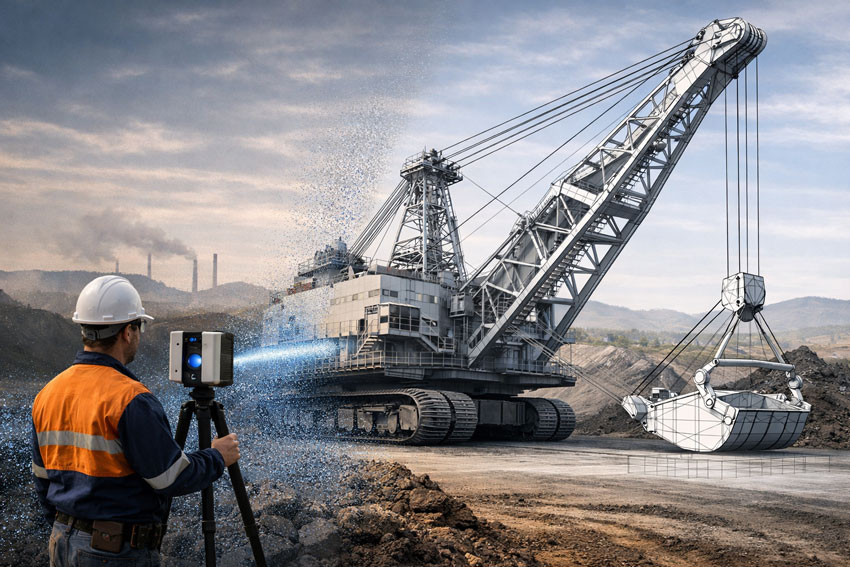
Engineering-grade LiDAR scanning of a dragline at a Hunter Valley mine producing CAD-ready data for SolidWorks and Autodesk Inventor

Hunter Valley Laser Scanning | CAD-Ready SolidWorks & Inventor

Engineering-Grade 3D & LiDAR Scanning Built for SolidWorks & Autodesk Inventor

The Hunter Valley is home to critical mining, power generation, manufacturing, and heavy-industry assets. In these environments, laser scanning is only valuable if the data can be used directly in engineering design software.

At Hamilton By Design, we deliver Hunter Valley laser scanning services that are purpose-built for engineering workflows โ€” ensuring scan data can be reliably used in SolidWorks and Autodesk Inventor without rework, approximation, or loss of accuracy.


Why โ€œScan-Onlyโ€ Data Is a Problem

Many laser scanning services focus on data capture only. While the point cloud may look impressive, it often fails at the most important step:

Can the scan be used directly in CAD and engineering design?

If the answer is no, the scan has limited value.

Common issues with low-grade or technician-only scanning include:

  • Point clouds that are not registered or scaled correctly
  • Insufficient accuracy for mechanical design tolerances
  • Poor alignment to real-world coordinate systems
  • Data that cannot be reliably modelled in SolidWorks or Inventor
  • Extra time and cost spent โ€œfixingโ€ scan data before design can begin

Why would you spend money on a scan that cannot be used for engineering?


Engineer performing engineering-grade laser scanning of a dragline excavator at a Hunter Valley mine for SolidWorks and Autodesk Inventor design

Engineering-Grade Laser Scanning โ€” Designed for CAD Use

Hamilton By Design approaches laser scanning as an engineering input, not a visual deliverable.

Our Hunter Valley laser scanning services are planned and executed so that scan data can be:

  • Used directly in SolidWorks
  • Imported and referenced accurately in Autodesk Inventor
  • Modelled into fabrication-ready geometry
  • Trusted for mechanical, structural, and layout decisions

This means the scan is not the end product โ€” it is the foundation for engineering and design.


Why Scanner Capability Matters

Not all scanners โ€” or scanning providers โ€” are equal.

Low-accuracy or inappropriate scanning equipment can result in:

  • Global accuracy drift
  • Poor definition of critical interfaces
  • Inability to confidently model mating parts, pipework, or steelwork
  • Designs that โ€œlook rightโ€ on screen but fail on site

Hamilton By Design uses engineering-grade scanning equipment and workflows, ensuring the captured data supports:

  • Mechanical equipment upgrades
  • Structural modifications
  • Conveyor, chute, and platform design
  • Fabrication and installation planning

Hunter Valley Applications Where CAD-Ready Scans Matter

Mining & CHPP Upgrades

Laser scanning of conveyors, transfer stations, chutes, and structures that must integrate precisely with new mechanical equipment.

Power Generation & Utilities

Accurate capture of plant rooms, pipework, platforms, and access systems for compliance and upgrade works.

Manufacturing & Heavy Industry

Reliable spatial data to support machinery installation, relocation, and layout optimisation.

Brownfield Construction & Retrofits

Engineering-grade scans to avoid clashes, rework, and costly shutdown overruns.


Engineer-Led Scanning โ€” Not Just Data Capture

At Hamilton By Design, laser scanning is delivered by engineers who understand how the data will be used.

This ensures:

  • Scan resolution and accuracy are matched to design intent
  • Critical interfaces are captured correctly
  • Data integrates seamlessly with CAD workflows
  • Accountability is maintained from scan through to design and documentation

You donโ€™t just receive a point cloud โ€” you receive usable engineering data.


Deliverables That Engineers Can Actually Use

Depending on your project, we provide:

  • Registered, engineering-grade point clouds
  • CAD-ready reference data for SolidWorks and Inventor
  • Section views and alignment references
  • Models and drawings derived directly from scan data
  • Documentation suitable for fabrication and construction

Everything is scoped so the scan adds value immediately, not later after rework.


Hunter Valley Laser Scanning โ€” Designed to Be Used, Not Admired

Laser scanning should remove uncertainty, not create more work.

By ensuring scan data can be used directly in SolidWorks and Autodesk Inventor, Hamilton By Design helps Hunter Valley projects move from site capture to design, fabrication, and installation with confidence.

Hamilton By Design delivers engineering-grade laser scanning in the Hunter Valley โ€” built for real engineering outcomes, not just visualisation.

Contact us to discuss your Hunter Valley laser scanning requirements or arrange an engineering-led site scan.

Name
Would you like us to arrange a phone consultation for you?
Address

3D Construction Scanning Darwin

Engineering-grade 3D laser scanner capturing Darwin port infrastructure, harbour assets, and urban skyline

Engineering-Grade LiDAR for Accurate As-Built & Construction Delivery

Construction projects in Darwin operate in a demanding environment โ€” tropical weather, remote logistics, accelerated schedules, and complex interfaces between structural, mechanical, and architectural elements. 3D construction scanning provides a reliable digital foundation to reduce risk, eliminate rework, and support confident decision-making throughout the project lifecycle.

Hamilton By Design delivers engineering-grade 3D construction scanning in Darwin, supporting contractors, engineers, builders, and asset owners with accurate spatial data, as-built models, and construction-ready documentation.

๐Ÿ‘‰ Learn more about our Darwin scanning capability:
https://www.hamiltonbydesign.com.au/3d-scanning-in-darwin/
https://www.hamiltonbydesign.com.au/home/engineering-services/3d-scanning-darwin/darwin-lidar-laser-scanning-services/


What Is 3D Construction Scanning?

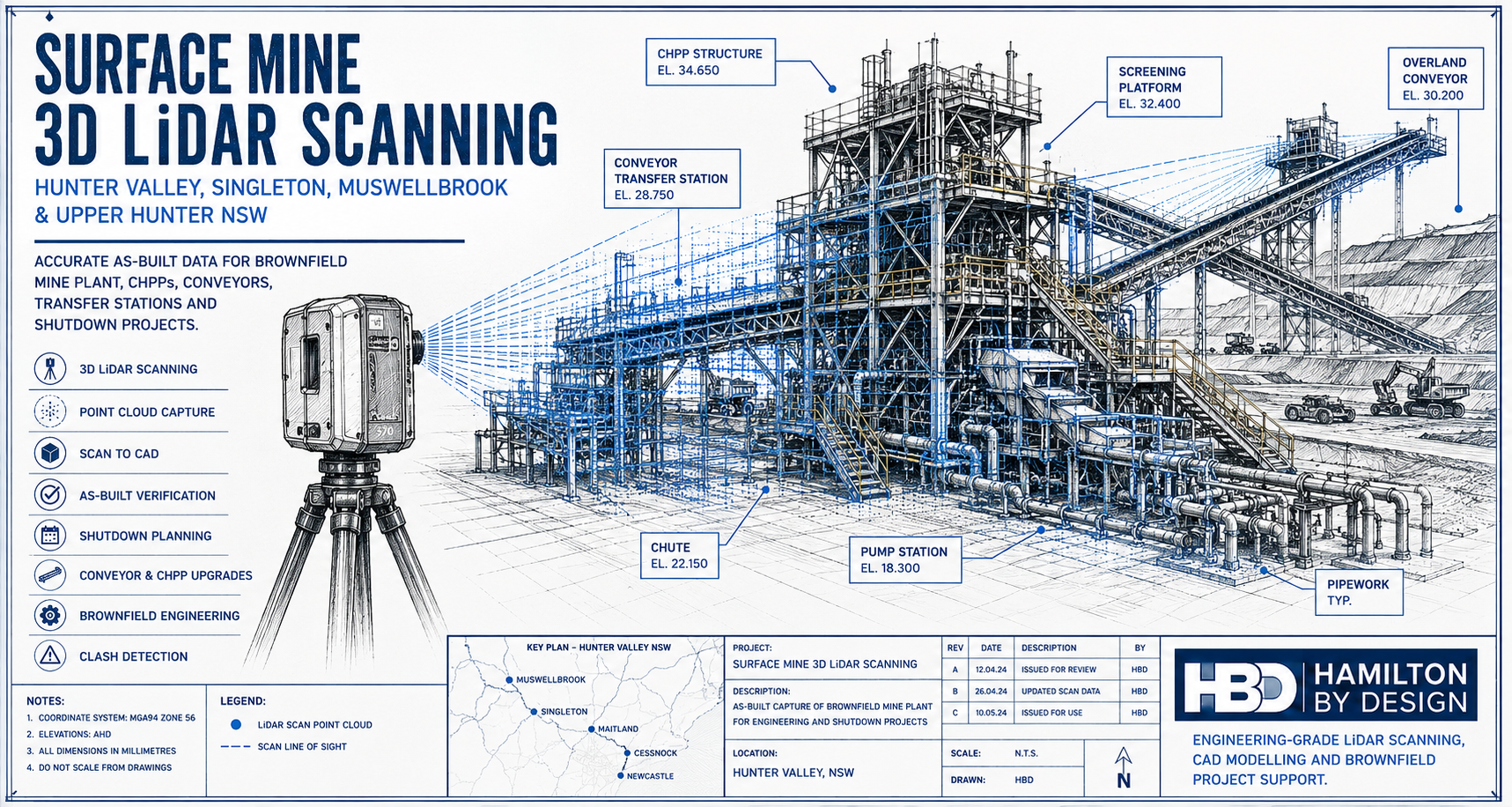
3D construction scanning uses high-accuracy LiDAR laser scanners to capture the real-world geometry of construction sites, partially completed works, and existing assets. The output is a dense, survey-grade point cloud that can be used to create:

  • Accurate as-built drawings
  • BIM and digital twin models
  • Clash detection and coordination models
  • Verification of construction tolerances
  • Retrofit and upgrade designs

Unlike traditional tape or total-station methods, LiDAR captures millions of points per second, ensuring complex geometry is recorded correctly the first time.


Engineering-grade 3D laser scanner capturing Darwin port infrastructure, harbour assets, and urban skyline

Why 3D Construction Scanning Matters in Darwin

Construction in Darwin often involves:

  • Live brownfield sites
  • Remote or logistically constrained projects
  • Tight shutdown or installation windows
  • High consequences of dimensional errors

3D construction scanning enables:

โœ” Reduced rework and RFIs
โœ” Improved trade coordination
โœ” Accurate verification before fabrication
โœ” Faster design and approval cycles
โœ” Safer site data capture with minimal disruption

This is particularly valuable for industrial buildings, ports, power generation facilities, defence infrastructure, and commercial developments across the Northern Territory.


Typical Construction Applications

As-Built Verification

Confirm what has actually been built โ€” not what was assumed โ€” before handover, certification, or the next construction stage.

Construction Progress Capture

Document progress at key milestones to support planning, claims, and coordination.

Retrofit & Upgrade Projects

Capture existing structures accurately before mechanical, electrical, or structural upgrades commence.

Clash Detection & Coordination

Overlay scanned data with design models to identify clashes early and avoid costly site changes.


Hamilton By Design logo displayed on a blue tilted rectangle with a grey gradient background

Engineering-Led Scanning โ€” Not Just Data Capture

At Hamilton By Design, 3D construction scanning is delivered by engineers, not just scanning technicians. This means:

  • Scan strategies aligned to engineering outcomes
  • Data captured at appropriate accuracy for construction tolerances
  • Deliverables tailored for CAD, BIM, and fabrication workflows
  • Clear accountability from scan to design to documentation

Our scanning integrates directly with mechanical design, structural analysis, and construction documentation services โ€” providing a single source of truth for your project.


Deliverables to Suit Construction Teams

Depending on your requirements, we can provide:

  • Registered point clouds
  • CAD-ready models
  • Revit / BIM outputs
  • Section views and construction references
  • Engineering drawings derived from scan data

All deliverables are tailored to suit builders, engineers, subcontractors, and asset owners.


Our clients:

3D Construction Scanning Darwin โ€” Partner with Confidence

Whether you are delivering a new build, managing a complex refurbishment, or upgrading an existing facility, 3D construction scanning in Darwin provides the clarity and accuracy needed to build with confidence.

Hamilton By Design supports construction projects across Darwin and the Northern Territory with engineering-grade LiDAR scanning, practical deliverables, and real-world construction experience.

Let Connect us to discuss your project requirements or arrange a site scan.

Name
Would you like us to arrange a phone consultation for you?
Address

AS ISO 10816 / 20816 โ€“ Mechanical Vibration

AS ISO 10816 & 20816 โ€“ Mechanical Vibration | Hamilton By Design

Mechanical vibration is one of the earliest indicators that rotating equipment is developing a fault. Standards such as AS ISO 10816 and AS ISO 20816 provide a consistent framework for measuring, evaluating, and managing vibration in industrial machinery.

At Hamilton By Design, we help clients apply these standards in a practical, engineering-led way by connecting vibration data with mechanical design, asset condition, and real-world site conditions.


What Are AS ISO 10816 and AS ISO 20816?

The AS ISO 10816 / 20816 standards define:

  • How mechanical vibration should be measured on machines
  • How vibration severity should be evaluated
  • What vibration levels are considered acceptable, marginal, or unacceptable

These standards are commonly applied to motors, pumps, gearboxes, compressors, fans, conveyors, and other rotating equipment where vibration provides an early warning of mechanical or structural issues.


Why Mechanical Vibration Standards Matter

Using vibration data without a recognised standard often leads to inconsistent interpretation and delayed action. Applying AS ISO 10816 / 20816 helps organisations to:

  • Identify mechanical problems early
  • Reduce unplanned downtime and breakdowns
  • Prevent secondary damage to bearings, shafts, and foundations
  • Improve overall equipment reliability
  • Support condition-based and predictive maintenance strategies

When vibration is assessed against an accepted standard, maintenance decisions become clearer and more defensible.


The Common Gap: Vibration Data Without Engineering Context

Many sites collect vibration data but struggle to connect it to:

  • As-installed geometry and alignment
  • Structural stiffness and support conditions
  • Design intent versus site reality
  • Maintenance and modification history

Vibration issues are often symptoms of broader mechanical or structural problems. Without engineering context, vibration data alone can be misleading.

This is where vibration assessment benefits from being connected to engineering-grade site information.

Engineering-Grade 3D LiDAR Scanning
https://www.hamiltonbydesign.com.au/home/engineering-services/engineering-grade-lidar-scanning/


How Hamilton By Design Helps

Hamilton By Design connects vibration standards with practical engineering outcomes through a coordinated service offering.

Engineering-Led Vibration Interpretation

We assess vibration results against AS ISO 10816 / 20816 using engineering judgement rather than relying solely on alarm limits. Machine type, operating duty, and site conditions are all considered.

Understanding the Physical Asset

By linking vibration data with mechanical layouts, drawings, and 3D models, we help identify whether vibration is driven by alignment issues, inadequate stiffness, foundation behaviour, or design constraints.

Mechanical Engineering Services
https://www.hamiltonbydesign.com.au/home/mechanical-engineering-consulting/mechanical-engineering/

SolidWorks & Mechanical CAD Services
https://www.hamiltonbydesign.com.au/home/engineering-services/solidworks/

Analysis Where Required

Where vibration levels indicate potential resonance, flexibility, or dynamic response issues, we support deeper investigation using structural and mechanical analysis tools.

SolidWorks FEA & Simulation
https://www.hamiltonbydesign.com.au/home/engineering-services/solidworks/solidworks-fea-simulation/

FEA Capabilities
https://www.hamiltonbydesign.com.au/home/engineering-services/fea-capabilities/

Clear, Usable Reporting

Our reporting focuses on:

  • What the vibration levels indicate
  • Why the issue matters to the asset
  • What actions are recommended

This ensures vibration results directly support maintenance and engineering decisions.


Where This Approach Adds Value

A connected vibration and engineering approach is particularly valuable in:

  • Mining and mineral processing plants
  • Heavy industrial facilities
  • Energy and utilities infrastructure
  • Brownfield upgrades and asset life-extension projects

Vibration issues are frequently linked to steelwork design, support conditions, or historical modifications that were not fully engineered.

Challenges of Not Consulting AS 3990 โ€“ Mechanical Equipment Steelwork
https://www.hamiltonbydesign.com.au/challenges-of-not-consulting-as-3990-mechanical-equipment-steelwork/

AS 1755 โ€“ Conveyor Safety
https://www.hamiltonbydesign.com.au/as-1755-conveyor-safety/


Summary

AS ISO 10816 and AS ISO 20816 provide the benchmark for assessing mechanical vibration.
Hamilton By Design provides the engineering connection that turns those benchmarks into practical action.

By linking vibration data with 3D scanning, mechanical design, and engineering analysis, vibration assessments become clearer, more accurate, and far more useful across the asset lifecycle.


Hamilton By Design logo displayed on a blue tilted rectangle with a grey gradient background

Related Engineering Services

3D Laser Scanning & Mechanical Design
https://www.hamiltonbydesign.com.au/3d-laser-scanning-mechanical-design-australia/

Mining Engineering Services
https://www.hamiltonbydesign.com.au/home/engineering-services/mining-engineering-services-australia/

From Scan to Shutdown

3D laser scanner capturing an industrial structure for engineering-grade digital modelling and verification

Why Hamilton By Design Is the Engineering Partner of Choice in Moranbah and the Bowen Basin – Engineering where it matters most

Moranbah and the surrounding Bowen Basin sit at the centre of Australiaโ€™s coal production engine. This is not a region defined by conceptual studies or theoretical designโ€”it is defined by tonnes per hour, shutdown windows, safety performance, and whether plant modifications fit first time.

For mining companies operating in this regionโ€”including major operators such as BHP Mitsubishi Alliance, Anglo American, Glencore, Whitehaven Coal, QCoal Group, Yancoal Australia, Coronado Global Resources, and Bowen Coking Coalโ€”engineering success is measured by outcomes, not promises.

Hamilton By Design exists specifically for environments like Moranbah: brownfield, high-risk, shutdown-driven, and unforgiving of design errors. This article explains why our engineer-led, scan-to-fabrication workflow aligns so closely with the realities of mechanical engineering in the Bowen Basinโ€”and how it delivers value across CHPPs, materials-handling plants, and mine infrastructure.


Moranbah: a convergence of mining, mechanics, and margin

Mechanical engineering in Moranbah is unique because it operates at the intersection of:

  • Live production assets
  • Harsh environmental conditions
  • Compressed shutdown schedules
  • Zero tolerance for rework

Almost every mine in the region is supported by a CHPP, conveyors, crushers, stackers, reclaimers, and complex transfer stations. These assets are often decades old, modified many times, and poorly documented.

For operators, this creates constant engineering risk:

  • Unknown as-built conditions
  • Dimensional uncertainty
  • Legacy structural fatigue
  • Congested plant layouts
  • Safety constraints during access and installation

Hamilton By Design was formed to remove this uncertainty.


The core problem: brownfield uncertainty

Most engineering failures in the Bowen Basin are not caused by poor calculations. They are caused by poor information.

Traditional workflows often rely on:

  • Outdated drawings
  • Manual tape measurements
  • Partial site access
  • Assumptions made under time pressure

In Moranbah, these assumptions are expensive.

A single clash during a CHPP shutdown can cascade into:

  • Lost production
  • Extended outages
  • Emergency site modifications
  • Safety exposure
  • Cost overruns

Hamilton By Design addresses this problem at its source: accurate, engineer-owned site data.


Engineer-led 3D laser scanning: data you can trust

4

Hamilton By Design delivers engineering-grade 3D LiDAR scanning, not generic survey capture. This distinction matters.

Our scans are:

  • Planned by mechanical engineers
  • Captured with fabrication tolerances in mind
  • Registered and verified for design use
  • Interpreted by the same engineers who model and draft the solution

For Bowen Basin operators, this means:

  • Confidence in clearances
  • Reliable tie-in locations
  • Accurate centre-lines and datum references
  • Reduced site revisits
  • Fewer RFIs during fabrication and installation

This approach underpins everything that follows.


From scan to CAD: turning reality into buildable models

Point clouds are only valuable if they are converted into usable engineering models.

Hamilton By Design specialises in:

  • SolidWorks-based mechanical modelling
  • CHPP equipment modelling
  • Conveyor and chute systems
  • Structural steel and platforms
  • Pipework, transfer chutes, and guards

Unlike generic drafting services, our models are:

  • Built for fabrication
  • Aligned to Australian Standards
  • Structured for downstream FEA where required
  • Designed with maintenance and installation in mind

For Moranbah projects, this means the model becomes a single source of truthโ€”shared between engineering, fabrication, and site teams.


Shutdown-driven design: engineering to the clock

Shutdowns in the Bowen Basin are short, expensive, and unforgiving.

Hamilton By Design engineers design specifically for shutdown execution by:

  • Preferring modular assemblies
  • Designing for pre-fabrication and trial-fit
  • Minimising hot work on site
  • Reducing installation complexity
  • Embedding lift and access considerations early

Our experience working with fabricators and site crews ensures that drawings are not just correctโ€”they are buildable under shutdown conditions.


Fabrication-ready drawings that reduce risk

4

In Moranbah, fabrication errors propagate directly to site risk.

Hamilton By Design produces:

  • Detailed fabrication drawings
  • Clear GA and assembly drawings
  • Accurate BOMs
  • Weld-ready detailing
  • Clear tolerances and notes

Fabricators value our drawings because they:

  • Reduce shop-floor guesswork
  • Minimise RFIs
  • Support first-time assembly
  • Align with real-world workshop practices

For mining companies, this translates to smoother shutdowns and fewer surprises.


A 3D laser scanner on a tripod capturing an industrial plant structure, with a colourful point cloud and blue CAD wireframe overlay illustrating engineering-grade 3D laser scanning accuracy.

Structural verification and FEA where it counts

Many Bowen Basin assets were not designed for their current duty cycles. Increased throughput, equipment upgrades, and extended asset life introduce structural risk.

Hamilton By Design integrates:

  • Structural checks
  • Load-path verification
  • Fatigue considerations
  • Finite Element Analysis (where appropriate)

FEA is applied pragmaticallyโ€”not as an academic exercise, but as a decision-support tool to:

  • Validate modifications
  • Avoid over-design
  • Reduce unnecessary steel
  • Confirm safety margins

This approach supports compliance while respecting cost and schedule constraints.


Digital QA and as-built confidence

One of the most overlooked advantages of scan-based engineering is digital quality assurance.

Hamilton By Design can:

  • Validate fabricated components against the model
  • Confirm installed geometry post-shutdown
  • Provide updated as-built documentation
  • Support future modifications with confidence

For asset owners, this builds a cumulative digital assetโ€”each project improving the next.


Why this matters to Bowen Basin operators

For companies operating multiple sites across the region, the benefits compound:

  • Consistency across projects and sites
  • Reduced engineering rework
  • Improved shutdown reliability
  • Better collaboration with fabricators
  • Lower total project risk

Hamilton By Designโ€™s workflow aligns with how mining actually operates in Moranbahโ€”not how it is described in textbooks.


A partner, not just a consultant

Hamilton By Design does not operate as a detached design office. We work alongside:

  • Maintenance teams
  • Shutdown planners
  • Fabricators
  • Site supervisors

Our value lies in understanding why a design is needed, how it will be built, and when it must be installed.

This mindset resonates strongly in the Bowen Basin, where credibility is earned through delivery.


Why Moranbah companies choose Hamilton By Design

In summary, Hamilton By Design helps mining companies in Moranbah and the Bowen Basin because we:

  • Specialise in brownfield mining environments
  • Deliver engineer-led 3D scanning
  • Convert data into fabrication-ready models
  • Design for shutdown execution
  • Reduce risk across engineering, fabrication, and installation
  • Speak the language of site, not just design offices

Engineered for Moranbah

Moranbah is not a place for generic solutions. It demands engineering that is accurate, practical, and accountable.

Hamilton By Design was built for regions like thisโ€”where engineering decisions have immediate operational consequences and where doing it right the first time matters.

For mining companies across the Bowen Basin, we provide more than drawings.
We provide clarity, confidence, and constructable engineeringโ€”from scan to shut down.

Hamilton By Design logo displayed on a blue tilted rectangle with a grey gradient background

Our clients:

Name
Would you like us to arrange a phone consultation for you?
Address