Lessons from a Preventable Underground Coal Mine Incident
The Technology Exists – So Why Are We Still Seeing These Incidents?
A recent Resources Safety & Health Queensland (RSHQ) investigation into a near-fatal underground coal mining incident has once again highlighted a challenge that continues to confront the mining industry.
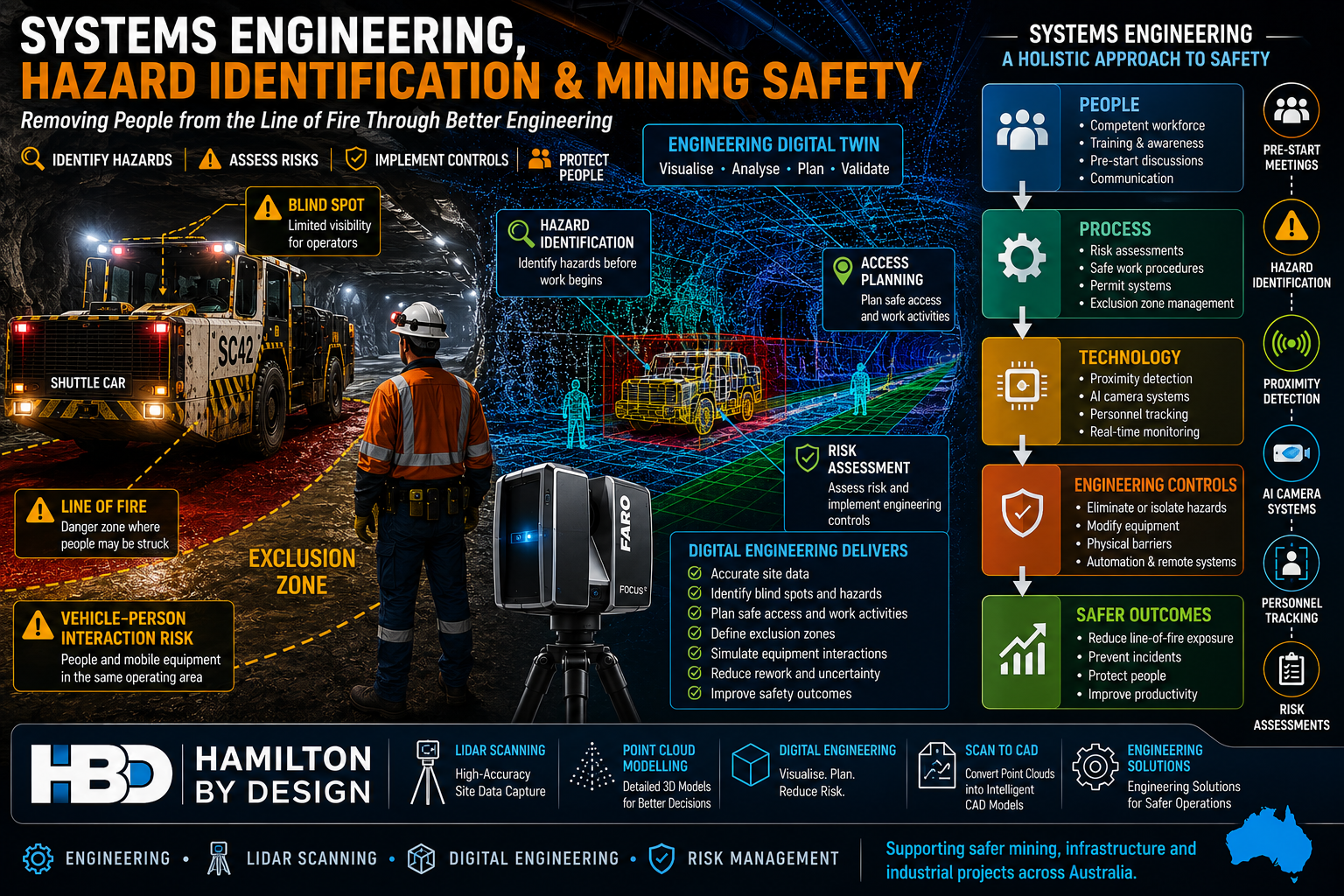
The incident occurred at an underground coal mine near Emerald in Queensland’s Bowen Basin when a worker entered the blind spot of a shuttle car and was struck by the machine. Investigators identified several contributing factors including poor visibility, inadequate communication, high background noise, blind spots around mobile equipment and the absence of proximity detection technology. RSHQ described the event as entirely preventable and encouraged operators to consider technologies already being used successfully at other Queensland mines.
While incidents such as this are often discussed from an operational perspective, they also highlight a broader engineering challenge.
The real question is:
How do we design systems that prevent workers from being exposed to hazards in the first place?
This is where systems engineering becomes critically important.
What is Systems Engineering?
Systems engineering is the disciplined approach of understanding how people, equipment, processes, technology, procedures and the operating environment interact as a complete system.
Rather than focusing on individual components, systems engineering examines:
- Human factors
- Equipment design
- Communication systems
- Work procedures
- Environmental conditions
- Technology controls
- Organisational culture
- Training and competency
- Risk management processes
When a serious incident occurs, it is rarely caused by a single failure.
Instead, multiple weaknesses align simultaneously.
In the Emerald incident, the shuttle car itself was not necessarily defective.
The system failed because:
- Workers changed position without positive communication.
- The vehicle operator was unaware of the workers’ location.
- Visibility was limited.
- Background noise masked movement.
- No proximity detection technology was available.
- Workers entered a line-of-fire zone.
A systems engineering approach asks:
What combination of controls could have prevented the event regardless of human error?
The Hierarchy of Controls
One of the most important principles in safety engineering is the Hierarchy of Controls.
Controls are generally ranked from most effective to least effective:
- Elimination
- Substitution
- Engineering Controls
- Administrative Controls
- Personal Protective Equipment
Many organisations rely heavily on procedures, training and pre-start discussions.
While these are important, they sit relatively low in the hierarchy.
Engineering controls are often more reliable because they do not depend entirely on human behaviour.
Examples include:
- Proximity detection systems
- AI camera systems
- Collision avoidance systems
- Personnel tracking systems
- Physical barriers
- Interlocks
- Remote operation technology
- Autonomous equipment
The objective should always be to engineer hazards out of the system wherever practical.
Hazard Identification Starts Before Work Begins
One of the most effective safety tools available is proactive hazard identification.
Many incidents occur because hazards are recognised only after work has commenced.
Hazard identification should occur during:
Project Planning
Before construction or maintenance work begins.
Design Reviews
Before equipment is fabricated or modified.
Shutdown Planning
Before personnel enter operational areas.
Pre-Start Meetings
Before workers commence each shift.
Field Risk Assessments
Immediately before performing a task.
A robust hazard identification process considers:
- Mobile equipment interactions
- Blind spots
- Stored energy
- Working at heights
- Falling objects
- Confined spaces
- Vehicle movements
- Emergency access
- Simultaneous operations
- Human factors
The goal is simple:
Identify hazards before they have an opportunity to cause harm.
Why Pre-Start Meetings Matter
In many operations, pre-start meetings can become routine.
Unfortunately, routine often leads to complacency.
The most effective pre-start meetings are not simply administrative exercises.
They provide an opportunity to discuss:
What Has Changed?
- New equipment
- New personnel
- Different environmental conditions
- Weather impacts
- Operational changes
What Are Today’s Hazards?
- Vehicle interactions
- Exclusion zones
- Ground conditions
- Overhead hazards
- Isolation requirements
What Are the Critical Controls?
- Spotters
- Communication methods
- Isolation procedures
- Permit requirements
- Emergency response arrangements
What Could Go Wrong?
This question alone can significantly improve hazard awareness.
A quality pre-start discussion encourages workers to actively think about risk before entering the workplace.
Line-of-Fire Hazards Remain a Major Industry Risk
Across mining, construction, manufacturing and heavy industry, line-of-fire incidents continue to be one of the leading causes of serious injury and fatalities.
Line-of-fire hazards include situations where workers are exposed to:
- Moving vehicles
- Rotating equipment
- Suspended loads
- Stored energy
- Pressurised systems
- Falling objects
- Uncontrolled equipment movement
Recent Queensland mining safety alerts have repeatedly highlighted similar themes:
- Workers trapped between vehicles.
- Workers entering exclusion zones.
- Poor communication.
- Lack of positive isolation.
- Mobile equipment interactions.
The underlying hazards are often well understood.
The challenge is ensuring controls remain effective in real-world operating environments.
The Role of Digital Engineering and LiDAR Scanning
Modern engineering tools are creating new opportunities to identify and manage risk before work begins.
Engineering-grade LiDAR scanning and digital engineering workflows allow project teams to create accurate digital representations of operational facilities.
Applications include:
Access Planning
Identifying safe access routes.
Equipment Interaction Analysis
Assessing vehicle and personnel separation.
Shutdown Planning
Visualising work fronts before crews arrive onsite.
Clash Detection
Identifying conflicts before installation.
Exclusion Zone Development
Understanding hazardous interaction areas.
Emergency Planning
Reviewing evacuation routes and emergency access.
Hamilton By Design regularly supports projects through:
- Engineering-grade LiDAR scanning
- Point cloud modelling
- Scan-to-CAD workflows
- Digital engineering
- Mechanical engineering
- Brownfield modifications
- As-built documentation
These tools provide project teams with accurate information that can improve both productivity and safety outcomes.
Proximity Detection Technology is Not New
One of the most significant observations from the recent incident is that proximity detection technology already exists.
In fact, underground mining industries have been investigating and deploying proximity detection systems around continuous miners and shuttle cars for many years. These systems can identify personnel entering predefined warning or hazard zones and initiate alarms, slowdowns or machine intervention depending on the system design.
Modern systems can provide:
- Warning zones
- Slow-down zones
- Automatic stop functions
- Personnel tracking
- Vehicle interaction monitoring
- AI-assisted hazard detection
The question is no longer whether the technology is available.
The question is how quickly and consistently industry adopts it.
Building Safer Systems
A mature safety culture understands that procedures alone are rarely enough.
The strongest organisations focus on building multiple layers of protection.
This includes:
People
- Training
- Competency
- Communication
Processes
- Risk assessments
- Safe work procedures
- Permit systems
Technology
- Proximity detection
- AI vision systems
- Personnel tracking
Engineering
- Equipment redesign
- Physical barriers
- Elimination of hazards
Leadership
- Safety culture
- Accountability
- Continuous improvement
When these elements work together, the likelihood of serious incidents is dramatically reduced.
Final Thoughts
The recent underground coal mining incident serves as a powerful reminder that safety is fundamentally a systems engineering challenge.
The objective should not simply be to react to incidents.
The objective should be to design work environments where incidents are far less likely to occur.
Hazard identification, risk assessment, effective pre-start meetings, engineering controls and modern technologies all play a critical role in achieving this outcome.
As the mining industry continues to embrace digital engineering, LiDAR scanning, automation, AI systems and proximity detection technologies, there is a significant opportunity to remove people from the line of fire and create safer workplaces.
The technology exists.
The challenge is ensuring it is implemented before the next near miss becomes a fatality.

References
- Resources Safety & Health Queensland (RSHQ) – Safety Alert: Underground shuttle car incident.
- Resources Safety & Health Queensland (RSHQ) – Vehicle interaction and line-of-fire safety alerts.
- Proximity Detection Systems in Underground Mines – Queensland Mining Industry Health and Safety Conference.
- Proximity Detection Options on Underground Mining Equipment.
- Safe to Work – Coal mine collision highlights parking procedure risks.
Contact Us – Talk to Us