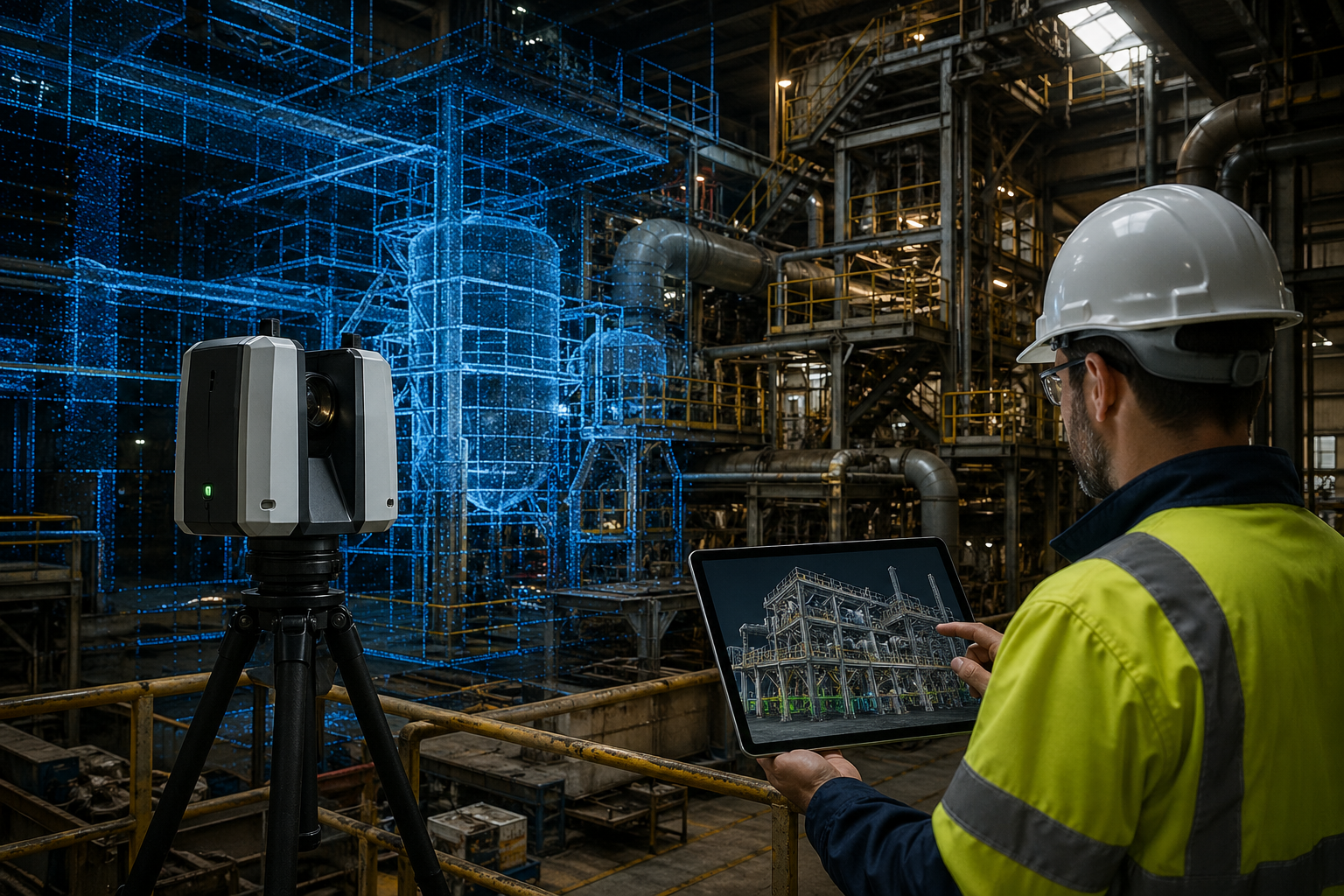
Hunter Valley Mining Engineering & 3D Laser Scanning Services | Hamilton By Design

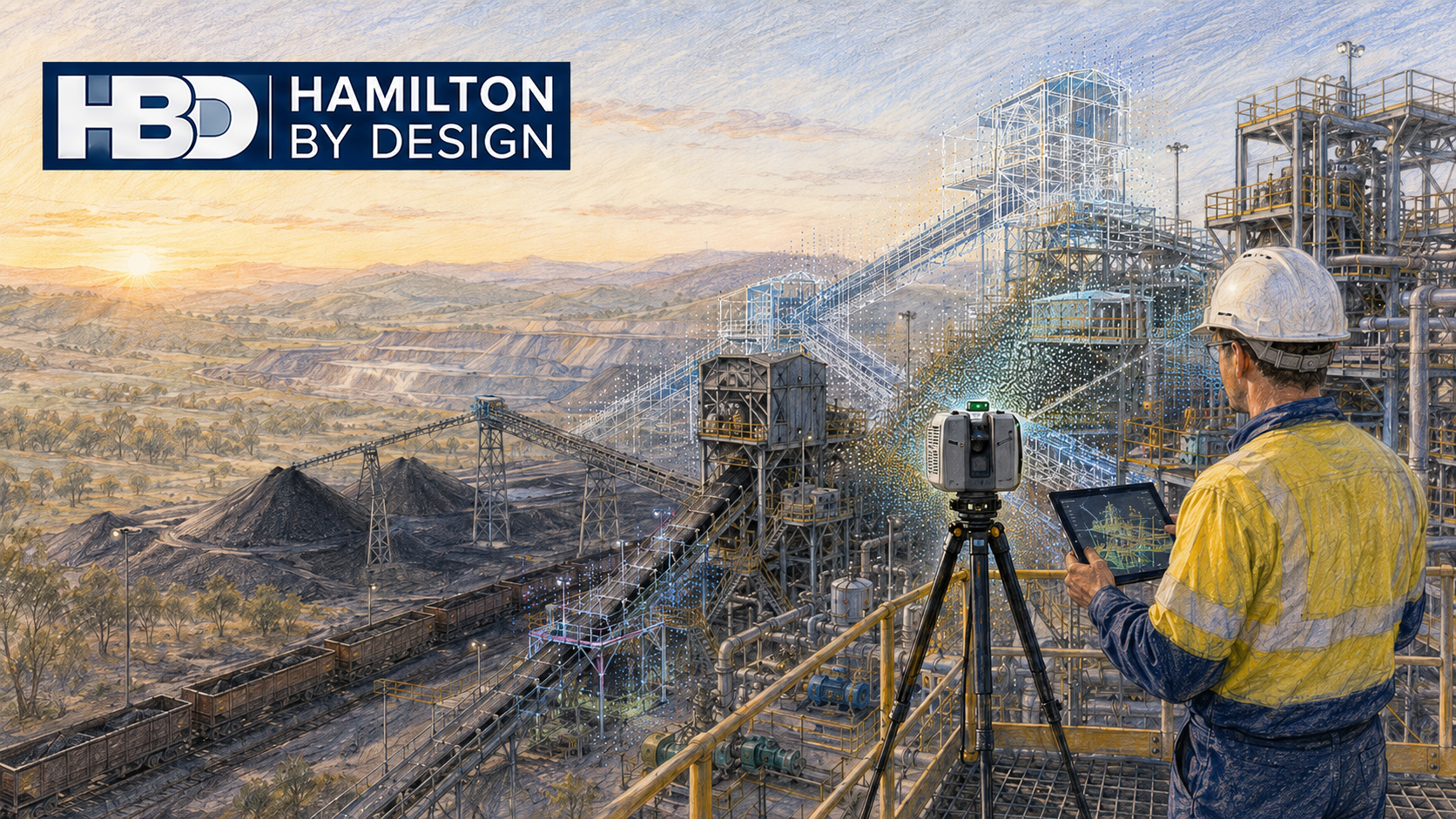
Colour-pencil illustration of 3D laser scanning at a Hunter Valley coal handling plant, with an engineer, conveyors, rail wagons and the Hamilton By Design logo.

Hunter Valley + Mining + Mechanical Engineering + Conveyor Systems + Industrial Design + 3D Lidar Laser Scanning Services = Hamilton By Design

Supporting Hunter Valley Mining Infrastructure, CHPP Facilities & Materials Handling Systems

The Hunter Valley is one of Australia’s most significant mining and industrial regions. Home to major coal mining operations, Coal Handling and Preparation Plants (CHPP), rail infrastructure, export facilities and bulk materials handling systems, the region continues to support large-scale engineering, maintenance and infrastructure projects.

At Hamilton By Design, we provide engineering-grade 3D laser scanning, reverse engineering, mechanical engineering and drafting services supporting mining infrastructure throughout the Hunter Valley.

Our team understands mining environments because we come from industry. Our experience spans materials handling systems, conveyor infrastructure, CHPP facilities, structural steelwork, shutdown engineering and brownfield plant modifications.

Supporting the Hunter Valley Coal Industry

The Hunter Valley Coal Chain is one of the largest integrated coal export systems in the world, linking mining operations throughout the Hunter Region with rail infrastructure and the Port of Newcastle export terminals.

Mining operations throughout the region rely on extensive infrastructure including:

  • Conveyor systems
  • CHPP facilities
  • Rail loading systems
  • Bulk materials handling equipment
  • Transfer stations
  • Stackers and reclaimers
  • Structural steel infrastructure
  • Pumping systems
  • Water management assets

Hamilton By Design provides engineering support services helping operators, contractors and project teams better understand existing site conditions before design, fabrication and installation activities commence.
3D LiDAR Scanning Hunter & Newcastle banner with white text on a blue background promoting engineering-grade laser scanning services for industrial, mining and infrastructure projects across the Hunter Valley and Newcastle region.
Mechanical Engineering Hunter & Newcastle banner promoting mechanical engineering services for mining, industrial plants, power generation, manufacturing and heavy industry throughout the Hunter Valley and Newcastle region.
Structural Drafting Hunter & Newcastle banner promoting structural drafting services for mining, industrial plants, power generation, manufacturing and infrastructure projects across the Hunter Valley and Newcastle region.

Engineering-Grade 3D Laser Scanning

Not all scans are equal.

At Hamilton By Design, we specialise in engineering-grade terrestrial LiDAR scanning designed to support practical engineering outcomes.

Our scanning services support:

  • Conveyor upgrades
  • Transfer station modifications
  • Shutdown planning
  • Existing condition surveys
  • Structural steel verification
  • Pipework modifications
  • Equipment replacement projects
  • Brownfield engineering
  • Asset capture programs
  • As-built verification

We provide registered point cloud data suitable for:

  • SolidWorks
  • Autodesk Revit
  • AutoCAD
  • Navisworks
  • Inventor
  • Recap
  • Digital engineering workflows

Accurate site information helps reduce project risk, improve constructability and minimise installation issues during shutdown activities.

Conveyor Systems & Materials Handling Engineering

Conveyor systems form the backbone of Hunter Valley mining operations.

Hamilton By Design supports projects involving:

  • Overland conveyors
  • Transfer stations
  • Conveyor gantries
  • Belt feeder systems
  • Chute upgrades
  • Structural modifications
  • Maintenance access improvements
  • Conveyor replacement projects

Working within existing operating facilities often requires accurate existing condition information before fabrication begins.

Our laser scanning and engineering services help ensure designs reflect real-world site conditions.

CHPP Upgrades & Plant Modifications

Coal Handling and Preparation Plants continue to evolve as production requirements change and ageing infrastructure requires replacement or modification.

We support projects involving:

  • Structural steel modifications
  • Conveyor upgrades
  • Pipework systems
  • Access platform improvements
  • Transfer chute modifications
  • Equipment replacement projects
  • Existing condition verification
  • Brownfield expansion works

Engineering-grade scanning provides a reliable foundation for design development and project planning.

Shutdown Engineering Support

Mining shutdowns are often where accurate engineering information delivers the greatest value.

Every hour of shutdown downtime can have significant production implications.

Hamilton By Design assists shutdown projects with:

  • Existing condition capture
  • Laser scanning surveys
  • Installation planning
  • Fabrication verification
  • Clash detection
  • Asset documentation
  • As-built verification

Accurate scan data helps reduce rework, improve fitment outcomes and minimise project risk during shutdown execution.

Reverse Engineering Services

Many mining facilities continue operating equipment where original drawings are incomplete, unavailable or no longer represent the installed asset.

Our reverse engineering services support:

  • Conveyor components
  • Chutes and transfer systems
  • Pump assemblies
  • Wear liners
  • Castings
  • Structural assemblies
  • Legacy plant equipment
  • Fabricated mining infrastructure

Using engineering-grade scanning and practical manufacturing experience, we develop models and fabrication drawings suitable for refurbishment, replacement or modification.

Mining Infrastructure Engineering

Mining infrastructure must operate in demanding environments while remaining maintainable and practical to construct.

Hamilton By Design supports projects involving:

  • Materials handling systems
  • Conveyor structures
  • Access platforms
  • Maintenance walkways
  • Pipework systems
  • Structural steel modifications
  • Brownfield upgrades
  • Industrial plant infrastructure

Our engineering approach focuses on constructability, maintainability and long-term asset performance.

Why Hamilton By Design?

Hamilton By Design combines practical trade experience with engineering capability.

Our experience includes:

  • Mechanical engineering
  • Fitting and machining
  • Industrial drafting
  • Mining operations
  • Materials handling systems
  • Smelting and processing facilities
  • Site-based engineering
  • Industrial maintenance

We understand that successful engineering projects require more than accurate models. They require solutions that can be fabricated, installed and maintained within real operating mining environments.

Servicing the Hunter Valley Mining Region

Hamilton By Design supports projects throughout:

  • Cessnock
  • Singleton
  • Muswellbrook
  • Mount Thorley
  • Ravensworth
  • Warkworth
  • Branxton
  • Rutherford
  • Beresfield
  • Tomago
  • Newcastle
  • Hunter Valley mining operations

Whether you require engineering-grade laser scanning, reverse engineering, conveyor design support or shutdown engineering services, our team is available to assist.


3D LiDAR scanning and 3D modelling service button โ€” laser scanner capturing a point cloud for engineering and CAD modelling
Mechanical engineering services

Engineering Support for Hunter Valley Mining Operations

Hamilton By Design provides engineering-grade 3D laser scanning, mechanical engineering, drafting and reverse engineering services supporting Hunter Valley mining infrastructure, CHPP facilities, conveyor systems and materials handling operations.

Contact Us – Talk to Us

Contact our team to discuss your next mining project and discover how accurate site data and practical engineering experience can improve project outcomes, reduce shutdown risk and support long-term asset performance.

Name
Would you like us to arrange a phone consultation for you?
Address
CHPP Engineering title graphic featuring bold white text reading "CHPP Engineering" centred on a blue rounded rectangle background.
Pipework Drafting title graphic featuring bold white text reading "Pipework Drafting" centred on a blue rounded rectangle background.
3D LiDAR Scanning for Engineering Projects title graphic featuring bold white text on a blue rounded rectangle background.

Our Clients:

Mechanical engineering services
Australian Drafting logo featuring bold white text reading "Australian Drafting" centred on a blue rounded rectangle background.
3D CAD Modelling Australia service banner for Hamilton By Design

Mechanical Engineering | Structural Engineering


Reverse Engineering Mining Industry

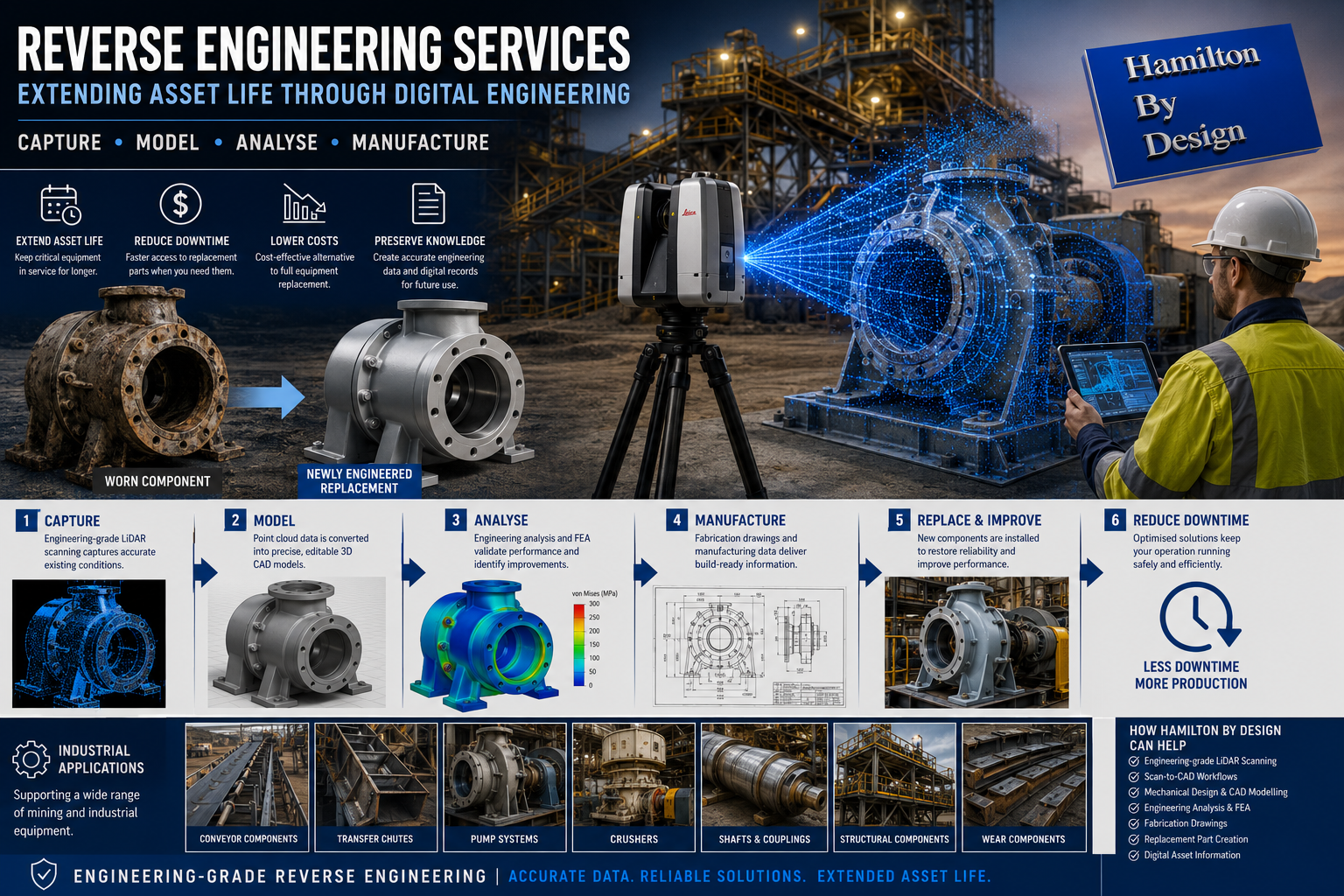
Engineering-grade reverse engineering workflow showing LiDAR scanning, CAD modelling, and FEA analysis used to recreate industrial equipment components.

Mining and industrial facilities often operate equipment for many years beyond its original installation date. Over time, machinery evolves through repairs, modifications, upgrades, and changing operational requirements. While equipment may continue performing effectively, obtaining replacement components can become increasingly difficult.

One of the most common challenges faced by industrial operations is finding replacement parts for ageing equipment where:

  • Original equipment manufacturers (OEMs) no longer support the product
  • Engineering drawings are unavailable
  • Documentation has been lost
  • Components have become obsolete
  • Lead times are excessive
  • Full equipment replacement becomes expensive

In these situations, reverse engineering can provide a practical pathway to maintain equipment performance and extend asset life.

At Hamilton By Design, we support mining and industrial operations through engineering-grade reverse engineering workflows incorporating 3D LiDAR scanning, CAD modelling, engineering analysis, and fabrication-ready documentation.

What is Reverse Engineering?

Reverse engineering involves capturing and analysing an existing component or system to recreate accurate engineering information.

Rather than starting from a new concept design, the process begins with an existing asset and develops:

  • Digital geometry
  • Engineering drawings
  • CAD models
  • Dimensional information
  • Design documentation
  • Manufacturing information

The goal is creating accurate engineering data that supports maintenance, fabrication, and equipment improvement.

Why Mining and Industrial Operations Use Reverse Engineering

Many industrial facilities contain equipment that may have operated for decades.

Examples include:

  • Conveyors
  • Transfer chutes
  • Pumps
  • Crushers
  • Structural components
  • Wear liners
  • Shafts
  • Fabricated assemblies
  • Mechanical components
  • Materials handling systems

As equipment ages, facilities can encounter increasing challenges obtaining replacement parts.

3D CAD Modelling Australia service banner for Hamilton By Design

Common issues include:

  • Obsolete components
  • Long manufacturing lead times
  • Missing drawings
  • Unknown modifications
  • Reduced OEM support
  • Increased maintenance costs

Reverse engineering helps bridge this information gap.

Obsolete Components and Missing Documentation

A common situation occurs when maintenance teams identify a failed component but no manufacturing information exists.

Examples may include:

  • Worn shafts
  • Custom brackets
  • Conveyor components
  • Pump assemblies
  • Structural items
  • Wear components

Without engineering information, organisations may face:

  • Extended downtime
  • Emergency fabrication
  • Manual measurement errors
  • Increased costs

Reverse engineering can convert physical components into accurate engineering data.

Extending Equipment Life

Full equipment replacement is not always necessary.

In many situations:

  • The surrounding system remains functional
  • Only selected components require replacement
  • Minor improvements may improve performance
  • Existing equipment can continue operating effectively

Extending equipment life may provide:

  • Lower capital expenditure
  • Reduced project risk
  • Reduced downtime
  • Improved return on investment
  • Improved operational continuity

Replacement Part Creation

Hamilton By Design can support replacement component development through engineering workflows including:

Existing Condition Capture

Capture existing equipment using:

  • Engineering-grade LiDAR scanning
  • Physical measurements
  • Dimensional verification

CAD Modelling

Develop:

  • Editable CAD models
  • Mechanical assemblies
  • Manufacturing information

Engineering Drawings

Generate:

  • General arrangement drawings
  • Fabrication drawings
  • Manufacturing documentation

Engineering Validation

Support projects through:

  • Design assessment
  • Engineering analysis
  • Finite Element Analysis (FEA)
  • Structural validation

Reducing Downtime

Unexpected equipment failures can significantly affect production.

Potential impacts may include:

  • Lost production
  • Shutdown delays
  • Increased labour requirements
  • Emergency maintenance costs
  • Reduced operational efficiency

Reverse engineering can support maintenance planning by creating:

  • Digital spare part libraries
  • Engineering records
  • Manufacturing information
  • Improved replacement processes

This allows organisations to move from reactive responses toward more structured asset management.

Cost Versus Full Equipment Replacement

Replacing an entire system can involve:

  • High capital cost
  • Long procurement timeframes
  • Installation costs
  • Production interruptions
  • Project risk

Reverse engineering may provide an alternative where:

  • Existing equipment remains suitable
  • Only selected components require replacement
  • Performance improvements can be introduced

Engineering decisions can then focus on lifecycle value rather than simply replacing complete systems.

Industrial Applications

Reverse engineering can support:

Mining Operations

  • Conveyor systems
  • Transfer chutes
  • Crushers
  • Pump systems
  • Structural assets
  • Processing equipment

Manufacturing Facilities

  • Production equipment
  • Mechanical assemblies
  • Custom components

Industrial Processing Plants

  • Wear components
  • Mechanical equipment
  • Plant modifications
  • Existing assets
3D LiDAR scanning and 3D modelling service button โ€” laser scanner capturing a point cloud for engineering and CAD modelling
Mechanical engineering services

How Hamilton By Design Supports Reverse Engineering Projects

Hamilton By Design combines engineering tools and practical engineering experience to support reverse engineering projects through:

  • Engineering-grade 3D LiDAR scanning
  • Scan-to-CAD workflows
  • Mechanical design
  • CAD modelling
  • Engineering analysis and FEA
  • Fabrication documentation
  • Existing condition verification

The objective is not simply reproducing a component.

The objective is creating reliable engineering information that supports productivity, maintenance, and long-term asset performance.

Engineering-grade reverse engineering helps transform ageing assets from a limitation into an opportunity for improved operational performance.

Our Clients:

3D CAD Modelling Australia service banner for Hamilton By Design
Australian Drafting logo featuring bold white text reading "Australian Drafting" centred on a blue rounded rectangle background.
Engineering Governance title graphic featuring bold white text reading "Engineering Governance" centred on a blue rounded rectangle background.
Mechanical, Structural & Pipework Drafting service banner by Hamilton By Design featuring white text on a blue background.
Mechanical engineering services
Blue rounded button with the text โ€œSolidWorks Designโ€ in white.
Finite Element Analysis (FEA) engineering simulation button
3D LiDAR Scanning Darwin for engineering surveys, laser scanning, reality capture and point cloud modelling services
3D LiDAR Scanning Australia engineering services for laser scanning, reality capture, scan-to-CAD, Scan-to-BIM and as-built documentation across Australia
3D LiDAR scanning services on the Central Coast providing engineering-grade laser scanning, point cloud capture, scan-to-CAD modelling and industrial reality capture for infrastructure and industrial projects.
3D LiDAR Scanning Perth for engineering surveys, laser scanning, reality capture and point cloud modelling services
3D LiDAR Scanning Sydney for engineering surveys, laser scanning, reality capture and point cloud modelling services
3D LiDAR Scanning Brisbane for engineering surveys, laser scanning, reality capture and point cloud modelling services
3D LiDAR Scanning Canberra for engineering surveys, laser scanning, reality capture and point cloud modelling services
3D LiDAR Scanning Newcastle for engineering surveys, laser scanning, reality capture and point cloud modelling services
3D LiDAR Scanning Adelaide for engineering surveys, laser scanning, reality capture and point cloud modelling services

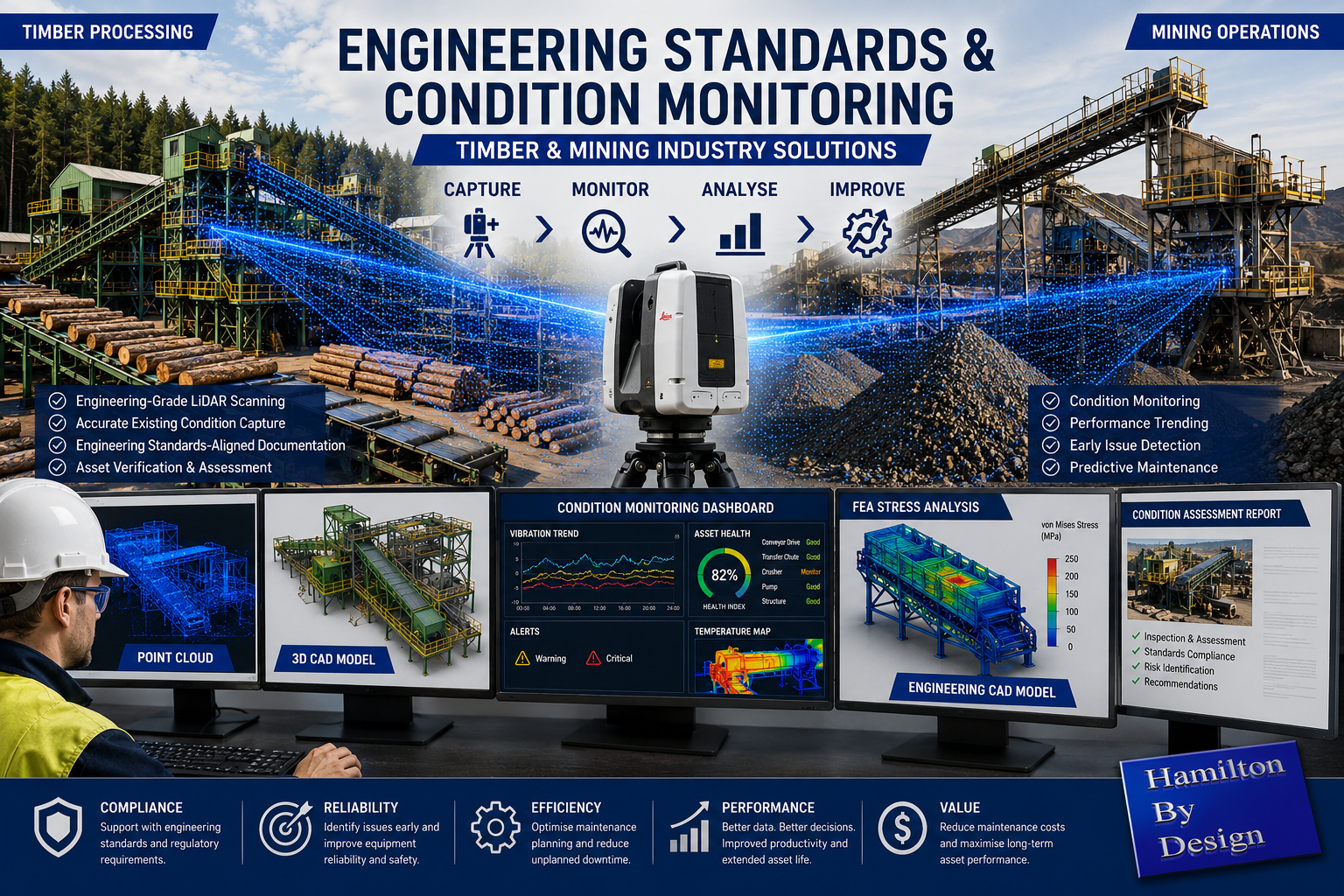
Engineering Standards & Condition Monitoring: Supporting Reliability in Timber and Mining Operations

Engineering-grade LiDAR scanning, condition monitoring, and FEA analysis workflow for timber processing and mining equipment reliability.

Industries such as timber processing and mining operate in demanding environments where equipment reliability directly affects productivity, maintenance costs, and operational performance. Conveyor systems, transfer chutes, rotating equipment, processing machinery, structural assets, and supporting infrastructure are often exposed to continuous loading, wear, vibration, fatigue, and harsh operating conditions.

While machinery failures may appear sudden, many develop gradually through changes in operating conditions, deterioration, or inadequate monitoring and maintenance practices.

Engineering standards and condition monitoring help organisations move from reactive maintenance toward informed engineering decisions and improved asset performance.

At Hamilton By Design, we support mining and timber processing industries through engineering-led approaches that combine engineering standards, digital engineering workflows, reality capture technologies, and practical engineering solutions.

Why Engineering Standards Matter

Engineering standards provide a structured framework for designing, assessing, operating, and maintaining equipment.

Standards help organisations achieve:

  • Improved safety
  • Greater consistency
  • Reduced risk
  • Improved reliability
  • Better maintenance planning
  • Regulatory compliance
  • Improved operational performance

Examples of standards commonly applied within industrial projects may include:

Structural and Mechanical Standards

  • AS 4100 โ€“ Steel structures
  • AS 1170 โ€“ Structural design actions
  • AS 3996 โ€“ Access covers and grates
  • AS 1657 โ€“ Fixed platforms, walkways, stairways and ladders
  • AS 1554 โ€“ Structural welding

Asset and Equipment Considerations

  • Fatigue assessment
  • Structural integrity
  • Mechanical reliability
  • Equipment life assessment
  • Materials handling performance

Engineering standards support more than design compliance. They help establish long-term operational reliability.

What is Condition Monitoring?

Condition monitoring involves collecting information about equipment performance and asset condition to identify potential issues before failures occur.

Rather than waiting for breakdowns, monitoring allows maintenance and engineering teams to make decisions using measurable data.

Condition monitoring can involve:

  • Equipment inspections
  • Structural assessments
  • Wear monitoring
  • Vibration monitoring
  • Alignment assessment
  • Existing condition capture
  • Thermal assessments
  • Trend analysis
  • Performance assessment

The objective is identifying deterioration before operational impacts occur.

Timber Industry Applications

Timber processing facilities operate continuously with significant material handling demands.

Common assets include:

  • Log conveyors
  • Timber handling systems
  • Chippers
  • Screening systems
  • Structural platforms
  • Transfer systems
  • Processing machinery

Typical challenges may include:

  • Equipment wear
  • Misalignment
  • Build-up
  • Fatigue
  • Structural deterioration
  • Conveyor performance issues

Engineering monitoring and assessment can improve:

  • Throughput
  • Reliability
  • Maintenance planning
  • Downtime reduction
  • Equipment life

Mining Industry Applications

Mining operations often involve harsh operating environments and heavy-duty equipment subjected to high loading conditions.

Applications can include:

  • Conveyor systems
  • Transfer chutes
  • Processing plants
  • Crushers
  • Pump systems
  • Structural assets
  • Materials handling systems

Common challenges may include:

  • Wear
  • Fatigue loading
  • Structural movement
  • Equipment deterioration
  • Production interruptions

Condition monitoring allows operational teams to move toward predictive maintenance approaches rather than emergency repairs.

How Hamilton By Design Supports Engineering Standards and Condition Monitoring

Hamilton By Design supports projects through a combination of engineering tools and practical experience.

Our services can include:

Engineering-Grade 3D LiDAR Scanning

Capture accurate existing conditions and generate point cloud information for:

  • Existing plant geometry
  • Structural assessment
  • Brownfield modifications
  • Asset verification
3D CAD Modelling Australia service banner for Hamilton By Design

Scan-to-CAD Workflows

Convert site information into:

  • Editable engineering models
  • Existing condition documentation
  • Engineering drawings

Engineering Analysis and Simulation

Support asset assessments through:

  • Finite Element Analysis (FEA)
  • Structural assessments
  • Load analysis
  • Design validation

Engineering Documentation

Deliver:

  • Drawings
  • Assessment reports
  • Design documentation
  • Asset information
3D LiDAR scanning and 3D modelling service button โ€” laser scanner capturing a point cloud for engineering and CAD modelling
Mechanical engineering services

Supporting Long-Term Asset Performance

Successful operations are not built around simply repairing equipment after failure.

Long-term value often comes from:

  • Improved reliability
  • Reduced maintenance costs
  • Better planning
  • Increased productivity
  • Reduced downtime
  • Improved asset life
  • Better engineering decisions

By combining engineering standards, condition monitoring, digital engineering workflows, and practical engineering solutions, organisations can move beyond assumptions and improve operational performance.

Hamilton By Design supports timber processing and mining industries by helping transform engineering information into practical decisions and measurable outcomes.

Hamilton By Design logo displayed on a blue tilted rectangle with a grey gradient background
Name
Would you like us to arrange a phone consultation for you?
Address

Our Clients:

3D CAD Modelling Australia service banner for Hamilton By Design
Australian Drafting logo featuring bold white text reading "Australian Drafting" centred on a blue rounded rectangle background.
Engineering Governance title graphic featuring bold white text reading "Engineering Governance" centred on a blue rounded rectangle background.
Mechanical, Structural & Pipework Drafting service banner by Hamilton By Design featuring white text on a blue background.
Mechanical engineering services
Blue rounded button with the text โ€œSolidWorks Designโ€ in white.
Finite Element Analysis (FEA) engineering simulation button
3D LiDAR Scanning Darwin for engineering surveys, laser scanning, reality capture and point cloud modelling services
3D LiDAR Scanning Australia engineering services for laser scanning, reality capture, scan-to-CAD, Scan-to-BIM and as-built documentation across Australia
3D LiDAR scanning services on the Central Coast providing engineering-grade laser scanning, point cloud capture, scan-to-CAD modelling and industrial reality capture for infrastructure and industrial projects.
3D LiDAR Scanning Perth for engineering surveys, laser scanning, reality capture and point cloud modelling services
3D LiDAR Scanning Sydney for engineering surveys, laser scanning, reality capture and point cloud modelling services
3D LiDAR Scanning Brisbane for engineering surveys, laser scanning, reality capture and point cloud modelling services
3D LiDAR Scanning Canberra for engineering surveys, laser scanning, reality capture and point cloud modelling services
3D LiDAR Scanning Newcastle for engineering surveys, laser scanning, reality capture and point cloud modelling services
3D LiDAR Scanning Adelaide for engineering surveys, laser scanning, reality capture and point cloud modelling services

Engineer-Led Industrial LiDAR Scanning for Mining and Heavy Industry

Engineer performing industrial LiDAR scanning on an Australian mining plant with point cloud overlay and mechanical CAD modelling workflow

Engineering-Grade LiDAR Scanning Australia | Hamilton By Design

Engineer-Led Industrial LiDAR Scanning Australia | Hamilton By Design

At Hamilton By Design, we believe industrial 3D laser scanning should deliver far more than a visual model or virtual walkthrough. In mining, manufacturing and heavy industrial environments, scanning data must support engineering decisions, fabrication accuracy, shutdown planning and long-term asset management.

Many companies now offer โ€œ3D scanningโ€ services. However, not all scanning systems, workflows or providers are the same. Across Australia, the market has become crowded with companies focused on real estate visualisation, architectural walkthroughs and general BIM modelling. While these services have their place, industrial facilities require a very different level of technical understanding.

Hamilton By Design specialises in engineer-led industrial LiDAR scanning focused on mechanical and structural engineering outcomes.


Why Industrial Facilities Require a Different Approach

Industrial sites are complex environments involving:

  • conveyors,
  • transfer chutes,
  • structural steel,
  • pipework,
  • pump skids,
  • process equipment,
  • access platforms,
  • shutdown works,
  • and brownfield modifications.
3D CAD Modelling Australia service banner for Hamilton By Design

In these environments, inaccurate data can create significant commercial and operational risks.

Poor-quality scanning or incomplete site capture can lead to:

  • fabrication clashes,
  • installation delays,
  • shutdown overruns,
  • rework costs,
  • safety risks,
  • and engineering non-conformance.

Unlike architectural walkthroughs or property visualisation projects, industrial scanning must support measurable engineering outcomes.

This is why Hamilton By Design focuses on:

  • engineering-grade terrestrial LiDAR,
  • scan-to-CAD workflows,
  • controlled engineering documentation,
  • and engineering governance systems.

Engineer-Led Scanning vs General Scanning Services

Owning a scanner does not automatically make a company an engineering specialist.

Many scanning providers focus on:

  • virtual tours,
  • digital walkthroughs,
  • building visualisation,
  • or general BIM deliverables.

Hamilton By Design approaches scanning differently.

Our workflow is driven by:

  • mechanical engineering requirements,
  • structural engineering considerations,
  • fabrication suitability,
  • and industrial project delivery.

We understand:

  • plant shutdown environments,
  • fabrication tolerances,
  • maintenance access requirements,
  • structural modifications,
  • and brownfield installation challenges.

This allows us to deliver scanning outcomes aligned with real engineering applications rather than simply producing point cloud data.


Industrial LiDAR Applications

Our industrial LiDAR scanning services support a wide range of applications across Australia.

Mining and Processing Plants

We assist mining and processing facilities with:

  • conveyor system upgrades,
  • transfer chute modifications,
  • pump station upgrades,
  • SMP projects,
  • slurry transport systems,
  • structural steel modifications,
  • and brownfield plant expansions.

Shutdown Planning

Accurate point cloud capture allows engineering teams to:

  • verify as-built conditions,
  • reduce shutdown uncertainty,
  • improve prefabrication accuracy,
  • and minimise onsite fit-up issues.

Structural and Mechanical Engineering

LiDAR data can support:

  • General Arrangement (GA) drawings,
  • structural modelling,
  • equipment integration,
  • pipe routing,
  • and engineering verification workflows.

Digital Engineering and Asset Management

Our workflows support:

  • scan-to-CAD modelling,
  • controlled revisions,
  • engineering governance,
  • and long-term asset documentation.

Understanding the Different Types of 3D Scanning

Not all scanning technologies are designed for the same purpose.

Terrestrial LiDAR Scanning

Tripod-based terrestrial LiDAR systems are typically best suited for:

  • industrial facilities,
  • mining plants,
  • brownfield environments,
  • and engineering-grade capture.

These systems provide highly controlled and repeatable data suitable for engineering workflows.

Mobile SLAM Scanning

SLAM-based systems can rapidly capture large environments and are useful in some applications. However, depending on the project requirements, these systems may introduce drift or reduced control compared with fixed terrestrial workflows.

Handheld Scanners

Handheld systems are often useful for:

  • smaller components,
  • reverse engineering,
  • and detailed geometry capture.

Virtual Tour Systems

Matterport and walkthrough systems can provide excellent visualisation tools but may not always deliver the level of engineering control required for fabrication or detailed industrial design.

At Hamilton By Design, we work with the technology that best suits the engineering outcome required by the client.

We do not make promises we cannot keep.


Why Engineering Governance Matters

One of the largest risks in industrial projects is poor drawing and document control.

Many organisations continue operating with:

  • outdated PDFs,
  • disconnected revisions,
  • unmanaged redlines,
  • and uncontrolled drawing systems.

Hamilton By Design supports engineering governance through:

  • revision-controlled workflows,
  • issue states such as IFR / IFA / IFC,
  • audit-ready documentation,
  • and structured engineering deliverables.

We also support workflows using:

  • SolidWorks,
  • AutoCAD LT,
  • and the 3DEXPERIENCE platform.

This helps provide a controlled single source of truth for engineering information across the project lifecycle.


Supporting Australian Industry

Hamilton By Design supports clients across Australia including:

  • mining operations,
  • manufacturing facilities,
  • processing plants,
  • infrastructure projects,
  • and heavy industrial sites.

We understand the realities of:

  • remote site access,
  • shutdown windows,
  • operational constraints,
  • and industrial project delivery.

Our focus is not simply collecting scan data.

Our focus is helping clients reduce engineering risk and improve project outcomes.


Industrial Scanning Backed by Engineering Understanding

The value of LiDAR scanning is not only the scanner itself.

The true value comes from:

  • understanding the engineering problem,
  • capturing the correct information,
  • and delivering data that supports real project outcomes.

At Hamilton By Design, our engineer-led approach combines:
  • industrial LiDAR scanning,
  • mechanical engineering understanding,
  • structural engineering workflows,
  • and engineering governance systems.

This allows us to support projects from initial site capture through to engineering documentation and fabrication-ready deliverables.

3D LiDAR scanning and 3D modelling service button โ€” laser scanner capturing a point cloud for engineering and CAD modelling
Mechanical engineering services

Our clients

Contact Hamilton By Design

To discuss industrial LiDAR scanning, scan-to-CAD workflows or engineering support for your next project, contact:
Hamilton By Design

We support mining, manufacturing and industrial clients across Australia with engineer-led reality capture and engineering documentation solutions.

Hamilton By Design logo displayed on a blue tilted rectangle with a grey gradient background

FARO Technologies โ€” Industrial 3D laser scanning, metrology and reality capture hardware/software solutions.

SolidWorks โ€” Professional CAD, simulation and product development platform widely used in mechanical engineering.

Dassault Systรจmes 3DEXPERIENCE Platform โ€” Cloud-based engineering governance, collaboration and product lifecycle management platform.

3D CAD Modelling Australia service banner for Hamilton By Design
Australian Drafting logo featuring bold white text reading "Australian Drafting" centred on a blue rounded rectangle background.
Engineering Governance title graphic featuring bold white text reading "Engineering Governance" centred on a blue rounded rectangle background.
Mechanical, Structural & Pipework Drafting service banner by Hamilton By Design featuring white text on a blue background.
Mechanical engineering services
Blue rounded button with the text โ€œSolidWorks Designโ€ in white.
Finite Element Analysis (FEA) engineering simulation button
3D LiDAR Scanning Darwin for engineering surveys, laser scanning, reality capture and point cloud modelling services
3D LiDAR Scanning Australia engineering services for laser scanning, reality capture, scan-to-CAD, Scan-to-BIM and as-built documentation across Australia
3D LiDAR scanning services on the Central Coast providing engineering-grade laser scanning, point cloud capture, scan-to-CAD modelling and industrial reality capture for infrastructure and industrial projects.
3D LiDAR Scanning Perth for engineering surveys, laser scanning, reality capture and point cloud modelling services
3D LiDAR Scanning Sydney for engineering surveys, laser scanning, reality capture and point cloud modelling services
3D LiDAR Scanning Brisbane for engineering surveys, laser scanning, reality capture and point cloud modelling services
3D LiDAR Scanning Canberra for engineering surveys, laser scanning, reality capture and point cloud modelling services
3D LiDAR Scanning Newcastle for engineering surveys, laser scanning, reality capture and point cloud modelling services
3D LiDAR Scanning Adelaide for engineering surveys, laser scanning, reality capture and point cloud modelling services

Brownfield Industrial Upgrades

LiDAR scanner capturing an operating industrial plant for brownfield industrial upgrade engineering and CAD modelling

Engineering-Led Design, Reality Capture, and Scan-to-CAD for Existing Assets

Brownfield industrial upgrades are where engineering risk is highest โ€” and where assumptions cost the most.

Existing plant, undocumented modifications, restricted access, and shutdown-driven timeframes demand accurate site data, practical engineering judgement, and build-ready design. At Hamilton By Design, we support brownfield upgrades through an engineering-led digital workflow that connects reality capture, scan-to-CAD, and mechanical design to deliver safer, more reliable shutdown outcomes.


3D LiDAR scanning and 3D modelling service button โ€” laser scanner capturing a point cloud for engineering and CAD modelling
Mechanical engineering services

What Defines a Brownfield Upgrade?

A brownfield upgrade involves modifying, extending, or replacing existing operational assets, often under live plant or shutdown constraints.

Typical challenges include:

  • Incomplete or outdated drawings
  • Limited physical access for verification
  • Interfaces with existing structures and services
  • Shutdown windows measured in days, not weeks

These conditions make engineering-led verification essential before design and fabrication begin.


Engineering-Led Reality Capture for Existing Plant

Hamilton By Design uses engineering-grade 3D LiDAR scanning to capture existing conditions accurately, even in complex and congested environments.

This approach allows engineering teams to:

  • Verify as-built conditions without repeated site access
  • Identify clashes and interferences early
  • Design upgrades that fit first time
  • Reduce exposure hours in live plant environments

Reality capture becomes a risk-reduction tool, not just a documentation exercise.


Typical Brownfield Assets We Support

Brownfield upgrades frequently focus on high-wear, high-risk interfaces within industrial and mining facilities.

Hoppers & Chutes

  • ROM hoppers and surge bins
  • Transfer chutes and discharge transitions
  • Wear-prone interfaces and liners

Conveyors & Transfer Stations

  • Conveyor head and tail stations
  • Transfer points and discharge zones
  • Supporting steelwork and access structures

Pump Boxes & Process Interfaces

  • Pump boxes, sumps, and pipe interfaces
  • Structural supports and maintenance access
  • Integration with existing plant services

Vertical Shaft & Drop Structures

  • Vertical shaft hoppers
  • Ore passes and gravity-fed transfers
  • Confined and difficult-to-access assets

These assets are rarely isolated โ€” they sit within tightly constrained systems where accuracy matters.


3D CAD Modelling Australia service banner for Hamilton By Design

Scan-to-CAD: Turning Reality Into Buildable Design

Point clouds alone donโ€™t deliver projects โ€” engineering-intent models do.

Our scan-to-CAD workflows are developed specifically for:

  • Mechanical and structural design
  • Fabrication-ready detailing
  • Brownfield integration and installation sequencing

By aligning LiDAR data directly with CAD and engineering workflows, we eliminate guesswork and support fit-first-time fabrication.


Reliable Support for Shutdown-Driven Projects

Shutdowns compress months of work into days. There is no tolerance for redesign on site.

Engineering-led reality capture supports shutdown success by:

  • Allowing design to be completed well in advance
  • Supporting off-site fabrication
  • Reducing RFIs and site queries
  • Increasing the amount of work completed per shutdown

Better information means more work done with fewer resources.


Safety Is an Engineering Outcome

Safety outcomes in brownfield environments are determined during planning and design, not during installation.

Accurate site data allows engineers to:

  • Design safer access and maintenance solutions
  • Reduce hot works and re-measurement on site
  • Identify hazards before shutdown execution
  • Improve compliance with Australian Standards

Engineering-led workflows reduce risk across the entire upgrade lifecycle.


Australian Engineering Quality You Can Rely On

Hamilton By Design delivers Australian engineering know-how, grounded in practical site experience.

We donโ€™t just capture data โ€” we:

  • Understand how plant is built and maintained
  • Design with fabrication and installation in mind
  • Take responsibility for engineering outcomes

This approach differentiates us from low-cost capture services that transfer risk downstream.


How This Integrates With Our Engineering Services

Brownfield upgrade support integrates directly with our broader capabilities, including:

  • Bulk material handling engineering
  • Mining and heavy-industry mechanical design
  • Engineering-led 3D scanning and scan-to-CAD workflows

This ensures continuity from site verification through to build-ready deliverables.


Speak With an Engineer

If youโ€™re planning a brownfield upgrade involving:

  • Hoppers, chutes, or bins
  • Conveyor transfers
  • Pump boxes or process interfaces
  • Vertical shaft or gravity-fed systems
  • Shutdown-critical works

Early engineering-led verification can significantly reduce risk.

๐Ÿ‘‰ Speak with an engineer at Hamilton By Design to discuss your upgrade or shutdown requirements.

Contact Us – Talk to Us

Name
Would you like us to arrange a phone consultation for you?
Address
Hamilton By Design logo displayed on a blue tilted rectangle with a grey gradient background
CHPP Engineering title graphic featuring bold white text reading "CHPP Engineering" centred on a blue rounded rectangle background.
Pipework Drafting title graphic featuring bold white text reading "Pipework Drafting" centred on a blue rounded rectangle background.
3D LiDAR Scanning for Engineering Projects title graphic featuring bold white text on a blue rounded rectangle background.
Finite Element Analysis (FEA) engineering simulation button
Mechanical engineering services

Mechanical Engineering | Structural Engineering


Brownfield Project Management

Brownfield industrial plant point cloud compared to clean Navisworks model showing real-world conditions versus design coordination

The Reality of Brownfield Development – Brownfield Project Management: Why Point Cloud Data Should Not Be Managed in Navisworks

Brownfield projects are not clean, linear, or model-driven.

They are:

  • Reactive
  • Incremental
  • Constrained by existing infrastructure
  • Driven by time, cost, and operational pressure

In this environment, the idea of maintaining a fully coordinated 3D model is often unrealistic.

A simple example illustrates this:

An electrician installs an additional power point on site. The work is completed, energised, and signed off. The drawings may be updated later โ€” the model almost never is.

This is not a failure of process โ€” it is the reality of brownfield operations.


3D LiDAR scanning and 3D modelling service button โ€” laser scanner capturing a point cloud for engineering and CAD modelling
Mechanical engineering services

Engineering Reality: From Sketch to CAD

Before anything becomes a 3D model, it starts much simpler.

As engineers, we still:

  • Sketch ideas
  • Mark up drawings
  • Discuss constraints on site

Only after this thinking process do concepts become CAD models.

This reinforces a key principle:

Engineering decisions are not driven by software โ€” software supports engineering judgement.


The Problem with Model-Centric Workflows

Platforms such as Autodesk Navisworks Manage are often positioned as central coordination tools, and in the right context they are highly effective.

However, in brownfield environments they introduce challenges:

Model Drift

  • Models quickly become outdated
  • Site changes are rarely captured in real time

High Maintenance Cost

  • Continuous updates require time and budget
  • Maintenance of models is rarely prioritised operationally

Limited Long-Term Trust

  • Teams revert back to:
    • Drawings
    • Site verification
    • Experience

The result is that the model becomes a temporary tool rather than a reliable long-term asset.


Where Multi-Discipline Coordination Actually Matters

Navisworks is most powerful when used for:

  • Multi-discipline coordination
  • Clash detection
  • Design validation

This is critical in greenfield environments where:

  • Structural, mechanical, electrical, and civil systems are designed simultaneously
  • Multiple teams work in parallel
  • Design clashes must be resolved before construction

In these cases, Navisworks plays a vital role in reducing risk and improving delivery outcomes.


Brownfield Reality: Coordination Happens on Site

In brownfield environments, the situation is very different.

Work is typically:

  • Localised
  • Task-specific
  • Carried out in isolation

Constraints are:

  • Already physically present
  • Visible and measurable
  • Managed in real time on site

In many cases:

Multi-discipline coordination is minimal or already resolved physically.

For example, an electrician installing a new outlet:

  • Reviews the environment
  • Works around existing services
  • Completes the installation

There is no model update, no coordination session, and no Navisworks workflow involved.


Point Cloud Data: The True As-Built Record

Using platforms such as FARO SCENE, point cloud data provides:

  • A direct capture of real-world conditions
  • A measurable and verifiable dataset
  • A snapshot of the plant at a point in time

Unlike models, point clouds are not interpretations โ€” they are records of reality.


3D CAD Modelling Australia service banner for Hamilton By Design

Critical Limitation: Line-of-Sight

Point cloud data is inherently line-of-sight dependent.

This means:

  • Only visible surfaces are captured
  • Occlusions create gaps in the dataset

When navigating a point cloud โ€” whether in SCENE or Navisworks โ€” moving outside original scan positions reveals these gaps.

Importantly:

  • This is not a software limitation
  • It is a fundamental characteristic of LiDAR capture

Creating a Navisworks model from a point cloud does not resolve this issue. It simply introduces another layer of processing without improving data completeness.


Why Navisworks Adds Limited Value for Point Cloud Management

If the objective is:

  • Visualisation
  • Measurement
  • Inspection

Then native scan platforms already provide these capabilities.

Within SCENE, users can:

  • Navigate freely
  • Measure accurately
  • Clip and section data
  • Access models using free viewer tools

Introducing Navisworks adds:

  • Additional processing steps
  • Data conversion (e.g. E57 to RCP)
  • Larger and duplicated datasets
  • No improvement in scan accuracy or completeness

Navisworks does not remove line-of-sight limitations, does not fill missing data, and does not enhance the underlying scan.


Best Practice: Brownfield Data Strategy

A more practical and effective approach is:

1. Point Cloud as the Primary Asset

  • Maintain original scan data (e.g. E57)
  • Store registered datasets
  • Use native platforms for access and interrogation

2. Targeted Modelling Only Where Required

  • Model critical interfaces and tie-in points
  • Avoid full plant modelling unless necessary

3. Drawings for Formal Deliverables

  • Maintain as-built documentation
  • Use redlines where appropriate

4. Navisworks for Project Phases Only

  • Apply Navisworks during major upgrades or greenfield-style coordination
  • Do not rely on it as a long-term data environment

Key Project Management Insight

Models degrade over time in brownfield environments.

Point cloud data remains a verifiable record of reality.


Conclusion

Navisworks remains a powerful tool for coordination and design validation, particularly in greenfield projects where multi-discipline interaction is high.

However, for brownfield project management:

  • Point clouds provide truth
  • Drawings provide documentation
  • Navisworks provides temporary coordination

If the objective is to visualise, measure, and understand existing conditions, managing point cloud data within native scanning platforms is more efficient, more accurate, and more sustainable than relying on Navisworks models.


One-Line Summary

In brownfield projects, the scan is the asset โ€” the model is only a moment in time.


CHPP Engineering title graphic featuring bold white text reading "CHPP Engineering" centred on a blue rounded rectangle background.
Pipework Drafting title graphic featuring bold white text reading "Pipework Drafting" centred on a blue rounded rectangle background.
3D LiDAR Scanning for Engineering Projects title graphic featuring bold white text on a blue rounded rectangle background.

Our clients

Contact Us – Talk to Us

Name
Would you like us to arrange a phone consultation for you?
Address