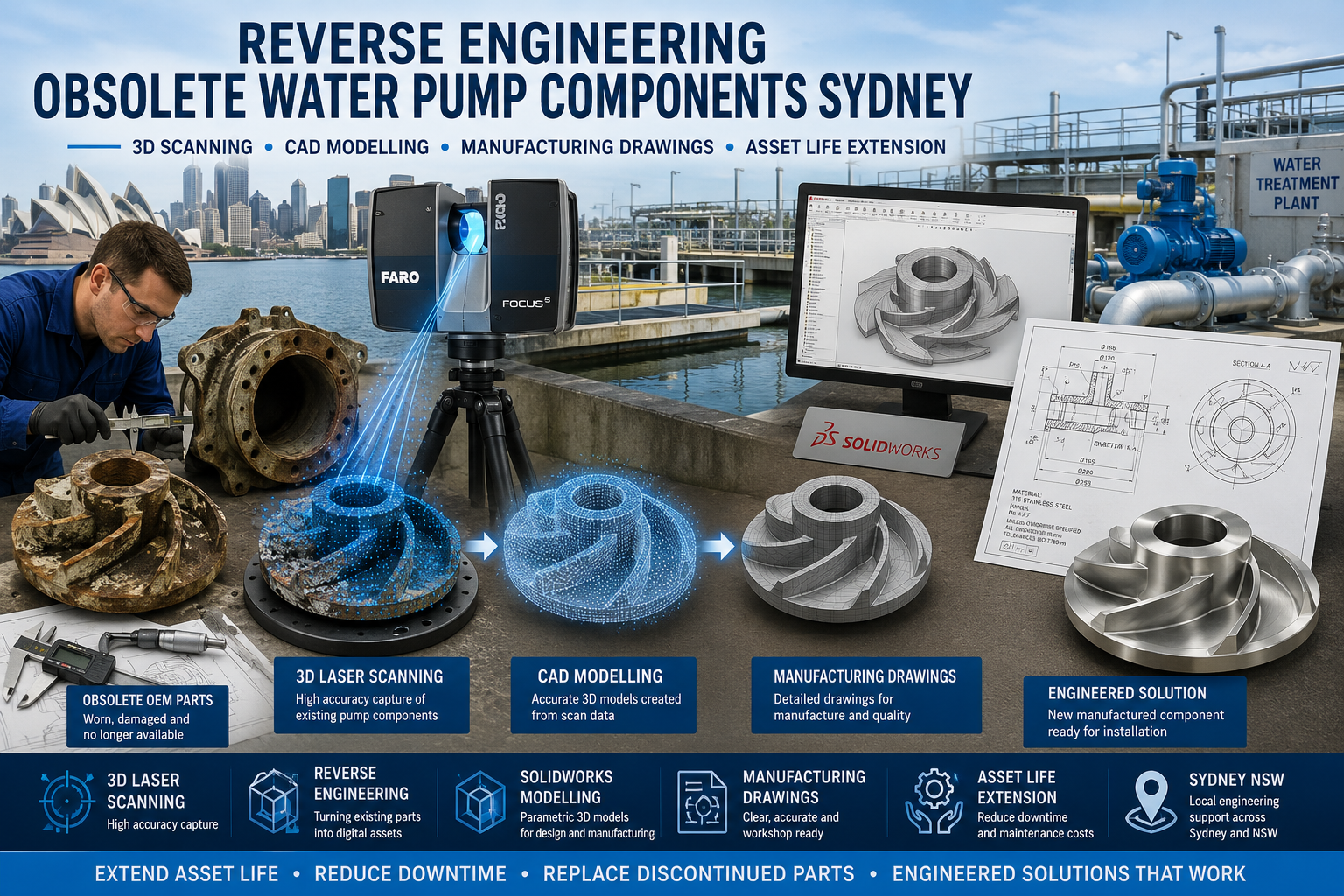
Reverse Engineering Obsolete Water Pump Components Sydney

Reverse engineering obsolete water pump components in Sydney using 3D laser scanning, SolidWorks CAD modelling and manufacturing drawings to replace discontinued OEM pump parts for water infrastructure and industrial facilities.

Reverse Engineering Obsolete Water Pump Components Sydney
Hamilton By Design provides reverse engineering services for obsolete water pump components in Sydney NSW, helping water utilities, maintenance teams, manufacturers, asset owners and engineering contractors replace discontinued OEM pump parts when drawings, models or supplier support are no longer available. We inspect, measure, scan and model existing pump components to create accurate CAD files, manufacturing drawings and engineering documentation suitable for repair, replacement, refurbishment or local manufacture.

Reverse Engineering for Obsolete Pump Components in Sydney NSW

Water pump assets often remain in service for decades. Over time, OEM parts can become unavailable, lead times can increase, suppliers may discontinue product lines, and replacement costs can become difficult to justify. For councils, water treatment plants, pumping stations, industrial facilities and infrastructure operators, this can create serious maintenance and operational risks.

Hamilton By Design supports Sydney-based clients by reverse engineering worn, damaged or obsolete water pump components so they can be reproduced, repaired or improved. This includes pump casings, impellers, shafts, sleeves, bushes, bearing housings, covers, flanges, couplings, wear rings, brackets and other mechanical pump components.

Our work combines practical trade experience, mechanical engineering knowledge, 3D scanning, CAD modelling and detailed drafting. The result is clear, usable documentation that can support fabrication, machining, casting, repair, procurement and asset maintenance.

Who We Help

We provide reverse engineering and engineering drafting services for clients across Sydney NSW and surrounding regions, including:

Water treatment plants
Wastewater facilities
Council pumping stations
Industrial water systems
Utilities and infrastructure operators
Manufacturing plants
Mining and mineral processing facilities
Ports and marine infrastructure
Mechanical contractors
Maintenance teams
Fabricators and machine shops
Pump repair workshops
Asset owners with discontinued OEM equipment

We also support projects in Newcastle, the Hunter Valley, Brisbane, Perth, Melbourne, regional NSW and across Australia where pump components or mechanical assets need to be measured, modelled and documented.

Why Reverse Engineer Obsolete Water Pump Components?

Reverse engineering is useful when an existing component is required but original design information is missing or unreliable. Many older water pump assets were installed years ago, and drawings may no longer exist, may be incomplete, or may not reflect changes made during maintenance.

Reverse engineering can help when:

OEM parts are discontinued
OEM lead times are too long
Replacement parts are too expensive
The original drawings are missing
The part has been modified over time
A casting pattern is no longer available
A pump needs to remain operational
A local manufacturing option is required
The component needs to be improved or strengthened
A damaged part needs to be reproduced urgently

For water infrastructure, downtime can be costly. Reverse engineering allows asset owners to extend the life of critical pump equipment while maintaining control over documentation, repair options and future spare parts.

Typical Pump Components We Reverse Engineer

Hamilton By Design can reverse engineer a wide range of pump and rotating equipment components, including:

Impellers
Pump casings
Bearing housings
Shafts
Shaft sleeves
Wear rings
Bushes
Couplings
Drive components
Flanges
Covers and guards
Mounting brackets
Split casings
Casting components
Machined components
Replacement OEM-style parts
Obsolete water pump components
Custom repair components

Where required, we can also document finished machining details, keyways, fits, tolerances, material notes, surface finish requirements and general arrangement information.

Technical Capability

Our reverse engineering workflow combines physical inspection, 3D measurement, laser scanning and CAD modelling. Depending on the component and project requirements, we can use:

FARO 3D laser scanning
FARO SCENE point cloud processing
Autodesk ReCap RCP and RCS workflows
E57 point cloud export
SolidWorks 3D modelling
Autodesk Inventor modelling
AutoCAD 2D drafting
STEP, SAT and Parasolid file creation
DWG and PDF manufacturing drawings
Engineering review and practical design input

For complex geometry such as cast pump casings or impellers, 3D scanning helps capture the external shape of the component. For machined features, manual measurement and engineering judgement are often required to define functional dimensions, tolerances and fits.

The goal is not just to copy the damaged part. The goal is to understand how the part functions, what surfaces are critical, what features are worn, and what information is required to manufacture or repair the part correctly.

Standards and Engineering Considerations

Depending on the project, documentation may reference relevant Australian Standards, client specifications, machining standards or general engineering practices. Reverse engineering pump components may involve consideration of:

Material selection
Corrosion resistance
Machining allowances
Casting allowances
Fits and tolerances
Surface finish
Weld repair requirements
Fastener details
Bearing and bush fits
Shaft alignment
Clearances
Operating environment
Maintenance access
Asset life extension
Fabrication and machining practicality

For water and wastewater applications, material selection is important. Stainless steel, duplex stainless, cast iron, bronze, polymer composites and engineered coatings may all be considered depending on the service environment and client requirements.

Our Reverse Engineering Process

1. Initial Review

We begin by reviewing the component, photos, existing drawings, site information and the reason the part needs to be reverse engineered. This helps determine whether the outcome should be a like-for-like replacement, a repair drawing, a manufacturing drawing, a 3D model, or an upgraded engineering solution.

2. Site Inspection or Component Measurement

The component can be measured on site in Sydney or inspected at a workshop. For larger pump assemblies or installed equipment, site scanning may be used to capture the surrounding equipment, pipework, access restrictions and interface points.

3. 3D Scanning and Manual Measurement

Where suitable, we use 3D scanning to capture the component geometry. Manual measurement is then used to confirm critical features such as bores, shaft diameters, bolt patterns, keyways, bearing fits, flange faces and machined surfaces.

4. Point Cloud Processing

Scan data is processed into usable formats such as E57, RCP or RCS. The point cloud can then be used as the reference geometry for CAD modelling, comparison and documentation.

5. CAD Modelling

The component is modelled in SolidWorks, Inventor or another suitable CAD platform. For cast or organic shapes, the model may include a practical representation of the geometry suitable for manufacturing, machining, fabrication or pattern development.

6. Engineering Review

We review the model for function, fit, interfaces and manufacturing practicality. Where a component is worn or damaged, engineering judgement may be required to identify original design intent rather than simply copying worn geometry.

7. Drawing and Documentation

Manufacturing drawings are produced showing the required dimensions, notes, tolerances, materials and machining information. Drawings can be supplied as PDF and DWG files, with 3D models supplied in SolidWorks, STEP, SAT or Parasolid formats.

8. Client Review and Final Issue

The drawing package is issued for client review. Where required, changes can be made based on additional photos, site checks, workshop feedback or manufacturing requirements.

Deliverables

Depending on the scope of work, clients may receive:

3D scan files
E57 point cloud files
RCP or RCS files
SolidWorks 3D models
Inventor 3D models
STEP files
SAT files
Parasolid files
DWG drawings
DXF profiles
PDF manufacturing drawings
General arrangement drawings
Machining drawings
Casting reference models
Inspection notes
Reverse engineering report
Critical dimension summaries
Material and finish notes
Assembly interface documentation

Not every project requires every deliverable. For some clients, a simple manufacturing drawing is sufficient. For others, a full 3D model, scan file, assembly drawing and engineering report may be required.

Why Choose Hamilton By Design?

Hamilton By Design brings together hands-on trade experience, mechanical design capability and engineering drafting expertise. Our background includes fitting and turning, CNC machining, fabrication, 3D CAD modelling, site measurement, mechanical engineering and industrial asset documentation.

We understand that reverse engineering is not only a drafting task. It requires practical knowledge of how parts are made, how they fit, how they wear and how they are repaired. This is especially important for pump components where worn surfaces, damaged castings, corrosion and missing information can affect the final outcome.

Our experience includes work across water, mining, ports, manufacturing, infrastructure, industrial plants and utilities. We use modern 3D scanning and CAD tools while applying practical engineering judgement to deliver documentation that fabricators, machinists and asset owners can actually use.

Hamilton By Design also provides related engineering and digital measurement services, including:

Scan to CAD Services
Scan to BIM Services
Mechanical Engineering Services
Reverse Engineering Services
3D LiDAR Scanning
Engineering Drafting
Structural Drafting
SolidWorks Modelling
As-Built Documentation
Industrial Site Measurement

Suggested internal links:

Reverse Engineering Services: /reverse-engineering/
Scan to CAD Services: /scan-to-cad/
Scan to BIM Services: /scan-to-bim/
Mechanical Engineering Services: /mechanical-engineering-services/
3D LiDAR Scanning: /3d-lidar-scanning/
Engineering Drafting Sydney: /engineering-services-sydney/

Frequently Asked Questions

Can you reverse engineer obsolete water pump parts without drawings?

Yes. We can measure, scan and model existing pump components even when original drawings are unavailable. Where parts are worn or damaged, we use engineering judgement to help determine the likely original geometry.

Do you provide reverse engineering services in Sydney NSW?

Yes. Hamilton By Design provides reverse engineering services across Sydney NSW, including water plants, industrial sites, workshops, pumping stations and infrastructure facilities.

What pump components can you reverse engineer?

We can reverse engineer pump casings, impellers, shafts, bushes, sleeves, covers, bearing housings, wear rings, brackets, flanges, couplings and other mechanical pump components.

Can you help replace discontinued OEM pump parts?

Yes. We can create CAD models and manufacturing drawings for discontinued OEM-style parts where original parts are no longer available or have long lead times.

Do you provide manufacturing drawings?

Yes. We can provide PDF and DWG drawings with dimensions, notes, materials, tolerances and machining details suitable for review by fabricators, machinists or repair workshops.

Can you scan large pump assemblies on site?

Yes. Larger pump assemblies, installed equipment and surrounding pipework can be scanned on site where required. This is useful when interface points, access constraints or as-built conditions need to be captured.

What file formats can you supply?

Typical file formats include E57, RCP, RCS, DWG, DXF, PDF, SolidWorks, STEP, SAT and Parasolid files.

Can you improve a component instead of copying it exactly?

Yes. Where required, we can review the component and suggest practical improvements relating to material, machining, fit, access, maintenance or durability. Any design changes should be reviewed and approved before manufacture.

Is reverse engineering suitable for urgent pump repairs?

Yes. Reverse engineering can be useful when a critical pump part has failed and OEM lead times are too long. The timeframe depends on the complexity of the part and the level of documentation required.

Do you work with pump repair workshops and machine shops?

Yes. We regularly support workshops, fabricators, machinists, maintenance contractors and asset owners with practical CAD models and drawings for repair, replacement and manufacturing work.

Hamilton By Design logo displayed on a blue tilted rectangle with a grey gradient background

Reverse Engineering Obsolete Water Pump Components in Sydney

Hamilton By Design helps Sydney water, wastewater, industrial and infrastructure clients extend the life of ageing pump assets by reverse engineering obsolete and discontinued components. We combine 3D scanning, manual measurement, CAD modelling, engineering drafting and practical mechanical experience to produce usable documentation for repair, replacement and manufacture.

If your water pump component is no longer available, has a long OEM lead time or needs to be reproduced from an existing part, Hamilton By Design can help create the CAD files, drawings and engineering documentation required to move the project forward.

Talk to Us – Contact Us

Name
Would you like us to arrange a phone consultation for you?
Address

Our clients:


Engineering Standards & Condition Monitoring: Supporting Reliability in Timber and Mining Operations

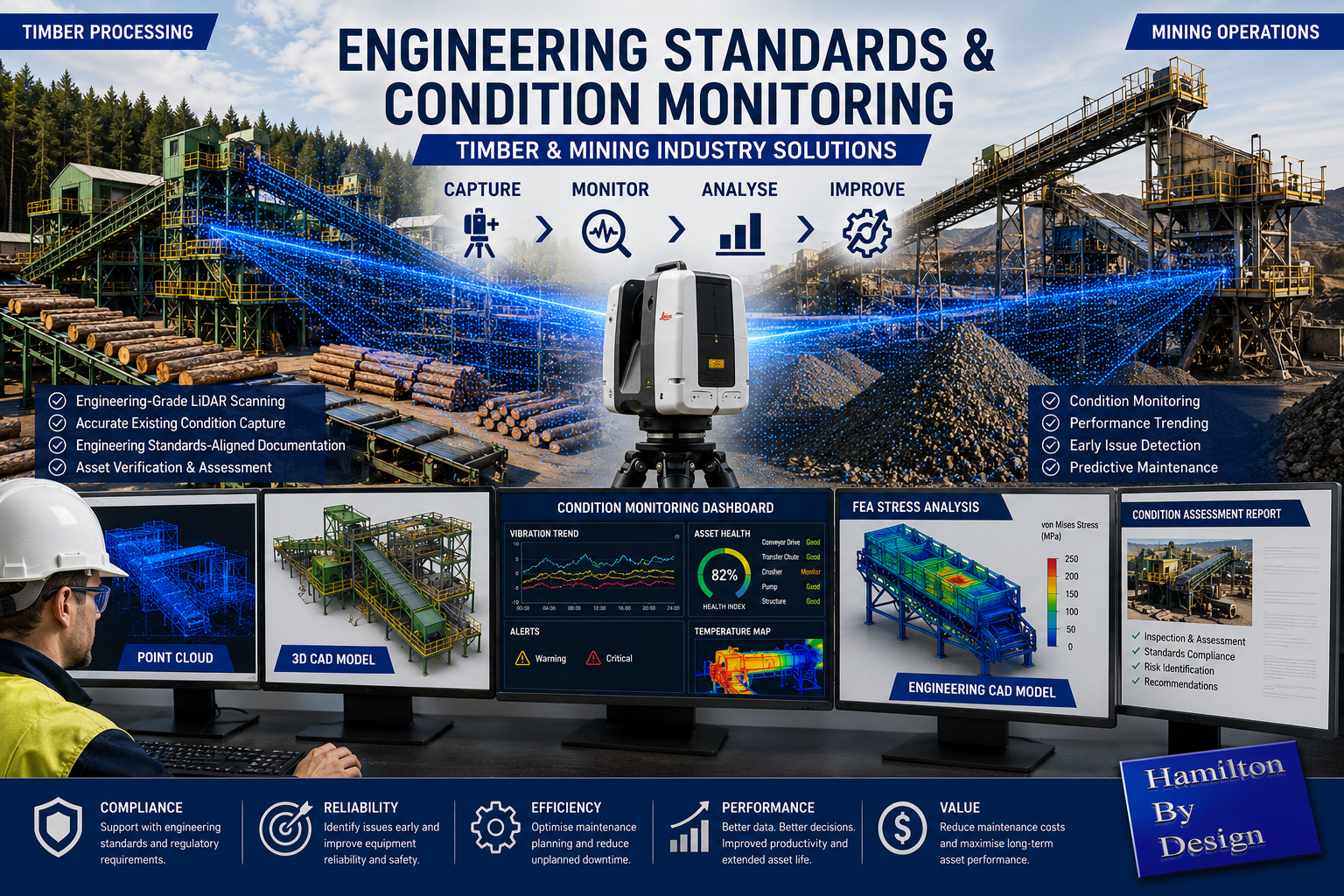
Engineering-grade LiDAR scanning, condition monitoring, and FEA analysis workflow for timber processing and mining equipment reliability.

Industries such as timber processing and mining operate in demanding environments where equipment reliability directly affects productivity, maintenance costs, and operational performance. Conveyor systems, transfer chutes, rotating equipment, processing machinery, structural assets, and supporting infrastructure are often exposed to continuous loading, wear, vibration, fatigue, and harsh operating conditions.

While machinery failures may appear sudden, many develop gradually through changes in operating conditions, deterioration, or inadequate monitoring and maintenance practices.

Engineering standards and condition monitoring help organisations move from reactive maintenance toward informed engineering decisions and improved asset performance.

At Hamilton By Design, we support mining and timber processing industries through engineering-led approaches that combine engineering standards, digital engineering workflows, reality capture technologies, and practical engineering solutions.

Why Engineering Standards Matter

Engineering standards provide a structured framework for designing, assessing, operating, and maintaining equipment.

Standards help organisations achieve:

  • Improved safety
  • Greater consistency
  • Reduced risk
  • Improved reliability
  • Better maintenance planning
  • Regulatory compliance
  • Improved operational performance

Examples of standards commonly applied within industrial projects may include:

Structural and Mechanical Standards

  • AS 4100 โ€“ Steel structures
  • AS 1170 โ€“ Structural design actions
  • AS 3996 โ€“ Access covers and grates
  • AS 1657 โ€“ Fixed platforms, walkways, stairways and ladders
  • AS 1554 โ€“ Structural welding

Asset and Equipment Considerations

  • Fatigue assessment
  • Structural integrity
  • Mechanical reliability
  • Equipment life assessment
  • Materials handling performance

Engineering standards support more than design compliance. They help establish long-term operational reliability.

What is Condition Monitoring?

Condition monitoring involves collecting information about equipment performance and asset condition to identify potential issues before failures occur.

Rather than waiting for breakdowns, monitoring allows maintenance and engineering teams to make decisions using measurable data.

Condition monitoring can involve:

  • Equipment inspections
  • Structural assessments
  • Wear monitoring
  • Vibration monitoring
  • Alignment assessment
  • Existing condition capture
  • Thermal assessments
  • Trend analysis
  • Performance assessment

The objective is identifying deterioration before operational impacts occur.

Timber Industry Applications

Timber processing facilities operate continuously with significant material handling demands.

Common assets include:

  • Log conveyors
  • Timber handling systems
  • Chippers
  • Screening systems
  • Structural platforms
  • Transfer systems
  • Processing machinery

Typical challenges may include:

  • Equipment wear
  • Misalignment
  • Build-up
  • Fatigue
  • Structural deterioration
  • Conveyor performance issues

Engineering monitoring and assessment can improve:

  • Throughput
  • Reliability
  • Maintenance planning
  • Downtime reduction
  • Equipment life

Mining Industry Applications

Mining operations often involve harsh operating environments and heavy-duty equipment subjected to high loading conditions.

Applications can include:

  • Conveyor systems
  • Transfer chutes
  • Processing plants
  • Crushers
  • Pump systems
  • Structural assets
  • Materials handling systems

Common challenges may include:

  • Wear
  • Fatigue loading
  • Structural movement
  • Equipment deterioration
  • Production interruptions

Condition monitoring allows operational teams to move toward predictive maintenance approaches rather than emergency repairs.

How Hamilton By Design Supports Engineering Standards and Condition Monitoring

Hamilton By Design supports projects through a combination of engineering tools and practical experience.

Our services can include:

Engineering-Grade 3D LiDAR Scanning

Capture accurate existing conditions and generate point cloud information for:

  • Existing plant geometry
  • Structural assessment
  • Brownfield modifications
  • Asset verification
3D CAD Modelling Australia service banner for Hamilton By Design

Scan-to-CAD Workflows

Convert site information into:

  • Editable engineering models
  • Existing condition documentation
  • Engineering drawings

Engineering Analysis and Simulation

Support asset assessments through:

  • Finite Element Analysis (FEA)
  • Structural assessments
  • Load analysis
  • Design validation

Engineering Documentation

Deliver:

  • Drawings
  • Assessment reports
  • Design documentation
  • Asset information
3D LiDAR scanning and 3D modelling service button โ€” laser scanner capturing a point cloud for engineering and CAD modelling
Mechanical engineering services

Supporting Long-Term Asset Performance

Successful operations are not built around simply repairing equipment after failure.

Long-term value often comes from:

  • Improved reliability
  • Reduced maintenance costs
  • Better planning
  • Increased productivity
  • Reduced downtime
  • Improved asset life
  • Better engineering decisions

By combining engineering standards, condition monitoring, digital engineering workflows, and practical engineering solutions, organisations can move beyond assumptions and improve operational performance.

Hamilton By Design supports timber processing and mining industries by helping transform engineering information into practical decisions and measurable outcomes.

Hamilton By Design logo displayed on a blue tilted rectangle with a grey gradient background
Name
Would you like us to arrange a phone consultation for you?
Address

Our Clients:

3D CAD Modelling Australia service banner for Hamilton By Design
Australian Drafting logo featuring bold white text reading "Australian Drafting" centred on a blue rounded rectangle background.
Engineering Governance title graphic featuring bold white text reading "Engineering Governance" centred on a blue rounded rectangle background.
Mechanical, Structural & Pipework Drafting service banner by Hamilton By Design featuring white text on a blue background.
Mechanical engineering services
Blue rounded button with the text โ€œSolidWorks Designโ€ in white.
Finite Element Analysis (FEA) engineering simulation button
3D LiDAR Scanning Darwin for engineering surveys, laser scanning, reality capture and point cloud modelling services
3D LiDAR Scanning Australia engineering services for laser scanning, reality capture, scan-to-CAD, Scan-to-BIM and as-built documentation across Australia
3D LiDAR scanning services on the Central Coast providing engineering-grade laser scanning, point cloud capture, scan-to-CAD modelling and industrial reality capture for infrastructure and industrial projects.
3D LiDAR Scanning Perth for engineering surveys, laser scanning, reality capture and point cloud modelling services
3D LiDAR Scanning Sydney for engineering surveys, laser scanning, reality capture and point cloud modelling services
3D LiDAR Scanning Brisbane for engineering surveys, laser scanning, reality capture and point cloud modelling services
3D LiDAR Scanning Canberra for engineering surveys, laser scanning, reality capture and point cloud modelling services
3D LiDAR Scanning Newcastle for engineering surveys, laser scanning, reality capture and point cloud modelling services
3D LiDAR Scanning Adelaide for engineering surveys, laser scanning, reality capture and point cloud modelling services

Forestry Industry & Timber Processing: Engineering Machinery for Productivity and Long-Term Value

Engineering-grade LiDAR scanning and FEA simulation workflow for forestry and timber processing equipment design.

The forestry and timber processing industries operate in demanding environments where productivity, reliability, and equipment performance directly influence profitability. Whether processing logs, handling timber products, operating sawmills, or managing materials handling systems, machinery downtime and inefficiencies can significantly affect production output and operating costs.

Modern engineering is moving beyond traditional design approaches and increasingly using digital engineering tools to optimise equipment before fabrication and installation begins.

At Hamilton By Design, we combine engineering-grade 3D LiDAR scanning, 3D modelling, and Finite Element Analysis (FEA) to support forestry and timber processing operations by delivering machinery and engineered systems designed for productivity, reliability, and long-term return on investment.

Designing for More Than Initial Cost

The lowest purchase price does not always provide the lowest operating cost.

Machinery and processing systems can incur substantial ongoing costs through:

  • Excessive wear
  • Unplanned maintenance
  • Downtime
  • Energy consumption
  • Material build-up
  • Inefficient layouts
  • Reduced production capacity
  • Premature equipment failure

Engineering decisions made during the design stage can influence the total lifecycle cost of equipment for many years after installation.

The objective is not simply designing machinery that works.

The objective is designing machinery that continues to perform efficiently throughout its operational life.

Engineering-Grade 3D LiDAR Scanning

For existing timber processing plants and brownfield facilities, one of the biggest challenges is understanding current conditions accurately.

Many facilities contain:

  • Existing conveyors
  • Timber processing machinery
  • Structural steel
  • Pipework
  • Platforms and access systems
  • Building constraints
  • Historical modifications

Outdated drawings or manual measurements can introduce risk into engineering projects.

Hamilton By Design uses engineering-grade 3D LiDAR scanning to capture accurate existing conditions and generate high-quality point cloud data.

This provides:
  • Accurate plant geometry
  • Existing condition verification
  • Reduced design assumptions
  • Improved fit-up accuracy
  • Reduced installation risk
  • Faster project development

Rather than designing around assumptions, engineering decisions can be based on actual site information.

3D Modelling for Better Project Outcomes

Once site information has been captured, point cloud data can be converted into editable engineering models.

3D CAD Modelling Australia service banner for Hamilton By Design

3D modelling provides benefits including:
  • Improved visualisation
  • Clash detection
  • Layout optimisation
  • Equipment integration
  • Fabrication planning
  • Improved communication

For forestry and timber processing projects this may include:

  • Log handling systems
  • Conveyors
  • Transfer systems
  • Chutes
  • Processing equipment
  • Access platforms
  • Structural modifications
  • Production upgrades

Digital models help identify issues before they become site problems.

Finite Element Analysis (FEA)

Engineering performance extends beyond appearance and fit-up.

Equipment must withstand:

  • Dynamic loading
  • Material impacts
  • Fatigue
  • Wear
  • Structural loading
  • Operational forces

Hamilton By Design can support projects through Finite Element Analysis (FEA) to evaluate equipment and structural performance before fabrication begins.

FEA can assist with:

  • Stress assessment
  • Deflection analysis
  • Structural performance
  • Design optimisation
  • Weight reduction opportunities
  • Reliability improvements

Rather than overdesigning equipment or relying on assumptions, designs can be refined using measurable engineering information.

Maximising Return on Investment

A successful project should not simply focus on reducing initial capital cost.

The real value often comes from:

  • Increased production rates
  • Reduced maintenance costs
  • Improved reliability
  • Reduced downtime
  • Improved safety
  • Lower lifecycle costs
  • Longer equipment life
  • Improved operational efficiency
3D LiDAR scanning and 3D modelling service button โ€” laser scanner capturing a point cloud for engineering and CAD modelling
Mechanical engineering services

Engineering decisions made early in a project often have long-term financial impacts.

How Hamilton By Design Supports Forestry and Timber Processing

Hamilton By Design combines digital engineering tools with practical engineering experience to support projects from concept through to delivery.

Our services include:

  • Engineering-grade 3D LiDAR scanning
  • Scan-to-CAD workflows
  • 3D modelling
  • Mechanical engineering design
  • Finite Element Analysis (FEA)
  • Engineering drawings
  • Fabrication documentation
  • Existing condition verification
  • Brownfield project support

By integrating reality capture, digital modelling, and engineering analysis, projects can move from assumptions toward measurable engineering outcomes.

The goal is simple:

Design machinery and systems that maximise productivity while delivering stronger long-term returns on investment.

3D CAD Modelling Australia service banner for Hamilton By Design
Australian Drafting logo featuring bold white text reading "Australian Drafting" centred on a blue rounded rectangle background.
Engineering Governance title graphic featuring bold white text reading "Engineering Governance" centred on a blue rounded rectangle background.
Mechanical, Structural & Pipework Drafting service banner by Hamilton By Design featuring white text on a blue background.
Mechanical engineering services
Blue rounded button with the text โ€œSolidWorks Designโ€ in white.
Finite Element Analysis (FEA) engineering simulation button
3D LiDAR Scanning Darwin for engineering surveys, laser scanning, reality capture and point cloud modelling services
3D LiDAR Scanning Australia engineering services for laser scanning, reality capture, scan-to-CAD, Scan-to-BIM and as-built documentation across Australia
3D LiDAR scanning services on the Central Coast providing engineering-grade laser scanning, point cloud capture, scan-to-CAD modelling and industrial reality capture for infrastructure and industrial projects.
3D LiDAR Scanning Perth for engineering surveys, laser scanning, reality capture and point cloud modelling services
3D LiDAR Scanning Sydney for engineering surveys, laser scanning, reality capture and point cloud modelling services
3D LiDAR Scanning Brisbane for engineering surveys, laser scanning, reality capture and point cloud modelling services
3D LiDAR Scanning Canberra for engineering surveys, laser scanning, reality capture and point cloud modelling services
3D LiDAR Scanning Newcastle for engineering surveys, laser scanning, reality capture and point cloud modelling services
3D LiDAR Scanning Adelaide for engineering surveys, laser scanning, reality capture and point cloud modelling services

High Court Changes Engineering Liability

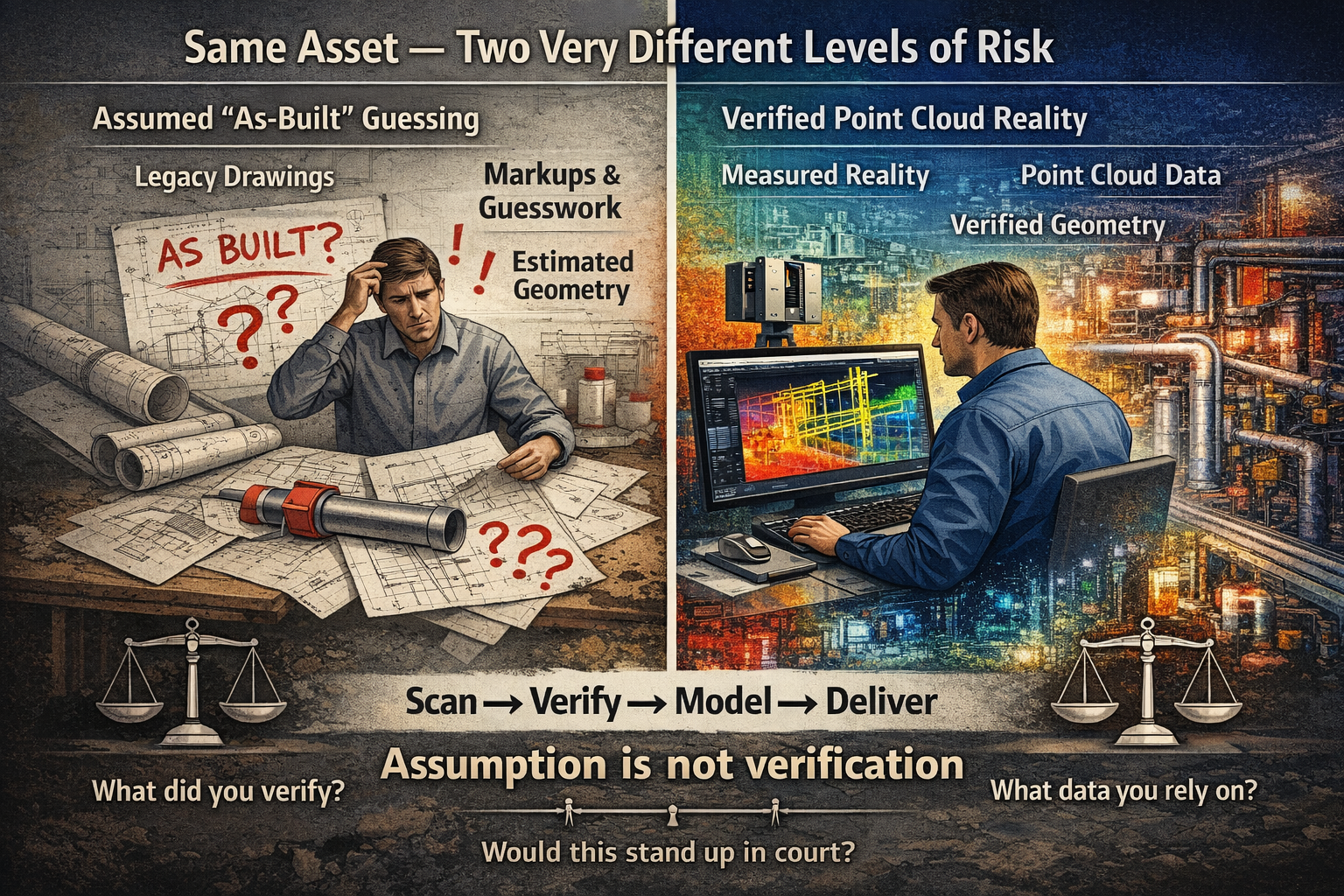
Split-screen engineering graphic comparing assumed as-built drawings with verified point cloud scanning data, highlighting the difference between estimated geometry and measured reality.

The High Court Just Changed Engineering Liability โ€” Why โ€œAs-Built Guessingโ€ Is No Longer Enough

The recent High Court decision in Pafburn Pty Ltd v The Owners โ€“ Strata Plan No 84674 has been widely discussed across the construction and legal sectors. Most commentary has focused on developers and builders, particularly the finding that they can be held fully liable for defects and cannot rely on proportionate liability to distribute responsibility.

But for engineers, designers, and anyone working in brownfield environments, the real impact runs deeper.

This case signals a clear shift in expectation โ€” away from assumption, and toward verified reality.


3D LiDAR scanning and 3D modelling service button โ€” laser scanner capturing a point cloud for engineering and CAD modelling
Mechanical engineering services

The Hidden Risk in โ€œAs-Builtโ€ Drawings

Across many projects, particularly in retrofit, maintenance, and upgrade work, design offices rely on what are commonly referred to as โ€œas-builtโ€ drawings.

In theory, these drawings represent what has actually been constructed on site.

In practice, however, that is not always the case.

Many โ€œas-builtsโ€ are produced through:

  • Manual markups during construction
  • Redline drawings updated after installation
  • Verbal confirmation from site teams
  • Interpretation of incomplete or outdated information

In some cases, they are never formally verified at all.

This creates a fundamental problem.

The design office is making decisions based on information that may be:

  • Incomplete
  • Inaccurate
  • Or in the worst case โ€” assumed

The Question That Is Now Being Asked

Following this High Court decision, the legal environment is changing.

It is no longer sufficient to say:

โ€œI worked from the drawings provided.โ€

Instead, the question is becoming:

What should a competent engineer have verified?

This is a significant shift.

It places responsibility not just on what information was used โ€” but on whether that information should have been trusted in the first place.


Assumption vs Measured Reality

At its core, this issue comes down to a simple comparison:

Does guessing what has been built offer the same level of coverage as measured data?

The answer is increasingly clear โ€” it does not.

When geometry is assumed:

  • Tolerances are unknown
  • Deviations from design are hidden
  • Errors compound as projects progress
  • Rework risk increases

More importantly, from a legal standpoint:

There is no defensible evidence of what actually existed at the time decisions were made.


The Role of Point Cloud Scanning

This is where point cloud scanning and reality capture fundamentally change the workflow.

Rather than relying on interpretation, point cloud data provides a direct measurement of site conditions.

A properly captured scan:

  • Records millions of measured points across the asset
  • Captures geometry exactly as installed
  • Provides a timestamped dataset of site conditions
  • Can be referenced, rechecked, and validated at any time

Most importantly, it creates a feedback loop between site and design.

Instead of guessing what has been built, the design office receives:

  • Accurate geometry
  • Verified spatial relationships
  • Real-world constraints

This allows models and drawings to be developed based on reality, not assumption.


Feeding Reality Back Into the Design Office

One of the most overlooked issues in engineering workflows is the disconnect between site and design.

Information typically flows in one direction:

  • Design โ†’ Construction

But the return flow:

  • Construction โ†’ Design

Is often inconsistent or incomplete.

Point cloud scanning closes this gap.

By scanning installed conditions and feeding that data back into the design environment, engineers can:

  • Align models with actual site geometry
  • Identify clashes before fabrication or installation
  • Validate clearances and fitment
  • Reduce the risk of downstream errors

This is not just about accuracy โ€” it is about confidence.


Why This Matters More After the High Court Decision

The implications of Pafburn Pty Ltd v The Owners โ€“ Strata Plan No 84674 go beyond contractual structures.

They influence how engineering decisions are evaluated.

When something goes wrong, the question is no longer simply:

โ€œWho was responsible for the design?โ€

It becomes:

  • What information was relied upon?
  • Was it reasonable to rely on that information?
  • Could the actual conditions have been verified?

If the tools to verify existed โ€” and were not used โ€” that becomes part of the discussion.


From Design Intent to Verified Condition

The industry is moving through a transition.

Historically, projects were driven by:

  • Design intent
  • Nominal dimensions
  • Idealised geometry

Today, the expectation is shifting toward:

  • Verified condition
  • Measured data
  • Real-world constraints

This shift is particularly important in:

  • Brownfield upgrades
  • Industrial plants
  • Mining infrastructure
  • Retrofit and modification projects

Where existing conditions rarely match original design documentation.


Practical Implications for Engineers

For engineers and designers, this means a change in approach.

Relying solely on drawings โ€” particularly for existing assets โ€” introduces risk.

A more robust workflow includes:

  • Verification of critical geometry
  • Clear documentation of data sources
  • Separation of assumed vs measured information
  • Use of reality capture where accuracy matters

This is not about replacing engineering judgement.

It is about supporting that judgement with evidence.


Conclusion: Coverage, Confidence, and Accountability

At the centre of this discussion is a simple idea:

Not all information offers the same level of coverage.

โ€œAs-builtโ€ drawings based on interpretation provide one level of confidence.

Measured point cloud data provides another.

As legal expectations evolve, the difference between the two becomes more significant.

Guessing what has been built โ€” even when done carefully โ€” does not offer the same level of coverage as data that can be measured, verified, and defended.


How We Approach It

At Hamilton By Design, our workflow is built around this principle:

Scan โ†’ Verify โ†’ Model โ†’ Deliver

By capturing real-world conditions and feeding that data back into the design process, we reduce uncertainty and provide a clear basis for engineering decisions.

Not just for better outcomes โ€” but for greater accountability.


If your next project relies on โ€œas-builtโ€ drawings alone, it is worth asking:

Are they measuredโ€ฆ or assumed?

3D CAD Modelling Australia service banner for Hamilton By Design

Our clients

Engineering Resources for Mining, Mechanical and Industrial Design

Mining and industrial engineering design montage showing conveyors, pipework systems, structural steel platforms and a mechanical assembly CAD model.

Supporting Engineering Knowledge Across Multiple Industry Blogs

At Hamilton By Design Co., we regularly publish engineering insights, technical discussions, and project examples across a number of specialist industry blogs.

These resources support engineers, plant operators, maintenance managers, and project teams working across mining, manufacturing, industrial infrastructure and structural design.

Many of these posts explore the practical engineering challenges encountered when designing, upgrading, or reverse engineering industrial equipment and facilities.

Topics include:

  • Mining plant design
  • Conveyor transfer systems
  • Structural steel detailing
  • Mechanical drafting
  • SolidWorks engineering design
  • Point cloud modelling and laser scanning
  • Design for manufacturing
  • Industrial plant upgrades

These blogs form part of the broader Hamilton By Design engineering knowledge network, providing practical insight into the real-world challenges of industrial design and engineering projects.


Hamilton By Design Engineering Blog Network

Hamilton By Design Engineering Blog

https://hamiltonbydesign.blogspot.com

This blog focuses on engineering services delivered by Hamilton By Design, including:

  • 3D laser scanning for engineering projects
  • Reverse engineering workflows
  • Industrial plant modelling
  • Engineering design case studies

It provides insights into how scanning and modelling technologies are applied to real engineering projects across Australia.


Mining Infrastructure and SolidWorks Design

https://mininginfrastructuresolidworksdesign.blogspot.com

This engineering blog focuses on the design and modelling of mining infrastructure, including:

  • Conveyor systems
  • Transfer chutes
  • Structural supports
  • Plant layout modelling

Articles often explore how SolidWorks and engineering modelling tools are used to develop reliable infrastructure for mining and bulk material handling.


Chutes and Transfer Stations

https://chutesandtransferstations.blogspot.com

Transfer chutes are one of the most critical components in bulk material handling systems.

This blog discusses:

  • Common chute failures in mining plants
  • Conveyor loading problems
  • Transfer point design
  • Bulk material handling improvements

Engineering design decisions made at transfer stations can significantly impact conveyor reliability, maintenance costs, and plant performance.


Design for Manufacturing

https://design-for-manufacturing.blogspot.com

The Design for Manufacturing (DFM) blog focuses on improving product and equipment designs to simplify fabrication and assembly.

Topics include:

  • Fabrication-friendly engineering design
  • Cost reduction through smarter design
  • Manufacturing workflow improvements
  • Practical mechanical engineering tips

Industrial Design Australia

https://industrialdesignaustralia.blogspot.com

This blog discusses engineering and industrial design challenges across Australian industries including:

  • Mining infrastructure
  • Industrial plants
  • Equipment upgrades
  • Plant shutdown planning

It highlights the engineering considerations required when working within complex operating facilities.


Mechanical Drafting Sydney

https://mechanical-drafting-sydney.blogspot.com

This blog focuses on professional drafting services including:

  • Mechanical design documentation
  • Engineering drawings
  • Industrial layout modelling
  • Detailed fabrication drawings

It provides insights into the role of drafting in delivering successful engineering projects.


Pipework Detailing

https://pipeworkdetailing.blogspot.com

Industrial pipe systems are critical infrastructure within processing plants.

This blog covers:

  • Pipe routing design
  • Pipe spool drawings
  • Scan-to-model workflows
  • Pipework engineering documentation

The content is particularly relevant to projects where laser scanning is used to capture existing plant geometry before upgrades.


SolidWorks Designer

https://solidworksdesigner.blogspot.com

This blog focuses on 3D mechanical design using SolidWorks, including:

  • Industrial equipment design
  • Mechanical assemblies
  • Engineering modelling workflows
  • Reverse engineering projects

SolidWorks Sydney

https://solidworkssydney.blogspot.com

This site focuses on SolidWorks engineering services in Australia, including:

  • Mechanical design
  • Industrial equipment modelling
  • Manufacturing design support

Structural Detailing

https://structural-detailing.blogspot.com

Structural detailing plays an important role in industrial plant upgrades and infrastructure projects.

This blog discusses:

  • Structural steel detailing
  • Engineering drawings for fabrication
  • Industrial infrastructure design

Structural Drafting

https://structural-drafting.blogspot.com

This blog focuses on structural drafting services including:

  • Steel framing drawings
  • Fabrication documentation
  • Structural engineering support for industrial facilities.

Structural Steel Drafting

https://structural-steel-drafting.blogspot.com

This blog focuses specifically on steel structures used in industrial plants and mining facilities, including:

  • Conveyor structures
  • Plant platforms
  • Maintenance walkways
  • Equipment support frames

Supporting Industrial Engineering Projects Across Australia

These blogs collectively explore the practical engineering knowledge required to support industrial facilities across Australia.

Many of the engineering topics discussed across these blogs are connected to services provided by Hamilton By Design, including:

  • Engineering grade 3D laser scanning
  • Point cloud to engineering model workflows
  • Mechanical and structural engineering design
  • Reverse engineering of industrial equipment
  • Plant upgrades and shutdown preparation

These resources help engineers and plant operators better understand how modern digital engineering tools can support safer, more efficient industrial infrastructure projects.

Hamilton By Design logo displayed on a blue tilted rectangle with a grey gradient background

3D LiDAR scanning and 3D modelling service button โ€” laser scanner capturing a point cloud for engineering and CAD modelling
Mechanical engineering services
Name
Would you like us to arrange a phone consultation for you?
Address


3D CAD Modelling Australia service banner for Hamilton By Design

Mechanical Engineering | Structural Engineering


3D LiDAR Scanning Darwin for engineering surveys, laser scanning, reality capture and point cloud modelling services
3D LiDAR Scanning Australia engineering services for laser scanning, reality capture, scan-to-CAD, Scan-to-BIM and as-built documentation across Australia
3D LiDAR scanning services on the Central Coast providing engineering-grade laser scanning, point cloud capture, scan-to-CAD modelling and industrial reality capture for infrastructure and industrial projects.
3D LiDAR Scanning Perth for engineering surveys, laser scanning, reality capture and point cloud modelling services
3D LiDAR Scanning Sydney for engineering surveys, laser scanning, reality capture and point cloud modelling services
3D LiDAR Scanning Brisbane for engineering surveys, laser scanning, reality capture and point cloud modelling services
3D LiDAR Scanning Canberra for engineering surveys, laser scanning, reality capture and point cloud modelling services
3D LiDAR Scanning Newcastle for engineering surveys, laser scanning, reality capture and point cloud modelling services
3D LiDAR Scanning Adelaide for engineering surveys, laser scanning, reality capture and point cloud modelling services

3D Scanning for Mining Shutdown Projects

3D Scanning for Mining Shutdown Projects | Engineering Laser Scanning

Mining shutdowns are critical windows where maintenance, upgrades, and engineering improvements must be completed quickly and safely. These shutdown periods often involve complex work scopes such as equipment replacements, structural upgrades, conveyor modifications, and new process installations.

One of the most effective technologies supporting shutdown planning today is engineering-grade 3D laser scanning. By capturing highly accurate spatial data of existing infrastructure, engineers can design and verify upgrades before the shutdown begins, reducing risk, rework, and costly delays.

At Hamilton By Design, 3D laser scanning plays a key role in helping mining operations capture accurate plant conditions and convert them into usable engineering data.


Why Mining Shutdowns Require Accurate Site Data

Mining plants evolve over decades. Equipment is modified, conveyors are relocated, structural steel is reinforced, and piping systems are extended or replaced. Unfortunately, plant drawings often do not reflect these changes.

During shutdown projects this creates significant risk, including:

  • Interference between new equipment and existing structures
  • Unexpected clashes with pipework or cable trays
  • Incorrect equipment fitment
  • Delays caused by rework or site modifications

3D laser scanning eliminates these uncertainties by capturing the true as-built condition of the plant.

Millions of spatial measurements are collected in minutes, producing a detailed point cloud model of the plant that engineers can use during design and planning.


How 3D Laser Scanning Supports Shutdown Planning

Engineering scanning provides accurate digital data that allows engineers to prepare shutdown work well before crews arrive onsite.

Capture Existing Plant Geometry

Scanning records the exact positions of key plant infrastructure including:

  • Conveyor structures
  • Transfer chutes
  • Structural steel
  • Pump skids
  • Pipework and services
  • Access platforms and walkways

This data forms a digital model of the plant that engineers can use during design.


Scan-to-CAD Engineering Models

Once scanning is complete, the point cloud data can be converted into CAD models. These models allow engineers to:

  • Design new components around existing infrastructure
  • Develop fabrication drawings
  • Plan shutdown installation sequences
  • Verify spatial clearances

This process is commonly known as Scan-to-CAD engineering modelling.


Clash Detection Before the Shutdown

One of the biggest advantages of scanning is the ability to identify problems before the shutdown begins.

Engineers can compare the scanned plant with proposed designs and identify potential clashes between:

  • Existing structures
  • Pipework and services
  • New equipment
  • Structural modifications

This ensures equipment will fit correctly when installation begins.


Typical Shutdown Projects That Benefit from 3D Scanning

Many mining upgrade projects benefit from scanning before shutdown work begins.

Conveyor and Transfer Upgrades

Mining conveyors are frequently modified during shutdowns. Engineers may need to:

  • Redesign transfer chutes
  • Install new belt cleaners
  • Upgrade pulley assemblies
  • Replace conveyor structures

Scanning ensures new equipment integrates correctly with existing infrastructure.


Pump and Process Equipment Replacement

Pump skids and process equipment often require precise alignment with existing pipework and foundations.

3D scanning allows engineers to verify:

  • Pipe flange locations
  • Equipment clearances
  • Structural support requirements

This reduces installation issues during shutdown.


Structural Steel Modifications

Structural upgrades are common in older processing plants. Scanning helps engineers assess:

  • Beam locations
  • Column spacing
  • Structural clearances
  • Equipment support interfaces

Accurate geometry reduces fabrication errors.


Brownfield Plant Expansions

Shutdowns are often used to integrate new plant sections into existing infrastructure.

Scanning allows engineers to design upgrades within tight spatial constraints, particularly in brownfield mining environments where space is limited.


Engineering-Grade Scanning vs Survey Scanning

Not all scanning services are the same.

Engineering-grade scanning focuses on design and fabrication accuracy, rather than simply generating visual models.

Hamilton By Design scanning workflows typically combine:

  • Engineering LiDAR scanners
  • Handheld metrology scanners where required
  • SolidWorks modelling
  • Engineering interpretation of point cloud data

This ensures the data supports real engineering decisions, not just visualisation.


Benefits for Mining Operations

Using 3D scanning during shutdown planning delivers several key advantages.

Reduced shutdown risk through accurate site data.

Faster engineering design using precise plant geometry.

Improved fabrication accuracy for shutdown components.

Reduced rework caused by installation clashes.

Improved safety through better shutdown planning.


Supporting Mining Shutdown Projects with Engineering 3D Scanning

Hamilton By Design provides engineering-led 3D laser scanning services for mining and industrial projects across Australia.

Our scanning workflows support:

  • Shutdown planning
  • Mechanical design upgrades
  • Scan-to-CAD modelling
  • Structural verification
  • Plant layout assessments
3D LiDAR scanning and 3D modelling service button โ€” laser scanner capturing a point cloud for engineering and CAD modelling
Mechanical engineering services

By combining advanced scanning technology with mechanical engineering expertise, we help mining companies reduce risk and deliver successful shutdown projects.


Name
Would you like us to arrange a phone consultation for you?
Address

3D CAD Modelling Australia service banner for Hamilton By Design
Australian Drafting logo featuring bold white text reading "Australian Drafting" centred on a blue rounded rectangle background.
Engineering Governance title graphic featuring bold white text reading "Engineering Governance" centred on a blue rounded rectangle background.
Mechanical, Structural & Pipework Drafting service banner by Hamilton By Design featuring white text on a blue background.
Mechanical engineering services
Blue rounded button with the text โ€œSolidWorks Designโ€ in white.
Finite Element Analysis (FEA) engineering simulation button
3D LiDAR Scanning Darwin for engineering surveys, laser scanning, reality capture and point cloud modelling services
3D LiDAR Scanning Australia engineering services for laser scanning, reality capture, scan-to-CAD, Scan-to-BIM and as-built documentation across Australia
3D LiDAR scanning services on the Central Coast providing engineering-grade laser scanning, point cloud capture, scan-to-CAD modelling and industrial reality capture for infrastructure and industrial projects.
3D LiDAR Scanning Perth for engineering surveys, laser scanning, reality capture and point cloud modelling services
3D LiDAR Scanning Sydney for engineering surveys, laser scanning, reality capture and point cloud modelling services
3D LiDAR Scanning Brisbane for engineering surveys, laser scanning, reality capture and point cloud modelling services
3D LiDAR Scanning Canberra for engineering surveys, laser scanning, reality capture and point cloud modelling services
3D LiDAR Scanning Newcastle for engineering surveys, laser scanning, reality capture and point cloud modelling services
3D LiDAR Scanning Adelaide for engineering surveys, laser scanning, reality capture and point cloud modelling services