SolidWorks Design Services

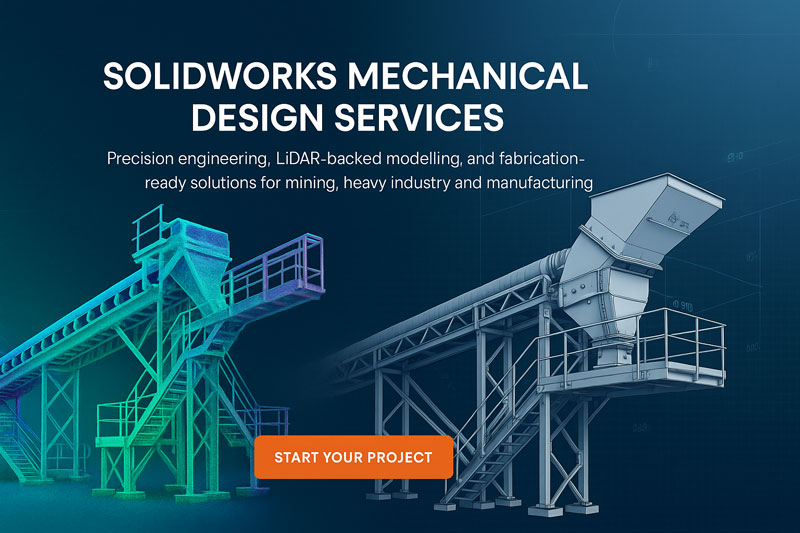
Hero image showing a LiDAR-coloured point-cloud model of an industrial conveyor system on the left transitioning into a detailed SolidWorks 3D CAD model on the right, with the heading ‘SolidWorks Mechanical Design Services’ and a call-to-action button that reads ‘Start Your Project’

SolidWorks Design Services

The Many Faces of Mechanical Design: How SolidWorks Powers Modern Engineering Across Australia

At Hamilton By Design, we see the same pattern every day across mining, heavy industry, manufacturing, and complex brownfield environments: the quality of engineering outcomes depends directly on the quality of the models driving them. And when it comes to mechanical design, SolidWorks remains one of the most capable and versatile platforms on the planet.

From dragline components to sheet metal enclosures, from pressure vessel upgrades to bespoke robotics, SolidWorks enables engineers to turn ideas into precise, fabrication-ready models that reduce rework, eliminate uncertainty, and accelerate project delivery.

Below, we explore the full spectrum of mechanical design disciplines where SolidWorks excels — and how Hamilton By Design uses this capability to deliver accurate, reliable, engineering-grade outcomes across Australia.


Why SolidWorks Remains the Backbone of Mechanical Design

SolidWorks brings together parametric modelling, simulation, large assembly performance, surfacing, sheet metal tools, weldments, routing and visualisation under a single environment. The result is powerful:

✔ Engineering that is data-driven
✔ Models that are precise and fabrication-ready
✔ Assemblies that reflect true site conditions
✔ Designs that respond intelligently to changes
✔ Drawings that follow Australian Standards
✔ Seamless integration with LiDAR-based as-builts

When paired with Hamilton By Design’s LiDAR scanning workflows, SolidWorks becomes an engine for delivering zero-guesswork mechanical design.


Mechanical Design Disciplines Perfectly Suited to SolidWorks Modelling

SolidWorks supports a huge range of engineering tasks. Below is a deep dive into the disciplines where Hamilton By Design deploys it every day.


1. Machine Design: Precision for Moving Systems

SolidWorks is a natural fit for mechanical equipment upgrades and R&D design work, including:

  • Gearboxes, shafts, keys, couplings
  • Linear motion systems and actuators
  • Mechanical linkages, cams and levers
  • Robotic mechanisms
  • Safety guards, enclosures and subframes
  • Automation concept development

Whether we’re modelling a drive assembly for a conveyor or designing a new piece of automated equipment, SolidWorks gives us full control over the mechanics, kinematics, clearances and manufacturability.


2. Structural Mechanical Design: Frames, Platforms & Fabrication

Mining and industrial plants rely heavily on welded structures and access systems. SolidWorks weldments excel at:

  • Platforms, walkways and stair systems
  • Equipment bases, skids and structural frames
  • Gantries, monorails and supports
  • Pipe supports and brackets
  • Structural reinforcements and upgrade scopes

Built-in cut lists, profile libraries and FEA ensure every frame is practical, safe and fabrication-ready.


3. Pressure Vessels, Tanks & Piping Systems

SolidWorks is an ideal tool for pressure-bound components and interconnected plant systems:

  • Tanks, vessels, bins and hoppers
  • Nozzles, flanges, stiffeners and ladders
  • Pipe routing and spooled sections
  • Chute systems, transitions and flow paths
  • Wear liners and maintenance-friendly redesigns

With stress linearisation, buckling analysis and accurate geometry import from LiDAR scans, we ensure designs meet engineering intent and fit up perfectly on site.


4. Sheet Metal: From Light Fabrication to Industrial Ducting

SolidWorks is the industry standard for sheet metal components:

  • Ducting and HVAC transitions
  • Guards, housings and folded enclosures
  • Electrical cabinets
  • Chute panels
  • Laser-cut and folded brackets

Automatic flat patterns and K-factor control mean fewer mistakes at the plasma/laser cutters and more predictable outcomes for fabricators.


5. Heavy Industry & Mining Equipment Modelling

Hamilton By Design’s roots in mining and heavy industry make SolidWorks invaluable for:

  • Conveyor components and guarding
  • Diverter chutes, hoppers and flow-optimised transitions
  • Bucket-wheel reclaimer parts
  • Crusher and screen upgrades
  • Dragline component modelling
  • Structural deformation/realignment scopes

Combined with LiDAR scanning, SolidWorks becomes the tool that eliminates shutdown fit-up problems.


6. Product Design & Industrial Design

SolidWorks’ surfacing and parametric tools are ideal for:

  • Consumer products
  • Power tools and ergonomic items
  • Injection-moulded components
  • Kitchen or appliance prototypes
  • Concept development for early-stage R&D

It supports rapid iterations, rendering, and export for 3D printing.


7. Robotics & Automation Systems

With the rise of automated processing and Industry 4.0, SolidWorks continues to shine in:

  • End effectors
  • Robotic arms and actuators
  • Kinematic studies
  • Sensor housings
  • Concept layouts for automated cells

We frequently pair this with our LiDAR models of existing plants to create automation solutions that genuinely fit the space.


8. Tooling, Jigs & Fixtures

Fabrication and machining rely on accurate tooling, and SolidWorks helps us design:

  • Welding jigs
  • Machining fixtures
  • Assembly tooling
  • Positioning and inspection gauges
  • Drill guides and alignment tooling

Parametric updates make future modifications simple and consistent.


9. Material Handling Systems

Across mining, ports, agriculture and waste facilities, SolidWorks supports:

  • Conveyor layouts
  • Screw and chain conveyors
  • Transfer chute redesigns
  • Feeders, bins and flow systems
  • Skids and support structures

We routinely pair mechanical redesign with simulation, checking wear patterns, stresses and clearances.


10. Reverse Engineering & As-Built Modelling from LiDAR

This is where Hamilton By Design leads the industry.

We scan sites with millimetre-level LiDAR, then rebuild clean parametric models in SolidWorks for:

  • Brownfield upgrades
  • Fit-up verification
  • Clash detection
  • Replacements and like-for-like manufacturing
  • Structural deformation assessments
  • Shutdown planning

It is the combination of LiDAR + engineering + SolidWorks that gives clients complete confidence in their next project.


How Clients Benefit from SolidWorks-Driven Mechanical Design

✔ Reduced rework

✔ Faster shutdown upgrades

✔ Accurate manufacturing drawings

✔ Better communication between engineers, fabricators and site teams

✔ Safer and more predictable installations

✔ Clear, simulation-backed decision-making

From CHPPs to ports, from power stations to manufacturing plants, SolidWorks modelling allows Hamilton By Design to deliver engineering outcomes you can trust.



Hamilton By Design logo displayed on a blue tilted rectangle with a grey gradient background
3D LiDAR scanning and 3D modelling service button — laser scanner capturing a point cloud for engineering and CAD modelling
Mechanical engineering services

Partner With Hamilton By Design for SolidWorks Mechanical Design

We support clients across:

  • NSW (Sydney, Newcastle, Central Coast, Hunter Valley)
  • QLD (Bowen Basin, Surat Basin, Mount Isa)
  • WA (Perth, Pilbara)
  • SA, VIC and regional Australia

If your next project needs mechanical accuracy, design certainty or LiDAR-integrated engineering, our team is ready to support you.

Name
Address
You would like to:

Our clients

SolidWorks

Finite Element Analysis (FEA) engineering simulation button
Mechanical engineering services
Mechanical Engineering Perth WA banner for Hamilton By Design featuring white text on a blue background.
3D Laser Scanning Perth WA banner for Hamilton By Design with white text on a blue background.
SolidWorks Perth WA banner for Hamilton By Design featuring white text on a blue background.
3D Laser Scanning

https://www.hamiltonbydesign.com.au/perth-wa

Engineering Projects

Engineering Services

3D Laser Scanning for Engineering

3D CAD Modelling Australia service banner for Hamilton By Design
3D LiDAR scanning and 3D modelling service button — laser scanner capturing a point cloud for engineering and CAD modelling
Mechanical engineering services
3D CAD Modelling Australia service banner for Hamilton By Design
Mechanical, Structural & Pipework Drafting service banner by Hamilton By Design featuring white text on a blue background.
Australian Drafting logo featuring bold white text reading "Australian Drafting" centred on a blue rounded rectangle background.
Blue banner graphic displaying the text "Point Cloud to CAD - Australia" in large white lettering, representing point cloud processing, scan-to-CAD conversion and digital engineering services across Australia.
CHPP Engineering title graphic featuring bold white text reading "CHPP Engineering" centred on a blue rounded rectangle background.
Engineering Governance title graphic featuring bold white text reading "Engineering Governance" centred on a blue rounded rectangle background.
Mechanical engineering services
Australian Drafting logo featuring bold white text reading "Australian Drafting" centred on a blue rounded rectangle background.
3D LiDAR Scanning Hunter & Newcastle banner with white text on a blue background promoting engineering-grade laser scanning services for industrial, mining and infrastructure projects across the Hunter Valley and Newcastle region.
Mechanical Engineering Hunter & Newcastle banner promoting mechanical engineering services for mining, industrial plants, power generation, manufacturing and heavy industry throughout the Hunter Valley and Newcastle region.
Structural Drafting Hunter & Newcastle banner promoting structural drafting services for mining, industrial plants, power generation, manufacturing and infrastructure projects across the Hunter Valley and Newcastle region.
Mechanical Engineering Perth WA banner for Hamilton By Design featuring white text on a blue background.
3D Laser Scanning Perth WA banner for Hamilton By Design with white text on a blue background.
SolidWorks Perth WA banner for Hamilton By Design featuring white text on a blue background.
Fabrication and product design services
Finite Element Analysis (FEA) engineering simulation button
3D LiDAR scanning and 3D modelling service button — laser scanner capturing a point cloud for engineering and CAD modelling
Blue rounded button with the text “SolidWorks Design” in white.
Mechanical drafting services button
Structural drafting services button

3D Scanning Sydney banner promoting engineering-grade 3D laser scanning, LiDAR scanning, and reality capture services by Hamilton By Design.
Mechanical Engineering Sydney banner with white text on a blue background representing Hamilton By Design's mechanical engineering services in Sydney.
Mechanical Drafting and 3D Modelling Sydney banner highlighting Hamilton By Design's CAD drafting, 3D modelling, and engineering design services in Sydney.

Mechanical Engineering | Structural Engineering


SolidWorks 3D Modelling Services

High-accuracy engineering design for mining, fabrication, and industrial projects across Australia

At Hamilton By Design, SolidWorks is at the core of everything we do. From detailed 3D modelling and mechanical design to FEA verification and fabrication-ready deliverables, our SolidWorks workflows support safe, efficient, and accurate engineering outcomes for complex brownfield and greenfield projects.

Whether we are laser-scanning a CHPP plant room, reverse-engineering a structural component, developing new mechanical assemblies, or verifying fit-ups using clash detection, SolidWorks allows us to transform real-world conditions into engineered, dependable solutions.

3D LiDAR scanning and 3D modelling service button — laser scanner capturing a point cloud for engineering and CAD modelling
Mechanical engineering services

Why SolidWorks Matters for Your Project

SolidWorks enables us to deliver higher accuracy, faster turnaround times, and better quality engineering documentation. When combined with our 3D LiDAR scanning and digital engineering workflows, SolidWorks becomes a powerful tool for:

  • Retrofitting and upgrade projects
  • Brownfield plant modifications
  • Structural and mechanical design
  • Reverse engineering of existing components
  • Fabrication drawing creation
  • Pipe routing and equipment layout
  • General arrangement (GA) development
  • Clash detection and interference checks

The result: fewer site surprises, reduced fabrication rework, and more predictable installation outcomes.


Our SolidWorks Capabilities

1. Advanced 3D Modelling

We build accurate, parametric 3D models for mechanical, structural, piping, and equipment systems. Models can be created from:

  • 3D LiDAR point clouds
  • Existing drawings
  • Physical measurements
  • Legacy data or supplier information

These models form the foundation for engineering design, fabrication deliverables, and digital twin development.


2. Engineering Design & Mechanical Development

Hamilton By Design provides full mechanical design support using SolidWorks, including:

  • Concept development
  • Detailed part and assembly design
  • Mechanism and motion analysis
  • Equipment layout planning
  • Design-for-manufacture (DFM) optimisation

We design with fabrication, installation, and long-term maintenance in mind.


3. Structural Modelling & Verification

Using SolidWorks and SolidWorks Simulation, we support structural engineering tasks such as:

  • Steelwork design
  • Platform and walkway modelling
  • Equipment support frames
  • Brackets, mounts, and tie-ins
  • Baseplates and skid packages

Models are used to check clashes, verify site conditions, and support safe installation planning.


4. FEA & Engineering Verification

SolidWorks Simulation allows us to perform engineering checks on components and structures, including:

  • Stress analysis (von Mises, principal stress)
  • Deflection modelling
  • Connection and bolt verification
  • Fatigue checks
  • Material comparison
  • Load path assessments

These studies ensure designs meet engineering standards and withstand real-world operating conditions.


5. Fabrication Drawings & Deliverables

We produce clear, accurate drawings for fabrication, workshop use, and installation teams:

  • Part drawings
  • Assembly drawings
  • DXF files for profiling
  • Welded assemblies
  • Cutting lists and BOMs
  • Marking plans
  • Site installation drawings

All drawings are generated directly from the master SolidWorks model to ensure consistency and reduce rework.


6. Scan-to-SolidWorks: Turning Point Clouds into Engineering Models

Our digital engineering workflow combines:

LiDAR Scan → Point Cloud → SolidWorks Model → Drawings & FEA

This allows us to:

  • Validate brownfield conditions
  • Reduce tape-measure errors
  • Check fit-up accuracy before fabrication
  • Avoid clashes during installation
  • Provide true “as-built” engineering context

This is one of Hamilton By Design’s strongest capabilities — and a major value driver for complex industrial environments.


SOLIDWORKS Professional Design certification badge by Dassault Systèmes
SOLIDWORKS Professional Drawing Tools certification badge by Dassault Systèmes

Our clients:

Industries We Support

SolidWorks is used across every sector Hamilton By Design services, including:

  • Mining & mineral processing
  • CHPP wash plants
  • Heavy industrial facilities
  • Fabrication workshops
  • Government infrastructure
  • Construction & modular buildings
  • Water and utility sectors

From bucket-wheel reclaimers to pump skids, conveyors, tanks, chutes, walkways, platforms, and complete plant rooms — SolidWorks allows us to deliver accurate, validated engineering models for real-world conditions.


Hamilton By Design logo displayed on a blue tilted rectangle with a grey gradient background
3D LiDAR scanning and 3D modelling service button — laser scanner capturing a point cloud for engineering and CAD modelling
Mechanical engineering services

Name
Would you like us to arrange a phone consultation for you?
Address

3D CAD Modelling Australia service banner for Hamilton By Design
3D LiDAR scanning and 3D modelling service button — laser scanner capturing a point cloud for engineering and CAD modelling
Mechanical engineering services
Mechanical drafting services button
Blue rounded button with the text “SolidWorks Design” in white.
Blue banner graphic displaying the text "Point Cloud to CAD - Australia" in large white lettering, representing point cloud processing, scan-to-CAD conversion and digital engineering services across Australia.
Mechanical, Structural & Pipework Drafting service banner by Hamilton By Design featuring white text on a blue background.
Engineering Governance title graphic featuring bold white text reading "Engineering Governance" centred on a blue rounded rectangle background.
Mining Plant Upgrades promotional graphic with bold white text on a blue background representing mining infrastructure, plant improvement, and engineering upgrade projects.
3D Pipework promotional graphic with bold white text on a blue background representing pipework design, modelling, drafting, and engineering services.
Australian Drafting logo featuring bold white text reading "Australian Drafting" centred on a blue rounded rectangle background.
3D Pipework promotional graphic with bold white text on a blue background representing pipework design, modelling, drafting, and engineering services.
Mining Plant Upgrades promotional graphic with bold white text on a blue background representing mining infrastructure, plant improvement, and engineering upgrade projects.
3D LiDAR Scanning for Engineering Projects title graphic featuring bold white text on a blue rounded rectangle background.
Australian Drafting logo featuring bold white text reading "Australian Drafting" centred on a blue rounded rectangle background.
Engineering Governance title graphic featuring bold white text reading "Engineering Governance" centred on a blue rounded rectangle background.
Mechanical, Structural & Pipework Drafting service banner by Hamilton By Design featuring white text on a blue background.
Mechanical engineering services
Blue rounded button with the text “SolidWorks Design” in white.
Finite Element Analysis (FEA) engineering simulation button

3D Scanning Sydney banner promoting engineering-grade 3D laser scanning, LiDAR scanning, and reality capture services by Hamilton By Design.
Mechanical Engineering Sydney banner with white text on a blue background representing Hamilton By Design's mechanical engineering services in Sydney.
Mechanical Drafting and 3D Modelling Sydney banner highlighting Hamilton By Design's CAD drafting, 3D modelling, and engineering design services in Sydney.

Mechanical Engineering | Structural Engineering


Coal Chute Design

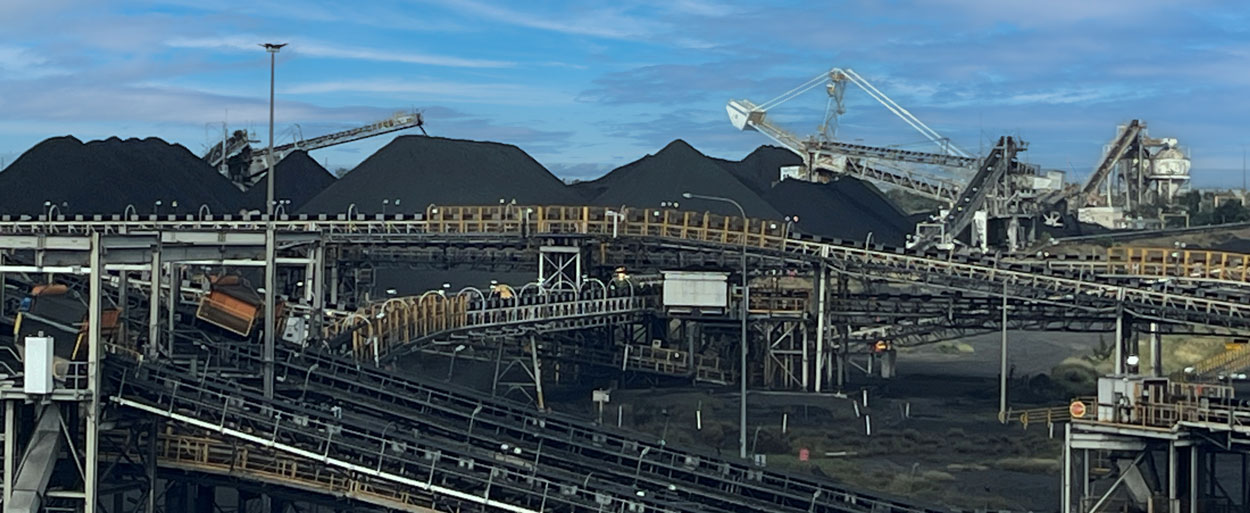
Coal handling and processing facility with multiple conveyors, stockpiles of coal, and stacking-reclaiming machinery operating under a blue sky

A Systems Engineering Approach for Reliable Coal Handling

In coal mining operations, transfer chutes play a deceptively small role with disproportionately large impacts. They sit quietly between conveyors, crushers, and stockpiles, directing tonnes of coal every hour. Yet when a chute is poorly designed or not maintained, the whole coal handling system suffers: blockages stop production, dust creates safety and environmental hazards, and worn liners demand costly maintenance shutdowns.

At Hamilton by Design, we believe coal chute design should be treated not as a piece of steelwork, but as a systems engineering challenge. By applying systems thinking, we connect stakeholder requirements, material behaviour, environmental factors, and lifecycle performance into a holistic design approach that delivers long-term value for mining operations in the Hunter Valley and beyond.


Coal Chutes in the Mining Value Chain

Coal chutes form the links in a chain of bulk material handling equipment:

  • ROM bins and crushers feed coal into the system.
  • Conveyors carry coal across site, often over long distances.
  • Transfer chutes guide coal between conveyors or onto stockpiles.
  • Load-out stations deliver coal to trains or ports for export.

Although they are small compared to conveyors or crushers, coal chutes are often where problems first appear. A well-designed chute keeps coal flowing consistently; a poorly designed one causes buildup, spillage, dust emissions, and accelerated wear. That’s why leading operators now see chute design as a critical system integration problem rather than just a fabrication task.

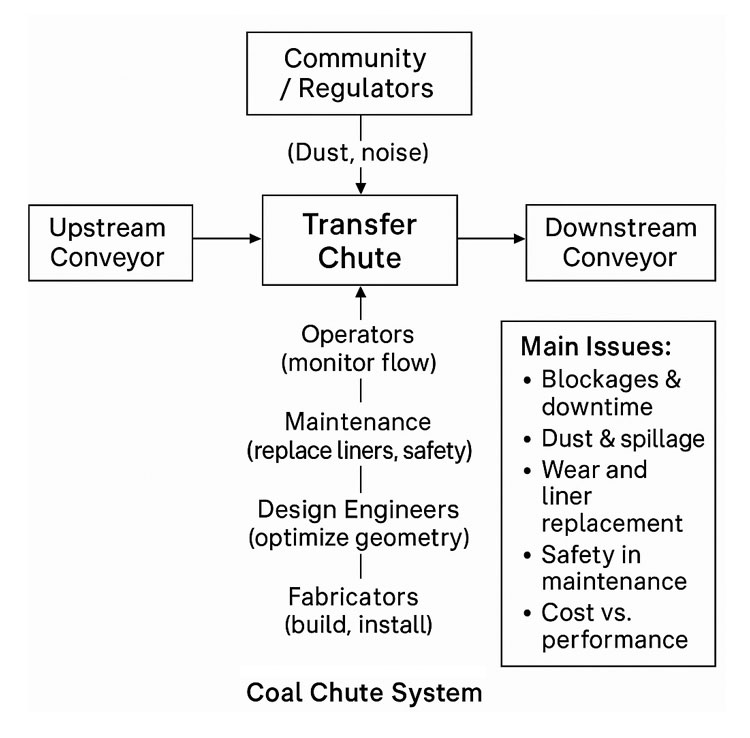
Flow diagram of a coal chute system showing upstream and downstream conveyors, the transfer chute, stakeholder interactions, and main issues such as blockages, dust, wear, maintenance safety, and cost versus performance

Systems Engineering in Coal Chute Design

Systems engineering is the discipline of managing complexity in engineering projects. It recognises that every component is part of a bigger system, with interdependencies and trade-offs. Applying this mindset to coal chute design ensures that each chute is considered not in isolation, but as part of the broader coal handling plant.

1. Requirements Analysis

The first step is gathering and analysing stakeholder and system requirements:

  • Throughput capacity: e.g. handling 4,000 tonnes per hour of coal.
  • Material properties: coal size distribution, moisture content, abrasiveness, stickiness.
  • Safety requirements: compliance with AS/NZS 4024 conveyor safety standards, confined space entry protocols, guarding, and interlocks.
  • Environmental compliance: dust, noise, and spillage limits.
  • Maintenance objectives: target liner life (e.g. 6 months), maximum downtime per liner change (e.g. 30 minutes with two workers).

A structured requirements phase reduces the risk of costly redesign later in the project.


2. System Design and Integration

Once requirements are defined, the design process considers how the chute integrates into the coal handling system:

  • Flow optimisation using DEM: Discrete Element Modelling allows engineers to simulate coal particle behaviour, test different geometries, and reduce blockages before steel is ever cut.
  • Dust control strategies: designing chutes with enclosures, sprays, and extraction ports to minimise airborne dust.
  • Wear management: predicting wear zones, selecting suitable liner materials (ceramic, Bisplate, rubber composites), and ensuring easy access for replacement.
  • Structural and safety design: ensuring the chute can withstand dynamic loads, vibration, and impact, while providing safe access platforms and guarding.
  • Interfaces with conveyors and crushers: alignment, skirt seals, trip circuits, and integration with PLC/SCADA control systems.

By treating the chute as a subsystem with multiple interfaces, designers avoid the “bolt-on” mentality that often leads to operational headaches.


3. Verification and Validation

The systems engineering V-model reminds us that every requirement must be verified and validated:

  • Component verification: weld inspections, liner hardness testing, nozzle spray checks.
  • Subsystem verification: chute section fit-up, guard gap measurements, coating checks.
  • Integration testing: conveyor-chute alignment, PLC spray interlocks, trip circuits.
  • System validation: commissioning with live coal flow, dust monitoring against limits, maintainability time trials for liner change.

By linking requirements directly to tests in a traceability matrix, operators can be confident that the chute is not only built to spec, but proven in operation.


Lifecycle Engineering: Beyond Installation

Good chute design doesn’t stop at commissioning. A lifecycle engineering mindset ensures the chute continues to deliver performance over years of operation.

  • Maintainability: modular liners, captive fasteners, hinged access doors, and clear procedures reduce downtime and improve worker safety.
  • Reliability: DEM-informed designs and wear-resistant materials reduce the frequency of blockages and rebuilds.
  • Sustainability: dust suppression and enclosure strategies reduce environmental impact and support community and regulatory compliance.
  • Continuous improvement: feedback loops from operators and maintenance teams feed into the next design iteration, closing the systems engineering cycle.

A Rich Picture of Coal Chute Complexity

Visualising the coal chute system as a rich picture reveals its complexity:

  • Operators monitoring flow from control rooms.
  • Maintenance crews working in confined spaces, replacing liners.
  • Design engineers using DEM simulations to model coal flow.
  • Fabricators welding heavy plate sections on site.
  • Environmental officers measuring dust levels near transfer points.
  • Regulators and community monitoring compliance.

This web of relationships shows why coal chute design benefits from systems thinking. No single stakeholder sees the whole picture—but systems engineering does.


Benefits of a Systems Engineering Approach

When coal chute design is guided by systems engineering principles, operators gain:

  • Higher reliability: smoother coal flow with fewer blockages.
  • Lower maintenance costs: liners that last longer and can be swapped quickly.
  • Improved compliance: dust, spillage, and safety issues designed out, not patched later.
  • Lifecycle value: less unplanned downtime and a lower total cost of ownership.

In short, systems engineering transforms coal chutes from weak links into strong connectors in the mining value chain.


Case Study: Hunter Valley Context

In the Hunter Valley, coal mines have long struggled with transfer chute problems. Companies like T.W. Woods, Chute Technology, HIC Services, and TUNRA Bulk Solids have all demonstrated the value of combining local fabrication expertise with advanced design tools. Hamilton by Design builds on this ecosystem by applying structured systems engineering methods, ensuring each chute project balances performance, safety, cost, and sustainability.


Conclusion

Coal chute design might seem like a small detail, but in mining, details matter. When transfer chutes fail, production stops. By applying systems engineering principles—from requirements analysis and DEM modelling to verification, lifecycle planning, and continuous improvement—we can design coal chutes that are reliable, maintainable, and compliant.

At Hamilton by Design, we believe in tackling these challenges with a systems mindset, delivering solutions that stand up to the realities of coal mining.


Are you struggling with coal chute blockages, dust, or costly downtime in your coal handling system?

Hamilton By Design logo displayed on a blue tilted rectangle with a grey gradient background

Contact Hamilton by Design today and discover how our systems engineering expertise in coal chute design can optimise your mining operations for performance, safety, and sustainability.

Mechanical Engineering | Structural Engineering

Mechanical Drafting | Structural Drafting

3D CAD Modelling | 3D Scanning

Chute Design

SolidWorks Contractors in Australia

Hamilton By Design – Blog

Our clients:

Name
Would you like us to arrange a phone consultation for you?
Address
Finite Element Analysis (FEA) engineering simulation button
Mechanical engineering services

Chute Design at Hamilton By Design

Chute Design at Hamilton By Design

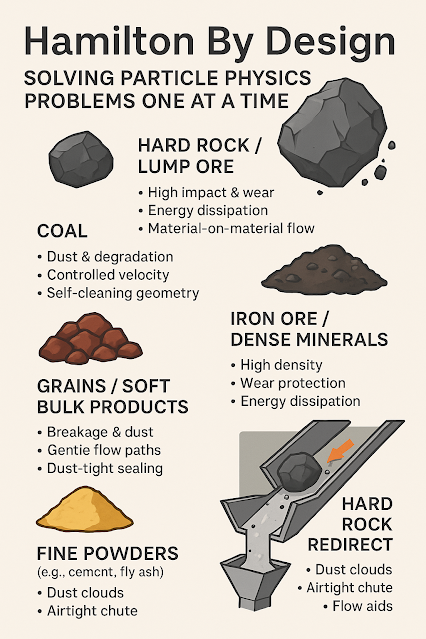
At Hamilton by Design, we see ourselves as more than engineers — we are problem-solvers who bring both science and experience to the table. Every bulk material transfer is unique, and each one carries its own challenges. By combining the principles of particle physics with decades of hands-on site experience, we design chutes and transfer points that perform in the real world, not just on a computer screen.

We are a small, specialised company, not a large corporate machine. That means you deal directly with the people who understand your operation, your materials, and your challenges. We take pride in our ability to stand on-site, watch the flow of material, and recognise behaviours that only years of experience can teach. This gives us the clarity to engineer practical solutions that keep your plant running reliably.

For us, your success is our success. We measure our achievement not by the number of projects we complete, but by the value we add to your operation — less dust, less wear, fewer stoppages, more tonnes moved.

Learn more about our approach and solutions Hamilton By Design – Chute Design


Our clients:

Name
Would you like us to arrange a phone consultation for you?
Address

Mechanical
Engineering
| Structural
Engineering

3D LiDAR scanning and 3D modelling service button — laser scanner capturing a point cloud for engineering and CAD modelling
Mechanical engineering services

Mechanical
Drafting
| Structural
Drafting

3D
Laser Scanning
| 3D
CAD Modelling
| 3D
Scanning

SolidWorks
Contractors in Australia

Hamilton By Design – Blog

Consulting Engineers

About Us –
Hamilton By Design

Bulk Materials Conveyor Transfer

Designing reliable bulk materials conveyor transfer station chutes involves a careful consideration of various principles to ensure efficient material handling, minimize maintenance, and avoid operational issues. Here are the key principles and potential pitfalls to look out for:

Key Principles

Material Flow Dynamics:

  • Controlled Flow: Ensuring that the material flow is controlled and predictable is crucial. This involves designing the chute to guide the material smoothly from one conveyor to the next without creating bottlenecks or excessive turbulence.
  • Optimal Angles: The chute’s angles should be carefully calculated. Angles that are too steep may cause material to accelerate excessively, leading to wear and impact damage, while shallow angles can cause blockages.
  • Trajectory Management: Properly managing the material’s trajectory helps in reducing spillage and wear. The trajectory should be designed to align with the receiving conveyor’s speed and direction.

Wear Resistance:

  • Material Selection: Using wear-resistant materials for the chute construction can significantly extend its lifespan. Materials like AR (abrasion-resistant) steel or liners made from ceramic or rubber are common choices.
  • Strategic Wear Points: Identifying and reinforcing areas that are prone to high wear, such as impact zones and high-friction areas, can prevent premature failure.

Dust and Spillage Control:

  • Sealing: Effective sealing around the chute is essential to prevent dust and material spillage, which can lead to environmental issues and loss of product.
  • Dust Suppression: Incorporating dust suppression systems, such as water sprays or dust extraction, can minimize airborne particles, ensuring a safer and cleaner working environment.

Maintenance and Accessibility:

  • Ease of Access: Designing the chute for easy access allows for routine maintenance and inspection without requiring extensive downtime or complex procedures.
  • Modular Components: Using modular components can simplify the replacement of worn parts, reducing maintenance time and costs.

Structural Integrity:

  • Robust Design: The chute must be structurally robust to withstand the dynamic loads of the bulk materials. This includes ensuring that the support structure is adequately reinforced.
  • Vibration and Impact Resistance: Designing to mitigate vibration and absorb impacts can reduce structural fatigue and extend the life of the chute.

Flow Rate Compatibility:

  • Capacity Matching: Ensuring the chute design matches the flow rate of the conveyor system it serves is vital. Overloading can lead to blockages and spillage, while underloading may indicate inefficient use of the system.

Pitfalls to Avoid

Incorrect Angle of Inclination:

  • Blockages and Spillage: If the chute angle is too steep or too shallow, it can lead to blockages or spillage. A steep angle might cause uncontrolled flow, while a shallow angle might lead to material build-up.

Insufficient Wear Protection:

  • Premature Wear: Failing to use appropriate wear-resistant materials or neglecting high-wear areas can result in frequent maintenance and downtime due to premature wear and tear.

Poorly Designed Transitions:

  • Material Segregation: Abrupt transitions or poorly designed junctions can cause material segregation, uneven flow, and increased wear on the chute and conveyor components.

Inadequate Dust Control:

  • Environmental and Health Issues: Neglecting dust control can lead to significant environmental and health issues, as well as potential regulatory fines and operational inefficiencies.

Maintenance Challenges:

  • Difficult Access: Designing chutes without considering maintenance access can lead to extended downtime and increased labor costs during repairs and inspections.

Ignoring Dynamic Loads:

  • Structural Failures: Not accounting for the dynamic loads and impact forces exerted by the bulk materials can lead to structural failures and hazardous conditions.

Poor Integration with Conveyor System:

  • Operational Inefficiencies: Failing to properly integrate the chute design with the conveyor system can lead to operational inefficiencies, increased wear on conveyor components, and potential system failures.

By adhering to these principles and being mindful of the potential pitfalls, the design of bulk materials conveyor transfer station chutes can be optimized for reliability, efficiency, and longevity.

Hamilton By Design logo displayed on a blue tilted rectangle with a grey gradient background
3D LiDAR scanning and 3D modelling service button — laser scanner capturing a point cloud for engineering and CAD modelling
Mechanical engineering services

For more information on Bulk Materials Conveyor Transfer please feel free to connect

Name
Would you like us to arrange a phone consultation for you?
Address


Mechanical Engineering | Structural Engineering

3D CAD Modelling Australia service banner for Hamilton By Design
Australian Drafting logo featuring bold white text reading "Australian Drafting" centred on a blue rounded rectangle background.
Engineering Governance title graphic featuring bold white text reading "Engineering Governance" centred on a blue rounded rectangle background.
Mechanical, Structural & Pipework Drafting service banner by Hamilton By Design featuring white text on a blue background.
Mechanical engineering services
Blue rounded button with the text “SolidWorks Design” in white.
Finite Element Analysis (FEA) engineering simulation button
3D LiDAR Scanning Darwin for engineering surveys, laser scanning, reality capture and point cloud modelling services
3D LiDAR Scanning Australia engineering services for laser scanning, reality capture, scan-to-CAD, Scan-to-BIM and as-built documentation across Australia
3D LiDAR scanning services on the Central Coast providing engineering-grade laser scanning, point cloud capture, scan-to-CAD modelling and industrial reality capture for infrastructure and industrial projects.
3D LiDAR Scanning Perth for engineering surveys, laser scanning, reality capture and point cloud modelling services
3D LiDAR Scanning Sydney for engineering surveys, laser scanning, reality capture and point cloud modelling services
3D LiDAR Scanning Brisbane for engineering surveys, laser scanning, reality capture and point cloud modelling services
3D LiDAR Scanning Canberra for engineering surveys, laser scanning, reality capture and point cloud modelling services
3D LiDAR Scanning Newcastle for engineering surveys, laser scanning, reality capture and point cloud modelling services
3D LiDAR Scanning Adelaide for engineering surveys, laser scanning, reality capture and point cloud modelling services


Mechanical Drafting | Structural Drafting

3D CAD Modelling | 3D Scanning

Hamilton By Design

Drafting Contractors

CAD Drafters / CAD Designers – Labour Hire

At Hamilton By Design, we provide specialised labour hire solutions for projects that demand precision, innovation, and industry-leading expertise. Our highly skilled professionals are trained in the most widely used CAD software in Australia, including AutoCAD, SolidWorks, Revit, SketchUp, Fusion 360, DraftSight, Free CAD, BricsCAD, and Tekla Structures.

Whether you require detailed 2D drafting, advanced 3D modeling, product development, or full-scale BIM integration, our team can seamlessly adapt to your preferred workflows and software environments. By engaging our labour hire services, you gain access to proven CAD proficiency, ensuring immediate productivity, technical accuracy, and reduced onboarding time.

From mechanical engineering and product design through to architecture, construction, and structural detailing, Hamilton By Design offers the right balance of flexibility and expertise. With us, you don’t just add extra resources—you strengthen your capability with the specialist skills, software knowledge, and professional experience needed to deliver results.

CAD Contractor Hire – Consignment Basis

Every project is unique, and we recognise that requirements can shift based on deadlines, complexity, and client expectations. That’s why we also provide CAD contractors on a consignment basis, giving you the freedom to scale your workforce as required—without the long-term overhead of full-time employment.

Our contractors bring deep expertise across leading CAD platforms, ensuring your project benefits from the right skills at the right time:

  • AutoCAD – Precision 2D drafting and versatile 3D modeling
  • SolidWorks – Advanced mechanical and product design
  • Revit – Comprehensive BIM workflows for architecture and construction
  • SketchUp – Fast, intuitive 3D concept design and visualization
  • Fusion 360 – Cloud-based CAD/CAM with integrated simulation tools
  • DraftSight – Cost-effective 2D drafting for technical drawings
  • FreeCAD – Open-source parametric 3D design for versatile applications
  • BricsCAD – DWG-compatible drafting and 3D modeling
  • Tekla Structures – Structural BIM for steel, concrete, and fabrication detailing

Whether you need short-term drafting support, product development specialists, or complete BIM integration, our consignment-based model delivers flexibility, cost control, and immediate access to talent. This approach allows you to focus on project success while we ensure the right people are in place to make it happen.


Hamilton By Design logo displayed on a blue tilted rectangle with a grey gradient background
3D LiDAR scanning and 3D modelling service button — laser scanner capturing a point cloud for engineering and CAD modelling
Mechanical engineering services

Name
Would you like us to arrange a phone consultation for you?
Address
3D Scanning Sydney banner promoting engineering-grade 3D laser scanning, LiDAR scanning, and reality capture services by Hamilton By Design.
Mechanical Engineering Sydney banner with white text on a blue background representing Hamilton By Design's mechanical engineering services in Sydney.
Mechanical Drafting and 3D Modelling Sydney banner highlighting Hamilton By Design's CAD drafting, 3D modelling, and engineering design services in Sydney.

3D CAD Modelling Australia service banner for Hamilton By Design


CHPP Engineering title graphic featuring bold white text reading "CHPP Engineering" centred on a blue rounded rectangle background.
Pipework Drafting title graphic featuring bold white text reading "Pipework Drafting" centred on a blue rounded rectangle background.
3D LiDAR Scanning for Engineering Projects title graphic featuring bold white text on a blue rounded rectangle background.

Finite Element Analysis (FEA) engineering simulation button
Structural drafting services button
Mechanical drafting services button


Australian Drafting logo featuring bold white text reading "Australian Drafting" centred on a blue rounded rectangle background.
Engineering Governance title graphic featuring bold white text reading "Engineering Governance" centred on a blue rounded rectangle background.
Engineering-Grade LiDAR Scanning title graphic featuring bold white text on a blue rounded rectangle background.


Mechanical drafting services button
Structural drafting services button


Fabrication and product design services
3D CAD Modelling Australia service banner for Hamilton By Design
Mechanical, Structural & Pipework Drafting service banner by Hamilton By Design featuring white text on a blue background.


3D LiDAR scanning and 3D modelling service button — laser scanner capturing a point cloud for engineering and CAD modelling
Mechanical engineering services
3D Scanning Sydney banner promoting engineering-grade 3D laser scanning, LiDAR scanning, and reality capture services by Hamilton By Design.
Mechanical Engineering Sydney banner with white text on a blue background representing Hamilton By Design's mechanical engineering services in Sydney.
Mechanical Drafting and 3D Modelling Sydney banner highlighting Hamilton By Design's CAD drafting, 3D modelling, and engineering design services in Sydney.
Mechanical Engineering | Structural Engineering