Builder Next Door Starting Piling?

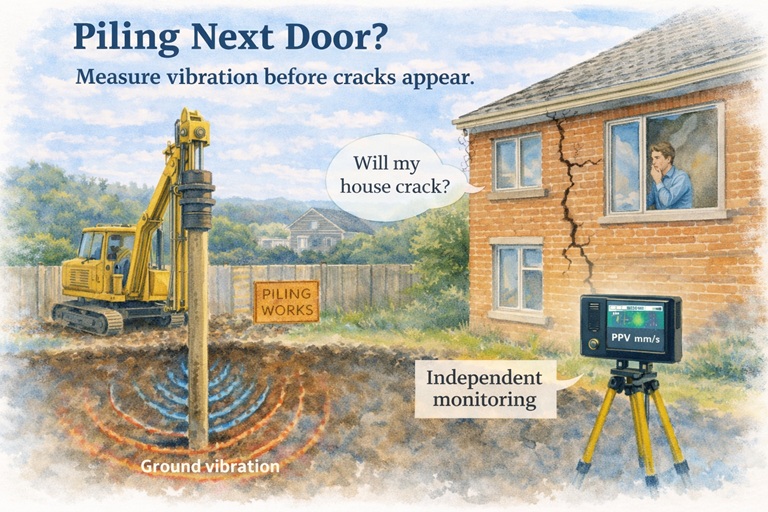
Construction piling next door causing ground vibration towards a residential house with monitoring equipment installed.

Read This Before Cracks Appear

Construction in Australia is getting closer to existing homes than ever before. Subdivisions, duplex developments, basement garages and boundary wall construction now routinely occur only metres from established houses.

One of the most misunderstood risks during nearby construction is ground vibration โ€” particularly from piling, sheet piling, rock breaking and compaction equipment.

Most homeowners only notice the issue once cracks appear.

By that point, proving the cause becomes significantly harder.
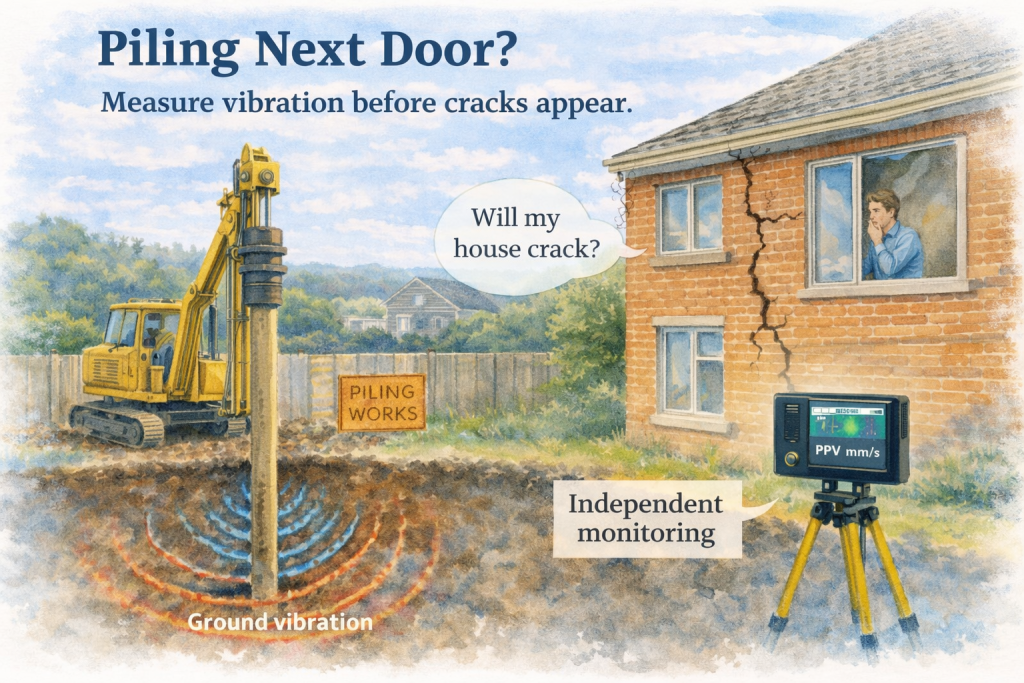

House at risk of cracks from nearby piling works with independent vibration monitoring device measuring movement.

What Is Actually Happening During Piling?

When a neighbouring builder installs piles, the ground does not simply โ€œshakeโ€ โ€” it transmits energy waves through the soil.
These waves travel through the foundation system of your home and can interact with the structure in very specific ways.

Depending on soil type and building construction, vibration can:

  • Amplify inside brick veneer cavities
  • Transfer through footings into slab edges
  • Excite steel lintels above windows
  • Cause differential movement between materials
  • Open previously dormant shrinkage cracks
  • Break brittle materials like grout and plasterboard joints

Many owners describe it as feeling like a truck hitting the house repeatedly โ€” and structurally, that is not far from reality.


The Critical Problem โ€” Evidence

Here is the reality:

If you do not measure vibration before damage occurs, proving responsibility later becomes extremely difficult.

Once construction finishes:

  • The vibration source is gone
  • Monitoring cannot be retroactively installed
  • Engineers must rely on assumptions
  • Insurance claims are often rejected
  • Builders argue pre-existing damage

This is why most vibration disputes fail โ€” not because damage didnโ€™t happen, but because it wasnโ€™t recorded at the time.


Why Cracks Appear Days or Weeks Later

Damage does not always occur instantly.

Vibration commonly causes:

  • Micro-movement in mortar joints
  • Loosening of interfaces between materials
  • Progressive settlement in reactive soils

Then later:

  • A hot day
  • Rain event
  • Door closing
  • Minor thermal expansion

โ€ฆand the crack becomes visible.

The construction activity triggered the mechanism โ€” but the visible damage appears later.

Without monitoring, causation becomes nearly impossible to demonstrate.


Australian Standards โ€” The Legal Threshold

Australian and international building damage criteria are based on Peak Particle Velocity (PPV), not how strong vibration feels.

Typical residential guidance limits:

FrequencyCosmetic Damage Threshold
< 10 Hz~5 mm/s
10โ€“50 Hz5โ€“15 mm/s
> 50 Hzup to 20 mm/s

Important:

Human perception is NOT a reliable indicator of structural damage risk.

Some damaging vibrations feel mild.
Some strong sensations cause no damage.

Only instrumentation determines the difference.


What You Should Do โ€” Before Work Starts

If you have received a notice of:

  • Piling
  • Rock breaking
  • Basement excavation
  • Sheet piling
  • Compaction works
  • Demolition close to boundary

You should arrange:

1. Pre-Construction Condition Survey

Photographic and measured documentation of existing condition.

2. Vibration Monitoring Installation

Sensors installed before the first machine arrives.

3. Continuous Logging During Construction

Provides legal evidence if thresholds are exceeded.


Why Timing Matters

The most valuable data occurs during the first day of piling.

After that:

  • Cracks may already initiate
  • You have no baseline
  • Arguments become opinion-based

Early measurement protects everyone โ€” homeowner and builder alike.


Who Is Responsible?

In Australia, responsibility is generally determined by measurable physical impact, not perception.

Courts consistently require:

  • Recorded vibration data
  • Engineering interpretation
  • Demonstrated building response

Without measurement, claims rely on visual opinion โ€” which rarely succeeds.


Peace of Mind Is the Real Outcome

Many monitored projects show vibration stays within acceptable limits.
In those cases, owners gain certainty their home is safe.

Monitoring is not about creating conflict โ€” it is about removing uncertainty.


We Travel Australia-Wide

Hamilton By Design provides independent vibration recording across Australia, including regional and remote locations.

We install monitoring equipment prior to construction and provide documented records suitable for engineering or legal use if required.


If Construction Is About To Start Next Door

Do not wait for cracks.

Once visible damage appears, the opportunity to capture critical evidence has often already passed.


๐Ÿ‘‰ Arrange vibration monitoring before works commence:
https://www.hamiltonbydesign.com.au/construction-vibration-monitoring-home-australia/


Final Thought

You insure your house against fire and storm โ€” events that may never happen.

Nearby construction is different.
It will happen, and it will introduce measurable forces into your home.

The question is not whether vibration occurs.

The question is whether it will be recorded.


3D LiDAR scanning and 3D modelling service button โ€” laser scanner capturing a point cloud for engineering and CAD modelling
Mechanical engineering services

Hamilton By Design
Engineering Measurement & 3D Spatial Documentation
Australia Wide

Name
Would you like us to arrange a phone consultation for you?
Address

3D CAD Modelling Australia service banner for Hamilton By Design
Finite Element Analysis (FEA) engineering simulation button
Mechanical engineering services

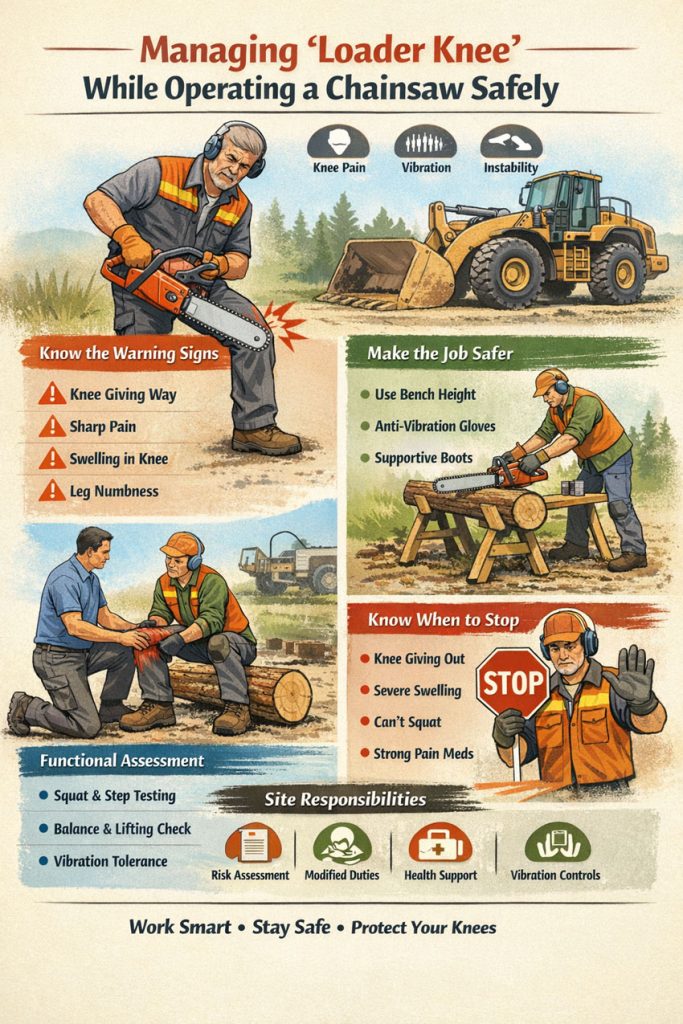
Managing โ€œLoader Kneeโ€ While Operating a Chainsaw Safely

Managing Loader Knee & Chainsaw Use โ€“ Work Safely in Australia

Years spent climbing in and out of loaders, dozers, and haul trucks can leave many operators with what is commonly called โ€œloader knee.โ€ It isnโ€™t a single diagnosis โ€” rather a collection of knee problems caused by repetitive climbing, whole-body vibration, and long hours in fixed seated positions.

For people who also need to use a chainsaw โ€” on a mine site, rural property, or maintenance role โ€” loader knee can become a serious safety risk. Chainsaw work demands balance, stable footing, and quick reactions. The good news is that with the right approach, many people can continue to work safely.

Why Loader Knee and Chainsaws Donโ€™t Mix Easily

Chainsaw operation places unique demands on the lower body:

  • Knees remain slightly bent for long periods
  • Weight shifts constantly between legs
  • The operator must react instantly to kickback or timber movement
  • Work often occurs on uneven ground with vibration through the arms and body

If loader knee has caused instability, pain, or reduced strength, these demands can increase the likelihood of a slip, loss of control, or secondary injury.


Infographic showing how to manage loader knee while operating a chainsaw safely with warnings, safe work methods and functional assessment steps.

Step 1 โ€“ Recognise the Early Warning Signs

Do not push through symptoms when a running saw is in your hands. Stop immediately if you experience:

  • Knee giving way or locking
  • Sharp pain when weight bearing
  • Swelling during the task
  • Reduced ability to squat or step sideways
  • Numbness or altered sensation down the leg

Finishing โ€œone last cutโ€ is how many incidents occur.


Step 2 โ€“ Make the Task Safer Before You Start

Engineering and Equipment Controls

  • Work at bench height using saw horses or log stands rather than ground felling
  • Choose a low-vibration chainsaw with a well-maintained sharp chain
  • Use anti-vibration gloves and supportive footwear
  • Avoid slopes, loose ground, and awkward reaches
  • Keep cutting zones close to waist height where possible

Administrative Controls

  • Limit cutting to 15โ€“20 minute blocks with rest breaks
  • Rotate to non-chainsaw duties
  • Use a second person for large or unstable timber
  • Complete a short warm-up before starting

Personal Supports

  • Knee brace with lateral support if recommended by a clinician
  • Strength program targeting quads, hamstrings, and glutes
  • Maintain healthy body weight to reduce joint load

Step 3 โ€“ Get the Right Type of Assessment

A general medical certificate often isnโ€™t enough. A functional capacity assessment should test the movements actually required for chainsaw work:

  • Holding a half-squat stance
  • Stepping sideways with a 5โ€“7 kg load
  • Recovering from a stumble
  • Tolerance to vibration
  • Repeated kneel-to-stand movements

This provides a realistic picture of whether the task is safe or needs modification.


Step 4 โ€“ Know When to Stop

Chainsaw use should cease โ€” temporarily or permanently โ€” if any of the following are present:

  • Recurrent knee collapse or instability
  • Inability to squat to approximately 70 degrees
  • Increasing swelling during work
  • Use of strong pain medication
  • Recent injections or acute injury

No production target is worth a life-changing accident.


Step 5 โ€“ Employer and Site Responsibilities

Under Australian WHS duties, a PCBU must ensure:

  • Task-specific risk assessments
  • Suitable duties or modified work
  • Review of vibration exposure
  • Access to occupational health support
  • Consideration of alternative methods such as pole saws or mechanical cutters

Managing loader knee is not just a personal issue โ€” it is a workplace safety obligation.


Hamilton By Design logo displayed on a blue tilted rectangle with a grey gradient background
3D Scanning Sydney banner promoting engineering-grade 3D laser scanning, LiDAR scanning, and reality capture services by Hamilton By Design.
Mechanical Engineering Sydney banner with white text on a blue background representing Hamilton By Design's mechanical engineering services in Sydney.
Mechanical Drafting and 3D Modelling Sydney banner highlighting Hamilton By Design's CAD drafting, 3D modelling, and engineering design services in Sydney.

A Practical Path Forward

Many experienced operators successfully continue chainsaw work by changing the way the task is done rather than ignoring the condition. The combination of smart engineering controls, realistic medical assessment, and sensible work planning keeps people productive and safe.

If you or your team need help developing:

  • Chainsaw SWMS and task risk assessments
  • Fitness-for-task guidance
  • Access and ergonomic improvements
  • Vibration exposure reviews

Hamilton By Design can assist with practical, site-focused solutions that protect both people and productivity.


Stay safe. Work smart. Look after your knees โ€” they still have plenty of shifts left in them.

3D LiDAR scanning and 3D modelling service button โ€” laser scanner capturing a point cloud for engineering and CAD modelling
Mechanical engineering services
Name
Would you like us to arrange a phone consultation for you?
Address
3D CAD Modelling Australia service banner for Hamilton By Design
3D LiDAR scanning and 3D modelling service button โ€” laser scanner capturing a point cloud for engineering and CAD modelling
Mechanical engineering services
Mechanical drafting services button
Blue rounded button with the text โ€œSolidWorks Designโ€ in white.
Blue banner graphic displaying the text "Point Cloud to CAD - Australia" in large white lettering, representing point cloud processing, scan-to-CAD conversion and digital engineering services across Australia.
Mechanical, Structural & Pipework Drafting service banner by Hamilton By Design featuring white text on a blue background.
Engineering Governance title graphic featuring bold white text reading "Engineering Governance" centred on a blue rounded rectangle background.
Mining Plant Upgrades promotional graphic with bold white text on a blue background representing mining infrastructure, plant improvement, and engineering upgrade projects.
3D Pipework promotional graphic with bold white text on a blue background representing pipework design, modelling, drafting, and engineering services.
Australian Drafting logo featuring bold white text reading "Australian Drafting" centred on a blue rounded rectangle background.
3D Pipework promotional graphic with bold white text on a blue background representing pipework design, modelling, drafting, and engineering services.
Mining Plant Upgrades promotional graphic with bold white text on a blue background representing mining infrastructure, plant improvement, and engineering upgrade projects.
3D LiDAR Scanning for Engineering Projects title graphic featuring bold white text on a blue rounded rectangle background.
Australian Drafting logo featuring bold white text reading "Australian Drafting" centred on a blue rounded rectangle background.
Engineering Governance title graphic featuring bold white text reading "Engineering Governance" centred on a blue rounded rectangle background.
Mechanical, Structural & Pipework Drafting service banner by Hamilton By Design featuring white text on a blue background.
Mechanical engineering services
Blue rounded button with the text โ€œSolidWorks Designโ€ in white.
Finite Element Analysis (FEA) engineering simulation button

Mechanical Engineering | Structural Engineering


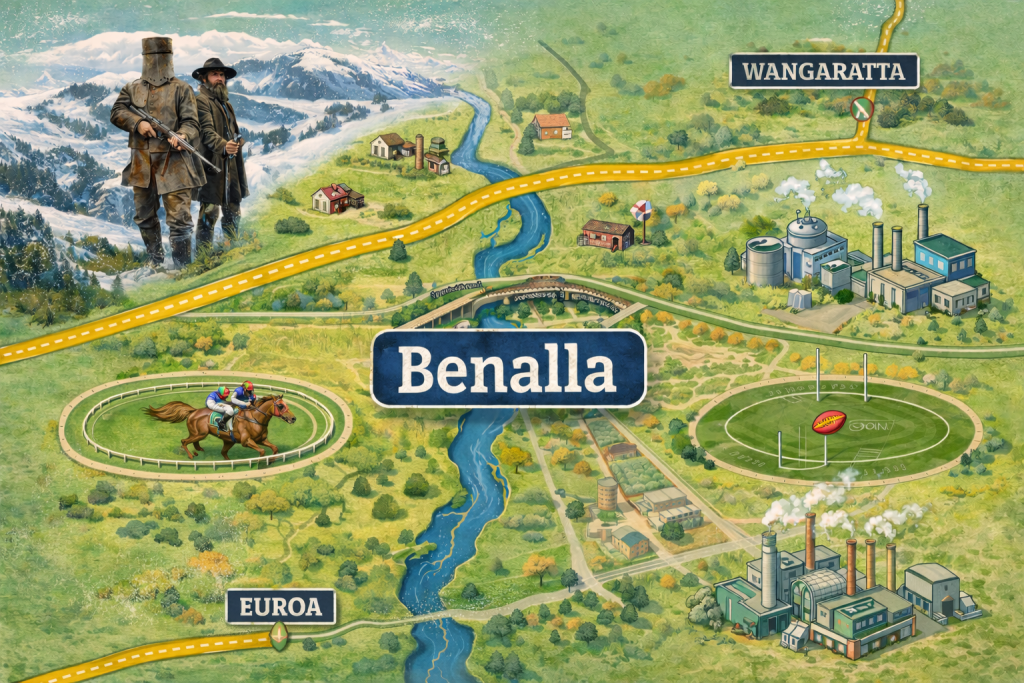
Mechanical Engineering Support for Manufacturing in Benalla

Mechanical Engineering Support Benalla | Manufacturing & Industrial

Practical engineering for real factories, real equipment, real deadlines

Benalla and the North East Victorian region are built on strong manufacturingโ€”electrical equipment, heavy industry, fabrication, food processing, and specialist production. Mechanical engineers working in these environments need support that understands uptime, safety, compliance, and getting equipment back into service quickly.

Hamilton By Design provides hands-on mechanical engineering services that help manufacturers move from site reality to engineering-ready solutionsโ€”without disrupting production.


Who we work with

We support mechanical engineers, maintenance teams, project managers, and workshop leaders across:

  • Electrical and industrial equipment manufacturing
  • Process and production facilities
  • Fabrication workshops and OEM suppliers
  • Maintenance and reliability teams
  • Capital upgrade and shutdown projects

Our role is to strengthen your in-house capability with accurate site information, practical design support, and clear engineering deliverables.


Our services

Site verification & as-built capture

Decisions are only as good as the information behind them. We help confirm existing conditions before designs are locked in.

  • Existing plant and equipment verification
  • Field measurement and dimensional checks
  • Brownfield interface confirmation
  • Layout validation before fabrication

3D laser scanning for manufacturing sites

Modern manufacturing upgrades demand accurate spatial data. We capture and deliver point clouds tailored for engineering workflows.

  • Rapid on-site data capture
  • Registered point cloud deliverables
  • Support for upgrades, relocations, and new equipment installs
  • Clash identification before shutdowns

Mechanical layout & modification support

Practical engineering to make changes fit the real world.

  • Equipment arrangement and access reviews
  • Interface coordination with structures and services
  • Design checks against site constraints
  • Fabrication and installation support

Reliability & maintenance engineering

Helping teams reduce downtime and improve maintainability.

  • Maintenance access optimisation
  • Equipment changeover planning
  • Practical improvement recommendations
  • Support for maintenance documentation

Manufacturing documentation

Clear, structured information that workshop and site teams can actually use.

  • Engineering-ready drawing packages
  • Asset and modification records
  • Handover documentation
  • Fabrication support information

Why manufacturing teams choose us

  • Engineer-led, site-first approach โ€“ we design around how your plant really operates
  • Production-aware โ€“ focused on minimal disruption and practical outcomes
  • Cross-discipline thinking โ€“ mechanical, structural and fabrication interfaces
  • Deliverables that work on the workshop floor โ€“ not just in the office

Typical projects in Benalla

  • Equipment upgrades and replacements
  • New machine installations into existing lines
  • Factory relocations and layout changes
  • Shutdown measurement and documentation
  • Access and maintainability improvements
  • Reverse engineering of legacy equipment

How we engage

  1. Initial discussion โ€“ understand your equipment, constraints, and timeline
  2. Plan the site approach โ€“ access, safety, and production considerations
  3. On-site capture & verification
  4. Delivery of practical engineering outputs ready for your workflow

Hamilton By Design logo displayed on a blue tilted rectangle with a grey gradient background

Contact

If youโ€™re a mechanical engineer or manufacturer in Benalla needing practical engineering support, we can help bridge the gap between site and design.

Hamilton By Design Co.
Servicing Benalla & Northeast Victoria

3D LiDAR scanning and 3D modelling service button โ€” laser scanner capturing a point cloud for engineering and CAD modelling
Mechanical engineering services


Name
Would you like us to arrange a phone consultation for you?
Address
3D CAD Modelling Australia service banner for Hamilton By Design

Industrial Machine Guarding Certification (Fixed Plant) โ€“ Engineering Verification & Guard Design

In industrial and mining environments, machine guarding is not a โ€œnice to haveโ€ โ€” itโ€™s a critical engineering control that protects people, prevents downtime, and demonstrates compliance with Australian WHS expectations.

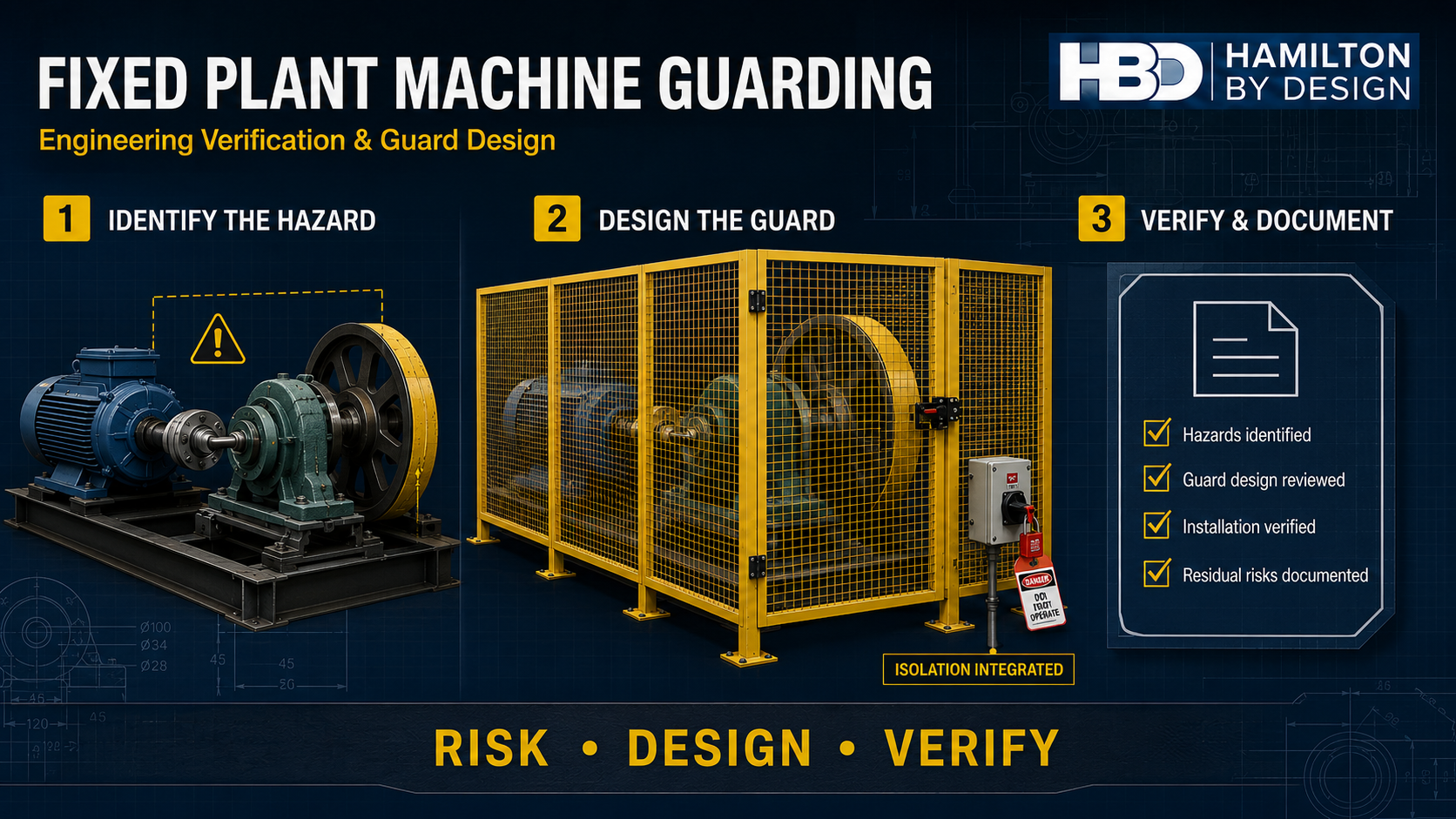
Hamilton By Design Co. provides engineering-led design consulting and certification-style verification for fixed plant machine guarding, including new guarding systems, upgrades, and retrofit solutions for existing equipment.

Our focus is simple: protect workers, support safe production, and provide clear, defensible engineering documentation.


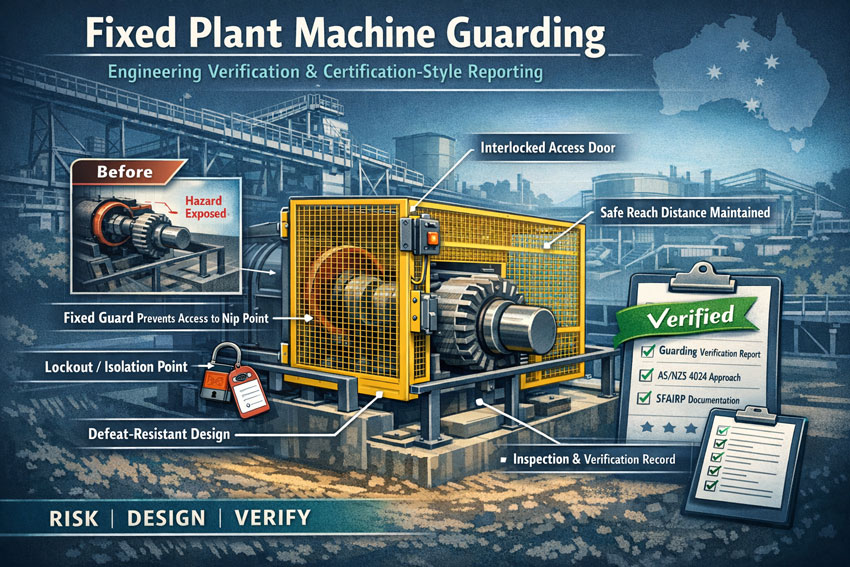
Engineering verification of fixed plant guarding with interlocked guard and inspection report.

What We Mean by โ€œGuarding Certificationโ€

In Australia, machine guarding is not typically certified under a single universal โ€œproduct stamp.โ€ Instead, machine guarding is assessed and verified through:

  • engineering design and risk-based safeguarding
  • alignment to recognised standards and good practice
  • site verification, inspection, and documentation that supports WHS duties

When we certify a guarding design, we provide an engineering verification that the guarding system has been assessed against Australian safety expectations and provides risk reduction so far as reasonably practicable (SFAIRP) for the intended use.



Fixed Plant Machine Guarding Services

We support fixed plant guarding across mining, processing, manufacturing, infrastructure and heavy industry, including:

Guarding Design & Retrofit Engineering

  • Fixed guards, mesh guards and perimeter guarding
  • Access prevention and safe maintenance access planning
  • Retrofit guarding upgrades for brownfields equipment
  • Guard structural design (frames, supports, fixings, corrosion allowance)

Guarding Verification & Certification Reports

  • Guard inspections (site verification and measurements)
  • Guarding compliance review and gap assessments
  • Design verification and risk reduction justification
  • Practical recommendations that balance safety and maintainability

Interlocks & Guarding Systems (Design Support)

  • Guard-associated interlocking concepts
  • Lock-out and isolation integration
  • Practical โ€œdefeat-resistantโ€ guard design principles

(Where functional safety calculations or specialist electrical control validation is required, we can work alongside your controls team or specialist partners.)


What We Deliver

Each project is documented for clarity and defensibility. Typical deliverables include:

  • Guarding risk review (hazards, access points, foreseeable misuse)
  • Design drawings / sketches and installation guidance
  • Verification checklist (inspection points and acceptance criteria)
  • Engineering Verification Report (often used as โ€œcertificationโ€ evidence)
  • Photo record and โ€œas-installedโ€ notes (where applicable)
  • Limitations, assumptions, and maintenance requirements

Standards & Compliance Approach

Our methodology is aligned with widely accepted Australian safeguarding practice, including:

  • AS/NZS 4024 (Safety of Machinery series)
  • Risk-based safeguarding methodology consistent with ISO 12100 principles
  • WHS duty expectations for plant and machinery risk control

We donโ€™t just reference standards โ€” we apply them to real conditions on your site: access, maintenance needs, exposure time, and realistic human behaviour around machines.


Who We Work With

We support:

  • mine sites and processing plants
  • maintenance departments
  • project teams (brownfields upgrades and shutdown work)
  • workshop supervisors and fabrication teams
  • OEMs and equipment suppliers needing Australian verification support

Whether your plant is locally built or imported, the end goal is the same: a safe guarding system that holds up under WHS scrutiny.


Why Hamilton By Design

Hamilton By Design is an engineer-led team that understands operational realities. We design guarding that:

  • protects people without creating unsafe workarounds
  • supports maintainability and inspection access
  • is practical to fabricate and install
  • is backed by professional engineering documentation

If you need a guarding solution that is fit-for-purpose and properly verified, we can support your team from assessment to final sign-off.


Typical Use Cases

  • Imported machinery requiring Australian guarding verification
  • Pre-commissioning guard reviews before handover
  • Incident-driven guarding upgrades
  • Shutdown retrofit packages and fabrication-ready guard designs
  • Periodic plant guarding audits and gap registers
3D LiDAR scanning and 3D modelling service button โ€” laser scanner capturing a point cloud for engineering and CAD modelling
Mechanical engineering services

Hamilton By Design logo displayed on a blue tilted rectangle with a grey gradient background

Call to Action

If you need a machine guarding certification-style verification or a complete fixed plant guarding design package, contact the Hamilton By Design team.

Letโ€™s reduce risk, protect your people, and keep your plant operating safely.

Name
Would you like us to arrange a phone consultation for you?
Address

3D CAD Modelling Australia service banner for Hamilton By Design
3D LiDAR scanning and 3D modelling service button โ€” laser scanner capturing a point cloud for engineering and CAD modelling
Mechanical engineering services
Mechanical drafting services button
Blue rounded button with the text โ€œSolidWorks Designโ€ in white.
Blue banner graphic displaying the text "Point Cloud to CAD - Australia" in large white lettering, representing point cloud processing, scan-to-CAD conversion and digital engineering services across Australia.
Mechanical, Structural & Pipework Drafting service banner by Hamilton By Design featuring white text on a blue background.
Engineering Governance title graphic featuring bold white text reading "Engineering Governance" centred on a blue rounded rectangle background.
Mining Plant Upgrades promotional graphic with bold white text on a blue background representing mining infrastructure, plant improvement, and engineering upgrade projects.
3D Pipework promotional graphic with bold white text on a blue background representing pipework design, modelling, drafting, and engineering services.
Australian Drafting logo featuring bold white text reading "Australian Drafting" centred on a blue rounded rectangle background.
3D Pipework promotional graphic with bold white text on a blue background representing pipework design, modelling, drafting, and engineering services.
Mining Plant Upgrades promotional graphic with bold white text on a blue background representing mining infrastructure, plant improvement, and engineering upgrade projects.
3D LiDAR Scanning for Engineering Projects title graphic featuring bold white text on a blue rounded rectangle background.
Australian Drafting logo featuring bold white text reading "Australian Drafting" centred on a blue rounded rectangle background.
Engineering Governance title graphic featuring bold white text reading "Engineering Governance" centred on a blue rounded rectangle background.
Mechanical, Structural & Pipework Drafting service banner by Hamilton By Design featuring white text on a blue background.
Mechanical engineering services
Blue rounded button with the text โ€œSolidWorks Designโ€ in white.
Finite Element Analysis (FEA) engineering simulation button

Mechanical Engineering | Structural Engineering


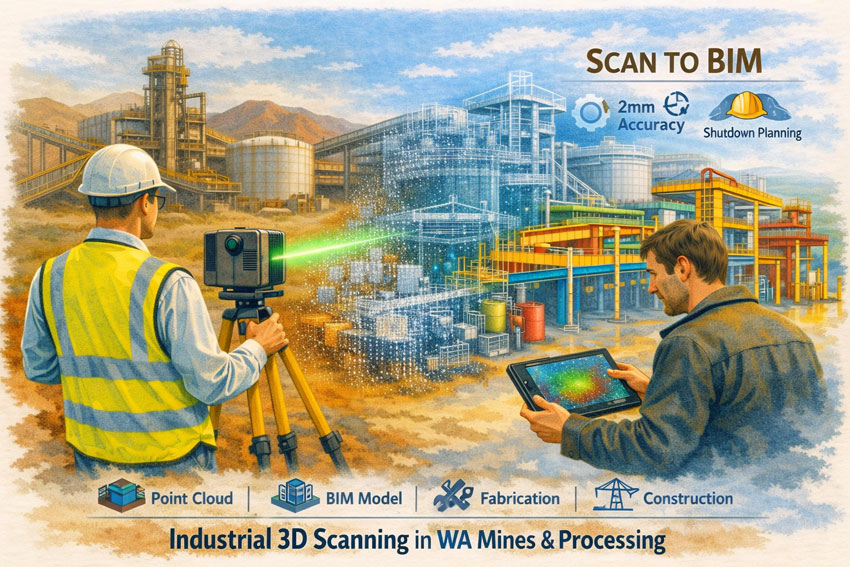
Industrial 3D Scanning in WA Mines & Processing

Laser scanning of WA mining infrastructure with Scan-to-BIM visualisation for industrial processing engineering.

Industrial 3D Scanning in WA Mines & Processing | Scan-to-BIM

Building Engineering Certainty in Brownfield Environments

Western Australiaโ€™s mining and mineral processing sector operates some of the most complex industrial assets in the world. Aging infrastructure, continuous production demands, and aggressive expansion schedules mean that every engineering decision must be based on accurate, reliable information. Industrial 3D Scanning in WA Mines & Processing has become the foundation for achieving this certaintyโ€”providing precise digital representations of plants, structures, and equipment before a single drawing is issued.


Industrial 3D scanning in WA mines showing laser capture of a processing plant with point cloud transforming into a BIM model.

The Backbone of Modern Mine Engineering

A laser scan is not simply a survey tool; it is the backbone of the entire project lifecycle. The quality of the initial scan determines the ease and accuracy of every task that followsโ€”layout design, clash detection, fabrication, and construction. If the backbone is broken, even simple tasks become difficult. Poor capture leads to rework, fabrication errors, and costly shutdown delays.

Industrial 3D scanning captures millions of measured points across conveyors, tanks, structural steel, pipe racks, and mechanical equipment with millimetre accuracy. For WA mine sites where access is restricted and downtime is expensive, this technology removes guesswork and replaces assumptions with verified data.


From Point Cloud to BIM Deliverables

The true value of scanning lies in what is delivered after capture. For mines and processing facilities, typical outputs include:

  • Engineering-grade point clouds for AutoCAD, Revit, and plant design platforms
  • Scan-to-BIM models of structures, pipework, and mechanical systems
  • Fabrication-ready DXF, STEP, or Parasolid files
  • Navisworks meshes for stakeholder review and constructability planning
  • As-built verification for shutdown and tie-in works

These deliverables allow engineering teams to design remotely, plan upgrades with confidence, and eliminate the need for repeated site visits across the vast distances of Western Australia.

Protecting the Project Team

Industrial projects are often pressured by schedules and budgets. High-quality 3D scanning protects the entire delivery teamโ€”project managers, engineers, designers, and fabricatorsโ€”by providing an objective source of truth. When design decisions are based on measured reality rather than tape measures and sketches, disputes reduce and collaboration improves.

For brownfield WA sites with decades of undocumented modifications, scanning becomes the neutral reference that aligns contractors, owners, and operators around the same dataset.

Applications Across WA Mines & Processing

Industrial 3D Scanning in WA Mines & Processing supports a wide range of activities:

  • Shutdown planning and tie-in verification
  • Conveyor and chute upgrades
  • Tank and structural remediation
  • Pipe spool prefabrication
  • Access platform and maintenance improvements
  • Expansion of crushing and screening circuits
  • Safety and egress compliance reviews

Whether in the Pilbara iron ore operations, Goldfields processing plants, or nickel and lithium facilities, scanning reduces risk in some of Australiaโ€™s harshest and most remote environments.

Remote Doesnโ€™t Mean Isolated

Western Australian mine sites can feel isolated, yet digital capture connects them directly to engineering teams anywhere in Australia. A single field visit can provide enough data for months of detailed design work. Teams can โ€œwalk the plantโ€ virtually, measure clearances, and develop solutions without repeated flights or shutdown interruptions.

An Engineer-Led Approach

Effective scan programs must be led by engineers who understand how the data will be used. Capture strategies, target placement, and accuracy tolerances are defined around the BIM deliverables, not around the scanner. This ensures that the final models support fabrication, not just visualisation.

3D LiDAR scanning and 3D modelling service button โ€” laser scanner capturing a point cloud for engineering and CAD modelling
Mechanical engineering services

Hamilton By Design logo displayed on a blue tilted rectangle with a grey gradient background

Industrial 3D Scanning in WA Mines & Processing is no longer optionalโ€”it is the starting point for safe, efficient, and predictable project delivery. When the backbone is strong, every downstream task becomes easier.

If your operation is planning upgrades, shutdowns, or expansions, begin with a measured digital foundation and let the data drive the outcome.

Our clients

Contact Us – Talk to Us

Name
Would you like us to arrange a phone consultation for you?
Address

Mechanical Engineering Perth WA banner for Hamilton By Design featuring white text on a blue background.
3D Laser Scanning Perth WA banner for Hamilton By Design with white text on a blue background.
SolidWorks Perth WA banner for Hamilton By Design featuring white text on a blue background.
https://www.hamiltonbydesign.com.au/perth-wa
3D CAD Modelling Australia service banner for Hamilton By Design
Mechanical Engineering Perth WA banner for Hamilton By Design featuring white text on a blue background.
3D Laser Scanning Perth WA banner for Hamilton By Design with white text on a blue background.
SolidWorks Perth WA banner for Hamilton By Design featuring white text on a blue background.
3D LiDAR scanning and 3D modelling service button โ€” laser scanner capturing a point cloud for engineering and CAD modelling
Mechanical engineering services
https://www.hamiltonbydesign.com.au/perth-wa

3D CAD Modelling Australia service banner for Hamilton By Design


CHPP Engineering title graphic featuring bold white text reading "CHPP Engineering" centred on a blue rounded rectangle background.
Pipework Drafting title graphic featuring bold white text reading "Pipework Drafting" centred on a blue rounded rectangle background.
3D LiDAR Scanning for Engineering Projects title graphic featuring bold white text on a blue rounded rectangle background.


Finite Element Analysis (FEA) engineering simulation button
Structural drafting services button
Mechanical drafting services button


Australian Drafting logo featuring bold white text reading "Australian Drafting" centred on a blue rounded rectangle background.
Engineering Governance title graphic featuring bold white text reading "Engineering Governance" centred on a blue rounded rectangle background.
Engineering-Grade LiDAR Scanning title graphic featuring bold white text on a blue rounded rectangle background.


Mechanical drafting services button
Structural drafting services button


Fabrication and product design services
3D CAD Modelling Australia service banner for Hamilton By Design
Mechanical, Structural & Pipework Drafting service banner by Hamilton By Design featuring white text on a blue background.


3D LiDAR scanning and 3D modelling service button โ€” laser scanner capturing a point cloud for engineering and CAD modelling
Mechanical engineering services
Mining & Processing Perth WA banner for Hamilton By Design featuring white text on a blue background.
Scan to BIM Perth WA banner for Hamilton By Design featuring white text on a blue background.
Ship Building Perth WA banner for Hamilton By Design featuring white text on a blue background.
Structural drafting services button
3D LiDAR scanning and 3D modelling services button
Mechanical drafting services button

Foundations First: What Recent Media Coverage Reminds Engineers About Process

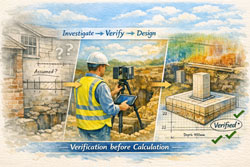
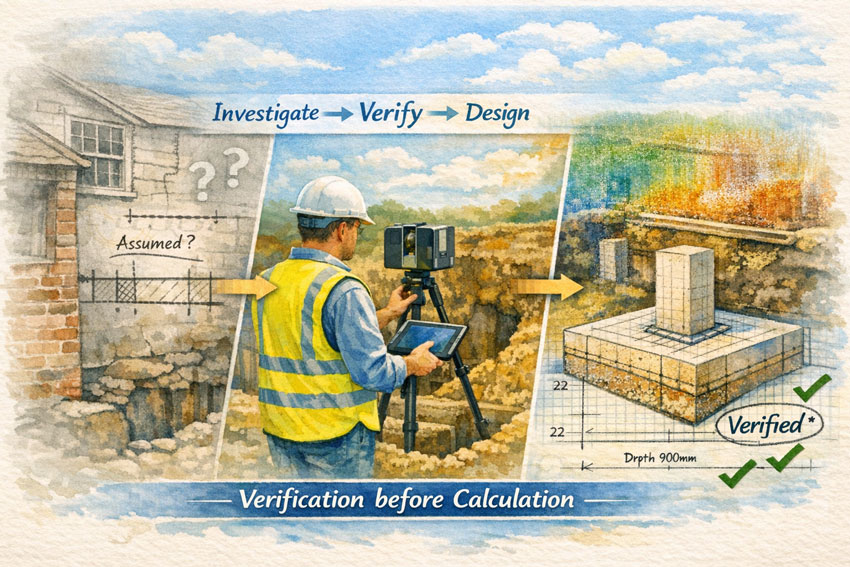
Watercolour-style illustration showing an engineer using a laser scanner to verify existing foundations before design, moving from โ€œassumedโ€ to โ€œverifiedโ€.

Engineering Lessons from Recent Media: Foundations & Process First

A recent Tasmanian news story reported on a homeowner receiving a substantial payout after major renovations led to cracking in their house. The coverage in The Mercury described how the problems were linked to inadequate consideration of existing footings and ground conditions during the design of a second-storey extension:

Woodbridge homeowner wins huge payout after home cracked following two-storey extension
https://www.themercury.com.au/truecrimeaustralia/police-courts-tasmania/woodbridge-homeowner-wins-huge-payout-after-home-cracked-following-twostorey-extension

Legal industry commentators also discussed the same matter as a reminder of professional responsibilities when working on existing buildings:

Cracks in the duty: When engineers miss the foundations โ€“ Barry Nilsson Lawyers
https://bnlaw.com.au/knowledge-hub/insights/cracks-in-the-duty-when-engineers-miss-the-foundations/

Rather than revisiting who was right or wrong, the reporting offers a constructive opportunity to reflect on how everyday engineering processes can be improvedโ€”especially on renovation and brownfield projects where information is incomplete.


1. Investigation Is Part of Design

The media narrative highlights a simple truth:
when we work with existing structures, the ground and foundations are not background detailsโ€”they are primary design inputs.

Good practice means:

  • Treating site verification as a formal stage of the project
  • Making recommendations for geotechnical or structural checks early
  • Being clear about what is known and what is assumed

A design based only on drawings is never as reliable as one based on verified conditions.


2. Make Assumptions Visible

News coverage often shows that problems grow in the grey space between architect, engineer, and builder.

Helpful habits include:

  • Keeping an assumptions register shared by the whole team
  • Noting on drawings what has been confirmed on site
  • Setting clear triggers for further investigation

When assumptions have owners, risks have boundaries.


3. Communication Is a Structural Element

Many reported disputes stem less from technical ability and more from gaps in communication.

Engineers can lead by:

  • Discussing uncertainties openly at the start
  • Confirming decisions in writing after meetings
  • Encouraging contractors to report unexpected conditions

Good communication is often cheaper than remediation.


4. Scope Changes = Risk Changes

Renovations rarely stay the same as the first sketch.
Media accounts of failures frequently involve projects that grew beyond the original intent.

Better process includes:

  • Re-checking engineering scope whenever the design evolves
  • Linking approvals to stages of investigation
  • Pricing verification as a real deliverable, not an afterthought

Clarity of scope is a form of structural strength.


5. Document the Story of the Project

Journalists and lawyers both rely on records to understand what happened.

For engineers, simple steps make a big difference:

  • Photos tied to inspection notes
  • Short design basis statements
  • Emails confirming client instructions
  • Sketches of as-found conditions

Documentation is not defensiveโ€”it is professional memory.


6. Respect the Interface Between Old and New

The media coverage repeatedly points to the moment where new work met an older structure.
That interface is where uncertainty lives.

Practical responses:

  • Specific checks on existing footings before adding load
  • Independent review for heritage or unknown construction
  • Monitoring after completion to confirm behaviour

The junction between old and new deserves the most attention.


7. The Courage to Pause

Perhaps the most human lesson from the reports is that engineers sometimes need to slow a project down.

Saying:

โ€œWe need more information before proceedingโ€

is not obstructionโ€”it is professionalism.

Organisations that support this courage protect clients and engineers alike.


Turning Headlines into Better Practice

The story covered by The Mercury and the subsequent industry commentary do not need to be read as cautionary tales. They can be read as learning opportunities:

  • Investigate before you calculate
  • Make assumptions visible
  • Communicate uncertainty early
  • Document decisions clearly
  • Treat existing conditions with respect

These are the foundations of good engineering, long before concrete is poured.


Engineer performing site investigation with 3D scanner, illustrating investigate โ†’ verify โ†’ design workflow for existing structures.

Final Thought

Risk will always exist in renovation and brownfield work.
What we control is the process we wrap around that risk.

When engineers focus on verification, transparency, and collaboration, projects become safer, clients are better served, and the profession grows stronger.

Good engineering is not only about correct numbersโ€”
it is about asking the right questions at the right time.

References

โ€œWoodbridge homeowner wins huge payout after home cracked following two-storey extensionโ€ โ€” The Mercury (Tasmania)
๐Ÿ”— https://www.themercury.com.au/truecrimeaustralia/police-courts-tasmania/woodbridge-homeowner-wins-huge-payout-after-home-cracked-following-twostorey-extension/news-story/32fe411a57c2471be44962cba86100bd


3D CAD Modelling Australia service banner for Hamilton By Design
Finite Element Analysis (FEA) engineering simulation button
Mechanical engineering services

Mechanical Engineering | Structural Engineering