Reverse Engineering Industrial Equipment Using 3D Scanning

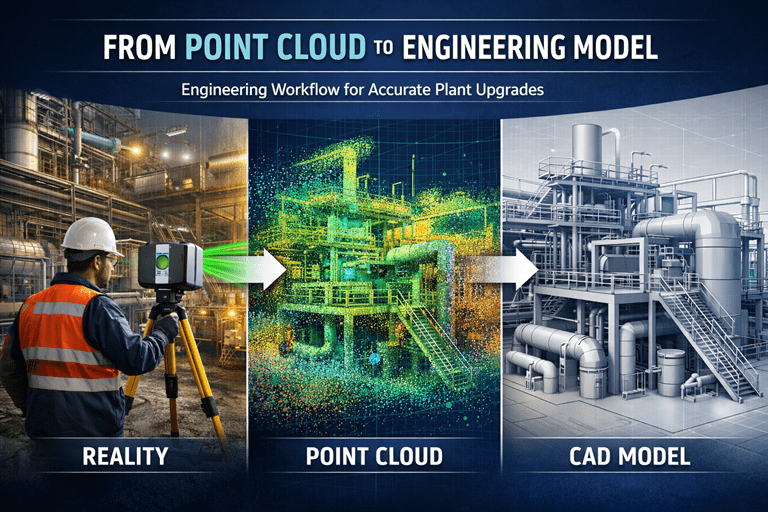
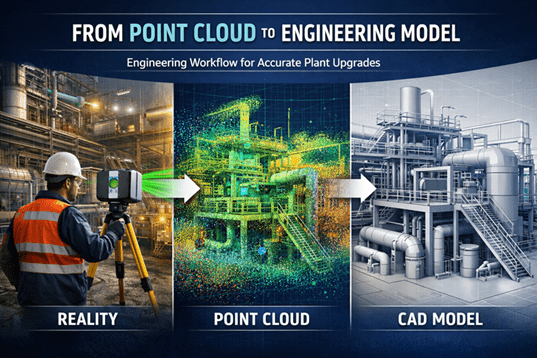
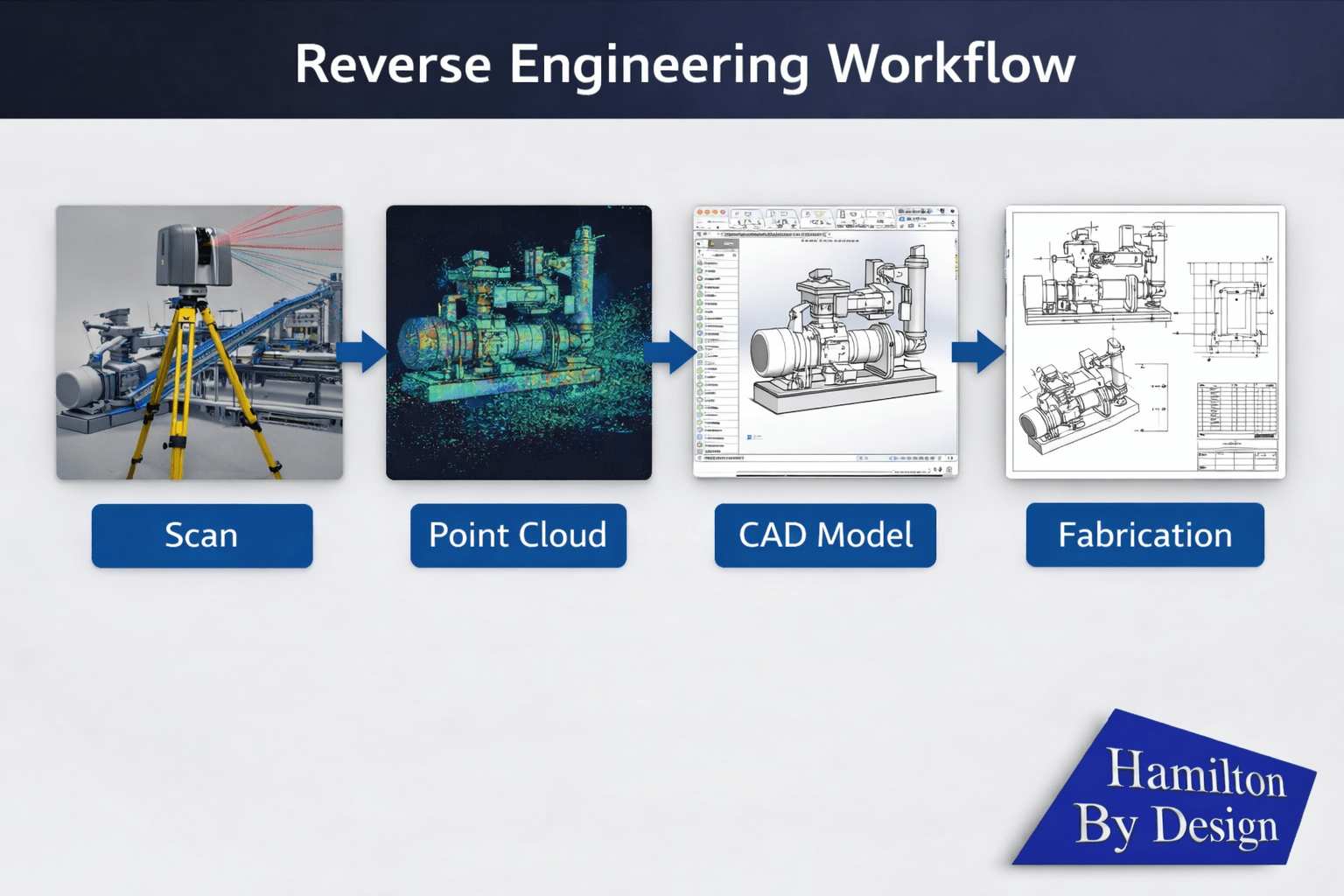
Reverse engineering workflow showing LiDAR scanning, point cloud processing, CAD modelling, and fabrication drawings for industrial equipment.

How 3D Scanning Supports Reverse Engineering in Mining and Industrial Facilities

In many mining and industrial operations, critical equipment often remains in service for decades. Over time, original design drawings may be lost, outdated, or incomplete. When upgrades, repairs, or replacements are required, engineers frequently need to recreate accurate models of existing components.

This is where reverse engineering scanning using 3D laser scanning technology has become an important engineering tool.

By capturing highly accurate measurements of existing equipment and infrastructure, engineers can develop digital models that support redesign, modification, or replication of components used in industrial operations.

At Hamilton By Design, 3D scanning is commonly used to support plant upgrades, equipment refurbishment, and engineering redesign projects across mining and industrial facilities.

Learn more about our scanning services here:


What is Reverse Engineering Using 3D Scanning?

Reverse engineering is the process of analysing an existing component or system in order to recreate its design data.

In industrial environments this often involves:

  • worn or obsolete equipment
  • legacy plant installations
  • components without available drawings
  • equipment modifications over time

Using 3D laser scanning, engineers can capture millions of measurement points across the surface of a component or installation. These measurements form a point cloud dataset, which can then be converted into a detailed CAD model.

This model can be used to redesign components, manufacture replacements, or integrate upgrades into existing plant infrastructure.


Why Reverse Engineering Is Common in Mining Operations

Mining facilities frequently operate with equipment that may have been installed many years earlier. Over time, modifications are made during shutdowns or maintenance activities, and the documentation of these changes may not always be updated.

When engineering teams plan upgrades, they often encounter situations where:

  • original drawings are unavailable
  • components have been modified in the field
  • replacement parts are no longer manufactured
  • installation geometry differs from the original design

In these cases, reverse engineering scanning allows engineers to capture the current condition of the equipment and create accurate digital models for design work.


How 3D Scanning Improves Reverse Engineering Accuracy

Traditional reverse engineering often relied on manual measurements and site sketches. While useful, these methods can introduce uncertainty when modelling complex components.

3D laser scanning improves this process by capturing a highly detailed representation of the equipment geometry.

Benefits include:

  • accurate measurement of complex shapes
  • capture of worn or distorted components
  • reduced manual measurement time
  • improved confidence in engineering models
  • better integration with existing plant infrastructure

Because scanning captures millions of points, engineers can analyse the exact condition of equipment before beginning redesign work.


Reverse Engineering Workflow Using 3D Scanning

A typical reverse engineering scanning workflow includes several steps.

1. Equipment Scanning

Engineers capture the geometry of the component or installation using a terrestrial laser scanner or handheld scanning system.

2. Point Cloud Processing

The captured scans are registered and processed to create a unified point cloud dataset representing the object.

3. CAD Model Creation

Engineers convert the scan data into engineering models using CAD software such as SolidWorks.

4. Design and Modification

The model can then be used to redesign components, analyse fitment, or prepare fabrication drawings.

You can learn more about this process here:


Applications of Reverse Engineering in Industrial Plants

Reverse engineering scanning is widely used in industrial facilities for many types of engineering work.

Common applications include:

  • reverse engineering pump components
  • redesigning worn mechanical equipment
  • recreating legacy machine parts
  • documenting existing plant installations
  • designing upgrades for conveyors and materials handling systems
  • integrating new equipment into existing plant layouts

These applications allow engineering teams to modernise infrastructure while maintaining compatibility with existing systems.


Reverse Engineering for Plant Upgrade Projects

Plant upgrades often require engineers to integrate new equipment into an existing facility that may have evolved over many years.

Using reverse engineering scanning, engineers can capture accurate geometry of the surrounding infrastructure before beginning design work.

This approach helps reduce risks such as:

  • component clashes
  • installation issues
  • inaccurate fabrication drawings
  • extended shutdown durations

Accurate digital models allow engineers to design upgrades with confidence and improve coordination between mechanical, structural, and fabrication teams.

Learn more about capturing existing conditions before plant upgrades here:


Conclusion

Reverse engineering using 3D scanning has become an essential engineering tool for mining and industrial facilities where accurate design data may not always be available.

By capturing precise measurements of existing equipment and infrastructure, engineers can recreate digital models that support repairs, upgrades, and replacement components.

For industries that rely on complex infrastructure and long operational lifecycles, reverse engineering scanning provides a reliable foundation for modern engineering design and plant upgrades.

Hamilton By Design provides engineering-grade 3D scanning services to support reverse engineering and upgrade projects across mining and industrial operations.


3D LiDAR scanning and 3D modelling service button โ€” laser scanner capturing a point cloud for engineering and CAD modelling
Mechanical engineering services
Name
Would you like us to arrange a phone consultation for you?
Address

Our Clients

3D CAD Modelling Australia service banner for Hamilton By Design
Finite Element Analysis (FEA) engineering simulation button
Mechanical engineering services

More Reading โ€“ Engineering Articles and Technical Resources

Engineer using a laser scanner capturing an industrial facility, converting scan data into a point cloud and engineering CAD model.

At Hamilton By Design, we regularly publish articles about engineering workflows, plant upgrades, LiDAR scanning, mechanical design, and industrial infrastructure.

We also contribute to technical discussions and engineering blogs that explore topics such as point cloud modelling, SolidWorks design, pipework detailing, and mining infrastructure upgrades.

This page provides a collection of additional technical reading and external resources related to engineering design and digital engineering workflows.

These articles complement the work we do at Hamilton By Design and may be useful for engineers, project managers, designers, and plant operators involved in industrial and mining infrastructure projects.


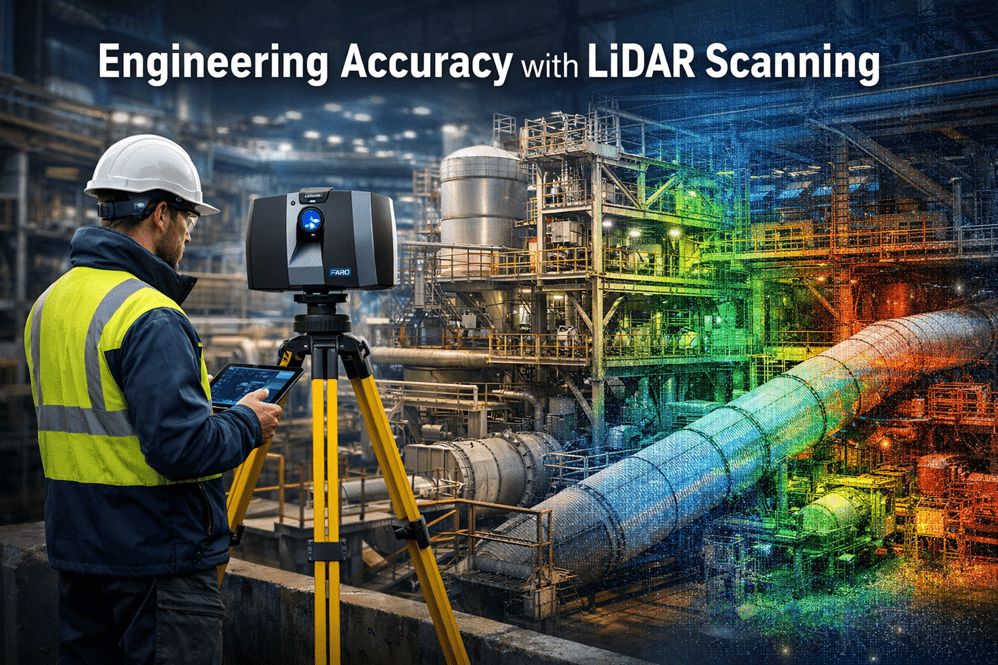
Industrial engineer operating a LiDAR laser scanner capturing high-accuracy point cloud data of a processing plant for engineering design and infrastructure upgrades.

Pipework Detailing and SolidWorks Design

One area where modern digital workflows are particularly valuable is pipework detailing and fabrication drawing development.

By combining LiDAR scanning with SolidWorks modelling, engineers can capture the true geometry of existing plant infrastructure and develop accurate pipe spool drawings for fabrication and installation.

The following article explores how laser scanning data can be used to support this workflow:

From Laser Scan to Pipe Spool Drawings โ€“ Using SolidWorks and LiDAR Data for Accurate Pipework Design

https://pipeworkdetailing.blogspot.com/2026/03/from-laser-scan-to-pipe-spool-drawings.html

This article discusses how engineering teams can move from capturing plant geometry with LiDAR scanning through to generating pipe spool drawings for fabrication.


LiDAR Scanning and Engineering Design Workflows

Laser scanning is increasingly used across industrial and mining projects to capture existing plant conditions before upgrades or modifications begin.

At Hamilton By Design we use engineering-grade LiDAR scanning to support:

โ€ข Mining infrastructure upgrades
โ€ข Industrial plant modifications
โ€ข Mechanical equipment installations
โ€ข Structural steel design
โ€ข Pipework routing and detailing
โ€ข Shutdown engineering projects

By converting scan data into engineering models, design teams can work directly against the true geometry of the plant environment.


You may also find the following articles useful:

Engineering Grade 3D Laser Scanning for Mining and Industrial Projects
https://www.hamiltonbydesign.com.au/home/engineering-grade-3d-laser-scanning-mining-industrial/

3D Laser Scanning Across Australia
https://www.hamiltonbydesign.com.au/home/engineering-services/3d-laser-scanning/3d-laser-scanning-across-australia/

3D Laser Scanning for Mining Plant Upgrades
https://www.hamiltonbydesign.com.au/engineering-grade-3d-laser-scanning-mining-plant-upgrades/

3D Laser Scanning for Mining Shutdown Projects
https://www.hamiltonbydesign.com.au/3d-laser-scanning-mining-shutdowns/

Capture Existing Conditions Before Plant Upgrades
https://www.hamiltonbydesign.com.au/capture-existing-conditions-before-plant-upgrades/

Point Cloud to Engineering Model Workflow
https://www.hamiltonbydesign.com.au/point-cloud-to-engineering-model-workflow/


Why We Share Additional Engineering Reading

Engineering projects often benefit from a combination of practical field knowledge, digital modelling workflows, and collaboration across the engineering community.

By sharing additional articles and resources, we hope to contribute to ongoing discussions about:

โ€ข Engineering measurement and accuracy
โ€ข Digital engineering workflows
โ€ข Mining infrastructure design
โ€ข Mechanical and structural modelling
โ€ข Industrial plant upgrades

If you are interested in discussing engineering-grade 3D laser scanning, mechanical engineering design, or infrastructure upgrades, please feel free to contact Hamilton By Design.

3D LiDAR scanning and 3D modelling service button โ€” laser scanner capturing a point cloud for engineering and CAD modelling
Mechanical engineering services
Name
Would you like us to arrange a phone consultation for you?
Address
3D CAD Modelling Australia service banner for Hamilton By Design

Mechanical Engineering, 3D Laser Scanning and Pump Rebuilding Services in Biloela, Queensland

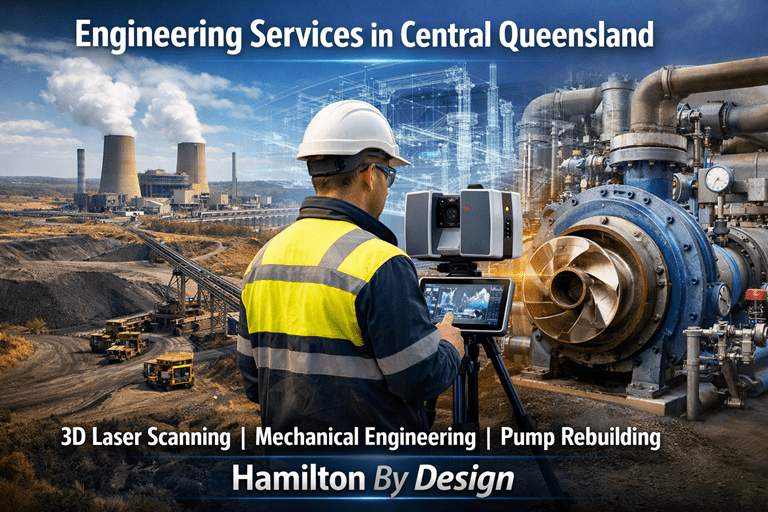
Industrial engineering services including 3D laser scanning mechanical engineering and pump rebuilding in Central Queensland

Supporting Mining, Power Generation and Industrial Infrastructure in the Callide Valley

The region surrounding Biloela plays an important role in Queenslandโ€™s energy and agricultural economy. With coal mining operations, power generation facilities, meat processing plants, and large agricultural enterprises, the area relies heavily on reliable mechanical and structural infrastructure.

Hamilton By Design provides engineering-grade technical services supporting industrial sites, shutdown projects and plant upgrades across regional Australia.

Our team works with mining operators, power stations, processing plants and engineering contractors who require accurate site data and practical mechanical engineering solutions.


Engineering Challenges in the Biloela Region

Industrial operations in and around Biloela typically operate under demanding conditions where equipment reliability and accurate engineering documentation are critical.

Many facilities in the region have been operating for decades and face challenges such as:

  • ageing plant infrastructure
  • incomplete or outdated drawings
  • shutdown upgrades and modifications
  • structural modifications for new equipment
  • pump and rotating equipment failures
  • plant expansions requiring accurate site measurements

Hamilton By Design supports engineering teams by providing accurate digital site capture and practical mechanical design support.


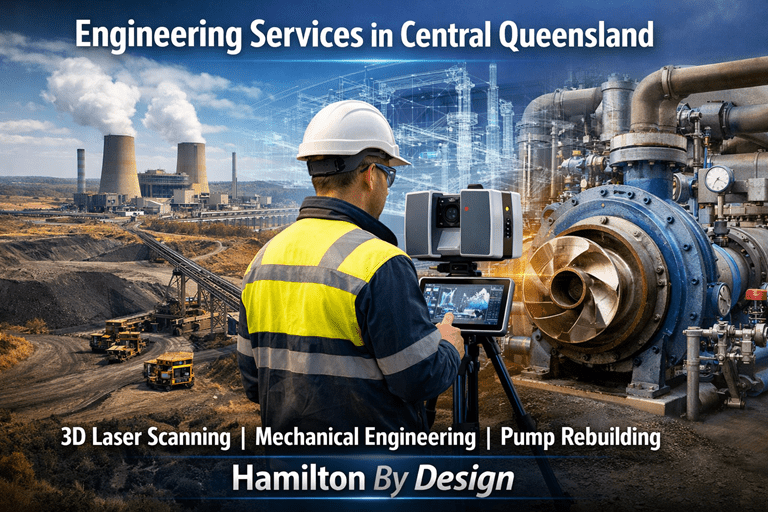
Mechanical engineering and 3D laser scanning services supporting mining and industrial infrastructure in Biloela Central Queensland

3D Laser Scanning for Mining and Industrial Sites

3D laser scanning is increasingly used across mining, power generation and industrial processing facilities to capture existing site conditions with high accuracy.

Hamilton By Design provides engineering-grade 3D laser scanning services suitable for:

  • mining infrastructure
  • power station upgrades
  • materials handling equipment
  • conveyor systems
  • structural steel modifications
  • pipework and pump installations

Laser scanning produces a high-resolution point cloud model of the site, allowing engineers to design modifications with confidence.

This approach helps reduce:

  • site rework
  • design clashes
  • shutdown delays
  • fabrication errors

By capturing accurate site geometry before engineering design begins, projects can move forward with significantly lower risk.


Mechanical Engineering Services

Hamilton By Design provides mechanical engineering design, drafting and technical support for industrial operations.

Typical engineering work includes:

  • pump and piping systems
  • materials handling equipment
  • conveyor structures
  • mechanical plant upgrades
  • structural support steel
  • shutdown engineering documentation
  • reverse engineering of components

Our experience supporting mining and industrial operations across Australia allows us to deliver practical engineering solutions suited to both metropolitan and regional industrial facilities.


Wastewater and Industrial Pump Rebuilding Services

Many industrial facilities and processing plants rely on wastewater pumping systems to move process water, slurry and waste streams throughout their operations.

Large wastewater systems often use major American-manufactured pump installations, however these systems frequently depend on smaller pumps throughout the plant for auxiliary and transfer duties.

Through our partner company ALNO CNC Machining, we provide specialist pump rebuilding and repair services for these smaller style pumps used throughout industrial wastewater systems.

These pumps are commonly used for:

  • transfer pumping
  • sump pumping
  • washdown systems
  • auxiliary pumping stations
  • process water circulation

Our pump rebuilding services include:

  • pump disassembly and inspection
  • shaft and impeller refurbishment
  • machining of worn components
  • seal and bearing replacement
  • reverse engineering of obsolete parts

By restoring worn pumps rather than replacing them, operators can often reduce downtime and significantly lower equipment replacement costs.


Supporting Regional Industry in Central Queensland

Hamilton By Design understands the challenges faced by regional industrial operations, particularly in mining and energy producing regions.

Our services support industrial operators in and around Biloela, including facilities located throughout the Callide Valley and Central Queensland region.

We assist companies by providing:

  • engineering-grade 3D laser scanning
  • mechanical engineering design and drafting
  • accurate site documentation for plant upgrades
  • industrial pump rebuilding and repair support

Whether the requirement is a shutdown upgrade, equipment repair, plant modification or engineering documentation, our team can assist with delivering practical engineering solutions.


Hamilton By Design logo displayed on a blue tilted rectangle with a grey gradient background

Speak With Our Engineering Team

If you are planning a plant upgrade, shutdown project, or equipment repair in Central Queensland, Hamilton By Design can assist with engineering and technical support.

Our services include:

  • 3D Laser Scanning
  • Mechanical Engineering Design
  • Industrial Pump Rebuilding and Repair

To discuss your project requirements, please contact our engineering team.

3D LiDAR scanning and 3D modelling service button โ€” laser scanner capturing a point cloud for engineering and CAD modelling
Mechanical engineering services
Name
Would you like us to arrange a phone consultation for you?
Address
CHPP Engineering title graphic featuring bold white text reading "CHPP Engineering" centred on a blue rounded rectangle background.
Pipework Drafting title graphic featuring bold white text reading "Pipework Drafting" centred on a blue rounded rectangle background.
3D LiDAR Scanning for Engineering Projects title graphic featuring bold white text on a blue rounded rectangle background.
3D CAD Modelling Australia service banner for Hamilton By Design
Australian Drafting logo featuring bold white text reading "Australian Drafting" centred on a blue rounded rectangle background.
Engineering Governance title graphic featuring bold white text reading "Engineering Governance" centred on a blue rounded rectangle background.
Mechanical, Structural & Pipework Drafting service banner by Hamilton By Design featuring white text on a blue background.
Mechanical engineering services
Blue rounded button with the text โ€œSolidWorks Designโ€ in white.
Finite Element Analysis (FEA) engineering simulation button
3D LiDAR Scanning Darwin for engineering surveys, laser scanning, reality capture and point cloud modelling services
3D LiDAR Scanning Australia engineering services for laser scanning, reality capture, scan-to-CAD, Scan-to-BIM and as-built documentation across Australia
3D LiDAR scanning services on the Central Coast providing engineering-grade laser scanning, point cloud capture, scan-to-CAD modelling and industrial reality capture for infrastructure and industrial projects.
3D LiDAR Scanning Perth for engineering surveys, laser scanning, reality capture and point cloud modelling services
3D LiDAR Scanning Sydney for engineering surveys, laser scanning, reality capture and point cloud modelling services
3D LiDAR Scanning Brisbane for engineering surveys, laser scanning, reality capture and point cloud modelling services
3D LiDAR Scanning Canberra for engineering surveys, laser scanning, reality capture and point cloud modelling services
3D LiDAR Scanning Newcastle for engineering surveys, laser scanning, reality capture and point cloud modelling services
3D LiDAR Scanning Adelaide for engineering surveys, laser scanning, reality capture and point cloud modelling services

Mining Infrastructure Design Discussions โ€“ SolidWorks and Industrial Engineering

Engineering workflow showing industrial laser scanning, point cloud data, and a CAD model used for plant upgrade design.

Modern mining and industrial infrastructure projects increasingly rely on advanced digital engineering tools to support plant design, equipment upgrades, and infrastructure development. Engineers working in mining environments must often design and model complex systems including materials handling equipment, processing plant infrastructure, and structural steel frameworks.

Engineer using a laser scanner capturing an industrial facility, converting scan data into a point cloud and engineering CAD model.

One of the most commonly used design platforms for mechanical engineering and plant infrastructure modelling is SolidWorks, which allows engineers to develop detailed 3D assemblies and fabrication-ready engineering drawings.

At Hamilton By Design, many projects involve the integration of modern digital engineering workflows with practical industry experience. These workflows often include:

  • Mechanical design for mining infrastructure
  • Bulk materials handling system design
  • Industrial plant layout modelling
  • Point cloud modelling from laser scanning
  • Engineering design for plant upgrades and shutdown projects

Engineering Design in Mining Infrastructure

Mining infrastructure often includes complex systems such as conveyors, transfer stations, processing equipment, and plant structures. Designing or upgrading these systems requires accurate modelling of both existing infrastructure and proposed modifications.

Modern engineering teams frequently combine several technologies during the design process, including:

  • 3D laser scanning to capture existing plant conditions
  • Point cloud modelling to represent real-world infrastructure
  • CAD modelling using platforms such as SolidWorks
  • Engineering drawings and documentation for fabrication and construction

These tools allow engineers to develop more accurate designs and reduce risks when implementing plant modifications or shutdown upgrades.


Engineering Discussions and SolidWorks Design Examples

Engineering professionals often share practical insights, modelling approaches, and design workflows through technical blogs and engineering discussion platforms.

For those interested in SolidWorks modelling techniques, mining infrastructure design concepts, and materials handling engineering, additional discussions can be found on the following engineering blog:

Mining Infrastructure โ€“ SolidWorks Design
https://mininginfrastructuresolidworksdesign.blogspot.com/

The blog explores various topics including mechanical design workflows, industrial equipment modelling, and practical engineering approaches used when designing plant infrastructure.


Supporting Mining Engineering Projects

Hamilton By Design supports mining and industrial operators with engineering services that include mechanical design, infrastructure modelling, and reality capture technologies such as laser scanning.

Learn more about our engineering-grade scanning and modelling services:

Engineering-Grade 3D Laser Scanning for Mining and Industrial Projects
https://www.hamiltonbydesign.com.au/home/engineering-grade-3d-laser-scanning-mining-industrial/

3D Laser Scanning Across Australia
https://www.hamiltonbydesign.com.au/home/engineering-services/3d-laser-scanning/3d-laser-scanning-across-australia/

Capturing Existing Conditions Before Plant Upgrades
https://www.hamiltonbydesign.com.au/capture-existing-conditions-before-plant-upgrades/


3D LiDAR scanning and 3D modelling service button โ€” laser scanner capturing a point cloud for engineering and CAD modelling
Mechanical engineering services

Engineering Knowledge Sharing

Engineering blogs and technical discussion platforms provide an opportunity for engineers, designers, and industry professionals to share knowledge about real-world engineering challenges.

By combining practical industry experience with modern digital engineering tools, the mining and industrial sectors continue to improve the way infrastructure is designed, documented, and upgraded.

For more engineering discussions on SolidWorks design and mining infrastructure modelling, visit:

https://mininginfrastructuresolidworksdesign.blogspot.com

3D CAD Modelling Australia service banner for Hamilton By Design
Australian Drafting logo featuring bold white text reading "Australian Drafting" centred on a blue rounded rectangle background.
Engineering Governance title graphic featuring bold white text reading "Engineering Governance" centred on a blue rounded rectangle background.
Mechanical, Structural & Pipework Drafting service banner by Hamilton By Design featuring white text on a blue background.
Mechanical engineering services
Blue rounded button with the text โ€œSolidWorks Designโ€ in white.
Finite Element Analysis (FEA) engineering simulation button
3D LiDAR Scanning Darwin for engineering surveys, laser scanning, reality capture and point cloud modelling services
3D LiDAR Scanning Australia engineering services for laser scanning, reality capture, scan-to-CAD, Scan-to-BIM and as-built documentation across Australia
3D LiDAR scanning services on the Central Coast providing engineering-grade laser scanning, point cloud capture, scan-to-CAD modelling and industrial reality capture for infrastructure and industrial projects.
3D LiDAR Scanning Perth for engineering surveys, laser scanning, reality capture and point cloud modelling services
3D LiDAR Scanning Sydney for engineering surveys, laser scanning, reality capture and point cloud modelling services
3D LiDAR Scanning Brisbane for engineering surveys, laser scanning, reality capture and point cloud modelling services
3D LiDAR Scanning Canberra for engineering surveys, laser scanning, reality capture and point cloud modelling services
3D LiDAR Scanning Newcastle for engineering surveys, laser scanning, reality capture and point cloud modelling services
3D LiDAR Scanning Adelaide for engineering surveys, laser scanning, reality capture and point cloud modelling services

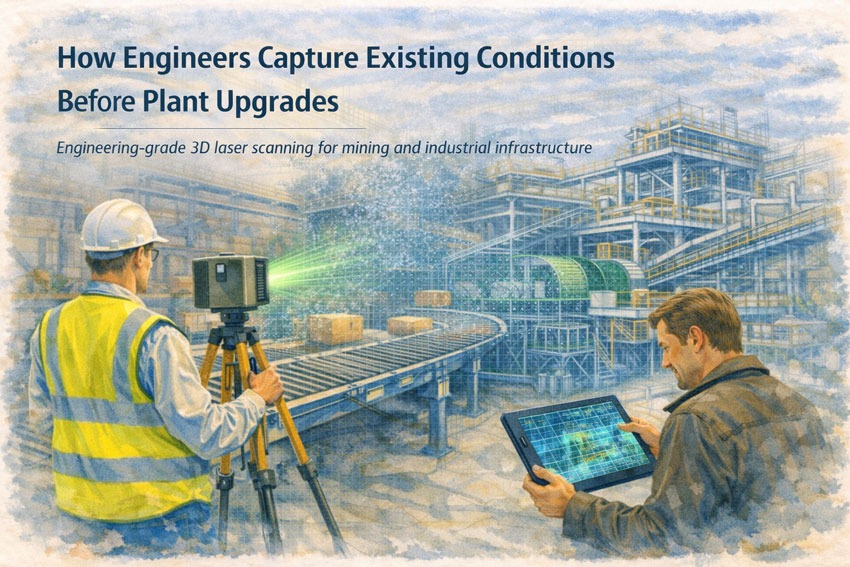
How Engineers Capture Existing Conditions Before Plant Upgrades

Engineer using a 3D laser scanner to capture existing conditions of mining plant infrastructure before upgrade engineering.

Mining and industrial processing plants are rarely static environments. Over time, equipment upgrades, maintenance modifications, structural repairs, and operational improvements result in plant infrastructure that no longer matches the original engineering drawings.

Before engineers can design plant upgrades, install new equipment, or modify existing infrastructure, they must first understand the true geometry of the existing plant environment.

Capturing accurate existing conditions is therefore one of the most important steps in any plant upgrade project.

Engineering teams commonly use 3D laser scanning, LiDAR surveying, and digital modelling techniques to create accurate representations of existing infrastructure before design work begins.

At Hamilton By Design, engineering-grade scanning technology is used to capture precise plant geometry and convert it into digital engineering models used for upgrade planning and design.

For an overview of how scanning supports mining and industrial infrastructure projects, see:

๐Ÿ‘‰ https://www.hamiltonbydesign.com.au/home/engineering-grade-3d-laser-scanning-mining-industrial/


3D laser scanning of mining conveyor and processing infrastructure to document existing plant geometry before upgrades.

Why Existing Conditions Matter in Plant Upgrade Projects

Plant upgrades often involve installing new equipment within complex existing infrastructure. This may include:

โ€ข upgrading conveyors and transfer towers
โ€ข installing new processing equipment
โ€ข modifying structural steel frameworks
โ€ข improving maintenance access and safety systems
โ€ข expanding plant throughput capacity

If the existing plant geometry is not accurately understood, installation work can become difficult or even impossible during shutdown periods.

Small dimensional differences between drawings and the real plant environment can lead to major installation challenges.

For this reason, capturing accurate existing conditions has become a critical step in modern mining infrastructure engineering.

Learn more about the broader engineering services supporting mining and mineral processing projects here:

๐Ÿ‘‰ https://www.hamiltonbydesign.com.au/home/mining-mineral-processing/


Traditional Methods of Capturing Existing Conditions

Historically, engineers relied on manual measurements and traditional surveying techniques to capture plant geometry.

These methods often involved:

โ€ข tape measurements
โ€ข total station surveys
โ€ข manual sketching and documentation
โ€ข physical inspections of plant infrastructure

While these methods can still be useful for small tasks, they are often slow and limited when working in large and complex industrial environments.

Mining plants frequently contain tightly packed infrastructure such as conveyors, structural steel, pipework, platforms, and maintenance equipment. Capturing this complexity using manual methods can be difficult and time-consuming.


Modern Approach: 3D Laser Scanning

Today, engineers increasingly rely on 3D laser scanning technology to capture existing plant conditions.

Laser scanning uses LiDAR technology to collect millions of spatial measurements of plant infrastructure. These measurements are combined into a point cloud dataset representing the exact geometry of the environment.

This digital dataset allows engineers to create highly accurate models of existing plant infrastructure before design work begins.

You can learn more about these services here:

๐Ÿ‘‰ https://www.hamiltonbydesign.com.au/home/engineering-services/3d-laser-scanning/


From Point Cloud to Engineering Model

Once laser scanning data has been captured, the point cloud dataset can be processed and converted into engineering models used for design and analysis.

Typical workflow includes:

  1. Planning scan locations within the plant
  2. Capturing infrastructure using LiDAR scanners
  3. Registering scan positions to create a unified point cloud
  4. Extracting structural and equipment geometry
  5. Creating CAD models for engineering analysis

These digital models allow engineers to analyse plant layouts, verify clearances, and design upgrade solutions before work begins on site.


Supporting Mining Plant Upgrade Engineering

Accurate digital models created from laser scanning are commonly used in projects involving:

โ€ข conveyor system upgrades
โ€ข transfer chute redesign
โ€ข structural modifications
โ€ข plant expansion projects
โ€ข installation of new processing equipment

By analysing the existing plant environment digitally, engineers can detect potential clashes and plan installation work before shutdown periods.

To learn more about engineering-grade scanning used for plant upgrade projects, visit:

๐Ÿ‘‰ https://www.hamiltonbydesign.com.au/engineering-grade-3d-laser-scanning-mining-plant-upgrades/


Reducing Risk During Shutdown Work

Many plant upgrades must be completed during planned shutdown periods, where time is limited and installation delays can be costly.

Capturing existing conditions before shutdown work begins allows engineers to develop upgrade designs and installation strategies in advance.

Digital models created from scan data allow engineering teams to:

โ€ข verify equipment clearances
โ€ข plan installation procedures
โ€ข identify potential conflicts between structures
โ€ข reduce unexpected installation challenges

This significantly improves the reliability of plant upgrade projects.


Engineering-Led Scanning for Mining Infrastructure

At Hamilton By Design, laser scanning is integrated directly with mechanical engineering workflows.

Rather than simply capturing survey data, scanning is performed with the goal of supporting engineering design and infrastructure upgrades.

This approach allows scan data to be converted into practical engineering solutions including:

โ€ข mechanical design models
โ€ข plant upgrade engineering
โ€ข structural analysis models
โ€ข digital infrastructure documentation

By combining engineering expertise with advanced scanning technology, accurate plant data can be used to develop reliable engineering outcomes.


Hamilton By Design logo displayed on a blue tilted rectangle with a grey gradient background

Learn More

If you would like to learn more about how engineers capture existing conditions before plant upgrades, explore the following resources:

Engineering-grade scanning overview:
๐Ÿ‘‰ https://www.hamiltonbydesign.com.au/home/engineering-grade-3d-laser-scanning-mining-industrial/

Mining and mineral processing engineering services:
๐Ÿ‘‰ https://www.hamiltonbydesign.com.au/home/mining-mineral-processing/

3D laser scanning engineering services:
๐Ÿ‘‰ https://www.hamiltonbydesign.com.au/home/engineering-services/3d-laser-scanning/

Mining plant upgrade engineering:
๐Ÿ‘‰ https://www.hamiltonbydesign.com.au/engineering-grade-3d-laser-scanning-mining-plant-upgrades/


Anthony Hamilton
Principal Engineer
Hamilton By Design


3D LiDAR scanning and 3D modelling service button โ€” laser scanner capturing a point cloud for engineering and CAD modelling
Mechanical engineering services
Name
Would you like us to arrange a phone consultation for you?
Address

3D CAD Modelling Australia service banner for Hamilton By Design

Scan for Conveyor Transfers

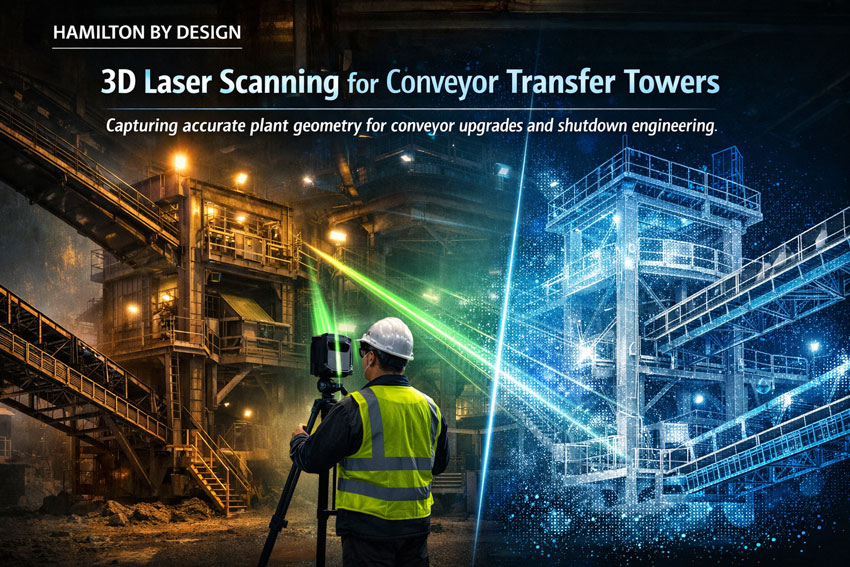
3D laser scanning of a mining conveyor transfer tower capturing point cloud data for engineering modelling.

Conveyor transfer towers are critical components within mining and bulk material handling operations. These structures control the movement of material between conveyors and often contain complex arrangements of chutes, structural steel, maintenance platforms, and access walkways.

Over time, many transfer towers are modified as production requirements change. Equipment upgrades, chute redesigns, and maintenance improvements can result in plant infrastructure that no longer matches the original engineering drawings.

For engineers planning upgrades or maintenance projects, accurate existing condition data is essential. One of the most effective ways to capture this information is through 3D laser scanning.

At Hamilton By Design, engineering-grade scanning is used to capture precise geometry of conveyor transfer towers and surrounding plant infrastructure. This data can then be converted into accurate digital models used for mechanical design, plant upgrades, and engineering analysis.

Engineer performing LiDAR scanning of a conveyor transfer tower in a mining processing plant.

Learn more about our engineering scanning capabilities here:
๐Ÿ‘‰ https://www.hamiltonbydesign.com.au/home/engineering-services/3d-laser-scanning/


Why Conveyor Transfer Towers Are Difficult to Measure

Transfer towers are often some of the most complex areas within a processing plant. They typically contain multiple systems operating within a confined structure including conveyors, transfer chutes, structural supports, and maintenance platforms.

These environments can include:

โ€ข multiple conveyors entering and exiting the structure
โ€ข chute systems with wear liners
โ€ข structural steel frames and supports
โ€ข maintenance walkways and access platforms
โ€ข dust control and service equipment

Because of the tight layout and elevation changes within these structures, traditional measurement methods can be slow and prone to error.

In many facilities, the original engineering drawings may also be outdated due to years of plant modifications.

Accurate measurement is therefore essential when designing upgrades or modifications to conveyor transfer systems.


Using 3D Laser Scanning to Capture Transfer Tower Geometry

Engineering-grade 3D laser scanning uses LiDAR technology to capture millions of spatial measurements of plant infrastructure.

The resulting dataset forms a point cloud model representing the exact geometry of conveyors, structural steel, chutes, and surrounding plant equipment.

This digital model allows engineers to analyse plant layouts and develop accurate engineering designs before physical work begins.

Laser scanning provides several advantages when working in conveyor transfer towers.

Accurate Existing Conditions

Scanning captures the true geometry of plant infrastructure, allowing engineers to design modifications based on reliable data rather than outdated drawings.

Improved Design Planning

Digital models generated from scan data allow engineers to verify clearances and identify potential clashes before installation.

Reduced Shutdown Risk

Engineering teams can plan installation work more effectively using digital models created from scan data.

Faster Data Capture

Laser scanning can capture complex structures quickly compared with traditional measurement methods.


3D Scanning for Mining Shutdown Projects

Many conveyor transfer tower upgrades are performed during planned mining shutdowns, where engineering teams must complete inspections, modifications, and installations within tight timeframes.

Laser scanning provides a fast and reliable way to capture accurate plant geometry before shutdown work begins. Engineers can then analyse the digital model and develop upgrade designs in advance.

This approach reduces the risk of unexpected installation issues during shutdown periods.

You can learn more about scanning applications during plant shutdowns here:

๐Ÿ‘‰ https://www.hamiltonbydesign.com.au/home/engineering-grade-3d-laser-scanning-mining-industrial/3d-scanning-mining-shutdown-projects/


From Laser Scan to Engineering Model

The laser scanning workflow for conveyor transfer towers typically follows a structured process.

  1. Planning scan locations within the transfer tower
  2. Capturing plant geometry using LiDAR scanners
  3. Registering scan positions to create a unified point cloud
  4. Extracting geometry from the point cloud dataset
  5. Creating engineering CAD models for design analysis

These models allow engineers to analyse plant infrastructure and design upgrade solutions with greater confidence.


Reverse Engineering Conveyor Infrastructure

In many mining plants, original equipment drawings are missing or no longer reflect the current infrastructure. In these cases, laser scanning can be used to reverse engineer existing equipment and structures.

By capturing the geometry of conveyors, chutes, and supporting structures, engineers can recreate accurate CAD models used for redesign, replacement components, or plant upgrades.

Hamilton By Design provides reverse engineering services using high-accuracy scanning technology.

Learn more about this process here:

๐Ÿ‘‰ https://www.hamiltonbydesign.com.au/reverse-engineer-3d-scanning/


Digital Engineering for Conveyor Transfer Towers

Digital models created from laser scanning allow engineers to analyse plant infrastructure in a controlled environment before work begins on site.

These models support engineering tasks such as:

โ€ข chute design and optimisation
โ€ข conveyor upgrade planning
โ€ข structural modifications
โ€ข clash detection and layout verification
โ€ข maintenance planning and documentation

For mining operations, this approach improves the reliability of plant upgrade projects and reduces engineering risk.


Engineering Support from Hamilton By Design

Hamilton By Design provides engineering-led 3D laser scanning and mechanical design services supporting mining and industrial infrastructure projects across Australia.

Our services include:

โ€ข conveyor transfer tower scanning
โ€ข plant upgrade engineering
โ€ข mechanical design and modelling
โ€ข reverse engineering of plant infrastructure
โ€ข digital engineering models and inspections

By combining scanning technology with engineering expertise, we help mining and industrial clients capture accurate plant geometry and convert it into practical engineering solutions.


Hamilton By Design logo displayed on a blue tilted rectangle with a grey gradient background

Learn More About Engineering-Grade Laser Scanning

For a full overview of engineering-grade laser scanning and its applications in mining and industrial plants, visit:


๐Ÿ‘‰ https://www.hamiltonbydesign.com.au/home/engineering-grade-3d-laser-scanning-mining-industrial/


Anthony Hamilton
Principal Engineer
Hamilton By Design


Name
Would you like us to arrange a phone consultation for you?
Address

3D CAD Modelling Australia service banner for Hamilton By Design