As-Built Documentation | Why Accurate Records Matter in Engineering
When drawings don’t reflect what is actually installed on site, projects are exposed to design errors, safety risks, rework, and compliance issues. In industrial, mining, power, and construction environments, relying on outdated or assumed information can quickly lead to costly mistakes.
At Hamilton By Design, as-built documentation is treated as an engineering deliverable, not an administrative afterthought.
What is as-built documentation?
As-built documentation records the true, physical condition of an asset after construction, modification, or installation.
This can include:
As-built drawings (plans, sections, elevations)
As-built CAD models
Verified dimensions and interfaces
Documented deviations from original design
Digital records suitable for future upgrades and maintenance
Unlike “design intent” drawings, as-built documentation reflects what exists in reality, not what was originally planned.
Why poor as-built documentation causes problems
Many facilities operate with drawings that are:
Outdated
Incomplete
Never updated after modifications
Based on assumptions or manual measurements
This creates risk when:
Designing upgrades or tie-ins
Replacing equipment
Assessing compliance with Australian Standards
Planning shutdowns or maintenance works
Common outcomes include:
Components that don’t fit
Unexpected clashes during installation
Delays during shutdown windows
Increased safety risk during construction and maintenance
How 3D laser scanning improves as-built accuracy
Modern as-built documentation increasingly relies on engineering-grade 3D laser scanning and LiDAR, rather than tape measures or legacy drawings.
3D scanning allows engineers to:
Capture accurate geometry of existing assets
Verify interfaces, clearances, and alignments
Identify undocumented changes and deviations
Produce reliable CAD models and drawings
When combined with engineering judgement, scanning provides defensible, fit-for-purpose as-built data suitable for design, fabrication, and compliance.
As-built documentation and Australian Standards
As-built documentation plays a critical role in supporting compliance with:
Australian Standards (e.g. access systems, steelwork, structures)
The National Construction Code (NCC)
Safety-in-design obligations
Asset integrity and maintenance requirements
Accurate as-built records enable engineers to:
Verify existing conditions against current standards
Design compliant upgrades and modifications
Demonstrate due diligence if designs or decisions are reviewed
Without reliable as-built data, compliance assessments are often based on assumptions — increasing risk for owners and contractors alike.
Scan-to-CAD: turning reality into usable engineering information
Capturing a point cloud is only the first step.
True as-built documentation requires scan-to-CAD workflows, where scan data is converted into:
Structured 3D CAD models
Clear 2D drawings
Fabrication-ready geometry
Engineering documentation suitable for construction
This process requires:
Controlled datums
Appropriate tolerances
Engineering interpretation of scan data
Understanding of how drawings will be used on site
Poorly modelled scan data can be just as problematic as poor drawings.
Where as-built documentation adds the most value
As-built documentation is particularly valuable for:
Brownfield and live-site upgrades
Mining and industrial facilities
Power generation and utilities
Manufacturing plants
Existing buildings undergoing refurbishment
Assets with long operational life and multiple modifications
In these environments, accurate documentation reduces risk, improves safety, and enables better decision-making across the asset lifecycle.
Engineering-led as-built documentation
At Hamilton By Design, as-built documentation is delivered as part of an integrated engineering workflow, combining:
Engineering-grade 3D laser scanning
CAD modelling and drafting
Mechanical and structural engineering expertise
Standards-aware documentation
This ensures as-built records are:
Accurate
Buildable
Defensible
Suitable for future engineering use
Our clients:
Final thoughts
As-built documentation is not just about record-keeping — it is about engineering confidence.
Accurate as-built information:
Reduces project risk
Improves safety
Supports compliance
Saves time and cost on future works
In complex industrial and construction environments, investing in proper as-built documentation pays for itself many times over.
Need accurate as-built documentation?
If you’re planning upgrades, maintenance, or new works and need engineering-grade as-built documentation, Hamilton By Design can help.
Accurate data today enables better decisions tomorrow.
Reality Capture Sydney | Property & Real Estate Services
Engineering-Grade LiDAR & Digital Reality Capture for the Built Environment
As Sydney’s construction, infrastructure, and industrial assets become more complex, traditional measurement methods are no longer sufficient. Reality capture has become a critical enabler for accurate planning, risk reduction, and confident project delivery across the built environment in Sydney.
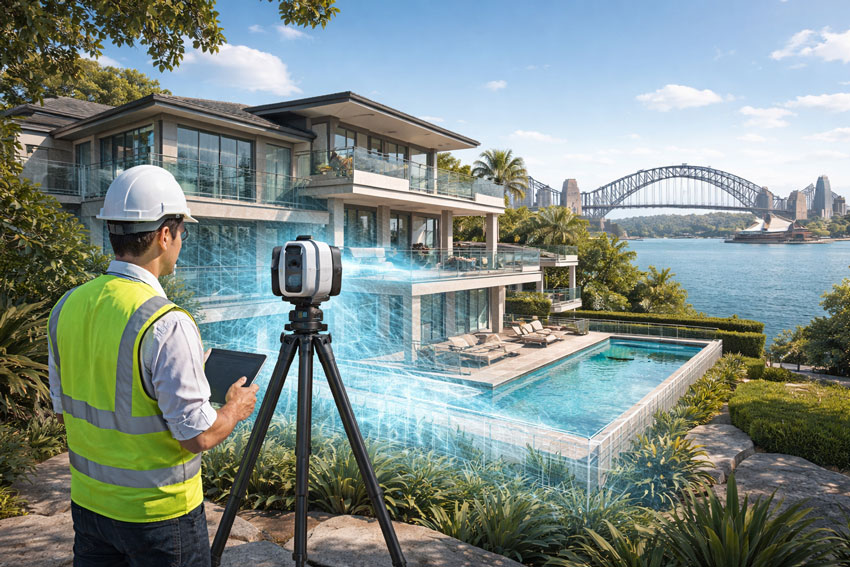
Hamilton By Design provides engineering-grade reality capture services in Sydney, combining high-accuracy LiDAR laser scanning with practical engineering workflows to deliver reliable as-built data, digital twins, and construction-ready models.
Digital Twin Development
Reality capture is often the first step in creating a digital twin of an existing asset, facility or infrastructure network.
Using engineering-grade terrestrial LiDAR scanning, Hamilton By Design captures highly detailed existing-condition data that can be used to develop accurate digital representations of buildings, industrial facilities and infrastructure assets throughout Sydney.
Digital twins provide a valuable foundation for planning upgrades, maintenance activities, asset management programs and future engineering projects by ensuring decision-makers have access to accurate and current information.
Asset Documentation & Existing Conditions
Many facilities operate with incomplete, outdated or missing drawings. Reality capture provides a reliable method of documenting existing conditions and creating an accurate record of an asset at a specific point in time.
Hamilton By Design supports asset owners, engineers and project teams by delivering comprehensive documentation of industrial facilities, manufacturing plants, infrastructure assets and commercial buildings throughout Sydney.
This information can be used for engineering design, maintenance planning, compliance assessments and future capital works projects.
Heritage & Existing Condition Surveys
Reality capture technology provides a non-invasive method of documenting heritage structures, existing buildings and architecturally significant assets.
High-density LiDAR scanning can capture detailed geometric information without disturbing the asset, creating an accurate digital record suitable for preservation, restoration and future reference.
This approach is particularly valuable where traditional measurement methods are impractical or where maintaining a permanent digital archive is important.
Infrastructure Corridor Capture
Reality capture is widely used to document transport corridors, utility networks and linear infrastructure projects.
Hamilton By Design can capture roads, rail corridors, processing facilities, pipelines and utility infrastructure to provide accurate spatial information for planning, design and asset management purposes.
The resulting datasets assist engineering teams in identifying constraints, verifying existing conditions and reducing uncertainty during project development.
Construction Verification & Progress Monitoring
Reality capture can be used throughout construction projects to verify installed works and monitor project progress.
By comparing captured data against design models, project teams can identify deviations, verify installation accuracy and document construction milestones.
This process helps reduce rework, improve project certainty and provide objective records of completed work.
Building Envelope Surveys
Reality capture provides an efficient method of documenting building facades, roof structures and external architectural features.
The resulting data can be used for refurbishment projects, façade upgrades, structural assessments and redevelopment planning.
Building envelope surveys provide accurate measurements and spatial information without requiring extensive manual site measurement activities.
Facility Management & Asset Registers
Reality capture data can support facility management programs by providing accurate information about buildings, equipment and infrastructure assets.
Digital asset records allow facility owners to improve maintenance planning, track asset changes and maintain up-to-date documentation throughout the asset lifecycle.
For many organisations, reality capture forms an important component of broader digital engineering and asset management strategies.
What Is Reality Capture?
Reality capture is the process of digitally recording real-world assets using technologies such as:
LiDAR laser scanning
High-resolution spatial data capture
Registered point clouds
3D models aligned to real geometry
The result is an accurate digital representation of existing conditions — enabling engineers, designers, and constructors to work from a single source of truth rather than assumptions or outdated drawings.
Why Reality Capture Matters in Sydney
Sydney projects frequently involve:
Live operational assets
Brownfield construction and upgrades
Tight construction tolerances
Complex interfaces between structural, mechanical, and architectural systems
Reality capture enables project teams to:
✔ Verify existing conditions before design ✔ Reduce rework and construction clashes ✔ Improve coordination across disciplines ✔ Accelerate approvals and decision-making ✔ Improve safety by minimising site re-visits
This is particularly valuable across commercial buildings, transport infrastructure, industrial facilities, utilities, and large refurbishment projects.
Engineering-Led Reality Capture — The Hamilton By Design Difference
At Hamilton By Design, reality capture is not treated as a standalone surveying task. Our services are engineer-led, ensuring the data captured is fit for downstream use in:
Mechanical and structural design
Construction coordination
Retrofit and upgrade works
Fabrication and installation planning
Our Sydney reality capture services integrate directly with CAD, BIM, and engineering documentation workflows — ensuring accountability from scan through to design and delivery.
Typical Reality Capture Applications in Sydney
As-Built Documentation
Capture accurate as-built conditions for compliance, certification, handover, or future upgrades.
Construction & Refurbishment Projects
Scan existing buildings and structures prior to modifications, extensions, or adaptive reuse.
Industrial & Infrastructure Assets
Capture complex geometry such as plant rooms, pipework, platforms, and structural steel.
Digital Twins & Asset Records
Create reliable digital records that support ongoing asset management and lifecycle planning.
Deliverables Tailored to Project Needs
Depending on your scope, Hamilton By Design can provide:
Registered LiDAR point clouds
CAD-ready geometry
BIM-compatible models
Section views and reference drawings
Engineering drawings derived from scan data
All deliverables are issued to suit engineers, builders, asset owners, and project managers working across Sydney.
Reality Capture Applications Across Sydney Industries
Reality capture provides value wherever accurate existing-condition information is required before design, construction or asset management decisions are made.
Commercial Buildings
Reality capture assists building owners, consultants and contractors by documenting existing conditions before refurbishment, fit-outs, services upgrades and redevelopment projects.
Industrial Facilities
Manufacturing plants, processing facilities and operational sites often contain undocumented modifications accumulated over many years. Reality capture provides an accurate digital record that supports future upgrades and maintenance planning.
Transport Infrastructure
Rail facilities, stations, maintenance depots, tunnels and transport corridors can be accurately captured to support planning, coordination and construction activities while minimising disruption to operations.
Utilities & Water Infrastructure
Reality capture supports pump stations, treatment plants, pipelines and utility infrastructure where accurate spatial information is required for maintenance, expansion and compliance projects.
Construction & Refurbishment
Capturing existing site conditions before construction begins reduces uncertainty, improves coordination and helps identify potential clashes before work reaches site.
Asset Management
Reality capture provides a reliable foundation for digital asset registers, facility management programs and long-term lifecycle planning.
Reality Capture Sydney — Build with Confidence
Reality capture removes uncertainty from complex projects. By accurately capturing what exists today, project teams can design, coordinate, and construct with confidence tomorrow.
Hamilton By Design supports Sydney-based projects with engineering-grade reality capture, practical deliverables, and a deep understanding of how digital data is used in real construction and industrial environments.
Industries We Support
Hamilton By Design provides reality capture services throughout Sydney for manufacturing facilities, rail infrastructure, water treatment plants, commercial buildings, hospitals, data centres and industrial facilities.
Using engineering-grade LiDAR scanning and digital reality capture workflows, we help project teams accurately document existing assets, improve project planning and reduce risk during design, construction and asset management activities.
Contact Hamilton By Design to discuss your Sydney reality capture requirements or arrange a site scan.
Related Sydney Reality Capture Services
Hamilton By Design provides specialised reality capture and 3D scanning services across Sydney, including:
3D Scanning Sydney for point clouds, scan-to-CAD and engineering-ready existing-condition data.
By combining reality capture, LiDAR scanning, engineering design and drafting under one team, Hamilton By Design helps Sydney projects move from existing conditions to construction-ready deliverables with confidence.
Hamilton By Design provides reality capture services throughout Sydney CBD, Parramatta, Liverpool, Penrith, Chatswood, Alexandria, Mascot, Newcastle and the Central Coast. Our engineering-led approach helps project teams accurately capture existing conditions, create digital asset records and support design, construction and asset management activities.
3D LiDAR Scanning for As-Built & Brownfield Engineering
At Hamilton By Design, we use engineering-grade 3D LiDAR scanning to capture the true as-built condition of your plant, structures and equipment — so you can design, fabricate and install with confidence.
From coal handling preparation plants (CHPP) and hard rock processing lines, through to power stations, manufacturing plants and commercial buildings, our engineer-led scanning process gives you accurate, clash-ready data for every brownfield project.
Why 3D LiDAR Scanning Matters for Brownfield Projects
Brownfield engineering is never “like the drawings”.
Over years of operation, plants twist, deflect, corrode and get modified during shutdowns. Legacy drawings are often incomplete or out of date. That’s where 3D LiDAR scanning changes the game:
Capture real geometry, not assumptions Record every beam, pipe, chute, cable tray and accessway as it actually exists today.
See deformations and historic repairs Pick up deflections, sagging, wear, corrosion loss and undocumented modifications that don’t appear in old drawings.
De-risk shutdowns and fit-ups Use the scan-based model to check new designs for clashes, access, maintenance and installation sequence before you cut steel.
Improve safety and compliance Support structural integrity assessments, access/egress reviews and compliance checks with a trusted, measurable digital record.
Reduce site time for designers Capture everything once, then let your engineering and drafting team work from the digital plant model instead of repeated site visits.
What We Scan
Hamilton By Design can scan and model:
CHPP and coal handling infrastructure
Screens, crushers, transfer towers, chutes, hoppers, conveyors, tripper gantries, stackers and reclaimers
Hard-rock and mineral processing plants
Mills, cyclones, crushers, bins, slurry pipework, support structures
Production lines, material handling systems, automation cells, storage areas
Commercial and building services
Plant rooms, risers, roof services, façades and structural frames
If it’s built and you need to understand it, we can scan it.
Engineer-Led Scanning, Not Just Survey
What sets Hamilton By Design apart is that our scanning is driven by mechanical engineers, not just surveyors.
That means we plan each scan campaign based on:
The future design work you need to do
The critical interfaces (bolt patterns, flanges, centre-lines, datum points)
The tolerances needed for fabrication and installation
The shutdown and access constraints on site
Because the same team that scans your plant is also involved in modelling, design and checking, we make sure the data captured is actually usable for engineering and drafting — not just a pretty point cloud.
Typical Workflow: From Scan to Engineering Model
Scope & Planning
Define the upgrade, problem area or shutdown scope
Agree survey tolerances, required deliverables and file formats
Plan access, shutdown windows and safety requirements
On-Site 3D LiDAR Scanning
Set up control and scanning positions for full coverage
Capture high-density scans of structures, equipment and services
Minimise disruption to operations where possible
Registration & Quality Checks
Register and align scans into a single, unified point cloud
Apply QA checks to confirm alignment and global accuracy
Provide initial visualisation for client review if required
3D Modelling & As-Built Geometry
Create engineering-ready 3D models in SolidWorks (or other CAD platforms as agreed)
Model structural steel, mechanical equipment, chutes, pipework and key interfaces
Prepare background models suitable for new design and layout work
As-Built & Brownfield Engineering Support
Use the model to support new projects: upgrades, replacements, debottlenecking and layout changes
Run fit-up checks, clash detection and access/maintenance reviews
Prepare fabrication drawings and installation packages as required
Handover & Ongoing Use
Provide point clouds, 3D models and drawings in agreed formats
Support future shutdowns and projects using the same trusted digital plant model
Deliverables You Can Expect
Depending on the project, we can provide:
Registered point clouds in industry-standard formats
3D CAD models (SolidWorks or exchange formats such as STEP, IGES, DWG)
As-built drawings and GA layouts for mechanical and structural systems
Clash-check models for integration of new designs
Sections and detail views for critical interfaces (bolt patterns, flange faces, datum planes)
Visualisations to support stakeholder communication and approvals
All deliverables are produced with fabrication and construction in mind — so your fabricators, installers and site team can act on them immediately.
Applications in As-Built & Brownfield Engineering
3D LiDAR scanning directly supports:
Shutdown-driven upgrades – de-risking installation windows by checking fit-up beforehand
Chute and hopper redesign – improving flow and wear life using accurate existing geometry
Conveyor and transfer tower modifications – adding new equipment or re-routing systems
Structural remediation and strengthening – understanding real load paths and condition
Pipework reroutes and tie-ins – locating existing lines, clashes and tie-in opportunities
Compliance and audit documentation – maintaining accurate records under Australian standards and site governance
Why Choose Hamilton By Design for 3D LiDAR Scanning?
Engineer-led, not equipment-led – we start with the engineering problem, then choose the scanning approach.
Single-source accountability – one team for scanning, modelling, engineering and drawings.
Brownfield experience – extensive work in CHPPs, mineral processing plants, power stations and heavy industry.
Fabrication-ready outputs – deliverables tailored for fabricators, installers and project engineers.
National coverage – servicing sites across NSW, QLD, WA, VIC and SA.
Next Steps
Planning a shutdown, upgrade or brownfield modification?
Hamilton By Design can help you capture the plant once and then reuse that digital model across multiple projects — reducing risk, improving accuracy and cutting rework.
Contact us to discuss your 3D LiDAR scanning requirements and we’ll help you define:
The scanning scope
Required tolerances
Ideal deliverables for your designers, fabricators and site team
So your next project starts with facts, not assumptions.
To provide the best experiences, we use technologies like cookies to store and/or access device information. Consenting to these technologies will allow us to process data such as browsing behaviour or unique IDs on this site. Not consenting or withdrawing consent, may adversely affect certain features and functions.
Functional
Always active
The technical storage or access is strictly necessary for the legitimate purpose of enabling the use of a specific service explicitly requested by the subscriber or user, or for the sole purpose of carrying out the transmission of a communication over an electronic communications network.
Preferences
The technical storage or access is necessary for the legitimate purpose of storing preferences that are not requested by the subscriber or user.
Statistics
The technical storage or access that is used exclusively for statistical purposes.The technical storage or access that is used exclusively for anonymous statistical purposes. Without a subpoena, voluntary compliance on the part of your Internet Service Provider, or additional records from a third party, information stored or retrieved for this purpose alone cannot usually be used to identify you.
Marketing
The technical storage or access is required to create user profiles to send advertising, or to track the user on a website or across several websites for similar marketing purposes.