3D Laser Scanning in Parramatta: Engineering-Grade Data for Safer Conveyor Systems and Better Risk Management

Watercolour illustration of engineers 3D laser scanning a warehouse conveyor system.

In consumer goods manufacturing, distribution centres and logistics facilities around Parramatta and Western Sydney, conveyor systems are mission-critical. Whether moving pallets, cartons, bottles, or bulk packaged goods, these systems must integrate with structural steel, mechanical equipment and building services without compromise.

Yet many existing facilities are built from legacy drawings, partial records or hand-measured surveys. This creates risk when planning upgrades, expansions or tie-ins โ€” especially where conveyors interface with mezzanines, sortation systems, robotics and utilities.

3D laser scanning provides a precise and reliable basis for understanding whatโ€™s actually on site before detailed engineering or shutdown activities begin.


Why Scan First? Engineering-Grade Reality Is the Backbone of Success

A good conveyor design solution depends on accurate understanding of:

  • where conveyors really sit in 3D space
  • how structural beams, columns and supports interact
  • exact locations of mechanical equipment
  • existing pipework, ducts and cable trays
  • access clearances for maintenance and shutdown execution

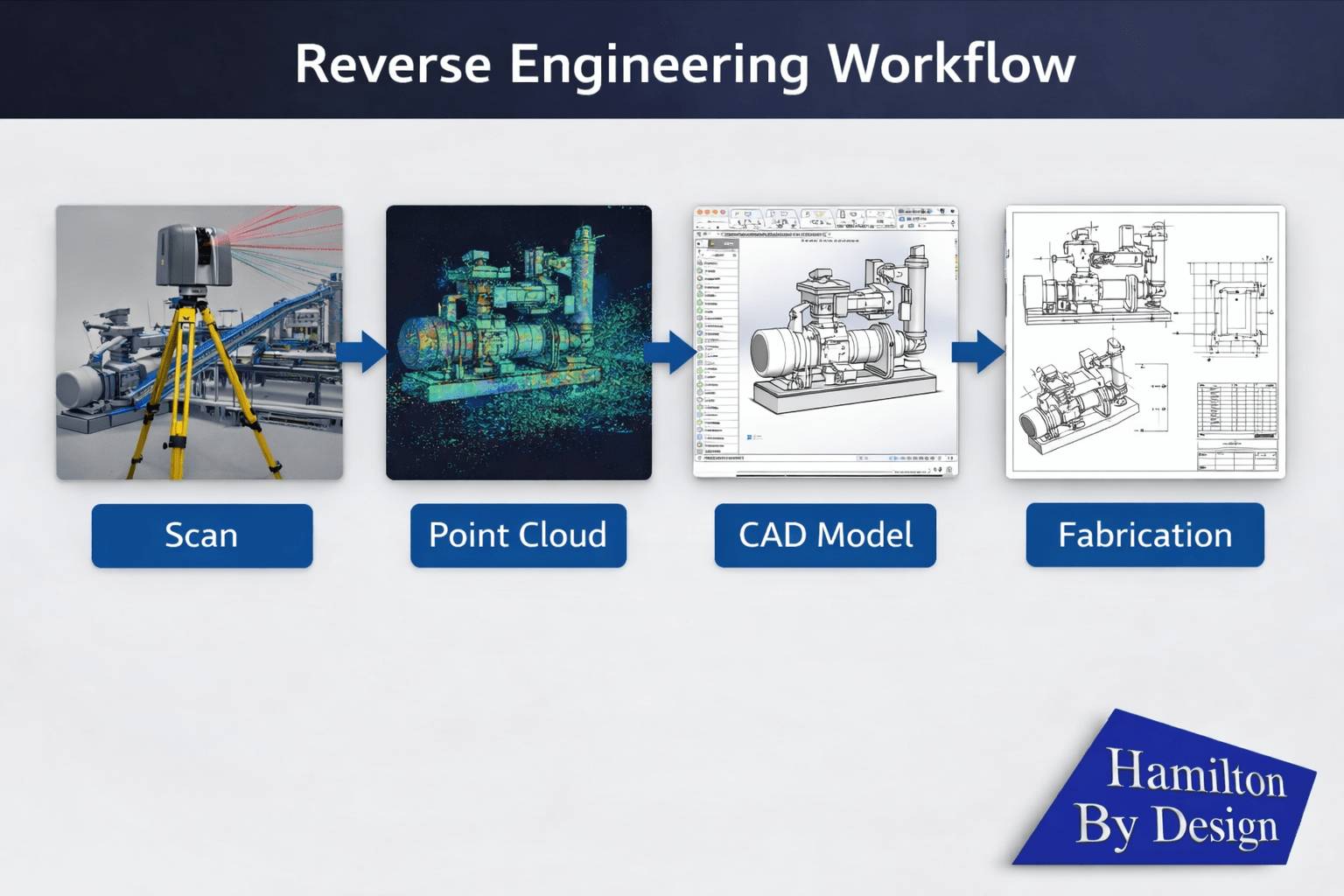
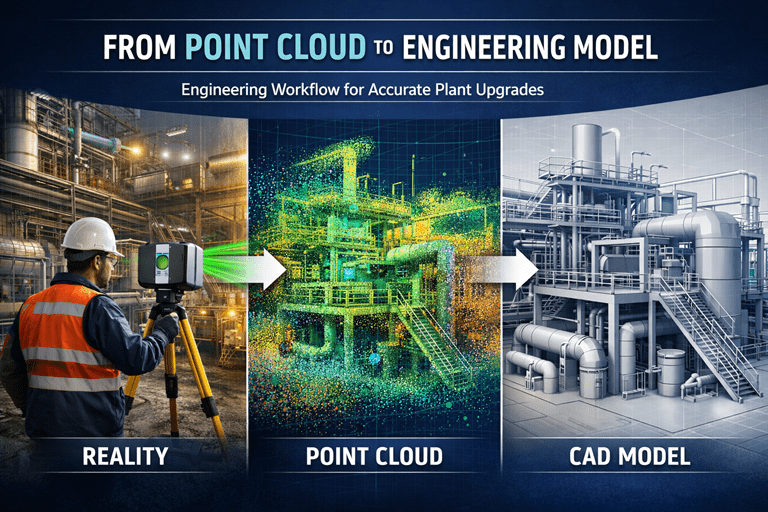
Traditional tape measures and manual field sketches are slow, error-prone and not suitable for complex conveyor networks. In contrast, 3D laser scanning captures millions of points in minutes and produces engineering-grade point clouds that reflect every surface, pipe, beam and conveyor geometry exactly as it exists.

This scan becomes the backbone of your engineering workflow โ€” a verified digital reference that informs design, reduces risk and underpins safe execution.


3D scanning of FMCG conveyor line shown in soft watercolour style.

From Reality Capture to Practical Engineering Outputs

A registered 3D point cloud delivers value throughout the project lifecycle. Typical deliverables include:

  • Full as-built point clouds: a complete digital record of existing conditions
  • Clash analysis models: identify conflicts between conveyors, structures and services
  • Fabrication-ready geometry: for skid frames, guards, support steel and pipe spools
  • DXF/STEP/Parasolid exports: for mechanical and structural drafting
  • Compatibility with Revit, AutoCAD, Navisworks: for design coordination

The result? Engineers spend more time solving real problems and less time correcting assumptions.


Designing for Safer Conveyor Integration

Upgrading or modifying conveyor systems in FMCG and logistics environments often involves:
  • adding sortation or scanning stations
  • rerouting belt paths to accommodate new equipment
  • expanding mezzanines or catwalks
  • integrating with automated storage and retrieval systems
  • adjusting utilities like compressed air, water or power services
  • installing guarding and safety infrastructure

Each of these tasks intersects with steelwork, services and building elements. Using 3D scan data for design coordination enables:

โœ” accurate spatial modelling
โœ” reduced field rework
โœ” clearer installation instructions
โœ” fewer late changes during shutdowns

This translates directly to lower cost, higher safety and greater schedule confidence.


Better Risk Management Through Verified Data

Conveyor upgrades and expansions are typically scheduled during short shutdown windows. Risk drivers commonly include:

  • uncertainty about existing conditions
  • interference with critical services
  • tight clearances that limit access
  • unexpected clashes on installation
  • insufficient documentation for permits or safety reviews

With scan-derived data, these risks are mitigated early. Design teams can model scenarios before fabrication, check for clashes electronically and articulate installation sequences with confidence.

This isnโ€™t just better practice โ€” itโ€™s good risk management.


As-Built Scanning for Handover Confidence

At project completion, a final 3D laser scan provides an accurate digital as-built model of the upgraded systems. This has several benefits:

  • avoids tape measure as-builts
  • records exact installation geometry
  • supports maintenance planning
  • provides a robust platform for future works
  • becomes an asset for ongoing risk assessments
The organisation receives not just installed equipment, but a verified digital twin for operations and design.


Applications Around Parramatta & Western Sydney

3D laser scanning is highly effective in these local industries:

โœ” FMCG production facilities
โœ” Beverage and food processing plants
โœ” Automated distribution centres
โœ” Parcel sortation hubs
โœ” Packaging and assembly lines
โœ” Warehouse conveyor networks
โœ” Industrial plant upgrades

Across these environments, conveyors are fundamental to throughput โ€” and accurate data is fundamental to success.


Hamilton By Design logo displayed on a blue tilted rectangle with a grey gradient background

3D LiDAR scanning and 3D modelling service button โ€” laser scanner capturing a point cloud for engineering and CAD modelling
Mechanical engineering services

Unlock Better Project Outcomes with 3D Scanning

A robust reality capture strategy delivers measurable improvements to:

  • safety protocols
  • design accuracy
  • fabrication efficiency
  • shutdown predictability
  • project cost control

In an industrial region like Parramatta โ€” where competitiveness depends on efficiency and certainty โ€” laser scanning is not just technology, itโ€™s a strategic engineering enabler.


Ready to Elevate Your Conveyor Project?

If youโ€™re planning a conveyor upgrade, system extension, or facility modification in the Parramatta or Western Sydney region, start with accurate reality capture.

Hamilton By Design Co. provides tailored 3D laser scanning services that support safer, more reliable, and more successful industrial outcomes.

Scan first.
Design with confidence.
Finish with a verified as-built.

Name
Would you like us to arrange a phone consultation for you?
Address

Related Sydney Services

Hamilton By Design provides engineering-led 3D scanning, LiDAR scanning, mechanical engineering and digital engineering services throughout Sydney and Greater Sydney.

Explore our related Sydney services:


  • 3D Scanning Sydney โ€“ Engineering-grade terrestrial laser scanning, as-built surveys and point cloud capture for industrial, infrastructure and commercial projects.
  • Reality Capture Sydney โ€“ High-accuracy reality capture, digital twins, asset documentation and engineering-grade site verification.
  • Scan to CAD Sydney โ€“ Convert point cloud data into AutoCAD, SolidWorks, Inventor and other engineering-ready CAD deliverables.
  • Point Cloud Modelling Sydney โ€“ Engineering-grade point cloud processing, clash detection, as-built verification and 3D modelling.
  • Mechanical Engineering Sydney โ€“ Mechanical design, plant upgrades, materials handling systems, conveyors, chutes, platforms and engineering support.
  • Structural Drafting Sydney โ€“ Structural steel drafting, fabrication drawings, GA drawings, workshop detailing and as-built documentation.

Hamilton By Design supports projects throughout Sydney CBD, Parramatta, Liverpool, Penrith, Blacktown, Chatswood, Alexandria, Mascot, Newcastle and the Central Coast.


Finite Element Analysis (FEA) engineering simulation button
Mechanical engineering services

Mechanical Engineering and 3D Scanning Services in Darwin

Industrial plant in Darwin being digitally captured with 3D scanning to support engineering design and upgrade planning.

Mechanical Engineering and 3D Scanning Services in Darwin

Supporting defence, industrial and infrastructure projects across Northern Australia

Darwin is a strategic industrial hub for Northern Australia, supporting defence facilities, oil and gas operations, ports, power generation and remote infrastructure servicing. Many of these assets operate in harsh environments and have been upgraded over long periods, making accurate design and modification work highly dependent on reliable as-built information.

Hamilton By Design provides engineering-led 3D laser scanning and mechanical engineering services in Darwin, supporting safer, faster and more accurate project delivery across operating facilities.


Engineer using LiDAR scanner to capture an industrial processing plant near Darwin in the Northern Territory for mechanical and structural design.

Engineering Challenges in Northern Australian Facilities

Industrial and infrastructure assets in the Top End face unique challenges, including:

  • High humidity and corrosion
  • Cyclone-rated structural requirements
  • Remote logistics and limited shutdown windows
  • Ageing infrastructure with incomplete documentation

These factors increase project risk when modifications rely on outdated drawings or manual site measurements.

Engineering-grade reality capture allows accurate design to be completed off-site, reducing rework and improving safety outcomes during installation.


How 3D Laser Scanning Supports Darwin Projects

Plant and Facility Upgrades

When upgrading mechanical systems, pipework, conveyors or process equipment, laser scanning provides accurate spatial data so new components can be designed to fit existing layouts before fabrication.

This is particularly valuable for:

  • Fuel and gas facilities
  • Power generation assets
  • Water and wastewater plants
  • Defence infrastructure

Shutdown and Maintenance Planning

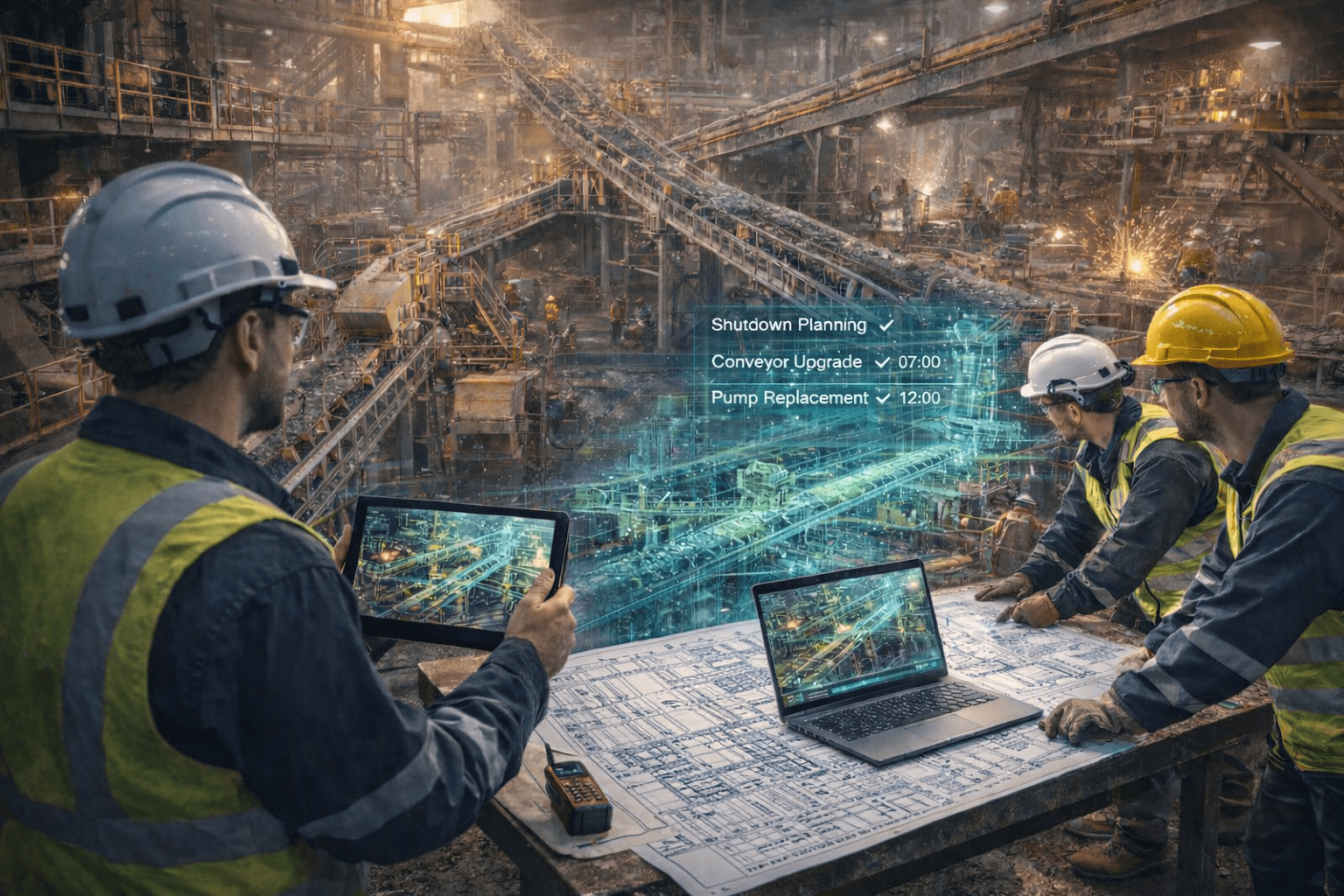
Short shutdown windows are common in remote facilities. Point cloud models support:

  • Access and lifting studies
  • Installation sequencing
  • Safety and exclusion zone planning

This reduces uncertainty and improves coordination between trades during critical maintenance periods.


Structural and Mechanical Retrofits

For strengthening structures, replacing worn equipment or installing new platforms, scanning provides geometry suitable for:

  • Fabrication drawings
  • Structural connection design
  • Mechanical interface modelling

Minimising the need for repeated site visits in high-risk environments.


Mechanical Engineering Services Supported by Reality Capture

Hamilton By Design integrates 3D scanning directly into engineering workflows, including:

  • Mechanical design and drafting
  • Structural support and modification design
  • Scan-to-CAD and scan-to-BIM modelling
  • Fabrication drawing development
  • Installation and constructability reviews

This ensures reality capture delivers practical engineering outcomes, not just visual documentation.


Industries Supported in the Darwin Region

Our engineering and scanning services support a wide range of industries, including:

  • Defence and military facilities
  • Oil and gas processing and storage
  • Port infrastructure and materials handling
  • Power generation and utilities
  • Remote industrial facilities and camps
  • Food and bulk materials processing

These sectors require high levels of accuracy, safety and reliability when modifying operating assets.


Why Engineering-Grade LiDAR Matters

Not all scanning technologies are suitable for industrial engineering.

For mechanical and structural design, projects typically require:

  • Millimetre-level accuracy
  • Long-range capture across large facilities
  • Reliable reference for fabrication and installation

Engineering-grade LiDAR systems provide the precision required to support fabrication-ready design and clash-free installation.


Benefits for Project Owners and Contractors

Using engineering-led reality capture provides measurable advantages:

  • Reduced re-measurement on site
  • Fewer design clashes
  • Improved constructability
  • Safer design development
  • Shorter shutdown durations
  • Greater confidence in project outcomes

In remote locations, avoiding rework and delays has a major impact on overall project cost and schedule.


Supporting Projects Across Northern Australia

While based on the east coast, Hamilton By Design regularly supports regional and remote projects using a combination of:

  • On-site scanning campaigns
  • Remote engineering and modelling workflows
  • Digital collaboration and model review

This allows Darwin-based projects to access specialist engineering and scanning capability without requiring permanent local resourcing.


Final Thoughts

For industrial and infrastructure projects in Darwin, combining mechanical engineering with engineering-grade 3D scanning provides a safer, faster and more reliable way to deliver upgrades in challenging operating environments.

By integrating reality capture directly into design and fabrication workflows, project teams can reduce risk, improve coordination and achieve better construction outcomes across Northern Australiaโ€™s critical assets.

Hamilton By Design logo displayed on a blue tilted rectangle with a grey gradient background
3D LiDAR scanning and 3D modelling service button โ€” laser scanner capturing a point cloud for engineering and CAD modelling
Mechanical engineering services
Name
Would you like us to arrange a phone consultation for you?
Address

Engineering 3D Scanning for Mining Projects in Zambia

Engineer using LiDAR scanner to capture copper processing plant and open-pit mine within a map of Zambia for engineering design and upgrade planning.

Engineering 3D Scanning for Mining Projects in Zambia

Supporting safer, faster and more accurate plant upgrades across the Copperbelt

Zambia is one of Africaโ€™s most important copper-producing nations, with large-scale mining and mineral processing facilities operating across the Copperbelt region. Many of these sites are complex, brownfield environments that have evolved over decades, making accurate design and upgrade work challenging without reliable as-built information.

Engineering-grade 3D laser scanning is now playing a critical role in supporting safer, faster and more accurate mining projects by providing detailed digital representations of existing plant and infrastructure.


Zambian mining facility being digitally captured with 3D scanning to create accurate models for engineering and shutdown planning.

Why Accurate As-Built Data Matters in Mining

Mining and processing plants typically undergo continuous modification to improve capacity, efficiency and reliability. Unfortunately, legacy drawings and documentation are often incomplete or no longer reflect the current configuration of the plant.

This creates risks such as:

  • Design clashes with existing services or structures
  • Unexpected installation constraints
  • Increased shutdown durations
  • Safety risks from unverified site conditions

3D laser scanning addresses these risks by capturing high-density point cloud data that reflects the true geometry of the operating facility at the time of capture.


How Engineering-Grade Scanning Supports Mining Projects

Plant Upgrades and Expansions

When installing new crushers, mills, pumps, pipework or conveyors, accurate spatial data is essential. Laser scanning allows engineers to design new equipment layouts directly within the existing plant model, validating clearances and interfaces before construction begins.

Shutdown and Maintenance Planning

Shutdown work is high-risk and time-critical. Point cloud models enable teams to:

  • Assess access routes
  • Plan lifting and installation sequences
  • Identify congestion points

This improves safety outcomes and reduces downtime during critical maintenance windows.


Mining hopper in a transfer station shown in cutaway, illustrating steady-state material flow, structural load distribution, and engineered hopper design.

Structural and Mechanical Retrofits

For structural strengthening, equipment replacement or capacity upgrades, scanning provides the geometry required to produce fabrication-ready drawings without relying on extensive manual site measurement in hazardous areas.

Digital Twin and Asset Management

Reality capture data can also be used to support longer-term asset management strategies, enabling:

  • Improved inspection planning
  • Better maintenance coordination
  • Faster future upgrade design

Digital plant models become a valuable operational asset, not just a project deliverable.


Why Engineering-Grade LiDAR Is Required for Industrial Sites

Not all 3D scanning technologies are suitable for mining environments.

While visual scanning systems are useful for building documentation and general layout capture, mining and processing facilities typically require:

  • Millimetre-level dimensional accuracy
  • Long-range scanning capability
  • Reliable reference data for CAD and BIM modelling

Engineering-grade LiDAR systems are designed for these conditions, making them suitable for mechanical and structural design workflows where tolerances and fit-up are critical.

For projects involving fabrication and installation, scanning must support engineering decisions โ€” not just visualisation.


Benefits for Mining Operators and Project Teams

Integrating engineering scanning into mining workflows delivers tangible benefits, including:

  • Reduced re-measurement on site
  • Fewer design clashes and construction rework
  • Improved constructability reviews
  • Safer design development off-site
  • Shorter shutdown durations
  • Higher confidence in project outcomes

In high-value mining projects, even small improvements in planning accuracy can result in significant cost and schedule savings.


Engineering-Led Reality Capture Workflows

The real value of 3D scanning is realised when it is integrated directly into engineering and design processes. At Hamilton By Design, reality capture is used to support:

  • Mechanical and structural design
  • Scan-to-CAD and Scan-to-BIM modelling
  • Fabrication drawing development
  • Installation planning and coordination

This ensures scan data is converted into practical engineering deliverables that support construction and long-term asset management.


Supporting Mining Projects Across Southern Africa

With ongoing investment in copper and critical minerals, Southern Africa continues to present strong demand for plant upgrades, expansions and reliability improvements.

Engineering-led reality capture provides a safer and more efficient way to support these projects, particularly in operating facilities where downtime and site access are highly constrained.

By combining laser scanning with mechanical and structural engineering expertise, project teams can reduce uncertainty and deliver upgrades with greater confidence.


Hamilton By Design logo displayed on a blue tilted rectangle with a grey gradient background

3D LiDAR scanning and 3D modelling service button โ€” laser scanner capturing a point cloud for engineering and CAD modelling
Mechanical engineering services

Final Thoughts

For mining operations in Zambia, 3D laser scanning is no longer a specialist add-on โ€” it is becoming a core engineering tool that supports safer and more efficient project delivery.

When paired with strong design and project management workflows, reality capture enables better planning, better coordination and better construction outcomes in some of the worldโ€™s most demanding industrial environments.

Name
Would you like us to arrange a phone consultation for you?
Address
Finite Element Analysis (FEA) engineering simulation button
Mechanical engineering services

Beyond Assumptions: Why Accurate Geometry and LiDAR Scanning are the Gold Standard for Modern Projects

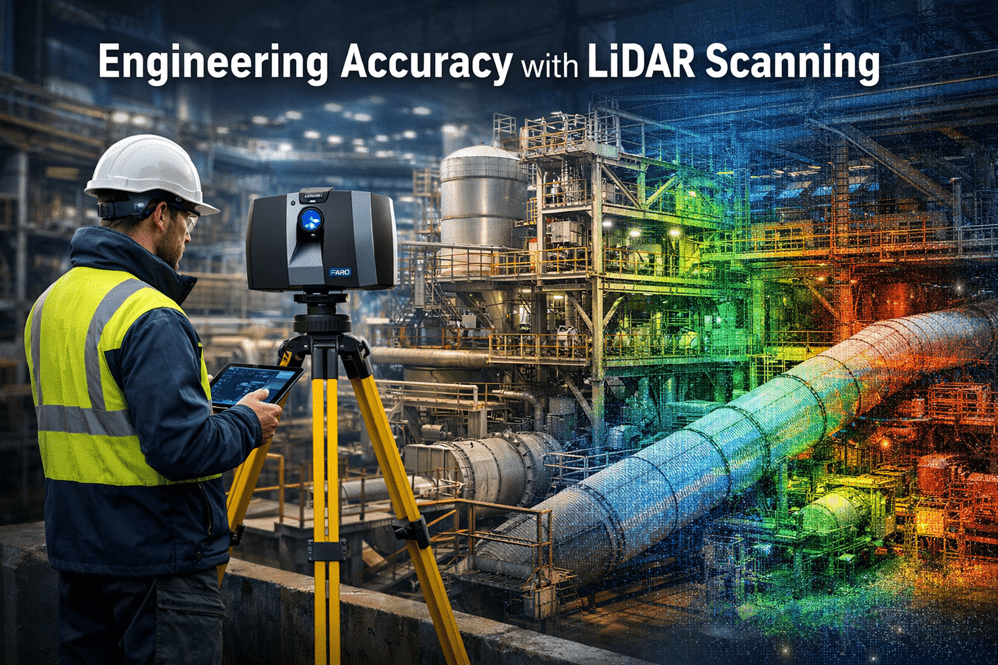
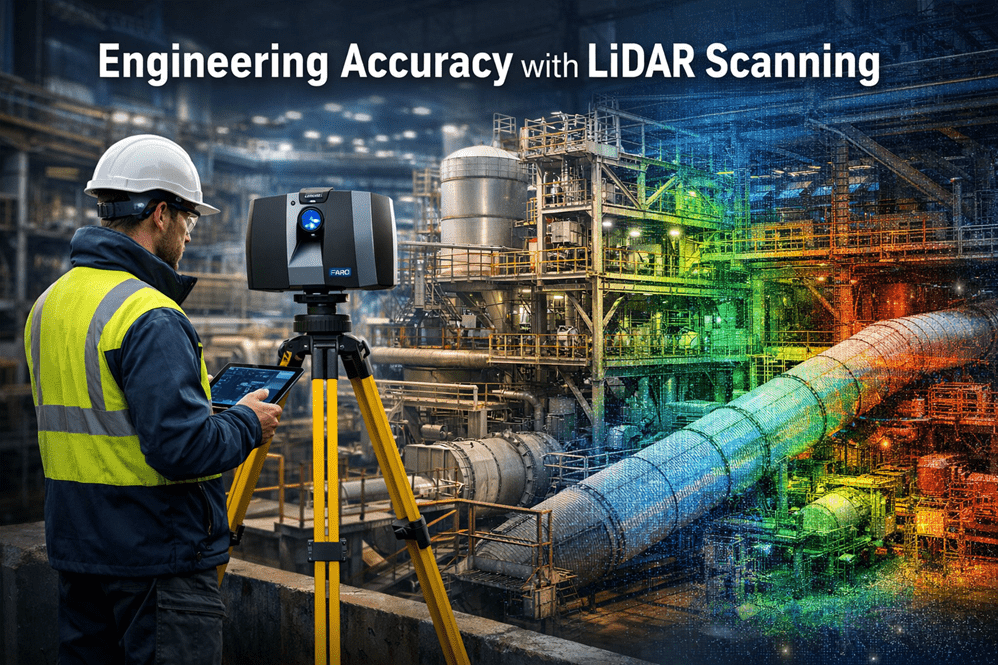
Engineering-grade LiDAR scanning infographic showing a FARO laser scanner capturing an industrial plant and converting site data into point clouds, scan-to-CAD models, and engineering-ready drawings to reduce rework and improve project outcomes.

In the world of industrial engineering and brownfield upgrades, there is a dangerous word: Assumption.

Whether you are upgrading a CHPP, modifying a conveyor system, or retrofitting a processing plant, your project is only as strong as the data itโ€™s built on. At Hamilton By Design, weโ€™ve seen how “near enough” measurements lead to costly rework, extended shutdowns, and safety risks.

The solution? Moving from manual estimation to Engineering-Led LiDAR Scanning.

The High Cost of Inaccurate Information

Traditional “manual” documentationโ€”using tape measures, spirit levels, and old 2D drawingsโ€”is prone to human error. In complex industrial environments, missing a single pipe interference or a slight structural lean by even 20mm can mean a prefabricated component wonโ€™t fit during a critical shutdown.

When site data is inaccurate:

  • Fabrication fails: Parts arrive on-site but don’t clear existing structures.
  • Costs skyrocket: Emergency “hot works” and on-site modifications blow out budgets.
  • Safety is compromised: Forced fits can create structural stress and unforeseen hazards.

Why Geometry is the Foundation of Engineering

Geometry isn’t just about shapes; it’s about the spatial relationship between every asset on your site. Accurate geometry is critical because:

  1. Clash Detection: It allows us to identify “soft” and “hard” clashes in a digital environment before a single bolt is turned.
  2. Structural Integrity: Precise angles and load-path documentation ensure that new modifications integrate safely with legacy steelwork.
  3. Efficiency: Understanding the exact volume, pitch, and clearance of a site allows for “First-Time-Fit” engineering.

LiDAR Scanning: The Simple Solution for Complex Reality

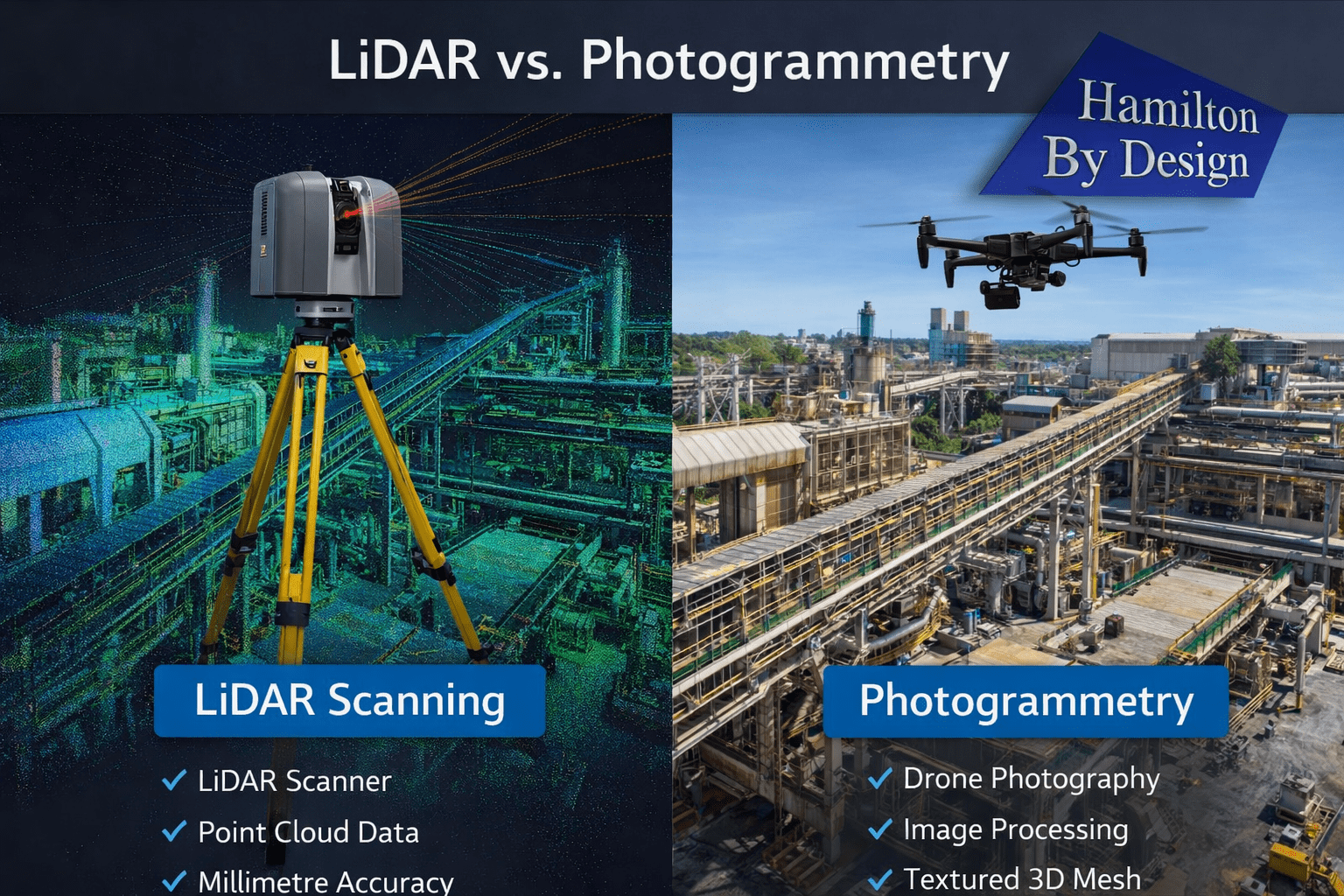
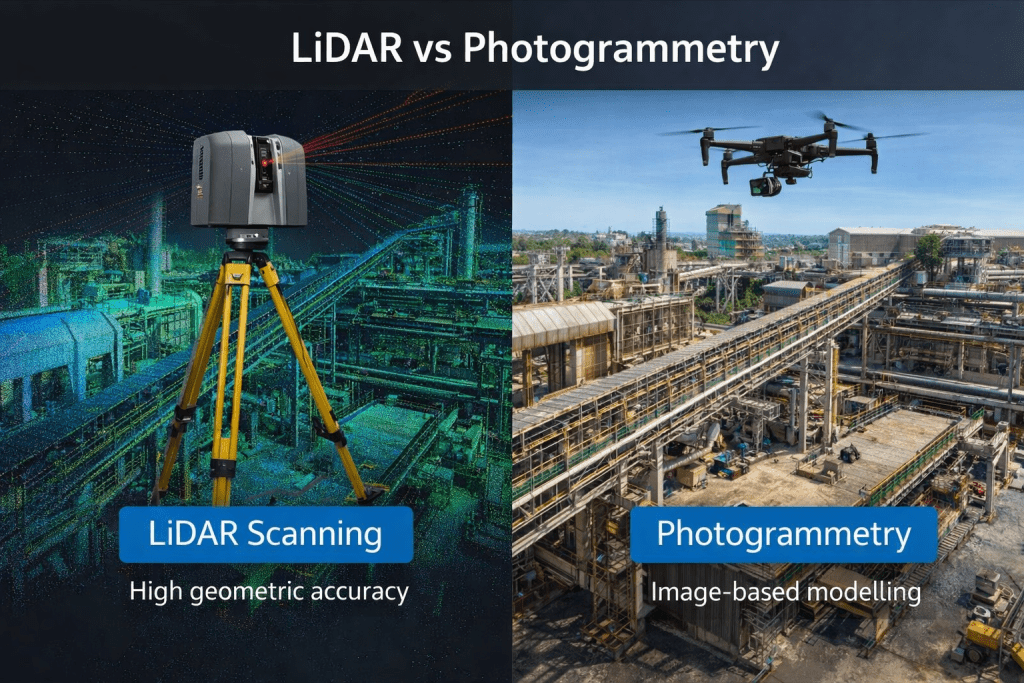
LiDAR (Light Detection and Ranging) removes the guesswork. A LiDAR scanner emits millions of laser pulses per second to create a Point Cloudโ€”a highly accurate 3D digital “twin” of your facility.

Why itโ€™s a game-changer:

  • Speed: Capture entire plant rooms or structural towers in minutes, not days.
  • Safety: We can scan hazardous or hard-to-reach areas from a safe distance, removing the need for scaffolding just to take a measurement.
  • Completeness: Unlike a manual survey that only measures what you think is important, LiDAR captures everything in its line of sight, providing context you might need later.

The “Silent Witness”: Point Clouds in Legal and Insurance Cases

Beyond design, point cloud data serves as an indisputable “source of truth” in legal and insurance contexts. Because a scan is a timestamped, millimeter-accurate record of reality, it is increasingly used in:

  • Construction Disputes: Providing evidence of “as-built” conditions vs. “as-designed” plans to settle variations or defect claims.
  • Incident Investigation: In the event of a structural failure or site accident, a pre-existing or post-incident scan provides an objective 3D map for forensic analysis.
  • Asset Accountability: Scans serve as a permanent record of site conditions before a contractor begins work, protecting owners and contractors alike from liability.

The Hamilton By Design Difference

We don’t just provide “data.” We provide engineering-led reality capture. Because we are engineers and fabricators ourselves, we know what to look for when we scan. We don’t just give you a cloud of dots; we translate that data into usable CAD models and fabrication-ready drawings that respect Australian Standards (like AS 4324.1).

Stop guessing and start building with confidence. [Contact the Hamilton By Design team today] to discuss how our LiDAR scanning services can de-risk your next project.

Hamilton By Design logo displayed on a blue tilted rectangle with a grey gradient background
3D LiDAR scanning and 3D modelling service button โ€” laser scanner capturing a point cloud for engineering and CAD modelling
Mechanical engineering services
3D LiDAR scanning and 3D modelling service button โ€” laser scanner capturing a point cloud for engineering and CAD modelling
Mechanical engineering services
Finite Element Analysis (FEA) engineering simulation button
Mechanical engineering services

Establish a Baseline for Wall Movement in Your Property

Wall Crack Monitoring & Structural Movement Baseline Scans | NSW

Know When Cracks Are Cosmetic โ€” and When Theyโ€™re Not

Cracks in walls are common, but not all cracks are harmless. The real risk isnโ€™t just that a crack exists โ€” itโ€™s how fast itโ€™s changing. Without a baseline, thereโ€™s no reliable way to tell whether your property is stable or slowly moving toward serious structural damage.

Thatโ€™s where our Property Wall Movement Baseline Scan comes in.


What Is a Baseline Scan?

A baseline scan is a highโ€‘accuracy digital survey of your property taken at the moment cracking is first observed. Using precision scanning technology, we capture:

  • Wall alignment and deflection
  • Crack location, length, and width
  • Floor and ceiling reference planes
  • Structural reference points across the building

This scan becomes your timeโ€‘zero reference point โ€” a measurable snapshot of your buildingโ€™s condition today.


Why a Baseline Matters

Without a baseline:

  • Cracks are judged visually (subjective and unreliable)
  • Engineers lack historical movement data
  • Insurance claims become harder to substantiate
  • Small issues can quietly become major repairs

With a baseline:

  • Movement can be quantified in millimetres
  • Crack growth rates can be tracked over time
  • Engineers can make confident, dataโ€‘driven decisions
  • You gain early warning before damage becomes critical

How the Process Works

1. Initial Scan

We perform a nonโ€‘invasive scan of affected areas and key structural zones to establish your baseline condition.

2. Data Archiving

All scan data is securely stored and referenced to fixed control points within your property.

3. Followโ€‘Up Scans

Repeat scans (3, 6, or 12 months later) are compared against the baseline to calculate:

  • Crack propagation rate
  • Wall movement direction
  • Structural settlement or heave

4. Clear Reporting

You receive a clear, easyโ€‘toโ€‘understand report showing:

  • Measured movement (if any)
  • Rate of change over time
  • Professional recommendations

Ideal For

  • Homeowners noticing new or worsening cracks
  • Properties affected by reactive soils or subsidence
  • Buildings near excavation or construction activity
  • Insurance documentation and dispute resolution
  • Engineers requiring longโ€‘term movement data

Early Data Saves Money

Monitoring movement early often means minor intervention instead of major reconstruction. A baseline scan gives you certainty, evidence, and peace of mind.

If nothing is moving โ€” youโ€™ll know.
If something is โ€” youโ€™ll know before itโ€™s too late.


Hamilton By Design logo displayed on a blue tilted rectangle with a grey gradient background
3D LiDAR scanning and 3D modelling service button โ€” laser scanner capturing a point cloud for engineering and CAD modelling
Mechanical engineering services

Book a Baseline Scan

If youโ€™ve noticed cracking, now is the right time to act.

Contact us today to establish your propertyโ€™s movement baseline and protect its longโ€‘term structural integrity.


Precision data. Clear answers. Smarter decisions.

Name
Would you like us to arrange a phone consultation for you?
Address
3D LiDAR scanning and 3D modelling service button โ€” laser scanner capturing a point cloud for engineering and CAD modelling
Mechanical engineering services
Finite Element Analysis (FEA) engineering simulation button
Mechanical engineering services

Engineering-Led 3D Scanning for Brownfield Industrial Upgrades

Mechanical engineer and client reviewing a ROM hopper with two discharge conveyors using LiDAR scanning at a mining bulk material handling facility

Engineering-Led 3D Scanning for Brownfield Industrial Upgrades

Safer Shutdowns, Smarter Design, and More Done With Fewer Resources

Brownfield industrial upgrades are some of the highest-risk engineering activities in mining and heavy industry. Existing assets, live plant interfaces, limited access, and tight shutdown windows leave little room for error.

At Hamilton By Design, we deliver engineering-led 3D LiDAR scanning to support brownfield upgradesโ€”providing accurate site data that enables safer design, efficient shutdown execution, and reliable outcomes when upgrading critical assets such as hoppers, chutes, pump boxes, conveyor transfers, and vertical shaft units.


Why Brownfield Upgrades Fail Without Accurate Site Data

Many brownfield failures trace back to the same root cause:

Design decisions made on assumptions, not reality.

Common issues include:

  • Outdated or incomplete drawings
  • Hidden interferences and undocumented modifications
  • Restricted access for survey and measurement
  • Time pressure during shutdowns

Engineering-led reality capture removes uncertainty before fabrication and installation begin.


Safety Starts Before the Shutdown

Safety in brownfield environments is largely determined during the design phase, not on site.

3D LiDAR scanning allows engineers to:

  • Design modifications without repeated site access
  • Reduce manual measurements in live plant areas
  • Identify clashes and pinch points early
  • Improve access, guarding, and maintainability outcomes

By reducing exposure hours and unplanned rework, scanning directly supports safer shutdown execution.


Typical Assets Upgraded in Brownfield Environments

Hamilton By Design supports upgrades to a wide range of industrial assets, including:

Hoppers & Chutes

  • ROM hoppers
  • Transfer chutes
  • Surge bins
  • Wear-prone interfaces

Conveyors & Transfer Stations

  • Conveyor head and tail stations
  • Transfer points
  • Discharge transitions
  • Supporting steelwork

Pump Boxes & Process Interfaces

  • Pump boxes and sumps
  • Pipework interfaces
  • Structural supports
  • Access platforms

Vertical Shaft & Drop Structures

  • Vertical shaft hoppers
  • Ore passes
  • Gravity-fed transfer systems

These assets are often deeply integrated into existing plant, making accurate as-built data critical.


Engineering-Led Scan-to-CAD for Upgrade Design

Our scan-to-CAD workflows are built around engineering outcomes, not just visual models.

This includes:

  • High-accuracy LiDAR capture of existing conditions
  • Engineering-intent CAD modelling
  • Design for fabrication and installation
  • Clash reduction across mechanical and structural scopes

The result is buildable design that aligns with real-world constraints.


Reliable Support for Shutdown-Driven Projects

Shutdowns demand precision. There is no time for re-measurements or redesign on site.

Engineering-led 3D scanning supports shutdown success by:

  • Allowing design to be completed well before shutdown
  • Supporting pre-fabrication of steelwork and chutes
  • Reducing RFIs and site queries
  • Increasing the amount of work completed per shutdown

When time and labour are limited, better information delivers better outcomes.


Mining engineers applying design-for-safety principles to improve material handling systems in an industrial workshop

Getting More Done With Fewer Resources

In todayโ€™s industrial environment, engineering teams are under pressure to:

  • Do more with fewer people
  • Reduce shutdown durations
  • Control capital and maintenance costs

Accurate digital site data allows teams to:

  • Minimise engineering rework
  • Reduce site-based labour
  • Improve coordination between disciplines
  • Make confident decisions faster

Reality capture becomes a force multiplier, not just a documentation tool.


Australian Engineering Quality You Can Rely On

Hamilton By Designโ€™s approach reflects Australian engineering standards and site experience.

We donโ€™t just scan โ€” we:

  • Understand how plant is built and maintained
  • Design with fabrication and installation in mind
  • Take responsibility for engineering outcomes

This sets our work apart from low-cost capture services that leave risk unresolved.


Hamilton By Design logo displayed on a blue tilted rectangle with a grey gradient background


3D LiDAR scanning and 3D modelling service button โ€” laser scanner capturing a point cloud for engineering and CAD modelling
Mechanical engineering services

Speak With an Engineer

If youโ€™re planning a brownfield upgrade involving:

  • Hoppers or chutes
  • Conveyor transfers
  • Pump boxes or sumps
  • Vertical shaft or drop structures
  • Shutdown-critical works

Hamilton By Design provides engineering-led 3D LiDAR scanning to support safer, more reliable brownfield upgrades.

Name
Would you like us to arrange a phone consultation for you?
Address

Our clients:


Finite Element Analysis (FEA) engineering simulation button
Mechanical engineering services