Choosing the Right 3D Scanning Tool for Engineering Projects
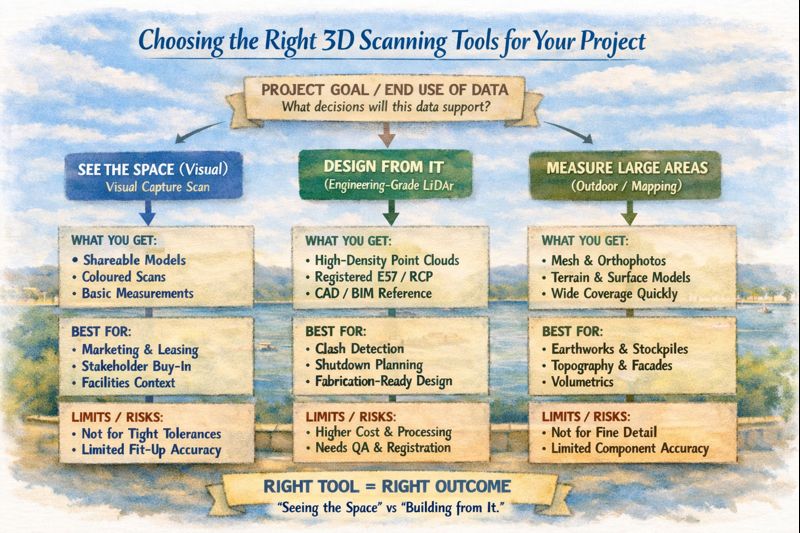
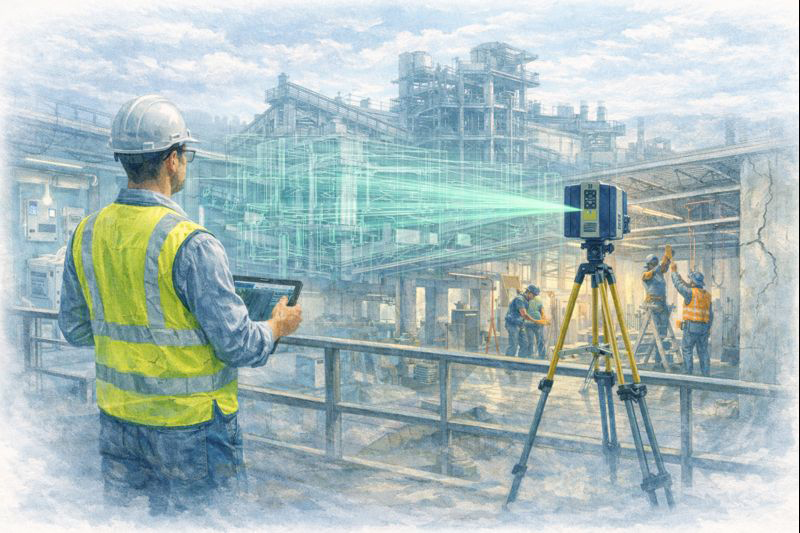
3D scanning is now widely used across construction, property, manufacturing, and heavy industry — but not all scanning tools are designed for the same outcomes. Choosing the right technology depends less on the buzzwords and more on what you actually need to do with the data after it’s captured.
This article explains the main types of 3D scanning commonly used in Australia today, what they’re best suited for, and how to choose the right approach for your project.
1. Visual Capture Scanning (Property, Architecture & Digital Twins)
Best for:
Property marketing and virtual tours
Design coordination
Facilities management
Heritage documentation
Basic Scan-to-BIM
Typical outputs:
Web-based walk‑through models
Coloured point clouds
Floor plans and simple BIM geometry
OBJ / E57 exports for modelling
Strengths:
Fast capture
Lower cost
Easy sharing via web platforms
Excellent for stakeholder engagement
Limitations:
Lower geometric accuracy
Not suitable for fabrication tolerances
Not reliable for mechanical or structural fit‑up
This type of scanning is ideal when the goal is visual context and spatial understanding, rather than precise dimensional control.
Engineering LiDAR is used when design decisions and fabrication depend on accurate geometry, not just visual representation.
3. Photogrammetry (Large Areas & Outdoor Mapping)
Best for:
Stockpile measurement
Terrain mapping
Façade capture
Infrastructure corridors
Typical outputs:
Mesh models
Orthophotos
Surface models
Strengths:
Covers large areas quickly
Drone‑based access
Useful for topography
Limitations:
Less accurate for fine detail
Poor performance in tight or indoor environments
Limited for mechanical components
Photogrammetry is excellent for scale and surface data, but not for high‑precision engineering work.
4. Why the End Use of Data Matters More Than the Scanner
The most common mistake in 3D scanning projects is choosing a capture method before defining:
Will the data be used for design and fabrication?
Or mainly for visualisation and documentation?
Do tolerances matter?
Will components be manufactured from this data?
If scanning is only used for:
Layout confirmation
Space planning
Stakeholder communication
Then visual scanning platforms may be entirely sufficient.
If scanning is used for:
Equipment replacement
Structural modification
Pipework or conveyor interfaces
Custom fabrication
Then engineering‑grade LiDAR is essential.
5. Matching the Tool to the Job
Project Type
Recommended Technology
Real estate & virtual tours
Visual capture scanning
Office and building refurbishments
Visual capture or LiDAR depending on tolerances
Plant upgrades & shutdowns
Engineering‑grade LiDAR
Mechanical retrofits
Engineering‑grade LiDAR
Large outdoor mapping
Photogrammetry or LiDAR
Fabrication from existing assets
Engineering‑grade LiDAR only
6. Scanning Is Only Step One
Regardless of the technology used, scanning only creates value when paired with:
Proper registration and QA
Engineering interpretation
CAD modelling and documentation
Design validation
Without these steps, point clouds remain large files with limited practical use.
The biggest performance gains come when scanning is directly integrated into:
Engineering design
Constructability reviews
Clash detection
Fabrication planning
Final Thoughts
3D scanning is not a single solution — it is a group of technologies with very different strengths.
The right approach depends on whether your project is focused on:
Seeing the space, or
Building from the space
Understanding that difference early can save significant time, cost, and rework later in the project lifecycle.
If you’re unsure which approach fits your project, start by defining what decisions and deliverables will rely on the data — then choose the scanning method that supports those outcomes, not just the fastest or cheapest option.
Digital Twin Asset Management Sydney | Hamilton By Design
From Point Cloud to Digital Twin: Better Asset Control for Sydney Precincts
For asset owners and facilities managers across Greater Sydney and the Central Coast, accurate and accessible building data is no longer a luxury — it is critical for maintenance planning, compliance, risk management, and future upgrades.
Yet many facilities still rely on incomplete drawings, outdated asset registers, or disconnected documentation spread across multiple systems.
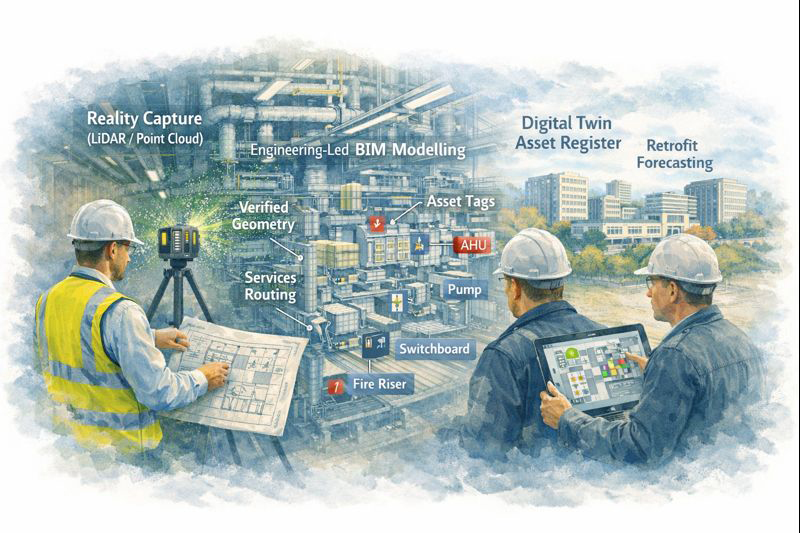
At Hamilton By Design, we use high-accuracy 3D scanning and engineering-led modelling to create digital twins — intelligent, data-rich representations of real facilities that support long-term asset management, not just one-off construction projects.
Why Traditional Building Records Fall Short
Over the life of a facility, buildings change constantly:
Services are upgraded or rerouted
Plant is replaced or relocated
Structural movement occurs over time
Temporary works become permanent
Documentation becomes fragmented or lost
As a result, asset owners are often forced to make decisions based on assumptions instead of verified data, increasing operational risk and lifecycle costs.
Digital twins replace uncertainty with measurable, current, and verifiable building intelligence.
What Is a Digital Twin — and Why It Matters
A digital twin is more than a 3D model. It is a continuously usable digital representation of your physical asset that can support:
Asset lifecycle management
Maintenance planning and scheduling
Retrofit and upgrade forecasting
Compliance verification and reporting
Insurance documentation and risk mitigation
Using LiDAR and reality capture, we first create highly accurate point cloud data of your facility. This is then converted into structured engineering models and documentation, forming the foundation of a usable digital twin environment.
Supporting the Full Asset Lifecycle
Digital twins created by Hamilton By Design are designed to support decision-making across the entire life of an asset.
Asset Lifecycle Management
Digital twins provide a verified reference for:
Plant locations and access paths
Service routing and capacity
Structural geometry and tolerances
Interface points between systems
This allows asset teams to plan interventions without repeated site surveys or intrusive investigations.
Maintenance Planning and Access Strategy
Maintenance activities often fail not due to equipment faults, but due to poor access planning and unknown service constraints.
Digital twins allow teams to:
Visualise maintenance access zones
Plan shutdown sequences
Coordinate contractor access safely
Reduce unexpected site conditions
This is particularly valuable in hospitals, transport facilities, and industrial plants where downtime is extremely costly.
Retrofit and Upgrade Forecasting
When assets age, upgrade programs become unavoidable — but without accurate models, forecasting becomes unreliable.
With digital twins, asset owners can:
Test retrofit scenarios digitally
Assess spatial constraints early
Coordinate staged construction programs
Validate new services layouts before installation
This significantly reduces redesign cycles and programme risk.
Compliance, Insurance and Risk Documentation
High-accuracy digital records also support:
Compliance audits
Fire and safety system verification
Engineering certification
Insurance risk assessments
Digital twins provide verifiable evidence of current conditions, which is increasingly important for regulatory and insurer requirements.
Enterprise-Value Scanning, Not Just Project Scanning
Many scanning services stop at delivering point clouds. Hamilton By Design goes further by integrating scanning into an engineering and asset management workflow.
Our service extends beyond capture into:
Mechanical engineering interpretation
Systems modelling and coordination
Project and asset integration support
Fabrication and modification planning
This makes digital twins a strategic asset tool, not just a design input.
Construction, Operations and Future-Proofing — All in One Model
Our digital twin workflows support:
Operational facilities
Construction planning
Ongoing modifications
Future asset strategies
By maintaining continuity between engineering, construction, and asset management data, digital twins become a single source of truth for multiple stakeholders.
Deliverables Designed for Asset Teams
We provide digital twin outputs in formats compatible with enterprise asset and design systems:
High-resolution point clouds (RCP / E57)
Revit asset models
AutoCAD documentation
SolidWorks equipment and systems models
Asset-aligned 2D drawings
Data structured for future updates
These can be used directly by engineering consultants, maintenance teams, and facilities management platforms.
Supporting Sydney and Central Coast Asset Portfolios
We work with asset owners across:
Healthcare precincts
Commercial property portfolios
Industrial facilities
Infrastructure and transport sites
Education campuses
Heritage and government assets
Our local support allows ongoing engagement as facilities evolve, not just one-off capture projects.
Turn Building Data into an Asset Strategy
Digital twins transform buildings from static structures into data-driven, manageable systems.
They allow asset owners to move from reactive maintenance to planned lifecycle control, improving reliability, safety, and financial predictability.
Arrange a Digital Twin Consultation
If you are responsible for long-term facility performance, compliance, or upgrade planning:
Please fill out the form below to arrange a phone consultation.
We’ll discuss your asset portfolio, operational requirements, and long-term objectives, and recommend a digital twin strategy that supports both current operations and future upgrades.
Reality Capture for Live Sites Sydney | 3D Scanning Without Shutdowns
Keep Sydney Projects Running: Accurate Reality Capture Without Shutdowns
Many projects across Greater Sydney and the Central Coast take place in live, operational environments — hospitals, shopping centres, CBD offices, industrial plants, transport facilities, and heritage buildings — where shutdowns are either impossible or extremely costly.
At Hamilton By Design, we provide engineer-led reality capture and 3D scanning services that allow accurate measurement, modelling, and verification without interrupting operations. Our approach supports safe access, staged construction, and clash-free installation — keeping your project moving while reducing risk, rework, and variations.
The Challenge of Working in Live Environments
Builders, project managers, and facilities teams face real risks when upgrading or modifying operational sites:
Buildings that have moved over time, with visible cracking or deformation
Changes in soil conditions or legacy engineering affecting structure and services
Outdated or unreliable drawings that no longer reflect site conditions
Unexpected clashes once walls, ceilings, or plant rooms are opened
High costs from rework and contract variations
Safety risks from confined spaces, working at heights, or restricted access zones
Relying on manual measurement or assumptions in these environments increases both programme risk and safety exposure.
Non-Contact Measurement for High-Risk and Restricted Sites
Our reality capture solutions use non-contact laser scanning and LiDAR technology to safely collect accurate site data, even in difficult or restricted environments.
This allows us to capture:
Services above ceilings and within plant rooms
Structural elements and building geometry
Equipment clearances and access constraints
Deformed or out-of-plumb structures
All while minimising disruption to occupants and operations.
Safety and Access Benefits
Reduced need for working at heights
Faster site presence and data capture
Minimal interference with daily operations
Scanning possible from walkways or public-access areas
Fewer permits, isolations, and shutdown windows required
This makes scanning ideal for live hospitals, retail centres, offices, and industrial facilities where safety and continuity are critical.
Supporting Staged Construction and Live Upgrades
Live environments rarely allow full shutdowns. Our reality capture workflows are designed to support:
Staged construction programs
Progressive installation of services
Ongoing refurbishment works
Verification before each construction phase
We can also perform repeat scanning to monitor:
Structural movement
Progressive cracking
Deformation of walls, floors, or structural members
This is especially valuable where movement, settlement, or ageing infrastructure is a concern.
Practical Outcomes for Builders and Project Teams
Our scan data is not just collected — it is engineered into practical construction deliverables that support real project decisions.
Clients use our reality capture outputs for:
Design of new mechanical, electrical, and plumbing services
Accurate as-built verification prior to fabrication
Set-out and coordination models for installation
Clash detection before construction begins
Monitoring movement or deformation over time
This reduces uncertainty, improves coordination between trades, and significantly lowers the risk of costly on-site surprises.
Construction-Ready Deliverables
We provide data in formats that integrate directly into your existing workflows and design platforms:
Point clouds (RCP / E57)
Revit models
AutoCAD files
SolidWorks models
2D drawings (plans, sections, elevations)
Clash-ready coordination models
Our focus is on delivering usable, construction-ready information, not just raw scan files.
Engineer-Led Reality Capture — Not Just Scanning
Hamilton By Design is not a scanning-only provider. We deliver end-to-end technical services, allowing us to support projects from concept through to installation.
Our integrated capabilities include:
Reality capture and 3D scanning
Mechanical engineering
Systems management
Project management
Machining and fabrication support
Because our work is engineer-led, scan data is interpreted with constructability, tolerances, and installation constraints in mind — not simply converted into drawings by offshore drafting teams.
This means better decisions, fewer assumptions, and stronger outcomes on site.
Supporting Greater Sydney and the Central Coast
We regularly support projects across:
Sydney CBD and metropolitan areas
Major commercial and retail precincts
Health and education facilities
Industrial and processing plants
Infrastructure and heritage assets
Central Coast commercial and industrial sites
Our local presence allows efficient mobilisation and ongoing project support throughout staged works.
Reduce Risk. Avoid Shutdowns. Build With Confidence.
Reality capture is no longer just a documentation tool — it is a risk management strategy for live environments.
By capturing what is truly on site before construction begins, you can:
Prevent clashes and redesign
Reduce variations and rework
Improve safety planning
Protect programme and operational continuity
Arrange a Phone Consultation
If you are planning works in a live or high-risk environment and need reliable site data without shutdowns:
Please fill out the form below to arrange a phone consultation.
We’ll discuss your site conditions, construction staging, and deliverable requirements, and recommend the most effective reality capture approach for your project.
Mechanical Engineering Services Central Coast NSW | Hamilton By Design Co.
Hamilton By Design Co. provides engineer-led mechanical engineering services across the Central Coast, supporting clients in Wyong, Gosford, Tuggerah, and Somersby with practical, site-based engineering and rapid-response project support.
We specialise in design, drafting, fabrication support, and advanced 3D LiDAR scanning, helping construction, food & beverage, and manufacturing businesses upgrade plant, replace critical components, and keep operations running when OEM lead times are too long.
If you need local, responsive mechanical engineers who understand how things are actually built and installed on site, our team is ready to help.
Engineer-Led Mechanical Engineering You Can Rely On
Unlike drafting-only providers, Hamilton By Design is an engineer-led team with in-house machining and fabrication capability. This means your designs are developed with real-world manufacturing and installation in mind — reducing rework, clashes, and costly site delays.
Our engineers work directly with your site teams, fabricators, and contractors to ensure solutions are practical, compliant, and delivered fast.
We support projects from:
Concept and feasibility
Problem-solving and plant modifications
Upgrades and replacements
Reverse engineering of existing equipment
Engineering certification and compliance
All work is completed to Australian and relevant international standards.
Advanced 3D LiDAR Scanning for Accurate Fit-Up
We use engineering-grade 3D LiDAR terrestrial scanning to capture existing plant and structures with high accuracy, allowing us to design components that fit first time.
Our scanning accuracy:
±2 mm over 70 metres
Suitable for structural steel, pipework, conveyors, platforms, and equipment layouts
Reduces shutdown time and site rework
Scan data is integrated directly into our SolidWorks 3D CAD and FEA workflows, ensuring your designs are based on real-world conditions — not assumptions or outdated drawings.
Mechanical Engineering Services We Provide
🔧 Design & Drafting
SolidWorks 3D modelling
Manufacturing and fabrication drawings
Installation drawings
As-built documentation
Compliance-ready documentation
🔥 FEA – Structural & Thermal Analysis
Structural stress analysis
Thermal modelling
Design optimisation
Engineering reports for certification and compliance
🏭 Fabrication & Machining Support
In-house machining capability
Fabrication-ready drawings
Tolerancing for real manufacturing conditions
Support through build and installation
🛠 Certification & Compliance
We support engineering sign-off and certification for:
Structural frames and platforms
Building services modifications
Plant and equipment upgrades
Pressure and load-bearing components
Safety-critical mechanical systems
Industries We Support on the Central Coast
🏗 Construction & Building Services
We support builders and contractors with:
Mechanical design for plant rooms and services
Structural steel modifications
Site fit-up verification using LiDAR scans
Compliance documentation and certification support
🥫 Food & Beverage Processing
We assist manufacturers with:
Production line upgrades
Replacement of OEM components
Hygienic design considerations
Fast turnaround to minimise downtime
⚙ Manufacturing & Industrial Equipment
We regularly deliver:
Reverse engineered components
Custom machinery design
Retrofit and upgrade solutions
Short-run replacement parts when OEM supply is delayed
Solving Real-World Plant Problems — Fast
Most clients contact us when:
OEM replacement parts have long lead times
Plant upgrades must happen during short shutdown windows
Existing drawings are inaccurate or missing
Modifications must fit into congested plant areas
Production downtime is costing money
Our site-based approach combined with rapid design, analysis, and fabrication support allows projects to move forward quickly and safely.
Local Mechanical Engineers for Wyong, Gosford, Tuggerah & Somersby
We provide on-site mechanical engineering services across the Central Coast, including:
Wyong
Gosford
Tuggerah
Somersby industrial areas
Site visits are available, and we also provide remote engineering support using 3D scan data and CAD models where appropriate.
Speak With a Mechanical Engineer — Fill Out the Form Below
If you need support with plant upgrades, replacement components, design verification, or urgent mechanical modifications, our team is ready to assist.
👉 Please fill out the enquiry form below and one of our engineers will contact you to discuss your project.
Employment Opportunities | Jobs in Australia | Hamilton By Design
Hamilton By Design is a growing Australian engineering and manufacturing business delivering practical, high-quality solutions to industrial and mining clients.
We are seeking motivated and safety-focused people who take pride in their work and enjoy being part of a hands-on, solutions-driven team. Opportunities may be available across design, machining, fabrication, and site support, depending on current projects and client needs.
Please review the positions listed below and apply to the role that best matches your skills and experience.
Location: Inner Sydney, NSW Employment Type: Full Time
About the Opportunity
Experienced Mechanical Design Draftsperson and Mechanical Engineer with over 2-3 years of industry experience across mining, mineral processing, bulk materials handling, manufacturing, infrastructure, ports, and heavy industrial environments.
Highly proficient in AutoCAD, Autodesk Inventor, SolidWorks, and 3D modelling workflows, with extensive experience delivering concept designs, detailed engineering drawings, manufacturing documentation, reverse engineering projects, and plant modification packages.
Possesses a strong background in engineering-grade LiDAR scanning and reality capture technologies, including advanced terrestrial laser scanning, point cloud processing, Scan-to-CAD workflows, and as-built verification. Experienced in operating industry-leading LiDAR systems and converting complex field-captured data into accurate 3D models, detailed manufacturing drawings, and engineering documentation.
Key capabilities include:
• Mechanical design and drafting for mining and industrial projects • Concept development through to detailed manufacturing documentation • AutoCAD 2D/3D and Autodesk Inventor modelling • SolidWorks mechanical design and assemblies • LiDAR scanning, point cloud registration, and reality capture workflows • Reverse engineering of existing plant and equipment • Engineering calculations and design verification • Structural steel detailing and minor structural design • General arrangement drawings, fabrication drawings, and BOM development • Equipment design including chutes, hoppers, conveyors, platforms, access systems, and material handling equipment • Design reviews, drawing checking, and quality assurance processes • Client, supplier, and fabrication workshop liaison • Site measurement, plant inspections, and brownfield project execution
Technical Expertise:
• Advanced LiDAR scanning technologies and reality capture systems • Point cloud processing and registration software • AutoCAD 2D/3D • Autodesk Inventor Professional • SolidWorks and 3D CAD modelling • Navisworks and clash detection workflows • Microsoft Office Suite • Engineering drawing standards and manufacturing documentation
Industry Experience:
• Construction Site Scanning • Mineral processing facilities • Bulk materials handling systems • Ports and terminals • Manufacturing facilities • Smelters and processing plants • Water and wastewater infrastructure • Energy and industrial facilities
Recognised for delivering accurate, practical, and cost-effective engineering solutions while maintaining high drafting standards, strong attention to detail, and a commitment to safety, quality, and project delivery.
Hamilton By Design Co. Email: [email protected] Subject: Application – LiDAR – SolidWorks – Inner Sydney NSW
Mechanical Draftsperson / SolidWorks Professional
Location: Fairfield–Liverpool Industrial Areas, NSW Employment Type: Full Time
About the Opportunity
Hamilton By Design Co. currently has a highly valued client seeking an experienced Mechanical Draftsperson / SolidWorks Professional to join their team. This opportunity would suit a motivated and technically capable individual looking to further develop their career within industrial and heavy manufacturing environments.
The successful candidate will work within a fast-paced environment supporting mechanical design and drafting activities across a range of engineering projects.
Skills & Experience Required
Minimum of 2 years of relevant mechanical design or drafting experience
Experience within the industrial or heavy manufacturing sector
High-level communication and interpersonal skills
Experience using SolidWorks and various current 3D CAD software packages
A Bachelor of Mechanical Engineering, or an Associate Diploma / Mechanical Design Drafting qualification
Strong attention to detail and effective time management skills
Ability to work effectively within a team environment
Comfortable working within a fast-paced environment
Ability to multitask and manage multiple projects simultaneously
Strong organisational and problem-solving skills
Desirable Skills
Experience producing manufacturing and fabrication drawings
Understanding of Australian drafting standards
Experience with mechanical assemblies and industrial equipment
Exposure to mining, manufacturing, or industrial plant environments
What We Offer
Full-time secure employment
Opportunity to work on diverse engineering projects
Exposure to industrial and heavy manufacturing environments
Career development opportunities
Supportive team environment
Opportunity for ongoing growth and professional development
How to Apply
Please submit:
Resume/CV
Cover Letter
Examples of drafting or design work (if available)
Applications can be sent to:
Hamilton By Design Co. Email: [email protected] Subject: Application – SolidWorks – Fairfield–Liverpool Industrial Area
Fabrication Draftsperson / Project Co-ordinator
Location: Central Coast, NSW Employment Type: Full Time
About the Opportunity
Hamilton By Design Co. currently has a highly valued client seeking an experienced Fabrication Draftsperson / Project Co-ordinator to join their growing team on the Central Coast.
This opportunity would suit a motivated individual with strong technical and organisational skills who enjoys working across fabrication, drafting, and project delivery activities within industrial and manufacturing environments.
The successful applicant will work closely with engineering, workshop, and project teams to support projects from concept and design through to fabrication and delivery.
Key Responsibilities
Develop and review fabrication drawings and engineering documentation
Produce detailed 2D and 3D CAD models and technical drawings
Assist with project co-ordination and scheduling activities
Liaise with clients, suppliers, workshop personnel, and project stakeholders
Prepare Bills of Materials (BOMs) and fabrication documentation
Monitor project progress and support delivery outcomes
Support manufacturing and workshop operations where required
Assist with procurement and material tracking activities
Review drawings and documentation for quality and compliance
Participate in continuous improvement and problem-solving activities
Skills & Experience Required
Relevant qualification in Mechanical Engineering, Design Drafting, or a related discipline
Experience within fabrication, industrial, or manufacturing environments
Experience using SolidWorks, AutoCAD, or similar 3D CAD software
Strong communication and interpersonal skills
Strong organisational and time management abilities
Ability to work independently and within a team environment
Strong attention to detail
Ability to manage multiple priorities and projects simultaneously
Positive attitude and proactive problem-solving skills
Desirable Skills
Experience producing fabrication and workshop drawings
Understanding of manufacturing and fabrication processes
Experience with structural steel, mechanical assemblies, or industrial equipment
Understanding of Australian drafting and fabrication standards
Exposure to project delivery and client interaction
What We Offer
Full-time secure employment
Diverse and interesting engineering projects
Supportive and collaborative team environment
Professional development opportunities
Opportunity for career growth and advancement
Exposure to a range of industrial and manufacturing applications
How to Apply
Please submit:
Resume/CV
Cover Letter
Examples of drafting or project work (if available)
Applications can be sent to:
Hamilton By Design Co. Email: [email protected] Subject: Application – Fabrication Draftsperson Co-ordinator – Central Coast
Job Title: Casual FIFO Mechanical Engineer – Design & Project Support Location: FIFO to QLD mine sites (including Mount Isa region) Employment Type: Casual / Project-Based Roster: Shutdowns and short-term project rosters (varies by project) Industry: Mining, Resources & Energy | Engineering
About the Company
Hamilton By Design provides mechanical engineering, design, and site support services to mining and industrial operations. We work across maintenance, shutdowns, and capital projects, delivering practical, site-ready engineering solutions.
About the Role
We are seeking a Mechanical Engineer with approximately 3+ years’ experience for casual FIFO engagements, supporting design, planning, and project execution on active mine sites and industrial facilities.
This role suits engineers who enjoy project-based work and gaining hands-on site experience across a variety of scopes.
Key Responsibilities
Mechanical design and drafting support using SolidWorks
Producing and reviewing fabrication and installation drawings
Assisting with project planning, scheduling, and coordination
Liaising with site supervisors, trades, and contractors
Supporting procurement, fabrication, and installation activities
Participating in site inspections and commissioning support
Ensuring compliance with safety, quality, and engineering standards
What We’re Looking For
Bachelor’s degree in Mechanical Engineering
Approximately 3+ years’ experience in mechanical design and project environments
Strong CAD skills (SolidWorks preferred)
Exposure to project coordination or delivery on industrial or mining sites
Ability to mobilise for FIFO work and operate in site environments
Strong safety focus and communication skills
Mandatory Requirements
Current Australian work rights
White Card
Ability to pass site medical and D&A screening
Willingness to complete site inductions (e.g. Standard 11 if required)
What We Offer
Competitive casual FIFO rates and project allowances
Flights, accommodation and meals provided
Exposure to mining shutdowns and brownfield projects
Opportunity for repeat project engagements
How to Apply
Please send your resume and brief summary of your design and project experience to: 📧 [email protected] Subject: Application – Casual FIFO Mechanical Engineer (Design & Projects)
Job Title: Cleaner – Residential, Office & Factory Cleaning Location: Mount Isa, QLD Employment Type: Casual or Part-Time (with opportunity for ongoing work) Industry: Trades & Services | Cleaning Services
About the Company
Hamilton By Design provides maintenance and support services to residential, commercial, and industrial clients in Mount Isa. We take pride in delivering reliable, high-quality service and building strong relationships with our customers.
About the Role
We are seeking reliable and motivated Cleaners to carry out cleaning services across homes, offices, and factory environments in Mount Isa. This role is ideal for someone who takes pride in their work and is comfortable working in a variety of environments.
Key Responsibilities
General residential cleaning (bathrooms, kitchens, floors, dusting)
Office cleaning including desks, amenities and common areas
Factory and light industrial cleaning (workshops, lunchrooms, amenities)
Safe use of cleaning equipment and chemicals
Maintaining high standards of cleanliness and hygiene
Following site safety and access procedures
What We’re Looking For
Previous cleaning experience (residential, commercial or industrial preferred)
Strong attention to detail and reliability
Ability to work independently and manage time effectively
Good communication skills and professional presentation
Current driver’s licence and reliable transport (preferred)
White Card (preferred for factory sites)
What We Offer
Steady local work in Mount Isa
Flexible hours depending on client needs
Supportive team environment
Opportunity for ongoing work for the right candidate
How to Apply
Please send your resume and brief work history to: 📧 [email protected] Subject: Application – Cleaner (Mount Isa)
Engineering Drafting Services Central Coast NSW | Hamilton By Design
When engineering projects move from concept to construction, clear and accurate drawings are what make the difference between smooth delivery and costly rework. For businesses on the Central Coast, having access to reliable, local engineering drafting services means faster communication, better outcomes, and drawings that actually work on site.
Hamilton By Design, based on the NSW Central Coast, provides professional engineering drafting services to support mechanical, structural, and industrial projects across the region and beyond.
What Are Engineering Drafting Services?
Engineering drafting is the process of converting design concepts, engineering calculations, and site requirements into detailed technical drawings. These drawings are used by fabricators, machinists, builders, and installers to manufacture and construct components correctly the first time.
Our drafting services typically include:
Dimensioned manufacturing drawings
Assembly and exploded views
Welded fabrication drawings
Structural steel and connection details
General arrangement (GA) drawings
Site and installation layouts
Clear drafting ensures everyone involved in the project is working from the same, accurate information.
Supporting Central Coast Industry & Construction
The Central Coast is home to a wide range of industries, including manufacturing, construction, infrastructure maintenance, and industrial services. We regularly support local businesses, contractors, and engineers who need drafting work completed accurately and efficiently.
Being locally based means we understand:
regional fabrication capabilities
site access and installation constraints
Australian Standards and compliance requirements
the importance of practical, buildable solutions
When needed, we can work closely with clients, fabricators, and installers to make sure drawings reflect real-world conditions.
Our Engineering Drafting Capabilities
We provide engineering drafting using SolidWorks and proven industry workflows.
Mechanical Drafting
Machined component drawings
Sheet metal and folded parts
Assemblies with bills of materials (BOMs)
Practical tolerancing for manufacturing
Structural & Fabrication Drafting
Structural steel and fabrication drawings
Weld symbols and fabrication notes
Platforms, handrails, and access systems
Workshop-ready drawing packs
As-Built & Legacy Drawing Updates
As-built drawings for existing assets
Updating and converting legacy drawings
Reverse engineering from physical components
Who We Work With
Our Central Coast engineering drafting services support:
manufacturers and machine shops
builders and fabricators
mining and industrial contractors
engineering consultants
councils and asset owners
From one-off components to ongoing drafting support, we scale our services to suit your project.
Why Choose a Local Engineering Drafting Service?
Working with a Central Coast–based drafting provider offers real advantages:
easier communication and faster turnaround
understanding of local suppliers and trades
drawings created with fabrication and installation in mind
long-term support for updates and modifications
At Hamilton By Design, our drafting work is backed by hands-on engineering and manufacturing experience — not just CAD skills.
Engineering Drafting You Can Build From
If you’re looking for engineering drafting services on the Central Coast that deliver clear, practical, and construction-ready drawings, Hamilton By Design can help.
Get in touch to discuss your project or request a quote.
To provide the best experiences, we use technologies like cookies to store and/or access device information. Consenting to these technologies will allow us to process data such as browsing behaviour or unique IDs on this site. Not consenting or withdrawing consent, may adversely affect certain features and functions.
Functional
Always active
The technical storage or access is strictly necessary for the legitimate purpose of enabling the use of a specific service explicitly requested by the subscriber or user, or for the sole purpose of carrying out the transmission of a communication over an electronic communications network.
Preferences
The technical storage or access is necessary for the legitimate purpose of storing preferences that are not requested by the subscriber or user.
Statistics
The technical storage or access that is used exclusively for statistical purposes.The technical storage or access that is used exclusively for anonymous statistical purposes. Without a subpoena, voluntary compliance on the part of your Internet Service Provider, or additional records from a third party, information stored or retrieved for this purpose alone cannot usually be used to identify you.
Marketing
The technical storage or access is required to create user profiles to send advertising, or to track the user on a website or across several websites for similar marketing purposes.